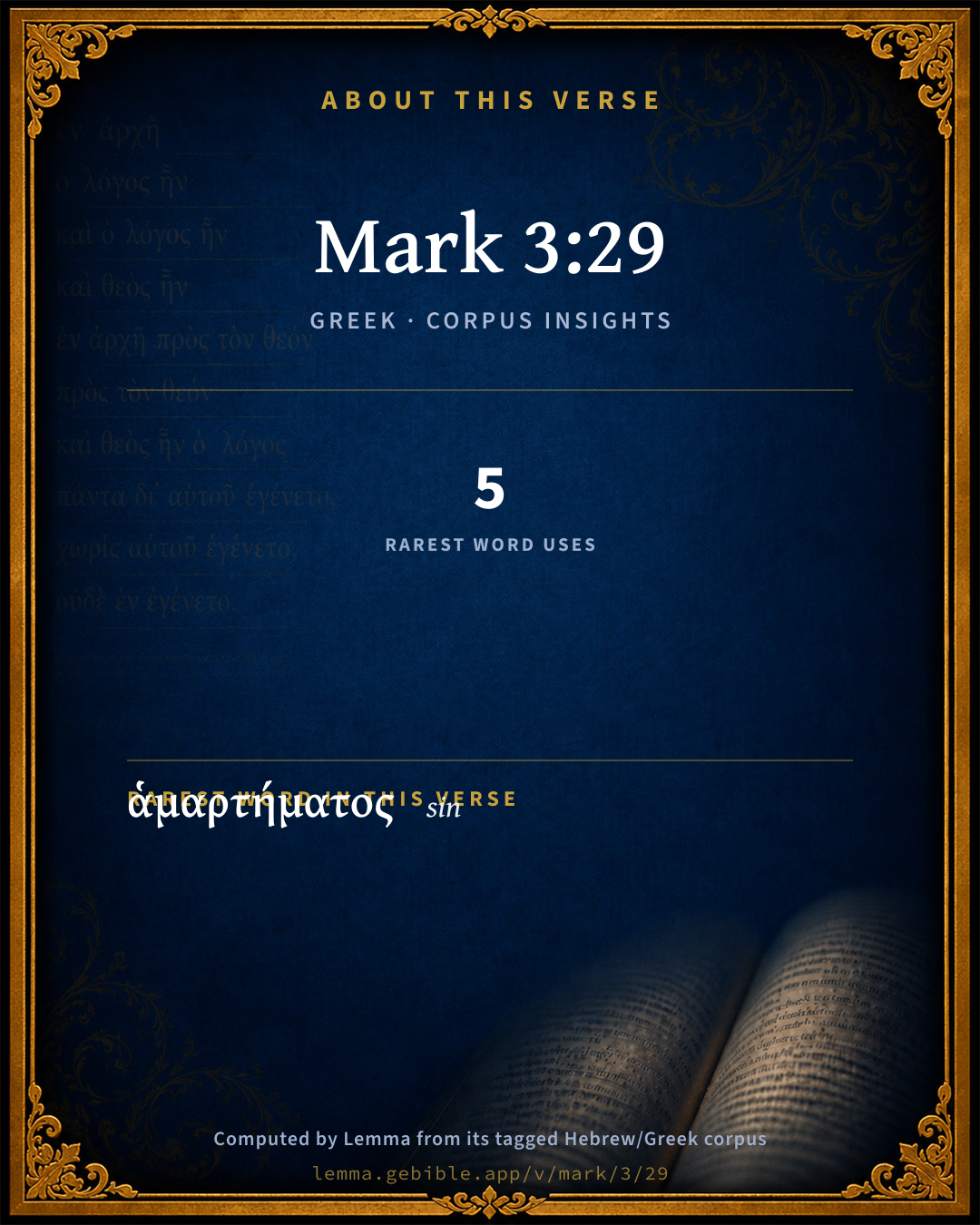
Mark 3:29

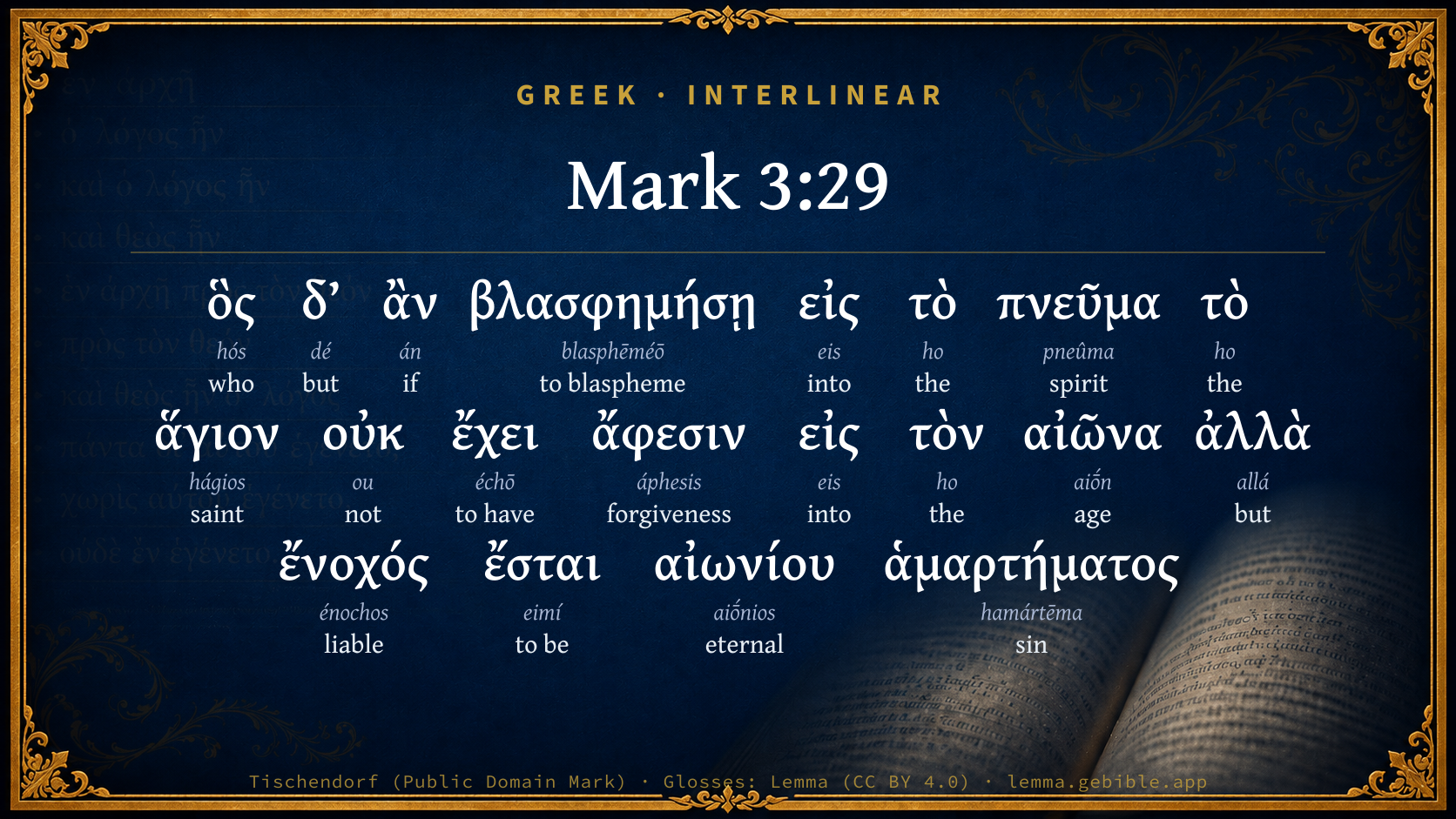
Greek (Tischendorf 8th ed.) Mark 3:29 appears in the Greek New Testament. The text above is from the Tischendorf 8th edition. Each word links to its Strong’s number and a concise gloss. Click any word for its full Thayer’s Greek Lexicon entry.
Download image
Cite this verse

Mark 3:29 (World English Bible). Public Domain. Lemma interlinear Bible study tool, https://lemma.gebible.app/v/mark/3/29.

Show BibTeX & RIS
BibTeX
RIS
English Translation
but whoever may blaspheme against the Holy Spirit never has forgiveness, but is guilty of an eternal sin"
World English Bible · Public Domain
Download a study sheet

One document with this verse’s original text, its word-by-word gloss line, the meaning frame, cross-references with their text, attributed commentary, and full source and license credits — printable, and it pastes into notes with its structure intact.

This verse Autodidact and up

Study sheet (.html) Plain text (.txt)

A passage Seminary Student

Up to 50 verses in one chapter. A passage sheet keeps up to 6 commentary sources and 12 cross-references per verse, in the order this page ranks them, and says so on the sheet whenever that leaves anything out. Ask for a single verse and you get the Autodidact verse sheet above.

Everything on this page stays free to read, with no account — the sheet is a download of what is already on screen, not access to it.

Want to remove ads? Support Godless Engineer
Compare translations 3

The same verse in 3 English versions, stacked beneath the original-language interlinear above. Click any original word for its lexicon entry.

Each is an independent rendering of the whole verse — the interlinear is not word-aligned to these translations.

Highlighted words mark where these versions differ — a whole-verse word diff, not a word-by-word alignment.

  • World English Bible Public Domain
    but whoever may blaspheme against the Holy Spirit never has forgiveness, but is guilty of an eternal sin"
  • King James Version Public Domain
    But he that shall blaspheme against the Holy Ghost hath never forgiveness, but is in danger of eternal damnation.
  • unfoldingWord Literal Text CC BY-SA 4.0
    but whoever blasphemes against the Holy Spirit does not have forgiveness to eternity but is guilty of an eternal sin” —

unfoldingWord Literal Text — © unfoldingWord, licensed CC BY-SA 4.0. Word-aligned USFM3 via Door43 (git.door43.org/unfoldingWord/en_ult).

Versions to compare (up to 4)

3 of 4 selected

Show all 19 translations

Every available English version of this verse, each an independent rendering of the whole verse.

  • World English Bible Public Domain
    but whoever may blaspheme against the Holy Spirit never has forgiveness, but is guilty of an eternal sin"
  • Berean Standard Bible Public Domain
    But whoever blasphemes against the Holy Spirit will never be forgiven; he is guilty of eternal sin.”
  • Majority Standard Bible Public Domain
    But whoever blasphemes against the Holy Spirit will never be forgiven; he is subject to eternal judgment.”
  • King James Version Public Domain
    But he that shall blaspheme against the Holy Ghost hath never forgiveness, but is in danger of eternal damnation.
  • American Standard Version (1901) Public Domain
    but whosoever shall blaspheme against the Holy Spirit hath never forgiveness, but is guilty of an eternal sin:
  • Revised Version (1885) Public Domain
    but whosoever shall blaspheme against the Holy Spirit hath never forgiveness, but is guilty of an eternal sin:
  • Geneva Bible (1599) Public Domain
    But hee that blasphemeth against the holy Ghost, shall neuer haue forgiuenesse, but is culpable of eternall damnation.
  • Douay-Rheims (1899) Public Domain
    But he that shall blaspheme against the Holy Ghost, shall never have forgiveness, but shall be guilty of an everlasting sin.
  • Young's Literal Translation Public Domain
    but whoever may speak evil in regard to the Holy Spirit hath not forgiveness -- to the age, but is in danger of age-during judgment;'
  • Literal Standard Version CC BY-SA 4.0
    but whoever may slander in regard to the Holy Spirit has no forgiveness—throughout the age, but is in danger of continuous judgment;
  • Unlocked Literal Bible CC BY-SA 4.0
    but whoever blasphemes against the Holy Spirit will never have forgiveness, but is guilty of an eternal sin.”
  • unfoldingWord Literal Text CC BY-SA 4.0
    but whoever blasphemes against the Holy Spirit does not have forgiveness to eternity but is guilty of an eternal sin” —
  • Darby Bible Public Domain
    but whosoever shall speak injuriously against the Holy Spirit, to eternity has no forgiveness; but lies under the guilt of an everlasting sin;
  • World Messianic Bible Public Domain
    but whoever may blaspheme against the Holy Spirit never has forgiveness, but is subject to eternal condemnation.”
  • Webster's Bible Public Domain
    But he that shall blaspheme against the Holy Spirit never hath forgiveness, but is in danger of eternal damnation:
  • Free Bible Version CC BY-SA 4.0
    but if people blaspheme by rejecting the Holy Spirit they can never be forgiven, because they are guilty of an eternal sin.”
  • Bible in Basic English Public Domain
    But whoever says evil things against the Holy Spirit will never have forgiveness, but the evil he has done will be with him for ever:
  • Text-Critical English NT CC BY 4.0
    But whoever blasphemes against the Holy Spirit never has forgiveness, but is subject to eternal judgment.”
  • Tyndale New Testament (1534) Public Domain
    But he that blasphemeth the holy goost shall never have forgevenes: but is in dauger of eternall dampnacion:

Literal Standard Version (2020), Covenant Press — licensed CC BY-SA 4.0. Text via the HelloAO Bible API (eBible.org). Unlocked Literal Bible (unfoldingWord) — licensed CC BY-SA 4.0. Text via the HelloAO Bible API (eBible.org). unfoldingWord Literal Text — © unfoldingWord, licensed CC BY-SA 4.0. Word-aligned USFM3 via Door43 (git.door43.org/unfoldingWord/en_ult). Free Bible Version, Dr. Jonathan Gallagher — licensed CC BY-SA 4.0. Text via the HelloAO Bible API (eBible.org).

Word by word

More ways to search: Search by grammar → Find every occurrence → Compare this word →

Practice this passage: Drill this verse → Learn its vocabulary →

ἁμαρτήματος
hamártēma
G265
“sin”
Noun, Genitive, Singular, Neuter
Part of Speech
Noun
Case
Genitive
Number
Singular
Gender
Neuter
Full Thayer's Definition

Origin: from G264

TDNT: 05:27,4

1. sin, evil deed
  1. ὃς hós G3739 “who” Relative pronoun, Nominative, Singular, Masculine
  2. δ’ dé G1161 “but” Conjunction
  3. ἂν án G302 “if” Particle
  4. βλασφημήσῃ blasphēméō G987 “to blaspheme” Verb, Aorist, Active, Subjunctive, 3rd person, Singular
  5. εἰς eis G1519 “into” Preposition
  6. τὸ ho G3588 “the” Article, Accusative, Singular, Neuter
  7. πνεῦμα pneûma G4151 “spirit” Noun, Accusative, Singular, Neuter
  8. τὸ ho G3588 “the” Article, Accusative, Singular, Neuter
  9. ἅγιον hágios G40 “saint” Adjective, Accusative, Singular, Neuter
  10. οὐκ ou G3756 “not” Particle, Negative
  11. ἔχει échō G2192 “to have” Verb, Present, Active, Indicative, 3rd person, Singular
  12. ἄφεσιν áphesis G859 “forgiveness” Noun, Accusative, Singular, Feminine
  13. εἰς eis G1519 “into” Preposition
  14. τὸν ho G3588 “the” Article, Accusative, Singular, Masculine
  15. αἰῶνα aiṓn G165 “age” Noun, Accusative, Singular, Masculine
  16. ἀλλὰ allá G235 “but” Conjunction
  17. ἔνοχός énochos G1777 “liable” Adjective, Nominative, Singular, Masculine
  18. ἔσται eimí G1510 “to be” Verb, Future, Middle deponent, Indicative, 3rd person, Singular
  19. αἰωνίου aiṓnios G166 “eternal” Adjective, Genitive, Singular, Feminine

About this verse

These counts appear in no published source. They are computed here, from the morphology-tagged text and Lemma’s own curated glosses. What Lemma adds →

20
words
17
distinct lemmas
Gospels
section

Notable vocabulary

The rarest word here is ἁμαρτήματος sin G265 — appearing just 5 times in the whole Greek New Testament.

Shared distinctive vocabulary

ἁμαρτήματος sin G265 occurs in 5 verses of the Greek New Testament. Also found in:

Repetition

Words recur within this verse:

Cross-references

5

Topical passages linked to Mark 3:29 in the Treasury of Scripture Knowledge — connected by theme and wording, ordered by reader-vote popularity; previews shown in the World English Bible.

  • Matthew 12:31–32 Therefore I tell you, every sin and blasphemy will be forgiven men, but the blasphemy against the Spirit will not be forgiven men.
  • Luke 12:10 Everyone who speaks a word against the Son of Man will be forgiven, but those who blaspheme against the Holy Spirit will not be forgiven.
  • Matthew 25:46 These will go away into eternal punishment, but the righteous into eternal life."
  • 2 Thessalonians 1:9 who will pay the penalty: eternal destruction from the face of the Lord and from the glory of his might,
  • Jude 1:13 wild waves of the sea, foaming out their own shame; wandering stars, for whom the blackness of darkness has been reserved forever.

Cross-references courtesy of OpenBible.info (CC BY 4.0).

Where the printed editions differ

1 variant

Places in this verse where the major printed Greek editions disagree on the wording in a way that affects the translation — a comparison of editions, not a manuscript-by-manuscript collation. The editions are the modern critical texts (Nestlé-Aland 28/27, SBL, Westcott-Hort, Tregelles, Tyndale House) and the traditional texts behind the KJV (the Textus Receptus and the Byzantine/Majority text). It is not a claim about which reading is original.

  1. Different wording
    ἁμαρτήματος·

    “sin;”

    In NA28NA27TynSBLWHTreg Not in TRByz

    κρίσεως (kriseōs) 'of judgment' occurs in traditional manuscripts (TR+Byz) instead of ἁμαρτήματος· (hamartēmatos) 'sin;' in older manuscripts (NA28+NA27+Tyn+SBL+WH+Treg)

Textual data: Translators Amalgamated Greek New Testament (STEPBible TAGNT) · CC BY 4.0.

Commentary

Notes on Mark 3:29 from classic Christian and Jewish commentators (each source and its license shown beneath its notes). The classic Christian expositions comment on the surrounding passage and are grouped to its opening verse, so a note may address several verses; the Jewish commentaries on the Tanakh (Rashi and others) are per-verse, so they appear only where the commentator wrote on this verse.

Lemma curates 59 commentaries, every one of them public domain or Creative Commons licensed, each selected and text-cleaned for this edition rather than reprinted as found. About our sources →

Bengel's Gnomon

Johann Albrecht Bengel

Mar 3:29. Αἰωνίου ἁμαρτίας, everlasting guilt) Sin in this place denotes guilt; and everlasting sin or guilt is opposed with great propriety of language to forgiveness [It therefore carries with it the punishment consisting as well of (in) the feeling as also of (in) the penalty itself (damnation). V. g.—Ἀιωνίου κρίσεως [the reading of the Rec. Text] is a gloss.[29]

[29] A, however, supports it. But BL Vulg. and Memph., and bcd (‘delicti’) support ἁμαρτήματος. D reads ἁμαρτίας; and so a and Cypr. have ‘peccati.’—ED.

Bengel's Gnomon of the New Testament — English translation (T&T Clark, Edinburgh, 1860) — public domain. Text from a community e-Sword module.

Expositor's Greek Testament

ed. W. Robertson Nicoll

Mar 3:29 . The great exception, blasphemy against the Holy Ghost. εἰς τὸν αἰῶνα : hath not forgiveness for ever. Cf. the fuller expression in Mt. ἀλλʼ ἔνοχός ἐστιν , but is guilty of. The negative is followed by a positive statement of similar import in Hebrew fashion. αἰωνίου ἁμαρτήματος , of an eternal sin. As this is equivalent to “hath never forgiveness,” we must conceive of the sin as eternal in its guilt, not in itself as a sin. The idea is that of an unpardonable sin, not of a sin eternally repeating itself. Yet this may be the ultimate ground of unpardonableness: unforgivable because never repented of. But this thought is not necessarily contained in the expression.

The Expositor's Greek Testament, edited by W. Robertson Nicoll (1897–1910) — public domain. Text from a community e-Sword module.

Cambridge Greek Testament for Schools and Colleges

29. ἁμαρτήματος ([560][561][562][563], Latt. Memph. Arm. Goth, [ἁμαρτίας, [564][565][566] rather than κρίσεως ([567][568]2[569][570], Syrr.).

[560] Codex Sinaiticus. 4th cent. Discovered by Tischendorf in 1859 at the Monastery of St Katharine on Mount Sinai. Now at St Petersburg. The whole Gospel, ending at Mar 16:8. Photographic facsimile, 1911.

[561] Codex Vaticanus. 4th cent., but perhaps a little later than א. In the Vatican Library almost since its foundation by Pope Nicolas V., and one of its greatest treasures. The whole Gospel, ending at Mar 16:8. Photographic facsimile, 1889.

[562] Codex Regius. 8th cent. An important witness. At Paris. Contains Mar 1:1 to Mar 10:15; Mar 10:30 to Mar 15:1; Mar 15:20 to Mar 16:20, but the shorter ending is inserted between Mar 16:8 and Mar 16:9, showing that the scribe preferred it to the longer one.

[563] Codex Sangallensis. 9th or 10th cent. Contains the Gospels nearly complete, with an interlinear Latin translation. The text of Mark is specially good, agreeing often with CL. At St Gall.

[564] Codex Ephraemi. 5th cent. A palimpsest: the original writing has been partially rubbed out, and the works of Ephraem the Syrian have been written over it; but a great deal of the original writing has been recovered; of Mark we have Mar 1:17 to Mar 6:31, Mar 8:5 to Mar 12:29, Mar 13:19 to Mar 16:20. In the National Library at Paris.

[565] An asterisk denotes that the word is not found elsewhere in N.T., and such words are included in the index, even if there is no note on them in the commentary.

[566] odex Bezae. 6th cent. Has a Latin translation (d) side by side with the Greek text, and the two do not quite always agree. Presented by Beza to the University Library of Cambridge in 1581. Remarkable for its frequent divergences from other texts. Contains Mark, except Mar 16:15-20, which has been added by a later hand. Photographic facsimile, 1899.

[567] Codex Alexandrinus. 5th cent. Brought by Cyril Lucar, Patriarch of Constantinople, from Alexandria, and afterwards presented by him to King Charles I. in 1628. In the British Museum. The whole Gospel. Photographic facsimile, 1879.

[568] Codex Ephraemi. 5th cent. A palimpsest: the original writing has been partially rubbed out, and the works of Ephraem the Syrian have been written over it; but a great deal of the original writing has been recovered; of Mark we have Mar 1:17 to Mar 6:31, Mar 8:5 to Mar 12:29, Mar 13:19 to Mar 16:20. In the National Library at Paris.

[569] Codex Oxoniensis. 9th cent. Contains Mark, except Mar 3:35 to Mar 6:20.

[570] Codex Petropolitanus. 9th cent. Gospels almost complete. Mar 16:18-20 is in a later hand.

29. βλασφημήσῃ εἰς. Cf. Act 6:11; Dan 3:29 (LXX. 96). The constr. is classical (Dem., Aesch.).

τὸ πνεῦμα τὸ ἅγιον. The Spirit, the Holy Spirit. The second art. puts a strong emphasis on ἅγιον, perhaps in opposition to the πνεῦμα ἀκάθαρτον (Mar 3:30). Cf. Mar 13:11; 1Th 4:8; Eph 4:30. The repeated art. in various expressions is freq. in Jn. See on Joh 4:9; Joh 8:31.

οὐκ ἔχει ἄφεσιν εἰς τὸν αἰῶνα. Mt. expands this into οὐκ ἀφεθήσεται αὐτῷ οὔτε ἐν τούτῳ τῷ αἰῶνι οὔτε ἐν τῷ μέλλοντι, and the context here seems to show that the expansion is correct. The ἐξουσία of the Son of Man to forgive sins (Mar 2:10) in this case cannot be exercised; there is no repentance, and therefore no forgiveness. Jesus had repeatedly freed men from the obsession of spirits whom the Scribes themselves recognized as the agents of Satan. Such acts could not be evil; they were acts of the Spirit, the Holy Spirit of God. Yet, in order to destroy the influence of One whose teaching often condemned their traditions, the Scribes had declared that these acts of the Holy Spirit were the acts of the prince of the demons. Such monstrous perversity was evidence of a spiritual condition which was becoming hopeless—a condition of constant and deliberate preference of darkness to light. The blasphemy against the Holy Spirit did not consist in saying “He has Beelzebub,” or “He casts out demons by the help of Satan”; no single utterance could be said to be unpardonable. It was the state of heart which produced these utterances that was so perilous; and that state was known to Him who pronounced this stern warning. We have not got our Lord’s exact words (Dalman, Words, p. 147). The report of them which has come down to us in three different forms does not require us to believe that these Scribes were already guilty of unpardonable wickedness; but their being capable of these utterances shows that they were perilously near to this. Repentance is not said to be impossible for them; but so long as they maintained that manifestations of Divine beneficence were Satanic, their recovery was impossible.

No hint is given as to whether repentance and forgiveness are possible in the next world. The only safe course is to repent here and now. From Mat 12:32 Bede draws as inference quasdam culpas in hoc saeculo, quasdam vero in futuro laxari; but the inference is precarious.

ἀλλὰ ἔνοχός ἐστιν. “But lies under the consequences of an act of sin which belongs to the sphere of the world to come” (Swete). Cf. 2Ma 13:6. In N.T. ὁ αἰών without οὗτος is sometimes used of this present life (Mar 4:19, Mar 11:14); in O.T., but not in N.T., this is also true of αἰώνιος. There is no need to say here to whom such an offender has to answer for such a sin (Mat 5:21-22). It is the character of the sin itself that is emphasized. Note that αἰωνίου precedes its substantive, not follows, as in ζωὴ αἰώνιος, the only other connexion in which Mk uses the word (Mar 10:17; Mar 10:30). Elsewhere the gen. after ἔνοχος indicates either the penalty (Mar 14:64; Mat 26:66; Heb 2:15), or that which is injured by the sin (1Co 11:27; cf. Jas 2:10). On εἰς τὸν αἰῶνα and αἰώνιος see App. [631] in the volume on S. John. On the difficult subject of the unpardonable sin see on 1Jn 5:16; Westcott on Heb 6:1-8 and Historic Faith, pp. 150 f.; Agar Beet, The Last Things, pp. 246 f.; D.C.G. art. “Blasphemy.”

[631] Codex Basiliensis. 8th cent. At Basle.

Cambridge Greek Testament for Schools and Colleges (Cambridge University Press, 1896; 21 vols, various authors incl. Carr, Maclear, Plummer, Farrar, Lumby, Moule, M. R. James, Simcox) — public domain. Text from a community e-Sword module.

Adam Clarke's Commentary

Verse 29. See Clarke on Mr 3:27.

Adam Clarke's Commentary on the Bible (1810–1826) — public domain. Text from a community e-Sword/MySword module.

Ellicott's Commentary for English Readers

(29) In danger of eternal damnation.—Better, eternal judgment, the Greek word not necessarily carrying with it the thoughts that now attach to the English. The best MSS., however, give, “in danger of an eternal sin”—i.e., of one which will, with its consequences, extend throughout the ages. It is, of course, more probable that a transcriber should have altered “sin” into “judgment,” substituting an easier for a more difficult rendering, than the converse.

A Bible Commentary for English Readers, edited by Charles John Ellicott (1878–1897) — public domain. Text from a community e-Sword module.

The Cambridge Bible for Schools and Colleges

gen. ed. J. J. S. Perowne

29. but he that shall blaspheme] The sin, against which these words are a terrible but merciful warning, is not so much an act, as a state of sin, on the part of one, who in defiance of light and knowledge, of set purpose rejects, and not only rejects but perseveres in rejecting, the warnings of conscience, and the Grace of the Holy Spirit, who blinded by religious bigotry rather than ascribe a good work to the Spirit of Good prefer to ascribe it to the Spirit of Evil, and thus wilfully put “bitter for sweet” and “sweet for bitter,” “darkness for light” and “light for darkness.” Such a state if persevered in and not repented of excludes from pardon, for it is the sin unto death spoken of in 1Jn_5:16.

The Cambridge Bible for Schools and Colleges (gen. ed. J. J. S. Perowne; Cambridge University Press, 1878–1918) — public domain. Text from a community e-Sword module.

John Gill's Exposition

And the multitude sat about him,.... In a circle, all around him, to hear him preach; so that there was no such thing as the messenger coming near him; but the message being whispered from one to another, it came to those who sat nearest him:

and they said unto him, behold, thy mother and thy brethren without seek for thee: in five of Beza's ancient copies, and in his most ancient one, are added, and thy sisters: agreeably, Christ hereafter makes mention of sister, as well as mother and brother; See Gill on Mat 12:47, and so it is read in the Alexandrian copy.

John Gill's Exposition of the Whole Bible (1746–1763) — public domain (CC PDM 1.0). Text via the HelloAO Bible API.

Trapp's Complete Commentary

John Trapp

29 But he that shall blaspheme against the Holy Ghost hath never forgiveness, but is in danger of eternal damnation:

Ver. 29. Hath never forgiveness] And yet Bellarmine teacheth that the sin against the Holy Ghost may be forgiven (lib. 2, de Poenitentia, cap. 16). But it may be he was of their opinion that taught here in England in the reign of Henry III, that to question the pope’s sanctions was the sin against the Holy Ghost. (Daniel’s Hist. of England, p. 163.)

John Trapp, A Commentary or Exposition upon All the Books of the Old and New Testament (1647–1656) — public domain. Text from a community e-Sword module.

Haydock's Catholic Bible Commentary

See St. Matthew xii. 32. --- Of an everlasting sin; i.e. of eternal punishment. (Witham) --- What is here called everlasting offence, is (as St. Matthew expresseth it) that which shall neither be remitted in this life, nor in the life to come; which words would not be true, says St. Augustine, if some sins were not forgiven in the world to come. Now, as no mortal sin can be forgiven after death, there must necessarily be smaller transgressions, which we call venial; though many of our separated brethren will needs have all sins to be mortal; which is very far from a comfortable tenet.

George Leo Haydock (1774–1849), Haydock's Catholic Family Bible and Commentary, 1859 edition — public domain. Excludes Psalms (Douay-Rheims chapter numbering differs from Protestant) and Deuterocanonical books (Catholic canon only).

The Pulpit Commentary

Hath never forgiveness. Not that any sinner need despair of forgiveness through the fear that he may have committed this sin; for his repentance shows that his state of mind has never been one of entire enmity, and that he has not so grieved the Holy Spirit as to have been entirely forsaken by him. But is in danger of eternal damnation. The Greek words, according to the most approved reading, are all enocov estin aiwniou amarthmatov : but is guilty of an eternal sin; thus showing that there are sins of which the effects and the punishment belong to eternity. He is bound by a chain or" sin from which he can never be loosed. (See St. Joh_9:41, "Therefore your sin remaineth.

The Pulpit Commentary (1880–1919), ed. H.D.M. Spence-Jones & Joseph S. Exell — public domain. Text from a community e-Sword module.

Scofield Reference Notes

C. I. Scofield

in danger

is bound by an eternal sin.

The Scofield Reference Bible (1917 edition), notes by C. I. Scofield — public domain. Text from a community e-Sword module.

Alford’s Greek Testament

Henry Alford

29. αἰωνίου ἁμαρτήματος] Beza explains αἰωνίου by ‘nunquam delendi.’ It is to the critical treatment of the sacred text that we owe the restoration of such important and deep-reaching expressions as this. It finds its parallel in ἀποθανεῖσθε ἐν ταῖς ἁμαρτίαις ὑμῶν, Joh 8:24.

Kuinoel’s idea, quoted and adopted by Wordsw., that ἁμάρτημα means in the LXX the punishment of sin, seems to be entirely unfounded. And as to its being “a Novatian error to assert that sin is αἰώνιον” (Wordsw.), it is at all events a legitimate inference from οὐκ ἔχει ἄφεσιν εἰς τὸν αἰῶνα. If a sin remains unremitted for ever, what is it but eternal?

Ver. 30 explains the ground and meaning of this awful denunciation of the Lord.

31.] ἔξω στ. ἀπ …, one of Mark’s precise details.

32.] καὶ ἐκ …, another such.

Henry Alford, The Greek Testament (1849–1861) — public domain. Text from a community e-Sword module.

International Critical Commentary

29. εἰς τὸ Πνεῦμα τὸ Ἅγιον—against the Holy Spirit.4 What is meant by the blasphemy against the Holy Spirit? The difficulty on one side, has been the consideration of this question without reference to the case in hand, and on the other hand, so superficial an explanation of this case as to leave what Jesus says about the enormity of the sin involved practically unexplained. Plainly, the Holy Spirit is not to be considered here in his independent action, but as the inward source of Jesus’ acts. What Jesus says is occasioned by their charge that he had an evil spirit; that is, that the power acting in him was not good, but bad. Now, the Holy Spirit is the Divine power to which the acts of Jesus are attributed. The Spirit is represented as descending on him at his baptism, and driving him into the wilderness, and Jesus is said to have begun his ministry in Galilee in the power of the Spirit. Especially, Jesus ascribes his expulsion of evil spirits to the Holy Spirit. Hence, a distinction is to be made between his other acts, and those which manifestly reveal the Holy Spirit in him, and between slander directed against him personally, as he appears in his common acts, and that which is aimed at those acts in which the Spirit is manifest. Just so far as there is in the man who utters the slander any recognition, however vague, of this agency, or so far as there is in the person against whom it is directed so manifest a revelation of the Spirit as should lead to this recognition, so far, there is danger, to say the least, of this blasphemy against the Holy Spirit. Moreover, this act of driving out evil spirits was the act in which the holiness of the Spirit operating in Jesus specially appeared. It is not in the power shown in the miracles that the operation of the Holy Spirit is most evident, but in their moral quality. There is the moral uniqueness about the miracles of Jesus which appears in the rest of his life, only there, it is, if anything, most conspicuous. And this quality appears specially where he not only cures the bodily diseases of men, but frees them from an evil spirit which deranges their inner life. To call that evil, instead of good, and especially to ascribe it to the very prince of evil, is the blasphemy against the Holy Spirit. The only alleviation of it is the failure to recognize fully these facts. οὐκ ἔχει ἄφεσιν εἰς τὸν αἰῶνα—hath never forgiveness,1 ἀλλὰ ἔνοχός ἐστιν αἰωνίου ἁμαρτήματος—but is guilty of an eternal sin.

ἁμαρτήματος, instead of κρίσεως, Tisch. Treg. WH. RV. א BL Δ 28, 33 (C* D 13, 69, 346, ἁμαρτίας), Latt. Memph.

An eternal sin may be one subjecting the person to an eternal punishment, eternal in its consequences, that Isa_2 But certainly it is equally allowable to suppose that it describes the sin itself as eternal, accounting for the impossibility of the forgiveness by the permanence of the sin,—endless consequences attached to endless sin. This is the philosophy of endless punishment. Sin reacts on the nature, an act passes into a state, and the state continues. That is, eternal punishment is not a measure of God’s resentment against a single sin, which is so enormous that the resentment never abates. It is the result of the effect of any sin, or course of sin in fixing the sinful state beyond recovery. This is more accordant with the inwardness of Jesus’ ordinary view of things.

International Critical Commentary — older volumes (1896–1929), various authors — public domain. Text from a community e-Sword module.

Vincent's Word Studies in the New Testament

Marvin R. Vincent

Guilty [ενοχος] . From ejn, in, ecw, to hold or have. Lit., is in the grasp of, or holden of. Compare 1Co 11:27; Jas 2:10.

Eternal damnation [αιωνιου αμαρτηματος] . An utterly false rendering. Rightly as Rev., of an eternal sin. So Wyc., everlasting trespass. The A. V. has gone wrong in following Tyndale, who, in turn, followed the erroneous text of Erasmus, krisewv, judgment, wrongly rendered damnation. See Mt 23:33, and compare Rev. there.

Marvin R. Vincent, Word Studies in the New Testament (1887–1900) — public domain. Text from a community e-Sword/MySword module.

Lesson kit

Teaching starters — assembled from the data on this page, not authored interpretation. Every prompt links to the verse data it draws on. Edit before teaching.

Mark, in the Gospels, opens this verse with 20 words (17 distinct Greek lemmas). Its most distinctive word is hamártēma (“sin”). A historical commentator’s framing appears above. Read the whole chapter for the surrounding context.

Discussion questions

  1. How does “sin” (hamártēma) shape what this verse is saying?
  2. How does Mark 3:28, which shares the word «sin», read alongside this verse?
  3. What does the repetition of “into” (2× in this one verse) do in this verse?
  4. These translations render this verse differently; the difference is in the English rendering, not the original. What questions does that raise?
  5. Compare how Bengel's Gnomon and Expositor's Greek Testament read this verse. Where do they agree or differ?

Things to notice

Reading settings

Reading text

Shown beneath each verse's original-language words.

Old Testament
Old Testament edition

Read the OT as the Masoretic Hebrew (MT) or the Greek Septuagint (LXX).

English shown for the Greek Septuagint (in the Hebrew ↔ Greek comparison).

Comparing translations? Open the Compare panel on any verse page to stack up to four side by side.