Matthew 19:10

Greek (Tischendorf 8th ed.) Matthew 19:10 appears in the Greek New Testament. The text above is from the Tischendorf 8th edition. Each word links to its Strong’s number and a concise gloss. Click any word for its full Thayer’s Greek Lexicon entry.
Download image
Cite this verse

Matthew 19:10 (World English Bible). Public Domain. Lemma interlinear Bible study tool, https://lemma.gebible.app/v/matthew/19/10.

Show BibTeX & RIS
BibTeX
RIS
English Translation
His disciples said to him, "If this is the case of the man with his wife, it is not expedient to marry."
World English Bible · Public Domain
Download a study sheet

One document with this verse’s original text, its word-by-word gloss line, the meaning frame, cross-references with their text, attributed commentary, and full source and license credits — printable, and it pastes into notes with its structure intact.

This verse Autodidact and up

Study sheet (.html) Plain text (.txt)

A passage Seminary Student

Up to 50 verses in one chapter. A passage sheet keeps up to 6 commentary sources and 12 cross-references per verse, in the order this page ranks them, and says so on the sheet whenever that leaves anything out. Ask for a single verse and you get the Autodidact verse sheet above.

Everything on this page stays free to read, with no account — the sheet is a download of what is already on screen, not access to it.

Want to remove ads? Support Godless Engineer
Compare translations 3

The same verse in 3 English versions, stacked beneath the original-language interlinear above. Click any original word for its lexicon entry.

Each is an independent rendering of the whole verse — the interlinear is not word-aligned to these translations.

Highlighted words mark where these versions differ — a whole-verse word diff, not a word-by-word alignment.

  • World English Bible Public Domain
    His disciples said to him, "If this is the case of the man with his wife, it is not expedient to marry."
  • King James Version Public Domain
    His disciples say unto him, If the case of the man be so with his wife, it is not good to marry.
  • unfoldingWord Literal Text CC BY-SA 4.0
    The disciples say to him, “If thus is the reason of the man with his wife, it is better not to marry.”

unfoldingWord Literal Text — © unfoldingWord, licensed CC BY-SA 4.0. Word-aligned USFM3 via Door43 (git.door43.org/unfoldingWord/en_ult).

Versions to compare (up to 4)

3 of 4 selected

Show all 19 translations

Every available English version of this verse, each an independent rendering of the whole verse.

  • World English Bible Public Domain
    His disciples said to him, "If this is the case of the man with his wife, it is not expedient to marry."
  • Berean Standard Bible Public Domain
    His disciples said to Him, “If this is the case between a man and his wife, it is better not to marry.”
  • Majority Standard Bible Public Domain
    His disciples said to Him, “If this is the case between a man and his wife, it is better not to marry.”
  • King James Version Public Domain
    His disciples say unto him, If the case of the man be so with his wife, it is not good to marry.
  • American Standard Version (1901) Public Domain
    The disciples say unto him, If the case of the man is so with his wife, it is not expedient to marry.
  • Revised Version (1885) Public Domain
    The disciples say unto him, If the case of the man is so with his wife, it is not expedient to marry.
  • Geneva Bible (1599) Public Domain
    Then sayd his disciples to him, If the matter be so betweene man and wife, it is not good to marry.
  • Douay-Rheims (1899) Public Domain
    His disciples say unto him: If the case of a man with his wife be so, it is not expedient to marry.
  • Young's Literal Translation Public Domain
    His disciples say to him, `If the case of the man with the woman is so, it is not good to marry.'
  • Literal Standard Version CC BY-SA 4.0
    His disciples say to Him, “If the case of the man with the woman is so, it is not good to marry.”
  • Unlocked Literal Bible CC BY-SA 4.0
    The disciples said to Jesus, “If that is the case of a man with his wife, it is not good to marry.”
  • unfoldingWord Literal Text CC BY-SA 4.0
    The disciples say to him, “If thus is the reason of the man with his wife, it is better not to marry.”
  • Darby Bible Public Domain
    His disciples say to him, If the case of the man be so with his wife, it is not good to marry.
  • World Messianic Bible Public Domain
    His disciples said to him, “If this is the case of the man with his wife, it is not expedient to marry.”
  • Webster's Bible Public Domain
    His disciples say to him, If the case of the man is so with his wife, it is not good to marry.
  • Free Bible Version CC BY-SA 4.0
    “If that's the situation between husband and wife, it's better not to marry!” his disciples told him.
  • Bible in Basic English Public Domain
    The disciples say to him, If this is the position of a man in relation to his wife, it is better not to be married.
  • Text-Critical English NT CC BY 4.0
    His disciples said to him, “If such is the case of a man with his wife, it is better not to marry.”
  • Tyndale New Testament (1534) Public Domain
    Then sayde his disciples to him: yf the mater be so betwene man and wyfe then is it not good to mary?

Literal Standard Version (2020), Covenant Press — licensed CC BY-SA 4.0. Text via the HelloAO Bible API (eBible.org). Unlocked Literal Bible (unfoldingWord) — licensed CC BY-SA 4.0. Text via the HelloAO Bible API (eBible.org). unfoldingWord Literal Text — © unfoldingWord, licensed CC BY-SA 4.0. Word-aligned USFM3 via Door43 (git.door43.org/unfoldingWord/en_ult). Free Bible Version, Dr. Jonathan Gallagher — licensed CC BY-SA 4.0. Text via the HelloAO Bible API (eBible.org).

Word by word

More ways to search: Search by grammar → Find every occurrence → Compare this word →

Practice this passage: Drill this verse → Learn its vocabulary →

συμφέρει
symphérō
G4851
“to bring together”
Verb, Present, Active, Indicative, 3rd person, Singular
Part of Speech
Verb
Tense
Present
Voice
Active
Mood
Indicative
Person
3rd person
Number
Singular
Full Thayer's Definition

Origin: from G4862 and G5342 (including its alternate)

TDNT: 10:09,1

1. to bear or bring together 2. to bear together or at the same time a. to carry with others b. to collect or contribute in order to help c. to help, be profitable, be expedient
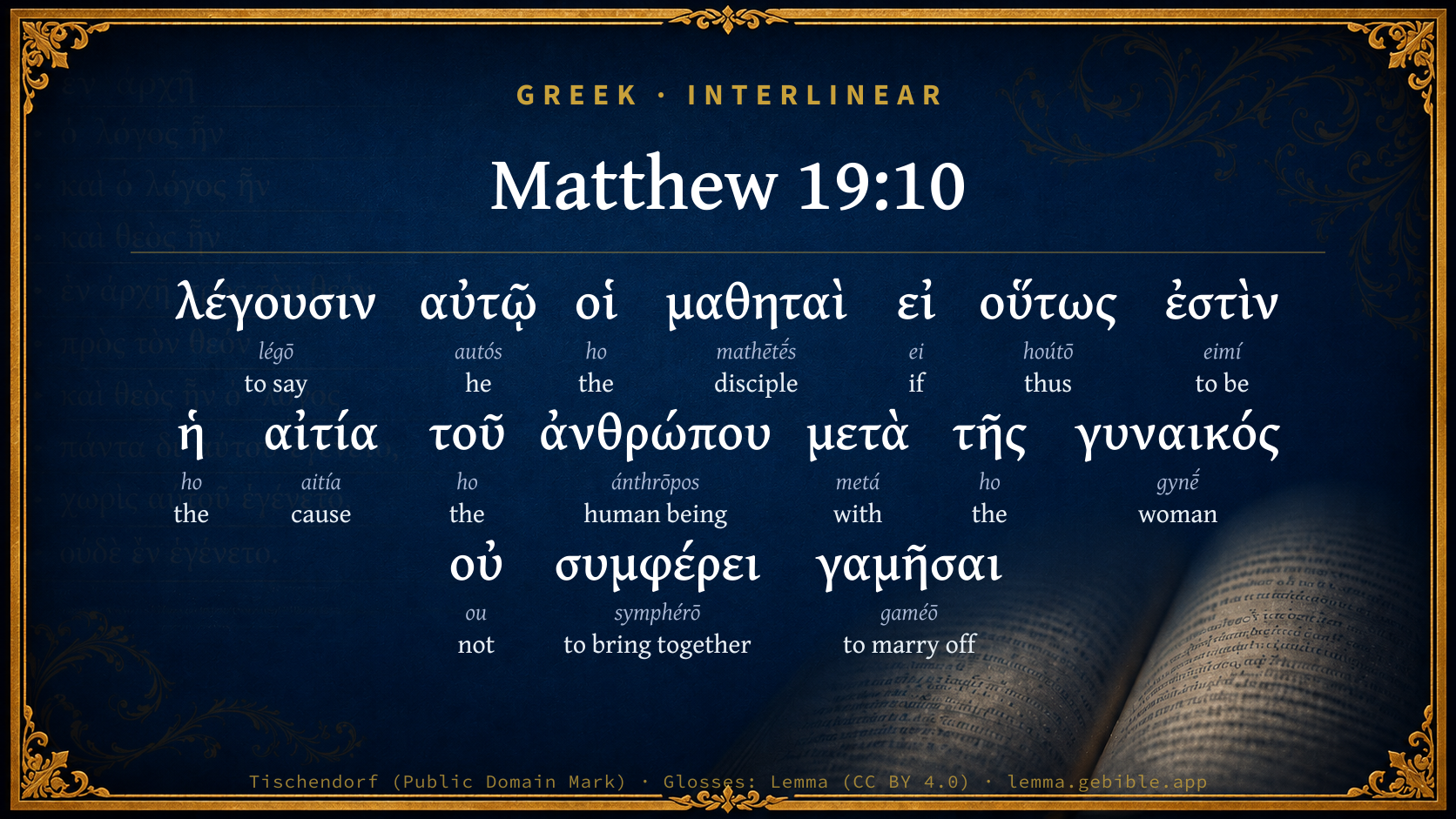
  1. λέγουσιν légō G3004 “to say” Verb, Present, Active, Indicative, 3rd person, Plural
  2. αὐτῷ autós G846 “he” Personal pronoun, Dative, Singular, Masculine
  3. οἱ ho G3588 “the” Article, Nominative, Plural, Masculine
  4. μαθηταὶ mathētḗs G3101 “disciple” Noun, Nominative, Plural, Masculine
  5. εἰ ei G1487 “if” Conditional
  6. οὕτως hoútō G3779 “thus” Adverb
  7. ἐστὶν eimí G1510 “to be” Verb, Present, Active, Indicative, 3rd person, Singular
  8. ἡ ho G3588 “the” Article, Nominative, Singular, Feminine
  9. αἰτία aitía G156 “cause” Noun, Nominative, Singular, Feminine
  10. τοῦ ho G3588 “the” Article, Genitive, Singular, Masculine
  11. ἀνθρώπου ánthrōpos G444 “human being” Noun, Genitive, Singular, Masculine
  12. μετὰ metá G3326 “with” Preposition
  13. τῆς ho G3588 “the” Article, Genitive, Singular, Feminine
  14. γυναικός gynḗ G1135 “woman” Noun, Genitive, Singular, Feminine
  15. οὐ ou G3756 “not” Particle, Negative
  16. γαμῆσαι gaméō G1060 “to marry off” Verb, Aorist, Active, Infinitive

About this verse

These counts appear in no published source. They are computed here, from the morphology-tagged text and Lemma’s own curated glosses. What Lemma adds →

17
words
14
distinct lemmas
Gospels
section

Notable vocabulary

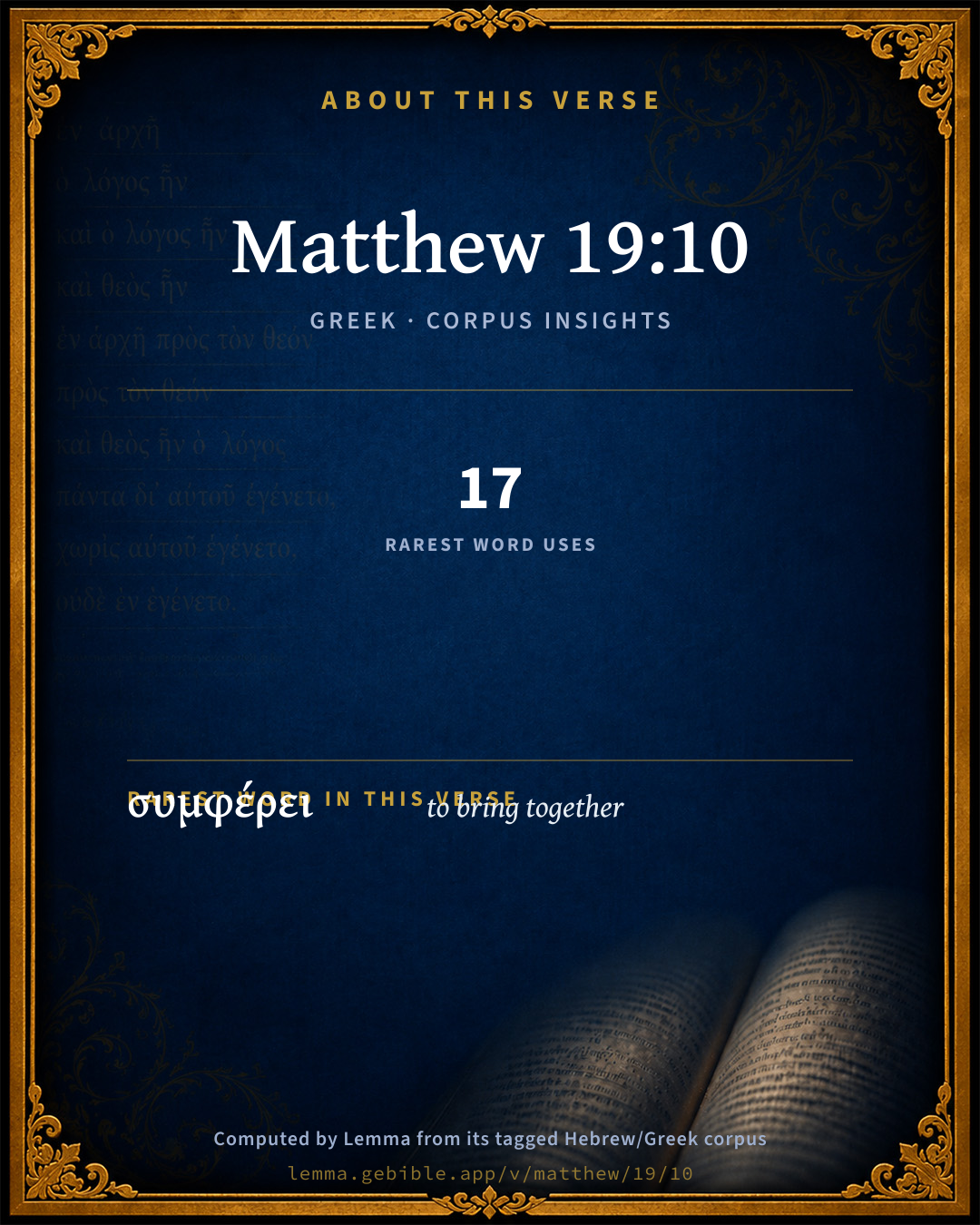
The rarest word here is συμφέρει to bring together G4851 — appearing just 17 times in the whole Greek New Testament.

Shared distinctive vocabulary

συμφέρει to bring together G4851 occurs in 17 verses of the Greek New Testament. Also found in:

Repetition

A word recurs within this verse:

Cross-references

13

Topical passages linked to Matthew 19:10 in the Treasury of Scripture Knowledge — connected by theme and wording, ordered by reader-vote popularity; previews shown in the World English Bible.

  • 1 Corinthians 7:32–35 But I desire to have you to be free from cares. He who is unmarried is concerned for the things of the Lord, how he may please the Lord;
  • Proverbs 5:15–19 Drink water out of your own cistern, Running water out of your own well.
  • Proverbs 18:22 Whoever finds a wife finds a good thing, And obtains favor of Yahweh.
  • Proverbs 19:13–14 A foolish son is the calamity of his father. A wife's quarrels are a continual dripping.
  • Proverbs 21:9 It is better to dwell in the corner of the housetop, Than to share a house with a contentious woman.
  • Proverbs 21:19 It is better to dwell in a desert land, Than with a contentious and fretful woman.
  • 1 Corinthians 7:1–2 Now concerning the things about which you wrote to me: it is good for a man not to touch a woman.
  • 1 Corinthians 7:8 But I say to the unmarried and to widows, it is good for them if they remain even as I am.
  • 1 Corinthians 7:39–40 A wife is bound by law for as long as her husband lives; but if the husband is dead, she is free to be married to whoever she desires, only in the Lord.
  • 1 Timothy 4:3 forbidding marriage and commanding to abstain from foods which God created to be received with thanksgiving by those who believe and know the truth.
  • 1 Timothy 5:11–15 But refuse younger widows, for when they have grown wanton against Christ, they desire to marry;
  • Genesis 2:18 Yahweh God said, "It is not good that the man should be alone; I will make him a helper suitable for him."
  • 1 Corinthians 7:26–28 I think that it is good therefore, because of the distress that is on us, that it is good for a man to be as he is.

Cross-references courtesy of OpenBible.info (CC BY 4.0).

Commentary

Notes on Matthew 19:10 from classic Christian and Jewish commentators (each source and its license shown beneath its notes). The classic Christian expositions comment on the surrounding passage and are grouped to its opening verse, so a note may address several verses; the Jewish commentaries on the Tanakh (Rashi and others) are per-verse, so they appear only where the commentator wrote on this verse.

Lemma curates 59 commentaries, every one of them public domain or Creative Commons licensed, each selected and text-cleaned for this edition rather than reprinted as found. About our sources →

Joseph Benson's Commentary

Mat 19:10-11. His disciples say, If the case of a man be so with his wife — If the marriage-bond be thus indissoluble, and a man cannot dismiss his wife unless she break that bond by going astray, but must bear with her, whether she be quarrelsome, petulant, prodigal, foolish, barren, given to drinking, or, in a word, troublesome by numberless vices; it is not good to marry — A man had better not marry at all, since by marrying he may entangle himself in an inextricable snare, and involve himself in trials and troubles which may make him miserable all the rest of his days. But he said, All men cannot receive this saying — Namely, that it is not expedient to marry; save they to whom it is given — As a peculiar gift, to conquer those inclinations toward that state which are found in mankind in general, according to the common constitution of human nature.

Joseph Benson's Commentary on the Old and New Testaments (1811–1818) — public domain. Text from a community e-Sword module.

Godbey's Commentary on the New Testament

William B. Godbey

CELIBACY

Mat 19:10-12. “His disciples say to Him, If the cause of a man is thus with his wife, it is better not to marry.” Since Jesus thus abrogated all right to divorcement except for fornication, the disciples propound this very practical question, whether it is not better to abstain from matrimony altogether. “Jesus said to them, All do not receive this word, but those to whom it has been given.” Now the meaning of this is very simple. God’s providence is over all of His true people, leading some of them, both brothers and sisters, to abide in celibacy, thus foregoing the privileges of matrimony for the Lord’s sake. Remember, the celibacy here mentioned is super-induced by the Divine guidance, matrimony being the Lord’s order, who, at His own option, doubtless makes many exceptions. “For there are eunuchs who were so born from the womb of their mother.” This affirmation of our Lord includes the people who have been born into the world with deficient genital organs. Of course, all such are excusable for abiding in celibacy. “And there are eunuchs who were made eunuchs by men.” In bygone ages emasculation was common, especially about royal courts, preparatory for the office of chamberlain and various public offices, especially in regal harems. This custom is still somewhat prevalent in the Old World. We read of the Ethiopian eunuch, who was the chief financial officer of Queen Candace. When I was in Egypt last November, I met an Ethiopian eunuch in the city of Cairo. “And there are eunuchs who made themselves eunuchs for the sake of the kingdom of the heavens. Let him who is able to receive it, receive it.” Here you see our Savior throws wide open the door of celibacy for the sake of His kingdom, inviting all to receive it, at their own option, under the Divine leadership. Bishops Asbury, McKendree, and George, those grand heroes of pioneer Methodism in America, all, like St. Paul, lived and died unmarried, being wedded to the gospel of Christ, in which they spent their long, laborious, and useful lives. Doubtless they all wear a brighter crown in heaven this day because of this life of self-denial for the kingdom of heaven, having doubtless traveled more miles, preached more sermons, and led more souls to God, than would have been possible if encumbered with home and family. We are happy to see so many of the holiness people ready to forego matrimony, give up home and all domestic attachments, for the missionary field. God multiply them a thousand-fold, expedite the world’s evangelization, and send along our glorious King!

William B. Godbey, Commentary on the New Testament (1896–1900) — public domain. Text from a community e-Sword module.

Bengel's Gnomon

Johann Albrecht Bengel

Mat 19:10. Τοῦ ἀνθρώπου—μετὰ τῆς γυναικὸς, of the man—with the woman) The nouns are used generically.

Bengel's Gnomon of the New Testament — English translation (T&T Clark, Edinburgh, 1860) — public domain. Text from a community e-Sword module.

Meyer's Critical & Exegetical Commentary

Heinrich August Wilhelm Meyer

Mat_19:10. This conversation is to be understood as having taken place privatim, in a house (Mar_10:10), or elsewhere.

εἰ οὕτως ἐστὶν ἡ αἰτία, κ.τ.λ.] ἡ αἰτία means causa, but not in the sense of res or relation (Grotius): si ita res se habet hoininis cum uxore (Grimm), which is at variance with the Greek usage, and would be tantamount to a Latin idiom; nor is it to be understood in the sense imported by Fritzsche: causa, qua aliquis cum uxore versari cogatur. According to the text, ἡ αἰτία can only be taken as referring back to the question concerning divorce, κατὰ πᾶσαν αἰτίαν, Mat_19:3. The correct interpretation, therefore, must be as follows: If it stands thus with regard to the reason in question, which the man must have in relation to his wife (in order, namely, to her divorce). The Lord had, in fact, declared the πορνεία of the wife to be such an αἰτία as the disciples had inquired about, and that, moreover, the sole one. This also leads me to withdraw my former interpretation of αἰτία in the sense of guilt, that, namely, which was understood to be expressed by the μοιχᾶται. The correct view is given by Hilgenfeld in his Zeitschr. 1868, p. 24, and, in the main, by so early an expositor as Euthymius Zigabenus: ἐὰν μία μόνη ἐστὶν ἡ αἰτία ἡ μέσον τοῦ ἀνδρὸς κ. τῆς γυναικὸς ἡ διαζευγνύουσα.

οὐ συμφ. γαμ.] because one cannot be released again, but, with the exception of adultery alone, must put up with all the womans other vices.

Meyer — Critical and Exegetical Commentary on the New Testament — English translation by Peter Christie, edited by Frederick Crombie (T&T Clark, 1880) — public domain. Text from a community e-Sword module.

Expositor's Greek Testament

ed. W. Robertson Nicoll

Mat 19:10-12 . Subsequent conversation with the disciples . Christ’s doctrine on marriage not only separated Him totacœlo from Pharisaic opinions of all shades, but was too high even for the Twelve. It was indeed far in advance of all previous or contemporary theory and practice in Israel. Probably no one before Him had found as much in what is said on the subject in Gen. It was a new reading of old texts by one who brought to them a new view of man’s worth, and still more of woman’s. The Jews had very low views of woman, and therefore of marriage. A wife was bought, regarded as property, used as a household drudge, and dismissed at pleasure vide Benzinger, Heb. Arch. , pp. 138 146.

Mat 19:10 . αἰτία : a vague word. We should say: if such be the state of matters as between husband and wife, and that is doubtless what is meant. So interpreted, αἰτία would = res, conditio . (So Grotius.) Fritzsche regards the phrase ἡ αἰτία τ . ἀ . μ . τ . γ . as in a negligent way expressing the idea: if the reason compelling a man to live with a wife be so stringent (no separation save for adultery). If we interpret αἰτία in the light of Mat 19:3 ( κατὰ π . αἰτίαν ) the word will mean cause of separation. The sense is the same, but in any view the manner of expression is somewhat helpless, as was not unnatural in the circumstances. Euthy. gives both meanings = αἰτία συζυγίας and αἰτία διαζευγνύουσα , with a preference for the former. ἀνθρώπου here = vir, maritus ; instances of this use in Kypke, Palairet, etc.

The Expositor's Greek Testament, edited by W. Robertson Nicoll (1897–1910) — public domain. Text from a community e-Sword module.

Geneva Bible (1599)

Geneva Bible translators

If the matter stands so between man and wife, or in marriage.

Geneva Bible (1599) marginal notes — public domain. Text via Bolls.life.

Jamieson, Fausset & Brown

Robert Jamieson, A. R. Fausset & David Brown

His disciples say unto him, If the case of the man be so with his wife, it is not good to marry--that is, "In this view of marriage, surely it must prove a snare rather than a blessing, and had better be avoided altogether."

Jamieson, Fausset & Brown — Commentary Critical and Explanatory on the Whole Bible (1871) — public domain (CC PDM 1.0). Text via the HelloAO Bible API.

Adam Clarke's Commentary

Verse 10. If the case of the man] του ανθρωπου, of a husband, so I think the word should be translated here. The Codex Bezae, Armenian, and most of the Itala, have του ανδρος, which, perhaps, more properly signifies a husband, though both words are used in this sense.

Our word husband comes from the Anglo-Saxon, hus and band: the bond of the house, anciently spelt housebond, - so in my old MS. Bible. It is a lamentable case when the husband, instead of being the bond and union of the family, scatters and ruins it by dissipation, riot, and excess.

It is not good to marry.] That is, if a man have not the liberty to put away his wife when she is displeasing to him. God had said, Ge 2:18, It is not good for man to be alone, i.e. unmarried. The disciples seem to say, that if the husband have not the power to divorce his wife when she is displeasing to him, it is not good for him to marry. Here was a flat contradiction to the decision of the Creator. There are difficulties and trials in all states; but let marriage and celibacy be weighed fairly, and I am persuaded the former will be found to have fewer than the latter. However, before we enter into an engagement which nothing but death can dissolve, we had need to act cautiously, carefully consulting the will and word of God. Where an unbridled passion, or a base love of money, lead the way, marriage is sure to be miserable.

Adam Clarke's Commentary on the Bible (1810–1826) — public domain. Text from a community e-Sword/MySword module.

Ellicott's Commentary for English Readers

(10) If the case of the man.—The words seem to indicate that the laxer view of the school of Hillel was the more popular one even with those who, like the disciples, had been roused to some efforts after a righteousness higher than that of the scribes or Pharisees. They looked forward to the possible discomforts of marriage under the conditions which their Master had set before them, and drew the conclusion that they outweighed its advantages. Why entangle themselves in a union which they were no longer able to dissolve, when they got tired of it, by the short and easy method of a bill of divorcement? It is instructive to remember that one of the greatest of English writers has taken the same line of thought in dealing with the question. Milton’s Doctrine and Discipline of Divorce, and the treatises that followed it, are but an elaborate and eloquent expression of the words of the disciples, “If the case of the man be so with his wife, it is not good to marry.”

A Bible Commentary for English Readers, edited by Charles John Ellicott (1878–1897) — public domain. Text from a community e-Sword module.

The Cambridge Bible for Schools and Colleges

gen. ed. J. J. S. Perowne

10. If the case of the man be so with his wife] If these are the conditions of marriage.

it is not good to marry] Nothing could prove more clearly the revolution in thought brought to pass by Christ than this. Even the disciples feel that such a principle would make the yoke of marriage unbearable.

The Cambridge Bible for Schools and Colleges (gen. ed. J. J. S. Perowne; Cambridge University Press, 1878–1918) — public domain. Text from a community e-Sword module.

John Gill's Exposition

His disciples say unto him,.... Being surprised at this account of things, it being quite contrary to what they had been taught, and very different from the general practice and usage of their nation:

if the case of a man be so with his wife; if they are so closely joined together in marriage; if they are, as it were, one flesh, or one body, that a man's wife is himself: that the bond between them is so inviolable, that it is not to be dissolved, but in case of adultery; that if a separation be made by a bill of divorce, in any other case, and either party marry again, they are guilty of adultery; if a man cannot part with his wife lawfully, provided she be chaste, and is faithful to his bed, let her be what she will otherwise, though ever so disagreeable in her person, and troublesome in her behaviour; though she may be passionate, and a brawler; though she may be drunken, luxurious, and extravagant, and mind not the affairs of her family, yet if she is not an adulteress, must not be put away:

it is not good to marry; it would be more expedient and advisable for a man to live always a single life, than to run the risk of marrying a woman, that may prove very disagreeable and uncomfortable; to whom he must be bound all the days of his or her life, and, in such a case, not to be able to relieve and extricate himself. This they said under the prejudice of a national law and custom, which greatly prevailed, and under the influence of a carnal heart.

John Gill's Exposition of the Whole Bible (1746–1763) — public domain (CC PDM 1.0). Text via the HelloAO Bible API.

Trapp's Complete Commentary

John Trapp

10 His disciples say unto him, If the case of the man be so with his wife, it is not good to marry.

Ver. 10. If the case of a man be so with his wife] viz. That he may not rid his hands of her when he will; better be married to a quartan ague than to a bad wife, said Simonides.

It is not good to marry] It is not evil to marry, but good to be wary; to look ere one leap. Alioqui saliens antequam videat, casurus est antequam debeat, as Bernard hath it. Most men, as these disciples, look not to the commodities but discommodities of wedlock, and other things, and are discontented. But as there be two kinds of antidotes against poison, viz. hot and cold; so against the troubles of life, whether single or married, viz. prayer and patience, the one hot, the other cold, the one quenching, the other quickening.

John Trapp, A Commentary or Exposition upon All the Books of the Old and New Testament (1647–1656) — public domain. Text from a community e-Sword module.

Albert Barnes' Notes on the Bible

His disciples say ... - The disciples were full of Jewish notions. They thought that the privilege of divorcing a wife when there was a quarrelsome disposition, or anything else that rendered the marriage unhappy, was a great privilege; and that in such cases to be always bound to live with a wife was a great calamity. They said, therefore, that if such was the case - such the condition on which people married - it was better not to marry.

Albert Barnes' Notes on the Bible (1834–1885) — public domain. Text from a community e-Sword/MySword module.

Matthew Poole's English Annotations

This is a very strange saying, and discovers to us both the imperfect state of Christ’s disciples, and also the tyranny of a sinful practice grown up into a custom. The Jews had assumed a liberty of turning their wives out of doors upon every light and trivial offence or dislike; the disciples think, if this licentiousness may not be allowed it is not good to marry. So a holy institution of God, ordained for the propagation of mankind, for the restraint of extravagant lust, and for the solace and comfort of man’s life, should be despised, rather than those unquiet lusts and corruptions mortified, the mortification of which would have made those irregular separations both needless and undesirable. Surely they should rather have said, If the case of a man be so with his wife, then both husbands and wives had need to learn to deny themselves, to comply each with another, to silence their brutish and boisterous passions, that, being the same flesh, they might also have one and the same spirit, and not be like a diseased piece of flesh, where humours so quarrel that one piece need be cut off to preserve the other. But the best of men have their infirmities; and, as the Hebrews said, Spiritus Dei non semper tangit corda prophetarum, The Spirit of God was not always upon the hearts of the prophets; so it is as true, Spiritius Dei non semper et ubique tangit corda fidelium, All that the saints say is not gospel. Their flesh hath its turn to speak, as well as the Spirit in them. A sinful liberty conceded, indulged, or connived at, by the laws, or by the rulers of a church or place where we live, for a long time, is not easily restrained, and even good men may for a time be carried away with the error of it, so as they cannot discern it, be convinced of it, or be brought clear of it to a conformity to the will of God.

Matthew Poole's English Annotations on the Holy Bible (1683–1685) — public domain. Text from a community e-Sword/MySword module.

Whedon's Commentary on the Bible

Daniel D. Whedon

10. Not good to marry — The apostles’ opinion seems to have been on the side of Hillel. It was probably accordant with the doctrine, or at least ordinary practice of that wicked age. The apostles therefore speak under the influence of their habitual impressions. So indissoluble a union with one woman they thought to be in any way intolerable. Better no marriage at all. And yet how fully experience shows that the age of strict marriage is the age of every quiet and healthful virtue. Such an institute stays at once a thousand irregularities of life. When the law of marriage banishes beforehand all thought of separation and transgression, the whole train of lower feelings become tranquilized and dismissed, and room is made for thoughts of other than sexual matters.

Daniel D. Whedon (gen. ed.), Commentary on the Old and New Testaments (1874–1909) — public domain. Text from a community e-Sword module.

The Pulpit Commentary

His disciples say unto him. Our Lord appears to have repeated privately to the disciples what he had said publicly to the Pharisees. If the case (h aitia) of the man be so with his wife. Some commentators take aitia to signify guilt: "if such guilt appertains to the married state." But the meaning is plain enough anyway, and the word, as here used, corresponds to the Latin causa, and the Hebrew dibrah, which may denote "case," "condition," etc. The disciples reflect the feeling of their day. Marriage without any possibility of essential release (for they see that this is Christ"s law) seems to them a severe and unbearable connection. It were better never to marry at all than to fetter one"s self with such an inexorable obligation. Such a doctrine was entirely novel in that age, and most unpalatable; and even the apostles receive it with wonder and hesitation. They have not yet leaned that in Messiah"s kingdom grace conquers natural inclination, and strengthens the weak will so that it rises superior to custom, prejudice, and the promptings of the flesh.

The Pulpit Commentary (1880–1919), ed. H.D.M. Spence-Jones & Joseph S. Exell — public domain. Text from a community e-Sword module.

Kretzmann's Popular Commentary

Paul E. Kretzmann

The dismay of the disciples:

v. 10. His disciples say unto Him, If the case of the man be so with his wife, it is not good to marry.

v. 11. But He said unto them, All men cannot receive this saying, save they to whom it is given.

v. 12. For there are some eunuchs which were so born from their mother’s womb; and there are some eunuchs which were made eunuchs of men; and there be eunuchs which have made themselves eunuchs for the kingdom of heaven’s sake. He that is able to receive it, let him receive it.

The Jews of Christ’s time had a very low view of women, and therefore of marriage. And the disciples were not free from the national ideas and prejudices. They had never had the subject presented to them like this before. If such be the state of affairs so far as the relations between husband and wife are concerned, they say, if the husband must regard his wife so highly, and if both husband and wife must regard the marriage bond as indissoluble, if this recourse to quick and easy divorces is both against the original order of God’s institution and against His revealed will, then it is poor policy to get married. But Christ corrects their poor understanding, and shows distinctly that the estate of marriage is the normal state for normal adults, only such individuals being ordinarily exempt from this rule whose physical and spiritual condition renders them unfit for the duties peculiar to the physical side of marriage. Some people are naturally, from their birth, incapable of contracting marriage. Others have been rendered impotent, sterile, through deliberate mutilation by others, as was done in the case of the Oriental eunuchs. Still others purposely force themselves to chastity, to a life outside of marriage, keeping the natural desires in subjection, in order to be able to devote their entire time and life to the service of the kingdom of God. But all three classes are abnormal, even the last, except in cases of religious persecution or for some other extraordinary reason, 1Co 7:26. Herewith Christ neither commands nor recommends celibacy, but sets these people, as a class, in a separate category, and warns that it takes a great deal of spiritual and moral capacity to grasp His saying. The claims of the kingdom of heaven are paramount, but Christ expects no one to feign an asceticism to which he is not fully equal, since that would be setting aside the law for the propagation of the human race by the order of marriage, which Christ has, throughout His declaration, very warmly defended. See 1Co 9:5-6. The last state described by Christ may, under circumstances, be preferable to the married state, but it takes an exceptional spiritual enlightenment to grasp it.

Paul E. Kretzmann, Popular Commentary of the Bible (1921–1924) — public domain. Text from a community e-Sword module.

Burkitt's Expository Notes on the New Testament

William Burkitt

That is, if a man be so strictly tied by marriage, it is best for him not to marry. A very rash saying of the disciples, discovering both their great carnality, and also the tyranny of a sinful practice, grown up into custom.

Learn, 1. That the best of men have their weakness and infirmities: and the flesh takes its turn to speak, as well as the spirit in them. All that the saints say, is not gospel.

Learn, 2. How impatient nature is of restraint, and how desirous of sinful liberty, and to be freed from the ties and bonds which the holy and wise laws of God put upon it.

William Burkitt's Expository Notes on the New Testament (1700–1703) — public domain. Text from a community e-Sword module.

The People's New Testament

B. W. Johnson

10. It is expedient not to marry. Such a rigid marriage law was too high for their loose Jewish ideas. It seemed to them as if it would be impossible to live up to so high an ideal. If a man could not get rid of his wife, if he tired of her, it were better not to marry.

B. W. Johnson's The People's New Testament with Notes (1889–1891) — public domain. Electronic text from the Christian Classics Ethereal Library (CCEL) ThML edition.

unfoldingWord translationNotes

Door43 World Missions Community

who are allowed

This can be stated in active form. AT: "whom God allows" or "whom God enables" (See: Active or Passive)

For there are eunuchs who were that way from their mother's womb

You can make explicit the implicit information. AT: "For there are different reasons that men do not marry. For instance, there are men who were born eunuchs" (See: Assumed Knowledge and Implicit Information)

there are eunuchs who were made eunuchs by men

This can be stated in active form. AT: "there are men whom other men have made eunuchs" (See: Active or Passive)

eunuchs who made themselves eunuchs

Possible meanings are 1) "men who have made themselves eunuchs by removing their private parts" or 2) "men who choose to remain unmarried and sexually pure." (See: Metaphor)

for the sake of the kingdom of heaven

Here "kingdom of heaven" refers to God's rule as king. This phrase is found only in the book of Matthew. If possible, keep "heaven" in your translation. AT: "so they can better serve our God in heaven" (See: Metonymy)

receive this teaching ... receive it

"accept this teaching ... accept it"

translationWords

disciple

Jesus

eunuch

womb

kingdom of God

receive

unfoldingWord translationNotes — © Distant Shores Media and the Door43 World Missions Community, licensed CC BY-SA 4.0. Source: git.door43.org/Door43/en_tn.

Cambridge Greek Testament for Schools and Colleges

10. It is difficult to fix the precise meaning of ἡ αἰτία. It is either: (1) the cause or principle of the conjugal union: ‘If the union be so close as thou sayest;’ or, (2) the cause or reason for divorce, namely adultery, referring to αἰτία, Mat 19:3: ‘If for this reason, and for this alone, divorce be allowed;’ or (3) ‘the case’ in a legal sense like causa, res de qua in judicio agitur: ‘If this be the only case with which a man may come into court.’ A further meaning, sometimes assigned ‘condition,’ ‘state of things,’ may be rejected. On the whole (2), which is Meyer’s view, seems preferable.

In D the reading is ἀνδρός, the correct word in contrast with γυναικός, but the reading is not supported. μετὰ is used to express relation generally, as in modern Greek.

οὐ συμφέρει γαμῆσαι. Nothing could prove more clearly the revolution in thought brought to pass by Christ than this. Even the disciples feel that such a principle would make the yoke of marriage unbearable.

γαμῆσαι. This aorist is used both in the sense of ‘to give to wife’ and ‘to take to wife,’ it is nearly confined to late authors. See Veitch sub voc. γαμέω.

Cambridge Greek Testament for Schools and Colleges (Cambridge University Press, 1896; 21 vols, various authors incl. Carr, Maclear, Plummer, Farrar, Lumby, Moule, M. R. James, Simcox) — public domain. Text from a community e-Sword module.

Alford’s Greek Testament

Henry Alford

10.] αἰτία, not the cause of divorce just mentioned; nor, the condition of the man with his wife: but the account to be given, ‘the original ground and principle,’ of the relationship of man and wife:—ἐὰν τοιαύτη ἐστὶν ἡ αἰτία τῆς συζυγίας, , who however mentions other renderings. The disciples apprehend that the trials and temptations of marriage would prove sources of sin and misery. This question and its answer are peculiar to Matthew.

Meyer refers αἰτία back to the αἰτία in ver. 3, and understands it to mean the only reason justifying divorce; but the above interpretation seems to me preferable.

11,

Henry Alford, The Greek Testament (1849–1861) — public domain. Text from a community e-Sword module.

International Critical Commentary

(E) 10. The disciples say to him, If the reason (of divorce) between a man and his wife be so, it is not convenient to marry.] The editor adds three verses which are not in Mk. Vv. 10, 11 are probably an editorial link to connect 12 with the preceding. αἰτία refers back to αἰτία of v. 3. If the cause or reason of divorce between man and wife be so, i.e. if it is to be limited to unchaste acts, it is better not to marry, because marriage with a woman of bad temper or malicious tongue, e.g., is in that case an intolerable burden which cannot be thrown off.

International Critical Commentary — older volumes (1896–1929), various authors — public domain. Text from a community e-Sword module.

Vincent's Word Studies in the New Testament

Marvin R. Vincent

The case [αιτια] . Not the relation of the man to his wife, nor the circumstances, the state of the case. Aijtia refers to cause (ver. 3), and the meaning is, if the matter stands thus with reference to the cause which the man must have for putting away his wife.

Marvin R. Vincent, Word Studies in the New Testament (1887–1900) — public domain. Text from a community e-Sword/MySword module.

Lesson kit

Teaching starters — assembled from the data on this page, not authored interpretation. Every prompt links to the verse data it draws on. Edit before teaching.

Matthew, in the Gospels, opens this verse with 17 words (14 distinct Greek lemmas). Its most distinctive word is symphérō (“to bring together”). A historical commentator’s framing appears above. Read the whole chapter for the surrounding context.

Discussion questions

  1. How does “to bring together” (symphérō) shape what this verse is saying?
  2. How does Matthew 5:29, which shares the word «to bring together», read alongside this verse?
  3. What does the repetition of “the” (4× in this one verse) do in this verse?
  4. These translations render this verse differently; the difference is in the English rendering, not the original. What questions does that raise?
  5. Compare how Joseph Benson's Commentary and Godbey's Commentary on the New Testament read this verse. Where do they agree or differ?

Things to notice

Reading settings

Reading text

Shown beneath each verse's original-language words.

Old Testament
Old Testament edition

Read the OT as the Masoretic Hebrew (MT) or the Greek Septuagint (LXX).

English shown for the Greek Septuagint (in the Hebrew ↔ Greek comparison).

Comparing translations? Open the Compare panel on any verse page to stack up to four side by side.