Matthew 6:28

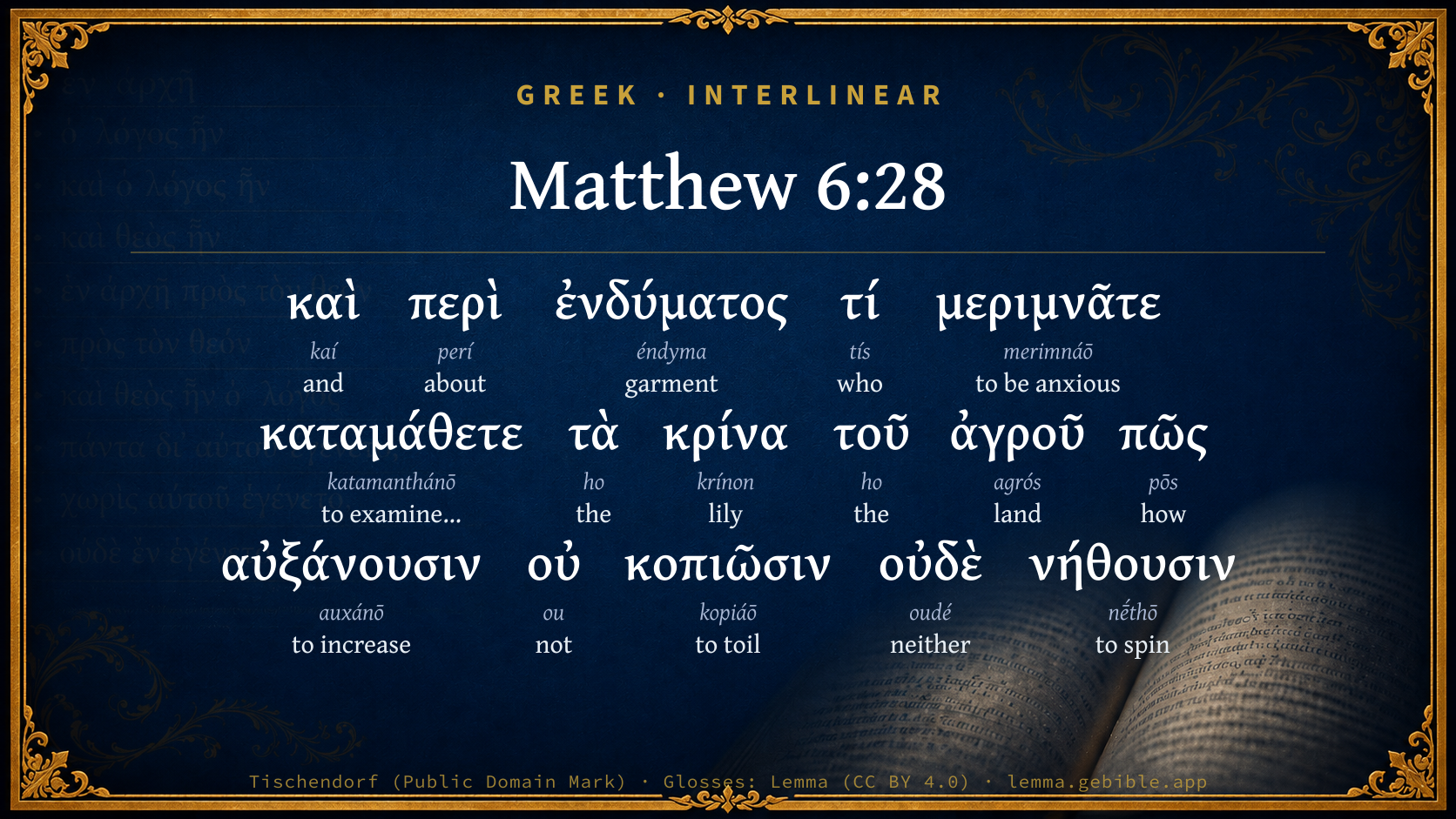
Greek (Tischendorf 8th ed.) Matthew 6:28 appears in the Greek New Testament. The text above is from the Tischendorf 8th edition. Each word links to its Strong’s number and a concise gloss. Click any word for its full Thayer’s Greek Lexicon entry.
Download image
Cite this verse

Matthew 6:28 (World English Bible). Public Domain. Lemma interlinear Bible study tool, https://lemma.gebible.app/v/matthew/6/28.

Show BibTeX & RIS
BibTeX
RIS
English Translation
Why are you anxious about clothing? Consider the lilies of the field, how they grow. They don't toil, neither do they spin,
World English Bible · Public Domain
Highlights
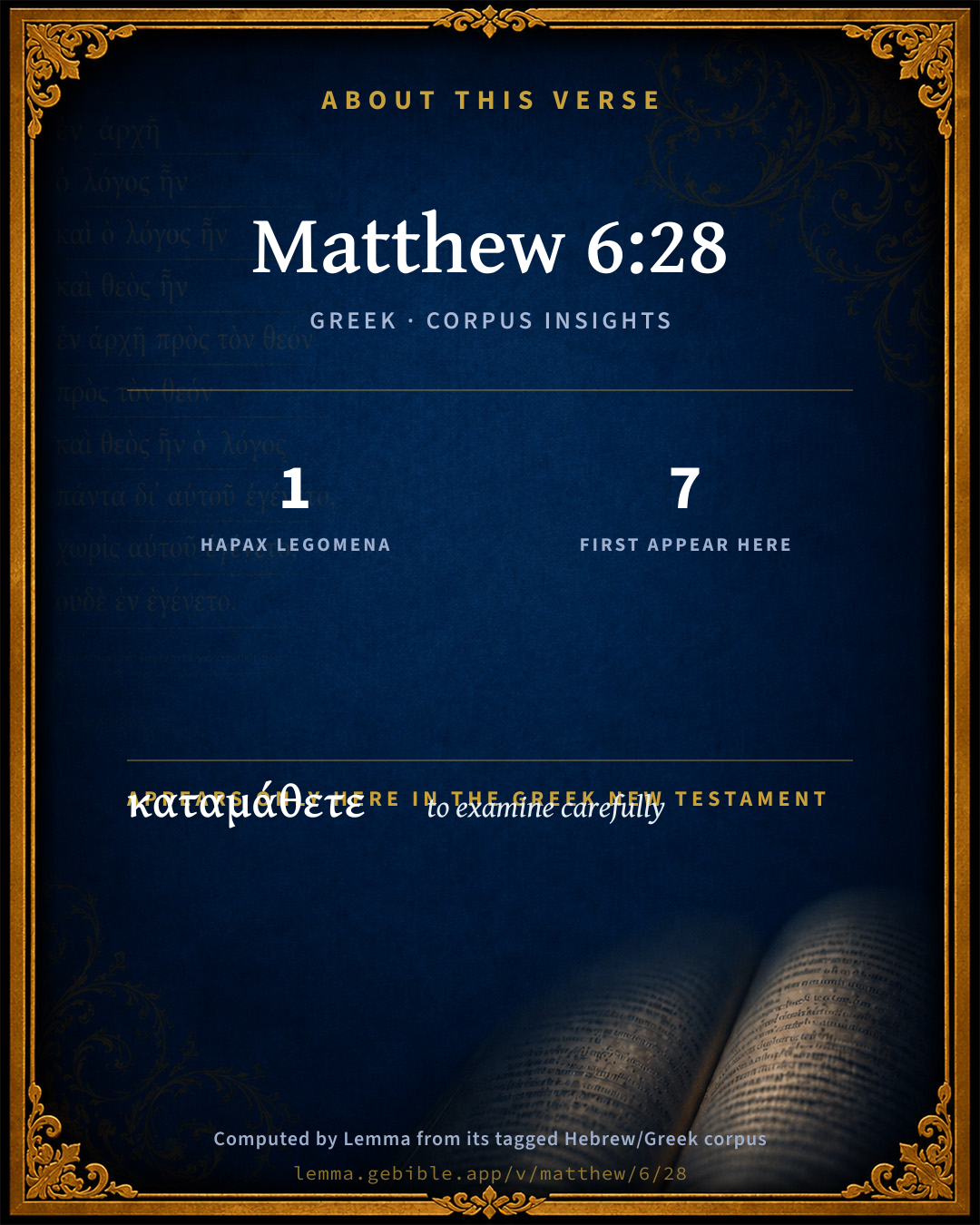
  • 1 hapax legomenon — only here in the Greek New Testament
  • 7 first appearances in the Greek New Testament
Full analysis ↓
Download a study sheet

One document with this verse’s original text, its word-by-word gloss line, the meaning frame, cross-references with their text, attributed commentary, and full source and license credits — printable, and it pastes into notes with its structure intact.

This verse Autodidact and up

Study sheet (.html) Plain text (.txt)

A passage Seminary Student

Up to 50 verses in one chapter. A passage sheet keeps up to 6 commentary sources and 12 cross-references per verse, in the order this page ranks them, and says so on the sheet whenever that leaves anything out. Ask for a single verse and you get the Autodidact verse sheet above.

Everything on this page stays free to read, with no account — the sheet is a download of what is already on screen, not access to it.

Want to remove ads? Support Godless Engineer
Compare translations 3

The same verse in 3 English versions, stacked beneath the original-language interlinear above. Click any original word for its lexicon entry.

Each is an independent rendering of the whole verse — the interlinear is not word-aligned to these translations.

Highlighted words mark where these versions differ — a whole-verse word diff, not a word-by-word alignment.

  • World English Bible Public Domain
    Why are you anxious about clothing? Consider the lilies of the field, how they grow. They don't toil, neither do they spin,
  • King James Version Public Domain
    And why take ye thought for raiment? Consider the lilies of the field, how they grow; they toil not, neither do they spin:
  • unfoldingWord Literal Text CC BY-SA 4.0
    And why are you anxious about clothing? Consider the lilies of the field—how they grow. They do not labor, neither do they spin.

unfoldingWord Literal Text — © unfoldingWord, licensed CC BY-SA 4.0. Word-aligned USFM3 via Door43 (git.door43.org/unfoldingWord/en_ult).

Versions to compare (up to 4)

3 of 4 selected

Show all 19 translations

Every available English version of this verse, each an independent rendering of the whole verse.

  • World English Bible Public Domain
    Why are you anxious about clothing? Consider the lilies of the field, how they grow. They don't toil, neither do they spin,
  • Berean Standard Bible Public Domain
    And why do you worry about clothes? Consider how the lilies of the field grow: They do not labor or spin.
  • Majority Standard Bible Public Domain
    And why do you worry about clothes? Consider how the lilies of the field grow: They do not labor or spin.
  • King James Version Public Domain
    And why take ye thought for raiment? Consider the lilies of the field, how they grow; they toil not, neither do they spin:
  • American Standard Version (1901) Public Domain
    And why are ye anxious concerning raiment? Consider the lilies of the field, how they grow; they toil not, neither do they spin:
  • Revised Version (1885) Public Domain
    And why are ye anxious concerning raiment? Consider the lilies of the field, how they grow; they toil not, neither do they spin:
  • Geneva Bible (1599) Public Domain
    And why care ye for raiment? Learne howe the lilies of the fielde doe growe: they are not wearied, neither spinne:
  • Douay-Rheims (1899) Public Domain
    And for raiment why are you solicitous? Consider the lilies of the field, how they grow: they labour not, neither do they spin.
  • Young's Literal Translation Public Domain
    and about clothing why are ye anxious? consider well the lilies of the field; how do they grow? they do not labour, nor do they spin;
  • Literal Standard Version CC BY-SA 4.0
    And why are you anxious about clothing? Consider well the lilies of the field; how do they grow? They do not labor, nor do they spin;
  • Unlocked Literal Bible CC BY-SA 4.0
    Why are you anxious about clothing? Think about the lilies in the fields, how they grow. They do not work, and they do not spin cloth.
  • unfoldingWord Literal Text CC BY-SA 4.0
    And why are you anxious about clothing? Consider the lilies of the field—how they grow. They do not labor, neither do they spin.
  • Darby Bible Public Domain
    And why are ye careful about clothing? Observe with attention the lilies of the field, how they grow: they toil not, neither do they spin;
  • World Messianic Bible Public Domain
    Why are you anxious about clothing? Consider the lilies of the field, how they grow. They don’t toil, neither do they spin,
  • Webster's Bible Public Domain
    And why are ye anxious for raiment? Consider the lilies of the field how they grow? they toil not, neither do they spin?
  • Free Bible Version CC BY-SA 4.0
    And why are you worried about clothes? Look at the beautiful flowers in the field. See how they grow: they don't work hard, they don't spin thread.
  • Bible in Basic English Public Domain
    And why are you troubled about clothing? See the flowers of the field, how they come up; they do no work, they make no thread:
  • Text-Critical English NT CC BY 4.0
    And why are you anxious about clothing? Consider the lilies of the field, how they grow: They do not toil or spin,
  • Tyndale New Testament (1534) Public Domain
    And why care ye then for raymet? Considre the lylies of the felde how they growe. They labour not nether spynne.

Literal Standard Version (2020), Covenant Press — licensed CC BY-SA 4.0. Text via the HelloAO Bible API (eBible.org). Unlocked Literal Bible (unfoldingWord) — licensed CC BY-SA 4.0. Text via the HelloAO Bible API (eBible.org). unfoldingWord Literal Text — © unfoldingWord, licensed CC BY-SA 4.0. Word-aligned USFM3 via Door43 (git.door43.org/unfoldingWord/en_ult). Free Bible Version, Dr. Jonathan Gallagher — licensed CC BY-SA 4.0. Text via the HelloAO Bible API (eBible.org).

Word by word

More ways to search: Search by grammar → Find every occurrence → Compare this word →

Practice this passage: Drill this verse → Learn its vocabulary →

καταμάθετε
katamanthánō
G2648
“to examine carefully”
Verb, Aorist, Active, Imperative, 2nd person, Plural
Part of Speech
Verb
Tense
Aorist
Voice
Active
Mood
Imperative
Person
2nd person
Number
Plural
Full Thayer's Definition

Origin: from G2596 and G3129

TDNT: 10:54,6

1. to learn thoroughly, examine carefully 2. to consider well
  1. καὶ kaí G2532 “and” Conjunction
  2. περὶ perí G4012 “about” Preposition
  3. ἐνδύματος éndyma G1742 “garment” Noun, Genitive, Singular, Neuter
  4. τί tís G5101 “who” Interrogative pronoun, Accusative, Singular, Neuter
  5. μεριμνᾶτε merimnáō G3309 “to be anxious” Verb, Present, Active, Indicative, 2nd person, Plural
  6. τὰ ho G3588 “the” Article, Accusative, Plural, Neuter
  7. κρίνα krínon G2918 “lily” Noun, Accusative, Plural, Neuter
  8. τοῦ ho G3588 “the” Article, Genitive, Singular, Masculine
  9. ἀγροῦ agrós G68 “land” Noun, Genitive, Singular, Masculine
  10. πῶς pōs G4459 “how” Adverb
  11. αὐξάνουσιν auxánō G837 “to increase” Verb, Present, Active, Indicative, 3rd person, Plural
  12. οὐ ou G3756 “not” Particle, Negative
  13. κοπιῶσιν kopiáō G2872 “to toil” Verb, Present, Active, Indicative, 3rd person, Plural
  14. οὐδὲ oudé G3761 “neither” Conjunction, Negative
  15. νήθουσιν nḗthō G3514 “to spin” Verb, Present, Active, Indicative, 3rd person, Plural

About this verse

These counts appear in no published source. They are computed here, from the morphology-tagged text and Lemma’s own curated glosses. What Lemma adds →

16
words
15
distinct lemmas
Gospels
section

Notable vocabulary

1 hapax legomenon — a word that appears only here in the entire Greek New Testament:

  • καταμάθετε to examine carefully G2648

First appearance in Scripture

These words make their first canonical appearance in the Greek New Testament here:

  • καταμάθετε to examine carefully G2648
  • κρίνα lily G2918
  • ἀγροῦ land G68
  • πῶς how G4459
  • αὐξάνουσιν to increase G837
  • κοπιῶσιν to toil G2872
  • νήθουσιν to spin G3514

Shared distinctive vocabulary

κρίνα lily G2918 occurs in 2 verses of the Greek New Testament. Also found in:

Repetition

A word recurs within this verse:

Cross-references

7

Topical passages linked to Matthew 6:28 in the Treasury of Scripture Knowledge — connected by theme and wording, ordered by reader-vote popularity; previews shown in the World English Bible.

  • Matthew 6:25 Therefore, I tell you, don't be anxious for your life: what you will eat, or what you will drink; nor yet for your body, what you will wear. Isn't life more than food, and the body more than clothing?
  • Philippians 4:6 In nothing be anxious, but in everything, by prayer and petition with thanksgiving, let your requests be made known to God.
  • Luke 12:27 Consider the lilies, how they grow. They don't toil, neither do they spin; yet I tell you, even Solomon in all his glory was not arrayed like one of these.
  • Matthew 6:31 "Therefore don't be anxious, saying, 'What will we eat?', 'What will we drink?' or, 'With what will we be clothed?'
  • Luke 22:35–36 He said to them, "When I sent you out without purse, and wallet, and shoes, did you lack anything?" They said, "Nothing."
  • Luke 3:11 He answered them, "He who has two coats, let him give to him who has none. He who has food, let him do likewise."
  • Matthew 10:10 Take no bag for your journey, neither two coats, nor shoes, nor staff: for the laborer is worthy of his food.

Cross-references courtesy of OpenBible.info (CC BY 4.0).

Commentary

Notes on Matthew 6:28 from classic Christian and Jewish commentators (each source and its license shown beneath its notes). The classic Christian expositions comment on the surrounding passage and are grouped to its opening verse, so a note may address several verses; the Jewish commentaries on the Tanakh (Rashi and others) are per-verse, so they appear only where the commentator wrote on this verse.

Lemma curates 59 commentaries, every one of them public domain or Creative Commons licensed, each selected and text-cleaned for this edition rather than reprinted as found. About our sources →

The Biblical Illustrator

Joseph S. Exell

Mat_6:28

Consider the lilies.

I. God puts on the lilies and tulips such gorgeous apparel for one days wearing, spun by providence, as far surpasseth the tracery of the most splendid court, that Solomon himself, with all his wisdom and magnificence, could not match them.

II. These are but inconsiderable creatures in comparison with men, and such as God has infinitely less obligations to take care of than He has for us, who are by adoption through His Son so nearly related to Him, that He is our heavenly Father.

III. Therefore be sure He will not fail in looking after us, who are creatures of so much greater excellence in ourselves, and of so much nearer relation to Himself; insomuch that he who distrusts God in these outward things, shows want of faith, by not depending upon God according to the dignity of His nature, as well as to the obligations of His grace. (Adam Littleton, D. D.)

Consider the lilies

I. The objects to which he directs us for the lesson he would teach.

II. The lesson itself. God takes care of the lilies; the inference

(1) From the less to the greater;

(2) From the gift to the recipient. Shall God follow the gift with so much interest and be unmindful of him for whom it is intended;

(3) From the ornamental to the needful.

III. The rebuke to unbelief and call for faith. (C. M. Merry.)

Consider the lilies

1. For the sake of their tender associations. The life of flowers has all the vicissitudes of human life.

2. Consider their growth.

3. Their beauty.

4. Their unselfishness.

5. Their death. (W. E. Shalders, B. A.)

Christ and the lilies

1. Lily-life and growth teach us freedom from care.

2. The lily grows everywhere, the Oriental lily.

3. The special utility of the lily.

4. A word on this question of raiment. Life first, then clothing. (A. J. Griffiths.)

The lilies witness

or, God will take care of you.

I. So, then, there is a gospel in nature. Under pretence of exalting what God has said in His Word we must not depreciate what He has done in His works. There is a gospel in nature, not the gospel. Christ comes as the interpreter of natures gospel. This gospel of nature is especially for the poor.

II. This gospel must be mused on. Natures text must be studied-consider. Multitudes are blind and deaf, not through misfortune, but from disposition. Natures gospel has no vision for those who consider not.

III. This gospel is very convincing and consolatory as explained by jesus christ.

1. God takes care of the lilies and the grass. They do not grow by chance.

2. From these specimens of nature Jesus preaches the good news of faith in providence. Men are better than birds, and more useful. (J. Stoughton, D. D.)

Lessons from the lilies

The lily as an emblem of our blessed Lord (Son_2:1).

1. Purity.

2. Admiration at the amazing power of God.

3. The unceasing watchfulness the Almighty One extends over all His works.

4. Humility. It delights in the valleys.

5. Contentment. Other flowers may boast that they grow in more conspicuous places, that their colours are more gay; but the lily is content to be as God made it.

6. Beauty.

7. A reminder of immortality. (J. Norton.)

The preaching of nature

1. The first lesson which these silent preachers would have us learn is the unfailing care of God for His creatures.

2. They indicate a resurrection.

3. The flowers teach us a lesson of usefulness.

4. The flowers teach us to be a comfort to our neighbours. (Wilmot Buxton.)

The good life a ministry to the barren life

In the highest part of the Peak of Teneriffe, far above the clouds, and in dry and burning waste, there grows a plant which, in the spring time, fills the air with delicious fragrance. There are some of us who may be condemned to live in a barren and dry land of hard work and lonely trouble. But loving natures and gentle words can make that desert blossom as the rose. (Wilmot Buxton.)

Consider the lilies

Contentment without distrust.

I. They are clothed with beauty (1Pe_3:3-4).

II. They grow without anxiety. They never fret because of the heat, drought, rain, or cold. They pass through changes; are of different growth.

III. They are watched, although soon to pall. (Canon Titcomb, M. A.)

True contentment found in God

If the sun of Gods countenance shine upon me I may well be content to be wet with some rain of affliction. (Bishop Hall.)

Lessons from the lily

I. It has its root hidden. Secret trust, etc. No pure white lily could live without the hidden root to draw up moisture from the soil.

II. Consider how pure and sweet the lily is, and how innocent. Everybody loves them. What a picture of the Child Jesus!

III. Consider the lilies as A lesson about dress. This the special lesson of text. He clothes the lilies in white. Some children always fretting about dress. Vain about dress. Sinfully careless about dress,

IV. Consider the lily in the evening. When sun sets, close up. Dont stare at darkness, hang the head and sleep. Children should do the same.

V. Even lilies must die. (C. R. Wynne, M. A.)

The lilies of the field

We learn from the lilies something con-cerning-

I. Our fathers power. Our heavenly Father is almighty. Variety in colour, size, and form of the lily, an indication of Gods power. Gods resources are so boundless. This power will punish or save us.

II. Our fathers care. Describe the beauty and delicacy of all the parts, etc. Note concerning lilies. They are comparatively insignificant. They are perishing. They often grow amongst thorns, yet are cared for.

III. Our faith. Our weakness and liability to sickness and death. Lilies not more frail than our lives.

IV. Our future life. When stem and flower wither, root does not die, etc.

V. Jesus Christ. He is called the Lily of the valley. There are spots and flaws in the character of all others, none in His. (W. H. Booth.)

Lily lessons

I. A lesson of wonder and delight in contemplating the works of God. They are Gods workmanship.

II. Admire and love what is beautiful. Some people take no account of beauty; they want only the useful. The beauty of heaven, the beauty of holiness.

III. Diligence.

IV. Patience and punctuality. Every blossom has its season.

V. Tolerance. Lilies and roses and oaks all grow in obedience to same laws; but each after its own pattern.

VI. A lesson of faith. (E. R. Conder, D. D.)

Gods workmanship combines regality and beauty

One of the most noticeable things concerning the beauty of Gods works is this-that it is never stuck on as mere outside show, but grows out of their nature. Men often make a thing ugly first, and then cover it up with paint, or plaster, or gilding, to make it beautiful. God never does so. You will find no sham ornaments on His works. The shape He gives to each creature is just that which is fitted for it; and the colour with which He adorns it will never wash off. In His great workshop, truth and beauty go together. (E. R. Conder, D. D.)

The Biblical Illustrator, edited by Joseph S. Exell (c. 1880s–1900s) — public domain. Text from a community e-Sword module.

Joseph Benson's Commentary

Mat 6:28-30. And why take ye thought — Why are you anxious about raiment? Consider the lilies of the field — Observe not only the animal, but, what is yet much lower, the vegetable part of the creation, and mark how the flowers of the meadows grow; they toil not — To prepare the materials of their covering; nor do they spin — Or weave them into garments. “The expression ου κοπια, here rendered, they toil not, denotes rural labour, 2Ti 2:6; and therefore is beautifully used in a discourse of clothing, the materials of which are produced by agriculture.” — Macknight. Even Solomon in all his glory — In his royal magnificence, and when sitting on his throne of ivory and gold, 1Ki 10:18; was not arrayed like one of these — Namely, in garments of so pure a white, and of such curious workmanship, as one of these lilies presents to your view. The eastern princes were often clothed in white robes, (and they were generally accounted a magnificent apparel; see Est 8:15, Dan 7:9;) and therefore Calmet and Doddridge properly refer this dress of Solomon to the whiteness of the lilies, rather than to tulips of various colours. or a purple kind of lily, supposed by Ray (On the Creation, page 107,) to be here intended by κρινα, the word we render lilies. Wherefore if God so clothe the grass of the field, &c. — If an inanimate thing, so trifling in its nature, and uncertain in its duration, is thus beautifully adorned, will not God take care to clothe you, who are more valuable, as ye are men endowed with reason, but especially as ye are my servants and friends? The grass of the field, is a general expression, including both herbs and flowers. Dr. Campbell renders the original expression, τον χορτον, the herbage, and observes, that it is evident from the lily being included under the term, that more is meant by it than is signified with us by the word grass; and he quotes Grotius as remarking that the Hebrews ranked the whole vegetable system under two classes, עצ, gnets, and עשּׁב, gnesheb, the former including all sorts of shrubs, as well as trees, and the latter every kind of plant, which has not, like trees and shrubs, a perennial stalk. Which to-day is — Namely, in the field; and to-morrow is cast into the oven — The word κλιβανον, here rendered the oven, is interpreted by some a still, for distilling herbs; but “there is no reason,” says Macknight, “to alter the translation, since it appears from Mat 13:10, that they used some kind of vegetable substances for fuel, particularly tares, which, if they were annuals, might be sufficiently dry for immediate use by the time they were cut down, as the herb of the field is here said to be; or to-morrow, in the text may mean, not the day immediately after the herbs are cut down, but any time soon after, the expression being proverbial, and easily admitting of this signification.” Dr. Campbell is of the same mind, observing that he had not seen a vestige of evidence in any ancient author, that the art of distillation was then known, or any authority, sacred or profane, for translating the word κλιβανος, a still. He thinks the scarcity of fuel in those parts, both formerly and at present, fully accounts for their having recourse to withered herbs for heating their ovens. It accounts also, he supposes, for the frequent recourse of the sacred penmen to those similitudes, whereby things found unfit for any nobler purpose, are represented as reserved for the fire. Add to this, Shaw (Trav. page 25,) and Harmer (chap. 4. obs. 6,) inform us, that myrtle, rosemary, and other plants, are made use of in Barbary to heat their ovens. Our Lord, to check every kind of distrust of the divine providence, and to encourage confidence therein, adds, O ye of little faith — Or, O ye distrustful, as Campbell renders the word ολιγοπιστοι, observing, that “it is quite in the genius of the Greek language to express, by such compound words, what in other languages is expressed by a more simple term.” It is hardly necessary to observe here, that “it does not follow from our Lord’s application of the expression, O ye of little faith, that it is an exercise of faith to sit with our arms folded, expecting support from the divine providence, without any action of our own; but after having done what prudence directs for providing the necessaries of life, we ought to trust in God, believing that he will make our labours effectual by his blessing.” It is remarked here by Dr. Doddridge, that the word αμφιεννυσιν, rendered clothe the grass of the field, properly implies the putting on a complete dress, that surrounds the body on all sides; and beautifully expresses that external membrane, which (like the skin in a human body) at once adorns the tender fabric of the vegetable, and guards it from the injuries of the weather. Every microscope in which a flower is viewed, gives a lively comment on this text.

Joseph Benson's Commentary on the Old and New Testaments (1811–1818) — public domain. Text from a community e-Sword module.

Bengel's Gnomon

Johann Albrecht Bengel

Mat 6:28. Πῶς αὐξάνει, how they grow) sc. to a great height.—οὐ κοπιᾷ, they toil not) Toil is remotely, spinning intimately connected with procuring raiment, as sowing and reaping are with food.

Bengel's Gnomon of the New Testament — English translation (T&T Clark, Edinburgh, 1860) — public domain. Text from a community e-Sword module.

Meyer's Critical & Exegetical Commentary

Heinrich August Wilhelm Meyer

Mat_6:28. Καὶ περὶ ἐνδύμ.] the new object of care placed first in the sentence.

καταμάθετε] consider, observe: occurring nowhere else in the New Testament, frequent in Greek writers, Gen_24:21; Gen_34:1; Job_35:5.

κρίνον, שׁוּשָׁן, lilies generally, various kinds of which grow wild in the East, without cultivation by human hands (τοῦ ἀγροῦ). There is no reason to think merely of the (flower) emperors crown (Kuinoel), or to suppose that anemones are intended (Furer in Schenkels Bibellex.); the latter are called ἀνεμῶναι in Greek.

πῶς] relatively: how, i.e. with what grace and beauty, they grow up! To take πῶς αὐξ. interrogatively (Palairetus, Fritzsche), so that οὐ κοπ., etc., would form the answer, is not so simple, nor is it in keeping with the parallel in Mat_6:26. They toil not, neither (specially) do they spin, to provide their raiment. The plurals (αὐξάνουσιν, etc., see the critical remarks) describe the lilies, not en masse, but singly (Kühner, ad Xen. Mem. iv. 3. 12, ad Anab. i. 2. 23), and indeed as though they were actual living persons (Krüger on Thuc. i. 58. 1). Comp. in general, Schoemann, ad Isaeum ix. 8.

Meyer — Critical and Exegetical Commentary on the New Testament — English translation by Peter Christie, edited by Frederick Crombie (T&T Clark, 1880) — public domain. Text from a community e-Sword module.

Expositor's Greek Testament

ed. W. Robertson Nicoll

Mat 6:28-30 . Lesson from the flowers . καταμάθετε , observe well that ye may learn thoroughly the lesson they teach. Here only in N.T., often in classics. Also in Sept [43] , e.g. , Gen 24:21 : The man observed her (Rebekah), learning her disposition from her actions. τὰ κρίνα , the lilium Persicum, Emperor’s crown , according to Rosenmüller and Kuinoel; the red anemone, according to Furrer (Zscht. für M. und R.) growing luxuriantly under thorn bushes. All flowers represented by the lily, said Euthy. Zig. long ago, and probably he is right. No need to discover a flower of rare beauty as the subject of remark. Jesus would have said the same thing of the snowdrop, the primrose, the bluebell or the daisy. After ἀγροῦ should come a pause. Consider these flowers! Then, after a few moments’ reflection: πῶς , not interrogative (Fritzsche), but expressive of admiration; vague, doubtful whether the growth is admired as to height (Bengel), rapidity, or rate of multiplication. Why refer to growth at all? Probably with tacit reference to question in Mat 6:27 . Note the verbs in the plural ( vide critical note) with a neuter nominative. The lilies are viewed individually as living beings, almost as friends, and spoken of with affection (Winer, § 58, 3). The verb αὐξάνω in active voice is transitive in class., intransitive only in later writers. κοπιῶσιν , νήθουσιν : “illud virorum est, qui agrum colunt, hoc mulierum domisedarum” (Rosenmüller). The former verb seems to point to the toil whereby bread is earned, with backward glance at the conditions of human growth; the latter to the lighter work, whereby clothing , the new subject of remark, is prepared.

[43] Septuagint.

The Expositor's Greek Testament, edited by W. Robertson Nicoll (1897–1910) — public domain. Text from a community e-Sword module.

Geneva Bible (1599)

Geneva Bible translators

By labor.

Geneva Bible (1599) marginal notes — public domain. Text via Bolls.life.

Jamieson, Fausset & Brown

Robert Jamieson, A. R. Fausset & David Brown

And why take ye thought for raiment? Consider--observe well.

the lilies of the field, how they grow: they toil not--as men, planting and preparing the flax.

neither do they spin--as women.

Jamieson, Fausset & Brown — Commentary Critical and Explanatory on the Whole Bible (1871) — public domain (CC PDM 1.0). Text via the HelloAO Bible API.

Adam Clarke's Commentary

Verse 28. And why take ye thought for raiment?] Or, why are ye anxiously careful about raiment? The fourth reason against such inquietudes is the example of inanimate creatures: The herbs and flowers of the field have their being, nourishment, exquisite flavours, and beautiful hues from God himself. They are not only without anxious care, but also without care or thought of every kind. Your being, its excellence and usefulness, do not depend on your anxious concern: they spring as truly from the beneficence and continual superintendence of God, as the flowers of the field do; and were you brought into such a situation, as to be as utterly incapable of contributing to your own preservation and support as the lilies of the field are to theirs, your heavenly Father could augment your substance, and preserve your being, when for his glory and your own advantage.

Consider] Diligently consider this, καταμαθετε, lay it earnestly to heart, and let your confidence be unshaken in the God of infinite bounty and love.

Adam Clarke's Commentary on the Bible (1810–1826) — public domain. Text from a community e-Sword/MySword module.

Ellicott's Commentary for English Readers

(28) Why take ye thought for raiment?—The question might well be asked of every race of the whole family of man. Yet we ought not to forget its special pointedness as addressed to a people who reckoned their garments, not less than their money, as part of their capital, and often expended on them the labour of many weeks or months. (Comp. Mat_6:20; Jas_5:2.)

Consider the lilies of the field.—Here again we may think of the lesson as drawn immediately from the surrounding objects. The hill-sides of Galilee are clothed in spring with the crown imperial, and the golden amaryllis, and crimson tulips, and anemones of all shades from scarlet to white, to say nothing of the commoner buttercups and dandelions and daisies; and all these are probably classed roughly together under the generic name of “lilies.” And these, with what we may reverently speak of as a love of Nature, the Lord tells His disciples to “consider,” i.e., not merely to look at with a passing glance, but to study—to learn, as it were, by heart—till they have realised every beauty of structure and form and hue.

A Bible Commentary for English Readers, edited by Charles John Ellicott (1878–1897) — public domain. Text from a community e-Sword module.

The Cambridge Bible for Schools and Colleges

gen. ed. J. J. S. Perowne

28. for raiment] The birds are an example of God’s care in providing food, the flowers of His care in providing apparel.

the lilies of the field] identified by Dr Thomson (Land and Book, p. 256), with a species of lily found in the neighbourhood of Hûlêh. He speaks of having met with “this incomparable flower, in all its loveliness … around the northern base of Tabor, and on the hills of Nazareth, where our Lord spent His youth.” Canon Tristram (Nat. Hist. of the Bible) claims this honour for the beautiful and varied anemone coronaria. “If in the wondrous richness of bloom which characterises the Land of Israel in spring any one plant can claim preeminence, it is the anemone, the most natural flower for our Lord to pluck and seize upon as an illustration, whether walking in the fields or sitting on the hill-side.”

The Cambridge Bible for Schools and Colleges (gen. ed. J. J. S. Perowne; Cambridge University Press, 1878–1918) — public domain. Text from a community e-Sword module.

John Gill's Exposition

And yet I say unto you, that even Solomon in all his glory,.... This is a certain truth, to be affirmed in the strongest manner, and to be believed, that not only men and kings too in general; but even particularly Solomon, the richest and most magnificent of all the kings of Israel, whose grandeur, and glory, exceeded all the princes of the earth; that even he, not in his common dress, but when "in his glory", and in "all" his glory, when arrayed with his royal and richest robes, with his crown on his head, and when seated on his throne,

was not arrayed like one of these lilies, or flowers of the field: for the glory and beauty of his garments were purely from art, but their's by nature; which can never be equalled by art. This phrase, "Solomon in all his glory", is the same which the Jewish doctors, in their writings, express by , "Solomon in his hour" (g): that is as their commentators explain it (h), , "in the time of his reign"; for they say he was first a king, and then a private person. Now, not whilst he was a private person, but when a king, in the height of his grandeur and magnificence, and when dressed out in the most splendid manner, he was exceeded in array by a single lily: or the sense is, in his royal apparel. For as the same doctors say,

"what is a man's "glory?" It is his clothing that is his outward glory; and again, garments are the glory of a man (i).''

(g) Misn. Bava Metzia, c. 7. sect. 1. T. Bab. ib. fol. 49. 1. & 83. 1. & 86. 2. (h) Jarchi & Bartenora in ib. (i) Tzeror Hammor, fol. 95. 1. & 99. 4. & 110. 4.

John Gill's Exposition of the Whole Bible (1746–1763) — public domain (CC PDM 1.0). Text via the HelloAO Bible API.

Trapp's Complete Commentary

John Trapp

28 And why take ye thought for raiment? Consider the lilies of the field, how they grow; they toil not, neither do they spin:

Ver. 28. Consider the lilies of the field] Contemplate them, saith Luther: understand them well, saith Erasmus: learn how they grow, saith Beza: hang upon these fair flowers, with the busy bee, till you have sucked some sweet meditation out of them. God is to be seen and admired in all his wondrous works. A skilful artificer takes it ill that he sets forth a curious piece, and no man looks at it. There is not a flower in the whole field (the word here rendered lilies signifieth all sorts of flowers) but sets forth God to us in lively colours. {a} Not to see him, is to incur the curse he hath denounced against such as regard not the work of the Lord, that is, the first making, neither consider the operation of his hands, Isa 5:12, that is, the wise disposing of his creatures, for our behoof and benefit. A godly ancient being asked by a profane philosopher, {b} how he could contemplate high things, since he had no books? wisely answered, that he had the whole world for his book, ready open at all times and in all places, and that therein he could read things divine and heavenly. A bee can suck honey out of a flower, that a fly cannot do. Our Saviour could have pointed us to our first parents clothed, and Elijah fed, the Israelites both fed and clothed extraordinarily by God in the wilderness. Never prince was so served in his greatest pomp, nor Solomon in all his royalty, as they. But because all men have not faith to believe that miracles shall be wrought for them, he sendeth us to these more ordinary and more easy instances of God’s bountiful and providential care of birds and lilies, that in them (as in so many optic glasses) we may see God’s infinite goodness and be confident.

They toil not, neither do they spin] Neque laborant, neque nent. This is the sluggard’s posy. How much better that emperor (Severus) who took for his motto, Laboremus: Let us be doing. God made not man to play, as he hath done Leviathan, but commandeth him to sweat out his living. This was at first God’s ordinance in Paradise, that his storehouse should be his workhouse, his pleasure his task, Gen 2:15. After the fall, it was enjoined as a punishment, Gen 3:19. So that new man is born to travail, and must labour with his own hands, neither eating the bread of idleness nor drinking the wine of violence, Job 5:7; Eph 4:28. That monk that laboureth not with his hands is a thief, saith an ancient: is a body louse, sucking the blood of others, saith a Neoterick: he shall die in his iniquity, saith God, because he hath not done good among his people, Eze 18:18. He buried himself alive, as that Vacia in Seneca; "he shall be buried with the burial of an ass" when he is dead, Jer 22:19. He shall hear, "O thou wicked and slothful servant," when he riseth again at the last day, Mat 25:26. God puts no difference between nequam the wicked and nequaquam, by no means an idle and an evil servant. This made Mr Calvin answer his friends with some indignation, when they admonished him, for his health’s sake, to forbear studying so hard, Quid? Vultis ut Dominus veniens me otiosum inveniret? "What! would you that Christ when he cometh should find me idle?"

{a} Contemplamini. Cognoscite lilia agri. Discite quomodo, &c. Generatim flores campi denotat.

{b} Anton. Erem. apud August. de doct. Christ. lib. 1, et Nicop. lib. 8, c. 40.

John Trapp, A Commentary or Exposition upon All the Books of the Old and New Testament (1647–1656) — public domain. Text from a community e-Sword module.

Albert Barnes' Notes on the Bible

Consider the lilies of the field - The fourth consideration is taken from the care which God bestows on lilies. Watch the growing of the lily. It toils not, and it spins not; yet night and day it grows. With a beauty with which the most splendid monarch of the East was never adorned. it expands its blossom and fills the air with fragrance. Yet this beauty is of short continuance. Soon it will fade, and the beautiful flower will be cut down and burned. God “so little” regards the bestowment of beauty and ornament as to give the highest adorning to this which is soon to perish. When He thus clothes a lily - a fair flower, soon to perish - will he be unmindful of his children? Shall they dear to His heart and imbued with immortality - lack that which is proper for them, and shall they in vain trust the God that decks the lily of the valley?

Even Solomon in all his glory ... - The common dress of Eastern kings was purple, but they sometimes wore white robes. See Est 8:15; Dan 7:9. It is to this that Christ refers. Solomon, says he, the richest and most magnificent king of Israel, was not clothed in a robe of “so pure a white” as the lily that grows wild in the field.

Albert Barnes' Notes on the Bible (1834–1885) — public domain. Text from a community e-Sword/MySword module.

Matthew Poole's English Annotations

From sensitive creatures our Lord proceedeth to vegetables, an order of creatures which have more than mere being, they have also life, though no sense, but yet two degrees beneath man, wanting not only reason, but sense. He shows us from an instance in these, that we have no more reason to be troubled and anxious about clothing, than about meat or drink. Clothing is of no other use than for warmth or ornament: for such clothing as will serve us for warmth, a little care will serve the turn; Sundamus ad supervacanea, our sweating thoughts are mostly for superfluities in clothing; if God see them fit for us, he will also give us them, without so many thoughts about them. Look upon

the lilies; ( whether he means what we call tulips, or other flowers called lilies, which probably those countries had in greater variety and beauty, is not worth the arguing); God designing to glorify himself in those creatures, though of meanest orders, hath given them a greater beauty than Solomon had in all his rich array; to let us know that art must not contend with nature, and that beauty and glory in apparel is no more than is to be found in creatures much inferior to our order; which made Solon (though a heathen) prefer the sight of a peacock to that of Croesus. And therefore this is a thing not worthy of any anxious thoughts, for if God seeth such things good for us, he that so clothes

the grass of the field, which is but of a few days’ continuance, will much more clothe us; and if we distrust him for such provision, we show ourselves persons of little faith.

Matthew Poole's English Annotations on the Holy Bible (1683–1685) — public domain. Text from a community e-Sword/MySword module.

Whedon's Commentary on the Bible

Daniel D. Whedon

28. Lilies — The Amaryllis lutea has been supposed to be the flower here specified. which is described as affording “one of the most brilliant and gorgeous objects in nature.” But Dr. Royle (Kitto’s Cyc.) decides it to be the Lilium Chalcedonicum, a flower marked for its showy splendour. Observe, the birds illustrate the precept in regard to food, the lilies in regard to raiment.

Daniel D. Whedon (gen. ed.), Commentary on the Old and New Testaments (1874–1909) — public domain. Text from a community e-Sword module.

The Pulpit Commentary

Parallel passage: Luk_12:26, Luk_12:27. Luke"s is longer and seemingly more original. But in the absence of external evidence, it must always be a matter of opinion whether Matthew has compressed the longer form of the words, or vice versa. And why take ye thought for raiment? In vers. 25-27 our Lord had spoken of food; in vers. 28-30 he speaks of dress. He insists on the needlessness (ver. 28) and on the comparative uselessness (ver. 29) of anxiety about it, since even the king who had the greatest opportunities could not vie in clothing with a single lily. Flowers have this glorious clothing (ver. 30), though they are so perishable: much more shall you be clothed. Consider (ver. 26, note). The lilies (ta krina). Though there are many kinds of lilies in Palestine, and some of brilliant colouring (particularly the purple and white Huleh lily found round Nazareth), yet none of them grows in such abundance as to give the tone to the colouring of the flowers generally. It seems, therefore, probable that the word is employed loosely. So, perhaps, in the LXX of Exo_25:31, Exo_25:33, Exo_25:34, and other passages, where it represents the "flowers" (jrP) on the candlestick. It appears, too, that vwOv ("lily," Authorized Version in Canticles) is also used by the Arabs of any bright flower. If a single species is to be thought of, Canon Tristram would prefer the Anemone coronaria of our gardens, which is "the most gorgeously painted, the most conspicuous in spring, and the most universally spread of all the floral treasures of the Holy Land" ("Natural History of the Bible," p. 464, edit. 1877). Of the field. Matthew only in this phrase (but cf. ver. 30, note). Its insertion emphasizes the spontaneity of origin, the absence of cultivation, the "waste" as not grown for the comfort or pleasure of man. How they grow. Professor Drummond"s beautiful remarks upon this verse ("Natural Law," etc.) do not belong to exegesis, but to homily, for the stress of our Lord"s words lies on "grow," not on "how;" he is thinking of the fact, net the manner of their growth. They toil not; to produce the raw material. Neither do they spin; to manufacture it when produced. "Illud virorum est, qui agrum colunt; hoc mulie-rum domisedarum" (Wetstein).

The Pulpit Commentary (1880–1919), ed. H.D.M. Spence-Jones & Joseph S. Exell — public domain. Text from a community e-Sword module.

The People's New Testament

B. W. Johnson

28. Consider the lilies. While the lilies do not toil or spin, they do their work, draw up sustenance from the earth, and drink in the dew, rain and sunbeams. So we are to do our appointed work. It we do this, trusting in God, he will supply all our needs.

B. W. Johnson's The People's New Testament with Notes (1889–1891) — public domain. Electronic text from the Christian Classics Ethereal Library (CCEL) ThML edition.

Cambridge Greek Testament for Schools and Colleges

28. In the textus receptus the verbs are in the sing. according to rule: this and τὰ ἑαυτῆς Mat 6:34 are grammatical corrections.

28. ἐνδύματος. The birds are an example of God’s care in providing food, the flowers of His care in providing apparel. The Creator promises that the care shown to the lowliest of his works shall be extended to the noblest.

τὰ κρίνα τοῦ ἀγροῦ, identified by Dr Thomson (Land and Book, p. 256) with a species of lily found in the neighbourhood of Hûlêh. He speaks of having met with ‘this incomparable flower, in all its loveliness … around the northern base of Tabor, and on the hills of Nazareth, where our Lord spent His youth.’ Canon Tristram (Nat. Hist. of the Bible) claims this honour for the beautiful and varied anemone coronaria. ‘If in the wondrous richness of bloom which characterises the Land of Israel in spring any one plant can claim preeminence, it is the anemone, the most natural flower for our Lord to pluck and seize upon as an illustration, whether walking in the fields or sitting on the hill-side.’

αὐξάνουσιν … κοπιῶσιν … νήθουσιν. Two reasons are assigned for the use of the plural verb after a neuter plural signifying material objects: either (1) the various parts of the subject are thought of separately rather than collectively; or (2) the action predicated of the subject is conceived as being repeated at successive periods. It may perhaps be a refinement to appeal to these reasons in this particular case, though both apply: probably the preceding structure, Mat 6:26, influences the syntax here. Other instances of this anomaly in the N.T. are 1Ti 5:25, τὰ ἄλλως ἔχοντα (ἔργα) κρυβῆναι οὐ δύνανται. Rev 1:19, ἃ εἶδες καὶ ἃ εἰσίν.

Cambridge Greek Testament for Schools and Colleges (Cambridge University Press, 1896; 21 vols, various authors incl. Carr, Maclear, Plummer, Farrar, Lumby, Moule, M. R. James, Simcox) — public domain. Text from a community e-Sword module.

Alford’s Greek Testament

Henry Alford

28.] καταμάθετε, implying more attention than ἐμβλέψατε: the birds fly by, and we can but look upon them: the flowers are ever with us, and we can watch their growth. These lilies have been supposed to be the crown imperial, (fritillaria imperialis, κρίνον βασιλικόν, Kaiserkrone,) which grows wild in Palestine, or the amaryllis lutea, (Sir J. E. Smith, cited by F. M.,) whose golden liliaceous flowers cover the autumnal fields of the Levant. Dr. Thomson, “The Land and the Book,” p. 256, believes the Huleh lily to be meant: “it is very large, and the three inner petals meet above, and form a gorgeous canopy, such as art never approached, and king never sat under, even in his utmost glory. And when I met this incomparable flower, in all its loveliness, among the oak woods around the northern base of Tabor, and on the hills of Nazareth, where our Lord spent His youth, I felt assured that it was this to which He referred.” Probably, however, the word here may be taken in a wider import, as signifying all wild flowers. πῶς is not interrogative, but relative: how they grow.

Henry Alford, The Greek Testament (1849–1861) — public domain. Text from a community e-Sword module.

International Critical Commentary

28. And for raiment, why are ye careful? Study the flowers of the field, how they grow; they toil not, they spin not.) Lk. has: “If therefore ye cannot even (do) the least, why are ye careful about the rest? Consider (κατανοήσατε) the flowers, how they grow.

They toil not, nor spin.”—καταμάθετε] see Moulton, p. 117, who suggests “understand, take in this fact about.”

(L)

International Critical Commentary — older volumes (1896–1929), various authors — public domain. Text from a community e-Sword module.

Lesson kit

Teaching starters — assembled from the data on this page, not authored interpretation. Every prompt links to the verse data it draws on. Edit before teaching.

Matthew, in the Gospels, opens this verse with 16 words (15 distinct Greek lemmas). Its most distinctive word is katamanthánō (“to examine carefully”). A historical commentator’s framing appears above. Read the whole chapter for the surrounding context.

Discussion questions

  1. How does “to examine carefully” (katamanthánō) shape what this verse is saying?
  2. This verse holds 1 word here found nowhere else in the Greek New Testament. What might the rare word draw attention to?
  3. 7 words here appear for the first time in Scripture. What is being introduced at this debut?
  4. Luke 12:27 shares the word «lily» with this verse. How do the two illuminate each other?
  5. “the” occurs 2× in this one verse. What is the effect of the repetition?
  6. The translations on this page render this verse differently — a whole-verse word diff, not a word-by-word alignment. What might account for the different wordings?
  7. Reading how The Biblical Illustrator and Joseph Benson's Commentary read this verse, where do the two commentators agree and where do they part?

Things to notice

  • 1 word in this verse appears nowhere else in the Greek New Testament.
  • 7 words make their first canonical appearance in Scripture here.
  • These translations choose different wording for 13 words in this verse.
  • “the” occurs 2× in this single verse.
  • 15 distinct Greek lemmas span 16 words in this verse.

Reading settings

Reading text

Shown beneath each verse's original-language words.

Old Testament
Old Testament edition

Read the OT as the Masoretic Hebrew (MT) or the Greek Septuagint (LXX).

English shown for the Greek Septuagint (in the Hebrew ↔ Greek comparison).

Comparing translations? Open the Compare panel on any verse page to stack up to four side by side.