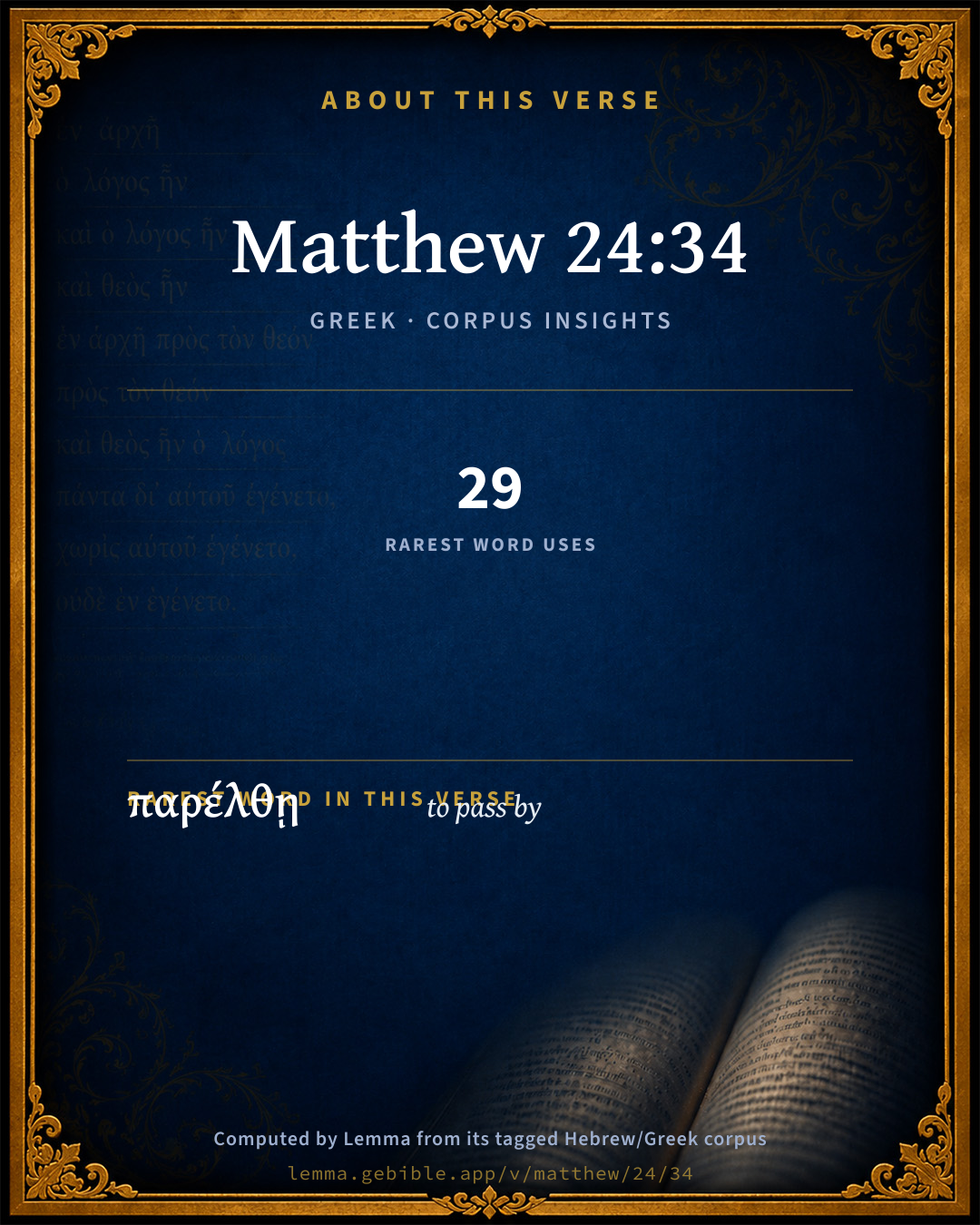
Matthew 24:34

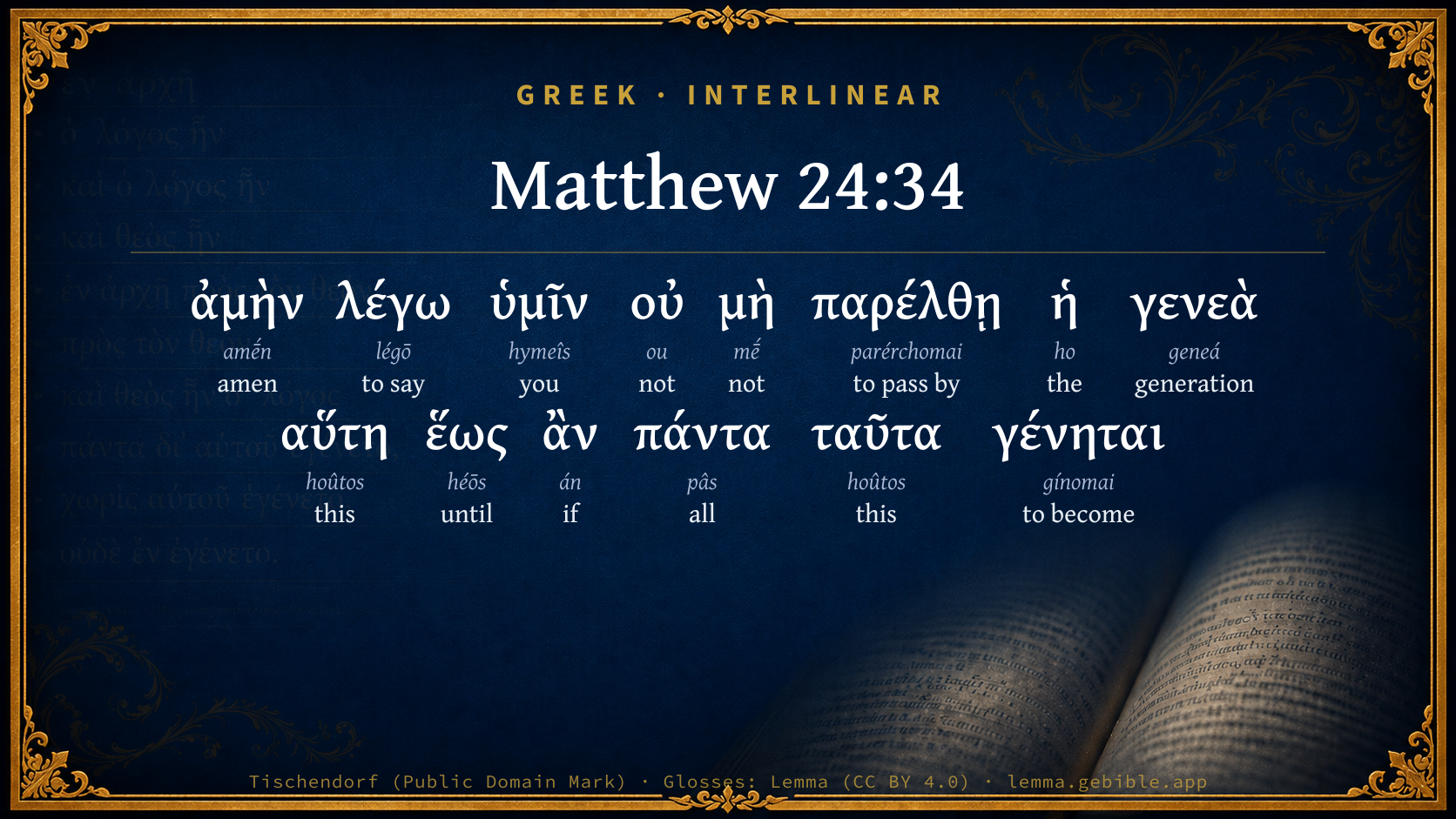
Greek (Tischendorf 8th ed.) Matthew 24:34 appears in the Greek New Testament. The text above is from the Tischendorf 8th edition. Each word links to its Strong’s number and a concise gloss. Click any word for its full Thayer’s Greek Lexicon entry.
Download image
Cite this verse

Matthew 24:34 (World English Bible). Public Domain. Lemma interlinear Bible study tool, https://lemma.gebible.app/v/matthew/24/34.

Show BibTeX & RIS
BibTeX
RIS
English Translation
Most assuredly I tell you, this generation will not pass away, until all these things are accomplished.
World English Bible · Public Domain
Download a study sheet

One document with this verse’s original text, its word-by-word gloss line, the meaning frame, cross-references with their text, attributed commentary, and full source and license credits — printable, and it pastes into notes with its structure intact.

This verse Autodidact and up

Study sheet (.html) Plain text (.txt)

A passage Seminary Student

Up to 50 verses in one chapter. A passage sheet keeps up to 6 commentary sources and 12 cross-references per verse, in the order this page ranks them, and says so on the sheet whenever that leaves anything out. Ask for a single verse and you get the Autodidact verse sheet above.

Everything on this page stays free to read, with no account — the sheet is a download of what is already on screen, not access to it.

Want to remove ads? Support Godless Engineer
Compare translations 3

The same verse in 3 English versions, stacked beneath the original-language interlinear above. Click any original word for its lexicon entry.

Each is an independent rendering of the whole verse — the interlinear is not word-aligned to these translations.

Highlighted words mark where these versions differ — a whole-verse word diff, not a word-by-word alignment.

  • World English Bible Public Domain
    Most assuredly I tell you, this generation will not pass away, until all these things are accomplished.
  • King James Version Public Domain
    Verily I say unto you, This generation shall not pass, till all these things be fulfilled.
  • unfoldingWord Literal Text CC BY-SA 4.0
    Truly I say to you that this generation will certainly not pass away until all these things happen.

unfoldingWord Literal Text — © unfoldingWord, licensed CC BY-SA 4.0. Word-aligned USFM3 via Door43 (git.door43.org/unfoldingWord/en_ult).

Versions to compare (up to 4)

3 of 4 selected

Show all 19 translations

Every available English version of this verse, each an independent rendering of the whole verse.

  • World English Bible Public Domain
    Most assuredly I tell you, this generation will not pass away, until all these things are accomplished.
  • Berean Standard Bible Public Domain
    Truly I tell you, this generation will not pass away until all these things have happened.
  • Majority Standard Bible Public Domain
    Truly I tell you, this generation will not pass away until all these things have happened.
  • King James Version Public Domain
    Verily I say unto you, This generation shall not pass, till all these things be fulfilled.
  • American Standard Version (1901) Public Domain
    Verily I say unto you, This generation shall not pass away, till all these things be accomplished.
  • Revised Version (1885) Public Domain
    Verily I say unto you, This generation shall not pass away, till all these things be accomplished.
  • Geneva Bible (1599) Public Domain
    Verely I say vnto you, this generation shall not passe, till all these things be done.
  • Douay-Rheims (1899) Public Domain
    Amen I say to you, that this generation shall not pass, till all these things be done.
  • Young's Literal Translation Public Domain
    Verily I say to you, this generation may not pass away till all these may come to pass.
  • Literal Standard Version CC BY-SA 4.0
    Truly I say to you, this generation may not pass away until all these may come to pass.
  • Unlocked Literal Bible CC BY-SA 4.0
    Truly I say to you, this generation will not pass away until all of these things will have happened.
  • unfoldingWord Literal Text CC BY-SA 4.0
    Truly I say to you that this generation will certainly not pass away until all these things happen.
  • Darby Bible Public Domain
    Verily I say to you, This generation will not have passed away until all these things shall have taken place.
  • World Messianic Bible Public Domain
    Most certainly I tell you, this generation will not pass away until all these things are accomplished.
  • Webster's Bible Public Domain
    Verily I say to you, This generation shall not pass, till all these things shall be fulfilled.
  • Free Bible Version CC BY-SA 4.0
    I tell you the truth: this generation won't pass away until all these things have happened.
  • Bible in Basic English Public Domain
    Truly I say to you, This generation will not come to an end till all these things are complete.
  • Text-Critical English NT CC BY 4.0
    Truly I say to you, this generation will certainly not pass away until all these things have taken place.
  • Tyndale New Testament (1534) Public Domain
    Verely I saye vnto you that this generacion shall not passe tyll all these be fulfilled.

Literal Standard Version (2020), Covenant Press — licensed CC BY-SA 4.0. Text via the HelloAO Bible API (eBible.org). Unlocked Literal Bible (unfoldingWord) — licensed CC BY-SA 4.0. Text via the HelloAO Bible API (eBible.org). unfoldingWord Literal Text — © unfoldingWord, licensed CC BY-SA 4.0. Word-aligned USFM3 via Door43 (git.door43.org/unfoldingWord/en_ult). Free Bible Version, Dr. Jonathan Gallagher — licensed CC BY-SA 4.0. Text via the HelloAO Bible API (eBible.org).

Word by word

More ways to search: Search by grammar → Find every occurrence → Compare this word →

Practice this passage: Drill this verse → Learn its vocabulary →

παρέλθῃ
parérchomai
G3928
“to pass by”
Verb, Aorist, Active, Subjunctive, 3rd person, Singular
Part of Speech
Verb
Tense
Aorist
Voice
Active
Mood
Subjunctive
Person
3rd person
Number
Singular
Full Thayer's Definition

Origin: from G3844 and G2064

TDNT: 13:21,3

1. to go past, pass by a. of persons moving forward 1. to pass by b. of time 1. an act continuing for a time c. metaph. 1. to pass away, perish 2. to pass by (pass over), that is, to neglect, omit, (transgress) 3. to be led by, to be carried past, be averted 2. to come near, come forward, arrive
  1. ἀμὴν amḗn G281 “amen” Hebrew transliteration
  2. λέγω légō G3004 “to say” Verb, Present, Active, Indicative, 1st person, Singular
  3. ὑμῖν hymeîs G5210 “you” Personal pronoun, 2nd person, Dative, Plural
  4. οὐ ou G3756 “not” Particle, Negative
  5. μὴ mḗ G3361 “not” Particle, Negative
  6. ἡ ho G3588 “the” Article, Nominative, Singular, Feminine
  7. γενεὰ geneá G1074 “generation” Noun, Nominative, Singular, Feminine
  8. αὕτη hoûtos G3778 “this” Demonstrative pronoun, Nominative, Singular, Feminine
  9. ἕως héōs G2193 “until” Adverb
  10. ἂν án G302 “if” Particle
  11. πάντα pâs G3956 “all” Adjective, Nominative, Plural, Neuter
  12. ταῦτα hoûtos G3778 “this” Demonstrative pronoun, Nominative, Plural, Neuter
  13. γένηται gínomai G1096 “to become” Verb, Aorist, Middle deponent, Subjunctive, 3rd person, Singular

About this verse

These counts appear in no published source. They are computed here, from the morphology-tagged text and Lemma’s own curated glosses. What Lemma adds →

14
words
13
distinct lemmas
Gospels
section

Shared distinctive vocabulary

παρέλθῃ to pass by G3928 occurs in 25 verses of the Greek New Testament. Also found in:

Repetition

A word recurs within this verse:

  • αὕτη this G3778 ×2

Cross-references

6

Topical passages linked to Matthew 24:34 in the Treasury of Scripture Knowledge — connected by theme and wording, ordered by reader-vote popularity; previews shown in the World English Bible.

  • Mark 13:30–31 Most assuredly I say to you, this generation will not pass away until all these things happen.
  • Luke 21:32–33 Most assuredly I tell you, this generation will not pass away until all things are accomplished.
  • Matthew 16:28 Most assuredly I tell you, there are some standing here who will in no way taste of death, until they see the Son of Man coming in his Kingdom."
  • Matthew 23:36 Most assuredly I tell you, all these things will come upon this generation.
  • Luke 11:50 that the blood of all the prophets, which was shed from the foundation of the world, may be required of this generation;
  • Matthew 12:45 Then he goes, and takes with himself seven other spirits more evil than he is, and they enter in and dwell there. The last state of that man becomes worse than the first. Even so will it be also to this evil generation."

Cross-references courtesy of OpenBible.info (CC BY 4.0).

Commentary

Notes on Matthew 24:34 from classic Christian and Jewish commentators (each source and its license shown beneath its notes). The classic Christian expositions comment on the surrounding passage and are grouped to its opening verse, so a note may address several verses; the Jewish commentaries on the Tanakh (Rashi and others) are per-verse, so they appear only where the commentator wrote on this verse.

Lemma curates 59 commentaries, every one of them public domain or Creative Commons licensed, each selected and text-cleaned for this edition rather than reprinted as found. About our sources →

Tyndale Open Study Notes

Tyndale Open Resources

24:34 this generation: In Matthew, generation is used particularly for contemporary, unbelieving Jews, especially focusing on the leaders who have led people away from the Messiah (11:16; 12:39, 41-42, 45; 16:4; 23:36).

Tyndale Open Study Notes — © Tyndale Open Resources, licensed CC BY-SA 4.0. Text via the HelloAO Bible API.

Bengel's Gnomon

Johann Albrecht Bengel

Mat 24:34. Γενεὰ, generation) sc. an age of men. This notion, which agrees with the event, corresponds most properly with the question, when? etc., proposed in ver, 3; cf. Mat 24:15; Mat 24:20, ch. Mat 23:36; Luk 23:38. From the date of this prediction to the destruction of Jerusalem was a space of forty years, and from the true year of our Lord’s nativity to that event was a space of about seventy-five years. The Jews, however (as, for example, in Seder Olam), reckon seventy-five years as one generation, and the words, οὐ μὴ παρέλθῃ, “shall not pass away,” intimate that the greater part of that generation, but not the whole of it, should have passed away before all the events indicated should have come to pass. The prediction is true with respect to either the forty or the seventy-five years.[1062] So accurately did the Evangelist describe it many years before the event took place.

[1062] Various things [agreeing with our Lord’s prophecy] can be brought forward from the writers of the Talmud, which are reported by them to have happened in the forty years before the destruction of the temple and the city, and which thus, with sufficient accuracy, harmonise with the history of the Passion.—Harm., p. 481.

Bengel's Gnomon of the New Testament — English translation (T&T Clark, Edinburgh, 1860) — public domain. Text from a community e-Sword module.

Meyer's Critical & Exegetical Commentary

Heinrich August Wilhelm Meyer

Mat_24:34. Declaration to the effect that all this is to take place before the generation then living should pass away. The well-nigh absurd manner in which it has been attempted to force into the words ἡ γενεὰ αὕτη such meanings as: the creation (Maldonatus), or: the human race (Jerome), or: the Jewish nation (Jansen, Calovius, Wolf, Heumann, Storr, Dorner, Hebart, Auberlen; see, on the other hand, on Mar_13:30), or: the class of men consisting of my believers (Origen, Chrysostom, Theophylact, Euthymius Zigabenus, Clarius, Paulus, Lange), resembles the unreasonable way in which Ebrard, following up his erroneous reference of πάντα ταῦτα (see on Mat_24:33), imports into the saying the idea: inde ab ipsorum (discipulorum) aetate omnibus ecclesiae temporibus interfutura, an imaginary view which passages like Mat_10:23, Mat_16:28, Mat_23:39, should have been sufficient to prevent. This also in opposition to the interpretation of Cremer: the generation of the elect now in question, and that of Klostermann: the (future) generation which is to witness those events, both of which are foreign to the sense. Comp. Mat_23:36.

The πάντα ταῦτα is the same as that of Mat_24:33, and therefore denoting neither the mere prognostics of the second advent, or, to be more definite, the taking away of the kingdom from Israel (Gess), nor specially the destruction of Jerusalem (Schott, E. J. Meyer, Hoelemann, Bäumlein in Klaibers Stud. I. 3, p. 41 ff.). That the second advent itself is intended to be included, is likewise evident from Mat_24:36, in which the subject of the day and hour of the advent is introduced.

Meyer — Critical and Exegetical Commentary on the New Testament — English translation by Peter Christie, edited by Frederick Crombie (T&T Clark, 1880) — public domain. Text from a community e-Sword module.

Expositor's Greek Testament

ed. W. Robertson Nicoll

Mat 24:34 Solemn assurance that the predicted will come to pass. πάντα ταῦτα is most naturally taken to mean the same things as in Mat 24:33 , he main subject of the discourse, the impending destruction of the Jewish state. Jesus was quite certain that they would happen within the then living generation ( ἡ γενεὰ αὕτη ), not merely through miraculous foresight but through clear insight into the moral forces at work.

The Expositor's Greek Testament, edited by W. Robertson Nicoll (1897–1910) — public domain. Text from a community e-Sword module.

Geneva Bible (1599)

Geneva Bible translators

This age: this word generation or Age, being used for the men of this age.

Geneva Bible (1599) marginal notes — public domain. Text via Bolls.life.

Adam Clarke's Commentary

Verse 34. This generation shall not pass] Η γενεα αυτη, this race; i.e. the Jews shall not cease from being a distinct people, till all the counsels of God relative to them and the Gentiles be fulfilled. Some translate η γενεα αυτη, this generation, meaning the persons who were then living, that they should not die before these signs, c., took place: but though this was true, as to the calamities that fell upon the Jews, and the destruction of their government, temple, c., yet as our Lord mentions Jerusalem's continuing to be under the power of the Gentiles till the fulness of the Gentiles should come in, i.e. till all the nations of the world should receive the Gospel of Christ, after which the Jews themselves should be converted unto God, Ro 11:25, &c., I think it more proper not to restrain its meaning to the few years which preceded the destruction of Jerusalem but to understand it of the care taken by Divine providence to preserve them as a distinct people, and yet to keep them out of their own land, and from their temple service. See on Mr 13:30. But still it is literally true in reference to the destruction of Jerusalem. John probably lived to see these things come to pass compare Mt 16:28, with Joh 21:22; and there were some rabbins alive at the time when Christ spoke these words who lived till the city was destroyed, viz. Rabban Simeon, who perished with the city; R. Jochanan ben Zaccai, who outlived it; R. Zadoch, R. Ismael, and others. See Lightfoot.

The war began, as Josephus says, Ant. b. xx. c. 11. s. 1, in the second year of the government of Gessius Florus, who succeeded Albinus, successor of Porcius Festus, mentioned Ac 24:27, in the month of May, in the twelfth year of Nero, and the seventeenth of Agrippa, mentioned Acts 25 and 26, that is, in May, A. D. 66.

The temple was burnt August 10, A. D. 70, the same day and month on which it had been burnt by the king of Babylon: Josephus, Ant. b. xx. c. 11. s. 8.

The city was taken September 8, in the second year of the reign of Vespasian, or the year of Christ 70. Ant. b. vi. c. 10.

That was the end of the siege of Jerusalem, which began, as Josephus several times observes, about the fourteenth day of the month Nisan, or our April. See War, b. v. c. 3. s. 1, c. 13. s. 7; b. vi. c. 9. s. 3.

Dr. Lardner farther remarks, There is also an ancient inscription to the honour of Titus, "who, by his father's directions and counsels, had subdued the Jewish nation and destroyed Jerusalem, which had never been destroyed by any generals, kings, or people, before." The inscription may be seen in GRUTER, vol. i. p. 244. It is as follows: -

IMP. TITO. CAESARI. DIVI. VESPASIANI. F

VESPASIANO. AUG. PONTIFICI. MAXIMO

TRIB, POT. X. IMP. XVII. COS. VIII. P. P.

PRINCIPI. SUO. S. P. Q. R.

QUOD. PRAECEPTIS. PATRIS. CONSILIISQUE. ET

AUSPICIIS. GENTEM. JUDAEOROM. DOMUIT. ET

URBEM. HIEROSOLYMAM. OMNIBUS. ANTE. SE

DUCIBUS. REGIBUS. GENTIBUSQUE. AUT. FRUSTRA.

PETITAM. AUT. OMNINO. INTENTATAM. DELEVIT.

For this complete conquest of Jerusalem, Titus had a triumphal arch erected to his honour, which still exists. It stands on the Via Sacra, leading from the forum to the amphitheatre. On it are represented the spoils of the temple of God, such as the golden table of the show-bread, the golden candlestick with its seven branches, the ark of the covenant, the two golden trumpets, c., c. for a particular account see the note on Ex 25:31. On this arch, a correct model of which, taken on the spot, now stands before me, is the following inscription: -

SENATUS

POPULUSQUE ROMANUS

DIVO TITO. DIVI VESPASIANI. F

VESPASIANO AUGUSTO.

"The Senate and People of Rome, to the Divine Titus, son of the Divine Vespasian and to Vespasian the Emperor."

On this occasion, a medal was struck with the following inscription round a laureated head of the emperor: - IMP.erator J.ulius CAES.ar VESP.asianus AUG.ustus. P.ontifex M.aximus, TR.ibunitia, P.otestate P.ater P.atrice CO.nS.ul VIII. - On the obverse are represented a palm tree, the emblem of the land of Judaea; the emperor with a trophy standing on the left; Judea, under the figure of a distressed woman, sitting at the foot of the tree weeping, with her head bowed down, supported by her left hand, with the legend JUDAEA CAPTA. S.enatus C.onsultus. at the bottom. This is not only an extraordinary fulfilment of our Lord's prediction, but a literal accomplishment of a prophecy delivered about 800 years before, Isa 3:26, And she, desolate, shall sit upon the ground.

Adam Clarke's Commentary on the Bible (1810–1826) — public domain. Text from a community e-Sword/MySword module.

Ellicott's Commentary for English Readers

(34) This generation shall not pass . . .—The natural meaning of the words is, beyond question. that which takes “generation” in the ordinary sense (as in Mat_1:17, Act_13:36, and elsewhere) for those who are living at any given period. So it was on “this generation” (Mat_23:36) that the accumulated judgments were to fall. The desire to bring the words into more apparent harmony with history has led some interpreters to take “generation” in the sense of “race” or “people,” and so to see in the words a prophecy of the perpetuity of the existence of the Jews as a distinct people till the end of the world. But for this meaning there is not the shadow of authority; nor does it remove the difficulty which it was invented to explain. The words of Mat_16:28 state the same fact in language which does not admit of any such explanation.

Till all these things be fulfilled.—Better, till all these things come to pass. The words do not necessarily imply more than the commencement of a process, the first unrolling of the scroll of the coming ages.

A Bible Commentary for English Readers, edited by Charles John Ellicott (1878–1897) — public domain. Text from a community e-Sword module.

The Cambridge Bible for Schools and Colleges

gen. ed. J. J. S. Perowne

34. This generation] See note, ch. Mat_16:28.

The Cambridge Bible for Schools and Colleges (gen. ed. J. J. S. Perowne; Cambridge University Press, 1878–1918) — public domain. Text from a community e-Sword module.

John Gill's Exposition

Heaven and earth shall pass away,.... This is either an assertion, which will be true at the end of time; not as to the substance of the heavens and earth, which will always remain, but as to the qualities of them, which will be altered: they will be renewed and refined, but not destroyed; the bad qualities, or evil circumstances, which attend them through the sin of man, will be removed and pass away, but they themselves will continue in being: or is a comparative expression, and the sense is, that the heavens and the earth, and the ordinances thereof, than which nothing can be more firm and strong, being fixed and supported by God himself, shall sooner pass away, than anything asserted and predicted by Christ shall:

but my words shall not pass away; be vain and empty, and unaccomplished; which is true of anything, and everything spoken by Christ; and especially here regards all that he had said concerning the calamities that should befall the Jews, before, at, or upon the destruction of their nation, city, and temple; and the design of the expression, is to show the certainty, unalterableness, and sure accomplishment of these things; see Jer 31:36.

John Gill's Exposition of the Whole Bible (1746–1763) — public domain (CC PDM 1.0). Text via the HelloAO Bible API.

Trapp's Complete Commentary

John Trapp

34 Verily I say unto you, This generation shall not pass, till all these things be fulfilled.

Ver. 34. This generation shall not pass] viz. That generation that immediately precedes the end of the world. That this is the sense, appears by the antithesis, Mat 24:36; "But of that day and hour knoweth no man," q.d. the generation and age wherein Christ shall come ye may know by the signs that foreshow it, but the day and hour ye must not look to know, be you never so intelligent.

John Trapp, A Commentary or Exposition upon All the Books of the Old and New Testament (1647–1656) — public domain. Text from a community e-Sword module.

Albert Barnes' Notes on the Bible

This generation ... - This age; this race of people. A generation is about 30 or 40 years. The destruction of Jerusalem took place about forty years after this was spoken. See the notes at Mat 16:28.

Till all these things ... - Until these things shall be accomplished. Until events shall take place which shall be a fulfillment of these words, if there were nothing further intended. He does not mean to exclude the reference to the judgment, but to say that the destruction of Jerusalem would be such as to make appropriate the words of the prediction, were there nothing beyond. Compare the notes at Mat 1:22-23. So when “death” was threatened to Adam, the propriety of the threatening would have been seen, and the threatening would have been fulfilled, had people suffered only temporal death. At the same time the threatening had “a fullness of meaning” that would cover also, and justify, eternal death. Thus the words of Christ describing the destruction of Jerusalem had a fulness of signification that would meet also the events of the judgment, and whose meaning would not be “entirely filled up” until the world was closed.

Albert Barnes' Notes on the Bible (1834–1885) — public domain. Text from a community e-Sword/MySword module.

Haydock's Catholic Bible Commentary

This generation; i.e. the nation of the Jews shall not cease to exist, until all these things shall be accomplished: thus we see the nation of the Jews still continue, and will certainly continue to the end of the world. (Tirinus) --- Then the cross, which as been a scandal to the Jew, and a stumbling-block to the Gentile, shall appear in the heavens, for the consolation of the good Christian. Hoc signum crucis erit in cœlo, cum Dominus ad judicandum venerit. --- If it be to be understood of the destruction of Jerusalem, the sense may be, this race of men now living; if of the last day of judgment, this generation of the faithful, saith Theophylactus,[4] shall be continued: i.e. the Church of Christ, to the end of the world. (Witham) --- This race, I tell you in very truth, shall not pass away till all this be finally accomplished in the ruin of Jerusalem, the most express figure of the destruction and end of the world. (Bible de Vence) --- By generation, our Saviour does not mean the people that were in existence at that time, but the faithful of his Church; thus says the psalmist: this is the generation of them that seek the Lord. (Psalm xxiii, ver. 6.) (St. John Chrysostom, hom. lxxvii.)

===============================

[BIBLIOGRAPHY]

Generatio hæc. Theophylact, e genea ton christianon.

George Leo Haydock (1774–1849), Haydock's Catholic Family Bible and Commentary, 1859 edition — public domain. Excludes Psalms (Douay-Rheims chapter numbering differs from Protestant) and Deuterocanonical books (Catholic canon only).

Whedon's Commentary on the Bible

Daniel D. Whedon

34. This generation shall not pass till all THESE THINGS be fulfilled — This celebrated verse has been quoted by many orthodox expositors, indeed by their great body in modern times, to show that all the events named in the discourse thus far take place in that generation. Certainly this cannot be true of Luk_21:24, for the events of that verse did not transpire during that generation. We trust that we have made it plain that the these things of this verse are simply the answer to the these things inquired about by the disciples in verse third. They ask when these things shall be. He is now prepared to answer: These things shall be before this present generation passes. But the these things of the question only comprehend the overthrow of the city and temple. This is identical with the these things of the thirty-third verse.

Precisely parallel to this verse is Mat_23:36 : “Verily I say unto you, all these things shall come upon this generation.” And by the these things of that verse plainly were meant the destruction of the city and state. And this parallelism, it might be remarked by the way, goes to show the incorrectness of the interpretation which some have adopted, by which the word generation is made to signify race. Were it to signify race, what race is indicated by this race? It might mean the human race, or the Jewish race, or the Christians, as Dr. Clarke supposes; and thus we are thrown into a state of perfect vagueness. But this rendering of the word has met with but little favour among scholars.

Of the overthrow of the temple, the disciples ask: “When shall THESE THINGS be?” Of that same event the Lord replies, after giving its full attendant details: “This generation shall not pass till all THESE THINGS be fulfilled.”

Daniel D. Whedon (gen. ed.), Commentary on the Old and New Testaments (1874–1909) — public domain. Text from a community e-Sword module.

The Pulpit Commentary

This generation. Our Lord"s assertion has given rise to sceptical observations, as if his prophecy had failed. Alford has endeavoured to remove objections by taking genea as equivalent to genov , a race or family of people, and referring it to the continued existence of the Jews. He cites Jer_8:3 (Septuagint); Mat_12:45 Mat_17:17 Mat_23:36, etc., in confirmation of this signification. His examples, however, are not unassailable, though such use is certainly classical; but it the same time, it is unlikely that Christ should thus indefinitely postpone a period of infinite importance to his hearers. But there is no necessity for assuming any unusual meaning in the term "this generation." Its plain and obvious reference is to the contemporaries of the speaker, or those who shall live some thirty or forty years longer; this period would bring them to the siege of Jerusalem. And remembering that Christ has drawn no definite line between this crisis and the final consummation, we are justified in regarding all these things as meaning, primarily, the signs preceding or accompanying the downfall of the city. In a secondary sense, "this generation" may mean the spiritual Israel, the generation of them that seek the Lord. (Psa_24:6) "All these things shall surely come to pass," says Chrysostom, "and the generation of the faithful shall remain, cut off by none of the things that have been mentioned. For both Jerusalem shall perish, and the more part of the Jews shall be destroyed, but over this generation shall nothing prevail not famine, not pestilence, not earthquake, not the tumults of wars, not false Christs, not false prophets, not deceivers, not traitors, not those that cause to offend, nor the false brethren, nor any other such-like temptations whatever." Some critics have combined the three meanings of "generation" given above, and have seen in Christ"s words a threefold reference, first, to the contemporary people; secondly, to the Jewish nation; thirdly, to the Christian believers or dispensation. According to Lange, "this generation" means the generation of those who know and discern these signs.

A key to our Lord"s meaning.

"This generation shall not pass till all these things be fulfilled." The position in which these words stand is significant. Many writers see references to the commonly called "end of the world" in vers. 29-31 because the imagery is so large as to seem unsuitable for a mere national desolation. Our Lord meets that difficulty, and distinctly declares that the figures picture events which belong to that generation. What needs to be clearly seen is, that this discourse of our Lord"s is not a general discourse on the "last things," but a precise anticipation of the experiences through which his disciples were about to pass, and a gracious preparation for them. He was leaving those disciples to themselves. He had indications to the very last of their unfitness to be left. They were still so hampered by their notions of a material kingdom. They were Jews, full of Jewish ideas. It would be a distress to them that the Jewish system was to be put away, as having fulfilled its mission. It might even be overwhelming to them that the very city and temple were destroyed. Our Lord would forewarn them. Their knowledge of the fact would help them to think aright, and to act aright, when the time came. This is the key to our Lord"s meaning.

I THE DISCIPLES HELPED TO THINK ARIGHT. We know how great a strain on them was the opening of the gospel to the Gentiles. St. Peter had to explain his conduct in baptizing Cornelius. St. Paul had to give account of his teachings of the Gentiles. And we can understand how much greater must have been the strain, when not only were Gentile Churches formed, but the Jewish Church was broken up. suppose that our Lord had never spoken of this removing of organized Judaism. We can quite see that the Jewish Christians would have been altogether alarmed and overwhelmed. They could think aright, and realize the permanency of the Church as a spiritual institution, independent of, if related to, any material forms.

II THE DISCIPLES HELPED TO ACT ARIGHT. Explain that, from a Jewish point of view, the centre for the new Christian mission must be Jerusalem. Those disciples would be likely to cling to Jerusalem in a way that would involve their personal safety. Our Lord therefore forewarned them. When certain events happened, they must finally and quickly forsake the sacred city. That there might be no self-delusions, no procrastinations, he made his meaning plain by the words of the text. R.T.

The Pulpit Commentary (1880–1919), ed. H.D.M. Spence-Jones & Joseph S. Exell — public domain. Text from a community e-Sword module.

John Wesley's Explanatory Notes

This generation of men now living shall not pass till all these things be done - The expression implies, that great part of that generation would be passed away, but not the whole. Just so it was. For the city and temple were destroyed thirty-nine or forty years after.

John Wesley, Explanatory Notes Upon the Whole Bible (1754–1765) — public domain. Text via the GEBible commentary corpus.

Scofield Reference Notes

C. I. Scofield

This generation

(Greek - ἀγενεαλόγητος," the primary definition of which is, "race, kind, family, stock, breed)." (So all lexicons.) That the word is used in this sense because none of "these things," i.e. the world-wide preaching of the kingdom, the great tribulation, the return of the Lord in visible glory, and the regathering of the elect, occurred at the destruction of Jerusalem by Titus, A.D. 70. The promise is, therefore, that the generation--nation, or family of Israel-- will be preserved unto "these things"; a promise wonderfully fulfilled to this day.

The Scofield Reference Bible (1917 edition), notes by C. I. Scofield — public domain. Text from a community e-Sword module.

The People's New Testament

B. W. Johnson

34, 35. This generation shall not pass till all these things be fulfilled. Some hold that “all these things,” in verse 33 and 34, refer only to what was said of the fall of Jerusalem, ending with verse 28. Others have contended that the phrase includes the second coming, but refers directly to the end of Jerusalem, which was a type of the end of the world. I believe, rather, that “all these things” embraces all thus far predicted, and that “this generation” means the Jewish race, instead of only those then living. The Greek word so rendered is used in the sense of race in the Greek classics, and as examples of such use in the New Testament, Alford points to Matt. 12:45, and Luke 16:8, as examples of such use in the New Testament. Christ has described the awful end of the Jewish state; after such a destruction and scattering of the remnant to the ends of the earth, all the examples of history would declare that the Jewish race would become extinct. Christ, however, declares that, contrary to all probability, it shall not pass away until he comes. They still exist, 1850 years after the prediction, distinct, but without a country.

B. W. Johnson's The People's New Testament with Notes (1889–1891) — public domain. Electronic text from the Christian Classics Ethereal Library (CCEL) ThML edition.

unfoldingWord translationNotes

Door43 World Missions Community

Truly I say to you

"I tell you the truth." This adds emphasis to what Jesus says next.

this generation will not pass away

Here "pass away" is a polite way of saying "die." AT: "this generation will not all die" (See: Euphemism)

this generation

Possible interpretations are 1) "all people alive today," referring to the people alive when Jesus was speaking, or 2) "all people alive when these things I have just told you about happen." Try to translate so that both interpretations are possible.

until all of these things will have happened

"until God causes all these things to happen"

Heaven and the earth will pass away

The words "heaven" and "earth" are a synecdoche that includes everything that God has created, especially those things that seem permanent. Jesus is saying that his word, unlike these things, is permanent. AT: "Even heaven and the earth will pass away" (See: Synecdoche)

pass away

"disappear" or "someday no longer exist"

my words will never pass away

Here "words" refers to what Jesus has said. AT: "what I say will always be true" (See: Metonymy)

translationWords

amen

generation

heaven

earth

word

unfoldingWord translationNotes — © Distant Shores Media and the Door43 World Missions Community, licensed CC BY-SA 4.0. Source: git.door43.org/Door43/en_tn.

Cambridge Greek Testament for Schools and Colleges

34. ἡ γενεὰ αὕτη. See note, ch. Mat 16:28.

36—End of CHAP. 25. PARABLES AND TEACHINGS CONCERNING THE SECOND ADVENT

Cambridge Greek Testament for Schools and Colleges (Cambridge University Press, 1896; 21 vols, various authors incl. Carr, Maclear, Plummer, Farrar, Lumby, Moule, M. R. James, Simcox) — public domain. Text from a community e-Sword module.

Alford’s Greek Testament

Henry Alford

34.] τὴν παρ., not as E. V., ‘a parable,’ but the (not, its: the fig-tree may teach many lessons besides this; cf. reff. Matt. Luke) parable,—the natural phænomenon which may serve as a key to the meaning.

This coming of the Lord shall be as sure a sign that the Kingdom of Heaven is nigh, as the putting forth of the tender leaves of the fig-tree is a sign that summer is nigh. Observe πάντα ταῦτα, every one of these things,—this coming of the Son of Man included, which will introduce the millennial Kingdom.

As regards the parable,—there is a reference to the withered fig-tree which the Lord cursed: and as that, in its judicial unfruitfulness, emblematized the Jewish people, so here the putting forth of the fig-tree from its state of winter dryness, symbolizes the future reviviscence of that race, which the Lord (ver. 34) declares shall not pass away till all be fulfilled. That this is the true meaning of that verse, must appear when we recollect that it forms the conclusion of this parable, and is itself joined by παρέλθῃ to the verse following. We cannot, in seeking for its ultimate fulfilment, go back to the taking of Jerusalem and make the words apply to it.

As this is one of the points on which the rationalizing interpreters (De Wette, &c.) lay most stress to shew that the prophecy has failed, it may be well to shew that γενεά has in Hellenistic Greek the meaning of a race or family of people. See Jer 8:3 LXX; compare ch. 23:36 with ib. ver. 35, ἐφονεύσατε … but this generation did not slay Zacharias—so that the whole people are addressed: see also ch. 12:45, in which the meaning absolutely requires this sense (see note there): see also Luk 17:25: Mat 17:17: Luk 16:8 (where γενεά is predicated both of the υἱοὶ τοῦ αἰῶνος τούτου and the νἱοὶ τοῦ φωτός): Act 2:40: Php 2:15. In all these places γενεά is = γένος, or nearly so; having it is true a more pregnant meaning, implying that the character of one generation stamps itself upon the race, as here in this verse also.

This meaning of γενεά is fully conceded by Dorner; ‘omnes reor concessuros, vocem γ. si eam vertas ætas, multas easque plane insuperabiles ciere difficultates, contextum vero et orationis progressum flagitare significationem gentis, nempe Judæorum.’ (Stier, ii. 502.) The continued use of παρέρχομαι in vv. 34, 35, should have saved the Commentators from the blunder of imagining that the then living generation was meant, seeing that the prophecy is by the next verse carried on to the end of all things: and that, as matter of fact, the Apostles and ancient Christians did continue to expect the Lord’s coming, after that generation had part away. But, as Stier well remarks, “there are men foolish enough now to say, heaven and earth will never pass away, but the words of Christ pass away in course of time—; of this, however, we wait the proof.” ii. 505.

πάντα ταῦτα] all the signs hitherto recounted—so that both these words, and ὑμεῖς, have their partial, and their full meanings.

ἐγγύς ἐστιν] viz. τὸ τέλος. On ver. 35 see Psa 119:89: Isa 40:8; Isa 51:6: Psa 102:26.

Henry Alford, The Greek Testament (1849–1861) — public domain. Text from a community e-Sword module.

International Critical Commentary

(M) 34. Verily I say to you, That this generation shall not pass away, until all these things have happened.] Mk. has μέχρις οὗ for ἕως ἄν.

International Critical Commentary — older volumes (1896–1929), various authors — public domain. Text from a community e-Sword module.

Lesson kit

Teaching starters — assembled from the data on this page, not authored interpretation. Every prompt links to the verse data it draws on. Edit before teaching.

Matthew, in the Gospels, opens this verse with 14 words (13 distinct Greek lemmas). Its most distinctive word is parérchomai (“to pass by”). A historical commentator’s framing appears above. Read the whole chapter for the surrounding context.

Discussion questions

  1. The word parérchomai carries the sense “to pass by.” How does it shape the verse?
  2. How does Matthew 5:18, which shares the word «to pass by», read alongside this verse?
  3. What does the repetition of “this” (2× in this one verse) do in this verse?
  4. The translations on this page render this verse differently — a whole-verse word diff, not a word-by-word alignment. What might account for the different wordings?
  5. Compare how Tyndale Open Study Notes and Bengel's Gnomon read this verse. Where do they agree or differ?

Things to notice

Reading settings

Reading text

Shown beneath each verse's original-language words.

Old Testament
Old Testament edition

Read the OT as the Masoretic Hebrew (MT) or the Greek Septuagint (LXX).

English shown for the Greek Septuagint (in the Hebrew ↔ Greek comparison).

Comparing translations? Open the Compare panel on any verse page to stack up to four side by side.