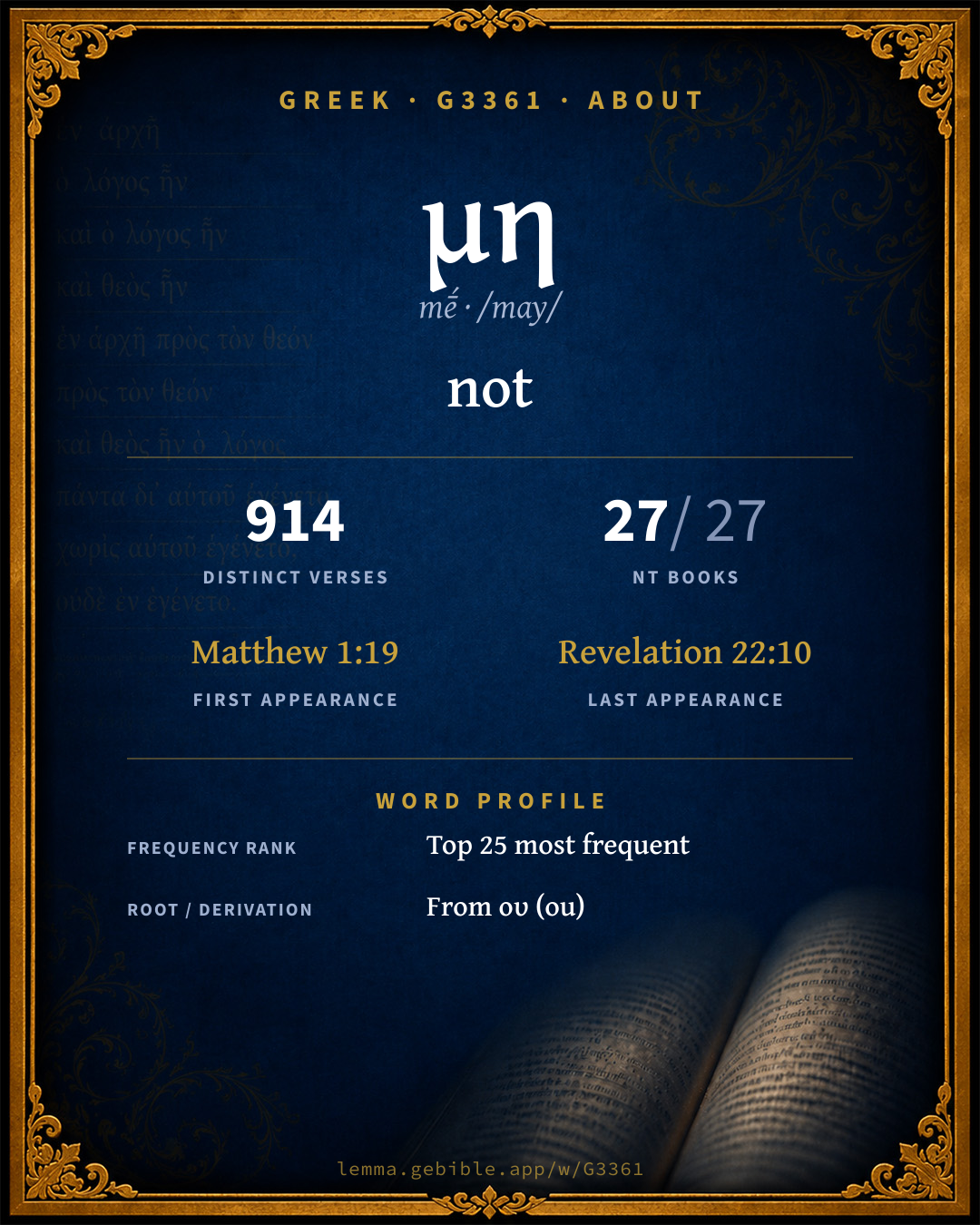
μή
not
Full lexicon entry — Thayer's Greek Lexicon
From Thayer's Greek Lexicon
Where this word appears
Grammar key — what these labels mean
Part of speech
- Particle
- A short, often untranslatable function word adding nuance or connection.
Degree
- Negative
- Marks a negative form.
Page 1 of 5 — showing verses 1–200 of 914 distinct verses where G3361 appears, across 27 books. Click any verse to open its interlinear word-by-word view. Verse text shown in the World English Bible for context — . Each verse’s Greek form is shown with its reference; the English is not keyword-highlighted, since the data carries no word-level English alignment. Use “Compare translations” on any verse to read it across multiple English versions. This concordance covers the Greek New Testament; Septuagint (Greek Old Testament) occurrences of this word are not indexed here.
Matthew 116 verses
- Matthew 1:19 μὴ ptcl neg Joseph, her husband, being a righteous man, and not willing to make her a public example, intended to put her away secretly.
- Matthew 1:20 μὴ ptcl neg But when he thought about these things, behold, an angel of the Lord appeared to him in a dream, saying, "Joseph, son of David, don't be afraid to take to yourself Mary, your wife, for that which is conceived in her is of the Holy Spirit.
- Matthew 2:12 μὴ ptcl neg Being warned in a dream that they shouldn't return to Herod, they went back to their own country another way.
- Matthew 3:9 μὴ ptcl neg Don't think to yourselves, 'We have Abraham for our father,' for I tell you that God is able to raise up children to Abraham from these stones.
- Matthew 3:10 μὴ ptcl neg "Even now the axe lies at the root of the trees. Therefore, every tree that doesn't bring forth good fruit is cut down, and cast into the fire.
- Matthew 5:13 μὴ ptcl neg "You are the salt of the earth, but if the salt has lost its flavor, with what will it be salted? It is then good for nothing, but to be cast out and trodden under the feet of men.
- Matthew 5:17 Μὴ ptcl neg "Don't think that I came to destroy the law or the prophets. I didn't come to destroy, but to fulfill.
- Matthew 5:18 μὴ ptcl neg For most assuredly, I tell you, until heaven and earth pass away, not even one smallest letter or one tiny pen stroke shall in any way pass away from the law, until all things are accomplished.
- Matthew 5:20 μὴ μὴ ptcl neg ptcl neg For I tell you that unless your righteousness exceeds that of the scribes and Pharisees, there is no way you will enter into the Kingdom of Heaven.
- Matthew 5:26 μὴ ptcl neg Most assuredly I tell you, you shall by no means get out of there, until you have paid the last penny.
- Matthew 5:29 μὴ ptcl neg If your right eye causes you to stumble, pluck it out and throw it away from you. For it is more profitable for you that one of your members should perish, than for your whole body to be cast into Gehenna.
- Matthew 5:30 μὴ ptcl neg If your right hand causes you to stumble, cut it off, and throw it away from you: for it is profitable for you that one of your members should perish, and not your whole body be thrown into Gehenna.
- Matthew 5:34 μὴ ptcl neg but I tell you, don't swear at all: neither by heaven, for it is the throne of God;
- Matthew 5:39 μὴ ptcl neg But I tell you, don't resist him who is evil; but whoever strikes you on your right cheek, turn to him the other also.
- Matthew 5:42 μὴ ptcl neg Give to him who asks you, and don't turn away him who desires to borrow from you.
- Matthew 6:1 μὴ μήγε ptcl neg ptcl neg "Be careful that you don't do your charitable giving before men, to be seen by them, or else you have no reward from your Father who is in heaven.
- Matthew 6:2 μὴ ptcl neg Therefore when you do merciful deeds, don't sound a trumpet before yourself, as the hypocrites do in the synagogues and in the streets, that they may get glory from men. Most assuredly I tell you, they have received their reward.
- Matthew 6:3 μὴ ptcl neg But when you do merciful deeds, don't let your left hand know what your right hand does,
- Matthew 6:7 μὴ ptcl neg In praying, don't use vain repetitions, as the Gentiles do; for they think that they will be heard for their much speaking.
- Matthew 6:8 μὴ ptcl neg Therefore don't be like them, for your Father knows what things you need, before you ask him.
- Matthew 6:13 μὴ ptcl neg Bring us not into temptation, but deliver us from the evil one. For yours is the Kingdom, the power, and the glory forever. Amen.'
- Matthew 6:15 μὴ ptcl neg But if you don't forgive men their trespasses, neither will your Father forgive your trespasses.
- Matthew 6:16 μὴ ptcl neg "Moreover when you fast, don't be like the hypocrites, with sad faces. For they disfigure their faces, that they may be seen by men to be fasting. Most assuredly I tell you, they have received their reward.
- Matthew 6:18 μὴ ptcl neg so that you are not seen by men to be fasting, but by your Father who is in secret, and your Father, who sees in secret, will reward you.
- Matthew 6:19 Μὴ ptcl neg "Don't lay up treasures for yourselves on the earth, where moth and rust consume, and where thieves break through and steal;
- Matthew 6:25 μὴ ptcl neg Therefore, I tell you, don't be anxious for your life: what you will eat, or what you will drink; nor yet for your body, what you will wear. Isn't life more than food, and the body more than clothing?
- Matthew 6:31 μὴ ptcl neg "Therefore don't be anxious, saying, 'What will we eat?', 'What will we drink?' or, 'With what will we be clothed?'
- Matthew 6:34 μὴ ptcl neg Therefore don't be anxious for tomorrow, for tomorrow will be anxious for itself. Each day's own evil is sufficient.
- Matthew 7:1 Μὴ μὴ ptcl neg ptcl neg "Don't judge, so that you won't be judged.
- Matthew 7:6 Μὴ ptcl neg "Don't give that which is holy to the dogs, neither throw your pearls before the pigs, lest perhaps they trample them under their feet, and turn and tear you to pieces.
- Matthew 7:9 μὴ ptcl neg Or who is there among you, who, if his son asks him for bread, will give him a stone?
- Matthew 7:10 μὴ ptcl neg Or if he asks for a fish, who will give him a serpent?
- Matthew 7:19 μὴ ptcl neg Every tree that doesn't grow good fruit is cut down, and thrown into the fire.
- Matthew 7:26 μὴ ptcl neg Everyone who hears these words of mine, and doesn't do them will be like a foolish man, who built his house on the sand.
- Matthew 8:28 μὴ ptcl neg When he came to the other side, into the country of the Gergesenes, two people possessed by demons met him there, coming out of the tombs, exceedingly fierce, so that nobody could pass by that way.
- Matthew 9:15 μὴ ptcl neg Jesus said to them, "Can the friends of the bridegroom mourn, as long as the bridegroom is with them? But the days will come when the bridegroom will be taken away from them, and then they will fast.
- Matthew 9:17 μήγε ptcl neg Neither do people put new wine into old wineskins, or else the skins would burst, and the wine be spilled, and the skins ruined. No, they put new wine into fresh wineskins, and both are preserved."
- Matthew 9:36 μὴ ptcl neg But when he saw the multitudes, he was moved with compassion for them, because they were harassed and scattered, like sheep without a shepherd.
- Matthew 10:5 μὴ μὴ ptcl neg ptcl neg Jesus sent these twelve out, and charged them, saying, "Don't go among the Gentiles, and don't enter into any city of the Samaritans.
- Matthew 10:9 μὴ ptcl neg Don't take any gold, nor silver, nor brass in your money belts.
- Matthew 10:10 μὴ ptcl neg Take no bag for your journey, neither two coats, nor shoes, nor staff: for the laborer is worthy of his food.
- Matthew 10:13 μὴ ptcl neg If the household is worthy, let your peace come on it, but if it isn't worthy, let your peace return to you.
- Matthew 10:14 μὴ ptcl neg Whoever doesn't receive you, nor hear your words, as you go out of that house or that city, shake off the dust from your feet.
- Matthew 10:19 μὴ ptcl neg But when they deliver you up, don't be anxious how or what you will say, for it will be given you in that hour what you will say.
- Matthew 10:23 μὴ ptcl neg But when they persecute you in this city, flee into the next, for most assuredly I tell you, you will not have gone through the cities of Israel, until the Son of Man has come.
- Matthew 10:26 μὴ ptcl neg Therefore don't be afraid of them, for there is nothing covered that will not be revealed; and hidden that will not be known.
- Matthew 10:28 μὴ μὴ ptcl neg ptcl neg Don't be afraid of those who kill the body, but are not able to kill the soul. Rather, fear him who is able to destroy both soul and body in Gehenna.
- Matthew 10:31 μὴ ptcl neg Therefore don't be afraid. You are of more value than many sparrows.
- Matthew 10:34 Μὴ ptcl neg "Don't think that I came to send peace on the earth. I didn't come to send peace, but a sword.
- Matthew 10:42 μὴ ptcl neg Whoever gives one of these little ones just a cup of cold water to drink in the name of a disciple, most assuredly I tell you he will in no way lose his reward."
- Matthew 11:6 μὴ ptcl neg Blessed is he who finds no occasion for stumbling in me."
- Matthew 11:23 μὴ ptcl neg You, Capernaum, who are exalted to Heaven, you will go down to Hades. For if the mighty works had been done in Sodom which were done in you, it would have remained until this day.
- Matthew 11:27 μὴ μὴ ptcl neg ptcl neg All things have been delivered to me by my Father. No one knows the Son, except the Father; neither does anyone know the Father, except the Son, and he to whom the Son desires to reveal him.
- Matthew 12:4 μὴ ptcl neg how he entered into the house of God, and ate the show bread, which was not lawful for him to eat, neither for those who were with him, but only for the priests?
- Matthew 12:16 μὴ ptcl neg and charged them that they should not make him known:
- Matthew 12:24 μὴ ptcl neg But when the Pharisees heard it, they said, "This man does not cast out demons, except by Beelzebul, the prince of the demons."
- Matthew 12:29 μὴ ptcl neg Or how can one enter into the house of the strong man, and plunder his goods, unless he first bind the strong man? Then he will plunder his house.
- Matthew 12:30 μὴ μὴ ptcl neg ptcl neg "He who is not with me is against me, and he who doesn't gather with me, scatters.
- Matthew 12:39 μὴ ptcl neg But he answered them, "An evil and adulterous generation seeks after a sign, but no sign will be given it but the sign of Jonah the prophet.
- Matthew 13:5 μὴ ptcl neg Others fell on rocky ground, where they didn't have much soil, and immediately they sprang up, because they had no depth of earth.
- Matthew 13:6 μὴ ptcl neg When the sun had risen, they were scorched. Because they had no root, they withered away.
- Matthew 13:14 μὴ μὴ ptcl neg ptcl neg In them the prophecy of Isaiah is fulfilled, which says, 'By hearing you will hear, And will in no way understand; Seeing you will see, And will in no way perceive:
- Matthew 13:19 μὴ ptcl neg When anyone hears the word of the Kingdom, and doesn't understand it, the evil one comes, and snatches away that which has been sown in his heart. This is what was sown by the roadside.
- Matthew 13:57 μὴ ptcl neg They were offended by him. But Jesus said to them, "A prophet is not without honor, except in his own country, and in his own house."
- Matthew 14:17 μὴ ptcl neg They told him, "We only have here five loaves and two fish."
- Matthew 14:27 μὴ ptcl neg But immediately Jesus spoke to them, saying "Cheer up! I AM! Don't be afraid."
- Matthew 15:5 μὴ ptcl neg But you say, 'Whoever may tell his father or his mother, "Whatever help you might otherwise have gotten from me is a gift devoted to God,"
- Matthew 15:24 μὴ ptcl neg But he answered, "I wasn't sent to anyone but the lost sheep of the house of Israel."
- Matthew 16:4 μὴ ptcl neg An evil and adulterous generation seeks after a sign, and there will be no sign given to it, except the sign of the prophet Jonah." He left them, and departed.
- Matthew 16:22 μὴ ptcl neg Peter took him aside, and began to rebuke him, saying, "Far be it from you, Lord! This will never be done to you."
- Matthew 16:28 μὴ ptcl neg Most assuredly I tell you, there are some standing here who will in no way taste of death, until they see the Son of Man coming in his Kingdom."
- Matthew 17:7 μὴ ptcl neg Jesus came and touched them and said, "Get up, and don't be afraid."
- Matthew 17:8 μὴ ptcl neg Lifting up their eyes, they saw no one, except Jesus alone.
- Matthew 17:27 μὴ ptcl neg But, lest we cause them to stumble, go to the sea, and cast a hook, and take up the first fish that comes up. When you have opened its mouth, you will find a stater coin. Take that, and give it to them for me and you."
- Matthew 18:3 μὴ μὴ ptcl neg ptcl neg and said, "Most assuredly I tell you, unless you turn, and become as little children, you will in no way enter into the Kingdom of Heaven.
- Matthew 18:10 μὴ ptcl neg See that you don't despise one of these little ones, for I tell you that in heaven their angels always see the face of my Father who is in heaven.
- Matthew 18:13 μὴ ptcl neg If he finds it, most assuredly I tell you, he rejoices over it more than over the ninety-nine which have not gone astray.
- Matthew 18:16 μὴ ptcl neg But if he doesn't listen, take one or two more with you, that at the mouth of two or three witnesses every word may be established.
- Matthew 18:25 μὴ ptcl neg But because he couldn't pay, his lord commanded him to be sold, with his wife, his children, and all that he had, and payment to be made.
- Matthew 18:35 μὴ ptcl neg So my heavenly Father will also do to you, if you don't each forgive your brother from your hearts for his misdeeds."
- Matthew 19:6 μὴ ptcl neg So that they are no more two, but one flesh. What therefore God has joined together, don't let man tear apart."
- Matthew 19:9 μὴ ptcl neg I tell you that whoever divorces his wife, except for sexual immorality, and marries another, commits adultery; and he who marries her when she is divorced commits adultery."
- Matthew 19:14 μὴ ptcl neg But Jesus said, "Allow the little children, and don't forbid them to come to me; for to such belongs the Kingdom of Heaven."
- Matthew 21:19 μὴ ptcl neg Seeing a fig tree by the road, he came to it, and found nothing on it but leaves. He said to it, "Let there be no fruit from you forever!" Immediately the fig tree withered away.
- Matthew 21:21 μὴ ptcl neg Jesus answered them, "Most assuredly I tell you, if you have faith, and don't doubt, you will not only do what is done to the fig tree, but even if you told this mountain, 'Be taken up and cast into the sea,' it would be done.
- Matthew 22:12 μὴ ptcl neg and he said to him, 'Friend, how did you come in here not wearing wedding clothing?' He was speechless.
- Matthew 22:23 μὴ ptcl neg On that day Sadducees (those who say that there is no resurrection) came to him. They asked him,
- Matthew 22:24 μὴ ptcl neg saying, "Teacher, Moses said, 'If a man dies, having no children, his brother shall marry his wife, and raise up seed for his brother.'
- Matthew 22:25 μὴ ptcl neg Now there were with us seven brothers. The first married and died, and having no seed left his wife to his brother.
- Matthew 22:29 μὴ ptcl neg But Jesus answered them, "You are mistaken, not knowing the Scriptures, nor the power of God.
- Matthew 23:3 μὴ ptcl neg All things therefore whatever they tell you to observe, observe and do, but don't do their works; for they say, and don't do.
- Matthew 23:8 μὴ ptcl neg But don't you be called 'Rabbi,' for one is your teacher, the Christ, and all of you are brothers.
- Matthew 23:9 μὴ ptcl neg Call no man on the earth your father, for one is your Father, he who is in heaven.
- Matthew 23:23 μὴ ptcl neg "Woe to you, scribes and Pharisees, hypocrites! For you tithe mint, dill, and cumin, and have left undone the weightier matters of the law: justice, mercy, and faith. But you ought to have done these, and not to have left the other undone.
- Matthew 23:39 μή ptcl neg For I tell you, you will not see me from now on, until you say, 'Blessed is he who comes in the name of the Lord!'"
- Matthew 24:2 μὴ ptcl neg But he answered them, "Don't you see all of these things? Most assuredly I tell you, there will not be left here one stone on another, that will not be thrown down."
- Matthew 24:4 μή ptcl neg Jesus answered them, "Be careful that no one leads you astray.
- Matthew 24:6 μὴ ptcl neg You will hear of wars and rumors of wars. See that you aren't troubled, for all this must happen, but the end is not yet.
- Matthew 24:17 μὴ ptcl neg Let him who is on the housetop not go down to take out things that are in his house.
- Matthew 24:18 μὴ ptcl neg Let him who is in the field not return back to get his clothes.
- Matthew 24:20 μὴ ptcl neg Pray that your flight will not be in the winter, nor on a Sabbath,
- Matthew 24:21 μὴ ptcl neg for then there will be great oppression, such as has not been from the beginning of the world until now, no, nor ever will be.
- Matthew 24:22 μὴ ptcl neg Unless those days had been shortened, no flesh would have been saved. But for the sake of the chosen ones, those days will be shortened.
- Matthew 24:23 μὴ ptcl neg "Then if any man tells you, 'Behold, here is the Christ,' or, 'There,' don't believe it.
- Matthew 24:26 μὴ μὴ ptcl neg ptcl neg If therefore they tell you, 'Behold, he is in the wilderness,' don't go out; 'Behold, he is in the inner chambers,' don't believe it.
- Matthew 24:34 μὴ ptcl neg Most assuredly I tell you, this generation will not pass away, until all these things are accomplished.
- Matthew 24:35 μὴ ptcl neg Heaven and earth will pass away, but my words will not pass away.
- Matthew 24:36 μὴ ptcl neg But no one knows of that day and hour, not even the angels of heaven, but my Father only.
- Matthew 25:29 μὴ ptcl neg For to everyone who has will be given, and he will have abundance, but from him who has not, even that which he has will be taken away.
- Matthew 26:5 μὴ μὴ ptcl neg ptcl neg But they said, "Not during the feast, lest a riot occur among the people."
- Matthew 26:29 μὴ ptcl neg But I tell you that I will not drink of this fruit of the vine from now on, until that day when I drink it anew with you in my Father's Kingdom."
- Matthew 26:35 μή ptcl neg Peter said to him, "Even if I must die with you, I will not deny you." All of the disciples also said likewise.
- Matthew 26:41 μὴ ptcl neg Watch and pray, that you don't enter into temptation. The spirit indeed is willing, but the flesh is weak."
- Matthew 26:42 μὴ ptcl neg Again, a second time he went away, and prayed, saying, "My Father, if this cup can't pass away from me unless I drink it, your desire be done."
- Matthew 28:5 μὴ ptcl neg The angel answered the women, "Don't be afraid, for I know that you seek Jesus, who has been crucified.
- Matthew 28:10 μὴ ptcl neg Then Jesus said to them, "Don't be afraid. Go tell my brothers that they should go into Galilee, and there they will see me."
Mark 68 verses
- Mark 2:4 μὴ ptcl neg When they could not come near to him for the crowd, they removed the roof where he was. When they had broken it up, they let down the mat that the paralytic was lying on.
- Mark 2:7 μὴ ptcl neg "Why does this man speak blasphemies like that? Who can forgive sins but God alone?"
- Mark 2:19 μὴ ptcl neg Jesus said to them, "Can the groomsmen fast while the bridegroom is with them? As long as they have the bridegroom with them, they can't fast.
- Mark 2:21 μή ptcl neg No one sews a piece of unshrunk cloth on an old garment, or else the patch shrinks and the new tears away from the old, and a worse hole is made.
- Mark 2:22 μή ptcl neg No one puts new wine into old wineskins, or else the new wine will burst the skins, and the wine pours out, and the skins will be destroyed; but they put new wine into fresh wineskins."
- Mark 2:26 μὴ ptcl neg How he entered into the house of God when Abiathar was high priest, and ate the show bread, which it is not lawful to eat except for the priests, and gave also to those who were with him?"
- Mark 3:9 μὴ ptcl neg He spoke to his disciples that a little boat should stay near him because of the crowd, so that they wouldn't press on him.
- Mark 3:12 μὴ ptcl neg He sternly warned them that they should not make him known.
- Mark 3:20 μὴ ptcl neg The multitude came together again, so that they could not so much as eat bread.
- Mark 3:27 μὴ ptcl neg But no one can enter into the house of the strong man to plunder, unless he first binds the strong man; and then he will plunder his house.
- Mark 4:5 μὴ ptcl neg Others fell on the rocky ground, where it had little soil, and immediately it sprang up, because it had no depth of soil.
- Mark 4:6 μὴ ptcl neg When the sun had risen, it was scorched; and because it had no root, it withered away.
- Mark 4:12 μὴ μὴ ptcl neg ptcl neg that 'seeing they may see, and not perceive; and hearing they may hear, and not understand; lest perhaps they should turn again, and their sins should be forgiven them.'"
- Mark 4:22 μὴ ptcl neg For there is nothing hidden, except that it should be made known; neither was anything made secret, but that it should come to light.
- Mark 5:7 μή ptcl neg and crying out with a loud voice, he said, "What have I to do with you, Jesus, you Son of the Most High God? I adjure you by God, don't torment me."
- Mark 5:10 μὴ ptcl neg He begged him much that he would not send them away out of the country.
- Mark 5:36 μὴ ptcl neg But Jesus, when he heard the message spoken, immediately said to the ruler of the synagogue, "Don't be afraid, only believe."
- Mark 5:37 μὴ ptcl neg He allowed no one to follow him, except Peter, James, and John the brother of James.
- Mark 6:4 μὴ ptcl neg Jesus said to them, "A prophet is not without honor, except in his own country, and among his own relatives, and in his own house."
- Mark 6:5 μὴ ptcl neg He could do no mighty work there, except that he laid his hands on a few sick people, and healed them.
- Mark 6:8 μὴ μὴ μὴ μὴ ptcl neg ptcl neg ptcl neg ptcl neg He charged them that they should take nothing for their journey, except a staff only: no bread, no wallet, no money in their purse,
- Mark 6:9 μὴ ptcl neg but to wear sandals, and not put on two tunics.
- Mark 6:11 μὴ ptcl neg Whoever will not receive you nor hear you, as you depart from there, shake off the dust that is under your feet for a testimony against them. Assuredly, I tell you, it will be more tolerable for Sodom and Gomorrah in the day of judgment than for that city!"
- Mark 6:34 μὴ ptcl neg Jesus came out, saw a great multitude, and he had compassion on them, because they were like sheep without a shepherd, and he began to teach them many things.
- Mark 6:50 μὴ ptcl neg for they all saw him, and were troubled. But he immediately spoke with them, and said to them, "Cheer up! It is I! Don't be afraid."
- Mark 7:3 μὴ ptcl neg (For the Pharisees, and all the Jews, don't eat unless they wash their hands and forearms, holding to the tradition of the elders.
- Mark 7:4 μὴ ptcl neg They don't eat when they come from the marketplace, unless they bathe themselves, and there are many other things, which they have received to hold to: washings of cups, pitchers, bronze vessels, and couches.)
- Mark 8:1 μὴ ptcl neg In those days, when there was a very great multitude, and they had nothing to eat, Jesus called his disciples to himself, and said to them,
- Mark 8:14 μὴ ptcl neg They forgot to take bread; and they didn't have more than one loaf in the boat with them.
- Mark 8:26 μὴ ptcl neg He sent him away to his house, saying, "Don't enter into the village, nor tell anyone in the village."
- Mark 9:1 μὴ ptcl neg He said to them, "Most assuredly I tell you, there are some standing here who will in no way taste death until they see the Kingdom of God come with power."
- Mark 9:9 μὴ ptcl neg As they were coming down from the mountain, he charged them that they should tell no one what things they had seen, until after the Son of Man had risen from the dead.
- Mark 9:29 μὴ ptcl neg He said to them, "This kind can come out by nothing, except by prayer and fasting."
- Mark 9:39 μὴ ptcl neg But Jesus said, "Don't forbid him, for there is no one who will do a mighty work in my name, and be able quickly to speak evil of me.
- Mark 9:41 μὴ ptcl neg For whoever will give you a cup of water to drink in my name, because you are Christ's, most assuredly I tell you, he will in no way lose his reward.
- Mark 10:9 μὴ ptcl neg What therefore God has joined together, let no man separate."
- Mark 10:14 μὴ ptcl neg But when Jesus saw it, he was moved with indignation, and said to them, "Allow the little children to come to me! Don't forbid them, for the Kingdom of God belongs to such as these.
- Mark 10:15 μὴ μὴ ptcl neg ptcl neg Most assuredly I tell you, whoever will not receive the Kingdom of God like a little child, he will in no way enter into it."
- Mark 10:18 μὴ ptcl neg Jesus said to him, "Why do you call me good? No one is good except one-- God.
- Mark 10:19 μὴ μὴ μὴ μὴ μὴ ptcl neg ptcl neg ptcl neg ptcl neg ptcl neg You know the commandments: 'Do not murder,' 'Do not commit adultery,' 'Do not steal,' 'Do not give false testimony,' 'Do not defraud,' 'Honor your father and mother.'"
- Mark 10:30 μὴ ptcl neg but he will receive one hundred times more now in this time, houses, brothers, sisters, mothers, children, and land, with persecutions; and in the age to come eternal life.
- Mark 11:13 μὴ ptcl neg Seeing a fig tree afar off having leaves, he came to see if perhaps he might find anything on it. When he came to it, he found nothing but leaves, for it was not the season for figs.
- Mark 11:23 μὴ ptcl neg For most assuredly I tell you, whoever may tell this mountain, 'Be taken up and cast into the sea,' and doesn't doubt in his heart, but believes that what he says is happening; he shall have whatever he says.
- Mark 12:14 μὴ ptcl neg When they had come, they asked him, "Teacher, we know that you are honest, and don't defer to anyone; for you aren't partial to anyone, but truly teach the way of God. Is it lawful to pay taxes to Caesar, or not?
- Mark 12:18 μὴ ptcl neg There came to him Sadducees, who say that there is no resurrection. They asked him, saying,
- Mark 12:19 μὴ ptcl neg "Teacher, Moses wrote to us, 'If a man's brother dies, and leaves a wife behind him, and leaves no children, that his brother should take his wife, and raise up offspring for his brother.'
- Mark 12:21 μὴ ptcl neg The second took her, and died, leaving no children behind him. The third likewise;
- Mark 12:24 μὴ ptcl neg Jesus answered them, "Isn't this because you are mistaken, not knowing the Scriptures, nor the power of God?
- Mark 13:2 μὴ μὴ ptcl neg ptcl neg Jesus said to him, "Do you see these great buildings? There will not be left here one stone on another, which will not be thrown down."
- Mark 13:5 μή ptcl neg Jesus, answering, began to tell them, "Be careful that no one leads you astray.
- Mark 13:7 μὴ ptcl neg "When you hear of wars and rumors of wars, don't be troubled. For those must happen, but the end is not yet.
- Mark 13:11 μὴ ptcl neg When they lead you away and deliver you up, don't be anxious beforehand, or premeditate what you will say, but say whatever will be given you in that hour. For it is not you who speak, but the Holy Spirit.
- Mark 13:15 μὴ ptcl neg and let him who is on the housetop not go down, nor enter in, to take anything out of his house.
- Mark 13:16 μὴ ptcl neg Let him who is in the field not return back to take his cloak.
- Mark 13:18 μὴ ptcl neg Pray that your flight won't be in the winter.
- Mark 13:19 μὴ ptcl neg For in those days there will be oppression, such as there has not been the like from the beginning of the creation which God created until now, and never will be.
- Mark 13:20 μὴ ptcl neg Unless the Lord had shortened the days, no flesh would have been saved; but for the sake of the chosen ones, whom he picked out, he shortened the days.
- Mark 13:21 μὴ ptcl neg Then if anyone tells you, 'Look, here is the Christ!' or, 'Look, there!' don't believe it.
- Mark 13:30 μὴ ptcl neg Most assuredly I say to you, this generation will not pass away until all these things happen.
- Mark 13:31 μὴ ptcl neg Heaven and earth will pass away, but my words will not pass away.
- Mark 13:32 μὴ ptcl neg But of that day or that hour no one knows, not even the angels in heaven, nor the Son, but only the Father.
- Mark 13:36 μὴ ptcl neg lest coming suddenly he might find you sleeping.
- Mark 14:2 μὴ ptcl neg For they said, "Not during the feast, because there might be a riot of the people."
- Mark 14:25 μὴ ptcl neg Most assuredly I tell you, I will no more drink of the fruit of the vine, until that day when I drink it anew in the Kingdom of God."
- Mark 14:31 μή ptcl neg But he spoke all the more, "If I must die with you, I will not deny you." They all said the same thing.
- Mark 14:38 μὴ ptcl neg Watch and pray, that you may not enter into temptation. The spirit indeed is willing, but the flesh is weak."
- Mark 16:6 μὴ ptcl neg He said to them, "Don't be amazed. You seek Jesus, the Nazarene, who has been crucified. He has risen. He is not here. Behold, the place where they laid him!
- Mark 16:18 μὴ ptcl neg they will take up serpents; and if they drink any deadly thing, it will in no way hurt them; they will lay hands on the sick, and they will recover."
Luke 126 verses
- Luke 1:13 μὴ ptcl neg But the angel said to him, "Don't be afraid, Zacharias, because your request has been heard, and your wife, Elizabeth, will bear you a son, and you shall call his name John.
- Luke 1:15 μὴ ptcl neg For he will be great in the sight of the Lord, and he will drink no wine nor strong drink. He will be filled with the Holy Spirit, even from his mother's womb.
- Luke 1:20 μὴ ptcl neg Behold, you will be silent and not able to speak, until the day that these things will happen, because you didn't believe my words, which will be fulfilled in their proper time."
- Luke 1:30 μὴ ptcl neg The angel said to her, "Don't be afraid, Mary, for you have found favor with God.
- Luke 2:10 μὴ ptcl neg The angel said to them, "Don't be afraid, for behold, I bring you good news of great joy which will be to all the people.
- Luke 2:26 μὴ ptcl neg It had been revealed to him by the Holy Spirit that he should not see death before he had seen the Lord's Christ.
- Luke 2:45 μὴ ptcl neg When they didn't find him, they returned to Jerusalem, looking for him.
- Luke 3:8 μὴ ptcl neg Bring forth therefore fruits worthy of repentance, and don't begin to say among yourselves, 'We have Abraham for our father;' for I tell you that God is able to raise up children to Abraham from these stones!
- Luke 3:9 μὴ ptcl neg Even now the axe also lies at the root of the trees. Every tree therefore that doesn't bring forth good fruit is cut down, and thrown into the fire."
- Luke 3:11 μὴ ptcl neg He answered them, "He who has two coats, let him give to him who has none. He who has food, let him do likewise."
- Luke 4:26 μὴ ptcl neg Elijah was sent to none of them, except to Zarephath, in the land of Sidon, to a woman who was a widow.
- Luke 4:27 μὴ ptcl neg There were many lepers in Israel in the time of Elisha the prophet, yet not one of them was cleansed, except Naaman, the Syrian."
- Luke 4:42 μὴ ptcl neg When it was day, he departed and went into an uninhabited place, and the multitudes looked for him, and came to him, and held on to him, so that he wouldn't go away from them.
- Luke 5:10 μὴ ptcl neg and so also were James and John, sons of Zebedee, who were partners with Simon. Jesus said to Simon, "Don't be afraid. From now on you will be catching people alive."
- Luke 5:19 μὴ ptcl neg Not finding a way to bring him in because of the multitude, they went up to the housetop, and let him down through the tiles with his cot into the midst before Jesus.
- Luke 5:21 μὴ ptcl neg The scribes and the Pharisees began to reason, saying, "Who is this that speaks blasphemies? Who can forgive sins, but God alone?"
About this entry
At a glance — auto-summarized from this page’s data, not written by a person. Every figure links to its source below. This summary describes the numbers; it doesn’t interpret them.
At its core, μη (mḗ) means “not.” It first appears in Matthew 1:19. It turns up in 914 verses across 27 books, one of the most common footprint. Sharing its root, it stands alongside ου, ου μη and ουδε. Each statement above links to its evidence; the full detail follows below.
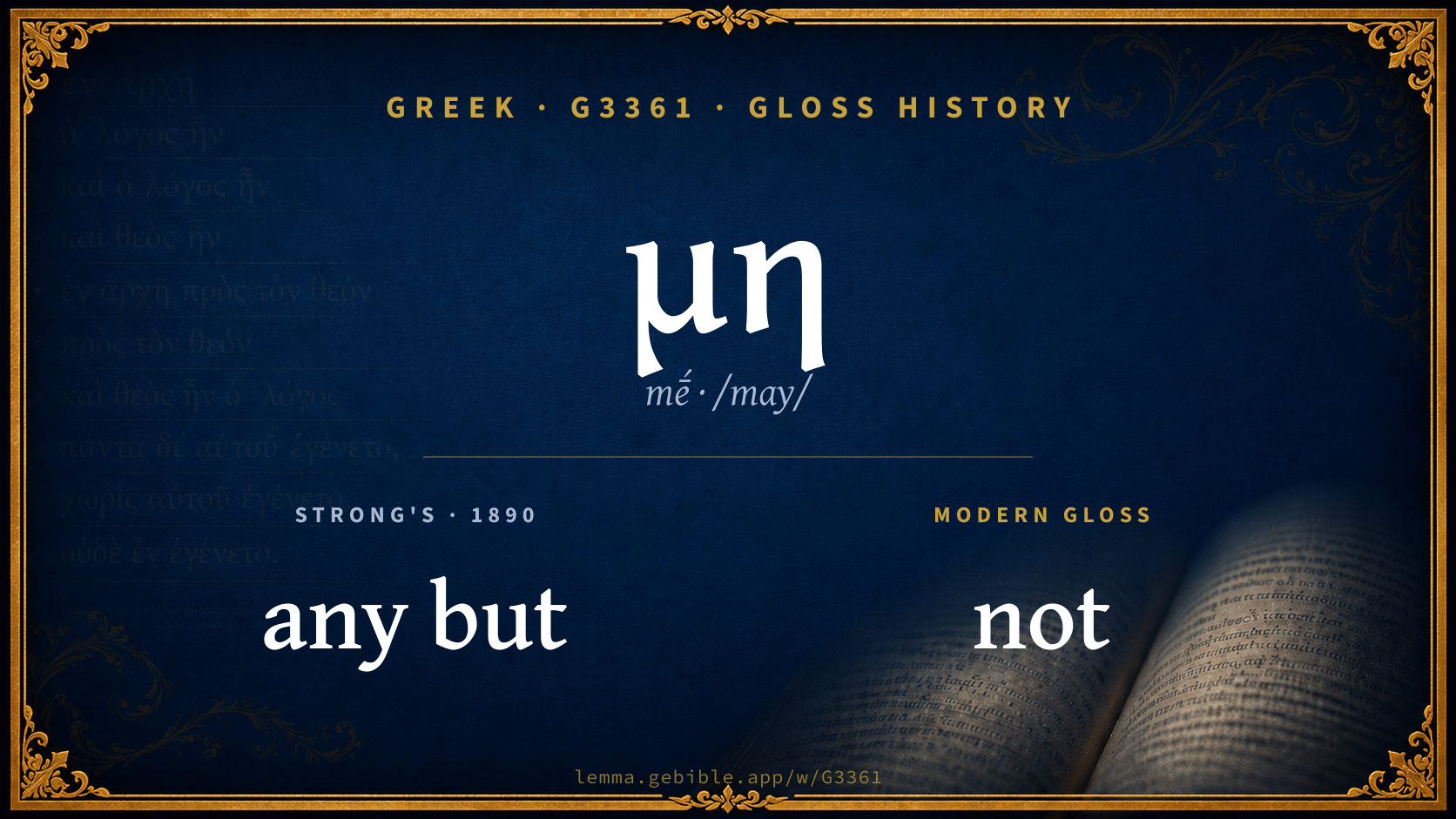
Gloss history
Strong's 1890 vs modern scholarship
About this word
Strong's G3361 catalogs a Greek word from the Greek New Testament.
These counts are not copied from any lexicon or concordance. They are computed here, from the morphology-tagged Greek New Testament. What Lemma adds →
- 914
- distinct verses
- The word appears in 914 distinct verses.
- 27 / 27
- NT books
- The word appears in 27 of 27 New Testament books.
- #19
- by frequency
- Top 25 most frequent Greek words (rank 19 of 5,347 Greek words by occurrence).
View all 914 occurrences in the concordance →
By section of the New Testament
By traditional corpus
Conventional, traditional groupings — biblical authorship is debated, so this is a traditional corpus grouping, not an authorship claim. Some books belong to more than one corpus (Luke is in both the Gospels and the Lukan corpus, and so on), so these shares overlap and need not total 100%. Each figure is a share of the word’s 914 distinct verses.
- Gospels 419 verses · 46%
- Pauline corpus 290 verses · 32%
- Lukan (Luke–Acts) 186 verses · 20%
- Johannine 174 verses · 19%
- General (Catholic) Epistles 67 verses · 7%
- Revelation 41 verses · 4%
- Hebrews 37 verses · 4%
How translations render this word
Counts come from each version’s own published word-to-Strong’s tagging or interlinear alignment — an approximate guide to how each version renders this word, not a word-level alignment the data otherwise carries. Because each total is that version’s own tagged count, the per-version totals vary from one another and need not match the appearance or distinct-verse counts above. These counts may also differ from a printed concordance because Lemma counts each distinctly tagged rendering and does not collapse phrase taggings into a single head-word total. This is a fixed set of word-tagged versions (KJV, ASV, BSB, ULT) and does not change with the reading translation you choose elsewhere. Each version’s license is shown beside its name below (and on Sources).
- King James Version: Not 493×, No 49×, God forbid 15×
- American Standard Version: Not 535×, No 64×, Lest 20×
- Berean Standard Bible: Not 142×, Do not 122×, No 41×
- unfoldingWord Literal Text: Not 754×, Certainly not 88×, Except 67×
King James Version Public Domain
Renders G3361 across 647 tagged occurrences — most commonly:
Plus other, less common renderings. Plus 33 renderings that appear only once — usually multi-word phrases or single function words the recovered tagging swept in, not distinct renderings. Not rendered by a distinct English word in 27 further occurrences.
American Standard Version Public Domain
Renders G3361 across 863 tagged occurrences — most commonly:
Plus other, less common renderings. Plus 89 renderings that appear only once — usually multi-word phrases or single function words the recovered tagging swept in, not distinct renderings. Not rendered by a distinct English word in 4 further occurrences.
Berean Standard Bible Public Domain
Renders G3361 across 413 tagged occurrences — most commonly:
Plus other, less common renderings. Plus 26 renderings that appear only once — usually multi-word phrases or single function words the recovered tagging swept in, not distinct renderings. Not rendered by a distinct English word in 242 further occurrences.
unfoldingWord Literal Text CC BY-SA 4.0
Renders G3361 across 1,087 tagged occurrences — most commonly:
Plus other, less common renderings. Plus 14 renderings that appear only once — usually multi-word phrases or single function words the recovered tagging swept in, not distinct renderings.
Senses in Thayer's
The 1 sense Thayer's distinguishes for this word, in lexicon order (not ranked by frequency or importance). The full entry — with sub-senses — is in the Lexicon Entry tab.
- no, not lest
Word origin
Derived from ου (ou) (G3756) — not.
A primary particle of qualified negation (whereas G3756 expresses an absolute denial); (adverbially) not (conjugationally) lest ; also (as interrogitive implying a negative answer [whereas G3756 expects an affirmative one]); whether : - any but (that) X forbear + God forbid + lack lest neither never no (X wise in) none nor [can-] not nothing that not un [-taken] without. Often used in compounds in substantially the same relations. See also G3362 G3363 G3364 G3372 G3373 G3375 G3378 .
— Strong’s Exhaustive Concordance (1890), public domain.
Forms in the corpus
The 4 distinct written forms G3361 takes in the Greek New Testament, most frequent first — each parse links to that case’s occurrences in the concordance.
| Form | Parsing | Example | Uses |
|---|---|---|---|
| μὴ mḕ | Particle, Negative | Matthew 1:19 | 966 |
| μή mḗ | Particle, Negative | Matthew 23:39 | 47 |
| Μὴ Mḕ | Particle, Negative | Matthew 5:17 | 12 |
| μήγε mḗge | Particle, Negative | Matthew 6:1 | 8 |
Same root — word family
Other Thayer's entries built from the same root as G3361, grouped by Strong’s listed origin. These share a root / origin per the lexicon — not necessarily a shared meaning. Each links to that word’s own entry.
Derives from
Shares the same root
- ου μη ou mḗ G3364 by no means
- ουδε oudé G3761 neither
- ουκετι oukéti G3765 no longer
- ουκουν oukoûn G3766 not therefore
- ουπω oúpō G3768 not yet
- ουτε oúte G3777 neither
- ουχι ouchí G3780 not at all
Derived from this word
- μηδαμως mēdamōs G3365 by no means
- μηδε mēdé G3366 and not
- μηδεις mēdeís G3367 no one
- μηκετι mēkéti G3371 no longer
- μη ουκ mḕ ouk G3378 not ever
- μηποτε mḗpote G3379 lest
- μηπω mḗpō G3380 not yet
- μηπως mḗpōs G3381 lest
- μητε mḗte G3383 nor
- μητι mḗti G3385 whether
- μητις mḗtis G3387 let no one
- ου ou G3756 not
Compare all same-root words → Showing 4 of 20 — not the complete family. They share a root, not necessarily a meaning.
Septuagint usage
The same Greek word μη appears 2,278 times in the Greek Old Testament (Septuagint), across 1,896 verses in 37 books.
- 2,278
- LXX occurrences
- Tagged occurrences of this Greek word in the Septuagint.
- 1,896
- verses
- Distinct Septuagint verses containing this word.
- 37 / 39
- OT books
- The word appears in 37 of the 39 Old Testament books.
Sample Septuagint occurrences
- Genesis 3:1 μή
- Exodus 2:14 μή
- Leviticus 5:1 μή
- Numbers 4:15 μή
- Deuteronomy 1:17 μή
- Joshua 1:9 μή
- Judges 2:3 μή
- Ruth 1:11 μή
- 1 Samuel 1:6 μή
- 2 Samuel 1:20 μή
- 1 Kings 2:9 μή
- 2 Kings 1:3 μή
Septuagint occurrences (same lexeme)
Every verse where the same Strong’s number (G3361) appears in the Greek Septuagint — showing the first 50 of 1,896. Verse text shown in the World English Bible for context; the Greek form is the matched word — the English is not keyword-highlighted.
- Genesis 3:1 μή Now the serpent was more subtle than any animal of the field which Yahweh God had made. He said to the woman, "Yes, has God said, 'You shall not eat of any tree of the garden?'"
- Genesis 3:3 μή but of the fruit of the tree which is in the midst of the garden, God has said, 'You shall not eat of it, neither shall you touch it, lest you die.'"
- Genesis 3:11 μή God said, "Who told you that you were naked? Have you eaten from the tree that I commanded you not to eat from?"
- Genesis 3:17 μή To Adam he said, "Because you have listened to your wife's voice, and have eaten of the tree, of which I commanded you, saying, 'You shall not eat of it,' cursed is the ground for your sake. In toil you will eat of it all the days of your life.
- Genesis 4:7 μή If you do well, will it not be lifted up? If you don't do well, sin crouches at the door. Its desire is for you, but you are to rule over it."
- Genesis 4:9 μή Yahweh said to Cain, "Where is Abel, your brother?" He said, "I don't know. Am I my brother's keeper?"
- Genesis 4:15 μή Yahweh said to him, "Therefore whoever slays Cain, vengeance will be taken on him sevenfold." Yahweh appointed a sign for Cain, lest any finding him should strike him.
- Genesis 6:3 μή Yahweh said, "My Spirit will not strive with man forever, because he also is flesh; yet will his days be one hundred twenty years."
- Genesis 7:2 μή You shall take seven pairs of every clean animal with you, the male and his female. Of the animals that are not clean, take two, the male and his female.
- Genesis 7:3 μή Also of the birds of the sky, seven and seven, male and female, to keep seed alive on the surface of all the earth.
- Genesis 7:8 μή Clean animals, animals that are not clean, birds, and everything that creeps on the ground
- Genesis 11:7 μή Come, let's go down, and there confuse their language, that they may not understand one another's speech."
- Genesis 13:8 μή Abram said to Lot, "Please, let there be no strife between me and you, and between my herdsmen and your herdsmen; for we are relatives.
- Genesis 14:23 μή that I will not take a thread nor a shoe-latchet nor anything that is yours, lest you should say, 'I have made Abram rich.'
- Genesis 15:1 μή After these things the word of Yahweh came to Abram in a vision, saying, "Don't be afraid, Abram. I am your shield, your exceedingly great reward."
- Genesis 16:2 μή Sarai said to Abram," See now, Yahweh has restrained me from bearing. Please go in to my handmaid. It may be that I will obtain children by her." Abram listened to the voice of Sarai.
- Genesis 18:3 μή and said, "My lord, if now I have found favor in your sight, please don't go away from your servant.
- Genesis 18:14 μή Is anything too hard for Yahweh? At the set time I will return to you, when the season comes round, and Sarah will have a son."
- Genesis 18:17 μή Yahweh said, "Will I hide from Abraham what I do,
- Genesis 18:21 μή I will go down now, and see whether they have done altogether according to the cry of it, which is come to me. If not, I will know."
- Genesis 18:23 μή Abraham drew near, and said, "Will you consume the righteous with the wicked?
- Genesis 18:28 μή What if there will lack five of the fifty righteous? Will you destroy all the city for lack of five?" He said, "I will not destroy it, if I find forty-five there."
- Genesis 18:29 μή He spoke to him yet again, and said, "What if there are forty found there?" He said, "I will not do it for the forty's sake."
- Genesis 18:30 μή He said, "Oh don't let the Lord be angry, and I will speak. What if there are thirty found there?" He said, "I will not do it, if I find thirty there."
- Genesis 18:31 μή He said, "See now, I have taken it on myself to speak to the Lord. What if there are twenty found there?" He said, "I will not destroy it for the twenty's sake."
- Genesis 18:32 μή He said, "Oh don't let the Lord be angry, and I will speak yet but this once. What if ten are found there?" He said, "I will not destroy it for the ten's sake."
- Genesis 19:7 μή He said, "Please, my brothers, don't act so wickedly.
- Genesis 19:8 μή See now, I have two virgin daughters. Please let me bring them out to you, and do you to them as is good in your eyes. Only don't do anything to these men, because they have come under the shadow of my roof."
- Genesis 19:9 μή They said, "Stand back!" They said, "This one fellow came in to live as a foreigner, and he appoints himself a judge. Now will we deal worse with you, than with them!" They pressed hard on the man, even Lot, and drew near to break the door.
- Genesis 19:15 μή When the morning arose, then the angels hurried Lot, saying, "Arise, take your wife, and your two daughters who are here, lest you be consumed in the iniquity of the city."
- Genesis 19:17 μή It came to pass, when they had taken them out, that he said, "Escape for your life! Don't look behind you, neither stay anywhere in the plain. Escape to the mountain, lest you be consumed!"
- Genesis 19:19 μή See now, your servant has found favor in your sight, and you have magnified your loving kindness, which you have shown to me in saving my life. I can't escape to the mountain, lest evil overtake me, and I die.
- Genesis 19:21 μή He said to him, "Behold, I have granted your request concerning this thing also, that I will not overthrow the city of which you have spoken.
- Genesis 20:6 μή God said to him in the dream, "Yes, I know that in the integrity of your heart you have done this, and I also withheld you from sinning against me. Therefore I didn't allow you to touch her.
- Genesis 20:7 μή Now therefore, restore the man's wife. For he is a prophet, and he will pray for you, and you will live. If you don't restore her, know for sure that you will die, you, and all who are yours."
- Genesis 20:9 μή Then Abimelech called Abraham, and said to him, "What have you done to us? How have I sinned against you, that you have brought on me and on my kingdom a great sin? You have done deeds to me that ought not to be done!"
- Genesis 21:12 μή God said to Abraham, "Don't let it be grievous in your sight because of the boy, and because of your handmaid. In all that Sarah says to you, listen to her voice. For from Isaac will your seed be called.
- Genesis 21:16 μή She went and sat down opposite him, a good way off, about a bow shot away. For she said, "Don't let me see the death of the child." She sat over against him, and lifted up her voice, and wept.
- Genesis 21:17 μή God heard the voice of the boy. The angel of God called to Hagar out of the sky, and said to her, "What ails you, Hagar? Don't be afraid. For God has heard the voice of the boy where he is.
- Genesis 21:23 μή Now therefore swear to me here by God that you will not deal falsely with me, nor with my son, nor with my son's son. But according to the kindness that I have done to you, you shall do to me, and to the land in which you have lived as a foreigner."
- Genesis 22:12 μή He said, "Don't lay your hand on the boy, neither do anything to him. For now I know that you fear God, seeing you have not withheld your son, your only son, from me."
- Genesis 23:6 μή "Hear us, my lord. You are a prince of God among us. In the choice of our tombs bury your dead. None of us will withhold from you his tomb, but that you may bury your dead."
- Genesis 24:3 μή I will make you swear by Yahweh, the God of heaven and the God of the earth, that you shall not take a wife for my son of the daughters of the Canaanites, among whom I live.
- Genesis 24:6 μή Abraham said to him, "Beware that you don't bring my son there again.
- Genesis 24:8 μή If the woman isn't willing to follow you, then you shall be clear from this my oath. Only you shall not bring my son there again."
- Genesis 24:33 μή Food was set before him to eat. But he said, "I will not eat until I have told my message." He said, "Speak on."
- Genesis 24:41 μή Then will you be clear from my oath, when you come to my relatives. If they don't give her to you, you shall be clear from my oath.'
- Genesis 24:49 μή Now if you will deal kindly and truly with my master, tell me. If not, tell me. That I may turn to the right hand, or to the left."
- Genesis 24:56 μή He said to them, "Don't hinder me, seeing Yahweh has prospered my way. Send me away that I may go to my master."
- Genesis 26:2 μή Yahweh appeared to him, and said, "Don't go down into Egypt. Dwell in the land which I will tell you of.
These are occurrences of the same Greek lexeme (G3361) in the Septuagint — not a translation of any one Hebrew word. The store carries no word-level Hebrew↔Greek alignment, so no Hebrew original is asserted here. Counts come from the recovered LXX Strong's tagging — high-frequency vocabulary is well covered, while rare or late forms may be untagged — so they reflect tagged occurrences and may slightly undercount.