Matthew 12:24

Greek (Tischendorf 8th ed.) Matthew 12:24 appears in the Greek New Testament. The text above is from the Tischendorf 8th edition. Each word links to its Strong’s number and a concise gloss. Click any word for its full Thayer’s Greek Lexicon entry.
Download image
Cite this verse

Matthew 12:24 (World English Bible). Public Domain. Lemma interlinear Bible study tool, https://lemma.gebible.app/v/matthew/12/24.

Show BibTeX & RIS
BibTeX
RIS
English Translation
But when the Pharisees heard it, they said, "This man does not cast out demons, except by Beelzebul, the prince of the demons."
World English Bible · Public Domain
Download a study sheet

One document with this verse’s original text, its word-by-word gloss line, the meaning frame, cross-references with their text, attributed commentary, and full source and license credits — printable, and it pastes into notes with its structure intact.

This verse Autodidact and up

Study sheet (.html) Plain text (.txt)

A passage Seminary Student

Up to 50 verses in one chapter. A passage sheet keeps up to 6 commentary sources and 12 cross-references per verse, in the order this page ranks them, and says so on the sheet whenever that leaves anything out. Ask for a single verse and you get the Autodidact verse sheet above.

Everything on this page stays free to read, with no account — the sheet is a download of what is already on screen, not access to it.

Want to remove ads? Support Godless Engineer
Compare translations 3

The same verse in 3 English versions, stacked beneath the original-language interlinear above. Click any original word for its lexicon entry.

Each is an independent rendering of the whole verse — the interlinear is not word-aligned to these translations.

Highlighted words mark where these versions differ — a whole-verse word diff, not a word-by-word alignment.

  • World English Bible Public Domain
    But when the Pharisees heard it, they said, "This man does not cast out demons, except by Beelzebul, the prince of the demons."
  • King James Version Public Domain
    But when the Pharisees heard it, they said, This fellow doth not cast out devils, but by Beelzebub the prince of the devils.
  • unfoldingWord Literal Text CC BY-SA 4.0
    But the Pharisees, having heard this, said, “He does not cast out demons except by Beelzebul, ruler of the demons.”

unfoldingWord Literal Text — © unfoldingWord, licensed CC BY-SA 4.0. Word-aligned USFM3 via Door43 (git.door43.org/unfoldingWord/en_ult).

Versions to compare (up to 4)

3 of 4 selected

Show all 19 translations

Every available English version of this verse, each an independent rendering of the whole verse.

  • World English Bible Public Domain
    But when the Pharisees heard it, they said, "This man does not cast out demons, except by Beelzebul, the prince of the demons."
  • Berean Standard Bible Public Domain
    But when the Pharisees heard this, they said, “Only by Beelzebul, the prince of demons, does this man drive out demons.”
  • Majority Standard Bible Public Domain
    But when the Pharisees heard this, they said, “Only by Beelzebul, the prince of demons, does this man drive out demons.”
  • King James Version Public Domain
    But when the Pharisees heard it, they said, This fellow doth not cast out devils, but by Beelzebub the prince of the devils.
  • American Standard Version (1901) Public Domain
    But when the Pharisees heard it, they said, This man doth not cast out demons, but by Beelzebub the prince of the demons.
  • Revised Version (1885) Public Domain
    But when the Pharisees heard it, they said, This man doth not cast out devils, but by Beelzebub the prince of the devils.
  • Geneva Bible (1599) Public Domain
    But when the Pharises heard it, they saide, This man casteth the deuils no otherwise out, but through Beelzebub the prince of deuils.
  • Douay-Rheims (1899) Public Domain
    But the Pharisees hearing it, said: This man casteth not out the devils but by Beelzebub the prince of the devils.
  • Young's Literal Translation Public Domain
    but the Pharisees having heard, said, `This one doth not cast out demons, except by Beelzeboul, ruler of the demons.'
  • Literal Standard Version CC BY-SA 4.0
    But the Pharisees having heard, said, “This One does not cast out demons, except by Beelzebul, ruler of the demons.”
  • Unlocked Literal Bible CC BY-SA 4.0
    But when the Pharisees heard of this miracle, they said, “This man does not cast out demons except by Beelzebul, the prince of the demons.”
  • unfoldingWord Literal Text CC BY-SA 4.0
    But the Pharisees, having heard this, said, “He does not cast out demons except by Beelzebul, ruler of the demons.”
  • Darby Bible Public Domain
    But the Pharisees, having heard [it], said, This [man] does not cast out demons, but by Beelzebub, prince of demons.
  • World Messianic Bible Public Domain
    But when the Pharisees heard it, they said, “This man does not cast out demons except by Beelzebul, the prince of the demons.”
  • Webster's Bible Public Domain
    But when the Pharisees heard it, they said, This man doth not cast out demons, but by Beelzebub the prince of the demons.
  • Free Bible Version CC BY-SA 4.0
    But when the Pharisees heard this, they replied, “This man can only throw out demons through the power of Beelzebub, the chief of demons!”
  • Bible in Basic English Public Domain
    But the Pharisees, hearing of it, said, This man only sends evil spirits out of men by Beelzebub, the ruler of evil spirits.
  • Text-Critical English NT CC BY 4.0
    But when the Pharisees heard this, they said, “It is only by Beelzebul, the ruler of demons, that this man casts out demons.”
  • Tyndale New Testament (1534) Public Domain
    But when the Pharises hearde that they sayde: This felow dryveth the devyls no nother wyse oute but by the helpe of Belzebub the chefe of the devyls.

Literal Standard Version (2020), Covenant Press — licensed CC BY-SA 4.0. Text via the HelloAO Bible API (eBible.org). Unlocked Literal Bible (unfoldingWord) — licensed CC BY-SA 4.0. Text via the HelloAO Bible API (eBible.org). unfoldingWord Literal Text — © unfoldingWord, licensed CC BY-SA 4.0. Word-aligned USFM3 via Door43 (git.door43.org/unfoldingWord/en_ult). Free Bible Version, Dr. Jonathan Gallagher — licensed CC BY-SA 4.0. Text via the HelloAO Bible API (eBible.org).

Word by word

More ways to search: Search by grammar → Find every occurrence → Compare this word →

Practice this passage: Drill this verse → Learn its vocabulary →

Βεελζεβοὺλ
Beelzeboúl
G954
“Beelzebul”
Noun, Proper, indeclinable
Part of Speech
Noun · Proper, indeclinable
Full Thayer's Definition

Origin: of Aramaic origin [by parody on G1176 ]

TDNT: 11:05,1

Beelzebub = "lord of the house" 1. a name of Satan, the prince of evil spirits
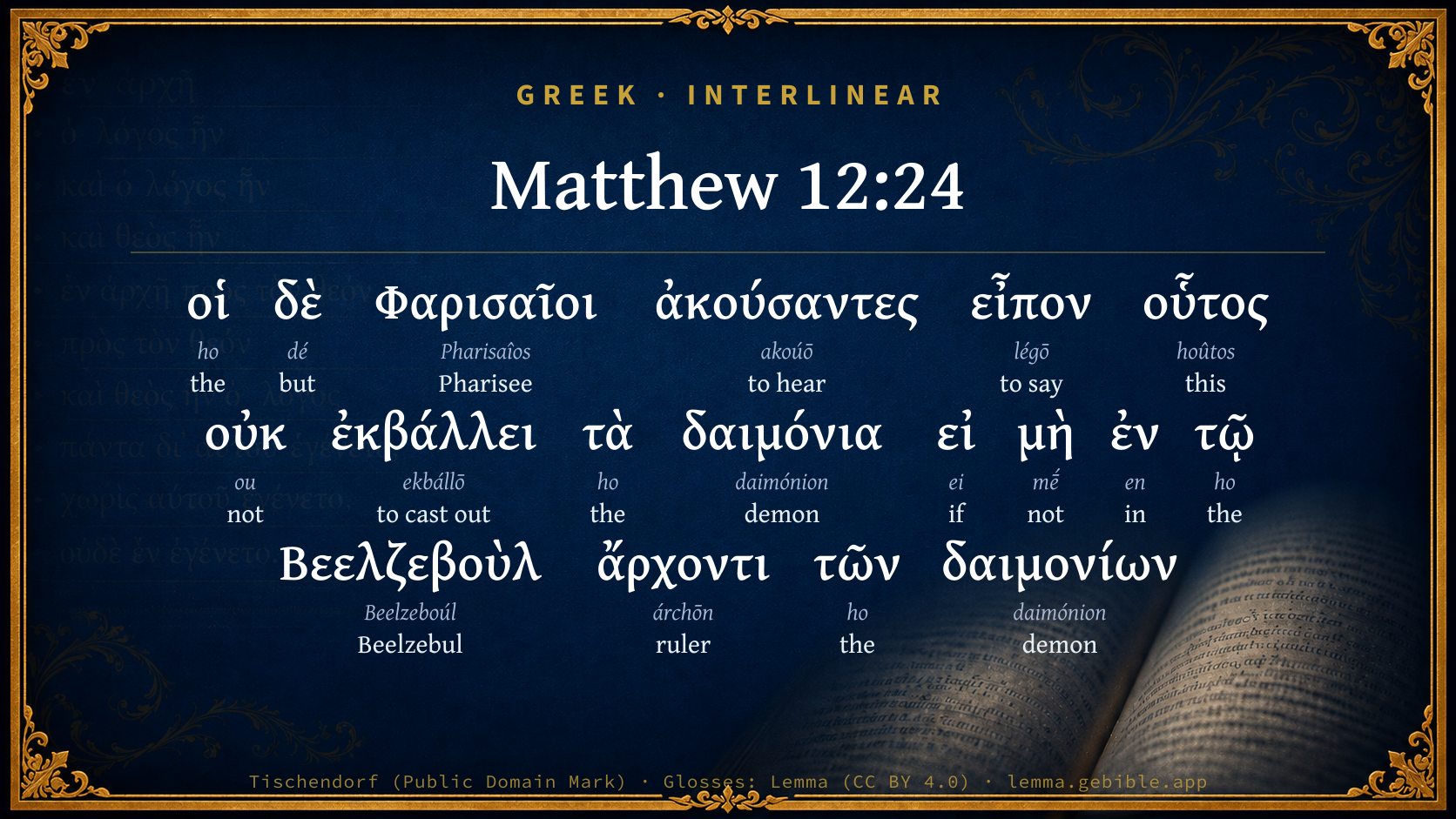
  1. οἱ ho G3588 “the” Article, Nominative, Plural, Masculine
  2. δὲ dé G1161 “but” Conjunction
  3. Φαρισαῖοι Pharisaîos G5330 “Pharisee” Noun, Nominative, Plural, Masculine
  4. ἀκούσαντες akoúō G191 “to hear” Verb, Aorist, Active, Participle, Nominative, Plural, Masculine
  5. εἶπον légō G3004 “to say” Verb, Aorist, Active, Indicative, 3rd person, Plural
  6. οὗτος hoûtos G3778 “this” Demonstrative pronoun, Nominative, Singular, Masculine
  7. οὐκ ou G3756 “not” Particle, Negative
  8. ἐκβάλλει ekbállō G1544 “to cast out” Verb, Present, Active, Indicative, 3rd person, Singular
  9. τὰ ho G3588 “the” Article, Accusative, Plural, Neuter
  10. δαιμόνια daimónion G1140 “demon” Noun, Accusative, Plural, Neuter
  11. εἰ ei G1487 “if” Conditional
  12. μὴ mḗ G3361 “not” Particle, Negative
  13. ἐν en G1722 “in” Preposition
  14. τῷ ho G3588 “the” Article, Dative, Singular, Masculine
  15. ἄρχοντι árchōn G758 “ruler” Noun, Dative, Singular, Masculine
  16. τῶν ho G3588 “the” Article, Genitive, Plural, Neuter
  17. δαιμονίων daimónion G1140 “demon” Noun, Genitive, Plural, Neuter

About this verse

These counts appear in no published source. They are computed here, from the morphology-tagged text and Lemma’s own curated glosses. What Lemma adds →

18
words
14
distinct lemmas
Gospels
section

Notable vocabulary

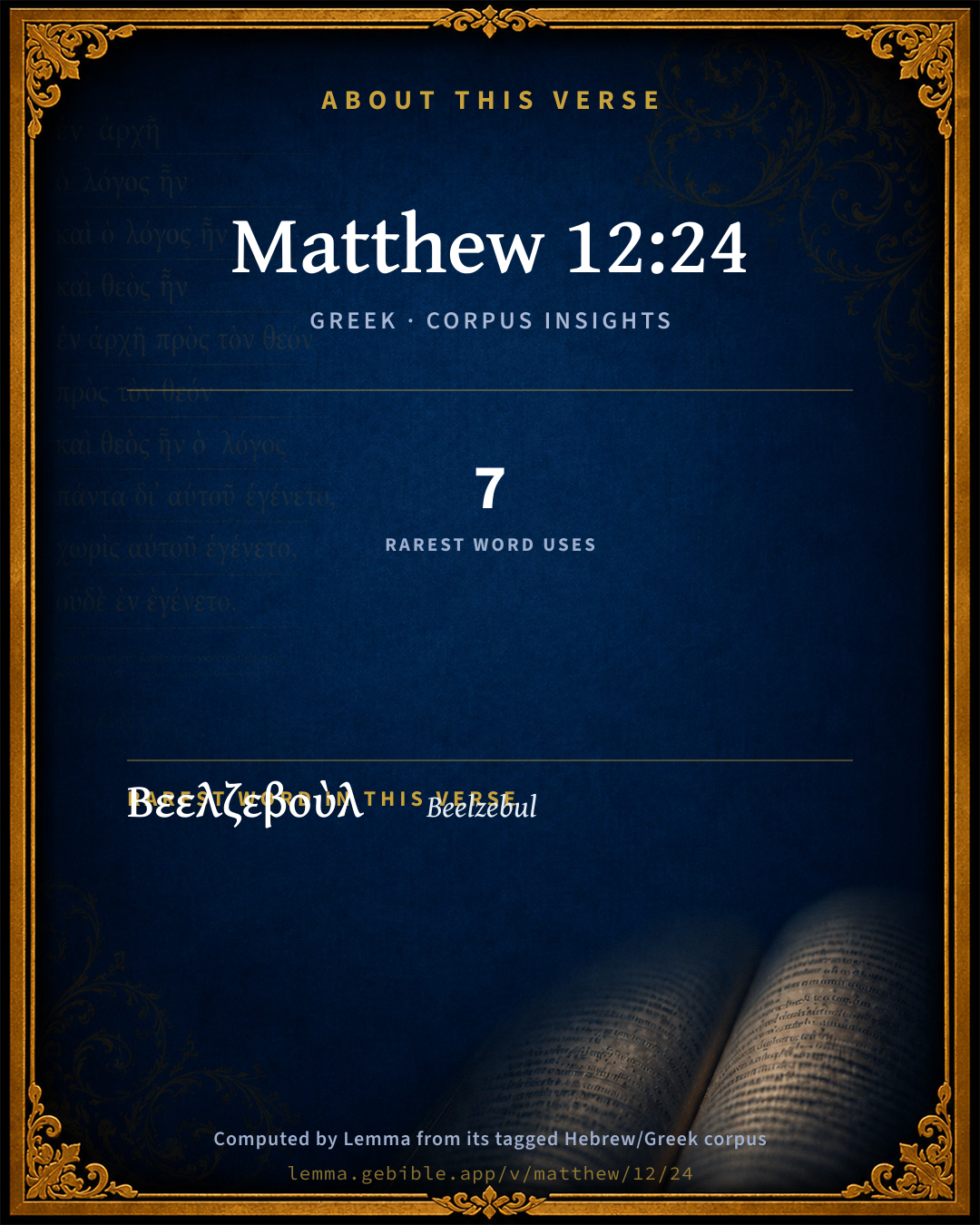
The rarest word here is Βεελζεβοὺλ Beelzebul G954 — appearing just 7 times in the whole Greek New Testament.

Shared distinctive vocabulary

Βεελζεβοὺλ Beelzebul G954 occurs in 7 verses of the Greek New Testament. Also found in:

Repetition

Words recur within this verse:

  • δαιμόνια demon G1140 ×2
  • οἱ the G3588 ×4

Cross-references

3

Topical passages linked to Matthew 12:24 in the Treasury of Scripture Knowledge — connected by theme and wording, ordered by reader-vote popularity; previews shown in the World English Bible.

  • Mark 3:22 The scribes who came down from Jerusalem said, "He has Beelzebul," and, "By the prince of the demons he casts out the demons."
  • Matthew 9:34 But the Pharisees said, "By the prince of the demons, he casts out demons."
  • Luke 11:15 But some of them said, "He casts out demons by Beelzebul, the prince of the demons."

Cross-references courtesy of OpenBible.info (CC BY 4.0).

Commentary

Notes on Matthew 12:24 from classic Christian and Jewish commentators (each source and its license shown beneath its notes). The classic Christian expositions comment on the surrounding passage and are grouped to its opening verse, so a note may address several verses; the Jewish commentaries on the Tanakh (Rashi and others) are per-verse, so they appear only where the commentator wrote on this verse.

Lemma curates 59 commentaries, every one of them public domain or Creative Commons licensed, each selected and text-cleaned for this edition rather than reprinted as found. About our sources →

Tyndale Open Study Notes

Tyndale Open Resources

12:24 Satan: Greek Beelzeboul; see study note on 10:25.

Tyndale Open Study Notes — © Tyndale Open Resources, licensed CC BY-SA 4.0. Text via the HelloAO Bible API.

Bengel's Gnomon

Johann Albrecht Bengel

Mat 12:24. Ἀκούσαντες, when they heard) sc. what the people said.—οἷτος, this) man. A contemptuous mode of expression.[569] [E. V. This fellow].—εἰ μὴ, except) A vehement affirmation.—ἐν τῷ Βεελζεβοὺλ ἄρχοντι τῶν δαιμονίων, by Beelzebub the prince of the devils) They call Satan thus. In the Old Testament this was the name of an idol. Cf. 1Co 10:20.

[569] Of what great moment a very few words may be.—V. g.

Bengel's Gnomon of the New Testament — English translation (T&T Clark, Edinburgh, 1860) — public domain. Text from a community e-Sword module.

Expositor's Greek Testament

ed. W. Robertson Nicoll

Mat 12:24 . Οἱ δὲ φαρισαῖοι . They of course have a very different opinion. In Mark these were men come down from Jerusalem, to watch, not to lay hold of Jesus, Galilee not being under the direct jurisdiction of the Sanhedrim then ( vide on Mark). Οὗτος οὐκ ἐκβάλλει , etc.: theory enunciated for second time, unless Mat 9:34 be an anticipation by the evangelist, or a spurious reading. What diversity of opinion! Christ’s friends, according to Mark, thought Him “beside himself” mad, Messiah, in league with Beelzebub! Herod had yet another theory: the marvellous healer was John redivivus , and endowed with the powers of the other world. All this implies that the healing ministry was a great fact. οὐκ … εἰ μὴ : the negative way of putting it stronger than the positive. The Pharisees had to add εἰ μὴ . They would gladly have said: “He does not cast out devils at all”. But the fact was undeniable; therefore they had to invent a theory to neutralise its significance. ἄρχοντι , without article, might mean, as prince , therefore able to communicate such power. So Meyer, Weiss, et al. But the article may be omitted after Βεελζεβοὺλ as after βασιλεύς , or on account of the following genitive. So Schanz. Whether the Pharisees believed this theory may be doubted. It was enough that it was plausible. To reason with such men is vain. Yet Jesus did reason for the benefit of disciples.

The Expositor's Greek Testament, edited by W. Robertson Nicoll (1897–1910) — public domain. Text from a community e-Sword module.

Jamieson, Fausset & Brown

Robert Jamieson, A. R. Fausset & David Brown

But when the Pharisees heard it--Mark (Mar 3:22) says, "the scribes which came down from Jerusalem"; so that this had been a hostile party of the ecclesiastics, who had come all the way from Jerusalem to collect materials for a charge against Him. (See on Mat 12:14).

they said, This fellow--an expression of contempt.

doth not cast out devils, but by Beelzebub--rather, "Beelzebul" (see on Mat 10:25).

the prince of the devils--Two things are here implied--first, that the bitterest enemies of our Lord were unable to deny the reality of His miracles; and next, that they believed in an organized internal kingdom of evil, under one chief. This belief would be of small consequence, had not our Lord set His seal to it; but this He immediately does. Stung by the unsophisticated testimony of "all the people," they had no way of holding out against His claims but the desperate shift of ascribing His miracles to Satan.

Jamieson, Fausset & Brown — Commentary Critical and Explanatory on the Whole Bible (1871) — public domain (CC PDM 1.0). Text via the HelloAO Bible API.

Adam Clarke's Commentary

Verse 24. Beelzebub] See Mt 10:25.

Adam Clarke's Commentary on the Bible (1810–1826) — public domain. Text from a community e-Sword/MySword module.

Ellicott's Commentary for English Readers

(24) Beelzebub the prince of the devils.—(See Notes on Mat_9:34; Mat_10:25.) The words appear to have been whispered by the Pharisees among the people. They were not addressed to Jesus. The charge is significant as showing that the Pharisees admitted the reality of the work of healing which they had witnessed, and were driven to explain it by assuming demoniacal agency.

A Bible Commentary for English Readers, edited by Charles John Ellicott (1878–1897) — public domain. Text from a community e-Sword module.

The Cambridge Bible for Schools and Colleges

gen. ed. J. J. S. Perowne

24–30. The Charge, “He casteth out devils by Beelzebub.” The Answer of Jesus

Mar_3:22-27; Luk_11:17.

24. Beelzebub] See ch. Mat_10:25.

The Cambridge Bible for Schools and Colleges (gen. ed. J. J. S. Perowne; Cambridge University Press, 1878–1918) — public domain. Text from a community e-Sword module.

John Gill's Exposition

Or else, how can anyone enter into a strong man's house,.... This is another argument of Christ's proving that his casting out of devils could not be by Satan, but by the Spirit of God; for if he did not act by any superior power to Satan's, and such by which he was able to master, overcome, and bind him, he could never

spoil his goods, as he did; or dispossess devils out of the bodies or souls of men: just as if a man should enter into another man's house, who is strong and robust, with a design to spoil his goods, who would never make use of the man himself to do it, and can never be thought to effect it, unless he has a power superior to his, and uses it;

except he first bind the strong man, and then he will spoil his house: by the "strong man", is meant the devil, see Isa 49:24 who is powerful and mighty, as appears from his nature, being an angel, though a fallen one, excelling in strength human creatures; from his names, such as the roaring lion, the great red dragon, leviathan, &c. from the extent of his dominion, here called "his house"; which reaches to the whole posse of devils, and world of men; whence he is called the prince of the power of the air, and the prince of this world, and the god of it; and from his works and actions, in and over the bodies and estates of men, by divine permission; which might be exemplified in the case of Job, and the demoniacs in the time of Christ; and in and over the souls of men, not only over wicked men, but men under a show of religion, as antichrist and his followers; yea, saints themselves, and even over Adam in a state of innocence; but Christ is stronger than he, and attacked him, and dispossessed him of the bodies of men; and restraining him from doing them any hurt, enters into the souls of men, dethrone him, and leads him captive, who led others; and keeps him from doing them any damage; as he will in the latter day "bind" him and shut him up in prison a thousand years; and also "spoils his goods", or "vessels", and "his house"; the palace of Satan, by taking bodies and souls out of his possession; by awakening the conscience, enlightening the mind, working upon the affections, subduing the will, and implanting principles of grace and holiness in the heart; and so making it a fit habitation for God, which spoils it for the devil: in all which, Satan can never be thought to have any hand; and therefore the suggestion that Christ casts out devils by his assistance, even out of the bodies of men, has no show of reason in it.

John Gill's Exposition of the Whole Bible (1746–1763) — public domain (CC PDM 1.0). Text via the HelloAO Bible API.

Trapp's Complete Commentary

John Trapp

24 But when the Pharisees heard it, they said, This fellow doth not cast out devils, but by Beelzebub the prince of the devils.

Ver. 24. This fellow doth not cast out devils, &c.] The devil that was cast out of the demoniac’s body seems to have gotten into these men’s hearts. But he was not his master crafts: for what a senseless slander hear we? He should have acted it a little better, to have been believed. Tenue mendacium pellucet, saith Tacitus. This was such a lie as might be easily looked through. But envy never regards how true, but how mischievous. Witness the Popish Pharisees, who tell the poor misled and muzzled people in their sermons that the Protestants are blasphemers of God and all his saints; that the English are grown barbarous, and eat young children; that ever since the pope excommunicated us we are as black as devils; that the gunpowder treason was plotted, and should have been acted, by the Puritans; that the fall of Blackfriars in London likewise was wrought by the Puritans, who had loosened the rafters, &c. {a} That these are the opinions we hold and teach: 1. To worship no God. 2. To frame our religion to the times. 3. To account gain godliness. 4. To pretend public liberty to our private lusts. 5. To break our oaths, when it makes for our advantage. 6. To cover hatred with flattery. 7. To confirm tyranny with bloodshed, &c. These and the like, that Cacodaemon Joannes, the black mouthed Jesuit, tells the world in print are our tenets and practices. Now "the Lord rebuke thee, Satan." But what reward shall be given to thee, thou false tongue? Even sharp arrows, with hot burning coals; yea, those very coals of hell from whence thou wert enkindled.

{a} Ex dissolutis per Puritanos continationibus, &c. D. Prid. Lect.

John Trapp, A Commentary or Exposition upon All the Books of the Old and New Testament (1647–1656) — public domain. Text from a community e-Sword module.

Matthew Poole's English Annotations

We met with the same blasphemous calumny from the same persons, Mat 9:34. The Pharisees, not acknowledging the Deity of Christ, nor that he was the Messiah, were for their interest concerned not to acknowledge, and as much as in them lay to keep others from believing, that he did that from his own power which God alone could do. But yet they might have allowed him to have by a power derived from God done these miraculous things, as Elijah and Elisha of old did. But they blaspheme at the highest rate imaginable, ascribing that to the devil which was proper to God alone. Christ’s miracles were exceeding many, and it was a time when the Messiah was expected. The sceptre was departed from Judah, and, as it appears from Joh 7:31, (whatever the Jews now say impudently), they heard that when the Messiah did come he should work many miracles. These things put them into a rage. This remarkable piece of history is recorded by three evangelists: by Matthew in this place; by Mark, Mar 3:22-30; and by Luke, Luk 11:15-20.

Matthew Poole's English Annotations on the Holy Bible (1683–1685) — public domain. Text from a community e-Sword/MySword module.

Whedon's Commentary on the Bible

Daniel D. Whedon

24. Pharisees heard it — The miracle was reported doubtless to them for explanation. They felt that if his pure doctrines should prevail, their influence was at an end. The miracle they do not deny, but ascribe it to an infernal power.

Beelzebub the prince of the devils — So great and numerous are the miracles that they cannot ascribe them to any one less than the prince. Beelzebub was worshipped at Ekron, (2Ki_1:1-2,) as the god of flies; that is, as the god who protected the inhabitants from the annoyance of gnats and flies. See note on Mat_10:25.

Daniel D. Whedon (gen. ed.), Commentary on the Old and New Testaments (1874–1909) — public domain. Text from a community e-Sword module.

The Pulpit Commentary

(On the relation of this verse to Mat_9:34, see notes there) But when the Pharisees. Not further defined here, but in Mar_3:22 spoken of as "the scribes that had come down from Jerusalem." Heard it, they said, This fellow; man (Revised Version); outov . (cf. Mat_9:3, note) Observe that outov (in Matthew only) here answers to the outov of ver. 23. "This man" is at once the object of hope in the minds of the multitudes, and of the deepest opposition on the part of the Pharisees. Doth not cast out devils, but. In the parallel passages there is merely a direct assertion that he does it by Beelzebub; here there is a denial of his power to do it by any other agency. Does Matthew"s version express rather the process of their deliberation, and that of Mark and Luke the final result? (On the Jewish tradition that our Lord performed miracles by magic, see Mat_2:14, note, and Lightfoot, "Hor. Hebr.," here) By; in, Revised Version, margin. (Mat_9:34, note) Beelzebub. (Mat_10:25, note) The prince. Better omit the article, arconti giving, so to speak, his official title. Of the devils.

A malicious explanation.

"This fellow doth not cast out devils, but by Beelzebub the prince of the devils." The Pharisees must have been very hard driven indeed in order to invent such an explanation. Perhaps what was in their minds was this: "He orders the evil spirits about as if he were a master, or prince, of them. He must be himself possessed with a devil, and it evidently is Beelzebub the prince of the devils." Our Lord had no difficulty in showing up the folly and malice of such suggestions.

1. Masters do not spoil the characteristic work of their servants; a prince of devils was not likely to prevent devils doing devils" work.

2. Jewish exorcists claimed power to cast out devils; these Pharisees claimed such power; then their argument was readily turned round on themselves they too must be possessed by Beelzebub the prince of the devils. "According to the Book of Henoch, the demons are the souls of the giants who corrupted themselves with the daughters of men; but Josephus regarded them as the spirits of dead men. They were so numerous that every man has ten thousand on his right hand, and one thousand on his left. The chief of the diabolical empire was Beelzebub." "The rabbis, scribes, and doctors of the Law undertook the casting out demons, and some of them were considered very skilful in the art. The healing art was simply exorcism." Dean Plumptre ventures to remind us that "we need not assume that such power was always a pretence, or rested only on spells and incantations. Earnestness, prayer, fasting, faith, these are always mighty in intensifying the power of will, before which the frenzied soul bows in submission or yields in confidence; and these may well have been found among the better and truer Pharisees.

I AN EXPLANATION MAY BE GOOD IF IT IS OFFERED IN A MALICIOUS SPIRIT. Its value, as an explanation, should be fairly weighed, without prejudice. We may often learn most valuable things from the bitter words of our enemies. They reveal to us what otherwise we might never have discovered.

II AN EXPLANATION IS LIKELY TO BE BAD WHEN IT IS OFFERED IN A MALICIOUS SPIRIT. It is better to suspect it; better not to make too much of it. Malice spoils eyesight, and certainly spoils judgment. These Pharisees fashioned a bad argument just because they felt angry with Jesus. R.T.

The Pulpit Commentary (1880–1919), ed. H.D.M. Spence-Jones & Joseph S. Exell — public domain. Text from a community e-Sword module.

John Wesley's Explanatory Notes

Mark iii, 22.

John Wesley, Explanatory Notes Upon the Whole Bible (1754–1765) — public domain. Text via the GEBible commentary corpus.

Scofield Reference Notes

C. I. Scofield

devils

demons. (See Scofield "Mat 7:22").

The Scofield Reference Bible (1917 edition), notes by C. I. Scofield — public domain. Text from a community e-Sword module.

The People's New Testament

B. W. Johnson

24. The Pharisees hearing it. Compare Mark 3:22–27. Mark says that some of these Pharisees were scribes who had come from Jerusalem. The ecclesiastical authorities at Jerusalem were now keeping their watch on Jesus. He casteth not out devils but by Beelzebub. See note on Matt. 10:25. Beelzebub, the prince of devils, meant the same as Satan. The Pharisees assert that the Lord's miraculous power is due to the aid of the devil.

B. W. Johnson's The People's New Testament with Notes (1889–1891) — public domain. Electronic text from the Christian Classics Ethereal Library (CCEL) ThML edition.

unfoldingWord translationNotes

Door43 World Missions Community

General Information:

In verse 25, Jesus begins to respond to the Pharisees' accusation that he healed the man by the power of Satan.

this miracle

This refers to the miracle of the healing of a blind, deaf, and demon-possessed man.

This man does not cast out demons except by Beelzebul

This can be stated in a positive form. "This man is only able to cast out the demon because he is a servant of Beelzebul" (See: Double Negatives)

This man

The Pharisees avoid calling Jesus by name to show they reject him.

the prince of the demons

"the chief of the demons"

Every kingdom divided against itself is made desolate, and every city or house divided against itself will not stand

Jesus uses a proverb to respond to the Pharisees. Both of these statements mean the same thing. They emphasize that it would not make sense for Beelzebul to use his power to fight other demons. (See: Proverbs and Parallelism)

Every kingdom divided against itself is made desolate

Here "kingdom" refers to those who live in the kingdom. This can be translated in active form. AT: "A kingdom will not last when its people fight among themselves" (See: Metonymy and Active or Passive)

every city or house divided against itself will not stand

Here "city" refers to the people who live there, and "house" refers to a family. Being "divided against itself" represents its people fighting each other. AT: "it ruins a city or a family when the people fight each other" (See: Metonymy and Metaphor)

translationWords

Pharisee

miracle

cast out

Beelzebul

prince

kingdom

desolate

unfoldingWord translationNotes — © Distant Shores Media and the Door43 World Missions Community, licensed CC BY-SA 4.0. Source: git.door43.org/Door43/en_tn.

Cambridge Greek Testament for Schools and Colleges

24–30. THE CHARGE, ‘HE CASTETH OUT DEVILS BY BEELZEBUB.’ THE ANSWER OF JESUS

Mar 3:22-27; Luk 11:15

24. Βεελζεβούλ. See ch. Mat 10:25.

Cambridge Greek Testament for Schools and Colleges (Cambridge University Press, 1896; 21 vols, various authors incl. Carr, Maclear, Plummer, Farrar, Lumby, Moule, M. R. James, Simcox) — public domain. Text from a community e-Sword module.

Alford’s Greek Testament

Henry Alford

24. οἱ δὲ Φ. ἀκούσ.] St. Mark states (3:22) that this accusation was brought by the γραμματεῖς οἱ ἀπὸ Ἱεροσολύμων καταβάντες. Luke (11:15), by τινὲς ἐξ αὐτῶν, i.e. τῶν ὄχλων. On the charge itself, Trench remarks, ‘A rigid monotheistic religion like the Jewish, left but one way of escape from the authority of miracles, which once were acknowledged to be indeed such, and not mere collusions and sleights of hand. There remained nothing to say but that which we find in the N.T. the adversaries of our Lord continually did say, namely, that these works were works of hell.’

Henry Alford, The Greek Testament (1849–1861) — public domain. Text from a community e-Sword module.

International Critical Commentary

(M) 24. But the Pharisees heard it, and said, This man doth not cast out devils, except by Beelzeboul, chief of the devils.] Mk. has: “And the scribes who had come down from. Jerusalem were saying that He hath Beelzeboul, and that by the chief of the devils He casts out devils.” Mt. and Lk. independently, or Lk. by reminiscence of Mt., fuse together the two clauses of Mk 22, and wrongly make Beelzeboul equivalent to the chief of the devils and Satan. In 10:25 βεελζεβούλ is a name of reproach. Here in Mk. it seems to be the name of a demon by whom Christ was regarded as possessed. But it is not equivalent to Satan, the ἄρχων τῶν δαιμονίων from whom Mk. distinguishes Beelzeboul. For Beelzeboul,1 see on 10:25.

International Critical Commentary — older volumes (1896–1929), various authors — public domain. Text from a community e-Sword module.

Lesson kit

Teaching starters — assembled from the data on this page, not authored interpretation. Every prompt links to the verse data it draws on. Edit before teaching.

Matthew, in the Gospels, opens this verse with 18 words (14 distinct Greek lemmas). Its most distinctive word is Beelzeboúl (“Beelzebul”). A historical commentator’s framing appears above. Read the whole chapter for the surrounding context.

Discussion questions

  1. What does “Beelzebul” (Beelzeboúl) contribute to the verse as a whole?
  2. How does Matthew 10:25, which shares the word «Beelzebul», read alongside this verse?
  3. What does the repetition of “demon” (2× in this one verse) do in this verse?
  4. These translations render this verse differently. What is at stake in choosing one wording over another?
  5. Compare how Tyndale Open Study Notes and Bengel's Gnomon read this verse. Where do they agree or differ?

Things to notice

Reading settings

Reading text

Shown beneath each verse's original-language words.

Old Testament
Old Testament edition

Read the OT as the Masoretic Hebrew (MT) or the Greek Septuagint (LXX).

English shown for the Greek Septuagint (in the Hebrew ↔ Greek comparison).

Comparing translations? Open the Compare panel on any verse page to stack up to four side by side.