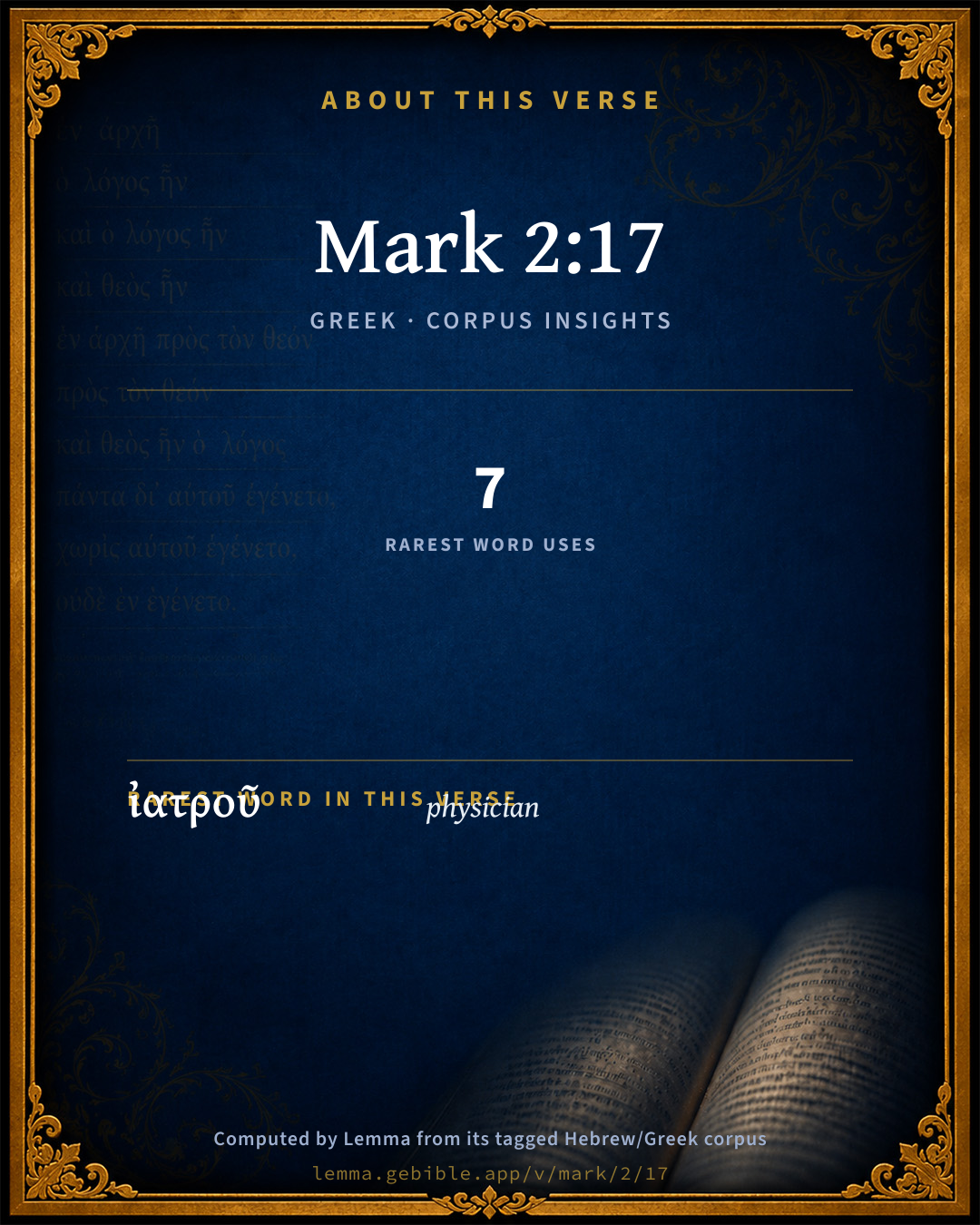
Mark 2:17

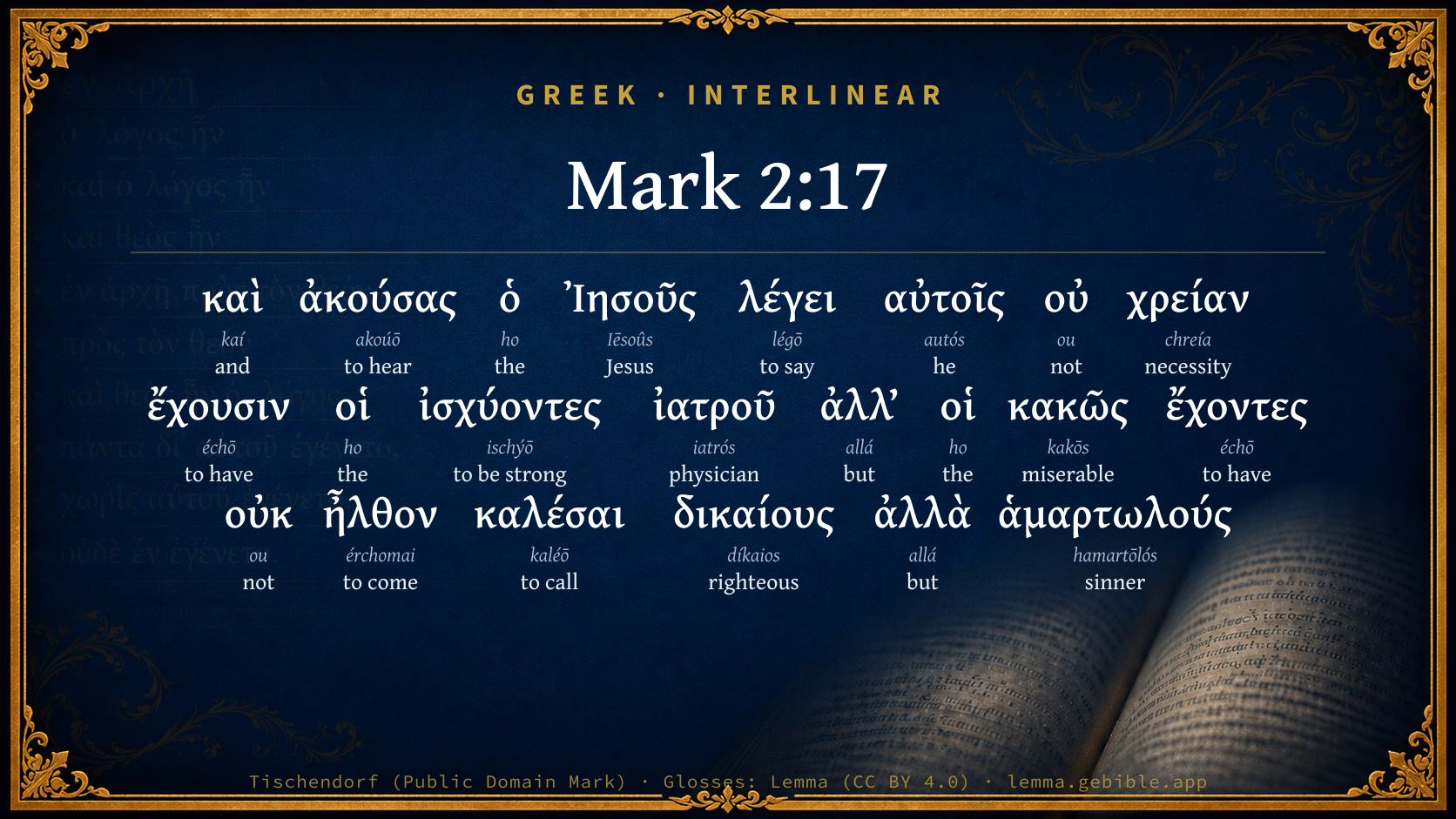
Greek (Tischendorf 8th ed.) Mark 2:17 appears in the Greek New Testament. The text above is from the Tischendorf 8th edition. Each word links to its Strong’s number and a concise gloss. Click any word for its full Thayer’s Greek Lexicon entry.
Download image
Cite this verse

Mark 2:17 (World English Bible). Public Domain. Lemma interlinear Bible study tool, https://lemma.gebible.app/v/mark/2/17.

Show BibTeX & RIS
BibTeX
RIS
English Translation
When Jesus heard it, he said to them, "Those who are healthy have no need for a physician, but those who are sick. I came not to call the righteous, but sinners to repentance."
World English Bible · Public Domain
Download a study sheet

One document with this verse’s original text, its word-by-word gloss line, the meaning frame, cross-references with their text, attributed commentary, and full source and license credits — printable, and it pastes into notes with its structure intact.

This verse Autodidact and up

Study sheet (.html) Plain text (.txt)

A passage Seminary Student

Up to 50 verses in one chapter. A passage sheet keeps up to 6 commentary sources and 12 cross-references per verse, in the order this page ranks them, and says so on the sheet whenever that leaves anything out. Ask for a single verse and you get the Autodidact verse sheet above.

Everything on this page stays free to read, with no account — the sheet is a download of what is already on screen, not access to it.

Want to remove ads? Support Godless Engineer
Compare translations 3

The same verse in 3 English versions, stacked beneath the original-language interlinear above. Click any original word for its lexicon entry.

Each is an independent rendering of the whole verse — the interlinear is not word-aligned to these translations.

Highlighted words mark where these versions differ — a whole-verse word diff, not a word-by-word alignment.

  • World English Bible Public Domain
    When Jesus heard it, he said to them, "Those who are healthy have no need for a physician, but those who are sick. I came not to call the righteous, but sinners to repentance."
  • King James Version Public Domain
    When Jesus heard it, he saith unto them, They that are whole have no need of the physician, but they that are sick: I came not to call the righteous, but sinners to repentance.
  • unfoldingWord Literal Text CC BY-SA 4.0
    And having heard, Jesus says to them, “The ones being healthy do not have need of a physician, but the ones having sickness. I did not come to call the righteous, but sinners.”

unfoldingWord Literal Text — © unfoldingWord, licensed CC BY-SA 4.0. Word-aligned USFM3 via Door43 (git.door43.org/unfoldingWord/en_ult).

Versions to compare (up to 4)

3 of 4 selected

Show all 19 translations

Every available English version of this verse, each an independent rendering of the whole verse.

  • World English Bible Public Domain
    When Jesus heard it, he said to them, "Those who are healthy have no need for a physician, but those who are sick. I came not to call the righteous, but sinners to repentance."
  • Berean Standard Bible Public Domain
    On hearing this, Jesus told them, “It is not the healthy who need a doctor, but the sick. I have not come to call the righteous, but sinners.”
  • Majority Standard Bible Public Domain
    On hearing this, Jesus told them, “It is not the healthy who need a doctor, but the sick. I have not come to call the righteous, but sinners, to repentance.”
  • King James Version Public Domain
    When Jesus heard it, he saith unto them, They that are whole have no need of the physician, but they that are sick: I came not to call the righteous, but sinners to repentance.
  • American Standard Version (1901) Public Domain
    And when Jesus heard it, he saith unto them, They that are whole have no need of a physician, but they that are sick: I came not to call the righteous, but sinners.
  • Revised Version (1885) Public Domain
    And when Jesus heard it, he saith unto them, They that are whole have no need of a physician, but they that are sick: I came not to call the righteous, but sinners.
  • Geneva Bible (1599) Public Domain
    Now when Iesus heard it, hee sayde vnto them, The whole haue no neede of the Physicion, but the sicke. I came not to call the righteous, but the sinners to repentance.
  • Douay-Rheims (1899) Public Domain
    Jesus hearing this, saith to them: They that are well have no need of a physician, but they that are sick. For I came not to call the just, but sinners.
  • Young's Literal Translation Public Domain
    And Jesus, having heard, saith to them, `They who are strong have no need of a physician, but they who are ill; I came not to call righteous men, but sinners to reformation.'
  • Literal Standard Version CC BY-SA 4.0
    And Jesus, having heard, says to them, “They who are strong have no need of a physician, but they who are ill; I did not come to call righteous men, but sinners.”
  • Unlocked Literal Bible CC BY-SA 4.0
    When Jesus heard this he said to them, “People who are strong in body do not need a physician; only people who are sick need one. I did not come to call righteous people, but sinful people.”
  • unfoldingWord Literal Text CC BY-SA 4.0
    And having heard, Jesus says to them, “The ones being healthy do not have need of a physician, but the ones having sickness. I did not come to call the righteous, but sinners.”
  • Darby Bible Public Domain
    And Jesus having heard [it] says to them, They that are strong have not need of a physician, but those who are ill. I have not come to call righteous [men], but sinners.
  • World Messianic Bible Public Domain
    When Yeshua heard it, he said to them, “Those who are healthy have no need for a physician, but those who are sick. I came not to call the righteous, but sinners to repentance.”
  • Webster's Bible Public Domain
    When Jesus heard it, he saith to them, They that are in health, have no need of a physician, but they that are sick; I came not to call the righteous, but sinners, to repentance.
  • Free Bible Version CC BY-SA 4.0
    When Jesus heard this, he told them, “It's not healthy people who need a doctor, but those who are sick. I haven't come to invite those who live right, but those who don't—the sinners.”
  • Bible in Basic English Public Domain
    And Jesus, hearing it, said to them, Those who are well have no need of a medical man, but those who are ill: I have come not to get the upright but sinners.
  • Text-Critical English NT CC BY 4.0
    When Jesus heard this, he said to them, “It is not the healthy who need a physician, but the sick. I did not come to call the righteous, but sinners to repentance.”
  • Tyndale New Testament (1534) Public Domain
    When Iesus hearde that he sayde vnto them. The whole have no nede of the phisicion but the sicke. I came not to call the rightwise but the synners to repentaunce.

Literal Standard Version (2020), Covenant Press — licensed CC BY-SA 4.0. Text via the HelloAO Bible API (eBible.org). Unlocked Literal Bible (unfoldingWord) — licensed CC BY-SA 4.0. Text via the HelloAO Bible API (eBible.org). unfoldingWord Literal Text — © unfoldingWord, licensed CC BY-SA 4.0. Word-aligned USFM3 via Door43 (git.door43.org/unfoldingWord/en_ult). Free Bible Version, Dr. Jonathan Gallagher — licensed CC BY-SA 4.0. Text via the HelloAO Bible API (eBible.org).

Word by word

More ways to search: Search by grammar → Find every occurrence → Compare this word →

Practice this passage: Drill this verse → Learn its vocabulary →

ἰατροῦ
iatrós
G2395
“physician”
Noun, Genitive, Singular, Masculine
Part of Speech
Noun
Case
Genitive
Number
Singular
Gender
Masculine
Full Thayer's Definition

Origin: from G2390

TDNT: 06:14,3

1. a physician
  1. καὶ kaí G2532 “and” Conjunction
  2. ἀκούσας akoúō G191 “to hear” Verb, Aorist, Active, Participle, Nominative, Singular, Masculine
  3. ὁ ho G3588 “the” Article, Nominative, Singular, Masculine
  4. Ἰησοῦς Iēsoûs G2424 “Jesus” Noun, Nominative, Singular, Masculine
  5. λέγει légō G3004 “to say” Verb, Present, Active, Indicative, 3rd person, Singular
  6. αὐτοῖς autós G846 “he” Personal pronoun, Dative, Plural, Masculine
  7. οὐ ou G3756 “not” Particle, Negative
  8. χρείαν chreía G5532 “necessity” Noun, Accusative, Singular, Feminine
  9. ἔχουσιν échō G2192 “to have” Verb, Present, Active, Indicative, 3rd person, Plural
  10. οἱ ho G3588 “the” Article, Nominative, Plural, Masculine
  11. ἰσχύοντες ischýō G2480 “to be strong” Verb, Present, Active, Participle, Nominative, Plural, Masculine
  12. ἀλλ’ allá G235 “but” Conjunction
  13. οἱ ho G3588 “the” Article, Nominative, Plural, Masculine
  14. κακῶς kakōs G2560 “miserable” Adverb
  15. ἔχοντες échō G2192 “to have” Verb, Present, Active, Participle, Nominative, Plural, Masculine
  16. οὐκ ou G3756 “not” Particle, Negative
  17. ἦλθον érchomai G2064 “to come” Verb, Aorist, Active, Indicative, 1st person, Singular
  18. καλέσαι kaléō G2564 “to call” Verb, Aorist, Active, Infinitive
  19. δικαίους díkaios G1342 “righteous” Adjective, Accusative, Plural, Masculine
  20. ἀλλὰ allá G235 “but” Conjunction
  21. ἁμαρτωλούς hamartōlós G268 “sinner” Adjective, Accusative, Plural, Masculine

About this verse

These counts appear in no published source. They are computed here, from the morphology-tagged text and Lemma’s own curated glosses. What Lemma adds →

22
words
17
distinct lemmas
Gospels
section

Notable vocabulary

The rarest word here is ἰατροῦ physician G2395 — appearing just 7 times in the whole Greek New Testament.

Shared distinctive vocabulary

ἰατροῦ physician G2395 occurs in 7 verses of the Greek New Testament. Also found in:

Repetition

Words recur within this verse:

  • ἔχουσιν to have G2192 ×2
  • ὁ the G3588 ×3
  • οὐ not G3756 ×2
  • ἀλλ’ but G235 ×2

Cross-references

19

Topical passages linked to Mark 2:17 in the Treasury of Scripture Knowledge — connected by theme and wording, ordered by reader-vote popularity; previews shown in the World English Bible.

  • Matthew 9:12–13 When Jesus heard it, he said to them, "Those who are healthy have no need for a physician, but those who are sick do.
  • Luke 15:7 I tell you that even so there will be more joy in heaven over one sinner who repents, than over ninety-nine righteous people who need no repentance.
  • Luke 5:31–32 Jesus answered them, "Those who are healthy have no need for a physician, but those who are sick do.
  • Luke 19:10 For the Son of Man came to seek and to save that which was lost."
  • 1 Timothy 1:15–16 The saying is faithful and worthy of all acceptance, that Christ Jesus came into the world to save sinners; of whom I am chief.
  • Titus 3:3–7 For we were also once foolish, disobedient, deceived, serving various lusts and pleasures, living in malice and envy, hateful, and hating one another.
  • Romans 5:6–8 For while we were yet weak, at the right time Christ died for the ungodly.
  • Isaiah 55:7 let the wicked forsake his way, and the unrighteous man his thoughts; and let him return to Yahweh, and he will have mercy on him; and to our God, for he will abundantly pardon.
  • Romans 5:20–21 The law came in besides, that the trespass might abound; but where sin abounded, grace did abound more exceedingly;
  • Luke 15:10 Even so, I tell you, there is joy in the presence of the angels of God over one sinner repenting."
  • 1 Corinthians 6:9–11 Or don't you know that the unrighteous will not inherit the Kingdom of God? Don't be deceived. Neither the sexually immoral, nor idolaters, nor adulterers, nor male prostitutes, nor homosexuals,
  • Isaiah 1:18 "Come now, and let us reason together," says Yahweh: "Though your sins be as scarlet, they shall be as white as snow. Though they be red like crimson, they shall be as wool.
  • Titus 2:14 who gave himself for us, that he might redeem us from all iniquity, and purify for himself a people for his own possession, zealous for good works.
  • John 9:40 Those of the Pharisees who were with him heard these things, and said to him, "Are we also blind?"
  • Luke 15:29 But he answered his father, 'Behold, these many years I have served you, and I never disobeyed a commandment of yours, but you never gave me a goat, that I might celebrate with my friends.
  • Acts 20:21 testifying both to Jews and to Greeks repentance toward God, and faith toward our Lord Jesus.
  • Luke 16:15 He said to them, "You are those who justify yourselves in the sight of men, but God knows your hearts. For that which is exalted among men is an abomination in the sight of God.
  • Acts 26:20 but declared first to them of Damascus, at Jerusalem, and throughout all the country of Judea, and also to the Gentiles, that they should repent and turn to God, doing works worthy of repentance.
  • Matthew 18:10 See that you don't despise one of these little ones, for I tell you that in heaven their angels always see the face of my Father who is in heaven.

Cross-references courtesy of OpenBible.info (CC BY 4.0).

Where the printed editions differ

1 variant

Places in this verse where the major printed Greek editions disagree on the wording in a way that affects the translation — a comparison of editions, not a manuscript-by-manuscript collation. The editions are the modern critical texts (Nestlé-Aland 28/27, SBL, Westcott-Hort, Tregelles, Tyndale House) and the traditional texts behind the KJV (the Textus Receptus and the Byzantine/Majority text). It is not a claim about which reading is original.

  1. Extra text
    εἰς μετάνοιαν.

    “into repentance.”

    In TRByz Not in NA28NA27TynSBLWHTreg

    εἰς μετάνοιαν.¶ (eis metanoian) 'into repentance.' is only in traditional manuscripts (TR+Byz)

Textual data: Translators Amalgamated Greek New Testament (STEPBible TAGNT) · CC BY 4.0.

Commentary

Notes on Mark 2:17 from classic Christian and Jewish commentators (each source and its license shown beneath its notes). The classic Christian expositions comment on the surrounding passage and are grouped to its opening verse, so a note may address several verses; the Jewish commentaries on the Tanakh (Rashi and others) are per-verse, so they appear only where the commentator wrote on this verse.

Lemma curates 59 commentaries, every one of them public domain or Creative Commons licensed, each selected and text-cleaned for this edition rather than reprinted as found. About our sources →

The Biblical Illustrator

Joseph S. Exell

Mar_2:17

They that are whole have no need of the physician.

For whom is the gospel meant?

I. Even a superficial glance at our Lords mission suffices to show that His work was for the sinful. His descent into the world implied that men needed deliverance. The bearing of the gospel covenant is towards guilty men. His mission is described as one of mercy and grace. The gospel turns its face always towards sin. The gospel has always found its greatest trophies amongst the most sinful. To whom else could it look?

II. The more closely we look the more clear this fact becomes. Christ came that He might be a sin bearer. The gifts of the gospel, such as pardon and justification, imply sin. The great deeds of our Lord, such as His death, resurrection, and ascension, all bear upon sinners.

III. It is our wisdom to accept the situation. The very best thing you can do, since the gospel looks towards sinners, is to get where the gospel looks. You will then be in your right place. This is the safest way to obtain the blessing. This is a place into which you can get directly.

IV. This doctrine has a great sanctifying influence. It changes the sinners thoughts of God. It inspires, melts, enlivens, and inflames him. It deals a deadly blow at his self-conceit. It produces a sense of gratitude. It makes him ready to forgive others. It becomes the very soul of enthusiasm. (C. H. Spurgeon.)

Christs treatment of sinners

I. Sinners in their natural state have need of repentance. This duty is often urged in Scripture (Isa_55:7; Mat_3:8; Act_2:38).

1. Without repentance none can be saved.

2. Let all, therefore, lay held on it without delay.

II. Sinners cannot repent of themselves. They must be called to it by Christ.

III. One main end of Christs coming into the world was to call and convert sinners, and bring them to repentance.

1. This should encourage sinners to come to Christ by faith, and by true repentance and humiliation for their sins, in hope of mercy and pardon. Since He came for this purpose, He will not reject any who accept His invitation and hearken to His call.

2. How excellent a work it must he-since Christ Himself came to begin it-to be the means of converting sinners, and drawing them to repentance. This is not merely the duty of ministers: all Christians may take part in it.

3. If Christ came to call sinners to repentance, then He did not come to give liberty to any to live in sin, or to commit sin. Repentance is the beginning of a new life-a life of emancipation from the power as well as the penalty of sin. (G. Petter.)

All the lessons of this word could not be even named here, but these are certainly in it.

I. Sin is sickness of the worst kind.

II. Repentance and forgiveness are the healing of the soul.

III. Christ is the souls Physician, skilled to heal all its diseases.

IV. The more grave our case is, the more eager Jesus is to cure it. What should we have done had this not been the ease? Happily He still stoops to closest, tenderest fellowship with sinners. He pities most the guiltiest, and is ever nearest to the neediest. (R. Glover.)

Christs call

I. Christ came not to call the righteous.

1. Because there were no righteous to call.

2. Because if there had been they would not have needed calling.

II. He came to call sinners.

1. All sinners.

2. Especially those conscious of their sins.

III. He came to call to repentance. His call is not an absolute call to the privileges of the sons of God, but to the fulfilment of a condition-repent, and believe. (Anon.)

Wretchedness a plea for salvation

On entering a ragged school you see a boy who can spell his way through a Bible-once a sealed book to him; he knows now of a Saviour, of whom once he had never heard the name. Clean, sharp, intelligent, bearing an honest air with him, he bespeaks your favour. But were these his passport to the asylum? No. He was adopted not for the sake of these, but notwithstanding the want of them. It was his wretchedness that saved him; the clean hands, and the rosy cheeks, and all that won our favour, are the results of that adoption. (Dr. Guthrie.)

The spirit in which to seek salvation

On one occasion, when the late Duke of Kent expressed some concern about the state of his soul in the prospect of death, his physician endeavoured to soothe his mind by referring to his high respectability and his honourable conduct in the distinguished situation in which Providence had placed him; but he stopped him short, saying, No; remember, if I am to be saved, it is not as a prince, but as a sinner.

The sinners hope

A Hottentot of immoral character, being under deep conviction of sin, was anxious to know how to pray. He went to his master, a Dutchman, to consult with him; but his master gave him no encouragement. A sense of his wickedness increased, and he had no one near to direct him. Occasionally, however, he was admitted with the family at the time of prayer. The portion of Scripture which was one day read was the parable of the Pharisee and publican. While the prayer of the Pharisee was read, the poor Hottentot thought within himself, This is a good man; here is nothing for me; but when his master came to the prayer of the publican-God, be merciful to me, a sinner-This suits me, he cried; now I know how to pray. With this prayer he immediately retired, and prayed night and day for two days, and then found peace. Full of joy and gratitude he went into the fields, and, as he had no one to whom he could speak, he exclaimed, Ye hills, ye rocks, ye trees, ye rivers, hear what God has done for my soul! He has been merciful to me, a sinner.

The great Physician and His patients

This was Christs apology for mingling with the publicans and sinners when the Pharisees murmured against Him. He triumphantly cleared Himself by showing that, according to the fitness of things, He was perfectly in order. He was acting according to His official character. A physician should be found where there is work for him to do, etc.

I. Mercy graciously regards sin as disease. It is more than disease, but mercy leniently and graciously chooses to view it as such. It is justified in such a view, for almost everything that may be said of deadly maladies may be said of sin.

1. Sin is an hereditary disease. The taint is in our blood, etc.

2. Sin, like sickness, is very disabling. It prevents our serving God. We cannot pray or praise God aright, etc. There is not a single moral power of manhood which sin has not stripped of its strength and glory.

3. Sin also, like certain diseases, is a very loathsome thing.

4. Fearfully polluting. Everything we do and think of grows polluted through our corruption.

5. Contagious. A man cannot be a sinner alone. One sinner destroyeth much good.

6. Very painful; and yet, on the other hand, at certain stages it brings on a deadness, a numbness of soul, preventing pain. Most men are unconscious of the misery of the fail. But when sin is really discerned, then it becomes painful indeed. Oh, what wretchedness was mine before I laid hold on Christ.

7. It is deep seated, and has its throne in the heart. The skill of physicians can often extract the roots of disease, but no skill can ever reach this. It is in its own nature wholly incurable. Man cannot cure himself. Jehovah Rophi the healing Lord, must manifest His omnipotent power.

8. It is a mortal disease. It kills not just now, but it will kill ere long.

II. It pleases Divine mercy to give to Christ the character of a Physician. Jesus Christ never came into the world merely to explain what sin is, but to inform us how it can be removed. As a Physician Christ is-

1. Authorised.

2. Qualified. He is, experimentally as well as by education, qualified in the healing art.

3. Has a wide practice.

4. His cures are speedy, radical, sure. His medicine is Himself. O Blessed Physician for this desperate disease!

III. That need is that alone which moves our gracious Physician to come to our aid. His Saviourship is based upon our sinnership. Need, need alone, is that which quickens the Physicians footsteps.

IV. It follows therefore, and the text positively asserts it, that the whole-that those who have no great need, no need at all-will be unaided by Christ.

V. It follows, then, that those who are sick shall be helped by Jesus. Are you sick, sinful, etc.? He loves to save. He can save the vilest. Trust Him. (C. H. Spurgeon.)

The Healer of souls

It is one of the most remarkable facts in the life of our Lord that He was obliged repeatedly to defend Himself for loving the sinful. It is a fact by which we may measure the usual progress of the world under the influence of Christian civilization. Now, philanthropy is generally practised and held in high esteem. Yet we do Christs censors injustice by looking on them as rare monsters of inhumanity. They were simply men whose thoughts and sympathies were dominated by the spirit of their age. For the love of the sinful was a new thing on the earth, whose appearance marked the beginning of a new era, well called the era of grace. Never was apology more felicitous or successful-Christ was a Physician. The defence is simple and irresistible.

I. That Christianity is before all things a religion of redemption. If such be its character, then to be true to itself Christianity cannot afford to be nice, dainty, disdainful, but must lay its healing hand on the most repulsive. Rabbinism may be exclusive, but not the religion of redemption. It is bound to be a religion for the masses. Christ is not merely an ethical Teacher, or Revealer of Divine mysteries; He is, in the first place, a Redeemer, only in the second the Revealer.

II. That Christianity is the religion of hope. It takes a cheerful view of the capabilities and prospects of man even at his worst. It believes that he can be cured. In this hopefulness Christianity stood alone in ancient times. It needed the eye of a more than earthly love, and of a faith that was the evidence of things not seen, to discern possibilities of goodness even in the waste places of society. The Church must have the Physicians confidence in His healing art; she must be inventive. She must have sympathy with people for their good. She must not frown on the zeal of those who would try new experiments.

III. Christianity is fit and worthy to be the universal religion. (A. B. Bruce, D. D.)

The sickness-the Physician

I. The sickness spoken of.

1. The likeness between the sickness of the body and that of the soul. As sickness is a disordered body, so is sin a precious soul all in disorder. Sickness of body, not healed, will kill the body. Sin, not healed, not pardoned, will kill the never-dying soul. Or, take any of the particular diseases which Christ healed on the earth, and see the likeness in them. He healed madness. Sin is madness-flying in the face of God. He healed fevers. Sin is a lever-consuming, burning the soul. He healed palsies. Sin is a palsy-laying the soul prostrate. He healed leprosy. Sin is a leprosy-very foul and loathsome. He healed deafness, blindness. The sinner is deaf, blind-deaf to the voice of God and of his own conscience-blind to all it most concerns him to see-to himself, God, Christ.

2. Well, sin is like disease; but see the difference: sickness is usually one disease. Sin is all diseases in one-the madness, the fever, the deafness, all in one! Men wish to be free of sickness of body. Alas! they do not wish to be free of sin, the disease of the soul. Sickness is disease; sin is crime-sin.

II. The glorious Physician.

1. Let me say of Him-there is no other. If you are sick in body you have a choice of physicians. But for the terrible sickness of sin none but Christ-Neither is there salvation in any other, etc. There needs no other.

2. That He knows our whole case, our whole disease, and so is able to deal with it. Other physicians have often to work in the dark. They are uncertain what the disease is, and, if they know, may be unable to heal.

3. That He is unspeakably tender. What else but love could have brought Him into this leprous world?

4. That He is a mighty, all-skilful Physician.

5. That He is a faithful Physician. He will not skin over your wound and say that it is healed-A new heart also will I give you.

6. He is a Physician very near at hand-A very present help in trouble. (C. J. Brown, D. D.)

Christ calling sinners to repentance

The call of St. Matthew the occasion of these words.

I. The observations naturally arising from the several particular expressions made use of in the text.

1. That sin is to the soul what disease or sickness is to the body.

2. That repentance is not an original and primary duty of religion, only of secondary intention, and of consequential obligation. The original duty of all rational creatures is to obey the commandments of God, and such as have always lived in obedience are not obliged to the duty of repentance. It applies to those who have sinned. It is a privilege to them to be permitted to perform it (Act_11:18). There is a repentance to which even the best of men are continually obliged. But this is not that repentance to which our Saviour came to call sinners.

3. The just and sharp reproof contained in this answer to the hypocritical Pharisees.

II. The general doctrine of repentance as here laid down by our Lord. The design of His preaching was to call sinners to repentance. (S. Clarke, D. D.)

Moral sickness

For as the natural health of the body consists in this: that every part and organ regularly and duly performs its proper function; and, when any of these are disordered or perverted in their operations, there ensues sickness and diseases: so likewise, with regard to the spiritual or moral state of the mind and soul; when every faculty is employed in its natural and proper manner, and with a just direction to the end it was designed for; when the understanding judges of things according to reason and truth, without partiality and without prejudice; when the will is in its actions directed by this judgment of right, without obstinacy or wilfulness; and when the passions in their due subordinate station, and the appetites under the government of sober intention, serve only to quicken the execution of what reason directs: then is the mind of man sound and whole; fit for all the operations of a rational creature, fit for the employments of a virtuous and religious life. On the contrary, the abuse or misemployment of any of these faculties, is the disease or sickness of the soul. And when they are all of them perverted, totally and habitually, by a general corruption and depravation of manners; then, as the body, by an incapacity of all its organs for the uses of natural life, dies and is dissolved; so the man in his moral capacity, by an habitual neglect and dislike of all virtuous practices, becomes (as the Scripture elegantly expresses it) dead in trespasses and sins. And as, in bodily diseases, some are more dangerous, and more likely to prove mortal, than others; in which sense our Saviour says concerning Lazarus, This sickness is not unto death (Joh_11:4); so, in the spiritual sense, the same apostle St. John, in his First Epistle, speaks of sins, which, according as there be any or no hope of men recovering from them, either are or are not unto death (1Jn_5:16). (S. Clarke, D. D.)

Christ came to call the sinner

Christ came to call not the righteous, but sinners to repentance. The schoolmaster does not gather the finest scholars in the country into his school, and try to teach them; he takes those who know little or nothing and educates them. The gardener does not bind up the strong, hardy plants; it is those that are weak and slender, those that have been broken down by the wind, that he trains to the pole or to the wall. It is the sick people, not the well people, who need the physician. No one can be too great a sinner to be beyond the need of Jesus; it was to save sinners that Jesus came. (The Sunday School Times.)

The value and capability of sinful man

By going to the lowest stratum of human nature, Christ gave a new idea of the value of man. He built a kingdom out of the refuse of society. To compare small things with great, it has been pointed out by Lord Macaulay that in an English cathedral there is an exquisite stained window which was made by an apprentice out of the pieces of glass which had been rejected by his master, and it was so far superior to every other in the church, that, according to tradition, the envious artist killed himself with vexation. All the builders of society had rejected the sinners, and made the painted window of the righteous. A new Builder came; His plan was original, startling, revolutionary; His eye was upon the condemned material; He made the first last, and the last first, and the stone which the builders rejected, He made the headstone of the corner. He always especially cared for the rejected stone. Men had always cared for the great, the beautiful, the righteous; it was left for Christ to care for sinners. (Dr. Parker.)

Christ an authorised Physician

When a physician presents himself, one of the first inquiries is, Is he a regular practitioner? Has he a right to practise? Has he a diploma? Very properly, the law requires that a man shall not be allowed to hack our bodies and poison us with drugs at his own pleasure without having at least a show of knowing what he is at. It has been tartly said that a doctor is a man who pours drugs, of which he knows little, into a body of which he knows still less. I fear that is often the case. Still a diploma is the best safeguard mortals have devised. Christ has the best authority for practising as a Physician. He has a Divine diploma. Would you like to see His diploma? I will read you a few words of it: it comes from the highest authority, not from the College of Physicians, but from the God of Physicians. Here are the words of it in the sixty-first chapter of Isaiah - The Spirit of the Lord is upon me, because the Lord hath anointed me to preach good tidings unto the meek. He hath sent me to bind up the broken hearted. He has a diploma for binding up broken hearts. I should not like to trust myself to a physician who was a mere self-dubbed doctor, who could not show any authorization; I must have him know as much as a man can know, little as I believe that will probably be. He must have a diploma; it must be signed and sealed too, and be in a regular manner, for few sensible men will risk their lives with ignorant quacks. Now Jesus Christ has His diploma and there it is-God hath sent Him to bind up the broken-hearted. The next thing you want in a physician is education; you want to know that he is thoroughly qualified; he must have walked the hospitals. And certainly our Lord Jesus Christ has done so. What form of disease did He not meet with? When He was here among men it pleased God to let the devil loose, in order that there might be more than usual venom in the veins of poor diseased manhood: and Christ met the devil at his darkest hour and fought with the great enemy when he had full liberty to do his worst with Him. Jesus did, indeed, enter into the woes of men. Walked the hospital! Why the whole world was an infirmary, and Christ the one only Physician, going from couch to couch, healing the sons of men. (C. H. Spurgeon.)

Christ a competent Physician

His cures are very speedy-there is life in a look at Him; His cures are radical-He strikes at the very centre of the disease, and hence His cures are very sure and certain. He never fails, and the disease never returns. There is no relapse where Christ heals; no fear that one of His patients should be but patched up for a season, He makes a new man of him; a new heart also does He give him, and a right spirit does He put within him. He is a Physician, one of a thousand, because He is well-skilled in all diseases. Physicians generally have some specialite. They may know a little about almost all our pains and ills, but there is usually one disease which they have studied the most carefully, one part of the human frame whose anatomy is as well-known to them as the rooms and cupboards of their own house. Jesus Christ has made the whole of human nature His specialite. He is as much at home with one sinner as with another sinner and never yet did He meet with an out-of-the-way case that was out of the way to Him. (C. H. Spurgeon.)

The Biblical Illustrator, edited by Joseph S. Exell (c. 1880s–1900s) — public domain. Text from a community e-Sword module.

Tyndale Open Study Notes

Tyndale Open Resources

2:17 Jesus answered his opponents with a well-known proverb, comparing himself to a doctor and sinners to sick people. Salvation is for those who know they are sinners, not those who think they are righteous (Luke 16:15; 18:9; Rom 3:23).

Tyndale Open Study Notes — © Tyndale Open Resources, licensed CC BY-SA 4.0. Text via the HelloAO Bible API.

Expositor's Greek Testament

ed. W. Robertson Nicoll

Mar 2:17 . καλέσαι : to call, suggestive of invitations to a feast (Fritzsche, Meyer, Holtz.), and making for the hypothesis that Jesus, not Matthew, was the real host at the social gathering: the whole plan His, and Matthew only His agent; vide notes on Mt. He called to that particular feast as to the feast of the kingdom, the one a means to the other as the end. δικαίους , ἁμαρτωλούς : Jesus preferred the company of the sinful to that of the righteous, and sought disciples from among them by preference. The terms are not ironical. They simply describe two classes of society in current language, and indicate with which of the two His sympathies lay.

The Expositor's Greek Testament, edited by W. Robertson Nicoll (1897–1910) — public domain. Text from a community e-Sword module.

Adam Clarke's Commentary

Verse 17. To repentance.] This is omitted by ABDKL, twenty-seven others; both the Syriac, Persic, Coptic, AEthiopic, Armenian, Gothic, Vulgate; six copies of the Itala; Euthymius and Augustin. Griesbach has left it out of the text; Grotius, Mill, and Bengel approve of the omission. See Clarke on Mt 9:13. I leave it as in the parallel place above quoted. Properly speaking, the righteous cannot be called to repentance. They have already forsaken sin, mourned for it, and turned to God. In the other parallel place, Lu 5:32, all the MSS. and versions retain μετανοιαν, repentance.

Adam Clarke's Commentary on the Bible (1810–1826) — public domain. Text from a community e-Sword/MySword module.

Ellicott's Commentary for English Readers

(17) I came not to call the righteous.—Closely as the three accounts agree, it is noticeable that here also St. Mark and St. Luke, as writing for Gentile readers, omit the reference which we find in Mat_9:13, to the words cited by our Lord from the Old Testament.

A Bible Commentary for English Readers, edited by Charles John Ellicott (1878–1897) — public domain. Text from a community e-Sword module.

John Gill's Exposition

And the disciples of John and of the Pharisees used to fast,.... Or "were fasting"; perhaps that very day, and so were the more displeased at this entertainment, Matthew had made for Christ and his disciples, and at their being at it; or fasting was usual with them: they fasted often, both John's disciples, and the disciples of the Pharisees, or the Pharisees themselves; so the Vulgate Latin reads: of their frequent fasting; see Gill on Mat 9:14,

and they came: both the disciples of John, Mat 9:14, and the Scribes and Pharisees, Luk 5:30,

and say unto him, why do the disciples of John and of the Pharisees fast, but thy disciples fast not? See Gill on Mat 9:14.

John Gill's Exposition of the Whole Bible (1746–1763) — public domain (CC PDM 1.0). Text via the HelloAO Bible API.

Trapp's Complete Commentary

John Trapp

17 When Jesus heard it, he saith unto them, They that are whole have no need of the physician, but they that are sick: I came not to call the righteous, but sinners to repentance.

Ver. 17. He saith unto them] Though not for their sakes (for he knew it was to no purpose) yet for his other hearers’ sakes, he makes apology, Jer 3:14-15. God often gives a pastor after his own heart, for a few that are to be converted.

John Trapp, A Commentary or Exposition upon All the Books of the Old and New Testament (1647–1656) — public domain. Text from a community e-Sword module.

Haydock's Catholic Bible Commentary

The Greek printed copies, and some manuscripts add to penance, as we read in Luke v. 33.

George Leo Haydock (1774–1849), Haydock's Catholic Family Bible and Commentary, 1859 edition — public domain. Excludes Psalms (Douay-Rheims chapter numbering differs from Protestant) and Deuterocanonical books (Catholic canon only).

The Pulpit Commentary

Jesus heard their murmurings, and his answer was, They that are whole have no need of a physician, but they that are sick. As the physician is not infected by the disease of the patient, but rather overcomes it and drives it from him, so it is no disgrace but rather an honor to the physician to associate himself with the sick, and so much the more, the greater the sickness. So that it is as though Christ said, "I who am sent from heaven by the Father, that I might be the Physician of the souls of sinners, am not defiled by their sins and spiritual diseases when I converse with them; but rather I cure and heal them, which is alike for my glory and for their good, and so much the more, the greater their sins. For I am the physician of sinners, not their companion. But you, scribes and Pharisees, are not the physicians but the companions of sinners, and so you are contaminated. Nevertheless, you desire to be thought righteous and holy; and therefore I do not associate with you,

(1) because the whole, such as you think yourselves to be, need not the spiritual Physician; and

(2) because your insincerity and hypocrisy are an offense to me."

The Pulpit Commentary (1880–1919), ed. H.D.M. Spence-Jones & Joseph S. Exell — public domain. Text from a community e-Sword module.

John Wesley's Explanatory Notes

I came not to call the righteous - Therefore if these were righteous I should not call them. But now, they are the very persons I came to save.

John Wesley, Explanatory Notes Upon the Whole Bible (1754–1765) — public domain. Text via the GEBible commentary corpus.

unfoldingWord translationNotes

Door43 World Missions Community

Connecting Statement:

Jesus responds to what the scribes had said to his disciples about his eating with tax collectors and sinful people.

he said to them

"he said to the scribes"

People who are strong in body do not need a physician; only people who are sick need one

Jesus used this proverb about sick people and doctors to teach them that only people who know that they are sinful realize that they need Jesus. (See: Proverbs)

strong in body

"healthy"

I did not come to call righteous people, but sinful people

Jesus expects his hearers to understand he came for those who want help. AT: "I came for people who understand they are sinful, not for people who believe they are righteous" (See: Irony)

but sinful people

The words "I came to call" are understood from the phrase before this. AT: "but I came to call sinful people" (See: Ellipsis)

translationWords

Jesus

righteous

sin

unfoldingWord translationNotes — © Distant Shores Media and the Door43 World Missions Community, licensed CC BY-SA 4.0. Source: git.door43.org/Door43/en_tn.

Cambridge Greek Testament for Schools and Colleges

17. [325][326][327][328][329][330][331][332] and versions omit εἰς μετάνοιαν, which comes from Luk 5:32.

[325] Codex Sinaiticus. 4th cent. Discovered by Tischendorf in 1859 at the Monastery of St Katharine on Mount Sinai. Now at St Petersburg. The whole Gospel, ending at Mar 16:8. Photographic facsimile, 1911.

[326] Codex Alexandrinus. 5th cent. Brought by Cyril Lucar, Patriarch of Constantinople, from Alexandria, and afterwards presented by him to King Charles I. in 1628. In the British Museum. The whole Gospel. Photographic facsimile, 1879.

[327] Codex Vaticanus. 4th cent., but perhaps a little later than א. In the Vatican Library almost since its foundation by Pope Nicolas V., and one of its greatest treasures. The whole Gospel, ending at Mar 16:8. Photographic facsimile, 1889.

[328] Codex Bezae. 6th cent. Has a Latin translation (d) side by side with the Greek text, and the two do not quite always agree. Presented by Beza to the University Library of Cambridge in 1581. Remarkable for its frequent divergences from other texts. Contains Mark, except Mar 16:15-20, which has been added by a later hand. Photographic facsimile, 1899.

[329] Codex Cyprius. 9th cent. One of the seven uncials which have the Gospels complete, the others being אBMSUΩ. At Paris.

[330] Codex Regius. 8th cent. An important witness. At Paris. Contains Mar 1:1 to Mar 10:15; Mar 10:30 to Mar 15:1; Mar 15:20 to Mar 16:20, but the shorter ending is inserted between Mar 16:8 and Mar 16:9, showing that the scribe preferred it to the longer one.

[331] Codex Sangallensis. 9th or 10th cent. Contains the Gospels nearly complete, with an interlinear Latin translation. The text of Mark is specially good, agreeing often with CL. At St Gall.

[332] Codex Petropolitanus. 9th cent. Gospels almost complete. Mar 16:18-20 is in a later hand.

17. καὶ ἀκούσας. Probably He overheard. In all three accounts He takes the whole responsibility. It is His doing, not the disciples’, that they eat with sinners, with excommunicated toll-collectors and their associates. He asserts His mission as the Physician of souls; physicians do not visit healthy persons, and they are not afraid of being infected by the diseases of the sick. Moreover, they cannot heal the sick without visiting them. It is possible that this aphorism was current in Palestine before Christ used it, and that it came to Palestine from the Cynics, but the idea is “such an obvious one that different men may quite well have stumbled on it independently” (Jülicher). As Euthymius remarks, ὁ μὲν νόμος ἐξέβαλλε τὸν κακόν, ὁ δὲ Χριστὸς μετέβαλλεν.

οἱ ἰσχύοντες. They that are strong. Cf. Soph. Track. 234.

οὐκ ἦλθον καλέσαι δικαίους. An argumentum ad hominem. They believed themselves to be δίκαιοι: He came to call those who knew themselves to be sinners, and He had no remedy for those who were convinced that they needed no remedy. The interpolation of εἰς μετάνοιαν weakens the incisiveness of the parallel; see crit. note. With ἦλθον cf. Mar 1:38, Mar 10:45. Those who attributed these expressions to Christ believed in His pre-existence; and whence came that belief? Salmon, Human Element, p. 170. Christ seems to have often used the form “not … but”; it is freq. in the Gospels, and specially freq. in Mk (Mar 3:26; Mar 3:29, Mar 4:17; Mar 4:22, Mar 5:39, Mar 6:9, Mar 7:19, Mar 9:37, Mar 10:8, etc.).

Cambridge Greek Testament for Schools and Colleges (Cambridge University Press, 1896; 21 vols, various authors incl. Carr, Maclear, Plummer, Farrar, Lumby, Moule, M. R. James, Simcox) — public domain. Text from a community e-Sword module.

International Critical Commentary

17. οἱ ἰσχύοντες—they that are strong. EV. whole. The contrast expressed figuratively by strong and sick is given literally in the latter part of the verse in the terms righteous and sinners. Jesus justifies his conduct in associating with sinners, from the point of view of the Pharisees themselves. Admitting them to be righteous and the publicans to be sinners, his office of physician put him under obligation to the sick rather than the strong. But he shows elsewhere that he does not admit this distinction. The Pharisees were extortionate as well as the publicans; they devoured widows’ houses; but they added to their wickedness by assuming a cloak of respectability, and thanking God that they were not as other men. The publicans, on the other hand, had the grace of honesty, and by their acknowledgment of sin, fulfilled the first condition of cure.

ἀλλὰ ἁμαρτωλούς—but sinners.

Omit εἰς μετάνοιαν, unto repentance, Tisch. Treg. WH. RV. א ABDKL mss. of Lat. Vet. Vulg. Memph. Pesh. Harcl. etc.

This omission leaves καλέσαι to be explained. It means to invite or summon; but to what? The answer is to be found by following out the terms of the figure. As a physician, Jesus summons sick souls to be cured. Or, dropping this figure, as a Saviour, he summons sinners to be saved. Owing to the blindness of men, the ordinary relation between them is reversed. Instead of the sick summoning the physician, it is here the physician who has to call the sick.

NONCONFORMITY IN MATTER OF FASTING

International Critical Commentary — older volumes (1896–1929), various authors — public domain. Text from a community e-Sword module.

Vincent's Word Studies in the New Testament

Marvin R. Vincent

They that are whole [οι ισχυοντες] . Lit., they that are strong. See on Luk 14:30, was not able; and 2Pe 2:11, power.

No need. The Greek order throws the emphasis on these words : No need have they that are strong of a physician. Wyc., Whole men have no need to a leech, but they that have evil.

Marvin R. Vincent, Word Studies in the New Testament (1887–1900) — public domain. Text from a community e-Sword/MySword module.

Lesson kit

Teaching starters — assembled from the data on this page, not authored interpretation. Every prompt links to the verse data it draws on. Edit before teaching.

Mark, in the Gospels, opens this verse with 22 words (17 distinct Greek lemmas). Its most distinctive word is iatrós (“physician”). A historical commentator’s framing appears above. Read the whole chapter for the surrounding context.

Discussion questions

  1. What does “physician” (iatrós) contribute to the verse as a whole?
  2. How does Matthew 9:12, which shares the word «physician», read alongside this verse?
  3. What does the repetition of “to have” (2× in this one verse) do in this verse?
  4. These translations render this verse differently; the difference is in the English rendering, not the original. What questions does that raise?
  5. Compare how The Biblical Illustrator and Tyndale Open Study Notes read this verse. Where do they agree or differ?

Things to notice

Reading settings

Reading text

Shown beneath each verse's original-language words.

Old Testament
Old Testament edition

Read the OT as the Masoretic Hebrew (MT) or the Greek Septuagint (LXX).

English shown for the Greek Septuagint (in the Hebrew ↔ Greek comparison).

Comparing translations? Open the Compare panel on any verse page to stack up to four side by side.