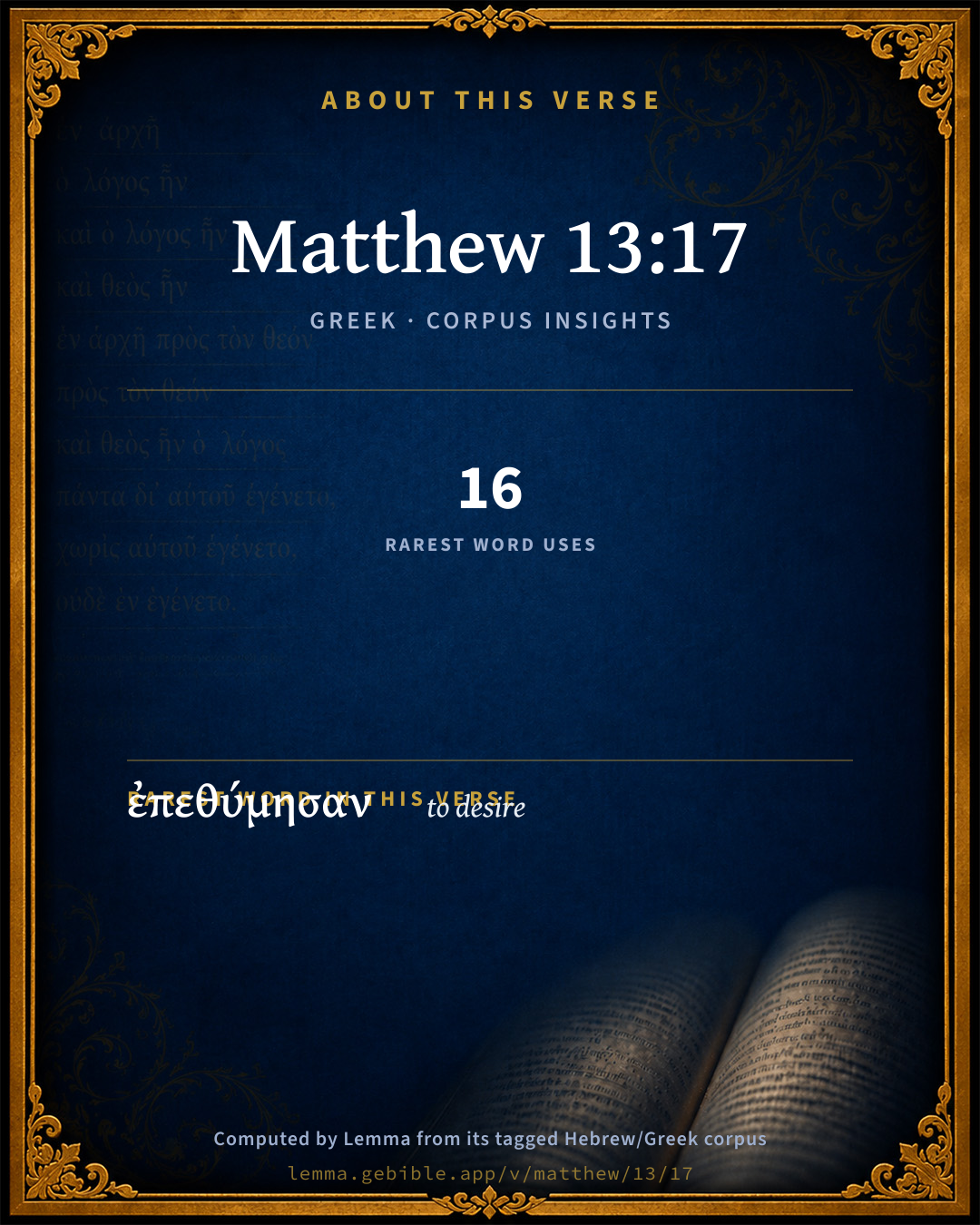
Matthew 13:17

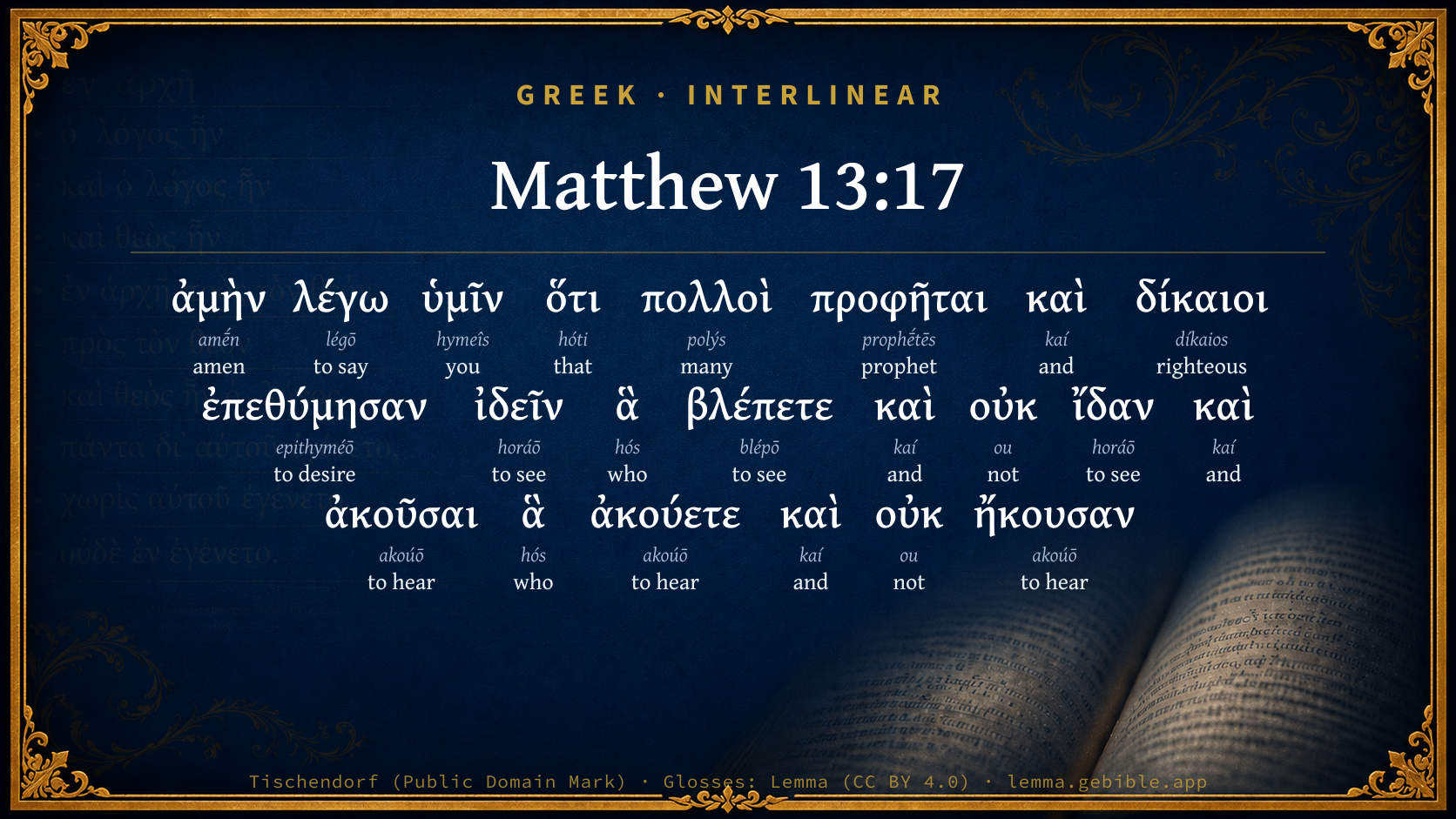
Greek (Tischendorf 8th ed.) Matthew 13:17 appears in the Greek New Testament. The text above is from the Tischendorf 8th edition. Each word links to its Strong’s number and a concise gloss. Click any word for its full Thayer’s Greek Lexicon entry.
Download image
Cite this verse

Matthew 13:17 (World English Bible). Public Domain. Lemma interlinear Bible study tool, https://lemma.gebible.app/v/matthew/13/17.

Show BibTeX & RIS
BibTeX
RIS
English Translation
For most assuredly I tell you that many prophets and righteous men desired to see the things which you see, and didn't see them; and to hear the things which you hear, and didn't hear them.
World English Bible · Public Domain
Download a study sheet

One document with this verse’s original text, its word-by-word gloss line, the meaning frame, cross-references with their text, attributed commentary, and full source and license credits — printable, and it pastes into notes with its structure intact.

This verse Autodidact and up

Study sheet (.html) Plain text (.txt)

A passage Seminary Student

Up to 50 verses in one chapter. A passage sheet keeps up to 6 commentary sources and 12 cross-references per verse, in the order this page ranks them, and says so on the sheet whenever that leaves anything out. Ask for a single verse and you get the Autodidact verse sheet above.

Everything on this page stays free to read, with no account — the sheet is a download of what is already on screen, not access to it.

Want to remove ads? Support Godless Engineer
Compare translations 3

The same verse in 3 English versions, stacked beneath the original-language interlinear above. Click any original word for its lexicon entry.

Each is an independent rendering of the whole verse — the interlinear is not word-aligned to these translations.

Highlighted words mark where these versions differ — a whole-verse word diff, not a word-by-word alignment.

  • World English Bible Public Domain
    For most assuredly I tell you that many prophets and righteous men desired to see the things which you see, and didn't see them; and to hear the things which you hear, and didn't hear them.
  • King James Version Public Domain
    For verily I say unto you, That many prophets and righteous men have desired to see those things which ye see, and have not seen them; and to hear those things which ye hear, and have not heard them.
  • unfoldingWord Literal Text CC BY-SA 4.0
    For truly I say to you that many prophets and righteous ones longed to see what you see, and did not see, and to hear what you hear, and did not hear.

unfoldingWord Literal Text — © unfoldingWord, licensed CC BY-SA 4.0. Word-aligned USFM3 via Door43 (git.door43.org/unfoldingWord/en_ult).

Versions to compare (up to 4)

3 of 4 selected

Show all 19 translations

Every available English version of this verse, each an independent rendering of the whole verse.

  • World English Bible Public Domain
    For most assuredly I tell you that many prophets and righteous men desired to see the things which you see, and didn't see them; and to hear the things which you hear, and didn't hear them.
  • Berean Standard Bible Public Domain
    For truly I tell you, many prophets and righteous men longed to see what you see but did not see it, and to hear what you hear but did not hear it.
  • Majority Standard Bible Public Domain
    For truly I tell you, many prophets and righteous men longed to see what you see but did not see it, and to hear what you hear but did not hear it.
  • King James Version Public Domain
    For verily I say unto you, That many prophets and righteous men have desired to see those things which ye see, and have not seen them; and to hear those things which ye hear, and have not heard them.
  • American Standard Version (1901) Public Domain
    For verily I say unto you, that many prophets and righteous men desired to see the things which ye see, and saw them not; and to hear the things which ye hear, and heard them not.
  • Revised Version (1885) Public Domain
    For verily I say unto you, that many prophets and righteous men desired to see the things which ye see, and saw them not; and to hear the things which ye hear, and heard them not.
  • Geneva Bible (1599) Public Domain
    For verely I say vnto you, that many Prophets, and righteous men haue desired to see those things which ye see, and haue not seene them, and to heare those things which ye heare, and haue not heard them.
  • Douay-Rheims (1899) Public Domain
    For, amen, I say to you, many prophets and just men have desired to see the things that you see, and have not seen them, and to hear the things that you hear and have not heard them.
  • Young's Literal Translation Public Domain
    for verily I say to you, that many prophets and righteous men did desire to see that which ye look on, and they did not see, and to hear that which ye hear, and they did not hear.
  • Literal Standard Version CC BY-SA 4.0
    for truly I say to you that many prophets and righteous men desired to see that which you look on, and they did not see, and to hear that which you hear, and they did not hear.
  • Unlocked Literal Bible CC BY-SA 4.0
    Truly I say to you that many prophets and righteous men desired to see the things that you see, and did not see them. They desired to hear the things that you hear, and did not hear them.
  • unfoldingWord Literal Text CC BY-SA 4.0
    For truly I say to you that many prophets and righteous ones longed to see what you see, and did not see, and to hear what you hear, and did not hear.
  • Darby Bible Public Domain
    for verily I say unto you, that many prophets and righteous [men] have desired to see the things which ye behold and did not see [them], and to hear the things which ye hear and did not hear [them].
  • World Messianic Bible Public Domain
    For most certainly I tell you that many prophets and righteous men desired to see the things which you see, and didn’t see them; and to hear the things which you hear, and didn’t hear them.
  • Webster's Bible Public Domain
    For verily I say to you, That many prophets and righteous men have desired to see the things which ye see, and have not seen them; and to hear the things which ye hear, and have not heard them.
  • Free Bible Version CC BY-SA 4.0
    I'm telling you, many prophets and good people longed to see what you're seeing, but didn't see it. They longed to hear what you're hearing, but didn't hear it.
  • Bible in Basic English Public Domain
    For truly, I say to you that prophets and upright men had a desire to see the things which you see, and saw them not; and to have knowledge of the words which have come to your ears, and they had it not.
  • Text-Critical English NT CC BY 4.0
    For truly I say to you, many prophets and righteous people desired to see the things you see but did not see them, and to hear the things you hear but did not hear them.
  • Tyndale New Testament (1534) Public Domain
    Verely I say vnto you that many Prophetes and perfaicte me have desired to se tho thinges which ye se and have not sene the: and to heare tho thinges which ye heare and have not herde the.

Literal Standard Version (2020), Covenant Press — licensed CC BY-SA 4.0. Text via the HelloAO Bible API (eBible.org). Unlocked Literal Bible (unfoldingWord) — licensed CC BY-SA 4.0. Text via the HelloAO Bible API (eBible.org). unfoldingWord Literal Text — © unfoldingWord, licensed CC BY-SA 4.0. Word-aligned USFM3 via Door43 (git.door43.org/unfoldingWord/en_ult). Free Bible Version, Dr. Jonathan Gallagher — licensed CC BY-SA 4.0. Text via the HelloAO Bible API (eBible.org).

Word by word

More ways to search: Search by grammar → Find every occurrence → Compare this word →

Practice this passage: Drill this verse → Learn its vocabulary →

ἐπεθύμησαν
epithyméō
G1937
“to desire”
Verb, Aorist, Active, Indicative, 3rd person, Plural
Part of Speech
Verb
Tense
Aorist
Voice
Active
Mood
Indicative
Person
3rd person
Number
Plural
Full Thayer's Definition

Origin: from G1909 and G2372

TDNT: 05:48,3

1. to turn upon a thing 2. to have a desire for, long for, to desire 3. to lust after, covet a. of those who seek things forbidden
  1. ἀμὴν amḗn G281 “amen” Hebrew transliteration
  2. λέγω légō G3004 “to say” Verb, Present, Active, Indicative, 1st person, Singular
  3. ὑμῖν hymeîs G5210 “you” Personal pronoun, 2nd person, Dative, Plural
  4. ὅτι hóti G3754 “that” Conjunction
  5. πολλοὶ polýs G4183 “many” Adjective, Nominative, Plural, Masculine
  6. προφῆται prophḗtēs G4396 “prophet” Noun, Nominative, Plural, Masculine
  7. καὶ kaí G2532 “and” Conjunction
  8. δίκαιοι díkaios G1342 “righteous” Adjective, Nominative, Plural, Masculine
  9. ἰδεῖν horáō G3708 “to see” Verb, Aorist, Active, Infinitive
  10. ἃ hós G3739 “who” Relative pronoun, Accusative, Plural, Neuter
  11. βλέπετε blépō G991 “to see” Verb, Present, Active, Indicative, 2nd person, Plural
  12. καὶ kaí G2532 “and” Conjunction
  13. οὐκ ou G3756 “not” Particle, Negative
  14. ἴδαν horáō G3708 “to see” Verb, Aorist, Active, Indicative, 3rd person, Plural
  15. καὶ kaí G2532 “and” Conjunction
  16. ἀκοῦσαι akoúō G191 “to hear” Verb, Aorist, Active, Infinitive
  17. ἃ hós G3739 “who” Relative pronoun, Accusative, Plural, Neuter
  18. ἀκούετε akoúō G191 “to hear” Verb, Present, Active, Indicative, 2nd person, Plural
  19. καὶ kaí G2532 “and” Conjunction
  20. οὐκ ou G3756 “not” Particle, Negative
  21. ἤκουσαν akoúō G191 “to hear” Verb, Aorist, Active, Indicative, 3rd person, Plural

About this verse

These counts appear in no published source. They are computed here, from the morphology-tagged text and Lemma’s own curated glosses. What Lemma adds →

22
words
14
distinct lemmas
Gospels
section

Notable vocabulary

The rarest word here is ἐπεθύμησαν to desire G1937 — appearing just 16 times in the whole Greek New Testament.

Shared distinctive vocabulary

ἐπεθύμησαν to desire G1937 occurs in 16 verses of the Greek New Testament. Also found in:

Repetition

Words recur within this verse:

  • ἀκοῦσαι to hear G191 ×3
  • ἰδεῖν to see G3708 ×2
  • καὶ and G2532 ×4
  • ἃ who G3739 ×2
  • οὐκ not G3756 ×2

Cross-references

6

Topical passages linked to Matthew 13:17 in the Treasury of Scripture Knowledge — connected by theme and wording, ordered by reader-vote popularity; previews shown in the World English Bible.

  • John 8:56 Your father Abraham rejoiced to see my day. He saw it, and was glad."
  • Hebrews 11:13 These all died in faith, not having received the promises, but having seen them and embraced them from afar, and having confessed that they were strangers and pilgrims on the earth.
  • 1 Peter 1:10–12 Concerning this salvation, the prophets sought and searched diligently, who prophesied of the grace that would come to you,
  • Luke 10:24 for I tell you that many prophets and kings desired to see the things which you see, and didn't see them, and to hear the things which you hear, and didn't hear them."
  • Ephesians 3:5–6 which in other generations was not made known to the children of men, as it has now been revealed to his holy apostles and prophets in the Spirit;
  • Hebrews 11:39–40 These all, having had testimony given to them through their faith, didn't receive the promise,

Cross-references courtesy of OpenBible.info (CC BY 4.0).

Commentary

Notes on Matthew 13:17 from classic Christian and Jewish commentators (each source and its license shown beneath its notes). The classic Christian expositions comment on the surrounding passage and are grouped to its opening verse, so a note may address several verses; the Jewish commentaries on the Tanakh (Rashi and others) are per-verse, so they appear only where the commentator wrote on this verse.

Lemma curates 59 commentaries, every one of them public domain or Creative Commons licensed, each selected and text-cleaned for this edition rather than reprinted as found. About our sources →

The Biblical Illustrator

Joseph S. Exell

Mat_13:13; Mat_13:17

But blessed are your eyes, for they see.

I. The two classes of persons here mentioned. Prophets-inspired men. Righteous men-saints. Every prophet was not a righteous man. To be a righteous man is more desirable than to be a prophet. Grace is a higher endowment than inspiration or genius.

II. These two classes of persons eagerly anticipated the Christian dispensation, Various dispensations-one religion, as one ocean. Every degree of experimental knowledge of the true religion awakens a desire for additional information. It satisfies, yet it stimulates. Moses, etc. The Divine revelation of the true religion has been progressive. The desires of the great and good are not always gratified according to their intensity. They must submit to the will of God.

III. Our privileges are far superior to those of these two classes of persons.

1. We should be grateful.

2. We should cherish a sense of responsibility.

3. We should strive to outstrip in attainment those whom we surpass in privilege. (Various.)

Divine illumination

I. To whom these words were addressed.

1. They were not addressed indiscriminately to the people.

2. They were addressed to His chosen disciples.

3. The same distinction must be observed when these words are applied to ourselves.

II. The spiritual import of these words when thus applied.

1. What the faithful disciples saw-the Lords Christ.

2. How it was the disciples saw those things in Him.

3. Unspeakably blessed are they who thus see. Are you in possession of these privileges? what do you know of them?

(1) Do you know that you are destitute of them?

(2) Do you humbly hope that light has visited your soul, but lament how dim it is? (F. Close. M. A.)

The Biblical Illustrator, edited by Joseph S. Exell (c. 1880s–1900s) — public domain. Text from a community e-Sword module.

Bengel's Gnomon

Johann Albrecht Bengel

Mat 13:17. Προφῆται, prophets) See Gnomon on 1Pe 1:10; 1Pe 1:12.—ἐπεθύμησαν, have desired) And that desire was pious and precious in the sight of God: see Gnomon on Joh 8:56.—οὐκ εἶδον, have not seen) See Heb 11:13; Heb 11:39.

Bengel's Gnomon of the New Testament — English translation (T&T Clark, Edinburgh, 1860) — public domain. Text from a community e-Sword module.

Jamieson, Fausset & Brown

Robert Jamieson, A. R. Fausset & David Brown

For verily I say unto you, That many prophets and righteous men have desired--rather, "coveted."

to see those things which ye see, and have not seen them; and to hear those things which ye hear, and have not heard them--Not only were the disciples blessed above the blinded just spoken of, but favored above the most honored and the best that lived under the old economy, who had but glimpses of the things of the new kingdom, just sufficient to kindle in them desires not to be fulfilled to any in their day. In Luk 10:23-24, where the same saying is repeated on the return of the Seventy--the words, instead of "many prophets and righteous men," are "many prophets and kings"; for several of the Old Testament saints were kings.

Second and Seventh Parables or First Pair:

THE WHEAT AND THE TARES, and THE GOOD AND BAD FISH (Mat 13:24-30, Mat 13:36-43, Mat 13:47-50).

The subject of both these parables--which teach the same truth, with a slight diversity of aspect--is: THE MIXED CHARACTER OF THE KINGDOM IN ITS PRESENT STATE, AND THE FINAL ABSOLUTE SEPARATION OF THE TWO CLASSES.

The Tares and the Wheat (Mat 13:24-30, Mat 13:36-43).

Jamieson, Fausset & Brown — Commentary Critical and Explanatory on the Whole Bible (1871) — public domain (CC PDM 1.0). Text via the HelloAO Bible API.

Adam Clarke's Commentary

Verse 17. Many prophets and righteous men] These lived by and died in the faith of the promised Messiah: the fulness of the time was not then come for his manifestation in the flesh. See also on Mt 13:11.

Adam Clarke's Commentary on the Bible (1810–1826) — public domain. Text from a community e-Sword/MySword module.

Ellicott's Commentary for English Readers

(17) Many prophets and righteous men.—The prophets of Israel were emphatically “men of desires.” They saw afar off the glory of the kingdom of the latter days. Each stood, as it were, on a Pisgah height, and looked on the vision of a land which he was not to enter. The words “have not seen them” seem to stand in verbal contradiction with those of Joh_8:56, “Your father Abraham rejoiced to see My day,” but it is clear that the difference is simply verbal. There is a joy in looking on the distant prospect which does not exclude, yea, rather implies the desire to reach that which even from afar appears so glorious. The feeling thus described is identical with the “searching diligently” of 1Pe_1:10, and with the “desire for a better country” of Heb_11:16.

A Bible Commentary for English Readers, edited by Charles John Ellicott (1878–1897) — public domain. Text from a community e-Sword module.

The Cambridge Bible for Schools and Colleges

gen. ed. J. J. S. Perowne

18–23. The Parable of the Sower is explained

Mar_4:14-20; Luk_8:11-15

19. On some the word of God makes no impression, as we say; some hearts are quite unsusceptible of good.

The Cambridge Bible for Schools and Colleges (gen. ed. J. J. S. Perowne; Cambridge University Press, 1878–1918) — public domain. Text from a community e-Sword module.

John Gill's Exposition

Hear ye therefore the parable of the sower. That is, the interpretation of the parable; for they had heard the parable before, and had desired an explanation of it; which, though not mentioned by Matthew, is, by the other evangelists, Mar 4:10, Luk 8:9 and since it was given to them to know the mysteries of the kingdom of heaven, therefore Christ calls upon them to attend unto, and hear, so as to understand the spiritual meaning of this parable. Mark relates, that he moreover said to his disciples at this time, "know ye not this parable?" Do ye not understand the meaning of it, so easy to be taken in? them as it were reproving for their dulness of hearing, notwithstanding the grace given them, and the advantages they enjoyed: "how then will ye know all parables?" all that he had delivered, or was about to deliver at this time, or should hereafter; which were of more difficult interpretation, and not so easy to be understood as this.

and since it was given to them to know the mysteries of the kingdom of heaven, therefore Christ calls upon them to attend unto, and hear, so as to understand the spiritual meaning of this parable. Mark relates, that he moreover said to his disciples at this time, "know ye not this parable?" Do ye not understand the meaning of it, so easy to be taken in? them as it were reproving for their dulness of hearing, notwithstanding the grace given them, and the advantages they enjoyed: "how then will ye know all parables?" all that he had delivered, or was about to deliver at this time, or should hereafter; which were of more difficult interpretation, and not so easy to be understood as this.

Matthew 13:19

mat 13:19

mat 13:19

mat 13:19When anyone heareth the word of the kingdom,.... Hence it appears, that by the "seed" in the parable is meant the Gospel, called the "word of the kingdom": because it treats of the king Messiah, of his person, office, and grace; and of his kingdom, and the administration of it by him, under the present dispensation; of the kingdom of grace saints enjoy now, and of the kingdom of heaven they shall enter into hereafter, through the grace and righteousness of Christ. Now such a hearer of this word is here described, who hears it accidentally, and only externally; hears the sound of it with his ears,

and understandeth it not with his heart. He is one that is careless and inattentive, negligent and forgetful; has some slight notions of things as he hears, but these pass away as they come; his affections are not at all touched, nor his judgment informed by them, but remains as stupid, and as unconcerned as ever; his heart is not opened to attend to, and receive the word, but continues hard and obdurate; and is like the common and beaten road, that is trodden down by everyone, and is not susceptible of the seed, that falls upon it.

Then cometh the wicked one, Satan, the devil, Mar 4:15 who is, by way of eminency, so called, being the first creature that became wicked, and the worst that is so; who is entirely and immutably wicked; whose whole work and employment lies in wickedness; and who, was the original cause of the wickedness that is among men, and which he is continually instigating and promoting: so the Jews frequently call (q) Samael, by whom they mean the devil, Samael, "the wicked". This evil spirit, as soon as ever he observes one hearing the word, especially that has not been used to attend, comes immediately, and, as he is hearing,

catcheth away that which is sown in his heart: not the grace of God, which being once implanted in the heart, can never be taken away by Satan; but the word which was sown, not in his understanding, in a spiritual sense, nor even in his affections, so as to love it, delight, and take pleasure in it; much less in his heart, so as to become the engrafted word able to save, or so as to believe in it, and in Christ revealed by it; but in his memory, and that but very slightly neither; for the heart sometimes means the memory; see Luk 2:51. Besides, the word only fell "upon", not "into" his heart, as into the good ground, as the metaphor in the parable shows; and it made no impression, nor was it inwardly received, but as soon as ever dropped, was "catched" away by the enemy; not by frightening him out of it, by persecution, as the stony ground hearer; nor by filling the mind with worldly cares, as the thorny ground hearer; but by various suggestions and temptations, darting in thoughts, presenting objects, and so diverted his mind from the word, and fixed his attention elsewhere; which is done at once, at an unawares, secretly, and without any notice of the person himself; so that the word is entirely lost to him, and he does not so much as remember the least thing he has been hearing:

this is he which receiveth the seed by the way side; such an hearer is comparable to such ground, on whom the word has no more effect, than seed sown upon a common beaten path.

(q) Sepher Bahir apud Zohar in Gen. fol. 27. 2. Debarim Rabba, fol. 145. 3.

John Gill's Exposition of the Whole Bible (1746–1763) — public domain (CC PDM 1.0). Text via the HelloAO Bible API.

Trapp's Complete Commentary

John Trapp

17 For verily I say unto you, That many prophets and righteous men have desired to see those things which ye see, and have not seen them; and to hear those things which ye hear, and have not heard them.

Ver. 17. Desired to see those things that ye see, &c.] They saw them, and saluted them only afar off, and in the dark glass of the ceremonies. "But we all with open face," &c., 2Co 3:18. The sea about the altar was brazen, and what eyes could pierce through it? Now our sea about the throne is glass, like to crystal, clearly conveying the light and sight of God to our eyes. 1Ki 7:23; Rev 4:6. All God’s ordinances are now so clear, that you may see Christ’s face in them. Yea, as the glass set full against the sun receives not only the beams, as other dark bodies do, but the image of the sun; so the understanding with open face beholding Christ, is transformed into the image and similitude of Christ.

John Trapp, A Commentary or Exposition upon All the Books of the Old and New Testament (1647–1656) — public domain. Text from a community e-Sword module.

Haydock's Catholic Bible Commentary

Amen, I say to you. St. Jerome remarks, that these words of our Saviour seem to contradict another part of Scripture, where it is said, Abraham desired to see my days; he saw them, and rejoiced. But St. Jerome answers his own objection thus: Abraham indeed saw my days, but only in a dark manner, in enigma, but not in reality, whilst you have your Lord with you; you speak to him, and interrogate him at pleasure. (St. Thomas Aquinas) --- Christ declares his disciples more blessed than the ancient patriarchs and prophets. ... They say him only by faith, but the disciples with their corporal eyes. (St. John Chrysostom)

George Leo Haydock (1774–1849), Haydock's Catholic Family Bible and Commentary, 1859 edition — public domain. Excludes Psalms (Douay-Rheims chapter numbering differs from Protestant) and Deuterocanonical books (Catholic canon only).

Whedon's Commentary on the Bible

Daniel D. Whedon

17. Many prophets and righteous men — The times of the Messiah, his character and kingdom, were all a matter of most profound interest to the Old Testament saints. All these were now being revealed to the humble and obedient apostles of our Lord. the men of old saw them only by faith in types, shadows, and dim intimations; the Jews rejected, but the simple disciples received them in blessed faith.

Daniel D. Whedon (gen. ed.), Commentary on the Old and New Testaments (1874–1909) — public domain. Text from a community e-Sword module.

The Pulpit Commentary

For verily. (Mat_5:18, note) Not in the parallel passage; it is much more common in Matthew than Luke. Our Lord contrasts his disciples" "blessedness" not only with the state of their contemporaries, but with that of their predecessors in faith. I say unto you, That many prophets and righteous men. Those who were specially favoured with insight into God"s methods, and those who approached most closely to his standard of righteousness. Righteous men; "kings" in Luke. St. Luke"s readers would probably not appreciate the force of the term, "righteous men." to the same degree that St. Matthew"s would. Have desired (epeyumhsan). By reading epeyumhsa , this saying has been attributed to Christ (see Bishop Westcott, "Introd.," App. C.; Resch, "Agrapha," p. 397). To see those things which ye see, and have not seen them; and to hear those things which ye hear, and have not heard them . (cf. Heb_11:13 1Pe_1:10-12)

Christians enjoying what prophets desired.

They who truly receive the teaching of Christ and profit by it enjoy privileges which prophets and righteous men longed for in vain.

I THE PROPHETS" DESIRES. The saints and seers of antiquity were not satisfied with the revelations made to them and the favour bestowed upon them. They looked forward to a glorious future when fuller light should appear, and when greater works of heavenly power should be accomplished. Let us consider the objects of the prophets" desire, what things they were the prophets longed to see and hear.

1. The vision of God. Job yearned to see God. (Job_23:3) The older revelations of God awakened a hunger for a nearer vision. The best men of antiquity desired above all things to "see the King in his beauty.

2. The redemption of man. Some were satisfied with the course of events and the condition of the world. But two classes of men were profoundly dissatisfied, viz.

(1) prophets, who saw the truth of God and perceived the falseness of the world, its direct antagonism to the Divine will; and

(2) righteous men, who had a keen conscience, and were horrified at the sin and guilt of mankind. Both of these saw that only ruin faced man when left to himself; both cried out for a Divine redemption.

3. The advent of the kingdom of heaven. This was the grand topic of Messianic prophecy; it was the supreme object of the patient hope of devout people, such as Anna and Simeon at the time of our Lord"s infancy. (Luk_2:25-38) Such a hope went beyond deliverance and redemption; it pointed to a golden age in the future, excelling the best days of the past.

II THE CHRISTIANS" PRIVILEGES. Christ congratulates his true disciples on their happy estate. Let us consider what privileges this brings.

1. The presence of Christ.

(1) He is the Revelation of God, longed for by prophets, but never seen in Old Testament times. Philip said, "Lord, show us the Father and it sufficeth us;" and Jesus replied, "He that hath seen me hath seen the Father". (Joh_14:8, Joh_14:9)

(2) He, too, brings redemption, for he is the Redeemer, and he comes to save the world by the sacrifice of himself.

(3) He establishes the kingdom of heaven, for he is its King. When Christ has come to us the kingdom is among us. But many saw Christ "after the flesh," in his bodily presence, and yet discerned none of these things. We do not see him walking in our streets or sitting at our table. Yet when we see him with the eyes of the heart, and perceive his Divine and redeeming presence, ours also is the vision longed for by the good and wise in ancient time.

2. The Word of life. This is what Christians hear. It is the good news of salvation in Christ. But it is also a living Word that awakens dead souls and quickens the Divine life within men. All who are within reach of the gospel may be familiar with the sound of this Word. But, alas! how many never perceive that to them has come a privilege greatly desired by prophets and righteous men of old. This Word must be heard in the heart to be appreciated. Then its gracious tones awaken responses of faith and love, because then it speaks in deep harmonies as the very music of heaven. W.F.A.

The Pulpit Commentary (1880–1919), ed. H.D.M. Spence-Jones & Joseph S. Exell — public domain. Text from a community e-Sword module.

Scofield Reference Notes

C. I. Scofield

prophets

The O.T. prophets saw in blended vision the rejection and crucifixion of the King (see "Christ, sacrifice,) Gen 4:4, (See Scofield "Heb 10:18") and also His glory as David’s Son. See Scofield "Zec 12:8", but "what manner of time the Spirit of Christ which was in them did signify when it testified beforehand the sufferings of Christ and the glory that should follow," was not revealed to them--only that the vision was not for themselves. 1Pe 1:10-12. That revelation Christ makes in these parables. A period of time is to intervene between His sufferings and His glory. That interval is occupied with the "mysteries of the kingdom of heaven" here described.

righteous Righteousness. (See Scofield "Rom 10:10").

The Scofield Reference Bible (1917 edition), notes by C. I. Scofield — public domain. Text from a community e-Sword module.

The People's New Testament

B. W. Johnson

17. Desired to see the things which ye see. The prophets and righteous had longed for the coming of Christ. His disciples enjoyed it.

18–23. Hear then the parable of the sower. In order to understand the parable we must listen to the explanation given in verses 18–23. Christ is the great Sower, and all whom he sends forth to preach are sowers under him. The seed sown is his Word, the Gospel of the Kingdom. The soil is human hearts. Four kinds of human hearts are described: 1. The wayside hearer; the light, flippant, indifferent hearer upon whom no impression is produced. 2. The stony hearer; the heart that exhibits an evanescent feeling at the appeal of the gospel; but upon whom no permanent impression is made. 3. The thorny soil; the heart that takes in the Word, but is so full of worldly cares that these presently gain the mastery. This describes the world-serving hearer. 4. The good soil; the good and honest heart; the heart that receives and retains the truth. In such a heart the seed will grow and the new life will be manifest. Three things, then, are needful: 1. A Sower. 2. Good Seed, the pure word of God. 3. A good and honest heart. A dishonest man cannot be converted until he casts out his dishonesty. He who cavils at and deceitfully entreats the word of God will not be profited.

B. W. Johnson's The People's New Testament with Notes (1889–1891) — public domain. Electronic text from the Christian Classics Ethereal Library (CCEL) ThML edition.

Alford’s Greek Testament

Henry Alford

17.] See ref. Prov. These verses occur again in a different connexion, and with the form of expression slightly varied, Luk 10:23, Luk 10:24. It was a saying likely to be repeated. There it is μακάρ. οἱ ὀφθ. οἱ βλέποντες ἃ βλέπετε: and for δίκαιοι we have βασιλεῖς. On the fact that prophets, &c. desired to see those things, see 2Sa 23:5: Job 19:23-27: also Exo 4:13, and Luk 2:29-32.

Henry Alford, The Greek Testament (1849–1861) — public domain. Text from a community e-Sword module.

Lesson kit

Teaching starters — assembled from the data on this page, not authored interpretation. Every prompt links to the verse data it draws on. Edit before teaching.

Matthew, in the Gospels, opens this verse with 22 words (14 distinct Greek lemmas). Its most distinctive word is epithyméō (“to desire”). A historical commentator’s framing appears above. Read the whole chapter for the surrounding context.

Discussion questions

  1. The word epithyméō carries the sense “to desire.” How does it shape the verse?
  2. Matthew 5:28 shares the word «to desire» with this verse. How do the two illuminate each other?
  3. “to hear” occurs 3× in this one verse. What is the effect of the repetition?
  4. These translations render this verse differently. What is at stake in choosing one wording over another?
  5. Reading how The Biblical Illustrator and Bengel's Gnomon read this verse, where do the two commentators agree and where do they part?

Things to notice

Reading settings

Reading text

Shown beneath each verse's original-language words.

Old Testament
Old Testament edition

Read the OT as the Masoretic Hebrew (MT) or the Greek Septuagint (LXX).

English shown for the Greek Septuagint (in the Hebrew ↔ Greek comparison).

Comparing translations? Open the Compare panel on any verse page to stack up to four side by side.