
Matthew 16:3

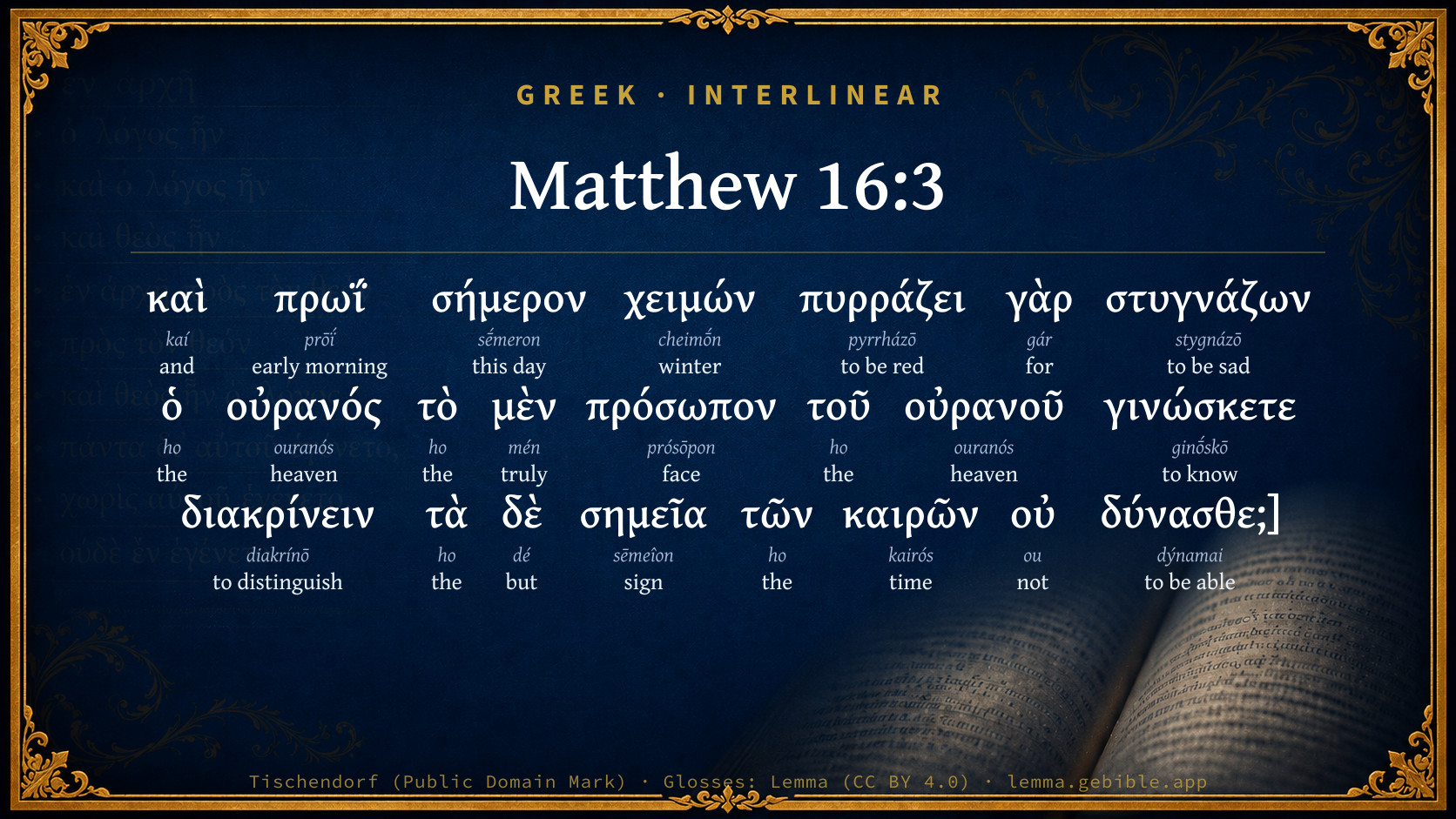
Greek (Tischendorf 8th ed.) Matthew 16:3 appears in the Greek New Testament. The text above is from the Tischendorf 8th edition. Each word links to its Strong’s number and a concise gloss. Click any word for its full Thayer’s Greek Lexicon entry.
Download image
Cite this verse

Matthew 16:3 (World English Bible). Public Domain. Lemma interlinear Bible study tool, https://lemma.gebible.app/v/matthew/16/3.

Show BibTeX & RIS
BibTeX
RIS
English Translation
In the morning, 'It will be foul weather today, for the sky is red and threatening.' Hypocrites! You know how to discern the appearance of the sky, but you can't discern the signs of the times!
World English Bible · Public Domain
Highlights
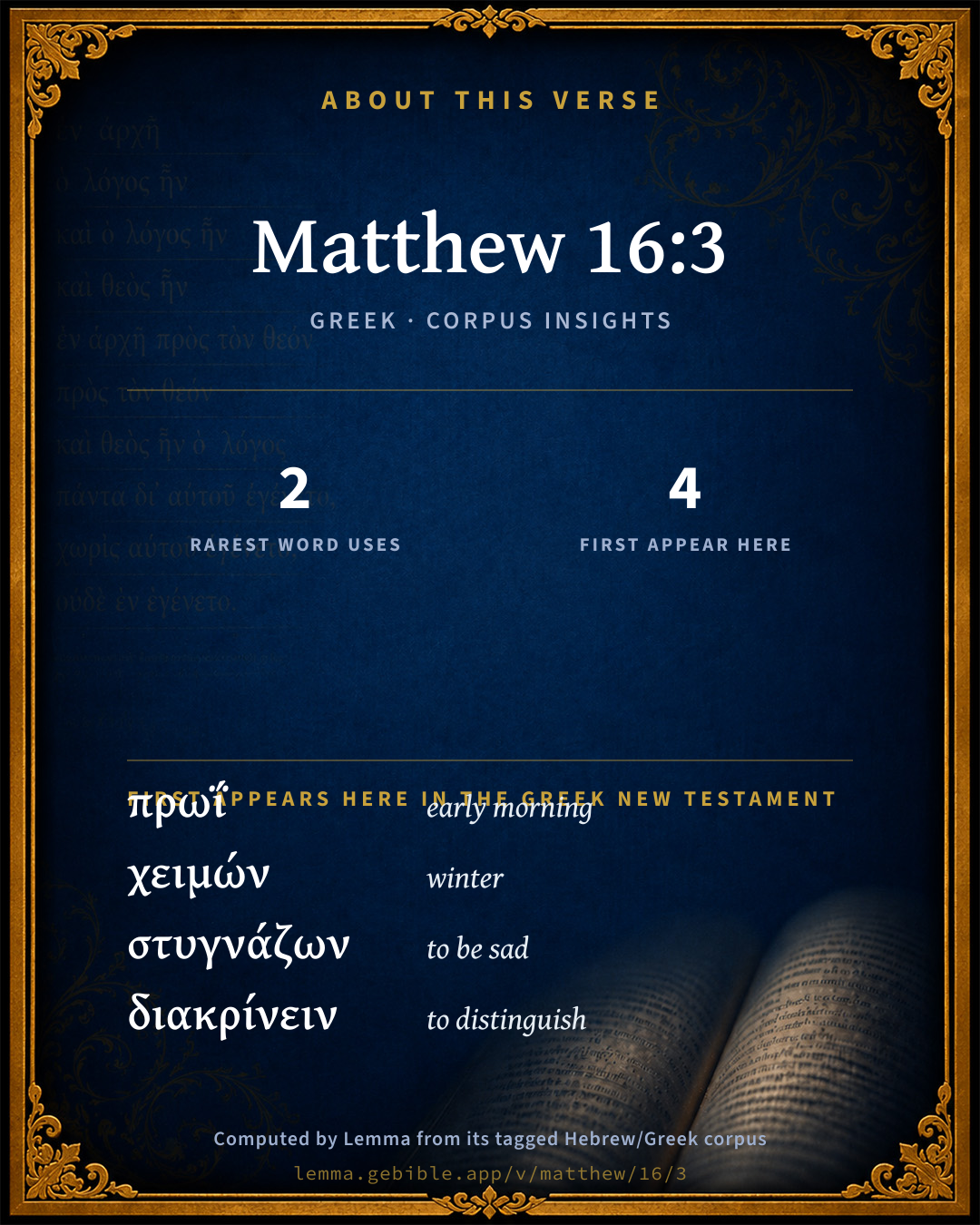
  • 4 first appearances in the Greek New Testament
Full analysis ↓
Download a study sheet

One document with this verse’s original text, its word-by-word gloss line, the meaning frame, cross-references with their text, attributed commentary, and full source and license credits — printable, and it pastes into notes with its structure intact.

This verse Autodidact and up

Study sheet (.html) Plain text (.txt)

A passage Seminary Student

Up to 50 verses in one chapter. A passage sheet keeps up to 6 commentary sources and 12 cross-references per verse, in the order this page ranks them, and says so on the sheet whenever that leaves anything out. Ask for a single verse and you get the Autodidact verse sheet above.

Everything on this page stays free to read, with no account — the sheet is a download of what is already on screen, not access to it.

Want to remove ads? Support Godless Engineer
Compare translations 3

The same verse in 3 English versions, stacked beneath the original-language interlinear above. Click any original word for its lexicon entry.

Each is an independent rendering of the whole verse — the interlinear is not word-aligned to these translations.

Highlighted words mark where these versions differ — a whole-verse word diff, not a word-by-word alignment.

  • World English Bible Public Domain
    In the morning, 'It will be foul weather today, for the sky is red and threatening.' Hypocrites! You know how to discern the appearance of the sky, but you can't discern the signs of the times!
  • King James Version Public Domain
    And in the morning, It will be foul weather to day: for the sky is red and lowering. O ye hypocrites, ye can discern the face of the sky; but can ye not discern the signs of the times?
  • unfoldingWord Literal Text CC BY-SA 4.0
    And in early morning, ‘Today will be stormy, for the sky is red, being overcast.’ You know to interpret the face of the sky, but the signs of the times you are not able.]

unfoldingWord Literal Text — © unfoldingWord, licensed CC BY-SA 4.0. Word-aligned USFM3 via Door43 (git.door43.org/unfoldingWord/en_ult).

Versions to compare (up to 4)

3 of 4 selected

Show all 19 translations

Every available English version of this verse, each an independent rendering of the whole verse.

  • World English Bible Public Domain
    In the morning, 'It will be foul weather today, for the sky is red and threatening.' Hypocrites! You know how to discern the appearance of the sky, but you can't discern the signs of the times!
  • Berean Standard Bible Public Domain
    and in the morning, ‘Today it will be stormy, for the sky is red and overcast.’ You know how to interpret the appearance of the sky, but not the signs of the times.
  • Majority Standard Bible Public Domain
    and in the morning, ‘Today it will be stormy, for the sky is red and overcast.’ You hypocrites! You know how to interpret the appearance of the sky, but not the signs of the times.
  • King James Version Public Domain
    And in the morning, It will be foul weather to day: for the sky is red and lowering. O ye hypocrites, ye can discern the face of the sky; but can ye not discern the signs of the times?
  • American Standard Version (1901) Public Domain
    And in the morning, `It will be' foul weather to-day: for the heaven is red and lowering. Ye know how to discern the face of the heaven; but ye cannot `discern' the signs of the times.
  • Revised Version (1885) Public Domain
    And in the morning, It will be foul weather today: for the heaven is red and lowring. Ye know how to discern the face of the heaven; but ye cannot discern the signs of the times.
  • Geneva Bible (1599) Public Domain
    And in the morning ye say, To day shall be a tempest: for the skie is red and lowring. O hypocrites, ye can discerne the face of the skie, and can ye not discerne the signes of the times?
  • Douay-Rheims (1899) Public Domain
    And in the morning: To day there will be a storm, for the sky is red and lowering. You know then how to discern the face of the sky: and can you not know the signs of the times?
  • Young's Literal Translation Public Domain
    and at morning, Foul weather to-day, for the heaven is red -- gloomy; hypocrites, the face of the heavens indeed ye do know to discern, but the signs of the times ye are not able!
  • Literal Standard Version CC BY-SA 4.0
    and at morning, Foul weather today, for the sky is red—gloomy; hypocrites, you indeed know to discern the face of the sky, but the signs of the times you are not able!
  • Unlocked Literal Bible CC BY-SA 4.0
    When it is morning, you say, 'It will be foul weather, for the sky is red and overcast.' You know how to interpret the appearance of the sky, but you cannot interpret the signs of the times.
  • unfoldingWord Literal Text CC BY-SA 4.0
    And in early morning, ‘Today will be stormy, for the sky is red, being overcast.’ You know to interpret the face of the sky, but the signs of the times you are not able.]
  • Darby Bible Public Domain
    and in the morning, A storm to-day, for the sky is red [and] lowering; ye know [how] to discern the face of the sky, but ye cannot the signs of the times.
  • World Messianic Bible Public Domain
    In the morning, ‘It will be foul weather today, for the sky is red and threatening.’ Hypocrites! You know how to discern the appearance of the sky, but you can’t discern the signs of the times!
  • Webster's Bible Public Domain
    And in the morning, It will be foul weather to-day: for the sky is red and lowering. O ye hypocrites, ye can discern the face of the sky; but can ye not discern the signs of the times?
  • Free Bible Version CC BY-SA 4.0
    while in the morning you say, ‘It'll be bad weather today, because the sky is red and overcast.’ You know how to predict the weather by what the sky looks like, but you can't recognize the signs of the times!
  • Bible in Basic English Public Domain
    And in the morning, The weather will be bad today, for the sky is red and angry. You are able to see the face of heaven, but not the signs of the times.
  • Text-Critical English NT CC BY 4.0
    And in the morning you say, ‘There will be a storm today, for the sky is red and threatening.’ Hypocrites! You know how to discern the appearance of the sky, but you cannot discern the signs of the times?
  • Tyndale New Testament (1534) Public Domain
    and in the morninge ye saye to daye shalbe foule wedder and that because the skye is cloudy and reed. O ye ypocrites ye can discerne the fassion of the skye: and can ye not discerne the signes of the tymes?

Literal Standard Version (2020), Covenant Press — licensed CC BY-SA 4.0. Text via the HelloAO Bible API (eBible.org). Unlocked Literal Bible (unfoldingWord) — licensed CC BY-SA 4.0. Text via the HelloAO Bible API (eBible.org). unfoldingWord Literal Text — © unfoldingWord, licensed CC BY-SA 4.0. Word-aligned USFM3 via Door43 (git.door43.org/unfoldingWord/en_ult). Free Bible Version, Dr. Jonathan Gallagher — licensed CC BY-SA 4.0. Text via the HelloAO Bible API (eBible.org).

Word by word

More ways to search: Search by grammar → Find every occurrence → Compare this word →

Practice this passage: Drill this verse → Learn its vocabulary →

πυρράζει
pyrrházō
G4449
“to be red”
Verb, Present, Active, Indicative, 3rd person, Singular
Part of Speech
Verb
Tense
Present
Voice
Active
Mood
Indicative
Person
3rd person
Number
Singular
Full Thayer's Definition

Origin: from G4450

TDNT: None

1. to become glowing, grow red, be red
  1. καὶ kaí G2532 “and” Conjunction
  2. πρωΐ prōḯ G4404 “early morning” Adverb
  3. σήμερον sḗmeron G4594 “this day” Adverb
  4. χειμών cheimṓn G5494 “winter” Noun, Nominative, Singular, Masculine
  5. γὰρ gár G1063 “for” Conjunction
  6. στυγνάζων stygnázō G4768 “to be sad” Verb, Present, Active, Participle, Nominative, Singular, Masculine
  7. ὁ ho G3588 “the” Article, Nominative, Singular, Masculine
  8. οὐρανός ouranós G3772 “heaven” Noun, Nominative, Singular, Masculine
  9. τὸ ho G3588 “the” Article, Accusative, Singular, Neuter
  10. μὲν mén G3303 “truly” Particle
  11. πρόσωπον prósōpon G4383 “face” Noun, Accusative, Singular, Neuter
  12. τοῦ ho G3588 “the” Article, Genitive, Singular, Masculine
  13. οὐρανοῦ ouranós G3772 “heaven” Noun, Genitive, Singular, Masculine
  14. γινώσκετε ginṓskō G1097 “to know” Verb, Present, Active, Indicative, 2nd person, Plural
  15. διακρίνειν diakrínō G1252 “to distinguish” Verb, Present, Active, Infinitive
  16. τὰ ho G3588 “the” Article, Accusative, Plural, Neuter
  17. δὲ dé G1161 “but” Conjunction
  18. σημεῖα sēmeîon G4592 “sign” Noun, Accusative, Plural, Neuter
  19. τῶν ho G3588 “the” Article, Genitive, Plural, Masculine
  20. καιρῶν kairós G2540 “time” Noun, Genitive, Plural, Masculine
  21. οὐ ou G3756 “not” Particle, Negative
  22. δύνασθε;] dýnamai G1410 “to be able” Verb, Present, Middle or Passive deponent, Indicative, 2nd person, Plural

About this verse

These counts appear in no published source. They are computed here, from the morphology-tagged text and Lemma’s own curated glosses. What Lemma adds →

23
words
18
distinct lemmas
Gospels
section

Notable vocabulary

The rarest word here is πυρράζει to be red G4449 — appearing just 2 times in the whole Greek New Testament.

First appearance in Scripture

These words make their first canonical appearance in the Greek New Testament here:

  • πρωΐ early morning G4404
  • χειμών winter G5494
  • στυγνάζων to be sad G4768
  • διακρίνειν to distinguish G1252

Shared distinctive vocabulary

πυρράζει to be red G4449 occurs in 2 verses of the Greek New Testament. Also found in:
Repetition

Words recur within this verse:

  • οὐρανός heaven G3772 ×2
  • ὁ the G3588 ×5

Cross-references

10

Topical passages linked to Matthew 16:3 in the Treasury of Scripture Knowledge — connected by theme and wording, ordered by reader-vote popularity; previews shown in the World English Bible.

  • Luke 12:56 You hypocrites! You know how to interpret the appearance of the earth and the sky, but how is it that you don't interpret this time?
  • 1 Chronicles 12:32 Of the children of Issachar, men who had understanding of the times, to know what Israel ought to do, the heads of them were two hundred; and all their brothers were at their commandment.
  • Matthew 11:5 the blind receive their sight, the lame walk, the lepers are cleansed, the deaf hear, the dead are raised up, and the poor have good news preached to them.
  • Luke 13:15 Therefore the Lord answered him, "You hypocrites! Doesn't each one of you free his ox or his donkey from the stall on the Sabbath, and lead him away to water?
  • Matthew 4:23 Jesus went about in all Galilee, teaching in their synagogues, preaching the Gospel of the Kingdom, and healing every disease and every sickness among the people.
  • Matthew 7:5 You hypocrite! First remove the beam out of your own eye, and then you can see clearly to remove the speck out of your brother's eye.
  • Matthew 15:7 You hypocrites! Well did Isaiah prophesy of you, saying,
  • Matthew 22:18 But Jesus perceived their wickedness, and said, "Why do you test me, you hypocrites?
  • Matthew 23:13 "Woe to you, scribes and Pharisees, hypocrites! For you devour widows' houses, and as a pretense you make long prayers. Therefore you will receive greater condemnation.
  • Luke 11:44 Woe to you, scribes and Pharisees, hypocrites! For you are like hidden graves, and the men who walk over them don't know it."

Cross-references courtesy of OpenBible.info (CC BY 4.0).

Where the printed editions differ

1 variant

Places in this verse where the major printed Greek editions disagree on the wording in a way that affects the translation — a comparison of editions, not a manuscript-by-manuscript collation. The editions are the modern critical texts (Nestlé-Aland 28/27, SBL, Westcott-Hort, Tregelles, Tyndale House) and the traditional texts behind the KJV (the Textus Receptus and the Byzantine/Majority text). It is not a claim about which reading is original.

  1. Extra text
    ὑποκριταί

    “hypocrites”

    In TRByz Not in NA28NA27TynSBLWHTreg

    ὑποκριταί (hupokritai) 'hypocrites' is only in traditional manuscripts (TR+Byz)

Textual data: Translators Amalgamated Greek New Testament (STEPBible TAGNT) · CC BY 4.0.

Commentary

Notes on Matthew 16:3 from classic Christian and Jewish commentators (each source and its license shown beneath its notes). The classic Christian expositions comment on the surrounding passage and are grouped to its opening verse, so a note may address several verses; the Jewish commentaries on the Tanakh (Rashi and others) are per-verse, so they appear only where the commentator wrote on this verse.

Lemma curates 59 commentaries, every one of them public domain or Creative Commons licensed, each selected and text-cleaned for this edition rather than reprinted as found. About our sources →

Tyndale Open Study Notes

Tyndale Open Resources

16:3 The signs of the times were Jesus himself (16:4) and the various miracles that he performed (cp. 11:2-6; 12:28).

Tyndale Open Study Notes — © Tyndale Open Resources, licensed CC BY-SA 4.0. Text via the HelloAO Bible API.

Bengel's Gnomon

Johann Albrecht Bengel

Mat 16:3. Ὑποκριταὶ,[710] hypocrites) The hypocrisy was their greater skill in natural than in spiritual things; for they who have the former have much less excuse than dull men for being wanting in the latter, although they are often wanting in it. For an example of both united, see ch. Mat 2:2.—πρόσωπον τοῦ οὐρανοῦ, the countenance of the sky) not face. A man’s countenance varies, his face is always the same. An instance of Prosopopœia,[711] as just before in the word ΣΤΥΓΝΆΖΩΝ, lowering.—τὰ σημεῖα τῶν καιρῶν, the signs of the times) i, e., those which are suitable to (congruentia) each time. Our Lord indicates, that not only are times to be distinguished by their signs, but also signs by the character of the times, and signs and the kinds of them from each other. For the mode of God’s dealing with man[712] is various—by various doctrines, persons, signs, times—all of which correspond among themselves: wherefore different signs suit different times. Those signs, less splendid indeed, but such as were altogether beneficial to man on earth (see ch. Mat 9:6), were suitable to the Messiah then being on earth; see ch. Mat 8:17, Luk 9:54. Wherefore it was incumbent upon them to obtain proofs, not from heaven, but from themselves: see Luk 12:57. For the same reason, after His ascension our Lord did not exhibit signs on earth, as He had previously done.[713]—Οὐ ΔΎΝΑΣΘΕ; are ye not able?) sc. to distinguish sign from sign:—said with astonishment. If you wished it, you could do so most fully: as it is, you are prevented from doing so by a voluntary blindness.

[710] The larger Ed. gave more weight to the reading of this word than the margin of the second Edition: however, the Ver. Germ. has not rejected it.—E. B.

[711] i.e. Personification. See explanation of technical terms in Appendix.—(I. B.)

[712] “Influxus Dei in homines,” the influx of the Deity into and among men.—ED.

[713] Nor will hereafter signs be wanting from heaven.—B. G. V.

Rec. Text has ὑποκριταὶ with b. But CDLΔ ac Vulg. omit it. It is plainly an interpolation through the harmonies from Luk 12:56. Lachm. reads καὶ before τὸ μὲν with C. But Tischend. omits it, with DLΔ ac Vulg.—ED.

Bengel's Gnomon of the New Testament — English translation (T&T Clark, Edinburgh, 1860) — public domain. Text from a community e-Sword module.

Expositor's Greek Testament

ed. W. Robertson Nicoll

Mat 16:3 . χειμών , a storm to-day; sign the same, a ruddy sky in the morning . στυγνάζων , late but expressive = triste coelum . No special meteorological skill indicated thereby, only the average power of observation based on experience, which is common to man kind. Lightfoot credits the Jews with special interest in such observations, and Christ was willing to give them full credit for skill in that sphere. His complaint was that they showed no such skill in the ethical sphere; they could not discern the signs of the times ( τῶν καιρῶν : the reference being, of course, chiefly to their own time). Neither Pharisees nor Sadducees had any idea that the end of the Jewish state was so near. They said εὐδία when they should have said χειμών . They mistook the time of day; thought it was the eve of a good time corning when it was the morning of the judgment day. For a historical parallel, vide Carlyle’s French Revolution , book ii., chap. i., Astraea Redux .

The Expositor's Greek Testament, edited by W. Robertson Nicoll (1897–1910) — public domain. Text from a community e-Sword module.

Geneva Bible (1599)

Geneva Bible translators

The outward show and countenance as it were of all things, is called in the Hebrews’ tongue, a face.

Geneva Bible (1599) marginal notes — public domain. Text via Bolls.life.

Adam Clarke's Commentary

Verse 3. The sky is red and lowering.] The signs of fair and foul weather were observed in a similar manner among the Romans, and indeed among most other people. Many treatises have been written on the subject: thus a poet: -

Caeruleus pluviam denunciant, IGNEUS euros.

Sin MACULAE incipient RUTILO immiscerier IGNI,

Omnia tunc pariter VENTO NIMBISQUE videbis

Fervere VIRG. Geor. i. l. 453.

"If fiery red his glowing globe descends,

High winds and furious tempests he portends:

But if his cheeks are swoll'n with livid blue,

He bodes wet weather, by his watery hue

If dusky spots are varied on his brow,

And streak'd with red a troubled colour show,

That sullen mixture shall at once declare,

Wind, rain, and storms, and elemental war."

Dryden.

Adam Clarke's Commentary on the Bible (1810–1826) — public domain. Text from a community e-Sword/MySword module.

The Cambridge Bible for Schools and Colleges

gen. ed. J. J. S. Perowne

3. the face of the sky] Perhaps Jesus and his questioners were looking across the lake towards the cliffs of Gergesa, with the sky red from the reflected sunset. In Luke the signs are “a cloud rising in the west” and the blowing of the “south wind.”

the signs of the times] Which point in many ways to the fulfilment of prophecy, and to the presence of Christ among men.

The Cambridge Bible for Schools and Colleges (gen. ed. J. J. S. Perowne; Cambridge University Press, 1878–1918) — public domain. Text from a community e-Sword module.

John Gill's Exposition

And in the morning, it will be foul weather today,.... When you rise in the morning, and take a survey of the heavens, it is a very usual thing with you to say, it is like to be windy or rainy weather today,

for the sky is red and lowring; which shows, that the clouds are so thick that the sun cannot pierce through them, and its face is not seen; so that it may be reasonably concluded they will issue in rain, or wind, or both.

O ye hypocrites. The Vulgate Latin, and Munster's Hebrew Gospel, leave out this appellation; but all other versions, as well as copies, have it: and it is an usual epithet, bestowed very justly by Christ, on these men; who pretended to be the guides of the people, took upon them to teach and instruct them in divine things, and set up themselves as men of great holiness, piety and knowledge; and yet, instead of searching the Scriptures, and comparing the characters of the times of the Messiah therein fixed, with the present ones, spent their time in making such low and useless observations, and which fall within the compass of everyone's knowledge and reach.

Ye can discern the face of the sky; very distinctly, and make some very probable guesses, if not certain conclusions, what will follow, good weather or bad:

but can ye not discern the signs of the times? or, as the Syriac reads it, "the time", the present time: if they had not been blind, they might easily have discerned, that the signs of the time of the Messiah's coming were upon them, and that Jesus was the Messiah; as the departure of the sceptre from Judah, the ending of Daniel's weeks, the various miracles wrought by Christ, the wickedness of the age in which they lived, the ministry of John the Baptist, and of Christ, the great flockings of the people, both to one and to the other, with divers other things which were easy to be observed by them: but they pretend this to be a very great secret.

"The secret of the day of death, they say (y), and the secret of the day when the king Messiah comes, who by his wisdom can find out?''

(y) Targum in Eccl. vii. 24.

John Gill's Exposition of the Whole Bible (1746–1763) — public domain (CC PDM 1.0). Text via the HelloAO Bible API.

Trapp's Complete Commentary

John Trapp

3 And in the morning, It will be foul weather to day: for the sky is red and lowring. O ye hypocrites, ye can discern the face of the sky; but can ye not discern the signs of the times?

Ver. 3. Can you not discern the sign of the times?] The men of Issachar were in great account with David, because "they had understanding of the times, to know what Israel ought to do," 1Ch 12:32; "A prudent man foreseeth an evil, and hideth himself," Pro 22:3. He foreseeth it; not by divination, or star gazing, but by a judicious collection and connection of causes and consequences: as, if God be the same that ever, as holy, just, powerful, &c.; if sin be the same that ever, as foul, loathsome, pernicious, &c.; then such and such events will follow upon such and such courses. As God hath given us signs, and fore tokens of a tempest, so he hath also of an ensuing judgment, and blames those that take not notice thereof; sending them to school to the stork and swallow, Jer 8:7. If Elias see but a cloud as a hand arising from Carmel, he can tell that great store of rain will follow, that the whole heaven will anon be covered. Finer tempers are sooner sensible of change of weather. Moses, as more acquainted with God, spies his wrath at first setting out: so might we have done ere it came to this, and have redeemed a great part of our present sorrows, had we had our eyes in our heads, Ecc 2:14, had we not been of those wilful ones, who seek straws to put out their eyes also, as Bernard hath it, or that wink for the filty talk, saith Justin Martyr, that they may not see, when some unsavoury potion is ministered unto them. {a}

{a} Qui festucam quaerunt unde oculos sibi eruant. Bern. εκουσιως καταπινοντες το πικρον.

John Trapp, A Commentary or Exposition upon All the Books of the Old and New Testament (1647–1656) — public domain. Text from a community e-Sword module.

Whedon's Commentary on the Bible

Daniel D. Whedon

3. Red — The evening and the morning redness betokened opposite things, fair weather and foul. The visible sky has signs they can read. Hypocrites — Who pretend that it is only for want of proper evidence that you do not believe my mission, when one half the sagacity you use in regard to the weather would, with an honest heart, convince you that a greater than Jonah is here. There would be less skepticism if men’s hearts were as pure as the evidences of religion are clear. Signs of the times — The evident approaches of the fulfilment of prophecy, and the tokens that society is going to destruction without a moral reformation, were the sad signs of these times. Were not Daniel’s seventy weeks of years drawing to a close, at which time the Messiah was to appear? Was not the sceptre departing from Judah, at which time their predicted Shiloh was to come? Had not the harbinger of the Messiah appeared and awakened them all with his warnings? Were there no recollections how Herod, alarmed by a sign from the sky, summoned the Sanhedrim to inform him of the place of Messiah’s birth? Was there not a general presentiment prevalent, through the East that the great One was about to appear? Was there not now One who was, by their recorded pedigrees, of the line of David, proving by miracles that he was the Messiah of prophecy? Had they not themselves confessed that his miracles were such as no power less than the highest spiritual agent could perform?

Daniel D. Whedon (gen. ed.), Commentary on the Old and New Testaments (1874–1909) — public domain. Text from a community e-Sword module.

The Pulpit Commentary

It will be foul weather today more tersely in the Greek, Today a storm! Such prognostications are found among all peoples. Many examples are collected by Wetstein. Lowring (stugnazwn); a word applied to the expression of the countenance, ("his countenance fell," Mar_10:22) and therefore applicable, by prosopopceia, to the look of the sky. Fillion quotes Aulus Gellius, 13:29, "Non solum in hominum corporibus, sed etiam in rerum cujusquemodi aliarum facies dicitur. Nam montis et coeli et maris facies, si tompestive dicatur, probe dicitur." O ye hypocrites (upokritai). The word is omitted by some uncial manuscripts, the Vulgate, etc., and many modern editors. If it is genuine, we must consider that Christ thus calls them, because their pretence of being satisfied with sufficient proof of Christ"s claims was a mere fiction, as they were obstinately determined never to acknowledge him. It would be casting pearls before swine to give further external proofs to people without sympathy and not open to conviction. The signs of the times (twn kairwn). Critical times, the age foretold for the appearance of the Messiah. These signs, which all who were candid and unbiassed might read, were such as the following: the sceptre had departed from Judah, and the lawgiver from between his feet; the fourth great empire was established; the prophetic weeks of Daniel were at their close; the Baptist had come in the spirit and power of Elias; all the world was expecting the advent of some great personage; the best and holiest Jews were looking for the Redeemer; Christ"s own miracles and teaching proved his Divinity and the fulfilment of many obscure prophecies; these and such like signs were set for all to see and ponder, and the Lord, as he marked the obstinate unbelief of his countrymen, might well be grieved, and "sigh deeply in his spirit". (Mar_8:12)

The Pulpit Commentary (1880–1919), ed. H.D.M. Spence-Jones & Joseph S. Exell — public domain. Text from a community e-Sword module.

John Wesley's Explanatory Notes

The signs of the times - The signs which evidently show, that this is the time of the Messiah.

John Wesley, Explanatory Notes Upon the Whole Bible (1754–1765) — public domain. Text via the GEBible commentary corpus.

unfoldingWord translationNotes

Door43 World Missions Community

Connecting Statement:

Jesus continues his response to the Pharisees and Sadducees.

When it is morning

The situation can be stated more clearly. AT: "If the sky is red in the morning" or "If the sky is red when the sun is rising" (See: Assumed Knowledge and Implicit Information)

foul weather

"cloudy, stormy weather"

red and overcast

"red and cloudy"

You know how to interpret the appearance of the sky

"You know how to look at the sky and understand what kind of weather you will have"

but you cannot interpret the signs of the times

"but you do not know how to look at what is happening right now and understand what it means"

An evil and adulterous generation seeks for a sign ... given to it

Jesus is speaking to his present generation. AT: "You are an evil and adulterous generation who demands signs from me ... given to you" See how you translated this in Matthew 12:39. (See: First, Second, or Third Person)

An evil and adulterous generation

Here "adulterous" is a metaphor for people who are not faithful to God. See how you translated this in Matthew 12:39. AT: "An unfaithful generation" or "A godless generation" (See: Metaphor)

no sign will be given to it

Jesus would not give them a sign because, though he had already performed many miracles, they refused to believe him. This can be stated in active form. See how you translated this in Matthew 12:39. AT: "I will not give it a sign" or "God will not give you a sign" (See: Active or Passive)

except the sign of Jonah

"except the same sign God gave to Jonah the prophet." See how you translated this in Matthew 12:39.

translationWords

sign

evil

adultery

generation

Jonah

Jesus

unfoldingWord translationNotes — © Distant Shores Media and the Door43 World Missions Community, licensed CC BY-SA 4.0. Source: git.door43.org/Door43/en_tn.

Cambridge Greek Testament for Schools and Colleges

3. ὑποκριταὶ omitted before τὸ μὲν πρόσωπον and (Mat 16:4) τοῦ προφήτου after Ἰωνᾶ.

3. στυγνάζων, late. Polybius uses στυγνότης of the weather.

τὸ πρόσωπον τοῦ οὐρανοῦ. Perhaps Jesus and His questioners were looking across the lake towards the cliffs of Gergesa, with the sky red from the reflected sunset. In Luke the signs are ‘a cloud rising in the west’ and the blowing of the ‘south wind.’

σημεῖα τῶν καιρῶν. The meaning of passing events—some of which point in many ways to the fulfilment of prophecy, and to the presence of Christ among men; others to the overthrow of the national existence through the misguided passions of the people, and the absence of true spiritual life. In Luke 13, two events of typical importance are reported to Jesus who shews how they are σημεῖα τῶν καιρῶν: they were not, as the Jews interpreted them, instances of individual punishment for sin, but they were warnings to the nation. Perhaps no clearer proof of this want of political or spiritual insight, and of blindness to facts, could be given than the pretension to political liberty made by the Jews, Joh 8:33, οὐδενὶ δεδουλεύκαμεν πώποτε. Neither Babylonish captivity, nor tribute to Caesar, nor presence of a Roman Procurator were σημεῖα to them.

The work and life of Christ were in the highest sense σημεῖα. He was Himself σημεῖον ἀντιλεγόμενον.

Cambridge Greek Testament for Schools and Colleges (Cambridge University Press, 1896; 21 vols, various authors incl. Carr, Maclear, Plummer, Farrar, Lumby, Moule, M. R. James, Simcox) — public domain. Text from a community e-Sword module.

Alford’s Greek Testament

Henry Alford

3.] Polybius iv. 21. 1, speaks of the ἠθῶν αὐστηρίαν (of the Arcadians) ἥτις αὐτοῖς παρέπεται διὰ τὴν τοῦ περιέχοντος (ἀέρος) ψυχρότητα καὶ στυγνότητα.

‘Si circa occidentem rubescunt nubes, serenitatem futuræ diei spondent; concavus oriens pluvias prædicit; idem ventos cum ante exorientem eum nubes rubescunt: quod si et nigræ rubentibus intervenerint (πυῤῥάζει στυγνάζων) et pluvias.’ Plin. Hist. Nat. xviii. 35.

πρόσωπον, because στυγνός and στυγνάζω are properly used of sadness and obscurity in the visage of man.

τῶν καιρῶν, of times, generally. The Jews had been, and were, most blind to the signs of the times, at all the great crises of their history;—and also particularly to the times in which they were then living. The sceptre had departed from Judah, the lawgiver no longer came forth from between his feet, the prophetic weeks of Daniel were just at their end; yet they discerned none of these things.

Henry Alford, The Greek Testament (1849–1861) — public domain. Text from a community e-Sword module.

International Critical Commentary

3. And in the morning (you say), To-day (will be) stormy: for the heaven is red and angry. The face of the heaven you know how to discern; but the sign of the times ye are unable.] For similar ideas differently worded, cf. Luk 12:54-56.

(M)

International Critical Commentary — older volumes (1896–1929), various authors — public domain. Text from a community e-Sword module.

Vincent's Word Studies in the New Testament

Marvin R. Vincent

Lowering [στυγναζων] . The verb means to have a gloomy look. Dr. Morison compares the Scotch gloaming or glooming. Cranmer, the sky is glooming red. The word is used only here and at Mr 10:22, of the young ruler, turning from Christ with his face overshadowed with gloom. A. V., he was sad. Rev., his countenance fell.

9, 10. Note the accurate employment of the two words for basket. See on 14 20.

Marvin R. Vincent, Word Studies in the New Testament (1887–1900) — public domain. Text from a community e-Sword/MySword module.

Lesson kit

Teaching starters — assembled from the data on this page, not authored interpretation. Every prompt links to the verse data it draws on. Edit before teaching.

Matthew, in the Gospels, opens this verse with 23 words (18 distinct Greek lemmas). Its most distinctive word is pyrrházō (“to be red”). A historical commentator’s framing appears above. Read the whole chapter for the surrounding context.

Discussion questions

  1. The word pyrrházō carries the sense “to be red.” How does it shape the verse?
  2. 4 words here appear for the first time in Scripture. What is being introduced at this debut?
  3. Matthew 16:2 shares the word «to be red» with this verse. How do the two illuminate each other?
  4. “heaven” occurs 2× in this one verse. What is the effect of the repetition?
  5. These translations render this verse differently. What is at stake in choosing one wording over another?
  6. Reading how Tyndale Open Study Notes and Bengel's Gnomon read this verse, where do the two commentators agree and where do they part?

Things to notice

  • 4 words make their first canonical appearance in Scripture here.
  • These translations choose different wording for 22 words in this verse.
  • “heaven” occurs 2× in this single verse.
  • 18 distinct Greek lemmas span 23 words in this verse.

Reading settings

Reading text

Shown beneath each verse's original-language words.

Old Testament
Old Testament edition

Read the OT as the Masoretic Hebrew (MT) or the Greek Septuagint (LXX).

English shown for the Greek Septuagint (in the Hebrew ↔ Greek comparison).

Comparing translations? Open the Compare panel on any verse page to stack up to four side by side.