
Matthew 7:25

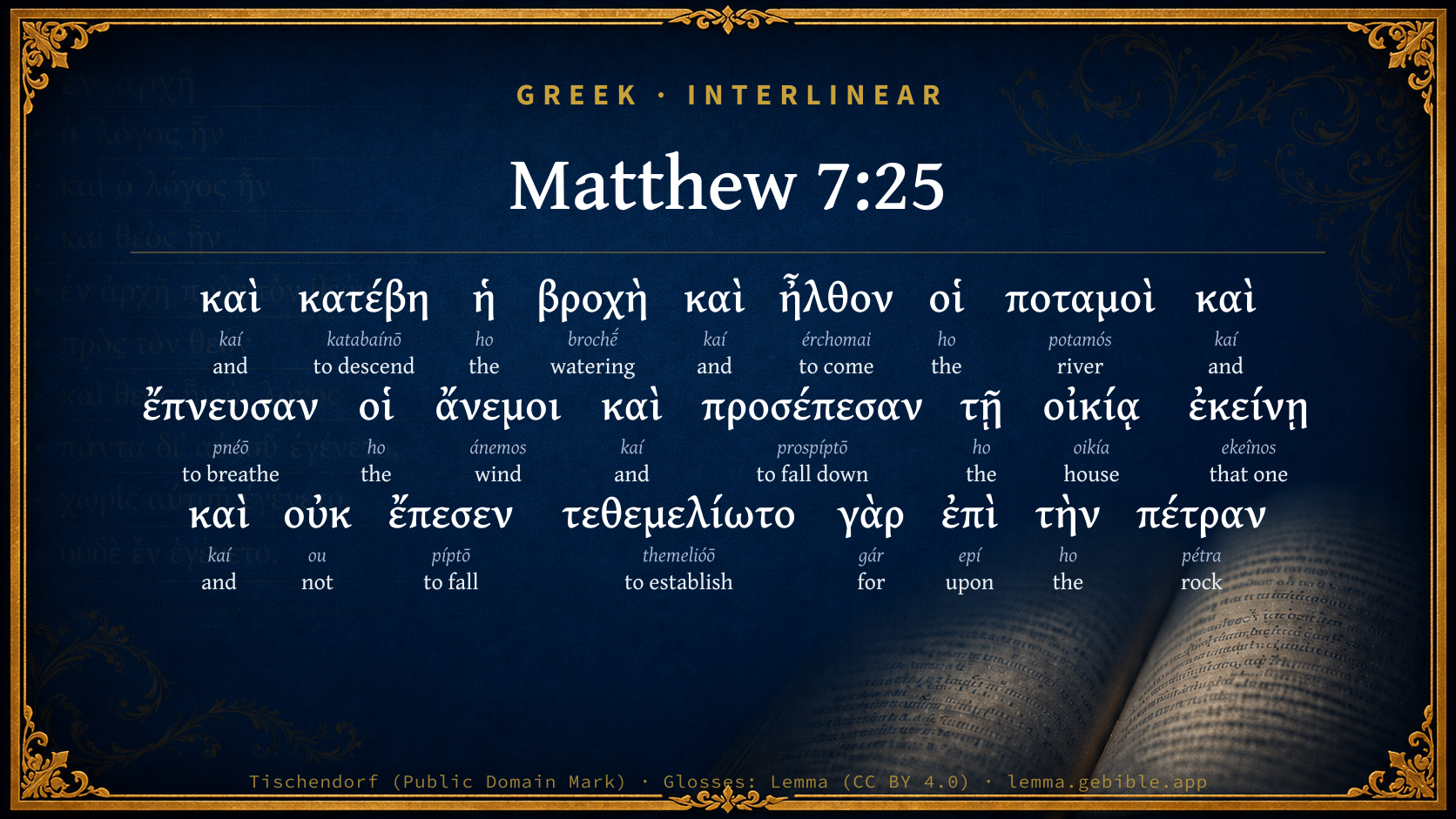
Greek (Tischendorf 8th ed.) Matthew 7:25 appears in the Greek New Testament. The text above is from the Tischendorf 8th edition. Each word links to its Strong’s number and a concise gloss. Click any word for its full Thayer’s Greek Lexicon entry.
Download image
Cite this verse

Matthew 7:25 (World English Bible). Public Domain. Lemma interlinear Bible study tool, https://lemma.gebible.app/v/matthew/7/25.

Show BibTeX & RIS
BibTeX
RIS
English Translation
The rain came down, the floods came, and the winds blew, and beat on that house; and it didn't fall, for it was founded on the rock.
World English Bible · Public Domain
Highlights
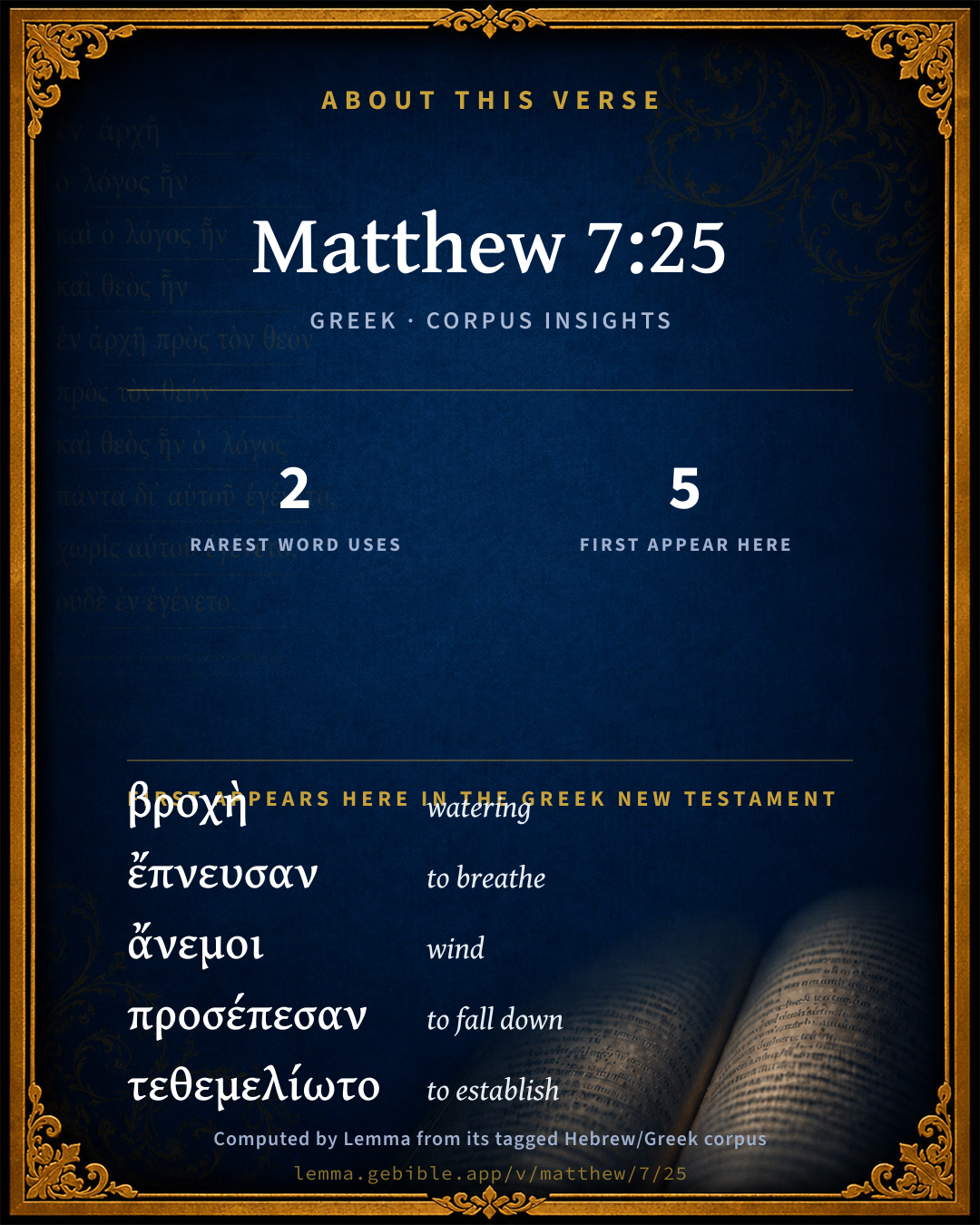
  • 5 first appearances in the Greek New Testament
Full analysis ↓
Download a study sheet

One document with this verse’s original text, its word-by-word gloss line, the meaning frame, cross-references with their text, attributed commentary, and full source and license credits — printable, and it pastes into notes with its structure intact.

This verse Autodidact and up

Study sheet (.html) Plain text (.txt)

A passage Seminary Student

Up to 50 verses in one chapter. A passage sheet keeps up to 6 commentary sources and 12 cross-references per verse, in the order this page ranks them, and says so on the sheet whenever that leaves anything out. Ask for a single verse and you get the Autodidact verse sheet above.

Everything on this page stays free to read, with no account — the sheet is a download of what is already on screen, not access to it.

Want to remove ads? Support Godless Engineer
Compare translations 3

The same verse in 3 English versions, stacked beneath the original-language interlinear above. Click any original word for its lexicon entry.

Each is an independent rendering of the whole verse — the interlinear is not word-aligned to these translations.

Highlighted words mark where these versions differ — a whole-verse word diff, not a word-by-word alignment.

  • World English Bible Public Domain
    The rain came down, the floods came, and the winds blew, and beat on that house; and it didn't fall, for it was founded on the rock.
  • King James Version Public Domain
    And the rain descended, and the floods came, and the winds blew, and beat upon that house; and it fell not: for it was founded upon a rock.
  • unfoldingWord Literal Text CC BY-SA 4.0
    And the rain came down, and the floods came, and the winds blew and struck against that house, but it did not fall down, for it had been founded on the rock.

unfoldingWord Literal Text — © unfoldingWord, licensed CC BY-SA 4.0. Word-aligned USFM3 via Door43 (git.door43.org/unfoldingWord/en_ult).

Versions to compare (up to 4)

3 of 4 selected

Show all 19 translations

Every available English version of this verse, each an independent rendering of the whole verse.

  • World English Bible Public Domain
    The rain came down, the floods came, and the winds blew, and beat on that house; and it didn't fall, for it was founded on the rock.
  • Berean Standard Bible Public Domain
    The rain fell, the torrents raged, and the winds blew and beat against that house; yet it did not fall, because its foundation was on the rock.
  • Majority Standard Bible Public Domain
    The rain fell, the torrents raged, and the winds blew and beat against that house; yet it did not fall, because its foundation was on the rock.
  • King James Version Public Domain
    And the rain descended, and the floods came, and the winds blew, and beat upon that house; and it fell not: for it was founded upon a rock.
  • American Standard Version (1901) Public Domain
    and the rain descended, and the floods came, and the winds blew, and beat upon that house; and if fell not: for it was founded upon the rock.
  • Revised Version (1885) Public Domain
    and the rain descended, and the floods came, and the winds blew, and beat upon that house; and it fell not: for it was founded upon the rock.
  • Geneva Bible (1599) Public Domain
    And the raine fell, and the floods came, and the windes blewe, and beat vpon that house, and it fell not: for it was grounded on a rocke.
  • Douay-Rheims (1899) Public Domain
    And the rain fell, and the floods came, and the winds blew, and they beat upon that house, and it fell not, for it was founded on a rock.
  • Young's Literal Translation Public Domain
    and the rain did descend, and the streams came, and the winds blew, and they beat on that house, and it fell not, for it had been founded on the rock.
  • Literal Standard Version CC BY-SA 4.0
    and the rain descended, and the streams came, and the winds blew, and they beat on that house, and it did not fall, for it had been founded on the rock.
  • Unlocked Literal Bible CC BY-SA 4.0
    The rain came down, the floods came, and the winds blew and beat upon that house, but it did not fall down, for it was built on the rock.
  • unfoldingWord Literal Text CC BY-SA 4.0
    And the rain came down, and the floods came, and the winds blew and struck against that house, but it did not fall down, for it had been founded on the rock.
  • Darby Bible Public Domain
    and the rain came down, and the streams came, and the winds blew and fell upon that house, and it did not fall, for it had been founded upon the rock.
  • World Messianic Bible Public Domain
    The rain came down, the floods came, and the winds blew and beat on that house; and it didn’t fall, for it was founded on the rock.
  • Webster's Bible Public Domain
    And the rain descended, and the floods came, and the winds blew, and beat upon that house; and it fell not: for it was founded upon a rock.
  • Free Bible Version CC BY-SA 4.0
    The rain poured down, and the floods rose, and the winds blew hard against the house, but it didn't fall down, because its foundations were on solid rock.
  • Bible in Basic English Public Domain
    And the rain came down and there was a rush of waters and the winds were driving against that house, but it was not moved; because it was based on the rock.
  • Text-Critical English NT CC BY 4.0
    The rain fell, the floods came, and the winds blew and beat on that house, but it did not fall, for it was founded on the rock.
  • Tyndale New Testament (1534) Public Domain
    and aboundance of rayne descended and the fluddes came and the wyndes blewe and bet vpon that same housse and it fell not because it was grounded on the rocke.

Literal Standard Version (2020), Covenant Press — licensed CC BY-SA 4.0. Text via the HelloAO Bible API (eBible.org). Unlocked Literal Bible (unfoldingWord) — licensed CC BY-SA 4.0. Text via the HelloAO Bible API (eBible.org). unfoldingWord Literal Text — © unfoldingWord, licensed CC BY-SA 4.0. Word-aligned USFM3 via Door43 (git.door43.org/unfoldingWord/en_ult). Free Bible Version, Dr. Jonathan Gallagher — licensed CC BY-SA 4.0. Text via the HelloAO Bible API (eBible.org).

Word by word

More ways to search: Search by grammar → Find every occurrence → Compare this word →

Practice this passage: Drill this verse → Learn its vocabulary →

βροχὴ
brochḗ
G1028
“watering”
Noun, Nominative, Singular, Feminine
Part of Speech
Noun
Case
Nominative
Number
Singular
Gender
Feminine
Full Thayer's Definition

Origin: from G1026

TDNT: None

1. a besprinkling, watering, rain a. used of a heavy shower or violent rainstorm
  1. καὶ kaí G2532 “and” Conjunction
  2. κατέβη katabaínō G2597 “to descend” Verb, Aorist, Active, Indicative, 3rd person, Singular
  3. ἡ ho G3588 “the” Article, Nominative, Singular, Feminine
  4. καὶ kaí G2532 “and” Conjunction
  5. ἦλθον érchomai G2064 “to come” Verb, Aorist, Active, Indicative, 3rd person, Plural
  6. οἱ ho G3588 “the” Article, Nominative, Plural, Masculine
  7. ποταμοὶ potamós G4215 “river” Noun, Nominative, Plural, Masculine
  8. καὶ kaí G2532 “and” Conjunction
  9. ἔπνευσαν pnéō G4154 “to breathe” Verb, Aorist, Active, Indicative, 3rd person, Plural
  10. οἱ ho G3588 “the” Article, Nominative, Plural, Masculine
  11. ἄνεμοι ánemos G417 “wind” Noun, Nominative, Plural, Masculine
  12. καὶ kaí G2532 “and” Conjunction
  13. προσέπεσαν prospíptō G4363 “to fall down” Verb, Aorist, Active, Indicative, 3rd person, Plural
  14. τῇ ho G3588 “the” Article, Dative, Singular, Feminine
  15. οἰκίᾳ oikía G3614 “house” Noun, Dative, Singular, Feminine
  16. ἐκείνῃ ekeînos G1565 “that one” Demonstrative pronoun, Dative, Singular, Feminine
  17. καὶ kaí G2532 “and” Conjunction
  18. οὐκ ou G3756 “not” Particle, Negative
  19. ἔπεσεν píptō G4098 “to fall” Verb, Aorist, Active, Indicative, 3rd person, Singular
  20. τεθεμελίωτο themelióō G2311 “to establish” Verb, Pluperfect, Passive, Indicative, 3rd person, Singular
  21. γὰρ gár G1063 “for” Conjunction
  22. ἐπὶ epí G1909 “upon” Preposition
  23. τὴν ho G3588 “the” Article, Accusative, Singular, Feminine
  24. πέτραν pétra G4073 “rock” Noun, Accusative, Singular, Feminine

About this verse

These counts appear in no published source. They are computed here, from the morphology-tagged text and Lemma’s own curated glosses. What Lemma adds →

25
words
17
distinct lemmas
Gospels
section

Notable vocabulary

The rarest word here is βροχὴ watering G1028 — appearing just 2 times in the whole Greek New Testament.

First appearance in Scripture

These words make their first canonical appearance in the Greek New Testament here:

  • βροχὴ watering G1028
  • ἔπνευσαν to breathe G4154
  • ἄνεμοι wind G417
  • προσέπεσαν to fall down G4363
  • τεθεμελίωτο to establish G2311

Shared distinctive vocabulary

βροχὴ watering G1028 occurs in 2 verses of the Greek New Testament. Also found in:
Repetition

Words recur within this verse:

Cross-references

13

Topical passages linked to Matthew 7:25 in the Treasury of Scripture Knowledge — connected by theme and wording, ordered by reader-vote popularity; previews shown in the World English Bible.

  • James 1:12 Blessed is the man who endures temptation, for when he has been approved, he will receive the crown of life, which the Lord promised to those who love him.
  • Psalms 125:1–2 Those who trust in Yahweh are as Mount Zion, Which can't be moved, but remains forever.
  • 1 Peter 1:7 that the proof of your faith, which is more precious than gold that perishes even though it is tested by fire, may be found to result in praise, glory, and honor at the revelation of Jesus Christ--
  • Colossians 2:7 rooted and built up in him, and established in the faith, even as you were taught, abounding in it in thanksgiving.
  • 1 Peter 1:5 who by the power of God are guarded through faith for a salvation ready to be revealed in the last time.
  • 1 Corinthians 3:13–15 each man's work will be revealed. For the Day will declare it, because it is revealed in fire; and the fire itself will test what sort of work each man's work is.
  • Acts 14:22 confirming the souls of the disciples, exhorting them to continue in the faith, and that through many afflictions we must enter into the Kingdom of God.
  • Psalms 92:13–15 They are planted in Yahweh's house. They will flourish in our God's courts.
  • Ephesians 3:17 that Christ may dwell in your hearts through faith; to the end that you, being rooted and grounded in love,
  • Ezekiel 13:11–16 tell those who daub it with whitewash, that it shall fall: there shall be an overflowing shower; and you, great hailstones, shall fall; and a stormy wind shall tear it.
  • Malachi 3:3 and he will sit as a refiner and purifier of silver, and he will purify the sons of Levi, and refine them as gold and silver; and they shall offer to Yahweh offerings in righteousness.
  • Matthew 16:18 I also tell you that you are Peter, and on this rock I will build my assembly, and the gates of Hades will not prevail against it.
  • 1 John 2:19 They went out from us, but they didn't belong to us; for if they had belonged to us, they would have continued with us. But they left, that they might be revealed that none of them belong to us.

Cross-references courtesy of OpenBible.info (CC BY 4.0).

Commentary

Notes on Matthew 7:25 from classic Christian and Jewish commentators (each source and its license shown beneath its notes). The classic Christian expositions comment on the surrounding passage and are grouped to its opening verse, so a note may address several verses; the Jewish commentaries on the Tanakh (Rashi and others) are per-verse, so they appear only where the commentator wrote on this verse.

Lemma curates 59 commentaries, every one of them public domain or Creative Commons licensed, each selected and text-cleaned for this edition rather than reprinted as found. About our sources →

Tyndale Open Study Notes

Tyndale Open Resources

7:25-27 The storm is a metaphor for God’s all-knowing judgment (see Jer 23:19; Ezek 1:4).

Tyndale Open Study Notes — © Tyndale Open Resources, licensed CC BY-SA 4.0. Text via the HelloAO Bible API.

Bengel's Gnomon

Johann Albrecht Bengel

Mat 7:25. Καὶ—καὶ—καὶ—κ.τ.λ., and—and—and—etc.) In the last days of a man and of the world, temptations throng together to the attack (concurrunt), sc., rains on the roof, rivers at the base, winds at the sides [of our spiritual edifice].[350]—ἡ βροχὴ, the rain) The presence of the article denotes that the rain will not be deficient.—προσέπεσον, fell upon) i.e. to try its power of endurance. In Mat 7:27, we have προσέκοψαν, beat upon, as though at random and without object.

[350] All kinds of judgments are here intimated; but especially the last judgment. It is indeed scarcely that the righteous man is saved, yet however he is saved [1Pe 4:18].—V. g.

Bengel's Gnomon of the New Testament — English translation (T&T Clark, Edinburgh, 1860) — public domain. Text from a community e-Sword module.

Expositor's Greek Testament

ed. W. Robertson Nicoll

Mat 7:25 . What follows shows his wisdom, justified by events which he had anticipated and provided for; not abstract possibilities, but likely to happen every year certain to happen now and then. Therefore the prudence displayed is not exceptional, but just ordinary common sense. καὶ : observe the five καὶ in succession an eloquent polysyndeton , as grammarians call it; note also the rhythm of the sentence in which the war of the elements is described: down came the rain, down rushed the rivers, blew the winds sudden, fell, terrible. προσέπεσον , they fell upon that house: rain on roof, river on foundation, wind on walls. And what happened? καὶ οὐκ ἔπεσεν . The elements fell on it, but it did not fall. τεθεμελίωτο γὰρ : for a good reason, it was founded on the rock. The builder had seen to that.

The Expositor's Greek Testament, edited by W. Robertson Nicoll (1897–1910) — public domain. Text from a community e-Sword module.

Jamieson, Fausset & Brown

Robert Jamieson, A. R. Fausset & David Brown

And the rain descended--from above.

and the floods came--from below.

and the winds blew--sweeping across.

and beat upon that house--thus from every direction.

and it fell not; for it was founded upon a rock--See Jo1 2:17.

Jamieson, Fausset & Brown — Commentary Critical and Explanatory on the Whole Bible (1871) — public domain (CC PDM 1.0). Text via the HelloAO Bible API.

Adam Clarke's Commentary

Verse 25. And the rain descended - floods came - winds blew] In Judea, and in all countries in the neighbourhood of the tropics, the rain sometimes falls in great torrents, producing rivers, which sweep away the soil from the rocky hills; and the houses, which are built of brick only dried in the sun, of which there are whole villages in the east, literally melt away before those rains, and the land-floods occasioned by them. There are three general kinds of trials to which the followers of God are exposed; and to which, some think, our Lord alludes here: First, those of temporal afflictions, coming in the course of Divine Providence: these may be likened to the torrents of rain. Secondly, those which come from the passions of men, and which may be likened to the impetuous rivers. Thirdly, those which come from Satan and his angels, and which, like tempestuous whirlwinds, threaten to carry every thing before them. He alone, whose soul is built on the Rock of ages, stands all these shocks; and not only stands in, but profits by them.

Adam Clarke's Commentary on the Bible (1810–1826) — public domain. Text from a community e-Sword/MySword module.

John Gill's Exposition

For he taught them, as one having authority,.... This does not so much respect the subject matter of his ministry, the gravity, weight, and solidity of his doctrine; which, to be sure, was greatly different from that of the Scribes, which chiefly lay in proposing and handling things trivial, and of no moment; such as the rituals of the law, the traditions of the elders, or washing of the hands and cups, &c. nor merely the manner of his delivery, which was with great affection, ardour, and fervency of spirit, with much liberty and utterance of speech, and with wonderful perspicuity and majesty; in which also he differed from the Scribes, who taught in a cold and lifeless manner, without any spirit and power; but this chiefly regards the method he used in preaching, which was by delivering truths of himself in his own name, and by his own authority; often using those words, "but I say unto you": he spoke as a lawgiver, as one that had authority from heaven, and not from men;

and not as the Scribes, who used to say, when they delivered any thing to the people, "our Rabbins", or "our wise men say" so and so: such as were on the side of Hillell made use of his name; and those who were on the side of Shammai made use of his name; scarce ever would they venture to say anything of themselves, but said, the ancient doctors say thus and thus: almost innumerable instances might be given, out of the Talmud, in which one Rabbi speaks in the name of another; but our Lord spoke boldly, of himself, in his own name, and did not go about to support his doctrine by the testimony of the elders; but spake, as having received power and authority, as man, from his Father, "and not as the Scribes". Some copies add, and Pharisees; these generally going together; and so read the Vulgate Latin, the Syriac, the Persic versions, and the Hebrew edition of Matthew by Munster.

Next: Matthew Chapter 8

John Gill's Exposition of the Whole Bible (1746–1763) — public domain (CC PDM 1.0). Text via the HelloAO Bible API.

Trapp's Complete Commentary

John Trapp

25 And the rain descended, and the floods came, and the winds blew, and beat upon that house; and it fell not: for it was founded upon a rock.

Ver. 25. And the rain descended, and the floods came, &c.] Many are the troubles of the righteous; they come commonly thick and threefold, one in the neck of another, as Job’s messengers. {a} "The clouds return after the rain," Ecc 12:2. There is a continual succession of miseries and molestations from the devil, the world, and the flesh, to them that hear and do the words of Christ: like the weather in winter, when a shower or two do not clear the air, but though it rain much, yet the sky is still overcast with clouds, which are dissolved upon the saints, sometimes in lesser and lighter crosses, as the smaller rain, sometimes in pressing and piercing calamities, like storm and hail. {b} The rain falls, the floods rise, the wind blows, and many a sharp shower beats upon the Christian’s building; but, like Noah’s ark, it is pitched within and without; like Mount Sion, it abides for ever immovable, because founded upon the Rock of ages. Si nos ruemus, ruet Christus usa, ille regnator mundi, said that noble Luther: If we fall, Christ shall fall too, that Ruler of the world: and let him fall; I had rather fall with Christ, than stand with Caesar. The devil stirs up a tempest against God’s children, saith Ambrose, sed ipse naufragium facit, but himself maketh shipwreck. The Church, according to that Venetian motto, nec fluctu, nec flatu movetur: and yet Venice hath but one street (they say) that is not daily overflowed by the sea.

And it fell not] Saving grace is incapable of being lost, though it may be impaired in the degrees, and may recoil to the root, as sap doth in winter. Christ lives in the hearts of all his saints, Gal 2:20, and can die no more, Rom 6:10. Die he may as well at the right hand of his Father, as in the heart of a Christian.

A weak brother, for whom Christ died, may perish, 1Co 8:11.

No thanks to us if he do not, who by scandalous courses offend and wound his conscience; but Christ will not lose him so. Destrut potest, ex parte, per interveniens scandalum; quod et verbum απολεω aliquo modo denotat, non distrahi penitus caula, &c.

There are those who deny the Lord that bought them, 2Pe 2:1.

Bought they were by Christ in their own conceit, and in the esteem of others, but it proved otherwise. Or, they were bought, that is, delivered, in a general sense (so the word here used often signifieth), from their superstition to the knowledge of salvation (I say not to saving knowledge), whereby they might preach to others, themselves being castaways. God hath charged Christ, as Mediator, to see to the keeping of the bodies and souls of all true believers, Joh 6:39-40. And he faithfully performed it. "Those thou gavest me I have kept," saith he, "and none of them is lost," Joh 17:12.

Christ makes exception of one that was lost, Ibid.

That shows he was never of his body; for can he be a Saviour of a son of perdition?

Why is he then excepted?

1. Because he seemed to be one of Christ’s, by reason of his office.

2. He speaketh there in particular of the twelve: and to be an apostle was, in itself, but an outward calling.

Christians may lose the things that they have wrought, 2Jn 1:8.

1. Temporaries may, and do; and of them it may be understood, Mat 7:9.

2. True Christians may:

1. In respect of the praise of men; all their former honour may be laid in the dust.

2. In regard of the inward sense and comfort, as David, Psa 32:1-11 Psa 51:1-19.

3. In respect of the fulness of the reward in heaven, their glory may be much lessened by their falls.

A righteous man may turn from his righteousness, and die, Eze 18:24.

From his righteousness imparted, or that of sanctification, he may turn in part, and for a time, and die a temporal death for his offence, as Josiah: not so from his righteousness imputed, or that of justification, so as to die eternally. Or the Holy Ghost may so speak, as of a thing impossible; as, If an angel from heaven should preach any other doctrine, &c., Gal 1:8, which cannot possibly be. So that this text concludes not categorically. The Comforter shall abide with us for ever, Joh 14:16. It is called an earnest, not a pawn. A pawn is to be returned again; but an earnest is part and pledge of the whole sum.

What need then so many exhortations to perseverance?

1. True grace in itself is leesable, in respect of us, who should fall from it, as Adam; but we are kept by the power and promise of God to salvation; and we need Christ’s left hand to be under us, and his right hand over us, to clasp and hold us up. He keepeth the feet of the saints, 1Sa 2:9, and preserves us from all such evil, as may frustrate our perseverance, 2Th 3:3; 1Jn 5:18.

2. By these exhortations, as means, God’s grace is promoted, and preserved in us.

3. We are but in part renewed, and are apt to backslide; if we row not hard, wind and tide will carry us back again. Heed therefore must be taken, that we look not back with Lot’s wife; that our Jacob’s ladder may reach to heaven; that our oil fail not, till the Bridegroom come; that our coat reach down to our heels, as Joseph’s and the high priest’s did; that we sacrifice the beast with the tail, Gen 37:3; Exo 28:4; Exo 28:42; Exo 29:22; that we keep in this fire of the sanctuary; or, if it slack, that we rake it out of the ashes, and blow it up again into a flame, αναζωπυρειν, 2Ti 1:6; that we turn not again, as we walk, with those living creatures, Eze 1:12; nor be like Nebuchadnezzar’s image, that began in gold, and ended in clay, Dan 2:33; that "we begin not in the Spirit and end in the flesh," Gal 3:3; that we go not backward as Hezekiah’s sun, nor stand at a stay, as Joshua’s, but rejoice to run our race, as David’s, Psa 19:4; and go on to the perfect day, as Solomon’s, Pro 4:18.

{a} Fluctus fluctum trudit. Πονος πονω πονον φερει- dolor et voluptas invicem cedunt, brevior voluptas. Sen.

{b} Calamitas est proprie calamorum comminutio a grandine seu tempestate. Sic cludes dicebantur surculorum detritio: strages a stratis arboribus. Becman. Scaliger. Et esto ruat: Malo ego cum Christo ruere, quam cum Caesare stare. Epist. ad Melch. Burton of Melancholy.

John Trapp, A Commentary or Exposition upon All the Books of the Old and New Testament (1647–1656) — public domain. Text from a community e-Sword module.

Haydock's Catholic Bible Commentary

The Scribes and Pharisees only explained the law, and laid open the promises of Moses, whereas our Saviour gives new laws, and makes new promises in his own name; But I say to you, &c. The energy also with which our Saviour spoke, together with the miracles which he wrought, had far greater influence on the minds of the people than the frigid manner in which the Scribes delivered their doctrines. (Menochius)

George Leo Haydock (1774–1849), Haydock's Catholic Family Bible and Commentary, 1859 edition — public domain. Excludes Psalms (Douay-Rheims chapter numbering differs from Protestant) and Deuterocanonical books (Catholic canon only).

The Pulpit Commentary

And the rain descended, and the floods came, and the winds blew, and beat upon that house; and it fell not: for it was founded upon a (Revised Version, the) rock. The stages of the tempest are expressed more vividly than in St. Luke.

The Pulpit Commentary (1880–1919), ed. H.D.M. Spence-Jones & Joseph S. Exell — public domain. Text from a community e-Sword module.

The People's New Testament

B. W. Johnson

25. The rain descended … and it fell not. Palestine is a country of torrents and sands. This verse gives a picture of the sudden violent storms and sweeping floods which are so common during the rainy season. The house founded upon the rock could not be undermined and destroyed, but would stand firm. So, says the Lord, shall it be with those who hear and obey. “They shall stand in the judgment” (Psa. 1:5).

B. W. Johnson's The People's New Testament with Notes (1889–1891) — public domain. Electronic text from the Christian Classics Ethereal Library (CCEL) ThML edition.

Alford’s Greek Testament

Henry Alford

25.] This similitude must not be pressed to an allegorical or symbolical meaning in its details, e.g. so that the rain, floods, and winds should mean three distinct kinds of temptation: but the Rock, as signifying Him who spoke this, is of too frequent use in Scripture for us to overlook it here: cf. 2Sa 22:2 (Psa 18:2), 32, 47; 23:3: Psa 28:1: 31:2, al. fr.; 61:2: Isa 26:4 (Heb.); 32:2; 44:8 (Heb.): 1Co 10:4, &c. He founds his house on a rock, who, hearing the words of Christ, brings his heart and life into accordance with His expressed will, and is thus by faith in union with Him, founded on Him. Whereas he who merely hears His words, but does them not, has never dug down to the rock, nor become united with it, nor has any stability in the hour of trial.

In τὴν πέτραν … τὴν ἄμμον,—the articles are categorical, importing that these two were usually found in the country where the discourse was delivered;—in ἡ βροχή, οἱ ποταμοί, οἱ ἄνεμοι, the same, implying that such trials of the stability of a house were common. In the whole of the similitude, reference is probably made to the prophetic passage Isa 28:15-18.

τεθεμελίωτο] The N.T. writers usually omit the augment in the pluperfect: so πεποιήκεισαν, Mar 15:7; ἐκβεβλήκει, 16:9; μεμενήκεισαν, 1Jn 2:19, al. fr. This is also done occasionally by Herodotus, and by Attic prose writers, where euphony is served by it. See Herod. i. 122; iii. 42; ix. 22: and Winer, § 12. 9.

Henry Alford, The Greek Testament (1849–1861) — public domain. Text from a community e-Sword module.

International Critical Commentary

25. And the rain came down, and the streams (ποταμοί) came, and the winds blew, and fell upon that house; and it fell not: for it was founded on the rock.] Lk. has: “And when there was a flood, the river (ποταμός) beat against that house, and could not shake it, because it was well founded.”

βροχή] is a late and rare word. The lexicons quote Orac. ap. Clem. Alex. 50. In Ox. Pap. iii. 593, a.d. 172, ii. 280. 5, a.d. 88-89, βροχαί are artificial inundations of land.

(L)

International Critical Commentary — older volumes (1896–1929), various authors — public domain. Text from a community e-Sword module.

Lesson kit

Teaching starters — assembled from the data on this page, not authored interpretation. Every prompt links to the verse data it draws on. Edit before teaching.

Matthew, in the Gospels, opens this verse with 25 words (17 distinct Greek lemmas). Its most distinctive word is brochḗ (“watering”). A historical commentator’s framing appears above. Read the whole chapter for the surrounding context.

Discussion questions

  1. How does “watering” (brochḗ) shape what this verse is saying?
  2. 5 words here appear for the first time in Scripture. What is being introduced at this debut?
  3. Matthew 7:27 shares the word «watering» with this verse. How do the two illuminate each other?
  4. “and” occurs 5× in this one verse. What is the effect of the repetition?
  5. These translations render this verse differently. What is at stake in choosing one wording over another?
  6. Reading how Tyndale Open Study Notes and Bengel's Gnomon read this verse, where do the two commentators agree and where do they part?

Things to notice

  • 5 words make their first canonical appearance in Scripture here.
  • These translations choose different wording for 12 words in this verse.
  • “and” occurs 5× in this single verse.
  • 17 distinct Greek lemmas span 25 words in this verse.

Reading settings

Reading text

Shown beneath each verse's original-language words.

Old Testament
Old Testament edition

Read the OT as the Masoretic Hebrew (MT) or the Greek Septuagint (LXX).

English shown for the Greek Septuagint (in the Hebrew ↔ Greek comparison).

Comparing translations? Open the Compare panel on any verse page to stack up to four side by side.