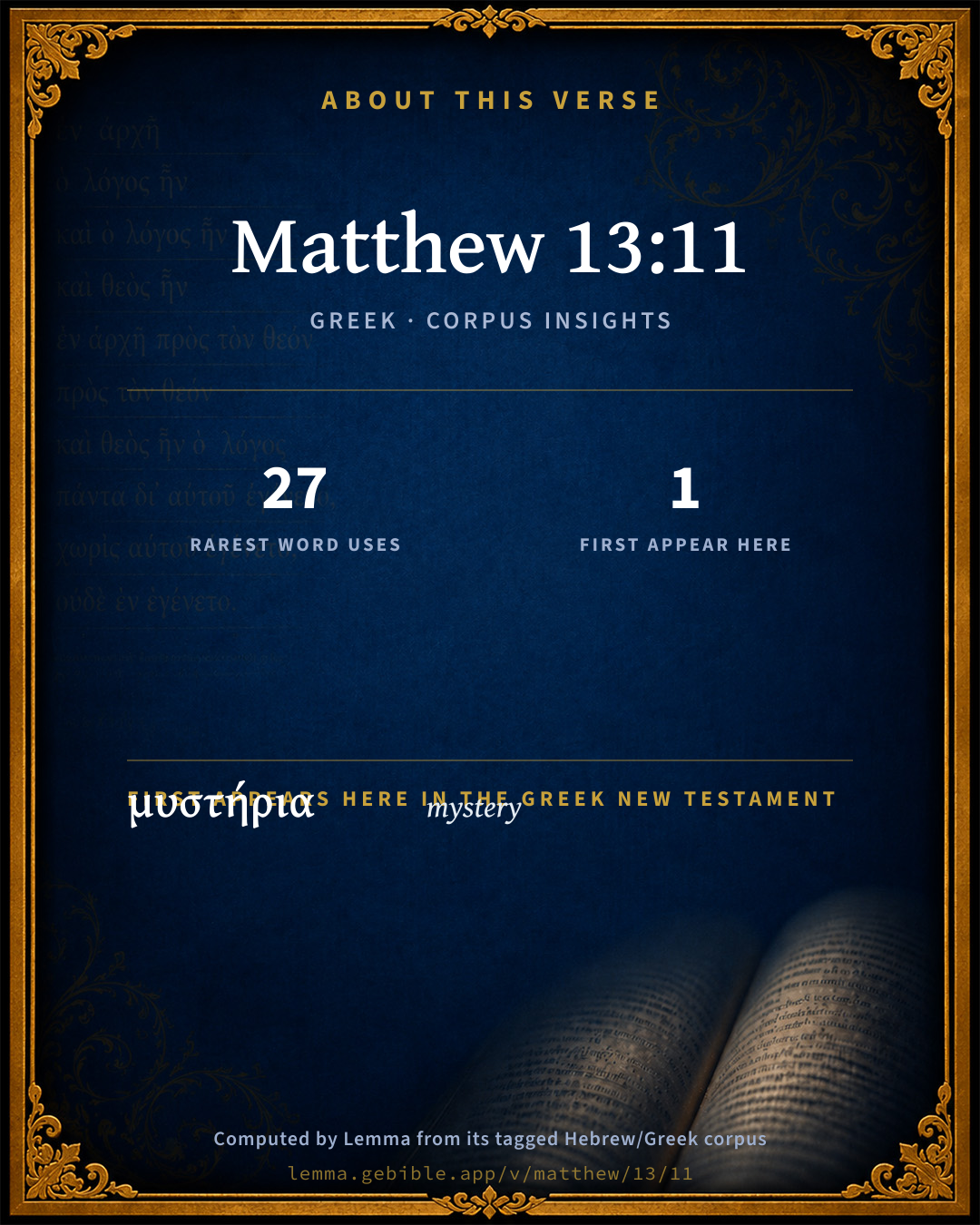
Matthew 13:11

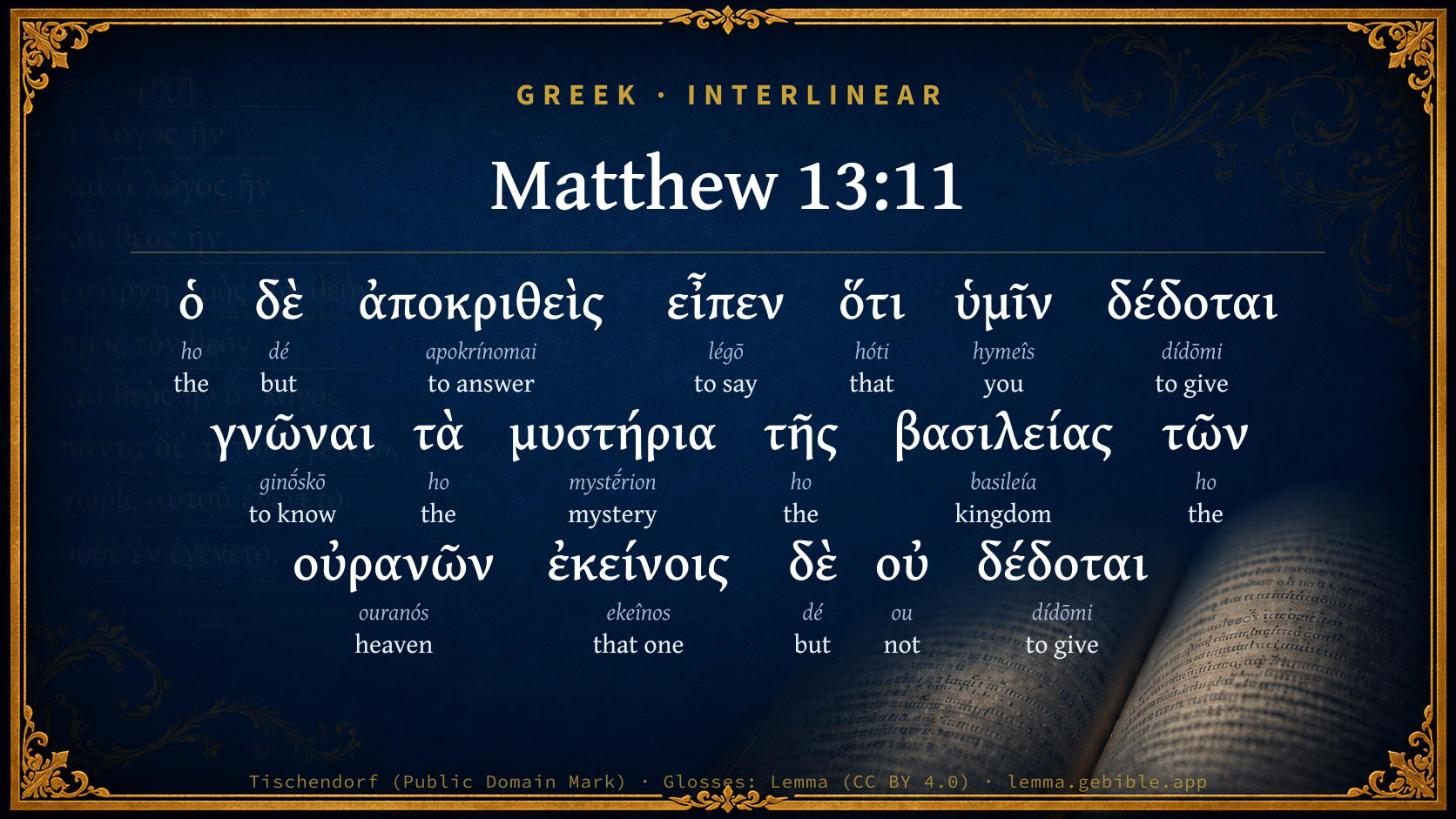
Greek (Tischendorf 8th ed.) Matthew 13:11 appears in the Greek New Testament. The text above is from the Tischendorf 8th edition. Each word links to its Strong’s number and a concise gloss. Click any word for its full Thayer’s Greek Lexicon entry.
Download image
Cite this verse

Matthew 13:11 (World English Bible). Public Domain. Lemma interlinear Bible study tool, https://lemma.gebible.app/v/matthew/13/11.

Show BibTeX & RIS
BibTeX
RIS
English Translation
He answered them, "To you it is given to know the mysteries of the Kingdom of Heaven, but it is not given to them.
World English Bible · Public Domain
Highlights
  • 1 first appearance in the Greek New Testament
Full analysis ↓
Download a study sheet

One document with this verse’s original text, its word-by-word gloss line, the meaning frame, cross-references with their text, attributed commentary, and full source and license credits — printable, and it pastes into notes with its structure intact.

This verse Autodidact and up

Study sheet (.html) Plain text (.txt)

A passage Seminary Student

Up to 50 verses in one chapter. A passage sheet keeps up to 6 commentary sources and 12 cross-references per verse, in the order this page ranks them, and says so on the sheet whenever that leaves anything out. Ask for a single verse and you get the Autodidact verse sheet above.

Everything on this page stays free to read, with no account — the sheet is a download of what is already on screen, not access to it.

Want to remove ads? Support Godless Engineer
Compare translations 3

The same verse in 3 English versions, stacked beneath the original-language interlinear above. Click any original word for its lexicon entry.

Each is an independent rendering of the whole verse — the interlinear is not word-aligned to these translations.

Highlighted words mark where these versions differ — a whole-verse word diff, not a word-by-word alignment.

  • World English Bible Public Domain
    He answered them, "To you it is given to know the mysteries of the Kingdom of Heaven, but it is not given to them.
  • King James Version Public Domain
    He answered and said unto them, Because it is given unto you to know the mysteries of the kingdom of heaven, but to them it is not given.
  • unfoldingWord Literal Text CC BY-SA 4.0
    But he, answering, said to them, “To you has been given to know the mysteries of the kingdom of the heavens, but to those it has not been given.

unfoldingWord Literal Text — © unfoldingWord, licensed CC BY-SA 4.0. Word-aligned USFM3 via Door43 (git.door43.org/unfoldingWord/en_ult).

Versions to compare (up to 4)

3 of 4 selected

Show all 19 translations

Every available English version of this verse, each an independent rendering of the whole verse.

  • World English Bible Public Domain
    He answered them, "To you it is given to know the mysteries of the Kingdom of Heaven, but it is not given to them.
  • Berean Standard Bible Public Domain
    He replied, “The knowledge of the mysteries of the kingdom of heaven has been given to you, but not to them.
  • Majority Standard Bible Public Domain
    He replied, “The knowledge of the mysteries of the kingdom of heaven has been given to you, but not to them.
  • King James Version Public Domain
    He answered and said unto them, Because it is given unto you to know the mysteries of the kingdom of heaven, but to them it is not given.
  • American Standard Version (1901) Public Domain
    And he answered and said unto them, Unto you it is given to know the mysteries of the kingdom of heaven, but to them it is not given.
  • Revised Version (1885) Public Domain
    And he answered and said unto them, Unto you it is given to know the mysteries of the kingdom of heaven, but to them it is not given.
  • Geneva Bible (1599) Public Domain
    And he answered, and said vnto them, Because it is giuen vnto you, to know the secretes of the kingdome of heauen, but to the it is not giue.
  • Douay-Rheims (1899) Public Domain
    Who answered and said to them: Because to you it is given to know the mysteries of the kingdom of heaven: but to them it is not given.
  • Young's Literal Translation Public Domain
    And he answering said to them that -- `To you it hath been given to know the secrets of the reign of the heavens, and to these it hath not been given,
  • Literal Standard Version CC BY-SA 4.0
    And He answering said to them that, “To you it has been given to know the secrets of the kingdom of the heavens, and to these it has not been given,
  • Unlocked Literal Bible CC BY-SA 4.0
    Jesus answered and said to them, “You have been given the privilege of understanding mysteries of the kingdom of heaven, but to them it is not given.
  • unfoldingWord Literal Text CC BY-SA 4.0
    But he, answering, said to them, “To you has been given to know the mysteries of the kingdom of the heavens, but to those it has not been given.
  • Darby Bible Public Domain
    And he answering said to them, Because to you it is given to know the mysteries of the kingdom of the heavens, but to them it is not given;
  • World Messianic Bible Public Domain
    He answered them, “To you it is given to know the mysteries of the Kingdom of Heaven, but it is not given to them.
  • Webster's Bible Public Domain
    He answered and said to them, Because it is given to you to know the mysteries of the kingdom of heaven, but to them it is not given.
  • Free Bible Version CC BY-SA 4.0
    “You're privileged to have revealed to you the mysteries of the kingdom of heaven, but they're not given such insights,” Jesus replied.
  • Bible in Basic English Public Domain
    And he said to them in answer, To you is given the knowledge of the secrets of the kingdom of heaven, but to them it is not given.
  • Text-Critical English NT CC BY 4.0
    Jesus answered them, “To you it has been given to know the mysteries of the kingdom of heaven, but to them it has not been given.
  • Tyndale New Testament (1534) Public Domain
    He answered and sayde vnto them: it is geve vnto you to knowe the secretes of the kyngdome of heven but to the it is not geve

Literal Standard Version (2020), Covenant Press — licensed CC BY-SA 4.0. Text via the HelloAO Bible API (eBible.org). Unlocked Literal Bible (unfoldingWord) — licensed CC BY-SA 4.0. Text via the HelloAO Bible API (eBible.org). unfoldingWord Literal Text — © unfoldingWord, licensed CC BY-SA 4.0. Word-aligned USFM3 via Door43 (git.door43.org/unfoldingWord/en_ult). Free Bible Version, Dr. Jonathan Gallagher — licensed CC BY-SA 4.0. Text via the HelloAO Bible API (eBible.org).

Word by word

More ways to search: Search by grammar → Find every occurrence → Compare this word →

Practice this passage: Drill this verse → Learn its vocabulary →

μυστήρια
mystḗrion
G3466
“mystery”
Noun, Accusative, Plural, Neuter
Part of Speech
Noun
Case
Accusative
Number
Plural
Gender
Neuter
Full Thayer's Definition

Origin: from a derivative of muo (to shut the mouth)

TDNT: 17:22,6

1. hidden thing, secret, mystery a. generally mysteries, religious secrets, confided only to the initiated and not to ordinary mortals b. a hidden or secret thing, not obvious to the understanding c. a hidden purpose or counsel 1. secret will 1c d. of men 1c e. of God: the secret counsels which govern God in dealing with the righteous, which are hidden from ungodly and wicked men but plain to the godly 2. in rabbinic writings, it denotes the mystic or hidden sense a. of an OT saying b. of an image or form seen in a vision c. of a dream
  1. ὁ ho G3588 “the” Article, Nominative, Singular, Masculine
  2. δὲ dé G1161 “but” Conjunction
  3. ἀποκριθεὶς apokrínomai G611 “to answer” Verb, Aorist, Passive deponent, Participle, Nominative, Singular, Masculine
  4. εἶπεν légō G3004 “to say” Verb, Aorist, Active, Indicative, 3rd person, Singular
  5. ὅτι hóti G3754 “that” Conjunction
  6. ὑμῖν hymeîs G5210 “you” Personal pronoun, 2nd person, Dative, Plural
  7. δέδοται dídōmi G1325 “to give” Verb, Perfect, Passive, Indicative, 3rd person, Singular
  8. γνῶναι ginṓskō G1097 “to know” Verb, Aorist, Active, Infinitive
  9. τὰ ho G3588 “the” Article, Accusative, Plural, Neuter
  10. τῆς ho G3588 “the” Article, Genitive, Singular, Feminine
  11. βασιλείας basileía G932 “kingdom” Noun, Genitive, Singular, Feminine
  12. τῶν ho G3588 “the” Article, Genitive, Plural, Masculine
  13. οὐρανῶν ouranós G3772 “heaven” Noun, Genitive, Plural, Masculine
  14. ἐκείνοις ekeînos G1565 “that one” Demonstrative pronoun, Dative, Plural, Masculine
  15. δὲ dé G1161 “but” Conjunction
  16. οὐ ou G3756 “not” Particle, Negative
  17. δέδοται dídōmi G1325 “to give” Verb, Perfect, Passive, Indicative, 3rd person, Singular

About this verse

These counts appear in no published source. They are computed here, from the morphology-tagged text and Lemma’s own curated glosses. What Lemma adds →

18
words
13
distinct lemmas
Gospels
section

First appearance in Scripture

This word makes its first canonical appearance in the Greek New Testament here:

  • μυστήρια mystery G3466

Shared distinctive vocabulary

μυστήρια mystery G3466 occurs in 27 verses of the Greek New Testament. Also found in:

Repetition

Words recur within this verse:

Cross-references

35

Topical passages linked to Matthew 13:11 in the Treasury of Scripture Knowledge — connected by theme and wording, ordered by reader-vote popularity; previews shown in the World English Bible.

  • 1 Corinthians 2:9–10 But as it is written, "Things which an eye didn't see, and an ear didn't hear, Which didn't enter into the heart of man, These God has prepared for those who love him."
  • 1 Corinthians 2:14 Now the natural man doesn't receive the things of God's Spirit, for they are foolishness to him, and he can't know them, because they are spiritually discerned.
  • Matthew 19:11 But he said to them, "Not all men can receive this saying, but those to whom it is given.
  • James 1:5 But if any of you lacks wisdom, let him ask of God, who gives to all liberally and without reproach; and it will be given to him.
  • 1 John 2:27 As for you, the anointing which you received from him remains in you, and you don't need for anyone to teach you. But as his anointing teaches you concerning all things, and is true, and is no lie, and even as it taught you, you will remain in him.
  • 1 John 2:20 You have an anointing from the Holy One, and you know the truth.
  • Ephesians 1:9 making known to us the mystery of his will, according to his good pleasure which he purposed in him
  • Ephesians 5:32 This mystery is great, but I speak concerning Christ and of the assembly.
  • Colossians 1:26–27 the mystery which has been hidden for ages and generations. But now it has been revealed to his saints,
  • Isaiah 35:8 A highway shall be there, and a way, and it shall be called The way of holiness. The unclean shall not pass over it, but is shall be for for him who walks in the Way. Wicked fools will not go there.
  • Matthew 16:17 Jesus answered him, "Blessed are you, Simon Bar Jonah, for flesh and blood has not revealed this to you, but my Father who is in heaven.
  • Luke 8:10 He said, "To you it is given to know the mysteries of the Kingdom of God, but to the rest in parables; that 'seeing they may not see, and hearing they may not understand.'
  • John 6:65 He said, "For this cause have I said to you that no one can come to me, unless it is given to him by my Father."
  • Romans 16:25
  • James 1:16–18 Don't be deceived, my beloved brothers.
  • Psalms 25:8–9 Good and upright is Yahweh, Therefore he will instruct sinners in the way.
  • Mark 4:11 He said to them, "To you is given the mystery of the Kingdom of God, but to those who are outside, all things are done in parables,
  • Luke 10:39–42 She had a sister called Mary, who also sat at Jesus' feet, and heard his word.
  • 1 Corinthians 2:7 But we speak God's wisdom in a mystery, the wisdom that has been hidden, which God foreordained before the worlds for our glory,
  • 1 Corinthians 13:2 If I have the gift of prophecy, and know all mysteries and all knowledge; and if I have all faith, so as to remove mountains, but don't have love, I am nothing.
  • 1 Corinthians 15:51 Behold, I tell you a mystery. We will not all sleep, but we will all be changed,
  • 1 Corinthians 4:1 So let a man think of us as Christ's servants, and stewards of God's mysteries.
  • 1 Timothy 3:9 holding the mystery of the faith in a pure conscience.
  • Psalms 25:14 The friendship of Yahweh is with those who fear him. He will show them his covenant.
  • Matthew 11:25–26 At that time, Jesus answered, "I thank you, Father, Lord of heaven and earth, that you hid these things from the wise and understanding, and revealed them to infants.
  • John 7:17 If anyone desires to do his will, he will know about the teaching, whether it is from God, or if I am speaking from myself.
  • 1 Corinthians 4:7 For who makes you different? And what do you have that you didn't receive? But if you did receive it, why do you boast as if you had not received it?
  • Ephesians 3:3–9 how that by revelation the mystery was made known to me, as I wrote before in few words,
  • Ephesians 6:19 on my behalf, that utterance may be given to me in opening my mouth, to make known with boldness the mystery of the Gospel,
  • Colossians 2:2 that their hearts may be comforted, they being knit together in love, and gaining all riches of the full assurance of understanding, that they may know the mystery of God, both of the Father and of Christ,
  • Isaiah 29:10 For Yahweh has poured out on you the spirit of deep sleep, and has closed your eyes, the prophets; and your heads, the seers, has he covered.
  • Acts 17:11–12 Now these were more noble than those in Thessalonica, in that they received the word with all readiness of the mind, examining the Scriptures daily to see whether these things were so.
  • Ephesians 1:18 having the eyes of your hearts enlightened, that you may know what is the hope of his calling, and what are the riches of the glory of his inheritance in the saints,
  • 1 Timothy 3:16 Without controversy, the mystery of godliness is great: God was revealed in the flesh, Justified in the spirit, Seen by angels, Preached among the nations, Believed on in the world, And received up in glory.
  • Acts 16:14 A certain woman named Lydia, a seller of purple, of the city of Thyatira, one who worshiped God, heard us; whose heart the Lord opened to listen to the things which were spoken by Paul.

Cross-references courtesy of OpenBible.info (CC BY 4.0).

Commentary

Notes on Matthew 13:11 from classic Christian and Jewish commentators (each source and its license shown beneath its notes). The classic Christian expositions comment on the surrounding passage and are grouped to its opening verse, so a note may address several verses; the Jewish commentaries on the Tanakh (Rashi and others) are per-verse, so they appear only where the commentator wrote on this verse.

Lemma curates 59 commentaries, every one of them public domain or Creative Commons licensed, each selected and text-cleaned for this edition rather than reprinted as found. About our sources →

Matthew Poole's English Annotations

Mark saith, Mar 4:11, Unto you it is given to know the mystery of the kingdom of God: but unto them that are without, all these things are done in parables. Luke saith no more than, Unto you it is given to know the mysteries of the kingdom of God: but to others in parables. Only, Mat 8:18, he saith,

Take heed therefore how ye hear: for whosoever hath, to him shall be given; and whosoever hath not, from him shall be taken even that which he seemeth to have. Because it is given to you, &c. given by my Father: God, according to the good pleasure of his will, hath given to some persons to know the mysteries of the kingdom of God, more than to others. Some here distinguish concerning the things which concern the kingdom of God. The laws of his kingdom, they say, are delivered plainly viz. those things which are necessary to be known in order to our salvation are delivered plainly, so as we may understand them. But there are other things that belong to his kingdom not so necessary to be known in order to salvation, these God giveth to some only to know. I cannot agree to this notion. God manifested in the flesh is the great mystery of the gospel, the mystery hid from ages, yet I am sure the knowledge of Christ as such is necessary to salvation. I therefore think the emphasis lieth upon know.

1. There is a more general and confused knowledge of a thing; and there is a more distinct, clear, particular knowledge.

2. There is a mere notional knowledge, and there is a more effective, experimental knowledge.

To you my Father hath given eternal life, and, as means in order to it, to know more clearly, particularly, and distinctly the things that concern the kingdom of God; to know and to believe in me, who am the Saviour of the world: my Father hath no such special and particular kindness for the generality of this people, and therefore he hath not given to them the same aids and assistance.

For whosoever hath, to him shall be given, and he shall have more abundance: by him that hath, some understand, he that hath and maketh use of what he hath, and that is plainly the sense of it Mat 25:29, where it is the epiparabola, or conclusion of the parable about the talents. But though the preceding parable plainly leadeth to such a sense there, yet the preceding words seem as directly to lead to another sense here, and what is the more natural and proper signification of the word hath, which most naturally signifies to have a thing in our possession. He that hath, therefore, in all reason signifies, he that hath that which, Mat 13:11, is said to be given. He that hath the saving knowledge of the mysteries of the kingdom of God. To him that doth not so much come to hear me out of curiosity, and comprehends by his understanding something of my will, but hath a heart that embraces and receiveth me, so as he believeth in me. To him that hath the seed of God in him as in good ground.

Shall be given: that is expounded by the next words,

and he shall have more abundance; he shall have more grace, a more full, and clear, and distinct knowledge of me, and the things which concern my kingdom.

But whosoever hath not, hath not the seed of God, a true root of grace, in whom the seed of my word hath not fallen as in good ground, but only as in the highway, or in thorny or stony ground,

from him shall be taken away even that which he hath. How can that be?

Answer: It must not be understood of things in the same nature and kind; Luke expounds it, Mat 8:18, by ο δοκει εχειν, that which either to himself or to others he seemeth to have. He that hath not a truth of grace may think he hath: his hope and opinion of himself shall fail. Others may, from his gifts and parts, think he hath. God shall unmask him, taking away his common gifts, or suffering him to fall into and be overcome by foul temptations. His gifts and parts shall decay, his moral righteousness will abate by God’s just dereliction of him, and withholding his restraining grace.

Matthew Poole's English Annotations on the Holy Bible (1683–1685) — public domain. Text from a community e-Sword/MySword module.

The Biblical Illustrator

Joseph S. Exell

Mat_13:11-12

Because it is given unto you to know the mysteries of the kingdom of heaven.

The preparation necessary for understanding the mysteries of the gospel

I. To explain what it is that we ought to have in order to attain an understanding of the mysteries of the gospel.

1. We ought to have an honest desire after light, and if we have this desire it will not remain unproductive. There is a connection announced in Scripture between desire and its accomplishment. The hungry are filled. Thousands are content that the Bible shall remain a sealed book-unto them it will not be given to know the mysteries of the kingdom of heaven.

2. We ought to have a habit of prayer conjoined with a habit of inquiry; and to this more will be given. It is in the Bible and not out of the Bible, where this light is to be met with. It is by the Spirit of God shining upon the Word, that His truth is reflected with clearness upon the soul.

3. We ought to do all that we know to be Gods will, and to this habit of humble, earnest, desirous reformation, more will be given. Doing stands in the same relation to prayer that reading does. Without the one or the other it is the prayer either of presumption or hypocrisy. Christ is given to those who obey Him. Reading, prayer, and reformation are obvious things; and it is the neglect of these obvious things which involves guilt. It is for want of seeking if you do not find.

II. Explain how it is that the mysteries of the gospel are, in many cases, evolved upon the mind in a clear and convincing manifestation. The carnal mind is enmity against God; and Divine truth must be brought to man from above. (Dr. Chalmers.)

For whosoever hath, to him shall be given.-

Increase of gifts

God heaps upon His faithful and elect people (such as the apostles were) new graces and benefits day by day, so that they abound in virtue and holiness: but from the unbelieving, the ungrateful, and the unworthy, He gradually takes away His gifts, both of nature and of grace.

I. He who hath faith, to him shall be given the knowledge of the mysteries of Gods kingdom; for these cannot be known without faith.

II. They who have ears or hearing, who come to God with a pure desire to learn and to obey, to them shall be revealed celestial verities; but from those who have not this pure desire, and who indulge in their own lusts and errors, shall be taken away, by degrees, that little knowledge of Divine things which they possess.

III. He who hath doctrine-in the sense of using it-he who diligently preaches and communicates to others that which lie has received, shall never be at a loss for doctrine and words which he may speak and preach, for God will supply them to him. But if any one does not make use of doctrine, he will gradually forget it and lose it. (Lapide.)

More and more, or less and less

I. This principle as it is illustrated in the parable of the sower.

II. In reference to the experience of all gracious souls. Let us give instances:

1. When a man believes the gospel in its most elementary form, that man will soon be taught the higher truths. Use starlight and you shall have sunlight soon.

2. And as it is with faith so is it with the possession of any genuine grace, Faith, love, zeal, increase by use.

3. The way in which this promise is carried out by our gracious God is worthy of observation. God gives more by a process of growth, as in parable of the sower. The main point is, have we the living principle?

III. The other side of the truth as exemplified in the experience of the insincere. They who have heard the gospel from childhood, now give up hearing. No taste for it. Lost power to appreciate it. Others receive the grace of God, but not acting upon it, lose its power. (C. H. Spurgeon.)

The law of increase

In the world among men it is commonly observed that it never rains but it pours. Where you see a sheep there is generally a flock. Money makes money. Poverty remains poor. Want of capital brings bankruptcy. A company starts on imaginary or borrowed capital: it makes a fuss and a noise, but it never prospers. By-and-by it breaks up, and all is lost, and yet it never had anything of its own to lose: thus it verifies to the letter the truth-whosoever hath not, from him shall be taken away even that he hath. Ordinarily, prosperity is a hen which likes to lay where there is a nest egg, and when one swallow of success conies others will follow it. Certainly we have found it so in the things of grace; where grace has been given more grace comes; spiritual capital well worked multiplies the stock, and spiritual wealth is realized where there is a solid basis to begin upon. (C. H. Spurgeon.)

Increase gradual through effort

Why did not the Lord give us the largest measure of grace to begin with-why promise more abundance as an after result? I think it is because we value grace all the more when it comes to us by little and little. Again, it is to our good to be exercised to get more grace. A poor woman is allowed to go and glean in a field; your generosity might say, Come, my good woman, I will give you the corn, and you shall not have the trouble of gleaning; but this might not be so good a thing for her as to allow her to gather the wheat by her own efforts. It is often much better to enable the poor to help themselves than to help them without their own exertions. God is wise towards us; he means to give us the corn, but he decides that we shall glean it, and so exercise ourselves unto godliness. We are to become rich in grace, but it is to be by heavenly trading. Growth is gift, remember that. (C. H. Spurgeon.)

Life before increase

A dead post which we saw in the ground twenty years ago is the same post still, no bigger, no smaller, and only altered by becoming rotten underground; but the tree which you saw twenty years ago, what a difference there is in it. It was then a sapling which you could bend, but now it has become as an iron pillar, and there is no moving it. So ought it to be with us, and we must aspire to have it so. (C. H. Spurgeon.)

The Biblical Illustrator, edited by Joseph S. Exell (c. 1880s–1900s) — public domain. Text from a community e-Sword module.

Tyndale Open Study Notes

Tyndale Open Resources

13:11-15 Jesus’ answer to the disciples’ question (13:10) was essentially that the people’s stubborn unbelief and rejection of Jesus had brought God’s condemnation.

13:11 You are permitted to understand: God had enabled the disciples to comprehend Jesus’ significance and to respond to his message of the Kingdom in faith and obedience (see 13:19, 23). • the secrets of the Kingdom of Heaven: Namely, that salvation is available to them in Jesus as the fulfillment of Old Testament promises.

Tyndale Open Study Notes — © Tyndale Open Resources, licensed CC BY-SA 4.0. Text via the HelloAO Bible API.

Bengel's Gnomon

Johann Albrecht Bengel

Mat 13:11. Ὅτι, because) This may be referred to the preceding διατί, why? Cf. in Mat 13:13, διὰ τοῦτο, therefore.—ὑμῖν, to you) who have.—τὰ μυστήρια, the mysteries) This term is applied, not to all things which all ought to know from revelation, but to those things which they, to whom secret things are revealed, know beyond those who know only what is strictly necessary.—ἐκείνοις, to them) who are without, in contradistinction to ὑμῖν, you, who are within.[602] οὐ δέδοται, it is not given) sc. to comprehend mysteries fully and clearly.[603]

[602] In the original, “hoc vim habet removendi.” I have paraphrased it, so as to express Benge’s meaning in a manner intelligible to the English reader.—(I. B.)

[603] In the original, “nosse mysteria nuda.” Literally, to know mysteries naked, i.e. fully revealed, without concealment or obscurity.—(I. B.)

“Mysteria nuda,” mysteries without the clothing of the parabolic form or guise.—ED.

Bengel's Gnomon of the New Testament — English translation (T&T Clark, Edinburgh, 1860) — public domain. Text from a community e-Sword module.

Meyer's Critical & Exegetical Commentary

Heinrich August Wilhelm Meyer

Mat_13:11. Δέδοται] by God, through the unfolding, that is, of your inward powers of perception, not merely by means of the exposition (Weizsäcker, p. 413). The opposite condition, Mat_13:13.

γνῶναι] even without the help of parabolic illustration, although previous to the outpouring of the Spirit, nay, previous to the second coming (1Co_13:9 f.), this would always be the case only to an imperfect degree.

τὰ μυστ. τ. βας. τ. οὐραν.] the secret things of the Messiahs kingdom, things which refer to the Messiahs kingdom. They are called μυστήρια, because their ἀποκάλυψις was now being brought about for the first time by means of the gospel. Comp. note on Rom_11:25; Rom_16:25. They are the purposes that are hid in God, which man can only know by the help of divine teaching, and which the gospel unveils.

ἐκείνοις δὲ οὐ δέδοται] is still to be connected with ὅτι (because).

Meyer — Critical and Exegetical Commentary on the New Testament — English translation by Peter Christie, edited by Frederick Crombie (T&T Clark, 1880) — public domain. Text from a community e-Sword module.

Geneva Bible (1599)

Geneva Bible translators

The gift of understanding and of faith is proper to the elect, and all the rest are blinded through the just judgment of God.

Geneva Bible (1599) marginal notes — public domain. Text via Bolls.life.

Jamieson, Fausset & Brown

Robert Jamieson, A. R. Fausset & David Brown

He answered and said unto them, Because it is given unto you to know the mysteries of the kingdom of heaven--The word "mysteries" in Scripture is not used in its classical sense--of religious secrets, nor yet of things incomprehensible, or in their own nature difficult to be understood--but in the sense of things of purely divine revelation, and, usually, things darkly announced under the ancient economy, and during all that period darkly understood, but fully published under the Gospel (Co1 2:6-10; Eph 3:3-6, Eph 3:8-9). "The mysteries of the kingdom of heaven," then, mean those glorious Gospel truths which at that time only the more advanced disciples could appreciate, and they but partially.

but to them it is not given--(See on Mat 11:25). Parables serve the double purpose of revealing and concealing; presenting "the mysteries of the kingdom" to those who know and relish them, though in never so small a degree, in a new and attractive light; but to those who are insensible to spiritual things yielding only, as so many tales, some temporary entertainment.

Jamieson, Fausset & Brown — Commentary Critical and Explanatory on the Whole Bible (1871) — public domain (CC PDM 1.0). Text via the HelloAO Bible API.

Adam Clarke's Commentary

Verse 11. It is given unto you to know the mysteries, c.] By mysteries, here, we may understand not only things concerning the scheme of salvation, which had not yet been revealed but also the prophetic declarations concerning the future state of the Christian Church, expressed in the ensuing parables. It is not given to them to know the purport and design of these things - they are gross of heart, earthly and sensual, and do not improve the light they have received: but to you it is given, because I have appointed you not only to be the first preachers of my Gospel to sinners, but also the persons who shall transmit accounts of all these things to posterity. The knowledge of these mysteries, in the first instance, can be given only to a few; but when these faithfully write and publish what they have heard and seen, unto the world, then the science of salvation is revealed and addressed to all. From Mt 13:17, we learn, that many prophets and righteous men had desired to see and hear these things, but had not that privilege - to them it was not given; not because God designed to exclude them from salvation, but because HE who knew all things knew, either that they were not proper persons, or that that was not the proper time: for the choice of the PERSONS by whom, and the choice of the TIME in which it is most proper to reveal Divine things, must ever rest with the all-wise God.

Adam Clarke's Commentary on the Bible (1810–1826) — public domain. Text from a community e-Sword/MySword module.

Ellicott's Commentary for English Readers

(11) It is given.—Better, it has been given, as by the special act of God.

To know the mysteries.—The Greek word, like “parable,” has passed into modern languages, and has suffered some change of meaning in the process. Strictly speaking, it does not mean, as we sometimes use it—when we speak, e.g., of the mystery of the Trinity, a truth which none can understand—something “awfully obscure” (the definition given in Johnson’s Dictionary), but one which, kept a secret from others, has been revealed to the initiated. Interpreted by our Lord’s teaching up to this time, the mysteries of the kingdom may be referred to the new birth of water and the Spirit (Joh_3:5), the judgment to be exercised hereafter by the Son of Man (Joh_5:25), the power of the Son of Man to forgive sins (Joh_9:6), the new ideas (no other word will express the fact so well) which He had proclaimed as to the Sabbath (Joh_12:8), and fasting, and prayer, and alms (Joh_6:1-18). Those ideas had been proved occasions of offence, and therefore, for the present, the Teacher falls back upon a method of more exoteric instruction.

A Bible Commentary for English Readers, edited by Charles John Ellicott (1878–1897) — public domain. Text from a community e-Sword module.

The Cambridge Bible for Schools and Colleges

gen. ed. J. J. S. Perowne

11. the mysteries of the kingdom of heaven] Secrets known only to the initiated—the inner teaching of the gospel. St Paul regards as “mysteries,” the spread of the gospel to the Gentiles, Eph_3:3-4; Eph_3:9; the doctrine of the resurrection, 1Co_15:51, the conversion of the Jews, Rom_11:25.

The Cambridge Bible for Schools and Colleges (gen. ed. J. J. S. Perowne; Cambridge University Press, 1878–1918) — public domain. Text from a community e-Sword module.

John Gill's Exposition

For whosoever hath, to him shall be given,.... Whoever has the true grace of God implanted in him, has a saving knowledge of Christ, and a spiritual acquaintance with the doctrines of the Gospel, shall have more grace given him; he shall grow in the knowledge of Christ, and the Spirit of truth shall lead him into all truth:

and he shall have more abundance: of grace, light, knowledge, and experience: all grace shall be made to abound towards him; he shall be filled with all the fulness of God, and shall arrive to the measure of the stature of the fulness of Christ; and his light shall shine more and more unto the perfect day.

But whosoever hath not: the truth of grace, nor a spiritual knowledge of Christ, nor any experience of the doctrines of the Gospel,

from him shall be taken away, even that he hath, or "that which he seemed to have", as Luke expresses it; for everything besides true grace is a mere show, and has no solidity in it; as natural parts, human learning, and a form of knowledge and of truth in the law, the national church state of the Jews, with all the outward privileges appertaining thereunto, all which may be here meant; and even speculative notions of the Gospel, the external gifts of the Spirit, the means of grace, the Gospel of the kingdom of God, and the ministry of it, which in process of time were wholly taken from these people.

John Gill's Exposition of the Whole Bible (1746–1763) — public domain (CC PDM 1.0). Text via the HelloAO Bible API.

Trapp's Complete Commentary

John Trapp

11 He answered and said unto them, Because it is given unto you to know the mysteries of the kingdom of heaven, but to them it is not given.

Ver. 11. Because it is given to you] Plutarch thinks that life is given to men merely for the getting of knowledge. And the Greeks call man Φωτα, for the inbred desire of light and knowledge that is naturally in all. {a} But desire we never so much, none can attain to sound and saving knowledge, but those only to whom it is given from above, into whose hearts Christ lets in a ray of heavenly light. Hence Pro 30:3-4, to know heavenly things is to ascend into heaven. And Luk 12:48, to know the Master’s will, is the great talent of all other: there is a "much" set upon it.

But to them it is not given] By a secret but most just judgment of God, who hath mercy on whom he will, and whom he will he hardeneth. The reason of many things now hidden from us we shall see at the last day. Have patience, and be content in the mean while with a learned ignorance.

{a} τον βιον εις γνωσιν απο θεου δοθηναι.

John Trapp, A Commentary or Exposition upon All the Books of the Old and New Testament (1647–1656) — public domain. Text from a community e-Sword module.

Haydock's Catholic Bible Commentary

To you it is given. The mysteries of the kingdom of God are not disclosed to the Scribes and Pharisees, who were unwilling to believe in him, (though it was the duty and occupation of the Scribes to expound the sacred oracles to others) but to those who adhered closely to Christ, and believed in him: let us therefore run in company with the apostles to Jesus Christ, that he may disclose to us the mysteries of his gospel. (St. Thomas Aquinas) --- Can we then suppose, for a single moment, that the mere putting of a Bible into every man’s hand, will convert the world. The command given to the apostles and their successors in the ministry is, Go ye, therefore, and teach all nations, baptizing them in the name of the Father, &c. teaching them to observe all things whatsoever I have commanded you. And lo, I am with you all days, even to the end of the world. (St. Matthew xxviii. 20). There is not a single word to them about writing. During 2,500 years, from Adam to Moses, were the patriarchal families and other servants of God in a state of ignorance, concerning either the positive instructions of the Almighty respecting the sabbath-day, the rites of sacrifice, or their moral duties? Yet there was no Scripture during all that period. For more than 400 years after Jesus Christ, the canon of Scripture, as now generally received by Protestants, remained unsettled. Had the apostles and evangelists done nothing more than publish their writings, and disseminate them to every pagan country, not a single nation, not a single pagan, would have abandoned their gods to believe in a crucified Jesus. --- To them it is not given; i.e. to such as are unworthy, and by hardening their hearts, have made themselves unworthy. (Witham)

George Leo Haydock (1774–1849), Haydock's Catholic Family Bible and Commentary, 1859 edition — public domain. Excludes Psalms (Douay-Rheims chapter numbering differs from Protestant) and Deuterocanonical books (Catholic canon only).

Whedon's Commentary on the Bible

Daniel D. Whedon

11. Given unto you to know the mysteries — Mysteries to others but plain truths to you, because I furnish you the key. The parabolic form veils the truth from them, but unveils the truth to you. See introductory note of the chapter. The kingdom of heaven — It is to be noted that these seven parables all have for their subject the kingdom of God: its planting principles, developments, and final victory.

Daniel D. Whedon (gen. ed.), Commentary on the Old and New Testaments (1874–1909) — public domain. Text from a community e-Sword module.

The Pulpit Commentary

He answered and said unto them, Because. Omit because, with the Revised Version. The oti is merely recitative. In this verse our Lord does not directly reply to their question, but only states God"s ways of dealing with the two different classes of people. (cf. Mat_11:25, note) It is given unto you (unto you it is given, Revised Version); which better represents the sharpness of the antithesis in the Greek. It is given; already (dedotai), i.e. in the counsel of God, though now given in possession, so far as regards this parable, by the explanation that I will add. To know the mysteries of the kingdom of heaven. The secrets about the establishment and development of God"s realm, which cannot be discovered by human reason, but which are made known to the initiated. Under the term "mystery," St. Paul refers to such revealed secrets as the preaching of the gospel to the Gentiles, (Eph_3:3, Eph_3:4, 9 Col_1:26) the conversion of the Jews, (Rom_11:25) the relation of Christ to the Church being like that of husband and wife, (Eph_5:32) and the general resurrection. (1Co_15:51) (Cf. Mat_11:25, note, "revealed;" and infra, ver. 35, note, and especially Bishop Lightfoot on the passage in Colossians) But to them it is not given. Professor Marshall suggests that the variation "the rest" (Luke), points to a slight difference in one word of the original Aramaic text, the phrase in Mark ("them that are without") combining both readings (see Expositor IV 4:446). The suggestion is ingenious, but seems hardly necessary.

The Pulpit Commentary (1880–1919), ed. H.D.M. Spence-Jones & Joseph S. Exell — public domain. Text from a community e-Sword module.

John Wesley's Explanatory Notes

To you, who have, it is given to know the mysteries of the kingdom of heaven - The deep things which flesh and blood cannot reveal, pertaining to the inward, present kingdom of heaven. But to them who have not, it is not given - Therefore speak I in parables, that ye may understand, while they do not understand.

John Wesley, Explanatory Notes Upon the Whole Bible (1754–1765) — public domain. Text via the GEBible commentary corpus.

Scofield Reference Notes

C. I. Scofield

mysteries

A "mystery" in Scripture is a previously hidden truth, now divinely revealed; but in which a supernatural element still remains despite the revelation. The greater mysteries are:

(1) The mysteries of the kingdom of heaven Mat 13:3-50.

(2) the mystery of Israel’s blindness during this age Rom 11:25 (with context);

(3) the mystery of the translation of living saints at the end of this age 1Co 15:51; 1Co 15:52; 1Th 4:14-17.

(4) the mystery of N.T. church as one body composed of Jew and Gentile Eph 3:1-11; Rom 16:25; Eph 6:19; Col 4:3.

(5) the mystery of the church as the bride of Christ Eph 5:28-32.

(6) the mystery of the inliving Christ Gal 2:20; Col 1:26; Col 1:27.

(7) the "mystery of God even Christ," i.e. Christ as the incarnate fullness of the Godhead embodied, in whom all the divine wisdom for man subsists Col 2:2; Col 2:9; 1Co 2:7.

(8) the mystery of the processes by which godlikeness is restored to man 1Ti 3:16.

(9) the mystery of iniquity 2Th 2:7; Mat 13:33.

(10) the mystery of the seven stars Rev 1:20.

(11) the mystery of Babylon Rev 17:5; Rev 17:7.

kingdom (See Scofield "Mat 3:2").

The Scofield Reference Bible (1917 edition), notes by C. I. Scofield — public domain. Text from a community e-Sword module.

Kretzmann's Popular Commentary

Paul E. Kretzmann

The reason for speaking in parables:

v. 11. He answered and said unto them, Because it is given unto you to know the mysteries of the kingdom of heaven, but to them it is not given.

v. 12. For whosoever hath, to him. shall be given, and he shall have more abundance; but whosoever hath not, from him shall be taken away even that he hath.

v. 13. Therefore speak I to them in parables; because they, seeing, see not, and hearing, they hear not, neither do they understand.

v. 14. And in them is fulfilled the prophecy of Esaias, which saith, By hearing ye shall hear, and shall not understand; and seeing ye shall see, and shall not perceive.

v. 15. For this people’s heart is waxed gross, and their ears are dull of hearing, and their eyes. they have closed, lest at any time they should see with their eyes, and hear with their ears, and should understand with their heart, and should be converted, and I should heal them.

Christ divides His hearers into two classes; but far from expounding a Calvinistic double decree in God, He makes a very careful distinction in explanation of the different positions toward Him and His message. To you it is given, He tells the disciples. It is not a matter of greater intelligence or of greater moral worth, but only of God’s gracious gift through the Holy Ghost. The mysteries of the kingdom of heaven they are to know through His agency, the truths once hidden, but now revealed and made known in order to add souls to the Kingdom, to His Church. The disciples had been given, and they had received, this knowledge for the salvation of their souls. The Spirit gave it to them that they not only heard and saw, but also understood with the heart and believed, as Luther says. And these mercies were to be multiplied upon them. Their understanding and their possession of the wonderful mysteries of God should grow from day to day, giving them, finally, a rich abundance of God’s mercies. But the other class did not receive Christ’s message, therefore to them nothing more is given. He that lacks understanding in spiritual matters will become more and more impoverished from day to day. It is the judgment of God upon a perverse people, due entirely to their own guilt and rejection of Him and His mercy. Isaiah had been obliged to take them to task for this refusal to bow under the hand of God, Isa 6:9-10. He had announced to them the judgment of God. Their physical eyes and ears may be in commission, but the understanding of their soul would become duller with the passage of time. Their heart would become stupid, they would have ever greater difficulty in hearing the voice of God, their eyes would become closed to the offering of His mercy. That is the judgment of God upon those that harden their hearts against the Gospel of mercy, whose prime purpose is to save souls. This judgment upon Israel began in the days of the Prophet Isaiah, and was completed in the days of Christ and the apostles. The great mass of the people of Palestine, both in Judea and Galilee, hardened their hearts against Christ’s Word and work. And so the preaching of Christ finally became unto them a savor of death unto death, 2Co 2:16.

Paul E. Kretzmann, Popular Commentary of the Bible (1921–1924) — public domain. Text from a community e-Sword module.

Cambridge Greek Testament for Schools and Colleges

11. τὰ μυστήρια τῆς βασιλείας τῶν οὐρανῶν. Secrets known only to the initiated—the inner teaching of the gospel. St Paul regards as ‘mysteries,’ the spread of the gospel to the Gentiles, Eph 3:3-4; Eph 3:9; the doctrine of the resurrection, 1Co 15:51, the conversion of the Jews, Rom 11:25; the relation of Christ to His Church; Eph 5:32.

To the Greek, μυστήρια would recall the associations of Eleusis and Samothrace, and so necessarily bring a part of the mystic thought into Christianity; only, however, to contrast the true Christian mysticism, which is open to all (νῦν δὲ ἐφανερώθη τοῖς ἁγίοις αὐτοῦ, Col 1:27), with the secresy and exclusiveness of the pagan mysteries. Bp. Lightfoot on Col 1:21-28. The derivation is from μύειν, ‘to close the lips.’ The initiated are called μεμυημένοι or τέλειοι (fully instructed); the use of the latter word may be applied to the same conception in 1Co 2:6, σοφίαν λαλοῦμεν ἐν τοῖς τελείοις … θεοῦ σοφίαν ἐν μυστηρίῳ κεκρυμμένην. See also Php 3:15; Heb 5:14.

Cambridge Greek Testament for Schools and Colleges (Cambridge University Press, 1896; 21 vols, various authors incl. Carr, Maclear, Plummer, Farrar, Lumby, Moule, M. R. James, Simcox) — public domain. Text from a community e-Sword module.

Alford’s Greek Testament

Henry Alford

11.] The Kingdom of Heaven, like other Kingdoms, has its secrets (μυστήριον,—see a definition by St. Paul in Rom 16:25 f.,—viz. χρόνοις αἰωνίοις σεσιγημένον, φανερωθὲν δὲ νῦν) and inner counsels, which strangers must not know. These are only revealed to the humble diligent hearers, ὑμῖν: to those who were immediately around the Lord with the twelve; not ἐκείνοις = τοῖς λοιποῖς Luke, = ἐκείνοις τοῖς ἔξω Mark. (1Co 5:12, 1Co 5:13.)

οὐ δέδοται = ἐν παραβολαῖς Luke, and τὰ πάντα γίνεται Mark.

Henry Alford, The Greek Testament (1849–1861) — public domain. Text from a community e-Sword module.

International Critical Commentary

(M) 11. And He answered and said that, To you it has been given to know the secrets of the kingdom of the heavens, but to them it has not been given.] Mk. has: “And He said to them, To you the secret of the kingdom of God has been given, but to those outside all things happen in parables.”—μυστήρια] for the plural, see on 8:26. The singular might suggest that the very conception of the kingdom was something unknown. But the idea of the kingdom was current and familiar. Christ’s teaching about it contained, however, many things unfamiliar. Hence the plural. Mt. adds the explanatory γνῶναι.—δέδοται] Christ’s teaching about the kingdom had familiarised His disciples with many conceptions (μυστήρια) of its nature and near approach which remained unknown to the masses of the people.—μυστήρια] The word is used in the LXX. to denote a “secret”; cf. Wis 2:22 “the secrets of God,” To 12:7 “the secret of a king,” Jth 2:2 the same, 2 Mac 13:21. The representation of eschatological ideas, immortality of the soul, resurrection of the body, future judgement, Messianic kingdom as “secrets” revealed to the elect, is especially characteristic of the Apocalyptic and Sibylline literature, and the word in this sense has been adopted by the New Testament writers. See Armitage Robinson, Ephesians, pp. 234 ff. S1 a b e ff k omit τῶν οὐρανῶν.

ἐκείνοις δὲ οὐ δεδόται] Mk. has the obscure ἐκείνοις δὲ τοῖς ἕξω ἐν παραβολαῖς πάντα γίνεται, which may perhaps mean, “all spiritual teaching is like an unexplained parable to the uninitiated,” or “to the multitude outside (the place where we are).”

International Critical Commentary — older volumes (1896–1929), various authors — public domain. Text from a community e-Sword module.

Vincent's Word Studies in the New Testament

Marvin R. Vincent

Mysteries [μυστηρια] . From muw, to close or shut. In classical Greek, applied to certain religious celebrations to which persons were admitted by formal initiation, and the precise character of which is unknown. Some suppose them to have been revelations of religious secrets; others of secret politico - religious doctrines; others, again, scenic representations of mythical legends. In this latter sense the term was used in the Middle Ages of miracle - plays - rude drams representing scenes from scripture and from the apocryphal gospels. Such plays are still enacted among the Basque mountaineers. (See Vincent, " In the Shadow of the Pyrenees. ")

A mystery does not denote an unknowable thing, but one which is withdrawn from knowledge or manifestation, and which cannot be known without special manifestation of it. Hence appropriate to the things of the kingdom of heaven, which could be known only by revelation. Paul (Phi 4:12) says, "I am instructed [μεμυημαι] both to be full and to be hungry," etc. But Rev. gives more correctly the force of instructed, by rendering I have learned the secret : the verb being muew (from the same root as musthria) to initiate into the mysteries.

Marvin R. Vincent, Word Studies in the New Testament (1887–1900) — public domain. Text from a community e-Sword/MySword module.

Lesson kit

Teaching starters — assembled from the data on this page, not authored interpretation. Every prompt links to the verse data it draws on. Edit before teaching.

Matthew, in the Gospels, opens this verse with 18 words (13 distinct Greek lemmas). Its most distinctive word is mystḗrion (“mystery”). A historical commentator’s framing appears above. Read the whole chapter for the surrounding context.

Discussion questions

  1. The word mystḗrion carries the sense “mystery.” How does it shape the verse?
  2. The word “mystery” first appears here in Scripture. What is being introduced at this debut?
  3. Mark 4:11 shares the word «mystery» with this verse. How do the two illuminate each other?
  4. “to give” occurs 2× in this one verse. What is the effect of the repetition?
  5. These translations render this verse differently. What is at stake in choosing one wording over another?
  6. Reading how Matthew Poole's English Annotations and The Biblical Illustrator read this verse, where do the two commentators agree and where do they part?

Things to notice

  • 1 word makes its first canonical appearance in Scripture here.
  • These translations choose different wording for 8 words in this verse.
  • “to give” occurs 2× in this single verse.
  • 13 distinct Greek lemmas span 18 words in this verse.

Reading settings

Reading text

Shown beneath each verse's original-language words.

Old Testament
Old Testament edition

Read the OT as the Masoretic Hebrew (MT) or the Greek Septuagint (LXX).

English shown for the Greek Septuagint (in the Hebrew ↔ Greek comparison).

Comparing translations? Open the Compare panel on any verse page to stack up to four side by side.