
Genesis 18:31

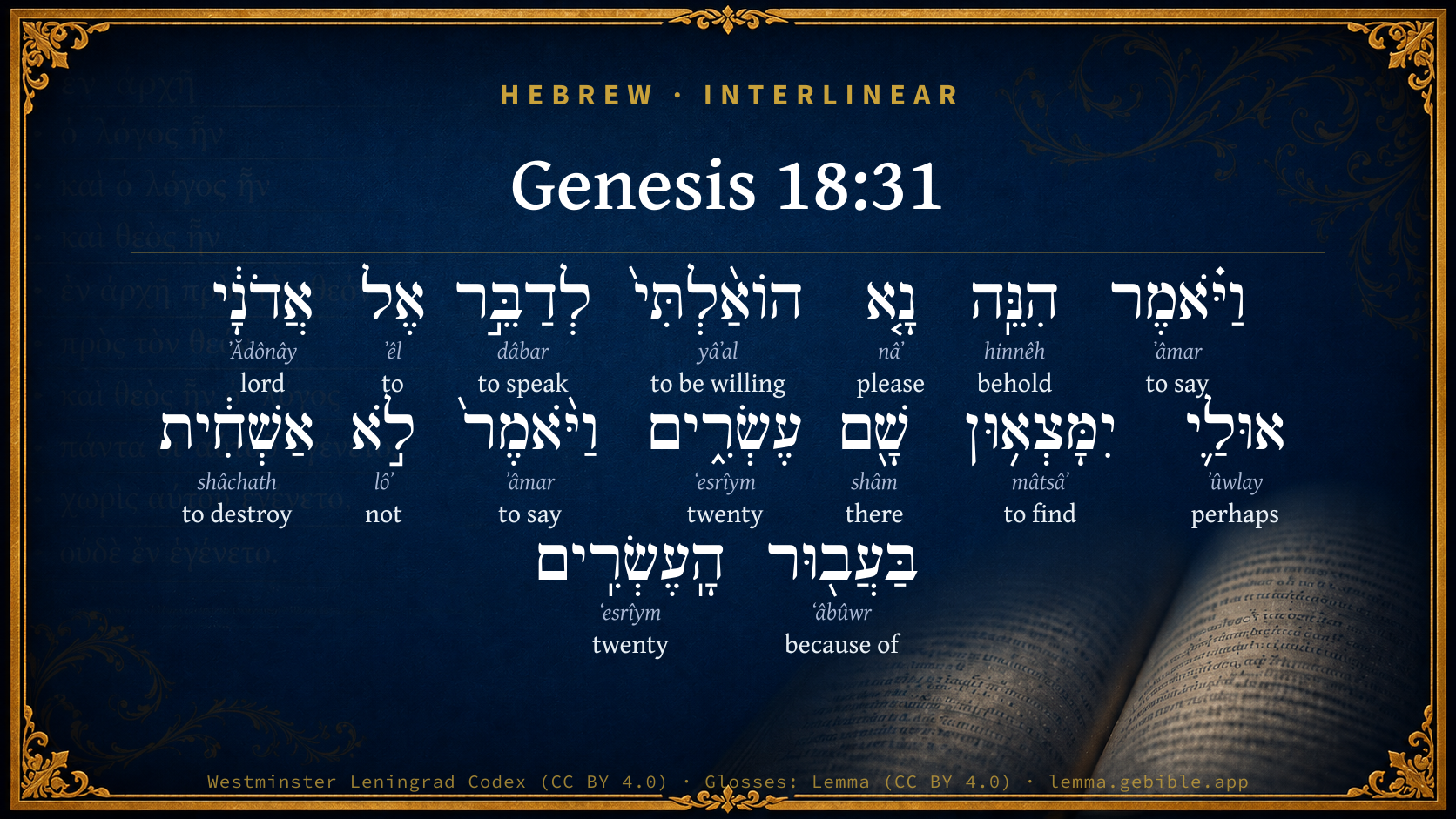
Hebrew (Westminster Leningrad Codex) Genesis 18:31 appears in the Hebrew Old Testament. The text above is from the Westminster Leningrad Codex. Each word links to its Strong’s number, a concise gloss, and parsing drawn from the Open Scriptures Hebrew Bible morphology. Click any word for its full Brown-Driver-Briggs (BDB) entry.
Download image
Cite this verse

Genesis 18:31 (World English Bible). Public Domain. Lemma interlinear Bible study tool, https://lemma.gebible.app/v/genesis/18/31.

Show BibTeX & RIS
BibTeX
RIS
English Translation
He said, "See now, I have taken it on myself to speak to the Lord. What if there are twenty found there?" He said, "I will not destroy it for the twenty's sake."
World English Bible · Public Domain
Download a study sheet

One document with this verse’s original text, its word-by-word gloss line, the meaning frame, cross-references with their text, attributed commentary, and full source and license credits — printable, and it pastes into notes with its structure intact.

This verse Autodidact and up

Study sheet (.html) Plain text (.txt)

A passage Seminary Student

Up to 50 verses in one chapter. A passage sheet keeps up to 6 commentary sources and 12 cross-references per verse, in the order this page ranks them, and says so on the sheet whenever that leaves anything out. Ask for a single verse and you get the Autodidact verse sheet above.

Everything on this page stays free to read, with no account — the sheet is a download of what is already on screen, not access to it.

Want to remove ads? Support Godless Engineer
Compare translations 3

The same verse in 3 English versions, stacked beneath the original-language interlinear above. Click any original word for its lexicon entry.

Each is an independent rendering of the whole verse — the interlinear is not word-aligned to these translations.

Highlighted words mark where these versions differ — a whole-verse word diff, not a word-by-word alignment.

  • World English Bible Public Domain
    He said, "See now, I have taken it on myself to speak to the Lord. What if there are twenty found there?" He said, "I will not destroy it for the twenty's sake."
  • King James Version Public Domain
    And he said, Behold now, I have taken upon me to speak unto the LORD: Peradventure there shall be twenty found there. And he said, I will not destroy it for twenty's sake.
  • unfoldingWord Literal Text CC BY-SA 4.0
    Then he said, “Behold, please, I have taken it upon myself to speak to my Lord. Suppose twenty are found there?” And he said, “I will not destroy it for the sake of the twenty.”

unfoldingWord Literal Text — © unfoldingWord, licensed CC BY-SA 4.0. Word-aligned USFM3 via Door43 (git.door43.org/unfoldingWord/en_ult).

Versions to compare (up to 4)

3 of 4 selected

Show all 18 translations

Every available English version of this verse, each an independent rendering of the whole verse.

  • World English Bible Public Domain
    He said, "See now, I have taken it on myself to speak to the Lord. What if there are twenty found there?" He said, "I will not destroy it for the twenty's sake."
  • Berean Standard Bible Public Domain
    And Abraham said, “Now that I have ventured to speak to the Lord, suppose twenty are found there?” He answered, “On account of the twenty, I will not destroy it.”
  • Majority Standard Bible Public Domain
    And Abraham said, “Now that I have ventured to speak to the Lord, suppose twenty are found there?” He answered, “On account of the twenty, I will not destroy it.”
  • King James Version Public Domain
    And he said, Behold now, I have taken upon me to speak unto the LORD: Peradventure there shall be twenty found there. And he said, I will not destroy it for twenty's sake.
  • American Standard Version (1901) Public Domain
    And he said, Behold now, I have taken upon me to speak unto the Lord: peradventure there shall be twenty found there. And he said, I will not destroy it for the twenty's sake.
  • Revised Version (1885) Public Domain
    And he said, Behold now, I have taken upon me to speak unto the Lord: peradventure there shall be twenty found there. And he said, I will not destroy it for the twenty’s sake.
  • Geneva Bible (1599) Public Domain
    Moreouer he said, Behold, now I haue begonne to speake vnto my Lord, What if twentie be founde there? And he answered, I will not destroy it for twenties sake.
  • Douay-Rheims (1899) Public Domain
    Lord, saith he, be not angry, I beseech thee, if I speak: What if thirty shall be found there? He answered: I will not do it, if I And thirty there.
  • Young's Literal Translation Public Domain
    And he saith, `Lo, I pray thee, I have willed to speak unto the Lord: peradventure there are found there twenty?' and He saith, `I do not destroy `it', because of the twenty.'
  • Literal Standard Version CC BY-SA 4.0
    And he says, “Now behold, I have willed to speak to the Lord: perhaps there are found there twenty?” And He says, “I do not destroy [it], because of the twenty.”
  • Unlocked Literal Bible CC BY-SA 4.0
    He said, “Look, I have undertaken to speak to my Lord! Perhaps twenty will be found there.” He replied, “I will not destroy it for the twenty's sake.”
  • unfoldingWord Literal Text CC BY-SA 4.0
    Then he said, “Behold, please, I have taken it upon myself to speak to my Lord. Suppose twenty are found there?” And he said, “I will not destroy it for the sake of the twenty.”
  • Darby Bible Public Domain
    And he said, Behold now, I have ventured to speak with the Lord. Perhaps there may be twenty found there. And he said, I will not destroy [it] for the twenty's sake.
  • World Messianic Bible Public Domain
    He said, “See now, I have taken it on myself to speak to the Lord. What if there are twenty found there?” He said, “I will not destroy it for the twenty’s sake.”
  • Webster's Bible Public Domain
    And he said, Behold now, I have taken upon me to speak to the Lord: Peradventure there will be twenty found there. And he said, I will not destroy it for twenty's sake.
  • Free Bible Version CC BY-SA 4.0
    “I admit I've been very bold to speak to my Lord like this,” Abraham said. “What if only twenty are found there?” “I won't do it for the sake of the twenty,” the Lord replied.
  • Bible in Basic English Public Domain
    And he said, See now, I have undertaken to put my thoughts before the Lord: what if there are twenty there? And he said, I will have mercy because of the twenty.
  • JPS Tanakh (1917) Public Domain
    And he said: 'Behold now, I have taken upon me to speak unto the Lord. Peradventure there shall be twenty found there.' And He said: 'I will not destroy it for the twenty's sake.'

Literal Standard Version (2020), Covenant Press — licensed CC BY-SA 4.0. Text via the HelloAO Bible API (eBible.org). Unlocked Literal Bible (unfoldingWord) — licensed CC BY-SA 4.0. Text via the HelloAO Bible API (eBible.org). unfoldingWord Literal Text — © unfoldingWord, licensed CC BY-SA 4.0. Word-aligned USFM3 via Door43 (git.door43.org/unfoldingWord/en_ult). Free Bible Version, Dr. Jonathan Gallagher — licensed CC BY-SA 4.0. Text via the HelloAO Bible API (eBible.org).

Word by word

More ways to search: Search by grammar → Find every occurrence → Compare this word →

Practice this passage: Drill this verse → Learn its vocabulary →

הוֹאַ֨לְתִּי֙
yâʼal
H2974
“to be willing”
Verb, Hiphil, Perfect, 1st Person, Common, Singular
Part of Speech
Verb
Stem
Hiphil
Form
Perfect
Person
1st Person
Gender
Common
Number
Singular
Full BDB Definition

Origin: a primitive root [probably rather the same as H2973 through the idea of mental weakness]

TWOT: 831

to begin, make a beginning, show willingness, undertake to do, be pleased, be determined - (Hiphil) - to agree to, show willingness, acquiesce, accept an invitation, be willing - to undertake - to resolve, be pleased, be determined
  1. וַיֹּ֗אמֶר ʼâmar H559 “and · to say” Conjunction + Verb, Qal, Sequential Imperfect, 3rd Person, Masculine, Singular
  2. הִנֵּֽה hinnêh H2009 “behold” Particle, Demonstrative
  3. נָ֤א nâʼ H4994 “please” Particle, Exhortation
  4. לְדַבֵּ֣ר dâbar H1696 “to speak” Preposition + Verb, Piel, Infinitive Construct
  5. אֶל ʼêl H413 “to” Preposition
  6. אֲדֹנָ֔י ʼĂdônây H136 “Lord · my” Noun, Common, Masculine, Plural, Construct + Suffix, Personal, 1st Person, Common, Singular
  7. אוּלַ֛י ʼûwlay H194 “perhaps” Adverb
  8. יִמָּצְא֥וּן mâtsâʼ H4672 “to find” Verb, Niphal, Imperfect, 3rd Person, Masculine, Plural + Suffix, n
  9. שָׁ֖ם shâm H8033 “there” Adverb
  10. עֶשְׂרִ֑ים ʻesrîym H6242 “twenty” Adjective, Cardinal number, Both, Plural, Absolute
  11. וַיֹּ֨אמֶר֙ ʼâmar H559 “and · to say” Conjunction + Verb, Qal, Sequential Imperfect, 3rd Person, Masculine, Singular
  12. לֹ֣א lôʼ H3808 “not” Particle, Negative
  13. אַשְׁחִ֔ית shâchath H7843 “to destroy” Verb, Hiphil, Imperfect, 1st Person, Common, Singular
  14. בַּעֲב֖וּר ʻâbûwr H5668 “in/at · because of of” Preposition + Noun, Common, Masculine, Singular, Construct
  15. הָֽעֶשְׂרִֽים ʻesrîym H6242 “the · twenty” Particle, Definite Article + Adjective, Cardinal number, Both, Plural, Absolute

About this verse

These counts appear in no published source. They are computed here, from the morphology-tagged text and Lemma’s own curated glosses. What Lemma adds →

16
words
14
distinct lemmas
Pentateuch
section

Notable vocabulary

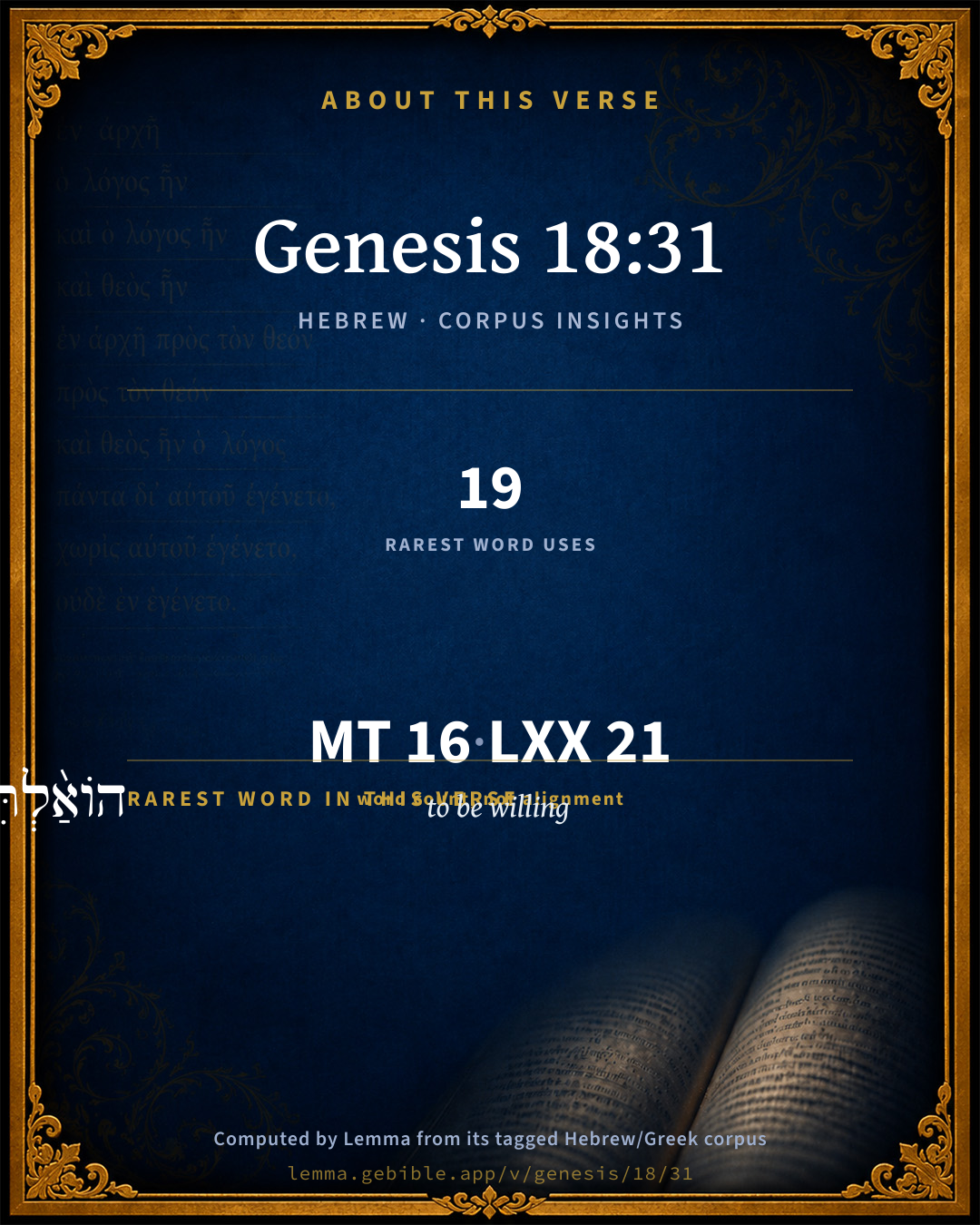
The rarest word here is הוֹאַ֨לְתִּי֙ to be willing H2974 — appearing just 19 times in the whole Hebrew Bible.

Shared distinctive vocabulary

הוֹאַ֨לְתִּי֙ to be willing H2974 occurs in 19 verses of the Hebrew Bible. Also found in:

Grammatical profile

  • 6 verbs
  • 2 nouns
  • 2 adjectives
  • 1 preposition
  • 2 adverbs
  • 3 particles

Verb forms

  • וַיֹּ֗אמֶר Qal · Sequential Imperfect
  • הוֹאַ֨לְתִּי֙ Hiphil · Perfect
  • לְדַבֵּ֣ר Piel · Infinitive Construct
  • יִמָּצְא֥וּן Niphal · Imperfect
  • וַיֹּ֨אמֶר֙ Qal · Sequential Imperfect
  • אַשְׁחִ֔ית Hiphil · Imperfect

Repetition

Words recur within this verse — often emphatic in Hebrew:

  • וַיֹּ֗אמֶר to say H559 ×2
  • עֶשְׂרִ֑ים twenty H6242 ×2

Hebrew & Septuagint length

In English translation the verse runs 33 words from the Hebrew and 34 from the Septuagint (LXX English) — closely comparable.

A rough comparison of the two English renderings, which tokenize alike — not a word-level alignment.

Word counts can differ between the Hebrew and the Greek without any difference in meaning — e.g. the Hebrew direct-object marker אֵת has no separate Greek word, and Greek often adds the article ὁ.

In the original languages it is 16 Hebrew tokens and 21 Greek tokens — but the two are counted differently (Hebrew bundles its prefixes and suffixes into one token; the Greek is in lemma form), so that isn’t a like-for-like length.

Cross-references

8

Topical passages linked to Genesis 18:31 in the Treasury of Scripture Knowledge — connected by theme and wording, ordered by reader-vote popularity; previews shown in the World English Bible.

  • Luke 11:8 I tell you, although he will not rise and give it to him because he is his friend, yet because of his persistence, he will get up and give him as many as he needs.
  • Genesis 18:27 Abraham answered, "See now, I have taken it on myself to speak to the Lord, who am but dust and ashes.
  • Matthew 7:7 "Ask, and it will be given you. Seek, and you will find. Knock, and it will be opened for you.
  • Matthew 7:11 If you then, being evil, know how to give good gifts to your children, how much more will your Father who is in heaven give good things to those who ask him!
  • Luke 18:1 He also spoke a parable to them that they must always pray, and not give up,
  • Ephesians 6:18 with all prayer and requests, praying at all times in the Spirit, and being watchful to this end in all perseverance and requests for all the saints:
  • Hebrews 4:16 Let us therefore draw near with boldness to the throne of grace, that we may receive mercy, and may find grace for help in time of need.
  • Hebrews 10:20–22 by the way which he dedicated for us, a new and living way, through the veil, that is to say, his flesh;

Cross-references courtesy of OpenBible.info (CC BY 4.0).

Hebrew and Greek witnesses Masoretic Hebrew ↔ Greek Septuagint

The same verse in the two great witnesses to the Old Testament, shown verse-for-verse.

These are two independent witnesses, not word-aligned to each other, and the Septuagint is shown in lemma (dictionary) form.

Hebrew Genesis 18:31 Masoretic · Westminster Leningrad Codex

וַיֹּ֗אמֶר הִנֵּֽה נָ֤א הוֹאַ֨לְתִּי֙ לְדַבֵּ֣ר אֶל אֲדֹנָ֔י אוּלַ֛י יִמָּצְא֥וּן שָׁ֖ם עֶשְׂרִ֑ים וַיֹּ֨אמֶר֙ לֹ֣א אַשְׁחִ֔ית בַּעֲב֖וּר הָֽעֶשְׂרִֽים

He said, "See now, I have taken it on myself to speak to the Lord. What if there are twenty found there?" He said, "I will not destroy it for the twenty's sake."

World English Bible · Public Domain

Greek LXX Genesis 18:31 Septuagint · lemma form

καί εἶπον ἐπειδή ἔχω λαλέω πρός ὁ κύριος ἐάν δέ εὑρίσκω ἐκεῖ εἴκοσι καί εἶπον οὐ μή ἀποὀλλύω ἕνεκεν ὁ εἴκοσι

And he said, Since I am able to speak to the Lord, what if there should be found there twenty? And he said, I will not destroy it, if I should find there twenty.

LXX2012 (modern English Septuagint) · Public Domain

Hebrew: Westminster Leningrad Codex (CC BY 4.0). Greek: Septuagint (public domain); English from LXX2012 (modern English Septuagint) (Public Domain). How the Septuagint differs from the Hebrew →

Targum (Aramaic paraphrase)

2

The Targum is the ancient Jewish Aramaic paraphrase of the Hebrew Scriptures — an interpretive translation, not the Hebrew text itself. Onkelos (literal) and Pseudo-Jonathan (expansive) render the Torah, and Jonathan the Prophets. Coverage is partial: where no permissively-licensed English translation exists for a verse, only the Aramaic is shown. This is verse-level text, not a word-by-word alignment to the Hebrew.

  1. Targum Onkelos Torah (Genesis–Deuteronomy)
    וַאֲמַר הָא כְעַן שָׁרֵיתִי לְמַלָּלָא קֳדָם יְיָ מָאִים יִשְׁתַּכְּחוּן תַּמָּן עֶשְרִין וַאֲמַר לָא אֲחַבֵּל בְּדִיל עֶשְׁרִין

    (no public-domain English translation for this verse)

    Targum Onkelos — Aramaic: “Onkelos Genesis” (public domain); “Onkelos Exodus” (public domain); “Onkelos Leviticus” (public domain); “Onkelos Numbers” (public domain); “Onkelos Deuteronomy” (public domain). English: “Sefaria Community Translation” (CC0 1.0 (public-domain dedication)); “J.W. Etheridge. The Targums of Onkelos and Jonathan Ben Uzziel on the Pentateuch. London: Longmans, Green, 1862” (public domain). Text via Sefaria.

  2. Targum Pseudo-Jonathan Torah (Genesis–Deuteronomy)
    וַאֲמַר בְּבָעוּ בְּרַחֲמִין הָא כְדוּן שָׁרִיתִי לְמַלָלָא קֳדָם רִבּוֹן כָּל עָלְמַיָא יְיָ מָאִים יִשְׁתַּכְּחוּן עֶשְרִין דְיֵצְלוּן עֲשָרָה עֲשָרָה לְתַרְתֵּין קוּרְיַין וְלִתְלַת שְׁבוֹק לְהוֹם בְּגִין רַחֲמָךְ וַאֲמַר לָא אֵיחַבֵּל בְּגִין זַכְוַות עֶשְרִין

    And he said, Imploring mercy, I have now begun to speak before the Lord, the Lord of all the world. Perhaps twenty who pray may be found; ten in each of the two cities, and the three forgive Thou for Thy mercy's sake! And He said, I will not destroy for the sake of the twenty innocent.

    Targum Pseudo-Jonathan — Aramaic: “Targum Jonathan on Genesis” (public domain); “Targum Jonathan on Exodus” (public domain); “Targum Jonathan on Leviticus” (public domain); “Targum Jonathan on Numbers” (public domain); “Targum Jonathan on Deuteronomy” (public domain). English: “The Targum of Jonathan ben Uzziel, trans. J. W. Etheridge, London, 1862” (public domain). Text via Sefaria.

Commentary

Notes on Genesis 18:31 from classic Christian and Jewish commentators (each source and its license shown beneath its notes). The classic Christian expositions comment on the surrounding passage and are grouped to its opening verse, so a note may address several verses; the Jewish commentaries on the Tanakh (Rashi and others) are per-verse, so they appear only where the commentator wrote on this verse.

Lemma curates 59 commentaries, every one of them public domain or Creative Commons licensed, each selected and text-cleaned for this edition rather than reprinted as found. About our sources →

Trapp's Complete Commentary

John Trapp

Gen 18:31 And he said, Behold now, I have taken upon me to speak unto the Lord: Peradventure there shall be twenty found there. And he said, I will not destroy [it] for twenty’s sake.

Ver. 31. Behold now, I have taken upon me.] {See Trapp on "Gen 18:29"} {See Trapp on "Gen 18:30"}

John Trapp, A Commentary or Exposition upon All the Books of the Old and New Testament (1647–1656) — public domain. Text from a community e-Sword module.

John Gill's Exposition

And he said, behold now, I have taken upon me to speak unto the Lord,.... See Gill on Gen 18:27,

Peradventure there shall be twenty found there; wouldest thou destroy it, such a number being in it; or, wouldest thou spare it for their sakes?

and he said, I will not destroy it for twenty's sake; if there were no more in it, I would spare it for their sake.

John Gill's Exposition of the Whole Bible (1746–1763) — public domain (CC PDM 1.0). Text via the HelloAO Bible API.

The Pulpit Commentary

And he said, Behold now, I have taken upon me (vide Ver. 27) to speak unto the Lord (Adonai): Peradventure there shall be twenty found there. And he said, I will not destroy it for twenty"s sake.

The Pulpit Commentary (1880–1919), ed. H.D.M. Spence-Jones & Joseph S. Exell — public domain. Text from a community e-Sword module.

Rashi

Rabbi Shlomo Yitzchaki (Rashi)

הואלתי means I am willing to speak, just as (Exodus 2:21) “And Moses was pleased (ויואל) [to dwell with the man]”.

Rashi on the Tanakh — English translations: “The Judaica Press complete Tanach with Rashi, translated by A. J. Rosenberg” (CC BY 4.0); “Pentateuch with Rashi's commentary by M. Rosenbaum and A.M. Silbermann, 1929-1934” (public domain); “The Metsudah Tanach series, Lakewood, N.J” (CC BY 4.0); and “The Book of Joshua, Metsudah Publications, 1997” (CC BY 4.0). Text via Sefaria.

Radak

Rabbi David Kimhi (Radak)

ויאמר, we already explained this type of response.

Radak on the Tanakh — English translations: “Sefaria Community Translation” (CC0 1.0 (public-domain dedication)); “Eliyahu Munk, HaChut Hameshulash” (CC BY 4.0); “Rabbi Mike Feuer, Jerusalem Anthology” (CC BY 4.0); and “R. David Kimhi on the first book of Psalms, Translated by R.G. Finch, London, 1919” (public domain). Text via Sefaria.

Lesson kit

Teaching starters — assembled from the data on this page, not authored interpretation. Every prompt links to the verse data it draws on. Edit before teaching.

Genesis, in the Pentateuch, opens this verse with 16 words (14 distinct Hebrew lemmas). Its most distinctive word is yâʼal (“to be willing”). A historical commentator’s framing appears above. Read the whole chapter for the surrounding context.

Discussion questions

  1. What does “to be willing” (yâʼal) contribute to the verse as a whole?
  2. How does Genesis 18:27, which shares the word «to be willing», read alongside this verse?
  3. What does the repetition of “to say” (2× in this one verse) do in this verse?
  4. These translations render this verse differently; the difference is in the English rendering, not the original. What questions does that raise?
  5. «וַיֹּ֗אמֶר» is a Qal Sequential Imperfect verb. How does that grammatical form shape the action described?
  6. Compare how Trapp's Complete Commentary and John Gill's Exposition read this verse. Where do they agree or differ?

Things to notice

Reading settings

Reading text

Shown beneath each verse's original-language words.

Old Testament
Old Testament edition

Read the OT as the Masoretic Hebrew (MT) or the Greek Septuagint (LXX).

English shown for the Greek Septuagint (in the Hebrew ↔ Greek comparison).

Comparing translations? Open the Compare panel on any verse page to stack up to four side by side.