
Matthew 24:22

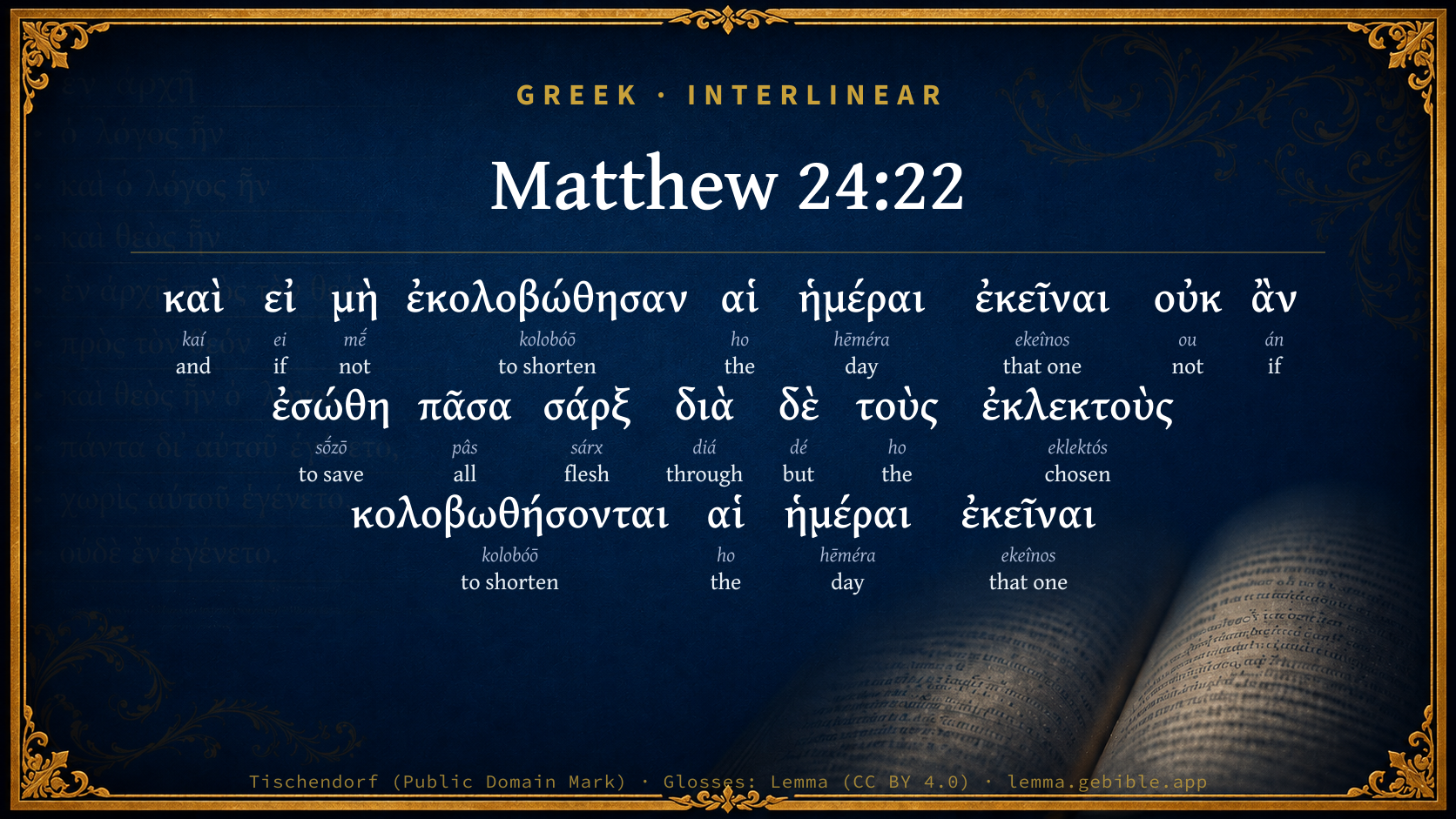
Greek (Tischendorf 8th ed.) Matthew 24:22 appears in the Greek New Testament. The text above is from the Tischendorf 8th edition. Each word links to its Strong’s number and a concise gloss. Click any word for its full Thayer’s Greek Lexicon entry.
Download image
Cite this verse

Matthew 24:22 (World English Bible). Public Domain. Lemma interlinear Bible study tool, https://lemma.gebible.app/v/matthew/24/22.

Show BibTeX & RIS
BibTeX
RIS
English Translation
Unless those days had been shortened, no flesh would have been saved. But for the sake of the chosen ones, those days will be shortened.
World English Bible · Public Domain
Highlights
  • 1 first appearance in the Greek New Testament
Full analysis ↓
Download a study sheet

One document with this verse’s original text, its word-by-word gloss line, the meaning frame, cross-references with their text, attributed commentary, and full source and license credits — printable, and it pastes into notes with its structure intact.

This verse Autodidact and up

Study sheet (.html) Plain text (.txt)

A passage Seminary Student

Up to 50 verses in one chapter. A passage sheet keeps up to 6 commentary sources and 12 cross-references per verse, in the order this page ranks them, and says so on the sheet whenever that leaves anything out. Ask for a single verse and you get the Autodidact verse sheet above.

Everything on this page stays free to read, with no account — the sheet is a download of what is already on screen, not access to it.

Want to remove ads? Support Godless Engineer
Compare translations 3

The same verse in 3 English versions, stacked beneath the original-language interlinear above. Click any original word for its lexicon entry.

Each is an independent rendering of the whole verse — the interlinear is not word-aligned to these translations.

Highlighted words mark where these versions differ — a whole-verse word diff, not a word-by-word alignment.

  • World English Bible Public Domain
    Unless those days had been shortened, no flesh would have been saved. But for the sake of the chosen ones, those days will be shortened.
  • King James Version Public Domain
    And except those days should be shortened, there should no flesh be saved: but for the elect's sake those days shall be shortened.
  • unfoldingWord Literal Text CC BY-SA 4.0
    And if those days had not been shortened, no flesh would be saved. But because of the elect, those days will be shortened.

unfoldingWord Literal Text — © unfoldingWord, licensed CC BY-SA 4.0. Word-aligned USFM3 via Door43 (git.door43.org/unfoldingWord/en_ult).

Versions to compare (up to 4)

3 of 4 selected

Show all 19 translations

Every available English version of this verse, each an independent rendering of the whole verse.

  • World English Bible Public Domain
    Unless those days had been shortened, no flesh would have been saved. But for the sake of the chosen ones, those days will be shortened.
  • Berean Standard Bible Public Domain
    If those days had not been cut short, nobody would be saved. But for the sake of the elect, those days will be cut short.
  • Majority Standard Bible Public Domain
    If those days had not been cut short, nobody would be saved. But for the sake of the elect, those days will be cut short.
  • King James Version Public Domain
    And except those days should be shortened, there should no flesh be saved: but for the elect's sake those days shall be shortened.
  • American Standard Version (1901) Public Domain
    And except those days had been shortened, no flesh would have been saved: but for the elect's sake those days shall be shortened.
  • Revised Version (1885) Public Domain
    And except those days had been shortened, no flesh would have been saved: but for the elect’s sake those days shall be shortened.
  • Geneva Bible (1599) Public Domain
    And except those dayes should be shortened, there should no flesh be saued: but for the elects sake those dayes shalbe shortened.
  • Douay-Rheims (1899) Public Domain
    And unless those days had been shortened, no flesh should be saved: but for the sake of the elect those days shall be shortened.
  • Young's Literal Translation Public Domain
    And if those days were not shortened, no flesh would have been saved; but because of the chosen, shall those days be shortened.
  • Literal Standard Version CC BY-SA 4.0
    And if those days were not shortened, no flesh would have been saved; but because of the chosen will those days be shortened.
  • Unlocked Literal Bible CC BY-SA 4.0
    Unless those days are shortened, no flesh would be saved. But for the sake of the elect, those days will be shortened.
  • unfoldingWord Literal Text CC BY-SA 4.0
    And if those days had not been shortened, no flesh would be saved. But because of the elect, those days will be shortened.
  • Darby Bible Public Domain
    and if those days had not been cut short, no flesh had been saved; but on account of the elect those days shall be cut short.
  • World Messianic Bible Public Domain
    Unless those days had been shortened, no flesh would have been saved. But for the sake of the chosen ones, those days will be shortened.
  • Webster's Bible Public Domain
    And except those days should be shortened, there would no flesh be saved: but for the elect's sake those days shall be shortened.
  • Free Bible Version CC BY-SA 4.0
    Unless those days are cut short, nobody will be saved, but for the sake of the chosen those days will be cut short.
  • Bible in Basic English Public Domain
    And if those days had not been made short there would have been no salvation for any, but because of the saints those days will be made short.
  • Text-Critical English NT CC BY 4.0
    If those days had not been cut short, no flesh would be saved. But for the sake of the chosen those days will be cut short.
  • Tyndale New Testament (1534) Public Domain
    Ye and except those dayes shuld be shortened there shuld no fleshe be saved: but for the chosens sake those dayes shalbe shortened.

Literal Standard Version (2020), Covenant Press — licensed CC BY-SA 4.0. Text via the HelloAO Bible API (eBible.org). Unlocked Literal Bible (unfoldingWord) — licensed CC BY-SA 4.0. Text via the HelloAO Bible API (eBible.org). unfoldingWord Literal Text — © unfoldingWord, licensed CC BY-SA 4.0. Word-aligned USFM3 via Door43 (git.door43.org/unfoldingWord/en_ult). Free Bible Version, Dr. Jonathan Gallagher — licensed CC BY-SA 4.0. Text via the HelloAO Bible API (eBible.org).

Word by word

More ways to search: Search by grammar → Find every occurrence → Compare this word →

Practice this passage: Drill this verse → Learn its vocabulary →

ἐκολοβώθησαν
kolobóō
G2856
“to shorten”
Verb, Aorist, Passive, Indicative, 3rd person, Plural
Part of Speech
Verb
Tense
Aorist
Voice
Passive
Mood
Indicative
Person
3rd person
Number
Plural
Full Thayer's Definition

Origin: from a derivative of the base of G2849

TDNT: 16:43,5

1. to mutilate 2. in NT: to shorten, abridge, curtail
  1. καὶ kaí G2532 “and” Conjunction
  2. εἰ ei G1487 “if” Conditional
  3. μὴ mḗ G3361 “not” Particle, Negative
  4. αἱ ho G3588 “the” Article, Nominative, Plural, Feminine
  5. ἡμέραι hēméra G2250 “day” Noun, Nominative, Plural, Feminine
  6. ἐκεῖναι ekeînos G1565 “that one” Demonstrative pronoun, Nominative, Plural, Feminine
  7. οὐκ ou G3756 “not” Particle, Negative
  8. ἂν án G302 “if” Particle
  9. ἐσώθη sṓzō G4982 “to save” Verb, Aorist, Passive, Indicative, 3rd person, Singular
  10. πᾶσα pâs G3956 “all” Adjective, Nominative, Singular, Feminine
  11. σάρξ sárx G4561 “flesh” Noun, Nominative, Singular, Feminine
  12. διὰ diá G1223 “through” Preposition
  13. δὲ dé G1161 “but” Conjunction
  14. τοὺς ho G3588 “the” Article, Accusative, Plural, Masculine
  15. ἐκλεκτοὺς eklektós G1588 “chosen” Adjective, Accusative, Plural, Masculine
  16. κολοβωθήσονται kolobóō G2856 “to shorten” Verb, Future, Passive, Indicative, 3rd person, Plural
  17. αἱ ho G3588 “the” Article, Nominative, Plural, Feminine
  18. ἡμέραι hēméra G2250 “day” Noun, Nominative, Plural, Feminine
  19. ἐκεῖναι ekeînos G1565 “that one” Demonstrative pronoun, Nominative, Plural, Feminine

About this verse

These counts appear in no published source. They are computed here, from the morphology-tagged text and Lemma’s own curated glosses. What Lemma adds →

20
words
15
distinct lemmas
Gospels
section

Notable vocabulary

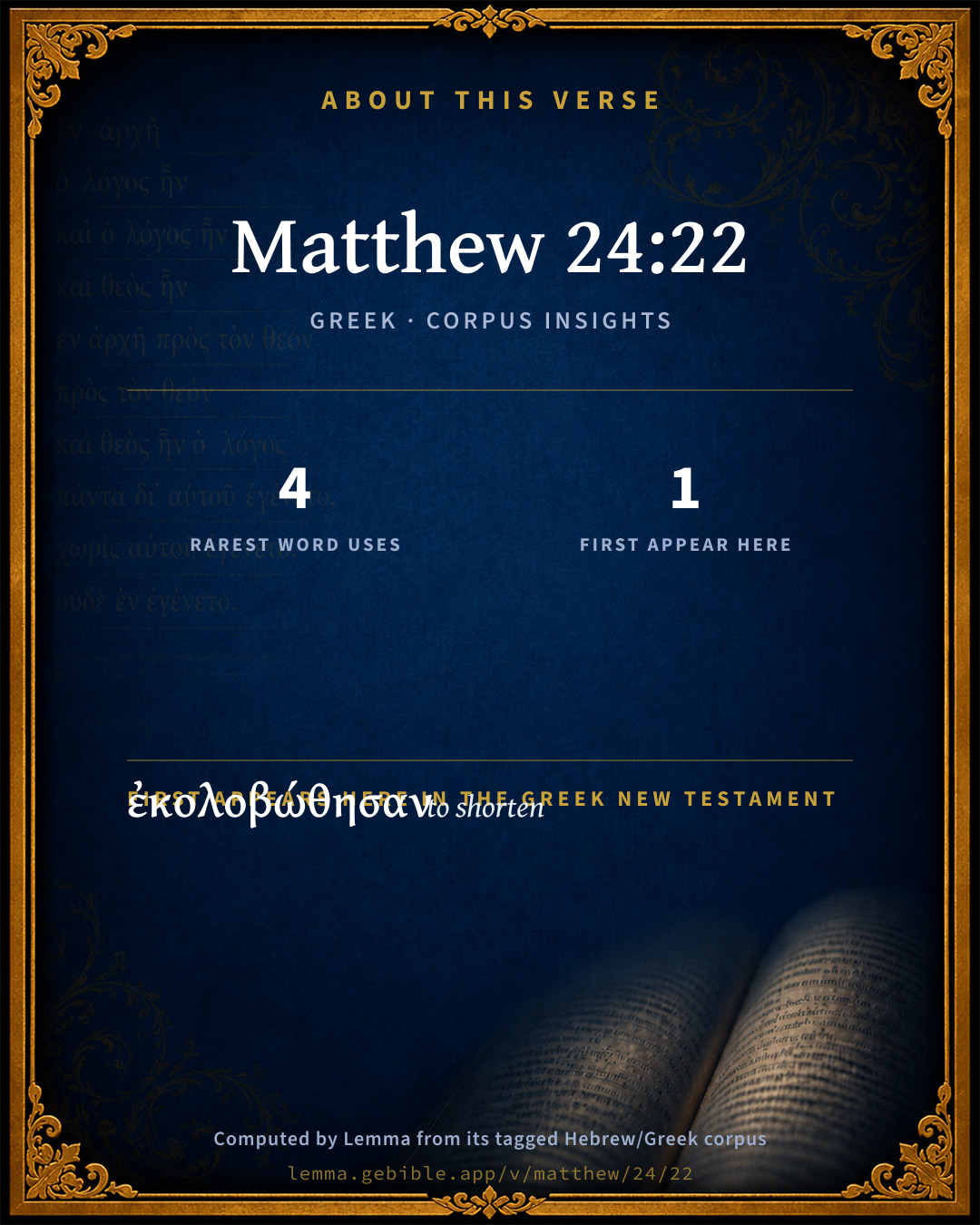
The rarest word here is ἐκολοβώθησαν to shorten G2856 — appearing just 4 times in the whole Greek New Testament.

First appearance in Scripture

This word makes its first canonical appearance in the Greek New Testament here:

  • ἐκολοβώθησαν to shorten G2856

Shared distinctive vocabulary

ἐκολοβώθησαν to shorten G2856 occurs in 2 verses of the Greek New Testament. Also found in:
Repetition

Words recur within this verse:

  • ἐκολοβώθησαν to shorten G2856 ×2
  • ἡμέραι day G2250 ×2
  • ἐκεῖναι that one G1565 ×2
  • αἱ the G3588 ×3

Cross-references

12

Topical passages linked to Matthew 24:22 in the Treasury of Scripture Knowledge — connected by theme and wording, ordered by reader-vote popularity; previews shown in the World English Bible.

  • Mark 13:20 Unless the Lord had shortened the days, no flesh would have been saved; but for the sake of the chosen ones, whom he picked out, he shortened the days.
  • 2 Timothy 2:10 Therefore I endure all things for the chosen ones' sake, that they also may obtain the salvation which is in Christ Jesus with eternal glory.
  • Matthew 24:24 For there will arise false christs, and false prophets, and they will show great signs and wonders, so as to lead astray, if possible, even the chosen ones.
  • Matthew 24:31 He will send out his angels with a great sound of a trumpet, and they will gather together his chosen ones from the four winds, from one end of the sky to the other.
  • Matthew 22:14 For many are called, but few chosen."
  • Luke 18:7 Won't God avenge his chosen ones, who are crying out to him day and night, and yet he exercises patience with them?
  • Isaiah 65:8–9 Thus says Yahweh, As the new wine is found in the cluster, and one says, Don't destroy it, for a blessing is in it: so will I do for my servants' sake, that I may not destroy them all.
  • Zechariah 13:8 It shall happen that in all the land," says Yahweh, Two parts in it will be cut off and die; But the third will be left in it.
  • Zechariah 14:2 For I will gather all nations against Jerusalem to battle; and the city will be taken, the houses rifled, and the women ravished. half of the city will go out into captivity, and the rest of the people will not be cut off from the city.
  • Romans 9:11 For being not yet born, neither having done anything good or bad, that the purpose of God according to election might stand, not of works, but of him who calls,
  • Romans 11:25–31 For I don't desire, brothers, to have you ignorant of this mystery, so that you won't be wise in your own conceits, that a partial hardening has happened to Israel, until the fullness of the Gentiles has come in,
  • Isaiah 6:13 If there are yet a tenth in it, It also shall in turn be eaten up: As a terebinth, and as an oak, whose stock remains, when they are felled; So the holy seed is its stock."

Cross-references courtesy of OpenBible.info (CC BY 4.0).

Commentary

Notes on Matthew 24:22 from classic Christian and Jewish commentators (each source and its license shown beneath its notes). The classic Christian expositions comment on the surrounding passage and are grouped to its opening verse, so a note may address several verses; the Jewish commentaries on the Tanakh (Rashi and others) are per-verse, so they appear only where the commentator wrote on this verse.

Lemma curates 59 commentaries, every one of them public domain or Creative Commons licensed, each selected and text-cleaned for this edition rather than reprinted as found. About our sources →

Joseph Benson's Commentary

Mat 24:22. Except those days should be shortened, &c. — If these wars and desolations were to continue for any length of time, none of the Jews would escape destruction; they would all be cut off, root and branch. For the calamities will be so severe that, like fire, they would soon consume all, and leave nothing for themselves to prey on. But for the elect’s sake — For the sake of those Jews that shall embrace the gospel; those days shall be shortened — The elect, is a well-known appellation in Scripture and antiquity for the Christians; and the Christian Jews, partly through the fury of the Zealots on the one hand, and the hatred of the Romans on the other; and partly through the difficulty of subsisting in the mountains without houses or provisions; would in all probability have been almost all destroyed, either by sword or by the famine, if the days had not been shortened. But providentially the days were shortened. Titus himself was desirous of putting a speedy end to the siege, having Rome, and the riches and pleasures there, before his eyes. Some of his officers proposed to him to turn the siege into a blockade, and since they could not take the city by storm, to starve it into a surrender; but he thought it not becoming to sit still with so great an army; he feared lest the length of the time should diminish the glory of his success. The besieged, too, helped to shorten the days, by their divisions and mutual slaughters; by burning their provisions, which would have sufficed for many years, and fatally deserting their strongest holds, where they could never have been taken by force, but by famine alone. Indeed, Jerusalem was so well fortified, and so well fitted to sustain a longer siege, that it could not have been taken in so short a time by the enemy without, had it not been for the factions and seditions within. Titus himself could not but ascribe the success to God, as he was viewing the fortifications after the city was taken. His words to his friends were very remarkable. “We have fought,” said he, “with God on our side, ο Θεος ην ο των δε ερυματων Ιουδαιους καθεκων, it is God who hath pulled the Jews out of these strong holds; for what could the hands of men, or machines, do against these towers?” God, therefore, in the opinion of Titus, as well as of the evangelist: shortened these days. After the destruction of Jerusalem too, God inclined the heart of Titus to take some pity upon the remnant of the Jews, and to restrain the nations from exercising the cruelty that they would have exercised against them. At Antioch, particularly, the senate importuned him to expel the Jews from the city: but he answered that their country being laid waste, there was no place to receive them. They then requested him to deprive the Jews of their former privileges; but those he permitted them to enjoy as before. Thus, for the elect’s sake those days of persecution were shortened.

Joseph Benson's Commentary on the Old and New Testaments (1811–1818) — public domain. Text from a community e-Sword module.

Tyndale Open Study Notes

Tyndale Open Resources

24:22 God’s chosen ones endure (24:13) and remain faithful (24:37–25:46; see Isa 65:8-9; Rom 11:7).

Tyndale Open Study Notes — © Tyndale Open Resources, licensed CC BY-SA 4.0. Text via the HelloAO Bible API.

Bengel's Gnomon

Johann Albrecht Bengel

Mat 24:22. Οὐκ ἄν ἐσώθη, would not be saved) They would be excluded by premature death from the salvation of the soul which is ascribed to the elect. They who have already attained salvation will utter the words which resound in Rev 7:10.—πᾶσα σάρξ, all flesh[1047]) in itself weak.—τοὺς ἐκλεκτοὺς, the elect) The elect, whether already converted or hereafter to become so, or as yet unborn, are mingled with the rest of mankind. Where the force of temptations exceeds the ordinary strength of the faithful, election is mentioned—see Mat 24:24; Mat 24:31, and Luk 18:7—and the faithfulness and power of God; see 1Co 10:13; 1Pe 1:5; Rev 13:8.—κολοβωθήσονται, shall be shortened) An appropriate verb, since that which is shortened loses the entireness of its parts, yet so that it may nevertheless be considered as the whole.

[1047] In E. V. the words are rendered, “no flesh should be saved.” The difference is one of idiom, not of sense. E. V. applies the negative universally to the subject; Bengel, translating the Greek words literally, applies the negative to the predicate: sc. all flesh would not be saved—i.e. all flesh would come under the category of not being saved; in other words, would perish.—(I. B.)

Bengel's Gnomon of the New Testament — English translation (T&T Clark, Edinburgh, 1860) — public domain. Text from a community e-Sword module.

Meyer's Critical & Exegetical Commentary

Heinrich August Wilhelm Meyer

Mat_24:22. And unless those days had been shortened, those, namely, of the θλίψις μεγάλη (Mat_24:29), etc. This is to be understood of the reduction of the number of the days over which, but for this shortening, the θλίψις would have extended, not of the curtailing of the length of the day (Fritzsche),a thought of which Lightfoot quotes an example from Rabbinical literature (comp. the converse of this, Jos_10:13), which, seeing that there is a considerable number of days, would be to introduce an element of a very extraordinary character into the usual ideas connected with the acceleration of the advent (1Co_7:29). Rather comp. the similar idea, which in Barnab. iv. is ascribed to Enoch.

ἐσώθη] used here with reference to the saving of the life (Mat_8:25, Mat_27:40; Mat_27:42; Mat_27:49, and frequently); Euthymius Zigabenus: οὐκ ἂν ὑπεξέφυγε τὸν θάνατον. Hofmann incorrectly explains: saved from denying the Lord.

πᾶσα σάρξ] every flesh, i.e. every mortal man (see on Act_2:16), would not be rescued, i.e. would have perished. Comp. for the position of the negative, Fritzsche, Diss. II. on 2 Cor. p. 24 f. The limitation of πᾶσα σάρξ to the Jews and Christians belonging to town or country who are found in immediate contact with the theatre of war, is justified by the context. The ἐκλεκτοί are included, but it is not these alone who are meant (Hofmann).

The aorist ἐκολοβ. conveys the idea that the shortening was resolved upon in the counsels of the divine compassion (Mar_13:20), and its relation to the aorist ἐσώθη in the apodosis is this. had the shortening of the period over which the calamities were to extend not taken place, this would have involved the utter destruction of all flesh. The future κολοβωθής. again conveys the idea that the actual shortening is being effected, and therefore that the case supposed, with the melancholy consequences involved in it, has been averted.

διὰ δὲ τοὺς ἐκλεκτούς] for sake of the chosen (for the Messianic kingdom), in order that they might be preserved for the approaching advent. That in seeking to save the righteous, God purposely adopts a course by which He may save others at the same time, is evident from Gen_18:13 ff. But the ἐκλεκτοί (see on Mat_22:14) are those who, at the time of the destruction of the capital, are believers in Christ, and are found persevering in their faith in Him (Mat_24:13); not the future credituri as well (Jahn in Bengels Archiv. II. 1; Schott, Opusc. II. p. 205 ff.; Lange, following Augustine, Calovius), which latter view is precluded by the εὐθέως of Mat_24:29.

There is a certain solemnity in the repetition of the same words κολοβ. αἱ ἡμέραι ἐκεῖναι. Ebrard lays stress upon the fact, as he supposes, that our passage describes a calamity cui finis sit imponendus, et quae ab aetate paulo saltem feliciore sit excipienda, and accordingly infers that the idea of the immediate end of the world is thereby excluded. But the aetas paulo saltem felicior, or the supposition that there is any interval at all between the θλίψις μεγάλη and Mat_24:29, is foreign to the text; but the end of the above-mentioned disaster is to take place in order that what is stated at Mat_24:29 may follow it at once.

Meyer — Critical and Exegetical Commentary on the New Testament — English translation by Peter Christie, edited by Frederick Crombie (T&T Clark, 1880) — public domain. Text from a community e-Sword module.

Geneva Bible (1599)

Geneva Bible translators

Those things which befell the people of the Jews, in the 34 years, when as the whole land was wasted, and at length the city of Jerusalem taken, and both it and their Temple destroyed, are mixed with those which shall come to pass before the last coming of our Lord.

The whole nation should utterly be destroyed: and this word Flesh is by a figure taken for man, as the Hebrews used to speak.

Geneva Bible (1599) marginal notes — public domain. Text via Bolls.life.

Adam Clarke's Commentary

Verse 22. Except those days should be shortened] Josephus computes the number of those who perished in the siege at eleven hundred thousand, besides those who were slain in other places, WAR, b. vi. c. 9; and if the Romans had gone on destroying in this manner, the whole nation of the Jews would, in a short time, have been entirely extirpated; but, for the sake of the elect, the Jews, that they might not be utterly destroyed, and for the Christians particularly, the days were shortened. These, partly through the fury of the zealots on one hand, and the hatred of the Romans on the other; and partly through the difficulty of subsisting in the mountains without houses or provisions, would in all probability have been all destroyed, either by the sword or famine, if the days had not been shortened. The besieged themselves helped to shorten those days by their divisions and mutual slaughters; and by fatally deserting their strong holds, where they never could have been subdued, but by famine alone. So well fortified was Jerusalem, and so well provided to stand a siege, that the enemy without could not have prevailed, had it not been for the factions and seditions within. When Titus was viewing the fortifications after the taking of the city, he could not help ascribing his success to God. "We have fought," said he, "with God on our side; and it is God who pulled the Jews out of these strong holds: for what could machines or the hands of men avail against such towers as these?" WAR, b. vi. c. 9.

Adam Clarke's Commentary on the Bible (1810–1826) — public domain. Text from a community e-Sword/MySword module.

Ellicott's Commentary for English Readers

(22) Should no flesh be saved.—The words are of course limited by the context to the scene of the events to which the prophecy refers. The warfare with foes outside the city, and the faction-fights and massacres within, would have caused an utter depopulation of the whole country.

For the elect’s sake.—Those who, as believers in Jesus, were the “remnant” of the visible Israel, and therefore the true Israel of God. It was for the sake of the Christians of Judæa, not for that of the rebellious Jews, that the war was not protracted, and that Titus, under the outward influences of Josephus and Bernice, tempered his conquests with compassion (Ant. xii. 3, § 2; Wars, vi. 9, § 2). The new prominence which the idea of an election gains in our Lord’s later teaching is every way remarkable. (Comp. Mat_18:7; Mat_20:6). The “call” had been wide; in those who received and obeyed it He taught men to recognise the “elect” whom God had chosen. Subtle questions as to whether the choice rested on foreknowledge or was absolutely arbitrary lay, if we may reverently so speak, outside the scope of His teaching.

A Bible Commentary for English Readers, edited by Charles John Ellicott (1878–1897) — public domain. Text from a community e-Sword module.

The Cambridge Bible for Schools and Colleges

gen. ed. J. J. S. Perowne

22. those days should be shortened] Several circumstances concurred to shorten the duration of the siege, such as the scanty supply of provisions, the crowded state of the city, the internal dissensions, and the abandonment of important defences. So strong did the place seem to Titus that he exclaimed, “We have certainly had God on our side in this war; and it was God alone who ejected the Jews from these fortifications.” Josephus vi. 9. 1.

The Cambridge Bible for Schools and Colleges (gen. ed. J. J. S. Perowne; Cambridge University Press, 1878–1918) — public domain. Text from a community e-Sword module.

John Gill's Exposition

And except those days should be shortened,.... That is, those days of tribulation which commenced at the siege of Jerusalem; and therefore cannot refer to the times before it, and the shortening of them by it, which were very dreadful and deplorable through the murders and robberies of the cut-throats and zealots; but to those after the siege began, which were very distressing to those that were within; and which, if they had not been shortened, or if the siege had been lengthened out further,

there should no flesh be saved; not one Jew in the city of Jerusalem would have been saved; they must everyone have perished by famine, or pestilence, or sword, or by the intestine wars and murders among themselves: nor indeed, if the siege had continued, would it have fared better with the inhabitants of the other parts of the country, among whom also many of the same calamities prevailed and spread themselves; so that, in all likelihood, if these days had been continued a little longer, there had not been a Jew left in all the land.

But for the elect's sake; those who were chosen in Christ, before the foundation of the world, to believe in him, and to be saved by him with an everlasting salvation; both those that were in the city, or, at least, who were to spring from some that were there, as their immediate offspring, or in future ages, and therefore they, and their posterity, must not be cut off; and also those chosen ones, and real believers, who were at Pella, and in the mountains, and other places, for the sake of these, and that they might be delivered from these pressing calamities,

those days shall be shortened: for otherwise, if God had not preserved a seed, a remnant, according to the election of grace, that should be saved, they had been as Sodom and as Gomorrha, not one would have escaped. The shortening of those days is not to be understood literally, as if the natural days, in which this tribulation was, were to be shorter than usual. The Jews indeed often speak of the shortening of days in this sense, as miraculously done by God: so they say (n), that

"five miracles were wrought for our father Jacob, when he went from Beersheba to go to Haran. The first miracle was, that , "the hours of the day were shortened for him", and the sun set before its time, because his word desired to speak with him.''

They also say (o),

"that the day in which Ahaz died, was shortened ten hours, that they might not mourn for him; and which afterwards rose up, and in the day that Hezekiah was healed, ten hours were added to it.''

But the meaning here is, that the siege of Jerusalem, and the calamities attending it, should be sooner ended: not than God had determined, but than the sin of the Jews deserved, and the justice of God might have required in strict severity, and might be reasonably expected, considering the aggravated circumstances of their iniquities. A like manner of speech is used by the Karaite Jews (p), who say,

"if we walk in our law, why is our captivity prolonged, and there is not found balm for our wounds? and why are not , "the days" of the golden and silver kingdom "lessened", for the righteousness of the righteous, which were in their days?''

(n) Targum Jonathan ben Uzziel, & Targum Hieros. in Gem xxviii. 10. (o) R. Sol. Jarchi in Isa. xxxviii. 8. (p) Chilluk M. S. apud Trigland. de sect. Karaeorum, c. 9. p. 147.

John Gill's Exposition of the Whole Bible (1746–1763) — public domain (CC PDM 1.0). Text via the HelloAO Bible API.

Trapp's Complete Commentary

John Trapp

22 And except those days should be shortened, there should no flesh be saved: but for the elect’s sake those days shall be shortened.

Ver. 22. There should no flesh be saved] That is, no Jew left alive; the Roman soldiers had been so often beaten by them, that they desired nothing more than to rid the world of them, But God, for his covenant’ sake, preserved a remnant of them, as he ever softeneth the sword of his justice in the oil of his mercy, as Nicephorus hath it. {a} Josephus attributeth it to Titus’ clemency: but our Saviour here better, to God’s infinite mercy to his elect. These are the salt of the earth, that sprinkled here and there, preserve it from putrefying and perishing. God gave all the souls that were in the ship to Paul, and all that were in Zoar to Lot. If it were not for his elect in the world, he would make a "short work in the earth," Rom 9:28.

{a} Deus vindictae gladium oleo miserationis semper emollit.

John Trapp, A Commentary or Exposition upon All the Books of the Old and New Testament (1647–1656) — public domain. Text from a community e-Sword module.

Albert Barnes' Notes on the Bible

Except those days should be shortened - If the calamities of the siege should be lengthened out. If famine and war should be suffered to rage.

No flesh be saved - None of the nation would be preserved alive. All the inhabitants of Judea would perish. The war, famine, and pestilence would entirely destroy them.

But for the elect’s sake - The “elect” here doubtless means “Christians.” See 1Pe 1:2; Rom 1:7; Eph 1:4; 1Th 1:4. The word “elect” means “to choose.” It is given to Christians because they are “chosen to salvation through sanctification of the Spirit and belief of the truth,” 1Pe 1:2. It is probable that in Jerusalem and the adjacent parts of Judea there were many who were true followers of Christ. On their account - to preserve them alive, and to make them the instruments of spreading the gospel Jesus said that those days should not be lengthened out so as to produce their destruction. It is related by Josephus (Jewish Wars, b. 1 chapter 12, section 1) that Titus at first resolved to reduce the city by famine. He therefore built a wall around it to keep any provisions from being carried in, and any of the people from going out. The Jews, however, drew up their army near the walls, engaged in battle, and the Romans pursued them, provoked by their attempts, and broke into the city. The affairs of Rome, also, at that time demanded the presence of Titus there; and, contrary to his original intention he pressed the siege and took the city by storm, thus “shortening” the time that would have been occupied in reducing it by famine. This was for the benefit of the “elect.” So the designs of wicked people, intended by them for the destruction of the people of God, are intended by God for the good of his chosen people. See the notes at Isa 10:7.

Albert Barnes' Notes on the Bible (1834–1885) — public domain. Text from a community e-Sword/MySword module.

Haydock's Catholic Bible Commentary

No flesh: a Hebraism for no person; denoting that no one would have escaped death, had the war continued. (Witham) --- All the Jews would have been destroyed by the Romans, or all the Christians by Antichrist. (Maldonatus) --- From this place, Jesus Christ foretells the coming of Antichrist, and forewarns Christians of latter ages, to guard all they can against seduction.

George Leo Haydock (1774–1849), Haydock's Catholic Family Bible and Commentary, 1859 edition — public domain. Excludes Psalms (Douay-Rheims chapter numbering differs from Protestant) and Deuterocanonical books (Catholic canon only).

Matthew Poole's English Annotations

Mark hath the same in effect, Mar 13:19,20. Luke speaks more particularly, Luk 21:23,24. For there shall be great distress in the land, and wrath upon this people. And they shall fall by the edge of the sword, and shall be led away captive into all nations: and Jerusalem shall be trodden down of the Gentiles, until the times of the Gentiles be fulfilled. These verses must be understood with reference to the Jewish nation, and whoso shall read in Josephus the history of the wars of the Jews, will easily agree there is nothing in all the foregoing Jewish story which we have recorded in Scripture like unto it; the final destruction of them by Titus was rather an abatement of miseries they suffered by the factions within themselves, than any thing else. And thus some think that God shortened those days of their misery by sending the Roman armies to quiet the seditions and factions amongst themselves, which were more cruel one to another. God promises to shorten these days for the elect’s sake that were amongst this sinful people. So that as the city was taken in less than six months, so was their whole country in less than eighteen months more. And if the Lord had not, in compassion to those amongst this people who belonged to his election of grace, shortened these days of calamity, both by sending the Roman armies to quiet their intestine divisions, and then giving these armies so quick a victory, none of the Jews would have been left alive, which indeed any one will judge that shall but read those histories.

Matthew Poole's English Annotations on the Holy Bible (1683–1685) — public domain. Text from a community e-Sword/MySword module.

Whedon's Commentary on the Bible

Daniel D. Whedon

22. Those days should be shortened — That is, terminated. Prevented from a perpetual continuance. Should no flesh be saved — Of the slaughtered Jewish nation. But for the elect’s sake — For the sake of the Christians among the Jews. This elect band were to be preserved, in order that the Gospel might be handed down to future ages.

Daniel D. Whedon (gen. ed.), Commentary on the Old and New Testaments (1874–1909) — public domain. Text from a community e-Sword module.

The Pulpit Commentary

Except these days should be shortened (ekolobwyhsan , had been shortened). In the midst of wrath God thinks on mercy. He providentially ordained that the days of vengeance should not be indefinitely prolonged; the siege was practically of short duration, the country was not wholly overrun and desolated. (comp. 2Ki_13:23) The natural causes that combined to produce this shortening of the siege have been recounted by commentators. These were the divided counsels of the Jews themselves, the voluntary surrender of parts of the fortifications, the fierce factions in the city, the destruction of magazines of provisions by calamitous fire, the suddenness of the arrival of Titus, and the fact that the walls had never been strengthened, as Herod Agrippa had intended. There should no flesh be saved; i.e. the whole Jewish nation would have been annihilated. For the elect"s sake. At the intercession of the escaped Christians, who offered up unceasing prayer for their brethren and countrymen, God lessened the duration of the calamities. "The supplication of a righteous man availeth much in its working". (Jam_5:16) Ten righteous would have saved Sodom; Lot"s intercession did preserve Zoar. (comp. Isa_6:13 Jer_5:1 Act_27:24) Some, not so suitably, explain "the elect" to be those Jews who should hereafter turn to the Lord; or the elect seed, "beloved for the fathers" sake". (Rom_11:28) We may well believe that the local tribulations, such as are intimated by Daniel and Christ, and their limitation in time, are a picture of what shall happen in the last days, the intermediate fulfilment being the prelude of the final accomplishment.

The Pulpit Commentary (1880–1919), ed. H.D.M. Spence-Jones & Joseph S. Exell — public domain. Text from a community e-Sword module.

John Wesley's Explanatory Notes

And unless those days were shortened - By the taking of Jerusalem sooner than could be expected: No flesh would be saved - The whole nation would be destroyed. But for the elect's sake - That is, for the sake of the Christians.

John Wesley, Explanatory Notes Upon the Whole Bible (1754–1765) — public domain. Text via the GEBible commentary corpus.

The People's New Testament

B. W. Johnson

22. No flesh would be saved. If such awful work should continue, it would exterminate the human race. For the elect's sake. On their account, because there is salt to save the earth, and end shall be put to the awful work of death. The elect are the believers in Christ (Rom. 11:5–7).

B. W. Johnson's The People's New Testament with Notes (1889–1891) — public domain. Electronic text from the Christian Classics Ethereal Library (CCEL) ThML edition.

Cambridge Greek Testament for Schools and Colleges

22. εἰ μὴ ἐκολοβώθησαν κ.τ.λ. ‘Unless those days had been shortened.’ The event still future, is by the divine prescience looked upon as past. κολοβόω, lit. ‘to cut off,’ ‘mutilate’ (Aristotle and Polyb.), here ‘to abridge.’

Several circumstances concurred to shorten the duration of the siege, such as the scanty supply of provisions, the crowded state of the city, the internal dissensions, and the abandonment of important defences. So strong did the place seem to Titus that he exclaimed, ‘We have certainly had God on our side in this war; and it was God alone who ejected the Jews from these fortifications.’ Josephus VI. 9. 1.

οὐκ ἂν ἐσώθη πᾶσα σάρξ. In this construction οὐ coalesces with the verb, so that οὐκ ἐσώθη = ἀπώλετο: when οὐ is joined to πᾶς the meaning is ‘not every’ as οὐ πᾶς ὁ λέγων Κύριε Κύριε, εἰσελεύσεται εἰς τὴν βασιλείαν, ch. Mat 7:12.

Cambridge Greek Testament for Schools and Colleges (Cambridge University Press, 1896; 21 vols, various authors incl. Carr, Maclear, Plummer, Farrar, Lumby, Moule, M. R. James, Simcox) — public domain. Text from a community e-Sword module.

Alford’s Greek Testament

Henry Alford

22.] In ver. 19 there is probably also an allusion to the horrors of the siege, which is here taken up by the γάρ. See Deu 28:49-57, which was literally fulfilled in the case of Mary of Peræa, related by Josephus, B. J. vi. 3. 4.

Our Lord still has in view the prophecy of Daniel (ch. 12:1), and this citation clearly shews the intermediate fulfilment, by the destruction of Jerusalem, of that which is yet future in its final fulfilment: for Daniel is speaking of the end of all things. Then only will these words be accomplished in their full sense: although Josephus (but he only in a figure of rhetoric) has expressed himself in nearly the same language (B. J. proœm. § 4): τὰ γοῦν πάντων ἀπʼ αἰῶνος ἀτυχήματα πρὸς τὰ Ἰουδαίων ἡττᾶσθαί μοι δοκεῖ κατὰ σύγκρισιν.

22.] If God had not in his mercy shortened (by His decree, to which the aor. refers) those days (ἡμέρας ἐκδικήσεως, Luk 21:2), the whole nation (in the ultimate fulfilment, all flesh) would have perished: but for the sake of the chosen ones,—the believing,—or those who should believe,—or perhaps the preservation of the chosen race whom God hath not cast off, Rom 11:1,—they shall be shortened. It appears that besides the cutting short in the Divine counsels, which must be hidden from us, various causes combined to shorten the siege. (1) Herod Agrippa had begun strengthening the walls of Jerusalem in a way which if finished would have rendered them πάσης ἀνθρωπίνης κρείττονα βίας, but was stopped by orders from Claudius, a.d. 42 or 43, Jos. Antt. xix. 7. 2. (2) The Jews, being divided into factions among themselves, had totally neglected any preparations to stand a siege. (3) The magazines of corn and provision were burnt just before the arrival of Titus; the words of Josephus are remarkable on this, κατακαῆναι δὲ πλὴν ὀλίγου πάντα τὸν σῖτον, ὃς ἂν αὐτοῖς οὐκ ἐπʼ ὀλίγα διήρκεσεν ἔτη πολιορκουμένοις, B. J. v. 1. 5. (4) Titus arrived suddenly, and the Jews voluntarily abandoned parts of the fortification (B. J. vi. 8. 4). (5) Titus himself confessed, (B. J. vi. 9. 1,) σὺν θεῷ γʼ ἐπολεμήσαμεν, καὶ θεὸς ἦν ὁ τῶνδε τῶν ἐρυμάτων Ἰουδαίους καθελών, ἐπεὶ χεῖρές τε ἀνθρώπων ἢ μηχαναὶ τί πρὸς τούτους τοὺς πύργους δύνανται; (The foregoing particulars are from Mr. Greswell, Par. v. 343 ff. note.) Some such providential shortening of the great days of tribulation, and hastening of God’s glorious Kingdom, is here promised for the latter times.

Henry Alford, The Greek Testament (1849–1861) — public domain. Text from a community e-Sword module.

International Critical Commentary

(M) 22. And except those days were shortened, no flesh should be saved: but because of the elect, those days shall be shortened.] Mk. has: “And except the Lord shortened the days, no flesh should be saved. But because of the elect whom He elected, He shortened the days.”—ἐκολοβώθησαν] pass for Mk.’s act; cf. Introduction, p. xxiii. For the omission of Mk.’s redundant οὓς ἐξελέξατο, cf. on 8:3.—οὐκ—πᾶς] A Hebraism; cf. Blass, p. 178. But see also Class. Rev. 1901, p. 442. κολοβόω is elsewhere used of physical amputation.—ἐκλεκτούς] For the elect in the final tribulation, cf. Enoch 1:1, 28:2, 3, 4, 48:9, 62:8, 11, 12, 13 “the elect shall be saved on that day.”

In Enoch 80:2 it is said that “in the days of the sinners the years, will be shortened”; cf. Apok. Abrahams 29: “zür Verkürzung des Äons der Gottlosigkeit.”

International Critical Commentary — older volumes (1896–1929), various authors — public domain. Text from a community e-Sword module.

Vincent's Word Studies in the New Testament

Marvin R. Vincent

Should be shortened [εκολοβωθησαν] . Rev., had been shortened. A very picturesque word. The verb is, literally, to dock, to cut off, leaving a stump, as a limb. Wyc., abridged. As a fact, various causes did combine to shorten the siege. Herod Agrippa was stopped in his work of strengthening the walls by orders from the emperor; the Jews, absorbed in their party strifes, had totally neglected preparations to stand a siege; the magazines of corn and provisions were burnt before the arrival of Titus. Titus arrived suddenly, and the Jews voluntarily abandoned parts of the fortification. Titus himself confessed that God was against the Jews, since otherwise neither his armies nor his engines would have availed against their defences.

Marvin R. Vincent, Word Studies in the New Testament (1887–1900) — public domain. Text from a community e-Sword/MySword module.

Lesson kit

Teaching starters — assembled from the data on this page, not authored interpretation. Every prompt links to the verse data it draws on. Edit before teaching.

Matthew, in the Gospels, opens this verse with 20 words (15 distinct Greek lemmas). Its most distinctive word is kolobóō (“to shorten”). A historical commentator’s framing appears above. Read the whole chapter for the surrounding context.

Discussion questions

  1. How does “to shorten” (kolobóō) shape what this verse is saying?
  2. The word “to shorten” first appears here in Scripture. What is being introduced at this debut?
  3. Mark 13:20 shares the word «to shorten» with this verse. How do the two illuminate each other?
  4. “to shorten” occurs 2× in this one verse. What is the effect of the repetition?
  5. The translations on this page render this verse differently — a whole-verse word diff, not a word-by-word alignment. What might account for the different wordings?
  6. Reading how Joseph Benson's Commentary and Tyndale Open Study Notes read this verse, where do the two commentators agree and where do they part?

Things to notice

  • 1 word makes its first canonical appearance in Scripture here.
  • These translations choose different wording for 16 words in this verse.
  • “to shorten” occurs 2× in this single verse.
  • 15 distinct Greek lemmas span 20 words in this verse.

Reading settings

Reading text

Shown beneath each verse's original-language words.

Old Testament
Old Testament edition

Read the OT as the Masoretic Hebrew (MT) or the Greek Septuagint (LXX).

English shown for the Greek Septuagint (in the Hebrew ↔ Greek comparison).

Comparing translations? Open the Compare panel on any verse page to stack up to four side by side.