
Matthew 2:18

Greek (Tischendorf 8th ed.) Matthew 2:18 appears in the Greek New Testament. The text above is from the Tischendorf 8th edition. Each word links to its Strong’s number and a concise gloss. Click any word for its full Thayer’s Greek Lexicon entry.
Download image
Cite this verse

Matthew 2:18 (World English Bible). Public Domain. Lemma interlinear Bible study tool, https://lemma.gebible.app/v/matthew/2/18.

Show BibTeX & RIS
BibTeX
RIS
English Translation
"A voice was heard in Ramah, Lamentation, weeping and great mourning, Rachel weeping for her children; She wouldn't be comforted, Because they are no more."
World English Bible · Public Domain
Highlights
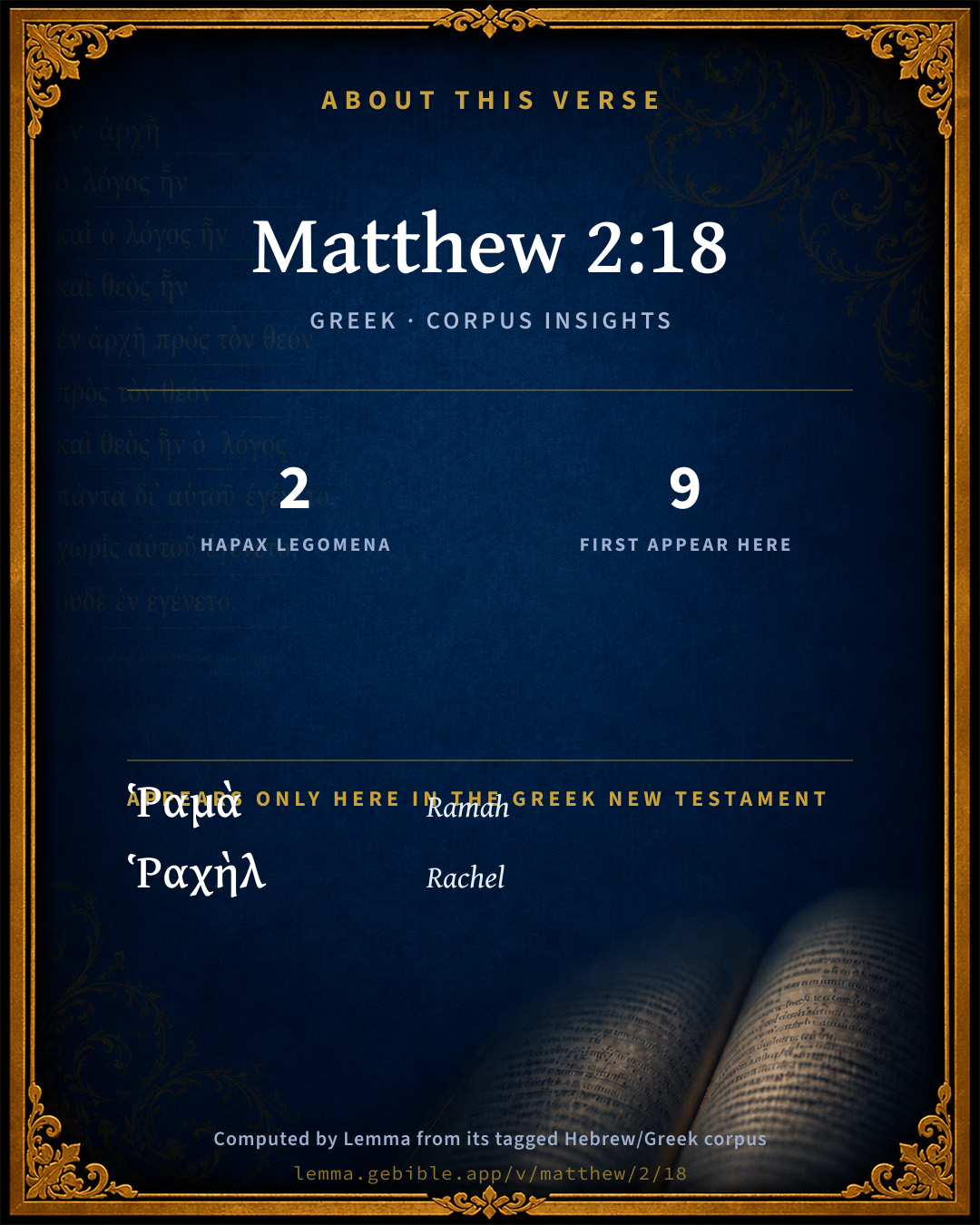
  • 2 hapax legomena — only here in the Greek New Testament
  • 9 first appearances in the Greek New Testament
Full analysis ↓
Download a study sheet

One document with this verse’s original text, its word-by-word gloss line, the meaning frame, cross-references with their text, attributed commentary, and full source and license credits — printable, and it pastes into notes with its structure intact.

This verse Autodidact and up

Study sheet (.html) Plain text (.txt)

A passage Seminary Student

Up to 50 verses in one chapter. A passage sheet keeps up to 6 commentary sources and 12 cross-references per verse, in the order this page ranks them, and says so on the sheet whenever that leaves anything out. Ask for a single verse and you get the Autodidact verse sheet above.

Everything on this page stays free to read, with no account — the sheet is a download of what is already on screen, not access to it.

Want to remove ads? Support Godless Engineer
Compare translations 3

The same verse in 3 English versions, stacked beneath the original-language interlinear above. Click any original word for its lexicon entry.

Each is an independent rendering of the whole verse — the interlinear is not word-aligned to these translations.

Highlighted words mark where these versions differ — a whole-verse word diff, not a word-by-word alignment.

  • World English Bible Public Domain
    "A voice was heard in Ramah, Lamentation, weeping and great mourning, Rachel weeping for her children; She wouldn't be comforted, Because they are no more."
  • King James Version Public Domain
    In Rama was there a voice heard, lamentation, and weeping, and great mourning, Rachel weeping for her children, and would not be comforted, because they are not.
  • unfoldingWord Literal Text CC BY-SA 4.0
    “A voice was heard in Ramah, weeping and great mourning, Rachel weeping for her children, and not willing to be comforted, because they are no more.”

unfoldingWord Literal Text — © unfoldingWord, licensed CC BY-SA 4.0. Word-aligned USFM3 via Door43 (git.door43.org/unfoldingWord/en_ult).

Versions to compare (up to 4)

3 of 4 selected

Show all 19 translations

Every available English version of this verse, each an independent rendering of the whole verse.

  • World English Bible Public Domain
    "A voice was heard in Ramah, Lamentation, weeping and great mourning, Rachel weeping for her children; She wouldn't be comforted, Because they are no more."
  • Berean Standard Bible Public Domain
    “A voice is heard in Ramah, weeping and great mourning, Rachel weeping for her children, and refusing to be comforted, because they are no more.”
  • Majority Standard Bible Public Domain
    “A voice is heard in Ramah, lamentation and weeping and great mourning, Rachel weeping for her children and refusing to be comforted, because they are no more.”
  • King James Version Public Domain
    In Rama was there a voice heard, lamentation, and weeping, and great mourning, Rachel weeping for her children, and would not be comforted, because they are not.
  • American Standard Version (1901) Public Domain
    A voice was heard in Ramah, Weeping and great mourning, Rachel weeping for her children; And she would not be comforted, because they are not.
  • Revised Version (1885) Public Domain
    A voice was heard in Ramah, Weeping and great mourning, Rachel weeping for her children; And she would not be comforted, because they are not.
  • Geneva Bible (1599) Public Domain
    In Rhama was a voyce heard, mourning, and weeping, and great howling: Rachel weeping for her children, and would not be comforted, because they were not.
  • Douay-Rheims (1899) Public Domain
    A voice in Rama was heard, lamentation and great mourning; Rachel bewailing her children, and would not be comforted, because they are not.
  • Young's Literal Translation Public Domain
    `A voice in Ramah was heard -- lamentation and weeping and much mourning -- Rachel weeping `for' her children, and she would not be comforted because they are not.'
  • Literal Standard Version CC BY-SA 4.0
    “A voice in Ramah was heard—weeping and much mourning—Rachel weeping [for] her children, and she would not be comforted because they are not.”
  • Unlocked Literal Bible CC BY-SA 4.0
    “A voice was heard in Ramah, weeping and great mourning, Rachel weeping for her children, and she refused to be comforted, because they were no more.”
  • unfoldingWord Literal Text CC BY-SA 4.0
    “A voice was heard in Ramah, weeping and great mourning, Rachel weeping for her children, and not willing to be comforted, because they are no more.”
  • Darby Bible Public Domain
    A voice has been heard in Rama, weeping, and great lamentation: Rachel weeping [for] her children, and would not be comforted, because they are not.
  • World Messianic Bible Public Domain
    “A voice was heard in Ramah, lamentation, weeping and great mourning, Rachel weeping for her children; she wouldn’t be comforted, because they are no more.”
  • Webster's Bible Public Domain
    In Rama was there a voice heard, lamentation, and weeping, and great mourning, Rachel weeping for her children, and would not be comforted, because they are not.
  • Free Bible Version CC BY-SA 4.0
    “The sound of terrible weeping and mourning was heard in Rama, Rachel crying for her children. They are dead, and she can't be comforted.”
  • Bible in Basic English Public Domain
    In Ramah there was a sound of weeping and great sorrow, Rachel weeping for her children, and she would not be comforted for their loss.
  • Text-Critical English NT CC BY 4.0
    “A voice was heard in Ramah, wailing, weeping, and great lamentation, Rachel weeping for her children, and she refused to be comforted, because they are no more.”
  • Tyndale New Testament (1534) Public Domain
    On the hilles was a voyce herde mornynge wepynge and greate lamentacion: Rachel wepynge for her chyldren and wolde not be conforted because they were not.

Literal Standard Version (2020), Covenant Press — licensed CC BY-SA 4.0. Text via the HelloAO Bible API (eBible.org). Unlocked Literal Bible (unfoldingWord) — licensed CC BY-SA 4.0. Text via the HelloAO Bible API (eBible.org). unfoldingWord Literal Text — © unfoldingWord, licensed CC BY-SA 4.0. Word-aligned USFM3 via Door43 (git.door43.org/unfoldingWord/en_ult). Free Bible Version, Dr. Jonathan Gallagher — licensed CC BY-SA 4.0. Text via the HelloAO Bible API (eBible.org).

Word by word

More ways to search: Search by grammar → Find every occurrence → Compare this word →

Practice this passage: Drill this verse → Learn its vocabulary →

Ῥαμὰ
Rhamâ
G4471
“Ramah”
Noun, Proper, indeclinable
Part of Speech
Noun · Proper, indeclinable
Full Thayer's Definition

Origin: of hebrew origin H7414

TDNT: None

Ramah = "a hill" 1. a town of the tribe of Benjamin, situated about 5 miles (8 km) north of Jerusalem on the road to Bethel
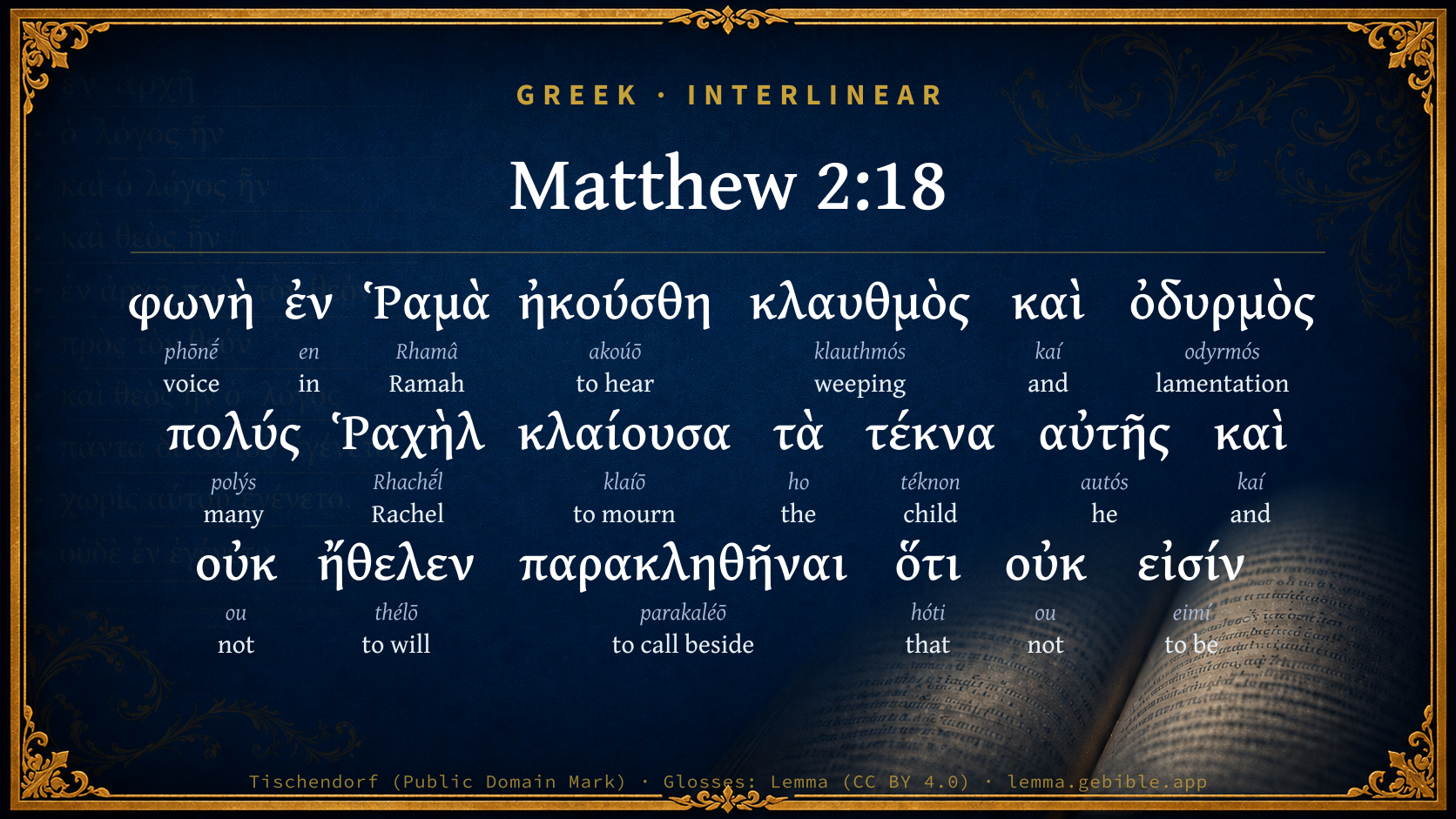
  1. φωνὴ phōnḗ G5456 “voice” Noun, Nominative, Singular, Feminine
  2. ἐν en G1722 “in” Preposition
  3. ἠκούσθη akoúō G191 “to hear” Verb, Aorist, Passive, Indicative, 3rd person, Singular
  4. κλαυθμὸς klauthmós G2805 “weeping” Noun, Nominative, Singular, Masculine
  5. καὶ kaí G2532 “and” Conjunction
  6. ὀδυρμὸς odyrmós G3602 “lamentation” Noun, Nominative, Singular, Masculine
  7. πολύς polýs G4183 “many” Adjective, Nominative, Singular, Masculine
  8. Ῥαχὴλ Rhachḗl G4478 “Rachel” Noun, Proper, indeclinable
  9. κλαίουσα klaíō G2799 “to mourn” Verb, Present, Active, Participle, Nominative, Singular, Feminine
  10. τὰ ho G3588 “the” Article, Accusative, Plural, Neuter
  11. τέκνα téknon G5043 “child” Noun, Accusative, Plural, Neuter
  12. αὐτῆς autós G846 “he” Personal pronoun, Genitive, Singular, Feminine
  13. καὶ kaí G2532 “and” Conjunction
  14. οὐκ ou G3756 “not” Particle, Negative
  15. ἤθελεν thélō G2309 “to will” Verb, Imperfect, Active, Indicative, 3rd person, Singular
  16. παρακληθῆναι parakaléō G3870 “to call beside” Verb, Aorist, Passive, Infinitive
  17. ὅτι hóti G3754 “that” Conjunction
  18. οὐκ ou G3756 “not” Particle, Negative
  19. εἰσίν eimí G1510 “to be” Verb, Present, Active, Indicative, 3rd person, Plural

About this verse

These counts appear in no published source. They are computed here, from the morphology-tagged text and Lemma’s own curated glosses. What Lemma adds →

20
words
18
distinct lemmas
Gospels
section

Notable vocabulary

2 hapax legomena — words that appear only here in the entire Greek New Testament:

First appearance in Scripture

These words make their first canonical appearance in the Greek New Testament here (9 in total — showing 8):

  • φωνὴ voice G5456
  • Ῥαμὰ Ramah G4471
  • κλαυθμὸς weeping G2805
  • ὀδυρμὸς lamentation G3602
  • πολύς many G4183
  • Ῥαχὴλ Rachel G4478
  • κλαίουσα to mourn G2799
  • τέκνα child G5043

Shared distinctive vocabulary

ὀδυρμὸς lamentation G3602 occurs in 2 verses of the Greek New Testament. Also found in:
Repetition

Words recur within this verse:

Cross-references

10

Topical passages linked to Matthew 2:18 in the Treasury of Scripture Knowledge — connected by theme and wording, ordered by reader-vote popularity; previews shown in the World English Bible.

  • Jeremiah 31:15 Thus says Yahweh: A voice is heard in Ramah, lamentation, and bitter weeping, Rachel weeping for her children; she refuses to be comforted for her children, because they are no more.
  • Jeremiah 9:17–21 Thus says Yahweh of Hosts, Consider you, and call for the mourning women, that they may come; and send for the skillful women, that they may come:
  • Jeremiah 4:31 For I have heard a voice as of a woman in travail, the anguish as of her who brings forth her first child, the voice of the daughter of Zion, who gasps for breath, who spreads her hands, [saying], Woe is me now! for my soul faints before the murderers.
  • Genesis 35:16–20 They traveled from Bethel. There was still some distance to come to Ephrath, and Rachel travailed. She had hard labor.
  • Ezekiel 2:10 He spread it before me: and it was written within and without; and there were written therein lamentations, and mourning, and woe.
  • Genesis 37:30 He returned to his brothers, and said, "The child is no more; and I, where will I go?"
  • Genesis 37:33–35 He recognized it, and said, "It is my son's coat. An evil animal has devoured him. Joseph is without doubt torn in pieces."
  • Genesis 42:36 Jacob, their father, said to them, "You have bereaved me of my children! Joseph is no more, Simeon is no more, and you want to take Benjamin away. All these things are against me."
  • Job 14:10 But man dies, and is laid low. Yes, man gives up the spirit, and where is he?
  • Revelation 8:13 I saw, and I heard an eagle, flying in mid heaven, saying with a loud voice, "Woe! Woe! Woe for those who dwell on the earth, because of the other voices of the trumpets of the three angels, who are yet to sound!"

Cross-references courtesy of OpenBible.info (CC BY 4.0).

Where the printed editions differ

1 variant

Places in this verse where the major printed Greek editions disagree on the wording in a way that affects the translation — a comparison of editions, not a manuscript-by-manuscript collation. The editions are the modern critical texts (Nestlé-Aland 28/27, SBL, Westcott-Hort, Tregelles, Tyndale House) and the traditional texts behind the KJV (the Textus Receptus and the Byzantine/Majority text). It is not a claim about which reading is original.

  1. Extra text
    θρῆνος καὶ

    “lamentation and”

    In TRByz Not in NA28NA27TynSBLWHTreg

    θρῆνος καὶ (thrēnos kai) 'lamentation and' is only in traditional manuscripts (TR+Byz)

Textual data: Translators Amalgamated Greek New Testament (STEPBible TAGNT) · CC BY 4.0.

Commentary

Notes on Matthew 2:18 from classic Christian and Jewish commentators (each source and its license shown beneath its notes). The classic Christian expositions comment on the surrounding passage and are grouped to its opening verse, so a note may address several verses; the Jewish commentaries on the Tanakh (Rashi and others) are per-verse, so they appear only where the commentator wrote on this verse.

Lemma curates 59 commentaries, every one of them public domain or Creative Commons licensed, each selected and text-cleaned for this edition rather than reprinted as found. About our sources →

Joseph Benson's Commentary

Mat 2:18. In Rama was a voice heard — Rachel weeping for her children — Benjamin, it is well known, was the son of Rachel: his posterity, therefore, who inhabited Ramah and the parts adjacent, sprung from her, and, according to the Scripture language, were her children. The slaughter of the inhabitants of Bethlehem, also, might with propriety enough be termed the slaughter of her children; she being buried there, Gen 35:19, and the Bethlehemites being the offspring of her husband and sister. It is by a very striking and beautiful figure of speech, by which she is here represented as awaked by the cries of the infants, and as rising out of her grave, and bitterly bewailing her little ones, who lie slaughtered in heaps around her. Because they are not — That is, are not among men, are taken away from the land of the living, are dead. The same phrase is frequently used in the same sense in the Old Testament. Now, as it was not true of those that were carried into captivity in Jeremiah’s days, that they were not, in this sense, why should it be thought strange that so literal a completion of the prophecy as took place in the days of Herod, should be referred to by the Holy Ghost? Here observe, The first crown of martyrdom for Jesus was won by these infant sufferers, and the honour to which they are advanced infinitely repays the short pains they endured. Some have questioned the authenticity of the evangelist’s narrative of the slaughter of these infants, on account of the diabolical wickedness of the action; but the following account, given by Prideaux, of Herod’s last deed and purpose, will convince any one that there was nothing too bad for that miserable man to perpetrate: — “Knowing the hatred the Jews had for him, he concluded aright, that there would be no lamentations at his death, but rather gladness and rejoicing all the country over. To prevent this, he framed a project and resolution in his mind, which was one of the most horrid and wicked, perchance, that ever entered into the heart of man. For, having issued out a summons to all the principal Jews of his kingdom, commanding their appearance at Jericho, (where he then lay,) on pain of death, at a day appointed; on their arrival thither, he shut them all up in the circus, and then, sending for Salerno his sister, and Alexas her husband, commanded them that, as soon as he was dead, they should send in the soldiers upon them, and put them all to the sword. ‘For this,’ said he, ‘will provide mourning for my funeral all over the land, and make the Jews in every family lament my death, whether they will or not:’ and when he had adjured them hereto, some hours after, he died. But they, not being wicked enough to do what they had been solemnly made to promise, rather chose to break their obligation, than to make themselves the executioners of so bloody and horrid a design.”

Since Josephus, who has given us the history of Herod’s transactions at large, has taken no notice of the slaughter of these children, some have been ready to suspect his fidelity as an historian, or, which is worse, that of St. Matthew. But there is no need to do either. For surely it is not to be supposed, that an historian lessens his credibility as often as he relates the facts omitted by another; or passes over those recorded by another. For it is hardly possible it should be otherwise, unless one should exactly copy from another. Besides, Josephus has so many instances exactly similar to this, and those so remarkable, that he might think it needless to add this. For, as Is. Vossius, a man by no means superstitious or credulous, has observed, after so many examples of Herod’s cruelty at Jerusalem and through all Judea, after so many sons, so many wives, relations, and friends, cut off by a variety of torments, it does not seem to have been a great thing to have also put to death the infants of a town or village, with the territory belonging to it, the slaughter of which could not have been very great in so small a place, especially since not all, but only the male infants were destroyed, and of these only such as were under two years old. What Tacitus has observed, Anal. Mat 6:7, is very applicable here: “I am not ignorant,” says he, “that the dangers and punishments undergone by many have been omitted by most writers, either because they were tired of relating such a multitude of instances, or feared that the things which had been wearisome and disagreeable to them would be equally so to their readers.” — Wetstein. Indeed, Josephus was not old enough to remember it himself, and if he did not find it in the Memoirs of Nicholas of Damascus, (that flattering historian, of whom we know he made great use in compiling the life of Herod,) he might be unwilling to introduce it, even if he were particularly acquainted with it; lest the occasion might have led him to mention what, generally, at least, he is solicitous to decline — I mean, Christian affairs. It is sufficient that this cruelty of Herod is preserved in Macrobius, who, in a chapter “concerning the jests of Augustus upon others, and of others upon him,” says, “When he heard that among those male infants about two years old, which Herod the king of the Jews ordered to be slain in Syria, one of his sons was also murdered, he said, ‘It is better to be Herod’s hog than his son.’” The saying alludes to his professing Judaism, which forbade his killing swine, or eating their flesh; therefore, his hog would have been safe where his son lost his life.

Joseph Benson's Commentary on the Old and New Testaments (1811–1818) — public domain. Text from a community e-Sword module.

Tyndale Open Study Notes

Tyndale Open Resources

2:18 Ramah, a village near Bethlehem, is the place of Rachel’s burial (Gen 35:18-20; Jer 31:15-17).

Tyndale Open Study Notes — © Tyndale Open Resources, licensed CC BY-SA 4.0. Text via the HelloAO Bible API.

Bengel's Gnomon

Johann Albrecht Bengel

Mat 2:18. Φωνὴ ἐν Ῥαμᾶ ἠκούσθη, θρῆνος καὶ κλαυθμὸς καὶ ὁδυρμὸς πολὺς, Ῥαχὴλ κλαίουσα τὰ τέκνα αὐτῆς· καὶ οὐκ ἤθελε παρακληθῆναι, κ.τ.λ.—A voice was heard in Rama, lamentation and weeping and much mourning: Rachel bewailing her children, and would not be comforted, etc.) The passage is thus rendered by the LXX., Jeremiah 31(38):15:—Φωνὴ ἐν Ῥαμᾶ (Cod. Alex. ἐν τῆ ὑψηλῇ) ἠκούσθη θρήνου καὶ κλαυθμοῦ καὶ ὀδυρμοῦ· Ραχηλ αποκλαιομένη ἐπὶ τῶν υἱῶν αὑτῆς· καὶ οὐκ ἠθέλησε παρακληθῆναι, κ.τ.λ.—A voice was heard in Rama (Cod. Al. on high) of lamentation and weeping and mourning: Rachel bewailing herself on account of her sons, and would not be comforted, etc.—ἠκούσθη, was heard) so that it reached the Lord. Jeremiah both prefixes and subjoins, Thus saith the Lord.—θρῆνος καὶ κλαυθμὸς καὶ ὀδυρμὸς πολὺς,[99] lamentation and weeping and much mourning) The LXX. have θρῆνου καὶ κλαυθμοῦ καὶ ὀδυρμοῦ, of weeping, and of lamentation, and of mourning. The original Hebrew, however, is נהי בכי תמרורים—lamentation, weeping of bitternesses, (i.e., lamentation and bitter weeping). The shorter[100] reading of St Matthew, supported by so many versions, viz.,[101] ΚΛΑΥΘΜῸς ΚΑῚ ὈΔΥΡΜῸς ΠΟΛῪς, weeping and much mourning, agrees with this so as to express the Hebrew plural תַּמְרוּרִים, bitternesses, by the Greek epithet πολὺς, much. I used to suspect that the translators who omitted ΘΡῆΝΟς ΚΑῚ, lamentation and, had done so from the poverty of their language: but you might, with equal justice, say that the Greek copyists added these words from the LXX., from not duly weighing the force of the adjective πολυς, much, which is not found in the LXX.

[99] In his Apparatus Criticus, Bengel writes, in loc.—

[100] E. M. has the longer reading.—(I. B.)

[101] So BZabc Vulg. Hilary, 613. D is the only very ancient authority for the θρῆνος καὶ of the Rec. Text.—ED. “18 (—θρῆνος καὶ) Æth. Arab. Copt. Lat. (et inde Barb. I. vel etiam Cypr. et Colbert. n. 2467), Pers. Syr. ex inopiâ synonymorum; Hieron. nescio an Justinus Martyr. Extat non solum apud LXX., sed etiam in Hebræo.” He then goes on. “Inopia synonymorum laborasse,” etc., as in the Gnomon, and concludes by referring the reader to that work.—(I. B.)

The Hebrew words[102] and accents[103] declare the matter more gradually (rem gradatim magis declarant), and exhibit successively,—(1.) Shrill grief indefinitely: her who mourns, and those whom she mourns, (2.) refusing the consolation offered to her; and the cause why she refused it.—The thirty-first chapter of Jeremiah is prospective to a great degree of the times of the New Testament; and so does this passage refer to this event in the New Testament history, whether Jeremiah regarded at the same time the Babylonian Captivity or not; a greater and less event of distinct periods may correspond with the single meaning of a single prediction, until the prophecy is exhausted.—Ῥαχὴλ, Rachel) put antonomatically for the individual daughters of Rachel and other mothers, who thus had sons of pangs [Benoni].—Cf. Gen 35:18. The sons of Rachel are named: the sons of other mothers are understood at the same time, as in 1Co 10:1, the Gentiles are also included under the fathers of the Jews. The infants of Bethlehem might also be called “sons of Rachel,” on account of the tomb of Rachel mentioned in Gen 35:19, as being near that town: just as the Samaritans (Joh 4:12) called Jacob their father, because they lived in the same place where he had formerly dwelt. But Rama did also belong to the tribe of Benjamin (see Jos 18:25), who was the son of Rachel. It is quite conceivable that the assassins despatched so suddenly by Herod to Bethlehem, may have proceeded even as far as Rama, as the towns were very near together: see Jdg 19:2; Jdg 19:9; Jdg 19:13; Ezr 2:21; Ezr 2:26: from which circumstance Jeremiah, a priest from the land of Benjamin, pointed it out as the limit of the massacre.—κλαίουσα, weeping) i.e., κλαίει, weeps, a Hebraism.—οὐκ ἤθελε παρακληθῆναι, refused to receive consolation) A phrase which expresses intense grief.—οὐκ εἰσί, they are not) Thus, in the S. V. of Gen 42:36, we read Ἰωσὴφ οὐκ ἔστι, Συμεὼν οὐκ ἔστι, Joseph is not, Simeon is not); and in 1Ki 20:40, οὗτος οὐκ ἦν, he was not) in the Hebrew איננו, he is not, in the singular number used distributively. The mothers mourn each especially their own, or even their only sons; for even only children would, in this case, be expressed in the plural number: the slaughtered infants were of two years old, or a little under, so that a single mother could not easily be deprived of more than one. The event was accurately foretold. Others refer the singular number to the Messiah, whom they suppose the women to have imagined slain, or mourned as banished.

[102] “Sermo.”—(I. B.)

[103] “The design of the accents in general is, to show the rhythmical members of the verses in the Old Testament text. But, as such, the use is twofold—viz., a. To show the logical relation of each word to the whole sentence: b. to mark the tone syllable to each word. In respect to the former, they serve as signs of interpunction; in respect to the latter, as signs of the tone or accent.… The use of the accents as signs of interpunction is somewhat complicated, since they serve not merely to separate the members of a sentence, like our period, colon, and comma, but also as marks of connection.”—Gesenius, Heb. Gr. sec. 15, q.v.—(I. B.)

Bengel's Gnomon of the New Testament — English translation (T&T Clark, Edinburgh, 1860) — public domain. Text from a community e-Sword module.

Meyer's Critical & Exegetical Commentary

Heinrich August Wilhelm Meyer

Mat_2:18. Jer_31:15 (freely quoted according to the Septuagint) treats of the leading away of the Jews to Babylon, whose destiny Rachel, the ancestress of the children of Ephraim, bewails. According to the typically prophetic view in Matthew, the lamentation and mourning of Rachel, represented by the prophet, has an antitypical reference to the murdering of the children of Bethlehem, who are her children, because she was the wife of Jacob, and the mother of Joseph and Benjamin (Gen_35:18). And this reference was all the more obvious that, according to Gen_35:19,[370] Rachel was buried at Bethlehem (Robinson, I. p. 373). According to Chrysostom, Theophylact, Euth. Zigabenus, Piscator, Fritzsche, Rachel is regarded as the representative of Bethlehem, or of the mothers of Bethlehem. But why, in keeping with the antitypical view of the prophets words, should not Rachel herself appear as lamenting over the massacre of those children? Rama, however, where, according to the prophet, that lamentation resounded, is here the type of Bethlehem.

Regarding the position of Rama (now the village er Ram), near to Gibeah, two hours to the north of Jerusalem, belonging at one time to Ephraim, at another to Benjamin, and on its identity, which is denied by others, with the Ramah of Samuel (Gesenius, Thes. III. p. 1275; Thenius, Winer, von Raumer, Keim), see Graf in the Stud. u. Krit. 1854, p. 858 ff.; Pressel in Herzogs Encykl. XII. p. 515 f. There the exiles were kept in custody, Jer_40:1.

ΚΛΑΊΟΥΣΑ] The participle, which in general never stands for the finite tense (in answer to de Wette), has here its government either with ἠκούσθη (Fritzsche) or with οὐκ ἤθελε, where καί is to be translated also (Rachel weeping … was also inaccessible to consolation; on the distinction between καὶ οὐκ and οὐδέ, see Hartung, Partikell. I. p. 212 f.). The first is to be preferred as the most natural and most appropriate to the emotional style, so that ῬΑΧῊΛ ΚΛΑΊΟΥΣΑ links itself on as an apposition, and then the author sequentium sententiarum gravitate commotus a participio ad verbum finitum deflectit, Kühner, ad Xen. Mem. ii. 1. 30.

On the tragic designation ΟὐΚ ΕἾΝΑΙ, mortuum esse, comp. xlii. 36; Thuc. ii. 44. 2; Herod. iii. 65; Wetstein in loc.; Ellendt, Lex. Soph. I. p. 515.

[370] Where, however, the words הוא בית לחם are to be regarded as a gloss. See Thenius on 1Sa_10:2; Graf in the Stud. u. Kritik. 1854, p. 868.

REMARK.

The slaughter of the children at Bethlehem is closely connected with the appearance of the Magi, and was in its legendary character already extended as early as Justin (c. Tr. 78) to all the children of Bethlehem. Josephus, who makes such minute mention of the cruelty of Herod (Antt. xv. 7. 8, xvi. 11. 3, xvii. 2. 4; see Ottii Spicileg. p. 541), is silent regarding this event, which, had it been known to him as a matter of history, he would most probably have mentioned on account of its unexampled brutality. The confused narrative of Macrobius (Sat. ii. 4)[371] can here determine nothing, because it first proceeded directly or indirectly from the Christian tradition. Finally, the slaughter of the children itself appears not only as an altogether superfluous measure, since, after the surprising homage offered by the Magi, the child, recently born under extraordinary circumstances, must have been universally known in the small and certainly also provincial village of Bethlehem, or could at least have been easily and certainly discovered by the inquiries of the authorities; but also as a very unwise measure, since a summary slaughter of children could by no means give the absolute certainty which was aimed at. To understand the origin of the legend, it is not enough to point back to the typical element in the childhood of Moses, or even to the dangers undergone in childhood by Romulus, Cyrus, and so on (Strauss); but see the Remark after Mat_2:12. It is arbitrary, however, to exclude the flight of Jesus into Egypt from this cycle of legends, and to explain it historically in an altogether strange fashion, from the terrible commotion in which, after the death of Herod, Jerusalem and the surrounding localities were plunged (Ammon, L. J. I. p. 226 f.). It is indissolubly connected with the slaughter of the children, and stands or falls with it; in the preliminary history of Luke there is no place whatever for it.

[371] Ed. Bipont. p. 341 of Augustus: Cum audisset, inter pueros, quos in Syria Herodes, rex Judaeorum, intra bimatum jussit interfici, filium quoque ejus occisum, ait: melius est Herodis porcum (ὗν) esse quam filium (υἱόν). A confusion of the murder of Antipater (Joseph. Antt. vii. 7) with our history, as if a son of the king himself (in answer to Wieseler, Beitr. p. 154) had been among the murdered Syrian children.

Meyer — Critical and Exegetical Commentary on the New Testament — English translation by Peter Christie, edited by Frederick Crombie (T&T Clark, 1880) — public domain. Text from a community e-Sword module.

Expositor's Greek Testament

ed. W. Robertson Nicoll

Mat 2:18 : still another prophetic reference, erem. 31:15, freely reproduced from the Sept [10] ; pathetic and poetic certainly, if the relevance be not conspicuously apparent. The evangelist introduces the prophetic passage in this case, not with ἵνα , but with τότε (Mat 2:17 ), suggesting a fulfilment not regarded as exclusive. The words, even in their original place, are highly imaginative. The scene of Rachel weeping for her children is one of several tableaux , which passed before the prophet’s eye in a vision, in a dream which, on awaking, he felt to be sweet. It was poetry to begin with, and it is poetry here. Rachel again weeps over her children; hers, because she was buried there, the prophet’s Ramah, near Gibeah, north of Jerusalem, standing for Bethlehem as far to the south. The prophetic passage did not create the massacre; the tradition of the massacre recalled to mind the prophecy, and led to its being quoted, though of doubtful appositeness in a strict sense. Jacob’s beloved wife seems to have occupied an imaginative place also in Rabbinical literature. Wünsche quotes this from the Midrasch : “Why did Jacob bury Rachel on the way to Ephratah or Bethlehem? (Gen 35:16 ). Because he foresaw that the exiles would at some future time pass that way, and he buried her there that she might pray for them” ( Beiträge , p. 11). Rachel was to the Hebrew fancy a mother for Israel in all time, sympathetic in all her children’s misfortunes.

[10] Septuagint.

The Expositor's Greek Testament, edited by W. Robertson Nicoll (1897–1910) — public domain. Text from a community e-Sword module.

Geneva Bible (1599)

Geneva Bible translators

A voice of lamenting, weeping, and howling.

That is to say, All that compass about Bethlehem: for Rachel Jacob’s wife, who died in childbirth, was buried in the way that leadeth to this town, which is also called Ephrathah, because of the fruitfulness of the soil, and plenty of corn.

Geneva Bible (1599) marginal notes — public domain. Text via Bolls.life.

Jamieson, Fausset & Brown

Robert Jamieson, A. R. Fausset & David Brown

In Rama was there a voice heard, lamentation, and weeping, and great mourning, Rachel weeping for her children, and would not be comforted, because they are not--These words, as they stand in Jeremiah, undoubtedly relate to the Babylonish captivity. Rachel, the mother of Joseph and Benjamin, was buried in the neighborhood of Bethlehem (Gen 35:19), where her sepulchre is still shown. She is figuratively represented as rising from the tomb and uttering a double lament for the loss of her children--first, by a bitter captivity, and now by a bloody death. And a foul deed it was. O ye mothers of Bethlehem! methinks I hear you asking why your innocent babes should be the ram caught in the thicket, while Isaac escapes. I cannot tell you, but one thing I know, that ye shall, some of you, live to see a day when that Babe of Bethlehem shall be Himself the Ram, caught in another sort of thicket, in order that your babes may escape a worse doom than they now endure. And if these babes of yours be now in glory, through the dear might of that blessed Babe, will they not deem it their honor that the tyrant's rage was exhausted upon themselves instead of their infant Lord?

Jamieson, Fausset & Brown — Commentary Critical and Explanatory on the Whole Bible (1871) — public domain (CC PDM 1.0). Text via the HelloAO Bible API.

Adam Clarke's Commentary

Verse 18. In Rama was there a voice heard] These words, quoted from Jer 31:15, were originally spoken concerning the captivity of the ten tribes; but are here elegantly applied to the murder of the innocents at Bethlehem. As if he had said, Bethlehem at this time resembled Rama; for as Rachel might be said to weep over her children, which were slaughtered or gone into captivity; so in Bethlehem, the mothers lamented bitterly their children, because they were slain. The word θρηνος, lamentation is omitted by the Codd. Vatic. Cypr. one of Selden's MSS. the Syriac, Arabic, Persic, AEthiopic, all the Itala, (except that in the Cod. Bezae,) Vulgate, and Saxon, several of the fathers, and above all Jeremiah, Jer 31:15, from which it is quoted. Griesbach leaves it in the text with a note of doubtfulness. This mourning may refer to cases far from uncommon in the east, where all the children have been massacred. The lamentations of a Hindoo mother for her child are loud and piercing; and it is almost impossible to conceive of a scene more truly heart-rending than that of a whole town of such mothers wailing over their massacred children. See WARD.

Adam Clarke's Commentary on the Bible (1810–1826) — public domain. Text from a community e-Sword/MySword module.

Ellicott's Commentary for English Readers

(18) In Rama was there a voice heard.—Here again we have an example of St. Matthew’s application of a passage that had a direct bearing upon the events of the time when it was delivered to those which his narrative had brought before him. The tomb of Rachel, “in the way to Ephrath, which is Bethlehem” (Gen_35:19), had been, probably from the day when the “pillar” which marked it was first set up, one of the sacred places of the land. It was so in the days of Samuel (1Sa_10:2). The language of Jeremiah in Jer_31:15, shows that it was so in his time. In his picture of the sufferings and slaughter of the captives of Judah, the image which best embodied his feelings of sorrow for his people was that of Rachel, as the great “mother in Israel,” seeing, as from the “high place” of her sepulchre (this is the meaning of the name Ramah), the shame and death of her children at the other Ramah, a few miles further to the north, and weeping for her bereavement. Historically, as we find from Jer_40:1, this was the place to which the prisoners were dragged, that Nebuzaradan might assign “such as were for death” to death, others to exile, and others again to remain as bondsmen in the land. That picture, St. Matthew felt, had been reproduced once again. The tomb of Rachel was as familiar to the people of Bethlehem (it stands but one mile to the north of the town) as it had been in the time of Jeremiah, and the imagery was therefore as natural in the one case as the other. The Ramah of Jer_40:1. was about seven or eight miles further north, on the borders of Benjamin, but it has been thought by some geographers that the name was given to some locality nearer the tomb of Rachel.

A Bible Commentary for English Readers, edited by Charles John Ellicott (1878–1897) — public domain. Text from a community e-Sword module.

The Cambridge Bible for Schools and Colleges

gen. ed. J. J. S. Perowne

18. Jer_31:15, in LXX. Jer_38:15. In a singularly touching passage, Rachel, the mother of the tribe of Benjamin (whose tomb was close to Bethlehem: Gen_35:19), is conceived of as weeping for her captive sons at Ramah—some of whom were possibly doomed to die; cp. Jer_40:1.

The Evangelist pictures Rachel’s grief re-awakened by the slaughter of the infants at Bethlehem.

The Ramah alluded to by Jeremiah, generally identified with the modern Er-Rama, was about 5 miles N. of Jerusalem, and in the tribe of Benjamin. There is no proof of another Ramah near Bethlehem. The analogy therefore must not be pressed.

The Cambridge Bible for Schools and Colleges (gen. ed. J. J. S. Perowne; Cambridge University Press, 1878–1918) — public domain. Text from a community e-Sword module.

Trapp's Complete Commentary

John Trapp

18 In Rama was there a voice heard, lamentation, and weeping, and great mourning, Rachel weeping for her children, and would not be comforted, because they are not.

Ver. 18. Lamentation, weeping, and great mourning] How impatient was Jacob in the loss of Joseph; David of Absalom, &c. Grief for sin (than which none more deep and soaking), is set forth by this unparalleled lamentation: {Zec 12:10; Mat 5:4} "Blessed are they that mourn" (πενθουντες), as men do at the death of their dearest children. But let such say to God, as St Jerome (ad Julian.) adviseth a friend of his in like case, Tulisti liberos, quos ipse dederas: non contristor quod recepisti: ago gratias quod dedisti: thou hast taken away whom thou hadst given me: I grieve not that thou hast taken them, but praise the Lord, that was pleased to give them.

Rachel weeping] That is, Bethlehem, in the way whereto Rachel died in childbirth, and was buried. "Give me children, or else I die:" give her children, and yet she dies. Well might Bethlehem weep, if at this massacre there were (as some affirm it) 14,000 infants butchered.

For her children] Those dear pledges and pieces of ourselves; called cari dears, by the Latins, and φιλτατα by the Greeks, darlings, in whom is all our delight, Eze 24:24; yet are they certain cares, but uncertain comforts, {a}

And would not be comforted] This confutes him in Plautus, that said, Mulier nulla dolet cordicitus ex animo, these mourned beyond measure, utterly refusing to be comforted by any fair words of the murderers excusing the matter (likely) to the miserable mothers, and promising amends from the king by some other means, or by any other way. But immoderate sorrow for losses past hope of recovery is more sullen than useful: our stomach may be bewrayed by it, not our wisdom; and although something we may yield to nature in these eases, yet nothing to impatience.

Because they were not] A just judgment of God upon them for their unnaturalness to the Son of God, whom they shut out into a stable. The dulness and dissoluteness of these Bethlehemites required thus to be raised and roused up as by the sound of a trumpet or report of a musket; happy for them, if they had hearts "to bear the rod, and who had appointed, it," Mic 6:9. But we many times mistake the cause of our misery, groping in the dark as the Sodomites, crying out upon the instrument, seldom reflecting; our minds being as ill set as our eyes, we turn neither of them inwards.

{a} Lambin. in Menech. Plauti, Act 1:1-26, Scene 1. Domi domitus fui usque cum charis meis. Filius dicitur a φιλος.

John Trapp, A Commentary or Exposition upon All the Books of the Old and New Testament (1647–1656) — public domain. Text from a community e-Sword module.

Albert Barnes' Notes on the Bible

In Rama was there a voice heard - Rama was a small town in the tribe of Benjamin. Rachel was the mother of Benjamin, and was buried near to Bethlehem, Gen 35:16-19. Rama was about 6 miles northwest of Jerusalem, near Bethel, and was some 10 or 12 miles from Bethlehem. The name Rama signifies an eminence, and was given to the town because it was situated on a hill. Rama is commonly supposed to be the same as the Arimarthea of the New Testament the place where Joseph lived who begged the body of Jesus. See Mat 27:57. This is also the same place in which Samuel was born, where he resided, died. and was buried, and where he anointed Saul as king, 1Sa 1:1, 1Sa 1:19; 1Sa 2:11; 1Sa 8:4; 1Sa 19:18; 1Sa 25:1. Mr. King, an American missionary, was at Rama - now called Romba - in 1824; and Mr. Whiting, another American missionary, was there in 1835. Mr. Whiting says: “The situation is exceedingly beautiful. It is about two hours distant from Jerusalem to the northwest, on an eminence commanding a view of a wide extent of beautiful diversified country. Hills, plains, and valleys, highly cultivated fields of wheat and barley, vineyards and oliveyards, are spread out before you as on a map, and numerous villages are scattered here and there over the whole view. To the west and northwest, beyond the hill-country, appears the vast plain of Sharon, and further still you look out upon the great and wide sea. It occurred to me as not improbable that in the days of David and Solomon this place may have been a favorite retreat during the heat of summer, and that here the former may have often struck his sacred lyre. Some of the Psalms, or at least one of them (see Psa 104:25, seem to have been composed in some place which commanded a view of the Mediterranean; and this is the only place, I believe, in the vicinity of Jerusalem that affords such a view.”

Rama was once a strongly fortified city, but there is no city here at present. A half-ruined Muslim mosque, which was originally a Christian church, stands over the tomb of the prophet; besides which, a few miserable dwellings are the only buildings that remain on this once-celebrated spot. Compare the notes at Isa 10:29. The tomb of Rachel, which is supposed to mark the precise spot where Rachel was buried (compare Gen 35:18-20; Gen 48:7), is near to Bethlehem, and she is represented as rising and weeping again over her children. “The tomb is a plain Saracenic mausoleum, having no claims to antiquity in its present form, but deeply interesting in sacred associations; for, by the singular consent of all authorities in such questions, it marks the actual site of her grave.” - The Land and the Book, vol. ii. 501.

By a beautiful figure of speech, the prophet introduces the mother weeping over the tribe, her children, and with them weeping over the fallen destiny of Israel, and over the calamities about te come upon the land. Few images could be more striking than thus to introduce a mother, long dead, whose sepulchre was near, weeping bitterly over the terrible calamities that befell her descendants. The language and the image also aptly and beautifully expressed the sorrows of the mothers in Bethlehem when Herod slew their infant children. Under the cruelty of the tyrant almost every family was a family of tears, and well might there be lamentation, and weeping, and great mourning.

We may remark here that the sacred writers were cautious of speaking of the characters of wicked people. Here was one of the worst men in the world, committing one of the most awful crimes, and yet there is not a single mark of exclamation; there is not a single reference to any other part of his conduct; there is nothing that could lead to the knowledge that his character in other respects was not upright. There is no wanton and malignant dragging him into the narrative that they might gratify malice in making free with a very bad character. What was to their purpose, they recorded; what was not, they left to others. This is the nature of religion. It does not speak evil of others except when necessary, nor then does it take pleasure in it.

Albert Barnes' Notes on the Bible (1834–1885) — public domain. Text from a community e-Sword/MySword module.

Haydock's Catholic Bible Commentary

A voice was heard in Rama.[4] St. Jerome takes Rama, not for the name of any city, but for a high place, as appears by his Latin translation. (Jeremias xxxi. 15.) But in all Greek copies here in St. Matthew, and in the Septuagint in Jeremias, we find the word itself Rama, so that it must signify a particular city. Rachel, who was buried at Bethlehem, is represented weeping (as it were in the person of those desolate mothers) the murder, and loss of so many children: and Rama being a city not far from Bethlehem, in the tribe of Benjamin, built on a high place, it is said that the cries and lamentations of these children, and their mothers, reached even to Rama. Cornel. a Lapide on Jeremias xxxi. thinks that these words were not only applied by the evangelist in a figurative sense, but that the prophet in the literal sense foretold these lamentations. (Witham)

===============================

[BIBLIOGRAPHY]

Vox in Excelso audita est. Jeremias xxxi. 15.

George Leo Haydock (1774–1849), Haydock's Catholic Family Bible and Commentary, 1859 edition — public domain. Excludes Psalms (Douay-Rheims chapter numbering differs from Protestant) and Deuterocanonical books (Catholic canon only).

Whedon's Commentary on the Bible

Daniel D. Whedon

18. In Ramah — Rama was a village in the tribe of Benjamin, near Bethlehem. Rachel weeping — Rachel was the wife of Jacob, or Israel, and died “in the way to Ephrath, which is Bethlehem.” (See Gen_35:19; Gen_48:7.) When the Babylonian captivity took place, Rama was the rendezvous where the Jews were assembled to be carried away. The prophet describes this by the beautiful passage (Jer_31:15-16) here quoted. Rachel, the ancestral mother of Israel, is represented as weeping over the loss of her captured and murdered children. In this the evangelist finds a typical resemblance to the martyrdom of the children by Herod.

89504e470d0a1a0a0000000d49484452000000950000009208030000007b7978c500000300504c54450000000101010202020303030404040505050606060707070808080909090a0a0a0b0b0b0c0c0c0d0d0d0e0e0e0f0f0f1010101111111212121313131414141515151616161717171818181919191a1a1a1b1b1b1c1c1c1d1d1d1e1e1e1f1f1f2020202020202222222323232424242424242626262727272828282828282a2a2a2b2b2b2c2c2c2c2c2c2e2e2e2f2f2f3030303030303232323333333434343434343636363737373838383838383a3a3a3b3b3b3c3c3c3c3c3c3e3e3e3f3f3f4040404141414141414343434444444545454646464747474848484949494949494b4b4b4c4c4c4d4d4d4e4e4e4f4f4f5050505151515151515353535454545555555656565757575858585959595959595b5b5b5c5c5c5d5d5d5e5e5e5f5f5f6060606161616161616363636464646565656666666767676868686969696969696b6b6b6c6c6c6d6d6d6e6e6e6f6f6f7070707171717171717373737474747575757676767777777878787979797979797b7b7b7c7c7c7d7d7d7e7e7e7f7f7f8080808181818282828383838383838585858686868787878888888989898a8a8a8b8b8b8c8c8c8d8d8d8e8e8e8f8f8f9090909191919292929393939393939595959696969797979898989999999a9a9a9b9b9b9c9c9c9d9d9d9e9e9e9f9f9fa0a0a0a1a1a1a2a2a2a3a3a3a3a3a3a5a5a5a6a6a6a7a7a7a8a8a8a9a9a9aaaaaaabababacacacadadadaeaeaeafafafb0b0b0b1b1b1b2b2b2b3b3b3b3b3b3b5b5b5b6b6b6b7b7b7b8b8b8b9b9b9babababbbbbbbcbcbcbdbdbdbebebebfbfbfc0c0c0c1c1c1c2c2c2c3c3c3c3c3c3c5c5c5c6c6c6c7c7c7c8c8c8c9c9c9cacacacbcbcbcccccccdcdcdcecececfcfcfd0d0d0d1d1d1d2d2d2d3d3d3d3d3d3d5d5d5d6d6d6d7d7d7d8d8d8d9d9d9dadadadbdbdbdcdcdcdddddddedededfdfdfe0e0e0e1e1e1e2e2e2e3e3e3e3e3e3e5e5e5e6e6e6e7e7e7e8e8e8e9e9e9eaeaeaebebebecececedededeeeeeeefefeff0f0f0f1f1f1f2f2f2f3f3f3f3f3f3f5f5f5f6f6f6f7f7f7f8f8f8f9f9f9fafafafbfbfbfcfcfcfdfdfdfefefeffffff0e79e2e400000001624b47440088051d48000000097048597300000ec400000ec401952b0e1b0000200049444154789c1c9b77581477f7f6c70208d29b8058107b89ddd812a3262696344b1293f84493986812a32631f66eecb12b221690de3b0b0bdbfbce96d9e9757b672982a8693fdff15dfee1e282d9b3df73ce7d7feeb906a0eb496fc0d73df0e2bfaede402fede9ea7cfe323810f433c160c86bf30d3c7bfab4dbe3ef0939dccfbc9d9d9ee77e3030d0d3dbe7659c1c49bbbb7cec33d6e761bc3ea717b1a36e87cd6177c19413d3b630a8937982716e1a2728c6ed65600b04138cd58674394c2c87da508aa45d361ca5ed0ebd100f901a2bff171e47676797dbc501767f28e00b863afb7dbd3dcf6dde60b72fe41bb07b7afb9e3cf173aeeeeebf5ef47a7d5d7eae970e06030166c01308843a1df62e87d7e7e0ac56cee8b0eba8208a388c8416378306838d75bbcd1a91d905137a176925110445191662480cc50802a70d16daa485708ac17187d3e62431a787643c56bb91e976d0bea007f2417a6060a0dfeeedf7b83bbb9e75053ca4d7eef2b81c6e5fd0e172301467b7d95ddd7e53a7cfd5c73afeebee87ba1c1e4f90b5062da40d277dacdec2313a8d4c5b5675fbd70337af5fbafbb840a0a4405d638d17d39b310421098396a535b093a35806c5191cd129311549a23486326e176544691b6e611d98196718d6e17659ed4ea703f0b83c8ca7d7e50f86fadc363bdbeb0b04023eafdbc95a399a71f9033eced3857919dad5fbcc060509246033336e9b55cf3a6c88d922be7ff8e3258bc22387860f0a8f0a0f4f4a1e1c961e9938ebe73fab5b0cb05c62821410a156321e07811b4d3863678d184e87701631c0308291387f099430e9500626699aa4ed4e87cb65c550a0db1b70770619b7c3d365e31c5cafcfe3f1077d0ed6e777b114cbd11e84eda2dc08e6d2605c00879c204db01464916b8a6f1d79675c6a78eac419853fd73de8a8d7a91b5bb5d29afbb7be5b9a32361e887cf7747e0b4c43422dea7fca2ab436c482d30e07c9d9ad5e230e23261843cd260bc6f7d5a485f976621633c25a199bdb6a32027694243954614118bfd31b605c368ab4fb7c4e6b67c8ef6069d4489a691fe2a549276ad3a24afe6a086c6eadbcbb256268caf8c9efe79875286cb76b151698b18028a4c5208d896e96549e38393f3c263a76b3c4d8ae2320858a351b1012e1078cb593ac81265918a74814c648fea3532865e7f8cb9a70bb83451c4e0c011c84cd13f210419874d9023d0c6dc360d6ebf77aad2e5fa0b3d3cd9809b75d1b70d2348c6a7b02d69ac63a59d5bbf119c0a48395551db4c7c5f51b09b9c98043b0de84a9c418a253b0286534ca2c60f999ad3307bdb6594828311666097bc065733a513bedb175b22441d22cc7903843700e86b6b224ff13bbd7cd991d1e86026c84d5e1b1595c569b93b077596d018e7685429dddae404fff8b173d6ed4d5e35405dd38edb1a39891d215ce0412267dd9a8167afc5470c0efb033cf70affc5f3dc8d819fe688da45b8d7988f6800bd618f8a56336258503313f35a0bd5692af816668373f4e5e92a44992b5db698480083b83f2353234c55a69845f4c8a047a833dc1909ff279fc018cf4d8bc5d2e67f7c093dea74f9f3f7ff6fc59c8e1f03e095942768478425398e6486a1830fd1684c23244ad667b02ee50a08be0eaaa31a50c7333169ad19bec84df472b6c088ec294d76f679b1f6d4e1b326c8d484ef7747abb9ed93b619d9a42381b4bb37607bf9916c2c1a224c76f1749f04da5ac56be2a9bd563f7f8b8a0abab8fc6ecacdfeff0f4fffdb4ef39af184ffa9f76bb83aed080ad874321a709da99327c76879d613d346df7bc1a445fb7cbfe176a55d799dc26ccebc19dbd6e8b9a084a119f83e2380241310c223815d5b62431664d99d76d41ed548f8d826d08e771daac3687d3e5a3389f93b6fbf9a9b173bcec60fc89b1c07f0303034f9e3c093c7fd2d7dfd5fbb4f7455fff5f7ff53ffdf7695fdf5f7f0703ff04d0fff3110398d58a7f3766d246dceeb777061c1ccada68d6d71d0a0443d40bc87ebfcd1fb479cd6c77bb5e0b3f37d7630e2fd96b738498275a9a75d22e9f053a16173d5ba18530c2c2e130a3773b3dc150d0ebb43b6c76b78bc110d6c68b02ff62189bc703f4f50e3ce5c5ddfbd7d3a7fd5d5d3da117dda1fee77d4f065ebe7cdad5d7dfddd5edeb60fecff71c3a903c761feceff4e3cf439e7e1c7ccef29fcbc1d9dc6e0bb0382135e5cdc30d04d60cad043efe167407f504ee11329cdbce6f0ec2f63364971e111e1b3cf6ed46d86b30b24cc0c6a2384953048e5959cee9a050842fcae3f5b89d4ea7dd660342bd7fbf08fa7afa069ef6f574853a3b9f053d5d7d3d9d5dde172f9ff73d0dd22f4d7f3b6947eee0f85f2cb801f9bf277d7d8e6e8f9eb4330ce77dfaa2930ea81b8198c3151df3e2563ed068549b52ff00f63db67a0dfa7e85b945a5e5970ca4f136993c848a0513a3869d109b7cb85342f3f520b00546502b6b75da4914e59be976b99c4e97c7866140a0933fabe0c0dffc79063a83fece1eaf2b18f2b9fd03cf06ba437d3dd6004dd91f00895798a0d580287ccfba7db85f960f997b432e967bf5abb0aaf4a3e18b4bb4871aa6a5fc666ab9b542feda329546a49774a01a75639da15a5124321fbf0619ed41ede32540fae946156f1a061b8df17e8de1bca1bb6cfc0432360747e0ac8bb2b36633e077f19ae9edee7606dcce80d7e1f3b97d5d019bcdfb9423dd9ddd0e2dc62a37c4bccbf8fa2cbd66dc0de38ac71fff2647bb8236b39e745b2d208cd1e575a54b27fcf29ec8b53972b9aca26d50eb9e892695d6226ad34e06c6458c04e2c216dd98bf4481577286b6eae8e405da2684305388516f80108c9f793b6d3141086b27f45adc6361580401426e0faf0a41973de8b4fa1ca4c3e5ee7c1264193703717e1be76465b7a2e7b6d9423e54cd69b4b4787dbb5c445acd8c85d123216bcded874d2dad0ff408fafe983f76d4b7bfb16a71721cf07df1b893cd98f266d5f8d9dbc20eee9f35e3c1c1c95777257d2dc20c925ee96fc3e21f760875b0490f4218af5b144da37a9d01629c145f950fb7da5916703b7cdd5da18095eb74b07e07ee70bb43033d0ec6e67375b9b47a4cbb03d821b9d8d903b23ebde6d2dcab8aa0d668aa6e67549881341f4888fb387c54d477e30e9ccafd637ee6f7c77f6b9c177ea3e1b7c57980c1f1e0cdb140f3def7a6e44042954e406bda0ba3774b195140231f3f682984a09089c7191227088a460c060b62f5f22cc6799d0ebbd50a4088b33b14f45094dfc6767a28afd7ddf96cc0cbd23ad0eac12407d3238a2187ce6f0839bdfbe6155114a80571847142fa3e13f95cb47cd8184252129f2b9d3928a5766154d471ddd1e8f424ede5bb5fdea66f4c1f7ce6e088ab4c902519d82486d17cf38f33102ded405b6702632de8abae21661dc12300694128d211ec0e7adc9e4e174bd380ceea78f6b4e76f221072bbfc76fbf3a7c1e7cf067adcdd7f23760d3c39fb3d13e727bb5d96be47e9871896e9655f1db8416f421c282bfa38b5f1f4817d9ed6da6251f1ce5b6bbf013eaac91b7de2faa4cb44f395c340c9f67767b1d6800ac71c0aa3dadec029895be9bb113bac8176a78d6a80a5b093d6e3569f0f05393fcbe0b64ebfb733f4a4d3c977d06e77055ff4fb9ff7f859d7c09360bfefa5a7f7d9537e1118b5e7545c36e757bfd4690ca186f16be40cf912e1ad81e67d94245d207c1738bc77f4d863e53780c56f541555ed48cc1e3a6dffe4ddf8aab9ad92fc05d36f16a64b2810817d5a8d4d88196d0ab3457636ecbe04f5ebcb86c7dc2fe10f8a7905820ca4c36d384dba7a3afd41bfd7c1530df04f575fe81955627cc27bcebf2f7a79a3e97de977387abd16ff88e85da4dd11701afcea85bf660110d149f9fd5e278fa72e1b8d321bdf7d787cda3b736665c7cdde7a237fc53541c1dc5961f75be73ceeaa4adbf5f093e4cb40b3c9c439fefce1f87143e3a543272eb162115c97fd55a35b48183e05a655d9049c81e0a9d36df775f9ec3c5d06fc9d019fdbce7180c7def5cfcb7fb8bf7b7a07fefdbbb7e7ef974f5ffafc2fff0e76922ba36b90a0d3ff12feebce140a8d1da1e7b34637d7e9f7f978cba25ddd56c23ea0872c5e75a35ca39b15b9ed6afdeebdf3c68e375d44c1bab80b793f2d2954a128ac48786feadca3c0a67bbb3265cf3852a7fe2dba02b218d833c0bc3ab2cbcfd829abdbe1f4ba7d4e8fcfe10ef1aac9bf01f0f2e58b97fff5bf1c78d2f3ecbfe7ddbdcf5e3c7b697f197812687a2fa18ab4f63d7bf2bc75d92137ad8f5a69d2aad44f0897c7f7eabc583b63ecb68b4c7f5b41d460680a30daa2a4e949cd0ddfcfa81853ef57248dd21cba8c59854d5fae8d7c073a9d516d5efdc9d80f6f751194993815994fba48fb9df4612506ad1b33631c45d094d3eef1d85d7eb7dbc3bf80d0f3ce675dc1978ee75e4fdf407f5fa8d7167af20fd277236c6a9bb6ff25ebe87f1821f9576db6a403f352a7a757ba09daea70f05645280c52086d2dabdabafa766ef3c6c253ca1a39902939b579f235b8a6f6f555b543049655c0b4dcc96b8c751776ae183966f4dcc865acac53657c5ab4e0538da8bea12d3c295ea927509e4e319e9228b7cfe17010bcf3b85c80f7e9d38117cf7a5d2f1cf66020d8e51de0b7dff252347e5db1027d1e42b8a33f29ecb0eedae8cce365bf8e89f9c883c0fcc4dbac8ceceec23763a3a64d0e5f7865e5cc382033a3a0437bf4dea8934327ec1f69967dbff7f4a98a777684fff9e0f8e2f8cc395f151517c95ada3a044a9b8914d56a66acc54c6e617b64d23c8501a2709df615c17356920f8a7c516e37d0fff4a9e3e93ff6ff9ebafd218670fb7a613e6b20093f2a11d0681e307efd93caa753de8eb87f654c46d48a7c5047588c16c64623be21fbaf569eace9682fcba96c2e3df1c69f9bbfbcba20a525edc6c4219fe71be6de5a5d14fbf3c7876ea6fdafa6aea5597ce34e0ba76bb7eb149444ef948990efc66a454a59f16783d782288b2a554690c07008c46c8cd56ae3998179c9baff0a74db09d2f5578875f1e044a26dd9972101cb5196aae5bb5c3235240edbd131f9c6add48e9a2ed64c990ca44e649a9c726b4fe99d79d32f5d39ff0e109671a2fec1950beb7f1e713c71c6f4c3bb5b96358cc84cd2de5ff3f32dc59fabf73dfc3a7ad39efc070a799b5ed7ee52cab472e79e9146505ea2db10f15d8d4d2df72a4d1a33c5a07a5987438ff0eeec78e241799bf322be604fc011f2397aedcd73d7d35ad882aa9a279712f280597dee4329b16efc3040c10a708784a2b1fb4b3fbef2cbd0af6386a4bc3b6efeb5d5e1e10b964c9ab2e9c2a3ec9d6b77fe927d06c85f7879c8f4e6bb232fbc1e037cb52a61f5a585437e1897fcb8b186fce5b1feb6a44eaa505e9eaa2e7509d165430e2b74469543afd5e9f4a009212c0a18458167ae1e8609d97a396f67b7ddf3dccaebed96af4031e1b0e83b32f384013da3df99fae0295abeeb489cc24e7a28cec0a82fddd3c86b767be46a8b5456ada7abe86b53e6cd9a999db8e0c13ac1cccc99f1fa41bfac892c4d5e1fbd3f39e78d772ab40dd78a74670e02aa9ce68d83460c49bfaad6282c3f2caf325869cd62200f33a226370cc32886c2101fde280ae8d5110c866a996ecaf797d5fb8fa1ebd99e38d0c60694fe86f13061a26dc8b5615761da706849d603b99ac3698cd59a5dd67fddc8739cb458351cd185e1188a364e1a953d61d3f182ac13bb2664958df95e563272f887d7c61e2fdc92010c8b1f3a22263c79f4d423b11b94779a9bd2d7cafd06e8d04f92ba2a75cdf478a9d80a39491c4531d8a026118c27997fdc8ece4e7fc0dbe90afedbed1d70e945a9af72a7c97322b182f5a2ac46357c4785aa4eb261e5e588973d3e1cb5f6a27808069ddd4f43dd66bb8bcf4c961022270d5a81aca668f9b025b3e7c49e5cfcfea5fbe985e182bc0df1d11937508dbd47a1c4db2d1540c9830599090704d71fd49b74922f7fa49adc5cc3b8e152e153356a50c8d4663e4b70385f554fbf8f73f70df8b8fffa075e7685fe6d8caeb138035c6dec7c63b7dbf3b72774716a85b6cdb2252e7a68bb95ff4c5cb79d35693dfe2e97c9d249323633a3b31abd28a7e8551b615fc9bdf163c27ff93dfbf2579f3eccf8ede284d72eab143c6d4258af9bb5c8009120eabdef1727007793724cacc13833d208928133118b613d034326334230ac83073e0ff0ef8bff0bf53d77bcb0fdf3f4c93fcfbd8ad17f10ce9718f7c6d556c7f3eea0ddeebc115757afdc31396bc266a1e3e54bc7809ad49bbd3aab4b611799db1b6b21a387fbc7e7a9b791a1e64e0b287e33f1e895c26da7861c3876eeb329b99cad5f471871c64dfa2d582d509f7a0334c8ef01f31b627329b9a5f6e6db5a1361da1bb35d47c0249f753812753f0b757703ff32ff0d3cb797f5f5babb9f05fecff3fd7ccaf6d26e1fbb4f15e87279ba8294473b845ebd6429981cf608edf359bd0442606a8599b83233226944723c40f8f894c9db0583cb39c4287ff4ddcab5abaeadba3ebeb62d35b14ed242777356630fa3872912dc19553808ec2060d5b1f896b20947ecd836cd9ae31d6667e3c821f54a138ce318ced8ac7dafb4fd597fe8c980d5c4f95e76fff5a4eb7c0a68c335d659b96ab6ebc5f3672f7add543da0eb39bb0219925ee1759021afc545769840755a76e6e484ef3bce7ef499150435a49230eb1a84a68ef323969efe74ed36a018d81f1311b1f79ea815b683fc5e39751693f90c5091788f55b1b26f006875f8171a1c51a9462a34146506962a29ce6ff2a37c52b4f19407f4f77843cf8314f75fb78bf2e887d6db347a6afa61592fed09fafc211fcb15c57748ca126f26c71d53d3260ce931a35cc0939e1e5659b5a054c1cc7ea341e000a51d2abd213222ea6262c1e21140feaf932b968cda79f4d68a8ceb3b843acc07794c26bb9eae882f06ca05b864cc9e89510b9aa510d489db4fa5341808d5f6b84f2faa603a0833106eb3f27ae57650b6277d4eca4fbfe857eefb541aa2cc1316045d56174f069e50c0eed32618da98a1daa494bd124a65f06888e732e5bd84b03aa69e2d39f1c6da449dc1461a5144f5f8a3fbcb63df7ba8d89b71b7fcf495ef17a502c30bb2cf3fd8d06ea15a10216a305717c744af4d9f77aa5e5a9e5c4f48216d072ec40ce7cfe6ebf073c0b047063b9f5fa57e7e0d79bda26882e9ec0f500e424b0b8734c07e243fa94a6e75391d56c6ee75d17475422ed93655119efe4d23ae33853cc13687e6fbe933abc4f2aaf23bf33e4a34ca550aa54dd6f8cedef2b8c16b7757df885a058c181a1f9db06ac95b43cf5f1f26d6687107a96a6a36b42e056e66c5c5fd596e7cd8a6175a34ad7cf26b2e8c2d6b6b6b5b1d7609759b4138c7089a309e903987cbe9edf2f17a498bb7af4649777bd605d6a2835d4ebbc31bf0705c1320ed40c75f1f9ef9f60d0d041a619ba3db9c1276eae1a12d89d3331b2adf968a696d474835eb5ae3b6d379a9939a3bd24fa7dd89ffe104f0f0f28c7df1c327977072a590912a14a0e0b3848b8d1762be6b21f4547b0b6812a90da8b079cb6505d96118344a2925ac106a27610886019bc3eb6238c6c035a3787c15048bb77d8348ad7227c771ffff4e42489c2c2584e1d5a35edff0400c42168bacb345183973f7f7917972cd9d4140924ca7d2d6994c698f0b9608c685df2a1a7db012d0bcf7f8716664f6d4dcd70f4e4f1799b45ab8b5435751fb477c4179ea5a95d1009b1a9a3a2cbafa3a9010e169791d2afbf7f18f702bfcea76208af31db4d14e0f4dd346d42ff9603c46b5974d69e8b63958c8ccc76de2d54b0e74b4d58eb83ff6ad1f952048ba098ceabe1ebe3877f4b44bb06949d48f334d9c12d3c91e0c0796c5cfd9173e4937fca7cfd6d7ccfdf2d0aaf82befbf15b5bd34f668493daa1428da0de2dbc0bb69b72bcd56d2481bad7a3da407d5a0ca2c1b655640eacc94161bd563860d180fa58087f5f4068221fb7f4e79aac580b687d91cff86308c7538dd5e2fcf114f65295203d2b23075c24693959714bbdf696c1c1d7feeee1953cbe4f93b1794e734f07c549b9a3716cc1f2a5bdeaede087c72e7b504605ccefbdbafbcd63cf4cdc1c769186b334aa8167b71d6f68eb2a257d5081af32bea6aaadbc594505c33b2886ac51f02a7eda4058309ebab3461ffa7eb598fffff705ab97d6d9fc3bba90a0f5a9d7d019f27687a6aedb6f7b18e848726239219392a4f653598f808e1e19c63c2e3d61d6c5f79467472c2c8ed52b3ba3ca6a27c8fe64fe0de5039f438baedfbdc866f1e6cdb979c9bda3cfecb11f55a6350ae5598541aadd6a2091f99755e78ec9d6fe744874d4afb54e440a92645aac8a2340d8e20205067476d10c300032f7b7abb832f5c1a5db85d069fffc0a9a1a4fd0334ed875f3abab990ff1937e62e07f5e9072dbcd58772039dbe3e0788374ed9f6dd5cd9104c7375d0af4a56cbf4be0f000b87ce1fb1a48d32dc040c43caebdfbff2f591cdf7468f01e6ff8ebb1115a386591836698db2b8ecc78bd3dfba79f7568da1b96a3e0cf242602c9e7d0986e68e391474601444207c76ee1fe8ea79dedfdd839dfdd6d46dce6e87ad76d0e70ef56021b55ddd7426d4cb2dffc8da15704c5f371d659efa9eb17cf3397a65f2e698933152d7b8ef0a9e0408ca5a92f0a0ec3de5c71d5685ac06304fca6d019ae6960073537e58b4454333b4cca7d620260c8749d323a0a030e7e21f9763dfca1859d73c9d700ad0e6d94d7b567bf511631c5d8893445fa5549fafbbe7c513c6573e481e8077178a484c03224e035af738e7e2e451b138fb5fe374fa09890247f6de90d3263268c03ca4423b21e9f29c58c57737537fa3342d2eb708a85f067cfa951e31c9274476bcff4bfdda5b33d4a5490983224a211e8c30a312a22c38acd189ab274ffc0e786b42414ccd8887e707cda149bb6d42aaaa22acc830616811a3231c10a5d3019dfe90c7e746991f3f857005607c58b0e1c329d9994333a725a54cbefc3009727b8d114a06c412dff8302cf2a6545f76fbc0d6baba59896f9cd5dc58b93e0b784b0cb606cc2d2b32d73eacee52a1545bccc6ace2919fc45d7a5ba833defeeafb7695cd435bda84fc8c5b2035a840be0e07f60baad79c88de2804129a42b85bb67851c56749d23271e46a9dd34eeb118502f038391c77792040d092b32aa9e8cd6fb7e7de6d2fb716163da8a8bd377605d347eba3ef3b2970e2e689476bd3f7eb7e18f5bf0591c317671e5a53405426672d5a5ba5937a205a75f4d863b9de2c839440f54fbb6a92d7c51cd6b42b0c42910a831d2008d68ae42210325224011fbade082a563f9adcb262f0351487603bb51c987e406736450e2a4775183f580880b10447795d37273400bfc58e5ddc30252e232b6ad6272969c34644de02da5d32d4bc608140d132667956c19a9a04207c48f8a4b90977a7cc999f23a2e3beab074e73706d9deec6c8af5724a61cd18a6b87e73efaf5461a0a1c6e50d4891595b84b898218de00430aad46acd71b3939dc54dbb479756d6e4c5385be91259d8ac6868d11df80a5bb465f600d3085f3ca00b9dc035e9b7cf131e597f72467d3d4eb803d15230fa4ecbb77ab757262aa996059e10fe90a9d2c6b69d49cb293719f0c7a77ebb0611fc75f5c79e8be5a346cdfcf8353b728348ab2ccab604d5bc5b6b0bad6a179f70b4c1784c039a946d5aca933b1b887e12432b3a1432e136a4181d6207b23293af5702bb0b7bec18490146a57441ca8c9fa49d218964e134652cb9f9549c2c7421d02a88915db16eddc059cbf30fdfba13726957034823cfad8c06036417dc6265a9a98bda831777fe58239378b726f03dfecfcaa6a4f53c5f07937675e1b1d5fa66988982d29152b94f9eb45831fed11745c6888acd369e51a89a49d20501767b0f05f18a484108951a30276ec7da365fc5cb3cea910cafb18bc16a8ea48dd63c4a323789b258dbc3b3bd8609787dc97a2ce5932bdca14fa3dedcf869561db877bd556071490776b40bdb5f572ea1fc2396b664f1ab3baf0ddec6a5155a90448fc6ed322ddaeb09f80b6acb4b5696d2dbf0c07feb866c8978fab1ebc06d85710fd5b845cabd529cd1a83d34638299d518b220c2c3723a001927e1a5eaf2c074ad590ae2dff54070e55277df5699c10b45d1e748e865eddd50260860974f9a6fe7e2fa331ebbb6e92fa0cf89fa12ee337b909d3b6d99020e6eded76d5a4277c7fe2ab2379d772ca2b528fb66aeb913ce040d8386070167069d2e393ef1cbcd4248c9bffe7cd6d7773136a62af9c4afa78e9ee41fca0ebc4840ef738282ba6d16b08ca81a92c286156e7940fae7c18552e54a9a56c3860643b75e7664c9a7d432aa81df6861ac70dbc5ed11e6bf75fc60cf4c17e876e2cf5cce9ac075eaba95e96356ec66b2d5ed6e6c4accae784e8cd31b1dfc41cfa13b8761f98d9524773aac769e9c047bf8ef869460e26b93a7b45d3a94cd59f5f4d4e5b5cf5677c4be59b95532d91575a0d46350359388eb6e2a0d1405376da44915a114ba86393a70d96a949a960d3acadbb34acd79aa010242b1cba14a08eb0e27c079ff4758682bb5221e1b4fd334777f4a003fe8a8c49398687d2f224111f0f3b71df7f0eca832933de013603db0f26cf00127b5dfa6e02df9d367e6be4157d69519a2cedc8f631db205c3eeddb9a4679546dfd3b7078d398ff49f9ebdbac663e21d8290b8c3228cd9276aacba883da8f0c8ffea5c274677cf4deea86f1368a3e3456d93e5ba830af1e56ae63393e4d747a3b03eca4d54ad32f23a7eff73a9fd3ddd63bc0d80eb3190172cc2fbdbcacf5b02f5d882ae3ddd1f33f06864702c0da7b8cdba1c5345b0060ae436dd9b659f6e1fdd9e16ab74c1e21d0b05523abeb570bc32513de515b79c0b5e304ebb4913c35d16694e69ba86529d8c49c3870efc8b799e33f6e50cbe30c16f399d1c8034089779c1d721e7271bc0f86dcdd3deca422176b55a99f766281e7ec0bed3e60e463a826bd15edea74f43e093eef7133bea987c3125f0bff00383f7151729591e974ea946f8f6379c6892e838a232664d75acc3ba6ab9f590443ae6f1ddf0294657ca68748c2c4321841a36618359366188349d02611b29e82215957e3c21f498482f5ab8f7fd16412cd03a27fbf61fcbf2220d6e06478167de6f33914a3c4b6bcc73db27b352293dd4874e1929189655307e176a49b7451b083f076b6c77f17f7d5d41f2f84ff5077f7bb6c915168c6c1db710df9fa96614641d908e02a51bb265c054175d7804c20f1f1e8b69463a8de66b158299309d26a4c8816b720106856e8b5369bec4ed8d5d8264979cde7c39281e3a35a8dd25be3870cdbd2dca4cf00ca4c14bf830e672fde98a9df387a5daa0598101d7b666b5b3dfa283f75f7e0e5b0dfd587735686b171c6b6215f02c73fb87c233b7df2d70df786a1b6a5000020004944415423b735a8c41d7f243e026b6f0c2fd1b48f0054d236606e8d8068cf985cf8c1d9d8e1d291470c7aadc646904688a6700235222804c190dea4432c58736c42aea6f4ddd1b337d5ee9c967fad5d3a765cddcf916a43e31aa01ed48120f092826065cac3f80775335a53739a676ec95e3aeae7e8ac1f86003becbdbefe5e93d968c4585495be15f86167717154d8eae525f55fa7c7a6ef792b357170fc92b871276ae56957a1c60d9f160945525dc6e8473f9cae1a397ef96aa5c602ca2406a954ad52eb3452955aa9d46a15a059c3cbe6a9d8e63b19d3bf2d9d5c7134fad63c554bdcd2d23f86348195e5917715723e0f52908d2c4cac3cb0b128cc34b52df32bc3e6e6881f92f3cfbdbbbbdad6e36779ba376b410bd8317c4bcac113f915c9df02b14051adabbdaee472fe8d8afbede347bc7fba3ebccc5c07b43757193a4c9f4757bd7ea339b2fafc885681d92454202a9942ae361ad57afe10cc90494f68cc9a47b5c0c9db5f9dcb38b667e69bf10f93da6b1e8df838fa8106ae2b095bdf24349900d0e8abb97cbed0726e6f65f1d2d2f4a6868cdaa49a8c12a04a61447c4f6c7ab146af83390a8c5d0f5c782ca9496d5e3732db28144a6ab2374e04b29bab2a972415ed9e6e10beb7b6b64a2141851f27de987fa10da86b04dada5ef50c568a3a847210d4e9f53abe377a1545230cd8fac1a005f5e5c0982b472b1bdfcc90f86b9b7e983ef391d2e11e324a05f32aeaa0247debee772e4dcdbaa54d6c0204e5233624376eb200f54ad266f73a511363c311585113f9cde0bc3cac7d41f5cda88dad4685166db9d99c7b4d57756a63eaecac3a7e14f6d61970ac4514bdf46a44cdc398ea524065b619ed7a5caf948ab5901186cc66235f98c5660dd8ac4de599abda4d1f01778aeff2f6132c2417456f8ecc9259aadf07daf55a2d80795ce864dd83b886c20505598fe2bcb9c3472c30cdbb0a68403e53b89db8c8c2132b63110d3d92f1f8acd9b04354f9f38c73a85b5c777ef6f88e5a85646f9268e6eb8c6cdcb6a16a4d1baa940085438695952457e586e9204c69d3d3306400611222319cc421a39166f5dd6a99542516722dd692b06161371f9cb8c154440bea4f0e91d8903bf122138601760e138f35cac688ef2c6f4e7d14376162560a7076c9e1141ce5ba9e0df474226e1f09139078cc8ec1398516ecc837aa07115b045a4fbd41db2ea408bc65fb83f462bd62a122eb9ea4a9ee6975ea23e8cd9d155135b7a34d668b09254da0c908429052af33208841a78771c8019b7d8ccb6284b46a43d5c54fb64e6e945a12df9186cd374849c1b02a9dc50238ac0eedd80acfaab8c8bcbfc3cd775b944d02f5fedf2f0272d2e17b12b077621e2f8638dce48855834a3aca74f9af7b5b97bdfb3aa83daa25ff00c6a00ab27ce218159d965256750107d9865640523e3c656a42e3c56194d317d4b0284ad324cb438301e16c144ed2ae3e9d93c3e41d885acf98d16ce09b3f80768dec7ec290a81a01485d046a6992047afcddf268ca7d1858dd8ea4fc1e9630222d61daad8d0fd2312bd3db19b2f770bebe1e5fc083261e03aad502423f522b15a44608c5800d5c96391833764a23cacd8289a356093fd19056b02d2ebf7a68cde30d85a7366b1d8cd34e7a708311b1d25a8432710ce6236907dae9c1022a984249751bad7ae787d65446e2d12d8a072e13245e0594b35427d003d3cd5186efbf12cf3ee80acbba58b375ede239e396bc31ccdfe97cd63fe07912ecece1e3868748fd75f1f2ab12bd1ad0a145b3d3754d9f1b0848d66e61e55716893a3ea8a88eba34b7b0ab4587c79fbc32f253ed98ec8d875e79a08f644c106e31222466a55c149f1464b096c0306fab802a6f62698db8724c73fc63b879cafb959b87d6f94de8903f31dc0fd8fbb9ba5dcad7d4e0d727abbeb4125d3650ce693e001ebb9db0cbe941d9e75dc180dbeba6127fcabe79e7e35a6902a7fe70d617168faec5e991b7e0705d4483f8e0b89afd404b78b3c426ee7817c8387fa224f150dc039dc869d1a3286884745a08e5bbc8619093d3d0bcf390f6d29fd7346885d520d39e5a382a0f950ebbd07412c835db54c046a98ae0b5fd59cb7a55f58af3c3b0a7ce7f5fbce80af5a8165d7cad2114a07c2e2fe97afeaa268f031f9607ac9b7e6b694e5a53f1a8d90db5bb73d56d8a014ab4edc4c2ca2f5695493f4c970c3f550752e5e589a5a597da069744fd2000f516aa0dd5c9441283494a11180a1a08dc42a104c63065a91b231f157494972d7eed565a8d427938fa4412004b3caa8899723d0b502e4fc12e43c9ac31fba5f680e7af501f29cfdaa158d7c472108b91902368b7b9dc1eab71747ee2b49931bb4fce2f6ecf04deabfde31ad386b77115c0eccdaf1755d3a2914965c3f6eb4058fc4352fd891b79a34d515fd51a48526e46db1b842289542497e88d5a9d4a22eb90982c18d200544e5a12332d71f2c263a269c52691f0e3c819f7c80e331a9da8d43180c76ba9f8faf194dd5540a5fc252cfddbf0c59b8fa0d62d9bac4ec2c339985e9ab63a9c5e56997c2ef69e6ee58cf5a32baf033381f781941c4cab97ee9fb8e7eacd738d2af1d0d9a529131a25b29a15c31ec6aebe17264c5f230ab66811235457a7959555885562a35ea1952be5cd1dbcc6abebc27f1295e435d75da8f8e6fd1d0fee4a243b169f9776b885d23040254781817fc8bb6743b3aaaac714d92867d785a46d8a9a0f812d5908aae59319ea856827c7795951ea9e8f4eed99fbf5aa8c8fd32757c4034bde5820125aaaefae5db769df52a564ffaef784299327480aea4fcdfe64c897efc6e545dd92e9555a096a1649f4b2aafcbcbc7c85b25d22909a54663d1f326aa2bf4e9d161e1e1f362939edd635850658b637ec57b819d2c74652463bd0d5d7535ea28bbf474515879e9b04abbf6bd5ce4c7d2d6290dd0ab9bcddce1e23eb61282f2bcc9c37bbea72eadcc59f7c327cc2de53c0e00fd37f6e82546dd74eb5bd55585f3a216bc4e1d3791f96b7c81f0f991a7d293ae2cf64502333e1161d829b2522c5e39d91b32e364940a94eadc33532066f9d722e366bd3c1eb850f174cbeb8b1b520aa85003259b3543b3c8a335881a7bd8187a5ccfd15191b2929fb7666a5647f31705e22a8b6209c9dc06dce8007a759966a4b581375b36dcec4b91917808cc945d97ba74c583be38be305178fc497b43c4c4e9e7a6842c1ac239f0b44a780f2e8d6860f33235a0c66b1874464a0c204b5a72cfe6d4bd6bc2b25ac99509b04061a6a3bf7fa2099053298e4f7b3ae653719c3551220526e57b291233bac56a0e75fd7953cab7573eaa23b39b316b2a2459baffd785454b8cd84399c04ca3a381b9f096c5649fc9a1125854b63ff98fae91723c2f7dd88ab1afeeda084d973ee94e5fe3a6bfa21e198df7e18fddb5bbfb5c95e9b509cd254b4e811d002abf54eb31ad699e5e23747eb8a0bbffc207b74b1596f43602d5ad17cec881a76db284fcfd1b0a644563a61517ce26e0b699047031a9eaf5ea2f4ae3ccb9dd9ba4d47d23e55a44fff7cfcb64b6356bd13a3c5dd1e96e4dc2ebffbd563ad7a60cda15bbcf49ac2521ec52f7fad23ae75d9c1dc8ef4c373d387be9722deb1bbe8bde6fc491bf25ccac1eb2509aa6f57b4c6b5a1321c37a2b0136695c0c94b2be32fdfb89d6510d13654825d4d4e90a99b2802a670eda873f9f16631fd6de60f308e392ce9004b10406faffbad26fd97dfd536651f5ce9218d8af24705d31649c2e4b8dbef733bbd9d7da1ee80c7671cb77ee6c542c4a51c1edf1a7b0bd89776e2f5f3275ad3537efdecee01e598479553946955602d0122d30e550d938e5b271b9ea3925b41dc4d9be0d6dab1b7a7a6a5cfde32e76ab5524a811e5d5df4b9250ab3340876a3a23183675f5274ad4c4e1cd78c721c181d894010f08f1dfa4a18b80f1cd876333f2676ca8ea25b4535a81e4d92906e7f6fc8e974f8ecfc12bacd5337ac2f2e232c0de96915318f523fc93ebd7cc11dc1c24d653f3dfcecfa95e90ff2673c185762b7a1eaf4738dc0f6b96953236e980c84d2a840301d8c25678fde9627c93fb66abe1692b834e819a06a6bc64383fc891926b5a0a251da905cdf1a96a3856978f030de0f00db7fd677739ca6860915568f4ad62cdffd76f8989495445613e6f2f604681aa5518ab67792f317cebf646a35f503e32e44df1df3c5afa919676312132a16b72cc95f592d5c27f1dd881b236b52d7ecf97049c6d184fa5dd1551468c27195beacbd6af2e0df46d4d3a9ef7f957dfd275c07ba2cf707975f3911bbbdd0a42245161d2d71b50ecb29009a3c34de1c1e6ee238206421377fa393df05a22e945bccacc31c408cedebde5d9ba7b3dafd360bcf5630c93802c8e00b138b251aee66e29a4371f943bf3cfaee951b636583dd2bf2cf6fa85f53d3903b79cb27b102af9e3c937c6ae19db9823b40bd4a6d90ddaffa7afed6ef3f7963ea0f4aa1443e327b719911630ce66fe7e58f3da359fcfe7d8b89e4b47a0354fec698c9c36b40adb178f06b7abe83761c39ba5adcf94e791df0337f283e1bc360ff27122d39d54ed2763e65c2b819c3704afcd6dee38faa149507dffc7477d4e3e19717ecf89f214a76a688fb56bbeefed1a2fb7112a5edfa0c815530f564e95e41e24569824202cb7702e3676e58bf25efc03bbb444253cdb8e2190285abdd007e9c3169646a996a7ff6d64245905735c1a9dbb72f77302241ebbde8a3af9e1ce875eb5b26ea44403991754620d75810929161662be2717829c680a016a31126506dc7da89670b6af595a997f227ccbb9a5110ffd3ec0ac074b7ad6d6675fe870d770159adc020dd78b6a57990a8f04e59cacd4723d5d2e6b7e63cae2f7eb868fa9e1b31c7aeb57c382c734ea1ca613298e5aa3b8fdf041a271e13decfce179859cb4fa91b63b38a959626f1b7d14db8110410082949905b56be7b3cd1cc62b944bb462c13d435d558cc2ac20e9b94a05663e0bf6f9fba75c7a3b65b73320b4e472e39063cce281cd3f6f59dda9bd537a4f2d3b5a34a8c3e45930a1c0fb7441eadbc9e9ff0e529a042b5754cfd9e49e940cae63f45eb671f5a3eef53d594d2663b8470d266d59dedafe52f7c6be8dac6b21988a96dc9e9e6833115ed5a63d1cc883239a80542a04b9c5c6729fd7e7f4135247349cd920389633ffe79f6c4ede620ed65103e0b985104946f59b3a7a2e45ac2c3d69cc55bb68f7a147727d3f6c781cb6bb6ce9c153e74dcd00d75a296064d7bd6debc99d5b73fcf99f2c7b76f579467d69c9f5caedb3ff281fef33b33bfffbc764ffbc44b36312b0f7400b75b368c3ffbf591b109354d9360a32e7b7dcd8c24356a31832363846696067acc9c6a68a58e00950215eb6b71ca977c5edbd2aead3df1de2a2dd96d32128805c1319366db849357eec79dbb5a591f7be78b99dacb653f951e18154fa2f5b5f5957b12d7fc5261f497ada85f5199bae9fdacd4e8dbfae4c7adcb2a00a544d9344822ce06f6b4605fde0faecfd3078ce2ca822fa65c1eb56dc70fb575793b877f4f09c09ab722867f005ba0266d54841ae7551475b35240e5b1710d0f967ea52385b366954a53462d58287ab4f24f03e772d238c20f171f62d67dbd6b70cc1f77c4950befff2f77fce0b89851f37fcb6d676d520c6e58fbe5e785ba0a4b74bd7cd8e539a57be480a0344c0654450f21651a4962c5e3e45bd9b5e6990af4d3ab4e462ef6ee2cce9af5a04027d831272266e721567f60cae63d6a5127e136370e9b61447102b07512d49c628febbf5f4fd64fbc811892eb7280d45b659fa76f6c4d17ab6d56a7cdcab18459fbd1ce9b59e380fd0261e5c71796bd3b5a449b2b3ebbabf2f0f91cd7343f8a154ed4baa85fb53b6fbffd67ddb6ea71f7849139231f4f59b5a7f95a3d20c4979784dd2ffd86547f51d2a109626ddf343d905cd8080c0796aa29a5a1b529ea9713c35b61ce86191a801324eaf50321d8d4b9eb6d15631c0d3682f3c12bc0dde428ad0bc57f9f569ddcda49737e9f3fe0739096af3fba9e0f1403bf428ac3c3c6a67d64378b4fa5777463b01dd268d19f8133e7d5a0a4553cba7d580138a4b1f283236bea8726d5b60f3b7671ce7707afcf99beeba3f0eb0ad9ee8b36ce61d16dcced8e0646edd68a051dba90082eda7fbf62f4e798b70733e646574106a71bf09a9cbd39698803fe6245596641e0d16429a0b1fc457aa16b07ce4c33c2b4cbedf5bfaa6a7dd4d5ea988edf814a70e7d0ea05483b284bfd1d95b3208442caf2881148cd5e1da23df9b924ec706d6cc9b941af25aa17bd5f5bba13887dbc6df0c8d3b72feb2f08daa5efdc9182323b382d77ddc20a63bb01a768031990dccc941c197cc71134eac171435acc3c4201240fc0f9198d46021c97fc8389d5c768df1013b8d278247bb506d05979b8c03d0e9bd5726c438e26529893f8ceeff380a6755fe1e0b75165ce1619d729b15345a9d72b3a46882c1dc0030d30726b74e3bc2bb9a9f7d272cf8aabb60e0efb66e9e8b0e8f1e7ae5d92e52fc953ea4c7a346e225052abc0ad5616d58bc17cddd4c8a15b491887f562601e48581906e80c38f4324002eb4887c5e5619bc616a7b643853f4ef8a2f841cbfeffc10296a04998c465173f2f52cfae286e9f3d3f3af394611da86f8bd1093109c262b585af8f7204ca57aa3a0a92a4d5d1e71fceda38920fd0a540f91eb945171d6f68ac368a8ffc2f627b655dea0da504eab2e416d630cd6a8ce065470bb215d78fe43d786c44cc707d4dfc39034ee338d065635ad431a70c9d0633823348fbfa4aa0a664d1a242bde6fafa6b73350c46e23a156269bbb2b0c6b8654fcbd5c3cb8049cb2b9876b538b65dadd33a8d66bb2c6a7d8ba036af5c72677979db8892f65f874fae6d4ffd7a78d50d50dcfe0550514aeb6a24f22bc37eba9a99235574a062a41596b4290d7a85542a451abf4d9ef10bb15367e840dbf3c6569930dc62013a599746f443a642a9625ab7c4cecbbfb6fe34f0be58fc705cf8d0f0a441adb05eaf55aacd46e99fd32ea88b81a6baa8630787ec395a8f56ac3aaaabd788a84e6da10098795ff9f9adf345632f61f949a5270b8f8dd85f3e7cf0b11cb549473eac04ee9e2a2aabcdd31f18b923a6460b2915069dde6c91ab341a95522ed56ac25b6a81edc52a559356b929aa1cc151de07fb9e0cd8cc22a00a3663ef2f69ddf7494e7431562f783d636e7acee165255aaf4129d3433a85fa42d6f6f67c407cee979a82096739c9a411b1b5ba7a453564eec772865dd45547e6e6ec1851ac28192a399077f6f7944da3529ade56ebcca834ebc4b0c9c3866467a6cc04809a56b146a39596921ad8a4d79b31d4acc725e1f9a723e2e422adaaa369489c9c24711806827f8710563e7a07262fdc7ca9a2295ab11d3a94b06ad46f523d6e904066096bd65808659b725ffc17a25f673d1cdc58d20e64889bbfca02aa5b6965071680d4bf0dbd91239a5e7db32e0e6cae0bbbb74c72f9c2ad6fb34f5e5c20d2141e8b6cde7afecebaaa2f94759a2f3ffa562ff219ac908935d326add6cc2769a3403731360b2897a94c88b662c8469ca62992045c4f1c0822d99a05e21dcd93ea567cae2cfee2e2ac020562b2d8adbd84d6ebb559ccb85eacde9db55efe3869d7eb4ae6f6d40f1654d657440a4913ab832c4cf585b8db151dab050fa7fd29654bc7840fbd5892a5ce4f69df7c5f07d5dcbfb6a555a6a8fa2ded16addfd7945a0a616290f1619cdd0c8210643042550b80844bb7156a0b6c34ef4a2f40498ae1a9afa72fd46770dc8c2882c840d1bb51a38e36af5a77c2c4e371c81664113fedf6e33a043398ae4efe5c8d03b7c7b794cffc54bf7aab7ef5c9d59c16949336b5300f7870425824d9902e92180bde9724ee3f119bfbf5a7f5f116b31f854f9b9a8c26cdeb430f088517f37f9ea5ef7099ec263aa0a6299a820d16eedb8415fb0097dc0ce14ac9604046122463b301fe976e5a0c2a63bfd31891ce6373ef463daa9ef19b524ba25d4a3f266a28fcc41cc29eb05efdcdb9ef7618669f9c5a51195e7d11ec909e9567832ca5356b308512c852ca548523c7c9ba74f77e144ed97534423a7647e59f4a97ae652667b3d63cba569037a95934627e4b4c1384338ccd657d75afcdc5221c363ba7bd30b1c86595f79325095f617eb7cfeff1004ffb9dfd4e9adc3dc3e8ea232656d7e546916b7e5d342f6345724666d6fc233793ce78316d372abb3d7625c196cd880e6d8e2f5ba7dc65d6c0534093556f22d59ea6a15741337e7b7c1d2a35497fbefceebe0b6f5fcfa81096b658d1039c58f741ccb02953cf0092f20b19505cb501c66098b25abda806275027fbf906d139c0ad260270db1aa0c90293348920409fcff3cff350c83849e0b15b967fc7cdd248afec6f9341624b75534bb9a86af99b94af97a1e9bba31229027d23ad6ef4a0a2ff05ebdc0e59a24862351accacaa20b5cd505d3afe880c24d59a0bc9b7b60b362e025ac527d9eaeb26f5e349cb1a0a66bd5d762bb6ac7e9ce4c372a10e2731d862d6b2560a7676691ecd1c076c4095ac8650456511046cb5d27cc679f5c47bd7b3eed0bc051d2e16ff260a98f40ebde863bce8f4c6074bdffe62a7708119f543866e9d207a8a0971df3bad5e002873c562bd4f9aa845dd1c29362a8a53cfaf5ff1c91444a2634061cab8e64582ef6ad2c54d0d1d57de84aa2357e98cb5a5658bc7cc074413e45f35b56b101231a86498d3edb6a337474d5a185f87682d0808fd30b85464e10812e3d304e6eba6dcfdae20182d75d490a28842e98c2baa45774f8f7babba5508c8b68ca837ff6a665c70e96b6984571692189747977e592982b0ba915244a15131bc4f000b4edf4c79aceb379cd69626165444deb8254e6a840ca553d91660bec8acd272225beda9f7af8f367c5d6131a8954ab5cee0c48d88beed78729b20e29ac260329bda86a7822d2c8212047f56181f43839d5ca72b79a216f76aa63f3664df145f79eda3468bda245fda1eff48239e9c54abc4ab278ced3039da38c381acf3231eb43422b73ed2b31a98020dcda26820ef68f23995c6745c5a3aa8b529aca0e8e2c7430bcececc6f5994f6fa5d99a0a1bd456eaebebb7613b8f11ea495c9557c5518696cad68bd9a2aa80fdb6569d5fb343f02bf48205c8d9114cfa246abd31b703a82b434111249b0396fb4261c6ba25bd5fa90447fc6bb63a1a42ef7d8ff465f370a97c52a71d6c89aae27ecfa2d472017ae3cacd068d50854a3fb72eea7cd75dbb2e187608bb125b9f8b364d1c33363250bb7a84b16462f7b3d6c5753ed05497d1d6c9ffa66c3ae5c8d4a0dea9472b5ca88617a636e5a6cdc6018b19012c9a0e1e64e48a2d51b0d5a2d2072b8ec1cebb7fbc8f107452673956a5ed2da09777de51a5e7a634be3cfea3ab67d52bf657c53e398043d65b1ebc19ad75221b942d991586110c36d4a85aa31fc4893b1b670c423b4feaab114f868fa8f6b62a2dfff525259b2212962e8d63529d1a377dd13ca14dafcaff5ef7d61316814ed028911911a141b81a409f74e696c1690357f065c804c9594114120bd1e4028bbcbe970b808857141252ec2b5cbda3a1e7e5aa33554dedd72e5da5b1eb034ad40a45899fa784174abd1eea744e23d710df546435e86456d53b7e9a0b6b2d1459a7c8bf24eca1bc686fcf69180f91090b3b4266af5ecc48c0460ead62b730fde9910912014891be290c66946c2dca6314b0913412d8c3fb123ec739f4500e274c5a038c26870e1b88561799279f55fd71c49104183fea37299d964997045f3e3be86da691b371c54bd5947148f6b45f33644ed6978334d4b396d10527b3ebbb2d2d1211955c2917a830ed4cd79538201554689f8c71a195938f723e58514f0f0ddf9d3f75f5a38e6fdf7868f797869d5a6ebe172b9ae7e61596da6966c919924163d61524d3ead050fbf6ea9229fa8f4d38153b48e821c84cd4e822040720ea7d3e5eb3472e6aa7405859be1a9e746edaf2e8d3d2ad3ddfa9fe4cee887e56f8cdb5b6f2c9f12033afc0edc804a814a69ae64dc269c25dc10041a4a1380d909d927346ad5e9a63ae9d02aa86871ededc2d7678fcf3d0a1cdb357215f0ce9eb62bc0c50295b03153936a54a20d4d9c4e22170bef258dbe3ced532927b1b325c04c1056512a1a62ed1c86019da150c0e3f6069fe93dcfd356bb839d84b0ec8af5d02747965db366148131e7ee0d9d8968b5faf2b4215a47c8eba18c8ad762de389c9ab352e0d143b8dcd8581eb569b77447c20181bae5142448150996a5d49f156f3c3bf7764e9ae1c73bd9d7de9b3bfacb86c64ba63ad5feb351086cd0b4e9ec72d1e9e183f61d9ab9cca2b7712a61c4a08716d6e9f45bbd9cc3c1bb73577777d0eb0d763ffbcbdebf2dba5a6a82d9ae0b3007488bded67d5e7d7c565b797c85d8df6d5267c7808cdfe9278827c793ae096fd5af00035d1c6eb51b2f8eab7cbdb62c2be98f0745c94a0920ad3ff59afee2cd77b62f795893fca869e9f95d57468e1939e2f5690f1ada9a36ce61d43a9b41e5640dcb802dc0e42ba53ad26af61f0d1fa1693252b0dbe40ef9b857daeef278bdfeeefe174c17d39b390b72c9075a4611a54ded1d459327adf9e4d1bdf17fb241afc3018e8dd7400ec68d50faa6a8f34fda8ad7b09e80d50219746197c63de448e58515c35eff562d485f34f9ce04d98ce4a9ef65eebd907997ac5873f7bd934df7ceec9c73e961932e62b8a2cd0aca03b8a8384ed4bc30f566ab9d2548e99098337a0b8d5929aadbe36079be7ad2d71b74729cd5fad73ffd4ed5f4db7dff780cb9efcd9314ac52ab0091a12621cf462afe5f07e71d25557986f18b4aefbd2de08220a2012c88286012310481084a30228a922021160896444c9426a8911241818565e9cbc2c2f63ab3bb33b3d3ef9ddb7b9d3bbdcf4e5f7621e4ae73cefc31e7cc39f39deffddee7f93d67eef71259ac7dc218abd34d4b114cf86fff46de34fa3dcea1442c24a61fdabed0c02146be7dddadcdd78cc7667e7e04383aa65cb760e0e1b787fcd7851cdb5ab1fbd9d14fffedf1079abfdf0c5cbf64d7e9cd70dbc6ddd36fd60c1b64a41bf8f6f6f14336706644b1729db04833bc56c16822190bfa7c817897e0e13d071ed2b784a22a7b82295fb1e3cacf1b6c154548024c883cd139a318475414c7fdae356330acd552f4accddc09628e4bc34f7d26109ccd796b46f574ebf5a75fbcf96dff59453f37f607e60e02a6ff28d7ffbcf0c9c315e7fff6e189f737fc30ece3e6924b2d50fddb533f7d0018babe42b55226aa4ce3daf640470657411723d0b8e68302affa558fdf2d053d36566a5df36b0b4e30e5a3edff9aff6ccbad2b338f4ea76c04073ad48e51636a6a48062369cfac32a8366e403f1d7fde6ab2bb8e0eab2daff4d96a5b37cfbcf5fc651b70fcdab247571e7be3e483130f8d39689cbcf74cd9c59b4f4c1b97ccc1a90000109c49444154f76ad9cdabe7d7df9cbe79d0c01315ed9b0f9bea81631dbafb6681a91d36ec6cc04c384817c9990959c2b58ce395dc3ed52d118ce225385aba3962be23218bcd2facfeeadad3ce8a8aa9e73148e06d76e395c1a30c6df56da4005183cf1af008e5446b3ff8671d545b37e5dd8b2d569b61e7b06f1ede73a5797cf9973be65fba0eec1b30787f8315aa3a7ae495852f2ed8f4f91f16035b7ff79ff2f68e63df0dfe3bf0fcba8b9b86d805a28ed2dbe68f3ce060cd18c4a03869a6649b0f8280843f100ef82498a4348d77f0c88da24dd618d764f8c1553f7b8fad590b2164630b1c40f1df4ca872eadacd3ad395d1bffae39e26c28e1a75d76b6fb50c993b64fbf1c37b87bf75e3dbb1e71b960d78a5ff9ecf4fbf36ab68fded0ab24127ef31ebf4b7ae575456edd9bde0e1e7e63cbef2e088dfafdc38009803d433edacd9852d19fd071ea1181465711cb532084c6ad4978a2553d1a0877613a4187260367be5639f9092553ff7d5d3c5bb367d0da96e07a958f4f48557fa6f3f79eedc9e432547fef1daa241133fbb7dc25bbf63d285d5332bcecc9ab6e4f3dbd7db3f583afb570b0e6d5db8fa8535f3a6f4030e5e4431cc59e9aabd546fb6d4d49c6b6e34394b6fb77f73e4a98b0d2583abad2d942c0a96cf1f7c86b659fc2c86131aa5422ca3725e2f108ba5537e456202bc0bf47141b12bb4a1e810462221ddbe15e7aa4736e848b32ad57db4aaa6e64855e589fffc65f7ee7d5fec7feb93afdf5f3377e62060d41b07071e6ca93f75f9c0ec779acf558c9cbefdd8d5437ffde883ad3fce04fe766cdf89037b0f1d3bb2e3d067fb77bd736adfe7afbfb1fa371f0313463f57fefde01a54e03857f375a0186c17041c23491013198a91c090e6839148575c6b479250653224c7bc719fefd5712c4853fac41843dbe4d7bfbd1208db991b2ba62f59b661d5e3f38ac73ef1d4a363863fba60fa80477e7ee689c98bfefce1b37356be3df574c9e9f3ba594bf79eb85c7ad178d858fac9fe4fde9b3561f3e2254bd77eb66edbaa2f7ffcefb58ab3a6fdb686717baa9e7fe00f0f9d5219c1c158db060e6db7e30ac5231c67c7dd9cc0d0b0d0c7edc97497cfed55c040dc9bd21a3127679d9376dc80580f7a69de33ef561c7bc4295320dde202619281ece6c6f6ab8d95ceaa52bb09263b51b6d3697d7be88851bf1d34e19a6ae8d4eb75678f94dfdaf8c958b40511612aae27dc28566f6ab58130ed3422185d3dcc5709f7af931c988b52edb593075cb1f9c18053f688aa8b51299195c2622804dc2b74776772dd69311652b2fec2bd78328c512b16b34ce10e6dda7ede600560535a9449819451d6cd21bc4b25520ceb22ddac42c565a272fcea964be789fd978e3671ae967f3c7170ebcf538b8d80d58f07054ca21910029d3601677d060cdf3277eaf77f9df9a7698b4091b290c1ce5d1307fe0bd78912c579025200171454600524aca9682e974876e7e3b170ee6e3a92eb894513299f6a9a37d2ca61691fbeb662cb86b52bbf10f80417f68909ccab8a0a8db13c2384135880c671cfb2c1b73e9e32fa6567d9ce76d2bae6cfb736ff7a4f553bbedeca689213c12d6eb455b0490e14e23ad0f747ed7cfbc133bbdffd23dc4ee39ce3c6c7a3faadac975d0e8ce4144566149e6631896745edb4abf1ae442c18ec4aa4b2316f24158ec5a4a85b2e5b3fe53d890babc2f1edb51dcd13cb5a081e853d8cb62455837d9265514cc6652e48984715570f7ffe9f5b46969c6c6dffcbfe86d96fbdb564f2cbe473248e2024cfc036836a121804bff64dc94fa39b6af1c7fe219f33e97063bb52faeae08736d1308b605aa861381ee76992c11582605515a07da1804f51c2b15034e2f1f83dbcaca669596c58de7fbbcfdb45612d9f40f0b683f4515aaab3607c47846783499fead1989ba05c0ad8b66971cdce61edd09a2187ccb58b7573ad84cdb0e4c18bb31c12c9e36d9ae1216d1066136a770c5d3e1e28d5b52f2cabf340753697bdf9b589c38e72140d4134ab6d17cda23cc388b487fb25d18b8a28057ca2e897bcf190475534ae08f29439e2b80accd7c7fcb87bd55efbd36ffe6eddb8db2d225f8d93b2dbcd38cc8804b7385d6d5627d5b26a62e3b9a21245b9507978cb8979cd1d3cef583bec650cb62168a71dee506a3a21b9b1e9a1e337cf004513174d2b61cd2c447774cc1d05d4a041d062b2f53de1836bb44ef75dfae364a1ef96102f0b62c0af7afdac100c7a03c12c4a92026e623aa2377f35fb2c4d91f4d7074f4f2f87febcc9f8e9ae4616d743302e130eded560b5e96c88aea36c41d1ceb649d76aed4d8b3fdbbc554662207fbbaa8584ad9d100535dfb423d0a6278bfffd44d58d9f469c6c6bbc65b450f65b2d152bfa4dafb9cd36b9788b0da3101477d93a718aa1ac0e8cd04e0880c89a0dca817c942379c913897b588bd3d414e8105d8873d5944a54b14310bcefda85f94f6fdcf4325081d7ea4c5490d6b7d0106ab7619d1b36d758be05f65ddcaac3c36b7ef8f7734e15549a4f03760867508b41d7a4b382974615ef7e6de0538f8fd97e2bda6e420d4dcdb535d381c51d2ec4e8406814264894201cb09397dda21374e07d1524355e10047f21c41134ab7815a700391d8d31a48b2a3437cddd6831445babe12bef9d7c78f9b87f9f1e70da8a76523e0c640886811c30d83c664ad57fc0f7d694cdebaca979a9e4e0c28e90449a670ea8860d4ecc5063325d38db72e6957dbad2e20f1f1fff830eb13731557a57f3eab90f1cbd8250462fe9a04886442816e609d51bf09134cc79fc7ec0eb97584971871486e1048973b03c6eebf1d2414708c202f0db63ea2c4cb019ff7ee5712dd857cf38b060c1f232aea69647ada67a1bdc669a593bcb70b566786bbf161ebfbcf2ea84131dca99435b26d346dc02593bb09f46ce1877e9e3dbfaef8658d84e3d4e1a113aa4bf3c70d2900b3a9a74f09d7699a45812a6659645784171e3b456319e0728d927e32e424cfb5821940c2b6440a682896048039b909bf6940f59dc8a3945b7421b16575f9d3da8ca38faa1fa9a1daf898d951c646c734e31ff695bed86e18ebf34b07a70e91e6ece8c0debdb2e14a9022ae96bccadcf1e6aff76d9cec92f0095d54efb0da8cd22c1c4817ec39682100d5a408a170496656892647850f6bb154990598677bb816434e0714b1c15f3bb83d9de7c4208857cf154581513e1140bc7115df1235fc3bcc1007adf79e6a7335321f8c2d8cf80a103dfb4d74c2ebd618781d6cb958f2c29dddf8a3b41aa76ea6325e5257bd7a08f4076b86dcad8c1dffcf6bc413fd5d2b8b58ea22d3c45201ea8f5a5c1c041875d922804d3161064588ed5de22eff5bab514ef56794a4b5ef1483014894682b97457b6bb3b1d0d84e2d1603c2667536a3c1abbcb04a80f1f7ca1c9d177993de4736e7eb171ccc4a17a76fb3b5f17ad9df2052a9cbbbcf8bcf3c72fa7a6408a509c865dc5b38b972e2bd9b797bbfd7869eb937316cf5b082c7346714970b23ec4656c3e3f71d83a9decc2658f405334e789c9aaa76f8a8ccfab89a64fe195a8571204c01dfa45da7bf285423e938c850b8974d297ec8947f39afd04f27e2a60773c52b488276c7102ef6d7c6669c9ad198dd78e3e55dcd1f2af39755367cf325e58f1d555c6a1d9794c07753a6eb8644878e781c5c470034a3cd870fbc91a11144c8cc0c83c2d55af0546fee467902e8be8e6489266b5b279fc81be893b922c482a478a9a8b697b1549a6e3017f34134ba653c964a6702fd37d27d17dbf3753c8a42381a81a1182553defcf9cf6a51d0ca9fad48d4e7fd7fa27973f7f65a5aee1d4f679670c7faafbf6dd476fdb36fe5e871bd6bef4e6d9419f16a30d079893c0e5d74fad58143a5a70283e0275b9831db69a45c08cd7594b4708140549a1108217785eeb319e21711ce16445a10951ee9b32047445fc814436d3954ce7d2f158572e1acd14d2997cea7e4e95c3c900178dc639163efbf204e0bd468a570b72b5dd68440c243bfca5fece87eb982f0f385b2b277d7cf900f0e951dba5d5f34f5efceabb3d6537cf0dbfb06dfc6e7d93cfc2e18e76bbc951757cf5a87e5bea197b6f0de5a33563d3f4409685be1922340ebb5c364e95458e11fbc88f01421ed9932874e7bbb2f96c3c140cab91583c19f20432dd3d514554d2a466430c0d76946c0006ed74300ccefaef5b603a21b2a75c71f1b98dfd4abfd0573cfd55a76ed39622a80a1a58255e1c6b193b7fd66f1ac80e02564c6e23c61160dbd569e31f5857e168e0e9369481dd4448201082e37951d0b68ac030dcc24b0425b054c02df5cdfd0885fd1e0d16142d1126a29168ac90d4b6488e65d3d97857dc1309f9533d36224a047db5db868edc604259be8dc03156b1ba6837ca9655d4ccfaf5bcd0bcaf4e0f78e354d146e0e0bc3747fc546fdcfd9d4500ed4e0c04ad5ea9d9b66dc6a87ebbda193d4313a820da091167690cd68c86515886d2f00225cc2c6575f10ca4d1a8e683e178d81ff07a622929130ce6dd396f2c9a2c244285b076ea43be40381b0bca94a00a5ec64fb594af9cb3acbcb1c12a3962aa0f14233c671721bd5180dd07b75f24d0baab67f71ffba2de01727681273117cce06df6ab5fcf1fdd7f54a9ce02e314c7525a0625782d2788a8d968c7c85f063b5114493084dd82a0200831202f024a2010884622e9bcaf3b162b78b3815824aa1df36cb42b938a852209ed634054542eca758b39b7b962da9b0b46bc6641cc9a45308a14088b411eeaa4553a6aa4198bd3ce40ed66dce38775a095f0f096dacb8b808943e7dea0ad30daf7cf0d498b2c8e51822cf3840b266902d69649302c85b10c0c6af6ccba184452805032114d440291ac3f17d3ea180bc7c2916434924b670bb95422d915d7905951831e6f984f79ef872304f8f3d619c0c8f5c76b68ed58c014cc5b0dfa9083a4882cead4c4c3a9b022cf7a49d161aade3577e888f145c73515b705458174da109a5358d4e9446851234fad5424c2d18426f10cce09244ab39cead4ba5100d2ddd978321e8ae422b9ae64ca9f882593a95f06947477177299743a9f4985647f5757be904d1402291f9bcfe24657e5aef193678f9dffe925b65364a07a5b27e2b79a499fb321039bec945357f6e16393c78d00267da0e361a81194ed01c9ad708c204b0c0ed9cc9d4e2ca472144533b42c49a2c0698d27d01ac4302a2fcb1e2f90cc7785bb0addbdf7f277b557fe6e3e7fa7b7a7b7b790c964f385beabf4b96cdc17cd657beeddbbf3bf483e7ed7ef73a31a75c00d2756cd993968c46f9f183978cacc35c533d6bd387bf9df77156d1a5d3cbdffa4310f2ddf76c16ab751aa5bcc20f5eeb05354bd6ed9adca94d66f88c381f8dd9a031114e3f66afc4bd32cced1b8e6d41e8fead30839db930a26bbeff4f47677f7deedb97bfffeddffdd2bf4f47625e28954e14e773e9dcae792e94c38910df4a8b96077dc1df3295c804b476427ca830e7367d3992fdfbafedd951b873f7ae5a3d2657f7cf260796987534261d8018a7e316660a2823f80c96e99a538519459cd7d5946e833666d5984e2f169ebd312bd66d38220fa7d4ad0ad00b9bb99603c974ee6b3894c3675a7f77e219f8e647ab40e8c25d2996424194f675299a4bbc77b5fcd06e38548f2be8767539aec6b758d042446e3329a4d725af2491146d9eeb1331a726b3f4a9304edf1e0bcc239518e8f720287a324c3fa7946f1bad520dda79e18c9081ccbf1dae122359d57fa1e247427837ec09f8cfa933dddd99eee6436dbd57baf3b16f12bc9de546f2e194f44bd6226168d46bb12ee9c2fd7e5bb2314f28982eaa77db21440042fe5515c3c4abbc2b0a4c43950e16d943924e1b81d57318ce3504c902955652918d4bec56a80c75001ca4508a2272670a4cba9211e8b41182f3308df87310c82382c0289fd1f1c6244ed2d02e0ed0000000049454e44ae426082

A beautiful illustration of this personification of captured Israel as a female is found in several ancient medals, still extant, in which a mourning female figure is stamped with the pathetic inscription, Judea capta.

The typical principles are the same as in Mat_2:15. Only there it is paternal Israel, and here it is maternal. There the father of the nation represents the nation, and here, his wife, the mother of tribes. Israel, or Judea, is here a woman. And as in the prophetic passage in Jeremiah, when fully quoted, there is a promised restoration for the hapless national Rachel, so in this case a triumph is shadowed for the maternal mourner.

They are not — Equivalent to our phrase, They are no more. They are borne away into slavery. To their weeping mother they are to all intents and purposes dead.

Daniel D. Whedon (gen. ed.), Commentary on the Old and New Testaments (1874–1909) — public domain. Text from a community e-Sword module.

The Pulpit Commentary

Vicarious sorrow.

"Rachel weeping for her children." It seems to be a most strange Divine permission that the innocent babes of Bethlehem should be slaughtered. One asks, but the question cannot be answered, "Why did not some miraculous hand preserve those innocents from Herod"s shameless device?" We can only say that God"s interventions are always held in the strictest limitations. They just effect their end, but interfere as little as possible with the ordinary course of human affairs, with the consequences of the passions and the sins of men. God"s working is as a thread running through all the piece of human life, but it does not interfere with the making of the piece. But this hardly meets the difficulty we feel here. This calamity for the Bethlehem children comes out of the Divine providence that led to Jesus being born in Bethlehem; and so we feel as if a kind of responsibility rested on God for the safety of the Bethlehem children. To answer this we are thrown back upon the principle of vicariousness which runs through all life-associations. Everywhere men are bearing burdens for others, and it is only when the calamity is very terrible, or imperils life, that we feel or express any great surprise.

I THE VICARIOUS SORROW OF THE ACTUAL MOTHERS. As the inhabitants of Bethlehem could not have been more than two thousand, there were not more than twenty babes slain; but that was sorrow in twenty homes and woe in twenty hearts. Vicarious parent-sorrow is effectively revealed in David"s wail over the slain Absalom, "Would God I had died for thee!" This opens up a full consideration of the way in which mothers vicariously bear every pain, disability, or trouble of their children. And mothers are but the highest types of the relations which knit man to man all the world over, so that no one man can ever suffer, but all others within reach vicariously suffer with him. From this, rise to conceive of the vicarious sorrow of the heavenly Father.

II THE VICARIOUS SYMPATHY OF THE RACE-MOTHER. Such Rachel is conceived to be. Poetically but poetry is the deepest truth Rachel is conceived as disturbed in her tomb near Bethlehem, by her sympathy with the stricken mothers and her sorrow for the slaughtered children. The race-mother is finely conceived as actually blending sympathetic tears with the bereaved mothers of Bethlehem, who are vicariously bereaved for Messiah"s sake. R.T.

The Pulpit Commentary (1880–1919), ed. H.D.M. Spence-Jones & Joseph S. Exell — public domain. Text from a community e-Sword module.

John Wesley's Explanatory Notes

Rachel weeping for her children - The Benjamites, who inhabited Rama, sprung from her. She was buried near this place; and is here beautifully represented risen, as it were out of her grave, and bewailing her lost children. Because they are not - that is, are dead. The preservation of Jesus from this destruction, may be considered as a figure of God's care over his children in their greatest danger. God does not often, as he easily could, cut off their persecutors at a stroke. But he provides a hiding place for his people, and by methods not less effectual, though less pompous, preserves them from being swept away, even when the enemy comes in like a flood. Jer. xxxi, 15.

John Wesley, Explanatory Notes Upon the Whole Bible (1754–1765) — public domain. Text via the GEBible commentary corpus.

The People's New Testament

B. W. Johnson

18. In Ramah was a voice heard. Ramah was a border fortress of Judah, where the captives were collected by the generals of Nebuchadnezzar after the fall of Jerusalem.

B. W. Johnson's The People's New Testament with Notes (1889–1891) — public domain. Electronic text from the Christian Classics Ethereal Library (CCEL) ThML edition.

Cambridge Greek Testament for Schools and Colleges

18. θρῆνος καὶ omitted before κλαυθμὸς with אB against many later authorities. The omission brings the quotation into closer verbal agreement with the Hebrew; but the words are found in the LXX., and were probably meant to express the Hebrew intensive word by an addition.

18. Jer 31:15, in LXX. Jer 38:15. In a singularly touching passage, Rachel, the mother of the tribe of Benjamin (whose tomb was close to Bethlehem; Gen 35:19), is conceived of as weeping for her captive sons at Ramah—some of whom were possibly doomed to die; cp. Jer 40:1.

The Evangelist pictures Rachel’s grief re-awakened by the slaughter of the infants at Bethlehem.

The Ramah alluded to by Jeremiah, generally identified with the modern Er-Rama, was about five miles N. of Jerusalem, and in the tribe of Benjamin. There is no proof of another Ramah near Bethlehem. The analogy therefore must not be pressed.

As the text now stands emended St Matthew’s citation agrees with the Hebrew (the repetition of ‘for her children’ in the last line in the Hebrew text is doubtful), and preserves the beauty of the parallelism. In the quatrain each couplet is in cognate parallelism [see Introduction, p. xxxviii.]; the second line advancing on the first, and further there is a parallel relation between lines 1 and 3 and 2 and 4. In the LXX. this beauty is lost; the reading of the Vatican codex is: φωνὴ ἐν Ῥαμὰ ἠκούσθη | θρήνου καὶ κλαυθμοῦ καὶ ὀδυρμοῦ | Ῥαχὴλ ἀποκλαιομένη [codex A. -ης ἐπὶ τῶν υἱῶν αὐτῆς] | οὐκ ἤθελε παύσασθαι ἐπὶ τοῖς υἱοῖς αὑτῆς [codex A. παρακληθῆναι and om. ἐπὶ τ. υἱ. αὐ.] ὅτι οὐκ εἰσίν |.

Observe here the loss of the parallelism by the genitive cases, line 2. It is an interesting example of St Matthew’s sense of poetical form, and of the greater excellence and beauty of his version as compared with the LXX.

Cambridge Greek Testament for Schools and Colleges (Cambridge University Press, 1896; 21 vols, various authors incl. Carr, Maclear, Plummer, Farrar, Lumby, Moule, M. R. James, Simcox) — public domain. Text from a community e-Sword module.

International Critical Commentary

18. κλαυθμός] C D al S1 S2 prefix θρῆνος καί to assimilate to O.T.

Just as in ch. 1 there is an undercurrent of apology against Jewish polemic, so too in this chapter. The fact which underlies it is the sojourn of Jesus in Egypt. Celsus is already acquainted with Jewish tradition that Christ worked as a labourer in Egypt, learned magical arts there, and made use of them when He returned to Palestine in order to support His claim to divinity (Contra Celsum, i. 28, 38). For the later forms of this tradition, see Krauss, p. 256, who emphasises the fact that the Talmudic tradition is not dependent on the first Gospel; Laible, pp. 44-48; Zahn, p. 104, Anm. 4. To rebut such misrepresentations of the influence of His sojourn in Egypt on the character of Jesus, the editor states the simple facts. Jesus had, indeed, gone down into Egypt, but as an infant, to escape from the wrath of a king. In all the circumstances of the visit to Egypt there had been unmistakable evidence of divine guidance. Just as of old the Israelite nation, Jehovah’s firstborn (Exo 4:22), had been called out of Egypt to be the chosen people; so Jesus the Son of God by supernatural conception was called out of Egypt to save His people. Just as Moses fled from Egypt to escape the wrath of Pharaoh, and returned there when his persecutor was dead (Exo 4:19), to be the deliverer of his people; so Jesus was taken into Egypt to escape the wrath of Herod, and returned to Palestine when Herod was dead, to deliver His people from their sins. See the admirable commentary of Zahn; and cf. G. H. Box, Interpreter, January 1906, p. 201.

The Origin and Date of the Narratives in Chs. 1, 2.

International Critical Commentary — older volumes (1896–1929), various authors — public domain. Text from a community e-Sword module.

Lesson kit

Teaching starters — assembled from the data on this page, not authored interpretation. Every prompt links to the verse data it draws on. Edit before teaching.

Matthew, in the Gospels, opens this verse with 20 words (18 distinct Greek lemmas). Its most distinctive word is Rhamâ (“Ramah”). A historical commentator’s framing appears above. Read the whole chapter for the surrounding context.

Discussion questions

  1. The word Rhamâ carries the sense “Ramah.” How does it shape the verse?
  2. 2 words here appear nowhere else in the Greek New Testament. Why might the author reach for such rare wording?
  3. 9 words make their first appearance in Scripture here. What does this debut establish?
  4. How does 2 Corinthians 7:7, which shares the word «lamentation», read alongside this verse?
  5. What does the repetition of “and” (2× in this one verse) do in this verse?
  6. The translations on this page render this verse differently — a whole-verse word diff, not a word-by-word alignment. What might account for the different wordings?
  7. Compare how Joseph Benson's Commentary and Tyndale Open Study Notes read this verse. Where do they agree or differ?

Things to notice

  • 2 words in this verse appear nowhere else in the Greek New Testament.
  • 9 words make their first canonical appearance in Scripture here.
  • These translations choose different wording for 8 words in this verse.
  • “and” occurs 2× in this single verse.
  • 18 distinct Greek lemmas span 20 words in this verse.

Reading settings

Reading text

Shown beneath each verse's original-language words.

Old Testament
Old Testament edition

Read the OT as the Masoretic Hebrew (MT) or the Greek Septuagint (LXX).

English shown for the Greek Septuagint (in the Hebrew ↔ Greek comparison).

Comparing translations? Open the Compare panel on any verse page to stack up to four side by side.