
Matthew 10:26

Greek (Tischendorf 8th ed.) Matthew 10:26 appears in the Greek New Testament. The text above is from the Tischendorf 8th edition. Each word links to its Strong’s number and a concise gloss. Click any word for its full Thayer’s Greek Lexicon entry.
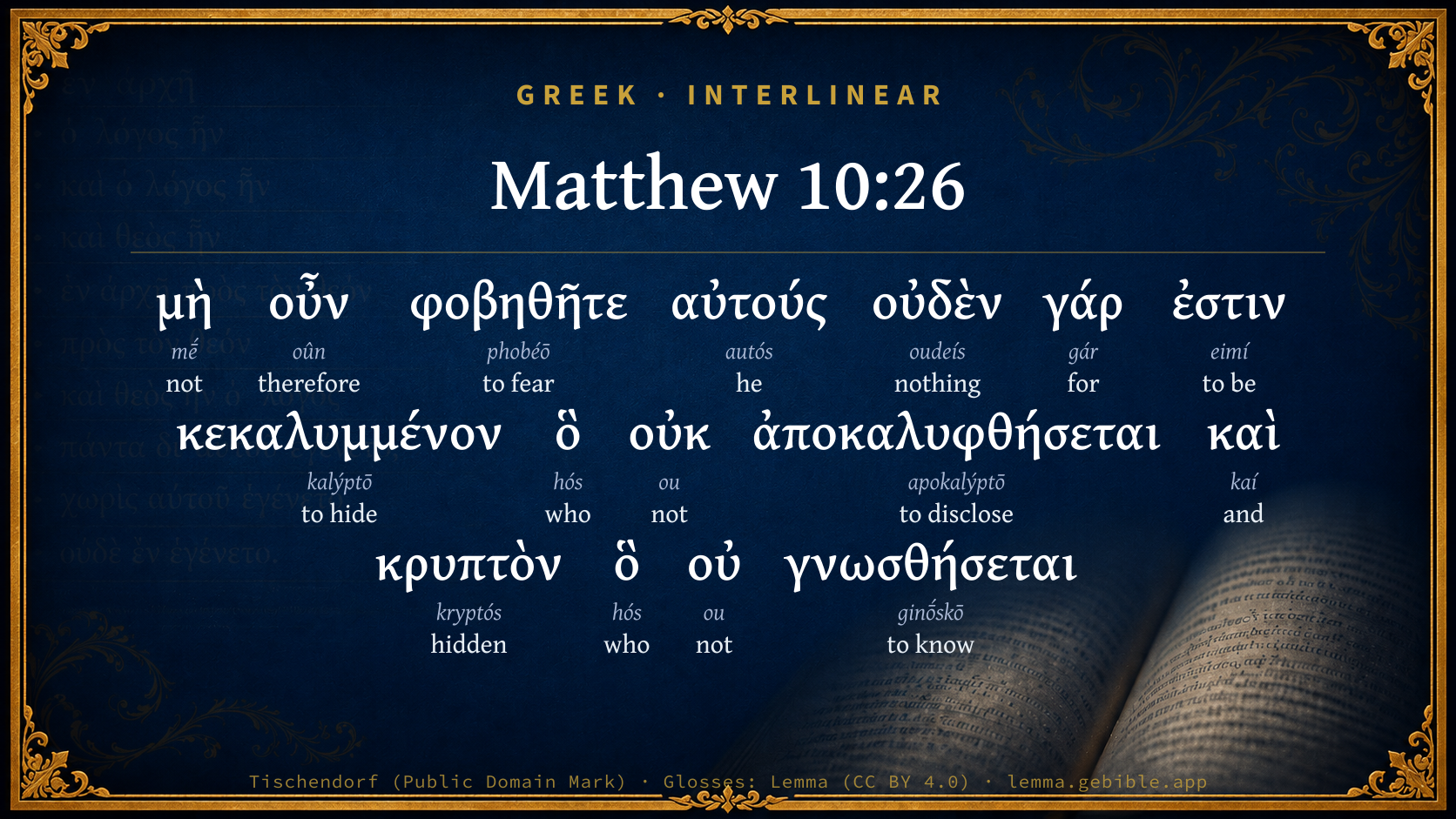
Download image
Cite this verse

Matthew 10:26 (World English Bible). Public Domain. Lemma interlinear Bible study tool, https://lemma.gebible.app/v/matthew/10/26.

Show BibTeX & RIS
BibTeX
RIS
English Translation
Therefore don't be afraid of them, for there is nothing covered that will not be revealed; and hidden that will not be known.
World English Bible · Public Domain
Highlights
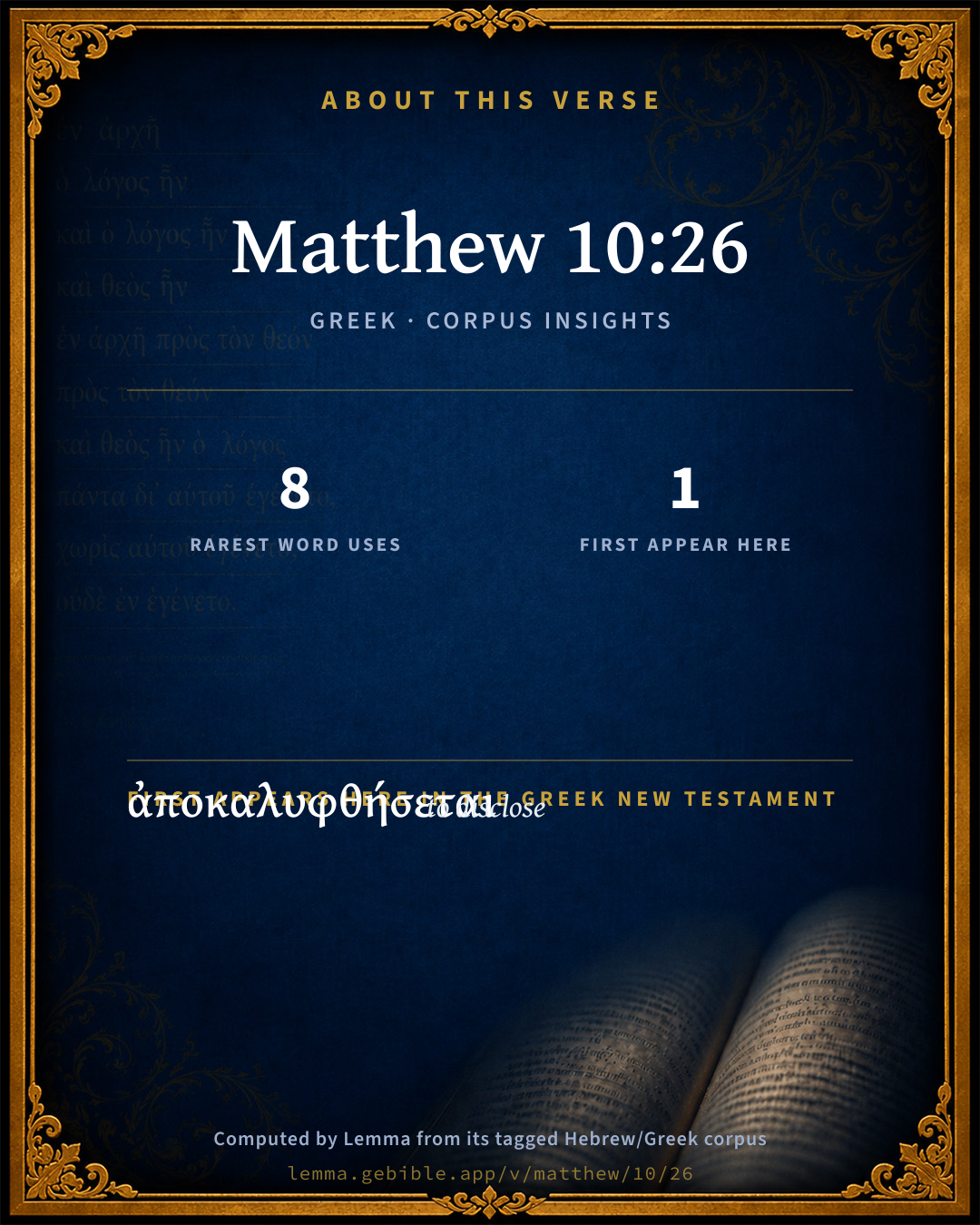
  • 1 first appearance in the Greek New Testament
Full analysis ↓
Download a study sheet

One document with this verse’s original text, its word-by-word gloss line, the meaning frame, cross-references with their text, attributed commentary, and full source and license credits — printable, and it pastes into notes with its structure intact.

This verse Autodidact and up

Study sheet (.html) Plain text (.txt)

A passage Seminary Student

Up to 50 verses in one chapter. A passage sheet keeps up to 6 commentary sources and 12 cross-references per verse, in the order this page ranks them, and says so on the sheet whenever that leaves anything out. Ask for a single verse and you get the Autodidact verse sheet above.

Everything on this page stays free to read, with no account — the sheet is a download of what is already on screen, not access to it.

Want to remove ads? Support Godless Engineer
Compare translations 3

The same verse in 3 English versions, stacked beneath the original-language interlinear above. Click any original word for its lexicon entry.

Each is an independent rendering of the whole verse — the interlinear is not word-aligned to these translations.

Highlighted words mark where these versions differ — a whole-verse word diff, not a word-by-word alignment.

  • World English Bible Public Domain
    Therefore don't be afraid of them, for there is nothing covered that will not be revealed; and hidden that will not be known.
  • King James Version Public Domain
    Fear them not therefore: for there is nothing covered, that shall not be revealed; and hid, that shall not be known.
  • unfoldingWord Literal Text CC BY-SA 4.0
    Therefore, do not fear them, for there is nothing concealed that will not be revealed, and hidden, that will not be made known.

unfoldingWord Literal Text — © unfoldingWord, licensed CC BY-SA 4.0. Word-aligned USFM3 via Door43 (git.door43.org/unfoldingWord/en_ult).

Versions to compare (up to 4)

3 of 4 selected

Show all 19 translations

Every available English version of this verse, each an independent rendering of the whole verse.

  • World English Bible Public Domain
    Therefore don't be afraid of them, for there is nothing covered that will not be revealed; and hidden that will not be known.
  • Berean Standard Bible Public Domain
    So do not be afraid of them. For there is nothing concealed that will not be disclosed, and nothing hidden that will not be made known.
  • Majority Standard Bible Public Domain
    So do not be afraid of them. For there is nothing concealed that will not be disclosed, and nothing hidden that will not be made known.
  • King James Version Public Domain
    Fear them not therefore: for there is nothing covered, that shall not be revealed; and hid, that shall not be known.
  • American Standard Version (1901) Public Domain
    Fear them not therefore: for there is nothing covered, that shall not be revealed; and hid, that shall not be known.
  • Revised Version (1885) Public Domain
    Fear them not therefore: for there is nothing covered, that shall not be revealed; and hid, that shall not be known.
  • Geneva Bible (1599) Public Domain
    Feare them not therefore: for there is nothing couered, that shall not be disclosed, nor hid, that shall not be knowen.
  • Douay-Rheims (1899) Public Domain
    Therefore fear them not. For nothing is covered that shall not be revealed: nor hid, that shall not be known.
  • Young's Literal Translation Public Domain
    `Ye may not, therefore, fear them, for there is nothing covered, that shall not be revealed, and hid, that shall not be known;
  • Literal Standard Version CC BY-SA 4.0
    You may not, therefore, fear them, for there is nothing covered that will not be revealed, and hid that will not be known;
  • Unlocked Literal Bible CC BY-SA 4.0
    Therefore do not fear them, for there is nothing concealed that will not be revealed, and nothing hidden that will not be known.
  • unfoldingWord Literal Text CC BY-SA 4.0
    Therefore, do not fear them, for there is nothing concealed that will not be revealed, and hidden, that will not be made known.
  • Darby Bible Public Domain
    Fear them not therefore; for there is nothing covered which shall not be revealed, and secret which shall not be known.
  • World Messianic Bible Public Domain
    Therefore don’t be afraid of them, for there is nothing covered that will not be revealed, or hidden that will not be known.
  • Webster's Bible Public Domain
    Fear them not therefore: for there is nothing covered, that shall not be revealed; and hid, that shall not be known.
  • Free Bible Version CC BY-SA 4.0
    So don't be frightened of them, for there's nothing covered that won't be exposed, and nothing hidden that won't be made known.
  • Bible in Basic English Public Domain
    Have, then, no fear of them: because nothing is covered which will not come to light, or secret which will not be made clear.
  • Text-Critical English NT CC BY 4.0
    “So do not be afraid of them, for there is nothing covered that will not be revealed, and nothing hidden that will not be made known.
  • Tyndale New Testament (1534) Public Domain
    Feare the not therfore. There is no thinge so close that shall not be openned and no thinge so hyd that shall not be knowen.

Literal Standard Version (2020), Covenant Press — licensed CC BY-SA 4.0. Text via the HelloAO Bible API (eBible.org). Unlocked Literal Bible (unfoldingWord) — licensed CC BY-SA 4.0. Text via the HelloAO Bible API (eBible.org). unfoldingWord Literal Text — © unfoldingWord, licensed CC BY-SA 4.0. Word-aligned USFM3 via Door43 (git.door43.org/unfoldingWord/en_ult). Free Bible Version, Dr. Jonathan Gallagher — licensed CC BY-SA 4.0. Text via the HelloAO Bible API (eBible.org).

Word by word

More ways to search: Search by grammar → Find every occurrence → Compare this word →

Practice this passage: Drill this verse → Learn its vocabulary →

κεκαλυμμένον
kalýptō
G2572
“to hide”
Verb, Perfect, Passive, Participle, Nominative, Singular, Neuter
Part of Speech
Verb
Tense
Perfect
Voice
Passive
Mood
Participle
Case
Nominative
Number
Singular
Gender
Neuter
Full Thayer's Definition

Origin: akin to G2813 and G2928

TDNT: 11:56,4

1. to hide, veil a. to hinder the knowledge of a thing
  1. μὴ mḗ G3361 “not” Particle, Negative
  2. οὖν oûn G3767 “therefore” Conjunction
  3. φοβηθῆτε phobéō G5399 “to fear” Verb, Aorist, Passive deponent, Imperative, 2nd person, Plural
  4. αὐτούς autós G846 “he” Personal pronoun, Accusative, Plural, Masculine
  5. οὐδὲν oudeís G3762 “nothing” Adjective, Nominative, Singular, Neuter, Negative
  6. γάρ gár G1063 “for” Conjunction
  7. ἐστιν eimí G1510 “to be” Verb, Present, Active, Indicative, 3rd person, Singular
  8. ὃ hós G3739 “who” Relative pronoun, Nominative, Singular, Neuter
  9. οὐκ ou G3756 “not” Particle, Negative
  10. ἀποκαλυφθήσεται apokalýptō G601 “to disclose” Verb, Future, Passive, Indicative, 3rd person, Singular
  11. καὶ kaí G2532 “and” Conjunction
  12. κρυπτὸν kryptós G2927 “hidden” Adjective, Nominative, Singular, Neuter
  13. ὃ hós G3739 “who” Relative pronoun, Nominative, Singular, Neuter
  14. οὐ ou G3756 “not” Particle, Negative
  15. γνωσθήσεται ginṓskō G1097 “to know” Verb, Future, Passive, Indicative, 3rd person, Singular

About this verse

These counts appear in no published source. They are computed here, from the morphology-tagged text and Lemma’s own curated glosses. What Lemma adds →

16
words
14
distinct lemmas
Gospels
section

Notable vocabulary

The rarest word here is κεκαλυμμένον to hide G2572 — appearing just 8 times in the whole Greek New Testament.

First appearance in Scripture

This word makes its first canonical appearance in the Greek New Testament here:

  • ἀποκαλυφθήσεται to disclose G601

Shared distinctive vocabulary

κεκαλυμμένον to hide G2572 occurs in 7 verses of the Greek New Testament. Also found in:
Repetition

Words recur within this verse:

Cross-references

20

Topical passages linked to Matthew 10:26 in the Treasury of Scripture Knowledge — connected by theme and wording, ordered by reader-vote popularity; previews shown in the World English Bible.

  • Luke 8:17 For nothing is hidden, that will not be revealed; nor anything secret, that will not be known and come to light.
  • Jeremiah 1:8 Don't be afraid because of them; for I am with you to deliver you, says Yahweh.
  • Mark 4:22 For there is nothing hidden, except that it should be made known; neither was anything made secret, but that it should come to light.
  • Isaiah 43:1–2 But now thus says Yahweh who created you, Jacob, and he who formed you, Israel: Don't be afraid, for I have redeemed you; I have called you by your name, you are mine.
  • 1 Corinthians 4:5 Therefore judge nothing before the time, until the Lord comes, who will both bring to light the hidden things of darkness, and reveal the counsels of the hearts. Then each man will get his praise from God.
  • Matthew 10:28 Don't be afraid of those who kill the body, but are not able to kill the soul. Rather, fear him who is able to destroy both soul and body in Gehenna.
  • Isaiah 41:10 Don't you be afraid, for I am with you; don't be dismayed, for I am your God; I will strengthen you; yes, I will help you; yes, I will uphold you with the right hand of my righteousness.
  • Isaiah 51:12–13 I, even I, am he who comforts you: who are you, that you are afraid of man who shall die, and of the son of man who shall be made as grass;
  • Luke 12:2–9 But there is nothing covered up, that will not be revealed, nor hidden, that will not be known.
  • Isaiah 51:7–8 Listen to me, you who know righteousness, the people in whose heart is my law; don't you fear the reproach of men, neither be you dismayed at their insults.
  • Proverbs 28:1 The wicked flee when no one pursues; But the righteous are as bold as a lion.
  • Isaiah 41:14 Don't be afraid, you worm Jacob, and you men of Israel; I will help you, says Yahweh, and your Redeemer is the Holy One of Israel.
  • Proverbs 29:25 The fear of man proves to be a snare, But whoever puts his trust in Yahweh is kept safe.
  • Ezekiel 2:6 You, son of man, don't be afraid of them, neither be afraid of their words, though briers and thorns are with you, and you do dwell among scorpions: don't be afraid of their words, nor be dismayed at their looks, though they are a rebellious house.
  • 1 Peter 3:14 But even if you should suffer for righteousness' sake, you are blessed. "Don't fear what they fear, neither be troubled."
  • Acts 4:19 But Peter and John answered them, "Whether it is right in the sight of God to listen to you rather than to God, judge for yourselves,
  • Jeremiah 1:17–18 You therefore gird up your loins, and arise, and speak to them all that I command you: don't be dismayed at them, lest I dismay you before them.
  • Acts 1:8 But you will receive power when the Holy Spirit has come upon you. You will be witnesses to me in Jerusalem, in all Judea and Samaria, and to the uttermost parts of the earth."
  • Luke 24:47 and that repentance and remission of sins should be preached in his name to all the nations, beginning at Jerusalem.
  • Acts 4:13 Now when they saw the boldness of Peter and John, and had perceived that they were unlearned and ignorant men, they marveled. They recognized that they had been with Jesus.

Cross-references courtesy of OpenBible.info (CC BY 4.0).

Commentary

Notes on Matthew 10:26 from classic Christian and Jewish commentators (each source and its license shown beneath its notes). The classic Christian expositions comment on the surrounding passage and are grouped to its opening verse, so a note may address several verses; the Jewish commentaries on the Tanakh (Rashi and others) are per-verse, so they appear only where the commentator wrote on this verse.

Lemma curates 59 commentaries, every one of them public domain or Creative Commons licensed, each selected and text-cleaned for this edition rather than reprinted as found. About our sources →

Lange's Commentary on the Holy Scriptures

9. Holy boldness and candor the duty of the disciples, based on holy watchfulness, and on confidence in their safety, under the sovereign protection of God.

Third and fourth warning and comfort. Mat_10:26-31.

26Fear them not therefore: for there is nothing covered [concealed, verhüllt], that shall not be revealed [enthüllt]; and hid [versteckt], that shall not be known [entdeckt]. 27What I tell you in darkness, that speak ye in [the, τῷ] light: and what ye hear in the ear, that preach ye upon the house-tops. 28And fear not [Be not afraid of, μὴ φοβεῖσθε ἀπό]36 them which [that] kill37 the body, but are not able to kill the soul:

But rather fear him [φοβεῖσθε τόν] which [who] is able to destroy both soul and body in hell. 29Are not two sparrows sold for a farthing [penny]38? and one of them shall not [not one of them shall] fall on the ground without your Father. 30But the very hairs of your head39 are all numbered. 31Fear ye not therefore, ye are of more value than many sparrows.

EXEGETICAL AND CRITICAL

Mat_10:26. Fear them not therefore.—Because every calumny of their faith was in the first place directed against their Master, who will set everything in its true light Confidence in His παρουσία is to form the ground of their perfect παρ̀ῥησία. All the wicked secrets of their opponents shall be brought to light; it would, therefore, be most unbecoming if they were to spread their faith, the most precious of all secrets, with timidity and by stealth,40 as if it were some dangerous mystery.

For there is nothing covered, etc.—These two proverbial sayings or principles are apparently intended to supplement each other. The first of them refers probably to the dealings of God: He conceals and He reveals. The second refers to the conduct of man in connection with the dealings of God: men hide and conceal the truth, but it will be discovered, known, and acknowledged. The appearing of Christ will place everything in its proper light, Mat_25:31; Eph_5:13; 1Co_4:5.

Mat_10:27. What I tell you.—This means to imply that the Lord recommended to His disciples to proceed more openly in their teaching than He had done. But this was the fundamental principle of the development of His revelation. His work was to be established in His disciples before it could be established in the world. Revelation had to receive its final completion in secret, among the despised community of the cross, before it could be presented in its fulness to the world.—Upon the house-tops.—The roofs were flat, so that it was possible to converse, in a loud voice, from one house-top to another, or into the street. A figurative expression for the most public declaration.

Mat_10:28. Fear not them that kill the body.[41]—This παῤῥησία may indeed occasion their death. But they should neither fear death nor those who kill. They kill only the body. In other words, the hope of the great appearing of Christ, which shall make everything manifest, must raise them also above the grave.

Both soul and body.—In my Life of Jesus (Mat_2:2, p. 721), I have with Stier applied this to Satan, while most commentators refer it to God. The former interpretation I supported on the following grounds: 1. Because the same kind of fear which is felt toward those who kill the body cannot be cherished in reference to God. But here I overlooked that the expression used in the one case is φοβεῖσθε ἀπὁ, [comp. the Hebr. יָרֵא מִין], and in the other, φοβήθητε [φοβεῖσθε] τόν. The word φοβεῖν may also be used in reference to proper fear, and the use of the Aorist (implying the continuation of a fear already cherished), as also the accusative instead of ἀπό, are in favor of this view. 2. Because the idea of destruction of body and soul seems rather to apply to Satan. But the great enemy does not destroy soul and body in hell (ἐν γεέννῃ),42 where he and condemned souls are punished (Mat_25:41; Rev_20:10), but before that time, and for the purpose of having them consigned to hell. The judgment of Gehenna is not administered by Satan. 3. Because of the expression ἀπόλλυμι, which in other places refers to noxious destruction, or to laying waste, and the name of ̓Απολλύων, “who dwells in the place of destruction.” However, the text does not bear, “Fear the destroyer,” but, “Fear Him who is able to destroy,” which could only refer to God. Finally, from the parallel passage in Luk_12:5, “Fear Him who hath power to cast into hell,” we at once conclude that this fear can only apply to the Almighty. Satan works that sinful fear of death which is the bondage from which we can only be delivered by a higher and holier fear—that of God (Heb_2:14).

[This change of Dr. Lange, which supersedes the protest of Meyer in loc. (4th ed., vol. 1, p. 239), is decidedly for the better. The Scripture nowhere uses the phrase φοβεῖσθαι τὸν διάβολον, nor does it ever ascribe to Satan such power of destruction; while, on the contrary, φοβεῖσθαι is usually followed by τòν θεόν, and God is represented throughout as the Almighty dispenser of life and death, both temporal and eternal. Bengel aptly quotes Jam_4:12, which is decisive against Stier: “There is one lawgiver who is able (ὁδυνάμενος) to save and to destroy” (ἀπολέσαι, the same words as in our passage). Christ sets God before us here as the sole object both of our godly, child-like fear, and (in Mat_10:29-31) of our child-like trust. We should fear Him alone because of His power to destroy, and should trust Him alone because of His power to save and His ever-watchful care of His children. See Dr. Alford’s remarks against Stier, and also the note of Dr. Owen in loc.: “Fear Him (i. e., God), not as before, fear from Him, because reverence and awe, such as is due from man to his Maker, is intended, and not the fear or terror which human cruelty can inspire.”—P. S.]

Mat_10:29. Two sparrows.—The word στρουθία properly signifies little birds generally [aviculi]; here, in the more definite sense, little sparrows [passerculi].—Farthing, penny, ἀσσάριον, the tenth part of a drachm, or a Roman denar, afterward valued still lower; indicating the smallest coin.—Not one of them shall fall to the ground.—To portray sudden death, the bird falling to the ground, struck by a stone or an arrow. Irenæus and Chrysostom refer it to the snare of the bird-catcher; but this would scarcely be so applicable.

Mat_10:30. But the very hairs.—Indicating the most special providence (providentia specialissima), and the most absolute preservation. The hair as the natural ornament of the head. No part of our life, of what characterizes or adorns it, shall be lost.

DOCTRINAL AND ETHICAL

1. The disciples must bear in mind that the gospel of Jesus is destined to become a revelation for all nations. They are to form a Church, and not a secret society, or party, or school, or political fraternity. The contrast between the secrecy which the Lord employed in teaching them, and the publicity with which they were to come forward, indicates the law according to which revelation was ever to develop and break forth more clearly and openly, and points far beyond the mission then entrusted to them.

2. They which kill the body.—(1) Psychology: body and soul; (2) doctrine of immortality; (3) eschatology: the kingdom of Christ belongs pre-eminently to the other world, beyond death and the grave. Mark also the contrast between killing the body and destroying body and soul. The soul cannot be annihilated. Lastly, it also implies the doctrine of the resurrection of the body. The bodies of the lost shall suffer with their souls in hell.43

3. Not a hair of your head shall perish without your Father, far less your head itself.—An expression implying their complete safety.—“Of more value than many sparrows.” This depends upon the διαφέρειν, and is intended to indicate the infinite superiority of the disciples over irrational creatures. The climax is as follows:—The humblest of God’s creatures have their value in His sight: how much more human beings! Especially Christians: but, above all, the witnesses of Jesus. The value of the life of Jesus is the height of the climax, but does not appear here.

HOMILETICAL AND PRACTICAL

The address of the Lord to His people: Fear not. 1. The fear from which we are delivered (of revilers and of murderers, of the loss of honor and of life); 2. the fear by which we are delivered (Fear Him who is able, etc.); 3. the spiritual grounds for being fearless (confidence in the great revelation of Christ, consciousness of our immortality and of our complete safety in the hands of God); the blessed effect of such fearlessness—perfect joy in bearing witness for Jesus (or in particular cases, triumph of life over death, entrance into glory).—With the manifestation of Christ’s righteousness, everything else must become manifest.—When God makes known what is hid, men can no longer succeed in concealing it.—The impending great revelation in its twofold effects: 1. As giving perfect comfort to the disciples: 2. as the greatest terror to an evil conscience.—Holy and spiritual fear will set us free from all carnal fear.—A right sense of our immortality consists in the feeling that we are perfectly safe in the keeping of our Father.—The price of articles in the market an emblem of the high price which God attaches to life.—Money, or the price which men attach, a symbol of the value which God sets.—“Are not two sparrows sold for a farthing?” or, the birds of the air a sermon to us, both in death and in life.—God cares for all living, after its own kind: 1. According to its life (the Living One cares for the living, the God of providence for every individual, the sympathizing Saviour pities every one); 2. according to its peculiar mode of life (for His creatures in His goodness, for persons in His love, for believers in His grace); 3. according to the object of their lives (Christ, for His own sake and for that of His people; Christians, for Christ’s and their own sakes; and all creatures, for the sake of Christians and of the kingdom of God).—“The very hairs of your head are all numbered;” or, the complete safety of Christians in the keeping of their Father: 1. Their whole life, with all that characterizes and adorns it, is safe; 2. they lose their earthly life, only to gain a higher; 3. their life, with all its gain, is bestowed on them by their Father in heaven.

Starke:—Those who fear to proclaim the whole truth are false teachers, and neither cold nor hot.—Quesnel: It is sinful to withhold the word of God from the common people. [Quesnel adds on Mat_10:27 : “The Church has no more hidden mysteries, nor secret truths; and it is now the time to reveal all the knowledge and grace which Christ has committed to her. It is to injure religion, to imagine that it contains some truths or mysteries which ought to be concealed.”—P. S.]—Cramer: Human fear must be overcome by the fear of God.—Eternal death is the only evil which really deserves to be feared.—Quesnel: It is a sign of great blindness to allow our souls to be destroyed.—The contemplation of the providence of God a powerful means for overcoming the fear of man.—What infinite value attaches to a soul for which Jesus has shed his blood! [We add from Quesnel on Mat_10:28 : “It is prudence to deliver up the body in order to save the soul. This is to cast the lading of the vessel into the sea, to preserve the men from destruction. A man loses nothing when he loses that only which must perish.”—P. S.]

Heubner:—Nothing in the life of His people is of small importance before God.—Infinite value of an immortal soul.

Footnotes:

[37] Mat_10:28.—̓Αποκτεννόντων [double ν, also in Cod. Sinait.] is the Æolian-Alexandrian form [for ἀποκτεινόντων.] Lachmann, [Tischendorf, Alford]. See the note of Meyer [Com. i., p. 227].

[38] Mat_10:29.—[Luther and Lange render ἀσσάριον (diminut from the Lat. as): Pfennig, de Wette: Heller. The E. V. uses farthing in Mat_5:26 for the Greek κορδάντης. But this is only the third or fourth part in value of an ἀσσάριον which is equal to a cent and a half of Am. money. Hence penny is more accurate. Conant: “The Saviour means by it the most trifling pecuniary value, or next to nothing; and to change the Common Version, merely for more minute exactness in such a case, would be mere pedantry. But as different words are used in the Greek and as farthing and penny represent their exact relation and nearly their actual value, there is no harm in making the distinction.”—P. S.]

[39] Mat_10:30.—[The Greek and the German have here the advantage over the English in being able to place your, is marked contrast to the sparrows, at the beginning of the sentence. ̔Τ μῶν δὲ καὶ αἱ τρίχεις τῆς κεφαλῆς, Lange (deviating from Luther): “An each aber sind auch die Haare des Hauptes,” etc. Perhaps we might render: “But as to you, the very hairs of your head,” etc.—P. S.]

[40][In German: mit ängstlicher Heimlichthuerei.—]

[41][These were the dying words of Ulrich Zwingli on the settle field of Cappel in Switzerland, Oct., 1531.—P. S.]

[42][Luther wrongly translates: in die Hölle, for in der, mistaking ἐν for εὶς. The E. V. here, as elsewhere, is more accurate.—P. S.]

[43][We add the remark of Dr. Brown: “both soul and body in hell. A decisive proof this that there is a hell for the body as well as the soul in the eternal world; in other words, that the torment that awaits the lost will have elements of suffering adapted to the material as well as the spiritual part of our nature, both of which, we are assured, will exist for ever.”—P. S.]

Lange's Commentary on the Holy Scriptures (Critical, Doctrinal, and Homiletical), ed. John Peter Lange, English translation edited by Philip Schaff (1864–1880) — public domain. Text from a community e-Sword module.

MacLaren's Expositions of Holy Scripture

Alexander MacLaren

Matthew

THE WIDENED MISSION, ITS PERILS AND DEFENCES

Mat 10:16-31.

We have already had two instances of Matthew’s way of bringing together sayings and incidents of a like kind without regard to their original connection. The Sermon on the Mount and the series of miracles in Mat 8:1 - Mat 8:34 and Mat 9:1 - Mat 9:38 are groups, the elements of which are for the most part found disconnected in Mark and Luke. This charge to the twelve in Mat 10:1 - Mat 10:42 seems to present a third instance, and to pass over in Mat 10:16 to a wider mission than that of the twelve during our Lord’s lifetime, for it forebodes persecution, whereas the preceding verses opened no darker prospect than that of indifference or non-reception. The ‘city’ which, in that stage of the gospel message, simply would ‘not receive you nor hear your words,’ in this stage has worsened into one where ‘they persecute you,’ and the persecutors are now ‘kings’ and ‘Gentiles,’ as well as Jewish councils and synagogue-frequenters. The period covered in these verses, too, reaches to the ‘end,’ the final revelation of all hidden things.

Obviously, then, our Lord is looking down a far future, and giving a charge to the dim crowd of His later disciples, whom His prescient eye saw pressing behind the twelve in days to come. He had no dreams of swift success, but realised the long, hard fight to which He was summoning His disciples. And His frankness in telling them the worst that they had to expect was as suggestive as was His freedom from the rosy, groundless visions of at once capturing a world which enthusiasts are apt to cherish, till hard experience shatters the illusions. He knew the future in store for Himself, for His Gospel, for His disciples. And He knew that dangers and death itself will not appal a soul that is touched into heroic self-forgetfulness by His love. ‘Set down my name,’ says the man in Pilgrim’s Progress, though he knew-may we not say, because he knew?-that the enemies were outside waiting to fall on him.

A further difference between this and the preceding section is, that there the stress was laid on the contents of the disciples’ message, but that here it is laid on their sufferings. Not so much by what they say, as by how they endure, are they to testify. ‘The noble army of martyrs praise Thee,’ and the primitive Church preached Jesus most effectually by dying for Him.

The keynote is struck in Mat 10:16, in which are to be noted the ‘Behold,’ which introduces something important and strange, and calls for close attention; the majestic ‘I send you,’ which moves to obedience whatever the issues, and pledges Him to defend the poor men who are going on His errands and the pathetic picture of the little flock huddled together, while the gleaming teeth of the wolves gnash all round them. A strange theme to drape in a metaphor! but does not the very metaphor help to lighten the darkness of the picture, as well as speak of His calmness, while He contemplates it? If the Shepherd sends His sheep into the midst of wolves, surely He will come to their help, and surely any peril is more courageously faced when they can say to themselves, ‘He put us here.’ The sheep has no claws to wound with nor teeth to tear with, but the defenceless Christian has a defence, and in his very weaponlessness wields the sharpest two-edged sword. ‘Force from force must ever flow.’ Resistance is a mistake. The victorious antagonist of savage enmity is patient meekness. ‘Sufferance is the badge of all’ true servants of Jesus. Wherever they have been misguided enough to depart from Christ’s law of endurance and to give blow for blow, they have lost their cause in the long run, and have hurt their own Christian life more than their enemies’ bodies. Guilelessness and harmlessness are their weapons. But ‘be ye wise as serpents’ is equally imperative with ‘guileless as doves.’ Mark the fine sanity of that injunction, which not only permits but enjoins prudent self-preservation, so long as it does not stoop to crooked policy, and is saved from that by dove-like guilelessness. A difficult combination, but a possible one, and when realised, a beautiful one!

The following verses {Mat 10:17} expand the preceding, and mingle in a very remarkable way plain predictions of persecution to the death and encouragements to front the worst. Jewish councils and synagogues, Gentile governors and kings, will unite for once in common hatred, than which there is no stronger bond. That is a grim prospect to set before a handful of Galilean peasants, but two little words turn its terror into joy; it is ‘for My sake,’ and that is enough. Jesus trusted His humble friends, as He trusts all such always, and believed that ‘for My sake’ was a talisman which would sweeten the bitterest cup and would make cowards into heroes, and send men and women to their deaths triumphant. And history has proved that He did not trust them too much. ‘For His sake’-is that a charm for us, which makes the crooked straight and the rough places plain, which nerves for suffering and impels to noble acts, which moulds life and takes the sting and the terror out of death? Nor is that the only encouragement given to the twelve, who might well be appalled at the prospect of standing before Gentile kings. Jesus seems to discern how they shrank as they listened, at the thought of having to bear ‘testimony’ before exalted personages, and, with beautiful adaptation to their weakness, He interjects a great promise, which, for the first time, presents the divine Spirit as dwelling in the disciples’ spirits. The occasion of the dawning of that great Christian thought is very noteworthy, and not less so is the designation of the Spirit as ‘of your Father,’ with all the implications of paternal care and love which that name carries. Special crises bring special helps, and the martyrologies of all ages and lands, from Stephen outside the city wall to the last Chinese woman, have attested the faithfulness of the Promiser. How often have some calm, simple words from some slave girl in Roman cities, or some ignorant confessor before Inquisitors, been manifestly touched with heavenly light and power, and silenced sophistries and threats!

The solemn foretelling of persecution, broken for a moment, goes on and becomes even more foreboding, for it speaks of dearest ones turned to foes, and the sweet sanctities of family ties dissolved by the solvent of the new Faith. There is no enemy like a brother estranged, and it is tragically significant that it is in connection with the rupture of family bonds that death is first mentioned as the price that Christ’s messengers would have to pay for faithfulness to their message. But the prediction springs at a bound, as it were, from the narrow circle of home to the widest range, and does not fear to spread before the eyes of the twelve that they will become the objects of hatred to the whole human race if they are true to Christ’s charge. The picture is dark enough, and it has turned out to be a true forecast of facts. It suggests two questions. What right had Jesus to send men out on such an errand, and to bid them gladly die for Him? And what made these men gladly take up the burden which He laid on them? He has the right to dispose of us, because He is the Son of God who has died for us. Otherwise He is not entitled to say to us, Do my bidding, even if it leads you to death. His servants find their inspiration to absolute, unconditional self-surrender in the Love that has died for them. That which gives Him His right to dispose of us in life and death gives us the disposition to yield ourselves wholly to Him, to be His apostles according to our opportunities, and to say, ‘Whether I live or die, I am the Lord’s.’

That thought of world-wide hatred is soothed by the recurrence of the talisman, ‘For My name’s sake,’ and by a moment’s showing of a fair prospect behind the gloom streaked with lightning in the foreground. ‘He that endureth to the end shall be saved.’ The same saying occurs in Mat 24:13, in connection with the prediction of the fall of Jerusalem, and in the same connection in Mar 13:13, in both of which places several other sayings which appear in this charge to the apostles are found. It is impossible to settle which is the original place for these, or whether they were twice spoken. The latter supposition is very unfashionable at present, but has perhaps more to say for itself than modern critics are willing to allow. But Luk 21:19 has a remarkable variation of the saying, for his version of it is, ‘In your patience, ye shall win your souls.’ His word ‘patience’ is a noun cognate with the verb rendered in Matthew and Mark ‘endureth,’ and to ‘win one’s soul’ is obviously synonymous with being ‘saved.’ The saying cannot be limited, in any of its forms, to a mere securing of earthly life, for in this context it plainly includes those who have been delivered to death by parents and brethren, but who by death have won their lives, and have been, as Paul expected to be, thereby ‘saved into His heavenly kingdom.’ To the Christian, death is the usher who introduces him into the presence-chamber of the King, and he that loseth his life ‘for My name’s sake,’ finds it glorified in, and into, life eternal.

But willingness to endure the utmost is to be accompanied with willingness to take all worthy means to escape it. There has been a certain unwholesome craving for martyrdom generated in times of persecution, which may appear noble but is very wasteful. The worst use that you can put a man to is to burn him, and a living witness may do more for Christ than a dead martyr. Christian heroism may be shown in not being afraid to flee quite as much as in courting, or passively awaiting, danger. And Christ’s Name will be spread when His lovers are hounded from one city to another, just as it was when ‘they that were scattered abroad, went everywhere, preaching the word.’ When the brands are kicked apart by the heel of violence, they kindle flames where they fall.

But the reason for this command to flee is perplexing. ‘Ye shall not have gone over the cities of Israel till the Son of Man be come.’ Is Jesus here reverting to the narrower immediate mission of the apostles? What ‘coming’ is referred to? We have seen that the first mission of the twelve was the theme of Mat 10:5 - Mat 10:15, and was there pursued to its ultimate consequences of final judgment on rejecters, whilst the wider horizon of a future mission opens out from Mat 10:16 onwards. A renewed contraction of the horizon is extremely unlikely. It would be as if ‘a flower should shut and be a bud again.’ The recurrence in Mat 10:23 of ‘Verily I say unto you,’ which has already occurred in Mat 10:15, closing the first section of the charge, makes it probable that here too a section is completed, and that probability is strengthened if it is observed that the same phrase occurs, for a third time, in the last verse of the chapter, where again the discourse soars to the height of contemplating the final reward. The fact that the apostles met with no persecution on their first mission, puts out of court the explanation of the words that refers them to that mission, and takes the ‘coming’ to be Jesus’ own appearances in the places they had preceded Him as His heralds. The difficult question as to what is the terminus ad quem pointed to here seems best solved by taking the ‘coming of the Son of Man’ to be His judicial manifestation in the destruction of Jerusalem and the consequent desolation of many of ‘the cities of Israel,’ whilst at the same time, the nearer and smaller catastrophe is a prophecy and symbol of the remoter and greater ‘day of the Son of Man’ at the end of the days. The recognition of that aspect of the fall of Jerusalem is forced on us by the eschatological parts of the Gospels, which are a bewildering whirl without it. Here, however, it is the crash of the fall itself which is in view, and the thought conveyed is that there would be cities enough to serve for refuges, and scope enough for evangelistic work, till the end of the Jewish possession of the land.

In Mat 10:26 - Mat 10:31, ‘fear not’ is thrice spoken, and at each occurrence is enforced by a reason. The first of these encouragements is the assurance of the certain ultimate world-wide manifestation of hidden things. That same dictum occurs in other connections, and with other applications, but in the present context can only be taken as an assurance that the Gospel message, little known as it thus far was, was destined to fill all ears. Therefore the disciples were to be fearless in doing their part in making it known, and so working in alliance with the divine purpose. It is the same thing that is meant by the ‘covered’ that ‘shall be revealed,’ the ‘hidden’ that ‘shall be known,’ ‘that which is spoken in darkness,’ and ‘that which is whispered in the ear’; and all four designations refer to the word which every Christian has it in charge to sound out. We note that Jesus foresees a far wider range of publicity for His servants’ ministry than for His own, just as He afterwards declared that they would do ‘greater works’ than His. He spoke to a handful of men in an obscure corner of the world. His teaching was necessarily largely confidential communication to the fit few. But the spark is going to be a blaze, and the whisper to become a shout that fills the world. Surely, then, we who are working in the line of direction of God’s working should let no fear make us dumb, but should ever hear and obey the command: ‘Lift up thy voice with strength, lift it up, be not afraid.’

A second reason for fearlessness is the limitation of the enemy’s power to hurt, reinforced by the thought that, while the penalties that man can inflict for faithfulness are only corporeal, transitory, and incapable of harming the true self, the consequences of unfaithfulness fling the whole man, body and soul, down to utter ruin. There is a fear that makes cowards and apostates; there is a fear which makes heroes and apostles. He who fears God, with the awe that has no torment and is own sister to love, is afraid of nothing and of no man. That holy and blessed fear drives out all other, as fire draws the heat out of a burn. He that serves Christ is lord of the world; he that fears God fronts the world, and is not afraid.

The last reason for fearlessness touches a tender chord, and discloses a gracious thought of God as Father, which softens the tremendous preceding word: ‘Who is able to destroy both soul and body in hell.’ Take both designations together, and let them work together in producing the awe which makes us brave, and the filial trust which makes us braver. A bird does not ‘fall to the ground’ unless wounded, and if it falls it dies. Jesus had looked pityingly on the great mystery, the woes of the creatures, and had stayed Himself on the thought of the all-embracing working of God. The very dying sparrow, with broken wing, had its place in that universal care. God is ‘immanent’ in nature. The antithesis often drawn between His universal care and His ‘special providence’ is misleading. Providence is special because it is universal. That which embraces everything must embrace each thing. But the immanent God is ‘your Father,’ and because of that sonship, ‘ye are of more value than many sparrows.’ There is an ascending order, and an increasing closeness and tenderness of relation. ‘A man is better than a sheep,’ and Christians, being God’s children, may count on getting closer into the Father’s heart than the poor crippled bird can, or than the godless man can. ‘Your Father,’ on the one hand, can destroy soul and body, therefore fear Him; but, on the other, He determines whether you shall ‘fall to the ground’ or soar above dangers, therefore fear none but Him.

Alexander MacLaren, Expositions of Holy Scripture (1904–1910) — public domain. Text from a community e-Sword module.

Bengel's Gnomon

Johann Albrecht Bengel

Mat 10:26. Οὖν, therefore) although you will be hated.—οὐδὲν, nothing) Cf. Mar 4:22; Luk 12:2.—γὰρ, κ.τ.λ., for, etc.) The world will not so quickly destroy you, by whom truth will be propagated far and wide.—κεκαλυμμένον, covered) i.e. removed from sight.—ἀποκαλυφθήσεται, shall be uncovered) especially in the time of the Messiah.—κρυπτὸν, hidden) i.e. removed from hearing: cf. Mat 10:27.

Bengel's Gnomon of the New Testament — English translation (T&T Clark, Edinburgh, 1860) — public domain. Text from a community e-Sword module.

Meyer's Critical & Exegetical Commentary

Heinrich August Wilhelm Meyer

Mat_10:26. Further encouragement by pointing to the providence of God.

στρουθία] The diminutive is used advisedly. Comp. Psa_11:1; Psa_84:3; Aristot. H. An. v. 2, ix. 7. Two small sparrows for a single farthing. The latter was one-tenth of a drachma, and subsequently it was still less. It is also used by Rabbinical writers to denote the smallest possible price of anything; Buxtorf, Lex. Talm. p. 175, Lightfoot, Schoettgen.

καί] is simply and, and placed first in the answer, which is, in fact, a continuation of the thought contained in the question. See Kühner, ad Xen. Mem. ii. 10. 2.

ἕν] a single.

πεσεῖται ἐπὶ τ. γῆν] not spoken of the bird that is caught in the snare or gin (Irenaeus, Chrysostom, Euth. Zigabenus), but of that which has dropped dead from the sky or the branches.

ἄνευ] independently of, without the interference; the reading ἄνευ τῆς βουλῆς τοῦ πατρ. ὑμ. is an old and correct gloss. Comp. the classical expressions ἄνευ θεοῦ, ἄτερ θεῶν, and sine Diis, Isa_36:10.

Mat_10:26-27. Οὖν] inference from Mat_10:24-25 : since, from the relation in which, as my disciples, you stand to me as your Master, it cannot surprise you, but must only appear as a necessary participation in the same fate, if they persecute you.

The γάρ which follows, then, conjoins with the μὴ φοβ. αὐτ. a further awakening considerationthat, namely, which arises out of the victorious publicity which the gospel is destined to attain; whereupon is added, in Mat_10:27, the exhortationan exhortation in keeping with this divine destiny of the gospelto labour boldly and fearlessly as preachers of that which He communicates to them in private intercourse. This addition is the more emphatic from there being no connecting particle to introduce it. The thought, elucescet tandem orbi vestra sinceritas, which others (Chrysostom, Theophylact, Theodoret, Heracleon in Cramers Cat., Erasmus, Grotius, Beza) have found in Mat_10:26, as well as the reference to the judgment (Hilgenfeld), are equally at variance with the context, as seen in Mat_10:27. For the figurative contrasting of σκοτία and φῶς, in the case of λέγειν and such like, comp. Soph. Phil. 578, and Wunder in loc.; for εἰς τ. οὖς, also a common expression among classical writers for what is told in confidence, see Valckenaer, ad Eurip. Hipp. 932.

Meyer — Critical and Exegetical Commentary on the New Testament — English translation by Peter Christie, edited by Frederick Crombie (T&T Clark, 1880) — public domain. Text from a community e-Sword module.

Expositor's Greek Testament

ed. W. Robertson Nicoll

Mat 10:26-27 . μὴ οὖν φοβηθῆτε : “fear not,” and again “fear not” in Mat 10:28 , and yet again, 31, says Jesus, knowing well what temptation there would be to fear. οὖν connects with Mat 10:24-25 ; fear not the inevitable for all connected with me, as you are, take it calmly. γάρ supplies a reason for fearlessness arising out of their vocation. It is involved in the apostolic calling that those who exercise it should attract public attention. Therefore, fear not what cannot be avoided if you would be of any use. Fear suits not an apostle any more than a soldier or a sailor, who both take coolly the risks of their calling. κεκαλυμμένον , ἀποκαλυφθήσεται ; κρυπτὸν , γνωσθήσεται : the two pairs of words embody a contrast between Master and disciples as to relative publicity. As movements develop they come more under the public eye. Christ’s teaching and conduct were not wholly covered and hidden. There was enough publicity to ensure ample criticism and hostility. But, relatively, His ministry was obscure compared to that of the apostles in after years to which the address looks forward. Therefore, more not less, tribulation to be looked for. The futures ἀποκαλ . γνωσ . with the relative virtually express intention; cf. Mar 4:22 , where ἵνα occurs; the hidden is hidden in order to be revealed. That is the law of the case to which apostles must reconcile themselves.

The Expositor's Greek Testament, edited by W. Robertson Nicoll (1897–1910) — public domain. Text from a community e-Sword module.

International Critical Commentary

26-33. The editor here inserts a section which finds a parallel in Luk 12:2-9, where it is ascribed to an occasion at a later period in Christ’s life. There is a good deal of agreement in language, with some striking differences. These differences do not favour the theory that the two Evangelists borrowed from the same written source; and the difference in historical setting is still more unfavourable to such a view, unfavourable to such a view, unless the supposed source contained sayings without any historical settings. It is probable that the two writers drew these words from different written sources, Mt.’s being the Logia.

(L) 26. Fear them not, therefore; for nothing is covered which shall not be revealed, and hidden which shall not be known.] Three times in the following verses we get this “fear not.” See Introduction, p. 65. The saying about that which is hidden being revealed seems to have been a traditional utterance of Christ which could be adapted to any context. Mk. has it after the parable of the Sower, 4:22, in the difficult form, οὐ γὰρ ἔστιν κρυπτὸν ἐὰν μὴ ἵνα φανερωθῇ οὐδὲ ἐγένετο ἀπόκρυφον ἀλλʼ ἵνα εἰς φανερὸν ἔλθῃ. It there seems to be applied to the teaching in parables. The truth was hidden in the parabolic teaching, but only that it might gain the greater publicity. Mt., having inserted a similar saying here, omits Mar 4:22 in his parallel section. Lk. in the parallel to Mk. has οὐ γὰρ ἔστιν κρυπτὸν ὃ οὐ φανερὸν γεηέσεται οὐδὲ ἀπόκρυφον ὃ οὐ μὴ γνωσθῇ καὶ εἰς φανερὸν ἔλθῃ. Lk. here in γνωσθῇ shows remembrance of the form of the saying which occurs in Mt., γνωσθήσεται. Lk. has the saying again in 12:2, where he has a section, 12:2-9, parallel to Mat 10:26-33, but assigned to a different occasion. The saying in 12:2 runs thus: οὐδὲν δὲ συγκεκαλυμμένον ἐστίν, ὃ οὐκ ἀποκαλυφθήσεται καὶ κρυπτὸν ὃ οὐ γνωσθήσεται. This is almost identical with Mt., where the words seem to be used as a proverbial saying, affording an analogy for the following exhortation: “Just as all hidden things are destined to be brought to light, so you must publish to the world what I tell you now in obscurity.” In Lk. the application seems different: “Beware of hypocrisy, because the truth will come to light.”

International Critical Commentary — older volumes (1896–1929), various authors — public domain. Text from a community e-Sword module.

Geneva Bible (1599)

Geneva Bible translators

Truth shall not always be hid.

Geneva Bible (1599) marginal notes — public domain. Text via Bolls.life.

Jamieson, Fausset & Brown

Robert Jamieson, A. R. Fausset & David Brown

Fear them not therefore: for there is nothing covered, that shall not be revealed; and hid, that shall not be known--that is, There is no use, and no need, of concealing anything; right and wrong, truth and error, are about to come into open and deadly collision; and the day is coming when all hidden things shall be disclosed, everything seen as it is, and every one have his due (Co1 4:5).

Jamieson, Fausset & Brown — Commentary Critical and Explanatory on the Whole Bible (1871) — public domain (CC PDM 1.0). Text via the HelloAO Bible API.

Adam Clarke's Commentary

Verse 26. Fear them not] A general direction to all the persecuted followers of Christ. Fear them not, for they can make you suffer nothing worse than they have made Christ suffer; and under all trials he has promised the most ample support.

For there is nothing covered, c.] God sees every thing this is consolation to the upright and dismay to the wicked; and he will bring into judgment every work, and every secret thing, whether good or bad, Ec 12:14.

Adam Clarke's Commentary on the Bible (1810–1826) — public domain. Text from a community e-Sword/MySword module.

Ellicott's Commentary for English Readers

(26) Fear them not therefore: for . . .—The words that bid them banish fear look backward and forward. Why should they be afraid when they were only suffering what their Master Himself had suffered, and when they could look forward to the open publicity of His triumph? In that day the veil that now conceals the truth shall be drawn away; the unknown sufferers for the truth shall receive the crown of martyrdom; the undetected cowardice that shrinks from confessing it will then be laid bare.

A Bible Commentary for English Readers, edited by Charles John Ellicott (1878–1897) — public domain. Text from a community e-Sword module.

The Cambridge Bible for Schools and Colleges

gen. ed. J. J. S. Perowne

26. for there is nothing covered, &c.] Two reasons against fear are implied: (1) If you fear, a day will come which will reveal your disloyalty; (2) Fear not, for one day the unreality of the things that terrify you will be made manifest.

The Cambridge Bible for Schools and Colleges (gen. ed. J. J. S. Perowne; Cambridge University Press, 1878–1918) — public domain. Text from a community e-Sword module.

John Gill's Exposition

What I tell you in darkness,.... Hence Christ proceeds to encourage his disciples to an open, plain, and faithful ministration of the Gospel, not fearing the faces and frowns of men. For with respect to the Gospel, his meaning is, that what was hid and covered should not remain so, but should be revealed, and made known, and they were the persons who were to do it; and it was with that view that he had communicated it to them: and whereas he had told them it "in darkness"; not in a dark and obscure manner; for though he spoke in parables to others, yet to them he made known the mysteries of the kingdom of heaven: and if at any time he delivered parables, or dark sayings, to them, he would afterwards, or when alone, explain them to them; but his meaning chiefly is, that what he communicated to them in private houses, when they were by themselves, and no one saw, or heard them, and so were in darkness with respect to others,

that speak ye in light; openly and publicly in the synagogues and temple, in the high places of the city, streets, or fields, wherever there is a concourse of people; hide and conceal nothing, but speak out all clearly, distinctly, fully, without the least reserve, or throwing any obscurity on it, which may cover the true sense of it from the view of the people.

And what ye hear in the ear, or is whispered to you by me, as your master. Christ alludes to the custom of the Jewish doctors, who had each an interpreter, into whose ear he used to whisper his doctrine, and then the interpreter delivered it to the people: so it is said (s),

"Rab came to the place of R. Shilla, and he had no speaker to stand by him; wherefore Rab stood by him, and explained.''

The gloss upon it is,

"an interpreter stands before a doctor whilst he is preaching, and the doctor , "whispers to him" in the Hebrew tongue, and he interprets it to the multitude in a tongue they understand.''

Again (t),

"they said to Judah bar Nachmani, the interpreter of Resh Lekish, stand for a speaker for him.''

The gloss upon it is,

"to cause his exposition to be heard by the congregation, , "which he shall whisper to thee".''

Now it was absolutely requisite, that the speaker, or interpreter, should faithfully relate what the doctor said; sometimes, it seems, he did not: it is said (u) in commendation of the meekness of R. Aba,

"that he delivered one sense, and his speaker said another, and he was not angry.''

The gloss says,

"his speaker was, he that interpreted to the multitude what he , "whispered to him" in the time of preaching.''

Sometimes one doctor is said to whisper in the ear of another, when he instructed him, or informed him of anything. R. Jochanan (w) whispered R. Joshua "in his ear". The Jews have a notion that the law was given this way; so they interpret "the eloquent orator" in Isa 3:3 (x) this is he to whom it is fit to deliver the words of the law, , "which was given by whispering": and so, it seems, the Gospel was in like manner delivered by Christ to his disciples. It was reckoned a very great honour, and a token of magisterial dignity, to have one to whisper in the ear to, and speak for them. So to one that related his dream, that he saw an ass standing at his pillow, and braying, answer is made, thou shalt be a king, that is, the head of a school; and "a speaker" or "an interpreter shall stand by thee" (y). Our Lord very justly takes upon him the character of a doctor, master, and dictator, and solemnly charges his disciples, clearly, loudly, and faithfully to declare what he suggested to them.

That preach ye, says he,

upon the housetops; for the roofs of their houses were not ridged, but plain, and flat, upon which they could stand or walk; and battlements were made about them to prevent their falling off, according to the law in Deu 22:8. Here many religious actions were performed: here Peter went up to pray, Act 10:9 and here persons sometimes sat and read: hence that passage in the Misna (z) if any one , "was reading on the top of a roof", and the book is rolled out of his hand, &c. and sometimes they made their proclamations from hence of their festivals and solemn days, and particularly of their sabbath; which was done by the sound of a trumpet, that the people might cease from work in the fields, and shut up their shops in the city, and light up their lamps. This proclamation, by the sound of a trumpet, was made six times by the chazan, or minister of the congregation, from an housetop; and, it is said, that there was, , "a peculiar roof in the highest part of the city", and from the middle of it he blew the trumpet (a). In allusion to this, our Lord orders his disciples to blow the trumpet of the everlasting Gospel; and loudly proclaim to all the truths and mysteries of grace, which he had made known to them.

(s) T. Bab. Yoma, fol. 20. 2. (t) T. Bab. Sanhed. fol. 7. 2. (u) T. Bab. Sota, fol. 40. 1. (w) T. Hieros Kiddushin, fol. 65. 4. (x) T. Bab. Chagiga, fol. 14. 1. (y) T. Bab. Beracot, fol. 56. 1. (z) Erubin, c. 10. sect. 3. (a) T. Bab. Sabbat, fol. 35. 2. & Gloss. in ib.

John Gill's Exposition of the Whole Bible (1746–1763) — public domain (CC PDM 1.0). Text via the HelloAO Bible API.

Trapp's Complete Commentary

John Trapp

26 Fear them not therefore: for there is nothing covered, that shall not be revealed; and hid, that shall not be known.

Ver. 26. Fear them not therefore] Be not reviled out of your religion, but say, If this what it means to be vile, I will be yet more vile. Contra sycophantae morsum non est remedium, saith Seneca. Didicit ille maledicere, et ego contemnere, said he in Tacitus. If I cannot be master of another man’s tongue, yet I can be of mine own ears. Dio writes of Severus, that he was careful of what he should do, but careless of what he should hear. {a} Do well and hear ill, is written upon heaven gates, said that martyr. Ill men’s mouths are as open sepulchres, saith David, wherein good men’s names are often buried: but the comfort is, there shall be a resurrection as well of names as of bodies, at the last day.

For there is nothing hidden that shall not be known] q.d. Deal not unfaithfully in the ministry: conceal not the truth in unrighteousness, betray not the cause of God by a cowardly silence. For (whatsoever you may plausibly plead and pretend for your false play) all shall out at length: and well it shall appear to the world that you served not the Lord Christ, but your own turns upon Christ: and so yourselves might sleep in a whole skin, let what would become of his cause and kingdom. Fearful men are the first in that black bill, Rev 21:8. And God equally hateth the timorous as the trencherous.

{a} εμμελης ην των πρακτεων, αμελης δε των περι αυτου λογοποιουμενων.

John Trapp, A Commentary or Exposition upon All the Books of the Old and New Testament (1647–1656) — public domain. Text from a community e-Sword module.

Albert Barnes' Notes on the Bible

Fear them not ... - He encouraged them by the assurance that God would protect them. and that their truth and innocence should yet be vindicated. It is probable that the declaration, There is nothing covered, etc., was a proverb among the Jews. By it our Saviour meant that their “innocence,” their “principles,” and their “integrity,” though then the world might not acknowledge them, in due time would be revealed, or God would vindicate them and the world would do them justice. They were, then, to be willing to be unknown, despised, persecuted for a time, with the assurance that their true characters would yet be understood and their sufferings appreciated.

Albert Barnes' Notes on the Bible (1834–1885) — public domain. Text from a community e-Sword/MySword module.

Haydock's Catholic Bible Commentary

For there is nothing hid, &c. Even in this life, for truth, however much oppressed, is yet accustomed at length to rise superior to oppression. What Christ therefore says here is, although the wicked persecute you, yet your virtue shall at length be known. (Menochius) --- Patience for a while, and soon your charity, which is now unknown, shall be renowned throughout the whole earth. You shall be blessed by all as the greatest benefactors, and the cultivators of virtue, while the words of your adversaries shall be heard with the greatest contempt. (St. John Chrysostom, hom. xxxv.)

George Leo Haydock (1774–1849), Haydock's Catholic Family Bible and Commentary, 1859 edition — public domain. Excludes Psalms (Douay-Rheims chapter numbering differs from Protestant) and Deuterocanonical books (Catholic canon only).

Matthew Poole's English Annotations

This is a proverbial speech, used by our Saviour upon more occasions than this, Mar 4:22; Luk 8:17; 12:2. As to his present use of it, the sense is, "Though my gospel be now covered and hid, yet it shall be revealed and made known." Or, "Though your innocency be hid and covered, yet God shall bring forth your judgment as the light, and your righteousness as the noonday." Or, "Though your enemies’ rage and malice be hid, and their vengeance seemeth to sleep, yet it shall be revealed." The first seemeth most probable, from what followeth in the next verse, which he seemeth to speak as a means to it.

Matthew Poole's English Annotations on the Holy Bible (1683–1685) — public domain. Text from a community e-Sword/MySword module.

Whedon's Commentary on the Bible

Daniel D. Whedon

26. Nothing covered, that shall not be revealed — All their words and deeds of darkness and violence shall be exposed in the broad light of God’s judgment.

Daniel D. Whedon (gen. ed.), Commentary on the Old and New Testaments (1874–1909) — public domain. Text from a community e-Sword module.

The Pulpit Commentary

Vers. 26-33, parallel passage: Luk_12:2-9, where it follows the warning against the leaven of the Pharisees. A similar saying to ver. 26 (parallel passage: Luk_12:2) is also found in Mar_4:22. (parallel passage: Luk_8:17) Though the two sayings are probably distinct, yet it is very possible that one may have been modified from the other in being reported. Fear them not therefore. These words are in Matthew only. Therefore. Since the Master bore such treatment. For. Hardly Fear them not, for your secret disloyalty wilt one day be known; but Fear them not so as to conceal your faith and principles, for these are of supreme importance; inner character is everything. This connexion seems to be more close than to read into the words a reference to the ultimate success of the gospel or to the unreality of those things that now terrify you. There is nothing. Even your own relation to me (cf. ver. 32). Covered, that shall not be revealed; uncovered. The cloak over it shall be drawn back. And hid, that shall not be known. It shall not only be stripped of its disguise, but also itself be brought out to light and its true character perceived.

The Pulpit Commentary (1880–1919), ed. H.D.M. Spence-Jones & Joseph S. Exell — public domain. Text from a community e-Sword module.

John Wesley's Explanatory Notes

Therefore fear them not - For ye have only the same usage with your Lord. There is nothing covered - So that however they may slander you now, your innocence will at length appear. Mark iv, 22; Luke viii, 17; xii, 2.

John Wesley, Explanatory Notes Upon the Whole Bible (1754–1765) — public domain. Text via the GEBible commentary corpus.

Kretzmann's Popular Commentary

Paul E. Kretzmann

Fearless Confession of Christ Demanded.

v. 26. Fear them not therefore; for there is nothing covered that shall not be revealed; and hid, that shall not be known.

v. 27. What I tell you in darkness, that speak ye in light; and what ye hear in the ear, that preach ye upon the housetops.

Have no fear, is the key-note of this section. Do not let fear, which is natural under the circumstances, overpower you, since they that are your enemies and try to harm you, are human beings. Take the risks of your high calling. Two proverbial sayings are offered by Christ in support of His urgent admonition. The covered things will be revealed, the secret things will be made known. The hatred and persecution of the world are often disguised under the form of patriotism and humanity, necessity of unification, etc. ; but God will, on the Day of Judgment, set everything in the proper light and render to every man his dues. In the meantime His work must go on. Its beginnings had of necessity been obscure, done, as it were, in darkness. But the disciples are to give it the proper publicity, set it forth in the light before the whole world. In the same way His confidential communications, His private teaching to them, was to be made common property. The learned doctors of the Jews had the custom of delivering their discourses in the synagogues to one of the elders, who then served as an interpreter in giving the people the sum of the dissertation in a popular form. In a similar manner, the work of the apostles should be carried on. The doctrine which they had received from Christ they are to proclaim with a loud voice from the roofs, since those of the Orient were flat and permitted such a use. Even today, and today perhaps more than ever, the disciples of Christ should make use of all legitimate ways to spread the Gospel-truths as widely as possible, never forgetting, however, that means to attract the people to the Gospel can never be made an end in themselves, lest the chief thing be made a matter of secondary importance. They shall be used to serve the Gospel only.

Paul E. Kretzmann, Popular Commentary of the Bible (1921–1924) — public domain. Text from a community e-Sword module.

Burkitt's Expository Notes on the New Testament

William Burkitt

Christ here exhorts his disciples to a free profession and open publication of the doctrine of the gospel, from this consideration, that whatever they say or do shall be brought to light, proclaimed and published to the world. I will make the excellency of your doctrine and the innocency of your lives shine as the light; your integrity in dispensing of it, and patience in suffering for it, shall redound to God’s glory and your commendation, at the revelation of your Lord from heaven. As wicked men have cause to fear because their evil deeds shall be made evident, so good men have cause to rejoice because their goodness and good deeds shall be made manifest. Let it be our care to do good, and it shall be Christ’s care to discover the goodness which we do, to vindicate it from misconstruction, and set it in its clearest light.

William Burkitt's Expository Notes on the New Testament (1700–1703) — public domain. Text from a community e-Sword module.

The People's New Testament

B. W. Johnson

26. Fear them not therefore. Because Christ shall triumph, and all shall be brought to judgment, where every secret shall be made manifest.

B. W. Johnson's The People's New Testament with Notes (1889–1891) — public domain. Electronic text from the Christian Classics Ethereal Library (CCEL) ThML edition.

unfoldingWord translationNotes

Door43 World Missions Community

Connecting Statement:

Jesus continues to instruct his disciples about the persecution they will endure when they go out to preach.

do not fear them

Here "them" refers to the people who mistreat followers of Jesus.

there is nothing concealed that will not be revealed, and nothing hidden that will not be known

Both of these statements mean the same thing. Being concealed or hidden represents being kept secret, and being revealed represents being made known. Jesus is emphasizing that God will make all things known. This can be stated in active form. AT: "God will reveal the things that people hide" (See: Metaphor and Active or Passive)

What I tell you in the darkness, say in the daylight, and what you hear softly in your ear, proclaim upon the housetops

Both of these statements mean the same thing. Jesus is emphasizing that the disciples should tell everyone what he tells the disciples in private. AT: "Tell people in the daylight what I tell you in the darkness, and proclaim upon the housetops what you hear softly in your ear" (See: Parallelism)

What I tell you in the darkness, say in the daylight

Here "darkness" is a metonym for "night" which is a metonym for "private." Here "daylight" is a metonym for "public." AT: "What I tell you privately at night, say in public in the day light" (See: Metonymy)

what you hear softly in your ear

This is a way of referring to whispering. AT: "what I whisper to you" (See: Idiom)

proclaim upon the housetops

Housetops where Jesus lived were flat, and people far away could hear anyone speaking with a loud voice. Here "housetops" refers to any place where all people can hear. AT: "speak loudly in a public place for all to hear" (See: Metonymy)

translationWords

fear

reveal

preach

unfoldingWord translationNotes — © Distant Shores Media and the Door43 World Missions Community, licensed CC BY-SA 4.0. Source: git.door43.org/Door43/en_tn.

Cambridge Greek Testament for Schools and Colleges

26. οὐδὲν γάρ ἐστιν κεκαλυμμένον κ.τ.λ. Two reasons against fear are implied: (1) If you fear, a day will come which will reveal your disloyalty; (2) Fear not, for one day the unreality of the things that terrify you will be made manifest.

Cambridge Greek Testament for Schools and Colleges (Cambridge University Press, 1896; 21 vols, various authors incl. Carr, Maclear, Plummer, Farrar, Lumby, Moule, M. R. James, Simcox) — public domain. Text from a community e-Sword module.

Alford’s Greek Testament

Henry Alford

26. μὴ οὖν] The force of this is: ‘Notwithstanding their treatment of Me your Master, Mine will be victory and triumph; therefore ye, My disciples, in your turn, need not fear.’ Compare Rom 8:37.

οὐδὲν γάρ ἐστιν] This solemn truth is again and again enounced by our Lord on different occasions, and with different references. See Luk 8:17; Luk 12:2. The former part of the verse drew comfort and encouragement from the past: this from the future. ‘All that is hidden must be revealed—(1) it is God’s purpose in His Kingdom that the everlasting Gospel shall be freely preached, and this purpose ye serve. (2) Beware then of hypocrisy (see Luk 12:2) through fear of men, for all such will be detected and exposed hereafter: and (3) fear them not, for, under whatever aspersions ye may labour from them, the day is coming which shall clear you and condemn them, if ye are fearlessly doing the work of Him that sent you’ (ch. 13:43). τίνος γὰρ ἕνεκεν ἀλγεῖτε; ὅτι γόητας ὑμᾶς καλοῦσι καὶ πλάνους; ἀναμείνατε μικρόν, καὶ σωτῆρας ὑμᾶς καὶ εὐεργέτας τῆς οἰκουμένης προσεροῦσιν ἅπαντες. Chrys. Hom. xxxiv. 1, p. 390.

Henry Alford, The Greek Testament (1849–1861) — public domain. Text from a community e-Sword module.

Lesson kit

Teaching starters — assembled from the data on this page, not authored interpretation. Every prompt links to the verse data it draws on. Edit before teaching.

Matthew, in the Gospels, opens this verse with 16 words (14 distinct Greek lemmas). Its most distinctive word is kalýptō (“to hide”). A historical commentator’s framing appears above. Read the whole chapter for the surrounding context.

Discussion questions

  1. The word kalýptō carries the sense “to hide.” How does it shape the verse?
  2. This is the first place “to disclose” appears in Scripture (first appears here). What does its debut here establish?
  3. How does Matthew 8:24, which shares the word «to hide», read alongside this verse?
  4. What does the repetition of “who” (2× in this one verse) do in this verse?
  5. The translations on this page render this verse differently — a whole-verse word diff, not a word-by-word alignment. What might account for the different wordings?
  6. Compare how Lange's Commentary on the Holy Scriptures and MacLaren's Expositions of Holy Scripture read this verse. Where do they agree or differ?

Things to notice

  • 1 word makes its first canonical appearance in Scripture here.
  • These translations choose different wording for 11 words in this verse.
  • “who” occurs 2× in this single verse.
  • 14 distinct Greek lemmas span 16 words in this verse.

Reading settings

Reading text

Shown beneath each verse's original-language words.

Old Testament
Old Testament edition

Read the OT as the Masoretic Hebrew (MT) or the Greek Septuagint (LXX).

English shown for the Greek Septuagint (in the Hebrew ↔ Greek comparison).

Comparing translations? Open the Compare panel on any verse page to stack up to four side by side.