Matthew 10:42

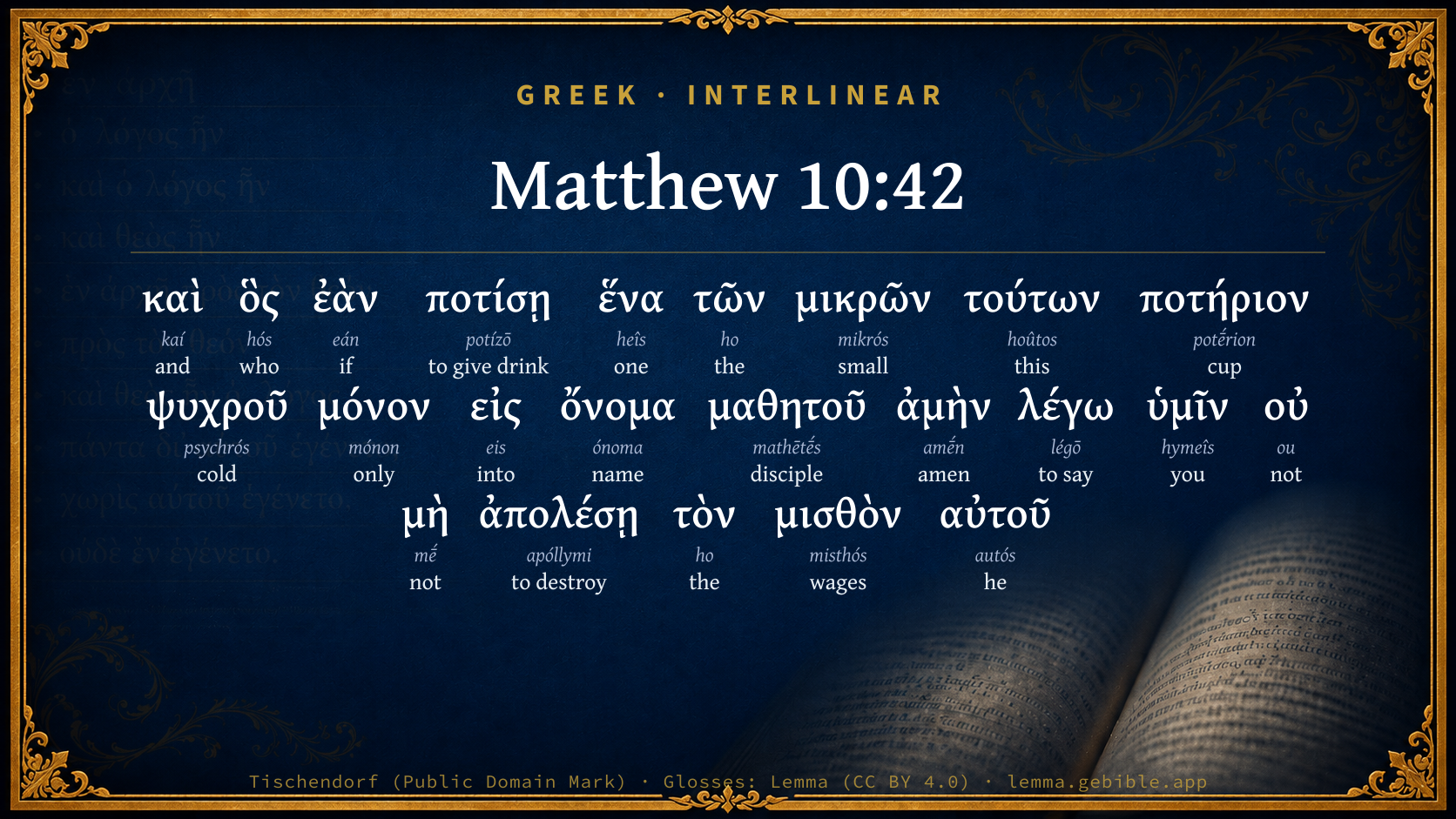
Greek (Tischendorf 8th ed.) Matthew 10:42 appears in the Greek New Testament. The text above is from the Tischendorf 8th edition. Each word links to its Strong’s number and a concise gloss. Click any word for its full Thayer’s Greek Lexicon entry.
Download image
Cite this verse

Matthew 10:42 (World English Bible). Public Domain. Lemma interlinear Bible study tool, https://lemma.gebible.app/v/matthew/10/42.

Show BibTeX & RIS
BibTeX
RIS
English Translation
Whoever gives one of these little ones just a cup of cold water to drink in the name of a disciple, most assuredly I tell you he will in no way lose his reward."
World English Bible · Public Domain
Highlights
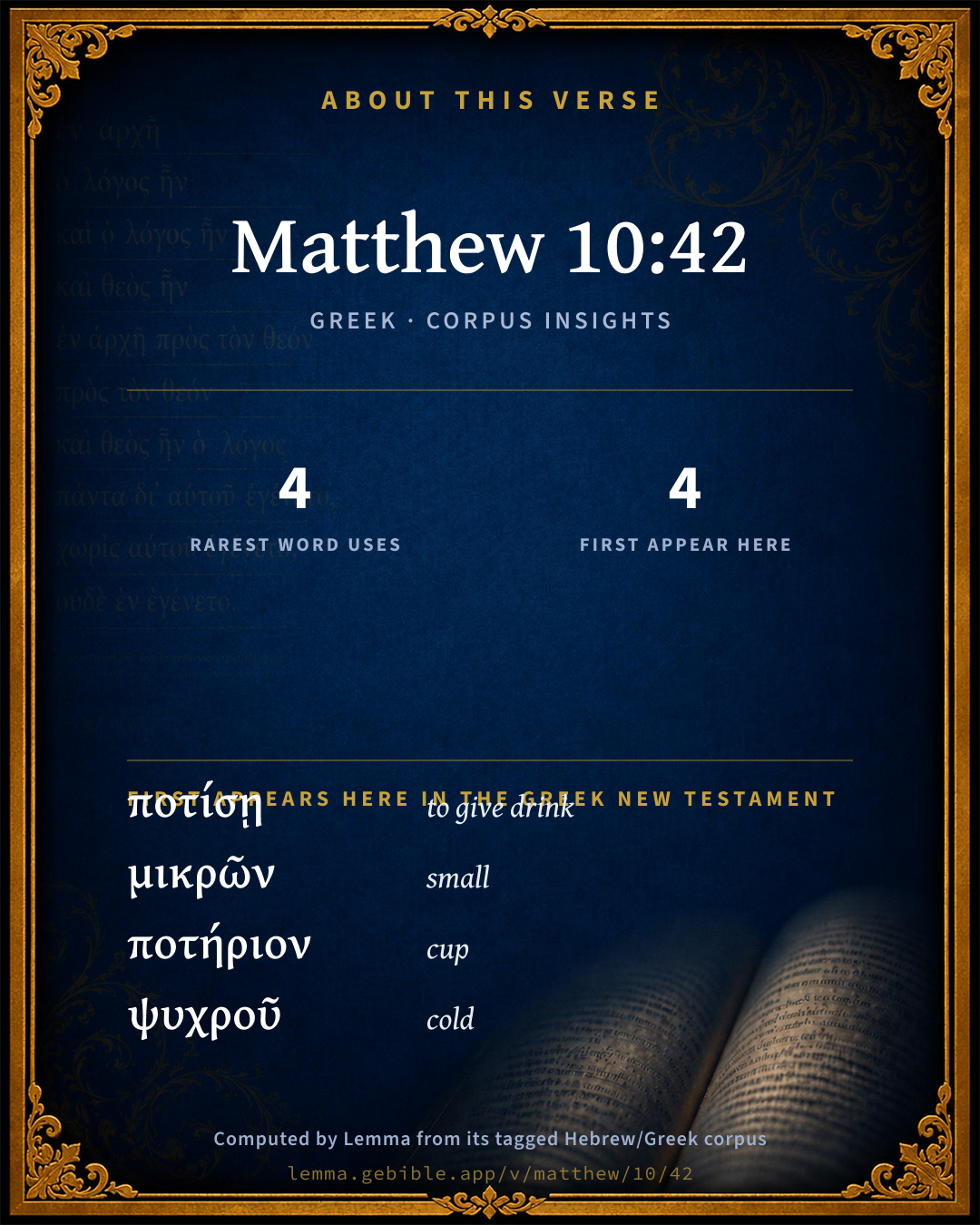
  • 4 first appearances in the Greek New Testament
Full analysis ↓
Download a study sheet

One document with this verse’s original text, its word-by-word gloss line, the meaning frame, cross-references with their text, attributed commentary, and full source and license credits — printable, and it pastes into notes with its structure intact.

This verse Autodidact and up

Study sheet (.html) Plain text (.txt)

A passage Seminary Student

Up to 50 verses in one chapter. A passage sheet keeps up to 6 commentary sources and 12 cross-references per verse, in the order this page ranks them, and says so on the sheet whenever that leaves anything out. Ask for a single verse and you get the Autodidact verse sheet above.

Everything on this page stays free to read, with no account — the sheet is a download of what is already on screen, not access to it.

Want to remove ads? Support Godless Engineer
Compare translations 3

The same verse in 3 English versions, stacked beneath the original-language interlinear above. Click any original word for its lexicon entry.

Each is an independent rendering of the whole verse — the interlinear is not word-aligned to these translations.

Highlighted words mark where these versions differ — a whole-verse word diff, not a word-by-word alignment.

  • World English Bible Public Domain
    Whoever gives one of these little ones just a cup of cold water to drink in the name of a disciple, most assuredly I tell you he will in no way lose his reward."
  • King James Version Public Domain
    And whosoever shall give to drink unto one of these little ones a cup of cold water only in the name of a disciple, verily I say unto you, he shall in no wise lose his reward.
  • unfoldingWord Literal Text CC BY-SA 4.0
    And whoever gives to one of these little ones a cup of cold water to drink only in the name of a disciple, truly I say to you, he will certainly not lose his reward.”

unfoldingWord Literal Text — © unfoldingWord, licensed CC BY-SA 4.0. Word-aligned USFM3 via Door43 (git.door43.org/unfoldingWord/en_ult).

Versions to compare (up to 4)

3 of 4 selected

Show all 19 translations

Every available English version of this verse, each an independent rendering of the whole verse.

  • World English Bible Public Domain
    Whoever gives one of these little ones just a cup of cold water to drink in the name of a disciple, most assuredly I tell you he will in no way lose his reward."
  • Berean Standard Bible Public Domain
    And if anyone gives even a cup of cold water to one of these little ones because he is My disciple, truly I tell you, he will never lose his reward.”
  • Majority Standard Bible Public Domain
    And if anyone gives even a cup of cold water to one of these little ones because he is My disciple, truly I tell you, he will never lose his reward.”
  • King James Version Public Domain
    And whosoever shall give to drink unto one of these little ones a cup of cold water only in the name of a disciple, verily I say unto you, he shall in no wise lose his reward.
  • American Standard Version (1901) Public Domain
    And whosoever shall give to drink unto one of these little ones a cup of cold water only, in the name of a disciple, verily I say unto you he shall in no wise lose his reward.
  • Revised Version (1885) Public Domain
    And whosoever shall give to drink unto one of these little ones a cup of cold water only, in the name of a disciple, verily I say unto you, he shall in no wise lose his reward.
  • Geneva Bible (1599) Public Domain
    And whosoeuer shall giue vnto one of these litle ones to drinke a cuppe of colde water onely, in the name of a disciple, verely I say vnto you, he shall not lose his rewarde.
  • Douay-Rheims (1899) Public Domain
    And whosoever shall give to drink to one of these little ones a cup of cold water only in the name of a disciple, amen I say to you, he shall not lose his reward.
  • Young's Literal Translation Public Domain
    and whoever may give to drink to one of these little ones a cup of cold water only in the name of a disciple, verily I say to you, he may not lose his reward.'
  • Literal Standard Version CC BY-SA 4.0
    and whoever may give to drink to one of these little ones a cup of cold water only in the name of a disciple, truly I say to you, he may not lose his reward.”
  • Unlocked Literal Bible CC BY-SA 4.0
    Whoever gives to one of these little ones even a cup of cold water to drink because he is a disciple, truly I say to you, he will in no way lose his reward.”
  • unfoldingWord Literal Text CC BY-SA 4.0
    And whoever gives to one of these little ones a cup of cold water to drink only in the name of a disciple, truly I say to you, he will certainly not lose his reward.”
  • Darby Bible Public Domain
    And whosoever shall give to drink to one of these little ones a cup of cold [water] only, in the name of a disciple, verily I say unto you, he shall in no wise lose his reward.
  • World Messianic Bible Public Domain
    Whoever gives one of these little ones just a cup of cold water to drink in the name of a disciple, most certainly I tell you, he will in no way lose his reward.”
  • Webster's Bible Public Domain
    And whoever shall give to drink to one of these little ones, a cup of cold water only, in the name of a disciple, verily, I say to you, he shall in no wise lose his reward.
  • Free Bible Version CC BY-SA 4.0
    I tell you the truth, those who give a drink of cool water to the least important of my disciples will definitely not miss out on their reward.”
  • Bible in Basic English Public Domain
    And whoever gives to one of these little ones a cup of cold water only, in the name of a disciple, truly I say to you, he will not go without his reward.
  • Text-Critical English NT CC BY 4.0
    And whoever gives one of these little ones even a cup of cold water to drink in the name of a disciple, truly I say to you, he will certainly not lose his reward.”
  • Tyndale New Testament (1534) Public Domain
    And whosoever shall geve vnto one of these lytle ones to drincke a cuppe of colde water only in the name of a disciple: I tel you of a trueth he shall not lose his rewarde.

Literal Standard Version (2020), Covenant Press — licensed CC BY-SA 4.0. Text via the HelloAO Bible API (eBible.org). Unlocked Literal Bible (unfoldingWord) — licensed CC BY-SA 4.0. Text via the HelloAO Bible API (eBible.org). unfoldingWord Literal Text — © unfoldingWord, licensed CC BY-SA 4.0. Word-aligned USFM3 via Door43 (git.door43.org/unfoldingWord/en_ult). Free Bible Version, Dr. Jonathan Gallagher — licensed CC BY-SA 4.0. Text via the HelloAO Bible API (eBible.org).

Word by word

More ways to search: Search by grammar → Find every occurrence → Compare this word →

Practice this passage: Drill this verse → Learn its vocabulary →

ψυχροῦ
psychrós
G5593
“cold”
Adjective, Genitive, Singular, Neuter
Part of Speech
Adjective
Case
Genitive
Number
Singular
Gender
Neuter
Full Thayer's Definition

Origin: from G5592

TDNT: 16:36,3

1. cold, cool a. of cool water 2. metaph. a. cold i.e. sluggish, inert b. in mind: of one destitute of warm Christian faith and the desire for holiness
  1. καὶ kaí G2532 “and” Conjunction
  2. ὃς hós G3739 “who” Relative pronoun, Nominative, Singular, Masculine
  3. ἐὰν eán G1437 “if” Conditional
  4. ποτίσῃ potízō G4222 “to give drink” Verb, Aorist, Active, Subjunctive, 3rd person, Singular
  5. ἕνα heîs G1520 “one” Adjective, Accusative, Singular, Masculine
  6. τῶν ho G3588 “the” Article, Genitive, Plural, Masculine
  7. μικρῶν mikrós G3398 “small” Adjective, Genitive, Plural, Masculine
  8. τούτων hoûtos G3778 “this” Demonstrative pronoun, Genitive, Plural, Masculine
  9. ποτήριον potḗrion G4221 “cup” Noun, Accusative, Singular, Neuter
  10. μόνον mónon G3440 “only” Adverb
  11. εἰς eis G1519 “into” Preposition
  12. ὄνομα ónoma G3686 “name” Noun, Accusative, Singular, Neuter
  13. μαθητοῦ mathētḗs G3101 “disciple” Noun, Genitive, Singular, Masculine
  14. ἀμὴν amḗn G281 “amen” Hebrew transliteration
  15. λέγω légō G3004 “to say” Verb, Present, Active, Indicative, 1st person, Singular
  16. ὑμῖν hymeîs G5210 “you” Personal pronoun, 2nd person, Dative, Plural
  17. οὐ ou G3756 “not” Particle, Negative
  18. μὴ mḗ G3361 “not” Particle, Negative
  19. ἀπολέσῃ apóllymi G622 “to destroy” Verb, Aorist, Active, Subjunctive, 3rd person, Singular
  20. τὸν ho G3588 “the” Article, Accusative, Singular, Masculine
  21. μισθὸν misthós G3408 “wages” Noun, Accusative, Singular, Masculine
  22. αὐτοῦ autós G846 “he” Personal pronoun, Genitive, Singular, Masculine

About this verse

These counts appear in no published source. They are computed here, from the morphology-tagged text and Lemma’s own curated glosses. What Lemma adds →

23
words
22
distinct lemmas
Gospels
section

Notable vocabulary

The rarest word here is ψυχροῦ cold G5593 — appearing just 4 times in the whole Greek New Testament.

First appearance in Scripture

These words make their first canonical appearance in the Greek New Testament here:

  • ποτίσῃ to give drink G4222
  • μικρῶν small G3398
  • ποτήριον cup G4221
  • ψυχροῦ cold G5593

Shared distinctive vocabulary

ψυχροῦ cold G5593 occurs in 3 verses of the Greek New Testament. Also found in:

Repetition

A word recurs within this verse:

Cross-references

17

Topical passages linked to Matthew 10:42 in the Treasury of Scripture Knowledge — connected by theme and wording, ordered by reader-vote popularity; previews shown in the World English Bible.

  • Hebrews 6:10 For God is not unrighteous, so as to forget your work and the labor of love which you showed toward his name, in that you served the saints, and still do serve them.
  • Matthew 25:40 "The King will answer them, 'Most assuredly I tell you, inasmuch as you did it to one of the least of these my brothers, you did it to me.'
  • Mark 9:41–42 For whoever will give you a cup of water to drink in my name, because you are Christ's, most assuredly I tell you, he will in no way lose his reward.
  • Matthew 18:10 See that you don't despise one of these little ones, for I tell you that in heaven their angels always see the face of my Father who is in heaven.
  • 2 Corinthians 9:6–15 Remember this: he who sows sparingly will also reap sparingly. He who sows bountifully will also reap bountifully.
  • Philippians 4:15–19 You yourselves also know, you Philippians, that in the beginning of the Gospel, when I departed from Macedonia, no assembly shared with me in the matter of giving and receiving but you only.
  • Luke 6:35 But love your enemies, and do good, and lend, expecting nothing back; and your reward will be great, and you will be children of the Most High; for he is kind toward the unthankful and evil.
  • Mark 12:42–43 A poor widow came, and she cast in two small brass coins, which equal a quadrans coin.
  • 2 Corinthians 8:12 For if the readiness is there, it is acceptable according to what you have, not according to what you don't have.
  • Proverbs 24:14 So you shall know wisdom to be to your soul; If you have found it, then there will be a reward, Your hope will not be cut off.
  • Mark 14:7–8 For you always have the poor with you, and whenever you want to, you can do them good; but you will not always have me.
  • Matthew 18:3–6 and said, "Most assuredly I tell you, unless you turn, and become as little children, you will in no way enter into the Kingdom of Heaven.
  • 1 Corinthians 8:10–13 For if a man sees you who have knowledge sitting in an idol's temple, won't his conscience, if he is weak, be emboldened to eat things sacrificed to idols?
  • Zechariah 13:7 "Awake, sword, against my shepherd, And against the man who is close to me," says Yahweh of Hosts. Strike the shepherd, and the sheep will be scattered; And I will turn my hand against the little ones.
  • Matthew 8:5–6 When he came into Capernaum, a centurion came to him, asking him,
  • Matthew 18:14 Even so it is not the will of your Father who is in heaven that one of these little ones should perish.
  • Luke 17:2 It would be better for him if a millstone were hung around his neck, and he were thrown into the sea, rather than that he should cause one of these little ones to stumble.

Cross-references courtesy of OpenBible.info (CC BY 4.0).

Commentary

Notes on Matthew 10:42 from classic Christian and Jewish commentators (each source and its license shown beneath its notes). The classic Christian expositions comment on the surrounding passage and are grouped to its opening verse, so a note may address several verses; the Jewish commentaries on the Tanakh (Rashi and others) are per-verse, so they appear only where the commentator wrote on this verse.

Lemma curates 59 commentaries, every one of them public domain or Creative Commons licensed, each selected and text-cleaned for this edition rather than reprinted as found. About our sources →

The Biblical Illustrator

Joseph S. Exell

Mat_10:42

A cup of cold water.

The cup of cold water

The doings of this life are had in remembrance: that no humble action in its relation to high principles is lost; but is retained in a future judgment.

I. The duty of acting from christian motives.

1. Our Saviour points out this by three examples.

2. The duty derives its importance from Gods omnipresence and omniscience. The cup of cold water comes under the Divine notice.

II. The influence of our actions upon the destinies of the future.

1. The history of nations and individuals proves how the past acts upon the future.

2. The promise of reward by Christ shows how every simple act done with reference to Himself is made to react upon ourselves in a way we should not anticipate apart from revelation.

3. Things done out of Christ, having no connection with His love, will perish. (W. D. Horwood.)

Giving to the needy giving to Christ

St. Martin, before he was baptized into the faith of Christ, and while still a soldier, showed a rare instance of love and charity. In the depth of winter, a beggar, clothed in rags, asked an alms of him for the love of God. Silver and gold he had none. His soldiers cloak was all he had to give. He drew his sword, cut it in half, gave one portion to the poor man, and was content himself with the other. And of him it may be truly said, He had his reward. That night, in a vision, he beheld our blessed Lord upon His throne, and all the host of heaven standing on His right; hand and His left. And as Martin looked more steadfastly on the Son of God, he saw Him to be arrayed in his own half-cloak; and he heard Him say, This hath Martin, unbaptized, given to Me.

Zeal for the young rewarded

I. The objects of compassionate regard alluded TO.

1. In their inherent depravity and their solemn destiny as intended for a state of unending being.

2. In their natural condition of helplessness and weakness amid the circumstances of peril to which they are exposed in their progress through the world.

3. In their influence for good or evil upon the world, and the final account they shall give at the bar of God.

II. The blessedness of those who, under the influence of Christian motives, shall make the young the objects of their devoted care.

1. They shall have their reward in the lovely and appropriate fruits with which the objects of their compassionate regard shall be adorned.

2. In the beneficial influence they shall thus originate and perpetuate.

3. In the approbation of their Saviour and their God. (H. Madgin.)

A good passport

Some few years ago, three small children-a boy and two girls, aged respectively ten, seven, and four-arrived in St. Louis, having travelled thither all the way from Kulin in Germany, without any escort or protection beyond a New Testament and their own innocence and helplessness. Their parents, who had emigrated from the Fatherland and settled in Missouri, had left them in charge of an aunt, to whom, in due time, they forwarded a sum of money sufficient to pay the passage of the little ones to their new home across the Atlantic. As the children could not speak a word of any language but German, it is doubtful whether they would ever have reached their destination at all, had not their aunt, with a womans ready wit, provided them with a passport, addressed, not so much to any earthly authority, as to Christian mankind generally. Before taking her leave of the children, the aunt gave the elder girl a New Testament, instructing her to show it to every- person who might accost her during the voyage, and especially to call their attention to the first leaf of the book. Upon that leaf the wise and good woman had written the names of the three children, and this simple statement: Their father and mother in America are anxiously awaiting their arrival at Sedalia, Missouri. This was followed by the irresistible appeal-their guide, safeguard, and interpreter throughout a journey over sea and land of more than 4,000 miles-Verily I say … unto Me. Many were the little acts of kindness shown to the little travellers, many the hands held out to smooth their journey, by those who read that appeal; and at length they reached their parents in perfect health and safety.

Christs appreciation of little services

1. Because they often have great results. A cup of cold water is mentioned here; we can hardly mention a service which one would more naturally think of as a little service, than the giving of a cup of cold water; and yet it may be great in its results. It may allay the fever, and drive away the coming madness of the man who is consumed by thirst-there may be life in a cup of cold water. The fainting traveller in the desert, where the greedy sun has licked all the water up, would die but for the cup of cold water which a provident pilgrim brings to him. Many a castaway on the ocean, drifting on his raft-many a wounded soldier, writhing among the heaps of the smitten on the battle-field-has spent his last breath in crying for a cup of cold water; and a cup of water given at a critical moment would have saved life.

2. When they are the best a man can render.

3. When they are truly rendered to Him. The giving of the cup of cold water, you observe, acquired its character of moral worth from its being given in the name of a disciple-given for Christs sake. It is possible to work in the kingdom of Jesus Christ, and not serve Christ at all. A soldier may go out in his countrys wars, and make for himself, by his courage and success, an imperishable name, and yet never really serve his country or his king, but only himself; his one impulse throughout may be not loyalty, not patriotism, but the desire of fame, the desire of power, a motive which never takes the man out of himself. (A Hannay.)

Slight services for Christ

1. Slight services are often all we have it in our power to render. What can I do for Christ?

2. Slight services are sufficient to show love for the Saviour.

3. Slight services, after all, may be invaluable services-trivial-cup of cold water.

4. Slight services shall be richly requited-He shall in no wise lose his reward. (J. Gage Rigg, B. A,)

A small act the embodiment of self-sacrifice

In Bonar and MacCheynes narrative of their mission to the Jews in Palestine (Edinburgh, 1839), an incident occurs, illustrative of this passage. During our ramble (near Gaza), … a kind Arab came forward from his tent as we passed, offering us the refreshment of a drink of water, saying, Jesherhetu mole?-Will you drink water? The promise of our Lord seems to refer to cases like this, where the individual, unasked, seeks out objects on whom to show kindness. The least desire to bless shall not lose its reward. We all know how precious a gift a cup of cold water may be, and what self-denial it may involve, from the well-known story of Sir Philip Sidney and the wounded soldier on the battle-field. Sidney, mortally wounded on the field of Zutphen, was about to drink a glass of water which some one had humanely brought him to assuage his agonizing thirst. Just, however, as he was about to press it to his lips, he saw a soldier, in like plight with himself, looking wistfully at it. Unable to resist the pleading eyes of his fellow-sufferer, Sidney handed the glass to him, exclaiming, Thy necessity is greater than mine. It is well-known that in Western Australia there is a great want of water, the rivers in that part of the island-continent being few. Mrs. Millett, in her Life in an Australian Parsonage, describes the feeling of distress, approaching to despair, experienced by a mother and her child who had missed their way in a remote part of the colony, and who had the dreary prospect, as night came on, of being many hours before they could hope to assuage their thirst; and their astonishment and delight, when, in that remote region, they saw, suddenly emerging from the trees, a woman and a girl each carrying a bucket. Perhaps, says Mrs. Millett, my friend mentally compared the incident to that of all angels visit, when the strangers showed her a spring at no great distance, whither they were already on their way to fetch water, having already walked two miles from their own home. We ourselves remember with pleasure a hot summer evening many years ago, when, tired with a long walk in the neighbourhood of Heidelberg, we asked the mistress of a picturesque German cottage for a glass of water. Readily was it brought, and the peasant-woman, on our thanking her, replied in a tone of true courtesy, Masser haben wir genug.-We have sufficient water. But, as Jeremy Taylor says, he will have no reward, who gives only water, when his neighbour needs wine or a cordial, and he could give it.

The Biblical Illustrator, edited by Joseph S. Exell (c. 1880s–1900s) — public domain. Text from a community e-Sword module.

Tyndale Open Study Notes

Tyndale Open Resources

10:42 The least of my followers probably refers to the low social standing of most of Jesus’ followers (cp. 5:3; 18:1-5 and 6:5; 23:5-12).

Tyndale Open Study Notes — © Tyndale Open Resources, licensed CC BY-SA 4.0. Text via the HelloAO Bible API.

Bengel's Gnomon

Johann Albrecht Bengel

Mat 10:42. Μικρῶν, little ones) (see ch. Mat 11:11, and Zec 13:7). A sweet epithet for disciples (cf. Mat 10:41, for the double mention of prophet, etc.) The world cares not for such as these. From these little ones are made prophets and righteous men.—ψυχροῦ, of cold water) This is without expense, and may be done even on the road. A proverbial expression, and contrasted! with he that receiveth.[504]—μὴ ἀπολέση, shall not lose) A consolation which, arising from former good deeds, cheers the disciple even in the midst of subsequent dangers.[505]—αὐτοῦ, his) i.e., of the little one, or rather his own. It is more to receive any one than to give him to drink, and therefore it has a greater reward.[506]

[504] i.e. to receive any one into the house as a guest—this is an act of hospitality, whereas to give a cup of cold water to a wayfarer is merely an act of kindness.—(I. B.)

[505] O the boundless riches of GOD, who both has it in His power and delights to pay in full such great rewards.—V. g.

[506] Bengel, J. A. (1860). Vol. 1: Gnomon of the New Testament (M. E. Bengel & J. C. F. Steudel, Ed.) (J. Bandinel & A. R. Fausset, Trans.) (185–250). Edinburgh: T&T Clark.

Bengel's Gnomon of the New Testament — English translation (T&T Clark, Edinburgh, 1860) — public domain. Text from a community e-Sword module.

Meyer's Critical & Exegetical Commentary

Heinrich August Wilhelm Meyer

Mat_10:42. Ἕνα … τούτων] a single one of these (δεικτικῶς) little ones. According to the whole context, which has been depicting the despised and painful circumstances of the disciples, and is now addressing to them the necessary encouragement, it is to be regarded as intentional and significant that Jesus employs the term μικρῶν (not μαθητῶν), an expression which (in answer to Wetstein) is not usual among Rabbinical writers to convey the idea of disciples. Otherwise Mat_18:6.

μόνον] only, connected with what precedes.

τὸν μισθὸν αὐτοῦ] the reward awaiting him, in the kingdom of the Messiah; Mat_5:12. Grotius says correctly: Docemur hic, facta ex animo, non animum ex factis apud Deum aestimari.

Meyer — Critical and Exegetical Commentary on the New Testament — English translation by Peter Christie, edited by Frederick Crombie (T&T Clark, 1880) — public domain. Text from a community e-Sword module.

Expositor's Greek Testament

ed. W. Robertson Nicoll

Mat 10:42 . he last word, and the most beautiful; spoken with deep pathos as an aside; about the disciples rather than to them, though heard by them. “Whosoever shall do the smallest service, were it but to give a drink to one of these little ones ( ἕνα τῶν μικρῶν τούτων , cf. Mat 25:40 ) in the name of a disciple, I declare solemnly even he shall without fail have his appropriate reward.” ψυχροῦ : expressive word for water, indicating the quality valued by the thirsty; literally a cup of the cool , suggesting by contrast the heat of the sun and the fierce thirst of the weary traveller. No small boon that cup in Palestine! “In this hot and dry land, where one can wander for hours without coming on a brook or an accessible cistern, you say ‘thank you’ for a drink of fresh water with very different feelings than we do at home” (Furrer, Wanderungen durch das Heilige Land , p. 118). Fritzsche remarks on the paucity of particles in Mat 10:34-42 as indicating the emotional condition of the speaker.

The Expositor's Greek Testament, edited by W. Robertson Nicoll (1897–1910) — public domain. Text from a community e-Sword module.

International Critical Commentary

(M) 42. And whosoever shall give to drink to one of these little ones a cup of cold water only in the name of a disciple, verily I say to you, he shall not lose his reward.] This saying is clearly out of place here, because there is nothing to the context to explain the meaning of τῶν μικρῶν τούτων. It occurs again in Mar 9:41 with ὑμᾶς for “these little ones.” ὃς γὰρ ἂν ποτίσῃ ὑμᾶς ποτήριον ὕδατος ἐν ὀνόματι ὅτι Χριστοῦ ἐστέ, ἀμὴν λέγω ὑμῖν ὅτι οὐ μὴ ἀπολέσῃ τὸν μισθὸν αὐτοῦ. Mt. in the parallel section to Mk. omits this verse. Mk., however, has τῶν μικρῶν τούτων in the next verse, 9:42. Mt. seems to be quoting from memory, and to have brought in the “these little ones” inadvertently. Mk.’s ὑμᾶς would have suited the purpose much better. If Mt. had known the saying independently with τῶν μικρῶν τούτων, he would almost certainly have inserted it in this form in the parallel to Mar 9:41. On the other hand, τῶν μικρῶν τούτων in Mat 10:42 can only be explained as a reminiscence of Mar 9:41, Mar 9:42.

M the Second Gospel.

E editorial passages.

1 ὀνὸματα is read by א A C L al, ὄνομα by B D.

2 οὒς καὶ ἀποστόλους ὠνόμασεν, א B C*vid Δ. But this clause may be an interpolation in Mk from Luk 6:15. If so, the title ἀπόστολος in Mt. is due to reminiscence of Mar 6:20.

LXX. The Septuagint Version.

Th. Theodotion.

Dalm. Dalman.

B. Babylonian Talmud.

al i.e. with other uncial MSS.

S Syriac version: Sinaitic MS.

L the Matthæan Logia.

Ditt. Dittenberger Sylloge.

1 Deissmann, Exp. Times, Nov. 1906, p. 62, suggests that πήρα means “a beggar’s collecting bag,” and quotes in support a Greek inscription of the Roman period found in Syria.

DB. Dictionary of the Bible (Hastings).

Jub. jubilees.

Ps.-Sol. The Psalms of Solomon.

1 C E al have Βεελζεβούλ; א B., Βεεζεβούλ; S1 c g2 Beelzebub. See on 12:24.

2 Cf. Chagiga 12b.

1 Quoted by Dr. Bigg, The Church’s Task under the Roman Empire, p. 79.

Plut. Plutarch.

International Critical Commentary — older volumes (1896–1929), various authors — public domain. Text from a community e-Sword module.

Geneva Bible (1599)

Geneva Bible translators

Which in the sight of the world are vile and abject.

Geneva Bible (1599) marginal notes — public domain. Text via Bolls.life.

Jamieson, Fausset & Brown

Robert Jamieson, A. R. Fausset & David Brown

And whosoever shall give to drink unto one of these little ones--Beautiful epithet! Originally taken from Zac 13:7. The reference is to their lowliness in spirit, their littleness in the eyes of an undiscerning world, while high in Heaven's esteem.

a cup of cold water only--meaning, the smallest service.

in the name of a disciple--or, as it is in Mark (Mar 9:41), because ye are Christ's: from love to Me, and to him from his connection with Me.

verily I say unto you, he shall in no wise lose his reward--There is here a descending climax--"a prophet," "a righteous man," "a little one"; signifying that however low we come down in our services to those that are Christ's, all that is done for His sake, and that bears the stamp of love to His blessed name, shall be divinely appreciated and owned and rewarded.

Next: Matthew Chapter 11

Jamieson, Fausset & Brown — Commentary Critical and Explanatory on the Whole Bible (1871) — public domain (CC PDM 1.0). Text via the HelloAO Bible API.

Adam Clarke's Commentary

Verse 42. A cup of cold water] υδατος, of water, is not in the common text, but it is found in the Codex Bezae, Coptic, Armenian, Gothic, Anglo-Saxon, Slavonic, all copies of the Itala, Vulgate, and Origen. It is necessarily understood; the ellipsis of the same substantive is frequent, both in the Greek and Latin writers. See Wakefield.

Little ones] My apparently mean and generally despised disciples.

But a cup of water in the eastern countries was not a matter of small worth. In India, the Hindoos go sometimes a great way to fetch it, and then boil it that it may do the less hurt to travellers when they are hot; and, after that, they stand from morning to night in some great road, where there is neither pit nor rivulet, and offer it, in honour of their god, to be drunk by all passengers. This necessary work of charity, in these hot countries, seems to have been practised by the more pious and humane Jews; and our Lord assures them that, if they do this in his name, they shall not lose their reward. See the Asiatic Miscellany, vol. ii. p. 142.

Verily - he shall in no wise lose his reward.] The rabbins have a similar saying: "He that gives food to one that studies in the law, God will bless him in this world, and give him a lot in the world to come." Syn. Sohar.

Love heightens the smallest actions, and gives a worth to them which they cannot possess without it. Under a just and merciful God every sin is either punished or pardoned, and every good action rewarded. The most indigent may exercise the works of mercy and charity; seeing even a cup of cold water, given in the name of Jesus, shall not lose its reward. How astonishing is God's kindness! It is not the rich merely whom he calls on to be charitable; but even the poor, and the most impoverished of the poor! God gives the power and inclination to be charitable, and then rewards the work which, it may be truly said, God himself hath wrought.

It is the name of Jesus that sanctifies every thing, and renders services, in themselves comparatively contemptible, of high worth in the sight of God. See Quesnel.

Adam Clarke's Commentary on the Bible (1810–1826) — public domain. Text from a community e-Sword/MySword module.

Ellicott's Commentary for English Readers

(42) One of these little ones.—The term was familiarly used of the scholars of a Rabbi, and in this sense our Lord, as the great Master, sending forth His disciples, now employs it. He would not disregard even the cup of cold water given to the humblest disciple as such and for the sake of Christ. Taken by themselves, the words do not go beyond this but the language of Mat_25:40 justifies their extension to every act of kindness done to any man in the name of that humanity which He shares with those whom He is not ashamed to call His brethren (Heb_2:11).

A Bible Commentary for English Readers, edited by Charles John Ellicott (1878–1897) — public domain. Text from a community e-Sword module.

The Cambridge Bible for Schools and Colleges

gen. ed. J. J. S. Perowne

42. one of these little ones] The reference may be to the disciples. But there appears to be a gradation in the lowest step of which are “these little ones.” Possibly some children standing near were then addressed, or, perhaps, some converts less instructed than the Apostles had gathered round. “The little ones” then would mean the young disciples, who are babes in Christ. The lowest in the scale—apostles—prophets—the saints—the young disciples. The simplest act of kindness done to one of Christ’s little ones as such shall have its reward.

The Cambridge Bible for Schools and Colleges (gen. ed. J. J. S. Perowne; Cambridge University Press, 1878–1918) — public domain. Text from a community e-Sword module.

Trapp's Complete Commentary

John Trapp

42 And whosoever shall give to drink unto one of these little ones a cup of cold water only in the name of a disciple, verily I say unto you, he shall in no wise lose his reward.

Ver. 42. Unto one of these little ones] So the saints are called, either because but a little flock, or little in their own eyes, or little set by in the world, or dearly respected of God, as little ones are by their loving parents.

A cup of cold water] As having not fuel to heat it, saith Jerome, nor better to bestow than Adam’s ale, a cup of water, yet desirous some way to seal up his love to poor Christ. Salvian saith, that Christ is mendicorum moximus, the greatest beggar in the world, as one that shareth in all his saints’ necessities. Relieve him therefore in them; so shall you lay up in store for yourselves a good foundation against the time to come; yea, you shall lay hold on eternal life, 1Ti 6:19. Of Midas it is fabled, that whatever he touched he turned into gold. Sure it is that whatsoever the hand of charity touch, be it but a cup of cold water, it turns the same, not into gold, but into heaven itself. He is a niggard then to himself that is niggardly to Christ’s poor. If heaven may be had for a cup of cold water, what a bodkin at the churl’s heart will this be one day! Surely the devil will keep holiday, as it were, in hell, in respect of such.

Verily, I say unto you, he shall in no wise, &c.] By this deep asseveration our Saviour tacitly taxeth the world’s unbelief, while they deal by him, as by some patching companion or base bankrupt, trust him not at all, without either ready money or a sufficient security. But what saith a grave divine? Is not mercy as sure a grain as vanity? Is God like to break, or forget? Is there not a book of remembrance written before him, which he more often peruseth than Ahasuerus did the Chronicles? The butler may forget Joseph, and Joseph his father’s house; but God is not unrighteous to forget your work and labour of love, which ye have shown toward his name, in that you have ministered to the saints, and do minister, Heb 6:10.

John Trapp, A Commentary or Exposition upon All the Books of the Old and New Testament (1647–1656) — public domain. Text from a community e-Sword module.

The Pulpit Commentary

Parallel passage: Mar_9:41, where it will be observed that the following verse is parallel to Mat_18:6 and Luk_17:2 (cf. supra, ver. 40). One of these little ones... a disciple. It is evident, from a comparison of ver. 41, that the two titles refer to one and the same person. Christ, using his own term, calls his followers "little ones;" using the term of others, he calls them "disciples." Little ones. Partly a word of personal endearment; (cf. Mat_25:40) partly a comparison with those mentioned in ver. 41. He is now speaking of one who is not distinguished from other believers by the reception of extraordinary Divine gifts, or by special zeal and holiness, but is only an ordinary disciple. In Mat_18:6 the term is used directly of children, but in Luk_17:2, and probably in Mar_9:41, 42, it is used metaphorically. A cup of cold water only. Observe that "if the "cup of cold water" is not to lose its reward, it must be proffered when he who gives it has nothing better to give" (H. Melvill, in Exell, on ver. 41). In the name of a disciple (ver. 41, note). Verily I say unto you, He shall in no wise lose his reward. (cf. Heb_6:10) Lose (apolesh). Does the Western reading, "His reward shall in no wise perish," indicate the unending duration of heavenly bliss, or is apolhtai , there a synonym for the ptaish of Ecc_2:8? Observe that if the original Aramaic were hyrga dbyye, it might be understood in either way (cf. references in Levy, "Chald. Worterb.," s.v. dba).

The Pulpit Commentary (1880–1919), ed. H.D.M. Spence-Jones & Joseph S. Exell — public domain. Text from a community e-Sword module.

John Wesley's Explanatory Notes

One of these little ones - The very least Christian. Mark ix, 41.

John Wesley, Explanatory Notes Upon the Whole Bible (1754–1765) — public domain. Text via the GEBible commentary corpus.

The People's New Testament

B. W. Johnson

42. Whosoever shall give to drink to these little ones. By the “little ones” are probably meant Christ's disciples. A cup of cold water only. The smallest act of kindness. If done “because he was a disciple,” or out of regard for Christ, he should never lose his reward. Good deeds are never lost. Note the six things here spoken of as belonging to discipleship of Christ: (1) Confessing, or professing; (2) Fighting; (3) Bearing his standard (the cross); (4) Suffering; (5) Following; (6) Giving up life. These are all the duties of the soldier.

B. W. Johnson's The People's New Testament with Notes (1889–1891) — public domain. Electronic text from the Christian Classics Ethereal Library (CCEL) ThML edition.

unfoldingWord translationNotes

Door43 World Missions Community

Connecting Statement:

Jesus finishes instructing his disciples about what they should do and expect when they go to preach.

Whoever gives

"Anyone who gives"

one of these little ones

"one of these lowly ones" or "the least important of these." The phrase "one of these" here refers to one of Jesus' disciples.

because he is a disciple

"because he is my disciple." Here "he" does not refer to the one giving but to the unimportant one.

truly I say to you

"I tell you the truth." This phrase adds emphasis to what Jesus says next.

he will ... his reward

Here "he" and "his" refer to the one who is giving.

he will in no way lose

"God will not deny him." This has nothing to do with having a possession taken away. It can be stated in positive form. AT: "God will certainly give him"

translationWords

disciple

amen

reward

unfoldingWord translationNotes — © Distant Shores Media and the Door43 World Missions Community, licensed CC BY-SA 4.0. Source: git.door43.org/Door43/en_tn.

Cambridge Greek Testament for Schools and Colleges

42. ἕνα τῶν μικρῶν. The reference may be to the disciples. But there appears to be a gradation, in the lowest step of which are ‘these little ones.’ Possibly some children standing near were then addressed, or, perhaps, some converts less instructed than the Apostles had gathered round. ‘The little ones’ then would mean the young disciples, who are babes in Christ. The lowest in the scale—apostles—prophets—the saints—the young disciples. The simplest act of kindness done to one of Christ’s little ones as such shall have its reward.

ψυχροῦ (ὕδατος). As aqua is understood in Latin ‘Frigida non desit, non deerit calda petenti.’ Mart. XIV. 103.

οὐ μὴ ἀπολέσῃ. οὐ μὴ expresses an emphatic denial. οὐ denies the fact, μὴ the very conception of it; οὐ denies a thing absolutely, μὴ as it presents itself to us. The explanation usually given of an ellipse of δέος ἐστιν fails to satisfy all instances. See Goodwin’s Greek Moods and Tenses, § 89.

Cambridge Greek Testament for Schools and Colleges (Cambridge University Press, 1896; 21 vols, various authors incl. Carr, Maclear, Plummer, Farrar, Lumby, Moule, M. R. James, Simcox) — public domain. Text from a community e-Sword module.

Alford’s Greek Testament

Henry Alford

42. τῶν μικρῶν] To whom this applies is not very clear. Hardly (De Wette) to the despised and meanly-esteemed for Christ’s sake. I should rather imagine some children may have been present; for of such does our Lord generally use this term, see ch. 18:2-6. Though perhaps the expression may be meant of lower and less advanced converts, thus keeping up the gradation from προφήτης. This however hardly seems likely: for how could a disciple be in a downward gradation from δίκαιος?

I may observe that Meyer denies the existence of the Rabbinical meaning of disciples commonly attributed to קטנים, little ones. In the passage from Bereschith Rabba quoted by Wetstein to support it, the word, he maintains, from the context, means parvuli, children, not disciples.

τὸν μισθ. αὐτ.] His (i.e. the doer’s) reward: not, ‘the reward of one of these little ones,’ as before μισθ. προφ., μισθ. δικαίου:—the article here makes the difference: and the expression is reflective.

Henry Alford, The Greek Testament (1849–1861) — public domain. Text from a community e-Sword module.

Lesson kit

Teaching starters — assembled from the data on this page, not authored interpretation. Every prompt links to the verse data it draws on. Edit before teaching.

Matthew, in the Gospels, opens this verse with 23 words (22 distinct Greek lemmas). Its most distinctive word is psychrós (“cold”). A historical commentator’s framing appears above. Read the whole chapter for the surrounding context.

Discussion questions

  1. The word psychrós carries the sense “cold.” How does it shape the verse?
  2. 4 words make their first appearance in Scripture here. What does this debut establish?
  3. How does Revelation 3:15, which shares the word «cold», read alongside this verse?
  4. What does the repetition of “the” (2× in this one verse) do in this verse?
  5. These translations render this verse differently. What is at stake in choosing one wording over another?
  6. Compare how The Biblical Illustrator and Tyndale Open Study Notes read this verse. Where do they agree or differ?

Things to notice

  • 4 words make their first canonical appearance in Scripture here.
  • These translations choose different wording for 17 words in this verse.
  • “the” occurs 2× in this single verse.
  • 22 distinct Greek lemmas span 23 words in this verse.

Reading settings

Reading text

Shown beneath each verse's original-language words.

Old Testament
Old Testament edition

Read the OT as the Masoretic Hebrew (MT) or the Greek Septuagint (LXX).

English shown for the Greek Septuagint (in the Hebrew ↔ Greek comparison).

Comparing translations? Open the Compare panel on any verse page to stack up to four side by side.