Matthew 22:11

Greek (Tischendorf 8th ed.) Matthew 22:11 appears in the Greek New Testament. The text above is from the Tischendorf 8th edition. Each word links to its Strong’s number and a concise gloss. Click any word for its full Thayer’s Greek Lexicon entry.
Download image
Cite this verse

Matthew 22:11 (World English Bible). Public Domain. Lemma interlinear Bible study tool, https://lemma.gebible.app/v/matthew/22/11.

Show BibTeX & RIS
BibTeX
RIS
English Translation
But when the king came in to see the guests, he saw there a man who didn't have on wedding clothing,
World English Bible · Public Domain
Download a study sheet

One document with this verse’s original text, its word-by-word gloss line, the meaning frame, cross-references with their text, attributed commentary, and full source and license credits — printable, and it pastes into notes with its structure intact.

This verse Autodidact and up

Study sheet (.html) Plain text (.txt)

A passage Seminary Student

Up to 50 verses in one chapter. A passage sheet keeps up to 6 commentary sources and 12 cross-references per verse, in the order this page ranks them, and says so on the sheet whenever that leaves anything out. Ask for a single verse and you get the Autodidact verse sheet above.

Everything on this page stays free to read, with no account — the sheet is a download of what is already on screen, not access to it.

Want to remove ads? Support Godless Engineer
Compare translations 3

The same verse in 3 English versions, stacked beneath the original-language interlinear above. Click any original word for its lexicon entry.

Each is an independent rendering of the whole verse — the interlinear is not word-aligned to these translations.

Highlighted words mark where these versions differ — a whole-verse word diff, not a word-by-word alignment.

  • World English Bible Public Domain
    But when the king came in to see the guests, he saw there a man who didn't have on wedding clothing,
  • King James Version Public Domain
    And when the king came in to see the guests, he saw there a man which had not on a wedding garment:
  • unfoldingWord Literal Text CC BY-SA 4.0
    But the king, having come in to look at the ones reclining to eat, saw there a man not wearing wedding clothes.

unfoldingWord Literal Text — © unfoldingWord, licensed CC BY-SA 4.0. Word-aligned USFM3 via Door43 (git.door43.org/unfoldingWord/en_ult).

Versions to compare (up to 4)

3 of 4 selected

Show all 19 translations

Every available English version of this verse, each an independent rendering of the whole verse.

  • World English Bible Public Domain
    But when the king came in to see the guests, he saw there a man who didn't have on wedding clothing,
  • Berean Standard Bible Public Domain
    But when the king came in to see the guests, he spotted a man who was not dressed in wedding clothes.
  • Majority Standard Bible Public Domain
    But when the king came in to see the guests, he spotted a man who was not dressed in wedding clothes.
  • King James Version Public Domain
    And when the king came in to see the guests, he saw there a man which had not on a wedding garment:
  • American Standard Version (1901) Public Domain
    But when the king came in to behold the guests, he saw there a man who had not on a wedding-garment:
  • Revised Version (1885) Public Domain
    But when the king came in to behold the guests, he saw there a man which had not on a wedding-garment:
  • Geneva Bible (1599) Public Domain
    Then the King came in, to see the ghestes, and sawe there a man which had not on a wedding garment.
  • Douay-Rheims (1899) Public Domain
    And the king went in to see the guests: and he saw there a man who had not on a wedding garment.
  • Young's Literal Translation Public Domain
    `And the king having come in to view those reclining, saw there a man not clothed with clothing of the marriage-feast,
  • Literal Standard Version CC BY-SA 4.0
    And the king having come in to view those reclining, saw there a man not clothed with wedding clothes,
  • Unlocked Literal Bible CC BY-SA 4.0
    But when the king came in to look at the guests, he saw a man there who was not wearing wedding clothes.
  • unfoldingWord Literal Text CC BY-SA 4.0
    But the king, having come in to look at the ones reclining to eat, saw there a man not wearing wedding clothes.
  • Darby Bible Public Domain
    And the king, having gone in to see the guests, beheld there a man not clothed with a wedding garment.
  • World Messianic Bible Public Domain
    “But when the king came in to see the guests, he saw there a man who didn’t have on wedding clothing,
  • Webster's Bible Public Domain
    And when the king came in to see the guests, he saw there a man who had not a wedding-garment:
  • Free Bible Version CC BY-SA 4.0
    But when the king came in to meet the guests, he noticed a man who didn't have a wedding robe on.
  • Bible in Basic English Public Domain
    But when the king came in to see the guests, he saw there a man who had not on a guest's robe;
  • Text-Critical English NT CC BY 4.0
    “But when the king came in to see the guests, he saw a man there who was not clothed with a wedding garment.
  • Tyndale New Testament (1534) Public Domain
    Then the kynge came in to viset the gestes and spyed there a man which had not on a weddinge garment

Literal Standard Version (2020), Covenant Press — licensed CC BY-SA 4.0. Text via the HelloAO Bible API (eBible.org). Unlocked Literal Bible (unfoldingWord) — licensed CC BY-SA 4.0. Text via the HelloAO Bible API (eBible.org). unfoldingWord Literal Text — © unfoldingWord, licensed CC BY-SA 4.0. Word-aligned USFM3 via Door43 (git.door43.org/unfoldingWord/en_ult). Free Bible Version, Dr. Jonathan Gallagher — licensed CC BY-SA 4.0. Text via the HelloAO Bible API (eBible.org).

Word by word

More ways to search: Search by grammar → Find every occurrence → Compare this word →

Practice this passage: Drill this verse → Learn its vocabulary →

ἔνδυμα
éndyma
G1742
“garment”
Noun, Accusative, Singular, Neuter
Part of Speech
Noun
Case
Accusative
Number
Singular
Gender
Neuter
Full Thayer's Definition

Origin: from G1746

TDNT: None

1. garment, raiment, cloak, an outer garment
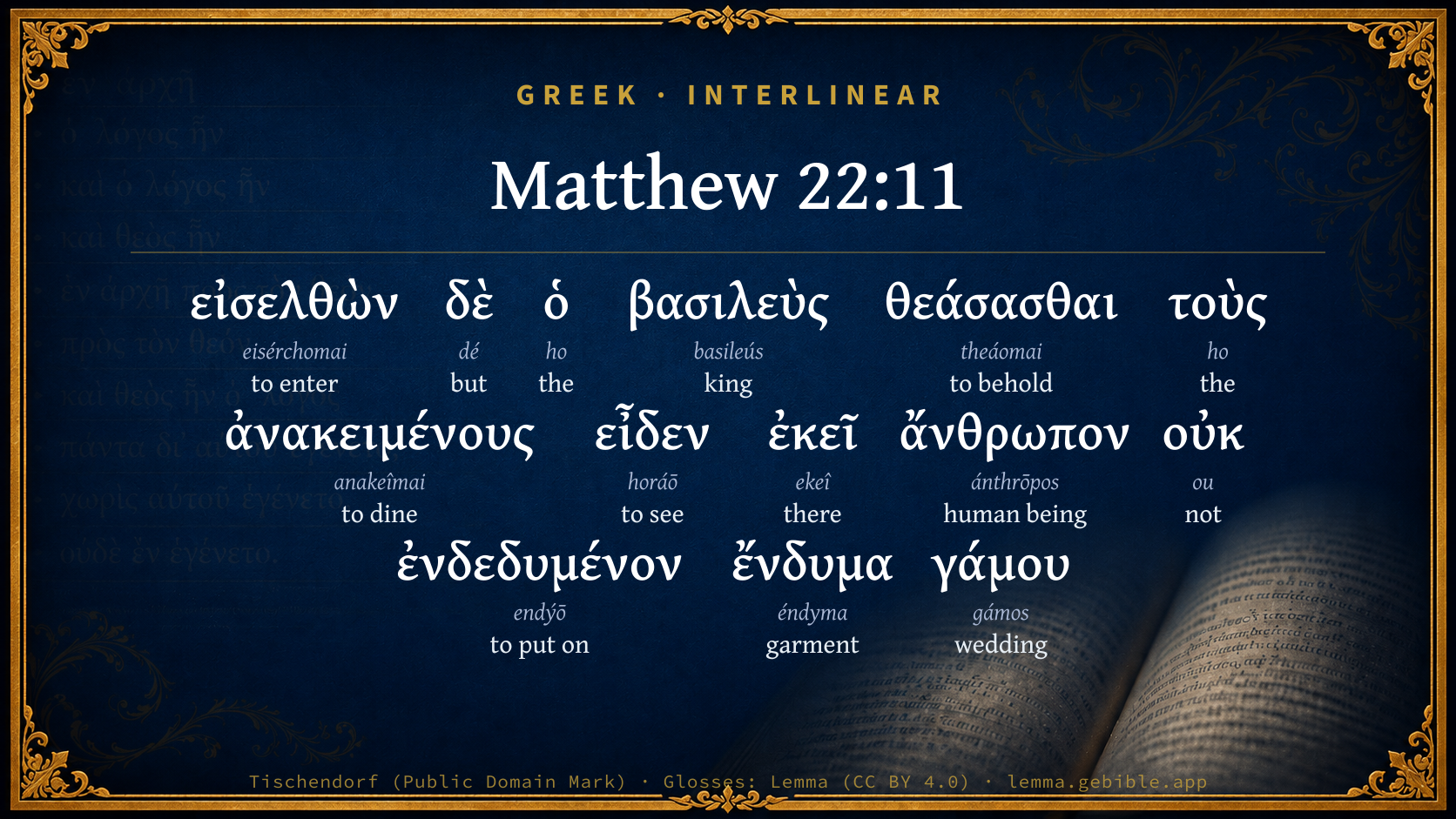
  1. εἰσελθὼν eisérchomai G1525 “to enter” Verb, Aorist, Active, Participle, Nominative, Singular, Masculine
  2. δὲ dé G1161 “but” Conjunction
  3. ὁ ho G3588 “the” Article, Nominative, Singular, Masculine
  4. βασιλεὺς basileús G935 “king” Noun, Nominative, Singular, Masculine
  5. θεάσασθαι theáomai G2300 “to behold” Verb, Aorist, Middle deponent, Infinitive
  6. τοὺς ho G3588 “the” Article, Accusative, Plural, Masculine
  7. ἀνακειμένους anakeîmai G345 “to dine” Verb, Present, Middle or Passive deponent, Participle, Accusative, Plural, Masculine
  8. εἶδεν horáō G3708 “to see” Verb, Aorist, Active, Indicative, 3rd person, Singular
  9. ἐκεῖ ekeî G1563 “there” Adverb
  10. ἄνθρωπον ánthrōpos G444 “human being” Noun, Accusative, Singular, Masculine
  11. οὐκ ou G3756 “not” Particle, Negative
  12. ἐνδεδυμένον endýō G1746 “to put on” Verb, Perfect, Middle, Participle, Accusative, Singular, Masculine
  13. γάμου gámos G1062 “wedding” Noun, Genitive, Singular, Masculine

About this verse

These counts appear in no published source. They are computed here, from the morphology-tagged text and Lemma’s own curated glosses. What Lemma adds →

14
words
13
distinct lemmas
Gospels
section

Notable vocabulary

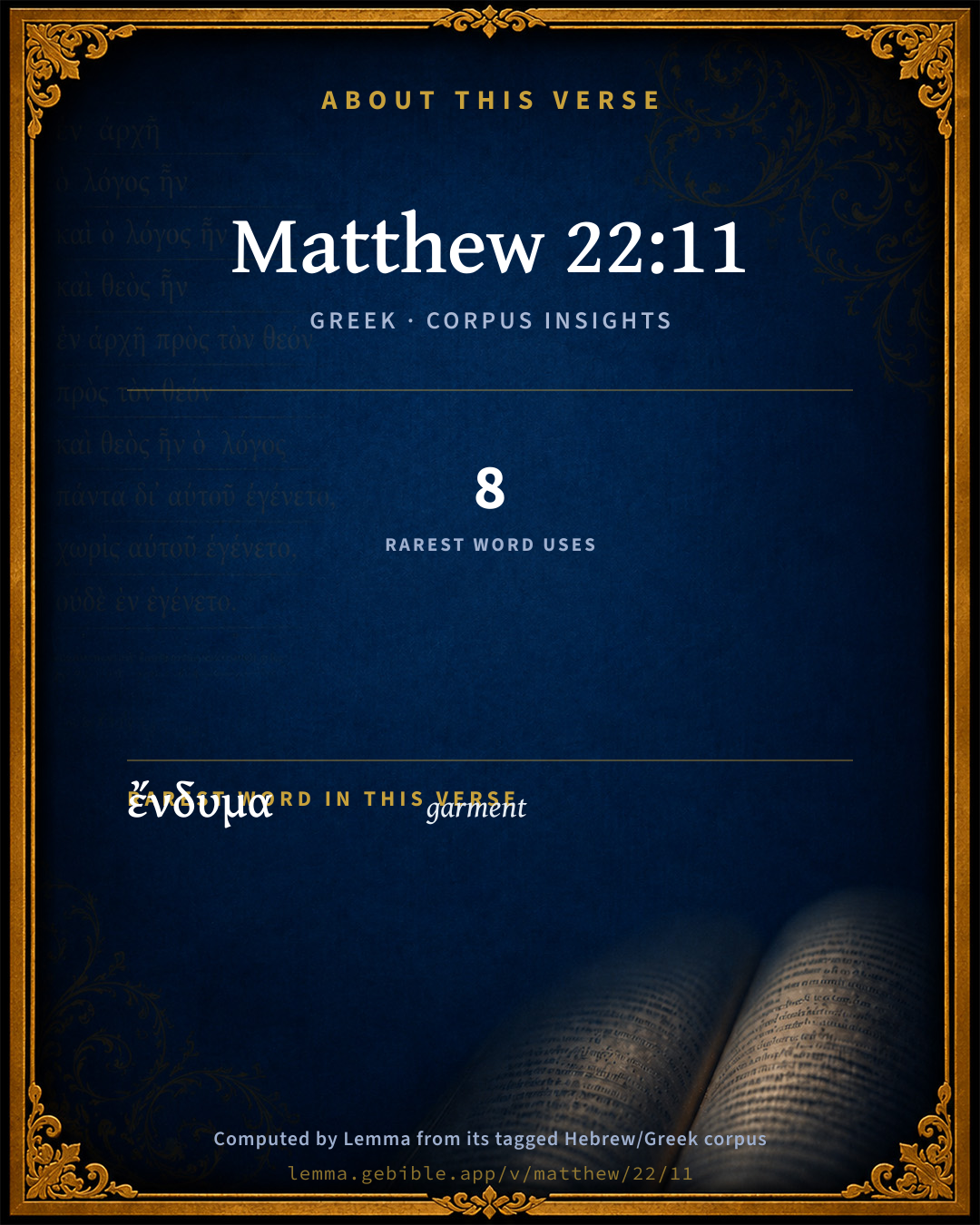
The rarest word here is ἔνδυμα garment G1742 — appearing just 8 times in the whole Greek New Testament.

Shared distinctive vocabulary

ἔνδυμα garment G1742 occurs in 8 verses of the Greek New Testament. Also found in:

Repetition

A word recurs within this verse:

Cross-references

24

Topical passages linked to Matthew 22:11 in the Treasury of Scripture Knowledge — connected by theme and wording, ordered by reader-vote popularity; previews shown in the World English Bible.

  • Revelation 3:4–5 Nevertheless you have a few names in Sardis that did not defile their garments. They will walk with me in white, for they are worthy.
  • Revelation 19:8 It was given to her that she would array herself in bright, pure, fine linen: for the fine linen is the righteous acts of the saints.
  • Zechariah 3:3–4 Now Joshua was clothed with filthy garments, and was standing before the angel.
  • Hebrews 4:12–13 For the word of God is living, and active, and sharper than any two-edged sword, and piercing even to the dividing of soul and spirit, of both joints and marrow, and is able to discern the thoughts and intentions of the heart.
  • Romans 13:14 But put on the Lord Jesus Christ, and make no provision for the flesh, for its lusts.
  • Ephesians 4:24 and put on the new man, who in the likeness of God has been created in righteousness and holiness of truth.
  • Colossians 3:10–11 and have put on the new man, that is being renewed in knowledge after the image of his Creator,
  • Revelation 16:15 "Behold, I come like a thief. Blessed is he who watches, and keeps his clothes, so that he doesn't walk naked, and they see his shame."
  • 2 Corinthians 5:3 if so be that being clothed we will not be found naked.
  • Galatians 3:27 For as many of you as were baptized into Christ have put on Christ.
  • Revelation 3:18 I counsel you to buy from me gold refined by fire, that you may become rich; and white garments, that you may clothe yourself, and that the shame of your nakedness may not be revealed; and eye salve to anoint your eyes, that you may see.
  • 1 Corinthians 4:5 Therefore judge nothing before the time, until the Lord comes, who will both bring to light the hidden things of darkness, and reveal the counsels of the hearts. Then each man will get his praise from God.
  • Isaiah 52:1 Awake, awake, put on your strength, Zion; put on your beautiful garments, Jerusalem, the holy city: for henceforth there shall no more come into you the uncircumcised and the unclean.
  • Isaiah 61:3–10 to appoint to those who mourn in Zion, to give to them a garland for ashes, the oil of joy for mourning, the garment of praise for the spirit of heaviness; that they may be called trees of righteousness, the planting of Yahweh, that he may be glorified.
  • Revelation 2:23 I will kill her children with Death, and all the assemblies will know that I am he who searches the minds and hearts. I will give to each one of you according to your deeds.
  • Psalms 45:13–14 The princess inside is all glorious. Her clothing is interwoven with gold.
  • Matthew 13:30 Let both grow together until the harvest, and in the harvest time I will tell the reapers, "First, gather up the darnel, and bind them in bundles to burn them; but gather the wheat into my barn."'"
  • Matthew 25:31–32 "But when the Son of Man comes in his glory, and all the holy angels with him, then he will sit on the throne of his glory.
  • Romans 3:22 even the righteousness of God through faith in Jesus Christ to all and on all those who believe. For there is no distinction,
  • Isaiah 64:6 For we are all become as one who is unclean, and all our righteousness are as a polluted garment: and we all do fade as a leaf; and our iniquities, like the wind, take us away.
  • Matthew 3:12 His winnowing fork is in his hand, and he will thoroughly cleanse his threshing floor. He will gather his wheat into the barn, but the chaff he will burn up with unquenchable fire."
  • 2 Kings 10:22 He said to him who was over the vestry, Bring forth vestments for all the worshippers of Baal. He brought them forth vestments.
  • Lamentations 5:22 But you have utterly rejected us; You are very angry against us.
  • Zephaniah 1:12 It will happen at that time, that I will search Jerusalem with lamps, and I will punish the men who are settled on their dregs, who say in their heart, "Yahweh will not do good, neither will he do evil."

Cross-references courtesy of OpenBible.info (CC BY 4.0).

Commentary

Notes on Matthew 22:11 from classic Christian and Jewish commentators (each source and its license shown beneath its notes). The classic Christian expositions comment on the surrounding passage and are grouped to its opening verse, so a note may address several verses; the Jewish commentaries on the Tanakh (Rashi and others) are per-verse, so they appear only where the commentator wrote on this verse.

Lemma curates 59 commentaries, every one of them public domain or Creative Commons licensed, each selected and text-cleaned for this edition rather than reprinted as found. About our sources →

The Biblical Illustrator

Joseph S. Exell

Mat_22:11-13

He saw there a man which had not on a wedding garment.

I. The invitation itself is in Mat_22:3-4. There is a double call. God will not take the first repulse, but will try again before He will quit a people. More particularly the first call was by the prophets, the second by the apostles. All things are ready, if we are ready.

II. The success of this invitation or offer of grace. Some slighted it, others rejected it with malice. Excusing is refusing.

III. The issue (Mat_22:7). When the king heard thereof, etc. Contempt of the gospel, joined with persecution of the preachers of it, bringeth utter ruin and devastation.

The next part of the parable (Mat_22:9-10).

I. The charge to invite.

II. The servants obedience and their success. A people may want God, but God cannot want a people to serve Him. All that give their names to God are not found; there is a mixture of good and bad. So sometimes the church is full, but heaven never the fuller; for though they receive the gospel, they do not receive it in full power and efficacy.

III. You have the carriage of the king towards the hypocritical guests.

I. The discovery. All that receive the gospel must look to have their sincerity tried, for the King will visit and observe the guests (Mat_22:14). The meaning is, that in the throng and multitude of converts, if there be but one that is insincere, God can espy him, and find him out. Repentance and reformation of life is the new garment of the soul; that only will become the gospel feast.

II. The expostulation. God loveth to make the sinner convinced and condemned in his own conscience, that He may be clear when He judgeth, and justified in all His proceedings with Him. The man was speechless. They that embrace the gospel and live in an unmortified and impenitent manner can have nothing to plead by way of excuse.

III. The doom and sentence (Mat_22:13). Conscience in hell will have a special kind of accusing, and self-tormenting in our reflecting on the refusal of the remedy. Christ will pronounce a heavier doom if we obey not the gospel, to which we profess to submit. It is dangerous to come to Gods feast without a wedding garment.

I. What is Gods feast? In the gospel all kinds of comforts and spiritual gifts and graces are ready prepared, and freely offered to us. God hath made excellent provision for the entertainment of His own family. This feast serveth for two uses.

1. For the honour of God, to show His magnificence and royalty, and the glory of His exceeding great grace and mercy in Jesus Christ (as Ezr_1:3-4), the choicest blessings. Love is gone to the utmost; beyond God there is nothing; God reconciled and God enjoyed are the chiefest blessings we can enjoy.

2. For the comfort and refreshment of sinful man. There is in it all we can expect in a feast.

(1) Ample satisfaction to every soul that is spiritually hungry and thirsty (Psa_36:8; Psa_22:26). There is no defect or want in Gods feast. But many prefer husks before the fatted calf. Swinish pleasures before these chaste delights. These besot the heart awhile, but they cannot satisfy it.

(2) Joy, pleasure, delight. What will cheer the heart and conscience? The pardon of sin is the true reviving thing (Mat_9:2).

(3) God useth us as friends. We may sit down at His table. But what an honour it is to sit down at the feast of the King of Kings! It is a token of our reconciliation with Him, for eating together is an act of friendship.

II. What is coming to this feast? It is to profess ourselves Christians, and using the ordinances which belong thereunto.

III. What is the wedding garment? It is usual in Scripture to set forth sin by nakedness, and grace by a garment (Rev_3:17-18). Graces are a beautiful ornament to the soul as garments are to the body. It is such a garment as becometh the solemnity of the marriage-feast of the kings son; the wedding garment is that new array which becometh such a solemnity. As it is a royal feast, it must be something more than ordinary excellency that is required of us; a spiritual feast, a spiritual excellency. Therefore the wedding garment is holiness, habitual and actual, which is the glory of God, and the beauty of God and His people (Rev_19:8). I must now represent the danger of entering upon the profession of the gospel, or coming to this feast without such a wedding garment.

IV. Thy odiousness of the sin in these considerations.

1. Your profession is partial; there is a twofold profession in word and deed. In word when we own Christ, in whom we have believed: in deed, when we walk answerably.

2. One part of the profession condemneth the other; if we own a God and do not live answerably our belief condemneth our practice (Tit_1:16). So while they own Christ they do but mock Him; they profess to honour Christ by coming to His feast, but they dishonour Him and affront Him while they come m their own and ordinary apparel. The ungodly lives of Christians are a reproach to Christianity. You should adorn, but you disgrace the gospel (Tit_2:10). Religion as visibly acted and expressed by you should be found a beautiful thing.

3. One part of your profession is abused to corrupt and destroy the other; and the Christian name is only taken on to patronize unchristian practices (Jud_1:4.). They come to the gospel feast that they may the more securely live in their sins.

V. The certainty of discovery.

1. When you come as guests to the marriage-feast your business lieth not with men, but with God. The king cometh to see the guests. You may have a garment to cover you before men, but not before God. But when the Lord looketh to the guests, He is the party with whom you have to do. How will you do to escape His eye and search? (Gal_6:7).

2. God loveth to unease hypocrites (Pro_26:26). His anger is more kindled against them because they profess such a nearness to Him.

3. Hypocrisy is hateful to God in anything, but especially in coming to the gospel feast. For that is a kind of daring of God, or a putting it to the trial whether He will discover you or no.

4. There are certain times when God cometh in a more ,especial manner to discover those that are unsound in the profession of the gospel.

God doth always see their hearts, but there are certain seasons when they shall know that He seeth them.

1. By trying judgments. When the tree is shaken the rotten apples fall.

2. Sometimes by offences (1Co_2:19).

3. At death a man should always be provided for that hour. We carry nothing out of the world but a winding-sheet and a wedding garment-the one for the soul, the other for the body.

4. In the Day of Judgment. When all the world is arraigned before Christ, and He distinguisheth the sheep from the goats, then will He expostulate with you. Where is your wedding garment?

5. The doom and punishment.

(1) They are not permitted to taste of the feast. God denieth them grace, and so they have but an empty ordinance.

(2) They incur eternal wrath (Mat_24:51); they are excluded the feast, and cast into the dungeon.

Use. To persuade us to get this wedding garment.

I. Then you are welcome and acceptable to God. You are not intruders, but welcome guests.

II. Then you may be bold, and will not be dashed out of countenance.

III. This showeth you were real friends to the Bridegroom, that you mean to honour Him with such a conversation as floweth from faith and love to Christ (Gal_5:6).

IV. Nothing doth more concern you than that you should not be Christians in vain, and profess Christ to your loss.

What remaineth, then, but that we look after the wedding garment.

I. Determine what it is. An holy conversation coming out of a renewed heart is this wedding garment (Mat_12:34).

II. Get this wedding garment out of the Kings wardrobe. God delights in the graces of His own Spirit. No man is born clothed; we have it from God.

III. Wear your wedding garment. Not only get grace, but exercise it in all duties towards God and man (Rev_16:15).

IV. Keep your garments undefiled, and unspotted from the world (Rev_3:4).

V. Wash your garments often in the blood of the Lamb (Rev_7:14). (T. Manton, D. D.)

The wedding garment

We must consider what we are to understand.

I. By the wedding garment. It is the costume or spiritual dress necessary for the enjoyment of heaven-holiness often described as a garment (Job_29:14; Isa_61:10; Psa_45:13; Rev_3:18; Rev_7:9).

II. The solemn scrutiny.

1. Was Divine.

2. Was personal, Religion is a personal concern.

III. The awful detection. We may form three conjectureS as to this robeless character.

1. It might have resulted from carelessness. He did not attend to the requirements of the king, etc. How many like him, etc. 2.:From procrastination. How many Such are always in Gods house.

3. From proud and wicked preference. Perhaps thought it not essential; had other views; would trust in the mercy of the king, or his own beautiful habiliments. How many of this class are there!

IV. The awful investigation.

1. It was public. Before all the guests. The enemies of Christ will be publicly confounded at the last day; clothed with shame and contempt.

2. It was reasonable. It gave an opportunity for the exhibition of righteousness. God will allow the sinner to plead.

3. It was overwhelming. He had no reason to assign, hence he was confounded.

V. The dreadful punishment.

1. The removal.

2. The sentence.

3. The misery.

Application.

1. Now, all that is necessary for heaven may be obtained, and that by all.

2. Let professors examine themselves, etc.

3. Let sinners be entreated. Listen to the voice of the gospel and live. (J. Burns, LL. D.)

The wedding garment

I. At this feast there was but one condition of acceptance-the wearing of a particular garment, Faith in Christ.

1. The wedding garment had no merit in itself: faith has no intrinsic worth.

2. It was all-important because commanded by the king: the fact that faith, as the instrument of justification, is ordained of God endows it with importance.

3. It was no arbitrary symbol.

4. It was highly significant.

II. There was one who failed to comply with this condition. Of whom is he the type?

1. He was in the guest-chamber.

2. He desired to eat of the feast.

3. He remained in the guest-chamber until the king came.

4. He may have been highly esteemed by the rest.

III. The probable reasons of his non-compliance. Pride, self-deception, pride of intellect. (R. Griffin.)

The hypocrite self-condemned

The guest referred to was speechless because-

I. He could not plead ignorance of the will of the king who had invited him to the feast.

II. He could not plead that in his case the wedding garment was not necessary.

III. He could not plead that a wedding garment was not placed within his reach.

IV. He had despised the wedding garment.

V. He was overwhelmed with a sense of guilt. Learn the worthlessness of mere profession, and the necessity of being prepared for coming judgment. (Studies.)

The wedding garment

Between this man and the other guests there are some points of resemblance, and some of difference. Let us trace-

I. The points of resemblance.

1. He Was an invited guest. We are all called to the great feast.

2. He was a needy guest. All equally needy.

3. He was an expectant guest.

II. The points of difference.

1. They differed in their appearances.

2. They not only differed in appearances, but in their principles, in their states, in their conduct. He had neglected to observe the conditions on which admission was granted, etc.

III. The causes of the difference. Perhaps it was carelessness, pride, mind pre-occupied, etc.

IV. The consequences to which it led.

1. Detection.

2. Overwhelming confusion.

3. Destruction. (A. Weston.)

The wedding garment

I. The scrutiny of the king.

1. The manner of his discovery. He was not discovered till the king came in. Though the Lord knoweth them that are His, they that are His do not always know each other.

2. The language of the address, Friend, etc. Gods judgments proceed upon our self-assumed character. The man was not obliged to accept the kings invitation. Not having a wedding garment. This was the affront.

II. The confusion of the criminal He was speechless. There was no excuse. Conscious guilt struck him dumb. Before the bar of God man will not be able to plead-the souls inborn sin. He could not plead inability to procure the garment. (D. Moore, M. A.)

The wedding garment

I. The points of resemblance between this man and the other guests.

1. He was an invited guest.

2. He was a needy guest.

3. He was an expecting guest.

II. The point of difference between the man here spoken of and the other guests. The wedding garment is, in short, a wedding spirit.

III. To what causes must we trace this difference between him and them. It must be traced to himself.

1. Perhaps carelessness, mere inconsideration, led to his refusal.

2. It may have been pride.

3. There was great irreverence in his conduct.

IV. The consequences to which it led.

1. Detection.

2. Confusion.

3. Destruction. (C. Bradley.)

The dreadful consequence of being found at last without the wedding garment

I. The discovery.

II. The trial.

III. The condemnation of this man. (T. Drummond.)

The rejected guest

1. The folly of the human heart as seen in the way in which men attempt to impose upon God.

2. Though only one rejected, the guests admitted far less numerous than those invited.

3. It was the mans own fault that he had not the wedding garment.

4. The wedding garment is something more than outward conduct, for it escaped human observation. It was something which the king could alone discover. (C. J. P. Eyre, M. A.)

Speechless

1. You cannot say that the gospel plan is unworthy of your acceptance as a rational and immortal being.

2. You will be speechless because you cannot plead ignorance of the plan of salvation.

3. You cannot plead as an excuse for your wickedness the necessity of an irreligious life from the decrees of God. (A. Gilmour.)

The garment of life

Old stories and strange chronicles of other days come into the thoughts as we listen to the words of Christ. For instance, they tell us of one who sat, day after day, in her fair house, past which a strong river flowed toward the sea, and she ever wove and wove, and never looked up, nor heeded aught beyond that task; till, on one fatal day, there came by a vision of the pride and beauty of this world: then she looked up, and left her work, and was lost, and undone. And so may it be in many a life: there is work for us to do, and do it we must; here is a garment to be woven, and God has told us what is coming, and has set us at the task, here beside the great river of time, which shall become for each, ere long, the river of death. What are we at? Are our hearts in the task? Or are the eyes wandering, and is the thing like to be left for ever undone? (Morgan Dix, D. D.)

The wedding garment is essentially a habit of holiness and righteousness

It differs, specifically, from those vanities in which we take so much delight, in the following respects:

1. It is a clothing of humility; no robe of pride to dress up the sinner.

2. It truly corresponds to what the wearer is; no masquerade dress disguising the idle reveller or the stealthy conspirator.

3. It is a habit of the inner as well as of the outer man. A dress of the soul, the everyday costume of the devout and religious spirit, the inner habit which goes together with the outer, orderly, and sober life. (Morgan Dix, D. D.)

The wedding garment: the maker and the materials

I. The maker. It must be woven by our own hands, if ever woven at all. No such thing as getting it made for you. Every man is his own artisan: there are no workshops, and no workmen, here or elsewhere, to fit for heaven the souls of those who will not make themselves ready. We can buy, according to our means, sufficient, or more than sufficient, of lavish or gorgeous apparel, for this world and this life; but not one thread or one fingers breadth of that which we need for the life to come.

II. The materials. These are from God. They are the redeeming work of Christ, His perfect righteousness, and absolute holiness, His merits, the benefits of His cross and passion, His mighty resurrection and glorious ascension. To weave these materials into a garment, skilled and industrious fingers are needed: faith, hope, love. We must weave a true Christian habit by Christian acts; we must take what the Lord has done for us, and of it we must work a holy life; we must become like Him.

III. We shall have his help if we work hard. If we do our best, God will supply all the defects in our work, and make it good; sufficient for every need. Such garment as the child of God tries to make, in accordance with Gods will, may need much altering and setting right; it shall need to be shaped, and washed, and made white, till it become that radiant dress which the King shall see with pleasure. (Morgan Dix, D. D.)

The wedding garment a festive robe

The garment must, surely, from the very nature of the image, have been intended to signify something public and visible, in which each wearer harmonises with all, and all with the spirit of the peculiar scene into which they are introduced, and to which the dress is appropriate. I would say, then, that by this remarkable symbol our Lord did not intend merely the inward principle of faith exclusively considered, nor yet merely the mysterious imputation of righteousness through identification with Christ (though these are, no doubt, necessary conditions and first steps to its possession); for apparel is, of all things, the most manifest and visible, and the wedding apparel is especially the apparel of joy. This festal garment of heaven, then, which each man must bring with him into the high presence of God, seems to be no other than that celestial temper which manifests itself by the infallible indications of a holy joy-that spiritual sympathy with the things of the spiritual world, which exhibits itself in cordial, irrepressible demonstration of the blessedness within; holy happiness, public and expressed; the joy in the Holy Ghost-no longer a secret, timid, half-uttered delight, but sparkling in the eye, and fearless in the voice; the life no longer hid with Christ in God, but apparent with Him in glory. I repeat it- inward, spiritual happiness, developed by the presence of God, and the consciousness of heaven, into visible manifestation-this is the wedding garment which Christ beholds and approves in the saved. (W. Archer Butler, M. A.)

Grace a garment

Tis usual in Scripture to set forth sin by nakedness, and grace by a garment. Graces are a beautiful ornament to the soul as garments are to the body. (T. Manton.)

False pretences in religion

I. The original and ground of this figurative expression, of having on the wedding garment. The constant and prevailing temper or disposition of any mans spirit, can no way be Set forth more expressively than under the similitude of bodily garments, so investing the person as to be his proper and distinguishing attire.

II. Useful and practical observations.

1. How absolutely and indispensably God expects and requires, that every man who hopes to be admitted into the kingdom of heaven, should have his mind endued, and as it were clothed, with those habitual virtuous qualifications, which can no otherwise be acquired than by righteous practice.

2. There is such a thing as a false or ill-grounded hope; there are deceitful expectations, which may betray men into perdition.

3. The judgment of God will be according to right, in the sense that we understand just and right; in the sense, that even the wickedest of men shall not be able to deny, is according to righteousness and justice. The man convicted was speechless.

4. The reality of the concern God has for the salvation of men.

5. A very moving admonition, how dreadful at last will be the state of those whom the great goodness and long-suffering of God have not been able to bring to repentance, and to effectual amendment of life and manners. (S. Clarke.)

Personal dealings with individuals

The professors of the gospel will be personally examined.

1. There is a personal visit, When the king came.

2. There is a personal scrutiny, He saw a man.

3. There is a personal interrogation, Friend, how camest thou in?

4. There is a personal conviction, He was speechless.

5. There is a personal bondage, Bind him.

6. There is a personal exclusion, Cast him into outer darkness.

7. There is a personal torment, Weeping and gnashing of teeth. (J. T. Woodhouse.)

Providing festal garments

The framework of the parable probably pre-supposes the Oriental custom of providing garments for the guests who were invited to a royal feast. Wardrobes tilled with many thousand garments formed part of the wealth of every Eastern prince (Mat_6:19; Jam_5:2), and it was part of his glory, as in the case of the assembly which Jehu held for the worshippers of Baal (2Ki_10:22), to bring -them out for use on state occasions. On this assumption, the act of the man who was found not having a wedding garment was one of wilful insult. He came in the filthy rags (Isa_64:6), of his old life, instead of putting on the white linen meet for a kingly feast (Ecc_9:8; Rev_3:4-5), which had been freely offered him. (Dean Plumptre.)

The wedding garment given

A coloured minister was once discoursing on salvation, which he illustrated as follows:-Suppose, said he, any of you wanted a coat, and should go to a white gentleman to purchase one. Well, he has one that exactly fits you, and in all respects is just what you need. You ask the price; but, when told, find that you have not enough money, and shake your head-No, massa; I am too poor; must go without,-and turn away. But he says, I know you cannot pay me; I have concluded to give it you. Will you have it? What would you do in that case? Would you stop to hem and haw, and say, Oh! hes just laughing at me; he dont mean it? No such thing. There is not one of you who would not take the coat, and say, Yes, massa, and thank you, too. Now, my dear friends, Gods salvation is offered to you as freely as that. Why wont you take it as freely? You are lost, undone sinners, and feel that you need a covering from His wrath. If you could keep His holy law blameless, you might purchase it by good works; but ah! you are full of sin. Prayers and tears are worthless. You are poor indeed, and if this is all your dependence I dont wonder that you are turning off in despair. But stop! look here! God speaks now, and offers you the perfect robe of Christs righteousness that will cover all your sins, and fit all your wants, and He says that you may have it without money and without price. (American Paper.)

Highways and hedges

We might do better if we went further afield. Our invitations to Christ, which fall so feebly on the ears of those who regularly hear us, would be welcomed by those to whom we never deliver them. We are fools to waste time in the shallows of our churches and chapels, when the deep outside teems with waiting fishes. We need fresh hearers: the newer the news to any man, the more likely is he to regard it as good news. Music-hall work, out-door preaching, house-to-house visitation have virgin soil to deal with, and there is none like it. Invite the oft-invited-certainly; but do not forget that those who have never been invited as yet cannot have been hardened by refusals. Beggars in the highways had never been bidden to a marriage-feast before; and so, when they were surprised with an invitation, they raised no questions, but gladly hastened to the banquet.

Lack of the wedding garment

Is there any common way of dealing with Gods invitation than that which this man adopted? He had no deep love for his king, no grateful and humbling sense of his kindness, no perception of what was due to him; but with the blundering stupidity of godlessness, thought selfishness would carry him through, and ran right upon his doom. What is commoner than this self-complacency, this utter blindness to the fact that God is holy, and that holiness must therefore be the rule everywhere; what is commoner than the feeling that we are well enough, that we shall somehow pass muster, that as we mean to take our places among the heavenly guests we shall surely not be rejected? How hard it is for any of us fully to grasp the radical nature of the inward change that is required if we are to be meet for the inheritance of the saints in light. Conformity to God, ability to rejoice with God and in God, humble and devoted reverence, a real willingness to do honour to the Kings Son-these are great attainments; but these constitute our wedding garment, without which we cannot remain in His presence nor abide His searching gaze. It is the heart that you bear towards Him that will determine your destiny. No mere appearance of accepting His invitation, no associating of yourself with those who love Him, no outward entrance into His presence, no making use of the right language is anything to the purpose. What is wanted is a profound sympathy with God, a real delight in what is holy, a radical acceptance of His will-in other words, and as the most untutored conscience might see, what is wanted is a state of mind in you which God can delight in, and approve of, and hold fellowship with. (Marcus Dods, D. D.)

Refusal of the wedding garment

Had the man any means of obtaining a dress more in keeping with the occasion? Was he not perhaps so poor that he could afford no preparation of any kind? Had this been so, it would have been pleaded in excuse. But no doubt the parable supposes that the not unusual custom of providing for the guests the needed garment had been adopted; a provision which this guest had despised and refused; he had pushed past the officious servants who would have clothed him. It is this that constituted the mans audacity and guilt. Similar audacity in entering the kings presence without putting on the robe sent by The king for that purpose, has been known to cost a prime minister his life. A traveller who was invited, with the ambassadors he accompanied, to the table of the Persian king, says: We were told by the officer that we, according to their usage, must hang the splendid vests that were sent us from the king over our dresses, and so appear in his presence. The ambassadors at first refused, but the officer urged it so earnestly, alleging, as also did others, that the omission would greatly displease the king, since all other envoys observed such a custom, that at last they consented, and hanged, as did we also, the splendid vests over their shoulders. So at this, marriage, dresses had been provided by the king. The guests who had been picked off the streets were not told to go home and do the best they could for their dress, but in the palace, in the vestibule of the banquet-hall, each man was arrayed in the dress the king wished to see worn. Possibly the man who declined the offered garment had a dress of his own he grudged to cover. Possibly be thought he was as well dressed as need be. He would stroll in superciliously as a patron or spectator, thinking it very fit for those poor, coarse-clothed and dirty people to make use of the kings wardrobe, but conscious of no speck or uncleanliness in his own raiment that should cause him to make any alteration of it. (Marcus Dods, D. D.)

The wedding garment

I. The multitude of guests.

II. The unfitted one.

III. The merciless end.

Piety outwardly manifested

All organized beings are sustained by an inner economy of life, which is made manifest by an outer life. There is in us an inner life of thoughts, opinions, beliefs, emotions, and desires. These should be brought in conformity with the mind and Spirit of Christ. They correspond with the root of the tree, or with the seed which you hide end bury in the ground. Now, you are not satisfied with the root and the sap of the tree, or the germ power in the seed that you have hid in the earth. These hidden, buried, and unrevealed powers do not suffice. You want them to come forth and put on their gay garments, that your eye may be delighted and gladdened by their beauty. And you cut down the tree, you plough up the seed, if it puts on no wedding garment of blossom and fruit. So, say not my faith is right, my opinions are correct, my emotions are warm; for God wants more than these. He looks for fruit, for the beautiful wedding garment of a pure, sweet, loving, unselfish, and Christ-like life. The outward beauty, it is true, grows out of the hidden life. It is not put on. ,The beauty of the lily is not put on the flower, as a man puts on his coat. It grows out of the lily-like nature of the flower, many put on the manners of the Christian; but when they are only put on they drop off and expose the nakedness of the wearer when temptation comes, or when there is no end to be answered by keeping them on. Let us train ourselves, day by day, into the habit and feeling of the Christian spirit and temper, so that acts of Christian love, nobleness, and self-denial may grow out of us, as the beautiful form and colour grow out of the lily, and the sweet fragrance out of the rose. (R. Davey.)

The wedding garment

1. An enemy at the feast.

2. The king at the feast.

3. The judge at the feast.

4. The criminal at the feast.

5. The executioner. (C. H. Spurgeon.)

Speechless at the judgment

There is no speechlessness at present, when we ply men with questions as to their being unprepared for eternity: they have all some specious excuse to plead, or some empty promise to make. But there will be no death-like silence hereafter, throughout the company of those who come up from the grave unclothed for eternity. Every particular of their lives will have crowded in upon the memory, and the consciousness of what they might have been will repress all murmuring at what they are. I have read the singular account of some who have been recovered from apparent death by drowning, and they say, that, as life went away, every action, every occurrence from infancy upwards, presented itself to the mind with overpowering vividness, so that the close was as it were the resurrection of their existence; they seemed to themselves to have lived the whole of life over again, in those fearful moments when they were grappling with death, so energetically and with so marvellous an accuracy did long-forgotten things pass before them, and the picture of their every day, and every week, and every hour, paint itself on the mental retina. And if there is to come at last this resuscitation of memory, oh! we cannot wonder at the speechlessness of those who are condemned at the judgment. (H. Melvill, B. D.)

Called, but not chosen

What of necessity must be the character of that man who has put on that robe?

1. He must be a humble man.

2. He may walk into the feast boldly in his confidence.

3. He must be joyous. It is a feast.

4. He must be loving. It is a feast to commemorate love.

5. The Christ that is on him will be the Christ that is in him. (J. Vaughan, M. A.)

The Biblical Illustrator, edited by Joseph S. Exell (c. 1880s–1900s) — public domain. Text from a community e-Sword module.

Joseph Benson's Commentary

Mat 22:11. And when the king came in to see the guests — The members of the visible church; he saw there a man which had not on a wedding- garment — To explain this, it must be observed, it was usual in the eastern countries to present the guests at marriages, and other solemnities, with garments wherein they were to appear, and the number of them was esteemed an evidence of the wealth and magnificence of the giver. This king, therefore, having invited so many from the lanes, and hedges, and highways, who could never have provided themselves with proper raiment in which to make their appearance at this marriage-feast, according to the custom of the country, must be supposed to have ordered each, on his applying to the ruler of the feast, to be presented with a proper garment, that they might all be clothed in a manner becoming the magnificence of the solemnity. But this man either neglected to apply, or refused to accept and put on, the garment offered him, which was the circumstance that rendered his conduct inexcusable. “That persons making an entertainment sometimes furnished the habits in which the guests should appear, is evident from what Homer (Odyss., lib. 8. ver. 402) says of Ulysses, being thus furnished by the Phæacians.” See also Odyss., lib. 4. ver. 47-51, where Homer tells us, that Telemachus and Pisistratus, happening to arrive at Menelaus’s house in Lacedæmon, while he was solemnizing the nuptials of his son and daughter, the maids of the house washed the strangers, anointed them, dressed them, and set them down by their master at table. “It is manifest also, from the account which Diodorus gives of the great hospitality of Gellias the Sicilian, who readily received all strangers, and at once supplied five hundred horsemen with clothes, who, by a violent storm, were driven to take shelter with him; (Diod. Sic., lib. 13., p. 375, edit. Steph.) — Now it was usual, more especially at marriage-feasts, for persons to appear in a sumptuous dress, adorned, as some writers tell us, with florid embroidery, (see Dr. Hammond,) though many times white garments seem to have been used on such occasions: (compare Rev 19:8-9.) We must therefore conclude, not only from the magnificence of the preparations, to which we must suppose the wardrobe of the prince corresponded, but likewise from the following circumstance of resentment against this guest, that a robe was offered but refused by him. And this is a circumstance, which, as Calvin observes, is admirably suited to the method of God’s dealing with us; who indeed requires holiness in order to our receiving the benefits of the gospel; but is graciously pleased to work it in us by his Holy Spirit; and therefore may justly resent and punish our neglect of so great a favour.” — Doddridge.

Joseph Benson's Commentary on the Old and New Testaments (1811–1818) — public domain. Text from a community e-Sword module.

Tyndale Open Study Notes

Tyndale Open Resources

22:11 The proper clothes correspond to spiritual fruit that demonstrates real faith (see 7:13-27).

Tyndale Open Study Notes — © Tyndale Open Resources, licensed CC BY-SA 4.0. Text via the HelloAO Bible API.

Bengel's Gnomon

Johann Albrecht Bengel

Mat 22:11. Ἄνθρωπον, a man) Some remarkable one amongst the many bad who were called, and yet not chosen; who is individually a sample of all such, one whom you would especially suppose to be chosen, and from whose not being chosen, the small number of the chosen is perceived. The singular number is emphatic; for the passage would otherwise have equally admitted of the plural.—ἔνδυμα γάμου, a wedding garment)[958] sc. the righteousness of Christ; see Gnomon on ch. Mat 6:33.

[958] Beng. states, in the note of the Germ. Vers. on this passage, that the persons themselves who were celebrating the marriage feast, distributed such garments to the guests.—E. B.

Bengel's Gnomon of the New Testament — English translation (T&T Clark, Edinburgh, 1860) — public domain. Text from a community e-Sword module.

Meyer's Critical & Exegetical Commentary

Heinrich August Wilhelm Meyer

Mat_22:11 f. Ἔνδυμα γάμου] a dress suited for a marriage. Comp. χλανὶς γαμική, Aristoph. Av. 1693. It is true that, in interpreting this passage, expositors (Michaelis, Olshausen) lay stress on the Oriental custom of presenting handsome caftans to those who are admitted to the presence of royalty (Harmer, Beobacht. II. p. 117; Rosenmüller, Morgenl. V. p. 75 ff.); and they are all the more disposed to do so, that such a custom is calculated to make it appear with greater prominence that righteousness is a free gift, and that, consequently, mans sin is so much the more heinous: but neither can it be proved (not from Gen_45:22; Jdg_14:12; 2Ki_5:22; 2Ki_10:22; Est_6:8; Est_8:15) that any such custom existed in ancient times, nor does the text make any allusion to it whatever, although it would have contributed not a little to bring out the idea of the parable. That those invited, however, should appear in festive attire was a matter of course, and demanded by the rules of ordinary etiquette (see Dougt. Anal. II. p. 23). The only thing intended to be represented here is the moral δικαιοσύνη, which, by faith in Christ, men are required to assume after being called to the Messianic kingdom through μετάνοια. Comp. Mat_6:33, Mat_5:20. So far, our Lords adversaries themselves could understand the figure of the wedding garment. But, of course, the true inward basis of the moral δικαιοσύνη was to be sought in that righteousness which, as a free gift, and in virtue of the death of Jesus, would be bestowed on those who believed (comp. the Fathers in Calovius). The knowledge of this truth, however, had to be reserved for a later stage in the development of Christian doctrine.

ἑταῖρε] Comp. on Mat_20:13.

πῶς εἰσῆλθες, κ.τ.λ.] a question expressive of astonishment: how has it been possible for thee to come in hither (how couldst thou venture to do so), without, etc.?

μὴ ἔχων] although thou hadst not. Differently Mat_22:11 : οὐκ ἐνδεδυμ. Comp. Buttmann, Neut. Gr. p. 301 [E. T. 351].

Meyer — Critical and Exegetical Commentary on the New Testament — English translation by Peter Christie, edited by Frederick Crombie (T&T Clark, 1880) — public domain. Text from a community e-Sword module.

Expositor's Greek Testament

ed. W. Robertson Nicoll

Mat 22:11-14 . The man without a wedding garment . Though this feature has no connection with the polemic against the Sanhedrists, it does not follow, as even Weiss (Matthäus-Evang.) admits, that it was not an authentic part of a parable spoken by Jesus. It would form a suitable pendant to any parable of grace, as showing that, while the door of the kingdom is open to all, personal holiness cannot be dispensed with.

Mat 22:11 . θεάσασθαι : we are not to suppose that the king came in to look out for offenders, but rather to show his countenance to his guests and make them welcome. ἄνθρωπον , etc.: while he was going round among the guests smiling welcome and speaking here and there a gracious word, his eye lighted on a man without a wedding robe. Only one? More might have been expected in such a company, but one suffices to illustrate the principle. οὐκ ἐνδεδ .: we have here an example of occasional departure from the rule that participles in the N. T. take μή as the negative in all relations.

The Expositor's Greek Testament, edited by W. Robertson Nicoll (1897–1910) — public domain. Text from a community e-Sword module.

Geneva Bible (1599)

Geneva Bible translators

In the small number which come at the calling, there are some castaways which do not confirm their faith with newness of life.

Geneva Bible (1599) marginal notes — public domain. Text via Bolls.life.

Jamieson, Fausset & Brown

Robert Jamieson, A. R. Fausset & David Brown

And when the king came in to see the guests--Solemn expression this, of that omniscient inspection of every professed disciple of the Lord Jesus from age to age, in virtue of which his true character will hereafter be judicially proclaimed!

he saw there a man--This shows that it is the judgment of individuals which is intended in this latter part of the parable: the first part represents rather national judgment.

which had not on a wedding garment--The language here is drawn from the following remarkable passage in Zep 1:7-8 : --"Hold thy peace at the presence of the Lord God; for the day of the Lord is at hand: for the Lord hath prepared a sacrifice, He hath bid His guests. And it shall come to pass in the day of the Lord's sacrifice, that I will punish the princes, and the king's children, and all such as are clothed with strange apparel." The custom in the East of presenting festival garments (see Gen 45:22; Kg2 5:22), even though nor clearly proved, Is certainly presupposed here. It undoubtedly means something which they bring not of their own--for how could they have any such dress who were gathered in from the highways indiscriminately?--but which they receive as their appropriate dress. And what can that be but what is meant by "putting on the Lord Jesus," as "THE LORD OUR RIGHTEOUSNESS?" (See Psa 45:13-14). Nor could such language be strange to those in whose ears had so long resounded those words of prophetic joy: "I will greatly rejoice in the Lord, my soul shall be joyful in my God; for He hath clothed me with the garments of salvation, He hath covered me with the robe of righteousness, as a bridegroom decketh himself with ornaments, and as a bride adorneth herself with her jewels" (Isa 61:10).

Jamieson, Fausset & Brown — Commentary Critical and Explanatory on the Whole Bible (1871) — public domain (CC PDM 1.0). Text via the HelloAO Bible API.

Adam Clarke's Commentary

Verse 11. When the king came] When God shall come to judge the world.

Wedding garment] Among the orientals, long white robes were worn at public festivals; and those who appeared on such occasions with any other garments were esteemed, not only highly culpable, but worthy of punishment. Our Lord seems here to allude to Zep 1:7-8, The Lord hath prepared a SACRIFICE, he hath BIDDEN his guests. And it shall come to pass, in the day of the Lord's sacrifice, that I will PUNISH the princes, and the KING'S CHILDREN, and ALL SUCH as are clothed with STRANGE APPAREL. The person who invited the guests prepared such a garment for each, for the time being; and with which he was furnished on his application to the ruler of the feast. It was this which made the conduct of the person mentioned in the text inexcusable; he might have had a proper marriage garment, if he had applied for it.

To afford accidental guests clothing suitable to a marriage feast, was a custom among the ancient Greeks. Homer relates that Telemachus, and the son of Nestor, arriving at Lacedaemon when Menelaus was making a marriage feast for his son and daughter, were accommodated with garments suited to the occasion, after having been bathed and anointed.

Τους δ' επει ουν δρωμαι λουσαν και χρισαν ελαιῳ,

Αμφι δ' αρα χλαινας ουλας βαλον ηδε χιτωνας,

Ες ρα θρονους εζοντο παρ' Ατρειδην Μενελαον

Odyss. l. iv. ver. 49-51.

They entered each a bath, and by the hands

Of maidens laved, and oiled, and clothed again

With shaggy mantles and resplendent vests,

Sat both enthroned at Menelaus' side. Cowper.

Among the Asiatics, garments called caftans, great numbers of which each nobleman has ordinarily ready in his wardrobe, are given to persons whom he wishes to honour: to refuse to accept or wear such a dress would be deemed the highest insult.

This marriage feast or dinner (the communication of the graces of the Gospel in this life) prepares for the marriage supper of the Lamb, Re 19:7-9, the enjoyment of eternal blessedness in the kingdom of glory. Now, as without holiness no man can see the Lord, we may at once perceive what our Lord means by the marriage garment - it is HOLINESS of heart and life: the text last quoted asserts that the fine, white, and clean linen (alluding to the marriage garment above mentioned) was an emblem of the RIGHTEOUSNESS of the SAINTS. Mark this expression: the righteousness, the whole external conduct; regulated according to the will and word of God. Of the SAINTS, the holy persons, whose souls were purified by the blood of the Lamb.

Adam Clarke's Commentary on the Bible (1810–1826) — public domain. Text from a community e-Sword/MySword module.

Ellicott's Commentary for English Readers

(11) To see the guests.—The verb conveys the idea of inspecting. The king came to see whether all the guests had fulfilled the implied condition of coming in suitable apparel. The framework of the parable probably pre-supposes the Oriental custom of providing garments for the guests who were invited to a royal feast. Wardrobes filled with many thousand garments formed part of the wealth of every Eastern prince (Mat_6:19; Jas_5:2), and it was part of his glory, as in the case of the assembly which Jehu held for the worshippers of Baal (2Ki_10:22), to bring them out for use on state occasions. On this assumption, the act of the man who was found “not having a wedding garment” was one of wilful insult. He came in the “filthy rags” (Isa_64:6) of his old life, instead of putting on the “white linen” meet for a kingly feast (Ecc_9:8; Rev_3:4-5) which had been freely offered him. Even without this assumption, the parable pre-supposes that the man might easily have got the garment, and that it was, therefore, his own fault that he had it not. What, then, is the “wedding garment?” Answers have been returned to that question from very different dogmatic standpoints. Some have seen in it the outward ordinance of Baptism, some the imputed righteousness of Christ covering the nakedness of our own unrighteousness. These answers, it is believed, are at once too narrow and too technical. The analogy of Scriptural symbolism elsewhere (Rev_3:4-5; Rev_3:18; Rev_19:8; 1Pe_5:5; Isa_1:18; Psa_109:18), leads us to see in the “garment” of a man the habits of good or evil by which his character is manifested to others. Here, therefore, the “wedding garment” is nothing less than the “holiness” without which “no man shall see the Lord” (Heb_12:14), and that holiness, as in the framework of the parable and in the realities of the spiritual life, Christ is ever ready to impart to him that truly believes. It is obvious that no inference can be drawn from the fact that in the parable one guest only is without the wedding garment, any more than from there being only one “wicked and slothful servant” in the parables of the Talents and the Pounds.

A Bible Commentary for English Readers, edited by Charles John Ellicott (1878–1897) — public domain. Text from a community e-Sword module.

The Cambridge Bible for Schools and Colleges

gen. ed. J. J. S. Perowne

11. which had not on a wedding garment] The festive robe which the master of the feast himself provided, so that there was no excuse. This man is the representative of a class—the bad (Mat_22:10), who are not clothed in righteousness.

The Cambridge Bible for Schools and Colleges (gen. ed. J. J. S. Perowne; Cambridge University Press, 1878–1918) — public domain. Text from a community e-Sword module.

John Gill's Exposition

And when the king came in to see the guests,.... Professors of religion, members of churches, whom God takes particular notice of; he is an omniscient being, and his eyes are upon all men and their actions, and especially on such as are called by his name: he takes notice how they behave in the exercise of grace, and discharge of duty, and distinguishes hypocrites from real believers; the latter of which he has a special affection for, makes rich and large provisions for them, and protects and defends them; he knows them that are his, and gives them marks of respect; and he spies out such as are not, and will in his own time discover them, to their utter confusion and ruin. There are certain times and seasons, when God may be said to come in to see his guests; as sometimes in a way of gracious visits to his dear children, when he bids them welcome to the entertainment of his house, and invites them to eat and drink abundantly: and sometimes in a way of providence, against formal professors and hypocrites; and at the last judgment, when he will separate the sheep from the goats, and discern between the righteous and the wicked:

he saw there a man which had not on a wedding garment; by which is meant, not good works, or a holy life and conversation, nor any particular grace of the Spirit, as faith, or charity, or humility, or repentance, or any other, nor the whole work of sanctification, nor the Holy Ghost, but the righteousness of Christ: for though good works are the outward conversation garments of believers, and these greatly become them and adorn the doctrine of Christ, yet they are imperfect, and have their spots, and need washing in the blood of Christ, and cannot in themselves recommend them to God; and though the Holy Spirit and his graces, his work of holiness upon the heart, make the saints all glorious within, yet not these, but the garment of Christ's righteousness, is their clothing of wrought gold, and raiment of needlework, in which they are brought into the king's presence: this, like a garment, is without them, and put upon them; and which covers and protects them, and beautifies and adorns them; and which may be called a wedding garment, because it is that, in which the elect of God were betrothed to Christ; in which they are made ready and prepared for him, as a bride adorned for her husband: and in which they will be introduced into his presence, and be by him presented, first to himself, and then to his Father, without spot, or wrinkle, or any such thing. This man had not on this garment, this robe of righteousness; it was not imputed to him; he had no knowledge of it; or if he had any, it was only a speculative one; he had no true faith in it; he had never put on Christ, as the Lord his righteousness; he had got into a church state without it, though there is no entrance into the kingdom of heaven but by it.

John Gill's Exposition of the Whole Bible (1746–1763) — public domain (CC PDM 1.0). Text via the HelloAO Bible API.

Trapp's Complete Commentary

John Trapp

11 And when the king came in to see the guests, he saw there a man which had not on a wedding garment:

Ver. 11. And when the king came in to see] He is in the assemblies of his saints to observe their behavior, and to apportion to them in blessing as they do to him in preparation; he goes down into his garden to see whether the vine flourish, and the pomegranates bud, Son 6:11; he walketh in the midst of the seven golden candlesticks, Rev 2:1. Now therefore we are all here present before God, said Cornelius, Act 10:33.

Which had not on a wedding garment] i.e. Christ apprehended by faith, and expressed in his virtues by holy life. Justification and sanctification are the righteousnesses of the saints (δικαιωματα των αγιων, Rev 19:8), wherewith arrayed they are beautiful even to admiration; as without the which, Satan stood at the right hand of Joshua the high priest, Zec 3:1, because (as some will have it) his accusation was as true as vehement, so that Satan had the upper hand of him, till such time as Christ bade, Take away the filthy garments from him; there he pardoned his sin in heaven; and unto him he said, Behold I have caused thine iniquity to pass from thee, and I will clothe thee with change of raiment; there he pardoned it in his own conscience also.

John Trapp, A Commentary or Exposition upon All the Books of the Old and New Testament (1647–1656) — public domain. Text from a community e-Sword module.

Albert Barnes' Notes on the Bible

A man which had not on a wedding garment - In ancient times, kings and princes were accustomed to make presents of changes of raiment to their friends and favourites, to refuse to receive which was an expression of highest contempt, Gen 45:22; 2Ki 10:22; Est 6:8; Est 8:15. It was, of course, expected that such garments would be worn when they came into the presence of the benefactor. The garments worn on festival occasions were chiefly long white robes, and it was the custom of the person who made the feast to prepare such robes to be worn by the guests. This renders the conduct of this man more inexcusable. He came in his common and ordinary dress, as he was taken from the highway: and though he had not a garment of his own suitable for the occasion, yet one had been provided for him, if he had applied for it. His not doing it was expressive of the highest disrespect for the king. This beautifully represents the conduct of the hypocrite in the church. A garment of salvation might be his, performed by the hands of the Saviour, and dyed in his blood; but the hypocrite chooses the filthy rags of his own righteousness, and thus offers the highest contempt for that provided in the gospel. He is to blame, not for being invited - not for coming, if he would come, for he is freely invited but for offering the highest contempt to the King of Zion in presenting himself with all his filth and rags, and in refusing to be saved in the way provided in the gospel.

Albert Barnes' Notes on the Bible (1834–1885) — public domain. Text from a community e-Sword/MySword module.

Haydock's Catholic Bible Commentary

Wedding garment, which Calvin erroneously understands of faith, for he came by faith to the nuptials. St. Augustine says it is the honour and glory of the spouse, which each one should seek, and not his own; and he shews this, in a sermon on the marriage feast, to be charity. This is the sentiment of the ancients, of St. Gregory, St. Ambrose, and others. What St. John Chrysostom expounds it, viz. an immaculate life, or a life shining with virtues, and free from the filth of sin, is nearly the same; for charity cannot exist without a good life, nor the purity of a good life, without charity. In his 70th homily on St. Matthew, he says that the garment of life is our works; and this is here mentioned, that none might presume, (like Calvin and his followers) that faith alone was sufficient for salvation. When, therefore we are called by the grace of God, we are clothed with a white garment, to preserve which from every stain, from every grievous sin, depends upon the diligence (the watching and praying) of every individual. (St. John Chrysostom) --- It was the custom then, as it still is in every civilized nation, not to appear at a marriage feast, or at a dinner of ceremony, except in the very best attire. (Bible de Vence)

George Leo Haydock (1774–1849), Haydock's Catholic Family Bible and Commentary, 1859 edition — public domain. Excludes Psalms (Douay-Rheims chapter numbering differs from Protestant) and Deuterocanonical books (Catholic canon only).

Whedon's Commentary on the Bible

Daniel D. Whedon

11. When the king came in to see the guests — The parabolic history overleaps vast spaces of time, and at one spring brings us to the judgment day. This is figured under the image of the king coming in to see the marriage guests. So this marriage lasts from the time of the coming of the Son of man to the time of his second appearing. Grandees who gave entertainments in ancient times, used to enter the dining hall after the guests were seated. Suetonius describes the Emperor Augustus as coming in while his guests were at table, and leaving before they had risen. Had not on a wedding garment — In the East much more regard is paid to the proprieties of costume for particular occasions than among us. To appear at court without a court dress is indeed, in monarchical countries, viewed as an insult. But to appear at a royal marriage in one’s ordinary dress could have nothing less in it than the most gross contempt.

Daniel D. Whedon (gen. ed.), Commentary on the Old and New Testaments (1874–1909) — public domain. Text from a community e-Sword module.

The Pulpit Commentary

The king came in to see the guests, who by this time had taken their appointed places at table. This second portion of the parable teaches that admission to the visible Church is not all that is required; there is also a scrutiny to be undergone and an award to be made. And that this investigation is keen and searching is denoted by the verb used, yeasasyai , which means not merely, to see casually, but to gaze upon with the intent of seeing the real nature and character of an object. The king makes his appearance in the banqueting hall, not to feast with the guests, but to welcome them, and to examine if they are properly ordered, served, and fitted for the high honour accorded to them. How close and personal is this inquiry is shown by the immediate detection of one unseemly guest among the multitude. The time when he thus comes is, in one view, the day of judgment; but such visitation and scrutiny are always recurring, as at solemn seasons, in days of trial, sacred services, holy communion, when he searches men"s hearts, and sees if they are prepared for his presence. Which had not on a wedding garment; ouk endedumenon enduma gamou : not garbed in wedding garment, the genitive expressing the peculiar character or quality of the garment. Wordsworth compares similar phrases: Luk_16:9 2Th_2:3, 9 Jam_1:25 2Pe_2:1, etc. It is said to have been an Oriental custom to present each guest invited to a royal feast with a festive robe to be worn on the occasion, as nowadays persons admitted to the royal presence are clothed with a caftan. Traces of the custom have been found in Gen_45:22 Jud_1:14:12 2Ki_5:22 2Ki_10:22; but they are not very convincing. The Romans seem to have had such a custom, the robes being called "cenatoria." Thus Martial, 10:87, 11, writes"Pugnorum reus ebriaeque noctis, Cenatoria mittat advocato.

But the fact remains that this guest had not presented himself in attire befitting the solemnity; in his everyday garb, and with no proper preparation, he had dared to come to this great festival. What is the spiritual meaning of the wedding garment is much disputed. It is evidently some virtue, or quality, or mark which conditions admission to the enjoyment of the kingdom of God. On the one hand, it is said that both bad and good guests wear it, and its possession does not alter the character of the wearer. Dress is something external and visible, therefore the garment cannot represent an inward grace or feeling, but some outward token by which Christians are distinguished, such as open reception of baptism and sacraments, and public profession of the faith. On the other hand, it is contended that the whole matter is spiritual, though veiled in material forms, and is concerned with man"s moral and spiritual nature. Hence it by no means follows that the wedding garment is not intended to have a spiritual signification. Ancient commentators universally look upon it in this light. Some regard it as an emblem of faith in Christ; others, of faith and love combined. "Habete fidem cum dilectione," writes St. Augustine, "Serm.," 90., "ista est vestis nuptialis." But it must be observed that faith of some sort was shown by accepting the invitation; so this could not be represented by the special garb which was absent. Others, again, see in it good works, or humility, or the purity effected by the grace of the Holy Spirit. Some moderns take it of "imputed," others of imparted, righteousness, bringing their controversies into the King"s presence. chamber. The English Church, taking the marriage feast as a figure of the Holy Communion, applies the wedding garment to that cleansing of the conscience which enables persons to come holy and clean to that heavenly feast (see the first Exhortation to Holy Communion). This is legitimate, but too restricted in its reference. The feast denotes the present and future kingdom of God; the entrance to this is a matter of free grace; the garment is moral fitness, the life and conduct dependent on the due use of God"s grace. This is in the power of all who have received the call; they have to act up to the high calling, to be wholly, heartily, really what they profess to be. The scrutiny, whether made in this life or in the life to come, shows how grace has been used, if we have put on Christ, if we have kept our soul pure and white, unsullied by sin, or washed clean by penitential tears and the blood of Christ. (see Rev_19:8) The metaphor concerning this robe of righteousness is found in Isa_61:10, "He hath clothed me with the garments of salvation, he hath covered me with the robe of righteousness, as a bridegroom decketh himself with a garland, and as a bride adorneth herself with her jewels." Commentators compare (but with doubtful appositeness) Zep_1:7, Zep_1:8.

The Pulpit Commentary (1880–1919), ed. H.D.M. Spence-Jones & Joseph S. Exell — public domain. Text from a community e-Sword module.

John Wesley's Explanatory Notes

The guest - The members of the visible Church.

John Wesley, Explanatory Notes Upon the Whole Bible (1754–1765) — public domain. Text via the GEBible commentary corpus.

The People's New Testament

B. W. Johnson

11. Saw there a man who had not a wedding garment. It is said to be a custom in the East, even at the present day, for the host to present his guests with robes of honor. Every saint is robed, not in his own righteousness, but in the white robes of Christ's righteousness. “As many of you as have been baptized into Christ have put on Christ” (Gal. 3:27). Abbott, on this passage says: “The garments we put on when we put on the Lord Jesus Christ by faith in baptism (Rom. 13:14; Gal. 3:26–27).… To be without the wedding garments, offered freely to him, implied that the man thought his usual attire good enough. He therefore represents one who, while professing to be for Christ, thought his own righteousness would save him without a trustful obedience to the Savior.”

B. W. Johnson's The People's New Testament with Notes (1889–1891) — public domain. Electronic text from the Christian Classics Ethereal Library (CCEL) ThML edition.

unfoldingWord translationNotes

Door43 World Missions Community

Connecting Statement:

Jesus continues telling a parable. (See: Parables)

how did you come in here without wedding clothes?

The king uses a question to scold the guest. AT: "you are not wearing proper clothes for a wedding. You should not be here." (See: Rhetorical Question)

the man was speechless

"the man was silent"

translationWords

king

unfoldingWord translationNotes — © Distant Shores Media and the Door43 World Missions Community, licensed CC BY-SA 4.0. Source: git.door43.org/Door43/en_tn.

Cambridge Greek Testament for Schools and Colleges

11. ἔνδυμα γάμου. The festive robe (χλανὶς γαμική, Arist. Av. 1693) which in this instance it is supposed the master of the feast himself provided, so that there was no excuse. The supposition is required by the conditions of the parable, and gifts of robes were, and still are, too common in the East to make this a difficulty, though no clear evidence of this practice appears in books of Eastern travel. This man is the representative of a class—the bad (Mat 22:10), who are not clothed in righteousness.

Cambridge Greek Testament for Schools and Colleges (Cambridge University Press, 1896; 21 vols, various authors incl. Carr, Maclear, Plummer, Farrar, Lumby, Moule, M. R. James, Simcox) — public domain. Text from a community e-Sword module.

International Critical Commentary

11. And the king went in to behold the guests, and saw there a man not attired in a wedding garment.]—οὐκ ἐνδεδυμένον] cf. Moulton, pp. 231 f.—θεάσασθαι] cf. on 11:7.

(L)

International Critical Commentary — older volumes (1896–1929), various authors — public domain. Text from a community e-Sword module.

Vincent's Word Studies in the New Testament

Marvin R. Vincent

To see [θεασασθαι] . Rev., somewhat stiffly, behold; but the idea is correct, as the verb denotes careful seeing, looking intently, inspection. See on Mt 11:7.

Marvin R. Vincent, Word Studies in the New Testament (1887–1900) — public domain. Text from a community e-Sword/MySword module.

Lesson kit

Teaching starters — assembled from the data on this page, not authored interpretation. Every prompt links to the verse data it draws on. Edit before teaching.

Matthew, in the Gospels, opens this verse with 14 words (13 distinct Greek lemmas). Its most distinctive word is éndyma (“garment”). A historical commentator’s framing appears above. Read the whole chapter for the surrounding context.

Discussion questions

  1. The word éndyma carries the sense “garment.” How does it shape the verse?
  2. Matthew 3:4 shares the word «garment» with this verse. How do the two illuminate each other?
  3. “the” occurs 2× in this one verse. What is the effect of the repetition?
  4. These translations render this verse differently. What is at stake in choosing one wording over another?
  5. Reading how The Biblical Illustrator and Joseph Benson's Commentary read this verse, where do the two commentators agree and where do they part?

Things to notice

Reading settings

Reading text

Shown beneath each verse's original-language words.

Old Testament
Old Testament edition

Read the OT as the Masoretic Hebrew (MT) or the Greek Septuagint (LXX).

English shown for the Greek Septuagint (in the Hebrew ↔ Greek comparison).

Comparing translations? Open the Compare panel on any verse page to stack up to four side by side.