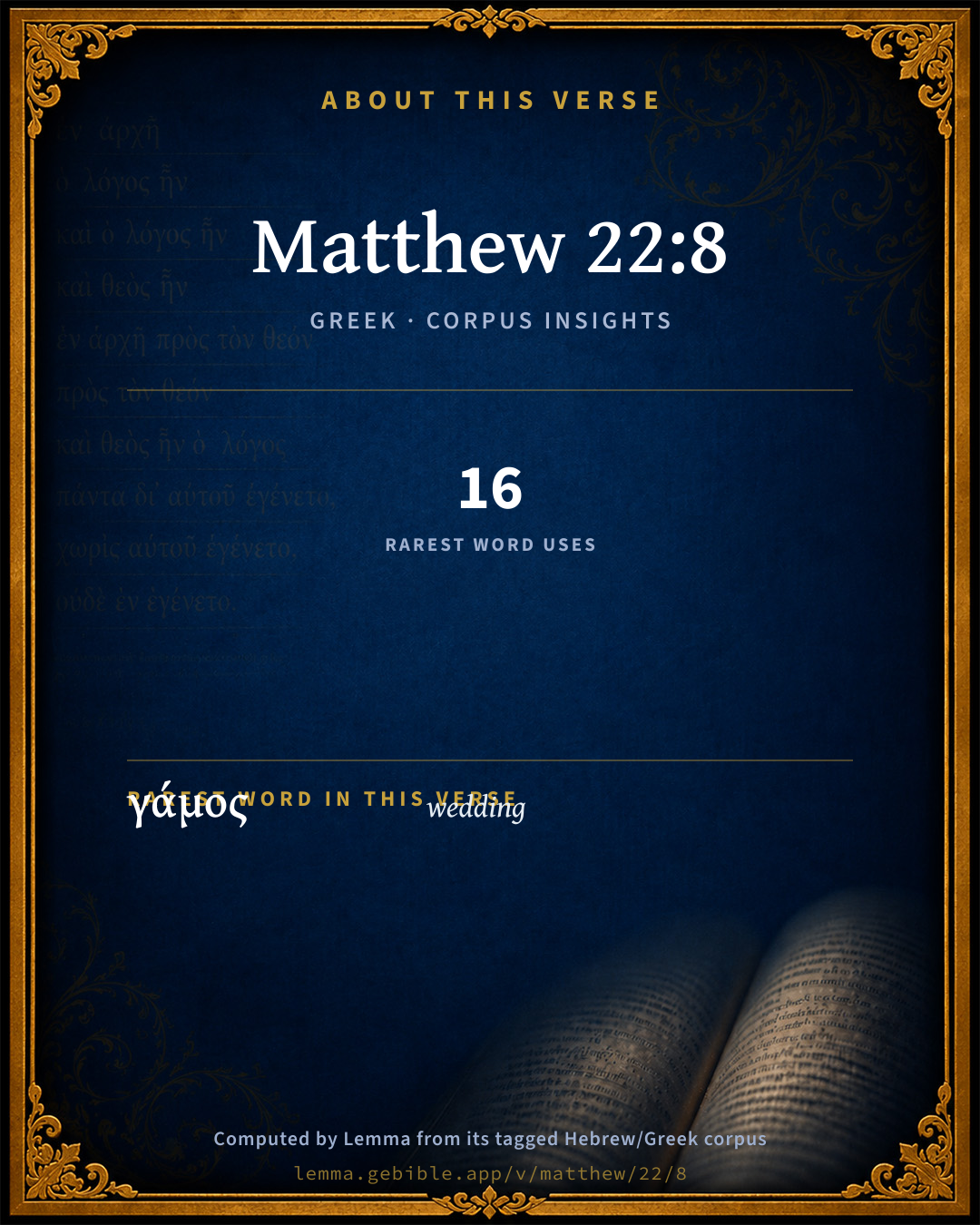
Matthew 22:8

Greek (Tischendorf 8th ed.) Matthew 22:8 appears in the Greek New Testament. The text above is from the Tischendorf 8th edition. Each word links to its Strong’s number and a concise gloss. Click any word for its full Thayer’s Greek Lexicon entry.
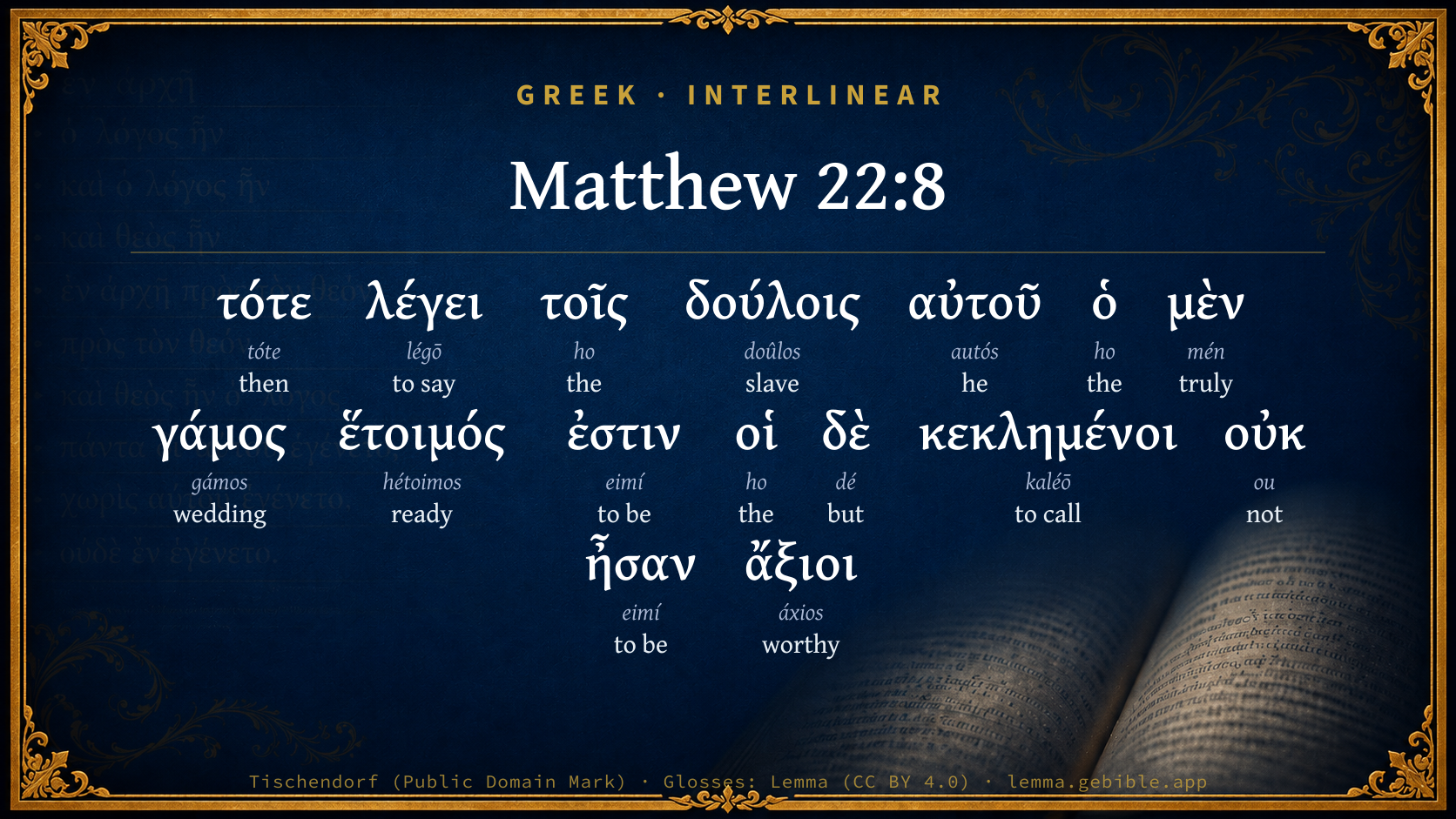
Download image
Cite this verse

Matthew 22:8 (World English Bible). Public Domain. Lemma interlinear Bible study tool, https://lemma.gebible.app/v/matthew/22/8.

Show BibTeX & RIS
BibTeX
RIS
English Translation
"Then he said to his servants, 'The wedding is ready, but those who were invited weren't worthy.
World English Bible · Public Domain
Download a study sheet

One document with this verse’s original text, its word-by-word gloss line, the meaning frame, cross-references with their text, attributed commentary, and full source and license credits — printable, and it pastes into notes with its structure intact.

This verse Autodidact and up

Study sheet (.html) Plain text (.txt)

A passage Seminary Student

Up to 50 verses in one chapter. A passage sheet keeps up to 6 commentary sources and 12 cross-references per verse, in the order this page ranks them, and says so on the sheet whenever that leaves anything out. Ask for a single verse and you get the Autodidact verse sheet above.

Everything on this page stays free to read, with no account — the sheet is a download of what is already on screen, not access to it.

Want to remove ads? Support Godless Engineer
Compare translations 3

The same verse in 3 English versions, stacked beneath the original-language interlinear above. Click any original word for its lexicon entry.

Each is an independent rendering of the whole verse — the interlinear is not word-aligned to these translations.

Highlighted words mark where these versions differ — a whole-verse word diff, not a word-by-word alignment.

  • World English Bible Public Domain
    "Then he said to his servants, 'The wedding is ready, but those who were invited weren't worthy.
  • King James Version Public Domain
    Then saith he to his servants, The wedding is ready, but they which were bidden were not worthy.
  • unfoldingWord Literal Text CC BY-SA 4.0
    Then he says to his servants, ‘The wedding feast is ready, but the ones having been invited were not worthy.

unfoldingWord Literal Text — © unfoldingWord, licensed CC BY-SA 4.0. Word-aligned USFM3 via Door43 (git.door43.org/unfoldingWord/en_ult).

Versions to compare (up to 4)

3 of 4 selected

Show all 19 translations

Every available English version of this verse, each an independent rendering of the whole verse.

  • World English Bible Public Domain
    "Then he said to his servants, 'The wedding is ready, but those who were invited weren't worthy.
  • Berean Standard Bible Public Domain
    Then he said to his servants, ‘The wedding banquet is ready, but those I invited were not worthy.
  • Majority Standard Bible Public Domain
    Then he said to his servants, ‘The wedding banquet is ready, but those I invited were not worthy.
  • King James Version Public Domain
    Then saith he to his servants, The wedding is ready, but they which were bidden were not worthy.
  • American Standard Version (1901) Public Domain
    Then saith he to his servants, The wedding is ready, but they that were bidden were not worthy.
  • Revised Version (1885) Public Domain
    Then saith he to his servants, The wedding is ready, but they that were bidden were not worthy.
  • Geneva Bible (1599) Public Domain
    Then saide hee to his seruants, Truely the wedding is prepared: but they which were bidden, were not worthy.
  • Douay-Rheims (1899) Public Domain
    Then he saith to his servants: The marriage indeed is ready; but they that were invited were not worthy.
  • Young's Literal Translation Public Domain
    then saith he to his servants, The marriage-feast indeed is ready, and those called were not worthy,
  • Literal Standard Version CC BY-SA 4.0
    then he says to his servants, The wedding feast indeed is ready, and those called were not worthy,
  • Unlocked Literal Bible CC BY-SA 4.0
    Then he said to his servants, 'The wedding is ready, but those who were invited were not worthy.
  • unfoldingWord Literal Text CC BY-SA 4.0
    Then he says to his servants, ‘The wedding feast is ready, but the ones having been invited were not worthy.
  • Darby Bible Public Domain
    Then he says to his bondmen, The wedding feast is ready, but those invited were not worthy;
  • World Messianic Bible Public Domain
    “Then he said to his servants, ‘The wedding is ready, but those who were invited weren’t worthy.
  • Webster's Bible Public Domain
    Then he saith to his servants, The wedding is ready, but they who were invited were not worthy.
  • Free Bible Version CC BY-SA 4.0
    Then the king said to his servants, ‘The wedding banquet is ready, but those who were invited didn't deserve to attend.
  • Bible in Basic English Public Domain
    Then he said to his servants, The feast is ready but the guests were not good enough.
  • Text-Critical English NT CC BY 4.0
    Then he said to his servants, ‘The wedding feast is ready, but those who were invited were not worthy.
  • Tyndale New Testament (1534) Public Domain
    Then sayde he to his servauutes: the weddinge was prepared. But they which were bydden were not worthy.

Literal Standard Version (2020), Covenant Press — licensed CC BY-SA 4.0. Text via the HelloAO Bible API (eBible.org). Unlocked Literal Bible (unfoldingWord) — licensed CC BY-SA 4.0. Text via the HelloAO Bible API (eBible.org). unfoldingWord Literal Text — © unfoldingWord, licensed CC BY-SA 4.0. Word-aligned USFM3 via Door43 (git.door43.org/unfoldingWord/en_ult). Free Bible Version, Dr. Jonathan Gallagher — licensed CC BY-SA 4.0. Text via the HelloAO Bible API (eBible.org).

Word by word

More ways to search: Search by grammar → Find every occurrence → Compare this word →

Practice this passage: Drill this verse → Learn its vocabulary →

γάμος
gámos
G1062
“wedding”
Noun, Nominative, Singular, Masculine
Part of Speech
Noun
Case
Nominative
Number
Singular
Gender
Masculine
Full Thayer's Definition

Origin: of uncertain affinity

TDNT: 11:48,1

1. a wedding or marriage festival, a wedding banquet, a wedding feast 2. marriage, matrimony
  1. τότε tóte G5119 “then” Adverb
  2. λέγει légō G3004 “to say” Verb, Present, Active, Indicative, 3rd person, Singular
  3. τοῖς ho G3588 “the” Article, Dative, Plural, Masculine
  4. δούλοις doûlos G1401 “slave” Noun, Dative, Plural, Masculine
  5. αὐτοῦ autós G846 “he” Personal pronoun, Genitive, Singular, Masculine
  6. ὁ ho G3588 “the” Article, Nominative, Singular, Masculine
  7. μὲν mén G3303 “truly” Particle
  8. ἕτοιμός hétoimos G2092 “ready” Adjective, Nominative, Singular, Masculine
  9. ἐστιν eimí G1510 “to be” Verb, Present, Active, Indicative, 3rd person, Singular
  10. οἱ ho G3588 “the” Article, Nominative, Plural, Masculine
  11. δὲ dé G1161 “but” Conjunction
  12. κεκλημένοι kaléō G2564 “to call” Verb, Perfect, Passive, Participle, Nominative, Plural, Masculine
  13. οὐκ ou G3756 “not” Particle, Negative
  14. ἦσαν eimí G1510 “to be” Verb, Imperfect, Active, Indicative, 3rd person, Plural
  15. ἄξιοι áxios G514 “worthy” Adjective, Nominative, Plural, Masculine

About this verse

These counts appear in no published source. They are computed here, from the morphology-tagged text and Lemma’s own curated glosses. What Lemma adds →

16
words
13
distinct lemmas
Gospels
section

Notable vocabulary

The rarest word here is γάμος wedding G1062 — appearing just 16 times in the whole Greek New Testament.

Shared distinctive vocabulary

γάμος wedding G1062 occurs in 16 verses of the Greek New Testament. Also found in:

Repetition

Words recur within this verse:

  • ἐστιν to be G1510 ×2
  • τοῖς the G3588 ×3

Cross-references

8

Topical passages linked to Matthew 22:8 in the Treasury of Scripture Knowledge — connected by theme and wording, ordered by reader-vote popularity; previews shown in the World English Bible.

  • Acts 13:46 Paul and Barnabas spoke out boldly, and said, "It was necessary that God's word should be spoken to you first. Since indeed you thrust it from you, and judge yourselves unworthy of eternal life, behold, we turn to the Gentiles.
  • 2 Thessalonians 1:5 This is an obvious sign of the righteous judgment of God, to the end that you may be counted worthy of the Kingdom of God, for which you also suffer.
  • Revelation 3:4 Nevertheless you have a few names in Sardis that did not defile their garments. They will walk with me in white, for they are worthy.
  • Luke 20:35 But those who are considered worthy to attain to that age and the resurrection from the dead, neither marry, nor are given in marriage.
  • Revelation 22:14 Blessed are those who do his commandments, that they may have the right to the tree of life, and may enter in by the gates into the city.
  • Matthew 10:11–13 Into whatever city or village you enter, find out who in it is worthy; and stay there until you go on.
  • Matthew 10:37–38 He who loves father or mother more than me is not worthy of me; and he who loves son or daughter more than me isn't worthy of me.
  • Luke 21:36 Therefore be watchful all the time, asking that you may be counted worthy to escape all these things that will happen, and to stand before the Son of Man."

Cross-references courtesy of OpenBible.info (CC BY 4.0).

Commentary

Notes on Matthew 22:8 from classic Christian and Jewish commentators (each source and its license shown beneath its notes). The classic Christian expositions comment on the surrounding passage and are grouped to its opening verse, so a note may address several verses; the Jewish commentaries on the Tanakh (Rashi and others) are per-verse, so they appear only where the commentator wrote on this verse.

Lemma curates 59 commentaries, every one of them public domain or Creative Commons licensed, each selected and text-cleaned for this edition rather than reprinted as found. About our sources →

Joseph Benson's Commentary

Mat 22:8-10. Then saith he to his servants, The wedding is ready — That is, the marriage-feast is prepared; but they which were bidden were not worthy — Were not disposed to receive the gospel, not willing to repent and believe, and behave kindly to the preachers of it: which is the description Christ gives to his apostles of those whom they were to account αξιοι, worthy, Mat 10:11-14. These here spoken of were αμελησαντες, (Mat 22:5,) slighters, despisers of the spiritual banquet, out of love to their secular interests; they loved other things more than Christ and the blessings of his kingdom; which he that doth, says Christ, is not worthy of me, because he will not take up his cross and follow me, Mat 10:37-38. Go ye therefore, &c. — As if he had said, Yet let not the provisions I have made be lost; but go into the highways, Gr. διεξοδους των οδων, the byways, or turnings of the road: or, as others interpret the expression, the ways most frequented, or the places where several streets and roads meet. As this is intended of the calling of the Gentiles, it intimates, that the Gentiles had as little reason to expect the call of the gospel, as common passengers and travellers to expect all invitation to a royal banquet. The offer of Christ and salvation to them, was, 1st, unlooked for; for they had had no previous notice of any such thing being intended: whereas the Jews had had notice of the gospel long before, and expected the Messiah and his kingdom. See Isa 65:1; Isa 2:2 d, It was universal, and undistinguishing; go and bid as many as you find, high and low, rich and poor, bond and free, young and old, Jew and Gentile; tell them all they shall be welcome to gospel privileges upon gospel terms; whoever will, let him come, without exception. So those servants went out — As their Lord had commanded them, and gathered as many as they found, good and bad — Giving a free invitation to all, whatever their character had formerly been. Thus, when the gospel was rejected by the Jews, the apostles, in obedience to Christ’s command, went into all parts of the world, and preached it to every creature that was willing to hear it; preached repentance and remission of sins in Christ’s name among all nations, Mar 16:16; Luk 24:47. And the wedding was furnished with guests — Great multitudes were gathered into the gospel church.

Joseph Benson's Commentary on the Old and New Testaments (1811–1818) — public domain. Text from a community e-Sword module.

Tyndale Open Study Notes

Tyndale Open Resources

22:8 Those who reject God’s invitation aren’t worthy to enter his Kingdom (cp. 3:8; 10:13, 37-38).

Tyndale Open Study Notes — © Tyndale Open Resources, licensed CC BY-SA 4.0. Text via the HelloAO Bible API.

Bengel's Gnomon

Johann Albrecht Bengel

Mat 22:8. Τότε, κ.τ.λ., then, etc.) see Act 13:46.—λέγει, κ.τ.λ., saith He, etc.) The Lord frequently reveals the principles of His counsel to His servants.—ἕτοιμός ἐστιν, is ready) and will not be dispensed with on account of the ingratitude of them which were bidden.[956]—οὐκ ἦσαν ἄξιοι, were not worthy) cf. Act 13:46. No one is considered unworthy until the offer has been made to and refused by him: by doing which he betrays himself. The past tense, were not worthy, is used to show that the opportunity of the unworthy has passed away.

[956] The Wedding is truly even still ready for the guests who are willing to come.—V. g.

Bengel's Gnomon of the New Testament — English translation (T&T Clark, Edinburgh, 1860) — public domain. Text from a community e-Sword module.

Meyer's Critical & Exegetical Commentary

Heinrich August Wilhelm Meyer

Mat_22:8. Οὐκ ἦσαν ἄξιοι] Comp. Act_13:46. Praeteritum indignos eo magis praetermittit, Bengel. To represent the expedition against the rebels, and the destruction of their city as actually taking place while the supper is being prepared,a thing hardly conceivable in real life,is to introduce an episode quite in accordance with the illustrative character of the parable, which after all is only a fictitious narrative. Comp., for example, the mustard seed which grows to a tree; the olive on which the wild branch is engrafted, Romans 11, etc.; see also note on Mat_25:1 f.

Meyer — Critical and Exegetical Commentary on the New Testament — English translation by Peter Christie, edited by Frederick Crombie (T&T Clark, 1880) — public domain. Text from a community e-Sword module.

Expositor's Greek Testament

ed. W. Robertson Nicoll

Mat 22:8-10 . τότε : after the second set of servants, as many as survived, had returned and reported their ill-success. λέγει , he says to them . ἔτοιμος , ready, and more.

The Expositor's Greek Testament, edited by W. Robertson Nicoll (1897–1910) — public domain. Text from a community e-Sword module.

Geneva Bible (1599)

Geneva Bible translators

The marriage feast.

Geneva Bible (1599) marginal notes — public domain. Text via Bolls.life.

Jamieson, Fausset & Brown

Robert Jamieson, A. R. Fausset & David Brown

The wedding is ready, but they which were bidden were not worthy--for how should those be deemed worthy to sit down at His table who had affronted Him by their treatment of His gracious invitation?

Jamieson, Fausset & Brown — Commentary Critical and Explanatory on the Whole Bible (1871) — public domain (CC PDM 1.0). Text via the HelloAO Bible API.

Adam Clarke's Commentary

Verse 8. Were not worthy.] Because they made light of it, and would not come; preferring earthly things to heavenly blessings. Among the Mohammedans, refusal to come to a marriage feast, when invited, is considered a breach of the law of God. HEDAYAH, vol. iv. p. 91. Any one that shall be invited to a dinner, and does not accept the invitation, disobeys God, and his messenger: and any one who comes uninvited, you may say is a thief, and returns a plunderer.-Mischat ul Mesabih. It was probably considered in this light among all the oriental nations. This observation is necessary, in order to point out more forcibly the iniquity of the refusal mentioned in the text. A man may be said to be worthy of, or fit for, this marriage feast, when, feeling his wretchedness and misery, he comes to God in the way appointed, to get an entrance into the holiest, by the blood of Jesus.

Adam Clarke's Commentary on the Bible (1810–1826) — public domain. Text from a community e-Sword/MySword module.

John Gill's Exposition

Then saith he to his servants,.... That were preserved from their rage and malice, and outlived their implacable enemies, and saw their utter ruin and destruction:

the wedding is ready; meaning not the marriage contract, which was secretly performed in eternity; or the calling of God's elect among the Jews, and their open espousal to Christ, which for the present was now over; but the marriage feast, or the Gospel dispensation, which was ushered in, and the ministry of it, to which nothing was wanting; all the promises, prophecies, types, and shadows, of the former dispensation, were now accomplished; the Lamb of God was slain, and all things to be done by him, were now finished; the ministers of the Gospel, the apostles, were called, their commission enlarged, and they qualified with a greater measure of the Spirit, and were sent to preach both to Jews and Gentiles:

but they which were bidden were not worthy; that is, the Jews, who had notice of this dispensation by the prophets, were told by John the Baptist, that it was at hand; were once, and again externally called unto it by the ministry of the apostles; but they were not only unworthy in themselves, as all men are, of such a blessing and privilege, but they behaved towards it in a very unworthy manner; they were so far from attending on it in a diligent and peaceable way, as becomes all such persons that are blessed with the external ministry of it; who when they do so, may be said to behave worthily, and, in some sense, to be worthy of such a privilege being continued with them; see Mat 10:13 compared with Luk 10:6 that they contradicted and blasphemed it, and by their own outrageous carriage, showed plainly that they were unworthy of it; and were so judged by Christ and his apostles, who ordered them to turn from them, and go to the Gentiles, and which may be intended in the following words.

John Gill's Exposition of the Whole Bible (1746–1763) — public domain (CC PDM 1.0). Text via the HelloAO Bible API.

Trapp's Complete Commentary

John Trapp

8 Then saith he to his servants, The wedding is ready, but they which were bidden were not worthy.

Ver. 8. They which were bidden were not worthy] Who were then? Such as came from the highways and hedges, Mat 22:9, that is, such as fit and show their sores to God, as the cripple and others do by the highway side to every passenger, to move pity. Such sensible sinners shall walk with Christ in white, for they are worthy.

John Trapp, A Commentary or Exposition upon All the Books of the Old and New Testament (1647–1656) — public domain. Text from a community e-Sword module.

Haydock's Catholic Bible Commentary

Were not worthy. The Almighty knew full well that they were not worthy; he still sent them these frequently repeated invitations, that they might be left without any excuse. (St. John Chrysostom, hom. lxx.) --- More is signified here than the bare letter conveys; they were not only less worthy of the nuptials, but by their very great obstinacy, ingratitude and impiety, quite unworthy. Not so the Gentiles. (Jansenius) --- Hence Christ says:

George Leo Haydock (1774–1849), Haydock's Catholic Family Bible and Commentary, 1859 edition — public domain. Excludes Psalms (Douay-Rheims chapter numbering differs from Protestant) and Deuterocanonical books (Catholic canon only).

Whedon's Commentary on the Bible

Daniel D. Whedon

8. Then saith he — As the Jews are now cast off, God will call the Gentiles to partake of his Gospel. Not worthy — They had rendered themselves unworthy of farther offers by their rejection of those they had received.

Daniel D. Whedon (gen. ed.), Commentary on the Old and New Testaments (1874–1909) — public domain. Text from a community e-Sword module.

The Pulpit Commentary

Then saith he. This is supposed to take place after the destruction of the murderers and their city; and, indeed, the final rejection of the Jews and the substitution of the Gentiles were consummated by the overthrow of Jerusalem and the Hebrew polity. The wedding is ready. God"s great design is not frustrated by the neglect of those first invited, only the guests are changed. Not worthy. Their unworthiness was proved by their rejection of the gracious call, as the worthiness of those subsequently called consisted in their acceptance thereof. The passage is well illustrated by the language of Paul and Barnabas. (Act_13:46, Act_13:47)

The Pulpit Commentary (1880–1919), ed. H.D.M. Spence-Jones & Joseph S. Exell — public domain. Text from a community e-Sword module.

John Wesley's Explanatory Notes

Go into the highways - The word properly signifies, the by- ways, or turnings of the road.

John Wesley, Explanatory Notes Upon the Whole Bible (1754–1765) — public domain. Text via the GEBible commentary corpus.

Kretzmann's Popular Commentary

Paul E. Kretzmann

New guests:

v. 8. Then saith he to his servants, The wedding is ready, but they which were bidden were not worthy.

v. 9. Go ye, therefore, into the highways, and as many as ye shall find, bid to the marriage.

v. 10. So those servants went out into the highways, and gathered together all, as many as they found, both bad and good; and the wedding was furnished with guests.

Then , when the report of the failure of his servants to persuade the former guests was made. Time was pressing; great hurry was demanded. So they should go out on the highways, to the place where there is a crossing over of roads, either a crossroads from which the roads radiate in every direction, or a place near the gates where the roads from all directions an together. In either case, many people would be passing by in just a little while, and the chance of finding guests would be much greater. No care should be exercised by the servants to make a careful selection, especially not so far as nationality was concerned: The unworthy guests should be replaced as rapidly as possible by others, whomever they might find. And the servants followed the command literally. Going out on the streets and roads, they brought together all whom they found, bad as well as good, and the nuptial assembly of those that were to partake of the feast was made complete.

The missing wedding-garment:

v. 11. And when the king came in to see the guests, he saw there a man which had not on a wedding-garment;

v. 12. and he saith unto him, Friend, how camest thou in hither not having a wedding-garment? And he was speechless.

v. 13. Then said the king to the servants, Bind him hand and foot, and take him away, and cast him into outer darkness; there shall be weeping and gnashing of teeth.

v. 14. For many are called, but few are chosen.

The king was naturally pleased over the success of his plan, and as soon as the guests were placed and the wedding-feast was in progress, he came in to welcome them all. But while passing down between the rows of tables his attention was drawn to one man who, although reclining with the rest at a table and partaking of the food, yet was not clothed in a proper wedding-garment. This was not only inexcusable, it was insulting. For the guests of Oriental kings were at all times, but especially upon such an occasion, provided with festal garments, and the accidental guest above all was taken care of in this respect. It was natural, also, and in keeping with the dignity of the occasion that the guests should take unusual care with their dress, in order not to seem insensible to the honor bestowed upon them. No wonder that the king’s surprised inquiry as to the way in which he managed to slip in unobserved, when, as he knew, a wedding-garment was required and might have been obtained for the asking, caused the guilty fellow literally to be strangled in his speech and unable to say a single word in explanation or defense. It was a case of foolishly and deliberately despising the bounty, the largess, of the king. And so the king passed summary sentence. The servants received orders to bind the guilty one hand and foot and to thrust him into the outer darkness of the dungeon, where he would have plenty of time to repent of his folly with weeping and gnashing of teeth. For, adds Jesus, many are called, but few are chosen.

The lesson of this parable is similar to that of the previous one, and was probably understood by the Jews in its first part. In the second part it went beyond the Jewish Church and contains a warning for all time. God Himself is the king. The wedding-feast is that of the Messiah’s kingdom, the marriage of the Lamb. The first invitation was issued to the chosen people of the Old Testament, the nation of the Jews. The prophets came to them in increasing numbers, with increasing clearness of message. Then came John the Baptist, Christ Himself, the apostles, with their urgent call to repentance and salvation. But the answer was indifference, hatred, blasphemy, murder. Then God’s patience was exhausted, then His judgment was executed upon Jerusalem and upon the Jewish nation, the Romans under Vespasian and Titus laying siege to their capital and destroying both Temple and city, 70 A. D. Since that time the Lord has faithfully attempted to get other guests for His wedding-feast. His messengers have gone forth on the highways and byways of the Gentile nations throughout the world. The Christian Church has spread to practically every country of the earth. Men of every tongue have been assembled in the great hall of the Lamb’s wedding-feast. Good and bad, hypocrites and sincere believers, are joined in the outward communion known as the visible Church. But the time of the King’s reckoning is coming. He has provided, through His Son Jesus Christ, a wedding-garment of spotless righteousness and purity for every sinner that is called to the feast. His mercy and grace are indeed free for all men, but they cannot partake of the meal without having first accepted this festal garment to cover the filth and nakedness of their sin. He will lay bare the deceit, if not before, then on the great Day of Judgment. And the insult to the love of God will be properly punished when every person that puts his trust in his own merit and works will be cast into the dungeon of hell with its everlasting torments. "That will be the punishment that the time of visitation has not been recognized nor accepted, that we were invited, had Sacrament, Baptism, Gospel, absolution, and still did not believe it, nor made ourselves of use. Would to God that the dear Lord would teach us thoroughly and brings to that point that we would realize what great mercy we have received in being invited to such a blessed feast, where we shall find salvation from sin, devil, death, and eternal wailing! He that will not accept this with thanks, but despises such grace, shall have eternal death instead of it. For one of the two it must be: Either receive the Gospel and believe and be saved, or do not believe and be condemned eternally."

Paul E. Kretzmann, Popular Commentary of the Bible (1921–1924) — public domain. Text from a community e-Sword module.

The People's New Testament

B. W. Johnson

8. The wedding is ready, but the bidden were not worthy. Those who reject the gospel invitation show that they are not worthy. Compare Paul, Acts 13:46.

B. W. Johnson's The People's New Testament with Notes (1889–1891) — public domain. Electronic text from the Christian Classics Ethereal Library (CCEL) ThML edition.

unfoldingWord translationNotes

Door43 World Missions Community

Connecting Statement:

Jesus continues telling a parable. (See: Parables)

those who were invited

This can be stated in active form. AT: "those whom I invited" (See: Active or Passive)

the highway crossings

"where the main roads of the city cross." The king is sending the servants to the place where they are most likely to find people.

both bad and good

"both the good people and the bad people"

So the wedding hall was filled with guests

This can be stated in active form. AT: "So the guests filled the wedding hall" (See: Active or Passive)

hall

a large room

translationWords

servant

worthy

feast

unfoldingWord translationNotes — © Distant Shores Media and the Door43 World Missions Community, licensed CC BY-SA 4.0. Source: git.door43.org/Door43/en_tn.

Alford’s Greek Testament

Henry Alford

8-10.] On οὐκ ἄξιοι see Act 13:46. ἦσαν, as Bengel,—“præteritum indignos eo magis prætermittit.”

διέξοδοι are the places of resort at the meetings of streets, the squares, or confluences of ways. De Wette and Meyer are wrong in saying that they are not in the city, ‘for that was destroyed:’ it is not the city of the murderers, but that in which the feast is supposed to be held, which is spoken of: not Jerusalem, but God’s world.

πονηρ. τε κ. ἀγαθ.] Both the open sinners and the morally good together. See ch. 13:47, where the net collects ἐκ παντὸς γένους. Stier remarks that we might expect, from ch. 21:31, to find the guest who by and by is expelled, among the ἀγαθοί.

ὁ γάμος is here the feast, not the place where it was held.

Here, so to speak, the first act of the parable closes; and here is the situation of the Church at this day;—collected out of all the earth, and containing both bad and good. ἐπλήσθη, as Meyer well remarks, is emphatic.

11,

Henry Alford, The Greek Testament (1849–1861) — public domain. Text from a community e-Sword module.

International Critical Commentary

8. Then he saith to his servants, The marriage feast is ready, but the invited (guests) were not worthy.]

(L)

International Critical Commentary — older volumes (1896–1929), various authors — public domain. Text from a community e-Sword module.

Lesson kit

Teaching starters — assembled from the data on this page, not authored interpretation. Every prompt links to the verse data it draws on. Edit before teaching.

Matthew, in the Gospels, opens this verse with 16 words (13 distinct Greek lemmas). Its most distinctive word is gámos (“wedding”). A historical commentator’s framing appears above. Read the whole chapter for the surrounding context.

Discussion questions

  1. What does “wedding” (gámos) contribute to the verse as a whole?
  2. Matthew 22:2 shares the word «wedding» with this verse. How do the two illuminate each other?
  3. “to be” occurs 2× in this one verse. What is the effect of the repetition?
  4. The translations on this page render this verse differently — a whole-verse word diff, not a word-by-word alignment. What might account for the different wordings?
  5. Reading how Joseph Benson's Commentary and Tyndale Open Study Notes read this verse, where do the two commentators agree and where do they part?

Things to notice

Reading settings

Reading text

Shown beneath each verse's original-language words.

Old Testament
Old Testament edition

Read the OT as the Masoretic Hebrew (MT) or the Greek Septuagint (LXX).

English shown for the Greek Septuagint (in the Hebrew ↔ Greek comparison).

Comparing translations? Open the Compare panel on any verse page to stack up to four side by side.