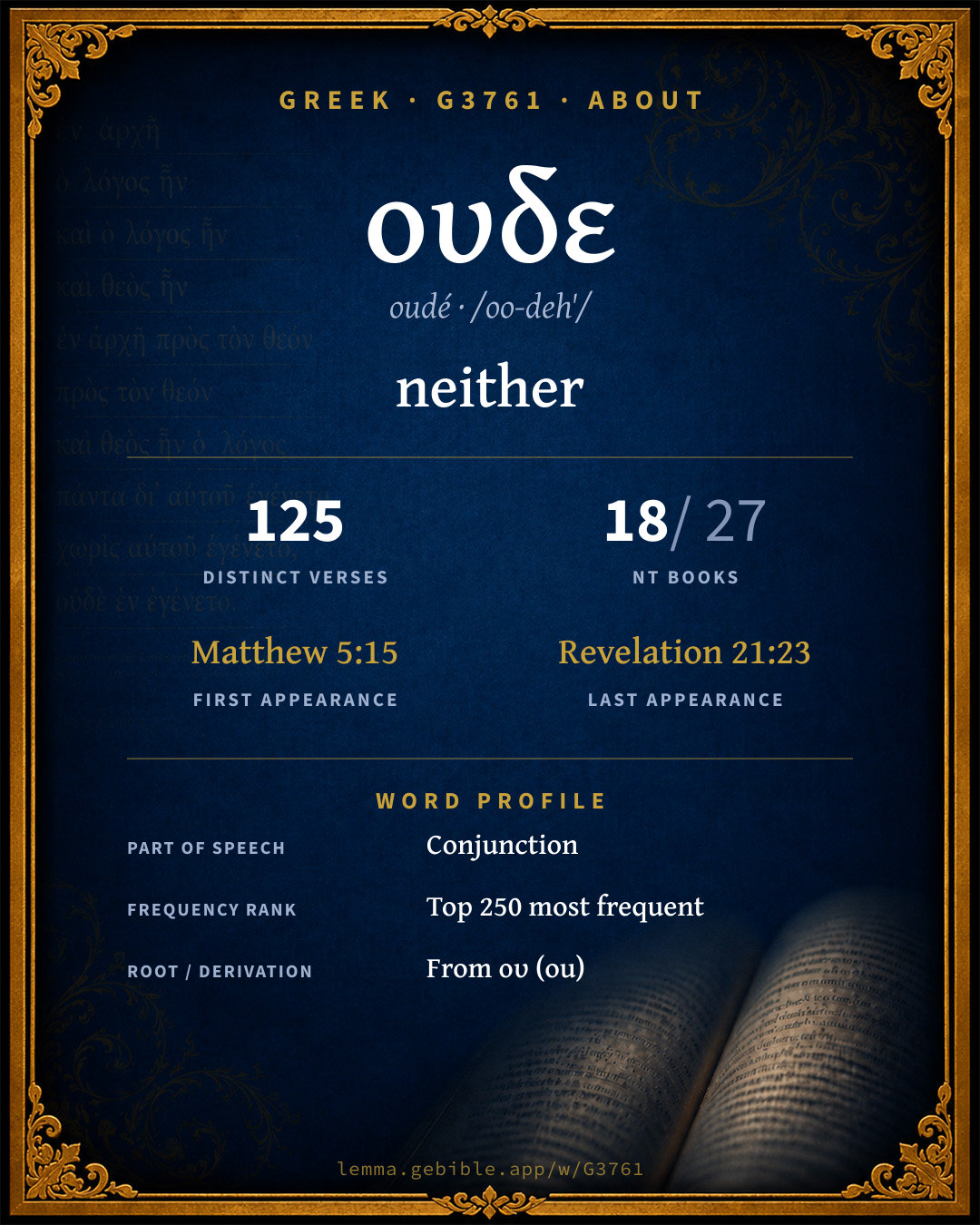
οὐδέ
neither
Full lexicon entry — Thayer's Greek Lexicon
From Thayer's Greek Lexicon
Where this word appears
Grammar key — what these labels mean
Part of speech
- Conjunction
- A joining word linking words or clauses.
Degree
- Negative
- Marks a negative form.
Every verse where G3761 appears — 125 distinct verses across 18 books. Click any verse to open its interlinear word-by-word view. Verse text shown in the World English Bible for context — . Each verse’s Greek form is shown with its reference; the English is not keyword-highlighted, since the data carries no word-level English alignment. Use “Compare translations” on any verse to read it across multiple English versions. This concordance covers the Greek New Testament; Septuagint (Greek Old Testament) occurrences of this word are not indexed here.
Matthew 24 verses
- Matthew 5:15 οὐδὲ conj neg Neither do you light a lamp, and put it under a measuring basket, but on a stand; and it shines to all who are in the house.
- Matthew 6:15 οὐδὲ conj neg But if you don't forgive men their trespasses, neither will your Father forgive your trespasses.
- Matthew 6:20 οὐδὲ conj neg but lay up for yourselves treasures in heaven, where neither moth nor rust consume, and where thieves don't break through and steal;
- Matthew 6:26 οὐδὲ οὐδὲ conj neg conj neg See the birds of the sky, that they don't sow, neither do they reap, nor gather into barns. Your heavenly Father feeds them. Aren't you of much more value than they?
- Matthew 6:28 οὐδὲ conj neg Why are you anxious about clothing? Consider the lilies of the field, how they grow. They don't toil, neither do they spin,
- Matthew 6:29 οὐδὲ conj neg yet I tell you that even Solomon in all his glory was not dressed like one of these.
- Matthew 7:18 οὐδὲ conj neg A good tree can't produce evil fruit, neither can a corrupt tree produce good fruit.
- Matthew 8:10 οὐδὲ conj neg When Jesus heard it, he marveled, and said to those who followed, "Most assuredly I tell you, I haven't found so great a faith, not even in Israel.
- Matthew 9:17 οὐδὲ conj neg Neither do people put new wine into old wineskins, or else the skins would burst, and the wine be spilled, and the skins ruined. No, they put new wine into fresh wineskins, and both are preserved."
- Matthew 10:24 οὐδὲ conj neg "A disciple is not above his teacher, nor a servant above his lord.
- Matthew 11:27 οὐδὲ conj neg All things have been delivered to me by my Father. No one knows the Son, except the Father; neither does anyone know the Father, except the Son, and he to whom the Son desires to reveal him.
- Matthew 12:4 οὐδὲ conj neg how he entered into the house of God, and ate the show bread, which was not lawful for him to eat, neither for those who were with him, but only for the priests?
- Matthew 12:19 οὐδὲ οὐδὲ conj neg conj neg He will not strive, nor shout; Neither will anyone hear his voice in the streets.
- Matthew 13:13 οὐδὲ conj neg Therefore I speak to them in parables, because seeing they don't see, and hearing, they don't hear, neither do they understand.
- Matthew 16:9 οὐδὲ conj neg Don't you yet perceive, neither remember the five loaves for the five thousand, and how many baskets you took up?
- Matthew 16:10 οὐδὲ conj neg Nor the seven loaves for the four thousand, and how many baskets you took up?
- Matthew 21:27 οὐδὲ conj neg They answered Jesus, and said, "We don't know." He also said to them, "Neither will I tell you by what authority I do these things.
- Matthew 22:46 οὐδὲ conj neg No one was able to answer him a word, neither dared any man from that day forth ask him any more questions.
- Matthew 23:13 οὐδὲ conj neg "Woe to you, scribes and Pharisees, hypocrites! For you devour widows' houses, and as a pretense you make long prayers. Therefore you will receive greater condemnation.
- Matthew 24:21 οὐδ’ conj neg for then there will be great oppression, such as has not been from the beginning of the world until now, no, nor ever will be.
- Matthew 24:36 οὐδὲ οὐδὲ conj neg conj neg But no one knows of that day and hour, not even the angels of heaven, but my Father only.
- Matthew 25:13 οὐδὲ conj neg Watch therefore, for you don't know the day nor the hour in which the Son of Man is coming.
- Matthew 25:45 οὐδὲ conj neg "Then he will answer them, saying, 'Most assuredly I tell you, inasmuch as you didn't do it to one of the least of these, you didn't do it to me.'
- Matthew 27:14 οὐδὲ conj neg He gave him no answer, not even one word, so that the governor marveled greatly.
Mark 9 verses
- Mark 4:22 οὐδὲ conj neg For there is nothing hidden, except that it should be made known; neither was anything made secret, but that it should come to light.
- Mark 5:3 οὐδὲ conj neg who had his dwelling in the tombs. Nobody could bind him any more, not even with chains,
- Mark 6:31 οὐδὲ conj neg He said to them, "You come apart into a deserted place, and rest awhile." For there were many coming and going, and they had no leisure so much as to eat.
- Mark 8:17 οὐδὲ conj neg Jesus, perceiving it, said to them, "Why do you reason that it's because you have no bread? Don't you perceive yet, neither understand? Is your heart still hardened?
- Mark 11:33 οὐδὲ conj neg They answered Jesus, "We don't know." Jesus said to them, "Neither do I tell you by what authority I do these things."
- Mark 12:10 οὐδὲ conj neg Haven't you even read this Scripture: 'The stone which the builders rejected, The same was made the head of the corner.
- Mark 13:32 οὐδὲ οὐδὲ conj neg conj neg But of that day or that hour no one knows, not even the angels in heaven, nor the Son, but only the Father.
- Mark 14:59 οὐδὲ conj neg Even so, their testimony did not agree.
- Mark 16:13 οὐδὲ conj neg They went away and told it to the rest. They didn't believe them, either.
Luke 18 verses
- Luke 6:3 οὐδὲ conj neg Jesus, answering them, said, "Haven't you read what David did when he was hungry, he, and those who were with him;
- Luke 6:43 οὐδὲ conj neg For there is no good tree that brings forth rotten fruit; nor again a rotten tree that brings forth good fruit.
- Luke 6:44 οὐδὲ conj neg For each tree is known by its own fruit. For people don't gather figs from thorns, nor do they gather grapes from a bramble bush.
- Luke 7:7 οὐδὲ conj neg Therefore I didn't even think myself worthy to come to you; but say the word, and my servant will be healed.
- Luke 7:9 οὐδὲ conj neg When Jesus heard these things, he marveled at him, and turned and said to the multitude who followed him, "I tell you, I have not found such great faith, no, not in Israel."
- Luke 8:17 οὐδὲ conj neg For nothing is hidden, that will not be revealed; nor anything secret, that will not be known and come to light.
- Luke 11:33 οὐδὲ conj neg "No man, when he has lit a lamp, puts it in a cellar, nor under a basket, but on a stand, that those who enter in may see the light.
- Luke 12:24 οὐδὲ conj neg Consider the ravens: they don't sow, they don't reap, they have no warehouse or barn, and God feeds them. How much more valuable are you than birds!
- Luke 12:26 οὐδὲ conj neg If then you aren't able to do even the least things, why are you anxious about the rest?
- Luke 12:27 οὐδὲ conj neg Consider the lilies, how they grow. They don't toil, neither do they spin; yet I tell you, even Solomon in all his glory was not arrayed like one of these.
- Luke 12:33 οὐδὲ conj neg Sell that which you have, and give gifts to the needy. Make for yourselves purses which don't grow old, a treasure in the heavens that doesn't fail, where no thief approaches, neither moth destroys.
- Luke 16:31 οὐδὲ conj neg "He said to him, 'If they don't listen to Moses and the prophets, neither will they be persuaded if one rises from the dead.'"
- Luke 17:21 οὐδὲ conj neg neither will they say, 'Look, here!' or, 'Look, there!' for behold, the Kingdom of God is within you."
- Luke 18:4 οὐδὲ conj neg He wouldn't for a while, but afterward he said to himself, 'Though I neither fear God, nor respect man,
- Luke 18:13 οὐδὲ conj neg But the tax collector, standing far away, wouldn't even lift up his eyes to heaven, but beat his breast, saying, 'God, be merciful to me, a sinner!'
- Luke 20:8 οὐδὲ conj neg Jesus said to them, "Neither will I tell you by what authority I do these things."
- Luke 23:15 οὐδὲ conj neg Neither has Herod, for I sent you to him, and see, nothing worthy of death has been done by him.
- Luke 23:40 οὐδὲ conj neg But the other answered, and rebuking him said, "Don't you even fear God, seeing you are under the same condemnation?
John 13 verses
- John 1:3 οὐδὲ conj neg All things were made through him. Without him was not anything made that has been made.
- John 1:13 οὐδὲ οὐδὲ conj neg conj neg who were born not of blood, nor of the will of the flesh, nor of the will of man, but of God.
- John 1:25 οὐδὲ οὐδὲ conj neg conj neg They asked him, "Why then do you baptize, if you are not the Christ, nor Elijah, nor the Prophet?"
- John 5:22 οὐδὲ conj neg For the Father judges no one, but he has given all judgment to the Son,
- John 6:24 οὐδὲ conj neg When the multitude therefore saw that Jesus wasn't there, nor his disciples, they themselves got into the boats, and came to Capernaum, seeking Jesus.
- John 7:5 οὐδὲ conj neg For even his brothers didn't believe in him.
- John 8:11 οὐδὲ conj neg She said, "No one, Lord." Jesus said, "Neither do I condemn you. Go your way. From now on, sin no more."
- John 8:42 οὐδὲ conj neg Therefore Jesus said to them, "If God were your Father, you would love me, for I came out and have come from God. For I haven't come of myself, but he sent me.
- John 11:50 οὐδὲ conj neg nor do you consider that it is advantageous for us that one man should die for the people, and that the whole nation not perish."
- John 13:16 οὐδὲ conj neg Most assuredly I tell you, a servant is not greater than his lord, neither one who is sent greater than he who sent him.
- John 14:17 οὐδὲ conj neg the Spirit of truth, whom the world can't receive; for it doesn't see him, neither knows him. You know him, for he lives with you, and will be in you.
- John 15:4 οὐδὲ conj neg Remain in me, and I in you. As the branch can't bear fruit by itself, unless it remains in the vine, so neither can you, unless you remain in me.
- John 16:3 οὐδὲ conj neg They will do these things because they have not known the Father, nor me.
Acts 12 verses
- Acts 2:27 οὐδὲ conj neg Because you will not leave my soul in Hades, Neither will you allow your Holy One to see decay.
- Acts 4:12 οὐδὲ conj neg There is salvation in none other, for neither is there any other name under heaven, that is given among men, by which we must be saved!"
- Acts 4:32 οὐδὲ conj neg The multitude of those who believed were of one heart and soul. Not one of them claimed that anything of the things which he possessed was his own, but they had all things in common.
- Acts 4:34 οὐδὲ conj neg For neither was there among them any who lacked, for as many as were owners of lands or houses sold them, and brought the proceeds of the things that were sold,
- Acts 7:5 οὐδὲ conj neg He gave him no inheritance in it, no, not so much as to set his foot on. He promised that he would give it to him for a possession, and to his seed after him, when he still had no child.
- Acts 8:21 οὐδὲ conj neg You have neither part nor lot in this matter, for your heart isn't right before God.
- Acts 9:9 οὐδὲ conj neg He was without sight for three days, and neither ate nor drank.
- Acts 16:21 οὐδὲ conj neg and set forth customs which it is not lawful for us to accept or to observe, being Romans."
- Acts 17:25 οὐδὲ conj neg neither is he served by men's hands, as though he needed anything, seeing he himself gives to all life and breath, and all things.
- Acts 19:2 οὐδ’ conj neg He said to them, "Did you receive the Holy Spirit when you believed?" They said to him, "No, we haven't even heard that there is a Holy Spirit."
- Acts 24:13 οὐδὲ conj neg Nor can they prove to you the things of which they now accuse me.
- Acts 24:18 οὐδὲ conj neg amid which certain Jews from Asia found me purified in the temple, not with a mob, nor with turmoil.
Romans 7 verses
- Romans 2:28 οὐδὲ conj neg For he is not a Jew who is one outwardly, neither is that circumcision which is outward in the flesh;
- Romans 3:10 οὐδὲ conj neg As it is written, "There is no one righteous. No, not one.
- Romans 4:15 οὐδὲ conj neg For the law works wrath, for where there is no law, neither is there disobedience.
- Romans 8:7 οὐδὲ conj neg because the mind of the flesh is hostile towards God; for it is not subject to God's law, neither indeed can it be.
- Romans 9:7 οὐδ’ conj neg Neither, because they are Abraham's seed, are they all children. But, "In Isaac will your seed be called."
- Romans 9:16 οὐδὲ conj neg So then it is not of him who wills, nor of him who runs, but of God who has mercy.
- Romans 11:21 οὐδὲ conj neg for if God didn't spare the natural branches, neither will he spare you.
1 Corinthians 10 verses
- 1 Corinthians 2:6 οὐδὲ conj neg We speak wisdom, however, among those who are full grown; yet a wisdom not of this world, nor of the rulers of this world, who are coming to nothing.
- 1 Corinthians 3:2 οὐδὲ conj neg I fed you with milk, not with meat; for you weren't yet ready. Indeed, not even now are you ready,
- 1 Corinthians 4:3 οὐδὲ conj neg But with me it is a very small thing that I should be judged by you, or by man's judgment. Yes, I don't judge my own self.
- 1 Corinthians 5:1 οὐδὲ conj neg It is actually reported that there is sexual immorality among you, and such sexual immorality as is not even named among the Gentiles, that one has his father's wife.
- 1 Corinthians 11:14 οὐδὲ conj neg Doesn't even nature itself teach you that if a man has long hair, it is a dishonor to him?
- 1 Corinthians 11:16 οὐδὲ conj neg But if any man seems to be contentious, we have no such custom, neither do God's assemblies.
- 1 Corinthians 14:21 οὐδ’ conj neg In the law it is written, "By men of strange languages and by the lips of strangers I will speak to this people. Not even thus will they hear me, says the Lord."
- 1 Corinthians 15:13 οὐδὲ conj neg But if there is no resurrection of the dead, neither has Christ been raised.
- 1 Corinthians 15:16 οὐδὲ conj neg For if the dead aren't raised, neither has Christ been raised.
- 1 Corinthians 15:50 οὐδὲ conj neg Now I say this, brothers, that flesh and blood can't inherit the Kingdom of God; neither does corruption inherit incorruption.
2 Corinthians 1 verse
Galatians 8 verses
- Galatians 1:1 οὐδὲ conj neg Paul, an apostle (not from men, neither through man, but through Jesus Christ, and God the Father, who raised him from the dead),
- Galatians 1:12 οὐδὲ conj neg For neither did I receive it from man, nor was I taught it, but it came to me through revelation of Jesus Christ.
- Galatians 1:17 οὐδὲ conj neg nor did I go up to Jerusalem to those who were apostles before me, but I went away into Arabia. Then I returned to Damascus.
- Galatians 2:3 οὐδὲ conj neg But not even Titus, who was with me, being a Greek, was compelled to be circumcised.
- Galatians 2:5 οὐδὲ conj neg to whom we gave no place in the way of subjection, not for an hour, that the truth of the Gospel might continue with you.
- Galatians 3:28 οὐδὲ οὐδὲ conj neg conj neg There is neither Jew nor Greek, there is neither slave nor free man, there is neither male nor female; for you are all one in Christ Jesus.
- Galatians 4:14 οὐδὲ conj neg That which was a temptation to you in my flesh, you didn't despise nor reject; but you received me as an angel of God, even as Christ Jesus.
- Galatians 6:13 οὐδὲ conj neg For even they who receive circumcision don't keep the law themselves, but they desire to have you circumcised, that they may boast in your flesh.
Philippians 1 verse
1 Thessalonians 2 verses
2 Thessalonians 1 verse
1 Timothy 3 verses
- 1 Timothy 2:12 οὐδὲ conj neg But I don't permit a woman to teach, nor to exercise authority over a man, but to be in quietness.
- 1 Timothy 6:7 οὐδὲ conj neg For we brought nothing into the world, and we certainly can't carry anything out.
- 1 Timothy 6:16 οὐδὲ conj neg who alone has immortality, dwelling in unapproachable light; whom no man has seen, nor can see: to whom be honor and eternal power. Amen.
Hebrews 6 verses
- Hebrews 8:4 οὐδ’ conj neg For if he were on earth, he would not be a priest at all, seeing there are priests who offer the gifts according to the law;
- Hebrews 9:12 οὐδὲ conj neg nor yet through the blood of goats and calves, but through his own blood, entered in once for all into the Holy Place, having obtained eternal redemption.
- Hebrews 9:18 οὐδ’ conj neg Therefore even the first covenant has not been dedicated without blood.
- Hebrews 9:25 οὐδ’ conj neg nor yet that he should offer himself often, as the high priest enters into the holy place year by year with blood not his own,
- Hebrews 10:8 οὐδὲ conj neg Previously saying, "Sacrifices and offerings and whole burnt offerings and sacrifices for sin you didn't desire, neither had pleasure in them" (those which are offered according to the law),
- Hebrews 13:5 οὐδ’ conj neg Be free from the love of money, content with such things as you have, for he has said, "I will in no way leave you, neither will I in any way forsake you."
1 Peter 1 verse
2 Peter 1 verse
1 John 2 verses
Revelation 6 verses
- Revelation 7:16 οὐδὲ οὐδὲ οὐδὲ conj neg conj neg conj neg They will never be hungry, neither thirsty any more; neither will the sun beat on them, nor any heat;
- Revelation 9:4 οὐδὲ οὐδὲ conj neg conj neg They were told that they should not hurt the grass of the earth, neither any green thing, neither any tree, but only those people who don't have God's seal on their foreheads.
- Revelation 9:20 οὐδὲ conj neg The rest of mankind, who were not killed with these plagues, didn't repent of the works of their hands, that they wouldn't worship demons, and the idols of gold, and of silver, and of brass, and of stone, and of wood; which can neither see, nor hear, nor walk.
- Revelation 12:8 οὐδὲ conj neg They didn't prevail, neither was a place found for him any more in heaven.
- Revelation 20:4 οὐδὲ conj neg I saw thrones, and they sat on them, and judgment was given to them. I saw the souls of those who had been beheaded for the testimony of Jesus, and for the word of God, and such as didn't worship the beast nor his image, and didn't receive the mark on their forehead and on their hand. They lived, and reigned with Christ for the thousand years.
- Revelation 21:23 οὐδὲ conj neg The city has no need for the sun, neither of the moon, to shine, for the very glory of God illuminated it, and its lamp is the Lamb.
About this entry
At a glance — auto-summarized from this page’s data, not written by a person. Every figure links to its source below. This summary describes the numbers; it doesn’t interpret them.
At its core, ουδε (oudé) means “neither.” Scripture first uses it in Matthew 5:15. Spanning 125 verses in 18 books, it ranks among the common words of the Greek New Testament. From the same root come ου, μη and ου μη. Dig into 125-verse concordance and the renderings breakdown below.
Gloss history
Strong's 1890 vs modern scholarship
About this word
Strong's G3761 catalogs a Greek word from the Greek New Testament.
These counts are not copied from any lexicon or concordance. They are computed here, from the morphology-tagged Greek New Testament. What Lemma adds →
- 125
- distinct verses
- The word appears in 125 distinct verses.
- 18 / 27
- NT books
- The word appears in 18 of 27 New Testament books.
- #123
- by frequency
- Top 250 most frequent Greek words (rank 123 of 5,347 Greek words by occurrence).
View all 125 occurrences in the concordance →
By section of the New Testament
By traditional corpus
Conventional, traditional groupings — biblical authorship is debated, so this is a traditional corpus grouping, not an authorship claim. Some books belong to more than one corpus (Luke is in both the Gospels and the Lukan corpus, and so on), so these shares overlap and need not total 100%. Each figure is a share of the word’s 125 distinct verses.
- Gospels 64 verses · 51%
- Pauline corpus 33 verses · 26%
- Lukan (Luke–Acts) 30 verses · 24%
- Johannine 21 verses · 17%
- Hebrews 6 verses · 5%
- Revelation 6 verses · 5%
- General (Catholic) Epistles 4 verses · 3%
How translations render this word
Counts come from each version’s own published word-to-Strong’s tagging or interlinear alignment — an approximate guide to how each version renders this word, not a word-level alignment the data otherwise carries. Because each total is that version’s own tagged count, the per-version totals vary from one another and need not match the appearance or distinct-verse counts above. These counts may also differ from a printed concordance because Lemma counts each distinctly tagged rendering and does not collapse phrase taggings into a single head-word total. This is a fixed set of word-tagged versions (KJV, ASV, BSB, ULT) and does not change with the reading translation you choose elsewhere. Each version’s license is shown beside its name below (and on Sources).
- King James Version: Neither 67×, Nor 31×, Not 23×
- American Standard Version: Neither 56×, Nor 30×, Not 20×
- Berean Standard Bible: Nor 32×, Even 14×, Neither 9×
- unfoldingWord Literal Text: Nor 63×, Even 25×, Neither 22×
King James Version Public Domain
Renders G3761 across 141 tagged occurrences — most commonly:
Plus 13 renderings that appear only once — usually multi-word phrases or single function words the recovered tagging swept in, not distinct renderings. Not rendered by a distinct English word in 2 further occurrences.
American Standard Version Public Domain
Renders G3761 across 136 tagged occurrences — most commonly:
Plus 9 renderings that appear only once — usually multi-word phrases or single function words the recovered tagging swept in, not distinct renderings. Not rendered by a distinct English word in 2 further occurrences.
Berean Standard Bible Public Domain
Renders G3761 across 77 tagged occurrences — most commonly:
Plus 9 renderings that appear only once — usually multi-word phrases or single function words the recovered tagging swept in, not distinct renderings. Not rendered by a distinct English word in 46 further occurrences.
unfoldingWord Literal Text CC BY-SA 4.0
Renders G3761 across 151 tagged occurrences — most commonly:
Plus 7 renderings that appear only once — usually multi-word phrases or single function words the recovered tagging swept in, not distinct renderings.
Senses in Thayer's
The 1 sense Thayer's distinguishes for this word, in lexicon order (not ranked by frequency or importance). The full entry — with sub-senses — is in the Lexicon Entry tab.
- but not, neither, nor, not even
Word origin
Derived from ου (ou) (G3756) — not.
Forms in the corpus
The 2 distinct written forms G3761 takes in the Greek New Testament, most frequent first — each parse links to that case’s occurrences in the concordance.
| Form | Parsing | Example | Uses |
|---|---|---|---|
| οὐδὲ oudè | Conjunction, Negative | Matthew 5:15 | 128 |
| οὐδ’ oud | Conjunction, Negative | Matthew 24:21 | 8 |
Same root — word family
Other Thayer's entries built from the same root as G3761, grouped by Strong’s listed origin. These share a root / origin per the lexicon — not necessarily a shared meaning. Each links to that word’s own entry.
Derives from
Shares the same root
- μη mḗ G3361 not
- ου μη ou mḗ G3364 by no means
- ουκετι oukéti G3765 no longer
- ουκουν oukoûn G3766 not therefore
- ουπω oúpō G3768 not yet
- ουτε oúte G3777 neither
- ουχι ouchí G3780 not at all
Derived from this word
Compare all same-root words → Showing 4 of 12 — not the complete family. They share a root, not necessarily a meaning.
Septuagint usage
The same Greek word ουδε appears 455 times in the Greek Old Testament (Septuagint), across 355 verses in 26 books.
- 455
- LXX occurrences
- Tagged occurrences of this Greek word in the Septuagint.
- 355
- verses
- Distinct Septuagint verses containing this word.
- 26 / 39
- OT books
- The word appears in 26 of the 39 Old Testament books.
Sample Septuagint occurrences
- Genesis 3:3 οὐδέ
- Exodus 4:10 οὐδέ
- Leviticus 5:11 οὐδέ
- Numbers 5:15 οὐδέ
- Deuteronomy 1:37 οὐδέ
- Joshua 1:5 οὐδέ
- Judges 1:18 οὐδέ
- 1 Samuel 3:13 οὐδέ
- 2 Samuel 2:19 οὐδέ
- 1 Kings 3:11 οὐδέ
- 2 Kings 1:18 οὐδέ
- 2 Chronicles 1:11 οὐδέ
Septuagint occurrences (same lexeme)
Every verse where the same Strong’s number (G3761) appears in the Greek Septuagint — showing the first 50 of 355. Verse text shown in the World English Bible for context; the Greek form is the matched word — the English is not keyword-highlighted.
- Genesis 3:3 οὐδέ but of the fruit of the tree which is in the midst of the garden, God has said, 'You shall not eat of it, neither shall you touch it, lest you die.'"
- Genesis 21:26 οὐδέ Abimelech said, "I don't know who has done this thing. Neither did you tell me, neither did I hear of it, until today."
- Genesis 39:9 οὐδέ He isn't greater in this house than I, neither has he kept back anything from me but you, because you are his wife. How then can I do this great wickedness, and sin against God?"
- Genesis 45:6 οὐδέ For these two years the famine has been in the land, and there are yet five years, in which there will be neither plowing nor harvest.
- Exodus 4:10 οὐδέ Moses said to Yahweh, "Oh, Lord, I am not eloquent, neither before now, nor since you have spoken to your servant; for I am slow of speech, and of a slow tongue."
- Exodus 7:23 οὐδέ Pharaoh turned and went into his house, neither did he lay even this to heart.
- Exodus 10:6 οὐδέ Your houses shall be filled, and the houses of all your servants, and the houses of all the Egyptians; as neither your fathers nor your fathers' fathers have seen, since the day that they were on the earth to this day.'" He turned, and went out from Pharaoh.
- Exodus 12:9 οὐδέ Don't eat it raw, nor boiled at all with water, but roasted with fire; with its head, its legs and its inner parts.
- Exodus 12:39 οὐδέ They baked unleavened cakes of the dough which they brought forth out of Egypt; for it wasn't leavened, because they were thrust out of Egypt, and couldn't wait, neither had they prepared for themselves any food.
- Exodus 13:7 οὐδέ Unleavened bread shall be eaten throughout the seven days; and no leavened bread shall be seen with you, neither shall there be yeast seen with you, in all your borders.
- Exodus 14:28 οὐδέ The waters returned, and covered the chariots and the horsemen, even all Pharaoh's army that went in after them into the sea. There remained not so much as one of them.
- Exodus 16:24 οὐδέ They laid it up until the morning, as Moses asked, and it didn't become foul, neither was there any worm in it.
- Exodus 20:4 οὐδέ "You shall not make for yourselves an idol, nor any image of anything that is in the heavens above, or that is in the earth beneath, or that is in the water under the earth:
- Exodus 20:5 οὐδέ you shall not bow yourself down to them, nor serve them, for I, Yahweh your God, am a jealous God, visiting the iniquity of the fathers on the children, on the third and on the fourth generation of those who hate me,
- Exodus 22:20 οὐδέ "He who sacrifices to any god, except to Yahweh only, shall be utterly destroyed.
- Exodus 23:13 οὐδέ "Be careful to do all things that I have said to you; and don't invoke the name of other gods, neither let them be heard out of your mouth.
- Exodus 23:18 οὐδέ "You shall not offer the blood of my sacrifice with leavened bread, neither shall the fat of my feast remain all night until the morning.
- Exodus 23:24 οὐδέ You shall not bow down to their gods, nor serve them, nor follow their practices, but you shall utterly overthrow them and demolish their pillars.
- Exodus 23:26 οὐδέ No one will miscarry or be barren in your land. I will fulfill the number of your days.
- Exodus 24:11 οὐδέ He didn't lay his hand on the nobles of the children of Israel. They saw God, and ate and drank.
- Exodus 32:18 οὐδέ He said, "It isn't the voice of those who shout for victory, neither is it the voice of those who cry for being overcome; but the noise of those who sing that I hear."
- Leviticus 5:11 οὐδέ "'But if he can't afford two turtledoves, or two young pigeons, then he shall bring his offering for that in which he has sinned, the tenth part of an ephah of fine flour for a sin offering. He shall put no oil on it, neither shall he put any frankincense on it, for it is a sin offering.
- Leviticus 11:10 οὐδέ All that don't have fins and scales in the seas, and in the rivers, of all that move in the waters, and of all the living creatures that are in the waters, they are an abomination to you,
- Leviticus 19:10 οὐδέ You shall not glean your vineyard, neither shall you gather the fallen grapes of your vineyard; you shall leave them for the poor and for the foreigner. I am Yahweh your God.
- Leviticus 19:15 οὐδέ "'You shall do no injustice in judgment: you shall not be partial to the poor, nor show favoritism to the great; but in righteousness shall you judge your neighbor.
- Leviticus 19:26 οὐδέ "'You shall not eat any meat with the blood still in it; neither shall you use enchantments, nor practice sorcery.
- Leviticus 19:27 οὐδέ You shall not cut the hair on the sides of your heads, neither shall you clip off the edge of your beard.
- Leviticus 21:11 οὐδέ neither shall he go in to any dead body, nor defile himself for his father, or for his mother;
- Leviticus 25:11 οὐδέ That fiftieth year shall be a jubilee to you. In it you shall not sow, neither reap that which grows of itself, nor gather from the undressed vines.
- Leviticus 25:36 οὐδέ Take no interest from him or profit, but fear your God; that your brother may live among you.
- Leviticus 26:1 οὐδέ "'You shall make for yourselves no idols, neither shall you raise up an engraved image or a pillar, neither shall you place any figured stone in your land, to bow down to it: for I am Yahweh your God.
- Leviticus 26:44 οὐδέ Yet for all that, when they are in the land of their enemies, I will not reject them, neither will I abhor them, to destroy them utterly, and to break my covenant with them; for I am Yahweh their God;
- Leviticus 27:10 οὐδέ He shall not alter it, nor change it, a good for a bad, or a bad for a good: and if he shall at all change animal for animal, then both it and that for which it is changed shall be holy.
- Leviticus 27:28 οὐδέ "'Notwithstanding, no devoted thing, that a man shall devote to Yahweh of all that he has, whether of man or animal, or of the field of his possession, shall be sold or redeemed: every devoted thing is most holy to Yahweh.
- Numbers 5:15 οὐδέ then the man shall bring his wife to the priest, and shall bring her offering for her: the tenth part of an ephah of barley meal. He shall pour no oil on it, nor put frankincense on it, for it is a meal offering of jealousy, a meal offering of memorial, bringing iniquity to memory.
- Numbers 11:19 οὐδέ You shall not eat one day, nor two days, nor five days, neither ten days, nor twenty days,
- Numbers 14:23 οὐδέ surely they shall not see the land which I swore to their fathers, neither shall any of those who despised me see it:
- Numbers 16:15 οὐδέ Moses was very angry, and said to Yahweh, "Don't respect their offering: I have not taken one donkey from them, neither have I hurt one of them."
- Numbers 20:5 οὐδέ Why have you made us to come up out of Egypt, to bring us in to this evil place? it is no place of seed, or of figs, or of vines, or of pomegranates; neither is there any water to drink.
- Numbers 20:17 οὐδέ Please let us pass through your land: we will not pass through field or through vineyard, neither will we drink of the water of the wells: we will go along the king's highway; we will not turn aside to the right hand nor to the left, until we have passed your border.
- Numbers 21:5 οὐδέ The people spoke against God, and against Moses, Why have you brought us up out of Egypt to die in the wilderness? for there is no bread, and there is no water; and our soul loathes this light bread.
- Numbers 22:12 οὐδέ God said to Balaam, You shall not go with them; you shall not curse the people; for they are blessed.
- Numbers 22:26 οὐδέ The angel of Yahweh went further, and stood in a narrow place, where was no way to turn either to the right hand or to the left.
- Numbers 23:19 οὐδέ God is not a man, that he should lie, Neither the son of man, that he should repent: Has he said, and will he not do it? Or has he spoken, and will he not make it good?
- Numbers 23:21 οὐδέ He has not saw iniquity in Jacob; Neither has he seen perverseness in Israel: Yahweh his God is with him, The shout of a king is among them.
- Numbers 23:23 οὐδέ Surely there is no enchantment with Jacob; Neither is there any divination with Israel: Now shall it be said of Jacob and of Israel, What has God done!
- Numbers 26:65 οὐδέ For Yahweh had said of them, They shall surely die in the wilderness. There was not left a man of them, save Caleb the son of Jephunneh, and Joshua the son of Nun.
- Numbers 31:49 οὐδέ and they said to Moses, Your servants have taken the sum of the men of war who are under our charge, and there lacks not one man of us.
- Numbers 35:23 οὐδέ or with any stone, by which a man may die, not seeing him, and cast it on him, so that he died, and he was not his enemy, neither sought his harm;
- Deuteronomy 1:37 οὐδέ Also Yahweh was angry with me for your sakes, saying, You also shall not go in there:
These are occurrences of the same Greek lexeme (G3761) in the Septuagint — not a translation of any one Hebrew word. The store carries no word-level Hebrew↔Greek alignment, so no Hebrew original is asserted here. Counts come from the recovered LXX Strong's tagging — high-frequency vocabulary is well covered, while rare or late forms may be untagged — so they reflect tagged occurrences and may slightly undercount.