
Matthew 5:26

Greek (Tischendorf 8th ed.) Matthew 5:26 appears in the Greek New Testament. The text above is from the Tischendorf 8th edition. Each word links to its Strong’s number and a concise gloss. Click any word for its full Thayer’s Greek Lexicon entry.
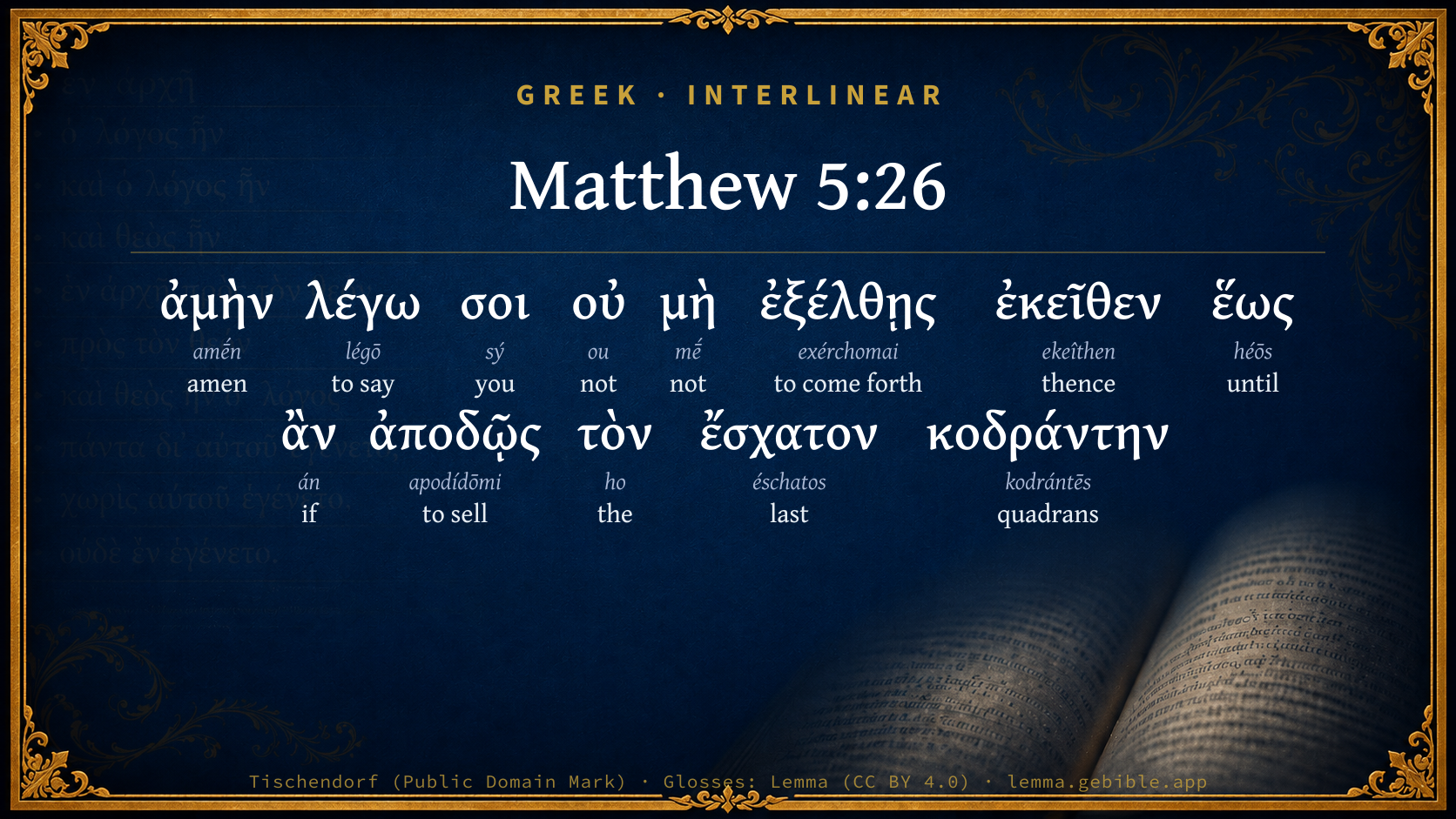
Download image
Cite this verse

Matthew 5:26 (World English Bible). Public Domain. Lemma interlinear Bible study tool, https://lemma.gebible.app/v/matthew/5/26.

Show BibTeX & RIS
BibTeX
RIS
English Translation
Most assuredly I tell you, you shall by no means get out of there, until you have paid the last penny.
World English Bible · Public Domain
Highlights
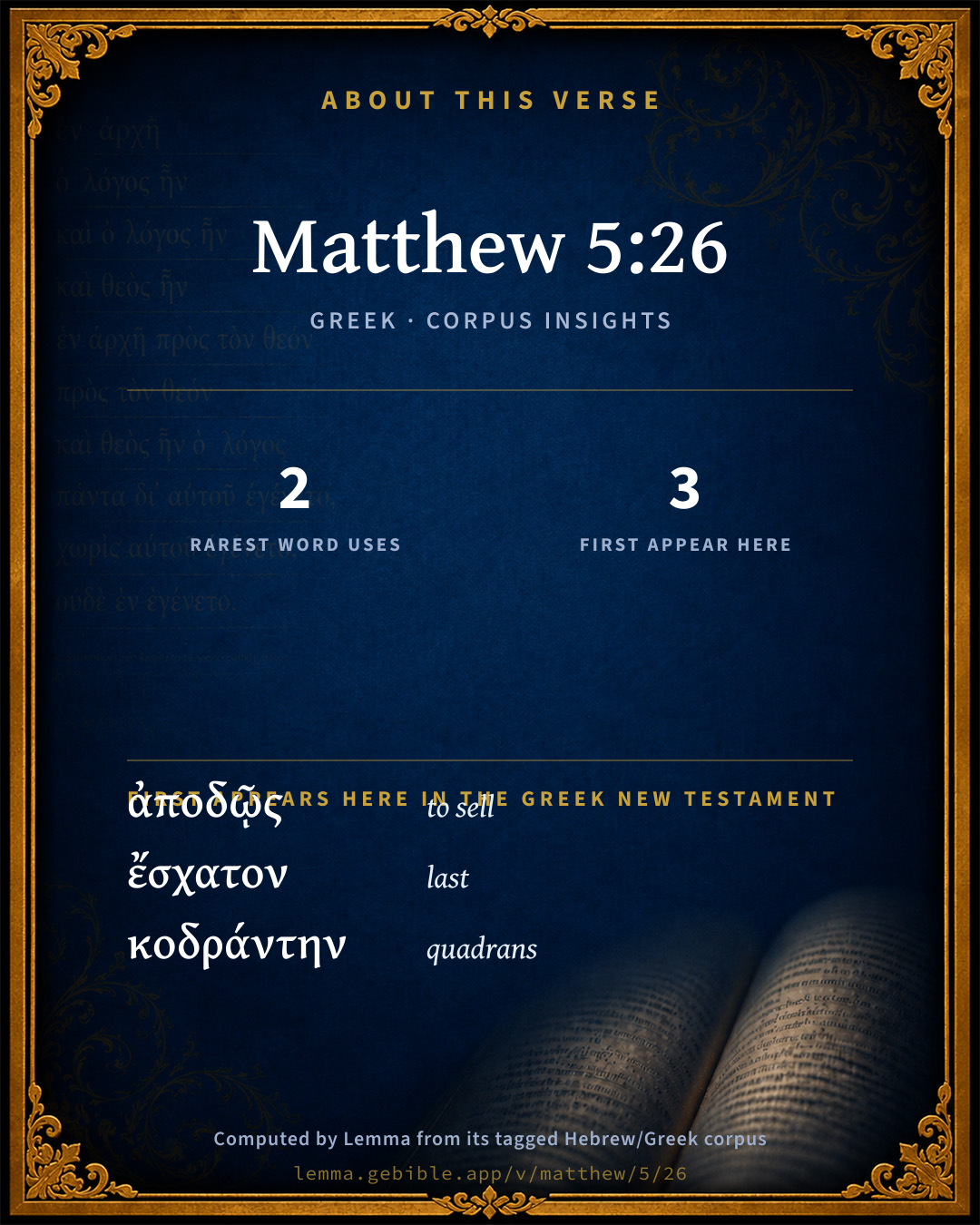
  • 3 first appearances in the Greek New Testament
Full analysis ↓
Download a study sheet

One document with this verse’s original text, its word-by-word gloss line, the meaning frame, cross-references with their text, attributed commentary, and full source and license credits — printable, and it pastes into notes with its structure intact.

This verse Autodidact and up

Study sheet (.html) Plain text (.txt)

A passage Seminary Student

Up to 50 verses in one chapter. A passage sheet keeps up to 6 commentary sources and 12 cross-references per verse, in the order this page ranks them, and says so on the sheet whenever that leaves anything out. Ask for a single verse and you get the Autodidact verse sheet above.

Everything on this page stays free to read, with no account — the sheet is a download of what is already on screen, not access to it.

Want to remove ads? Support Godless Engineer
Compare translations 3

The same verse in 3 English versions, stacked beneath the original-language interlinear above. Click any original word for its lexicon entry.

Each is an independent rendering of the whole verse — the interlinear is not word-aligned to these translations.

Highlighted words mark where these versions differ — a whole-verse word diff, not a word-by-word alignment.

  • World English Bible Public Domain
    Most assuredly I tell you, you shall by no means get out of there, until you have paid the last penny.
  • King James Version Public Domain
    Verily I say unto thee, Thou shalt by no means come out thence, till thou hast paid the uttermost farthing.
  • unfoldingWord Literal Text CC BY-SA 4.0
    Truly I say to you, you will certainly not come out from there until you have paid the last quadrans.

unfoldingWord Literal Text — © unfoldingWord, licensed CC BY-SA 4.0. Word-aligned USFM3 via Door43 (git.door43.org/unfoldingWord/en_ult).

Versions to compare (up to 4)

3 of 4 selected

Show all 19 translations

Every available English version of this verse, each an independent rendering of the whole verse.

  • World English Bible Public Domain
    Most assuredly I tell you, you shall by no means get out of there, until you have paid the last penny.
  • Berean Standard Bible Public Domain
    Truly I tell you, you will not get out until you have paid the last penny.
  • Majority Standard Bible Public Domain
    Truly I tell you, you will not get out until you have paid the last penny.
  • King James Version Public Domain
    Verily I say unto thee, Thou shalt by no means come out thence, till thou hast paid the uttermost farthing.
  • American Standard Version (1901) Public Domain
    Verily I say unto thee, thou shalt by no means come out thence, till thou have paid the last farthing.
  • Revised Version (1885) Public Domain
    Verily I say unto thee, Thou shalt by no means come out thence, till thou have paid the last farthing.
  • Geneva Bible (1599) Public Domain
    Verely I say vnto thee, thou shalt not come out thence, till thou hast payed the vtmost farthing.
  • Douay-Rheims (1899) Public Domain
    Amen I say to thee, thou shalt not go out from thence till thou repay the last farthing.
  • Young's Literal Translation Public Domain
    verily I say to thee, thou mayest not come forth thence till that thou mayest pay the last farthing.
  • Literal Standard Version CC BY-SA 4.0
    truly I say to you, you may not come forth from there until you may pay the last penny.
  • Unlocked Literal Bible CC BY-SA 4.0
    Truly I say to you, you will never come out from there until you have paid the last bit of money you owe.
  • unfoldingWord Literal Text CC BY-SA 4.0
    Truly I say to you, you will certainly not come out from there until you have paid the last quadrans.
  • Darby Bible Public Domain
    Verily I say to thee, Thou shalt in no wise come out thence till thou hast paid the last farthing.
  • World Messianic Bible Public Domain
    Most certainly I tell you, you shall by no means get out of there until you have paid the last penny.
  • Webster's Bible Public Domain
    Verily, I say to thee, thou shalt by no means come out thence, till thou hast paid the uttermost farthing.
  • Free Bible Version CC BY-SA 4.0
    I tell you the truth: you won't get out of there until you've paid every last penny.
  • Bible in Basic English Public Domain
    Truly I say to you, You will not come out from there till you have made payment of the very last farthing.
  • Text-Critical English NT CC BY 4.0
    Truly I say to yoʋ, yoʋ will certainly not come out of there until yoʋ have paid the last penny.
  • Tyndale New Testament (1534) Public Domain
    I say vnto ye verely: thou shalt not come out thece till thou have payed the utmost farthige.

Literal Standard Version (2020), Covenant Press — licensed CC BY-SA 4.0. Text via the HelloAO Bible API (eBible.org). Unlocked Literal Bible (unfoldingWord) — licensed CC BY-SA 4.0. Text via the HelloAO Bible API (eBible.org). unfoldingWord Literal Text — © unfoldingWord, licensed CC BY-SA 4.0. Word-aligned USFM3 via Door43 (git.door43.org/unfoldingWord/en_ult). Free Bible Version, Dr. Jonathan Gallagher — licensed CC BY-SA 4.0. Text via the HelloAO Bible API (eBible.org).

Word by word

More ways to search: Search by grammar → Find every occurrence → Compare this word →

Practice this passage: Drill this verse → Learn its vocabulary →

About this verse

These counts appear in no published source. They are computed here, from the morphology-tagged text and Lemma’s own curated glosses. What Lemma adds →

13
words
13
distinct lemmas
Gospels
section

Notable vocabulary

The rarest word here is κοδράντην quadrans G2835 — appearing just 2 times in the whole Greek New Testament.

First appearance in Scripture

These words make their first canonical appearance in the Greek New Testament here:

  • ἀποδῷς to sell G591
  • ἔσχατον last G2078
  • κοδράντην quadrans G2835

Shared distinctive vocabulary

κοδράντην quadrans G2835 occurs in 2 verses of the Greek New Testament. Also found in:
Cross-references

7

Topical passages linked to Matthew 5:26 in the Treasury of Scripture Knowledge — connected by theme and wording, ordered by reader-vote popularity; previews shown in the World English Bible.

  • Matthew 18:34 His lord was angry, and delivered him to the tormentors, until he should pay all that was due to him.
  • Luke 12:59 I tell you, you will by no means get out of there, until you have paid the very last penny."
  • 2 Thessalonians 1:9 who will pay the penalty: eternal destruction from the face of the Lord and from the glory of his might,
  • James 2:13 For judgment is without mercy to him who has shown no mercy. Mercy triumphs over judgment.
  • Matthew 25:41 Then he will say also to those on the left hand, 'Depart from me, you cursed, into the eternal fire which is prepared for the devil and his angels;
  • Matthew 25:46 These will go away into eternal punishment, but the righteous into eternal life."
  • Luke 16:26 Besides all this, between us and you there is a great gulf fixed, that those who want to pass from here to you are not able, and that none may cross over from there to us.'

Cross-references courtesy of OpenBible.info (CC BY 4.0).

Commentary

Notes on Matthew 5:26 from classic Christian and Jewish commentators (each source and its license shown beneath its notes). The classic Christian expositions comment on the surrounding passage and are grouped to its opening verse, so a note may address several verses; the Jewish commentaries on the Tanakh (Rashi and others) are per-verse, so they appear only where the commentator wrote on this verse.

Lemma curates 59 commentaries, every one of them public domain or Creative Commons licensed, each selected and text-cleaned for this edition rather than reprinted as found. About our sources →

Bengel's Gnomon

Johann Albrecht Bengel

Mat 5:26. Ἕως ἄν, until) The debtor is left to himself; see ch. Mat 18:34. It is strange that the expression, ἕως ἄν, should have been urged by those, who hence infer the possibility of payment, rather than τὸν ἔσχατον κοδράντην, the last farthing.—τὸν ἔσχατον, the last) Thus does Divine justice exact everything, not a single farthing more or less than you owe.[209]—κοδράντην, quadrantem) Substantives which express foreign articles are very frequently transferred from one language to another, instead of being translated.[210]

[209] O the vain and most deceitful persuasion of the old man, whereby he supposes that God will only lightly exact the debts due to Him. Nay, unless remission interpose so as to remove utterly one’s countless faults, the uttermost avarice of man does not exercise as great rigour, as the divine justice justly and deservedly maintains.—Vers. Germ.

[210] The quadrans, the fourth part of an asse, about a farthing and a half of our money.—(I. B.)

Bengel's Gnomon of the New Testament — English translation (T&T Clark, Edinburgh, 1860) — public domain. Text from a community e-Sword module.

Geneva Bible (1599)

Geneva Bible translators

Thou shalt be dealt withall to the utmost extremity.

Geneva Bible (1599) marginal notes — public domain. Text via Bolls.life.

Jamieson, Fausset & Brown

Robert Jamieson, A. R. Fausset & David Brown

Verily I say unto thee, Thou shalt by no means come out thence, fill thou hast paid the uttermost farthing--a fractional Roman coin, to which our "farthing" answers sufficiently well. That our Lord meant here merely to give a piece of prudential advice to his hearers, to keep out of the hands of the law and its officials by settling all disputes with one another privately, is not for a moment to be supposed, though there are critics of a school low enough to suggest this. The concluding words--"Verily I say unto thee, Thou shalt by no means come out," &c.--manifestly show that though the language is drawn from human disputes and legal procedure, He is dealing with a higher than any human quarrel, a higher than any human tribunal, a higher than any human and temporal sentence. In this view of the words--in which nearly all critics worthy of the name agree--the spirit of them may be thus expressed: "In expounding the sixth commandment, I have spoken of offenses between man and man; reminding you that the offender has another party to deal with besides him whom he has wronged on earth, and assuring you that all worship offered to the Searcher of hearts by one who knows that a brother has just cause of complaint against him, and yet takes no steps to remove it, is vain: But I cannot pass from this subject without reminding you of One whose cause of complaint against you is far more deadly than any that man can have against man: and since with that Adversary you are already on the way to judgment, it will be your wisdom to make up the quarrel without delay, lest sentence of condemnation be pronounced upon you, and then will execution straightway follow, from the effects of which you shall never escape as long as any remnant of the offense remains unexpiated." It will be observed that as the principle on which we are to "agree" with this "Adversary" is not here specified, and the precise nature of the retribution that is to light upon the despisers of this warning is not to be gathered from the mere use of the word "prison"; so, the remedilessness of the punishment is not in so many words expressed, and still less is its actual cessation taught. The language on all these points is designedly general; but it may safely be said that the unending duration of future punishment--elsewhere so clearly and awfully expressed by our Lord Himself, as in Mat 5:29-30, and Mar 9:43, Mar 9:48 --is the only doctrine with which His language here quite naturally and fully accords. (Compare Mat 18:30, Mat 18:34).

The Same Subject Illustrated from the Seventh Commandment (Mat 5:27-32).

Jamieson, Fausset & Brown — Commentary Critical and Explanatory on the Whole Bible (1871) — public domain (CC PDM 1.0). Text via the HelloAO Bible API.

Adam Clarke's Commentary

Verse 26. The uttermost farthing.] Κοδραντην. The rabbins have this Greek word corrupted into קרדיונטסס kordiontes, and קונטריק, kontrik, and say, that two פרוטות prutoth make a kontarik, which is exactly the same with those words in Mr 12:42, λεπτα δυο, ο εστι κοδραντης, two mites, which are one farthing. Hence it appears that the λεπτον lepton was the same as the prutah. The weight of the prutah was half a barley-corn, and it was the smallest coin among the Jews, as the kodrantes, or farthing, was the smallest coin among the Romans. If the matter issue in law, strict justice will be done, and your creditor be allowed the fulness of his just claim; but if; while you are on the way, going to the magistrate, you come to a friendly agreement with him, he will relax in his claims, take a part for the whole, and the composition be, in the end, both to his and your profit.

This text has been considered a proper foundation on which to build not only the doctrine of a purgatory, but also that of universal restoration. But the most unwarrantable violence must be used before it can be pressed into the service of either of the above antiscriptural doctrines. At the most, the text can only be considered as a metaphorical representation of the procedure of the great Judge; and let it ever be remembered, that by the general consent of all (except the basely interested) no metaphor is ever to be produced in proof of any doctrine. In the things that concern our eternal salvation, we need the most pointed and express evidence on which to establish the faith of our souls.

Adam Clarke's Commentary on the Bible (1810–1826) — public domain. Text from a community e-Sword/MySword module.

Ellicott's Commentary for English Readers

(26) The uttermost farthing.—The Greek word is derived from the Latin quadrans, the fourth part of the Roman as, a small copper or bronze coin which had become common in Palestine. The “mite,” half the quadrans (Mar_12:42), was the smallest coin in circulation. The “farthing” of Mat_10:29 is a different word, and was applied to the tenth part of the drachma.

Do the words point to a terminable or to an endless punishment? In the frame-work of the similitude such a sentence would not involve perpetual imprisonment, if only the condemned could get together the money wherewith to pay his debt or fine; and we might infer, as Romanist divines have inferred, that such a payment, to be followed by liberation, was possible in the divine judgment. But in practice, unless the man had friends or property, the sentence would, for the most part, involve a life-long punishment. And the question may well be asked, when we turn to the realities shadowed forth in the parable, Can a man pay the “uttermost farthing” in that unseen world? Does he pay by enduring for a given time a given measure of suffering, bodily or spiritual? Can he there find others to pay it for him? Do not the words “till thou hast paid” exclude the thought of their intervention as availing to stay the full action of the great law of retribution? These questions must, for the most part, be so answered as to diminish the force of the first hasty inference. If hope is not shut out altogether, it is because we cannot absolutely answer the first question in the negative. There may be a suffering that works repentance, and the repentance may lead to peace and pardon—there may be, but that is the very utmost that can be said. It is noticeable that the word “prison” is that used in 1Pe_3:19, where the “spirits in prison” are, almost beyond a doubt, represented as the objects of a dispensation that proclaimed even there the good news of salvation. But the whole tone of the passage is that of one who seeks to deepen the sense of danger, not to make light of it, to make men feel that they cannot pay their debt, though God may forgive it freely, accepting faith in Him in lieu of payment.

A Bible Commentary for English Readers, edited by Charles John Ellicott (1878–1897) — public domain. Text from a community e-Sword module.

John Gill's Exposition

Verily, I say unto thee,.... This may be depended upon, you may assure yourself of it, that

thou shalt by no means come out thence, from prison,

till thou hast paid the uttermost farthing, or "last farthing"; or as the Ethiopic version reads it, "till thou hast exactly paid all"; which seems to express the inexorableness of the creditor, and the impossibility of the debtor's release.

John Gill's Exposition of the Whole Bible (1746–1763) — public domain (CC PDM 1.0). Text via the HelloAO Bible API.

Trapp's Complete Commentary

John Trapp

26 Verily I say unto thee, Thou shalt by no means come out thence, till thou hast paid the uttermost farthing.

Ver. 26. Thou shalt by no means come out thence till, &c.] i.e. Never come ont. Let our merit mongers first go to hell for their sins, and stay all eternity there; then afterward, if God will create another eternity, they may have liberty to relate their good works, and call for their wages. But the curse of the law will first be served of such, as, seeking to be Saved by the works of the law, are fallen from Christ; these shall never come out till they have paid the utmost farthing. And when will that be? We read of a miserable malefactor (John Chambone by name) who had lain in the dungeon at Lyons the duration of seven or eight months. This thief, for pain and torment, cried out of God, and cursed his parents that begat him, being almost eaten up with lice, and ready to eat his own flesh for hunger; being fed with such bread as dogs and horses had refused to eat. So it pleased the goodness of Almighty God, that Petrus Bergerius, a French martyr, was cast into the same dungeon; through whose preaching and prayers he was brought to repentance, learning much comfort and patience by the word of the gospel preached unto him. Touching his conversion he wrote a very sweet letter out of his bonds, declaring therein, that the next day after that he had taken held of the gospel, and framed himself to patience according to the same, his lice (which he could pluck out before by twenty at once between his fingers) now were so gone from him that he had not one. Furthermore, so the alms of good people were extended towards him, that he was fed with white bread, and that which was very good. His imprisonment, at utmost, lasted but while life; death as a jailer knocked off his shackles, and set him into the glorious liberty of the saints above. So the penitent thief in the Gospel; and so that Robert Samuel, martyr, above mentioned. But not so those that are clapt up in the dark dungeon of hell. Their misery is as endless as easeless. A river of brimstone is not consumed by burning; the smoke of that pit ascendeth for ever. A child with a spoon may sooner empty the sea than the damned in hell accomplish their misery. All that wicked men suffer here is but a paying the usury money required for that dreadful debt, that must be paid at last by all that make not timely composition.

John Trapp, A Commentary or Exposition upon All the Books of the Old and New Testament (1647–1656) — public domain. Text from a community e-Sword module.

Whedon's Commentary on the Bible

Daniel D. Whedon

26. Paid the uttermost — See on chap. Mat_18:30. Farthing — About two fifths of a cent.

Daniel D. Whedon (gen. ed.), Commentary on the Old and New Testaments (1874–1909) — public domain. Text from a community e-Sword module.

The Pulpit Commentary

Thou shalt by no means, etc. A solemn statement of the unrelenting character of justice. The Romanists hold that the verse implies

(1) that if payment can be made, release follows;

(2) and that payment can be made.

The first statement is probable; but as for the slightest hint of the second, it is wholly wanting. Christ affirms that non-reconciliation with a brother, if carried beyond that limit of time within which the quarrel can be made up, involves consequences in which the element of mercy will be entirely absent. The element of mercy can enter up to a certain point of time, but after that only justice. (On "pay," apodwv , see Mat_6:4, note) It will be observed that, in the above interpretation, antidikov has been consistently explained as a human adversary, for this seems to be the primary meaning here. But it should not be forgotten that, in the parallel passage in Luke, the reference is to God. Offences against man are there represented in their true character as offences against God, who is therefore depicted as the adversary in a lawsuit. That, from another point of view, be is also the Judge, matters not. Both conceptions of him are true, and can be kept quite distinct. It may be the case, indeed, that this reference of antidikov to God was present to St. Matthew"s mind also when he recorded these words, and this would partly account for the terrible emphasis on ver. 26, the pendant to ver. 22. But even if the reference to God were present to St. Matthew"s mind by way of application, it is not with him, as it is with St. Luke, tile primary. signification of the word. Farthing. The quadrans, the smallest Roman coin.

The Pulpit Commentary (1880–1919), ed. H.D.M. Spence-Jones & Joseph S. Exell — public domain. Text from a community e-Sword module.

John Wesley's Explanatory Notes

Till thou hast paid the last farthing - That is, for ever, since thou canst never do this. What has been hitherto said refers to meekness: what follows, to purity of heart.

John Wesley, Explanatory Notes Upon the Whole Bible (1754–1765) — public domain. Text via the GEBible commentary corpus.

Scofield Reference Notes

C. I. Scofield

paid

Cf. Isa 40:2; Rth 1:21; Rth 1:22

The Scofield Reference Bible (1917 edition), notes by C. I. Scofield — public domain. Text from a community e-Sword module.

The People's New Testament

B. W. Johnson

26. Thou shalt not come out from thence. After the debtor was cast into prison he was held until the debt was paid, and if it were not, he remained in prison until he died. Farthing. A small, insignificant copper coin. The warning against lawsuits is clear, but there is a higher idea still. The Lord would warn us to make everything right before it is too late. Before the judgment there is a chance; after it there is nothing but payment.

B. W. Johnson's The People's New Testament with Notes (1889–1891) — public domain. Electronic text from the Christian Classics Ethereal Library (CCEL) ThML edition.

Cambridge Greek Testament for Schools and Colleges

26. κοδράντην. Cp. Mar 12:42, λεπτὰ δύο ὅ ἐστιν κοδράντης. κοδράντης = Lat. quadrans, the fourth part of an as, and the smallest Roman coin. τὸ λεπτὸν in the parallel passage in Luke is the prutah or smallest Jewish coin. For this view of sin as a debt cp. ὀφειλήματα in the Lord’s Prayer, and the parable of the Unmerciful Servant, ch. Mat 18:23 foll., and the Lord’s question to Simon the Pharisee, Luk 7:42.

See Luk 12:57-59, where the same illustration is used in reference to the divine judgment which was swiftly overtaking the Jewish people.

Cambridge Greek Testament for Schools and Colleges (Cambridge University Press, 1896; 21 vols, various authors incl. Carr, Maclear, Plummer, Farrar, Lumby, Moule, M. R. James, Simcox) — public domain. Text from a community e-Sword module.

Alford’s Greek Testament

Henry Alford

26.] These words, which in the earthly example imply future liberation, because an earthly debt can be paid in most cases, so in the spiritual counterpart amount to a negation of it, because the debt can never be discharged. We have ἕως ἀποδῷ τὸ ὀφειλόμενον in ch. 18:30, where the payment was clearly impossible.

ὑπηρέτης = πράκτωρ in Luk 12:58, and is the officer of the court who saw the sentences executed. If we are called on to assign a meaning to ὑπηρέτης in the interpretation, it must represent the chief of those who in ch. 18:34, are hinted at by βασανισταί, viz. the great enemy, the minister of the divine wrath.

κοδράντην, quadrantem, a Latin word (= λεπτόν in Luke), the fourth part of an as. See note on Luke, l. c

Henry Alford, The Greek Testament (1849–1861) — public domain. Text from a community e-Sword module.

Lesson kit

Teaching starters — assembled from the data on this page, not authored interpretation. Every prompt links to the verse data it draws on. Edit before teaching.

Matthew, in the Gospels, opens this verse with 13 words (13 distinct Greek lemmas). Its most distinctive word is kodrántēs (“quadrans”). A historical commentator’s framing appears above. Read the whole chapter for the surrounding context.

Discussion questions

  1. The word kodrántēs carries the sense “quadrans.” How does it shape the verse?
  2. 3 words make their first appearance in Scripture here. What does this debut establish?
  3. How does Mark 12:42, which shares the word «quadrans», read alongside this verse?
  4. These translations render this verse differently. What is at stake in choosing one wording over another?
  5. Compare how Bengel's Gnomon and Geneva Bible (1599) read this verse. Where do they agree or differ?

Things to notice

Reading settings

Reading text

Shown beneath each verse's original-language words.

Old Testament
Old Testament edition

Read the OT as the Masoretic Hebrew (MT) or the Greek Septuagint (LXX).

English shown for the Greek Septuagint (in the Hebrew ↔ Greek comparison).

Comparing translations? Open the Compare panel on any verse page to stack up to four side by side.