
Matthew 12:39

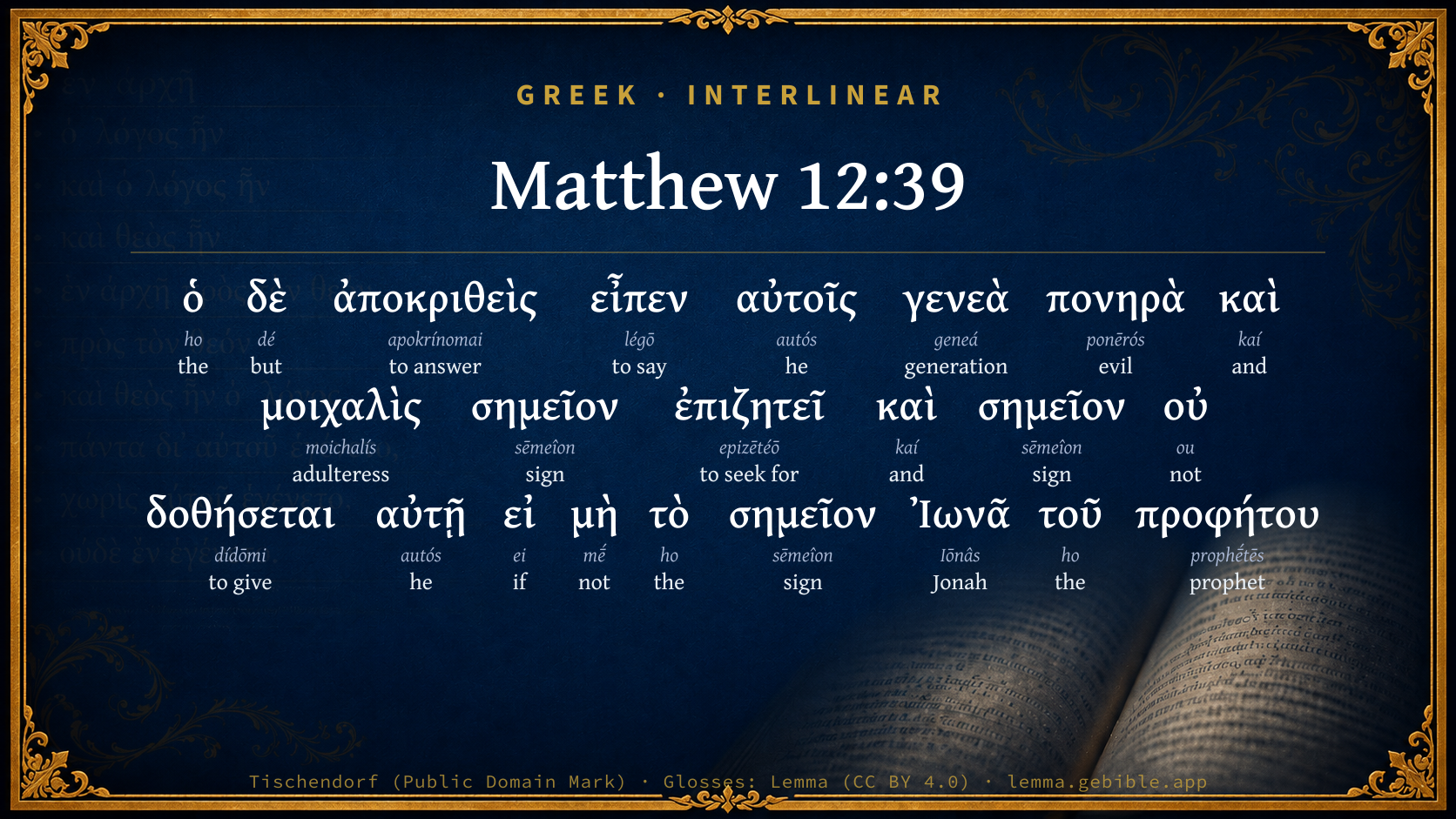
Greek (Tischendorf 8th ed.) Matthew 12:39 appears in the Greek New Testament. The text above is from the Tischendorf 8th edition. Each word links to its Strong’s number and a concise gloss. Click any word for its full Thayer’s Greek Lexicon entry.
Download image
Cite this verse

Matthew 12:39 (World English Bible). Public Domain. Lemma interlinear Bible study tool, https://lemma.gebible.app/v/matthew/12/39.

Show BibTeX & RIS
BibTeX
RIS
English Translation
But he answered them, "An evil and adulterous generation seeks after a sign, but no sign will be given it but the sign of Jonah the prophet.
World English Bible · Public Domain
Highlights
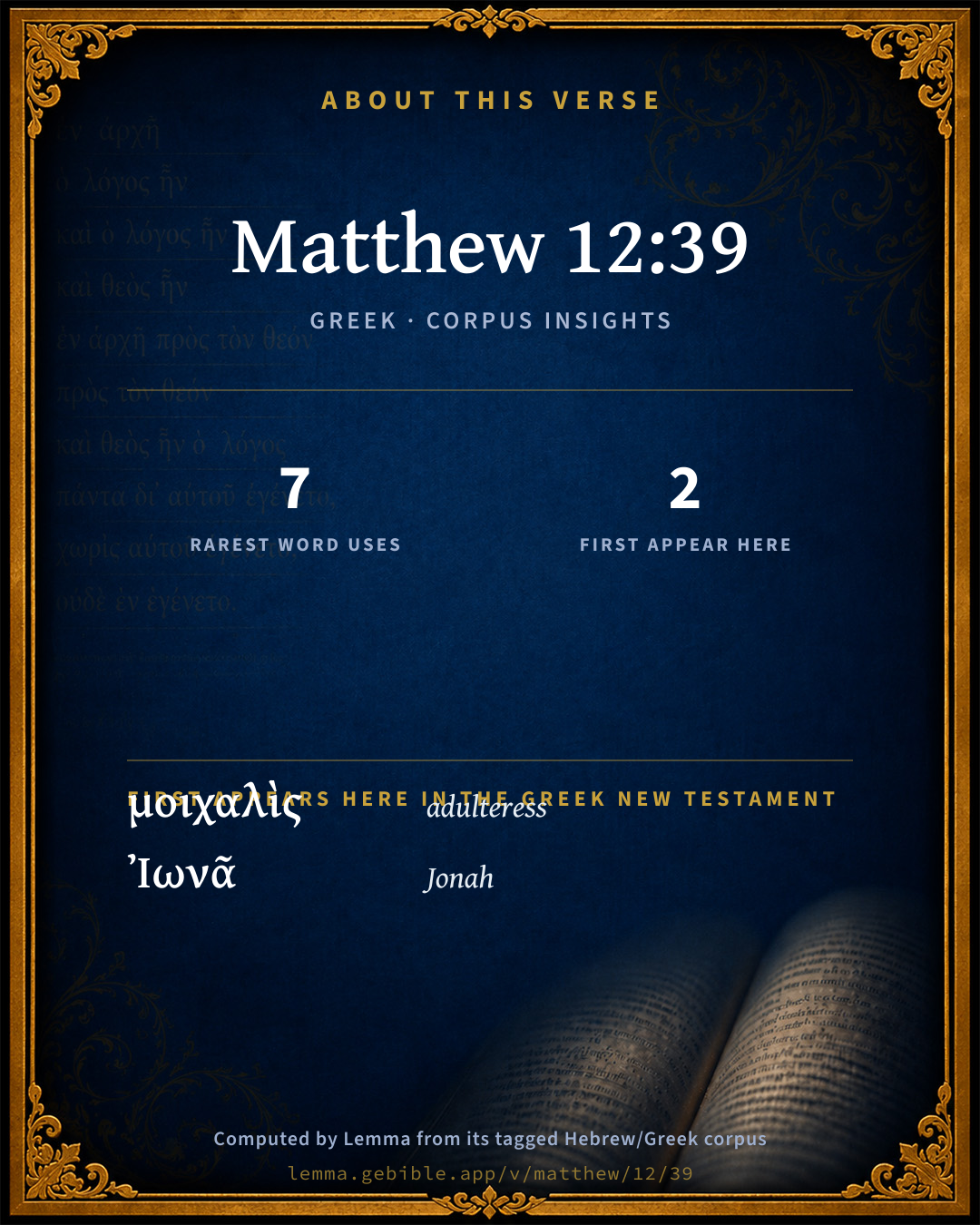
  • 2 first appearances in the Greek New Testament
Full analysis ↓
Download a study sheet

One document with this verse’s original text, its word-by-word gloss line, the meaning frame, cross-references with their text, attributed commentary, and full source and license credits — printable, and it pastes into notes with its structure intact.

This verse Autodidact and up

Study sheet (.html) Plain text (.txt)

A passage Seminary Student

Up to 50 verses in one chapter. A passage sheet keeps up to 6 commentary sources and 12 cross-references per verse, in the order this page ranks them, and says so on the sheet whenever that leaves anything out. Ask for a single verse and you get the Autodidact verse sheet above.

Everything on this page stays free to read, with no account — the sheet is a download of what is already on screen, not access to it.

Want to remove ads? Support Godless Engineer
Compare translations 3

The same verse in 3 English versions, stacked beneath the original-language interlinear above. Click any original word for its lexicon entry.

Each is an independent rendering of the whole verse — the interlinear is not word-aligned to these translations.

Highlighted words mark where these versions differ — a whole-verse word diff, not a word-by-word alignment.

  • World English Bible Public Domain
    But he answered them, "An evil and adulterous generation seeks after a sign, but no sign will be given it but the sign of Jonah the prophet.
  • King James Version Public Domain
    But he answered and said unto them, An evil and adulterous generation seeketh after a sign; and there shall no sign be given to it, but the sign of the prophet Jonas:
  • unfoldingWord Literal Text CC BY-SA 4.0
    But answering, he said to them, “An evil and adulterous generation seeks a sign, but a sign will not be given to it except the sign of Jonah the prophet.

unfoldingWord Literal Text — © unfoldingWord, licensed CC BY-SA 4.0. Word-aligned USFM3 via Door43 (git.door43.org/unfoldingWord/en_ult).

Versions to compare (up to 4)

3 of 4 selected

Show all 19 translations

Every available English version of this verse, each an independent rendering of the whole verse.

  • World English Bible Public Domain
    But he answered them, "An evil and adulterous generation seeks after a sign, but no sign will be given it but the sign of Jonah the prophet.
  • Berean Standard Bible Public Domain
    Jesus replied, “A wicked and adulterous generation demands a sign, but none will be given it except the sign of the prophet Jonah.
  • Majority Standard Bible Public Domain
    Jesus replied, “A wicked and adulterous generation demands a sign, but none will be given it except the sign of the prophet Jonah.
  • King James Version Public Domain
    But he answered and said unto them, An evil and adulterous generation seeketh after a sign; and there shall no sign be given to it, but the sign of the prophet Jonas:
  • American Standard Version (1901) Public Domain
    But he answered and said unto them, An evil and adulterous generation seeketh after a sign; and there shall no sign be given it but the sign of Jonah the prophet:
  • Revised Version (1885) Public Domain
    But he answered and said unto them, An evil and adulterous generation seeketh after a sign; and there shall no sign be given to it but the sign of Jonah the prophet:
  • Geneva Bible (1599) Public Domain
    But he answered and said to them, An euill and adulterous generation seeketh a signe, but no signe shall be giuen vnto it, saue that signe of the Prophet Ionas.
  • Douay-Rheims (1899) Public Domain
    Who answering said to them: An evil and adulterous generation seeketh a sign: and a sign shall not be given it, but the sign of Jonas the prophet.
  • Young's Literal Translation Public Domain
    And he answering said to them, `A generation, evil and adulterous, doth seek a sign, and a sign shall not be given to it, except the sign of Jonah the prophet;
  • Literal Standard Version CC BY-SA 4.0
    And He answering said to them, “A generation, evil and adulterous, seeks a sign, and a sign will not be given to it, except the sign of Jonah the prophet;
  • Unlocked Literal Bible CC BY-SA 4.0
    But Jesus answered and said to them, “An evil and adulterous generation seeks for a sign. But no sign will be given to it except the sign of Jonah the prophet.
  • unfoldingWord Literal Text CC BY-SA 4.0
    But answering, he said to them, “An evil and adulterous generation seeks a sign, but a sign will not be given to it except the sign of Jonah the prophet.
  • Darby Bible Public Domain
    But he, answering, said to them, A wicked and adulterous generation seeks after a sign, and a sign shall not be given to it save the sign of Jonas the prophet.
  • World Messianic Bible Public Domain
    But he answered them, “An evil and adulterous generation seeks after a sign, but no sign will be given to it but the sign of Jonah the prophet.
  • Webster's Bible Public Domain
    But he answered and said to them, An evil and adulterous generation seeketh for a sign, and there shall no sign be given to it, but the sign of the prophet Jonah.
  • Free Bible Version CC BY-SA 4.0
    “An evil and adulterous generation are the ones who look for a miraculous sign. The only sign they will be given is the sign of the prophet Jonah,” Jesus told them.
  • Bible in Basic English Public Domain
    But he, answering, said to them, An evil and false generation is looking for a sign; and no sign will be given to it but the sign of the prophet Jonah:
  • Text-Critical English NT CC BY 4.0
    But Jesus answered them, “An evil and adulterous generation asks for a sign, but no sign will be given to it except the sign of the prophet Jonah.
  • Tyndale New Testament (1534) Public Domain
    He answered and sayde to the: The evyll and advoutrous generacion seketh a signe but ther shall no signe be geve to the saue the signe of the Prophete Ionas.

Literal Standard Version (2020), Covenant Press — licensed CC BY-SA 4.0. Text via the HelloAO Bible API (eBible.org). Unlocked Literal Bible (unfoldingWord) — licensed CC BY-SA 4.0. Text via the HelloAO Bible API (eBible.org). unfoldingWord Literal Text — © unfoldingWord, licensed CC BY-SA 4.0. Word-aligned USFM3 via Door43 (git.door43.org/unfoldingWord/en_ult). Free Bible Version, Dr. Jonathan Gallagher — licensed CC BY-SA 4.0. Text via the HelloAO Bible API (eBible.org).

Word by word

More ways to search: Search by grammar → Find every occurrence → Compare this word →

Practice this passage: Drill this verse → Learn its vocabulary →

μοιχαλὶς
moichalís
G3428
“adulteress”
Noun, Nominative, Singular, Feminine
Part of Speech
Noun
Case
Nominative
Number
Singular
Gender
Feminine
Full Thayer's Definition

Origin: a prolonged form of the feminine of G3432

TDNT: 16:09,6

1. an adulteress 2. as the intimate alliance of God with the people of Israel was likened to a marriage, those who relapse into idolatry are said to commit adultery or play the harlot a. fig. equiv. to faithless to God, unclean, apostate
  1. ὁ ho G3588 “the” Article, Nominative, Singular, Masculine
  2. δὲ dé G1161 “but” Conjunction
  3. ἀποκριθεὶς apokrínomai G611 “to answer” Verb, Aorist, Passive deponent, Participle, Nominative, Singular, Masculine
  4. εἶπεν légō G3004 “to say” Verb, Aorist, Active, Indicative, 3rd person, Singular
  5. αὐτοῖς autós G846 “he” Personal pronoun, Dative, Plural, Masculine
  6. γενεὰ geneá G1074 “generation” Noun, Nominative, Singular, Feminine
  7. πονηρὰ ponērós G4190 “evil” Adjective, Nominative, Singular, Feminine
  8. καὶ kaí G2532 “and” Conjunction
  9. σημεῖον sēmeîon G4592 “sign” Noun, Accusative, Singular, Neuter
  10. ἐπιζητεῖ epizētéō G1934 “to seek for” Verb, Present, Active, Indicative, 3rd person, Singular
  11. καὶ kaí G2532 “and” Conjunction
  12. σημεῖον sēmeîon G4592 “sign” Noun, Nominative, Singular, Neuter
  13. οὐ ou G3756 “not” Particle, Negative
  14. δοθήσεται dídōmi G1325 “to give” Verb, Future, Passive, Indicative, 3rd person, Singular
  15. αὐτῇ autós G846 “he” Personal pronoun, Dative, Singular, Feminine
  16. εἰ ei G1487 “if” Conditional
  17. μὴ mḗ G3361 “not” Particle, Negative
  18. τὸ ho G3588 “the” Article, Accusative, Singular, Neuter
  19. σημεῖον sēmeîon G4592 “sign” Noun, Accusative, Singular, Neuter
  20. Ἰωνᾶ Iōnâs G2495 “Jonah” Noun, Genitive, Singular, Masculine
  21. τοῦ ho G3588 “the” Article, Genitive, Singular, Masculine
  22. προφήτου prophḗtēs G4396 “prophet” Noun, Genitive, Singular, Masculine

About this verse

These counts appear in no published source. They are computed here, from the morphology-tagged text and Lemma’s own curated glosses. What Lemma adds →

23
words
17
distinct lemmas
Gospels
section

Notable vocabulary

The rarest word here is μοιχαλὶς adulteress G3428 — appearing just 7 times in the whole Greek New Testament.

First appearance in Scripture

These words make their first canonical appearance in the Greek New Testament here:

  • μοιχαλὶς adulteress G3428
  • Ἰωνᾶ Jonah G2495

Shared distinctive vocabulary

μοιχαλὶς adulteress G3428 occurs in 6 verses of the Greek New Testament. Also found in:
Repetition

Words recur within this verse:

  • σημεῖον sign G4592 ×3
  • ὁ the G3588 ×3
  • αὐτοῖς he G846 ×2
  • καὶ and G2532 ×2

Cross-references

5

Topical passages linked to Matthew 12:39 in the Treasury of Scripture Knowledge — connected by theme and wording, ordered by reader-vote popularity; previews shown in the World English Bible.

  • Matthew 16:4 An evil and adulterous generation seeks after a sign, and there will be no sign given to it, except the sign of the prophet Jonah." He left them, and departed.
  • Luke 11:29–32 When the multitudes were gathering together to him, he began to say, "This is an evil generation. It seeks after a sign. No sign will be given to it but the sign of Jonah, the prophet.
  • Isaiah 57:3 But draw near here, you sons of the sorceress, the seed of the adulterer and the prostitute.
  • Mark 8:38 For whoever will be ashamed of me and of my words in this adulterous and sinful generation, the Son of Man also will be ashamed of him, when he comes in the glory of his Father with the holy angels."
  • James 4:4 You adulterers and adulteresses, don't you know that friendship with the world is enmity with God? Whoever therefore wants to be a friend of the world makes himself an enemy of God.

Cross-references courtesy of OpenBible.info (CC BY 4.0).

Commentary

Notes on Matthew 12:39 from classic Christian and Jewish commentators (each source and its license shown beneath its notes). The classic Christian expositions comment on the surrounding passage and are grouped to its opening verse, so a note may address several verses; the Jewish commentaries on the Tanakh (Rashi and others) are per-verse, so they appear only where the commentator wrote on this verse.

Lemma curates 59 commentaries, every one of them public domain or Creative Commons licensed, each selected and text-cleaned for this edition rather than reprinted as found. About our sources →

Tyndale Open Study Notes

Tyndale Open Resources

12:39-40 To demand a sign demonstrates a lack of faith. • The sign of the prophet Jonah consisted of Jonah’s “resurrection” from the large fish after three days and three nights as well as his preaching (12:41; Luke 11:32); it was analogous to Jesus’ burial and resurrection and his preaching. Jesus was drawing a parallel between Jonah’s experience and what he himself would experience. He was not predicting an exact chronology of his death and resurrection. • Heart of the earth is a euphemism for the grave.

Tyndale Open Study Notes — © Tyndale Open Resources, licensed CC BY-SA 4.0. Text via the HelloAO Bible API.

Bengel's Gnomon

Johann Albrecht Bengel

Mat 12:39. Γεμεὰ, a generation) A race of the same age and disposition.—μοιχαλὶς, adulterous) i.e. strictly so speaking: see ch. Mat 5:32; and also, by synecdoche, very guilty; see Jas 4:4.—σημεῖον, a sign) and one too of a certain special kind. This word is thrice repeated here with great emphasis; cf. 2Co 11:12, where the meaning is, They wish for an occasion, and no occasion is given them; which resembles what is said here, They seek for a sign, and no sign shall be given them.—ἐπιζητεῖ seeketh in addition) i.e. beyond those which it has already seen, it requires further signs, as if it had seen none yet.—τὸ σημεῖον Ἰωνᾶ, the sign of Jonah) that is such a one as was given in Jonah.

Bengel's Gnomon of the New Testament — English translation (T&T Clark, Edinburgh, 1860) — public domain. Text from a community e-Sword module.

Meyer's Critical & Exegetical Commentary

Heinrich August Wilhelm Meyer

Mat_12:39. Μοιχαλίς] ὡς ἀφιστάμενοι ἀπὸ τοῦ θεοῦ, Theophylact. The Hebrew (Psa_73:27; Isa_57:3 ff.; Eze_23:27, al.) conceived his sacred relation to God as represented by the figure of marriage, hence idolatry and intercourse with Gentiles were spoken of as adultery. Gesenius, Thes. I. p. 422. On this occasion Jesus transfers the figure to moral unfaithfulness to God, Jam_4:4; Rev_2:20 ff.

γενεά] generation; the representatives of which had certainly made the request, while the multitude, Mat_12:46, was likewise present.

ἐπιζητεῖ] See on Mat_6:32.

σημεῖον οὐ δοθήσεται αὐτῇ] Seeing that the demand of the Pharisees had manifestly pointed to a sign of a higher order than any with which Jesus had hitherto favoured them,that is to say, some wonderful manifestation, by which He might now prove, as He had never done before, that He was unquestionably the Messiahfor they would not admit that the miracles they had already seen were possessed of the evidential force of the actual σημεῖον; it is certain that, in this His reply, Jesus must likewise have used σημεῖον as meaning pre-eminently a confirmatory sign of a very special and convincing nature. Consequently there is no need to say that we are here precluded from looking upon the miracles in the light of signs, and that, according to our passage, they were not performed with any such object in view (de Wette); rather let us maintain, that they were certainly performed for such a purpose (Joh_11:41 f., with which Joh_4:48 is not at variance, comp. the note following Mat_8:4), though, in the present instance, it is not these that are referred to, but a sign κατʼ ἐξοχήν, such as the Pharisees contemplated in their demand. Euth. Zigabenus (comp. Chrysostom) inaptly observes: τί οὖν; οὐκ ἐποίησεν ἔκτοτε σημεῖον; ἐποίησεν ἀλλʼ οὐ διʼ αὐτούς, πεπωρωμένοι γὰρ ἦσαν· ἀλλὰ διὰ τὴν τῶν ἄλλων ὠφέλειαν.

τὸ σημ. Ἰωνᾶ] which was given in the person of Jonah, Joh_2:1. Jesus thus indicates His resurrection, διὰ τὴν ὁμοιότητα, Euth. Zigabenus. Notice the emphasis in the thrice repeated σημεῖον.

Meyer — Critical and Exegetical Commentary on the New Testament — English translation by Peter Christie, edited by Frederick Crombie (T&T Clark, 1880) — public domain. Text from a community e-Sword module.

Expositor's Greek Testament

ed. W. Robertson Nicoll

Mat 12:39 . γενεὰ as in Mat 11:16 , a moral class, “quae in omni malitia et improbitate vivit,” Suicer, s. v. γενεά . μοιχαλὶς , unfaithful to God as a wife to a husband, apt description of men professing godliness but ungodly in heart. ἐπιζητεῖ , hankers after, as in Mat 6:32 ; characteristic; men that have no light within crave external evidence, which given would be of no service to them. Therefore: οὐ δοθήσεται : it will not be given either by Jesus or by any one else. He declines, knowing it to be vain. No sign will convince them; why give one? εἰ μὴ , etc.: except the sign of Jonah the prophet, which was no sign in their sense. What is referred to? But for what follows we should have said: the preaching of repentance by Jonah to the Ninevites. So Luk 11:30 seems to take it. Jonah preached repentance to the men of Nineveh as the only way of escape from judgment. Jesus points to that historic instance and says: Beware! Jonah was not the only prophetic preacher of repentance; but, as Nineveh is held up as a reproach to the persons addressed, to single him out was fitting.

The Expositor's Greek Testament, edited by W. Robertson Nicoll (1897–1910) — public domain. Text from a community e-Sword module.

Geneva Bible (1599)

Geneva Bible translators

Bastard, which fell from Abraham’s faith, or forsook the true worship of God.

Geneva Bible (1599) marginal notes — public domain. Text via Bolls.life.

Jamieson, Fausset & Brown

Robert Jamieson, A. R. Fausset & David Brown

But he answered and said unto them--"when the people were gathered thick together" (Luk 11:29).

An evil and adulterous generation--This latter expression is best explained by Jer 3:20, "Surely as a wife treacherously departeth from her husband, so have ye dealt treacherously with Me, O house of Israel, saith the Lord." For this was the relationship in which He stood to the covenant-people--"I am married unto you" (Jer 3:14).

seeketh after a sign--In the eye of Jesus this class were but the spokesmen of their generation, the exponents of the reigning spirit of unbelief.

and there shall no sign be given to it, but the sign of the prophet Jonas.

Jamieson, Fausset & Brown — Commentary Critical and Explanatory on the Whole Bible (1871) — public domain (CC PDM 1.0). Text via the HelloAO Bible API.

Adam Clarke's Commentary

Verse 39. An evil and adulterous generation] Or, race of people; for so γενεα should be translated here, and in most other places in the Gospels; for our Lord, in general, uses it to point out the Jewish people. This translation is a key to unlock some very obscure passages in the evangelists.

Seeketh after a sign] Or, seeketh another sign, (επιζητει,) so I think this word should be translated. Our Lord had already given the Jews several signs; and here they desire sign upon sign.

Our Lord terms the Jews an adulterous race. Under the old covenant, the Jewish nation was represented as in a marriage contract with the Lord of hosts; as believers, in the new covenant, are represented as the spouse of Christ. All unfaithfulness and disobedience was considered as a breach of this marriage contract; hence the persons who were thus guilty are denominated adulterers and adulteresses. But, independently of this, there is the utmost proof, from their own writings, that in the time of our Lord they were most literally an adulterous race of people: for, at this very time, R. Jochanan ben Zacchai abrogated the trial by the bitter waters of jealousy, because so many were found to be thus criminal. See on Joh 8:3.

Adam Clarke's Commentary on the Bible (1810–1826) — public domain. Text from a community e-Sword/MySword module.

Ellicott's Commentary for English Readers

(39) An evil and adulterous generation.—The true relation between Israel and Jehovah had been represented by the prophets as that of the wife to her husband (Jeremiah 3; Ezekiel 16, 23; Hosea 1, 2). The adulterous generation was therefore one that was unfaithful to its Lord—demanding a sign, instead of finding sufficient proofs of faithfulness and love in what He had already done.

There shall no sign be given to it.—The words seem at first to place our Lord’s miracles of healing outside the category of signs, and yet it was to these that He referred the messengers of the Baptist as proof that the Christ had indeed come (Mat_11:5). They must, however, be interpreted by the context. One sign and only one, such as they demanded, should be given to those for whom the other notes of Messiahship were insufficient, and that should be the sign of the prophet Jonas.

A Bible Commentary for English Readers, edited by Charles John Ellicott (1878–1897) — public domain. Text from a community e-Sword module.

The Cambridge Bible for Schools and Colleges

gen. ed. J. J. S. Perowne

39. adulterous] estranged from God; a figure often used by the Prophets to express the defection of Israel from Jehovah.

The Cambridge Bible for Schools and Colleges (gen. ed. J. J. S. Perowne; Cambridge University Press, 1878–1918) — public domain. Text from a community e-Sword module.

John Gill's Exposition

Then he said, I will return into my house,.... Into the land of Judea, particularly into the Scribes and Pharisees, outward professors of religion; who, notwithstanding their outward reformation, and great pretensions to holiness, are Satan's house still: he has a property in them, a claim upon them; and though he says,

from whence I came out, yet he never really and properly quitted it, only seemingly, and in appearance; and therefore his returning is only throwing off the guise, and reassuming his former character, as a vicious and unclean spirit.

And when he is come, he findeth it empty: not empty of sin: this puts me in mind of a passage in the Misna (y), where it is said, that on a fast day,

"when they stand in prayer, they cause to descend, or go before the ark, an old man, who is used (to prayer,) whose children, , "and his house, are empty", so that his heart is perfect in prayer,''

or entirely at leisure for it. The commentators (z) on that phrase, "his house is empty", note, that he was empty of sin, and free from it, and one concerning whom an evil report had not gone forth from his youth: but such was not this house; it was empty of God, of the true knowledge of him, of the fear of him, and love to him; of Christ, of faith in him, affection for him, and hope on him; of the Spirit of God, and of his graces, and of spiritual, internal religion, and powerful godliness.

Swept; not with the Spirit of grace convincing of sin, righteousness, and judgment; but with the besom of an outward reformation:

and garnished; not with internal grace, which makes saints all glorious within; but with secret lusts and corruptions, which rendered it an agreeable habitation for this unclean spirit; and at most, with some show of morality, a little negative holiness, or abstinence from outward acts of sin, an observance of some external rites and ceremonies, and a few hypocritical performances of fasting and prayer; which Satan can very well bear with, so long as the heart is empty of spiritual grace, and till an opportunity offers of throwing off all appearance of good.

(y) Taanith, c. 2. sect. 2. (z) Maimon. & Bartenora in ib.

John Gill's Exposition of the Whole Bible (1746–1763) — public domain (CC PDM 1.0). Text via the HelloAO Bible API.

Trapp's Complete Commentary

John Trapp

39 But he answered and said unto them, An evil and adulterous generation seeketh after a sign; and there shall no sign be given to it, but the sign of the prophet Jonas:

Ver. 39. An evil and adulterous generation, &c.] Spuria soboles, a bastardly brood. So he calleth them, because utterly degenerate from their forefathers’ faith and holiness.

Seeking after a sign] επιζητει, summo studio efflagitat. Seeking with utmost earnestness, as if it were such a business as must be done or they were undone. It is the guise of hypocrites to be hot in a cold matter, to show great zeal in trifles, neglecting the main meanwhile.

But the sign of the prophet Jonas] Nor that neither, but for a further mischief to them; as their fathers had quails to choke them, a king to vex them, &c., and as Ahaz had a sign, whether he would or no, to render him the more inexcusable. Deus saepe dat iratus, quod negat propitius. God gives his enemies some giftless gifts (αδωρα δωπα, Soph.), as Saul gave Michal to David, to be a snare to him; or as Christ gave Judas the bag, to discover the rottenness of his heart.

John Trapp, A Commentary or Exposition upon All the Books of the Old and New Testament (1647–1656) — public domain. Text from a community e-Sword module.

Haydock's Catholic Bible Commentary

Sign of Jonas. I will give no other sign than my death and resurrection, as then, though unwillingly, they will acknowledge me, and people will believe and be converted: so in John (Chap. viii.) it is said, When you shall have exalted the Son of man, then you shall know that I am he. (Menochius)

George Leo Haydock (1774–1849), Haydock's Catholic Family Bible and Commentary, 1859 edition — public domain. Excludes Psalms (Douay-Rheims chapter numbering differs from Protestant) and Deuterocanonical books (Catholic canon only).

Whedon's Commentary on the Bible

Daniel D. Whedon

39. He answered — Our Lord uniformly rebuked this demand for a sign. The temper of the demand itself was not to be indulged. Luke says that they made the request tempting, or making experiments upon him. They had a moblike desire to see splendid shows in the sky, not unlike the excitement of the populace for fireworks on some day of public celebration. And for a Messiah they wished a leader of the people who should gratify their riotous tastes and give them war and victory. This is the Messiah that gross human nature ever seeks. Adulterous — Compare note, Mat_4:8, and introduction to chap. v, par. 4. Israel had once been, as it were, the true spouse and bride of Jehovah. Their true spouse now was Jesus, the Jehovah incarnate. But with a vile spiritual adultery they were forsaking him, and embracing in their hearts a false Messiah, the incarnation of their own riotous tastes and appetites. Hence they were not only an evil, but adulterous generation. Sign of the prophet Jonas — Our Lord, even in refusing a sign, gives a sign. His prophecy of his burial, after the manner of the swallowing of Jonah, was in itself a miracle of foreknowledge, and so a proof of his Messiahship.

Daniel D. Whedon (gen. ed.), Commentary on the Old and New Testaments (1874–1909) — public domain. Text from a community e-Sword module.

The Pulpit Commentary

Of the passages mentioned in the introductory note on vers. 38-42, Mat_16:4 is verbally identical with the answer of our present verse, except the omission of the words, "the prophet," which occur nowhere else but in this passage. But he answered and said to them, An evil (ponhra , Mat_6:13, note) and adulterous generation. However frequent the sin of adultery may then have been, the common metaphorical sense of spiritual unfaithfulness to God and the practical worship of some other than Jehovah seems the more probable here. (cf. Jam_4:4 Rev_2:20-23) Seeketh after (epizhtei); Mat_6:32. A sign; but there shall no sign be given to it. In Mar_8:12 our Lord"s reply ends here. But the sign of the Prophet Jonas; Jonah the prophet (Revised Version). In Mat_16:4 and Luk_11:29 "the prophet" has been added in the Received Text.

The Pulpit Commentary (1880–1919), ed. H.D.M. Spence-Jones & Joseph S. Exell — public domain. Text from a community e-Sword module.

John Wesley's Explanatory Notes

An adulterous generation - Whose heart wanders from God, though they profess him to be their husband. Such adulterers are all those who love the world, and all who seek the friendship of it. Seeketh a sign - After all they have had already, which were abundantly sufficient to convince them, had not their hearts been estranged from God, and consequently averse to the truth. The sign of Jonah - Who was herein a type of Christ.

John Wesley, Explanatory Notes Upon the Whole Bible (1754–1765) — public domain. Text via the GEBible commentary corpus.

Kretzmann's Popular Commentary

Paul E. Kretzmann

The refusal:

v. 39. But He answered and said unto them, An evil and adulterous generation seeketh after a sign, and there shall no sign be given to it but the sign of the prophet Jonas.

v. 40. For as Jonas was three days and three nights in the whale’s belly, so shall the Son of Man be three days and three nights in the heart of the earth.

An evil brood and adulterous He calls them. He saw into their hearts and judged them accordingly. He knew what their purpose in asking a miracle was, since they were not earnest seekers after truth. In a spiritual sense they were adulterers, Isa 23:17; they were idolaters, since they rejected Him, the Messiah of the world. They would join with the heathens in the act of His condemnation and crucifixion. One sign, one great miracle, indeed, would be given to them and to the world: His resurrection, typified in the history of the prophet Jonas. The belief in His resurrection will for this generation and for all the generations to come be the touchstone by which the followers of Christ will be distinguished from His enemies. Jesus refers to the time between His burial and resurrection according to the Jewish manner of reckoning time, any part of a day being counted as a full day.

Paul E. Kretzmann, Popular Commentary of the Bible (1921–1924) — public domain. Text from a community e-Sword module.

The People's New Testament

B. W. Johnson

39. An evil and adulterous generation. We must keep in mind that the Lord is speaking to his enemies. He compares them to a faithless wife. They were faithless to God. The sign of Jonah. See next verse.

B. W. Johnson's The People's New Testament with Notes (1889–1891) — public domain. Electronic text from the Christian Classics Ethereal Library (CCEL) ThML edition.

Cambridge Greek Testament for Schools and Colleges

39. μοιχαλίς, estranged from God; a figure often used by the Prophets to express the defection of Israel from Jehovah. Cp. ch. Mat 16:4 and Isa 1:21, πῶς ἐγένετο πόρνη πόλις πιστὴ Σιὼν πλήρης κρίσεως; and Isa 57:3.

Cambridge Greek Testament for Schools and Colleges (Cambridge University Press, 1896; 21 vols, various authors incl. Carr, Maclear, Plummer, Farrar, Lumby, Moule, M. R. James, Simcox) — public domain. Text from a community e-Sword module.

Alford’s Greek Testament

Henry Alford

39.] μοιχαλίς (see reff.), because they had been the peculiar people of the Lord, and so in departing from Him had broken the covenant of marriage, according to the similitude so common in the Prophets.

The expression σημεῖον οὐ δοθ. αὐτῇ does not, as De Wette maintains, exclude our Lord’s miracles from being σημεῖα: but is the direct answer to their request in the sense in which we know they used σημεῖον, ‘a sign, not wrought by Him, and so able to be suspected of magic art, but one from Heaven.’ Besides, even if this were not so, how can the refusing to work a miracle to satisfy them, affect the nature or signification of those wrought on different occasions, and with a totally different view? And yet on ground like this it is (De Wette, vol. i. p. 147) that rationalistic systems are built. τί οὖν; οὐκ ἐποίησεν ἔκτοτε σημεῖον; ἐποίησεν, ἀλλʼ οὐ διʼ αὐτούς, πεπωρωμένοι γὰρ ἦσαν, ἀλλὰ διὰ τὴν τῶν ἄλλων ὠφέλειαν. in loc. Notice ἐπιζητεῖ; not merely quærit, but requirit; misses, and demands as a sine quâ non. See Palm and Rost’s Lex. sub voce.

The sign of Jonas is the most remarkable foreshadowing in the O.T. of the resurrection of our Lord. It was of course impossible that His resurrection should be represented by an actual resurrection, as his birth was by births (Isaac, Samson, Samuel, Mahershalalhashbaz), and His death by deaths (Abel; the substitute for Isaac; Zechariah the prophet; the daily and occasional sacrifices); so that we find the events symbolic of his resurrection (Joseph’s history; Isaac’s sacrifice; Daniel’s and Jonah’s deliverance), representing it in a figure (Heb 11:19, ἐν παραβολῇ). In the case before us the figure was very remarkable, and easily to be recognized in the O.T. narrative. For Jonah himself calls the belly of the sea monster בֶּטֶן שְׁאוֹל (Jon 2:2), ‘the belly of Hades,’ = καρδίᾳ τῆς γῆς here. And observe, that the type is not of our Lord’s body being deposited in the tomb of Joseph of Arimathea, for neither could that be called ‘the heart of the earth,’ nor could it be said that ‘the Son of Man’ was there during the time; but of our Lord’s personal descent into the place of departed souls:—see Eph 4:9: 1Pe 3:19, and note on Luk 23:43.

Henry Alford, The Greek Testament (1849–1861) — public domain. Text from a community e-Sword module.

International Critical Commentary

(L) 39. And He answered and said to them, An evil and adulterous generation seeks for a sign; and a sign shall not be given to it, save the sign of Jonah the prophet.] Lk. has: “And when the multitudes were crowding together, He began to say, This generation is an evil generation: it seeks a sign, and a sign shall not be given to it, save the sign of Jonah.”—μοιχαλίς] means apostate, disobedient, and unfaithful to God.

(E?L) 40. For as Jonah was in the belly of the monster three days and three nights; so shall the Son of Man be in the heart of the earth three days and three nights.] Lk. has: “For as Jonah was a sign to the Ninevites, so shall be also the Son of Man to this generation.”

It is probable that Mt. (or the writer of his source) has paraphrased the saying as recorded by Lk., in order to explain the parallelism between Jonah as a sign and the Son of Man as a sign. “As Jonah was a sign.” But how was he a sign? Certainly not simply because he preached. His message of warning could in no true sense be called a sign. He was a sign because of his remarkable experience recorded in Jon 1-2. “So shall the Son of Man be a sign,” in virtue of His remarkable life’s history from beginning to end. The writer of the saying as recorded in Mt. has wished to make this parallelism clear. He has done so by illustrating it from one particular event in the life history of Jonah and of the Son of Man, in connection with which there was, as it seemed to him, a striking coincidence. The Son of Man ( = Christ) foretold, as tradition recorded, that He would rise again after three days; cf. Mar 8:31, Mar 9:31, Mar 10:34, Mat 27:63. (This was traditionally interpreted as equivalent to “on the third day,” cf. Mat 16:21, Mat 17:23, Mat 20:19, Luk 9:22, Luk 9:18:33, Luk 9:24:7, Luk 9:46, Act 10:40). It might, therefore, be said that He lay in the grave for three days. Mt. turned to the Book of Jonah, and found in 2:1 the words: καὶ ἦν Ἰωνᾶς ἐν τῇ κοιλίᾳ τοῦ κήτους τρεῖς ἡμέρας καὶ τρεῖς νύκτας. Here was material for a comparison. Jonah’s wonderful story of guidance and preservation culminated in his sojourn in the belly of the sea monster followed by his miraculous deliverance. This, as illustrating his whole unique experience, made him a sign to the Ninevites. He preached to them as one miraculously accredited. The life history of the Son of Man culminated in His sojourn in the grave, followed by His miraculous resurrection. This, as illustrating His whole life of wonder and marvel, constituted Him a sign to the men of that generation. Mt. has, of course, rather forced his analogy.1 Putting aside the fact that according to Christian tradition Christ lay in the grave only one whole day and parts of two others, he has tried to increase the parallelism by adding τρεῖς νύκτας, when at the most there were only two.

The words ἦν Ἰωνᾶς—νύκτας are borrowed from Jon 2:1.—τῇ καρδίᾳ τῆς γῆς] cf. Deu 4:11 Heb. “the heart of heaven,” and cor maris, 4 Es ( = 2 Es R. V.) 13:25, 51.

International Critical Commentary — older volumes (1896–1929), various authors — public domain. Text from a community e-Sword module.

Vincent's Word Studies in the New Testament

Marvin R. Vincent

Adulterous [μοιχαλις] . A very strong and graphic expression, founded upon the familiary Hebrew representation of the relation of God 's people to him under the figure of marriage. See Psa 73:27; Isa 57:3 sqq.; Isa 61:5; Eze 23:27. Hence idolatry and intercourse with Gentiles were described as adultery; and so here, of moral unfaithfulness to God. Compare Jas 4:4; Rev 2:20 sqq. Thus Dante :

"Where Michael wrought Vengeance upon the proud adultery." Inf., 7, 12.

Marvin R. Vincent, Word Studies in the New Testament (1887–1900) — public domain. Text from a community e-Sword/MySword module.

Lesson kit

Teaching starters — assembled from the data on this page, not authored interpretation. Every prompt links to the verse data it draws on. Edit before teaching.

Matthew, in the Gospels, opens this verse with 23 words (17 distinct Greek lemmas). Its most distinctive word is moichalís (“adulteress”). A historical commentator’s framing appears above. Read the whole chapter for the surrounding context.

Discussion questions

  1. The word moichalís carries the sense “adulteress.” How does it shape the verse?
  2. 2 words make their first appearance in Scripture here. What does this debut establish?
  3. How does Matthew 16:4, which shares the word «adulteress», read alongside this verse?
  4. What does the repetition of “sign” (3× in this one verse) do in this verse?
  5. These translations render this verse differently; the difference is in the English rendering, not the original. What questions does that raise?
  6. Compare how Tyndale Open Study Notes and Bengel's Gnomon read this verse. Where do they agree or differ?

Things to notice

  • 2 words make their first canonical appearance in Scripture here.
  • These translations choose different wording for 12 words in this verse.
  • “sign” occurs 3× in this single verse.
  • 17 distinct Greek lemmas span 23 words in this verse.

Reading settings

Reading text

Shown beneath each verse's original-language words.

Old Testament
Old Testament edition

Read the OT as the Masoretic Hebrew (MT) or the Greek Septuagint (LXX).

English shown for the Greek Septuagint (in the Hebrew ↔ Greek comparison).

Comparing translations? Open the Compare panel on any verse page to stack up to four side by side.