
Matthew 9:12

Greek (Tischendorf 8th ed.) Matthew 9:12 appears in the Greek New Testament. The text above is from the Tischendorf 8th edition. Each word links to its Strong’s number and a concise gloss. Click any word for its full Thayer’s Greek Lexicon entry.
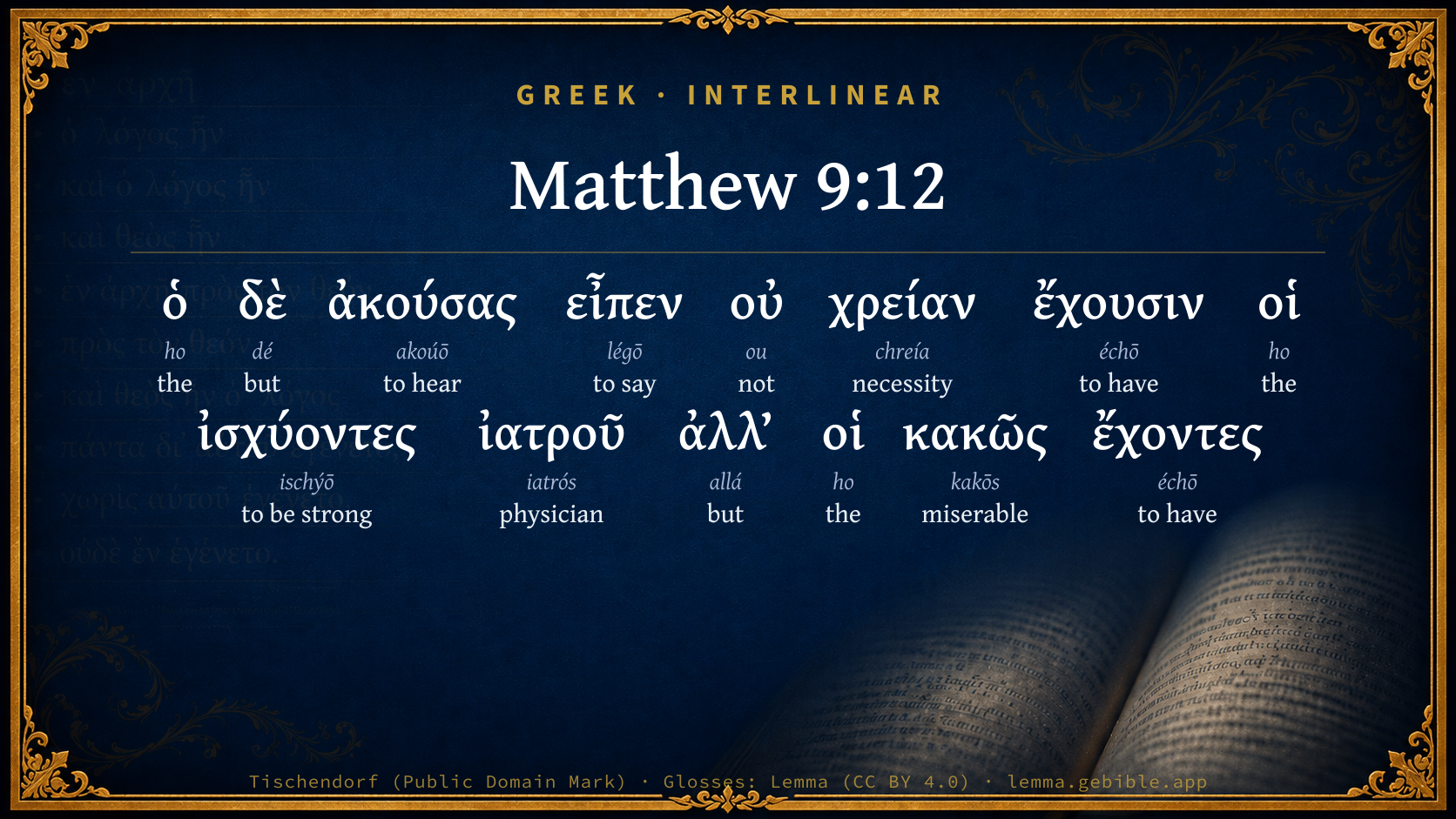
Download image
Cite this verse

Matthew 9:12 (World English Bible). Public Domain. Lemma interlinear Bible study tool, https://lemma.gebible.app/v/matthew/9/12.

Show BibTeX & RIS
BibTeX
RIS
English Translation
When Jesus heard it, he said to them, "Those who are healthy have no need for a physician, but those who are sick do.
World English Bible · Public Domain
Highlights
  • 1 first appearance in the Greek New Testament
Full analysis ↓
Download a study sheet

One document with this verse’s original text, its word-by-word gloss line, the meaning frame, cross-references with their text, attributed commentary, and full source and license credits — printable, and it pastes into notes with its structure intact.

This verse Autodidact and up

Study sheet (.html) Plain text (.txt)

A passage Seminary Student

Up to 50 verses in one chapter. A passage sheet keeps up to 6 commentary sources and 12 cross-references per verse, in the order this page ranks them, and says so on the sheet whenever that leaves anything out. Ask for a single verse and you get the Autodidact verse sheet above.

Everything on this page stays free to read, with no account — the sheet is a download of what is already on screen, not access to it.

Want to remove ads? Support Godless Engineer
Compare translations 3

The same verse in 3 English versions, stacked beneath the original-language interlinear above. Click any original word for its lexicon entry.

Each is an independent rendering of the whole verse — the interlinear is not word-aligned to these translations.

Highlighted words mark where these versions differ — a whole-verse word diff, not a word-by-word alignment.

  • World English Bible Public Domain
    When Jesus heard it, he said to them, "Those who are healthy have no need for a physician, but those who are sick do.
  • King James Version Public Domain
    But when Jesus heard that, he said unto them, They that be whole need not a physician, but they that are sick.
  • unfoldingWord Literal Text CC BY-SA 4.0
    But he, having heard this, said, “The ones being healthy do not have need of a physician, but the ones having sickness.

unfoldingWord Literal Text — © unfoldingWord, licensed CC BY-SA 4.0. Word-aligned USFM3 via Door43 (git.door43.org/unfoldingWord/en_ult).

Versions to compare (up to 4)

3 of 4 selected

Show all 19 translations

Every available English version of this verse, each an independent rendering of the whole verse.

  • World English Bible Public Domain
    When Jesus heard it, he said to them, "Those who are healthy have no need for a physician, but those who are sick do.
  • Berean Standard Bible Public Domain
    On hearing this, Jesus said, “It is not the healthy who need a doctor, but the sick.
  • Majority Standard Bible Public Domain
    On hearing this, Jesus said to them, “It is not the healthy who need a doctor, but the sick.
  • King James Version Public Domain
    But when Jesus heard that, he said unto them, They that be whole need not a physician, but they that are sick.
  • American Standard Version (1901) Public Domain
    But when he heard it, he said, They that are whole have no need of a physician, but they that are sick.
  • Revised Version (1885) Public Domain
    But when he heard it, he said, They that are whole have no need of a physician, but they that are sick.
  • Geneva Bible (1599) Public Domain
    Nowe when Iesus heard it, hee sayde vnto them, The whole neede not a Physition, but they that are sicke.
  • Douay-Rheims (1899) Public Domain
    But Jesus hearing it, said: They that are in health need not a physician, but they that are ill.
  • Young's Literal Translation Public Domain
    And Jesus having heard, said to them, `They who are whole have no need of a physician, but they who are ill;
  • Literal Standard Version CC BY-SA 4.0
    And Jesus having heard, said to them, “They who are whole have no need of a physician, but they who are ill;
  • Unlocked Literal Bible CC BY-SA 4.0
    When Jesus heard this, he said, “People who are strong in body do not need a physician, only those who are sick.
  • unfoldingWord Literal Text CC BY-SA 4.0
    But he, having heard this, said, “The ones being healthy do not have need of a physician, but the ones having sickness.
  • Darby Bible Public Domain
    But [Jesus] hearing it, said, They that are strong have not need of a physician, but those that are ill.
  • World Messianic Bible Public Domain
    When Yeshua heard it, he said to them, “Those who are healthy have no need for a physician, but those who are sick do.
  • Webster's Bible Public Domain
    But when Jesus heard that, he said to them, They that are in health need not a physician, but they that are sick.
  • Free Bible Version CC BY-SA 4.0
    When Jesus heard the question, he replied, “Those who are well don't need a doctor, but sick people do.
  • Bible in Basic English Public Domain
    But on hearing this he said, Those who are well have no need of a medical man, but those who are ill.
  • Text-Critical English NT CC BY 4.0
    When Jesus heard this, he said to them, “It is not the healthy who need a physician, but the sick.
  • Tyndale New Testament (1534) Public Domain
    When Iesus herde that he sayde vnto them: The whole neade not the phisicion but they that are sicke.

Literal Standard Version (2020), Covenant Press — licensed CC BY-SA 4.0. Text via the HelloAO Bible API (eBible.org). Unlocked Literal Bible (unfoldingWord) — licensed CC BY-SA 4.0. Text via the HelloAO Bible API (eBible.org). unfoldingWord Literal Text — © unfoldingWord, licensed CC BY-SA 4.0. Word-aligned USFM3 via Door43 (git.door43.org/unfoldingWord/en_ult). Free Bible Version, Dr. Jonathan Gallagher — licensed CC BY-SA 4.0. Text via the HelloAO Bible API (eBible.org).

Word by word

More ways to search: Search by grammar → Find every occurrence → Compare this word →

Practice this passage: Drill this verse → Learn its vocabulary →

About this verse

These counts appear in no published source. They are computed here, from the morphology-tagged text and Lemma’s own curated glosses. What Lemma adds →

14
words
11
distinct lemmas
Gospels
section

Notable vocabulary

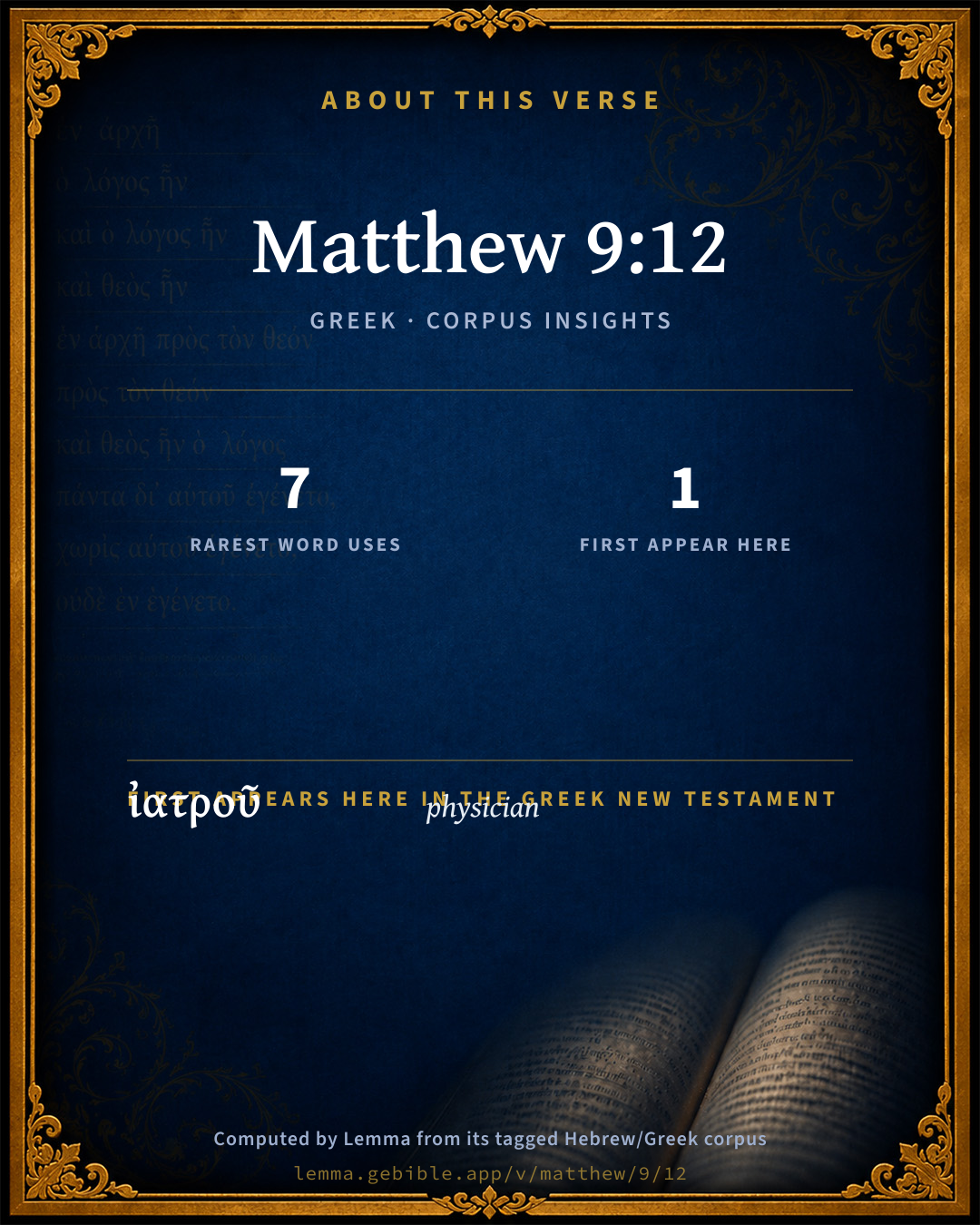
The rarest word here is ἰατροῦ physician G2395 — appearing just 7 times in the whole Greek New Testament.

First appearance in Scripture

This word makes its first canonical appearance in the Greek New Testament here:

  • ἰατροῦ physician G2395

Shared distinctive vocabulary

ἰατροῦ physician G2395 occurs in 7 verses of the Greek New Testament. Also found in:
Repetition

Words recur within this verse:

  • ἔχουσιν to have G2192 ×2
  • ὁ the G3588 ×3

Cross-references

14

Topical passages linked to Matthew 9:12 in the Treasury of Scripture Knowledge — connected by theme and wording, ordered by reader-vote popularity; previews shown in the World English Bible.

  • Luke 5:31 Jesus answered them, "Those who are healthy have no need for a physician, but those who are sick do.
  • Revelation 3:17–18 Because you say, 'I am rich, and have gotten riches, and have need of nothing;' and don't know that you are the wretched one, miserable, poor, blind, and naked;
  • Jeremiah 33:6 Behold, I will bring it health and cure, and I will cure them; and I will reveal to them abundance of peace and truth.
  • Mark 2:17 When Jesus heard it, he said to them, "Those who are healthy have no need for a physician, but those who are sick. I came not to call the righteous, but sinners to repentance."
  • Luke 9:11 But the multitudes, perceiving it, followed him. He welcomed them, and spoke to them of the Kingdom of God, and he cured those who needed healing.
  • Psalms 147:3 He heals the broken in heart, And binds up their wounds.
  • Jeremiah 17:14 Heal me, O Yahweh, and I shall be healed; save me, and I shall be saved: for you are my praise.
  • Hosea 14:4 "I will heal their waywardness. I will love them freely; For my anger is turned away from him.
  • Jeremiah 30:17 For I will restore health to you, and I will heal you of your wounds, says Yahweh; because they have called you an outcast, [saying], It is Zion, whom no man seeks after.
  • Psalms 6:2 Have mercy on me, Yahweh, for I am faint. Yahweh, heal me, for my bones are troubled.
  • Psalms 41:4 I said, "Yahweh, have mercy on me! Heal me, for I have sinned against you."
  • Luke 8:43 A woman who had a flow of blood for twelve years, who had spent all her living on physicians, and could not be healed by any,
  • Luke 18:11–13 The Pharisee stood and prayed to himself like this: 'God, I thank you, that I am not like the rest of men, extortioners, unrighteous, adulterers, or even like this tax collector.
  • Romans 7:9–24 I was alive apart from the law once, but when the commandment came, sin revived, and I died.

Cross-references courtesy of OpenBible.info (CC BY 4.0).

Commentary

Notes on Matthew 9:12 from classic Christian and Jewish commentators (each source and its license shown beneath its notes). The classic Christian expositions comment on the surrounding passage and are grouped to its opening verse, so a note may address several verses; the Jewish commentaries on the Tanakh (Rashi and others) are per-verse, so they appear only where the commentator wrote on this verse.

Lemma curates 59 commentaries, every one of them public domain or Creative Commons licensed, each selected and text-cleaned for this edition rather than reprinted as found. About our sources →

The Biblical Illustrator

Joseph S. Exell

Mat_9:12

They that be whole need not a physician.

The heavenly physician

I. Who neglect the heavenly physician?

1. Those who depend for salvation upon their own good lives.

2. Those who depend for salvation upon their religious duties.

3. Those who depend for salvation upon their correct notions.

II. Those who value the heavenly physician-They that are sick. A general invitation to this Physician. Reasons why some of you are still uncured. How will His medicine affect you? Think of His love. (C. Clayton, M. A.)

I. There is a moral disease in the heart and character of man,

1. Depraved mental appetite.

2. The faculty of moral vision is impaired.

3. Moral stupor and lethargic disposition of mind.

4. Feverish excitement of disposition.

5. Moral weakness and want of activity.

II. The peculiar characteristics by which this moral disease is distinguished.

1. Universal in extent.

2. Disastrous in results.

3. Incurable by anything less than Divine energy.

III. The remedy proposed.

1. Universally adapted.

2. Absolutely free.

3. Infallably efficacious. (The Pulpit.)

Jesus the Physician

I. We are all sick. Many are our ailments. Sin the great malady. We need a Physician. The world has no medicines.

II. What a physician he is.

1. He is appointed of God (Isa_61:1).

2. He is adapted for it. Understands all cases. Neglects none.

III. The remedy. He makes use of many means of recovery.

1. Sometimes he makes use of the affections as a means of restoring health. How many have to trace that recovery to loss of a dear object!

2. Sometimes He makes use of a reproving conscience.

3. The main remedy is His own precious blood:

(1) it is no small mercy to feel our spiritual malady;

(2) the remedy must be received or our souls sickness cannot be healed;

(3) beware of false, superficial healing;

(4) beware of losing the healing;

(5) take heed of expecting a more perfect cure than scripture warrants;

(6) admire the costliness of the remedy, its freeness, universality, and, above all, the Giver. (J. H. Evans, M. A.)

Christ the great Physician

I. That sin is the disease of the soul.

1. Sickness destroys our power of action.

2. It deprives a man of rest.

3. It frequently occasions delirium.

4. It deforms the body.

5. It is the forerunner of death.

II. That Jesus Christ is the great physician.

III. That men are generally too insensible of their sins to apply to Christ.

IV. Those who know their true condition are very desirous of his help, (G. Burder.)

The Physician and His patients

I. A defence, complete and unanswerable. Christ did not come despising the people, but as a Healer of the sick.

II. A direction to His followers.

1. Christianity is remedial.

2. Christianity is hopeful. (D. Fraser, D. D.)

The healing work healthy

A physician once told us that he kept himself in health by going to see patients. Whenever he discontinued this, and insisted on patients coming to him, or when he tried to go out of practice altogether, he fell into lethargy, and lost both physical and mental power; but so soon as he resumed active efforts to heal others, his own healthy returned. Let servants and handmaids of Christ take the hint. He who desires sound, strong, spiritual life and health in himself should go and try to heal others, showing patience, sympathy, and hopefulness. This is to walk as Christ walked. (D. Fraser, D. D.)

The characteristics of the whole and sick, in a spiritual sense, considered and contrasted

There are none of the sons of men who are really whole. The whole and sick in contrast are these:

1. He that is whole has never had a clear affecting sight and sense of sin; but he that is sick is fully convicted, and deeply sensible of it.

2. They that are whole are generally easy and serene, and unapprehensive of danger; but the sick soul is alarmed and anxious, and cant be easy till it perceives some appearances of recovery.

3. They that are whole are unwilling to apply to a physician, or to follow his prescriptions; but to the sick a physician is welcome, and they will submit to his directions, however self-denying. (S. Davies, M. A.)

Christ no specialist

Properly we have amongst ourselves now special studies of special cases. One man undertakes the brain, another the heart, another the blood, it may be, another the bones and joints. This is right, amongst ourselves; for probably hardly any one man has the time, even if he had the capacity, to master with sufficient adequateness all the details and necessities of our wondrous bodily frame. But Jesus Christ said to the leper, Be thou clean, to the man sick of the palsy, grievously tormented, I will come and heal him. When he went into Peters house and saw his wifes mother laid and sick of the fever, he touched her hand and the fever left her, he put out the fire with his touch. He is no specialist, he has not a necromancers power over any one department of human life or human suffering. His healing was fundamental and all-inclusive. He made the well-head pure, and the flowing stream was as pure as the fountain whence it flowed. It is so in spiritual matters. There is not in the Church a doctor who cures lying, and another who makes a special study of drunkenness, and a third who is gifted with peculiar ability in dealing with persons of felonious disposition. There is one Mediator between God and man: he makes the heart right, and then all the accidental local diseases, with all their train of ever-varying symptoms, are cleansed and utterly expelled. (J. Parker, D. D.)

Jesus Christ can attend to all who come to Him at the same moment

I once went with a friend who wanted to see a great physician. But there were ever so many other people waiting to see him, and they went in by turns one by one, and we had to wait a whole hour before our turn came. The physician could not attend to more than one person at a time. But if all you dear children were to pray to the Saviour this evening at the same moment, and tell Him all your wants, He could listen to you all at the same time, and help each of you according to your need. (W. Harris.)

Jesus is always at home

If your little sister was taken very ill and you were sent for the doctor, you would run with all your speed; yet when you came to his house he might be just gone out, and your sister might die before he came home. But this is never the case with Jesus. Whenever you call upon Him, you will find Him. He is always where people can find Him directly they want Him, and you know he can heal people without coming to them in His bodily presence. (W. Harris.)

Unconscious of danger

Sometimes people are in a very dangerous state, and yet they do not feel pain. In a sad railway accident which happened some time ago, a young lady was taken out of one of the carriages, and she said she was not hurt at all, she felt no pain. She stood up and tried to walk and then fell back dead. She had received a very serious injury, and yet she did not feel it at the moment. So it was with these Pharisees, they had a sin within their hearts which would ruin them if it was not taken away. That sin was pride. This sin is so dangerous, because it keeps people from feeling how sinful they are, and so keeps them from coming to Jesus Christ to be healed. (W. Harris.)

Christ the Physician of souls

I. Sin is the sickness of the soul. It is the disease of the soul that makes the sinner a sick man.

1. Sickness brings pain and torment to the body, so does sin to the soul.

2. Sickness takes away the beauty of the body. Sin spoils the beauty of the soul.

3. Diseases are deaths carols which are sent; before it to bind the prisoner. Sin tends to spiritual and eternal deeds, and will bring it on if it be not cured,

II. What is in sin that sickens the soul?

1. The guilt of it the obligation to punishment.

2. The stain. It brings a blot with it, that defiles the soul.

3. The reigning power of it. Sin keeps its throne. It commands and receives obedience.

4. The indwelling power of it.

III. What are the properties of soul sickness?

1. It is spiritual. They are the most dangerous disorders that affect the vital parts.

2. It is an universal sickness, spreading itself through the whole man. All the faculties of the soul are injured and disordered by it. It darkens the mind, wounds the conscience, pollutes the heart, disorders the affections, and weakens the memory for good.

3. It is an infectious sickness.

4. It is hereditary, natural to us. We are born with it.

5. It is a growing disease.

6. It is mortal disease.

IV. Is sin the sickness of your soul?

1. Go quickly to the Physician for the cure of the disease of the soul which you labour under, Delay no longer.

2. Time is flying. No medicine will cure that wound, no argument will persuade it to return. Yesterday has taken its eternal farewell. The candle burnt to the snuff will not light again. Your only time is the present.

3. Death is approaching. If death take us away raider the power of that sickness, there is no cure for it hereafter, if.

4. Make frequent application to Christ. Such people as can take little food at once, had need to take it frequently, Alas! the few addresses which we make to the throne of grace, look like as we thought ourselves whole, little needing the Physician. (Thomas Boston.)

Christs way of caring souls

Three things concur to the care of the soul.

I. The blood of Christ.

II. The spirit of Christ.

III. The word of Christ.

1. He sent His word and healed them.

2. The waters of the sanctuary are healing waters. (Thomas Boston.)

Christ cures all who come to Him

Why does He undertake and perform the cure of souls?

I. Because he has his fathers commission for that effect.

II. Because of his love and pity to men. Love provided the remedy and applies it also.

III. Because he hath been at vast expense to prepare the remedy and medicine for their souls.

IV. For his own glory.

1. The glory of the Mediator is highly exalted by His curing sick souls.

2. The glory of God is displayed in the cure.

3. Had the sick been left to be swallowed up by death, justice would have been exalted, but now justice, mercy, grace, and truth, are all glorified in their salvation through Christ. (Thomas Boston.)

Christ the Physician of souls

Come to Him for the cure of your spiritual diseases.

I. You have need of him. Let necessity drive you to Him. The less you see your need, the more need you have of Him. Some diseases are very common among us.

1. Blindness of the eyes of the mind.

2. Spiritual dumbness.

3. Hardness of heart.

4. Falling evil of backsliding.

5. Pride and self-conceit.

6. Decay of grace.

II. Christ is skilful.

1. He knows what will suit your disease.

2. He is successful. Seine diseases are the reproach of medicine; none can baffle Him.

III. He cures freely.

1. Other physicians are enriched by their patients, but He enricheth His making them heirs of glory.

2. He is the only physician.

3. Either you must die or come to film. (Thomas Boston.)

The Biblical Illustrator, edited by Joseph S. Exell (c. 1880s–1900s) — public domain. Text from a community e-Sword module.

Bengel's Gnomon

Johann Albrecht Bengel

Mat 9:12.[406] ΧΡΕΊΑΝ, need) χρεῖαι, needs, are to be seen everywhere.—[407]ΚΑΚῶς, ill) Such is indeed the case with sinners.[408]

[406] Jesus, as a faithful master, brings help to his disciples.—V. g.

[407] Dost thou feel infirmity (οἱ κακῶς ἔχοντες), as opposed to strength (οἱ ἰσχύοντες)? In that case betake thyself to the Physician, and seek His help.—V. g.

[408] In the original, “Sic sane habent peccatores.” There is a play here on the word habent, sc. χρείαν ἔχουσιν—κακῶς ἔχοντες.—(I. B.)

Bengel's Gnomon of the New Testament — English translation (T&T Clark, Edinburgh, 1860) — public domain. Text from a community e-Sword module.

Meyer's Critical & Exegetical Commentary

Heinrich August Wilhelm Meyer

Mat_9:12. The whole and the sick of the proverb are figurative expressions for the δίκαιοι and the ἁμαρτωλοί, Mat_9:13. In the application the Pharisees are included among the former, not on account of their comparatively greater (de Wette), but because of their fancied, righteousness, as is evident from the sentiments of Jesus regarding this class of men expressed elsewhere, and likewise from Mat_9:13. The thought, then, is this: the righteous (among whom you reckon yourselves) do not need the deliverer, but the sinners. This contains an ironica concessio to the Pharisees, in qua ideo offendi eos docet peccatorum intuitu, quia justitiam sibi arrogant, Calvin. The objection, that in point of fact Jesus is come to call the self-righteous as well, is only apparent, seeing that He could not direct His call to these, as such (Joh_9:39 ff.), so long as they did not relinquish their pretensions, and were themselves without receptivity for healing.

Meyer — Critical and Exegetical Commentary on the New Testament — English translation by Peter Christie, edited by Frederick Crombie (T&T Clark, 1880) — public domain. Text from a community e-Sword module.

Expositor's Greek Testament

ed. W. Robertson Nicoll

Mat 9:12 . ὁ δὲ α . εἶπεν : to whom? Were the fault-finders present to hear? οὐ χρείαν , etc.: something similar can be cited from classic authors, vide instances in Grotius, Elsner, and Wetstein. The originality lies in the application = the physician goes where he is needed, therefore, I am here among the people you contemptuously designate publicans and sinners. The first instalment, this, of Christ’s noble apology for associating with the reprobates a great word.

The Expositor's Greek Testament, edited by W. Robertson Nicoll (1897–1910) — public domain. Text from a community e-Sword module.

Jamieson, Fausset & Brown

Robert Jamieson, A. R. Fausset & David Brown

But when Jesus heard that, he said unto them--to the Pharisees and scribes; addressing Himself to them, though they had shrunk from addressing Him.

They that be whole need not a physician, but they that are sick--that is, "Ye deem yourselves whole; My mission, therefore, is not to you: The physician's business is with the sick; therefore eat I with publicans and sinners." Oh, what myriads of broken hearts, of sin-sick souls, have been bound up by this matchless saying!

Jamieson, Fausset & Brown — Commentary Critical and Explanatory on the Whole Bible (1871) — public domain (CC PDM 1.0). Text via the HelloAO Bible API.

Adam Clarke's Commentary

Verse 12. They that be whole need not a physician] A common proverb, which none could either misunderstand or misapply. Of it the reader may make the following use:-

1. Jesus Christ represents himself here as the sovereign Physician of souls.

2. That all stand in need of his healing power.

3. That men must acknowledge their spiritual maladies, and the need they have of his mercy, in order to be healed by him.

4. That it is the most inveterate and dangerous disease the soul can be afflicted with to imagine itself whole, when the sting of death, which is sin, has pierced it through in every part, infusing its poison every where.

Adam Clarke's Commentary on the Bible (1810–1826) — public domain. Text from a community e-Sword/MySword module.

Ellicott's Commentary for English Readers

(12) They that be whole.—Literally, They that are strong. St. Luke gives, with a more professional precision, “They that are in health.” That, speaking from the thoughts and standpoint of those addressed (which in another than our Lord we might term grave irony), which enters so largely into our Lord’s teaching, appears here in its most transparent form. Those of whom He speaks were, we know, suffering from the worst form of spiritual disease, but in their own estimation they were without spot or taint, and as such. therefore, He speaks to them. On their own showing, they ought not to object to His carrying on that work where there was most need of it. The proverb cited by Him in Luk_4:23 shows that it was not the first time that He had referred to His own work as that of the Great Physician.

A Bible Commentary for English Readers, edited by Charles John Ellicott (1878–1897) — public domain. Text from a community e-Sword module.

The Cambridge Bible for Schools and Colleges

gen. ed. J. J. S. Perowne

12. They that be whole, &c.] There is a touch of irony in the words. They that are “whole” are they who think themselves whole. So below, the “righteous” are those who are righteous in their own eyes.

The Cambridge Bible for Schools and Colleges (gen. ed. J. J. S. Perowne; Cambridge University Press, 1878–1918) — public domain. Text from a community e-Sword module.

John Gill's Exposition

But go ye and learn what that meaneth,.... , "go and learn", is a phrase used by the Jews (a), when they are about to explain a passage of Scripture, and fetch an argument from the connection of the text. So the phrase , "what that is", or "what that meaneth", is Talmudic, as, "what is it?" , "what is that which is written?" , "what is the Scripture?" that is, what is the meaning of it? Our Lord speaks in their own dialect, and tacitly reproves their ignorance of the Scriptures; and instead of finding fault with him, and his conduct, he intimates, it would better become them to endeavour to find out the meaning of that passage in Hos 6:6 "I will have mercy, and not sacrifice"; which, if rightly understood, was sufficient to silence all their cavils and objections: and which words are to be taken, not in an absolute and unlimited sense; for sacrifices even of slain beasts, which were offered up in the faith of Christ's sacrifice, and were attended with other acts of religion and piety, were acceptable to God, being his own institutions and appointments; but in a comparative sense, as the following clause in the prophet shows; "and the knowledge of God more than burnt offerings"; and so the sense is given in the "Chaldee paraphrase", after this manner: "for in those that exercise mercy is my good will and pleasure", or "delight", "more than in sacrifice": and the meaning is, that God takes more delight and pleasure, either in showing mercy himself to poor miserable sinners; or in acts of mercy, compassion, and beneficence done by men, to fallen creatures in distress, whether for the good of their bodies, or more especially for the welfare of their souls, than he does even in sacrifices, and in any of the rituals of the ceremonial law, though of his own appointing: and therefore must be supposed to have a less regard to sacrifices, which were offered, neither in a right manner, nor from a right principle, nor to a right end; and still less to human traditions, and customs, which were put upon a level, and even preferred to his institutions; such as these the Pharisees were so zealous of. The force of our Lord's reasoning is, that since his conversation, with publicans and sinners, was an act of mercy and compassion to their souls, and designed for their spiritual good; it must be much more pleasing to God, than had he attended to the traditions of the elders, they charge him with the breach of: besides, what he was now doing was the end of his coming into this world, and which was answered hereby;

for I am not come to call the righteous, but sinners, to repentance. The phrase, "to repentance", is not in the Vulgate Latin, nor in Munster's Hebrew Gospel, nor in the Syriac, Ethiopic, and Persic versions; but is in the Arabic, and in the ancient Greek copies, and is very justly retained. The "repentance" here designed, is not a legal, but an evangelical one: which is attended with faith in Christ, with views, at least hopes of pardon through his blood, and springs from a discovery and sense of his love: it lies in a true sense of sin, and the exceeding sinfulness of it, by the light of the Spirit of God; in a godly sorrow for it, and hearty loathing of it; in real shame and blushing for it, ingenuous confession of it, and departing from it; all which is brought on, influenced, heightened, and increased, by displays of the love of God through Christ. The persons called to this are not the "righteous"; meaning either such who are really so, because these are already called to it, though, whilst in a state of imperfection, daily need the exercise of this grace; or rather such who are so in their own opinion, and in the sight of men only, not in the sight of God, which was the case of the Scribes and Pharisees, and very few of these were called and brought to repentance; but "sinners", even the worst, and chief of sinners, who, as they stand in need of this grace, and when thoroughly convinced, see they do; so Christ came into this world as prophet and minister of the word to "call" them to it: which call of his does not suppose that they had a power to repent of themselves; for this man has not, he is naturally blind, and do not see his sin; his heart is hard and obdurate, and till his eyes are opened, and his stony heart taken away by a superior power to his own, he will never repent; though he may have space, yet if he has not grace given him, he will remain impenitent. No means will bring him to it of themselves, neither the most severe judgments, nor the greatest kindnesses, nor the most powerful ministry; repentance is entirely a free grace gift: nor does the call of Christ imply the contrary; which may be considered either as external, as a preacher of the word, and as such was not always attended to, and effectual, but often slighted and rejected: or as internal, being by the power of his grace effectual; for he who called to repentance, as a minister of the word, as a prince and a saviour, was able to give it, and which none but a divine person is able to do. The Jews have a saying (b) of

"shepherds, collectors of taxes and "publicans", , "that their repentance is difficult".''

Now, since this was the end of his coming into the world, his conduct in conversing with publicans and sinners was in all respects highly to be justified.

(a) T. Bab. Succa, fol. 5. 1. & Sanhedrim, fol. 86. 1. Moses Kotsensis Mitzvot Tora pr. neg. 116. Vid. Maimon. Hilchot Melachim, c. 5. sect. 11. (b) T. Bab. Bava Kama, fol. 94. 3.

John Gill's Exposition of the Whole Bible (1746–1763) — public domain (CC PDM 1.0). Text via the HelloAO Bible API.

Trapp's Complete Commentary

John Trapp

12 But when Jesus heard that, he said unto them, They that be whole need not a physician, but they that are sick.

Ver. 12. But when Jesus heard that, he said] Hence we learn, that although it be a servile business, as Plato calleth it, and an endless piece of work, to make answer and apology to all slanders (πασιν απολογεισθαι θεραπευτικον); yet where God’s glory is interested, and the salvation of other men’s souls hazarded, we must endeavour the clearing of our names, and the righting of our injuries and indignities cast upon us. But let this be done with meekness of wisdom, with weight of reason, not heat of passion, and rather in God’s words than in our own, as here.

They that be whole] There are none such, but in conceit only. The civil justiciary ails nothing, complains of nothing, is as sound as a rock; but no such sound heart can come to heaven; as, in another sense, none but sound can come there. Only sensible sinners are capable of cure and comfort, such as see themselves Christless creatures.

Need not the physician] And the physician needs them as little; he came not, cares not, for them, they have as much help from him as they seek. Presumption is as a chain to their neck, and they believe their interest in Christ, when it is no such thing. They make a bridge of their own shadow, and so fall into the brook; they perish by catching at their own catch, hanging on their own fancy, which they falsely call and count faith.

John Trapp, A Commentary or Exposition upon All the Books of the Old and New Testament (1647–1656) — public domain. Text from a community e-Sword module.

Albert Barnes' Notes on the Bible

They that be whole ... - Jesus, in reply, said that the whole needed not a physician. Sick persons only needed his aid. A physician would not commonly be found with those that were in health. His proper place was among the sick. So, says he, “If you Pharisees are such as you think yourselves - already pure and holy - you do not need my aid. It would be of no use to you, and you would not thank me for it. With those persons who feel that they are sinners I may be useful, and there is my proper place.” Or the expression may mean, “I came on purpose to save sinners: my business is with them. There are none righteous; and as a physician is in his proper place with the “sick,” so am I with guilty and miserable sinners.”

Albert Barnes' Notes on the Bible (1834–1885) — public domain. Text from a community e-Sword/MySword module.

Haydock's Catholic Bible Commentary

They that are in health. The explication of which is, I converse with sinners, that I may heal their souls from incredulity. (Menochius)

George Leo Haydock (1774–1849), Haydock's Catholic Family Bible and Commentary, 1859 edition — public domain. Excludes Psalms (Douay-Rheims chapter numbering differs from Protestant) and Deuterocanonical books (Catholic canon only).

Matthew Poole's English Annotations

Mark and Luke, in the places before mentioned, have the same answer, only leaving out these words, Go ye and learn what that meaneth, I will have mercy, and not sacrifice, quoted from Hos 6:6. Our Saviour’s reply to the Pharisees, to him that duly considers it, will appear very smart.

1. They were a generation that laid all religion upon rituals, sacrifice, and traditions.

2. That justified themselves, Luk 16:15, and thought they needed no repentance.

Saith our Saviour, I am the spiritual Physician. With him would they have the physician to converse, but with such as are sick? Those that are whole (as the Pharisees account themselves) think they have no need of my coming amongst them. By their peevishness at the acts of mercy which I do (and those of the highest mercy too, healing souls) they show that they do not understand what Hosea (a prophet acknowledged by themselves) long since taught them, that the Lord desired mercy before sacrifice; for that appeareth to be the sense of not sacrifice in that text, both by the next words, and the knowledge of God more than burnt offerings, and by the many precepts by which God declared that he did desire sacrifices.

For I am not come to call the righteous, that is, those who are swelled in an opinion of their own righteousness but (sensible) sinners to repentance: first to repentance, then to the receiving remission of sins through me, and eternal life.

Matthew Poole's English Annotations on the Holy Bible (1683–1685) — public domain. Text from a community e-Sword/MySword module.

Whedon's Commentary on the Bible

Daniel D. Whedon

12. Whole need not a physician — Here is the fundamental principle of benevolence on which he proceeded. He asked not, Where shall I find the wealthy, the honourable, or the learned? Such had their comforts, and would despise his offers. He visited not Herod or Caesar. He condescended to those whom all acknowledged to be miserable and lost. He thus visibly declared that the Saviour of man is emphatically a Saviour of the lost.

Daniel D. Whedon (gen. ed.), Commentary on the Old and New Testaments (1874–1909) — public domain. Text from a community e-Sword module.

The Pulpit Commentary

But when Jesus heard that, he said unto them, They that be whole. Oi iscuontev (so also Mark) may include an arriere-pensee of moral self-assertion which St. Luke entirely loses by his alteration to oi ugiainontev : cf. 1Co_4:10. Need not; have no need of (Revised Version). These are the emphatic words in the sentence. Christ takes the Pharisees at their own estimate of themselves, and, without entering into the question of whether this was right or wrong, shows them that on their own showing he would be useless to them. A physician, but they that are sick. "Sed ubi dolores sunt, air, illic festinat medicns," Ephr. Syr., in his exposition of Tatian"s "Diatess." (Resch, "Agrapha," p. 443).

The Pulpit Commentary (1880–1919), ed. H.D.M. Spence-Jones & Joseph S. Exell — public domain. Text from a community e-Sword module.

Kretzmann's Popular Commentary

Paul E. Kretzmann

Christ’s defense:

v. 12. But when Jesus heard that, He said unto them, They that be whole need not a physician, but they that are sick.

v. 13. But go ye and learn what that meaneth, I will have mercy and not sacrifice; for I am not come to call the righteous, but sinners, to repentance.

Jesus heard the murmuring and took the fault-finders to task. He quotes a proverb in explanation of His own conduct, implying, at the same time, a criticism of their position. A physician naturally finds his field of activity among the sick, such as feel the need of his services. Those that are well, or deceive themselves into the belief that they are in perfect health, resent the suggestion of a physician in their case. Christ is the true Physician of the soul. He that is spiritually well, that is righteous and perfect, without sin, feels no need of the Savior of sinners. Though there are no just persons in the world that would honestly belong to this class, the great majority claim perfection, a complete righteousness, for themselves. They want nothing of Jesus, the Redeemer. Only the meek and lowly in heart, that feel their sin and the curse of sin, they come to the Friend of sinners and accept healing at His hands. Jesus reminds the Pharisees, who might have felt the inference, of the word of the prophet, Hos 6:6. Mercy goes before sacrifice. All service of the lips and sacrifices of the hands, all mere outward worship, all dead orthodoxy, is an abomination before the Lord. A merciful heart manifesting its sympathy in deeds of mercy pleases Him. But the Pharisees of all times have never felt the need of the mercy of God, and therefore have never tasted its sublime sweetness. For that reason they feel no mercy towards their fellow-creatures. All those that are called after the name of Christ must be filled with the enthusiasm of the mission of Jesus.

Paul E. Kretzmann, Popular Commentary of the Bible (1921–1924) — public domain. Text from a community e-Sword module.

Burkitt's Expository Notes on the New Testament

William Burkitt

As if our Lord had said "With whom should the physician converse, but with his sick patients? Now I am come into the world to do the office of a kind physician unto men: surely then I am to take all opportunities to help and heal them: they that are sick need the physician: but for you Pharisees, who are whole and well in your own opinion and swelled with a conceit of your own righteousness, I have no hopes of doing any good upon you; for such as think themselves whole desire no physician’s help.

Learn hence, 1. That sin is the soul’s malady, its spiritual disease and sickness.

2. That Christ is the physician appointed by God for the cure and healing of this disease and malady.

3. That there are multitudes spiritually sick, who yet think themselves sound and whole.

4. That only such as are sensible of their spiritual sickness, are subjects capable of cure, and the persons whom Christ is a healing physician to; They that are whole need not a physician, but they that are sick.

William Burkitt's Expository Notes on the New Testament (1700–1703) — public domain. Text from a community e-Sword module.

The People's New Testament

B. W. Johnson

12. They that are whole need not a physician, etc. In other words: “If these people are as sinful as you allege, they are the very ones who need a Savior.”

B. W. Johnson's The People's New Testament with Notes (1889–1891) — public domain. Electronic text from the Christian Classics Ethereal Library (CCEL) ThML edition.

unfoldingWord translationNotes

Door43 World Missions Community

General Information:

These events occur at the house of Matthew the tax collector.

When Jesus heard this

Here "this" refers to the question the Pharisees asked about Jesus eating with tax collectors and sinners.

People who are strong in body do not need a physician, only those who are sick

Jesus answers with a proverb. He means that he eats with these kinds of people because he has come to help sinners. (See: Proverbs)

People who are strong in body

"People who are healthy"

physician

doctor

those who are sick

The phrase "need a physician" is understood. AT: "people who are sick need a physician" (See: Ellipsis)

You should go and learn what this means

Jesus is about to quote the scriptures. AT: "You should learn the meaning of what God said in the scriptures"

You should go

Here "you" is plural and refers to the Pharisees. (See: Forms of You)

I desire mercy and not sacrifice

Jesus is quoting what the prophet Hosea wrote in the scriptures. Here, "I" refers to God.

For I came

Here "I" refers to Jesus.

the righteous

Jesus is using irony. He does not think there are any people who are righteous and do not need to repent. AT: "those who think they are righteous" (See: Irony)

translationWords

mercy

sacrifice

righteous

repent

sin

unfoldingWord translationNotes — © Distant Shores Media and the Door43 World Missions Community, licensed CC BY-SA 4.0. Source: git.door43.org/Door43/en_tn.

Cambridge Greek Testament for Schools and Colleges

12. οἱ ἰσχύοντες κ.τ.λ. There is a touch of irony in the words. They that are ‘whole’ are they who think themselves whole. So below, the ‘righteous’ are those who are righteous in their own eyes.

Cambridge Greek Testament for Schools and Colleges (Cambridge University Press, 1896; 21 vols, various authors incl. Carr, Maclear, Plummer, Farrar, Lumby, Moule, M. R. James, Simcox) — public domain. Text from a community e-Sword module.

Alford’s Greek Testament

Henry Alford

12. ἰσχύοντες.… κακῶς ἔχ.] Both words, in the application of the saying, must be understood subjectively (‘ironica concessio,’ Calvin, Meyer): as referring to their respective opinions of themselves; as also δικαιους and ἁμαρτωλούς, ver. 13:—not as though the Pharisees were objectively either ἰσχύοντες or δίκαιοι, however much objective truth κακῶς ἔχοντες and ἁμαρτωλοί may have had as applied to the publicans and sinners.

Henry Alford, The Greek Testament (1849–1861) — public domain. Text from a community e-Sword module.

International Critical Commentary

(M) 12. And He hearing, said, The strong have no need of a physician, but they who are in evil plight.] Mk. has: “And Jesus hearing, saith to them that,” etc.—ὄτι] recitative, is characteristic of Mk. Mt. generally omits; cf. Introduction, p. xix f.

International Critical Commentary — older volumes (1896–1929), various authors — public domain. Text from a community e-Sword module.

Lesson kit

Teaching starters — assembled from the data on this page, not authored interpretation. Every prompt links to the verse data it draws on. Edit before teaching.

Matthew, in the Gospels, opens this verse with 14 words (11 distinct Greek lemmas). Its most distinctive word is iatrós (“physician”). A historical commentator’s framing appears above. Read the whole chapter for the surrounding context.

Discussion questions

  1. The word iatrós carries the sense “physician.” How does it shape the verse?
  2. The word “physician” first appears here in Scripture. What is being introduced at this debut?
  3. Mark 2:17 shares the word «physician» with this verse. How do the two illuminate each other?
  4. “to have” occurs 2× in this one verse. What is the effect of the repetition?
  5. These translations render this verse differently. What is at stake in choosing one wording over another?
  6. Reading how The Biblical Illustrator and Bengel's Gnomon read this verse, where do the two commentators agree and where do they part?

Things to notice

  • 1 word makes its first canonical appearance in Scripture here.
  • These translations choose different wording for 12 words in this verse.
  • “to have” occurs 2× in this single verse.
  • 11 distinct Greek lemmas span 14 words in this verse.

Reading settings

Reading text

Shown beneath each verse's original-language words.

Old Testament
Old Testament edition

Read the OT as the Masoretic Hebrew (MT) or the Greek Septuagint (LXX).

English shown for the Greek Septuagint (in the Hebrew ↔ Greek comparison).

Comparing translations? Open the Compare panel on any verse page to stack up to four side by side.