Matthew 10:38

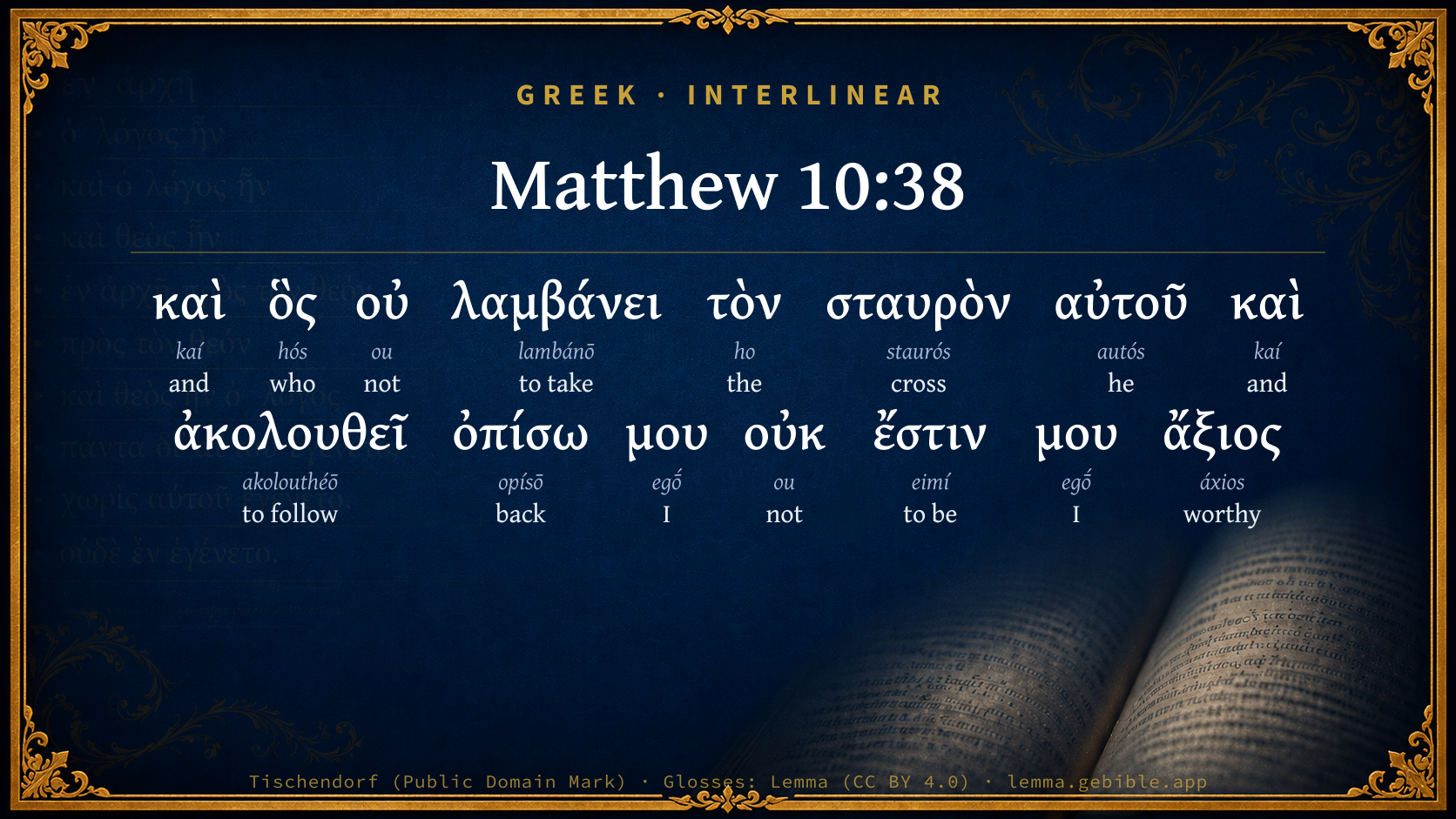
Greek (Tischendorf 8th ed.) Matthew 10:38 appears in the Greek New Testament. The text above is from the Tischendorf 8th edition. Each word links to its Strong’s number and a concise gloss. Click any word for its full Thayer’s Greek Lexicon entry.
Download image
Cite this verse

Matthew 10:38 (World English Bible). Public Domain. Lemma interlinear Bible study tool, https://lemma.gebible.app/v/matthew/10/38.

Show BibTeX & RIS
BibTeX
RIS
English Translation
He who doesn't take his cross and follow after me, isn't worthy of me.
World English Bible · Public Domain
Highlights
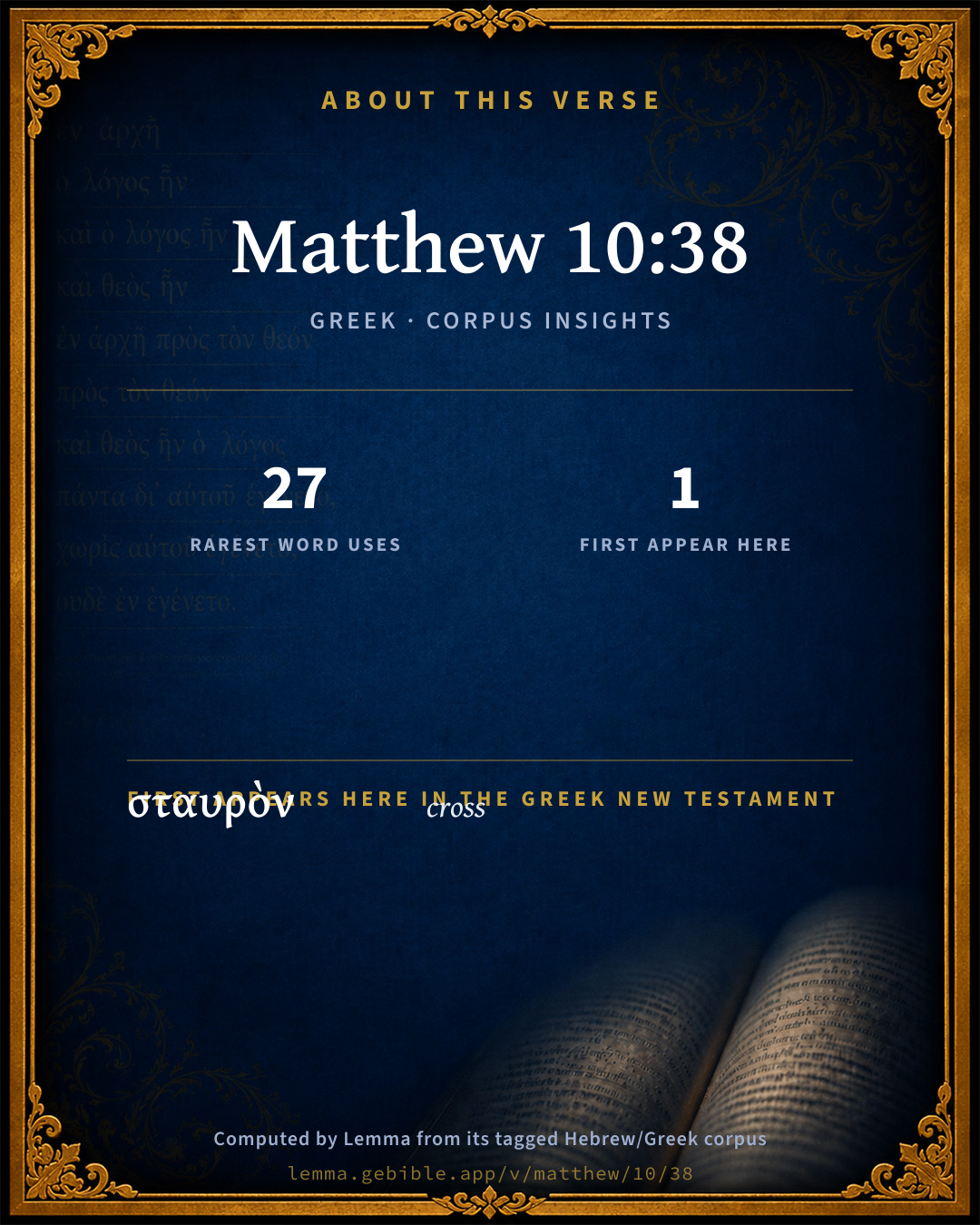
  • 1 first appearance in the Greek New Testament
Full analysis ↓
Download a study sheet

One document with this verse’s original text, its word-by-word gloss line, the meaning frame, cross-references with their text, attributed commentary, and full source and license credits — printable, and it pastes into notes with its structure intact.

This verse Autodidact and up

Study sheet (.html) Plain text (.txt)

A passage Seminary Student

Up to 50 verses in one chapter. A passage sheet keeps up to 6 commentary sources and 12 cross-references per verse, in the order this page ranks them, and says so on the sheet whenever that leaves anything out. Ask for a single verse and you get the Autodidact verse sheet above.

Everything on this page stays free to read, with no account — the sheet is a download of what is already on screen, not access to it.

Want to remove ads? Support Godless Engineer
Compare translations 3

The same verse in 3 English versions, stacked beneath the original-language interlinear above. Click any original word for its lexicon entry.

Each is an independent rendering of the whole verse — the interlinear is not word-aligned to these translations.

Highlighted words mark where these versions differ — a whole-verse word diff, not a word-by-word alignment.

  • World English Bible Public Domain
    He who doesn't take his cross and follow after me, isn't worthy of me.
  • King James Version Public Domain
    And he that taketh not his cross, and followeth after me, is not worthy of me.
  • unfoldingWord Literal Text CC BY-SA 4.0
    And whoever does not take up his cross and follow after me is not worthy of me.

unfoldingWord Literal Text — © unfoldingWord, licensed CC BY-SA 4.0. Word-aligned USFM3 via Door43 (git.door43.org/unfoldingWord/en_ult).

Versions to compare (up to 4)

3 of 4 selected

Show all 19 translations

Every available English version of this verse, each an independent rendering of the whole verse.

  • World English Bible Public Domain
    He who doesn't take his cross and follow after me, isn't worthy of me.
  • Berean Standard Bible Public Domain
    and anyone who does not take up his cross and follow Me is not worthy of Me.
  • Majority Standard Bible Public Domain
    and anyone who does not take up his cross and follow Me is not worthy of Me.
  • King James Version Public Domain
    And he that taketh not his cross, and followeth after me, is not worthy of me.
  • American Standard Version (1901) Public Domain
    And he that doth not take his cross and follow after me, is not worthy of me.
  • Revised Version (1885) Public Domain
    And he that doth not take his cross and follow after me, is not worthy of me.
  • Geneva Bible (1599) Public Domain
    And hee that taketh not his crosse, and followeth after me, is not worthie of me.
  • Douay-Rheims (1899) Public Domain
    And he that taketh not up his cross, and followeth me, is not worthy of me.
  • Young's Literal Translation Public Domain
    and whoever doth not receive his cross and follow after me, is not worthy of me.
  • Literal Standard Version CC BY-SA 4.0
    and whoever does not receive his cross and follow after Me, is not worthy of Me.
  • Unlocked Literal Bible CC BY-SA 4.0
    He who does not pick up his cross and follow after me is not worthy of me.
  • unfoldingWord Literal Text CC BY-SA 4.0
    And whoever does not take up his cross and follow after me is not worthy of me.
  • Darby Bible Public Domain
    And he who does not take up his cross and follow after me is not worthy of me.
  • World Messianic Bible Public Domain
    He who doesn’t take his cross and follow after me isn’t worthy of me.
  • Webster's Bible Public Domain
    And he that taketh not his cross, and followeth me, is not worthy of me.
  • Free Bible Version CC BY-SA 4.0
    If you don't pick up your cross and follow me you don't deserve to be mine.
  • Bible in Basic English Public Domain
    And he who does not take his cross and come after me is not good enough for me.
  • Text-Critical English NT CC BY 4.0
    And whoever does not take up his cross and follow me is not worthy of me.
  • Tyndale New Testament (1534) Public Domain
    And he that taketh not his crosse and foloweth me ys not mete for me.

Literal Standard Version (2020), Covenant Press — licensed CC BY-SA 4.0. Text via the HelloAO Bible API (eBible.org). Unlocked Literal Bible (unfoldingWord) — licensed CC BY-SA 4.0. Text via the HelloAO Bible API (eBible.org). unfoldingWord Literal Text — © unfoldingWord, licensed CC BY-SA 4.0. Word-aligned USFM3 via Door43 (git.door43.org/unfoldingWord/en_ult). Free Bible Version, Dr. Jonathan Gallagher — licensed CC BY-SA 4.0. Text via the HelloAO Bible API (eBible.org).

Word by word

More ways to search: Search by grammar → Find every occurrence → Compare this word →

Practice this passage: Drill this verse → Learn its vocabulary →

σταυρὸν
staurós
G4716
“cross”
Noun, Accusative, Singular, Masculine
Part of Speech
Noun
Case
Accusative
Number
Singular
Gender
Masculine
Full Thayer's Definition

Origin: from the base of G2476

TDNT: 16:32,1

1. an upright stake, esp. a pointed one 2. a cross a. a well known instrument of most cruel and ignominious punishment, borrowed by the Greeks and Romans from the Phoenicians; to it were affixed among the Romans, down to the time of Constantine the Great, the guiltiest criminals, particularly the basest slaves, robbers, the authors and abetters of insurrections, and occasionally in the provinces, at the arbitrary pleasure of the governors, upright and peaceable men also, and even Roman citizens themselves b. the crucifixion which Christ underwent
  1. καὶ kaí G2532 “and” Conjunction
  2. ὃς hós G3739 “who” Relative pronoun, Nominative, Singular, Masculine
  3. οὐ ou G3756 “not” Particle, Negative
  4. λαμβάνει lambánō G2983 “to take” Verb, Present, Active, Indicative, 3rd person, Singular
  5. τὸν ho G3588 “the” Article, Accusative, Singular, Masculine
  6. αὐτοῦ autós G846 “he” Personal pronoun, Genitive, Singular, Masculine
  7. καὶ kaí G2532 “and” Conjunction
  8. ἀκολουθεῖ akolouthéō G190 “to follow” Verb, Present, Active, Indicative, 3rd person, Singular
  9. ὀπίσω opísō G3694 “back” Adverb
  10. μου egṓ G1473 “I” Personal pronoun, 1st person, Genitive, Singular
  11. οὐκ ou G3756 “not” Particle, Negative
  12. ἔστιν eimí G1510 “to be” Verb, Present, Active, Indicative, 3rd person, Singular
  13. μου egṓ G1473 “I” Personal pronoun, 1st person, Genitive, Singular
  14. ἄξιος áxios G514 “worthy” Adjective, Nominative, Singular, Masculine

About this verse

These counts appear in no published source. They are computed here, from the morphology-tagged text and Lemma’s own curated glosses. What Lemma adds →

15
words
12
distinct lemmas
Gospels
section

First appearance in Scripture

This word makes its first canonical appearance in the Greek New Testament here:

  • σταυρὸν cross G4716

Shared distinctive vocabulary

σταυρὸν cross G4716 occurs in 27 verses of the Greek New Testament. Also found in:

Repetition

Words recur within this verse:

Cross-references

6

Topical passages linked to Matthew 10:38 in the Treasury of Scripture Knowledge — connected by theme and wording, ordered by reader-vote popularity; previews shown in the World English Bible.

  • Mark 8:34 He called the multitude to himself with his disciples, and said to them, "Whoever wants to come after me, let him deny himself, and take up his cross, and follow me.
  • Luke 14:27 Whoever doesn't bear his own cross, and come after me, can't be my disciple.
  • Matthew 16:24 Then Jesus said to his disciples, "If anyone desires to come after me, let him deny himself, and take up his cross, and follow me.
  • Luke 9:23–24 He said to all, "If anyone desires to come after me, let him deny himself, take up his cross, and follow me.
  • John 19:17 He went out, bearing his cross, to the place called "The Place of a Skull," which is called in Hebrew, "Golgotha,"
  • Mark 10:21 Jesus looking at him loved him, and said to him, "One thing you lack. Go, sell whatever you have, and give to the poor, and you will have treasure in heaven; and come, follow me, taking up the cross."

Cross-references courtesy of OpenBible.info (CC BY 4.0).

Commentary

Notes on Matthew 10:38 from classic Christian and Jewish commentators (each source and its license shown beneath its notes). The classic Christian expositions comment on the surrounding passage and are grouped to its opening verse, so a note may address several verses; the Jewish commentaries on the Tanakh (Rashi and others) are per-verse, so they appear only where the commentator wrote on this verse.

Lemma curates 59 commentaries, every one of them public domain or Creative Commons licensed, each selected and text-cleaned for this edition rather than reprinted as found. About our sources →

The Biblical Illustrator

Joseph S. Exell

Mat_10:38

He that taketh not; his cross.

Cross-bearing

I. What is is peculiar cross? He that taketh not his cross.

1. It may be the giving up of certain pleasures.

2. The endurance of reproach or poverty.

3. The suffering of losses and persecutions for Christs sake.

4. The consecrating all to Jesus.

5. The endurance of my heavenly Fathers will.

II. What am i to do with it?

1. I an: deliberately to take it up.

2. I am boldly to face it. It is only a wooden cross after all.

3. I am patiently to endure it, for I have only to carry it a little way.

4. I am cheerfully to resign myself to it, for my Lord appoints it.

5. I am obediently to follow Christ with it.

What an honour and a comfort to be treading in His steps! This is the essential point. It is not enough to bear a cross, we must bear it after Jesus. I ought to be thankful that I have only to bear it, and that it does not bear me. It is a royal burden, a sanctified burden, a sanctifying burden, a burden which gives communion with Christ.

III. What should encourge me?

1. Necessity: I cannot be a disciple without cross-bearing.

2. Society: better men than I have carried it.

3. Love: Jesus bore a far heavier cross than mine.

4. Faith: grace will be given equal to the weight of the cross.

5. Hope: good to myself will result from my bearing this load.

6. Zeal: Jesus will be honoured by my patient endurance.

7. Experience: I shall yet find pleasure in it, for it will produce in me much blessing. The cross is a fruitful tree.

8. Expectation: glory will be the reward of it.

Let not the ungodly fancy that theirs is a better lot: the Psalmist says, many sorrows shall be to the wicked. Let not the righteous dread the cross, for it will not crush them: it may be painted with iron colours by our fears, but it is not made of that heavy metal; we can bear it, and we will bear it right joyously. (C. H. Spurgeon.)

Following Christ by way of the cross

When Alexander the Great marched through Persia, his way was stopped with ice and snow, insomuch that his soldiers, being tired out with hard marches, were discouraged, and would have gone no further, which he perceiving, dismounted his horse, and went on four through the midst of them all, making himself a way with a pickaxe; whereat they all being ashamed, first his friends, then the captains of his army, and, last of all, the common soldiers, followed him. So should all men follow Christ their Saviour, by that rough and unpleasant way of the cross that He hath traversed before them. He having drunk unto them in the cup of His passion, they are to pledge Him when occasion is offered; He having left them an example of His suffering, they are to follow Him in the selfsame steps of sorrow. (John Spencer.)

The cross taken up

The cross is easier to him who takes it up than to him who drags it along. (J. E. Vaux.)

The cross not to be made

We are bid to take not to make our cross. God in His providence will provide one for us. And we are bid to take it up; we hear nothing of laying it down. Our troubles and our lives live and die together. (W. Gurnall.)

No man, said Flavel, hath a velvet cross. As an old Yorkshire working-man, a friend of mine, said. Ah! it is blessed work cross-bearing when its tied on with love. (Newman Hall.)

Welcome the cross of Christ, and bear it triumphantly; but see that it be indeed Christs cross, and not thine own. (Wilcox.)

The cross a sweet burden

Christs cross is the sweetest burden that ever I bore; it is such a burden as wings are to a bird, or sails to a ship, to carry me forward to my harbour. (Samuel Rutherford.)

A procession of cross-bearers

The Saviour here, in His character of Seer, looks into His own future, and moulds His language accordingly. He sees the cross in the distance. He connects Himself with it. He comes out of Himself, as it were to look at Himself with His cross. He sees Himself bearing His cross. The vision grows into a complete picture. His followers are bearing crosses too! And thus the heavenly procession moves on, until a point is reached where time melts into eternity, and earth is the stepping-stone to heaven. At that point there may occur what men call execution; but, looked at on its upper side, the event is coronation and glorification. The crown surmounts the cross. (James Morison, D. D.)

The Biblical Illustrator, edited by Joseph S. Exell (c. 1880s–1900s) — public domain. Text from a community e-Sword module.

Bengel's Gnomon

Johann Albrecht Bengel

Mat 10:38. Τὸν σταυρὸν, his cross) The cross, which was unused by the Jews as a punishment, was not employed proverbially to denote extreme adversity: our Lord therefore, in this passage, alludes to His own Cross, which He was already bearing in secret.—λαμβάνει, taketh) sc. willingly.

Bengel's Gnomon of the New Testament — English translation (T&T Clark, Edinburgh, 1860) — public domain. Text from a community e-Sword module.

Meyer's Critical & Exegetical Commentary

Heinrich August Wilhelm Meyer

Mat_10:38. To take up his cross means, willingly to undergo the severe trials that fall to his lot (2Co_1:5; Php_3:10). Figurative expression, borrowed from the practice according to which condemned criminals were compelled to take up their own cross and carry it to the place of execution; Mat_27:32; Luk_23:26; Joh_19:16; Artemid. ii. 56, p. 153; Plut. Mor. p. 554 A; Cic. de divin. i. 26; Valer. Max. xi. 7. The form of this expression, founded as it is upon the kind of death which Christ Himself was to die, is one of the indications of that later period from which the passage from Mat_10:24 onward has been transferred to its present connection. Matthew himself betrays the prolepsis in Mat_26:24 f.; comp. Mar_8:34; Luk_14:27.

ὀπίσω μου: in conformity with the Hebrew אחרי. Comp., however, ἀκολ. κατόπιν τινός, Arist. Plut. xiii.

Meyer — Critical and Exegetical Commentary on the New Testament — English translation by Peter Christie, edited by Frederick Crombie (T&T Clark, 1880) — public domain. Text from a community e-Sword module.

Expositor's Greek Testament

ed. W. Robertson Nicoll

Mat 10:38 . σταυρὸν . There is here no necessary allusion to the death of Jesus Himself by crucifixion, though one possessing such insight into the course of events, as this whole discourse indicates, must have known quite well when He uttered the words what awaited Himself, the worst possible probable if not certain. The reference is to the custom of the condemned person carrying his own cross. Death by crucifixion, though not practised among the Jews, would be familiar to them through Roman custom. Vide Grotius for Greek and Roman phrases, containing figurative allusions to the cross. This sentence and the next will occur again in this Gospel (Mat 16:24-25 ).

The Expositor's Greek Testament, edited by W. Robertson Nicoll (1897–1910) — public domain. Text from a community e-Sword module.

International Critical Commentary

(L) 38. And he who taketh not his cross, and followeth after Me, is not worthy of Me.] Lk. has: “Whosoever beareth not his cross, and cometh after Me, cannot be My disciple.” It is clear that in the Synoptic Gospels we have three recensions of this saying, viz. (a) Mar 8:34 = Mat 16:24 = Luk 9:23, a positive form, εἴ τις θέλει ὀπίσω μον ἐλθεῖν (Lk. ἔρχεσθαι) ἀρνησάσθω ἑαυτὸν καὶ ἀράτω τὸν σταυρὸν αὐτοῦ (Lk. adds καθʼ ἡμέραν) καὶ ἀκολουθείτω μοι. (b) Mat 10:38, a negative form, ὃς οὐ λαμβάνει τὸν σταυρὸν αὐτοῦ καὶ ἀκολουθεῖ ὀποίσω μου. (c) Luk 14:27, another negative form in a different context, ὅστις οὐ βαστάζει τὸν σταυρὸν ἐαυτοῦ καὶ ἔρχεται ὀπίσω μου. The two latter look like independent translations of a Semitic original. It is commonly assumed that this saying betrays reflection upon the manner of Christ’s death. So far as Lk. is concerned, the thought of discipleship as involving probable death in persecution, seems less obvious than that of faithful discipleship simply. It would not have been surprising had we found “yoke” for “cross” there. The Rabbis spoke of a man as receiving the yoke of the law, cf: Ab 36; or the yoke of the kingdom of the heavens, cf. B. Berakhoth 13a. So Christ, elsewhere, Mat 11:29, spoke of His yoke. But it is historically probable that Christ in speaking of His death should anticipate it as one of crucifixion. This had become, as it would seem, typical of violent death. It is so used in the parables of the Mechilta. Cf. Fiebig, Altjüd. Gleichnisse, p. 44: “(Like) a robber who entered in and outraged the king’s palace, (saying), If I find the king’s son I will seize him and kill and crucify him.” Cf. Plato, Rep. ii. 361: “The just man—will be impaled.” The condemned man carried his cross to the place of execution. Cf. Artemidorus, ii. 56: ὁ μέλλων αὐτῷ (σταυρῷ) προσηλοῦσθαι πρότερον αὐτὸν βαστάζει;1 Bereshith Rabba, Par. 56 (Wünsche, p. 266): “Abraham took the wood of the offering as one who bears his cross upon his shoulder”; Plut. de Sera Num. Vind. c. 9: καὶ τῷ σώματι τῶν κολαζομέων ἕκαστος κακούργων ἐκφέρει τὸν αὐτοῦ σταυρόν. The thought in Mat 10:38 is no doubt of death in persecution. The disciples would be dragged before courts of justice, v. 17; they would be killed by their relatives, v. 21. But they were not to fear physical death, v. 28. If they shrank back and recanted their faith in Christ, He would deny them before God, v. 33. They must be prepared to go to a shameful death, following His example, v. 38.

International Critical Commentary — older volumes (1896–1929), various authors — public domain. Text from a community e-Sword module.

Jamieson, Fausset & Brown

Robert Jamieson, A. R. Fausset & David Brown

And he that taketh not his cross, and followeth after me, is not worthy of me--a saying which our Lord once and again emphatically reiterates (Mat 16:24; Luk 9:23; Luk 14:27). We have become so accustomed to this expression--"taking up one's cross"--in the sense of "being prepared for trials in general for Christ's sake," that we are apt to lose sight of its primary and proper sense here--"a preparedness to go forth even to crucifixion," as when our Lord had to bear His own cross on His way to Calvary--a saying the more remarkable as our Lord had not as yet given a hint that He would die this death, nor was crucifixion a Jewish mode of capital punishment.

Jamieson, Fausset & Brown — Commentary Critical and Explanatory on the Whole Bible (1871) — public domain (CC PDM 1.0). Text via the HelloAO Bible API.

Adam Clarke's Commentary

Verse 38. He that taketh not his cross] i.e. He who is not ready, after my example, to suffer death in the cause of my religion, is not worthy of me, does not deserve to be called my disciple.

This alludes to the custom of causing the criminal to bear his own cross to the place of execution; so Plutarch, ΕκαϚος των κακουργων εκφερει τον αυτου Ϛαυρον. Each of the malefactors carries on his own cross. See Clarke on Joh 19:17.

Adam Clarke's Commentary on the Bible (1810–1826) — public domain. Text from a community e-Sword/MySword module.

Ellicott's Commentary for English Readers

(38) He that taketh not his cross.—The words were hardly a specific announcement of the manner of our Lord’s death, though they imply, interpreted by events, a distinct prevision of it, such as that which we trace in Joh_3:14. To the disciples they would recall the sad scene which Roman rule had made familiar to them, the procession of robbers or rebels, each carrying the cross on which he was to suffer to the place of execution. They would learn that they were called to a like endurance of ignominy and suffering. When they saw their Master Himself carrying His own cross, the words would come back to their minds with a new significance.

A Bible Commentary for English Readers, edited by Charles John Ellicott (1878–1897) — public domain. Text from a community e-Sword module.

The Cambridge Bible for Schools and Colleges

gen. ed. J. J. S. Perowne

38. he that taketh not his cross] A further advance in the devotion and self-abandonment required in the disciples of Jesus. These are deeply interesting and solemn words. The cross is named for the first time by the Saviour. The expression recurs ch. Mat_16:24, following upon the announcement of the Passion to the disciples. By the Roman custom criminals were compelled to bear the cross to the place of execution. The Galilæans would know too well what was meant by “taking the cross.” Many hundreds had paid that forfeiture for rebellion that had not prospered under Judas the Gaulonite and others. (See Introduction, Chapter 4.)

The Cambridge Bible for Schools and Colleges (gen. ed. J. J. S. Perowne; Cambridge University Press, 1878–1918) — public domain. Text from a community e-Sword module.

John Gill's Exposition

He that findeth his life shall lose it,.... That man that seeks to preserve his life, and the temporal enjoyments of it, by a sinful compliance with his friends and the world, and by a denial of Christ, or non-confession of him; if he is not, by the providence of God, deprived of the good things of life, and dies a shameful death, both which are sometimes the case of such persons; yet he is sure to lose the happy and eternal life of his soul and body, in the world to come: so that the present finding of life, or the possession of it, on such sinful terms, will in the issue prove an infinite and irreparable loss unto him. On the other hand, Christ observes,

he that loseth his life for my sake, shall find it. That man that is willing to forego the present advantages of life, to suffer reproach and persecution, and lay down his life cheerfully for the sake of Christ and his Gospel, for the profession of his name, rather than drop, deny, conceal, or neglect any truth and ordinance of his, shall find his soul possessed of eternal life, as soon as separated from his body; and shall find his corporal life again, in the resurrection morn, to great advantage; and shall live with Christ in soul and body, in the utmost happiness, to all eternity.

John Gill's Exposition of the Whole Bible (1746–1763) — public domain (CC PDM 1.0). Text via the HelloAO Bible API.

Trapp's Complete Commentary

John Trapp

38 And he that taketh not his cross, and followeth after me, is not worthy of me.

Ver. 38. And he that taketh not up his cross] Omnis Christianus crucianus, saith Luther. Every Christian is sure of his cross; but, first, it must be "his" cross, such as God hath laid upon him, not such as he hath created to himself (as Baal’s priests, who cut themselves with knives and lancets, 1Ki 18:28, the Circumcelliones of old, and the monks at this day, with their voluntary penances, &c.). Next, he must take it, and not stay till it be laid upon him; or then bear it as an ass doth his burden, because he can neither will nor choose; but he must be active in suffering and take God’s part against himself. Nay, he must (as he may) be cheerful under his cross, and thankful for it, as a favour, an honour. Act 5:41; Act 20:24; The very beasts take blows from their keepers. Turks, when cruelly lashed by their officers, give them thanks and go their ways. Porters go singing under their burdens, &c. Levius fit patientia quicquid corrigere est nefas. (Horat.)

And followeth after me] Or cometh not behind me (οπισω μου); and this not aloof off, as Peter, Mat 26:58, but close at heels, as Caleb, Num 14:24; walking in Christ, Col 2:6; as Christ 1Jn 2:6; putting him on in his virtues, as Constantine’s sons did their father, and preaching forth his praises, 1Pe 2:9. He is a Saviour to none but those to whom he is a sampler; neither have any his redemption but they that take his direction; his benediction, but those that submit to his jurisdiction.

John Trapp, A Commentary or Exposition upon All the Books of the Old and New Testament (1647–1656) — public domain. Text from a community e-Sword module.

Albert Barnes' Notes on the Bible

And he that taketh not his cross ... - When persons were condemned to be crucified, a part of the sentence was that they should carry the cross on which they were to die to the place of execution. Thus, Christ carried his, until he fainted from fatigue and exhaustion. See notes at Mat 27:31. The cross was usually composed of two rough beams of wood, united in the form of this figure of a cross It was an instrument of death. See the notes at Mat 27:31-32. To carry it was burdensome, was disgraceful, was trying to the feelings, was an addition to the punishment. So “to carry the cross” is a figurative expression, denoting that we must endure whatever is burdensome, or is trying, or is considered disgraceful, in following Christ. It consists simply in doing our duty, let the people of the world think of it or speak of it as they may. It does not consist in making trouble for ourselves, or doing things merely “to be opposed;” it is doing just what is required of us in the Scriptures, let it produce whatever shame, disgrace, or pain it may. This every follower of Jesus is required to do.

Albert Barnes' Notes on the Bible (1834–1885) — public domain. Text from a community e-Sword/MySword module.

Haydock's Catholic Bible Commentary

He that, &c. There are two kinds of crosses which our Saviour here commands us to take up: one corporal, and the other spiritual. By the former, he commands us to restrain the unruly appetites of the touch, taste, sight, &c. By the other, which is far more worthy our notice, he teaches us to govern the affections of the mind, and restrain all its irregular motions, by humility, tranquillity, modesty, peace, &c. Precious indeed in the sight of God, and glorious is that cross, which governs and brings under proper rule the lawless passions of the mind. (St. Augustine)

George Leo Haydock (1774–1849), Haydock's Catholic Family Bible and Commentary, 1859 edition — public domain. Excludes Psalms (Douay-Rheims chapter numbering differs from Protestant) and Deuterocanonical books (Catholic canon only).

Matthew Poole's English Annotations

We have much the same in Mat 16:24; Mar 8:34; Luk 9:23; It is not he that maketh not, but

he that taketh not his cross; that is, he that doth not willingly, and cheerfully, and patiently bear and undergo those trials, and afflictions, and persecutions, which God in the way of his providence shall lay upon him, and bring him into, for my sake and my gospel, is not worthy of the name or reward of my disciples. Our Saviour calls all such trials, the cross, either with reference to the Roman last punishment, by crucifying, or signifying what death he should die, and with reference to his own cross.

Matthew Poole's English Annotations on the Holy Bible (1683–1685) — public domain. Text from a community e-Sword/MySword module.

Whedon's Commentary on the Bible

Daniel D. Whedon

38. Taketh not his cross — As our Saviour had not been crucified, some have affirmed that he could not have uttered these words at this time. And some sceptical writers have affirmed that it is put into the mouth of Jesus in this passage by an anachronism on the part of the evangelist. But death by crucifixion, though a Roman punishment, had already been made by the Roman dominion perfectly familiar to Jewish eyes. It was the natural subject of allusion whenever the highest punishment of the law was to be mentioned. And for the same reason that it was the most obvious punishment specified in this discourse, it was the mode of our Saviour’s death. It was the representative method of capital execution. If the Lord was conscious that this was to be the mode of his own death, it would be rather a covert allusion to the secret future fact, than a proper prediction or prophecy.

Our Lord here indeed specifies what did not take place at his own crucifixion. One did follow him, taking up not his own cross, but the cross of the Saviour. But what the Lord here commands is, that each follower should take up, not his Saviour’s cross, but his own. The requirement is, that as Christ bore his own cross to his own crucifixion, so his followers should bear each his own cross to his own crucifixion. So the great crucified leader is followed by an endless train of crucified followers. They are crucified symbolically, in all their sufferings of mind or body, in behalf of Christ and of truth. Each follower who hath the spirit of his Master, is crucified in fact or in readiness of spirit. The Spirit of Christ is the spirit of martyrdom.

Daniel D. Whedon (gen. ed.), Commentary on the Old and New Testaments (1874–1909) — public domain. Text from a community e-Sword module.

The Pulpit Commentary

Besides the parallel passage, Luk_14:27 (vide supra), cf. also (for vers. 38, 39) Mat_16:24, 25 (parallel passages: Mar_8:34, 35 Luk_9:23, Luk_9:24) and he that taketh not; doth not take (Revised Version), which calls attention to the change to the more definite mode of expression (ov ... lambanei). Taketh. Receives in submission when given him; contrast aratw , "take up from the ground", (Mat_16:24) and bastazei , "bear". (Luk_14:27) His cross. A reference to the custom (vide Meyer) of criminals carrying their cross before they were crucified upon it. If, therefore, the figure may be pressed, the reference here is to the bearing of trials, even though they are such as point forward to greater trials in the future. Observe the torture and the ignominy of the trials that Christ expects his followers to be prepared for. And followeth after me. For Christ"s journey ended in nothing less. Is not worthy of me. "And having been a little chastised, they shall be greatly rewarded: for God proved them, and found them worthy of himself". (RAPC Wis 3:5) Compare the reply of St. Thomas Aquinas to our Lord in vision after he had completed his "Summa:" "Thoma, bene scripsisti de me; Quam reci-pies a Me pro rue labore mercedem? Domine, non nisi Te" (Archbishop Vaughan"s "Life of St. Thomas," frontispiece).

Cross-bearing.

Confusion of mind is caused by associating this figure with our Lord"s crucifixion, or with the fact that he was required to carry his cross to the place of crucifixion. It cannot be too clearly pointed out, that our Lord used the figure to illustrate his teachings before his disciples had formed the faintest idea that he was to be crucified; and yet he must have meant them to understand him. They did understand. Cross-bearing was a commonly used figure of the day, and stood for "doing a thing that was disagreeable to do, or bearing a thing that was painful to bear, because it was right. " In that sort of sense Christ used it in our text. "Christian duty, sometimes painful, involves crucifixion of self, sacrifice of natural feelings." Dean Plumptre says, "These words would recall to the disciples the sad scenes which Roman rule had made familiar to them the procession of robbers or rebels, each carrying the cross on which he was to suffer to the place of execution. They would learn that they were called to a like endurance of ignominy and suffering." It is, however, better to preserve the familiar proverbial character of our Lord"s allusion.

I EVERY CHRISTIAN MAN HAS HIS CROSS. Every individual has his cross. We all have to say, again and again, "Things will not be according to my mind." Becoming a Christian may alter our crosses, but it is pretty certain to multiply them. The more active and enterprising a Christian is, the more, and the weightier, will be his crosses. They will always be marked by their demand on the Christian to do what he ought rather than what he likes. A cross is that which puts a man on self-restraints and self-denials.

II EVERY CHRISTIAN MAN IS REVEALED BY THE WAY IN WHICH HE DEALS WITH HIS CROSS.

1. He may spurn it.

2. He may leave it.

3. He may lift it.

He is disloyal if he spurns it. He is negligent if he leaves it. He is truehearted if he lifts it. This leads on to the thought that if "cross-bearing" is discipline, and may even be stern discipline, it is always sanctifying. Cross-bearing may even be figured as the "highway of holiness. R.T.

The Pulpit Commentary (1880–1919), ed. H.D.M. Spence-Jones & Joseph S. Exell — public domain. Text from a community e-Sword module.

John Wesley's Explanatory Notes

He that taketh not his cross - That is, whatever pain or inconvenience cannot be avoided, but by doing some evil, or omitting some good. Matt. xvi, 24; Luke xiv, 27.

John Wesley, Explanatory Notes Upon the Whole Bible (1754–1765) — public domain. Text via the GEBible commentary corpus.

The People's New Testament

B. W. Johnson

38. He that taketh not his cross. Luke adds, daily; not once, but all the time. The cross is the pain of the self-denial required. The cross is the symbol of doing our duty, even at the cost of the most painful death. Christ obeyed God, and carried out his work of the salvation of men, though it required him to die upon the cross in order to do it. And ever since, the cross has stood as the emblem, not of suffering, but of suffering for the sake of Christ and his gospel. And follow me. To follow Christ is to take him for our master, our teacher, our example; to believe his doctrines, to uphold his cause, to obey his precepts, and to do it though it leads to heaven by the way of the cross.

B. W. Johnson's The People's New Testament with Notes (1889–1891) — public domain. Electronic text from the Christian Classics Ethereal Library (CCEL) ThML edition.

Cambridge Greek Testament for Schools and Colleges

38. ὅς οὐ λαμβάνει τὸν σταυρὸν αὐτοῦ. A further advance in the devotion and self-abandonment required in the disciples of Jesus. These are deeply interesting and solemn words. The cross is named for the first time by the Saviour. The expression recurs ch. Mat 16:24, following upon the announcement of the Passion to the disciples. By the Roman custom criminals were compelled to bear the cross to the place of execution. The Galilæans would know too well what was meant by ‘taking the cross.’ Many hundreds had paid that forfeiture for rebellion that had not prospered under Judas the Gaulonite and others. (See Introduction, Chapter IV)

Cambridge Greek Testament for Schools and Colleges (Cambridge University Press, 1896; 21 vols, various authors incl. Carr, Maclear, Plummer, Farrar, Lumby, Moule, M. R. James, Simcox) — public domain. Text from a community e-Sword module.

Alford’s Greek Testament

Henry Alford

38.] How strange must this prophetic announcement have seemed to the Apostles! It was no Jewish proverb (for crucifixion was not a Jewish punishment), no common saying, which our Lord here and so often utters. See ch. 16:24; Mar 10:21: Luk 9:23. He does not here plainly mention His Cross; but leaves it to be understood, see ver. 25. This is one of those sayings of which Joh 12:16 was eminently true. Neander (Leben Jesu, p. 546, note) quotes from Plutarch, de sera numinis vindicta, c. ix., καὶ τῷ μὲν σώματι τῶν κολαζομένων ἕκαστος κακούργων ἐκφέρει τὸν αὑτοῦ σταυρόν (meaning, as he explains it, a guilty conscience),—as a proof that our Lord used this saying without any conscious reference to His own Death. But he confesses that if the ὑψοῦν of Joh 12:32 is to be understood as there interpreted (ver. 33), he should be ready to allow the allusion here also. Seeing then that we do thus understand it, his inference has no value for us. Besides which, the passage of Plutarch does not even prove the expression to have been proverbial.

Henry Alford, The Greek Testament (1849–1861) — public domain. Text from a community e-Sword module.

Vincent's Word Studies in the New Testament

Marvin R. Vincent

His cross [τον σταυρον αυτου] . This was no Jewish proverb, crucifixion not being a Jewish punishment; so that Jesus uses the phrase anticipatively, in view of the death which he himself was to die. This was one of those sayings described in Joh 12:16, which the disciples understood not at the first, but the meaning of which was revealed in the light of later events. The figure itself was borrowed from the practice which compelled criminals to bear their own cross to the place of execution. His cross : his own. All are not alike. There are different crosses for different disciples. The English proverb runs : "Every cross hath its inscription" - the name of him for whom it is shaped.

Marvin R. Vincent, Word Studies in the New Testament (1887–1900) — public domain. Text from a community e-Sword/MySword module.

Lesson kit

Teaching starters — assembled from the data on this page, not authored interpretation. Every prompt links to the verse data it draws on. Edit before teaching.

Matthew, in the Gospels, opens this verse with 15 words (12 distinct Greek lemmas). Its most distinctive word is staurós (“cross”). A historical commentator’s framing appears above. Read the whole chapter for the surrounding context.

Discussion questions

  1. The word staurós carries the sense “cross.” How does it shape the verse?
  2. The word “cross” first appears here in Scripture. What is being introduced at this debut?
  3. Matthew 16:24 shares the word «cross» with this verse. How do the two illuminate each other?
  4. “and” occurs 2× in this one verse. What is the effect of the repetition?
  5. The translations on this page render this verse differently — a whole-verse word diff, not a word-by-word alignment. What might account for the different wordings?
  6. Reading how The Biblical Illustrator and Bengel's Gnomon read this verse, where do the two commentators agree and where do they part?

Things to notice

  • 1 word makes its first canonical appearance in Scripture here.
  • These translations choose different wording for 10 words in this verse.
  • “and” occurs 2× in this single verse.
  • 12 distinct Greek lemmas span 15 words in this verse.

Reading settings

Reading text

Shown beneath each verse's original-language words.

Old Testament
Old Testament edition

Read the OT as the Masoretic Hebrew (MT) or the Greek Septuagint (LXX).

English shown for the Greek Septuagint (in the Hebrew ↔ Greek comparison).

Comparing translations? Open the Compare panel on any verse page to stack up to four side by side.