Matthew 23:39

Greek (Tischendorf 8th ed.) Matthew 23:39 appears in the Greek New Testament. The text above is from the Tischendorf 8th edition. Each word links to its Strong’s number and a concise gloss. Click any word for its full Thayer’s Greek Lexicon entry.
Download image
Cite this verse

Matthew 23:39 (World English Bible). Public Domain. Lemma interlinear Bible study tool, https://lemma.gebible.app/v/matthew/23/39.

Show BibTeX & RIS
BibTeX
RIS
English Translation
For I tell you, you will not see me from now on, until you say, 'Blessed is he who comes in the name of the Lord!'"
World English Bible · Public Domain
Download a study sheet

One document with this verse’s original text, its word-by-word gloss line, the meaning frame, cross-references with their text, attributed commentary, and full source and license credits — printable, and it pastes into notes with its structure intact.

This verse Autodidact and up

Study sheet (.html) Plain text (.txt)

A passage Seminary Student

Up to 50 verses in one chapter. A passage sheet keeps up to 6 commentary sources and 12 cross-references per verse, in the order this page ranks them, and says so on the sheet whenever that leaves anything out. Ask for a single verse and you get the Autodidact verse sheet above.

Everything on this page stays free to read, with no account — the sheet is a download of what is already on screen, not access to it.

Want to remove ads? Support Godless Engineer
Compare translations 3

The same verse in 3 English versions, stacked beneath the original-language interlinear above. Click any original word for its lexicon entry.

Each is an independent rendering of the whole verse — the interlinear is not word-aligned to these translations.

Highlighted words mark where these versions differ — a whole-verse word diff, not a word-by-word alignment.

  • World English Bible Public Domain
    For I tell you, you will not see me from now on, until you say, 'Blessed is he who comes in the name of the Lord!'"
  • King James Version Public Domain
    For I say unto you, Ye shall not see me henceforth, till ye shall say, Blessed is he that cometh in the name of the Lord.
  • unfoldingWord Literal Text CC BY-SA 4.0
    For I say to you, you will certainly not see me from now until you say, ‘Blessed is the one coming in the name of the Lord!’”

unfoldingWord Literal Text — © unfoldingWord, licensed CC BY-SA 4.0. Word-aligned USFM3 via Door43 (git.door43.org/unfoldingWord/en_ult).

Versions to compare (up to 4)

3 of 4 selected

Show all 19 translations

Every available English version of this verse, each an independent rendering of the whole verse.

  • World English Bible Public Domain
    For I tell you, you will not see me from now on, until you say, 'Blessed is he who comes in the name of the Lord!'"
  • Berean Standard Bible Public Domain
    For I tell you that you will not see Me again until you say, ‘Blessed is He who comes in the name of the Lord.’”
  • Majority Standard Bible Public Domain
    For I tell you that you will not see Me again until you say, ‘Blessed is He who comes in the name of the Lord.’”
  • King James Version Public Domain
    For I say unto you, Ye shall not see me henceforth, till ye shall say, Blessed is he that cometh in the name of the Lord.
  • American Standard Version (1901) Public Domain
    For I say unto you, Ye shall not see me henceforth, till ye shall say, Blessed `is' he that cometh in the name of the Lord.
  • Revised Version (1885) Public Domain
    For I say unto you, Ye shall not see me henceforth, till ye shall say, Blessed is he that cometh in the name of the Lord.
  • Geneva Bible (1599) Public Domain
    For I say vnto you, ye shall not see mee henceforth till that ye say, Blessed is he that commeth in the Name of the Lord.
  • Douay-Rheims (1899) Public Domain
    For I say to you, you shall not see me henceforth till you say: Blessed is he that cometh in the name of the Lord.
  • Young's Literal Translation Public Domain
    for I say to you, ye may not see me henceforth, till ye may say, Blessed `is' he who is coming in the name of the Lord.'
  • Literal Standard Version CC BY-SA 4.0
    for I say to you, you may not see Me from now on, until you may say, Blessed [is] He who is coming in the Name of the LORD.”
  • Unlocked Literal Bible CC BY-SA 4.0
    For I say to you, You will not see me from now on until you say, 'Blessed is he who comes in the name of the Lord.'”
  • unfoldingWord Literal Text CC BY-SA 4.0
    For I say to you, you will certainly not see me from now until you say, ‘Blessed is the one coming in the name of the Lord!’”
  • Darby Bible Public Domain
    for I say unto you, Ye shall in no wise see me henceforth until ye say, Blessed [be] he that comes in the name of [the] Lord.
  • World Messianic Bible Public Domain
    For I tell you, you will not see me from now on, until you say, ‘Blessed is he who comes in the name of the Lord!’”
  • Webster's Bible Public Domain
    For I say to you, Ye shall not see me henceforth, till ye shall say, Blessed is he that cometh in the name of the Lord.
  • Free Bible Version CC BY-SA 4.0
    I tell you this: you won't see me from now on until you say, ‘Blessed is the one who comes in the name of the Lord.’”
  • Bible in Basic English Public Domain
    For I say to you, You will not see me from this time till you say, A blessing on him who comes in the name of the Lord.
  • Text-Critical English NT CC BY 4.0
    For I tell you, from now on you will certainly not see me until you say, ‘Blessed is he who comes in the name of the Lord!’ ”
  • Tyndale New Testament (1534) Public Domain
    For I saye to you ye shall not se me henceforthe tyll that ye saye: blessed is he that cometh in the name of the Lorde.

Literal Standard Version (2020), Covenant Press — licensed CC BY-SA 4.0. Text via the HelloAO Bible API (eBible.org). Unlocked Literal Bible (unfoldingWord) — licensed CC BY-SA 4.0. Text via the HelloAO Bible API (eBible.org). unfoldingWord Literal Text — © unfoldingWord, licensed CC BY-SA 4.0. Word-aligned USFM3 via Door43 (git.door43.org/unfoldingWord/en_ult). Free Bible Version, Dr. Jonathan Gallagher — licensed CC BY-SA 4.0. Text via the HelloAO Bible API (eBible.org).

Word by word

More ways to search: Search by grammar → Find every occurrence → Compare this word →

Practice this passage: Drill this verse → Learn its vocabulary →

ἄρτι
árti
G737
“now”
Adverb
Part of Speech
Adverb
Full Thayer's Definition

Origin: from a derivative of G142 (cf G740 ) through the idea of suspension

TDNT: 22:26,7

1. just now, this moment 2. now at this time, at this very time, this moment
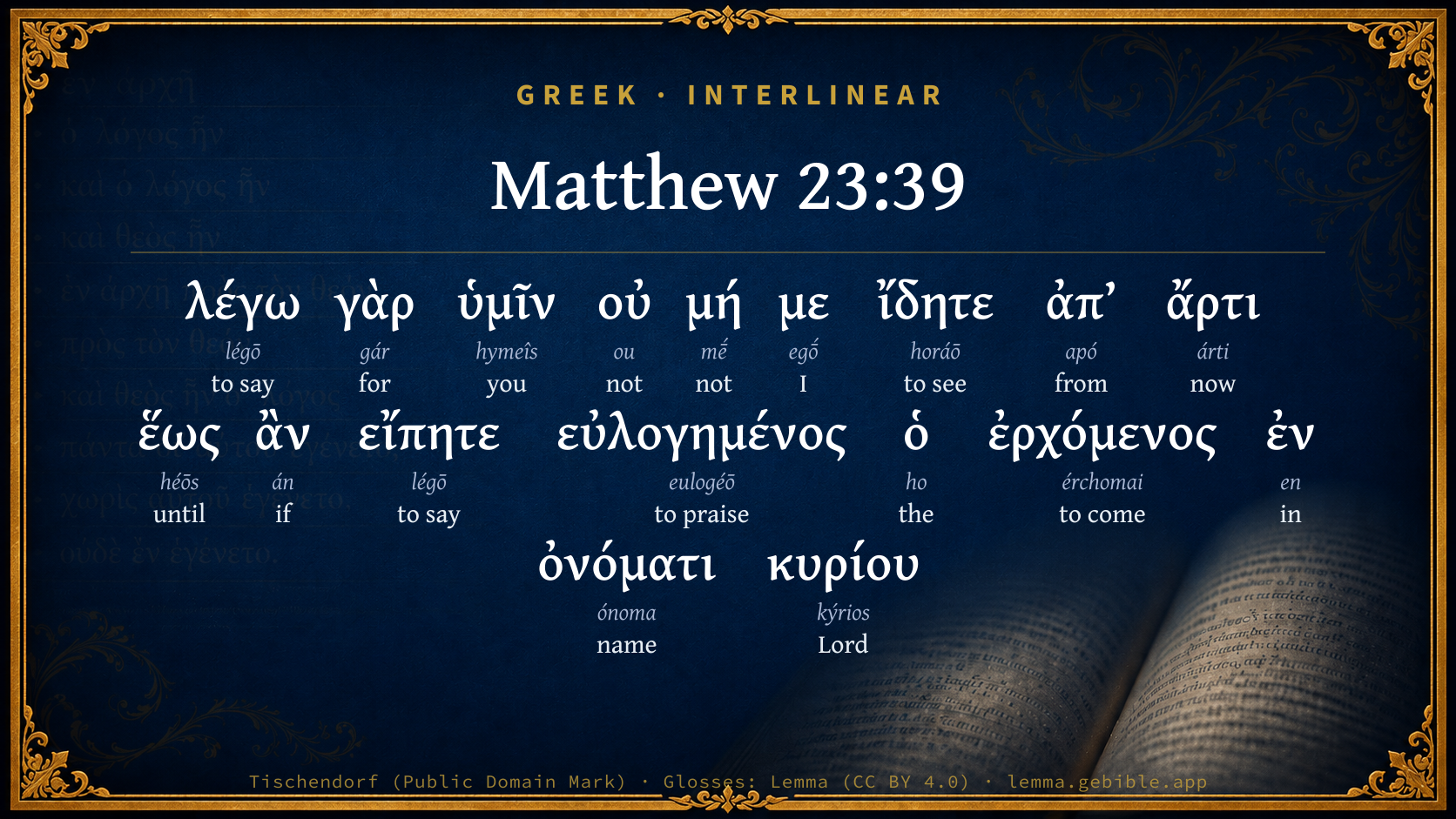
  1. λέγω légō G3004 “to say” Verb, Present, Active, Indicative, 1st person, Singular
  2. γὰρ gár G1063 “for” Conjunction
  3. ὑμῖν hymeîs G5210 “you” Personal pronoun, 2nd person, Dative, Plural
  4. οὐ ou G3756 “not” Particle, Negative
  5. μή mḗ G3361 “not” Particle, Negative
  6. με egṓ G1473 “I” Personal pronoun, 1st person, Accusative, Singular
  7. ἴδητε horáō G3708 “to see” Verb, Aorist, Active, Subjunctive, 2nd person, Plural
  8. ἀπ’ apó G575 “from” Preposition
  9. ἕως héōs G2193 “until” Adverb
  10. ἂν án G302 “if” Particle
  11. εἴπητε légō G3004 “to say” Verb, Aorist, Active, Subjunctive, 2nd person, Plural
  12. εὐλογημένος eulogéō G2127 “to praise” Verb, Perfect, Passive, Participle, Nominative, Singular, Masculine
  13. ὁ ho G3588 “the” Article, Nominative, Singular, Masculine
  14. ἐρχόμενος érchomai G2064 “to come” Verb, Present, Middle or Passive deponent, Participle, Nominative, Singular, Masculine
  15. ἐν en G1722 “in” Preposition
  16. ὀνόματι ónoma G3686 “name” Noun, Dative, Singular, Neuter
  17. κυρίου kýrios G2962 “Lord” Noun, Genitive, Singular, Masculine

About this verse

These counts appear in no published source. They are computed here, from the morphology-tagged text and Lemma’s own curated glosses. What Lemma adds →

18
words
17
distinct lemmas
Gospels
section

Shared distinctive vocabulary

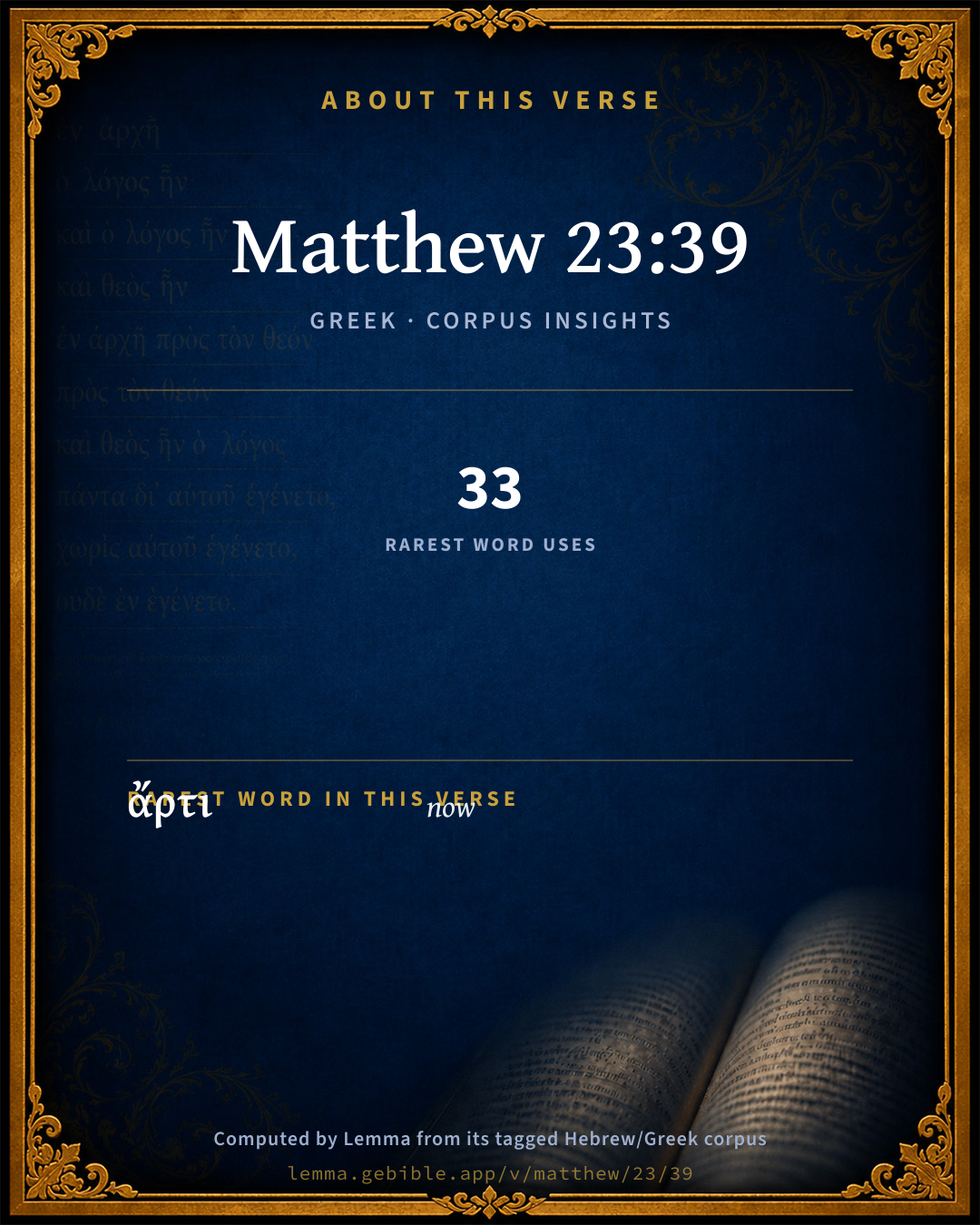
ἄρτι now G737 occurs in 32 verses of the Greek New Testament. Also found in:

Repetition

A word recurs within this verse:

  • λέγω to say G3004 ×2

Cross-references

15

Topical passages linked to Matthew 23:39 in the Treasury of Scripture Knowledge — connected by theme and wording, ordered by reader-vote popularity; previews shown in the World English Bible.

  • Psalms 118:26 Blessed is he who comes in the name of Yahweh! We have blessed you out of the house of Yahweh.
  • Matthew 21:9 The multitudes who went before him, and who followed kept shouting, "Hosanna to the son of David! Blessed is he who comes in the name of the Lord! Hosanna in the highest!"
  • Romans 11:25 For I don't desire, brothers, to have you ignorant of this mystery, so that you won't be wise in your own conceits, that a partial hardening has happened to Israel, until the fullness of the Gentiles has come in,
  • Isaiah 40:9–11 You who tell good news to Zion, go up on a high mountain; you who tell good news to Jerusalem, lift up your voice with strength; lift it up, don't be afraid; say to the cities of Judah, Behold, your God!
  • Hosea 3:4 For the children of Israel shall abide many days without king, and without prince, and without sacrifice, and without sacred stone, and without ephod or idols.
  • Zechariah 12:10 I will pour on the house of David, and on the inhabitants of Jerusalem, the spirit of grace and of supplication; and they will look to me whom they have pierced; and they shall mourn for him, as one mourns for his only son, and will grieve bitterly for him, as one grieves for his firstborn.
  • Luke 2:26–30 It had been revealed to him by the Holy Spirit that he should not see death before he had seen the Lord's Christ.
  • Luke 10:22–23 Turning to the disciples, he said, "All things have been delivered to me by my Father. No one knows who the Son is, except the Father, and who the Father is, except the Son, and he to whomever the Son desires to reveal him."
  • Luke 17:22 He said to the disciples, "The days will come, when you will desire to see one of the days of the Son of Man, and you will not see it.
  • John 8:21 Jesus said therefore again to them, "I am going away, and you will seek me, and you will die in your sins. Where I go, you can't come."
  • John 8:24 I said therefore to you that you will die in your sins; for unless you believe that I am he, you will die in your sins."
  • John 8:56 Your father Abraham rejoiced to see my day. He saw it, and was glad."
  • John 14:9 Jesus said to him, "Have I been with you such a long time, and do you not know me, Philip? He who has seen me has seen the Father. How do you say, 'Show us the Father?'
  • John 14:19 Yet a little while, and the world will see me no more; but you will see me. Because I live, you will live also.
  • 2 Corinthians 3:14–18 But their minds were hardened, for until this very day at the reading of the old covenant the same veil remains, because in Christ it passes away.

Cross-references courtesy of OpenBible.info (CC BY 4.0).

Commentary

Notes on Matthew 23:39 from classic Christian and Jewish commentators (each source and its license shown beneath its notes). The classic Christian expositions comment on the surrounding passage and are grouped to its opening verse, so a note may address several verses; the Jewish commentaries on the Tanakh (Rashi and others) are per-verse, so they appear only where the commentator wrote on this verse.

Lemma curates 59 commentaries, every one of them public domain or Creative Commons licensed, each selected and text-cleaned for this edition rather than reprinted as found. About our sources →

Scofield Reference Notes

C. I. Scofield

till

The three "untils" of Israel’s blessing:

(1) Israel must say, "blessed is He" Mat 23:39; Rom 10:3; Rom 10:4

(2) Gentile world-power must run its course. Luk 21:24; Dan 2:34; Dan 2:35.

(3) The elect number of Gentiles must be brought in. Then "the Deliverer shall come out of Zion." etc. Rom 11:25-27.

The Scofield Reference Bible (1917 edition), notes by C. I. Scofield — public domain. Text from a community e-Sword module.

Tyndale Open Study Notes

Tyndale Open Resources

23:39 Blessings on the one who comes in the name of the Lord: This is possibly the prediction of an end-time conversion of the nation of Israel to the Messiah (see also Rom 11:12-32).

Tyndale Open Study Notes — © Tyndale Open Resources, licensed CC BY-SA 4.0. Text via the HelloAO Bible API.

Bengel's Gnomon

Johann Albrecht Bengel

Mat 23:39. Λέγω, I say) See Gnomon on Luk 13:35.—ἴδητε, ye shall see) sc. you, inhabitants of Jerusalem. Cf. Luk 13:35.—ἀπʼ ἄρτι, from the present time[1024]) The short interval preceding our Lord’s death (and that spent without the Temple[1025]) is included in the present time [the ἌΡΤΙ of the text].—ἛΩς, until) sc. after a long interval.—εἴπητε, κ.τ.λ., ye shall say, etc.) They would say so when reciting the Hallel[1026] at the Passover, but without applying the words to Jesus. That which is here foretold will actually come to pass at the appointed time, as in ch. Mat 21:9 was performed that which had been predicted in Luk 13:35. Our Lord, however, does not add “again,” although the people had shouted those words on the occasion recorded in Mat 21:9. For neither had all joined in this acclamation to Him, nor had they who did so understood what they were saying, as Israel shall understand hereafter: and soon after they, as it were, retracted their acclamation. The first utterance of these words was less complete, the second will be worthy of the name.[1027] Cf. Gnomon on the omission of “again,” in Act 1:11.—εὐλογημένος, κ.τ.λ., Blessed, etc.) With this verse concludes our Lord’s public discourse to the Jews: with this verse will begin their repentance.

[1024] E. V. Henceforth.—(I. B.)

[1025] Within which, and in reference to which, these words, Mat 23:38, were spoken.—ED.

[1026] “Lastly,” says Hartwell Horne, in describing the Jewish Passover, “a fourth cup of wine was filled, called the cup of the Hallel: over it they completed, either by singing or recitation, the great Hallel, or hymn of praise, consisting of Psalms 115-118 inclusive, with a prayer, and so concluded.”—(I. B.)

[1027] Sc. of an utterance or saying, dictio, referring to the words, “Ye shall say.” Cf. in 1Co 14:15, “I will sing with the spirit, and I will sing with the understanding also.”—(I. B.)

Bengel's Gnomon of the New Testament — English translation (T&T Clark, Edinburgh, 1860) — public domain. Text from a community e-Sword module.

Expositor's Greek Testament

ed. W. Robertson Nicoll

Mat 23:39 . ἀπʼ ἄρτι , from this moment, Christ’s prophetic work done now: it remains only to die. ἕως ἂν εἴπητε : a future contingency on which it depends whether they shall ever see Him again (Weiss in Meyer). He will not trouble them any more till their mood change and they be ready to receive Him with a Messianic salutation.

The exquisite finish of this discourse, in the case of ordinary orators, would suggest premeditation and even writing. We have no means of knowing to what extent Jesus had considered beforehand what He was to say on this momentous occasion. The references to the whited sepulchres and the tombs of the prophets show that the speech was in part at least an extempore utterance.

The Expositor's Greek Testament, edited by W. Robertson Nicoll (1897–1910) — public domain. Text from a community e-Sword module.

Jamieson, Fausset & Brown

Robert Jamieson, A. R. Fausset & David Brown

For I say unto you--and these were His last words to the impenitent nation, see on Mar 13:1, opening remarks.

Ye shall not see me henceforth--What? Does Jesus mean that He was Himself the Lord of the temple, and that it became "deserted" when HE finally left it? It is even so. Now is thy fate sealed, O Jerusalem, for the glory is departed from thee! That glory, once visible in the holy of holies, over the mercy seat, when on the day of atonement the blood of typical expiation was sprinkled on it and in front of it--called by the Jews the Shekinah, or the Dwelling, as being the visible pavilion of Jehovah--that glory, which Isaiah (Isa 6:1-13) saw in vision, the beloved disciple says was the glory of Christ (Joh 12:41). Though it was never visible in the second temple, Haggai foretold that "the glory of that latter house should be greater than of the former" (Hag 2:9) because "the Lord whom they sought was suddenly to come to His temple" (Mal 3:1), not in a mere bright cloud, but enshrined in living humanity! Yet brief as well as "sudden" was the manifestation to be: for the words He was now uttering were to be HIS VERY LAST within its precincts.

till ye shall say, Blessed is he that cometh in the name of the Lord--that is, till those "Hosannas to the Son of David" with which the multitude had welcomed Him into the city--instead of "sore displeasing the chief priests and scribes" (Mat 21:15) --should break forth from the whole nation, as their glad acclaim to their once pierced, but now acknowledged, Messiah. That such a time will come is clear from Zac 12:10; Rom 11:26; Co2 3:15-16, &c. In what sense they shall then "see Him" may be gathered from Zac 2:10-13; Eze 37:23-28; Eze 39:28-29, &c.

Next: Matthew Chapter 25

Jamieson, Fausset & Brown — Commentary Critical and Explanatory on the Whole Bible (1871) — public domain (CC PDM 1.0). Text via the HelloAO Bible API.

Adam Clarke's Commentary

Verse 39. Ye shall not see me] I will remove my Gospel from you, and withdraw my protection.

Till ye shall say, Blessed] Till after the fulness of the Gentiles is brought in, when the word of life shall again be sent unto you; then will ye rejoice, and bless, and praise him that cometh in the name of the Lord, with full and final salvation for the lost sheep of the house of Israel. See Ro 11:26-27.

Our Lord plainly foresaw that, in process of time, a spiritual domination would arise in his Church; and, to prevent its evil influence, he leaves the strong warnings against it which are contained in the former part of this chapter. As the religion of Christ is completely spiritual, and the influence by which it is produced and maintained must come from heaven; therefore, there could be no master or head but himself: for as the Church (the assemblage of true believers) is his body, all its intelligence, light, and life, must proceed from him alone. Our forefathers noted this well; and this was one of the grand arguments by which they overturned the papal pretensions to supremacy in this country. In a note on Mt 23:9, in a Bible published by Edmund Becke in 1549, the 2nd of Edward VI., we find the following words: - Call no man your father upon the earth. Here is the Bishoppe of Rome declared a plaine Antichrist, in that he woulde be called the most holye father; and that all Christen men shoulde acknowledge hym for no lesse then their spyritual father, notwithstandinge these playne wordes of Christe. It is true, nothing can be plainer; and yet, in the face of these commands, the pope has claimed the honour; and millions of men have been so stupid as to concede it. May those days of darkness, tyranny, and disgrace, never return!

From the 13th to the 39th verse, our Lord pronounces eight woes, or rather pathetic declarations, against the scribes and Pharisees.

1. For their unwillingness to let the common people enjoy the pure word of God, or its right explanation: Ye shut up the kingdom, c., Mt 23:13.

2. For their rapacity, and pretended sanctity in order to secure their secular ends: Ye devour widows houses, c., Mt 23:14.

3. For their pretended zeal to spread the kingdom of God by making proselytes, when they had no other end in view than forming instruments for the purposes of their oppression and cruelty: Ye compass sea and land, &c., Mt 23:15.

4. For their bad doctrine and false interpretations of the Scriptures, and their dispensing with the most solemn oaths and vows at pleasure: Ye blind guides, which say, Whosoever shall swear by the temple, it is nothing, &c., Mt 23:16-22.

5. For their superstition in scrupulously attending to little things, and things not commanded, and omitting matters of great importance, the practice of which God had especially enjoined: Ye pay tithe of mint and cummin, &c., Mt 23:23-24.

6. For their hypocrisy, pretended saintship, and endeavouring to maintain decency in their outward conduct, while they had no other object in view than to deceive the people, and make them acquiesce in their oppressive measures: Ye make clean the outside of the cup, Mt 23:25-26.

7. For the depth of their inward depravity and abomination, having nothing good, fair, or supportable, but the mere outside. - Most hypocrites and wicked men have some good: but these were radically and totally evil: Ye are like unto whited sepulchres - within full - of all uncleanness, Mt 23:27-28.

8. For their pretended concern for the holiness of the people, which proceeded no farther than to keep them free from such pollutions as they might accidentally and innocently contract, by casually stepping on the place where a person had been buried: and for their affected regret that their fathers had killed the prophets, while themselves possessed and cultivated the same murderous inclinations: Ye - garnish the sepulchres of the righteous, and say, If we had been, c., Mt 23:29-30.

It is amazing with what power and authority our blessed Lord reproves this bad people. This was the last discourse they ever heard from him and it is surprising, considering their wickedness, that they waited even for a mock trial, and did not rise up at once and destroy him. But the time was not yet come in which he was to lay down his life, for no man could take it from him.

While he appears in this last discourse with all the authority of a lawgiver and judge, he at the same time shows the tenderness and compassion of a friend and a father: he beholds their awful state - his eye affects his heart, and he weeps over them! Were not the present hardness and final perdition of these ungodly men entirely of themselves? Could Jesus, as the Supreme God, have fixed their reprobation from all eternity by any necessitating decree; and yet weep over the unavoidable consequences of his own sovereign determinations? How absurd as well as shocking is the thought! This is Jewish exclusion: Credat Judaeus Apella-non ego.

Adam Clarke's Commentary on the Bible (1810–1826) — public domain. Text from a community e-Sword/MySword module.

Ellicott's Commentary for English Readers

(39) Till ye shall say.—There is obviously a reference to the fact that the words quoted from Psa_118:26, had been uttered by the crowd but a few days before on His solemn entry into Jerusalem. Not till those words should be uttered once again—not in a momentary burst of excitement, not with feigned Hosannas, but in spirit and in truth—would they look on Him as they looked now. There can be little doubt that our Lord points to the second Advent, and to the welcome that will then be given Him by all the true Israel of God. For that generation, and for the outward Israel as such, the abandonment was final.

A Bible Commentary for English Readers, edited by Charles John Ellicott (1878–1897) — public domain. Text from a community e-Sword module.

The Cambridge Bible for Schools and Colleges

gen. ed. J. J. S. Perowne

39. For explains “desolate” of Mat_23:38. The Temple is desolate, for Christ, who is the Lord of the Temple, leaves it for ever.

till ye shall say] Till, like the children in these Temple-courts, ye recognise Me as the Messiah. See ch. Mat_21:15. The words of Jesus, and the place, and the anger of the Scribes, may have recalled to some the scene in which Jeremiah, on the same spot, denounced the sin of Israel, called them to repentance, and foretold the destruction of the Temple: “then will I make this house like Shiloh” … “and all the people took him, saying, Thou shalt surely die,” Jer_26:1-8.

The Cambridge Bible for Schools and Colleges (gen. ed. J. J. S. Perowne; Cambridge University Press, 1878–1918) — public domain. Text from a community e-Sword module.

Trapp's Complete Commentary

John Trapp

39 For I say unto you, Ye shall not see me henceforth, till ye shall say, Blessed is he that cometh in the name of the Lord.

Ver. 39. Till ye shall say, Blessed, &c.] That is, ye shall never see me, or not till the general judgment; when as you that would not obey that sweet voice of mine, "Come unto me, ye that are weary," &c., shall have no other command of mine to obey, but that dreadful Discedite, " Go, ye cursed, into everlasting fire," &c.

John Trapp, A Commentary or Exposition upon All the Books of the Old and New Testament (1647–1656) — public domain. Text from a community e-Sword module.

Albert Barnes' Notes on the Bible

Ye shall not see me ... - The day of your mercy is gone by. I have offered you protection and salvation, and you have rejected it. You are about to crucify me, and your temple to be destroyed, and you, as a nation, to be given up to long and dreadful suffering. You will not see me as a merciful Saviour, offering you redemption any more, until you have borne these heavy judgments. They must come upon you, and be borne, until you would be glad to hail a deliverer, and say, Blessed is he that cometh in the name of the Lord. Blessed be he that comes as the Messiah, to bring deliverance. This has not been yet accomplished, but the days will come when the Jews, long cast out and rejected, will hail Jesus as the Messiah, and receive him whom their fathers killed as the merciful Saviour, Rom 11:25-32.

Remarks On Matthew 23

1. Proper respect should always be shown to teachers and rulers, Mat 23:3.

2. We are not to copy the example of wicked people, though they are our teachers or rulers, Mat 23:3. We are to frame our conduct by the law of God, and not by the example of people.

3. People are often very rigid in exacting of others what they fail altogether of performing themselves, Mat 23:4.

4. We are not to seek human honors Mat 23:8, nor to give flattering titles to others, nor to allow others to give them to us Mat 23:9. Our highest honor is in humility, and he is most exalted who is most lowly, Mat 23:11-12.

5. In the descriptions of the scribes and Pharisees in this chapter, we have a full-length portrait of a hypocrite.

(1) They shut up the kingdom of heaven against others, Mat 23:13. They made great pretensions to knowledge, but they neither entered in themselves, nor suffered others.

(2) They committed the grossest iniquity under a cloak of religion, Mat 23:14. They cheated widows out of their property, and made long prayers to hide their villainy.

(3) They showed great zeal in making proselytes, yet did it only for gain, and made them more wicked, Mat 23:15.

(4) They taught false doctrine, and they resorted to artful contrivances to destroy the force of oaths, and to shut out the Creator from their view, Mat 23:16-22.

(5) They were superstitious, Mat 23:23. Small matters they were exact in; matters of real importance they cared little about.

(6) They took great pains to appear well, while they themselves knew that it was all deceit and falsehood, Mat 23:25-28.

(7) They professed great veneration for the memory of the pious dead, while at the same time they were conscious that they really approved the conduct of those that killed them, Mat 23:29-31.

Never, perhaps, was there a combination of more wicked feelings and hypocritical actions than among them; and never was there more profound knowledge of the human heart, and more faithfulness, than in him who tore off the mask, and showed them what they were.

6. It is amazing with what power and authority our blessed Lord reproves this wicked people. It is wonderful that they ever waited for a mock trial, and did not kill him at once. But his time was not come, and they were restrained, and not buffered to act out the fury of their mad passions.

7. Jesus pities dying sinners, Mat 23:37. He seeks their salvation. He pleads with them to be saved. He would gather them to him, if they would come. The most hardened, even like the sinners of Jerusalem, he would save if they would come to him. But they will not. They turn from him, and tread the road to death.

8. The reason why the wicked are not saved is their own obstinacy. They choose not to be saved, and they die. If they will not come to Christ, it is right that they should die. If they do not come, they must die.

9. The sinner will be destroyed, Mat 23:38. The day will come when the mercy of God will be clean gone forever, and the forbearance of God exhausted, and then the sinner must perish. When once God has given him over, he must die. No man, no parent, no minister, no friend, no angel, no archangel, can then save. Salvation is lost, forever lost. Oh how amazing is the folly of the wicked, that they weary out the forbearance of God, and perish in their sins!

Albert Barnes' Notes on the Bible (1834–1885) — public domain. Text from a community e-Sword/MySword module.

Haydock's Catholic Bible Commentary

Till you say, blessed is he that cometh. Hereafter you shall own me for your Messias, and the world’s Redeemer, at least at the day of judgment. (Witham) --- The time here foretold, when they should say: Blessed is he that cometh in the name of the Lord, is the day of general judgment. When our Saviour says, henceforth, we must understand it of all that time, which intervened between the time of his speaking and his passion. (St. John Chrysostom, hom. lxxv.) --- It may also be understood of the Jews, who are to be converted to the faith of Jesus Christ towards the end of the world. (Menochius)

George Leo Haydock (1774–1849), Haydock's Catholic Family Bible and Commentary, 1859 edition — public domain. Excludes Psalms (Douay-Rheims chapter numbering differs from Protestant) and Deuterocanonical books (Catholic canon only).

Whedon's Commentary on the Bible

Daniel D. Whedon

39. Ye shall not see me — In the word ye Jesus still considers Jerusalem as being the same historical and national person through all ages. Till ye — In your posterity in a future age. Blessed is he — The language by which the children in the temple recognized him as the Messiah. Psa_118:6.

The meaning of the whole is, that the Jews shall be converted to Christ as a race, and doubtless Jerusalem as a city be restored, before the second coming of Christ.

Thus does this most terrible of all discourses first soften to the language of tender pity, and at last close with a valid promise. He could now bid Jerusalem farewell; to that generation a final farewell. Yet not final to Jerusalem, for she shall see his face again. But before that time one condition was foreseen as to be fulfilled. She should have acknowledged him as her true Messiah. How long the interval between that conversion and that advent, he does not say. In the prospective of the vast distance, the two events seem not now far apart. Yet long ages may intervene between the two. Jesus only declares that the latter shall not take place until after the former. See note on Mat_24:14.

Our Lord’s public ministry has now closed. He departs from the temple, in whose court he had delivered this last discourse of terror and tenderness. Henceforth he retires to the bosom of his own disciples to prepare himself for the sacrifice.

There is a locality outside the wall which now encloses the grounds of the ancient temple, called, “The wailing place of the Jews.” By paying for the privilege, the Jews of Jerusalem resort to this spot every Friday, and bewail the fall of their nation and temple. This scene of sorrow, mournfully illustrates how truly their house is left unto them desolate. Yet it suggests the hope that Israel is preserved for purposes yet unfulfilled.

Daniel D. Whedon (gen. ed.), Commentary on the Old and New Testaments (1874–1909) — public domain. Text from a community e-Sword module.

The Pulpit Commentary

Ye shall not see me henceforth. Christ explains the denunciation just given. In a few days he will be separated from them by death and burial; and, though he appeared to certain chosen witnesses after his resurrection, he was seen no more by the people; (Act_10:41) their house was deserted. Some take the word "see" in the sense of know, recognize; but it seems rather weak to say, "Ye shall not know me till ye acknowledge me as Messiah," as the knowing and acknowledging are practically identical or simultaneous. Till ye shall say, Blessed is he that cometh in the name of the Lord! The words which had greeted his triumphal entry a few days before. (Mat_21:9) The clause, "till ye shall say," does not shut the door of hope forever; it looks forward to a happier prospect. The time intended is that when Israel shall repent of its rejection of the Messiah, and in bitter contrition look on him whom it pierced, owning and receiving Jesus with glad "Hosannahs!" Then shall they behold him coming in power and glory, and shall regain their old position as beloved of God. (see Hos_3:4, 5 Zec_12:10) Then "all Israel shall be saved". (Rom_11:26) Thus this terrible chapter, so dark and menacing, closes with a glow of hope and a promise, indefinite but certain, of final restoration.

The Pulpit Commentary (1880–1919), ed. H.D.M. Spence-Jones & Joseph S. Exell — public domain. Text from a community e-Sword module.

John Wesley's Explanatory Notes

Ye - Jews in general; men of Jerusalem in particular: shall not see me from this time - Which includes the short space till his death, till, after a long interval of desolation and misery, ye say, Blessed is he that cometh in the name of the Lord - Ye receive me with joyful and thankful hearts. This also shall be accomplished in its season.

John Wesley, Explanatory Notes Upon the Whole Bible (1754–1765) — public domain. Text via the GEBible commentary corpus.

The People's New Testament

B. W. Johnson

39. Ye shall not see me henceforth. This seems to imply that the temple shall be deserted when he leaves it. With his departure the presence of God departs. He was the Lord of the temple. Till ye shall say. These were his last words in the temple precincts, but they do not shut out all hope. Even yet when the Jews shall join in the hosannahs of those who, on the Sunday before, had sung his praises, and cry, “Blessed is he that cometh in the name of the Lord,” they may be permitted to behold their Messiah. Many have seen in this passage a promise of the final conversion of Israel. Zech. 12:10; Rom.11:26; 2 Cor. 3:15 seem to favor the same view. When Christ abandoned the temple in Jerusalem, it was only fit for the destroyer. If we should drive him out of his spiritual temple, the church, it would be left as dead as the body without the spirit.

B. W. Johnson's The People's New Testament with Notes (1889–1891) — public domain. Electronic text from the Christian Classics Ethereal Library (CCEL) ThML edition.

Cambridge Greek Testament for Schools and Colleges

39. γὰρ explains ἔρημος of Mat 23:38. The Temple is desolate, for Christ, who is the Lord of the Temple, leaves it for ever.

ἕως ἂν εἴπητε. Till, like the children in these Temple-courts, ye recognise Me as the Messiah. See ch. Mat 21:15. The words of Jesus, and the place, and the anger of the Scribes, may have recalled to some the scene in which Jeremiah, on the same spot, denounced the sin of Israel, called them to repentance, and foretold the destruction of the Temple: ‘then will I make this house like Shiloh’ … ‘and all the people took him, saying, Thou shalt surely die,’ Jer 26:1-8.

Cambridge Greek Testament for Schools and Colleges (Cambridge University Press, 1896; 21 vols, various authors incl. Carr, Maclear, Plummer, Farrar, Lumby, Moule, M. R. James, Simcox) — public domain. Text from a community e-Sword module.

Alford’s Greek Testament

Henry Alford

39.] This is our Lord’s last and solemn departure from the temple—the true μεταβαίνωμεν ἐντεῦθεν (‘motus excedentium Deorum.’ Tacitus).

οἶκος ὑμῶν] no more God’s, but your house—said primarily of the temple,—then of Jerusalem,—and then of the whole land in which ye dwell.

οὐ μή με ἴδητε] He did not shew Himself to all the people after His resurrection, but only to chosen witnesses, Act 10:41.

ἕως ἂν εἴπ.] until that day, the subject of all prophecy, when your repentant people shall turn with true and loyal Hosannas and blessings to greet ‘Him whom they have pierced:’ see Deu 4:30, Deu 4:31: Hos 3:4, Hos 3:5: Zec 12:10; Zec 14:8-11. Stier well remarks, ‘He who reads not this in the prophets, reads not yet the prophets aright.’

Henry Alford, The Greek Testament (1849–1861) — public domain. Text from a community e-Sword module.

International Critical Commentary

39. For I say to you, You shall not see Me henceforth, until you say, Blessed is He that cometh in the name of the Lord.] So Luk 13:35 with δέ for γάρ, without ἀπʼ ἄρτι, and with ἕως for ἕως ἄν. ἀφίεται ὑμῖν] cf. Apoc. Bar 8:2 “He who kept the house has forsaken it”; Joseph. Wars, vi. 299; 2 Es 1:33, Jer 12:7, Jer 26:6, Enoch 89:56 “He forsook that their house.” ἀπʼ ἄπτι] See note on p. 284.

International Critical Commentary — older volumes (1896–1929), various authors — public domain. Text from a community e-Sword module.

Lesson kit

Teaching starters — assembled from the data on this page, not authored interpretation. Every prompt links to the verse data it draws on. Edit before teaching.

Matthew, in the Gospels, opens this verse with 18 words (17 distinct Greek lemmas). Its most distinctive word is árti (“now”). A historical commentator’s framing appears above. Read the whole chapter for the surrounding context.

Discussion questions

  1. What does “now” (árti) contribute to the verse as a whole?
  2. How does Matthew 3:15, which shares the word «now», read alongside this verse?
  3. What does the repetition of “to say” (2× in this one verse) do in this verse?
  4. These translations render this verse differently; the difference is in the English rendering, not the original. What questions does that raise?
  5. Compare how Scofield Reference Notes and Tyndale Open Study Notes read this verse. Where do they agree or differ?

Things to notice

Reading settings

Reading text

Shown beneath each verse's original-language words.

Old Testament
Old Testament edition

Read the OT as the Masoretic Hebrew (MT) or the Greek Septuagint (LXX).

English shown for the Greek Septuagint (in the Hebrew ↔ Greek comparison).

Comparing translations? Open the Compare panel on any verse page to stack up to four side by side.