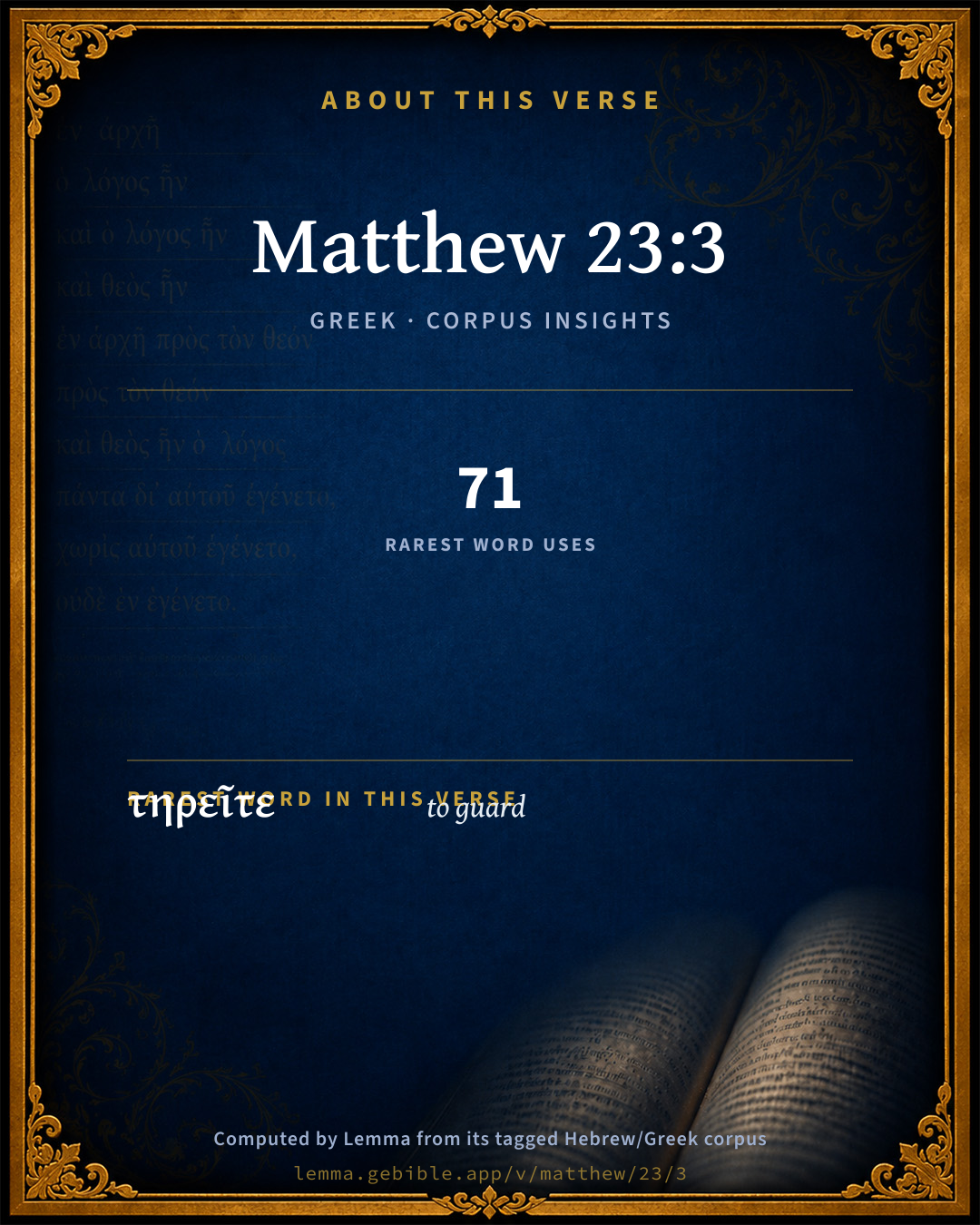
Matthew 23:3

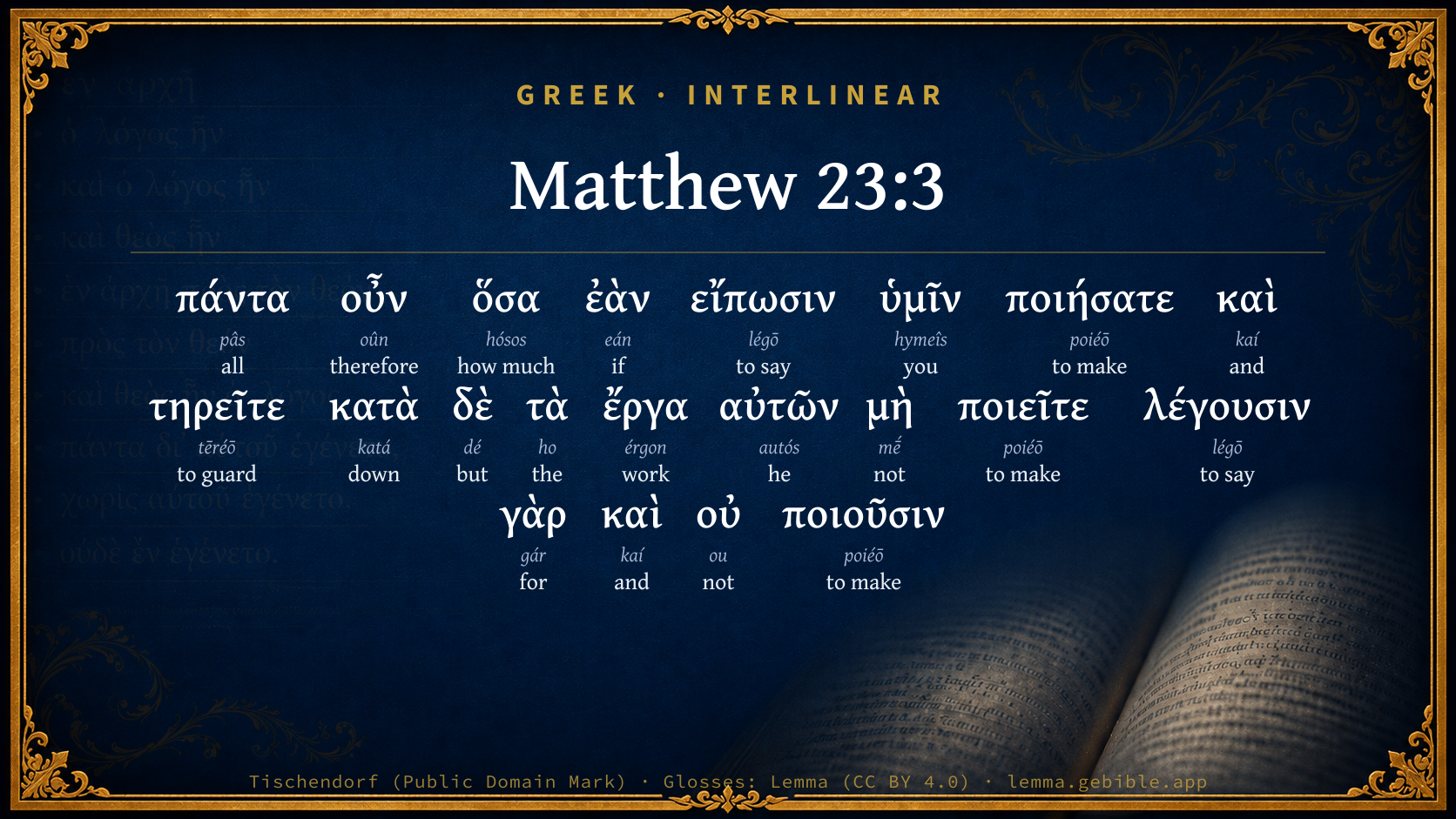
Greek (Tischendorf 8th ed.) Matthew 23:3 appears in the Greek New Testament. The text above is from the Tischendorf 8th edition. Each word links to its Strong’s number and a concise gloss. Click any word for its full Thayer’s Greek Lexicon entry.
Download image
Cite this verse

Matthew 23:3 (World English Bible). Public Domain. Lemma interlinear Bible study tool, https://lemma.gebible.app/v/matthew/23/3.

Show BibTeX & RIS
BibTeX
RIS
English Translation
All things therefore whatever they tell you to observe, observe and do, but don't do their works; for they say, and don't do.
World English Bible · Public Domain
Download a study sheet

One document with this verse’s original text, its word-by-word gloss line, the meaning frame, cross-references with their text, attributed commentary, and full source and license credits — printable, and it pastes into notes with its structure intact.

This verse Autodidact and up

Study sheet (.html) Plain text (.txt)

A passage Seminary Student

Up to 50 verses in one chapter. A passage sheet keeps up to 6 commentary sources and 12 cross-references per verse, in the order this page ranks them, and says so on the sheet whenever that leaves anything out. Ask for a single verse and you get the Autodidact verse sheet above.

Everything on this page stays free to read, with no account — the sheet is a download of what is already on screen, not access to it.

Want to remove ads? Support Godless Engineer
Compare translations 3

The same verse in 3 English versions, stacked beneath the original-language interlinear above. Click any original word for its lexicon entry.

Each is an independent rendering of the whole verse — the interlinear is not word-aligned to these translations.

Highlighted words mark where these versions differ — a whole-verse word diff, not a word-by-word alignment.

  • World English Bible Public Domain
    All things therefore whatever they tell you to observe, observe and do, but don't do their works; for they say, and don't do.
  • King James Version Public Domain
    All therefore whatsoever they bid you observe, that observe and do; but do not ye after their works: for they say, and do not.
  • unfoldingWord Literal Text CC BY-SA 4.0
    Therefore, everything, as much as they say to you, do and keep. But do not do according to their works, for they say and do not do.

unfoldingWord Literal Text — © unfoldingWord, licensed CC BY-SA 4.0. Word-aligned USFM3 via Door43 (git.door43.org/unfoldingWord/en_ult).

Versions to compare (up to 4)

3 of 4 selected

Show all 19 translations

Every available English version of this verse, each an independent rendering of the whole verse.

  • World English Bible Public Domain
    All things therefore whatever they tell you to observe, observe and do, but don't do their works; for they say, and don't do.
  • Berean Standard Bible Public Domain
    So practice and observe everything they tell you. But do not do what they do, for they do not practice what they preach.
  • Majority Standard Bible Public Domain
    So observe and practice everything they tell you to observe. But do not do what they do, for they do not practice what they preach.
  • King James Version Public Domain
    All therefore whatsoever they bid you observe, that observe and do; but do not ye after their works: for they say, and do not.
  • American Standard Version (1901) Public Domain
    all things therefore whatsoever they bid you, `these' do and observe: but do not ye after their works; for they say, and do not.
  • Revised Version (1885) Public Domain
    all things therefore whatsoever they bid you, these do and observe: but do not ye after their works; for they say, and do not.
  • Geneva Bible (1599) Public Domain
    All therefore whatsoeuer they bid you obserue, that obserue and doe: but after their workes doe not: for they say, and doe not.
  • Douay-Rheims (1899) Public Domain
    All things therefore whatsoever they shall say to you, observe and do: but according to their works do ye not; for they say, and do not.
  • Young's Literal Translation Public Domain
    all, then, as much as they may say to you to observe, observe and do, but according to their works do not, for they say, and do not;
  • Literal Standard Version CC BY-SA 4.0
    all, then, as much as they may say to you to observe, observe and do, but according to their works do not do, for they say, and do not do;
  • Unlocked Literal Bible CC BY-SA 4.0
    Therefore whatever they command you to do, do these things and observe them. But do not imitate their deeds, for they say things but then do not do them.
  • unfoldingWord Literal Text CC BY-SA 4.0
    Therefore, everything, as much as they say to you, do and keep. But do not do according to their works, for they say and do not do.
  • Darby Bible Public Domain
    all things therefore, whatever they may tell you, do and keep. But do not after their works, for they say and do not,
  • World Messianic Bible Public Domain
    All things therefore whatever they tell you to observe, observe and do, but don’t do their works; for they say, and don’t do.
  • Webster's Bible Public Domain
    All therefore, whatever they bid you observe, that observe and do: but do not ye according to their works: for they say, and do not.
  • Free Bible Version CC BY-SA 4.0
    so obey them and do everything they tell you. But don't follow what they do, because they don't practice what they preach.
  • Bible in Basic English Public Domain
    All things, then, which they give you orders to do, these do and keep: but do not take their works as your example, for they say and do not.
  • Text-Critical English NT CC BY 4.0
    Therefore observe and do all that they tell you to observe. But do not do what they do, for they say things and do not do them.
  • Tyndale New Testament (1534) Public Domain
    All therfore whatsoever they byd you observe that observe and do: but after their workes do not: For they saye and do not.

Literal Standard Version (2020), Covenant Press — licensed CC BY-SA 4.0. Text via the HelloAO Bible API (eBible.org). Unlocked Literal Bible (unfoldingWord) — licensed CC BY-SA 4.0. Text via the HelloAO Bible API (eBible.org). unfoldingWord Literal Text — © unfoldingWord, licensed CC BY-SA 4.0. Word-aligned USFM3 via Door43 (git.door43.org/unfoldingWord/en_ult). Free Bible Version, Dr. Jonathan Gallagher — licensed CC BY-SA 4.0. Text via the HelloAO Bible API (eBible.org).

Word by word

More ways to search: Search by grammar → Find every occurrence → Compare this word →

Practice this passage: Drill this verse → Learn its vocabulary →

τηρεῖτε
tēréō
G5083
“to guard”
Verb, Present, Active, Imperative, 2nd person, Plural
Part of Speech
Verb
Tense
Present
Voice
Active
Mood
Imperative
Person
2nd person
Number
Plural
Full Thayer's Definition

Origin: from teros (a watch, perhaps akin to G2334 )

TDNT: 10:20,1

1. to attend to carefully, take care of a. to guard b. metaph. to keep, one in the state in which he is c. to observe d. to reserve: to undergo something
  1. πάντα pâs G3956 “all” Adjective, Accusative, Plural, Neuter
  2. οὖν oûn G3767 “therefore” Conjunction
  3. ὅσα hósos G3745 “how much” Correlative pronoun, Accusative, Plural, Neuter
  4. ἐὰν eán G1437 “if” Conditional
  5. εἴπωσιν légō G3004 “to say” Verb, Aorist, Active, Subjunctive, 3rd person, Plural
  6. ὑμῖν hymeîs G5210 “you” Personal pronoun, 2nd person, Dative, Plural
  7. ποιήσατε poiéō G4160 “to make” Verb, Aorist, Active, Imperative, 2nd person, Plural
  8. καὶ kaí G2532 “and” Conjunction
  9. κατὰ katá G2596 “down” Preposition
  10. δὲ dé G1161 “but” Conjunction
  11. τὰ ho G3588 “the” Article, Accusative, Plural, Neuter
  12. ἔργα érgon G2041 “work” Noun, Accusative, Plural, Neuter
  13. αὐτῶν autós G846 “he” Personal pronoun, Genitive, Plural, Masculine
  14. μὴ mḗ G3361 “not” Particle, Negative
  15. ποιεῖτε poiéō G4160 “to make” Verb, Present, Active, Imperative, 2nd person, Plural
  16. λέγουσιν légō G3004 “to say” Verb, Present, Active, Indicative, 3rd person, Plural
  17. γὰρ gár G1063 “for” Conjunction
  18. καὶ kaí G2532 “and” Conjunction
  19. οὐ ou G3756 “not” Particle, Negative
  20. ποιοῦσιν poiéō G4160 “to make” Verb, Present, Active, Indicative, 3rd person, Plural

About this verse

These counts appear in no published source. They are computed here, from the morphology-tagged text and Lemma’s own curated glosses. What Lemma adds →

21
words
17
distinct lemmas
Gospels
section

Repetition

Words recur within this verse:

  • ποιήσατε to make G4160 ×3
  • εἴπωσιν to say G3004 ×2
  • καὶ and G2532 ×2

Cross-references

13

Topical passages linked to Matthew 23:3 in the Treasury of Scripture Knowledge — connected by theme and wording, ordered by reader-vote popularity; previews shown in the World English Bible.

  • 2 Timothy 3:5 holding a form of godliness, but having denied the power thereof. Turn away from these, also.
  • Romans 2:19–24 and are confident that you yourself are a guide of the blind, a light to those who are in darkness,
  • Titus 1:16 They profess that they know God, but by their works they deny him, being abominable, disobedient, and unfit for any good work.
  • Acts 5:29 But Peter and the apostles answered, "We must obey God rather than men.
  • Romans 13:1 Let every soul be in subjection to the higher authorities, for there is no authority except from God, and those who exist are ordained by God.
  • Deuteronomy 17:9–12 and you shall come to the priests the Levites, and to the judge who shall be in those days: and you shall inquire; and they shall show you the sentence of judgment.
  • 2 Chronicles 30:12 Also on Judah came the hand of God to give them one heart, to do the commandment of the king and of the princes by the word of Yahweh.
  • Psalms 50:16–20 But to the wicked God says, "What right do you have to declare my statutes, That you have taken my covenant on your lips,
  • Matthew 21:30 He came to the second, and said the same thing. He answered, 'I go, sir,' but he didn't go.
  • Exodus 18:19–20 Listen now to my voice. I will give you counsel, and God be with you. You represent the people before God, and bring the causes to God.
  • Exodus 18:23 If you will do this thing, and God commands you so, then you will be able to endure, and all of these people also will go to their place in peace."
  • Deuteronomy 4:5 Behold, I have taught you statutes and ordinances, even as Yahweh my God commanded me, that you should do so in the midst of the land where you go in to possess it.
  • Matthew 15:2–9 "Why do your disciples disobey the tradition of the elders? For they don't wash their hands when they eat bread."

Cross-references courtesy of OpenBible.info (CC BY 4.0).

Where the printed editions differ

1 variant

Places in this verse where the major printed Greek editions disagree on the wording in a way that affects the translation — a comparison of editions, not a manuscript-by-manuscript collation. The editions are the modern critical texts (Nestlé-Aland 28/27, SBL, Westcott-Hort, Tregelles, Tyndale House) and the traditional texts behind the KJV (the Textus Receptus and the Byzantine/Majority text). It is not a claim about which reading is original.

  1. Extra text
    τηρεῖν

    “to keep”

    In TRByz Not in NA28NA27TynSBLWHTreg

    τηρεῖν (tērein) 'to keep' is only in traditional manuscripts (TR+Byz)

Textual data: Translators Amalgamated Greek New Testament (STEPBible TAGNT) · CC BY 4.0.

Commentary

Notes on Matthew 23:3 from classic Christian and Jewish commentators (each source and its license shown beneath its notes). The classic Christian expositions comment on the surrounding passage and are grouped to its opening verse, so a note may address several verses; the Jewish commentaries on the Tanakh (Rashi and others) are per-verse, so they appear only where the commentator wrote on this verse.

Lemma curates 59 commentaries, every one of them public domain or Creative Commons licensed, each selected and text-cleaned for this edition rather than reprinted as found. About our sources →

Tyndale Open Study Notes

Tyndale Open Resources

23:3 practice and obey: This was not a blanket endorsement of all that the Pharisees teach (see 15:1-20; 16:5-12; 23:13-39). It might refer only to what was in accord with the law of Moses, or it might be bitter irony or sarcasm. Jesus might also have been counseling conformity to the Pharisees’ teachings to avoid giving offense (17:24-27).

Tyndale Open Study Notes — © Tyndale Open Resources, licensed CC BY-SA 4.0. Text via the HelloAO Bible API.

Bengel's Gnomon

Johann Albrecht Bengel

Mat 23:3. Οὖν, therefore) This particle limits the expression “whatsoever they bid you observe,” so that the people should not think that they were bound to observe the traditions of the Pharisees equally with the law of Moses;[984] see Mat 23:4.—τηρεῖτε, observe) sc. mentally.[985]—ΠΟΙΕῖΤΕ, do) sc. actually. An imperative corresponded with by the other which follows.—λέγουσι, they say) Mosaic commands, which ought to be “observed” and “done.”

[984] i.e., because it implies that their claim to obedience rested on their sitting in Moses’ seat.—(I. B.)—i.e. so far, and only so far, as they really sat in Moses’ seat—viz., taught only what Moses in the written law commands.—ED.

[985] τὰ ἔργα αὐτῶν) Verse 5–7.μὴ ποιεῖτε) Verse 8–12.

Bengel's Gnomon of the New Testament — English translation (T&T Clark, Edinburgh, 1860) — public domain. Text from a community e-Sword module.

Meyer's Critical & Exegetical Commentary

Heinrich August Wilhelm Meyer

Mat_23:3. Οὖν] inasmuch as they speak as teachers and interpreters of the Mosaic law.

πάντα … ὅσα] Limitations of the sense, which lie outside the point of view marked out by the expression Moses seat,as though Jesus had in view only the moral part of the law (Chrysostom), or contemplated merely what had reference to the theocratic polity (Lange), or meant simply to speak comparatively (Bleek),are in opposition to the text, and are of an arbitrary character, all the more so that the multitude was assumed to possess sufficient capacity for judging as to how much of the teaching was binding upon them, and how much was not. The words are addressed to the ὄχλοι, whom Jesus had neither the power nor the wish to release from their obligations in respect to the manifest teachings of the law. But having a regard to the glaring inconsistency between the teaching and the conduct of their pharisaic instructors, and considering His own fundamental principle with regard to the obligatory character of the law, Mat_23:18 f., He could not have spoken otherwise than He did when He inculcated upon the people the duty of complying with the words while refusing to imitate the conduct of those instructors. This utterance was conservative, as befitted the needs of the people, and unsparingly outspoken, as the conduct of the Pharisees deserved; but, in opposition to both Pharisees and people, it guarded the holiness of the law. Observe that He is here speaking of the Pharisees in their special capacity as teachers of the Mosaic law (Augustine, Calvin, Grotius, Bengel), so that His language is at variance neither with Mat_16:6 nor with the axiom given in Mat_15:13; Act_5:29.

ποιήσατε κ. τηρεῖτε (see critical notes): aorist and present: do it, and observe it constantly. See Kühner, II. 1, p. 158 f.

Meyer — Critical and Exegetical Commentary on the New Testament — English translation by Peter Christie, edited by Frederick Crombie (T&T Clark, 1880) — public domain. Text from a community e-Sword module.

Expositor's Greek Testament

ed. W. Robertson Nicoll

Mat 23:3 . εἴπωσιν , say, in the sense of enjoining; no need therefore of τηρεῖν as in T. R. ποιήσατε καὶ τηρεῖτε : The natural order if the previous τηρεῖν be omitted. The diverse tenses are significant, the former pointing to detailed performance, the latter to habitual observance. Christ here recognises the legitimacy of the scribal function of interpretation in a broad way, which may appear too unqualified and incompatible with His teaching at other times (Mat 15:1-20 ) (so Holtz., H. C.). Allowance must be made for Christ’s habit of unqualified statement, especially here when He is going to attack in an uncompromising manner the conduct of the Jewish doctors. He means: as teachers they have their place, but beware of following their example.

The Expositor's Greek Testament, edited by W. Robertson Nicoll (1897–1910) — public domain. Text from a community e-Sword module.

Geneva Bible (1599)

Geneva Bible translators

Provided always, that they deliver Moses his doctrine which they profess, which thing the Metaphor of the seat showeth, which they occupied as teachers of Moses his learning.

Geneva Bible (1599) marginal notes — public domain. Text via Bolls.life.

Jamieson, Fausset & Brown

Robert Jamieson, A. R. Fausset & David Brown

All therefore--that is, all which, as sitting in that seat and teaching out of that law.

they bid you observe, that observe and do--The word "therefore" is thus, it will be seen, of great importance, as limiting those injunctions which He would have them obey to what they fetched from the law itself. In requiring implicit obedience to such injunctions, He would have them to recognize the authority with which they taught over and above the obligations of the law itself--an important principle truly; but He who denounced the traditions of such teachers (Mat 15:3) cannot have meant here to throw His shield over these. It is remarked by WEBSTER and WILKINSON that the warning to beware of the scribes is given by Mark and Luke (Mar 12:38; Luk 20:46) without any qualification: the charge to respect and obey them being reported by Matthew alone, indicating for whom this Gospel was especially written, and the writer's desire to conciliate the Jews.

Jamieson, Fausset & Brown — Commentary Critical and Explanatory on the Whole Bible (1871) — public domain (CC PDM 1.0). Text via the HelloAO Bible API.

Adam Clarke's Commentary

Verse 3. All therefore whatsoever] That is, all those things which they read out of the law and prophets, and all things which they teach consistently with them. This must be our Lord's meaning: he could not have desired them to do every thing, without restriction, which the Jewish doctors taught; because himself warns his disciples against their false teaching, and testifies that they had made the word of God of none effect by their traditions. See Mt 15:6, &c. Besides, as our Lord speaks here in the past tense - whatsoever they HAVE commanded, οσαειπωσιν, he may refer to the teaching of a former period, when they taught the way of God in truth, or were much less corrupted than they were now.

Adam Clarke's Commentary on the Bible (1810–1826) — public domain. Text from a community e-Sword/MySword module.

Ellicott's Commentary for English Readers

(3) All therefore whatsoever . . .—Followed, as the words are, by repeated protests against special and grave errors in the teaching of the Pharisees, it is obvious that they must be received with an implied limitation. So far as they really sit in Moses’ seat, and set forth his teaching—as, e.g., the scribe had done whose answer has been just recorded—they were to be followed with all obedience. That which was wanting was the life, without which even the highest maxims of morality became but the common-places of rhetorical declamation. It was one thing to “draw fine pictures of virtue,” and another to bring thought and word and deed into conformity with them.

A Bible Commentary for English Readers, edited by Charles John Ellicott (1878–1897) — public domain. Text from a community e-Sword module.

John Gill's Exposition

All therefore whatsoever they bid you observe,.... This must be restrained to things that were agreeable to the chair of Moses, in which they sat, to the law of Moses, which they read and explained, to other parts of Scripture and truth in general; for otherwise many of their glosses and traditions were repugnant to the law, and ought not to be observed, as appears from Mat 5:1. The word "observe", in this clause, is omitted by the Vulgate Latin, Arabic, and Ethiopic versions, and in Munster's Hebrew Gospel; and Beza says, it is wanting in one ancient copy, but is in others; and is retained in the Syriac and Persic versions

that observe and do; hearken to what they say, give diligent heed unto it, take notice of it, and act according to it:

but do not ye after their works; let their doctrine be the rule of your lives, so far as it agrees with the law of Moses; but let not their actions be drawn into an example by you; conform to their instructions, but do not imitate their practices:

for they say, and do not; they talk of good works, but do none; they bid others do them, but do not practise them themselves; they very strictly and severely enjoin them on others, but are very careless themselves to observe them; and of this the Jews are so conscious, that they suggest the same doctrine (n).

"The daughter of Ahar (a wicked man) came before Rabbi; she said to him, Rabbi, supply me with the necessaries of life: he replied to her, daughter, who art thou? she answered him, the daughter of Ahar: he said to her, is there any of his seed in the world? for lo! it is written, Job 18:19. "He shall neither have son, nor nephew, among his people, nor any remaining, in his dwellings": she replied to him, , "remember his law, or doctrine, but do not remember his works."--Says R. Jochanan, what is that which is written, Mal 2:7. "For the priest's lips should keep knowledge, and they should seek the law at his mouth; for he is the messenger of the Lord of hosts." If the doctor is like to an angel, or messenger of the Lord of hosts, they should seek the law at his mouth; and if not, they should not seek the law at his mouth. Says Resh Lekish, R. Meir found and explained that Scripture, Pro 22:17. "Bow down thine ear, and hear the words of the wise, and apply thine heart to my knowledge": to their knowledge it is not said, but to my knowledge. R. Chanina says, hence, Psa 45:10. "Hearken, O daughter! and consider, incline thine ear, forget thine own people, and thy father's house": on which the gloss is, forget their works, and do not learn them: he that knows how to take care not to learn their works, may learn the law from their mouths.''

--And a little after,

"the disciples of the wise men are like to a nut; as a nut, though it is defiled with mire and filth, yet that which is within it is not to be rejected; so a scholar, or a disciple of a wise man, though he act wickedly, his law, or doctrine, is not to be despised.''

Good doctrine is not the worse for being taught by bad men; nor are good works to be slighted and neglected, because they are not done by all that teach them; but it must be owned that examples are very useful and forcible, and practice greatly recommends doctrine; and it is to be wished, that they both always went together.

(n) T. Bab. Chagiga, fol. 15. 2.

John Gill's Exposition of the Whole Bible (1746–1763) — public domain (CC PDM 1.0). Text via the HelloAO Bible API.

Trapp's Complete Commentary

John Trapp

3 All therefore whatsoever they bid you observe, that observe and do; but do not ye after their works: for they say, and do not.

Ver. 3. All therefore whatsoever] Not their traditions, superstitions, and corrupt glosses upon the law, but whatsoever they teach that is agreeable to truth; so long as they sit close to Moses’ chair, and keep it warm, as it were, hearken to them. God’s good gifts are to be acknowledged and improved even in the worst, as David made Saul’s epitaph, 2Sa 1:19-27, though the devil preached his funeral, 1Sa 28:19.

But do not ye after their works] Saith Chrysostom, Si pastores bene vivunt, eorum lucrum est, si bene dicunt, tuum. Accipe quod tuum est, omitte alienum. If ministers do well, it is their own gain; if they say well, it is thine. Take thou what thine own is, and let alone what is another man’s. Sulla and King Richard III commanded others, under great penalties, to be virtuous and modest, when themselves walked the clean contrary way. A deformed painter may draw a goodly picture; a stinking breath sound a mighty blast; and he that hath but a bad voice, show cunning in descant. A blind man may bear a torch in a dark night, and a harp make music to others, which itself is not sensible of. Posts set for direction of passengers by the highway side do point out the way which themselves go not: and sign posts tell the traveller there is wholesome diet or warm lodging within, when themselves remain in the storms without. Leud preachers are like steeple spires, or high pinnacles, which point up to heaven, but press down to the centre.

For they say, and do not] They had tongues which spake by the talent, but their hands scarcely wrought by the ounce; like that ridiculous actor at Smyrna, who pronouncing O coelum, O heaven, pointed with his finger toward the ground: {a} so these Pharisees had the heaven commonly at their tongues’ end, but the earth continually at their fingers’ end. In a certain battle against the Turks, there was a bishop that thus encouraged the army: Play the men, fellow soldiers, today: and I dare promise you, that if ye die fighting, ye shall sup tonight with God in heaven. Now after the battle was begun the bishop withdrew himself; and when some of the soldiers inquired among themselves what was become of the bishop, and why he would not take a supper with them that night in heaven, others answered, Hodie sibi ieiunium indixit, ideoque non vult nobiscum in coelo caenare. This is fasting day with him, and therefore he will eat no supper, no, not in heaven. Epictetus was wont to say that there were many philosophers (we may say divines) ανευ του πραττειν, μεχοι του λεγειν, as far as a few words would go. But ω τλημων, αρετη λογος αρ ησθα, &c., is religion now become a word? goodness a name? as Brutus once cried out. Should it be said of holiness, as it was once in another place, audivimus famam; we have heard the fame thereof with our ears, and that is all? Job 28:22. The foolish virgins were found with their sic dicentes, so talking but the good servants shall be found with their sic facientes, so doing. Christ was full of grace as well as truth. John Baptist was both a burning and shining light. Origen’s teaching and living were said to be both one. {b} That is the best sermon surely, that is dug out of a man’s own breast, when he practiseth what he preacheth, non verbis solum praedicans sed exemplis, not by words only by by example, as Eusebius testifieth of Origen, and Mr Gataker of Mr Stock. As the want hereof occasioned Campian to write ministris eorum nihil vilius, their ministers are most base.

{a} Of this actor, Polemo, chaffing, said, ουτος τη χειρι σολοικεζει.

{b} Spectemur agendo. Joh 1:16. Και εδειξε και εδιδαξε. Basil. Quod iussit et gessit. Bern. Eph 41.

John Trapp, A Commentary or Exposition upon All the Books of the Old and New Testament (1647–1656) — public domain. Text from a community e-Sword module.

Albert Barnes' Notes on the Bible

All, therefore, whatsoever ... - That is, all that they teach that is consistent with the Law of Moses - all the commands of Moses which they read to you and properly explain. The word “all” could not be taken without such a restriction, for Christ himself accuses them of teaching many things contrary to that law, and of making it void by their traditions, Mat 15:1-6.

They say, and do not - The interpretation which they give to the law is in the main correct, but their lives do not correspond with their teaching. It is not the duty of people to imitate their teachers unless their lives are pure; they are to obey the law of God, and not to frame their lives by the example of evil people.

Albert Barnes' Notes on the Bible (1834–1885) — public domain. Text from a community e-Sword/MySword module.

Haydock's Catholic Bible Commentary

All therefore whatsoever they shall say. St. Augustine, in his defence of the Apostolic See, thus argues, contra lit. Petil. "Why dost thou call the apostolic chair the chair of pestilence? If, for the men that sit therein, I ask: did our Lord Jesus Christ, on account of the Pharisees, reflect upon the chair, wherein they sat? Did he not commend that chair of Moses, and, preserving the honour of the chair, reprove them? For he sayeth: they have sat on the chair of Moses. All therefore whatsoever they shall say to you, observe and do. These points if you did well consider, you would not, for the men whom you defame, blaspheme the Apostolic See, wherewith you do not hold communion." (lib. ii. chap. 51) And again, chap. 61 Ibid. "Neither on account of the Pharisees, to whom you maliciously compare us, did our Lord command the chair of Moses to be forsaken; (in which chair he verily figured his own) for he warned the people to do what they say, and not what they do, and that the holiness of the chair be in no case forsaken, nor the unity of the flock divided, on account of the wicked lives of the pastors." --- Christ does not tell them to observe every thing, without exception, that the Pharisees should say to them; for, (as it was observed in a previous chapter) many superstitions and false ordinances had obtained amongst them, corrupting the Scriptures by their traditions; but only such as were not contrary to the law of Moses. We are taught to obey bad no less than good ministers, in those things that are not expressly contrary to the law of God. Hence appears how unfounded and unreasonable is the excuse so often adduced by persons in justification of their misdeeds, viz. that they saw their pastors do the same. Such must attend to the rule here given by Jesus Christ. What they say, do: but according to their works, do ye not. (Denis the Carthusian) --- The words, all whatsoever, shew that nothing must be excepted, but what the supreme law orders to be excepted. (Estius)

George Leo Haydock (1774–1849), Haydock's Catholic Family Bible and Commentary, 1859 edition — public domain. Excludes Psalms (Douay-Rheims chapter numbering differs from Protestant) and Deuterocanonical books (Catholic canon only).

Whedon's Commentary on the Bible

Daniel D. Whedon

3. Bid you observe — Not certainly the traditions of men; for those he has most unsparingly condemned. Mat_15:3. But whensoever truly sitting in Moses’ seat and truly delivering, in their own or Moses’ words, the law, that do. Meanwhile the copy of the law is ever in your reach, as your check upon them. Do not err by not knowing the Scriptures.

No argument can be drawn from this entire passage in favour of apostolic succession, of submission of the people to wicked pastors, or of the closing of the Bible to popular perusal.

Daniel D. Whedon (gen. ed.), Commentary on the Old and New Testaments (1874–1909) — public domain. Text from a community e-Sword module.

The Pulpit Commentary

All therefore. It is because of their official authority as appointed teachers and expositors of the Law that Christ gives the following injunction. That observe and do. Many manuscripts and versions invert the order of the verbs, reading, do and observe. The received text seems most logical. Observe; threite , present imperative, continue to observe as a rule of conduct. Do; poihsate , aorist, do immediately, whenever the occasion arises. All that they taught or commanded out of the Law, or in due accordance therewith, was to be observed and obeyed. The statement is made in general terms, but was conditional and restricted by other considerations. It was only their official injunctions, derived immediately from Scripture, not their glosses, evasions, and interpretations, that were to be regarded with respect. The Lord had already taken occasion to warn against these errors. (see Mat_16:6, Mat_16:11, Mat_16:12, etc.) As inheritors of the authority of Moses, and speaking ex cathedra, they were so far worthy of respect. This principle laid down, Christ proceeds to denounce their evil practices. After their works. You must distinguish between their preaching and their practice; the latter is to be shunned with all care. The scribes are never accused of corrupting the sacred text, which, indeed, was scrupulously guarded, and kept pure and unaltered. It was their treatment of the doctrines thereof that was censured. Our Lord shows their evil example in two particulars their principle was "words, not deeds" (ver. 4), and ostentation in religion (vers. 5-7). They say, and do not. They enunciated the Law, they enjoined obedience to it in the minutest particulars, and yet they themselves continually, in the most important points (ver. 23), infringed, neglected, evaded it. St. Paul, himself a strict Pharisee, denounces in stern language such inconsistent professors. (Rom_2:21-23)

HOMILIES BY R. TUCK Ver. 3. The sin of inconsistency.

"For they say, and do not." To our Lord the supreme offence was contradiction between saying and doing, appearance and fact, outside and inside, show and reality. A man who is himself consciously sincere is always keen to detect, quick to revolt against, insincerity in others. But if inconsistency is mischievous in any man, it is doubly mischievous in religious teachers, and in persons occupying prominent positions of influence. Probably the reference of our Lord to "scribes and Pharisees" is intended to limit his denunciation to particular classes of Pharisees those who were learned in the Law, and professed to teach the Law. It really means "those Pharisees who were also scribes." And when Jesus adds the word "hypocrites," he really limits his denunciation to such as were hypocrites.

I INCONSISTENCY IS THE PERIL OF OFFICIALS. Whatever is done regularly as a duty is in danger of being done perfunctorily. The heart may go with the act at first, but the constancy and the outwardness soon involve the failing of heart interest, and presently the heart is occupied with one thing and the hands with another; and even the desire for harmony between the interests of heart and hand can easily be lost. This is the common peril of all officials priests, clergy, statesmen, teachers, secretaries; and the peril is never so great as in cases of religion. Cases of open inconsistency may happily be infrequent in the Christian ministry, but the fear of inconsistency should always be present to the mind of those who hold office, and make them watchful and zealous concerning their own integrity. A teacher never has his true power unless heart and hand go well together.

II INCONSISTENCY IS THE PERIL OF DISCIPLES. Our Lord was anxious concerning the influence of the model teachers of his day on the men who were to teach his truth after he ascended. So his words are intended to be a solemn warning to them. What scribes said was more worthy and more important than what they did. What our Lord"s disciples were and did was always much more important than what they said. To do Christ"s work in the world, our words must always precisely utter our hearts. But show the danger of overstating religious feeling and experience, and so weakening our force by the suggestion of inconsistency.

III INCONSISTENCY IS THE PERIL OF THE PEOPLE. For if they see it in their teachers, they readily take up the idea that it is permissible in themselves, and so Christ"s truth is dishonoured and his service misconceived. R.T.

The Pulpit Commentary (1880–1919), ed. H.D.M. Spence-Jones & Joseph S. Exell — public domain. Text from a community e-Sword module.

John Wesley's Explanatory Notes

All things therefore - Which they read out of the law, and enforce therefrom.

John Wesley, Explanatory Notes Upon the Whole Bible (1754–1765) — public domain. Text via the GEBible commentary corpus.

The People's New Testament

B. W. Johnson

3. Whatsoever they bid you, that observe and do. While in Moses' seat, presenting the law of Moses. He has elsewhere taught that the traditions they added were to be rejected (Matt. chap. 15). Do not after their works. Do not follow their examples. The law of Moses was still in force, for the Christian dispensation was not ushered in until Christ died, and hence was still to be obeyed, but the wicked example of its teachers was to be rejected.

B. W. Johnson's The People's New Testament with Notes (1889–1891) — public domain. Electronic text from the Christian Classics Ethereal Library (CCEL) ThML edition.

Cambridge Greek Testament for Schools and Colleges

3. τηρεῖν, omitted after εἴπωσιν ὑμῖν.

ποιήσατε καὶ τηρεῖτε for τηρεῖτε καὶ ποιεῖτε.

3. ποιήσατε. ‘Do the special act enjoined.’ τηρεῖτε, ‘continue to observe.’

Cambridge Greek Testament for Schools and Colleges (Cambridge University Press, 1896; 21 vols, various authors incl. Carr, Maclear, Plummer, Farrar, Lumby, Moule, M. R. James, Simcox) — public domain. Text from a community e-Sword module.

Alford’s Greek Testament

Henry Alford

3. πάντα οὖν ὅσα ἄν] The οὖν here is very significant:—because they sit on Moses’ seat: and this clears the meaning, and shews it to be, ‘all things which they, as successors of Moses, out of his law, command you to observe, do;’ there being a distinction between their lawful teaching as expounders of the law, and their frivolous traditions superadded thereto, and blamed below.

ποιήσατε, do, as occasion arises. τηρεῖτε, observe, having respect to them as a constant rule of conduct. The present binds on the habitual practice to the mere momentary act of the aorist.

Henry Alford, The Greek Testament (1849–1861) — public domain. Text from a community e-Sword module.

International Critical Commentary

3. All things therefore whatsoever they say to you, do and observe.] The words are difficult in view of the criticism of the regulations of the traditional law in 15:1-20; cf. esp. 15:6. We must suppose that a limitation is to be inferred from “sit in Moses’ seat.” Do all things that they teach, in so far as this is in harmony with the spirit of the Mosaic law. The comprehensiveness of the saying reminds us of 5:18.—But do not according to their works: for they say, and do not.] This can hardly mean that the Pharisees did not themselves endeavour to conform to the regulations of the traditional law. The λέγουσιν implies that the whole Pharisaic system was professedly an endeavour to fulfil the commands of God expressed in the Old Testament, and to live up to the moral standard there revealed. By οὐ ποιοῦσι is meant that in practice their system tended to miss the real righteousness of the Old Testament, and to overlook its true principles, love, mercy, truth, etc. Cf. 12:7. They professed regard for the Old Testament, but neglected the mercy which it taught; 15:4, 5 they so explained away the divine command of filial duty as to sanction the direct contrary; 23:23 they paid great attention to minuter regulations of the law, but neglected the great underlying moral principles.

(L)

International Critical Commentary — older volumes (1896–1929), various authors — public domain. Text from a community e-Sword module.

Lesson kit

Teaching starters — assembled from the data on this page, not authored interpretation. Every prompt links to the verse data it draws on. Edit before teaching.

Matthew, in the Gospels, opens this verse with 21 words (17 distinct Greek lemmas). Its most distinctive word is tēréō (“to guard”). A historical commentator’s framing appears above. Read the whole chapter for the surrounding context.

Discussion questions

  1. The word tēréō carries the sense “to guard.” How does it shape the verse?
  2. 2 Timothy 3:5 shares this passage’s theme. How do the two illuminate each other?
  3. “to make” occurs 3× in this one verse. What is the effect of the repetition?
  4. The translations on this page render this verse differently — a whole-verse word diff, not a word-by-word alignment. What might account for the different wordings?
  5. Reading how Tyndale Open Study Notes and Bengel's Gnomon read this verse, where do the two commentators agree and where do they part?

Things to notice

Reading settings

Reading text

Shown beneath each verse's original-language words.

Old Testament
Old Testament edition

Read the OT as the Masoretic Hebrew (MT) or the Greek Septuagint (LXX).

English shown for the Greek Septuagint (in the Hebrew ↔ Greek comparison).

Comparing translations? Open the Compare panel on any verse page to stack up to four side by side.