

Mark 4:17
Greek (Tischendorf 8th ed.) Mark 4:17 appears in the Greek New Testament. The text above is from the Tischendorf 8th edition. Each word links to its Strong’s number and a concise gloss. Click any word for its full Thayer’s Greek Lexicon entry.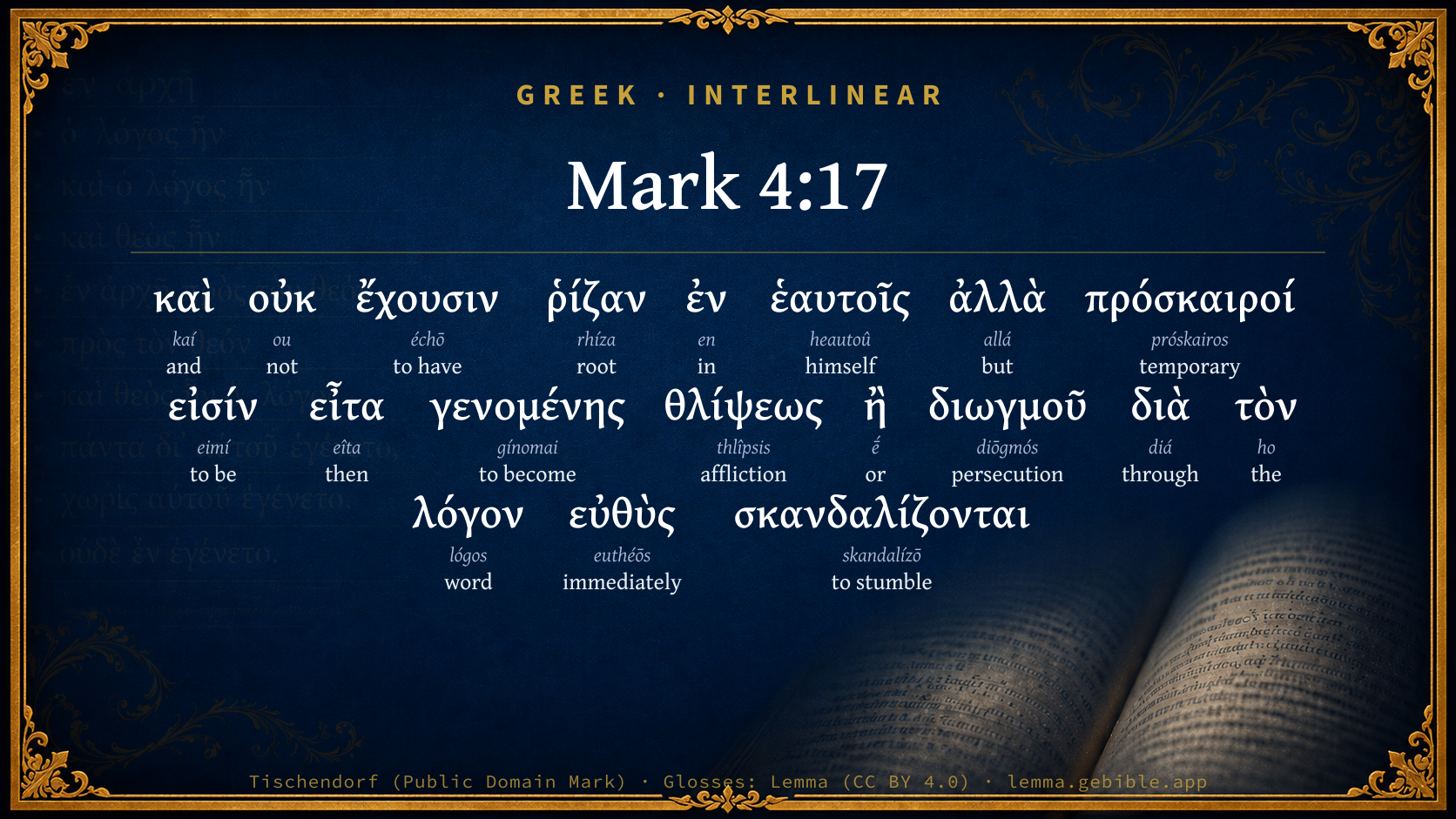
They have no root in themselves, but are short-lived. When oppression or persecution arises because of the word, immediately they stumble.
Download a study sheet
One document with this verse’s original text, its word-by-word gloss line, the meaning frame, cross-references with their text, attributed commentary, and full source and license credits — printable, and it pastes into notes with its structure intact.
This verse Autodidact and up
A passage Seminary Student
Up to 50 verses in one chapter. A passage sheet keeps up to 6 commentary sources and 12 cross-references per verse, in the order this page ranks them, and says so on the sheet whenever that leaves anything out. Ask for a single verse and you get the Autodidact verse sheet above.
Everything on this page stays free to read, with no account — the sheet is a download of what is already on screen, not access to it.
Compare translations 3
The same verse in 3 English versions, stacked beneath the original-language interlinear above. Click any original word for its lexicon entry.
Each is an independent rendering of the whole verse — the interlinear is not word-aligned to these translations.
Highlighted words mark where these versions differ — a whole-verse word diff, not a word-by-word alignment.
-
World English Bible Public Domain
They have no root in themselves, but are short-lived. When oppression or persecution arises because of the word, immediately they stumble.
-
King James Version Public Domain
And have no root in themselves, and so endure but for a time: afterward, when affliction or persecution ariseth for the word's sake, immediately they are offended.
-
unfoldingWord Literal Text CC BY-SA 4.0
and they have no root in themselves, but are temporary. Then, tribulation or persecution having happened because of the word, immediately they are caused to stumble.
unfoldingWord Literal Text — © unfoldingWord, licensed CC BY-SA 4.0. Word-aligned USFM3 via Door43 (git.door43.org/unfoldingWord/en_ult).
Show all 19 translations
Every available English version of this verse, each an independent rendering of the whole verse.
-
World English Bible Public Domain
They have no root in themselves, but are short-lived. When oppression or persecution arises because of the word, immediately they stumble.
-
Berean Standard Bible Public Domain
But they themselves have no root, and they remain for only a season. When trouble or persecution comes because of the word, they quickly fall away.
-
Majority Standard Bible Public Domain
But they themselves have no root, and they remain for only a season. When trouble or persecution comes because of the word, they quickly fall away.
-
King James Version Public Domain
And have no root in themselves, and so endure but for a time: afterward, when affliction or persecution ariseth for the word's sake, immediately they are offended.
-
American Standard Version (1901) Public Domain
and they have no root in themselves, but endure for a while; then, when tribulation or persecution ariseth because of the word, straightway they stumble.
-
Revised Version (1885) Public Domain
and they have no root in themselves, but endure for a while; then, when tribulation or persecution ariseth because of the word, straightway they stumble.
-
Geneva Bible (1599) Public Domain
Yet haue they no roote in themselues, and endure but a time: for when trouble and persecution ariseth for the worde, immediatly they be offended.
-
Douay-Rheims (1899) Public Domain
And they have no root in themselves, but are only for a time: and then when tribulation and persecution ariseth for the word they are presently scandalized.
-
Young's Literal Translation Public Domain
and have not root in themselves, but are temporary; afterward tribulation or persecution having come because of the word, immediately they are stumbled.
-
Literal Standard Version CC BY-SA 4.0
and have no root in themselves, but are temporary; afterward tribulation or persecution having come because of the word, immediately they are stumbled.
-
Unlocked Literal Bible CC BY-SA 4.0
They have no root in themselves, but endure for a short time. Then tribulation or persecution comes because of the word, and immediately they stumble.
-
unfoldingWord Literal Text CC BY-SA 4.0
and they have no root in themselves, but are temporary. Then, tribulation or persecution having happened because of the word, immediately they are caused to stumble.
-
Darby Bible Public Domain
and they have no root in themselves, but are for a time: then, tribulation arising, or persecution on account of the word, immediately they are offended.
-
World Messianic Bible Public Domain
They have no root in themselves, but are short-lived. When oppression or persecution arises because of the word, immediately they stumble.
-
Webster's Bible Public Domain
And have no root in themselves, and so endure but for a time: afterward, when affliction or persecution ariseth for the word's sake, immediately they relapse.
-
Free Bible Version CC BY-SA 4.0
But since they have no real roots, they only last for a while until trouble or persecution comes, and then they quickly fall away.
-
Bible in Basic English Public Domain
And they have no root in themselves, but go on for a time; then, when trouble comes or pain, because of the word, they quickly become full of doubts.
-
Text-Critical English NT CC BY 4.0
Yet they have no root in themselves, but are only temporary. When tribulation or persecution arises on account of the word, they immediately fall away.
-
Tyndale New Testament (1534) Public Domain
yet have no rotes in them selves and so endure but a tyme: and anone as trouble and persecucion aryseth for the wordes sake they fall immediatly.
Literal Standard Version (2020), Covenant Press — licensed CC BY-SA 4.0. Text via the HelloAO Bible API (eBible.org). Unlocked Literal Bible (unfoldingWord) — licensed CC BY-SA 4.0. Text via the HelloAO Bible API (eBible.org). unfoldingWord Literal Text — © unfoldingWord, licensed CC BY-SA 4.0. Word-aligned USFM3 via Door43 (git.door43.org/unfoldingWord/en_ult). Free Bible Version, Dr. Jonathan Gallagher — licensed CC BY-SA 4.0. Text via the HelloAO Bible API (eBible.org).
Word by word
More ways to search: Search by grammar → Find every occurrence → Compare this word →
Practice this passage: Drill this verse → Learn its vocabulary →
- Appears 4× in the Greek New Testament
- First appears at Matthew 13:21
- Part of Speech
- Adjective
- Case
- Nominative
- Number
- Plural
- Gender
- Masculine
Full Thayer's Definition
- καὶ kaí G2532 “and” Conjunction
- οὐκ ou G3756 “not” Particle, Negative
- ἔχουσιν échō G2192 “to have” Verb, Present, Active, Indicative, 3rd person, Plural
- ῥίζαν rhíza G4491 “root” Noun, Accusative, Singular, Feminine
- ἐν en G1722 “in” Preposition
- ἑαυτοῖς heautoû G1438 “himself” Reflexive pronoun, 3rd person, Dative, Plural, Masculine
- ἀλλὰ allá G235 “but” Conjunction
- πρόσκαιροί próskairos G4340 “temporary” Adjective, Nominative, Plural, Masculine
- εἰσίν eimí G1510 “to be” Verb, Present, Active, Indicative, 3rd person, Plural
- εἶτα eîta G1534 “then” Adverb
- γενομένης gínomai G1096 “to become” Verb, Aorist, Middle deponent, Participle, Genitive, Singular, Feminine
- θλίψεως thlîpsis G2347 “affliction” Noun, Genitive, Singular, Feminine
- ἢ ḗ G2228 “or” Particle
- διωγμοῦ diōgmós G1375 “persecution” Noun, Genitive, Singular, Masculine
- διὰ diá G1223 “through” Preposition
- τὸν ho G3588 “the” Article, Accusative, Singular, Masculine
- λόγον lógos G3056 “word” Noun, Accusative, Singular, Masculine
- εὐθὺς euthéōs G2112 “immediately” Adverb
- σκανδαλίζονται skandalízō G4624 “to stumble” Verb, Present, Passive, Indicative, 3rd person, Plural
About this verse
These counts appear in no published source. They are computed here, from the morphology-tagged text and Lemma’s own curated glosses. What Lemma adds →
- 19
- words
- 19
- distinct lemmas
- Gospels
- section
Notable vocabulary
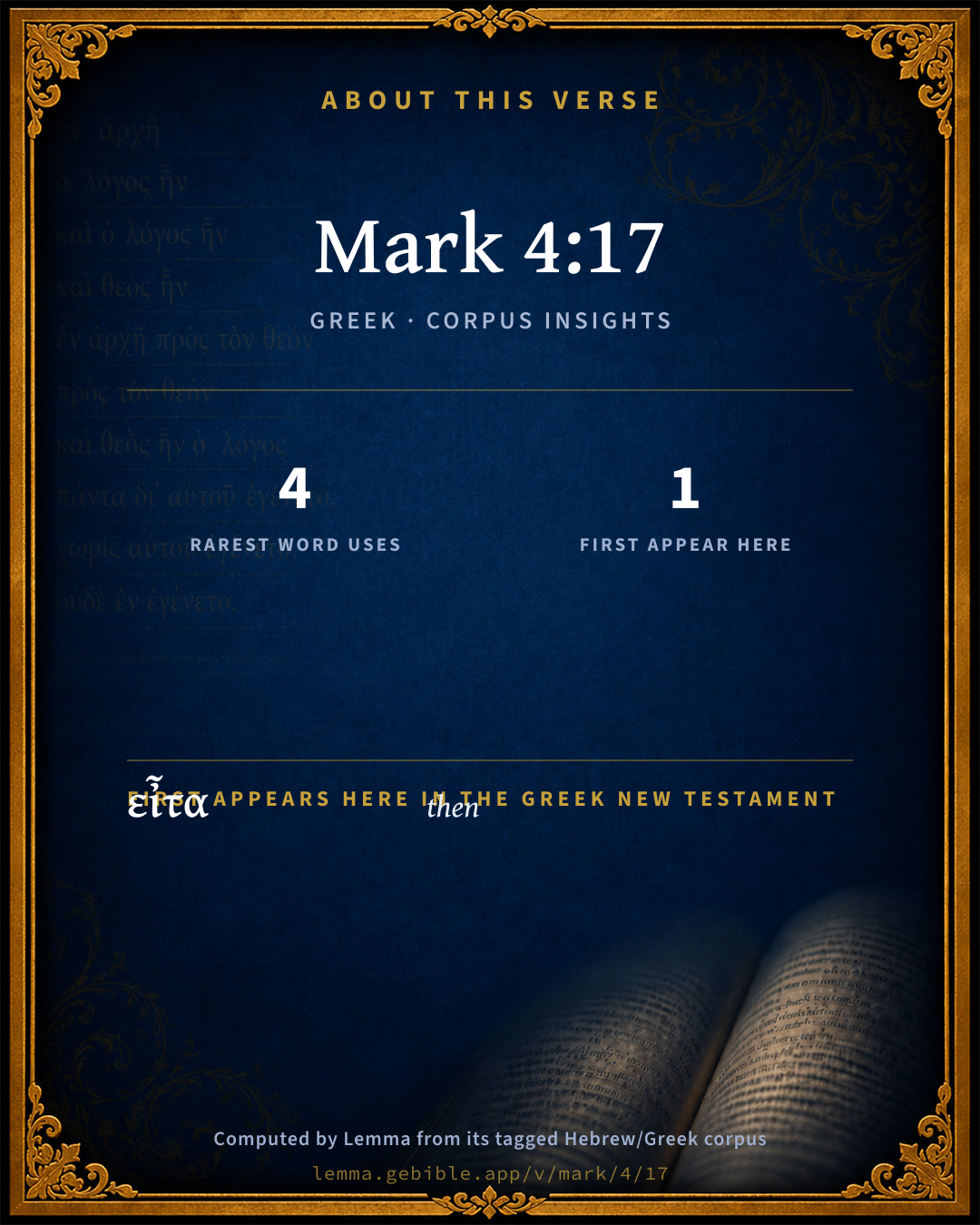
The rarest word here is πρόσκαιροί temporary G4340 — appearing just 4 times in the whole Greek New Testament.
First appearance in Scripture
This word makes its first canonical appearance in the Greek New Testament here:
- εἶτα then G1534
Shared distinctive vocabulary
πρόσκαιροί temporary G4340 occurs in 4 verses of the Greek New Testament. Also found in:
Cross-references
21Topical passages linked to Mark 4:17 in the Treasury of Scripture Knowledge — connected by theme and wording, ordered by reader-vote popularity; previews shown in the World English Bible.
- Matthew 11:6 Blessed is he who finds no occasion for stumbling in me."
- 1 Thessalonians 3:3–5 that no one be moved by these afflictions. For you know that we are appointed to this task.
- Matthew 12:31 Therefore I tell you, every sin and blasphemy will be forgiven men, but the blasphemy against the Spirit will not be forgiven men.
- John 15:2–7 Every branch in me that doesn't bear fruit, he takes away. Every branch that bears fruit, he prunes, that it may bear more fruit.
- Revelation 2:10 Don't be afraid of the things which you are about to suffer. Behold, the devil is about to throw some of you into prison, that you may be tested; and you will have oppression for ten days. Be faithful to death, and I will give you the crown of life.
- Job 19:28 If you say, 'How we will persecute him!' Because the root of the matter is found in me,
- Job 27:8–10 For what is the hope of the godless, when he is cut off, When God takes away his life?
- Matthew 13:21 yet he has no root in himself, but endures for a while. When oppression or persecution arises because of the word, immediately he stumbles.
- Matthew 24:9–10 Then they will deliver you up to oppression, and will kill you. You will be hated by all of the nations for my name's sake.
- Mark 4:5–6 Others fell on the rocky ground, where it had little soil, and immediately it sprang up, because it had no depth of soil.
- Luke 12:10 Everyone who speaks a word against the Son of Man will be forgiven, but those who blaspheme against the Holy Spirit will not be forgiven.
- John 8:31 Jesus therefore said to those Jews who had believed him, "If you remain in my word, then you are truly my disciples.
- 1 Corinthians 10:12–13 Therefore let him who thinks he stands be careful that he doesn't fall.
- 2 Timothy 1:15 This you know, that all who are in Asia turned away from me; of whom are Phygelus and Hermogenes.
- 2 Timothy 2:17–18 and their word will consume like gangrene, of whom is Hymenaeus and Philetus;
- 2 Timothy 4:16 At my first defense, no one came to help me, but all left me. May it not be held against them.
- Hebrews 10:29 How much worse punishment, do you think, will he be judged worthy of, who has trodden under foot the Son of God, and has counted the blood of the covenant with which he was sanctified an unholy thing, and has insulted the Spirit of grace?
- 1 John 2:19 They went out from us, but they didn't belong to us; for if they had belonged to us, they would have continued with us. But they left, that they might be revealed that none of them belong to us.
- Revelation 2:13 "I know your works and where you dwell, where Satan's throne is. You hold firmly to my name, and didn't deny my faith in the days of Antipas my witness, my faithful one, who was killed among you, where Satan dwells.
- Galatians 6:12 As many as desire to look good in the flesh, they compel you to be circumcised; only that they may not be persecuted for the cross of Christ.
- 2 Timothy 4:10 for Demas left me, having loved this present world, and went to Thessalonica; Crescens to Galatia, and Titus to Dalmatia.
Cross-references courtesy of OpenBible.info (CC BY 4.0).
Lesson kit
Teaching starters — assembled from the data on this page, not authored interpretation. Every prompt links to the verse data it draws on. Edit before teaching.
Mark, in the Gospels, opens this verse with 19 words (19 distinct Greek lemmas). Its most distinctive word is próskairos (“temporary”). A historical commentator’s framing appears above. Read the whole chapter for the surrounding context.
Discussion questions
- The word próskairos carries the sense “temporary.” How does it shape the verse?
- This is the first place “then” appears in Scripture (first appears here). What does its debut here establish?
- How does Matthew 13:21, which shares the word «temporary», read alongside this verse?
- These translations render this verse differently. What is at stake in choosing one wording over another?
- Compare how The Cambridge Bible for Schools and Colleges and John Gill's Exposition read this verse. Where do they agree or differ?
Things to notice
- 1 word makes its first canonical appearance in Scripture here.
- These translations choose different wording for 20 words in this verse.
- 19 distinct Greek lemmas span 19 words in this verse.
Commentary
Notes on Mark 4:17 from classic Christian and Jewish commentators (each source and its license shown beneath its notes). The classic Christian expositions comment on the surrounding passage and are grouped to its opening verse, so a note may address several verses; the Jewish commentaries on the Tanakh (Rashi and others) are per-verse, so they appear only where the commentator wrote on this verse.
Lemma curates 59 commentaries, every one of them public domain or Creative Commons licensed, each selected and text-cleaned for this edition rather than reprinted as found. About our sources →
The Cambridge Bible for Schools and Colleges
gen. ed. J. J. S. Perowne
The Cambridge Bible for Schools and Colleges (gen. ed. J. J. S. Perowne; Cambridge University Press, 1878–1918) — public domain. Text from a community e-Sword module.
John Gill's Exposition
John Gill's Exposition of the Whole Bible (1746–1763) — public domain (CC PDM 1.0). Text via the HelloAO Bible API.
Trapp's Complete Commentary
John Trapp
John Trapp, A Commentary or Exposition upon All the Books of the Old and New Testament (1647–1656) — public domain. Text from a community e-Sword module.
Cambridge Greek Testament for Schools and Colleges
Cambridge Greek Testament for Schools and Colleges (Cambridge University Press, 1896; 21 vols, various authors incl. Carr, Maclear, Plummer, Farrar, Lumby, Moule, M. R. James, Simcox) — public domain. Text from a community e-Sword module.
International Critical Commentary
International Critical Commentary — older volumes (1896–1929), various authors — public domain. Text from a community e-Sword module.