Matthew 24:44

Greek (Tischendorf 8th ed.) Matthew 24:44 appears in the Greek New Testament. The text above is from the Tischendorf 8th edition. Each word links to its Strong’s number and a concise gloss. Click any word for its full Thayer’s Greek Lexicon entry.
Download image
Cite this verse

Matthew 24:44 (World English Bible). Public Domain. Lemma interlinear Bible study tool, https://lemma.gebible.app/v/matthew/24/44.

Show BibTeX & RIS
BibTeX
RIS
English Translation
Therefore also be ready, for in an hour that you don't expect, the Son of Man will come.
World English Bible · Public Domain
Download a study sheet

One document with this verse’s original text, its word-by-word gloss line, the meaning frame, cross-references with their text, attributed commentary, and full source and license credits — printable, and it pastes into notes with its structure intact.

This verse Autodidact and up

Study sheet (.html) Plain text (.txt)

A passage Seminary Student

Up to 50 verses in one chapter. A passage sheet keeps up to 6 commentary sources and 12 cross-references per verse, in the order this page ranks them, and says so on the sheet whenever that leaves anything out. Ask for a single verse and you get the Autodidact verse sheet above.

Everything on this page stays free to read, with no account — the sheet is a download of what is already on screen, not access to it.

Want to remove ads? Support Godless Engineer
Compare translations 3

The same verse in 3 English versions, stacked beneath the original-language interlinear above. Click any original word for its lexicon entry.

Each is an independent rendering of the whole verse — the interlinear is not word-aligned to these translations.

Highlighted words mark where these versions differ — a whole-verse word diff, not a word-by-word alignment.

  • World English Bible Public Domain
    Therefore also be ready, for in an hour that you don't expect, the Son of Man will come.
  • King James Version Public Domain
    Therefore be ye also ready: for in such an hour as ye think not the Son of man cometh.
  • unfoldingWord Literal Text CC BY-SA 4.0
    For this reason you also be ready, because in that hour you do not think, the Son of Man comes.

unfoldingWord Literal Text — © unfoldingWord, licensed CC BY-SA 4.0. Word-aligned USFM3 via Door43 (git.door43.org/unfoldingWord/en_ult).

Versions to compare (up to 4)

3 of 4 selected

Show all 19 translations

Every available English version of this verse, each an independent rendering of the whole verse.

  • World English Bible Public Domain
    Therefore also be ready, for in an hour that you don't expect, the Son of Man will come.
  • Berean Standard Bible Public Domain
    For this reason, you also must be ready, because the Son of Man will come at an hour you do not expect.
  • Majority Standard Bible Public Domain
    For this reason, you also must be ready, because the Son of Man will come at an hour you do not expect.
  • King James Version Public Domain
    Therefore be ye also ready: for in such an hour as ye think not the Son of man cometh.
  • American Standard Version (1901) Public Domain
    Therefore be ye also ready; for in an hour that ye think not the Son of man cometh.
  • Revised Version (1885) Public Domain
    Therefore be ye also ready: for in an hour that ye think not the Son of man cometh.
  • Geneva Bible (1599) Public Domain
    Therefore be ye also ready: for in the houre that ye thinke not, will the Sonne of man come.
  • Douay-Rheims (1899) Public Domain
    Wherefore be you also ready, because at what hour you know not the Son of man will come.
  • Young's Literal Translation Public Domain
    because of this also ye, become ye ready, because in what hour ye do not think, the Son of Man doth come.
  • Literal Standard Version CC BY-SA 4.0
    because of this also you, become ready, because in what hour you do not think, the Son of Man comes.
  • Unlocked Literal Bible CC BY-SA 4.0
    Therefore you must also be ready, for the Son of Man will come at an hour that you do not expect.
  • unfoldingWord Literal Text CC BY-SA 4.0
    For this reason you also be ready, because in that hour you do not think, the Son of Man comes.
  • Darby Bible Public Domain
    Wherefore *ye* also, be ye ready, for in that hour that ye think not the Son of man comes.
  • World Messianic Bible Public Domain
    Therefore also be ready, for in an hour that you don’t expect, the Son of Man will come.
  • Webster's Bible Public Domain
    Therefore be ye also ready: for in such an hour as ye think not, the Son of man cometh.
  • Free Bible Version CC BY-SA 4.0
    You also need to be ready, because the Son of man is coming at a time when you're not expecting him.
  • Bible in Basic English Public Domain
    Be ready then; for at a time which you have no thought of the Son of man will come.
  • Text-Critical English NT CC BY 4.0
    Therefore you also must be ready, for the Son of Man is coming at an hour when you do not expect him.
  • Tyndale New Testament (1534) Public Domain
    Therfore be ye also redy for in the houre ye thinke he wolde not: wyll the sonne of man come.

Literal Standard Version (2020), Covenant Press — licensed CC BY-SA 4.0. Text via the HelloAO Bible API (eBible.org). Unlocked Literal Bible (unfoldingWord) — licensed CC BY-SA 4.0. Text via the HelloAO Bible API (eBible.org). unfoldingWord Literal Text — © unfoldingWord, licensed CC BY-SA 4.0. Word-aligned USFM3 via Door43 (git.door43.org/unfoldingWord/en_ult). Free Bible Version, Dr. Jonathan Gallagher — licensed CC BY-SA 4.0. Text via the HelloAO Bible API (eBible.org).

Word by word

More ways to search: Search by grammar → Find every occurrence → Compare this word →

Practice this passage: Drill this verse → Learn its vocabulary →

ἕτοιμοι
hétoimos
G2092
“ready”
Adjective, Nominative, Plural, Masculine
Part of Speech
Adjective
Case
Nominative
Number
Plural
Gender
Masculine
Full Thayer's Definition

Origin: from an old noun heteos (fitness)

TDNT: 13:44,3

1. prepare ready a. of things 1. ready at hand 2. opportune, seasonable b. of persons 1. ready prepared 1b c. to do something 1b d. to receive one coming
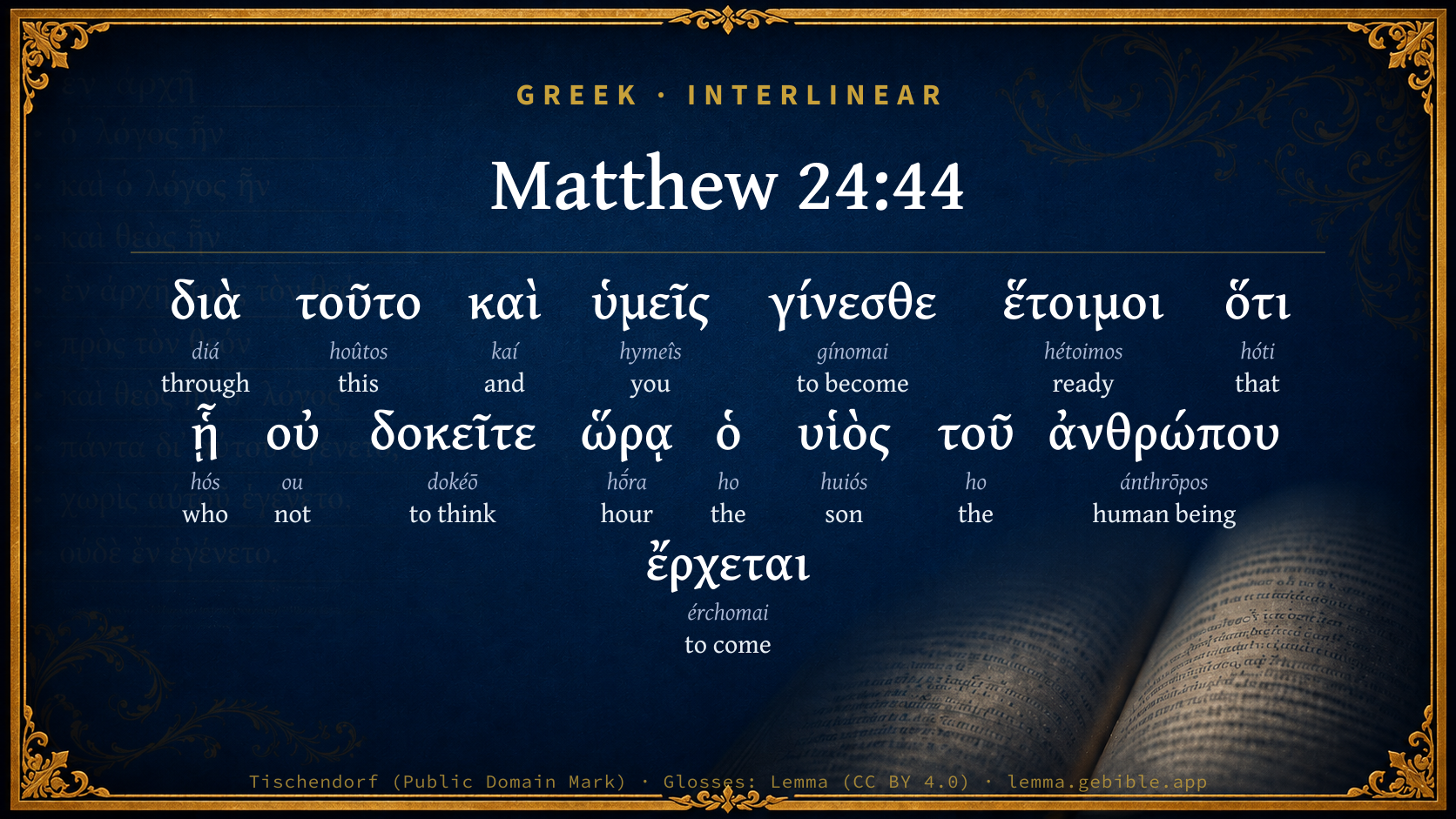
  1. διὰ diá G1223 “through” Preposition
  2. τοῦτο hoûtos G3778 “this” Demonstrative pronoun, Accusative, Singular, Neuter
  3. καὶ kaí G2532 “and” Conjunction
  4. ὑμεῖς hymeîs G5210 “you” Personal pronoun, 2nd person, Nominative, Plural
  5. γίνεσθε gínomai G1096 “to become” Verb, Present, Middle or Passive deponent, Imperative, 2nd person, Plural
  6. ὅτι hóti G3754 “that” Conjunction
  7. ᾗ hós G3739 “who” Relative pronoun, Dative, Singular, Feminine
  8. οὐ ou G3756 “not” Particle, Negative
  9. δοκεῖτε dokéō G1380 “to think” Verb, Present, Active, Indicative, 2nd person, Plural
  10. ὥρᾳ hṓra G5610 “hour” Noun, Dative, Singular, Feminine
  11. ὁ ho G3588 “the” Article, Nominative, Singular, Masculine
  12. υἱὸς huiós G5207 “son” Noun, Nominative, Singular, Masculine
  13. τοῦ ho G3588 “the” Article, Genitive, Singular, Masculine
  14. ἀνθρώπου ánthrōpos G444 “human being” Noun, Genitive, Singular, Masculine
  15. ἔρχεται érchomai G2064 “to come” Verb, Present, Middle or Passive deponent, Indicative, 3rd person, Singular

About this verse

These counts appear in no published source. They are computed here, from the morphology-tagged text and Lemma’s own curated glosses. What Lemma adds →

16
words
15
distinct lemmas
Gospels
section

Notable vocabulary

The rarest word here is ἕτοιμοι ready G2092 — appearing just 17 times in the whole Greek New Testament.

Shared distinctive vocabulary

ἕτοιμοι ready G2092 occurs in 17 verses of the Greek New Testament. Also found in:

Repetition

A word recurs within this verse:

Cross-references

8

Topical passages linked to Matthew 24:44 in the Treasury of Scripture Knowledge — connected by theme and wording, ordered by reader-vote popularity; previews shown in the World English Bible.

  • Matthew 25:10 While they went away to buy, the bridegroom came, and those who were ready went in with him to the marriage feast, and the door was shut.
  • Matthew 24:42 Watch therefore, for you don't know in what hour your Lord comes.
  • Matthew 25:13 Watch therefore, for you don't know the day nor the hour in which the Son of Man is coming.
  • Luke 12:40 Therefore be ready also, for the Son of Man is coming in an hour that you don't expect him."
  • Philippians 4:5 Let your gentleness be known to all men. The Lord is at hand.
  • Matthew 24:27 For as the lightning comes forth from the east, and is seen even to the west, so will be the coming of the Son of Man.
  • Revelation 19:7 Let us rejoice and be exceedingly glad, and let us give the glory to him. For the marriage of the Lamb has come, and his wife has made herself ready."
  • James 5:9 Don't grumble, brothers, against one another, so that you won't be judged. Behold, the judge stands at the door.

Cross-references courtesy of OpenBible.info (CC BY 4.0).

Commentary

Notes on Matthew 24:44 from classic Christian and Jewish commentators (each source and its license shown beneath its notes). The classic Christian expositions comment on the surrounding passage and are grouped to its opening verse, so a note may address several verses; the Jewish commentaries on the Tanakh (Rashi and others) are per-verse, so they appear only where the commentator wrote on this verse.

Lemma curates 59 commentaries, every one of them public domain or Creative Commons licensed, each selected and text-cleaned for this edition rather than reprinted as found. About our sources →

The Biblical Illustrator

Joseph S. Exell

Mat_24:44

Them be ye also ready.

I. The coming of the Son of Man. His title. His coming is death. There is certainty in His coming.

II. That man in his unconverted state is unready for his coming. Man is not ready-

1. For he is born under the curse of the law.

2. For he is under the dominion of sin.

3. For his life is one of disobedience to the commands of heaven.

4. For he is unfit for the glorified state.

III. The absolute necessity for being ready.

1. The nature of the readiness. Not being born in a Christian land-not mere profession. Be ready: the act is ours, the grace is Gods.

1. Ready in state.

2. Ready in life.

(1) It is necessary that we are regenerate.

(2) That our generation-work be done.

(3) That the mind be weaned from the world, and fixed on spiritual objects.

IV. The argument used to enforce this necessity-For in such an hour.

1. Youthful hour.

2. Hour of health.

3. Hour of carnal amusement.

4. Hour of worldly prosperity. (T. Jones.)

Ready for death

I. To speak of death.

1. At death, the body is dissolved into dust.

2. At death, the soul and body separate.

3. At death, the soul appears before God.

II. Who are ready for death?

1. All who are prepared to die see their lost state by nature.

2. All who love God.

3. All who have God.

III. Reasons why we should be prepared to die.

1. Death is sure.

2. The time is uncertain.

3. This is the only world where you can be prepared to die.

4. Now is the time God has given you to prepare to die.

5. He is a wise man who prepares to die.

6. He is a fool who refuses to prepare to die. (A. Fletcher, M. A.)

Comfort under bereavement

I. The admonition. To be ready for the coming of Christ ought to be the great end of life.

1. To be ready for death, is to have obtained the pardon of all sins.

2. It is to possess renewed natures.

3. It is to have all the graces of the Spirit in vigorous exercise.

II. The motive and argument employed.

1. The uncertainty of the event in question. 2. Death may come when, according to human calculation, there is the least Prospect of it.

3. It may call us when our earthly concerns may make it most inconvenient for us to depart.

4. It may approach when we are least ready for its approach. (T. Brown, D. D.)

The shortness and uncertainty of life

I. The scriptural account of the uncertainty of human life.

II. Inquire how the uncertainty of life so seldom leads men prepare for leaving it.

1. Want of consideration.

2. Love of this world and its enjoyments.

3. A vague impression that death is a distant event.

III. Some of the comforts and advantages of being prepared for death.

1. It secures the testimony of a good conscience, connected with the favour of God, and the happiness that results from both.

2. Preparation for death alleviates the afflictions of life, and affords much consolation under them.

3. It frees from slavish fear of that event. (A. Grant, D. D.)

The great business of life

I. The event predicted.

1. His coming at the day of judgment.

2. At the hour of death.

II. The duty enjoined.

1. It is an evangelical readiness.

2. It is a gracious readiness.

3. It is an habitual readiness. (T. Hitchin.)

The second advent

I. What is revealed concerning our Lords character and appearance?

1. Preparation made.

2. His first coming was in weakness; His second, in illimitable power. His first, in humiliation; His second, in glory.

II. The effect of His coming.

1. Renovation.

2. Dissolution.

3. Manifestation. (E. Fisk, LL. B.)

Ready to die

A ship in a port, with all its provisions and sails and men on board, is in one sense of the word, ready-ready for sea; but it may not be ready in the sense this text enjoins. Its sails must be in their places, its anchor must be up, every man must be at his post: then it is actually ready for the ocean and its storms. Let the command come, and in a minute or two it is disengaged from the fastenings that held it, lies down to the breeze, and without hurry or alarm is gone. And this is the readiness our Lord has here in His mind-a state of actual readiness, preparedness of mind and heart. (C. Bradley.)

I. A call to a state of preparation. The readiness to which we are called is a state that will give us admission to Paradise. The qualification for such a distinction and privilege is-

1. The possession of Christian acceptance and holiness.

2. A faithful and assiduous fulfilment of trust. Trusts of the most important kind are committed to man, for which he is accountable and responsible.

3. Habitual watchfulness.

II. Our Lord enforces this call by the declaration of an impressive fact.

1. The coming of the Son of Man.

2. The purposes of His coming.

3. Mans ignorance of the period of His coming. (J. Rattenbury.)

Preparation for death

I. The event for which we are to be ready.

1. At death, the body turns to its original dust.

2. At death, the soul and body separate.

3. At death, the soul appears before God.

II. What is implied in being ready? Great events require suitable preparation. Preparation for death implies-

1. A perception of unfitness for death, without an interest in the favour of God.

2. Faith in Christ, which is instrumental in obtaining pardon of sin, etc.

3. Holiness.

4. Diligence in the use of the public and private means of grace.

III. Motives to urge us to be ready.

1. Death is sure to come.

2. The time of deaths approach is uncertain.

3. Abundant provision is made to induce this preparation.

4. The present life is the only period in which we can prepare for death.

5. To be ready indicates true wisdom, and gives peace. (W. N.)

Ready

I. What are we to be ready for? To be ready to leave all that is about us and all that belongs to us, however cherished.

1. To be ready to leave this world, with all its cares, its troubles, and anxieties, for a better.

2. To be willing to be rid of many things that now burden us, and that every Christian more or less feebly desires to be rid of: sin, sorrow, sickness, appetites, disquiet, etc.

3. To be ready to stand at the judgment-seat of Christ. How do you expect to appear there?

II. Why we are to be ready.

1. It is Christs command. Surely that is enough.

2. He who commands is competent to say what the readiness consists in. It is not what we think, nor what the minister prescribes, nor what custom says; but what Christ has inspired in His own holy word. Faith in Christ, etc.

3. He has promised to make us ready. He is the author first, and the finisher next, of our faith.

4. Why is it so important to be ready? We are to see the Son of God, etc.

5. Such readiness will not interfere with the duties of this world. (J. Cumming, D. D.)

Getting ready for heaven

Mamma, said a child, my Sunday-school teacher tells me that this world is only a place in which God lets us live a little while, that we may prepare for a better world; but, mother, I do not See anybody preparing. I see you preparing to go into the country, and Aunt Eliza is preparing to come here; but I do not see any one preparing to go to heaven. If everybody wants to go there, why dont they try to get ready?

Always ready

Sir Colin Campbell, when summoned to go to India to quell the rebellion, was asked, How long would it take him to get ready? He replied promptly, Half-an-hour. As a good soldier he lived in constant readiness for the call of duty. What a lesson for Christian soldiers! Suetonius tells us that it was a piece of Julius Caesars policy never to fore-acquaint his soldiers of any set time of removal or onset, that he might ever have them in readiness to draw forth whithersoever he would. Christ, in like manner, who is called the Captain of our salvation (Heb_2:10). Our enemy is always ready to annoy us; should we not therefore look to our stand, and be vigilant? Solomons wisdom, Lots integrity, and Noahs sobriety, felt the smart of the serpents sting. The first was seduced, the second stumbled, and the third fell, while the eye of watchfulness was fallen asleep. (John Trapp.)

Judgment not the less certain because unexpected

Every judgment, coming of Christ, is as the springing of a mine. There is a moment of deep suspense after the match has been applied to the fuse which is to fire the train. Men stand at a distance, and hold their breath. There is nothing seen but a thin, small column of white smoke, rising fainter and fainter, till it seems to die away. Then men breathe again; and the inexperienced soldier would approach the place, thinking that the thing has been a failure. It is only faith in the experience of the commander, or the veterans, which keeps men from hurrying to the spot again-till just when expectation has begun to die away, the low, deep thunder sends up the column of earth majestically to heaven, and all that was on it comes crushing down again in its far circle, shattered and blackened with the blast. It is so with the world. By Gods Word the world is doomed. The moment of suspense is past: the first centuries in which men expected the convulsion to take place at once-for even Apostles were looking for it in their lifetime. We have fallen upon days of scepticism. There are no signs of ruin yet. We tread upon it like a solid thing fortified by its adamantine hills for ever. There is nothing against that, but a few words in a printed book. But the world is mined; and the spark has fallen; and just at the moment when serenity is at its height, the heavens shall pass away with a great noise, and the elements shall melt with fervent heat, and the feet of the Avenger shall stand on the earth. (F. W. Robertson, M. A.)

Sudden death

I. The solemn events for which we ought always to be ready.

1. Death.

2. Judgment.

3. Eternity.

II. In what this readiness consists, and how it is to be obtained. It consists in a proper arrangement of all our temporal and spiritual concerns. The preparation of the heart for the worship of God on earth and in heaven is from the Lord, and includes-

1. Divine illumination.

2. There must be faith.

3. A life of faith must be evidenced by a life of holiness.

4. We must live a life of prayer.

III. The importance of being always ready, Reasons-

1. It is certain the Son of Man will come.

2. It is uncertain when the Son of Man will appear. (Essex Remembrancer.)

The latter end considered

Why do men refuse to heed the caution, and shrink from contemplations on their latter end.

1. The love of life is a powerful instinct. As men shrink from death by this vital instinct, so the thoughts of it are disagreeable.

2. The sentiments and symbols of men respecting death which have a painful and mischievous effect upon the imagination and feelings.

3. There are reasons which act powerfully from out of the affections, to make men slow to think of death. The mother could think of death except as a separation from her child.

4. Do you fear to come to God because of sin. Christ removes this. The pain of dying is small. We shall enter upon another life divested of the hindrances of this. Why is it not as easy to think of death as a golden gate, as to think of it as a murky gate? (H. W. Beecher.)

Watching for the future no hindrance to present duty

I remark, then, in view of this subject thus far opened, that a proper Christian watchfulness and forethoughtfulness in regard to death and the future life will not abstract us from this world, but return us back to it better fitted to perform our part here than ever before. You are, after a long, weary summers day, suffocated with heat, grimed with dust, covered with perspiration, and fretted of skin; and you are permitted to go down to the shore of the ocean, and bathe in its translucent waters; and your body is cleansed and cooled, and reinvigorated; and you return along the shadow of the evening, grateful, and stronger than you went. Now, Gods ocean of eternity is so near, that the soul, moiled with trouble, may cast itself in, and bathe its troubles away, and return to its life again, bright, clear, inspired, strong. If you think of death as a slave, looking upon it as going into servitude under a hard master, then it may weaken you, and take away the comfort that you have; but if you think of it, as every child of God has a right to think of it, as going to your Fathers house, where a rich banquet is prepared for you, and where you shall enjoy the companionship of saints and angels, it will be a source of comfort and strength to you. We can afford to take trouble here for the sake of gaining such an inheritance. What would I care for being poor, if I knew that at the end of one year I should have ten millions of dollars? Men would toil hard, and unremittingly, and without complaint, if they could be assured that the boundary of their toil was within their computation, and that all beyond was to be enjoyment and the amplest wealth. Men do endure everything in the hope of securing wealth and enjoyment. How will they pursue laborious industry in the chilling regions of the North, or how will they plunge into the heat of the tropics, encountering sickness, and the malaria of every delta that has commerce in it, in the hope that they may return to their fathers house, or the village or neighbourhood of their birth, and spend the few closing days of their life in pleasure and comfort. And if such is the strength of the hope of a short period of earthly peace and rest, how much greater must be the strength of that mans hope who expects, after a few years (he cares not how few, so that Gods will is done) he shall rise out of this world of trouble, and care, and vicissitudes, into the land of glory; Gods land of freedom, of nobility, of purity, of truth? (H. W. Beecher.)

Dying in work

It was Augustines wish that Christ, when He came, might find him either praying or preaching. It was Latimers wish (and he had it) that he might shed his heart-blood for Christ. It was Jewels wish that he might die preaching, and he did so, for presently, after his last sermon at Lacock, in Wiltshire, he was, by reason of sickness, forced to his bed, from whence he never came off till his translation to glory. I have heard the like of Mr. Lancaster, a precious man of God, some time pastor of Bloxham, in Oxfordshire, a man very famous for his living by faith. Cushamerns, a Dutch divine, and one of the first preachers of the gospel at Erfurt, in Germany, had his pulpit poisoned by the malicious Papists there, and so took his death in Gods work. What l would you that the Lord, when He comes, should find me idle? said Calvin to his friends, who wished him to forbear studying awhile for his healths sake. And such a like answer made Dr. Reynolds to his physician upon the like occasion. Elijah was going on and talking with Elisha (about heavenly things, no doubt) when the chariot of heaven came to fetch him. There can be no better posture or state for the messenger of our dissolution to find-us in than in a diligent prosecution of our general or particular calling. (John Trapp.)

Always ready to die

Mr. Wesley was once asked by a lady, Suppose you knew you were to die at twelve oclock to-morrow night, how would you spend the intervening time? How, madam? he replied; why, just as I intend to spend it now. I should preach this night at Gloucester, and again at five to-morrow morning. After that I should ride to Tewkesbury, preach in the afternoon, and meet the societies in the evening. I should then repair to friend Martins house, who expects to entertain me, converse and pray with the family as usual, retire to my room at ten oclock, commend myself to my heavenly Father, lie down to rest, and wake up in glory.

A minister is a steward

I. What Christs ministers are entrusted with?

1. The gospel.

2. The ordinances.

3. The care of the Church.

4. The souls of the members.

II. What ministers may be said to be stewards and rulers; teachers and preachers; elders or pastors?

III. Who are wise, faithful servants of Jesus Christ?

1. Such as serve Christ because they love Him.

2. Such as serve Christ in all humility.

3. Such as serve Him with a perfect heart.

4. Such as feed the Masters household with all that food the Master hath provided or appointed for them.

5. Such as feeds the whole household.

6. Such as seeks the honour of Christ in all he does, not his own gain.

7. Such as cares for the weak babes, or little children, of his Masters family. (Benjamin Keach.)

The Biblical Illustrator, edited by Joseph S. Exell (c. 1880s–1900s) — public domain. Text from a community e-Sword module.

Bengel's Gnomon

Johann Albrecht Bengel

Mat 24:44. Ἔρχεται, cometh) The present tense.

Bengel's Gnomon of the New Testament — English translation (T&T Clark, Edinburgh, 1860) — public domain. Text from a community e-Sword module.

Meyer's Critical & Exegetical Commentary

Heinrich August Wilhelm Meyer

Mat_24:44. Διὰ τοῦτο] in order that, as regards your salvation, your case may not be similar to the householder in question, who ought to have watched, although he did not know the φυλακή of the thief.

καὶ ὑμεῖς] as the householder would have been had he watched.

ἕτοιμοι] spoken of their spiritual readiness for the second advent, which would take them by surprise (Mat_25:10; Tit_3:1). This preparedness they were to acquire for themselves (γίνεσθε).

Meyer — Critical and Exegetical Commentary on the New Testament — English translation by Peter Christie, edited by Frederick Crombie (T&T Clark, 1880) — public domain. Text from a community e-Sword module.

Ellicott's Commentary for English Readers

(44) In such an hour as ye think not.—The words are important as showing that even the signs which were to be as the budding of the fig-tree at the approach of summer were intended only to rouse the faithful to watchfulness, not to enable men to fix the times and the seasons which the Father hath set in His own power. The apparent destiny of failure which has attended on all attempts to go beyond this in the interpretation of the apocalyptic eschatology of Scripture might have been avoided had men been more careful to restrain here also their efforts after knowledge “within the limits of the knowable.”

A Bible Commentary for English Readers, edited by Charles John Ellicott (1878–1897) — public domain. Text from a community e-Sword module.

John Gill's Exposition

Who then is a faithful and wise servant,.... The Vulgate Latin adds, "do you think?" and is a question put to the disciples, which they might apply to themselves: in Luk 12:42, it is spoken in answer to a question of Peter's, in relation to the above exhortation, whether it was spoken to them, or to all; and by this answer, it looks as if it was more especially designed for them, though it may be applied to other. The "servant" is there called a "steward", for such a servant is meant; and a name that is very proper for the apostles and ministers of the word, who are stewards of the mysteries of Christ, and of the manifold grace of God; and whose characters are, that they are "faithful": for this is required in stewards, that they be faithful to the trust reposed in them; as ministers are, when they preach the pure Gospel of Christ, and the whole of it; conceal no part, nor keep anything of it; seek not to please men, but God; neither seek their own things, their ease, honour, and profit, but the glory of God, the honour of Christ, and the good of souls; and abide by the truths, cause, and interest of a Redeemer, at all hazards. And they are "wise", who know and are well instructed in divine things; who make Christ the main subject of their ministry; who improve their talents and time for their master's use, and the advantage of those that are under their care; who seek for, and deliver acceptable words and matter; and manage their whole trust, so as to be able to give in a good account of their stewardship another day. The post that such a person is put in, and the work he is to do, follow:

whom his Lord hath made ruler over his household; or "family", the church of God, which is the household of God, and of faith, in which are believers of various growths and sizes; some fathers, some young men, some children; and over these, the ministers are, by their Lord, made and placed as rulers; not as lords and tyrants over God's heritage, to govern them in an arbitrary way, but as over them in the Lord, to rule them according to the word of God, and the laws of his house; by preaching the Gospel, administering ordinances, and keeping up his worship and the discipline of the church; and whose principal business it is,

to give them meat in due season; even "their portion" of it, as in Luk 12:42, for the word of God is to be cut and rightly divided, and everyone in the family, according to his age, appetite, and digestion, is to have his proper part and portion given him: it must be meat, proper food, such as is solid, substantial, and nourishing; even the wholesome words of Christ Jesus, that must be given them, and not husks and empty trash; and all in due season, in its proper time, as their cases and circumstances require, and call for; as whether weary, or uncomfortable, or in the dark, or under temptations and afflictions: for a word fitly and seasonably spoken, how useful is it!

John Gill's Exposition of the Whole Bible (1746–1763) — public domain (CC PDM 1.0). Text via the HelloAO Bible API.

Trapp's Complete Commentary

John Trapp

44 Therefore be ye also ready: for in such an hour as ye think not the Son of man cometh.

Ver. 44. Therefore be ye also ready] Suetonius tells us that it was a piece of Julius Caesar’s policy never to forewarn his soldiers of any set time of removal or onset, that he might ever have them in readiness to draw forth whithersoever he would. {a} Christ, in like manner, who is called the "Captain of our salvation," Heb 2:10. Our enemy is always ready to annoy us, should we not, therefore look to our stand, and be vigilant? Solomon’s wisdom, Lot’s integrity, and Noah’s sobriety, felt the smart of the serpent’s sting. The first was seduced, the second stumbled, and the third fell, while the eye of watchfulness was fallen asleep.

For in such an hour, &c.] Christ will soonest seize upon the secure, 1Th 5:3; such shall sleep as Sisera, who ere he awaked had his head fastened to the ground, as if it had been now listening what was become of the soul. {See Trapp on "Mat 24:42"}

{a} Scilicet ut paratum ot intentum momentis omnibus, quo vellet subito educeret.

John Trapp, A Commentary or Exposition upon All the Books of the Old and New Testament (1647–1656) — public domain. Text from a community e-Sword module.

Albert Barnes' Notes on the Bible

Be ye also ready - Luke Luk 21:36 says that he charged them to pray always, that they might be accounted worthy to escape those things - the judgments coming upon the wicked - and to stand before the Son of man - that is, to stand there approved by him, or to be admitted to his favor. He also charged them Luk 21:34 to take heed and not to suffer their hearts to be overcharged with surfeiting, or too much eating, or drunkenness, or the cares of this life, lest that day should come upon them unawares; things improper if there were no judgment - especially mad and wicked when the judgment is near.

Albert Barnes' Notes on the Bible (1834–1885) — public domain. Text from a community e-Sword/MySword module.

Whedon's Commentary on the Bible

Daniel D. Whedon

44. Therefore be ye also ready — As, like the householder, ye know not at what hour, or at which watch, the spoiler will come, so all the night is watch time. Be ye, like the householder, at all time ready. For the individual death is the virtual coming of the Son of man. Not that the coming of the Son of man here is death, nor truly to be identified with death; but the being on the watch for judgment is pressed instead of the being on the watch for death, inasmuch as death is nothing but a passage to judgment. If a man live in preparation for judgment he is in preparation for death. Death is simply a transition into the world where retribution reigns, and where the virtual judgment throne of Christ is in spirit continually in session.

Daniel D. Whedon (gen. ed.), Commentary on the Old and New Testaments (1874–1909) — public domain. Text from a community e-Sword module.

The Pulpit Commentary

Therefore. Regarding the solemn example just given, taking it as applicable to spiritual things. The warning is of general obligation, and may be used by each individual Christian for his own benefit; for there is a sense in which the day of death is the coming of Christ, and as death leaves us so, as far as we know, judgment will find us.

Abiding readiness.

"Therefore be ye also ready." The one point which our Lord seeks to impress on his disciples is the uncertainty of the time of the great testing day, and of all testing days. The fact that a reckoning day for the Lord"s servants must come has to be fully accepted. If there is any sense in which we are now in trust during our Lord"s absence, it is certain that his absence can only be temporary. We can never cease to be servants in charge. We can never get a personal right in the things of which we are set in charge. Purposely our Lord withholds from his disciples of every age the date of his return. It is truest kindness to do so. It is moral training to do so. His disciples always go wrong when they try to fix dates. Christ distinctly refuses to allow any data on which such fixtures can be made. Prophets of the "second coming," and of the "end of the world," are wise above what is written, and let their imaginations run riot over Bible figures of speech.

I THE MORAL INFLUENCE OF FEELING THAT THE MASTER MAY COME AT ANY TIME.

1. It keeps the thought of the Master close, near to us at all times. So it takes us out of ourselves.

2. It keeps us thinking what the Master would like to see when he comes. So it makes us ever busy about our work.

3. It sets us upon thinking what pleasant surprises we can give our Master when he comes. So it lifts our work high above the drudgery of service.

4. It keeps in our hearts the ever-cheering confidence of the Master"s smile, if he sees all has been right and is right in his home. Add that all this filling of our souls with the thought of our Master provides the healthiest deliverance from all self-centred sentimentalism. Illustrate from our Lord"s picture of the good servant, who was found "watching," in the sense of being busy about his work.

II THE MORAL INFLUENCE OF FEELING THAT THE MASTER IS DELAYING HIS COMING. This represents the most striking contrast. The thought of the Master is lifted away, and self rises to fill the vacant space. No need to hurry preparations; it will be soon enough when he sends notice. Meanwhile there can be self-enjoyment. There is no fear of being taken at unawares. See the picture of the unworthy servant. Whether men think they can, or think they cannot, fix the time of Christ"s coming, the fact for them all will be that he will come to them at unawares, and find them out. R.T.

The Pulpit Commentary (1880–1919), ed. H.D.M. Spence-Jones & Joseph S. Exell — public domain. Text from a community e-Sword module.

Scofield Reference Notes

C. I. Scofield

Son of man

(See Scofield "Mat 8:20")

The Scofield Reference Bible (1917 edition), notes by C. I. Scofield — public domain. Text from a community e-Sword module.

The People's New Testament

B. W. Johnson

44. Be ye also ready. The duty enjoined is not to watch for Christ, but to watch ourselves to see that we are ready.

B. W. Johnson's The People's New Testament with Notes (1889–1891) — public domain. Electronic text from the Christian Classics Ethereal Library (CCEL) ThML edition.

International Critical Commentary

(L) 44. Therefore be ye also ready; because at an hour which ye think not the Son of Man cometh.]

International Critical Commentary — older volumes (1896–1929), various authors — public domain. Text from a community e-Sword module.

Lesson kit

Teaching starters — assembled from the data on this page, not authored interpretation. Every prompt links to the verse data it draws on. Edit before teaching.

Matthew, in the Gospels, opens this verse with 16 words (15 distinct Greek lemmas). Its most distinctive word is hétoimos (“ready”). A historical commentator’s framing appears above. Read the whole chapter for the surrounding context.

Discussion questions

  1. The word hétoimos carries the sense “ready.” How does it shape the verse?
  2. Matthew 22:4 shares the word «ready» with this verse. How do the two illuminate each other?
  3. “the” occurs 2× in this one verse. What is the effect of the repetition?
  4. These translations render this verse differently; the difference is in the English rendering, not the original. What questions does that raise?
  5. Reading how The Biblical Illustrator and Bengel's Gnomon read this verse, where do the two commentators agree and where do they part?

Things to notice

Reading settings

Reading text

Shown beneath each verse's original-language words.

Old Testament
Old Testament edition

Read the OT as the Masoretic Hebrew (MT) or the Greek Septuagint (LXX).

English shown for the Greek Septuagint (in the Hebrew ↔ Greek comparison).

Comparing translations? Open the Compare panel on any verse page to stack up to four side by side.