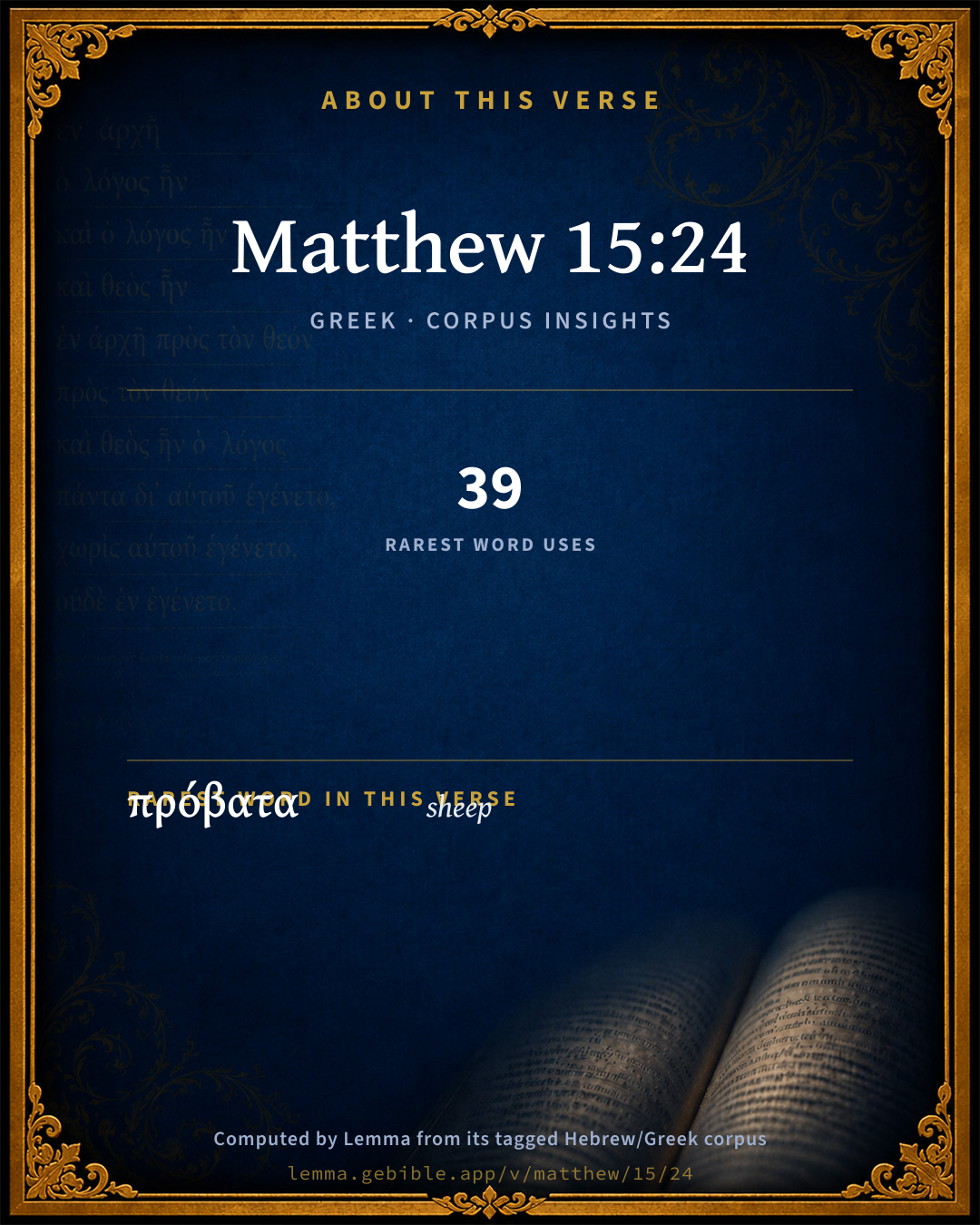
Matthew 15:24

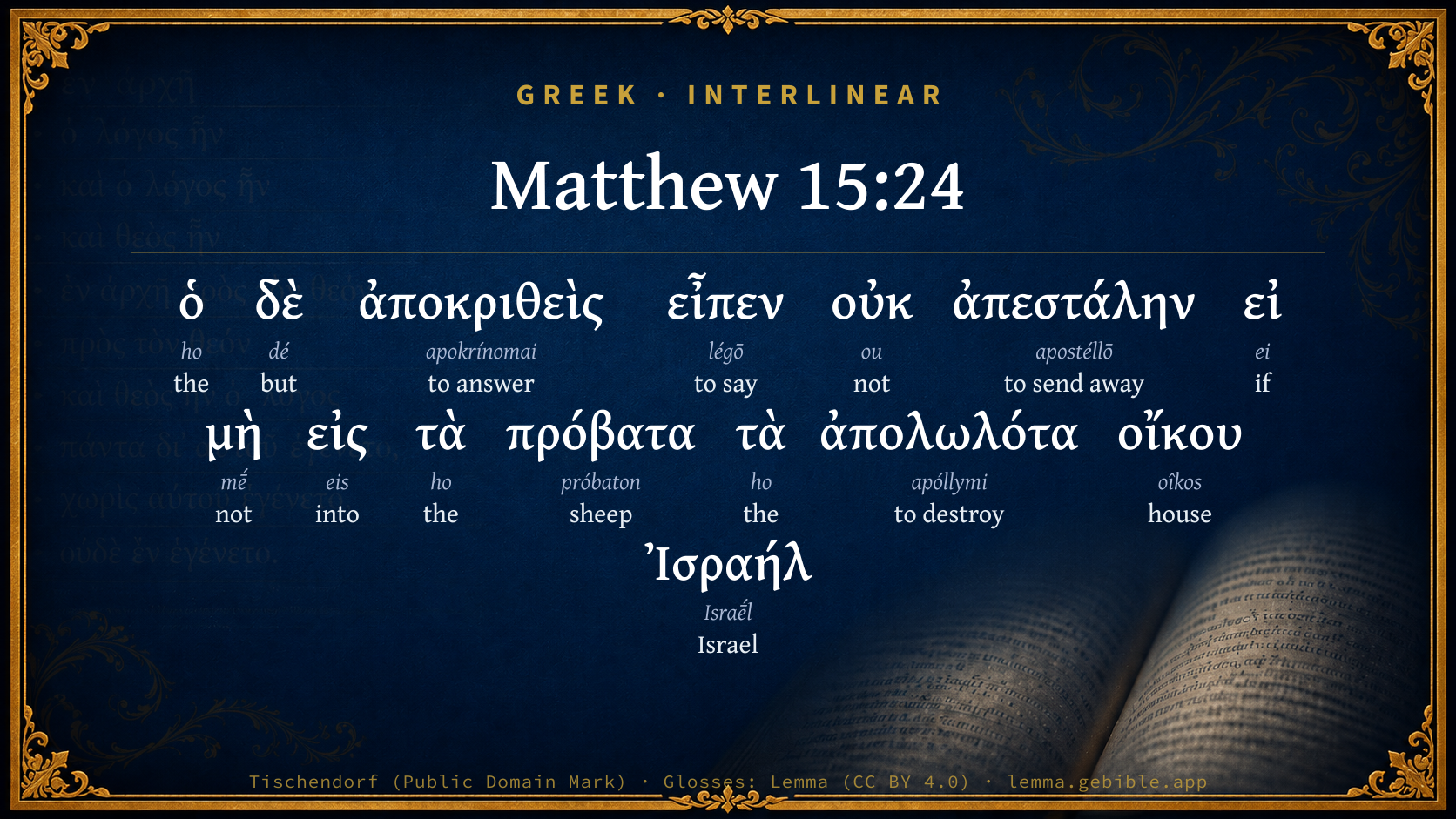
Greek (Tischendorf 8th ed.) Matthew 15:24 appears in the Greek New Testament. The text above is from the Tischendorf 8th edition. Each word links to its Strong’s number and a concise gloss. Click any word for its full Thayer’s Greek Lexicon entry.
Download image
Cite this verse

Matthew 15:24 (World English Bible). Public Domain. Lemma interlinear Bible study tool, https://lemma.gebible.app/v/matthew/15/24.

Show BibTeX & RIS
BibTeX
RIS
English Translation
But he answered, "I wasn't sent to anyone but the lost sheep of the house of Israel."
World English Bible · Public Domain
Download a study sheet

One document with this verse’s original text, its word-by-word gloss line, the meaning frame, cross-references with their text, attributed commentary, and full source and license credits — printable, and it pastes into notes with its structure intact.

This verse Autodidact and up

Study sheet (.html) Plain text (.txt)

A passage Seminary Student

Up to 50 verses in one chapter. A passage sheet keeps up to 6 commentary sources and 12 cross-references per verse, in the order this page ranks them, and says so on the sheet whenever that leaves anything out. Ask for a single verse and you get the Autodidact verse sheet above.

Everything on this page stays free to read, with no account — the sheet is a download of what is already on screen, not access to it.

Want to remove ads? Support Godless Engineer
Compare translations 3

The same verse in 3 English versions, stacked beneath the original-language interlinear above. Click any original word for its lexicon entry.

Each is an independent rendering of the whole verse — the interlinear is not word-aligned to these translations.

Highlighted words mark where these versions differ — a whole-verse word diff, not a word-by-word alignment.

  • World English Bible Public Domain
    But he answered, "I wasn't sent to anyone but the lost sheep of the house of Israel."
  • King James Version Public Domain
    But he answered and said, I am not sent but unto the lost sheep of the house of Israel.
  • unfoldingWord Literal Text CC BY-SA 4.0
    But he, answering, said, “I was not sent, except to the lost sheep of the house of Israel.”

unfoldingWord Literal Text — © unfoldingWord, licensed CC BY-SA 4.0. Word-aligned USFM3 via Door43 (git.door43.org/unfoldingWord/en_ult).

Versions to compare (up to 4)

3 of 4 selected

Show all 19 translations

Every available English version of this verse, each an independent rendering of the whole verse.

  • World English Bible Public Domain
    But he answered, "I wasn't sent to anyone but the lost sheep of the house of Israel."
  • Berean Standard Bible Public Domain
    He answered, “I was sent only to the lost sheep of the house of Israel.”
  • Majority Standard Bible Public Domain
    He answered, “I was sent only to the lost sheep of the house of Israel.”
  • King James Version Public Domain
    But he answered and said, I am not sent but unto the lost sheep of the house of Israel.
  • American Standard Version (1901) Public Domain
    But he answered and said, I was not sent but unto the lost sheep of the house of Israel.
  • Revised Version (1885) Public Domain
    But he answered and said, I was not sent but unto the lost sheep of the house of Israel.
  • Geneva Bible (1599) Public Domain
    But he answered, and said, I am not sent, but vnto the lost sheepe of the house of Israel.
  • Douay-Rheims (1899) Public Domain
    And he answering, said: I was not sent but to the sheep that are lost of the house of Israel.
  • Young's Literal Translation Public Domain
    and he answering said, `I was not sent except to the lost sheep of the house of Israel.'
  • Literal Standard Version CC BY-SA 4.0
    and He answering said, “I was not sent except to the lost sheep of the house of Israel.”
  • Unlocked Literal Bible CC BY-SA 4.0
    But Jesus answered and said, “I was not sent to anyone except to the lost sheep of the house of Israel.”
  • unfoldingWord Literal Text CC BY-SA 4.0
    But he, answering, said, “I was not sent, except to the lost sheep of the house of Israel.”
  • Darby Bible Public Domain
    But he answering said, I have not been sent save to the lost sheep of Israel's house.
  • World Messianic Bible Public Domain
    But he answered, “I wasn’t sent to anyone but the lost sheep of the house of Israel.”
  • Webster's Bible Public Domain
    But he answered and said, I am not sent but to the lost sheep of the house of Israel.
  • Free Bible Version CC BY-SA 4.0
    “I was sent only to the lost sheep of the house of Israel,” Jesus said to the woman.
  • Bible in Basic English Public Domain
    But he made answer and said, I was sent only to the wandering sheep of the house of Israel.
  • Text-Critical English NT CC BY 4.0
    In response Jesus said, “I was sent only to the lost sheep of the house of Israel.”
  • Tyndale New Testament (1534) Public Domain
    He answered and sayde: I am not sent but vnto the loost shepe of the housse of Israel.

Literal Standard Version (2020), Covenant Press — licensed CC BY-SA 4.0. Text via the HelloAO Bible API (eBible.org). Unlocked Literal Bible (unfoldingWord) — licensed CC BY-SA 4.0. Text via the HelloAO Bible API (eBible.org). unfoldingWord Literal Text — © unfoldingWord, licensed CC BY-SA 4.0. Word-aligned USFM3 via Door43 (git.door43.org/unfoldingWord/en_ult). Free Bible Version, Dr. Jonathan Gallagher — licensed CC BY-SA 4.0. Text via the HelloAO Bible API (eBible.org).

Word by word

More ways to search: Search by grammar → Find every occurrence → Compare this word →

Practice this passage: Drill this verse → Learn its vocabulary →

πρόβατα
próbaton
G4263
“sheep”
Noun, Accusative, Plural, Neuter
Part of Speech
Noun
Case
Accusative
Number
Plural
Gender
Neuter
Full Thayer's Definition

Origin: probably from a presumed. derivative of G4260

TDNT: 17:29,9

1. any four footed, tame animal accustomed to graze, small cattle (opp. to large cattle, horses, etc.), most commonly a sheep or a goat a. a sheep, and so always in the NT
  1. ὁ ho G3588 “the” Article, Nominative, Singular, Masculine
  2. δὲ dé G1161 “but” Conjunction
  3. ἀποκριθεὶς apokrínomai G611 “to answer” Verb, Aorist, Passive deponent, Participle, Nominative, Singular, Masculine
  4. εἶπεν légō G3004 “to say” Verb, Aorist, Active, Indicative, 3rd person, Singular
  5. οὐκ ou G3756 “not” Particle, Negative
  6. ἀπεστάλην apostéllō G649 “to send away” Verb, Aorist, Passive, Indicative, 1st person, Singular
  7. εἰ ei G1487 “if” Conditional
  8. μὴ mḗ G3361 “not” Particle, Negative
  9. εἰς eis G1519 “into” Preposition
  10. τὰ ho G3588 “the” Article, Accusative, Plural, Neuter
  11. τὰ ho G3588 “the” Article, Accusative, Plural, Neuter
  12. ἀπολωλότα apóllymi G622 “to destroy” Verb, Perfect, Active, Participle, Accusative, Plural, Neuter
  13. οἴκου oîkos G3624 “house” Noun, Genitive, Singular, Masculine
  14. Ἰσραήλ Israḗl G2474 “Israel” Noun, Proper, indeclinable

About this verse

These counts appear in no published source. They are computed here, from the morphology-tagged text and Lemma’s own curated glosses. What Lemma adds →

15
words
13
distinct lemmas
Gospels
section

Shared distinctive vocabulary

πρόβατα sheep G4263 occurs in 37 verses of the Greek New Testament. Also found in:

Repetition

A word recurs within this verse:

Cross-references

11

Topical passages linked to Matthew 15:24 in the Treasury of Scripture Knowledge — connected by theme and wording, ordered by reader-vote popularity; previews shown in the World English Bible.

  • Matthew 10:5–6 Jesus sent these twelve out, and charged them, saying, "Don't go among the Gentiles, and don't enter into any city of the Samaritans.
  • Romans 15:8 Now I say that Christ has been made a minister of the circumcision for the truth of God, that he might confirm the promises given to the fathers,
  • Jeremiah 50:6–7 My people have been lost sheep: their shepherds have caused them to go astray; they have turned them away on the mountains; they have gone from mountain to hill; they have forgotten their resting-place.
  • Acts 13:46 Paul and Barnabas spoke out boldly, and said, "It was necessary that God's word should be spoken to you first. Since indeed you thrust it from you, and judge yourselves unworthy of eternal life, behold, we turn to the Gentiles.
  • Ezekiel 34:5–6 They were scattered, because there was no shepherd; and they became food to all the animals of the field, and were scattered.
  • Acts 3:25–26 You are the children of the prophets, and of the covenant which God made with our fathers, saying to Abraham, 'In your seed will all the families of the earth be blessed.'
  • Ezekiel 34:16 I will seek that which was lost, and will bring back that which was driven away, and will bind up that which was broken, and will strengthen that which was sick: but the fat and the strong I will destroy; I will feed them in justice.
  • Isaiah 53:6 All we like sheep have gone astray; everyone has turned to his own way; and Yahweh has laid on him the iniquity of us all.
  • Ezekiel 34:23 I will set up one shepherd over them, and he shall feed them, even my servant David; he shall feed them, and he shall be their shepherd.
  • Luke 15:4–6 "Which of you men, if you had one hundred sheep, and lost one of them, wouldn't leave the ninety-nine in the wilderness, and go after the one that was lost, until he found it?
  • Matthew 9:36 But when he saw the multitudes, he was moved with compassion for them, because they were harassed and scattered, like sheep without a shepherd.

Cross-references courtesy of OpenBible.info (CC BY 4.0).

Commentary

Notes on Matthew 15:24 from classic Christian and Jewish commentators (each source and its license shown beneath its notes). The classic Christian expositions comment on the surrounding passage and are grouped to its opening verse, so a note may address several verses; the Jewish commentaries on the Tanakh (Rashi and others) are per-verse, so they appear only where the commentator wrote on this verse.

Lemma curates 59 commentaries, every one of them public domain or Creative Commons licensed, each selected and text-cleaned for this edition rather than reprinted as found. About our sources →

Bengel's Gnomon

Johann Albrecht Bengel

Mat 15:24. Ἀπεστάλην, I am sent) Our Lord referred everything to His Mission.—πρόβατα, sheep) Israel is the Lord’s flock (see Psalms 95), Jesus the Shepherd.—οἴκου Ἰσραήλ, the house of Israel) This appeared to restrict His grace.

Mat 15:24; Mat 15:26. Εἰ μὴ—τοῖς κυναρίοις, except—to little dogs) Our Lord’s language, in Mat 15:24, contains no repulse, as explained in Mat 15:26,[695] but rather suggests hope to constant faith. The twenty-fourth verse is to be understood, not with reference to the whole mediatorial office, but only our Lord’s preaching and miracles.

[695] Bengel’s words are, “Sermo in thesi expressus, in hypothesi nullam habet repulsam: sed potius spem facit fidei constanti. Thesis autem accipienda est, non de officio toto mediatorio, sed de prædicatione et miraculis.” I have endeavoured to render this so as to be intelligible to the general reader.—(I. B.)

Bengel's Gnomon of the New Testament — English translation (T&T Clark, Edinburgh, 1860) — public domain. Text from a community e-Sword module.

Meyer's Critical & Exegetical Commentary

Heinrich August Wilhelm Meyer

Mat_15:24. Those words are addressed to the disciples (comp. note on Mat_10:6); the answer to the woman comes afterwards in Mat_15:26.

It is usually supposed that what Jesus had in view was merely to put her confidence in Him to the test (Ebrard, Baur, Schenkel, Weiss); whilst Chrysostom, Theophylact, Euth. Zigabenus, Luther, Glöckler, assert that His aim was to furnish her with an opportunity for displaying her faith. But the moral sense protests against this apparent cruelty of playing the part of a dissembler with the very intention of tormenting; it rather prefers to recognise in our Lords demeanour a sincere disposition to repel, which, however, is subsequently conquered by the womans unshaken trust (Chrysostom: καλὴν ἀναισχυντίαν). Ewald appropriately observes how, on this occasion, Jesus shows His greatness in a twofold way: first, in prudently and resolutely confining Himself to the sphere of His own country; and then in no less thoughtfully overstepping this limit whenever a higher reason rendered it proper to do so, and as if to foreshadow what was going to take place a little farther on in the future.

It was not intended that Christ should come to the Gentiles in the days of His flesh, but that He should do so at a subsequent period (Mat_28:19), in the person of the Spirit acting through the medium of apostolic preaching (Joh_10:16; Eph_2:17). But the difficulty of reconciling this with Mat_8:5, Mat_11:12, on which Hilgenfeld lays some stress, as being in favour of our present narrative, is somewhat lessened by the fact that, according to Luk_7:2 ff., the centurion was living in the heart of the people, and might be said to be already pretty much identified with Judaism; whereas we have a complete stranger in the case of the woman, before whom Jesus sees Himself called upon, in consequence of their request, Mat_15:23, strictly to point out to His disciples that His mission, so far as its fundamental object was concerned, was to be confined exclusively to Israel. Volkmar, indeed, makes out that the words were never spoken at all; that their teaching is of a questionable nature; and that the whole thing is an imitation of the story of Elijah and the widow of Zarephath (1 Kings 17); while Scholten, p. 213, regards it merely as a symbolical representation of the relation of the Gentile world to the kingdom of God, and which had come to be treated as a fact.

Meyer — Critical and Exegetical Commentary on the New Testament — English translation by Peter Christie, edited by Frederick Crombie (T&T Clark, 1880) — public domain. Text from a community e-Sword module.

Expositor's Greek Testament

ed. W. Robertson Nicoll

Mat 15:24 . οὐκ ἀπεστάλην : Jesus is compelled to explain Himself, and His explanation is bonâ fide , and to be taken in earnest as meaning that He considered it His duty to restrict His ministry to Israel, to be a shepherd exclusively to the lost sheep of Israel ( τὰ πρόβατα τ . ἀ ., cf. Mat 9:36 ), as He was wont to call them with affectionate pity. There was probably a mixture of feelings in Christ’s mind at this time; an aversion to recommence just then a healing ministry at all a craving for rest and retirement; a disinclination to be drawn into a ministry among a heathen people, which would mar the unity of His career as a prophet of God to Israel (the drama of His life to serve its purpose must respect the limits of time and place); a secret inclination to do this woman a kindness if it could in any way be made exceptional; and last but not least, a feeling that her request was really not isolated but representative = the Gentile world in her inviting Him, a fugitive from His own land, to come over and help them, an omen of the transference of the kingdom from Jewish to Pagan soil.

The Expositor's Greek Testament, edited by W. Robertson Nicoll (1897–1910) — public domain. Text from a community e-Sword module.

Geneva Bible (1599)

Geneva Bible translators

Of the people of Israel, which people was divided into tribes, but all those tribes came of one house.

Geneva Bible (1599) marginal notes — public domain. Text via Bolls.life.

Jamieson, Fausset & Brown

Robert Jamieson, A. R. Fausset & David Brown

But he answered and said, I am not sent but to the lost sheep of the house of Israel--(Also see on Mar 7:26.)

Jamieson, Fausset & Brown — Commentary Critical and Explanatory on the Whole Bible (1871) — public domain (CC PDM 1.0). Text via the HelloAO Bible API.

Adam Clarke's Commentary

Verse 24. I am not sent but unto the lost sheep] By the Divine appointment, I am come to preach the Gospel to the Jews only. There are certain preachers who should learn a lesson of important instruction from this part of our Lord's conduct. As soon as they hear of a lost sheep being found by other ministers, they give all diligence to get that one into their fold: but display little earnestness in seeking in the wilderness for those that are lost. This conduct, perhaps, proceeds from a consciousness of their inability to perform the work of an evangelist; and leads them to sit down in the labours of others, rather than submit to the reproach of presiding over empty chapels. Such persons should either dig or beg immediately, as they are a reproach to the pastoral office; for, not being sent of God, they cannot profit the people.

The wilderness of this world is sufficiently wide and uncultivated. Sinners abound every where; and there is ample room for all truly religious people, who have zeal for God, and love for their perishing follow creatures, to put forth all their strength, employ all their time, and exercise all their talents, in proclaiming the Gospel of God; not only to the lost sheep of the house of Israel, but to a lost WORLD. Nor can such exertions be unsuccessful. There the pure truth of God is preached, many will be converted. Where that truth is preached, though with a mixture of error, some will be converted, for God will bless his own truth. But where nothing but false doctrine is preached, no soul is converted: for God will never sanction error by a miracle of his mercy.

Adam Clarke's Commentary on the Bible (1810–1826) — public domain. Text from a community e-Sword/MySword module.

Ellicott's Commentary for English Readers

(24) I am not sent (better, I was not sent) but unto the lost sheep of the house of Israel.—This, then, was what had restrained Him. Those wandering sheep, without a shepherd, were the appointed objects of His care. Were He to go beyond that limit in a single case, it might be followed by a thousand, and then, becoming, as it were, before the time, the Apostle of the Gentiles, He would cease to draw to Himself the hearts of Israel as their Redeemer. We call to mind the case of the centurion’s servant (Mat_8:10), and wonder that that was not decisive as a precedent in the supplicant’s favour. The two cases stood, however, on a very different footing. The centurion who had built a synagogue was practically, if not formally, a proselyte of the gate. As the elders of the synagogue pleaded for him as worthy, the work of healing wrought for him would not alienate them or their followers. The woman belonged, on the contrary, to the most scorned and hated of all heathen races, to the Canaan on which the primeval curse was held to rest (Gen_9:25), and had as yet done nothing to show that she was in any sense a convert to the faith of Israel.

A Bible Commentary for English Readers, edited by Charles John Ellicott (1878–1897) — public domain. Text from a community e-Sword module.

The Cambridge Bible for Schools and Colleges

gen. ed. J. J. S. Perowne

24. I am not sent but unto the lost sheep of the house of Israel] Jesus came to save all, but His personal ministry was confined, with few exceptions, to the Jews.

The thought of Israel as a flock of sheep lost on the mountains is beautifully drawn out, Ezekiel 34; “My flock was scattered upon all the face of the earth, and none did search or seek after them,” (Mat_15:6.) Read the whole chapter.

The Cambridge Bible for Schools and Colleges (gen. ed. J. J. S. Perowne; Cambridge University Press, 1878–1918) — public domain. Text from a community e-Sword module.

John Gill's Exposition

But he answered, and said,.... To his disciples, who knew how limited their commission was, that they were not to go into the way of the Gentiles, not to preach to them, nor perform miracles among them; and therefore could not reasonably expect that either the woman, or they, on her behalf, should succeed in this matter.

I am not sent, but to the lost sheep of the house of Israel; as a priest, or as a Saviour and Redeemer, he was sent to make satisfaction and atonement for the sins of all God's elect, and to obtain eternal redemption and salvation for all of them, whether Jews or Gentiles; but as a prophet, in the discharge of his own personal ministry, he was sent by his Father only to the Jews; he was the "minister of the circumcision", Rom 15:8 that is, a minister to the circumcised Jews; he was sent only to preach the Gospel to them, and work miracles among them, in proof of his Messiahship; and upon their rejection of him, then his apostles were to be sent among the Gentiles; but he himself was sent only to the Jews, here styled "the lost sheep of the house of Israel": by "the house of Israel", is meant the whole body of the Jewish nation, so called from Israel, the name of Jacob their father, from whom they sprung; and by the "lost sheep" of that house, are more especially designed the elect of God among them: for though all the individuals of that house were "lost" persons, considered in Adam, and in themselves, as the rest of mankind, and Christ, in the external ministry of the word, was sent to preach to them all; yet the elect of God are only "sheep": they are the sheep of Christ, of his pasture, and of his hand, whom he has the particular care and charge of; and who, in their natural state, are lost and straying, and could never find their way, or recover themselves from their lost state in Adam, and by their own transgressions; but he came to seek, and to save them, and to these his ministry was powerful and efficacious.

John Gill's Exposition of the Whole Bible (1746–1763) — public domain (CC PDM 1.0). Text via the HelloAO Bible API.

Trapp's Complete Commentary

John Trapp

24 But he answered and said, I am not sent but unto the lost sheep of the house of Israel.

Ver. 24. But unto the lost sheep, &c.] He was properly the apostle of the circumcision, Rom 15:8; Heb 3:1, till the wall of partition was broken down by his resurrection. Then the veil rent, and it was open tide. Then he became a light to lighten the Gentiles, as well as he was the glory of his people Israel.

John Trapp, A Commentary or Exposition upon All the Books of the Old and New Testament (1647–1656) — public domain. Text from a community e-Sword module.

Matthew Poole's English Annotations

Our Lord by these words doth not deny but that he was sent as a Redeemer to more, but not as a minister, or as an apostle, as he is called, Heb 3:1. The apostle, Rom 15:8, saith, that Jesus Christ was a minister of the circumcision for the truth of God to confirm the promises made unto the fathers. Our Lord’s ministry was confined to the Jews; so was the apostles’, Mat 10:5. Till some time after our Saviour’s ascension the gospel was not preached generally to the Gentiles, though some particular persons might and did, both in Christ’s time and in the time of the apostles, before they did go to the Gentiles, hear, receive and embrace the gospel, as we shall hear this woman did.

Matthew Poole's English Annotations on the Holy Bible (1683–1685) — public domain. Text from a community e-Sword/MySword module.

Whedon's Commentary on the Bible

Daniel D. Whedon

24. He answered — To the disciples. The fact that our Lord gives this reason to the disciples shows that he is assigning the true cause of his actions. It is not, as some think, to draw out the woman’s faith, that he declines to hear her prayer; but because his immediate mission is not to Gentile, but to Jew. Sent — All his actions are under the control of Him from whom he has received his commission; and the tenor of that commission limits him to Israel. Lost sheep — Such is the character of which the whole house of Israel consists. They are all lost sheep, and to them is he sent.

Daniel D. Whedon (gen. ed.), Commentary on the Old and New Testaments (1874–1909) — public domain. Text from a community e-Sword module.

The Pulpit Commentary

I am (was) not sent but unto the lost sheep of the house of Israel. Doubtless the woman had listened to the apostles" intercession, and thought her cause won; but the repulse is only repeated; this Gentile is beyond the sphere of his mission; he cannot help her without departing from the rule which he had set himself. Jesus says nothing here about the rejection of the Jews and the future ingathering of the Gentiles; he states merely that his personal mission while he was on earth was confined to the Hebrew nation. He was, as St. Paul calls him, (Rom_15:8) "a Minister of the circumcision." Later, he would send others to evangelize those who were now aliens from the chosen commonwealth; at present he has come unto his own possessions. Lost sheep. There is a tenderness in this expression natural from the mouth of the good Shepherd. He had used it when he sent forth the twelve on their apostolical journey; (Mat_10:6) the metaphor is found in the Old Testament (see Jer_50:6, etc.) It is appropriate here, where he is emphasizing his attitude towards the chosen people, and teaching the Canaanitish woman the relative position of Jew and Gentile.

The Pulpit Commentary (1880–1919), ed. H.D.M. Spence-Jones & Joseph S. Exell — public domain. Text from a community e-Sword module.

John Wesley's Explanatory Notes

I am not sent - Not primarily; not yet.

John Wesley, Explanatory Notes Upon the Whole Bible (1754–1765) — public domain. Text via the GEBible commentary corpus.

Scofield Reference Notes

C. I. Scofield

lost sheep For Another Point of View: See Topic 301191 (Greek - ἀπόλλυμι). (See Scofield "Joh 3:16")

The Scofield Reference Bible (1917 edition), notes by C. I. Scofield — public domain. Text from a community e-Sword module.

Burkitt's Expository Notes on the New Testament

William Burkitt

Observe, when our Saviour doth answer, he gives not one word of comfort, but rather a repulse. Christ has often-times love in his heart to his people, when they can read none in his countenance, nor gather it from his discourse.

Observe, the answer itself, Christ says not, I am to sent unto the lost sheep of the house of Adam, but to the lost sheep of the house of Israel. The Jews are compared unto sheep, the Gentiles unto dogs. Christ insinuates, that though they were a lost sheep of Adam, yet not being one of the lost sheep of Israel, he could do nothing for her. It was a common saying among the Jews, "That the nations of the world were likened to dogs, whereas they were God’s sons and daughters."

William Burkitt's Expository Notes on the New Testament (1700–1703) — public domain. Text from a community e-Sword module.

The People's New Testament

B. W. Johnson

24. I am not sent but to the lost sheep of the house of Israel. The Lord's personal mission was to the Jews. Under the first commission his apostles were directed to go only to the Jews (Matt. 10:6). It would be impossible to evangelize the Gentiles without setting aside the Jewish customs, the law of Moses, and arousing the bitterest prejudice of the Jews. Hence it was the divine plan that the Son should “keep the law blameless” during his ministry. It was only when the Jews crucified him “that the handwriting of ordinances was nailed to the cross,” the “wall of partition” between Jews and Gentiles broken down, and all prepared for the Great Commission which bade his disciples “go into all the world and preach the gospel to every creature.”

B. W. Johnson's The People's New Testament with Notes (1889–1891) — public domain. Electronic text from the Christian Classics Ethereal Library (CCEL) ThML edition.

unfoldingWord translationNotes

Door43 World Missions Community

I was not sent to anyone

This can be stated in active form. AT: "God did not send me to anyone" (See: Active or Passive)

to the lost sheep of the house of Israel

This is a metaphor comparing the entire nation of Israel to sheep who have gone away from their shepherd. See how you translated this in Matthew 10:6. (See: Metaphor)

she came

"the Canaanite woman came"

bowed down before him

This shows that the woman humbled herself before Jesus. (See: Symbolic Action)

It is not right to take the children's bread and throw it to the little dogs

Jesus responds to the woman with a proverb. The basic meaning is that it is not right to take what is supposed to belong to Jews and give it to non-Jews. (See: Proverbs)

the children's bread

Here "bread" refers to food in general. AT: "the children's food" (See: Synecdoche)

the little dogs

The Jews considered dogs to be unclean animals. Here they are used as an image for non-Jews.

translationWords

Jesus

send

ewe

house

Israel

bow

bread

unfoldingWord translationNotes — © Distant Shores Media and the Door43 World Missions Community, licensed CC BY-SA 4.0. Source: git.door43.org/Door43/en_tn.

Cambridge Greek Testament for Schools and Colleges

24. εἰς τὰ πρόβατα τὰ ἀπολωλότα κ.τ.λ. Jesus came to save all, but his personal ministry was confined, with few exceptions, to the Jews.

The thought of Israel as a flock of sheep lost upon the mountain is beautifully drawn out, Ezekiel 34; ‘My flock was scattered upon all the face of the earth, and none did search or seek after them’ (Mat 15:6). Read the whole chapter.

Cambridge Greek Testament for Schools and Colleges (Cambridge University Press, 1896; 21 vols, various authors incl. Carr, Maclear, Plummer, Farrar, Lumby, Moule, M. R. James, Simcox) — public domain. Text from a community e-Sword module.

Alford’s Greek Testament

Henry Alford

24.] See ch. 10:5. Such was the purpose of our Lord’s personal ministry; yet even this was occasionally broken by such incidents as this. The ‘fountain sealed’ sometimes broke its banks, in token of the rich flood of grace which should follow. See Rom 15:8.

Henry Alford, The Greek Testament (1849–1861) — public domain. Text from a community e-Sword module.

Lesson kit

Teaching starters — assembled from the data on this page, not authored interpretation. Every prompt links to the verse data it draws on. Edit before teaching.

Matthew, in the Gospels, opens this verse with 15 words (13 distinct Greek lemmas). Its most distinctive word is próbaton (“sheep”). A historical commentator’s framing appears above. Read the whole chapter for the surrounding context.

Discussion questions

  1. How does “sheep” (próbaton) shape what this verse is saying?
  2. Matthew 7:15 shares the word «sheep» with this verse. How do the two illuminate each other?
  3. “the” occurs 3× in this one verse. What is the effect of the repetition?
  4. The translations on this page render this verse differently — a whole-verse word diff, not a word-by-word alignment. What might account for the different wordings?
  5. Reading how Bengel's Gnomon and Meyer's Critical & Exegetical Commentary read this verse, where do the two commentators agree and where do they part?

Things to notice

Reading settings

Reading text

Shown beneath each verse's original-language words.

Old Testament
Old Testament edition

Read the OT as the Masoretic Hebrew (MT) or the Greek Septuagint (LXX).

English shown for the Greek Septuagint (in the Hebrew ↔ Greek comparison).

Comparing translations? Open the Compare panel on any verse page to stack up to four side by side.