

Matthew 6:5
Greek (Tischendorf 8th ed.) Matthew 6:5 appears in the Greek New Testament. The text above is from the Tischendorf 8th edition. Each word links to its Strong’s number and a concise gloss. Click any word for its full Thayer’s Greek Lexicon entry.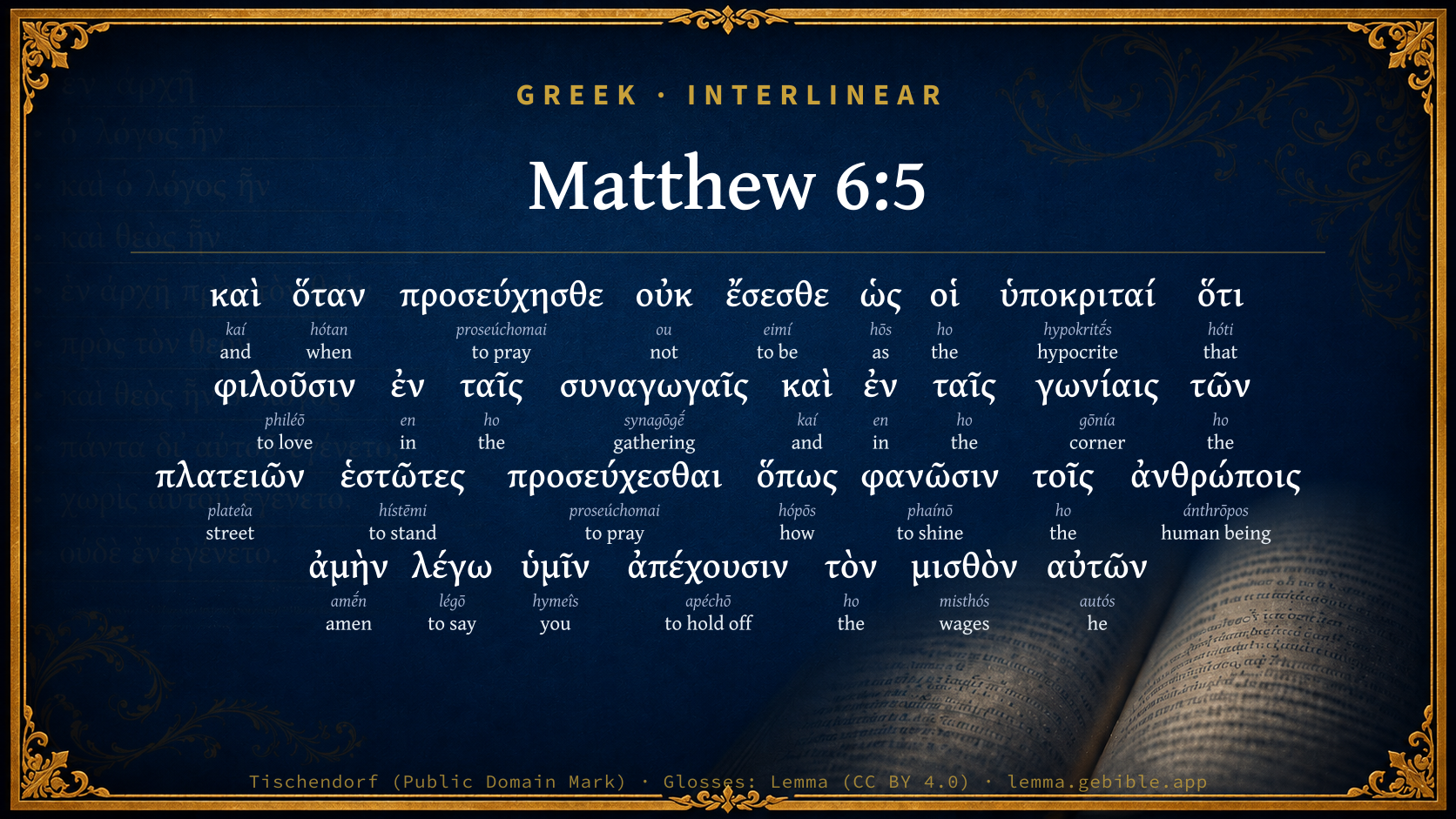
"When you pray, you shall not be as the hypocrites, for they love to stand and pray in the synagogues and in the corners of the streets, that they may be seen by men. Most assuredly, I tell you, they have received their reward.
Download a study sheet
One document with this verse’s original text, its word-by-word gloss line, the meaning frame, cross-references with their text, attributed commentary, and full source and license credits — printable, and it pastes into notes with its structure intact.
This verse Autodidact and up
A passage Seminary Student
Up to 50 verses in one chapter. A passage sheet keeps up to 6 commentary sources and 12 cross-references per verse, in the order this page ranks them, and says so on the sheet whenever that leaves anything out. Ask for a single verse and you get the Autodidact verse sheet above.
Everything on this page stays free to read, with no account — the sheet is a download of what is already on screen, not access to it.
Compare translations 3
The same verse in 3 English versions, stacked beneath the original-language interlinear above. Click any original word for its lexicon entry.
Each is an independent rendering of the whole verse — the interlinear is not word-aligned to these translations.
Highlighted words mark where these versions differ — a whole-verse word diff, not a word-by-word alignment.
-
World English Bible Public Domain
"When you pray, you shall not be as the hypocrites, for they love to stand and pray in the synagogues and in the corners of the streets, that they may be seen by men. Most assuredly, I tell you, they have received their reward.
-
King James Version Public Domain
And when thou prayest, thou shalt not be as the hypocrites are: for they love to pray standing in the synagogues and in the corners of the streets, that they may be seen of men. Verily I say unto you, They have their reward.
-
unfoldingWord Literal Text CC BY-SA 4.0
And when you pray, do not be like the hypocrites, for they love to pray, having stood in the synagogues and on the corners of the street, so that they may be seen by men. Truly I say to you, they have their reward in full.
unfoldingWord Literal Text — © unfoldingWord, licensed CC BY-SA 4.0. Word-aligned USFM3 via Door43 (git.door43.org/unfoldingWord/en_ult).
Show all 19 translations
Every available English version of this verse, each an independent rendering of the whole verse.
-
World English Bible Public Domain
"When you pray, you shall not be as the hypocrites, for they love to stand and pray in the synagogues and in the corners of the streets, that they may be seen by men. Most assuredly, I tell you, they have received their reward.
-
Berean Standard Bible Public Domain
And when you pray, do not be like the hypocrites. For they love to pray standing in the synagogues and on the street corners to be seen by men. Truly I tell you, they already have their full reward.
-
Majority Standard Bible Public Domain
And when you pray, do not be like the hypocrites. For they love to pray standing in the synagogues and on the street corners to be seen by men. Truly I tell you, they already have their full reward.
-
King James Version Public Domain
And when thou prayest, thou shalt not be as the hypocrites are: for they love to pray standing in the synagogues and in the corners of the streets, that they may be seen of men. Verily I say unto you, They have their reward.
-
American Standard Version (1901) Public Domain
And when ye pray, ye shall not be as the hypocrites: for they love to stand and pray in the synagogues and in the corners of the streets, that they may be seen of men. Verily I say unto you, They have received their reward.
-
Revised Version (1885) Public Domain
And when ye pray, ye shall not be as the hypocrites: for they love to stand and pray in the synagogues and in the corners of the streets, that they may be seen of men. Verily I say unto you, They have received their reward.
-
Geneva Bible (1599) Public Domain
And when thou prayest, be not as the hypocrites: for they loue to stand, and pray in the Synagogues, and in the corners of the streetes, because they would be seene of men. Verely I say vnto you, they haue their rewarde.
-
Douay-Rheims (1899) Public Domain
And when ye pray, you shall not be as the hypocrites, that love to stand and pray in the synagogues and corners of the streets, that they may be seen by men: Amen I say to you, they have received their reward.
-
Young's Literal Translation Public Domain
`And when thou mayest pray, thou shalt not be as the hypocrites, because they love in the synagogues, and in the corners of the broad places -- standing -- to pray, that they may be seen of men; verily I say to you, that they have their reward.
-
Literal Standard Version CC BY-SA 4.0
And when you may pray, you will not be as the hypocrites, because they cherish to pray standing in the synagogues and in the corners of the broad places, that they may be seen of men; truly I say to you that they have their reward.
-
Unlocked Literal Bible CC BY-SA 4.0
When you pray, do not be like the hypocrites, for they love to stand and pray in the synagogues and on the street corners, so that they may be seen by people. Truly I say to you, they have received their reward.
-
unfoldingWord Literal Text CC BY-SA 4.0
And when you pray, do not be like the hypocrites, for they love to pray, having stood in the synagogues and on the corners of the street, so that they may be seen by men. Truly I say to you, they have their reward in full.
-
Darby Bible Public Domain
And when thou prayest, thou shalt not be as the hypocrites; for they love to pray standing in the synagogues and in the corners of the streets so that they should appear to men. Verily I say unto you, They have their reward.
-
World Messianic Bible Public Domain
“When you pray, you shall not be as the hypocrites, for they love to stand and pray in the synagogues and in the corners of the streets, that they may be seen by men. Most certainly, I tell you, they have received their reward.
-
Webster's Bible Public Domain
And when thou prayest, thou shalt not be as the hypocrites are: for they love to pray standing in the synagogues, and in the corners of the streets, that they may be seen by men. Verily, I say to you, they have their reward.
-
Free Bible Version CC BY-SA 4.0
When you pray, don't be like the hypocrites, for they love to stand up and pray in the synagogues and on the street corners so that people can see them. I promise you, they already have their reward.
-
Bible in Basic English Public Domain
And when you make your prayers, be not like the false-hearted men, who take pleasure in getting up and saying their prayers in the Synagogues and at the street turnings so that they may be seen by men. Truly I say to you, They have their reward.
-
Text-Critical English NT CC BY 4.0
“When yoʋ pray, do not be like the hypocrites. For they love to pray standing in the synagogues and at the street corners so that they may be seen by others. Truly I say to you, they have received their reward.
-
Tyndale New Testament (1534) Public Domain
And when thou prayest thou shalt not be as the ypocrytes are. For they love to stond and praye in the synagoges and in the corners of the stretes because they wolde be sene of men. Verely I saye vnto you they haue their rewarde.
Literal Standard Version (2020), Covenant Press — licensed CC BY-SA 4.0. Text via the HelloAO Bible API (eBible.org). Unlocked Literal Bible (unfoldingWord) — licensed CC BY-SA 4.0. Text via the HelloAO Bible API (eBible.org). unfoldingWord Literal Text — © unfoldingWord, licensed CC BY-SA 4.0. Word-aligned USFM3 via Door43 (git.door43.org/unfoldingWord/en_ult). Free Bible Version, Dr. Jonathan Gallagher — licensed CC BY-SA 4.0. Text via the HelloAO Bible API (eBible.org).
Word by word
More ways to search: Search by grammar → Find every occurrence → Compare this word →
Practice this passage: Drill this verse → Learn its vocabulary →
- Appears 9× in the Greek New Testament
- First appears here
- Part of Speech
- Noun
- Case
- Dative
- Number
- Plural
- Gender
- Feminine
Full Thayer's Definition
- καὶ kaí G2532 “and” Conjunction
- ὅταν hótan G3752 “when” Conjunction
- προσεύχησθε proseúchomai G4336 “to pray” Verb, Present, Middle or Passive deponent, Subjunctive, 2nd person, Plural
- οὐκ ou G3756 “not” Particle, Negative
- ἔσεσθε eimí G1510 “to be” Verb, Future, Middle deponent, Indicative, 2nd person, Plural
- ὡς hōs G5613 “as” Adverb
- οἱ ho G3588 “the” Article, Nominative, Plural, Masculine
- ὑποκριταί hypokritḗs G5273 “hypocrite” Noun, Nominative, Plural, Masculine
- ὅτι hóti G3754 “that” Conjunction
- φιλοῦσιν philéō G5368 “to love” Verb, Present, Active, Indicative, 3rd person, Plural
- ἐν en G1722 “in” Preposition
- ταῖς ho G3588 “the” Article, Dative, Plural, Feminine
- συναγωγαῖς synagōgḗ G4864 “gathering” Noun, Dative, Plural, Feminine
- καὶ kaí G2532 “and” Conjunction
- ἐν en G1722 “in” Preposition
- ταῖς ho G3588 “the” Article, Dative, Plural, Feminine
- γωνίαις gōnía G1137 “corner” Noun, Dative, Plural, Feminine
- τῶν ho G3588 “the” Article, Genitive, Plural, Feminine
- πλατειῶν plateîa G4113 “street” Noun, Genitive, Plural, Feminine
- ἑστῶτες hístēmi G2476 “to stand” Verb, Perfect, Active, Participle, Nominative, Plural, Masculine
- προσεύχεσθαι proseúchomai G4336 “to pray” Verb, Present, Middle or Passive deponent, Infinitive
- ὅπως hópōs G3704 “how” Adverb
- φανῶσιν phaínō G5316 “to shine” Verb, Aorist, Passive, Subjunctive, 3rd person, Plural
- τοῖς ho G3588 “the” Article, Dative, Plural, Masculine
- ἀνθρώποις ánthrōpos G444 “human being” Noun, Dative, Plural, Masculine
- ἀμὴν amḗn G281 “amen” Hebrew transliteration
- λέγω légō G3004 “to say” Verb, Present, Active, Indicative, 1st person, Singular
- ὑμῖν hymeîs G5210 “you” Personal pronoun, 2nd person, Dative, Plural
- ἀπέχουσιν apéchō G568 “to hold off” Verb, Present, Active, Indicative, 3rd person, Plural
- τὸν ho G3588 “the” Article, Accusative, Singular, Masculine
- μισθὸν misthós G3408 “wages” Noun, Accusative, Singular, Masculine
- αὐτῶν autós G846 “he” Personal pronoun, Genitive, Plural, Masculine
About this verse
These counts appear in no published source. They are computed here, from the morphology-tagged text and Lemma’s own curated glosses. What Lemma adds →
- 32
- words
- 24
- distinct lemmas
- Gospels
- section
Notable vocabulary
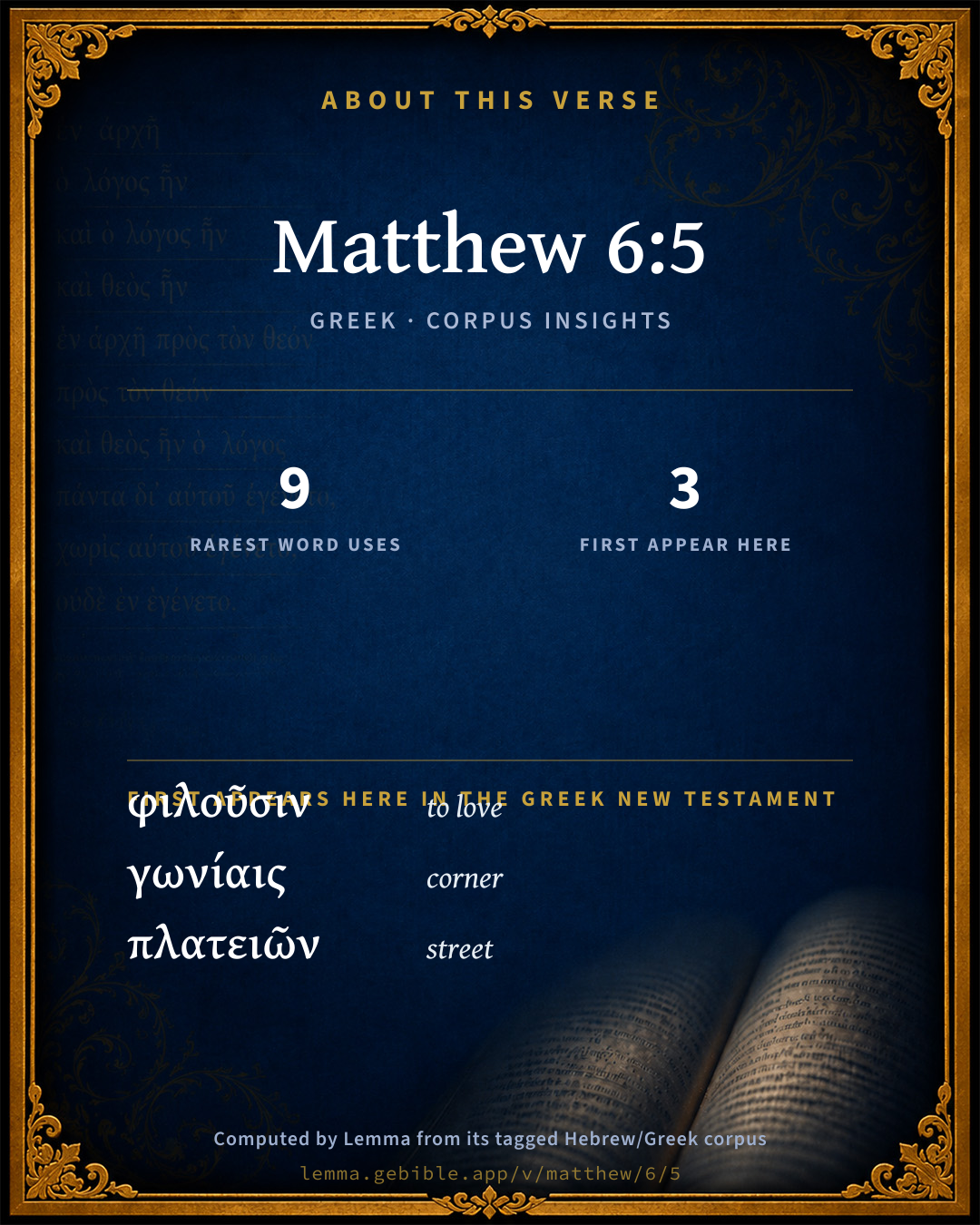
The rarest word here is γωνίαις corner G1137 — appearing just 9 times in the whole Greek New Testament.
First appearance in Scripture
These words make their first canonical appearance in the Greek New Testament here:
Shared distinctive vocabulary
γωνίαις corner G1137 occurs in 9 verses of the Greek New Testament. Also found in:
Cross-references
31Topical passages linked to Matthew 6:5 in the Treasury of Scripture Knowledge — connected by theme and wording, ordered by reader-vote popularity; previews shown in the World English Bible.
- Matthew 6:2 Therefore when you do merciful deeds, don't sound a trumpet before yourself, as the hypocrites do in the synagogues and in the streets, that they may get glory from men. Most assuredly I tell you, they have received their reward.
- Luke 18:10–11 "Two men went up into the temple to pray; one was a Pharisee, and the other was a tax collector.
- Luke 18:13 But the tax collector, standing far away, wouldn't even lift up his eyes to heaven, but beat his breast, saying, 'God, be merciful to me, a sinner!'
- Mark 11:25 Whenever you stand praying, forgive, if you have anything against anyone; so that your Father, who is in heaven, may also forgive you your transgressions.
- Isaiah 55:6–7 Seek you Yahweh while he may be found; call you on him while he is near:
- Jeremiah 29:12 You shall call on me, and you shall go and pray to me, and I will listen to you.
- Isaiah 1:15 When you spread forth your hands, I will hide my eyes from you; Yes, when you make many prayers, I will not hear. Your hands are full of blood.
- James 4:6 But he gives more grace. Therefore it says, "God resists the proud, but gives grace to the humble."
- Daniel 6:10 When Daniel knew that the writing was signed, he went into his house (now his windows were open in his chamber toward Jerusalem) and he kneeled on his knees three times a day, and prayed, and gave thanks before his God, as he did before.
- Matthew 7:7–8 "Ask, and it will be given you. Seek, and you will find. Knock, and it will be opened for you.
- Luke 18:1 He also spoke a parable to them that they must always pray, and not give up,
- Luke 20:47 who devour widows' houses, and for a pretense make long prayers: these will receive greater condemnation."
- Ephesians 6:18 with all prayer and requests, praying at all times in the Spirit, and being watchful to this end in all perseverance and requests for all the saints:
- Luke 11:43 Woe to you Pharisees! For you love the best seats in the synagogues, and the greetings in the marketplaces.
- Psalms 5:2 Listen to the voice of my cry, my King and my God; For to you do I pray.
- Psalms 55:17 Evening, morning, and at noon, I will cry out in distress. He will hear my voice.
- Matthew 21:22 All things, whatever you ask in prayer, believing, you will receive."
- James 5:15–16 and the prayer of faith will heal him who is sick, and the Lord will raise him up. If he has committed sins, he will be forgiven.
- Proverbs 16:5 Everyone who is proud in heart is an abomination to Yahweh: They shall assuredly not be unpunished.
- Daniel 9:4–19 I prayed to Yahweh my God, and made confession, and said, Oh, Lord, the great and dreadful God, who keeps covenant and loving kindness with those who love him and keep his commandments,
- Luke 14:12–14 He also said to the one who had invited him, "When you make a dinner or a supper, don't call your friends, nor your brothers, nor your kinsmen, nor rich neighbors, or perhaps they might also return the favor, and pay you back.
- Matthew 9:38 Pray therefore that the Lord of the harvest will send out laborers into his harvest."
- Mark 12:38 In his teaching he said to them, "Beware of the scribes, who like to walk in long robes, and to get greetings in the marketplaces,
- Colossians 4:2–3 Continue steadfastly in prayer, watching therein with thanksgiving;
- Matthew 23:13 "Woe to you, scribes and Pharisees, hypocrites! For you devour widows' houses, and as a pretense you make long prayers. Therefore you will receive greater condemnation.
- John 16:24 Until now, you have asked nothing in my name. Ask, and you will receive, that your joy may be made full.
- 1 Thessalonians 5:17 Pray without ceasing.
- Job 27:8–10 For what is the hope of the godless, when he is cut off, When God takes away his life?
- Proverbs 15:8 The sacrifice made by the wicked is an abomination to Yahweh, But the prayer of the upright is his delight.
- Matthew 23:6 and love the place of honor at feasts, the best seats in the synagogues,
- Matthew 6:16 "Moreover when you fast, don't be like the hypocrites, with sad faces. For they disfigure their faces, that they may be seen by men to be fasting. Most assuredly I tell you, they have received their reward.
Cross-references courtesy of OpenBible.info (CC BY 4.0).
Where the printed editions differ
2 variantsPlaces in this verse where the major printed Greek editions disagree on the wording in a way that affects the translation — a comparison of editions, not a manuscript-by-manuscript collation. The editions are the modern critical texts (Nestlé-Aland 28/27, SBL, Westcott-Hort, Tregelles, Tyndale House) and the traditional texts behind the KJV (the Textus Receptus and the Byzantine/Majority text). It is not a claim about which reading is original.
-
Different wording
προσεύχησθε,
“you [pl.] may pray,”
In NA28NA27TynSBLWHTreg Not in TRByzπροσεύχῃ (proseuchē) 'you [one] may pray' occurs in traditional manuscripts (TR+Byz) instead of προσεύχησθε, (proseuchēsthe) 'you [pl.] may pray,' in older manuscripts (NA28+NA27+Tyn+SBL+WH+Treg)
-
Different wording
ἔσεσθε
“you [pl.] will be”
In NA28NA27TynSBLWHTreg Not in TRByzἔσῃ (esē) 'you [one] will be' occurs in traditional manuscripts (TR+Byz) instead of ἔσεσθε (esesthe) 'you [pl.] will be' in older manuscripts (NA28+NA27+Tyn+SBL+WH+Treg)
Textual data: Translators Amalgamated Greek New Testament (STEPBible TAGNT) · CC BY 4.0.
Lesson kit
Teaching starters — assembled from the data on this page, not authored interpretation. Every prompt links to the verse data it draws on. Edit before teaching.
Matthew, in the Gospels, opens this verse with 32 words (24 distinct Greek lemmas). Its most distinctive word is gōnía (“corner”). A historical commentator’s framing appears above. Read the whole chapter for the surrounding context.
Discussion questions
- How does “corner” (gōnía) shape what this verse is saying?
- 3 words make their first appearance in Scripture here. What does this debut establish?
- How does Matthew 21:42, which shares the word «corner», read alongside this verse?
- What does the repetition of “to pray” (2× in this one verse) do in this verse?
- These translations render this verse differently. What is at stake in choosing one wording over another?
- Compare how Matthew Henry's Commentary and The Cambridge Bible for Schools and Colleges read this verse. Where do they agree or differ?
Things to notice
- 3 words make their first canonical appearance in Scripture here.
- These translations choose different wording for 18 words in this verse.
- “to pray” occurs 2× in this single verse.
- 24 distinct Greek lemmas span 32 words in this verse.
Commentary
Notes on Matthew 6:5 from classic Christian and Jewish commentators (each source and its license shown beneath its notes). The classic Christian expositions comment on the surrounding passage and are grouped to its opening verse, so a note may address several verses; the Jewish commentaries on the Tanakh (Rashi and others) are per-verse, so they appear only where the commentator wrote on this verse.
Lemma curates 59 commentaries, every one of them public domain or Creative Commons licensed, each selected and text-cleaned for this edition rather than reprinted as found. About our sources →
Matthew Henry's Commentary
Matthew Henry's Commentary on the Whole Bible (1708–1710) — public domain (CC PDM 1.0). Text via the HelloAO Bible API.
The Cambridge Bible for Schools and Colleges
gen. ed. J. J. S. Perowne
The Cambridge Bible for Schools and Colleges (gen. ed. J. J. S. Perowne; Cambridge University Press, 1878–1918) — public domain. Text from a community e-Sword module.
The Biblical Illustrator
Joseph S. Exell
The Biblical Illustrator, edited by Joseph S. Exell (c. 1880s–1900s) — public domain. Text from a community e-Sword module.
Joseph Benson's Commentary
Joseph Benson's Commentary on the Old and New Testaments (1811–1818) — public domain. Text from a community e-Sword module.
Broadus on Matthew
John A. Broadus
John A. Broadus, Commentary on the Gospel of Matthew (American Baptist Publication Society, 1886) — public domain. Text from a community e-Sword module.
Tyndale Open Study Notes
Tyndale Open Resources
Tyndale Open Study Notes — © Tyndale Open Resources, licensed CC BY-SA 4.0. Text via the HelloAO Bible API.
Bengel's Gnomon
Johann Albrecht Bengel
Bengel's Gnomon of the New Testament — English translation (T&T Clark, Edinburgh, 1860) — public domain. Text from a community e-Sword module.
Meyer's Critical & Exegetical Commentary
Heinrich August Wilhelm Meyer
Meyer — Critical and Exegetical Commentary on the New Testament — English translation by Peter Christie, edited by Frederick Crombie (T&T Clark, 1880) — public domain. Text from a community e-Sword module.
Expositor's Greek Testament
ed. W. Robertson Nicoll
The Expositor's Greek Testament, edited by W. Robertson Nicoll (1897–1910) — public domain. Text from a community e-Sword module.
Geneva Bible (1599)
Geneva Bible translators
Geneva Bible (1599) marginal notes — public domain. Text via Bolls.life.
Jamieson, Fausset & Brown
Robert Jamieson, A. R. Fausset & David Brown
Jamieson, Fausset & Brown — Commentary Critical and Explanatory on the Whole Bible (1871) — public domain (CC PDM 1.0). Text via the HelloAO Bible API.
Adam Clarke's Commentary
Adam Clarke's Commentary on the Bible (1810–1826) — public domain. Text from a community e-Sword/MySword module.
Ellicott's Commentary for English Readers
A Bible Commentary for English Readers, edited by Charles John Ellicott (1878–1897) — public domain. Text from a community e-Sword module.
John Gill's Exposition
John Gill's Exposition of the Whole Bible (1746–1763) — public domain (CC PDM 1.0). Text via the HelloAO Bible API.
Trapp's Complete Commentary
John Trapp
John Trapp, A Commentary or Exposition upon All the Books of the Old and New Testament (1647–1656) — public domain. Text from a community e-Sword module.
Albert Barnes' Notes on the Bible
Albert Barnes' Notes on the Bible (1834–1885) — public domain. Text from a community e-Sword/MySword module.
Haydock's Catholic Bible Commentary
George Leo Haydock (1774–1849), Haydock's Catholic Family Bible and Commentary, 1859 edition — public domain. Excludes Psalms (Douay-Rheims chapter numbering differs from Protestant) and Deuterocanonical books (Catholic canon only).
Matthew Poole's English Annotations
Matthew Poole's English Annotations on the Holy Bible (1683–1685) — public domain. Text from a community e-Sword/MySword module.
Whedon's Commentary on the Bible
Daniel D. Whedon
Daniel D. Whedon (gen. ed.), Commentary on the Old and New Testaments (1874–1909) — public domain. Text from a community e-Sword module.
The Pulpit Commentary
The Pulpit Commentary (1880–1919), ed. H.D.M. Spence-Jones & Joseph S. Exell — public domain. Text from a community e-Sword module.
John Wesley's Explanatory Notes
John Wesley, Explanatory Notes Upon the Whole Bible (1754–1765) — public domain. Text via the GEBible commentary corpus.
Scofield Reference Notes
C. I. Scofield
The Scofield Reference Bible (1917 edition), notes by C. I. Scofield — public domain. Text from a community e-Sword module.
Kretzmann's Popular Commentary
Paul E. Kretzmann
Paul E. Kretzmann, Popular Commentary of the Bible (1921–1924) — public domain. Text from a community e-Sword module.
Burkitt's Expository Notes on the New Testament
William Burkitt
William Burkitt's Expository Notes on the New Testament (1700–1703) — public domain. Text from a community e-Sword module.
The People's New Testament
B. W. Johnson
B. W. Johnson's The People's New Testament with Notes (1889–1891) — public domain. Electronic text from the Christian Classics Ethereal Library (CCEL) ThML edition.
unfoldingWord translationNotes
Door43 World Missions Community
unfoldingWord translationNotes — © Distant Shores Media and the Door43 World Missions Community, licensed CC BY-SA 4.0. Source: git.door43.org/Door43/en_tn.
Cambridge Greek Testament for Schools and Colleges
Cambridge Greek Testament for Schools and Colleges (Cambridge University Press, 1896; 21 vols, various authors incl. Carr, Maclear, Plummer, Farrar, Lumby, Moule, M. R. James, Simcox) — public domain. Text from a community e-Sword module.
Alford’s Greek Testament
Henry Alford
Henry Alford, The Greek Testament (1849–1861) — public domain. Text from a community e-Sword module.
International Critical Commentary
International Critical Commentary — older volumes (1896–1929), various authors — public domain. Text from a community e-Sword module.