

Matthew 25:3
Greek (Tischendorf 8th ed.) Matthew 25:3 appears in the Greek New Testament. The text above is from the Tischendorf 8th edition. Each word links to its Strong’s number and a concise gloss. Click any word for its full Thayer’s Greek Lexicon entry.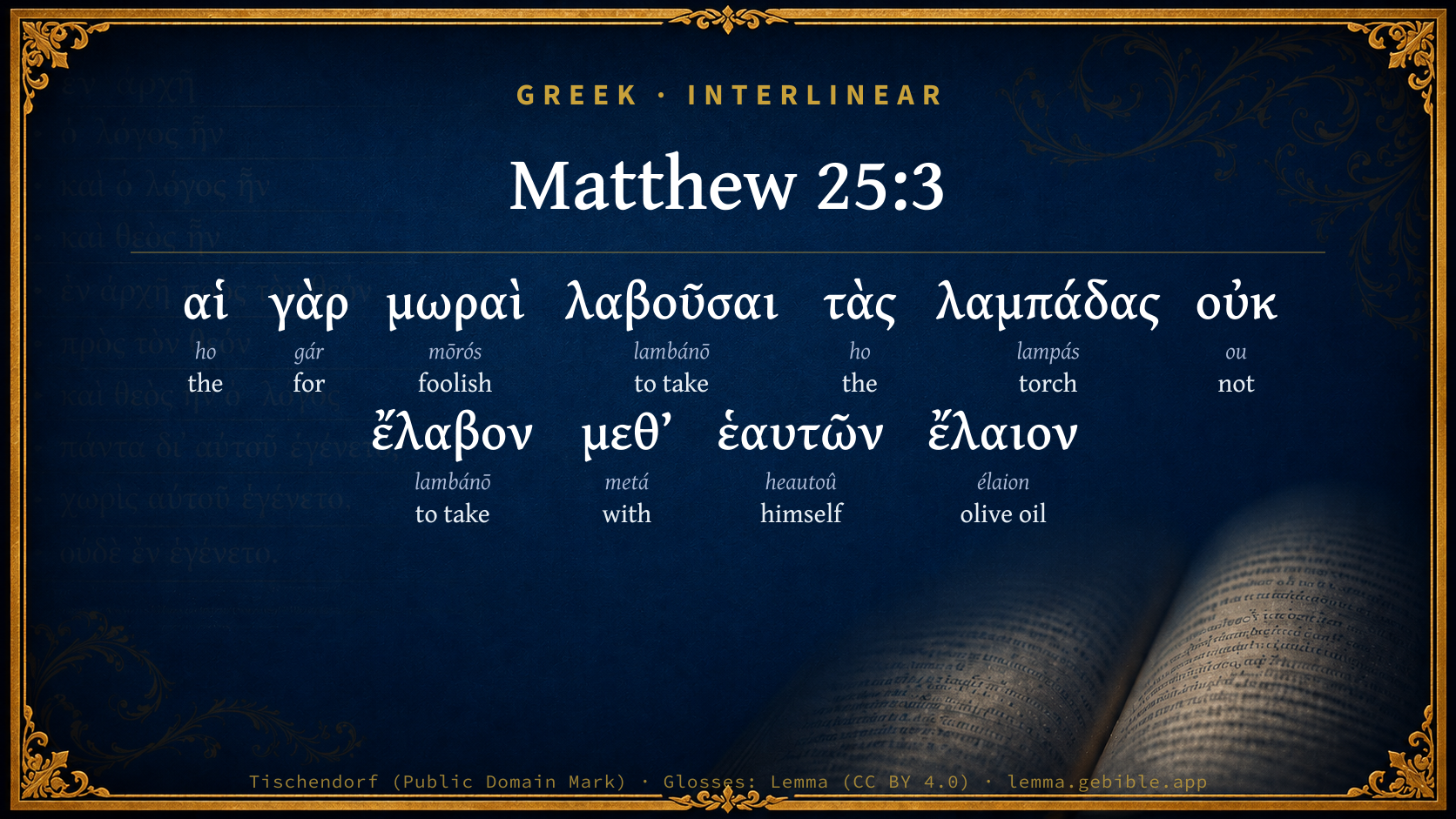
Those who were foolish, when they took their lamps, took no oil with them,
Download a study sheet
One document with this verse’s original text, its word-by-word gloss line, the meaning frame, cross-references with their text, attributed commentary, and full source and license credits — printable, and it pastes into notes with its structure intact.
This verse Autodidact and up
A passage Seminary Student
Up to 50 verses in one chapter. A passage sheet keeps up to 6 commentary sources and 12 cross-references per verse, in the order this page ranks them, and says so on the sheet whenever that leaves anything out. Ask for a single verse and you get the Autodidact verse sheet above.
Everything on this page stays free to read, with no account — the sheet is a download of what is already on screen, not access to it.
Compare translations 3
The same verse in 3 English versions, stacked beneath the original-language interlinear above. Click any original word for its lexicon entry.
Each is an independent rendering of the whole verse — the interlinear is not word-aligned to these translations.
Highlighted words mark where these versions differ — a whole-verse word diff, not a word-by-word alignment.
-
World English Bible Public Domain
Those who were foolish, when they took their lamps, took no oil with them,
-
King James Version Public Domain
They that were foolish took their lamps, and took no oil with them:
-
unfoldingWord Literal Text CC BY-SA 4.0
For the foolish, having taken their lamps, did not take oil with them.
unfoldingWord Literal Text — © unfoldingWord, licensed CC BY-SA 4.0. Word-aligned USFM3 via Door43 (git.door43.org/unfoldingWord/en_ult).
Show all 19 translations
Every available English version of this verse, each an independent rendering of the whole verse.
-
World English Bible Public Domain
Those who were foolish, when they took their lamps, took no oil with them,
-
Berean Standard Bible Public Domain
The foolish ones took their lamps but did not take along any extra oil.
-
Majority Standard Bible Public Domain
Those who were foolish took their lamps but did not take along any extra oil.
-
King James Version Public Domain
They that were foolish took their lamps, and took no oil with them:
-
American Standard Version (1901) Public Domain
For the foolish, when they took their lamps, took no oil with them:
-
Revised Version (1885) Public Domain
For the foolish, when they took their lamps, took no oil with them:
-
Geneva Bible (1599) Public Domain
The foolish tooke their lampes, but tooke none oyle with them.
-
Douay-Rheims (1899) Public Domain
But the five foolish, having taken their lamps, did not take oil with them:
-
Young's Literal Translation Public Domain
they who were foolish having taken their lamps, did not take with themselves oil;
-
Literal Standard Version CC BY-SA 4.0
they who were foolish having taken their lamps, did not take with themselves oil;
-
Unlocked Literal Bible CC BY-SA 4.0
For when the foolish virgins took their lamps, they did not take any oil with them.
-
unfoldingWord Literal Text CC BY-SA 4.0
For the foolish, having taken their lamps, did not take oil with them.
-
Darby Bible Public Domain
They that were foolish took their torches and did not take oil with them;
-
World Messianic Bible Public Domain
Those who were foolish, when they took their lamps, took no oil with them,
-
Webster's Bible Public Domain
They that were foolish took their lamps, and took no oil with them:
-
Free Bible Version CC BY-SA 4.0
The foolish girls took their lamps but didn't take any oil with them,
-
Bible in Basic English Public Domain
For the foolish, when they took their lights, took no oil with them.
-
Text-Critical English NT CC BY 4.0
When those who were foolish took their lamps, they did not take oil with them,
-
Tyndale New Testament (1534) Public Domain
The folysshe toke their lampes but toke none oyle with the.
Literal Standard Version (2020), Covenant Press — licensed CC BY-SA 4.0. Text via the HelloAO Bible API (eBible.org). Unlocked Literal Bible (unfoldingWord) — licensed CC BY-SA 4.0. Text via the HelloAO Bible API (eBible.org). unfoldingWord Literal Text — © unfoldingWord, licensed CC BY-SA 4.0. Word-aligned USFM3 via Door43 (git.door43.org/unfoldingWord/en_ult). Free Bible Version, Dr. Jonathan Gallagher — licensed CC BY-SA 4.0. Text via the HelloAO Bible API (eBible.org).
Word by word
More ways to search: Search by grammar → Find every occurrence → Compare this word →
Practice this passage: Drill this verse → Learn its vocabulary →
- Appears 9× in the Greek New Testament
- First appears at Matthew 25:1
- Part of Speech
- Noun
- Case
- Accusative
- Number
- Plural
- Gender
- Feminine
Full Thayer's Definition
- αἱ ho G3588 “the” Article, Nominative, Plural, Feminine
- γὰρ gár G1063 “for” Conjunction
- μωραὶ mōrós G3474 “foolish” Adjective, Nominative, Plural, Feminine
- λαβοῦσαι lambánō G2983 “to take” Verb, Aorist, Active, Participle, Nominative, Plural, Feminine
- τὰς ho G3588 “the” Article, Accusative, Plural, Feminine
- λαμπάδας lampás G2985 “torch” Noun, Accusative, Plural, Feminine
- οὐκ ou G3756 “not” Particle, Negative
- ἔλαβον lambánō G2983 “to take” Verb, Aorist, Active, Indicative, 3rd person, Plural
- μεθ’ metá G3326 “with” Preposition
- ἑαυτῶν heautoû G1438 “himself” Reflexive pronoun, 3rd person, Genitive, Plural, Feminine
- ἔλαιον élaion G1637 “olive oil” Noun, Accusative, Singular, Neuter
About this verse
These counts appear in no published source. They are computed here, from the morphology-tagged text and Lemma’s own curated glosses. What Lemma adds →
- 11
- words
- 9
- distinct lemmas
- Gospels
- section
Notable vocabulary
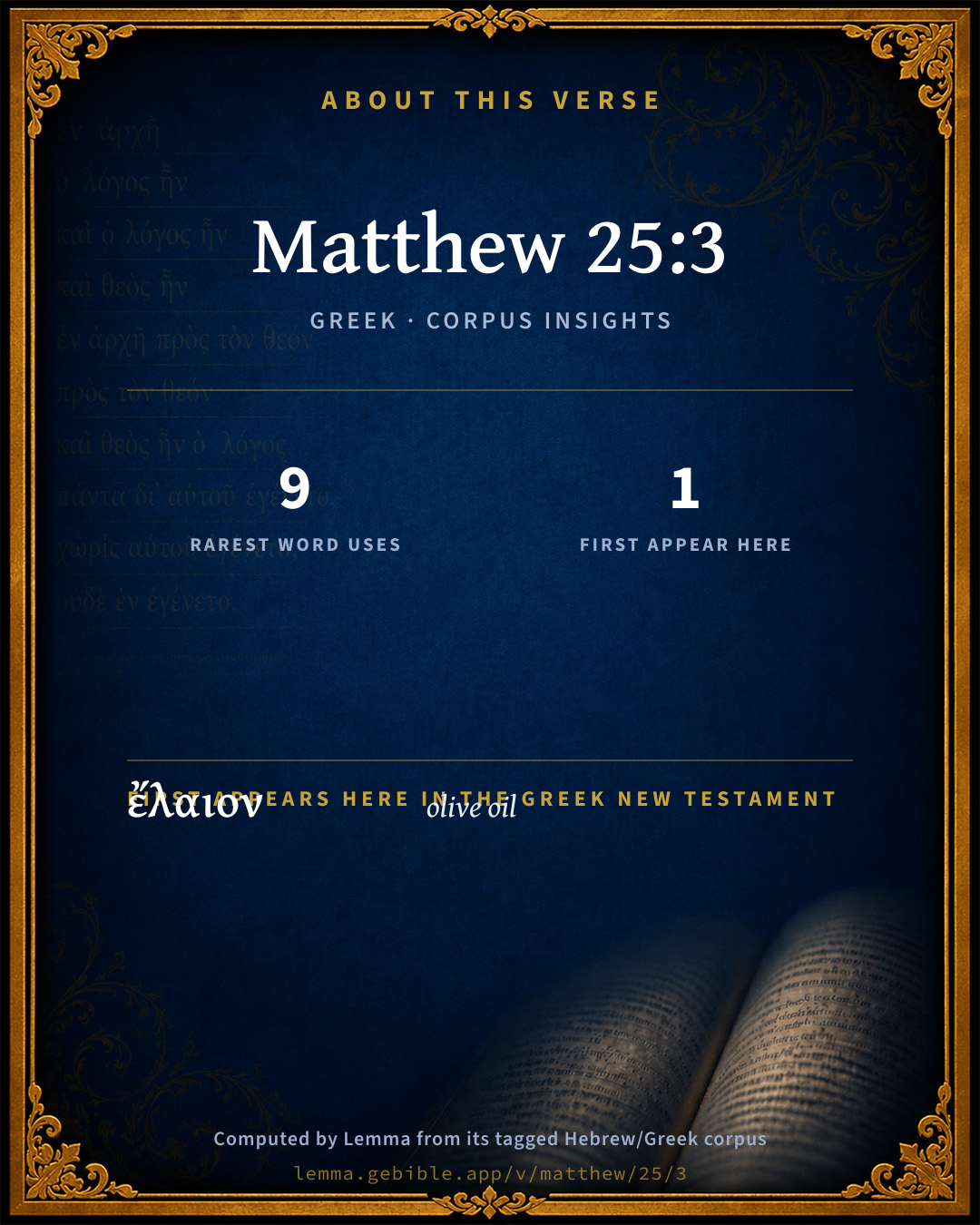
The rarest word here is λαμπάδας torch G2985 — appearing just 9 times in the whole Greek New Testament.
First appearance in Scripture
This word makes its first canonical appearance in the Greek New Testament here:
- ἔλαιον olive oil G1637
Shared distinctive vocabulary
λαμπάδας torch G2985 occurs in 9 verses of the Greek New Testament. Also found in:
Cross-references
7Topical passages linked to Matthew 25:3 in the Treasury of Scripture Knowledge — connected by theme and wording, ordered by reader-vote popularity; previews shown in the World English Bible.
- Revelation 3:15–16 "I know your works, that you are neither cold nor hot. I wish you were cold or hot.
- 2 Timothy 3:5 holding a form of godliness, but having denied the power thereof. Turn away from these, also.
- Isaiah 48:1–2 Hear you this, house of Jacob, who are called by the name of Israel, and are come forth out of the waters of Judah; who swear by the name of Yahweh, and make mention of the God of Israel, but not in truth, nor in righteousness
- Isaiah 58:2 Yet they seek me daily, and delight to know my ways: as a nation that did righteousness, and didn't forsake the ordinance of their God, they ask of me righteous judgments; they delight to draw near to God.
- Revelation 3:1 "And to the angel of the assembly in Sardis write: He who has the seven Spirits of God, and the seven stars says these things: "I know your works, that you have a reputation of being alive, but you are dead.
- Hebrews 12:15 looking carefully lest there be any man who falls short of the grace of God; lest any root of bitterness springing up trouble you, and thereby the many be defiled;
- Matthew 23:25–26 "Woe to you, scribes and Pharisees, hypocrites! For you clean the outside of the cup and of the platter, but within they are full of extortion and unrighteousness.
Cross-references courtesy of OpenBible.info (CC BY 4.0).
Lesson kit
Teaching starters — assembled from the data on this page, not authored interpretation. Every prompt links to the verse data it draws on. Edit before teaching.
Matthew, in the Gospels, opens this verse with 11 words (9 distinct Greek lemmas). Its most distinctive word is lampás (“torch”). A historical commentator’s framing appears above. Read the whole chapter for the surrounding context.
Discussion questions
- The word lampás carries the sense “torch.” How does it shape the verse?
- The word “olive oil” first appears here in Scripture. What is being introduced at this debut?
- Matthew 25:1 shares the word «torch» with this verse. How do the two illuminate each other?
- “to take” occurs 2× in this one verse. What is the effect of the repetition?
- The translations on this page render this verse differently — a whole-verse word diff, not a word-by-word alignment. What might account for the different wordings?
- Reading how Tyndale Open Study Notes and Bengel's Gnomon read this verse, where do the two commentators agree and where do they part?
Things to notice
- 1 word makes its first canonical appearance in Scripture here.
- These translations choose different wording for 7 words in this verse.
- “to take” occurs 2× in this single verse.
- 9 distinct Greek lemmas span 11 words in this verse.
Commentary
Notes on Matthew 25:3 from classic Christian and Jewish commentators (each source and its license shown beneath its notes). The classic Christian expositions comment on the surrounding passage and are grouped to its opening verse, so a note may address several verses; the Jewish commentaries on the Tanakh (Rashi and others) are per-verse, so they appear only where the commentator wrote on this verse.
Lemma curates 59 commentaries, every one of them public domain or Creative Commons licensed, each selected and text-cleaned for this edition rather than reprinted as found. About our sources →
Tyndale Open Study Notes
Tyndale Open Resources
Tyndale Open Study Notes — © Tyndale Open Resources, licensed CC BY-SA 4.0. Text via the HelloAO Bible API.
Bengel's Gnomon
Johann Albrecht Bengel
Bengel's Gnomon of the New Testament — English translation (T&T Clark, Edinburgh, 1860) — public domain. Text from a community e-Sword module.
Meyer's Critical & Exegetical Commentary
Heinrich August Wilhelm Meyer
Meyer — Critical and Exegetical Commentary on the New Testament — English translation by Peter Christie, edited by Frederick Crombie (T&T Clark, 1880) — public domain. Text from a community e-Sword module.
Expositor's Greek Testament
ed. W. Robertson Nicoll
The Expositor's Greek Testament, edited by W. Robertson Nicoll (1897–1910) — public domain. Text from a community e-Sword module.
Ellicott's Commentary for English Readers
A Bible Commentary for English Readers, edited by Charles John Ellicott (1878–1897) — public domain. Text from a community e-Sword module.
The Cambridge Bible for Schools and Colleges
gen. ed. J. J. S. Perowne
The Cambridge Bible for Schools and Colleges (gen. ed. J. J. S. Perowne; Cambridge University Press, 1878–1918) — public domain. Text from a community e-Sword module.
John Gill's Exposition
John Gill's Exposition of the Whole Bible (1746–1763) — public domain (CC PDM 1.0). Text via the HelloAO Bible API.
Trapp's Complete Commentary
John Trapp
John Trapp, A Commentary or Exposition upon All the Books of the Old and New Testament (1647–1656) — public domain. Text from a community e-Sword module.
Whedon's Commentary on the Bible
Daniel D. Whedon
Daniel D. Whedon (gen. ed.), Commentary on the Old and New Testaments (1874–1909) — public domain. Text from a community e-Sword module.
The Pulpit Commentary
The Pulpit Commentary (1880–1919), ed. H.D.M. Spence-Jones & Joseph S. Exell — public domain. Text from a community e-Sword module.
John Wesley's Explanatory Notes
John Wesley, Explanatory Notes Upon the Whole Bible (1754–1765) — public domain. Text via the GEBible commentary corpus.
Burkitt's Expository Notes on the New Testament
William Burkitt
William Burkitt's Expository Notes on the New Testament (1700–1703) — public domain. Text from a community e-Sword module.
The People's New Testament
B. W. Johnson
B. W. Johnson's The People's New Testament with Notes (1889–1891) — public domain. Electronic text from the Christian Classics Ethereal Library (CCEL) ThML edition.
Cambridge Greek Testament for Schools and Colleges
Cambridge Greek Testament for Schools and Colleges (Cambridge University Press, 1896; 21 vols, various authors incl. Carr, Maclear, Plummer, Farrar, Lumby, Moule, M. R. James, Simcox) — public domain. Text from a community e-Sword module.
International Critical Commentary
International Critical Commentary — older volumes (1896–1929), various authors — public domain. Text from a community e-Sword module.
Vincent's Word Studies in the New Testament
Marvin R. Vincent
Marvin R. Vincent, Word Studies in the New Testament (1887–1900) — public domain. Text from a community e-Sword/MySword module.