
Matthew 25:9

Greek (Tischendorf 8th ed.) Matthew 25:9 appears in the Greek New Testament. The text above is from the Tischendorf 8th edition. Each word links to its Strong’s number and a concise gloss. Click any word for its full Thayer’s Greek Lexicon entry.
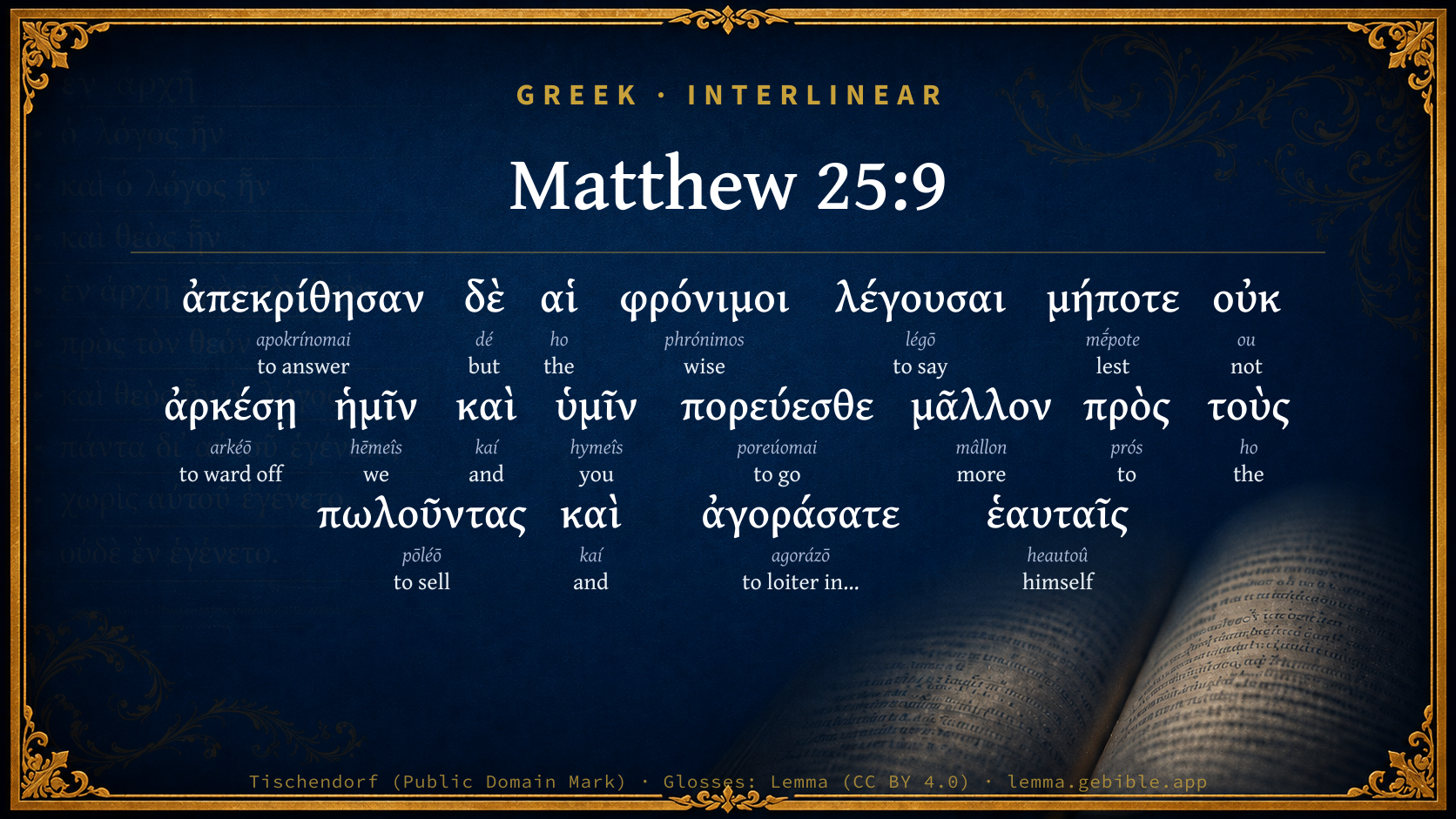
Download image
Cite this verse

Matthew 25:9 (World English Bible). Public Domain. Lemma interlinear Bible study tool, https://lemma.gebible.app/v/matthew/25/9.

Show BibTeX & RIS
BibTeX
RIS
English Translation
But the wise answered, saying, 'What if there isn't enough for us and you? You go rather to those who sell, and buy for yourselves.'
World English Bible · Public Domain
Highlights
  • 1 first appearance in the Greek New Testament
Full analysis ↓
Download a study sheet

One document with this verse’s original text, its word-by-word gloss line, the meaning frame, cross-references with their text, attributed commentary, and full source and license credits — printable, and it pastes into notes with its structure intact.

This verse Autodidact and up

Study sheet (.html) Plain text (.txt)

A passage Seminary Student

Up to 50 verses in one chapter. A passage sheet keeps up to 6 commentary sources and 12 cross-references per verse, in the order this page ranks them, and says so on the sheet whenever that leaves anything out. Ask for a single verse and you get the Autodidact verse sheet above.

Everything on this page stays free to read, with no account — the sheet is a download of what is already on screen, not access to it.

Want to remove ads? Support Godless Engineer
Compare translations 3

The same verse in 3 English versions, stacked beneath the original-language interlinear above. Click any original word for its lexicon entry.

Each is an independent rendering of the whole verse — the interlinear is not word-aligned to these translations.

Highlighted words mark where these versions differ — a whole-verse word diff, not a word-by-word alignment.

  • World English Bible Public Domain
    But the wise answered, saying, 'What if there isn't enough for us and you? You go rather to those who sell, and buy for yourselves.'
  • King James Version Public Domain
    But the wise answered, saying, Not so; lest there be not enough for us and you: but go ye rather to them that sell, and buy for yourselves.
  • unfoldingWord Literal Text CC BY-SA 4.0
    But the wise answered, saying, ‘Lest there not be enough for us and for you, go instead to the ones selling, and buy for yourselves.’

unfoldingWord Literal Text — © unfoldingWord, licensed CC BY-SA 4.0. Word-aligned USFM3 via Door43 (git.door43.org/unfoldingWord/en_ult).

Versions to compare (up to 4)

3 of 4 selected

Show all 19 translations

Every available English version of this verse, each an independent rendering of the whole verse.

  • World English Bible Public Domain
    But the wise answered, saying, 'What if there isn't enough for us and you? You go rather to those who sell, and buy for yourselves.'
  • Berean Standard Bible Public Domain
    ‘No,’ said the wise ones, ‘or there may not be enough for both us and you. Instead, go to those who sell oil and buy some for yourselves.’
  • Majority Standard Bible Public Domain
    ‘No,’ said the wise ones, ‘or there may not be enough for both us and you. Instead, go to those who sell oil and buy some for yourselves.’
  • King James Version Public Domain
    But the wise answered, saying, Not so; lest there be not enough for us and you: but go ye rather to them that sell, and buy for yourselves.
  • American Standard Version (1901) Public Domain
    But the wise answered, saying, Peradventure there will not be enough for us and you: go ye rather to them that sell, and buy for yourselves.
  • Revised Version (1885) Public Domain
    But the wise answered, saying, Peradventure there will not be enough for us and you: go ye rather to them that sell, and buy for yourselves.
  • Geneva Bible (1599) Public Domain
    But the wise answered, saying, Not so, lest there will not be ynough for vs and you: but goe ye rather to them that sell, and bye for your selues.
  • Douay-Rheims (1899) Public Domain
    The wise answered, saying: Lest perhaps there be not enough for us and for you, go ye rather to them that sell, and buy for yourselves.
  • Young's Literal Translation Public Domain
    and the prudent answered, saying -- Lest there may not be sufficient for us and you, go ye rather unto those selling, and buy for yourselves.
  • Literal Standard Version CC BY-SA 4.0
    and the prudent answered, saying, Lest there may not be sufficient for us and you, go rather to those selling, and buy for yourselves.
  • Unlocked Literal Bible CC BY-SA 4.0
    But the wise answered and said, 'Since there will not be enough for us and you, go instead to those who sell and buy some for yourselves.'
  • unfoldingWord Literal Text CC BY-SA 4.0
    But the wise answered, saying, ‘Lest there not be enough for us and for you, go instead to the ones selling, and buy for yourselves.’
  • Darby Bible Public Domain
    But the prudent answered saying, [We cannot,] lest it might not suffice for us and for you. Go rather to those that sell, and buy for yourselves.
  • World Messianic Bible Public Domain
    But the wise answered, saying, ‘What if there isn’t enough for us and you? You go rather to those who sell, and buy for yourselves.’
  • Webster's Bible Public Domain
    But the wise answered, saying, Not so; lest there be not enough for us and you: but go ye rather to them that sell, and buy for yourselves.
  • Free Bible Version CC BY-SA 4.0
    ‘No, because otherwise there won't be enough for both you and for us. Go to the shopkeepers and buy some oil for yourselves.’
  • Bible in Basic English Public Domain
    But the wise made answer, saying, There may not be enough for us and you; it would be better for you to go to the traders and get oil for yourselves.
  • Text-Critical English NT CC BY 4.0
    But the wise replied, ‘No, there will not be enough for us and for you. Instead, go to those who sell oil and buy some for yourselves.’
  • Tyndale New Testament (1534) Public Domain
    but the wyse answered sayinge. Not so lest ther be not ynough for vs and you: but goo rather to them that sell and by for youre selves.

Literal Standard Version (2020), Covenant Press — licensed CC BY-SA 4.0. Text via the HelloAO Bible API (eBible.org). Unlocked Literal Bible (unfoldingWord) — licensed CC BY-SA 4.0. Text via the HelloAO Bible API (eBible.org). unfoldingWord Literal Text — © unfoldingWord, licensed CC BY-SA 4.0. Word-aligned USFM3 via Door43 (git.door43.org/unfoldingWord/en_ult). Free Bible Version, Dr. Jonathan Gallagher — licensed CC BY-SA 4.0. Text via the HelloAO Bible API (eBible.org).

Word by word

More ways to search: Search by grammar → Find every occurrence → Compare this word →

Practice this passage: Drill this verse → Learn its vocabulary →

ἀρκέσῃ
arkéō
G714
“to ward off”
Verb, Aorist, Active, Subjunctive, 3rd person, Singular
Part of Speech
Verb
Tense
Aorist
Voice
Active
Mood
Subjunctive
Person
3rd person
Number
Singular
Full Thayer's Definition

Origin: apparently a primary word [but probably akin to G142 through the idea of raising a barrier]

TDNT: 08:44,8

1. to be possessed of unfailing strength a. to be strong, to suffice, to be enough 1. to defend, ward off b. to be satisfied, to be contented
  1. ἀπεκρίθησαν apokrínomai G611 “to answer” Verb, Aorist, Middle deponent, Indicative, 3rd person, Plural
  2. δὲ dé G1161 “but” Conjunction
  3. αἱ ho G3588 “the” Article, Nominative, Plural, Feminine
  4. φρόνιμοι phrónimos G5429 “wise” Adjective, Nominative, Plural, Feminine
  5. λέγουσαι légō G3004 “to say” Verb, Present, Active, Participle, Nominative, Plural, Feminine
  6. μήποτε mḗpote G3379 “lest” Adverb, Negative
  7. οὐκ ou G3756 “not” Particle, Negative
  8. ἡμῖν hēmeîs G2249 “we” Personal pronoun, 1st person, Dative, Plural
  9. καὶ kaí G2532 “and” Conjunction
  10. ὑμῖν hymeîs G5210 “you” Personal pronoun, 2nd person, Dative, Plural
  11. πορεύεσθε poreúomai G4198 “to go” Verb, Present, Middle or Passive deponent, Imperative, 2nd person, Plural
  12. μᾶλλον mâllon G3123 “more” Adverb
  13. πρὸς prós G4314 “to” Preposition
  14. τοὺς ho G3588 “the” Article, Accusative, Plural, Masculine
  15. πωλοῦντας pōléō G4453 “to sell” Verb, Present, Active, Participle, Accusative, Plural, Masculine
  16. καὶ kaí G2532 “and” Conjunction
  17. ἀγοράσατε agorázō G59 “to loiter in marketplace” Verb, Aorist, Active, Imperative, 2nd person, Plural
  18. ἑαυταῖς heautoû G1438 “himself” Reflexive pronoun, 2nd person, Dative, Plural, Feminine

About this verse

These counts appear in no published source. They are computed here, from the morphology-tagged text and Lemma’s own curated glosses. What Lemma adds →

19
words
17
distinct lemmas
Gospels
section

Notable vocabulary

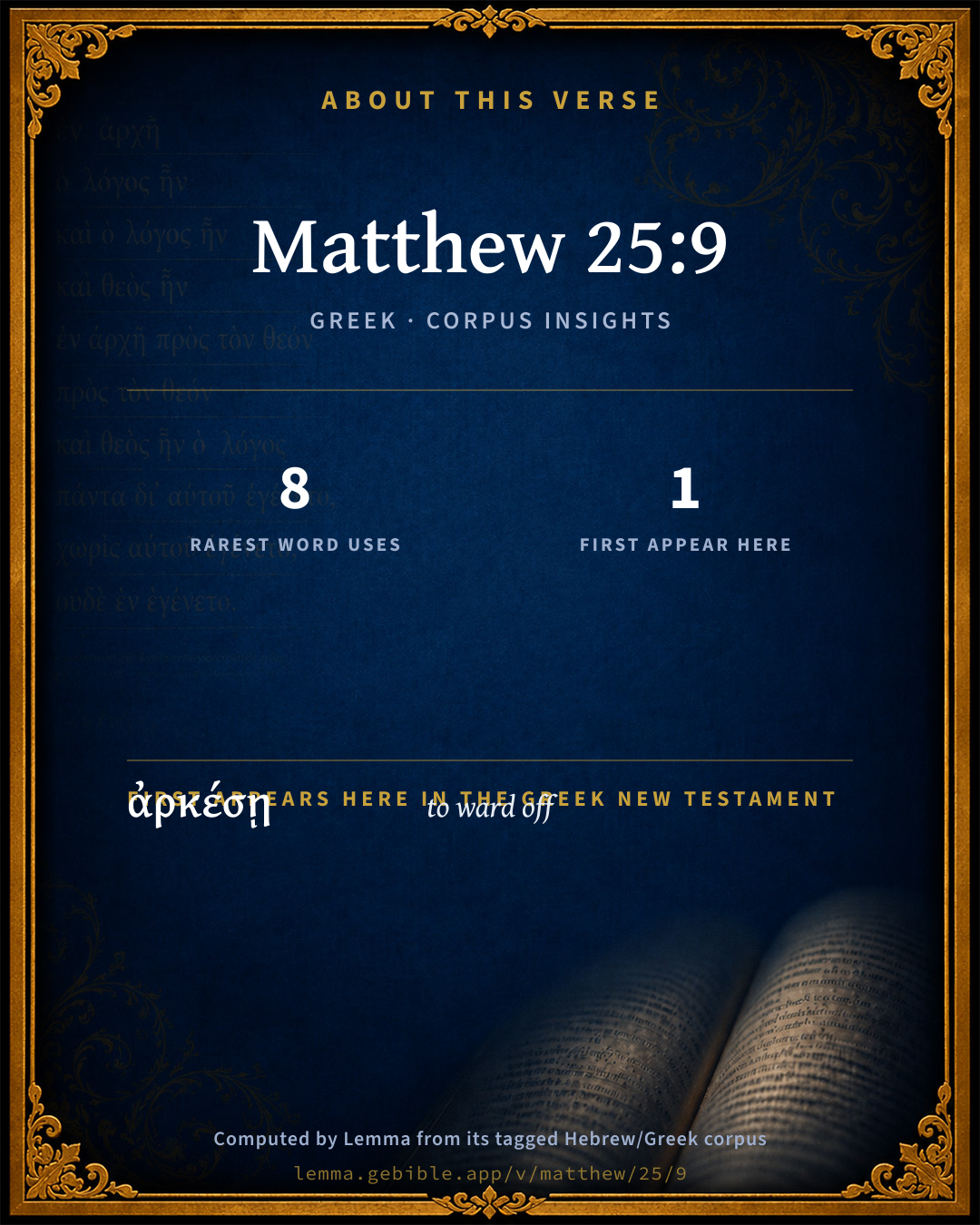
The rarest word here is ἀρκέσῃ to ward off G714 — appearing just 8 times in the whole Greek New Testament.

First appearance in Scripture

This word makes its first canonical appearance in the Greek New Testament here:

  • ἀρκέσῃ to ward off G714

Shared distinctive vocabulary

ἀρκέσῃ to ward off G714 occurs in 8 verses of the Greek New Testament. Also found in:
Repetition

Words recur within this verse:

Cross-references

8

Topical passages linked to Matthew 25:9 in the Treasury of Scripture Knowledge — connected by theme and wording, ordered by reader-vote popularity; previews shown in the World English Bible.

  • Psalms 49:7–9 None of them can by any means redeem his brother, Nor give God a ransom for him.
  • Revelation 3:17–18 Because you say, 'I am rich, and have gotten riches, and have need of nothing;' and don't know that you are the wretched one, miserable, poor, blind, and naked;
  • Isaiah 55:6–7 Seek you Yahweh while he may be found; call you on him while he is near:
  • Isaiah 55:1–3 Ho, everyone who thirsts, come you to the waters, and he who has no money; come you, buy, and eat; yes, come, buy wine and milk without money and without price.
  • Ezekiel 14:20 though Noah, Daniel, and Job, were in it, as I live, says the Lord Yahweh, they should deliver neither son nor daughter; they should but deliver their own souls by their righteousness.
  • Jeremiah 15:1 Then said Yahweh to me, Though Moses and Samuel stood before me, yet my mind would not be toward this people: cast them out of my sight, and let them go forth.
  • Ezekiel 14:14–16 though these three men, Noah, Daniel, and Job, were in it, they should deliver but their own souls by their righteousness, says the Lord Yahweh.
  • Acts 8:22 Repent therefore of this, your wickedness, and ask God if perhaps the thought of your heart may be forgiven you.

Cross-references courtesy of OpenBible.info (CC BY 4.0).

Commentary

Notes on Matthew 25:9 from classic Christian and Jewish commentators (each source and its license shown beneath its notes). The classic Christian expositions comment on the surrounding passage and are grouped to its opening verse, so a note may address several verses; the Jewish commentaries on the Tanakh (Rashi and others) are per-verse, so they appear only where the commentator wrote on this verse.

Lemma curates 59 commentaries, every one of them public domain or Creative Commons licensed, each selected and text-cleaned for this edition rather than reprinted as found. About our sources →

Joseph Benson's Commentary

Mat 25:9. But the wise answered, saying, Not so — The words, not so, are not in the Greek, which is only, μηποτε ουκ αρκεση ημιν και υμιν, lest it should not be sufficient for us and you. They begin the sentence abruptly, showing thereby their surprise at the state of those poor wretches who had so long deceived them, as well as their own souls. Lest there be not enough — It is sure there is not: for no man has more holiness than is sufficient for himself. Go ye rather to them that sell — Without money, and without price: That is, to God in Christ. And buy — If ye can. O no! The time is past, and returns no more. But this clause, Buy for yourselves, seems, as Dr. Doddridge observes, “merely an ornamental circumstance; and it is strange that any popish writers should consider it as favouring their doctrine of a stock of merits in the church, founded on works of supererogation; since, if it referred to them at all, (which there is no reason to imagine,) it would rather expose than encourage any dependance upon them.” Observe, reader, now only is the accepted time, and the day of salvation, when we may come to God through Christ, in the use of the means of grace, and buy for ourselves the divine oil, which will never fail us: nay, we are counselled and exhorted to do so: and if we despise and reject these counsels and exhortations, while they may be useful, our cries and wishes will be as surely rejected another day, and our vain attempts to purchase when the bridegroom is coming will issue in an eternal exclusion from his kingdom.

Joseph Benson's Commentary on the Old and New Testaments (1811–1818) — public domain. Text from a community e-Sword module.

Bengel's Gnomon

Johann Albrecht Bengel

Mat 25:9. Λέγουσαι, κ.τ.λ., saying, etc.) In this, as in everything else, they showed themselves prudent.—μήτοτε, κ.τ.λ., lest, etc.) A broken[1085] sentence, suitable to the hurry of that event.—οὐκ ἀρκέσῃ, there be not sufficient) sc. for both you and us: i.e. we cannot share with you: a metonomy of the consequent [for the antecedent]. Every one must live by his own faith.—ἡμῖν, for us) The prudent now have hardly[1086] enough for their own use. You ought previously to have followed the example of the prudent.—πορεύεσθε, κ.τ.λ., go ye, etc.) Let us do in time what will then prove to have been wise.—πρὸς τοὺς πωλοῦντας, to them that sell) although they are not traders [i.e. do not make salvation a matter of traffic].—ἀγοράσατε, buy) See Rev 3:18.

[1085] “Not so,” is not expressed in the original, which abruptly begins with “μήποτε,” “lest haply.”—ED.

[1086] “Ægre.” There is here an allusion to 1Pe 4:18, where Bengel renders μόλις (E. V. scarcely, Vulg. vix) by ægre. See Gnomon in loc.—(I. B.)

Bengel's Gnomon of the New Testament — English translation (T&T Clark, Edinburgh, 1860) — public domain. Text from a community e-Sword module.

Meyer's Critical & Exegetical Commentary

Heinrich August Wilhelm Meyer

Mat_25:9. Μήποτε … ὑμῖν] Since οὐ μή is the correct reading (see critical remarks), and seeing that the ἀρκέσῃ following cannot be regarded as dependent on μήποτε, but only on οὐ μή, the punctuation should be as follows: μήποτε· οὐ μὴ ἀρκέσῃ, κ.τ.λ.: never (shall we give you of our oil): there will certainly not be enough for us and you! For the absolute negative μὴ, comp. Mat_26:5; Exo_10:11; Matthiae, p. 1454; Kühner, II. 2, p. 1047. Correctly Bornemann, as above, p. 110; Bleek, Lange, Luthardt. Comp. Winer, p. 556 [E. T. 632]; Ellendt, Lex. Soph. II. p. 107.

Meyer — Critical and Exegetical Commentary on the New Testament — English translation by Peter Christie, edited by Frederick Crombie (T&T Clark, 1880) — public domain. Text from a community e-Sword module.

Expositor's Greek Testament

ed. W. Robertson Nicoll

Mat 25:9 . μήποτε , lest, implying, and giving a reason for, an unexpressed declinature. Kypke renders, perhaps, fortasse , citing examples from classics, also Loesner, giving examples from Philo. Elsner suggests that ὁρᾶτε or βλέπετε is understood before μήποτε . Schott, putting a comma after ὑμῖν , and omitting δὲ after πορεύεσθε , translates thus: lest perchance there be not enough for us and you, go rather to them that sell, etc. (“ne forte oleum neque nobis neque vobis sufficiat, abite potius,” etc.). πορεύεσθε , etc.: this seems a cold, ungenerous suggestion on the part of the wise, and apparently untrue to what was likely to occur among girls at such a time. Could the oil really be got at such a time of night? and, supposing it could, would going not throw them out of the festivities? Augustine says: “non consulentium sed irridentium est ista responsio” (Serm. xc., iii., 8). More humanely, in the modern spirit, Koetsveld suggests that the marriage procession to music and song was very slow, and that there was a fair chance of overtaking it after the purchase ( De Gelijk. , p. 220). Let us hope so; but I fear we must fall back on the fact that “sudden emergencies bring into play a certain element of selfishness,” and take the advice of the wise as simply a refusal to be burdened with their neighbours’ affairs

The Expositor's Greek Testament, edited by W. Robertson Nicoll (1897–1910) — public domain. Text from a community e-Sword module.

Adam Clarke's Commentary

Verse 9. Lest there be not enough for us and you] These had all been companions in the Christian course, and there was a time when they might have been helpful to each other; but that time is now past for ever-none has a particle of grace to spare, not even to help the soul of the dearest relative! The grace which every man receives is just enough to save his own soul; he has no merits to bequeath to the Church; no work of supererogation which can be placed to the account of another.

Go ye rather to them that sell, and buy] By leaving out the particle δε, but, (on the indisputable authority of ABDGHKS, and HV, of Matthai, with sixteen others, the Armenian, Vulgate, and all the Itala but one,) and transposing a very little the members of the sentence, the sense is more advantageously represented, and the reading smoother: Rather go to them that sell, and buy for yourselves, lest there be not enough for us and you. Beza, Mill, Bengel, and Griesbach, approve of the omission of the particle δε

Adam Clarke's Commentary on the Bible (1810–1826) — public domain. Text from a community e-Sword/MySword module.

Ellicott's Commentary for English Readers

(9) Not so.—The words, as the italics show, are not in the Greek. They are, perhaps, necessary to complete the sense in English; but there is a tone of regretful tenderness in the way in which, in the original, the wise virgins give the reason that makes compliance with the request impossible, without directly uttering a refusal.

Go ye rather to them that sell.—This feature in the parable is too remarkable to be passed over lightly, especially as the “exchangers” in the parable that follows are clearly more or less analogous. We have to ask, then, who they are that, in the interpretation of the parable, according to the data already ascertained, answer to “them that sell.” And the answer is, that they are the pastors and teachers of the Church—the stewards of the mysteries of God. Through them, whether as preachers of the divine Word of Wisdom, or as administering the sacraments which are signs and means of grace, men may, by God’s appointment, obtain the gift and grace they need. The “buying” and “selling” belong, of course, in their literal sense, to the parable only. No gift of God can be purchased with money (Act_8:20). But the words are not, therefore, any more than in Mat_13:44-46 (where see Notes), destitute of meaning. Men may “buy” the truth which they are not to sell (Pro_23:23). They are invited to buy the “wine and milk,” which symbolise God’s spiritual gifts, “without money and without price” (Isa_55:1). The price that God requires is the consecration of their heart (Pro_23:26).

A Bible Commentary for English Readers, edited by Charles John Ellicott (1878–1897) — public domain. Text from a community e-Sword module.

The Cambridge Bible for Schools and Colleges

gen. ed. J. J. S. Perowne

9. lest there be not enough for us and you] The bridal procession was still to be made in which there would be need of burning lamps. The wise cannot impart their oil:—an incident necessary to the leading idea of the parable;—nothing can make up for unreadiness at the last moment. This point has been adduced as an argument against works of supererogation.

Not so; lest there be not] Accepting a variation in the text adopted by Lachmann and Tregelles and Meyer, translate “Not so;” (which now comes into the text,) “there will surely not be enough,” &c.

The Cambridge Bible for Schools and Colleges (gen. ed. J. J. S. Perowne; Cambridge University Press, 1878–1918) — public domain. Text from a community e-Sword module.

John Gill's Exposition

But the wise answered, saying, not so,.... A flat denial; and which sprung not from want or compassion; for the saints are taught not only to compassionate one another, and to pity fallen professors, but even to regard their very enemies in distress: nor from a narrow, niggardly spirit, since such are directed and exhorted to communicate freely, both in things temporal and spiritual, they are capable of, to them that are in need, and even to lay down their lives for the brethren; nor from an uncivil, morose, and churlish disposition; or from a careless and indolent one, as being unconcerned what became of these persons; but from an indignation at the honour put upon them, and the slight put upon God and Christ, and the Spirit of grace: saints know that all grace comes from Father, Son, and Spirit; and frankly own, that what they have is from thence; and they give God all the glory of it, and cannot bear any such application to them for it, as this; but show the same spirit, as Paul and Barnabas did, when the Lystrians were going to sacrifice to them. Moreover, this denial arose from a consciousness of insufficiency to help them in this respect: it is the saints' mercy that they cannot lose the grace they have, nor can any take it away from them, and it is not in their power to give it away; nor can any be sanctified, or justified, or saved, by another man's grace: the reason alleged by them is,

lest there be not enough for us and you; saints have a large abundance of grace communicated to them; some have more, others less; at least it so appears, as to exercise; but they that have the most, have none to spare, and see their need of more; and ask for more, being sensible that present grace in them, is not sufficient for time to come, but grace in Christ only; wherefore their answer, and the reason of it, were like themselves, wise; and this destroys the notion of supererogation;

but go ye rather to them that sell, and buy for yourselves. This advice is thought by some, to be ironical and sarcastic; but it seems rather to be serious, and in good earnest; directing them to go to proper persons for grace; not to men, even ministers of the Gospel, nor to angels; but to God the Father, the Father of mercies, and God of all comfort, who sits on a throne of grace, and gives it liberally to them that come to him for it through Christ, and ask it of him; and to Christ the mediator, who is full of grace and truth, and counsels persons to buy of him gold tried in the fire, grace more precious than the purest gold; and to the Spirit of grace, who gives it to all severally as he will: who are said to "sell", and "men" to buy; not in a proper sense, by giving any valuable consideration for the grace of God, which is impossible to be done; but in an improper sense, without money and without price; or in other words, by giving and receiving freely.

John Gill's Exposition of the Whole Bible (1746–1763) — public domain (CC PDM 1.0). Text via the HelloAO Bible API.

Trapp's Complete Commentary

John Trapp

9 But the wise answered, saying, Not so; lest there be not enough for us and you: but go ye rather to them that sell, and buy for yourselves.

Ver. 9. Lest there be not enough, &c.] The best have nought to spare, whatever Papists fancy of the church treasury. The righteous is scarcely saved; at death he finds all he could do little enough; though he began early, and bestirred himself to his utmost, hard and scarce gets he to heaven, though he hath instantly served God day and night, Act 26:7, with a kind of extension and vehemency (εν εκτενεια).

But go ye rather to them that sell] Salsa est derisio non cohortatio, like that, Isa 47:13. As if God should say to Papists, Go to your indulgencers, pardon mongers, annealers; {a} or to carnal gospellers, Go to your parasitical preachers, that have soothed you up in your sins (and ye loved to have it so), or at the best, have shot off a few pop guns only against gross sins, and licked you whole again presently with, I hope better things of you.

{a} To burn in colours upon glass, earthenware, or metal, to enamel by encaustic process. ŒD

John Trapp, A Commentary or Exposition upon All the Books of the Old and New Testament (1647–1656) — public domain. Text from a community e-Sword module.

Haydock's Catholic Bible Commentary

Go ye rather to them that sell. The wise virgins do not there advise the foolish to go and buy, but upbraid them for the poor store of good works they have laid up. They had before only sought the praises of men in their good actions, and therefore are answered by the wise: "go now to those to whom you have given all your actions; go and see what their praises will avail, what peace of conscience they can give you: and, if they have praised you, and made you esteemed in the eyes of men, see if they can do the same before God." (St. Augustine)

George Leo Haydock (1774–1849), Haydock's Catholic Family Bible and Commentary, 1859 edition — public domain. Excludes Psalms (Douay-Rheims chapter numbering differs from Protestant) and Deuterocanonical books (Catholic canon only).

Whedon's Commentary on the Bible

Daniel D. Whedon

9. Lest there be not enough for us — Here is a striking denial of the Romish doctrine of supererogation, by which the merits of particular saints may by surplus save other persons. The righteous are scarcely saved. After we have done all, we are unprofitable servants. We are saved not by works of righteousness which we have done, but by the merits of the Lord our righteousness. Go ye rather to them that sell — This is added to show how utterly too late it is. The wise give the only counsel that thought can devise, but it is a plain impossibility. The judgment is too near, and the remedy is beyond all reach.

Daniel D. Whedon (gen. ed.), Commentary on the Old and New Testaments (1874–1909) — public domain. Text from a community e-Sword module.

The Pulpit Commentary

Not so; lest there be not enough (mhpote ou mh arkesh , haply it will not suffice). Edersheim renders, "Not at all it will never suffice for us and you," in order to give the force of the double negation. In Aristotle, mhpote is often equivalent to "perhaps," e.g. "Eth. Nic.," 10:1. 3. "Even so they failed," says St. Chrysostom, "and neither the humanity of those of whom they begged, nor the easiness of their request, nor their necessity and want, made them obtain their petition. And what do we learn from hence? That no man can protect us there if we are betrayed by our works; not because he will not, but because he cannot. For these, too, take refuge in the impossibility. This the blessed Abraham also indicated, saying, "Between us and you there is a great gulf," so that not even when willing is it permitted them to pass it." But (probably spurious) go ye rather to them that sell. The answer is not harsh, and the advice is not ironical or unkind. The wise cannot of themselves supply the lack. They have no superabundant store of grace to communicate to others; at best even they are unprofitable servants; the righteous shall scarcely be saved; so they direct their companions to the only source where effectual grace may be obtained. They that sell are the ministers and stewards of Christ"s mysteries, who dispense the means of grace. These are said to be bought, as the treasure hid in the field or the pearl of great price is bought. (Mat_13:44-46) Divine grace can always be procured by those who will pay the price thereof; and the price is faith and prayer and earnestness, nothing more, nothing less. (Isa_55:1 Rev_3:18) But the time is short; delay is fatal; hence the counsel so urgently given, "Go ye," etc. Buy for yourselves. This is important. Every one must bear his own burden. The grace must be their own; what is required of those who would meet the Bridegroom without shame and fear is personal preparation, personal faith and holiness. We shall be judged individually; our Christian virtues must be entirely our own, wrought in us by the grace of God, with which we have humbly and thankfully cooperated. It is curious that some ancient and modern commentators see in this part of the parable, only an ornamental detail without special signification.

The Pulpit Commentary (1880–1919), ed. H.D.M. Spence-Jones & Joseph S. Exell — public domain. Text from a community e-Sword module.

John Wesley's Explanatory Notes

But the wise answered, Lest there be not enough for us and you! - Beginning the sentence with a beautiful abruptness; such as showed their surprise at the state of those poor wretches, who had so long received them, as well as their own souls. Lest there be not enough - It is sure there is not; for no man has more than holiness enough for himself. Go ye rather to them that sell - Without money and without price: that is, to God, to Christ. And buy - If ye can. O no! The time is past and returns no more!

John Wesley, Explanatory Notes Upon the Whole Bible (1754–1765) — public domain. Text via the GEBible commentary corpus.

Burkitt's Expository Notes on the New Testament

William Burkitt

Observe here, 1. The wise virgin’s denial, Not so; they will part with no oil.

Learn hence, That it must be the care of every one to get grace of his own, otherwise the grace of others will do him no good. It is not what others have done, that will save us, without our own endeavours.

Observe, 2. The reason of their denial, Lest there be not enough for us and you.

Thence note, That such Christians as have most grace, or the largest stock of grace, have none to spare; none to spare in regard of their occasions for grace on earth, and in regard of their expectations of glory in heaven.

Observe, 3. The advice and counsel given; Go to them that sell, and buy for yourselves. Some take this for an exhortation, others for a mocking derision. Go to them that sell: That is, say some, to the shop of the ordinances where it may be had.

Thence note, That such as would have grace, must have timely recourse to the ordinances and means of grace: Go to them, and buy. Others understand the words ironically, and as spoken by way of derision, Go to them that sell, if you know where to find them, and either buy or borrow for yourselves.

Learn thence, That it is the greatest folly in the world to have oil to buy, when we should have oil to burn; to have our grace to seek, when we should have it to exert and exercise. It is no time to get grace when the Bridegroom is come, and the day of grace is past and over.

William Burkitt's Expository Notes on the New Testament (1700–1703) — public domain. Text from a community e-Sword module.

The People's New Testament

B. W. Johnson

9. Lest there be not enough for us and you. The wise virgins had sufficient for themselves, but none to spare, hence could be of no help. No one has a fund of surplus piety that he can turn over to someone else. Go ye, … buy for yourselves. The advice is the best possible. Every one had to procure for himself the needful grace and piety.

B. W. Johnson's The People's New Testament with Notes (1889–1891) — public domain. Electronic text from the Christian Classics Ethereal Library (CCEL) ThML edition.

Cambridge Greek Testament for Schools and Colleges

9. οὐκ ἀρκέσῃ is upheld with אALZ of the uncials against οὐ μὴ ἀρκέσῃ with BCD and several late uncials. See Winer, p. 632, and Dr Moulton’s note 3. This is the first appeal to Codex A.

9. Μήποτε οὐκ ἀρκέσῃ ἡμῖν καὶ ὑμῖν. The bridal procession was still to be made in which there would be need of burning lamps. The wise cannot impart their oil:—an incident necessary to the leading idea of the parable;—nothing can make up for unreadiness at the last moment. This point has been adduced as an argument against works of supererogation.

μήποτε οὐκ ἀρκέσῃ. ‘Lest haply it suffice not.’ There is an ellipse of a refusal or of a word signifying fear. The reading οὐ μὴ ἀρκ. need not alter the construction, οὐ μὴ being merely a strengthened negative; but by some μήποτε is taken by itself, ‘no, in no wise.’

Cambridge Greek Testament for Schools and Colleges (Cambridge University Press, 1896; 21 vols, various authors incl. Carr, Maclear, Plummer, Farrar, Lumby, Moule, M. R. James, Simcox) — public domain. Text from a community e-Sword module.

Alford’s Greek Testament

Henry Alford

9.] σβ., are going out,—not as E. V., and even recently Bp. Wordsw. to support his interpretation of ver. 5,—‘are gone out:’ and there is deep truth in this: the lamps of the foolish virgins are not extinguished altogether.

μήπ. οὐ μὴ ἀρ.] see Psa 49:7: Rom 14:12. No man can have more of this provision than will supply his own wants.

πορεύεσθε] This is not said in mockery, as some (Luther, Calv.) suppose: but in earnest.

οἱ πωλοῦντες are the ordinary dispensers of the means of grace—ultimately of course God Himself, who alone can give his Spirit. The counsel was good, and well followed—but the time was past. (Observe that those who sell are a particular class of persons—no mean argument for a set and appointed ministry—and moreover for a paid ministry. If they sell, they receive for the thing sold: cf. our Lord’s saying, Luk 10:7. This selling bears no analogy with the crime of Simon Magus in Acts 8: cf. our Lord’s other saying, Mat 10:8.)

Henry Alford, The Greek Testament (1849–1861) — public domain. Text from a community e-Sword module.

International Critical Commentary

9. But the wise answered, saying, There might not be sufficient for us and for you: go rather to the dealers, and buy for yourselves.]

(L)

9. μήποτε οὐ μὴ ἀρκέσῃ] So B C D al. א A L Z have οὐκ for οὐ μή; cf. Blass, pp. 213, 255, 256; Moulton, 192.

International Critical Commentary — older volumes (1896–1929), various authors — public domain. Text from a community e-Sword module.

Vincent's Word Studies in the New Testament

Marvin R. Vincent

Not so, lest, etc. [μηποτε ου μη αρκεση] . The Greek does not give the blunt negative of the A. V. It is a more courteous form of refusal, making the reason for refusing to supply the place of the negative. Give us of your oil, say the foolish. The wise reply, Lest perchance there be not by any means [ου μη, τηε δουβλε νεγατιςε] enough. The Rev. gives it very happily. Per adventure there will not be enough, etc.

Marvin R. Vincent, Word Studies in the New Testament (1887–1900) — public domain. Text from a community e-Sword/MySword module.

Lesson kit

Teaching starters — assembled from the data on this page, not authored interpretation. Every prompt links to the verse data it draws on. Edit before teaching.

Matthew, in the Gospels, opens this verse with 19 words (17 distinct Greek lemmas). Its most distinctive word is arkéō (“to ward off”). A historical commentator’s framing appears above. Read the whole chapter for the surrounding context.

Discussion questions

  1. What does “to ward off” (arkéō) contribute to the verse as a whole?
  2. The word “to ward off” first appears here in Scripture. What is being introduced at this debut?
  3. Luke 3:14 shares the word «to ward off» with this verse. How do the two illuminate each other?
  4. “the” occurs 2× in this one verse. What is the effect of the repetition?
  5. These translations render this verse differently; the difference is in the English rendering, not the original. What questions does that raise?
  6. Reading how Joseph Benson's Commentary and Bengel's Gnomon read this verse, where do the two commentators agree and where do they part?

Things to notice

  • 1 word makes its first canonical appearance in Scripture here.
  • These translations choose different wording for 9 words in this verse.
  • “the” occurs 2× in this single verse.
  • 17 distinct Greek lemmas span 19 words in this verse.

Reading settings

Reading text

Shown beneath each verse's original-language words.

Old Testament
Old Testament edition

Read the OT as the Masoretic Hebrew (MT) or the Greek Septuagint (LXX).

English shown for the Greek Septuagint (in the Hebrew ↔ Greek comparison).

Comparing translations? Open the Compare panel on any verse page to stack up to four side by side.