
Matthew 22:17

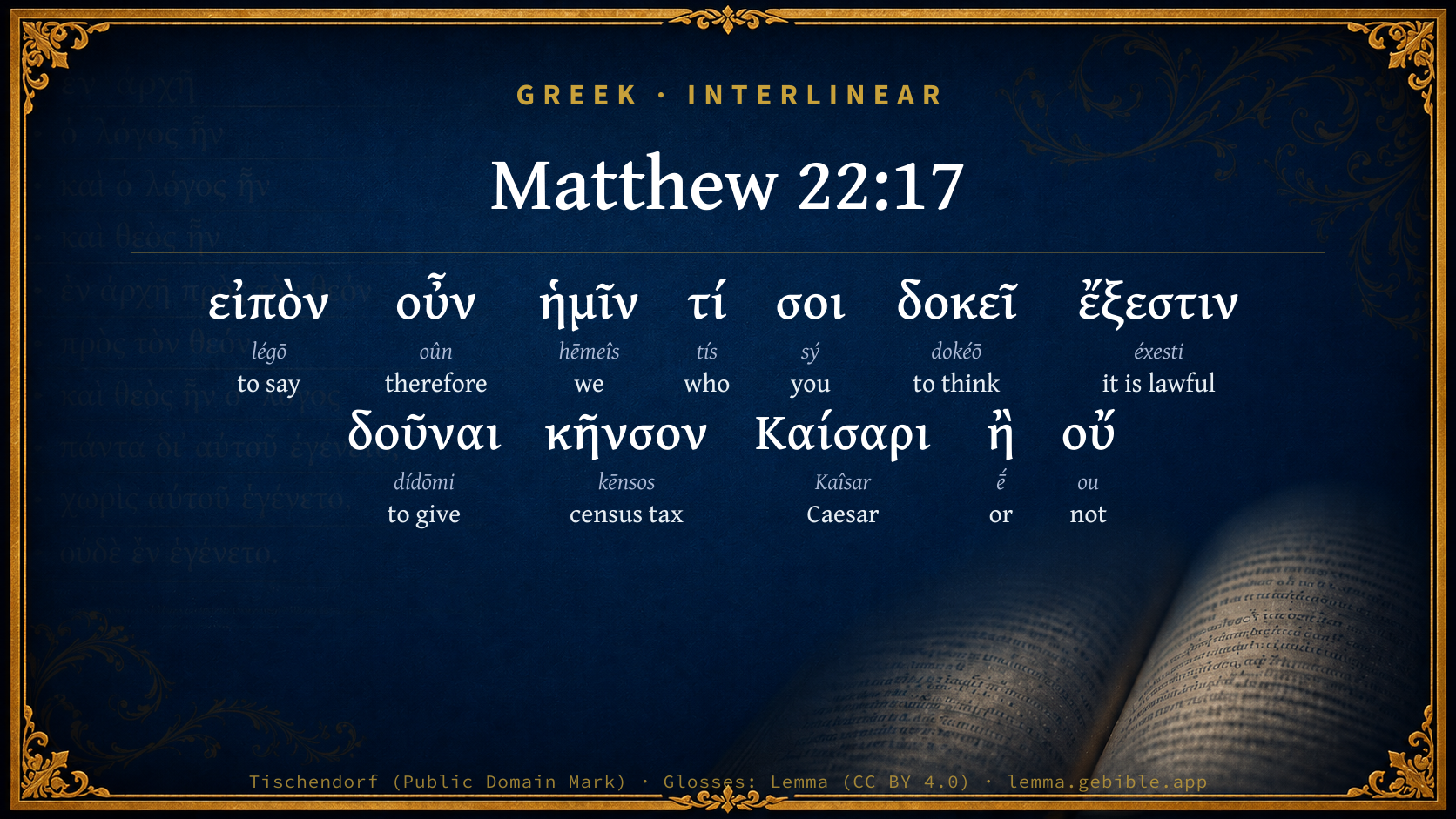
Greek (Tischendorf 8th ed.) Matthew 22:17 appears in the Greek New Testament. The text above is from the Tischendorf 8th edition. Each word links to its Strong’s number and a concise gloss. Click any word for its full Thayer’s Greek Lexicon entry.
Download image
Cite this verse

Matthew 22:17 (World English Bible). Public Domain. Lemma interlinear Bible study tool, https://lemma.gebible.app/v/matthew/22/17.

Show BibTeX & RIS
BibTeX
RIS
English Translation
Tell us therefore, what do you think? Is it lawful to pay taxes to Caesar, or not?"
World English Bible · Public Domain
Highlights
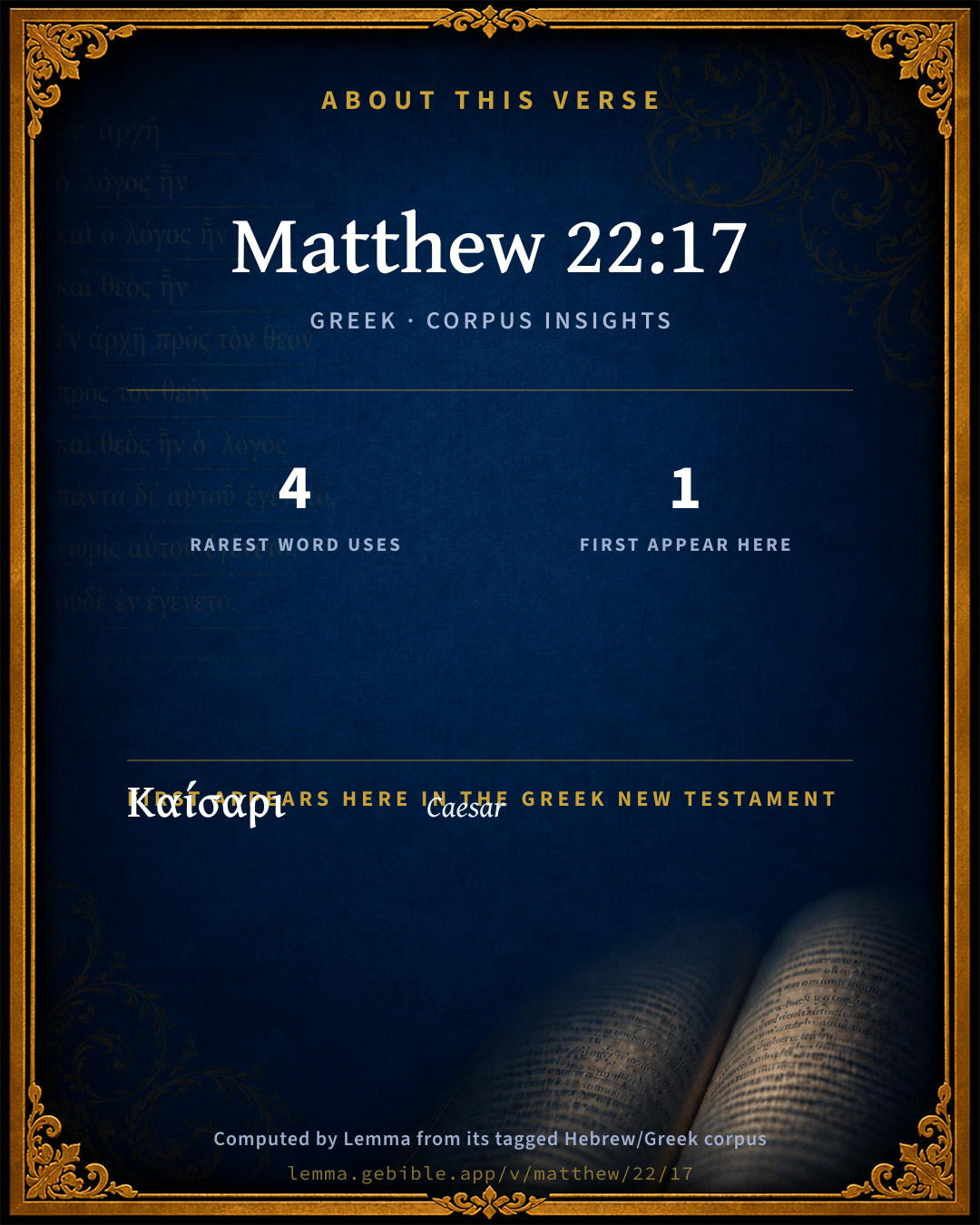
  • 1 first appearance in the Greek New Testament
Full analysis ↓
Download a study sheet

One document with this verse’s original text, its word-by-word gloss line, the meaning frame, cross-references with their text, attributed commentary, and full source and license credits — printable, and it pastes into notes with its structure intact.

This verse Autodidact and up

Study sheet (.html) Plain text (.txt)

A passage Seminary Student

Up to 50 verses in one chapter. A passage sheet keeps up to 6 commentary sources and 12 cross-references per verse, in the order this page ranks them, and says so on the sheet whenever that leaves anything out. Ask for a single verse and you get the Autodidact verse sheet above.

Everything on this page stays free to read, with no account — the sheet is a download of what is already on screen, not access to it.

Want to remove ads? Support Godless Engineer
Compare translations 3

The same verse in 3 English versions, stacked beneath the original-language interlinear above. Click any original word for its lexicon entry.

Each is an independent rendering of the whole verse — the interlinear is not word-aligned to these translations.

Highlighted words mark where these versions differ — a whole-verse word diff, not a word-by-word alignment.

  • World English Bible Public Domain
    Tell us therefore, what do you think? Is it lawful to pay taxes to Caesar, or not?"
  • King James Version Public Domain
    Tell us therefore, What thinkest thou? Is it lawful to give tribute unto Caesar, or not?
  • unfoldingWord Literal Text CC BY-SA 4.0
    Therefore, tell us, what do you think? Is it lawful to give a poll tax to Caesar, or not?”

unfoldingWord Literal Text — © unfoldingWord, licensed CC BY-SA 4.0. Word-aligned USFM3 via Door43 (git.door43.org/unfoldingWord/en_ult).

Versions to compare (up to 4)

3 of 4 selected

Show all 19 translations

Every available English version of this verse, each an independent rendering of the whole verse.

  • World English Bible Public Domain
    Tell us therefore, what do you think? Is it lawful to pay taxes to Caesar, or not?"
  • Berean Standard Bible Public Domain
    So tell us what You think: Is it lawful to pay taxes to Caesar or not?”
  • Majority Standard Bible Public Domain
    So tell us what You think: Is it lawful to pay taxes to Caesar or not?”
  • King James Version Public Domain
    Tell us therefore, What thinkest thou? Is it lawful to give tribute unto Caesar, or not?
  • American Standard Version (1901) Public Domain
    Tell us therefore, What thinkest thou? Is it lawful to give tribute unto Caesar, or not?
  • Revised Version (1885) Public Domain
    Tell us therefore, What thinkest thou? Is it lawful to give tribute unto Caesar, or not?
  • Geneva Bible (1599) Public Domain
    Tell vs therefore, how thinkest thou? Is it lawfull to giue tribute vnto Cesar, or not?
  • Douay-Rheims (1899) Public Domain
    Tell us therefore what dost thou think, is it lawful to give tribute to Caesar, or not?
  • Young's Literal Translation Public Domain
    tell us, therefore, what dost thou think? is it lawful to give tribute to Caesar or not?'
  • Literal Standard Version CC BY-SA 4.0
    tell us, therefore, what do You think? Is it lawful to give tribute to Caesar or not?”
  • Unlocked Literal Bible CC BY-SA 4.0
    So tell us, what do you think? Is it lawful to pay taxes to Caesar or not?”
  • unfoldingWord Literal Text CC BY-SA 4.0
    Therefore, tell us, what do you think? Is it lawful to give a poll tax to Caesar, or not?”
  • Darby Bible Public Domain
    tell us therefore what thou thinkest: Is it lawful to give tribute to Caesar, or not?
  • World Messianic Bible Public Domain
    Tell us therefore, what do you think? Is it lawful to pay taxes to Caesar, or not?”
  • Webster's Bible Public Domain
    Tell us therefore, What thinkest thou? Is it lawful to give tribute to Cesar, or not?
  • Free Bible Version CC BY-SA 4.0
    So let us know your opinion. Is it right to pay Caesar's taxes, or not?”
  • Bible in Basic English Public Domain
    Give us, then, your opinion of this: Is it right to give tax to Caesar, or not?
  • Text-Critical English NT CC BY 4.0
    Tell us then, what do yoʋ think? Is it lawful to pay taxes to Caesar or not?”
  • Tyndale New Testament (1534) Public Domain
    Tell vs therfore: how thynkest thou? Is it lawfull to geve tribute vnto Cesar or not?

Literal Standard Version (2020), Covenant Press — licensed CC BY-SA 4.0. Text via the HelloAO Bible API (eBible.org). Unlocked Literal Bible (unfoldingWord) — licensed CC BY-SA 4.0. Text via the HelloAO Bible API (eBible.org). unfoldingWord Literal Text — © unfoldingWord, licensed CC BY-SA 4.0. Word-aligned USFM3 via Door43 (git.door43.org/unfoldingWord/en_ult). Free Bible Version, Dr. Jonathan Gallagher — licensed CC BY-SA 4.0. Text via the HelloAO Bible API (eBible.org).

Word by word

More ways to search: Search by grammar → Find every occurrence → Compare this word →

Practice this passage: Drill this verse → Learn its vocabulary →

κῆνσον
kēnsos
G2778
“census tax”
Noun, Accusative, Singular, Masculine
Part of Speech
Noun
Case
Accusative
Number
Singular
Gender
Masculine
Full Thayer's Definition

Origin: of Latin origin

TDNT: None

1. census (among the Romans, denoting a register and valuation of property in accordance with which taxes were paid), in the NT the tax or tribute levied on individuals and to be paid yearly. (our capitation or poll tax) 2. the coin with which the tax is paid, tribute money
  1. εἰπὸν légō G3004 “to say” Verb, Aorist, Active, Imperative, 2nd person, Singular
  2. οὖν oûn G3767 “therefore” Conjunction
  3. ἡμῖν hēmeîs G2249 “we” Personal pronoun, 1st person, Dative, Plural
  4. τί tís G5101 “who” Interrogative pronoun, Accusative, Singular, Neuter
  5. σοι sý G4771 “you” Personal pronoun, 2nd person, Dative, Singular
  6. δοκεῖ dokéō G1380 “to think” Verb, Present, Active, Indicative, 3rd person, Singular
  7. ἔξεστιν éxesti G1832 “it is lawful” Verb, Present, Active, Indicative, 3rd person, Singular
  8. δοῦναι dídōmi G1325 “to give” Verb, Aorist, Active, Infinitive
  9. Καίσαρι Kaîsar G2541 “Caesar” Noun, Dative, Singular, Masculine
  10. ἢ ḗ G2228 “or” Particle
  11. οὔ ou G3756 “not” Particle, Negative

About this verse

These counts appear in no published source. They are computed here, from the morphology-tagged text and Lemma’s own curated glosses. What Lemma adds →

12
words
12
distinct lemmas
Gospels
section

Notable vocabulary

The rarest word here is κῆνσον census tax G2778 — appearing just 4 times in the whole Greek New Testament.

First appearance in Scripture

This word makes its first canonical appearance in the Greek New Testament here:

  • Καίσαρι Caesar G2541

Shared distinctive vocabulary

κῆνσον census tax G2778 occurs in 4 verses of the Greek New Testament. Also found in:
Cross-references

16

Topical passages linked to Matthew 22:17 in the Treasury of Scripture Knowledge — connected by theme and wording, ordered by reader-vote popularity; previews shown in the World English Bible.

  • Luke 2:1 Now it happened in those days, that a decree went out from Caesar Augustus that all the world should be enrolled.
  • Romans 13:6–7 For this reason you also pay taxes, for they are ministers of God's service, attending continually on this very thing.
  • Matthew 17:25 He said, "Yes." When he came into the house, Jesus anticipated him, saying, "What do you think, Simon? From whom do the kings of the earth receive toll or tribute? From their children, or from strangers?"
  • Acts 28:22 But we desire to hear from you what you think. For, as concerning this sect, it is known to us that everywhere it is spoken against."
  • Deuteronomy 17:14–15 When you are come to the land which Yahweh your God gives you, and shall possess it, and shall dwell therein, and shall say, I will set a king over me, like all the nations that are round about me;
  • Ezra 4:13 Be it known now to the king that if this city is built, and the walls finished, they will not pay tribute, custom, or toll, and in the end it will be hurtful to the kings.
  • Ezra 7:24 Also we inform you, that touching any of the priests and Levites, the singers, porters, Nethinim, or servants of this house of God, it shall not be lawful to impose tribute, custom, or toll, on them.
  • Nehemiah 5:4 There were also that said, We have borrowed money for the king's tribute [on] our fields and our vineyards.
  • Nehemiah 9:37 It yields much increase to the kings whom you have set over us because of our sins: also they have power over our bodies, and over our cattle, at their pleasure, and we are in great distress.
  • Jeremiah 42:2–3 and said to Jeremiah the prophet, Let, we pray you, our supplication be presented before you, and pray for us to Yahweh your God, even for all this remnant; for we are left but a few of many, as your eyes do see us:
  • Jeremiah 42:20 For you have dealt deceitfully against your own souls; for you sent me to Yahweh your God, saying, Pray for us to Yahweh our God; and according to all that Yahweh our God shall say, so declare to us, and we will do it:
  • Luke 3:1 Now in the fifteenth year of the reign of Tiberius Caesar, Pontius Pilate being governor of Judea, and Herod being tetrarch of Galilee, and his brother Philip tetrarch of the region of Ituraea and Trachonitis, and Lysanias tetrarch of Abilene,
  • John 19:12–15 At this, Pilate was seeking to release him, but the Jews cried out, saying, "If you release this man, you aren't Caesar's friend! Everyone who makes himself a king speaks against Caesar!"
  • Acts 5:37 After this man, Judas of Galilee rose up in the days of the enrollment, and drew away some people after him. He also perished, and all, as many as obeyed him, were scattered abroad.
  • Acts 17:7 whom Jason has received. These all act contrary to the decrees of Caesar, saying that there is another king, Jesus!"
  • Acts 25:8 while he said in his defense, "Neither against the law of the Jews, nor against the temple, nor against Caesar, have I sinned at all."

Cross-references courtesy of OpenBible.info (CC BY 4.0).

Commentary

Notes on Matthew 22:17 from classic Christian and Jewish commentators (each source and its license shown beneath its notes). The classic Christian expositions comment on the surrounding passage and are grouped to its opening verse, so a note may address several verses; the Jewish commentaries on the Tanakh (Rashi and others) are per-verse, so they appear only where the commentator wrote on this verse.

Lemma curates 59 commentaries, every one of them public domain or Creative Commons licensed, each selected and text-cleaned for this edition rather than reprinted as found. About our sources →

Tyndale Open Study Notes

Tyndale Open Resources

22:17 Is it right . . . or not? The question was designed to trap Jesus. If he answered no, he could be arrested for rebellion against Rome. If he answered yes, he could be accused of supporting Roman oppression.

Tyndale Open Study Notes — © Tyndale Open Resources, licensed CC BY-SA 4.0. Text via the HelloAO Bible API.

Bengel's Gnomon

Johann Albrecht Bengel

Mat 22:17. Ἕξεστι, is it lawful?) They do not merely say, is it incumbent? but, is it lawful? [not must we? but may we?] i.e. on account of what was due to God.—ἣ οὔ, or not) They demand a categorical answer.

Bengel's Gnomon of the New Testament — English translation (T&T Clark, Edinburgh, 1860) — public domain. Text from a community e-Sword module.

Meyer's Critical & Exegetical Commentary

Heinrich August Wilhelm Meyer

Mat_22:17. Ἔξεστι] problem founded on theocratic one-sidedness, as though the Jews were still the independent people of God, according to their divine title to recognise no king but God Himself. Comp. Michaelis, Mos. R. III. p. 154. It was also on this ground that Judas the Gaulonite appears to have refused to pay the tribute. See Joseph. Antt. xviii. 1. 1. As to κῆνσος, not merely poll-tax, but land-tax as well, see on Mat_17:25.

Καίσαρι] without the article, being used as a proper name.

ἢ οὒ] flagitant responsum rotundum, Bengel.

Meyer — Critical and Exegetical Commentary on the New Testament — English translation by Peter Christie, edited by Frederick Crombie (T&T Clark, 1880) — public domain. Text from a community e-Sword module.

Expositor's Greek Testament

ed. W. Robertson Nicoll

Mat 22:17 . εἰπὸν οὖν , etc.: the snare, a question as to the lawfulness in a religious point of view ( ἔξεστι fas est , Grotius) of paying tribute to Caesar. The question implies a possible antagonism between such payment and duty to God as theocratic Head of the nation. Vide Deu 17:15 . ἢ οὔ : yes or no? they expect or desire a negative answer, and they demand a plain one responsum rotundum , Bengel; for an obvious reason indicated by Lk. (Luk 20:20 ). They demanded more than they were ready to give, whatever their secret leanings; no fear of them playing a heroic part.

The Expositor's Greek Testament, edited by W. Robertson Nicoll (1897–1910) — public domain. Text from a community e-Sword module.

Geneva Bible (1599)

Geneva Bible translators

The word that is used here, signifieth a valuing and rating of men’s substance, according to the proportion whereof they paid tribute in those provinces which were subject to tribute, and it is here taken for the tribute itself.

The Christians must obey their Magistrates, although they be wicked and extortioners, but so far forth as the authority that God hath over us may remain safe unto him, and his honor be not diminished.

Geneva Bible (1599) marginal notes — public domain. Text via Bolls.life.

Ellicott's Commentary for English Readers

(17) Is it lawful to give tribute . . .?—The question was obviously framed as a dilemma. If answered in the affirmative, the Pharisees would be able to denounce Him to the people as a traitor to His country, courting the favour of their heathen oppressors. If in the negative, the Herodians (on the assumption which seems the more probable) could accuse Him, as He was eventually accused, of “perverting the nation, and forbidding to give tribute to Cæsar” (Luk_23:2).

Tribute.—The original gives the Latin “census,” i.e., the poll-tax of a denarius per head, assessed on the whole population, the publicans being bound to transmit the sum so collected to the Roman treasury. As being a direct personal tax it was looked on by the more zealous Jews as carrying with it a greater humiliation than export or import duties, and was consequently resisted (as by Judas of Galilee and his followers) by many who acquiesced more or less readily in the payment of the customs (Act_5:37).

A Bible Commentary for English Readers, edited by Charles John Ellicott (1878–1897) — public domain. Text from a community e-Sword module.

The Cambridge Bible for Schools and Colleges

gen. ed. J. J. S. Perowne

17. Is it lawful to give tribute unto Cesar, or not?] The injunction, “thou mayest not set a stranger over thee” (Deu_17:15), was interpreted to mean that the Jews should pay tribute to no foreign power. But their history exhibits them as tributary in turn to Assyria, Babylon, Egypt and Persia.

The question was an attempt to see whether Jesus would adopt the watchword of the Zealots. This special tribute, the poll-tax levied on each individual, was particularly offensive to the patriotic party among the Jews.

The Cambridge Bible for Schools and Colleges (gen. ed. J. J. S. Perowne; Cambridge University Press, 1878–1918) — public domain. Text from a community e-Sword module.

John Gill's Exposition

Shew me the tribute money,.... Not any money, or any sort of coin that was current among them; but that in which the tribute was usually paid, which was Roman money: and they brought unto him a penny; not as, being what was the usual sum that was paid for tribute at one time, but as a sample of what sort of money it was paid in, in Roman pence; one of which was seven pence halfpenny of our money.

Shew me the tribute money,.... Not any money, or any sort of coin that was current among them; but that in which the tribute was usually paid, which was Roman money: and they brought unto him a penny; not as, being what was the usual sum that was paid for tribute at one time, but as a sample of what sort of money it was paid in, in Roman pence; one of which was seven pence halfpenny of our money.

Matthew 22:20

mat 22:20

mat 22:20

mat 22:20And he saith unto them,.... Having the penny in one hand, and pointing to it with the other,

whose is this image and superscription? or inscription? for the penny that was, brought him had an image upon it, the form of a man's head struck on it, and round about it an inscription, or writing, showing who it was the image of, and whose money it was, and when it was coined: this is enough to show, that this penny was not a Jewish, but a Roman one; for the Jews, though they put inscriptions, yet no images on their coin; and much less would they put Caesar's thereon, as was on this: it is asked (r),

"What is the coin of Jerusalem? The answer is, David and Solomon on one side, and Jerusalem the holy city off the other side, i.e. as the gloss observes, David and Solomon were "written" on one side, and on the other side were written Jerusalem the holy city.''

It follows,

"and what was the coin of Abraham our father? an old man and an old woman, (Abraham and Sarah,) on one side, and a young man and a young woman, (Isaac and Rebekah,) on the other side.''

The gloss on it is,

"not that there was on it the form of an old man and an old woman on one side, and of a young man and a young woman on the other, for it is forbidden to make the form of a man; but so it was written on one side, an old man and an old woman, and on the other side, a young man and a young woman.''

(r) T. Bab. Bava Kama, fol. 97. 2. Vid. Bereshit Rabbas sect. 39. fol. 34. 4. & Midrash Kohelet, fol 95. 4.

John Gill's Exposition of the Whole Bible (1746–1763) — public domain (CC PDM 1.0). Text via the HelloAO Bible API.

Trapp's Complete Commentary

John Trapp

17 Tell us therefore, What thinkest thou? Is it lawful to give tribute unto Caesar, or not?

Ver. 17. Is it lawful] They make it a case of conscience. Dissembled sanctity is double iniquity. Covetousness goes cloaked or coloured, 1Th 2:5. So doth malice most times; but God will wash off its varnish with rivers of brimstone.

To give tribute] Κηνσον, a kind of coin proper to this purpose. The Jews paid then to the Romans, as now they do to the pope, and other princes of Italy, a yearly rent for the very heads they wear. And yet how they brave it to our Saviour, and say, Joh 8:33; "We were never in bondage to any man." And there is not a more vain glorious people this day under heaven than the Jews, saith Alsted.

John Trapp, A Commentary or Exposition upon All the Books of the Old and New Testament (1647–1656) — public domain. Text from a community e-Sword module.

Haydock's Catholic Bible Commentary

Is it lawful, reasonable and just, to give tribute to Cæsar? It was at that time a question much agitated among the Jews, whether they, being the peculiar people of God, ought to be subject and pay taxes to Cæsar, or to any prince whatsoever, or be exempt from them. (Witham) --- Judas Galilæus, about the time of Christ’s birth, stirred up the people to a revolt, which though suppressed by violent measures, and himself slain by the Romans, yet the doctrine he broached did not expire with him. Some even among the Pharisees were of opinion, that it was unlawful for the people of God to serve strangers and idolater, as we learn from Josephus. The question, therefore, proposed to our Saviour was insidious in the extreme, and not easy to be answered, without incurring the displeasure of one or the other of the parties. For, if he answered that it was lawful, he would expose himself to the hatred of the Jews, who were aggrieved with what generally thought an unjust extortion, and a mark of servitude injurious to God; if he denied the legality of this hated capitation-tax, he would incur the displeasure of the Herodians, and be denounced to Cæsar. This latter appears to have been their wish; as, in that case, it would have been very easy to persuade Pilate, that Christ and his disciples coming from Galilee, were favourer of that sect, who, from the name of their founder, Judas Galilæus, were called Galilæans; and some of whom, as we read in St. Luke (chap. xiii. 1,) Pilate put to death, whose blood he mingled with their sacrifices. Indeed so determined were the enemies of Christ to injure him with Pilate on this subject, that not withstanding his answer was plainly in favour of the tribute, yet they blushed not a few days after to accuse him to Pilate of teaching it to be unlawful to pay tribute; we have found him, say they, forbidding tribute to be paid to Cæsar. (Tirinus and Denis the Carthusian)

George Leo Haydock (1774–1849), Haydock's Catholic Family Bible and Commentary, 1859 edition — public domain. Excludes Psalms (Douay-Rheims chapter numbering differs from Protestant) and Deuterocanonical books (Catholic canon only).

Whedon's Commentary on the Bible

Daniel D. Whedon

17. Lawful to give tribute unto Cesar, or not — If he say no, then he will incur the hostility of government. If yes, he loses the favour of the people, by which of late he had been so completely protected. The tribute was a poll-tax, or levy of a denarius upon every person, imposed by the Roman government ever since Judea became a province. Cesar was a name common to all the emperors, derived originally from Julius Cesar, the proper founder of Roman imperialism in the place of the old republic. The present emperor was Tiberius.

Daniel D. Whedon (gen. ed.), Commentary on the Old and New Testaments (1874–1909) — public domain. Text from a community e-Sword module.

The Pulpit Commentary

Tell us therefore. Because you are so truthful and impartial, give us your unprejudiced opinion about the following much-disputed question. These people assume to be simple-minded inquirers, who came to Jesus to have a perplexity resolved. St. Luke gives their real character, "They sent forth spies, which should feign themselves just men, that they might take hold of his words." Is it lawful (exesti) to give tribute (khnson , censure) unto Caesar, or not? The tribute is the poll tax levied by the Romans. Caesar at this time was Tiberius; the title was now applied to the emperors, though its subsequent use was different. By asking concerning the lawfulness of the payment, they do not inquire whether it was expedient or advisable to make it, but whether it was morally and religiously right, consistent with their obligation as subjects of the theocratic kingdom. Some, as Judas of Galilee (Act_5:37; Josephus, "Ant.," 18:1: 1, 6), had resorted to violence in their opposition to the tax; and indeed, the question here put was much debated between opposite parties. The Pharisees were strongly opposed to foreign domination, and thought it derogatory and sacrilegious for the people of Jehovah to pay impost to a foreign and heathen authority. The Herodians, on the other hand, submitted without reserve to the supremacy of Rome, and, for political reasons, silenced all nationalist and ultra-patriotic feeling. By putting this question, the disputants thought to force Christ into a dilemma, where he must answer directly "Yes" or "No," and where, whichever reply he made, he would equally offend one or other of the parties into which the state was divided. If he affirmed the lawfulness of the tax, he would lose his popularity with the mass of the people, as one who disowned the sovereignty of Jehovah, and would give the death blow to his own claims as Messiah-King. If he garb a negative reply, he would be deemed an enemy of Rome and a promoter of seditious views, and be liable to be handed over to the civil power for the punishment of disaffection and treason. (see Luk_20:20) They falsely brought this charge against him before Pilate. (Luk_23:2)

The Pulpit Commentary (1880–1919), ed. H.D.M. Spence-Jones & Joseph S. Exell — public domain. Text from a community e-Sword module.

John Wesley's Explanatory Notes

Is it lawful to give tribute to Caesar? - If he had said, Yes, the Pharisees would have accused him to the people, as a betrayer of the liberties of his country. If he had said, No, the Herodians would have accused him to the Roman governor.

John Wesley, Explanatory Notes Upon the Whole Bible (1754–1765) — public domain. Text via the GEBible commentary corpus.

Kretzmann's Popular Commentary

Paul E. Kretzmann

The question and the reply:

v. 17. Tell us therefore, What thinkest Thou? Is it lawful to give tribute unto Caesar, or not?

v. 18. But Jesus perceived their wickedness and said, Why tempt ye Me, ye hypocrites?

v. 19. Show Me the tribute-money. And they brought unto Him a penny.

v. 20. And He saith unto them, Whose is this image and superscription?

v. 21. They say unto Him, Caesar’s. Then saith He unto them, Render therefore unto Caesar the things which are Caesar’s, and unto God the things that are God’s.

v. 22. When they had heard these words, they marveled, and left Him, and went their way.

They come out with their question as though they were altogether innocent and harmless, merely asking for the opinion of a respected teacher, desiring to know whether it is the right, the proper thing, whether it should be done thus, to pay tribute or poll-tax to the Roman emperor. The difficulty of the question lay in this, that it was put from the religious point of view: Would it not seem that the tax-payer is in danger of coming into conflict with God and with his duty toward the Church? They expected, of course, that Jesus would declare against the paying of the tax, in which case they would have had reason to denounce Him before the Roman governor as a rebel. On the other hand, if He favored the paying of this most objectionable tax, they could easily cast the suspicion upon Him as though He were a friend and agent of the Roman government and had no proper love for the privileges of the Jews as the chosen people of God. But Christ knew their wickedness. He tells them that they are hypocrites with their attempt to mask their attack under the guise of sincere compliments, poor actors in tempting Him from the path of His ministry. He demands to be shown the coin of the census, the piece of money which had to be paid for this tax. And when they showed Him a denarius , the Roman silver coin with the image and inscription of Caesar, worth about seventeen cents in American money, He quickly gave them His decision: Caesar’s give to Caesar, God’s to God; a simple and most effective rule for keeping the distinction between Church and State clearly defined. It was an answer which silenced them completely, and should provide the necessary information on this vexed question for all time. God’s people should above all give to God due honor and obedience. In those things which concern the Word of God, worship itself, faith, and conscience, we are obedient to God only and pay no attention to objections made by men. But in mere temporal, earthly things, which concern money, possessions, body, life, we obey the government of the country in which we live. "Though they were not worth it, yet the Lord taught them the right way. And with these words He also confirms the temporal sword. They hoped He would condemn it and talk against it; but He does nothing of the kind, but praises the worldly government and commands they should give to it what pertains thereto. Thereby He states His will that there should be government, princes, and lords, to whom we should be obedient, let them be whoever and whatever they will. And we should not ask whether they have the rule and the government with justice and right or with injustice, and hold it thus; we must merely look upon the power and government which is good, for it has been ordained and instituted by God, Rom 13:1. Thou dare not abuse the government if thou occasionally be oppressed by princes and tyrants, and they abuse their power which they have from God; they will surely have to give an account of it. The abuse of a thing does not make the thing evil which in itself is good. But what if they should want to take the Gospel from us, or prohibit its preaching? Then thou shalt say: The Gospel and the Word of God I will not give you, neither have ye any power concerning that; for your government is a temporal government over earthly goods, but the Gospel is a spiritual, heavenly possession; therefore your power does not extend over the Gospel and the Word of God. That we shall not yield, for it is the power of God, Rom 1:16; 1Co 1:18, against which even the portals of hell cannot prevail, Mat 16:18. Therefore the Lord condenses these two points very nicely, and separates them from each other in one verse, and says: ’Render unto Caesar the things which are Caesar’s, and unto God the things that are God’s. ’ To God pertains His honor, that I believe Him to be the true, almighty, and wise God, and confess that He is the Author of everything good. And though I do not give Him this honor, yet He keeps it; thy honoring will neither add to nor detract from it; but in me He is true, almighty, and wise if I consider Him thus and believe that He is just as He has it told about Him. But to the government is due fear, custom, tribute, tax, and obedience. God wants the heart; the body and goods are under the government, over which it should rule in the stead of God."

Paul E. Kretzmann, Popular Commentary of the Bible (1921–1924) — public domain. Text from a community e-Sword module.

The People's New Testament

B. W. Johnson

17. Is it lawful to pay tribute to Cæsar, or not? To the Roman emperor, who had subjected Judea. If he had said “no,” they expected to denounce him to the Roman governor as teaching sedition. If he had said “yes,” they expected it would destroy his influence, as the people hated the Romans and the tribute.

B. W. Johnson's The People's New Testament with Notes (1889–1891) — public domain. Electronic text from the Christian Classics Ethereal Library (CCEL) ThML edition.

Cambridge Greek Testament for Schools and Colleges

17. ἔξεστιν δουναι κῆνσον Καίσαρι ἢ οὔ; The injunction, ‘thou mayest not set a stranger over thee’ (Deu 17:15), was interpreted to mean that the Jews should pay tribute to no foreign power. But their history exhibits them as tributary in turn to Assyria, Babylon, Egypt and Persia.

The question was an attempt to see whether Jesus would adopt the watchword of the Zealots—‘there is no king but God.’ This special tribute, the poll-tax levied on each individual, was particularly offensive to the patriotic party among the Jews. The foreign word (censum) would in itself have a hateful sound to Jewish ears, and was probably purposely used by the Pharisees and Herodians for that reason. The translator of the Aramaic gospel (see Introd. ch. 2) does not suffer the point to be lost by giving a Greek equivalent for censum.

Cambridge Greek Testament for Schools and Colleges (Cambridge University Press, 1896; 21 vols, various authors incl. Carr, Maclear, Plummer, Farrar, Lumby, Moule, M. R. James, Simcox) — public domain. Text from a community e-Sword module.

Alford’s Greek Testament

Henry Alford

17.] κῆνσος = φόρος, Luk 20:22; = ἐπικεφάλαιον: a poll tax, which had been levied since Judæa became a province of Rome.

Henry Alford, The Greek Testament (1849–1861) — public domain. Text from a community e-Sword module.

International Critical Commentary

17. Tell us, therefore, What thinkest Thou? Is it lawful to give tribute to Cœsar or not?] Mk. omits the first clause, and adds δῶμεν ἢ μὴ σῶμεν. For τί σοι δοκεῖ, see on 17:25. For Mt.’s omission of the redundant “shall we give or not give,” see on 8:16; and for κῆνσος, 17:25.

(M)

International Critical Commentary — older volumes (1896–1929), various authors — public domain. Text from a community e-Sword module.

Lesson kit

Teaching starters — assembled from the data on this page, not authored interpretation. Every prompt links to the verse data it draws on. Edit before teaching.

Matthew, in the Gospels, opens this verse with 12 words (12 distinct Greek lemmas). Its most distinctive word is kēnsos (“census tax”). A historical commentator’s framing appears above. Read the whole chapter for the surrounding context.

Discussion questions

  1. The word kēnsos carries the sense “census tax.” How does it shape the verse?
  2. The word “Caesar” first appears here in Scripture. What is being introduced at this debut?
  3. Matthew 17:25 shares the word «census tax» with this verse. How do the two illuminate each other?
  4. These translations render this verse differently. What is at stake in choosing one wording over another?
  5. Reading how Tyndale Open Study Notes and Bengel's Gnomon read this verse, where do the two commentators agree and where do they part?

Things to notice

  • 1 word makes its first canonical appearance in Scripture here.
  • These translations choose different wording for 10 words in this verse.
  • 12 distinct Greek lemmas span 12 words in this verse.

Reading settings

Reading text

Shown beneath each verse's original-language words.

Old Testament
Old Testament edition

Read the OT as the Masoretic Hebrew (MT) or the Greek Septuagint (LXX).

English shown for the Greek Septuagint (in the Hebrew ↔ Greek comparison).

Comparing translations? Open the Compare panel on any verse page to stack up to four side by side.