

Matthew 13:21
Greek (Tischendorf 8th ed.) Matthew 13:21 appears in the Greek New Testament. The text above is from the Tischendorf 8th edition. Each word links to its Strong’s number and a concise gloss. Click any word for its full Thayer’s Greek Lexicon entry.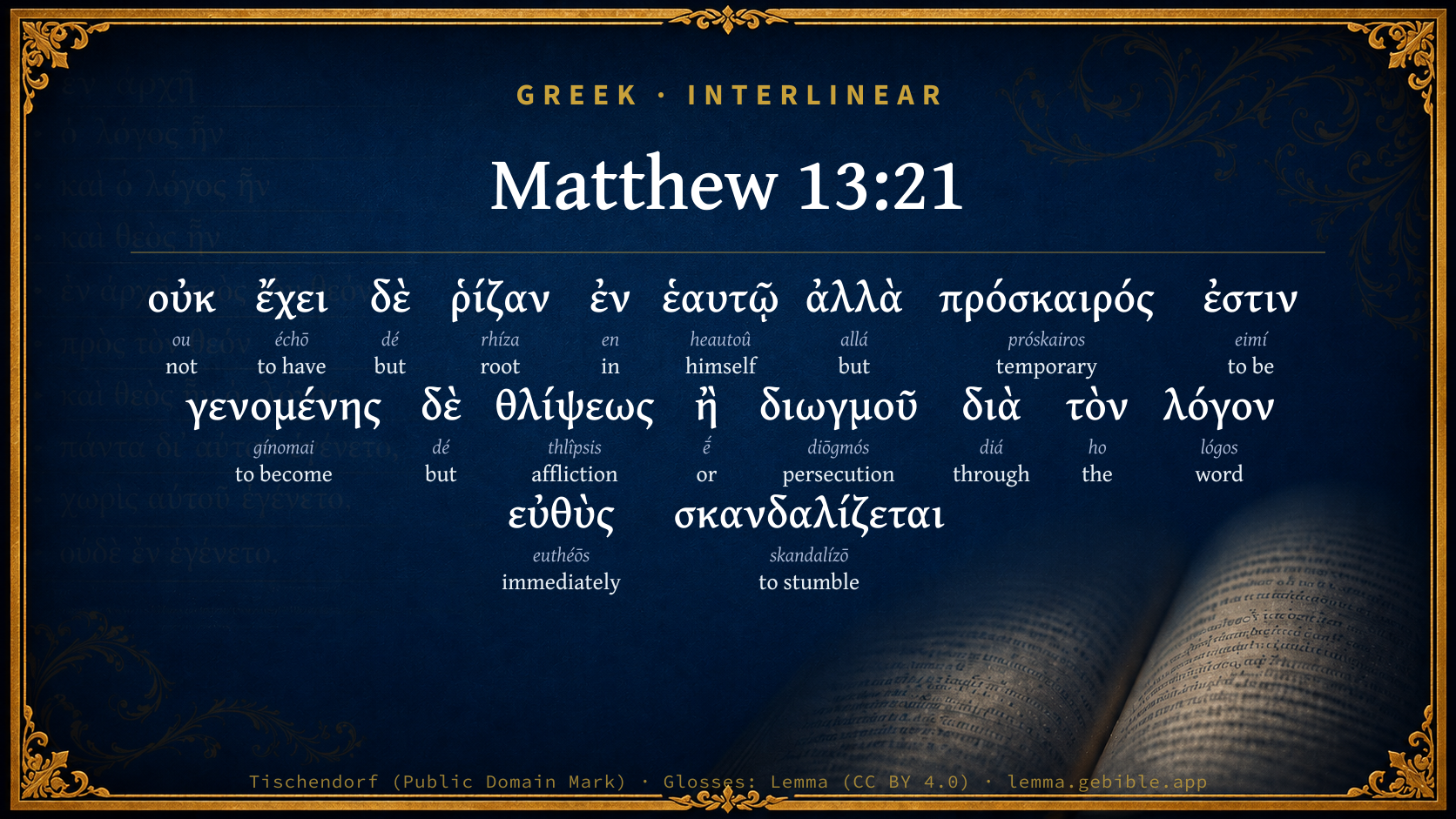
yet he has no root in himself, but endures for a while. When oppression or persecution arises because of the word, immediately he stumbles.
Download a study sheet
One document with this verse’s original text, its word-by-word gloss line, the meaning frame, cross-references with their text, attributed commentary, and full source and license credits — printable, and it pastes into notes with its structure intact.
This verse Autodidact and up
A passage Seminary Student
Up to 50 verses in one chapter. A passage sheet keeps up to 6 commentary sources and 12 cross-references per verse, in the order this page ranks them, and says so on the sheet whenever that leaves anything out. Ask for a single verse and you get the Autodidact verse sheet above.
Everything on this page stays free to read, with no account — the sheet is a download of what is already on screen, not access to it.
Compare translations 3
The same verse in 3 English versions, stacked beneath the original-language interlinear above. Click any original word for its lexicon entry.
Each is an independent rendering of the whole verse — the interlinear is not word-aligned to these translations.
Highlighted words mark where these versions differ — a whole-verse word diff, not a word-by-word alignment.
-
World English Bible Public Domain
yet he has no root in himself, but endures for a while. When oppression or persecution arises because of the word, immediately he stumbles.
-
King James Version Public Domain
Yet hath he not root in himself, but dureth for a while: for when tribulation or persecution ariseth because of the word, by and by he is offended.
-
unfoldingWord Literal Text CC BY-SA 4.0
but he has no root in himself but is temporary; and tribulation or persecution having happened because of the word, immediately he is caused to stumble.
unfoldingWord Literal Text — © unfoldingWord, licensed CC BY-SA 4.0. Word-aligned USFM3 via Door43 (git.door43.org/unfoldingWord/en_ult).
Show all 19 translations
Every available English version of this verse, each an independent rendering of the whole verse.
-
World English Bible Public Domain
yet he has no root in himself, but endures for a while. When oppression or persecution arises because of the word, immediately he stumbles.
-
Berean Standard Bible Public Domain
But since he has no root, he remains for only a season. When trouble or persecution comes because of the word, he quickly falls away.
-
Majority Standard Bible Public Domain
But since he has no root, he remains for only a season. When trouble or persecution comes because of the word, he quickly falls away.
-
King James Version Public Domain
Yet hath he not root in himself, but dureth for a while: for when tribulation or persecution ariseth because of the word, by and by he is offended.
-
American Standard Version (1901) Public Domain
yet hath he not root in himself, but endureth for a while; and when tribulation or persecution ariseth because of the word, straightway he stumbleth.
-
Revised Version (1885) Public Domain
yet hath he not root in himself, but endureth for a while; and when tribulation or persecution ariseth because of the word, straightway he stumbleth.
-
Geneva Bible (1599) Public Domain
Yet hath he no roote in himselfe, and dureth but a season: for assoone as tribulation or persecution commeth because of the woorde, by and by he is offended.
-
Douay-Rheims (1899) Public Domain
Yet hath he not root in himself, but is only for a time: and when there ariseth tribulation and persecution because of the word, he is presently scandalized.
-
Young's Literal Translation Public Domain
and he hath not root in himself, but is temporary, and persecution or tribulation having happened because of the word, immediately he is stumbled.
-
Literal Standard Version CC BY-SA 4.0
and he has no root in himself, but is temporary, and persecution or tribulation having happened because of the word, immediately he is stumbled.
-
Unlocked Literal Bible CC BY-SA 4.0
yet he has no root in himself and he endures for a while. When tribulation or persecution arises because of the word, he quickly falls away.
-
unfoldingWord Literal Text CC BY-SA 4.0
but he has no root in himself but is temporary; and tribulation or persecution having happened because of the word, immediately he is caused to stumble.
-
Darby Bible Public Domain
but has no root in himself, but is for a time only; and when tribulation or persecution happens on account of the word, he is immediately offended.
-
World Messianic Bible Public Domain
yet he has no root in himself, but endures for a while. When oppression or persecution arises because of the word, immediately he stumbles.
-
Webster's Bible Public Domain
Yet he hath not root in himself, but endureth for a while: for when tribulation or persecution ariseth because of the word, forthwith he is offended.
-
Free Bible Version CC BY-SA 4.0
They last for a while, but because they don't have roots, when problems and troubles come, they quickly fall away.
-
Bible in Basic English Public Domain
But having no root in himself, he goes on for a time; and when trouble comes or pain, because of the word, he quickly becomes full of doubts.
-
Text-Critical English NT CC BY 4.0
Yet he has no root in himself, but is only temporary. When tribulation or persecution arises on account of the word, he immediately falls away.
-
Tyndale New Testament (1534) Public Domain
yet hath he no rottes in him selfe and therfore dureth but a season: for assone as tribulacion or persecucion aryseth because of the worde by and by he falleth.
Literal Standard Version (2020), Covenant Press — licensed CC BY-SA 4.0. Text via the HelloAO Bible API (eBible.org). Unlocked Literal Bible (unfoldingWord) — licensed CC BY-SA 4.0. Text via the HelloAO Bible API (eBible.org). unfoldingWord Literal Text — © unfoldingWord, licensed CC BY-SA 4.0. Word-aligned USFM3 via Door43 (git.door43.org/unfoldingWord/en_ult). Free Bible Version, Dr. Jonathan Gallagher — licensed CC BY-SA 4.0. Text via the HelloAO Bible API (eBible.org).
Word by word
More ways to search: Search by grammar → Find every occurrence → Compare this word →
Practice this passage: Drill this verse → Learn its vocabulary →
- Appears 4× in the Greek New Testament
- First appears here
- Part of Speech
- Adjective
- Case
- Nominative
- Number
- Singular
- Gender
- Masculine
Full Thayer's Definition
- οὐκ ou G3756 “not” Particle, Negative
- ἔχει échō G2192 “to have” Verb, Present, Active, Indicative, 3rd person, Singular
- δὲ dé G1161 “but” Conjunction
- ῥίζαν rhíza G4491 “root” Noun, Accusative, Singular, Feminine
- ἐν en G1722 “in” Preposition
- ἑαυτῷ heautoû G1438 “himself” Reflexive pronoun, 3rd person, Dative, Singular, Masculine
- ἀλλὰ allá G235 “but” Conjunction
- πρόσκαιρός próskairos G4340 “temporary” Adjective, Nominative, Singular, Masculine
- ἐστιν eimí G1510 “to be” Verb, Present, Active, Indicative, 3rd person, Singular
- γενομένης gínomai G1096 “to become” Verb, Aorist, Middle deponent, Participle, Genitive, Singular, Feminine
- δὲ dé G1161 “but” Conjunction
- θλίψεως thlîpsis G2347 “affliction” Noun, Genitive, Singular, Feminine
- ἢ ḗ G2228 “or” Particle
- διωγμοῦ diōgmós G1375 “persecution” Noun, Genitive, Singular, Masculine
- διὰ diá G1223 “through” Preposition
- τὸν ho G3588 “the” Article, Accusative, Singular, Masculine
- λόγον lógos G3056 “word” Noun, Accusative, Singular, Masculine
- εὐθὺς euthéōs G2112 “immediately” Adverb
- σκανδαλίζεται skandalízō G4624 “to stumble” Verb, Present, Passive, Indicative, 3rd person, Singular
About this verse
These counts appear in no published source. They are computed here, from the morphology-tagged text and Lemma’s own curated glosses. What Lemma adds →
- 19
- words
- 18
- distinct lemmas
- Gospels
- section
Notable vocabulary
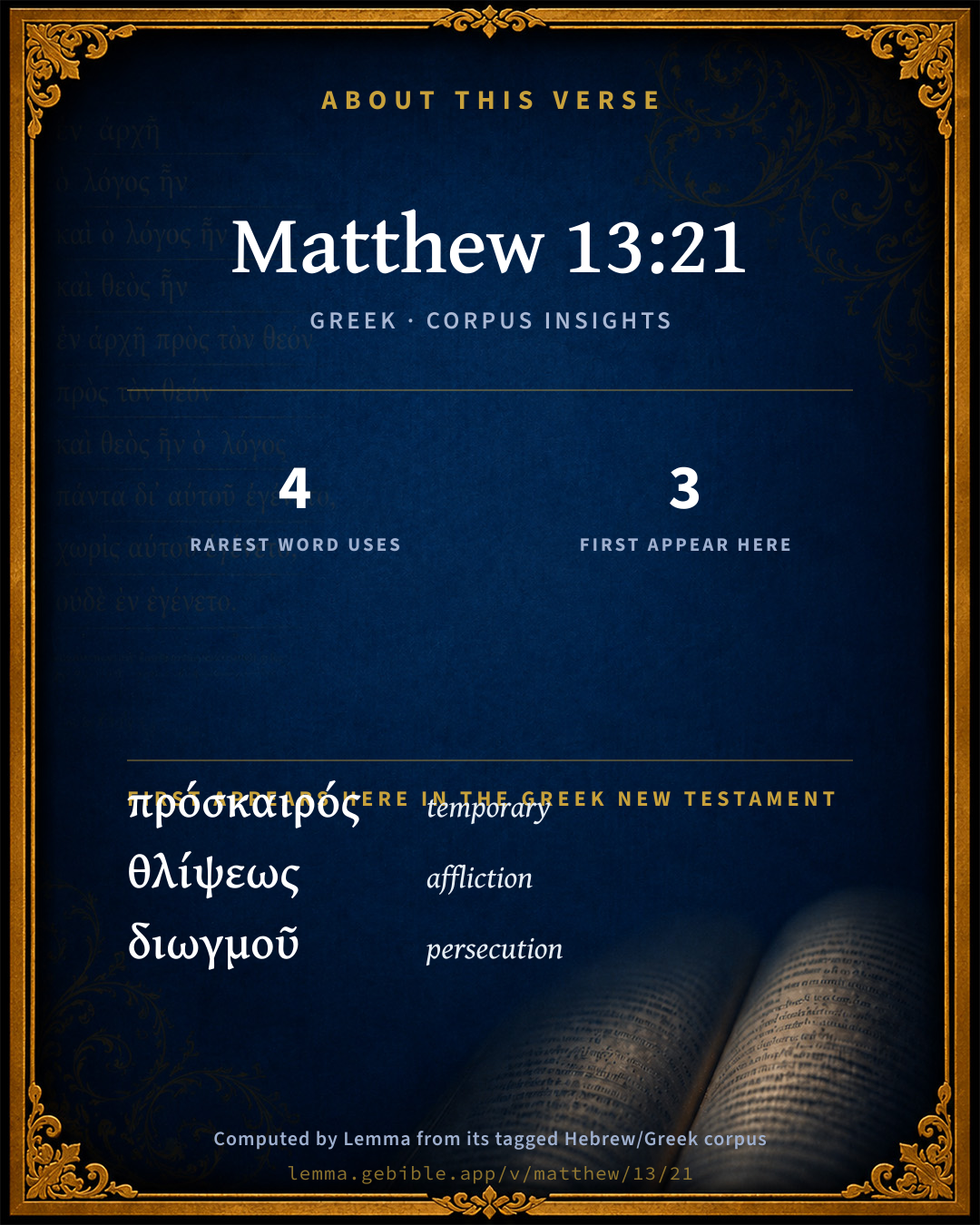
The rarest word here is πρόσκαιρός temporary G4340 — appearing just 4 times in the whole Greek New Testament.
First appearance in Scripture
These words make their first canonical appearance in the Greek New Testament here:
Shared distinctive vocabulary
πρόσκαιρός temporary G4340 occurs in 4 verses of the Greek New Testament. Also found in:
Repetition
A word recurs within this verse:
- δὲ but G1161 ×2
Cross-references
45Topical passages linked to Matthew 13:21 in the Treasury of Scripture Knowledge — connected by theme and wording, ordered by reader-vote popularity; previews shown in the World English Bible.
- Matthew 11:6 Blessed is he who finds no occasion for stumbling in me."
- 2 Peter 1:8–9 For if these things are yours and abound, they make you to be not idle nor unfruitful to the knowledge of our Lord Jesus Christ.
- Ephesians 3:17 that Christ may dwell in your hearts through faith; to the end that you, being rooted and grounded in love,
- Hosea 6:4 "Ephraim, what shall I do to you? Judah, what shall I do to you? For your love is like a morning cloud, And like the dew that disappears early.
- Job 19:28 If you say, 'How we will persecute him!' Because the root of the matter is found in me,
- Proverbs 12:3 A man shall not be established by wickedness, But the root of the righteous shall not be moved.
- John 15:5–7 I am the vine. You are the branches. He who remains in me, and I in him, the same bears much fruit, for apart from me you can do nothing.
- Job 27:8–10 For what is the hope of the godless, when he is cut off, When God takes away his life?
- Psalms 36:3 The words of his mouth are iniquity and deceit. He has ceased to be wise and to do good.
- Mark 13:12–13 "Brother will deliver up brother to death, and the father his child. Children will rise up against parents, and cause them to be put to death.
- John 12:25–26 He who loves his life will lose it. He who hates his life in this world will keep it to eternal life.
- Proverbs 12:12 The wicked desires the plunder of evil men, But the root of the righteous flourishes.
- Matthew 5:10–12 Blessed are those who have been persecuted for righteousness' sake, For theirs is the Kingdom of Heaven.
- Matthew 7:22–23 Many will tell me in that day, 'Lord, Lord, didn't we prophesy in your name, in your name cast out demons, and in your name do many mighty works?'
- Matthew 7:26–27 Everyone who hears these words of mine, and doesn't do them will be like a foolish man, who built his house on the sand.
- Matthew 10:22 You will be hated by all men for my name's sake, but he who endures to the end will be saved.
- Matthew 10:37–39 He who loves father or mother more than me is not worthy of me; and he who loves son or daughter more than me isn't worthy of me.
- Matthew 13:6 When the sun had risen, they were scorched. Because they had no root, they withered away.
- Matthew 13:57 They were offended by him. But Jesus said to them, "A prophet is not without honor, except in his own country, and in his own house."
- Matthew 16:24–26 Then Jesus said to his disciples, "If anyone desires to come after me, let him deny himself, and take up his cross, and follow me.
- Matthew 24:9–10 Then they will deliver you up to oppression, and will kill you. You will be hated by all of the nations for my name's sake.
- Matthew 24:13 But he who endures to the end, the same will be saved.
- Matthew 26:31 Then Jesus said to them, "All of you will be made to stumble because of me tonight, for it is written, 'I will strike the shepherd, and the sheep of the flock will be scattered.'
- Matthew 26:33 But Peter answered him, "Even if all will be made to stumble because of you, I will never be made to stumble."
- Mark 4:17 They have no root in themselves, but are short-lived. When oppression or persecution arises because of the word, immediately they stumble.
- Mark 8:34–36 He called the multitude to himself with his disciples, and said to them, "Whoever wants to come after me, let him deny himself, and take up his cross, and follow me.
- Luke 8:13 Those on the rock are they who, when they hear, receive the word with joy; but these have no root, who believe for a while, then fall away in time of temptation.
- Luke 9:23–25 He said to all, "If anyone desires to come after me, let him deny himself, take up his cross, and follow me.
- Luke 14:26–33 "If anyone comes to me, and doesn't hate his own father, mother, wife, children, brothers, and sisters, yes, and his own life also, he can't be my disciple.
- Luke 21:12–18 But before all these things, they will lay their hands on you and will persecute you, delivering you up to synagogues and prisons, bringing you before kings and governors for my name's sake.
- John 6:26 Jesus answered them, "Most assuredly I tell you, you seek me, not because you saw signs, but because you ate of the loaves, and were filled.
- John 6:61–65 But Jesus knowing in himself that his disciples murmured at this, said to them, "Does this cause you to stumble?
- John 6:70–71 Jesus answered them, "Didn't I choose you, the twelve, and one of you is a devil?"
- Acts 8:21–23 You have neither part nor lot in this matter, for your heart isn't right before God.
- Romans 2:7 to those who by patience in well-doing seek for glory and honor and incorruptibility, eternal life;
- Galatians 5:6 For in Christ Jesus neither circumcision amounts to anything, nor uncircumcision, but faith working through love.
- Galatians 6:12 As many as desire to look good in the flesh, they compel you to be circumcised; only that they may not be persecuted for the cross of Christ.
- Galatians 6:15 For in Christ Jesus neither is circumcision anything, nor uncircumcision, but a new creation.
- Philippians 1:6 being confident of this very thing, that he who began a good work in you will complete it until the day of Jesus Christ.
- 2 Timothy 1:15 This you know, that all who are in Asia turned away from me; of whom are Phygelus and Hermogenes.
- 2 Timothy 4:10 for Demas left me, having loved this present world, and went to Thessalonica; Crescens to Galatia, and Titus to Dalmatia.
- Hebrews 10:35–39 Therefore don't throw away your boldness, which has a great reward.
- 1 Peter 1:5 who by the power of God are guarded through faith for a salvation ready to be revealed in the last time.
- 1 John 2:19–20 They went out from us, but they didn't belong to us; for if they had belonged to us, they would have continued with us. But they left, that they might be revealed that none of them belong to us.
- Revelation 2:13 "I know your works and where you dwell, where Satan's throne is. You hold firmly to my name, and didn't deny my faith in the days of Antipas my witness, my faithful one, who was killed among you, where Satan dwells.
Cross-references courtesy of OpenBible.info (CC BY 4.0).
Lesson kit
Teaching starters — assembled from the data on this page, not authored interpretation. Every prompt links to the verse data it draws on. Edit before teaching.
Matthew, in the Gospels, opens this verse with 19 words (18 distinct Greek lemmas). Its most distinctive word is próskairos (“temporary”). A historical commentator’s framing appears above. Read the whole chapter for the surrounding context.
Discussion questions
- What does “temporary” (próskairos) contribute to the verse as a whole?
- 3 words make their first appearance in Scripture here. What does this debut establish?
- How does Mark 4:17, which shares the word «temporary», read alongside this verse?
- What does the repetition of “but” (2× in this one verse) do in this verse?
- The translations on this page render this verse differently — a whole-verse word diff, not a word-by-word alignment. What might account for the different wordings?
- Compare how Bengel's Gnomon and Meyer's Critical & Exegetical Commentary read this verse. Where do they agree or differ?
Things to notice
- 3 words make their first canonical appearance in Scripture here.
- These translations choose different wording for 17 words in this verse.
- “but” occurs 2× in this single verse.
- 18 distinct Greek lemmas span 19 words in this verse.
Commentary
Notes on Matthew 13:21 from classic Christian and Jewish commentators (each source and its license shown beneath its notes). The classic Christian expositions comment on the surrounding passage and are grouped to its opening verse, so a note may address several verses; the Jewish commentaries on the Tanakh (Rashi and others) are per-verse, so they appear only where the commentator wrote on this verse.
Lemma curates 59 commentaries, every one of them public domain or Creative Commons licensed, each selected and text-cleaned for this edition rather than reprinted as found. About our sources →
Bengel's Gnomon
Johann Albrecht Bengel
Bengel's Gnomon of the New Testament — English translation (T&T Clark, Edinburgh, 1860) — public domain. Text from a community e-Sword module.
Meyer's Critical & Exegetical Commentary
Heinrich August Wilhelm Meyer
Meyer — Critical and Exegetical Commentary on the New Testament — English translation by Peter Christie, edited by Frederick Crombie (T&T Clark, 1880) — public domain. Text from a community e-Sword module.
Expositor's Greek Testament
ed. W. Robertson Nicoll
The Expositor's Greek Testament, edited by W. Robertson Nicoll (1897–1910) — public domain. Text from a community e-Sword module.
Adam Clarke's Commentary
Adam Clarke's Commentary on the Bible (1810–1826) — public domain. Text from a community e-Sword/MySword module.
Ellicott's Commentary for English Readers
A Bible Commentary for English Readers, edited by Charles John Ellicott (1878–1897) — public domain. Text from a community e-Sword module.
The Cambridge Bible for Schools and Colleges
gen. ed. J. J. S. Perowne
The Cambridge Bible for Schools and Colleges (gen. ed. J. J. S. Perowne; Cambridge University Press, 1878–1918) — public domain. Text from a community e-Sword module.
John Gill's Exposition
John Gill's Exposition of the Whole Bible (1746–1763) — public domain (CC PDM 1.0). Text via the HelloAO Bible API.
Trapp's Complete Commentary
John Trapp
John Trapp, A Commentary or Exposition upon All the Books of the Old and New Testament (1647–1656) — public domain. Text from a community e-Sword module.
Haydock's Catholic Bible Commentary
George Leo Haydock (1774–1849), Haydock's Catholic Family Bible and Commentary, 1859 edition — public domain. Excludes Psalms (Douay-Rheims chapter numbering differs from Protestant) and Deuterocanonical books (Catholic canon only).
Whedon's Commentary on the Bible
Daniel D. Whedon
Daniel D. Whedon (gen. ed.), Commentary on the Old and New Testaments (1874–1909) — public domain. Text from a community e-Sword module.
The Pulpit Commentary
The Pulpit Commentary (1880–1919), ed. H.D.M. Spence-Jones & Joseph S. Exell — public domain. Text from a community e-Sword module.
John Wesley's Explanatory Notes
John Wesley, Explanatory Notes Upon the Whole Bible (1754–1765) — public domain. Text via the GEBible commentary corpus.
Cambridge Greek Testament for Schools and Colleges
Cambridge Greek Testament for Schools and Colleges (Cambridge University Press, 1896; 21 vols, various authors incl. Carr, Maclear, Plummer, Farrar, Lumby, Moule, M. R. James, Simcox) — public domain. Text from a community e-Sword module.
Alford’s Greek Testament
Henry Alford
Henry Alford, The Greek Testament (1849–1861) — public domain. Text from a community e-Sword module.
Vincent's Word Studies in the New Testament
Marvin R. Vincent
Marvin R. Vincent, Word Studies in the New Testament (1887–1900) — public domain. Text from a community e-Sword/MySword module.