
Matthew 19:18

Greek (Tischendorf 8th ed.) Matthew 19:18 appears in the Greek New Testament. The text above is from the Tischendorf 8th edition. Each word links to its Strong’s number and a concise gloss. Click any word for its full Thayer’s Greek Lexicon entry.
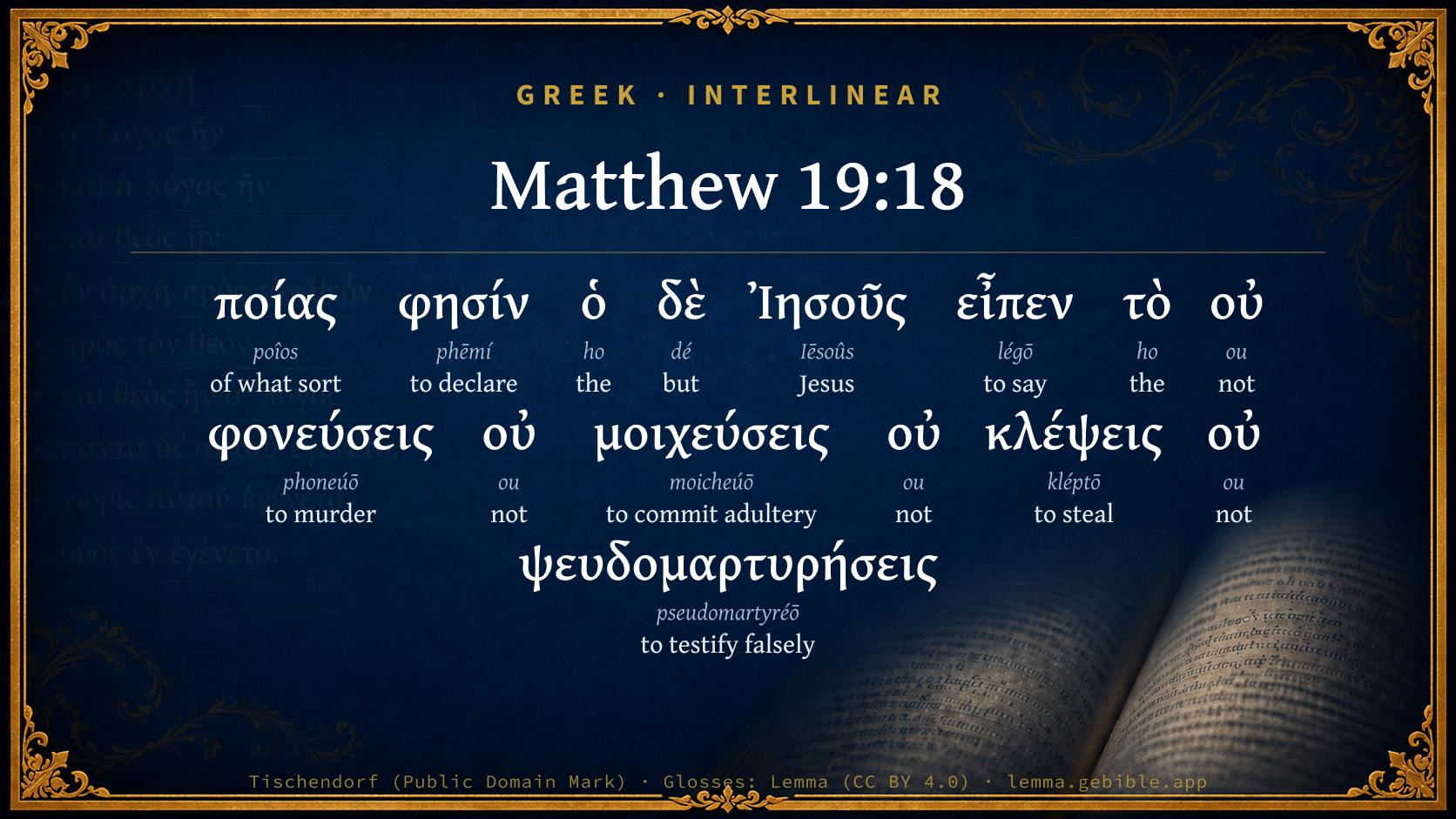
Download image
Cite this verse

Matthew 19:18 (World English Bible). Public Domain. Lemma interlinear Bible study tool, https://lemma.gebible.app/v/matthew/19/18.

Show BibTeX & RIS
BibTeX
RIS
English Translation
He said to him, "Which ones?" Jesus said, "'You shall not murder.' 'You shall not commit adultery.' 'You shall not steal.' 'You shall not offer false testimony.'
World English Bible · Public Domain
Highlights
  • 2 first appearances in the Greek New Testament
Full analysis ↓
Download a study sheet

One document with this verse’s original text, its word-by-word gloss line, the meaning frame, cross-references with their text, attributed commentary, and full source and license credits — printable, and it pastes into notes with its structure intact.

This verse Autodidact and up

Study sheet (.html) Plain text (.txt)

A passage Seminary Student

Up to 50 verses in one chapter. A passage sheet keeps up to 6 commentary sources and 12 cross-references per verse, in the order this page ranks them, and says so on the sheet whenever that leaves anything out. Ask for a single verse and you get the Autodidact verse sheet above.

Everything on this page stays free to read, with no account — the sheet is a download of what is already on screen, not access to it.

Want to remove ads? Support Godless Engineer
Compare translations 3

The same verse in 3 English versions, stacked beneath the original-language interlinear above. Click any original word for its lexicon entry.

Each is an independent rendering of the whole verse — the interlinear is not word-aligned to these translations.

Highlighted words mark where these versions differ — a whole-verse word diff, not a word-by-word alignment.

  • World English Bible Public Domain
    He said to him, "Which ones?" Jesus said, "'You shall not murder.' 'You shall not commit adultery.' 'You shall not steal.' 'You shall not offer false testimony.'
  • King James Version Public Domain
    He saith unto him, Which? Jesus said, Thou shalt do no murder, Thou shalt not commit adultery, Thou shalt not steal, Thou shalt not bear false witness,
  • unfoldingWord Literal Text CC BY-SA 4.0
    He says to him, “Which ones?” And Jesus said, “Do not kill, do not commit adultery, do not steal, do not testify falsely,

unfoldingWord Literal Text — © unfoldingWord, licensed CC BY-SA 4.0. Word-aligned USFM3 via Door43 (git.door43.org/unfoldingWord/en_ult).

Versions to compare (up to 4)

3 of 4 selected

Show all 19 translations

Every available English version of this verse, each an independent rendering of the whole verse.

  • World English Bible Public Domain
    He said to him, "Which ones?" Jesus said, "'You shall not murder.' 'You shall not commit adultery.' 'You shall not steal.' 'You shall not offer false testimony.'
  • Berean Standard Bible Public Domain
    “Which ones?” the man asked. Jesus answered, “‘Do not murder, do not commit adultery, do not steal, do not bear false witness,
  • Majority Standard Bible Public Domain
    “Which ones?” the man asked. Jesus answered, “‘Do not murder, do not commit adultery, do not steal, do not bear false witness,
  • King James Version Public Domain
    He saith unto him, Which? Jesus said, Thou shalt do no murder, Thou shalt not commit adultery, Thou shalt not steal, Thou shalt not bear false witness,
  • American Standard Version (1901) Public Domain
    He saith unto him, Which? And Jesus said, Thou shalt not kill, Thou shalt not commit adultery, Thou shalt not steal, Thou shalt not bear false witness,
  • Revised Version (1885) Public Domain
    He saith unto him, Which? And Jesus said, Thou shalt not kill, Thou shalt not commit adultery, Thou shalt not steal, Thou shalt not bear false witness,
  • Geneva Bible (1599) Public Domain
    He sayd to him, Which? And Iesus sayde, These, Thou shalt not kill: Thou shalt not commit adulterie: Thou shalt not steale: Thou shalt not beare false witnesse.
  • Douay-Rheims (1899) Public Domain
    He said to him: Which And Jesus said: Thou shalt do no murder, Thou shalt not commit adultery, Thou shalt not steal, Thou shalt not bear false witness.
  • Young's Literal Translation Public Domain
    He saith to him, `What kind?' And Jesus said, `Thou shalt not kill, thou shalt not commit adultery, thou shalt not steal, thou shalt not bear false witness,
  • Literal Standard Version CC BY-SA 4.0
    He says to Him, “What kind?” And Jesus said, “You will not murder, You will not commit adultery, You will not steal, You will not bear false witness,
  • Unlocked Literal Bible CC BY-SA 4.0
    The man said to him, “Which commandments?” Jesus said, “Do not kill, do not commit adultery, do not steal, do not bear false witness,
  • unfoldingWord Literal Text CC BY-SA 4.0
    He says to him, “Which ones?” And Jesus said, “Do not kill, do not commit adultery, do not steal, do not testify falsely,
  • Darby Bible Public Domain
    He says to him, Which? And Jesus said, Thou shalt not kill, Thou shalt not commit adultery, Thou shalt not steal, Thou shalt not bear false witness,
  • World Messianic Bible Public Domain
    He said to him, “Which ones?” Yeshua said, “‘You shall not murder.’ ‘You shall not commit adultery.’ ‘You shall not steal.’ ‘You shall not offer false testimony.’
  • Webster's Bible Public Domain
    He saith to him, Which? Jesus said, Thou shalt do no murder, Thou shalt not commit adultery, Thou shalt not steal, Thou shalt not bear false witness,
  • Free Bible Version CC BY-SA 4.0
    “Which ones?” the man asked him. “Don't murder, don't commit adultery, don't steal, don't give false testimony,
  • Bible in Basic English Public Domain
    He says to him, Which? And Jesus said, Do not put anyone to death, Do not be untrue in married life, Do not take what is not yours, Do not give false witness,
  • Text-Critical English NT CC BY 4.0
    The man said to him, “Which ones?” Jesus said, “Yoʋ shall not murder, Yoʋ shall not commit adultery, Yoʋ shall not steal, Yoʋ shall not give false testimony,
  • Tyndale New Testament (1534) Public Domain
    The other sayde to him Which? And Iesus sayde: breake no wedloke kill not steale not: beare not falce witnes:

Literal Standard Version (2020), Covenant Press — licensed CC BY-SA 4.0. Text via the HelloAO Bible API (eBible.org). Unlocked Literal Bible (unfoldingWord) — licensed CC BY-SA 4.0. Text via the HelloAO Bible API (eBible.org). unfoldingWord Literal Text — © unfoldingWord, licensed CC BY-SA 4.0. Word-aligned USFM3 via Door43 (git.door43.org/unfoldingWord/en_ult). Free Bible Version, Dr. Jonathan Gallagher — licensed CC BY-SA 4.0. Text via the HelloAO Bible API (eBible.org).

Word by word

More ways to search: Search by grammar → Find every occurrence → Compare this word →

Practice this passage: Drill this verse → Learn its vocabulary →

ψευδομαρτυρήσεις
pseudomartyréō
G5576
“to testify falsely”
Verb, Future, Active, Indicative, 2nd person, Singular
Part of Speech
Verb
Tense
Future
Voice
Active
Mood
Indicative
Person
2nd person
Number
Singular
Full Thayer's Definition

Origin: from G5575

TDNT: 12:33,6

1. to utter falsehoods in giving testimony, to testify falsely, to bear false witness
  1. ποίας poîos G4169 “of what sort” Interrogative pronoun, Accusative, Plural, Feminine
  2. φησίν phēmí G5346 “to declare” Verb, Present, Active, Indicative, 3rd person, Singular
  3. ὁ ho G3588 “the” Article, Nominative, Singular, Masculine
  4. δὲ dé G1161 “but” Conjunction
  5. Ἰησοῦς Iēsoûs G2424 “Jesus” Noun, Nominative, Singular, Masculine
  6. εἶπεν légō G3004 “to say” Verb, Aorist, Active, Indicative, 3rd person, Singular
  7. τὸ ho G3588 “the” Article, Accusative, Singular, Neuter
  8. οὐ ou G3756 “not” Particle, Negative
  9. φονεύσεις phoneúō G5407 “to murder” Verb, Future, Active, Indicative, 2nd person, Singular
  10. οὐ ou G3756 “not” Particle, Negative
  11. μοιχεύσεις moicheúō G3431 “to commit adultery” Verb, Future, Active, Indicative, 2nd person, Singular
  12. οὐ ou G3756 “not” Particle, Negative
  13. κλέψεις kléptō G2813 “to steal” Verb, Future, Active, Indicative, 2nd person, Singular
  14. οὐ ou G3756 “not” Particle, Negative

About this verse

These counts appear in no published source. They are computed here, from the morphology-tagged text and Lemma’s own curated glosses. What Lemma adds →

15
words
11
distinct lemmas
Gospels
section

Notable vocabulary

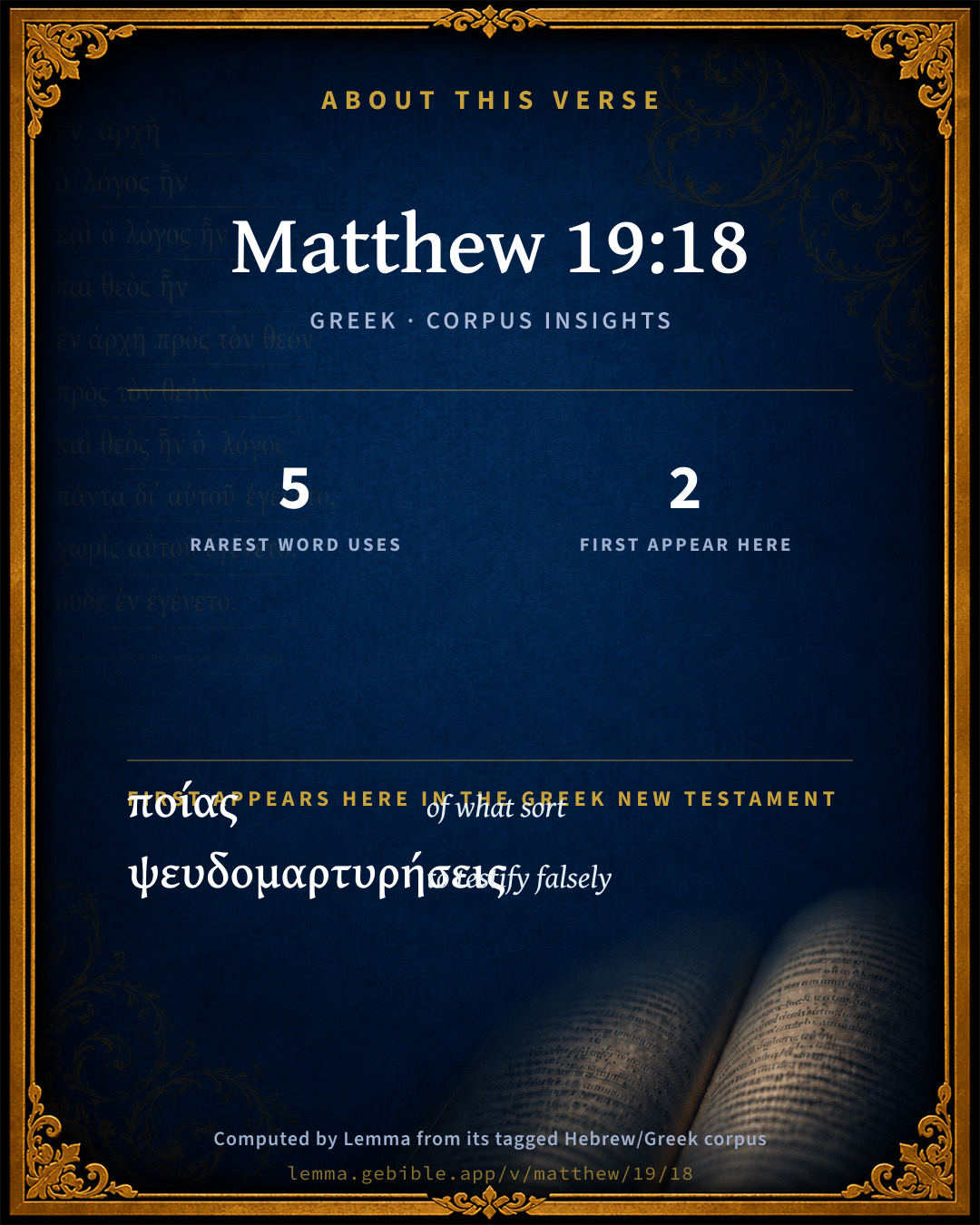
The rarest word here is ψευδομαρτυρήσεις to testify falsely G5576 — appearing just 5 times in the whole Greek New Testament.

First appearance in Scripture

These words make their first canonical appearance in the Greek New Testament here:

  • ποίας of what sort G4169
  • ψευδομαρτυρήσεις to testify falsely G5576

Shared distinctive vocabulary

ψευδομαρτυρήσεις to testify falsely G5576 occurs in 5 verses of the Greek New Testament. Also found in:
Repetition

Words recur within this verse:

Cross-references

8

Topical passages linked to Matthew 19:18 in the Treasury of Scripture Knowledge — connected by theme and wording, ordered by reader-vote popularity; previews shown in the World English Bible.

  • Deuteronomy 5:16–21 "Honor your father and your mother, as Yahweh your God commanded you; that your days may be long, and that it may go well with you, in the land which Yahweh your God gives you.
  • Exodus 20:12–17 "Honor your father and your mother, that your days may be long in the land which Yahweh your God gives you.
  • Mark 10:19 You know the commandments: 'Do not murder,' 'Do not commit adultery,' 'Do not steal,' 'Do not give false testimony,' 'Do not defraud,' 'Honor your father and mother.'"
  • Luke 18:20 You know the commandments: 'Don't commit adultery,' 'Don't murder,' 'Don't steal,' 'Don't give false testimony,' 'Honor your father and your mother.'"
  • James 2:10–11 For whoever shall keep the whole law, and yet stumble in one point, he has become guilty of all.
  • Matthew 5:21–28 "You have heard that it was said to the ancient ones, 'You shall not murder;' and 'Whoever shall murder shall be in danger of the judgment.'
  • Romans 13:8–10 Owe no one anything, except to love one another; for he who loves his neighbor has fulfilled the law.
  • Galatians 3:10 For as many as are of the works of the law are under a curse. For it is written, "Cursed is everyone who doesn't continue in all things that are written in the book of the law, to do them."

Cross-references courtesy of OpenBible.info (CC BY 4.0).

Commentary

Notes on Matthew 19:18 from classic Christian and Jewish commentators (each source and its license shown beneath its notes). The classic Christian expositions comment on the surrounding passage and are grouped to its opening verse, so a note may address several verses; the Jewish commentaries on the Tanakh (Rashi and others) are per-verse, so they appear only where the commentator wrote on this verse.

Lemma curates 59 commentaries, every one of them public domain or Creative Commons licensed, each selected and text-cleaned for this edition rather than reprinted as found. About our sources →

Bengel's Gnomon

Johann Albrecht Bengel

Mat 19:18. Ποίας; which?) There was no need to ask which, as our Lord had said the [commandments] τας.[867]

[867] Thus indicating those pre-eminently so called, and implying the necessity of keeping all of them.—(I. B.)

Mat 19:18-19. Οὐ φονεύσεις·—ἀγαπήσεις, κ.τ.λ., thou shalt not murder thou shalt love, etc.) Precepts negative and affirmative. The duties of the Second Table are more palpable than those of the First.

Bengel's Gnomon of the New Testament — English translation (T&T Clark, Edinburgh, 1860) — public domain. Text from a community e-Sword module.

Meyer's Critical & Exegetical Commentary

Heinrich August Wilhelm Meyer

Mat_19:18 f. Agreeably to the meaning of his question, Mat_19:16, the young man expected to be referred to commandments of a particular kind, and therefore calls for further information respecting the ἐντολάς to which Jesus referred; hence ποίας, which is not equivalent to τίνας, but is to be understood as requesting a qualitative statement.

For the purpose of indicating the kind of commandments he had in view Jesus simply mentions, by way of example, one or two belonging to the second table of the decalogue, but also at the same time the fundamental one (Rom_13:9) respecting the love of our neighbour (Lev_19:18), because it was through it (for which also see note on Mat_22:39) He wished the young man to be tested. This latter commandment, introduced with skilful tact, Origen incorrectly regards as an interpolation; de Wette likewise takes exception to it; comp. Bleek, who considers Lukes text to be rather more original.

Meyer — Critical and Exegetical Commentary on the New Testament — English translation by Peter Christie, edited by Frederick Crombie (T&T Clark, 1880) — public domain. Text from a community e-Sword module.

Expositor's Greek Testament

ed. W. Robertson Nicoll

Mat 19:18 . ποίας ; not = τίνας (Grotius), but what sort of commands: out of the multitude of commands divine and human, which do you mean? He had a shrewd guess doubtless, but wanted to be sure. Christ’s reply follows in this and subsequent verse, quoting in direct form prefaced with τό the sixth, seventh, eighth, ninth, and fifth commands of the Decalogue with that to love a neighbour as ourselves from Lev 19:18 . This last Origen regarded as an interpolation, and Weiss thinks that the evangelist has introduced it from Mat 22:39 as one that could not be left out. If it be omitted the list ends with the fifth, a significantly emphatic position, reminding us of Mat 15:4 , and giving to the whole list an antithetic reference to the teaching of the scribes. In sending the inquirer to the second table of the Decalogue as the sum of duty, Jesus gave an instruction anything but commonplace, though it seem so to us. He was proclaiming the supremacy of the ethical , a most important second lesson for the inquirer, the first being the necessity of using moral epithets carefully and sincerely. From the answer given to this second lesson it will appear whereabouts the inquirer is, a point Jesus desired to ascertain.

The Expositor's Greek Testament, edited by W. Robertson Nicoll (1897–1910) — public domain. Text from a community e-Sword module.

International Critical Commentary

(M) 18. He saith to Him, Of what sort? And Jesus said, Thou shalt not kill, Thou shalt not commit adultery, Thou shalt not steal, Thou shalt not bear false witness, Honour father and mother; and, Thou shall love thy neighbour as thyself.] Mk. has: “Do not kill, Do not commit adultery, Do not steal, Do not bear false witness, Do not defraud.” Mt. takes a severer view of the character of the questioner than Mk. By representing him as asking, “What good thing shall I do that I may have eternal life?” he makes the question more unintelligent than it is in Mk. Here, by inserting λέγει—τό, he emphasises the man’s obtuseness. In v. 20, by putting into his mouth, “What lack I yet?” he attributes to him selfsufficiency. And he omits altogether Mk v. 21a. Compare the treatment in Mat 22:34-40 of the questioner described in Mar 12:28-34. ποίας may mean, “What sort of commandment?” cf. 22:36. Or ποῖος may be hardly distinguishable from τίς. “Which commandments?” cf. Blass, p. 176; Win.-Schm. p. 241. See on 24:42.— οὐ φονεύσεις, κ.τ.λ.] Mk. has μὴ φονεύσῃς, κ.τ.λ. After μὴ ψευδομαρτυρήσῃς, Mk. has μὴ ἀποστερήσῃς (so א A B2 C D latt.). This may be a reminiscence of Exo 21:10, or Deu 24:14 (LXX. A F), or Ecclus 4:1. Mt. omits it (if it was in his text of Mk., but B S1 omit there), and substitutes after “honour father and mother,” “thou shalt love thy neighbour as thyself.” This comes from Lev 19:18, and occurs again in 22:39 = Mar 12:31 = Luk 10:27, whence it is here taken. The first four clauses come from Exo 20:13-16 or Deu 5:17-20. In Mk. the order μὴ μοιχ. μὴ φον. is attested by A N X al latt., but μὴ φον. μὴ μοιχ. in אa B C al S1. Mt. has this latter order, which is that of the Massoretic Text of Ex. and Dt., and of the LXX. A F. In. Ex. B has οὐ μοιχ. οὐ κλεψ. οὐ φον., and in Dt. οὐ μοιχ. οὐ φον. οὐ κλεψ. Thus Mk. (אa B C al S1) and Mt. agree in order with the Heb. (M.T.) and the LXX. (A F Luc.). The other order, οὐ μοιχ. οὐ φον. οὐ κλεψ., represented by Mk. (A N X al latt.), Luk 18:20, LXX. (B in Dt.), Philo, is now supported by the Hebrew Papyrus published in the Proceedings of the Society of Biblical Archælogy, xxv. Pt. 1. pp. 34-56. Mk. has the conjunctive for the indicative of the LXX. Mt. assimilates to the LXX.

International Critical Commentary — older volumes (1896–1929), various authors — public domain. Text from a community e-Sword module.

Adam Clarke's Commentary

Verse 18. Thou shalt do no murder, &c.] But some say these commandments are not binding on us. Vain, deceived men! Can a murderer, an adulterer, a thief, and a liar enter into eternal life? No. The God of purity and justice has forbidden it. But we are not to keep these commandments in order to purchase eternal life. Right. Neither Jesus Christ, nor his genuine messengers, say you are. To save your souls, Christ must save you from your sins, and enable you to walk before him in newness of life.

Adam Clarke's Commentary on the Bible (1810–1826) — public domain. Text from a community e-Sword/MySword module.

Ellicott's Commentary for English Readers

(18) He saith unto him, Which?—Literally, of what kind? The questioner has been trained in the language of the schools, has heard debates as to which was the great commandment of the Law (22:36). Which class of commandments is he to keep that he may win eternal life?

Thou shalt do no murder.—Our Lord’s answer was clearly determined by the method of which we have ventured to speak as calling up the thought of that of Socrates. To a questioner of another type of character He would have pointed (as in Mat_22:37) to the two great commandments, the love of God, and the love of man, on which hung all the Law and the Prophets. Here it was more in harmony with His loving purpose to leave out of sight altogether the commandments of the first table, that tell men of their duty towards God, and to direct attention only to those which, as speaking of our duty to our neighbour, were thought common and familiar things. The change in the order of the commandments, so that the Fifth follows those which in the Decalogue it precedes, seems to imply a design to lead the seeker through the negative to the positive forms of law, through definite prohibitions of single acts to the commandments which were “exceeding broad,” as fulfilled only in the undefined region of the affections.

A Bible Commentary for English Readers, edited by Charles John Ellicott (1878–1897) — public domain. Text from a community e-Sword module.

The Cambridge Bible for Schools and Colleges

gen. ed. J. J. S. Perowne

18. Which?] Accurately “what sort of commandments.”

Comp. this enumeration with that in ch. Mat_15:19. Here, as there, the commandments proceed in order from the 6th to the 9th. Here, as there, the enumeration stops at covetousness—the rich ruler’s special failing. Neither St Mark nor St Luke preserve the same order.

The Cambridge Bible for Schools and Colleges (gen. ed. J. J. S. Perowne; Cambridge University Press, 1878–1918) — public domain. Text from a community e-Sword module.

John Gill's Exposition

He saith unto him, which?.... Whether those commandments of a moral, or of a ceremonial kind; whether the commands of the written, or of the oral law; of God, or of the elders, or both; or whether he did not mean some new commandments of his own, which he delivered as a teacher sent from God:

Jesus said; according to the other evangelists, "thou knowest the commandments"; not the true nature, spirituality, and use of them, but the letter and number of them; being trained up from a child by his parents, in the reading them, committing them to memory, and the outward observance of them, particularly those of the second table:

thou shalt do no murder, thou shalt not commit adultery, thou shalt not steal, thou shalt not bear false witness. Christ takes no notice of the ceremonial law, nor of the traditions of the elders, only moral precepts; and these only such as refer to the second, and not the first table of the law, which respect duty to the neighbour, and not to God: and this he does, because these commandments were more known, and were in common use; and he chose to instance in these, partly to show, that if men are under obligation to regard these, much more such as concern God more immediately; and partly, to observe, that if men are deficient in their duty to one another, they are much more so in their worship of God; and consequently, eternal life is never to be got and enjoyed by the performance of these things.

John Gill's Exposition of the Whole Bible (1746–1763) — public domain (CC PDM 1.0). Text via the HelloAO Bible API.

Trapp's Complete Commentary

John Trapp

18 He saith unto him, Which? Jesus said, Thou shalt do no murder, Thou shalt not commit adultery, Thou shalt not steal, Thou shalt not bear false witness,

Ver. 18. Thou shalt do no murder] Our Saviour instanceth the commandments of the second table only, as presupposing those of the first, for the second table must be kept in the first; {a} and the whole law, say the schools, is but one copulative. The two tables of the law (saith a reverend divine) {b} are, in their object, answerable to the two natures of Christ, for God is the object of one man or the other. And as they meet together in the person of Christ, so must they be united in the affections and endeavours of a Christian.

{a} Primo praecepto reliquorum omnium observatio praecipitur. Luther.

{b} Mr Ley’s Pattern of Piety, p. 99.

John Trapp, A Commentary or Exposition upon All the Books of the Old and New Testament (1647–1656) — public domain. Text from a community e-Sword module.

Matthew Poole's English Annotations

Mark addeth, defraud not, Mar 10:19, but Luke doth not put it in, Luk 18:20. Three things we may observe:

1. There are no commandments mentioned but those of the second table.

2. Nor are they reckoned up in order.

3. The tenth commandment is expressed by, Thou shalt love thy neighbour as thyself; which elsewhere our Saviour calls the second great commandment, and makes comprehensive of all the commandments of the second table.

We must not from our Saviour’s order here, in the enumeration of the commandments, either conclude that the precepts of the second table are greater than those of the first, or that it is enough to keep them in order to eternal life: nor yet, that the fifth commandment is lesser than the sixth, seventh, eighth, ninth, because it is put after them. But;

1. Our Saviour had reckoned up commandments enough to convince this man that he could not by keeping the commandments hope for eternal life.

2. He had reckoned those, by some of which he intended by and by to convince him that he had not kept the commandments.

3. And those of the non observation of which it was most easy to convince him.

4. The Pharisees looked upon these as the most vulgar and easy commandments.

5. Because love to our neighbour is an excellent evidence of our love to God.

As concerning the order in which they are enumerated, it was not our Saviour’s business here to show which was the greatest commandment; that he hath elsewhere determined, calling, Thou shalt love the Lord thy God with all thy heart, &c., the first and great commandment: here he is not solicitous about the order.

Matthew Poole's English Annotations on the Holy Bible (1683–1685) — public domain. Text from a community e-Sword/MySword module.

Whedon's Commentary on the Bible

Daniel D. Whedon

18. He saith unto him, Which? — The young man can hardly believe that this new teacher would refer him back to the old ten commandments. He has kept them, as he imagines, until they have grown commonplace. At the same time a sense of the insufficiency of his own righteousness does not allow him ease. He has no full sense of peace with God. He wishes some new prescription, by which he may feel that he is a sure heir of eternal life. Jesus said — Our Lord gives a few specimens, to intimate that it is just no more than the original decalogue, to which he is referred.

Daniel D. Whedon (gen. ed.), Commentary on the Old and New Testaments (1874–1909) — public domain. Text from a community e-Sword module.

The Pulpit Commentary

Which (poiav)? Christ"s answer was disappointing to the inquirer; it was too vague and general to satisfy his thought. He expected to hear (as the rabbis taught) of some special precept or precepts, difficult of accomplishment, and not usually regarded, by observance of which he could obtain his great reward. So he asks with laudable persistence, Of what sort are these commandments which I have to obey?" He is far from thinking of the common duties of the Decalogue, though doubtless he had been taught that these varied greatly in meritoriousness. Christ, in reply, notifies, as examples, the chief enactments of what we call the second table of the Decalogue, quoting the sixth, seventh, eighth, ninth, and fifth. He enunciates nothing uncommon, nothing new; and, by prefixing the definite article to to the enumeration, he makes the whole a substantial unity, comprising the moral law of duty to one"s neighbour. Perhaps Christ confines his list to the second table in order to make the man feel his imperfection in these ordinary matters, or to bring out his self-righteous spirit. There could be no doubt that infringement of the first table involved the loss of eternal life. Ver. 17 virtually includes the spirit of this table. It was round these last six commandments chiefly that rabbinical traditions and interpretations had gathered, so that their plain meaning was obscured or depraved. Whoever observed the second table in spirit and truth, kept also the first; (Rom_13:9, Rom_13:10) and it is easier to love one"s neighbour than to love God, as the apostle witnesses; (see 1Jn_4:20) and without love of our neighbour there cannot be true love of God.

The Pulpit Commentary (1880–1919), ed. H.D.M. Spence-Jones & Joseph S. Exell — public domain. Text from a community e-Sword module.

Burkitt's Expository Notes on the New Testament

William Burkitt

Observe here, That the duties which our Saviour instances in, are the duties of the second table, which hypocrites are most failing in; but the sincere practice of our duty to our neighbour, is a singular evidence of our love to God. These duties of the second table the young man says he had kept from his youth, and perhaps might say it truly, according to the Pharisees interpretation, which condemned only the gross, outward act, not the inward lust and motion of the heart.

Learn hence, How apt men are to think well of themselves, and have too high an opinion of their own goodness and righteousness before God: All these have I kept from my youth.

William Burkitt's Expository Notes on the New Testament (1700–1703) — public domain. Text from a community e-Sword module.

The People's New Testament

B. W. Johnson

18, 19. Which? Thou shalt not kill. The Lord passes over the first four of the ten commandments, throws the young man back to his relations with his fellow-men, compels him to give an account of his moral goodness, and after keeping the letter of the moral commands, still to confess his sense of a lack.

B. W. Johnson's The People's New Testament with Notes (1889–1891) — public domain. Electronic text from the Christian Classics Ethereal Library (CCEL) ThML edition.

unfoldingWord translationNotes

Door43 World Missions Community

love your neighbor

The Jewish people believed that their neighbors were only other Jews. Jesus is extending that definition to include all people.

translationWords

command

Jesus

adultery

corrupt witness

honor

love

neighbor

unfoldingWord translationNotes — © Distant Shores Media and the Door43 World Missions Community, licensed CC BY-SA 4.0. Source: git.door43.org/Door43/en_tn.

Cambridge Greek Testament for Schools and Colleges

18. ποίας; What commandments? written or unwritten? human or divine? the law of Moses or the traditions of the elders? or perhaps the young ruler expected a specimen of the rules with which this new Rabbi would instruct his disciples to ‘fence round’ the law. In N.T. ποῖος may perhaps always be distinguished from τίς; in later Greek (see Sophocles, Lex. sub voc.) and in the modern vernacular the distinction is lost.

τὸ οὐ φονεύσεις κ.τ.λ. For the use of the article prefixed to a sentence cp. εἶπεν αὐτῷ· τὸ εἰ δύνῃ, Mar 9:23; ὁ πᾶς νόμος ἐν ἑνὶ λόγῳ πεπλήρωται ἐν τῷ ἀγαπήσεις τὸν πλησίον σου, Gal 5:14. See Winer, p. 135.

οὐ φονεύσεις. In Hebrew a negative is never used with the imperative; prohibitions being always expressed by means of the future (or imperfect). This idiom is here followed in the Greek, οὐ φον.—prohibition, τίμα—positive command (Rœd.-Gesen. Hebr. Gram., p. 280) the future is however also used in pure Greek to express the imperative notion, as e.g. λέγʼ εἴ τι βούλει, χειρὶ δʼ οὐ ψαύσεις ποτέ, Eur Med. 1320 (Donaldson Grk. Gram. p. 407).

Comp. this enumeration with that in ch. Mat 15:19. Here, as there, the commandments proceed in order from the 6th to the 9th. Here, as there, the enumeration stops at covetousness—the rich ruler’s special failing. The fifth commandment not named in ch. 15 had probably an individual application here. Neither St Mark nor St Luke preserve the same order

Cambridge Greek Testament for Schools and Colleges (Cambridge University Press, 1896; 21 vols, various authors incl. Carr, Maclear, Plummer, Farrar, Lumby, Moule, M. R. James, Simcox) — public domain. Text from a community e-Sword module.

Alford’s Greek Testament

Henry Alford

18.] De Wette observes well, that our Lord gives this enumeration of the commandments to bring out the self-righteous spirit of the young man, which He before saw. He only mentions those of the second table, having in ver. 17, in His declaration respecting ἀγαθός, included those of the first. Mark has the addition of μὴ ἀποστερήσῃς, representing probably the tenth commandment.

Henry Alford, The Greek Testament (1849–1861) — public domain. Text from a community e-Sword module.

Lesson kit

Teaching starters — assembled from the data on this page, not authored interpretation. Every prompt links to the verse data it draws on. Edit before teaching.

Matthew, in the Gospels, opens this verse with 15 words (11 distinct Greek lemmas). Its most distinctive word is pseudomartyréō (“to testify falsely”). A historical commentator’s framing appears above. Read the whole chapter for the surrounding context.

Discussion questions

  1. The word pseudomartyréō carries the sense “to testify falsely.” How does it shape the verse?
  2. 2 words make their first appearance in Scripture here. What does this debut establish?
  3. How does Mark 10:19, which shares the word «to testify falsely», read alongside this verse?
  4. What does the repetition of “not” (4× in this one verse) do in this verse?
  5. These translations render this verse differently; the difference is in the English rendering, not the original. What questions does that raise?
  6. Compare how Bengel's Gnomon and Meyer's Critical & Exegetical Commentary read this verse. Where do they agree or differ?

Things to notice

  • 2 words make their first canonical appearance in Scripture here.
  • These translations choose different wording for 14 words in this verse.
  • “not” occurs 4× in this single verse.
  • 11 distinct Greek lemmas span 15 words in this verse.

Reading settings

Reading text

Shown beneath each verse's original-language words.

Old Testament
Old Testament edition

Read the OT as the Masoretic Hebrew (MT) or the Greek Septuagint (LXX).

English shown for the Greek Septuagint (in the Hebrew ↔ Greek comparison).

Comparing translations? Open the Compare panel on any verse page to stack up to four side by side.