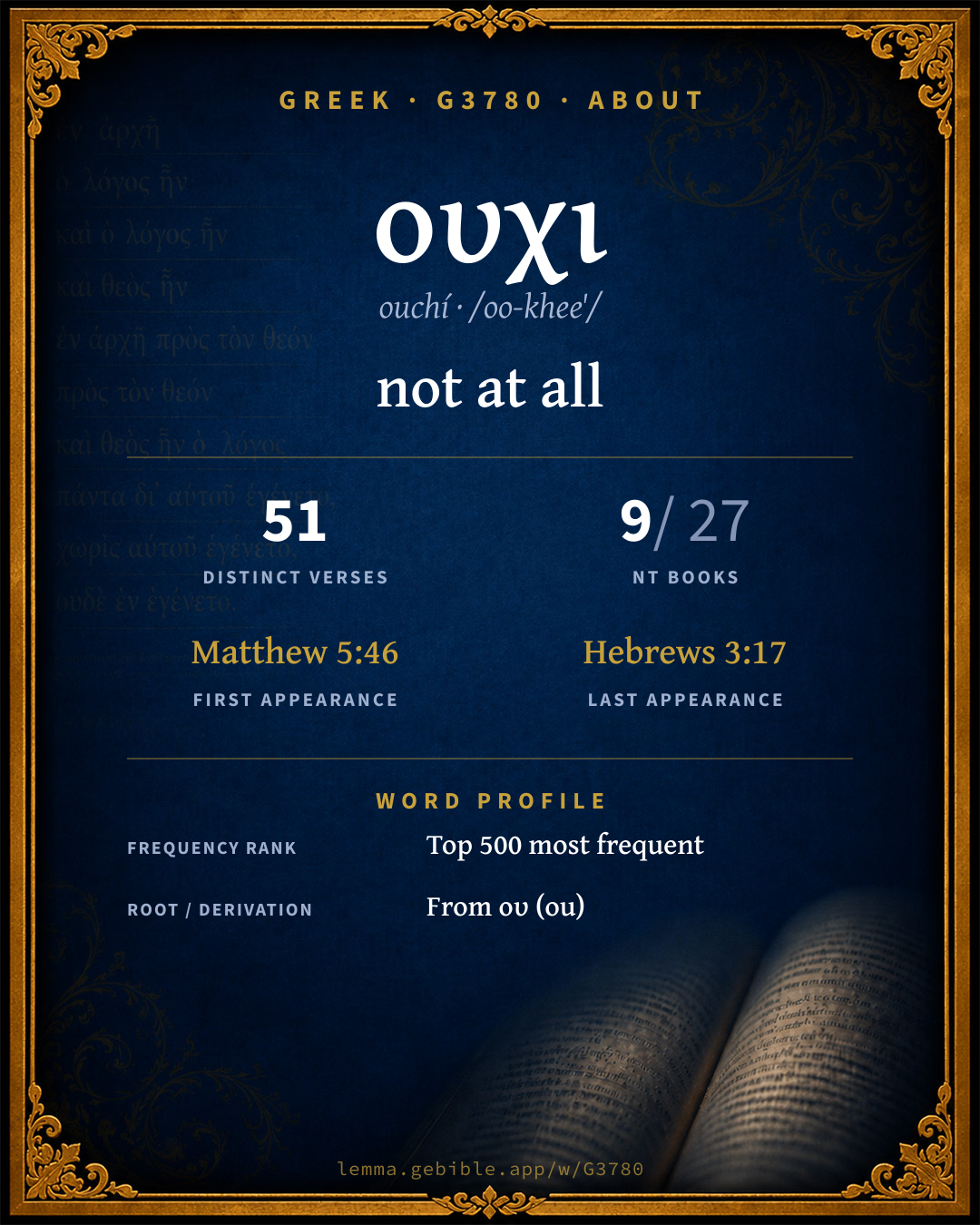
οὐχί
not at all
Full lexicon entry — Thayer's Greek Lexicon
From Thayer's Greek Lexicon
Where this word appears
Grammar key — what these labels mean
Part of speech
- Particle
- A short, often untranslatable function word adding nuance or connection.
Degree
- Interrogative
- Marks an interrogative form.
- Negative
- Marks a negative form.
Grammatical forms
- Particle, Interrogative 42 times (79%)
- Particle, Negative 11 times (21%)
Parsed forms decoded from the imported morphology (Robinson–Tischendorf, public domain), counted across 53 parsed occurrences — not distinct verses.
Every verse where G3780 appears — 51 distinct verses across 9 books. Click any verse to open its interlinear word-by-word view. Verse text shown in the World English Bible for context — . Each verse’s Greek form is shown with its reference; the English is not keyword-highlighted, since the data carries no word-level English alignment. Use “Compare translations” on any verse to read it across multiple English versions. This concordance covers the Greek New Testament; Septuagint (Greek Old Testament) occurrences of this word are not indexed here.
Matthew 9 verses
- Matthew 5:46 οὐχὶ ptcl interrog For if you love those who love you, what reward do you have? Don't even the tax collectors do the same?
- Matthew 5:47 οὐχὶ ptcl interrog If you only greet your friends, what more do you do than others? Don't even the tax collectors do the same?
- Matthew 6:25 οὐχὶ ptcl interrog Therefore, I tell you, don't be anxious for your life: what you will eat, or what you will drink; nor yet for your body, what you will wear. Isn't life more than food, and the body more than clothing?
- Matthew 10:29 οὐχὶ ptcl interrog "Aren't two sparrows sold for an assarion? Not one of them falls on the ground apart from your Father's will,
- Matthew 12:11 οὐχὶ ptcl interrog He said to them, "What man is there among you, who has one sheep, and if this one falls into a pit on the Sabbath day, won't he grab on to it, and lift it out?
- Matthew 13:27 οὐχὶ ptcl interrog The servants of the householder came and said to him, 'Sir, didn't you sow good seed in your field? Where did this darnel come from?'
- Matthew 13:56 οὐχὶ ptcl interrog Aren't all of his sisters with us? Where then did this man get all of these things?"
- Matthew 18:12 οὐχὶ ptcl interrog "What do you think? If a man has one hundred sheep, and one of them goes astray, doesn't he leave the ninety-nine, go to the mountains, and seek that which has gone astray?
- Matthew 20:13 οὐχὶ ptcl interrog "But he answered one of them, 'Friend, I am doing you no wrong. Didn't you agree with me for a denarius?
Luke 18 verses
- Luke 1:60 οὐχί ptcl neg His mother answered, "Not so; but he will be called John."
- Luke 4:22 οὐχὶ ptcl interrog All testified about him, and wondered at the gracious words which proceeded out of his mouth, and they said, "Isn't this Joseph's son?"
- Luke 6:39 οὐχὶ ptcl interrog He spoke a parable to them. "Can the blind guide the blind? Won't they both fall into a pit?
- Luke 12:6 οὐχὶ ptcl interrog "Aren't five sparrows sold for two assaria coins? Not one of them is forgotten by God.
- Luke 12:51 οὐχί ptcl neg Do you think that I have come to give peace in the earth? I tell you, no, but rather division.
- Luke 13:3 οὐχί ptcl neg I tell you, no, but, unless you repent, you will all perish in the same way.
- Luke 13:5 οὐχί ptcl neg I tell you, no, but, unless you repent, you will all perish in the same way."
- Luke 14:28 οὐχὶ ptcl interrog For which of you, desiring to build a tower, doesn't first sit down and count the cost, to see if he has enough to complete it?
- Luke 14:31 οὐχὶ ptcl interrog Or what king, as he goes to encounter another king in war, will not sit down first and consider whether he is able with ten thousand to meet him who comes against him with twenty thousand?
- Luke 15:8 οὐχὶ ptcl interrog Or what woman, if she had ten drachma coins, if she lost one drachma coin, wouldn't light a lamp, sweep the house, and seek diligently until she found it?
- Luke 16:30 οὐχί ptcl neg "He said, 'No, father Abraham, but if one goes to them from the dead, they will repent.'
- Luke 17:8 οὐχὶ ptcl interrog and will not rather tell him, 'Prepare my supper, clothe yourself properly, and serve me, while I eat and drink. Afterward you shall eat and drink'?
- Luke 17:17 οὐχὶ ptcl interrog Jesus answered, "Weren't the ten cleansed? But where are the nine?
- Luke 18:30 οὐχὶ ptcl neg who will not receive many times more in this time, and in the world to come, eternal life."
- Luke 22:27 οὐχὶ ptcl interrog For who is greater, one who sits at the table, or one who serves? Isn't it he who sits at the table? But I am in the midst of you as one who serves.
- Luke 23:39 οὐχὶ ptcl interrog One of the criminals who was hanged insulted him, saying, "If you are the Christ, save yourself and us!"
- Luke 24:26 οὐχὶ ptcl interrog Didn't the Christ have to suffer these things and to enter into his glory?"
- Luke 24:32 οὐχὶ ptcl interrog They said one to another, "Weren't our hearts burning within us, while he spoke to us along the way, and while he opened the Scriptures to us?"
John 5 verses
- John 9:9 οὐχί ptcl neg Others were saying, "It is he." Still others were saying, "He looks like him." He said, "I am he."
- John 11:9 οὐχὶ ptcl interrog Jesus answered, "Aren't there twelve hours of daylight? If a man walks in the day, he doesn't stumble, because he sees the light of this world.
- John 13:10 οὐχὶ ptcl neg Jesus said to him, "Someone who has bathed only needs to have his feet washed, but is completely clean. You are clean, but not all of you."
- John 13:11 οὐχὶ ptcl neg For he knew him who would betray him, therefore he said, "You are not all clean."
- John 14:22 οὐχὶ ptcl interrog Judas (not Iscariot) said to him, "Lord, what has happened that you are about to reveal yourself to us, and not to the world?"
Acts 2 verses
Romans 3 verses
- Romans 3:27 οὐχί ptcl neg Where then is the boasting? It is excluded. By what manner of law? Of works? No, but by a law of faith.
- Romans 3:29 οὐχὶ ptcl interrog Or is God the God of Jews only? Isn't he the God of Gentiles also? Yes, of Gentiles also,
- Romans 8:32 οὐχὶ ptcl interrog He who didn't spare his own Son, but delivered him up for us all, how would he not also with him freely give us all things?
1 Corinthians 10 verses
- 1 Corinthians 1:20 οὐχὶ ptcl interrog Where is the wise? Where is the scribe? Where is the lawyer of this world? Hasn't God made foolish the wisdom of this world?
- 1 Corinthians 3:3 οὐχὶ ptcl interrog for you are still fleshly. For insofar as there is jealousy, strife, and factions among you, aren't you fleshly, and don't you walk in the ways of men?
- 1 Corinthians 5:2 οὐχὶ ptcl interrog You are puffed up, and didn't rather mourn, that he who had done this deed might be removed from among you.
- 1 Corinthians 5:12 οὐχὶ ptcl interrog For what have I to do with also judging those who are outside? Don't you judge those who are within?
- 1 Corinthians 6:1 οὐχὶ ptcl interrog Dare any of you, having a matter against his neighbor, go to law before the unrighteous, and not before the saints?
- 1 Corinthians 6:7 οὐχὶ οὐχὶ ptcl interrog ptcl interrog Therefore it is already altogether a defect in you, that you have lawsuits one with another. Why not rather be wronged? Why not rather be defrauded?
- 1 Corinthians 8:10 οὐχὶ ptcl interrog For if a man sees you who have knowledge sitting in an idol's temple, won't his conscience, if he is weak, be emboldened to eat things sacrificed to idols?
- 1 Corinthians 9:1 οὐχὶ ptcl interrog Am I not free? Am I not an apostle? Haven't I seen Jesus Christ, our Lord? Aren't you my work in the Lord?
- 1 Corinthians 10:16 οὐχὶ οὐχὶ ptcl interrog ptcl interrog The cup of blessing which we bless, isn't it a communion of the blood of Christ? The bread which we break, isn't it a communion of the body of Christ?
- 1 Corinthians 10:29 οὐχὶ ptcl neg Conscience, I say, not your own, but the other's conscience. For why is my liberty judged by another conscience?
2 Corinthians 1 verse
1 Thessalonians 1 verse
Hebrews 2 verses
About this entry
At a glance — auto-summarized from this page’s data, not written by a person. Every figure links to its source below. This summary describes the numbers; it doesn’t interpret them.
At its core, ουχι (ouchí) means “not at all.” Scripture first uses it in Matthew 5:46. It appears 51 verses across 9 books of the Greek New Testament, among its moderately common vocabulary. The word gravitates to Luke (35%), then 1 Corinthians and Matthew. It clusters with ου, μη and ου μη under a shared root. Each statement above links to its evidence; the full detail follows below.
Gloss history
Strong's 1890 vs modern scholarship

About this word
Strong's G3780 catalogs a Greek word from the Greek New Testament.
These counts are not copied from any lexicon or concordance. They are computed here, from the morphology-tagged Greek New Testament. What Lemma adds →
- 51
- distinct verses
- The word appears in 51 distinct verses.
- 9 / 27
- NT books
- The word appears in 9 of 27 New Testament books.
- #300
- by frequency
- Top 500 most frequent Greek words (rank 300 of 5,347 Greek words by occurrence).
View all 51 occurrences in the concordance →
Most concentrated in
- Luke 18 verses 35%
- 1 Corinthians 10 verses 20%
- Matthew 9 verses 18%
By section of the New Testament
By traditional corpus
Conventional, traditional groupings — biblical authorship is debated, so this is a traditional corpus grouping, not an authorship claim. Some books belong to more than one corpus (Luke is in both the Gospels and the Lukan corpus, and so on), so these shares overlap and need not total 100%. Each figure is a share of the word’s 51 distinct verses.
- Gospels 32 verses · 63%
- Lukan (Luke–Acts) 20 verses · 39%
- Pauline corpus 15 verses · 29%
- Johannine 5 verses · 10%
- Hebrews 2 verses · 4%
How translations render this word
Counts come from each version’s own published word-to-Strong’s tagging or interlinear alignment — an approximate guide to how each version renders this word, not a word-level alignment the data otherwise carries. Because each total is that version’s own tagged count, the per-version totals vary from one another and need not match the appearance or distinct-verse counts above. These counts may also differ from a printed concordance because Lemma counts each distinctly tagged rendering and does not collapse phrase taggings into a single head-word total. This is a fixed set of word-tagged versions (KJV, ASV, BSB, ULT) and does not change with the reading translation you choose elsewhere. Each version’s license is shown beside its name below (and on Sources).
- King James Version: Not 41×, Nay 5×, Was it not 2×
- American Standard Version: Not 36×, Nay 5×
- Berean Standard Bible: Not 20×, No 7×, Are not 2×
- unfoldingWord Literal Text: Not 43×, No 6×, Is it not 2×
King James Version Public Domain
Renders G3780 across 56 tagged occurrences — most commonly:
Plus 8 renderings that appear only once — usually multi-word phrases or single function words the recovered tagging swept in, not distinct renderings.
American Standard Version Public Domain
Renders G3780 across 56 tagged occurrences — most commonly:
Plus 15 renderings that appear only once — usually multi-word phrases or single function words the recovered tagging swept in, not distinct renderings.
Berean Standard Bible Public Domain
Renders G3780 across 40 tagged occurrences — most commonly:
Plus 3 renderings that appear only once — usually multi-word phrases or single function words the recovered tagging swept in, not distinct renderings. Not rendered by a distinct English word in 3 further occurrences.
unfoldingWord Literal Text CC BY-SA 4.0
Renders G3780 across 55 tagged occurrences — most commonly:
Plus 4 renderings that appear only once — usually multi-word phrases or single function words the recovered tagging swept in, not distinct renderings.
Senses in Thayer's
The 1 sense Thayer's distinguishes for this word, in lexicon order (not ranked by frequency or importance). The full entry — with sub-senses — is in the Lexicon Entry tab.
- not, by no means, not at all
Word origin
Derived from ου (ou) (G3756) — not.
Intensive of G3756 ; not indeed : - nay not.
— Strong’s Exhaustive Concordance (1890), public domain.
Forms in the corpus
The 2 distinct written forms G3780 takes in the Greek New Testament, most frequent first — each parse links to that case’s occurrences in the concordance.
| Form | Parsing | Example | Uses |
|---|---|---|---|
| οὐχὶ ouchì | Particle, Interrogative | Matthew 5:46 | 46 |
| οὐχί ouchí | Particle, Negative | Luke 1:60 | 7 |
Same root — word family
Other Thayer's entries built from the same root as G3780, grouped by Strong’s listed origin. These share a root / origin per the lexicon — not necessarily a shared meaning. Each links to that word’s own entry.
Derives from
Shares the same root
- μη mḗ G3361 not
- ου μη ou mḗ G3364 by no means
- ουδε oudé G3761 neither
- ουκετι oukéti G3765 no longer
- ουκουν oukoûn G3766 not therefore
- ουπω oúpō G3768 not yet
- ουτε oúte G3777 neither
Compare all same-root words → Showing 4 of 9 — not the complete family. They share a root, not necessarily a meaning.