
Matthew 18:22

Greek (Tischendorf 8th ed.) Matthew 18:22 appears in the Greek New Testament. The text above is from the Tischendorf 8th edition. Each word links to its Strong’s number and a concise gloss. Click any word for its full Thayer’s Greek Lexicon entry.
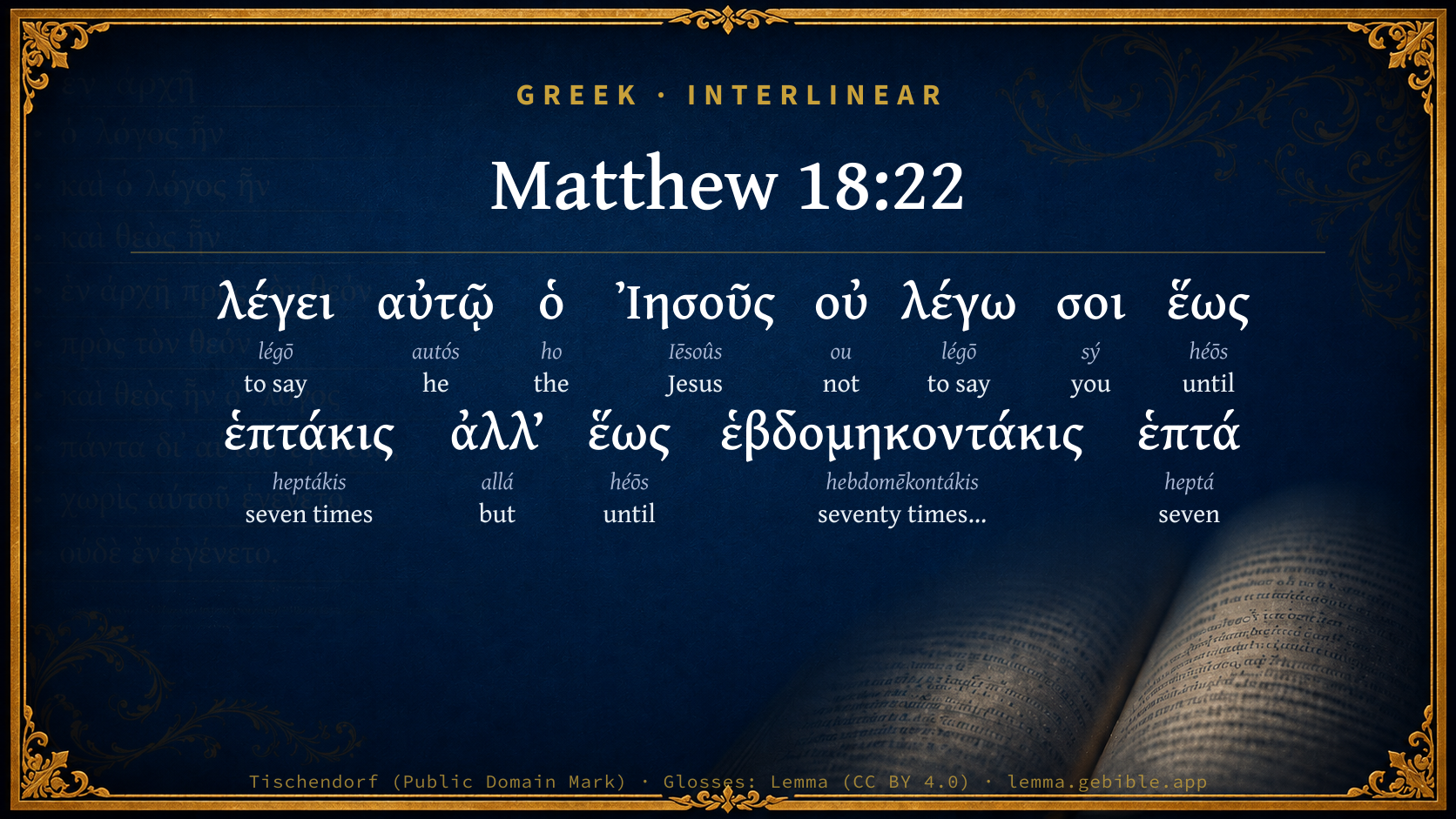
Download image
Cite this verse

Matthew 18:22 (World English Bible). Public Domain. Lemma interlinear Bible study tool, https://lemma.gebible.app/v/matthew/18/22.

Show BibTeX & RIS
BibTeX
RIS
English Translation
Jesus said to him, "I don't tell you until seven times, but, until seventy times seven.
World English Bible · Public Domain
Highlights
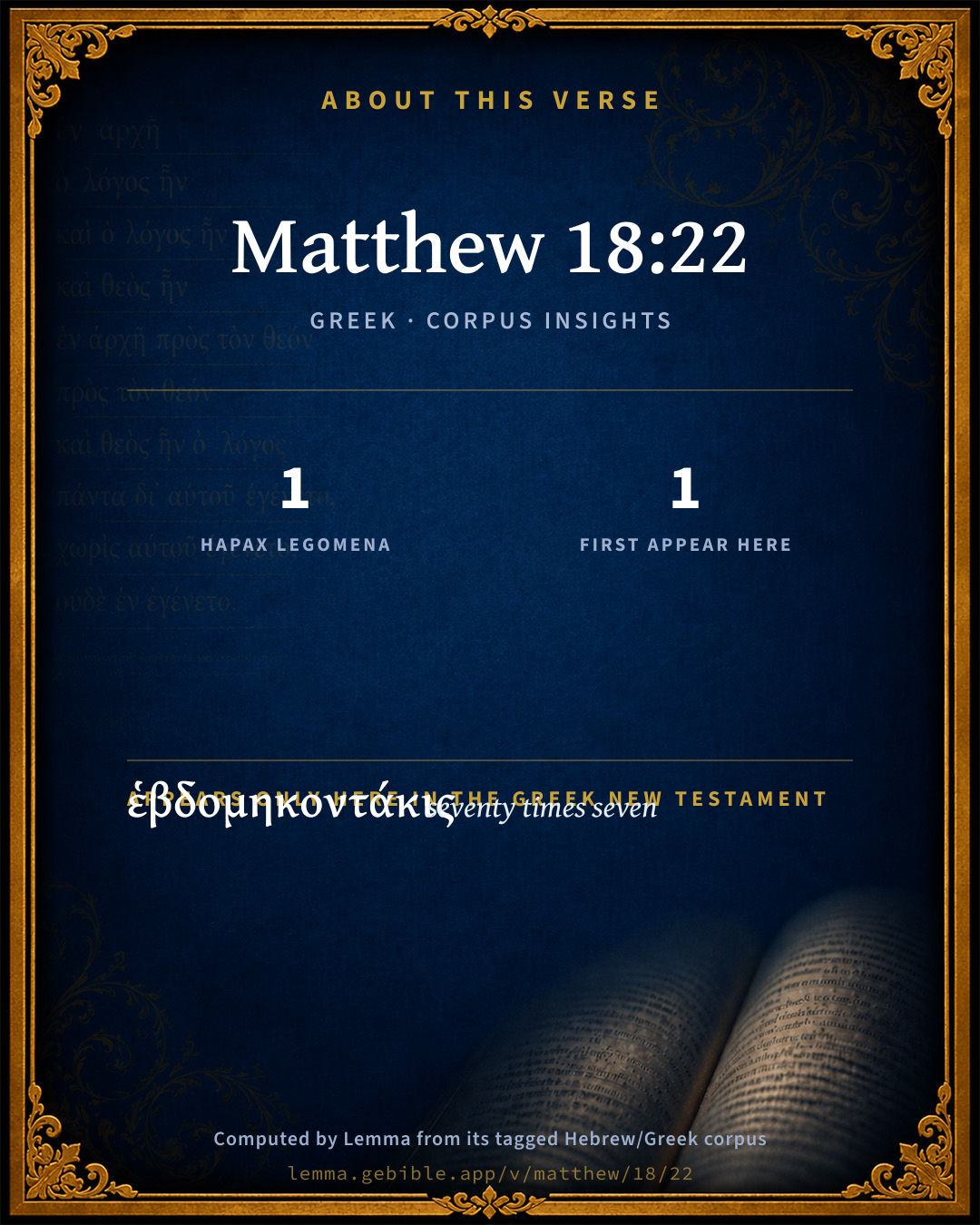
  • 1 hapax legomenon — only here in the Greek New Testament
  • 1 first appearance in the Greek New Testament
Full analysis ↓
Download a study sheet

One document with this verse’s original text, its word-by-word gloss line, the meaning frame, cross-references with their text, attributed commentary, and full source and license credits — printable, and it pastes into notes with its structure intact.

This verse Autodidact and up

Study sheet (.html) Plain text (.txt)

A passage Seminary Student

Up to 50 verses in one chapter. A passage sheet keeps up to 6 commentary sources and 12 cross-references per verse, in the order this page ranks them, and says so on the sheet whenever that leaves anything out. Ask for a single verse and you get the Autodidact verse sheet above.

Everything on this page stays free to read, with no account — the sheet is a download of what is already on screen, not access to it.

Want to remove ads? Support Godless Engineer
Compare translations 3

The same verse in 3 English versions, stacked beneath the original-language interlinear above. Click any original word for its lexicon entry.

Each is an independent rendering of the whole verse — the interlinear is not word-aligned to these translations.

Highlighted words mark where these versions differ — a whole-verse word diff, not a word-by-word alignment.

  • World English Bible Public Domain
    Jesus said to him, "I don't tell you until seven times, but, until seventy times seven.
  • King James Version Public Domain
    Jesus saith unto him, I say not unto thee, Until seven times: but, Until seventy times seven.
  • unfoldingWord Literal Text CC BY-SA 4.0
    Jesus says to him, “I do not say to you up to seven times, but up to 77 times.

unfoldingWord Literal Text — © unfoldingWord, licensed CC BY-SA 4.0. Word-aligned USFM3 via Door43 (git.door43.org/unfoldingWord/en_ult).

Versions to compare (up to 4)

3 of 4 selected

Show all 19 translations

Every available English version of this verse, each an independent rendering of the whole verse.

  • World English Bible Public Domain
    Jesus said to him, "I don't tell you until seven times, but, until seventy times seven.
  • Berean Standard Bible Public Domain
    Jesus answered, “I tell you, not just seven times, but seventy-seven times!
  • Majority Standard Bible Public Domain
    Jesus answered, “I tell you, not just seven times, but seventy-seven times!
  • King James Version Public Domain
    Jesus saith unto him, I say not unto thee, Until seven times: but, Until seventy times seven.
  • American Standard Version (1901) Public Domain
    Jesus saith unto him, I say not unto thee, Until seven times; but, Until seventy times seven.
  • Revised Version (1885) Public Domain
    Jesus saith unto him, I say not unto thee, Until seven times; but, Until seventy times seven.
  • Geneva Bible (1599) Public Domain
    Iesus said vnto him, I say not to thee, Vnto seuen times, but, Vnto seuentie times seuen times.
  • Douay-Rheims (1899) Public Domain
    Jesus saith to him: I say not to thee, till seven times; but till seventy times seven times.
  • Young's Literal Translation Public Domain
    Jesus saith to him, `I do not say to thee till seven times, but till seventy times seven.
  • Literal Standard Version CC BY-SA 4.0
    Jesus says to him, “I do not say to you until seven times, but until seventy times seven.
  • Unlocked Literal Bible CC BY-SA 4.0
    Jesus said to him, “I do not tell you seven times, but until seventy times seven.
  • unfoldingWord Literal Text CC BY-SA 4.0
    Jesus says to him, “I do not say to you up to seven times, but up to 77 times.
  • Darby Bible Public Domain
    Jesus says to him, I say not to thee until seven times, but until seventy times seven.
  • World Messianic Bible Public Domain
    Yeshua said to him, “I don’t tell you until seven times, but, until seventy times seven.
  • Webster's Bible Public Domain
    Jesus saith to him, I say not to thee, Until seven times: but, Until seventy times seven.
  • Free Bible Version CC BY-SA 4.0
    “No, not seven times. I would say seventy times seven!” Jesus told him.
  • Bible in Basic English Public Domain
    Jesus says to him, I say not to you, Till seven times; but, Till seventy times seven.
  • Text-Critical English NT CC BY 4.0
    Jesus said to him, “Not, I tell yoʋ, up to seven times, but up to seventy times seven.
  • Tyndale New Testament (1534) Public Domain
    Iesus sayd vnto him: I saye not vnto the seven tymes: but seventy tymes seventymes.

Literal Standard Version (2020), Covenant Press — licensed CC BY-SA 4.0. Text via the HelloAO Bible API (eBible.org). Unlocked Literal Bible (unfoldingWord) — licensed CC BY-SA 4.0. Text via the HelloAO Bible API (eBible.org). unfoldingWord Literal Text — © unfoldingWord, licensed CC BY-SA 4.0. Word-aligned USFM3 via Door43 (git.door43.org/unfoldingWord/en_ult). Free Bible Version, Dr. Jonathan Gallagher — licensed CC BY-SA 4.0. Text via the HelloAO Bible API (eBible.org).

Word by word

More ways to search: Search by grammar → Find every occurrence → Compare this word →

Practice this passage: Drill this verse → Learn its vocabulary →

About this verse

These counts appear in no published source. They are computed here, from the morphology-tagged text and Lemma’s own curated glosses. What Lemma adds →

13
words
11
distinct lemmas
Gospels
section

Notable vocabulary

1 hapax legomenon — a word that appears only here in the entire Greek New Testament:

  • ἑβδομηκοντάκις seventy times seven G1441

First appearance in Scripture

This word makes its first canonical appearance in the Greek New Testament here:

  • ἑβδομηκοντάκις seventy times seven G1441

Shared distinctive vocabulary

ἑπτάκις seven times G2034 occurs in 3 verses of the Greek New Testament. Also found in:
Repetition

Words recur within this verse:

  • λέγει to say G3004 ×2
  • ἕως until G2193 ×2

Cross-references

11

Topical passages linked to Matthew 18:22 in the Treasury of Scripture Knowledge — connected by theme and wording, ordered by reader-vote popularity; previews shown in the World English Bible.

  • Colossians 3:13 bearing with one another, and forgiving each other, if any man has a complaint against any; even as Christ forgave you, so you also do.
  • Mark 11:25 Whenever you stand praying, forgive, if you have anything against anyone; so that your Father, who is in heaven, may also forgive you your transgressions.
  • Ephesians 4:31–5:1 Let all bitterness, wrath, anger, outcry, and slander, be put away from you, with all malice.
  • Matthew 6:14–15 "For if you forgive men their trespasses, your heavenly Father will also forgive you.
  • Genesis 4:24 If Cain will be avenged seven times, Truly Lamech seventy-seven times."
  • Romans 12:21 Don't be overcome by evil, but overcome evil with good.
  • Ephesians 4:26 "Be angry, and don't sin." Don't let the sun go down on your wrath,
  • Isaiah 55:7 let the wicked forsake his way, and the unrighteous man his thoughts; and let him return to Yahweh, and he will have mercy on him; and to our God, for he will abundantly pardon.
  • Micah 7:19 He will again have compassion on us. He will tread our iniquities under foot; And you will cast all their sins into the depths of the sea.
  • Matthew 6:11–12 Give us today our daily bread.
  • 1 Timothy 2:8 I desire therefore that the men in every place pray, lifting up holy hands without wrath and doubting.

Cross-references courtesy of OpenBible.info (CC BY 4.0).

Commentary

Notes on Matthew 18:22 from classic Christian and Jewish commentators (each source and its license shown beneath its notes). The classic Christian expositions comment on the surrounding passage and are grouped to its opening verse, so a note may address several verses; the Jewish commentaries on the Tanakh (Rashi and others) are per-verse, so they appear only where the commentator wrote on this verse.

Lemma curates 59 commentaries, every one of them public domain or Creative Commons licensed, each selected and text-cleaned for this edition rather than reprinted as found. About our sources →

Tyndale Open Study Notes

Tyndale Open Resources

18:22 seventy times seven: Or seventy-seven times; either way, Jesus prescribes limitless readiness to forgive from the heart (18:35; cp. Gen 4:23-24).

Tyndale Open Study Notes — © Tyndale Open Resources, licensed CC BY-SA 4.0. Text via the HelloAO Bible API.

Bengel's Gnomon

Johann Albrecht Bengel

Mat 18:22. Ἑβδομηκοντάκις ἑπτὰ, seventy-seven[836]) The termination κις makes the whole number seventy-seven. Thus the LXX., in Gen 4:24, use the same phrase regarding Lamech.[837]

[836] E. V. “Seventy times seven.” Vulg., “Septuagies septies.”—(I. B.)

[837] One could hardly believe that so great dissension could arise even among those entertaining the worst feelings towards others. Therefore there is required a willingness to forgive, which cannot be wearied out by any provocations, however numerous.—V. g.

“If Cain be avenged sevenfold, truly Lamech seventy and sevenfold;” not “seventy times seven;” LXX. ἑπτακοντάκις ἕπτα.—ED.

Bengel's Gnomon of the New Testament — English translation (T&T Clark, Edinburgh, 1860) — public domain. Text from a community e-Sword module.

Meyer's Critical & Exegetical Commentary

Heinrich August Wilhelm Meyer

Mat_18:22. Οὐ λέγω σοι] are to be taken together (in answer to Fritzsche), and to be rendered thus: I do not say to thee, I do not give thee the prescription; comp. Joh_16:26.

ἑβδομηκοντάκις ἑπτά] not: till seventy times seven, i.e. till the four hundred and ninetieth time (Jerome, Theophylact, Erasmus, Luther, Grotius, de Wette, Bleek); but, seeing that we have ἑπτά, and not ἑπτάκις again, the rendering should simply be: till seventy-seven times. No doubt, according to the classical usage of adverbial numerals, this would have been expressed by ἑπτὰ καὶ ἑβδομηκοντάκις or ἑβδομήκοντα ἑπτάκις; but the expression in the text is according to the LXX. Gen_4:24.[1] So, and that correctly, Origen, Augustine, Bengel, Ewald, Hilgenfeld, Keim; comp. the Gospel of the Hebrews in Hilgenfelds N. T. extra can. IV. p. 24.

For the sense, comp. Theophylact: οὐχ ἵνα ἀριθμῷ περικλείσῃ τὴν συγχώρησιν, ἀλλὰ τὸ ἄπειρον ἐνταῦθα σημαίνει· ὡς ἂν εἰ ἔλεγεν· ὁσάκις ἂν πταίσας μετανοῇ συγχώρει αὐτῷ.

[1] 1 Where, indeed, שִׁבְעִים וְשִׁבְעָה cannot possibly mean anything else than seventy-seven, as is clear from the וְ, not seventy times seven; comp. Jdg_8:14. This in answer to Kamphausen in the Stud. u. Krit. 1861, p. 121 f. The (substantive) feminine form שבעה cannot be considered strange (seventy and a seven). See Ewald, Lehrb. d. Hebr. Spr. § 267 c., and his Jahrb. XI. p. 198.

Meyer — Critical and Exegetical Commentary on the New Testament — English translation by Peter Christie, edited by Frederick Crombie (T&T Clark, 1880) — public domain. Text from a community e-Sword module.

Expositor's Greek Testament

ed. W. Robertson Nicoll

Mat 18:22 . οὐ : emphatic “no” to be connected with ἕως ἑπτάκις . Its force may be brought out by translating: no, I tell you, not till, etc. ἀλλὰ ἑ . ἑ . ἑ .: Christ’s reply lifts the subject out of the legal sphere, where even Peter’s suggestion left it (seven times and no more a hard rule), into the evangelic, and means: times without number , infinite placability. This alone decides between the two renderings of ἑβδομηκοντάκις ἑπτά : seventy-seven times and seventy times seven, in favour of the latter as giving a number (490) practically equal to infinitude. Bengel leans to the former, taking the termination - κις as covering the whole number seventy-seven, and referring to Gen 4:24 as the probable source of the expression. Similarly some of the Fathers (Orig., Aug.), De Wette and Meyer. The majority adopt the opposite view, among whom may be named Grotius and Fritzsche, who cite the Syriac version in support. On either view there is inexactness in the expression. Seventy times seven requires the termination - κις at both words. Seventy-seven times requires the - κις at the end of the second word rather than at end of first: either ἑπτὰ καὶ ἑβδο … κις , or ἑβδομ … τα ἑπτάκις .

The Expositor's Greek Testament, edited by W. Robertson Nicoll (1897–1910) — public domain. Text from a community e-Sword module.

Jamieson, Fausset & Brown

Robert Jamieson, A. R. Fausset & David Brown

Jesus saith unto him, I say not unto thee, Until seven times; but, Until seventy times seven--that is, so long as it shall be needed and sought: you are never to come to the point of refusing forgiveness sincerely asked. (See on Luk 17:3-4).

Jamieson, Fausset & Brown — Commentary Critical and Explanatory on the Whole Bible (1871) — public domain (CC PDM 1.0). Text via the HelloAO Bible API.

Adam Clarke's Commentary

Verse 22. Seventy times seven.] There is something very remarkable in these words, especially if collated with Ge 4:24, where the very same words are used-"If any man kill LAMECH, he shall be avenged seventy times seven." The just God punishes sin in an exemplary manner. Sinful man, who is exposed to the stroke of Divine justice, should be abundant in forgiveness, especially as the merciful only shall find mercy. See Clarke on Mt 5:7, and on Mt 6:14; Mt 6:15. The sum seventy times seven makes four hundred and ninety. Now an offence, properly such, is that which is given wantonly, maliciously, and without ANY PROVOCATION. It is my opinion, that, let a man search ever so accurately, he will not find that he has received, during the whole course of his life, four hundred and ninety such offences. If the man who receives the offence has given any cause for it, in that case, the half of the offence, at least, towards his brother, ceases.

Adam Clarke's Commentary on the Bible (1810–1826) — public domain. Text from a community e-Sword/MySword module.

Ellicott's Commentary for English Readers

(22) Seventy times seven.—The use of the symbolic numbers that indicated completeness was obviously designed to lead the mind of the questioner altogether away from any specially numerical standard as such. As there was no such limit to the forgiveness of God, so there should be none to that of man. The very question as to the latter showed the inquirer had not rightly apprehended the nature and extent of the former.

A Bible Commentary for English Readers, edited by Charles John Ellicott (1878–1897) — public domain. Text from a community e-Sword module.

The Cambridge Bible for Schools and Colleges

gen. ed. J. J. S. Perowne

22. Until seventy times seven] i. e. an infinite number of times. There is no limit to forgiveness.

The Cambridge Bible for Schools and Colleges (gen. ed. J. J. S. Perowne; Cambridge University Press, 1878–1918) — public domain. Text from a community e-Sword module.

John Gill's Exposition

But forasmuch as he had not to pay,.... Every sinner is insolvent; sinful man has run out the whole stock of nature, and is become a bankrupt, and has nothing to offer by way of composition; nor has he any righteousness to answer for him, nor any works of righteousness which deserve that name: and if he had, these are nothing in point of payment: for a debt of sin cannot be discharged by a debt of obedience; since God has a prior right to the latter; and in paying it, a man does but what is his duty. Sin being committed against an infinite God, contracts the nature of an infinite debt, which cannot be paid off by a finite creature. Christ only was able to pay this debt, and he has done it for his people; and without an interest in his blood, righteousness, and satisfaction, every debtor is liable to be cast, and will be cast into the prison of hell, there to lie till the uttermost farthing of the ten thousand talents is paid, which will be to all eternity. We see what a sad condition sin has brought men into; it has stripped them of their estates and possessions; it has reduced them to want and beggary; it exposes them to a prison; to the just resentments of their creditor; to the wrath of God, and the curses of the law; and what little reason there is to think, yea, how impossible it is, that a man should be able to merit anything at the hands of God, to whom he is so greatly indebted: he must first pay his debts, which is a thing impracticable, before he can pretend to do anything deserving the notice of God; and even was he set free, and clear of all his debts, and entered upon a new life of obedience, and this strictly attended to, without contracting any debts for the future, yet all this would be but what is due to God, and could merit nothing of him; see Luk 17:10. We see also from hence, how much the saints are obliged to Christ Jesus, and how thankful they should be to him, who became a surety for such insolvent creatures; has paid all their debts for them, and procured for them every blessing of grace they stand in need of: but think, O sinner, what thou wilt be able to say and do, when God comes to reckon with thee, and thou hast nothing to pay, nor any to pay for thee, or be thy surety; a prison must be thy portion ever.

His Lord commanded him to be sold, and his wife and children, and all that he had; according to the Jewish laws, in such a case: of a man's being sold, or selling himself when poor, see Lev 25:47, for the law in Exo 22:3, referred to by some as an instance of this, respects the selling of a man for theft, and not for debt. Of the selling of a man's wife for the payment of his debts, I do not remember to have read any law concerning it, or instances of it; but of children being taken for bondmen by the creditor, for their father's debts, mention is made, Kg2 4:1. These children, by the Jewish writers (i), are said to be the children of Obadiah, who contracted the debt to feed the prophets in a cave, when they were persecuted by Jezebel; and the creditor, according to them, was Jehoram, the son of Ahab, who lent him money on usury for this purpose, in his father's time; and now Obadiah being dead, he takes his children for the debt, and makes them bondmen; see also Neh 5:5. There seems to be an allusion to this practice, in Isa 50:1, and it was not only the custom of the Jews to come upon children for the debts of parents, but of other nations: with the Athenians, if a father could not pay his debts, the son was obliged to pay, and in the mean while to be kept in bonds till he did (k): and as Grotius, in Kg2 4:1 proves from Plutarch and Dionysius Halicarnassensis, children were sold by the creditors of their parents, as in Asia, at Athens, and at Rome. Now this expresses the state of bondage, sin, as a debt, brings men into; they become slaves to their own lusts, vassals of Satan, and in bondage to the law; and also the ruin and destruction it exposes them to; as, the curse and condemnation of the law, the wrath of God, eternal death, even the destruction of body and soul in hell:

and payment to be made by punishment, which will always be making, and never finished. This order of the king was not intended to be executed, as the sequel shows; but declares the will of God, that the sad and woeful condition of man should be set before him by the ministers of the word; signifying what his state is, how deserving of vengeance, and what must be his portion, if grace prevent not: the view of which is to vindicate the rights of law and justice, to express the sinner's deserts, and move him to apply to the Lord for grace and mercy, which effect it had.

(i) Targum Jon. in loc. Tanchuma in Abarbinel in loc. Jarchi, Kimchi & Laniado in ib. (k) Alex. ab Alex. Genial. Dier. l. 6. c. 10.

John Gill's Exposition of the Whole Bible (1746–1763) — public domain (CC PDM 1.0). Text via the HelloAO Bible API.

Trapp's Complete Commentary

John Trapp

22 Jesus saith unto him, I say not unto thee, Until seven times: but, Until seventy times seven.

Ver. 22. Until seventy times seven] i.e. Infinities, toties quoties. God multiplieth pardons, Isa 55:7; so should we. "Love covereth all sins," Pro 10:12, so large is the skirt of love’s mantle. Between God and us the distance is infinite, and if it were possible, our love to him, and to our friends in him, our foes for him, should fill up that distance, and extend itself to infiniteness. We may without sin be sensible of injuries (a sheep is as sensible of a bite as a swine), but it must be with the silence of a sheep, or at utmost the mourning of a dove, not the roaring of a bear, or bellowing of a bull, when baited. All desire of revenge must be carefully cast out; and if the wrong doer say, I repent, you must say, I remit, and that from the heart; being herein like that king of England, of whom it is said that he never forgot anything but injuries. Every Christian should keep a continual jubilee, nexus solvendo et nexas remittendo, by loosing bonds and remitting wrongs, εορταζωμεν, 1Co 5:8.

John Trapp, A Commentary or Exposition upon All the Books of the Old and New Testament (1647–1656) — public domain. Text from a community e-Sword module.

Albert Barnes' Notes on the Bible

Till seven times? - The Jews caught that a man was to forgive another three times, but not the fourth. Peter more than doubled this, and asked whether forgiveness was to be exercised to so great an extent.

I say not unto thee, Until seven times, but, Until seventy times seven - The meaning is, that we are not to limit our forgiveness to any fixed number of times. See Gen 4:24. As often as a brother injures us and asks forgiveness, we are to forgive him. It is, indeed, his duty to ask forgiveness, Luk 17:4. If he does this, it is our duty to declare that we forgive him, and to treat him accordingly. If he does not ask us to forgive him, yet we are not at liberty to follow him with revenge and malice, but are still to treat him kindly and to do him good, Luk 10:30-37.

Albert Barnes' Notes on the Bible (1834–1885) — public domain. Text from a community e-Sword/MySword module.

Haydock's Catholic Bible Commentary

Till seventy times seven; i.e. 490 times; but it is put by way of an unlimited number, to signify we must pardon private injuries, though even so often done to us. (Witham) --- When our brother sins against us, we must grieve for his sake over the evil he has committed; but for ourselves we ought greatly to rejoice, because we are thereby made like our heavenly Father, who bids the sun to shine upon the good and the bad. But if the thought of having to imitate God alarms us, though it should not seem difficult to a true lover of God, let us place before our eyes the examples of his favourite servants. Let us imitate Joseph, who though reduced to a state of the most abject servitude, by the hatred of his unnatural brethren, yet in the affliction of his heart, employed all his power to succour them in their afflictions. Let us imitate Moses, who after a thousand injuries, raised his fervent supplications in behalf of his people. Let us imitate the blessed Paul, who, though daily suffering a thousand afflictions from the Jews, still wished to become an anathema for their salvation. Let us imitate Stephen, who, when the stones of his persecutors were covering him with wounds, prayed that the Almighty would pardon their sin. Let us follow these admirable examples, then shall we extinguish the flames of anger, then will our heavenly Father grant us the forgiveness of our sins, through the merits of our Lord Jesus Christ. (St. John Chrysostom, hom. lxii.)

George Leo Haydock (1774–1849), Haydock's Catholic Family Bible and Commentary, 1859 edition — public domain. Excludes Psalms (Douay-Rheims chapter numbering differs from Protestant) and Deuterocanonical books (Catholic canon only).

Whedon's Commentary on the Bible

Daniel D. Whedon

22. Seventy times seven — This may seem a maxim of impracticable morality; but the duty of such a succession of pardons is founded upon the supposition of the offender’s sincere repentance, as a condition, and the absence of any danger from his machinations. Doubtless one would endeavour in some way to remove the liability to such repeated backslidings and necessities for forgiveness, before the full number above named had arrived. Yet the rule lays down that in no case do we retain resentment toward a sincere penitent. And thus we have a striking parallel to the state of things between God and ourselves as continually sinning and repenting.

Daniel D. Whedon (gen. ed.), Commentary on the Old and New Testaments (1874–1909) — public domain. Text from a community e-Sword module.

The Pulpit Commentary

I say not unto thee. Jesus gives the full weight of his authority to his precept, in distinction from Peter"s suggestion and rabbinical glosses. Seventy times seven. No specific number, but practically unlimited. There is no measure to forgiveness; it must be practised whenever occasion arises. Some translate, "seventy-seven times," making an allusion to the retribution exacted from Lamech: "If Cain shall be avenged sevenfold, truly Lamech seventy and sevenfold". (Gen_4:24) Christian forgiveness must be extended as far as old-world vengeance. Mercy rejoices against judgment. But the genius of the language supports the rendering of the Authorized Version. St. Paul has caught the spirit of his Master when he writes, "Forgiving one another, even as God for Christ"s sake hath forgiven you". (Eph_4:32) In the Mosaic dispensation there was some foreshadowing of the doctrine of forgiveness in the enactments which enjoined tender treatment of debtors, and in the terms of the jubilee law; but there were no rules concerning the pardon of personal injuries; the tendency of many prominent injunctions was to encourage retaliation. Herein is seen an important distinction between the Law and the gospel, the institutions antecedent to the death and atonement of Christ, and those subsequent thereto.

The Christian limit of forgiveness.

"Until seventy times seven." This is no fixed number. It is a figurative way of saying that there is, and there can be, no limit to Christian forgiveness. To understand the point and force of St. Peter"s question, it is necessary to know the rabbinical rules of forgiveness with which he would be familiar. It was a settled rule of the rabbis that forgiveness should not be extended more than three times. Edersheim says, "It was a principle of rabbinism that, even if the wrong doer had made full restoration, he would not obtain forgiveness till he had asked it of him whom he had wronged, but that it was cruelty in such circumstances to refuse pardon." It says much for St. Peter"s apprehension of his Master that he was sure he would not limit forgiveness to the rabbinical "three times." From his point of view, making the three times into seven times was a splendid piece of liberality. But he could not measure the generosity and nobility of his Lord, who took the "three times" and made it "seventy times seven." "It did not occur to St. Peter that the very act of numbering offences marked an externalism which had never entered into, nor comprehended, the spirit of Christ. He had yet to learn, what we, alas! too often forget, that as Christ"s forgiveness, so that of the Christian, must not be computed by numbers. It is qualitative, not quantitative. Christ forgives sin, not sins; and he who has experienced it follows in his footsteps.

I THE ULTIMATE LIMIT IS THE DIVINE EXAMPLE OF FORGIVENESS. "As Christ forgave you, so also do ye." What do we expect from God? Can we conceive of a limit to the times when we may hope for the mercy of God? What would life be worth if we could? The fear of outstretching the limit would fill us with misery. Man can never lose the hope in God. If he does he becomes fixed in sin. "There is forgiveness with thee;" a man must be able to say that in full view of the provocations of a long life, when he comes to his dying day. To the Divine forgiveness there is no qualification of degrees or numbers.

II THE PRACTICAL LIMIT IS OUR CHRISTLY LOVE FOR OUR BROTHER. If we are Christly, we want to do him good. It does not matter about ourselves, and injury done to us. It does matter to a Christly man that a brother has done a wrong. The Christly man is set upon his recovery from the wrong; and if that means his forgiveness over and over again, until patience is tried unto the uttermost, the Christly man will forgive and bear, if only he may win back his erring brother at last. R.T.

The Pulpit Commentary (1880–1919), ed. H.D.M. Spence-Jones & Joseph S. Exell — public domain. Text from a community e-Sword module.

John Wesley's Explanatory Notes

Till seventy times seven - That is, as often as there is occasion. A certain number is put for an uncertain.

John Wesley, Explanatory Notes Upon the Whole Bible (1754–1765) — public domain. Text via the GEBible commentary corpus.

The People's New Testament

B. W. Johnson

22. Until seventy times seven. That is, there should be no limit at which it shall be refused if it is asked in the spirit of sincere penitence. By reference to Luke 17:4, one can see the condition of forgiveness. It is that the offender professes repentance. We are to forgive men their trespasses on the same condition that God forgives us ours, and he does not forgive the impenitent. Our mercy must be just as unlimited as that of God.

B. W. Johnson's The People's New Testament with Notes (1889–1891) — public domain. Electronic text from the Christian Classics Ethereal Library (CCEL) ThML edition.

Cambridge Greek Testament for Schools and Colleges

22. ἕως ἑβδομηκοντάκις ἑπτά, i.e. an infinite number of times. There is no limit to forgiveness.

Cambridge Greek Testament for Schools and Colleges (Cambridge University Press, 1896; 21 vols, various authors incl. Carr, Maclear, Plummer, Farrar, Lumby, Moule, M. R. James, Simcox) — public domain. Text from a community e-Sword module.

International Critical Commentary

22. Jesus saith to him, Not, I say to thee, until seven times; but, until seventy times seven.] The latter number is meant as an indefinitely great one. There is the same literary contrast between seven and seventy times seven in Gen 4:24 LXX. Cf. Moulton, p. 98: “A definite allusion to the Genesis story is highly probable. Jesus pointedly sets against the natural man’s craving for seventy-sevenfold revenge, the spiritual man’s ambition to exercise the privilege of seventy-sevenfold forgiveness.” Dr. Moulton had previously said that the meaning “seventy seven times” is unmistakable in Genesis. It is very probable that Mt.’s ἑβδομηκοντάκις ἑπτά is modelled on the similar phrase in Genesis, but it seems doubtful whether in both passages we should not translate seventy times seven, rather than seventy-seven times. In Mt., D has ἑβδομηκοντάκις ἑπτάκις, an obvious emendation. Blass renders seventy times seven, p. 145. So Wellhausen and Zahn, in loc. Contrast the teaching in the Babylonian Talmud, Joma 86b “Rabbi Jose ben Jehuda said, If a man commits an offence once they forgive him, a second time they forgive him, a third time they forgive him, the fourth time they do not forgive him: for it is said (here follow Job 33:29 and Amo 2:6)”; 87a “Rabbi Isaac said, Every one who vexes his neighbour, if only in words, must appease him.” “Rabbi Jose ben Hanina said, He who begs forgiveness from his neighbour must not do so more than three times, for it is said” (here follows Gen 2:17, in which are here three particles of entreaty).

International Critical Commentary — older volumes (1896–1929), various authors — public domain. Text from a community e-Sword module.

Vincent's Word Studies in the New Testament

Marvin R. Vincent

Seventy times seven [εβδομηκοντακις επτα] . 5 It was a settled rule of Rabbinism that forgiveness should not be extended more than three times. Even so, the practice was terribly different. The Talmud relates, without blame, the conduct of a rabbi who would not forgive a very small slight of his dignity, though asked by the offender for thirteen successive years, and that on the day of atonement; the reason being that the offended rabbi had learned by a dream that his offending brother would attain the highest dignity; whereupon he feigned himself irreconcilable, to force the other to migrate from Palestine to Babylon, where, unenvied by him, he might occupy the chief place (Edersheim). It must, therefore, have seemed to Peter a stretch of charity to extend forgiveness from three to seven times. Christ is not specifying a number of times greater than the limit of seven. He means that there is to be no limit. "Forgiveness is qualitative, not quantitative."

Marvin R. Vincent, Word Studies in the New Testament (1887–1900) — public domain. Text from a community e-Sword/MySword module.

Lesson kit

Teaching starters — assembled from the data on this page, not authored interpretation. Every prompt links to the verse data it draws on. Edit before teaching.

Matthew, in the Gospels, opens this verse with 13 words (11 distinct Greek lemmas). Its most distinctive word is hebdomēkontákis (“seventy times seven”). A historical commentator’s framing appears above. Read the whole chapter for the surrounding context.

Discussion questions

  1. What does “seventy times seven” (hebdomēkontákis) contribute to the verse as a whole?
  2. 1 word here appears nowhere else in the Greek New Testament. Why might the author reach for such rare wording?
  3. This is the first place “seventy times seven” appears in Scripture (first appears here). What does its debut here establish?
  4. How does Matthew 18:21, which shares the word «seven times», read alongside this verse?
  5. What does the repetition of “to say” (2× in this one verse) do in this verse?
  6. These translations render this verse differently; the difference is in the English rendering, not the original. What questions does that raise?
  7. Compare how Tyndale Open Study Notes and Bengel's Gnomon read this verse. Where do they agree or differ?

Things to notice

  • 1 word in this verse appears nowhere else in the Greek New Testament.
  • 1 word makes its first canonical appearance in Scripture here.
  • These translations choose different wording for 11 words in this verse.
  • “to say” occurs 2× in this single verse.
  • 11 distinct Greek lemmas span 13 words in this verse.

Reading settings

Reading text

Shown beneath each verse's original-language words.

Old Testament
Old Testament edition

Read the OT as the Masoretic Hebrew (MT) or the Greek Septuagint (LXX).

English shown for the Greek Septuagint (in the Hebrew ↔ Greek comparison).

Comparing translations? Open the Compare panel on any verse page to stack up to four side by side.