Matthew 12:20

Greek (Tischendorf 8th ed.) Matthew 12:20 appears in the Greek New Testament. The text above is from the Tischendorf 8th edition. Each word links to its Strong’s number and a concise gloss. Click any word for its full Thayer’s Greek Lexicon entry.
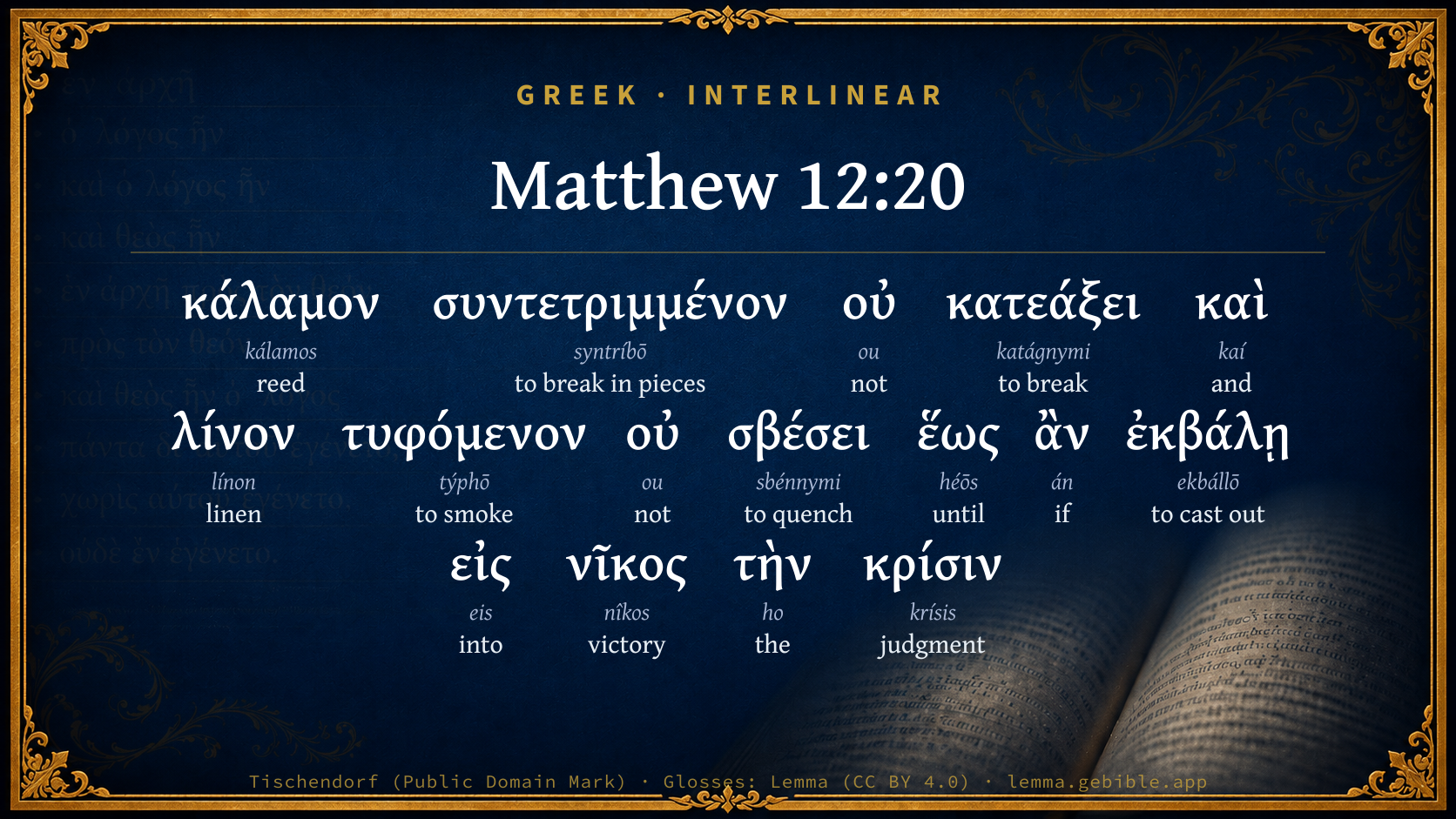
Download image
Cite this verse

Matthew 12:20 (World English Bible). Public Domain. Lemma interlinear Bible study tool, https://lemma.gebible.app/v/matthew/12/20.

Show BibTeX & RIS
BibTeX
RIS
English Translation
He won't break a bruised reed. He won't quench a smoking flax, Until he leads justice to victory.
World English Bible · Public Domain
Highlights
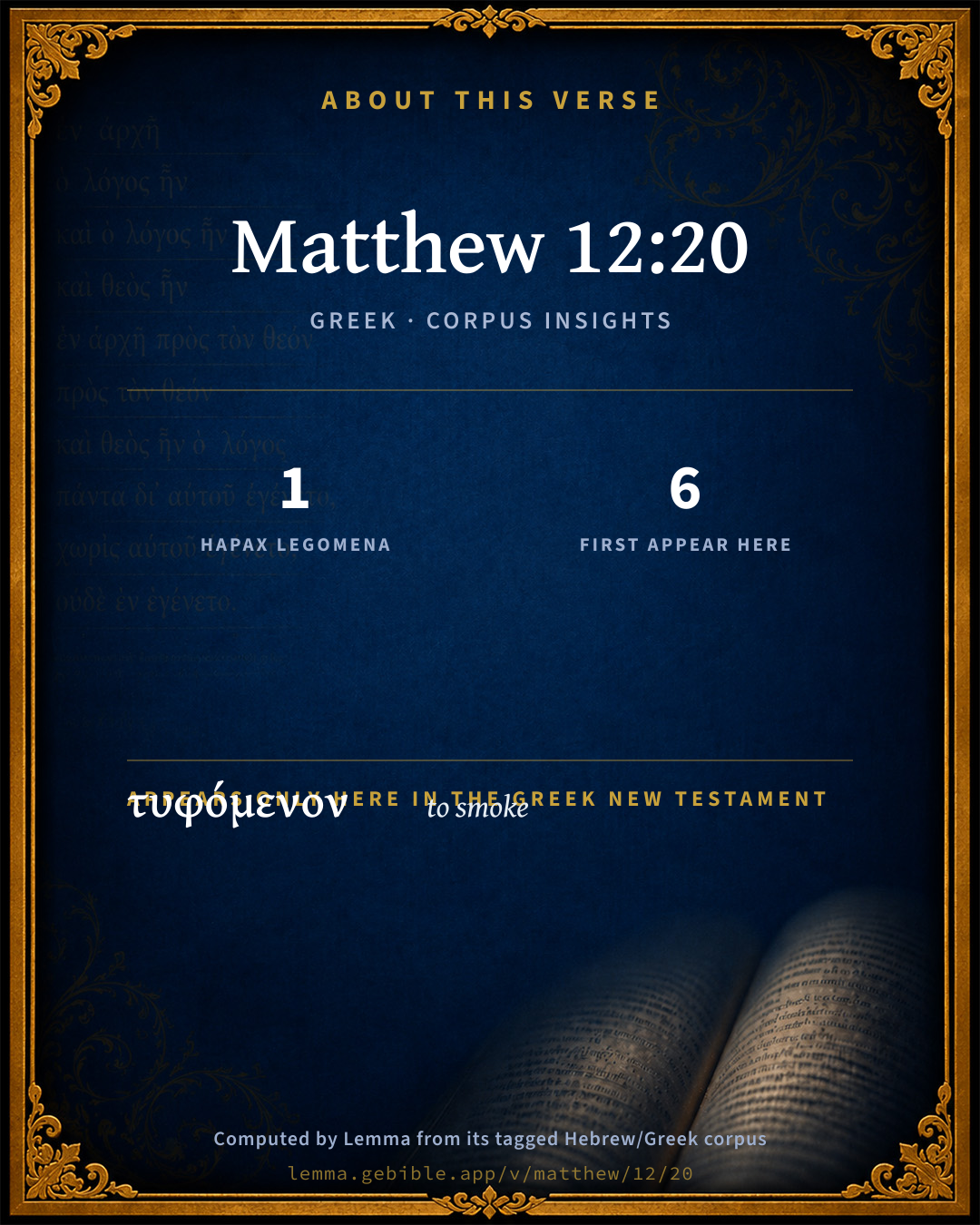
  • 1 hapax legomenon — only here in the Greek New Testament
  • 6 first appearances in the Greek New Testament
Full analysis ↓
Download a study sheet

One document with this verse’s original text, its word-by-word gloss line, the meaning frame, cross-references with their text, attributed commentary, and full source and license credits — printable, and it pastes into notes with its structure intact.

This verse Autodidact and up

Study sheet (.html) Plain text (.txt)

A passage Seminary Student

Up to 50 verses in one chapter. A passage sheet keeps up to 6 commentary sources and 12 cross-references per verse, in the order this page ranks them, and says so on the sheet whenever that leaves anything out. Ask for a single verse and you get the Autodidact verse sheet above.

Everything on this page stays free to read, with no account — the sheet is a download of what is already on screen, not access to it.

Want to remove ads? Support Godless Engineer
Compare translations 3

The same verse in 3 English versions, stacked beneath the original-language interlinear above. Click any original word for its lexicon entry.

Each is an independent rendering of the whole verse — the interlinear is not word-aligned to these translations.

Highlighted words mark where these versions differ — a whole-verse word diff, not a word-by-word alignment.

  • World English Bible Public Domain
    He won't break a bruised reed. He won't quench a smoking flax, Until he leads justice to victory.
  • King James Version Public Domain
    A bruised reed shall he not break, and smoking flax shall he not quench, till he send forth judgment unto victory.
  • unfoldingWord Literal Text CC BY-SA 4.0
    He will not break a bruised reed; and he will not quench a smoking flax, until he casts out justice to victory,

unfoldingWord Literal Text — © unfoldingWord, licensed CC BY-SA 4.0. Word-aligned USFM3 via Door43 (git.door43.org/unfoldingWord/en_ult).

Versions to compare (up to 4)

3 of 4 selected

Show all 19 translations

Every available English version of this verse, each an independent rendering of the whole verse.

  • World English Bible Public Domain
    He won't break a bruised reed. He won't quench a smoking flax, Until he leads justice to victory.
  • Berean Standard Bible Public Domain
    A bruised reed He will not break, and a smoldering wick He will not extinguish, till He leads justice to victory.
  • Majority Standard Bible Public Domain
    A bruised reed He will not break, and a smoldering wick He will not extinguish, till He leads justice to victory.
  • King James Version Public Domain
    A bruised reed shall he not break, and smoking flax shall he not quench, till he send forth judgment unto victory.
  • American Standard Version (1901) Public Domain
    A bruised reed shall he not break, And smoking flax shall he not quench, Till he send forth judgment unto victory.
  • Revised Version (1885) Public Domain
    A bruised reed shall he not break, And smoking flax shall he not quench, Till he send forth judgment unto victory.
  • Geneva Bible (1599) Public Domain
    A bruised reede shall he not breake, and smoking flaxe shall he not quenche, till he bring forth iudgement vnto victorie.
  • Douay-Rheims (1899) Public Domain
    The bruised reed he shall not break: and smoking flax he shall not extinguish: till he send forth judgment unto victory.
  • Young's Literal Translation Public Domain
    a bruised reed he shall not break, and smoking flax he shall not quench, till he may put forth judgment to victory,
  • Literal Standard Version CC BY-SA 4.0
    A bruised reed He will not break, || And smoking flax He will not quench, || Until He may put forth judgment to victory,
  • Unlocked Literal Bible CC BY-SA 4.0
    He will not break any bruised reed; he will not quench any smoking flax, until he leads justice to victory,
  • unfoldingWord Literal Text CC BY-SA 4.0
    He will not break a bruised reed; and he will not quench a smoking flax, until he casts out justice to victory,
  • Darby Bible Public Domain
    a bruised reed shall he not break, and smoking flax shall he not quench, until he bring forth judgment unto victory;
  • World Messianic Bible Public Domain
    He won’t break a bruised reed. He won’t quench a smoking flax, until he leads justice to victory.
  • Webster's Bible Public Domain
    A bruised reed shall he not break, and smoking flax shall he not quench, till he shall send forth judgment to victory.
  • Free Bible Version CC BY-SA 4.0
    He won't break a damaged reed, And he won't extinguish a smoking wick, Until he has proved that his judgment is right,
  • Bible in Basic English Public Domain
    The crushed stem will not be broken by him; and the feebly burning light will he not put out, till he has made righteousness overcome all.
  • Text-Critical English NT CC BY 4.0
    A bruised reed he will not break, and a smoldering wick he will not extinguish, until he brings justice to victory.
  • Tyndale New Testament (1534) Public Domain
    a brosed rede shall he not breacke and flaxe that begynneth to burne he shall not queche tyll he sende forth iudgement vnto victory

Literal Standard Version (2020), Covenant Press — licensed CC BY-SA 4.0. Text via the HelloAO Bible API (eBible.org). Unlocked Literal Bible (unfoldingWord) — licensed CC BY-SA 4.0. Text via the HelloAO Bible API (eBible.org). unfoldingWord Literal Text — © unfoldingWord, licensed CC BY-SA 4.0. Word-aligned USFM3 via Door43 (git.door43.org/unfoldingWord/en_ult). Free Bible Version, Dr. Jonathan Gallagher — licensed CC BY-SA 4.0. Text via the HelloAO Bible API (eBible.org).

Word by word

More ways to search: Search by grammar → Find every occurrence → Compare this word →

Practice this passage: Drill this verse → Learn its vocabulary →

τυφόμενον
týphō
G5188
“to smoke”
Verb, Present, Passive, Participle, Accusative, Singular, Neuter
Part of Speech
Verb
Tense
Present
Voice
Passive
Mood
Participle
Case
Accusative
Number
Singular
Gender
Neuter
Full Thayer's Definition

Origin: apparently a primary verb

TDNT: None

1. to cause or emit smoke, raise a smoke 2. to smoke
  1. κάλαμον kálamos G2563 “reed” Noun, Accusative, Singular, Masculine
  2. συντετριμμένον syntríbō G4937 “to break in pieces” Verb, Perfect, Passive, Participle, Accusative, Singular, Masculine
  3. οὐ ou G3756 “not” Particle, Negative
  4. κατεάξει katágnymi G2608 “to break” Verb, Future, Active, Indicative, 3rd person, Singular
  5. καὶ kaí G2532 “and” Conjunction
  6. λίνον línon G3043 “linen” Noun, Accusative, Singular, Neuter
  7. οὐ ou G3756 “not” Particle, Negative
  8. σβέσει sbénnymi G4570 “to quench” Verb, Future, Active, Indicative, 3rd person, Singular
  9. ἕως héōs G2193 “until” Adverb
  10. ἂν án G302 “if” Particle
  11. ἐκβάλῃ ekbállō G1544 “to cast out” Verb, Aorist, Active, Subjunctive, 3rd person, Singular
  12. εἰς eis G1519 “into” Preposition
  13. νῖκος nîkos G3534 “victory” Noun, Accusative, Singular, Neuter
  14. τὴν ho G3588 “the” Article, Accusative, Singular, Feminine
  15. κρίσιν krísis G2920 “judgment” Noun, Accusative, Singular, Feminine

About this verse

These counts appear in no published source. They are computed here, from the morphology-tagged text and Lemma’s own curated glosses. What Lemma adds →

16
words
15
distinct lemmas
Gospels
section

Notable vocabulary

1 hapax legomenon — a word that appears only here in the entire Greek New Testament:

  • τυφόμενον to smoke G5188

First appearance in Scripture

These words make their first canonical appearance in the Greek New Testament here:

  • συντετριμμένον to break in pieces G4937
  • κατεάξει to break G2608
  • λίνον linen G3043
  • τυφόμενον to smoke G5188
  • σβέσει to quench G4570
  • νῖκος victory G3534

Shared distinctive vocabulary

λίνον linen G3043 occurs in 2 verses of the Greek New Testament. Also found in:

Repetition

A word recurs within this verse:

Cross-references

19

Topical passages linked to Matthew 12:20 in the Treasury of Scripture Knowledge — connected by theme and wording, ordered by reader-vote popularity; previews shown in the World English Bible.

  • Isaiah 42:3–4 A bruised reed will he not break, and a dimly burning wick will he not quench: he will bring forth justice in truth.
  • Ezekiel 34:16 I will seek that which was lost, and will bring back that which was driven away, and will bind up that which was broken, and will strengthen that which was sick: but the fat and the strong I will destroy; I will feed them in justice.
  • Isaiah 61:1–3 The Spirit of the Lord Yahweh is on me; because Yahweh has anointed me to preach good news to the humble; he has sent me to bind up the broken-hearted, to proclaim liberty to the captives, and the opening [of the prison] to those who are bound;
  • Psalms 147:3 He heals the broken in heart, And binds up their wounds.
  • Luke 4:18 "The Spirit of the Lord is on me, Because he has anointed me to preach good news to the poor. He has sent me to heal the brokenhearted, To proclaim release to the captives, Recovering of sight to the blind, To deliver those who are crushed,
  • Lamentations 3:31–34 For the Lord will not cast off forever.
  • Psalms 51:17 The sacrifices of God are a broken spirit. A broken and contrite heart, O God, you will not despise.
  • 2 Corinthians 2:7 so that on the contrary you should rather forgive him and comfort him, lest by any means such a one should be swallowed up with his excessive sorrow.
  • Hebrews 12:12–13 Therefore, lift up the hands that hang down and the feeble knees,
  • Matthew 11:28 "Come to me, all you who labor and are heavily burdened, and I will give you rest.
  • 2 Corinthians 10:3–5 For though we walk in the flesh, we don't wage war according to the flesh;
  • Revelation 6:2 And behold, a white horse, and he who sat on it had a bow. A crown was given to him, and he came forth conquering, and to conquer.
  • 2 Kings 18:21 Now, behold, you trust on the staff of this bruised reed, even on Egypt; whereon if a man lean, it will go into his hand, and pierce it: so is Pharaoh king of Egypt to all who trust on him.
  • Isaiah 57:15 For thus says the high and lofty One who inhabits eternity, whose name is Holy: I dwell in the high and holy place, with him also who is of a contrite and humble spirit, to revive the spirit of the humble, and to revive the heart of the contrite.
  • Romans 15:17–19 I have therefore my boasting in Christ Jesus in things pertaining to God.
  • Isaiah 40:11 He will feed his flock like a shepherd, he will gather the lambs in his arm, and carry them in his bosom, [and] will gently lead those who have their young.
  • Revelation 19:11–21 I saw the heaven opened, and behold, a white horse, and he who sat on it is called Faithful and True. In righteousness he judges and makes war.
  • Psalms 98:1–3 Sing to Yahweh a new song, For he has done marvelous things! His right hand, and his holy arm, have worked salvation for him.
  • 2 Corinthians 2:14 Now thanks be to God, who always leads us in triumph in Christ, and reveals through us the sweet aroma of his knowledge in every place.

Cross-references courtesy of OpenBible.info (CC BY 4.0).

Commentary

Notes on Matthew 12:20 from classic Christian and Jewish commentators (each source and its license shown beneath its notes). The classic Christian expositions comment on the surrounding passage and are grouped to its opening verse, so a note may address several verses; the Jewish commentaries on the Tanakh (Rashi and others) are per-verse, so they appear only where the commentator wrote on this verse.

Lemma curates 59 commentaries, every one of them public domain or Creative Commons licensed, each selected and text-cleaned for this edition rather than reprinted as found. About our sources →

The Biblical Illustrator

Joseph S. Exell

Mat_12:20

A bruised reed shall He not break.

The tenderness of Christ

1. The originality of Christ. It is easy to smile on the strong and prosperous: Christs smiles were for the weak.

2. The love of Christ is the root of His tenderness, This brought Him from the land of glory; He came to save man.

3. How practical Christs teaching.

4. But in dealing with bruised reed and dim wick, tenderness must be wise not to break the reed and quench the wick. No unwise precipitancy.

5. His work is not merely negative. He will do more than not break; He will strengthen. His work is perfect. (C. T. Coster.)

Compassion of Christ to weak believers

I. Some characteristics of weak believers.

1. The metaphor of a bruised reed conveys the idea of

(1) a state of weakness. He is weak in knowledge, love, faith, joy, zeal, prayer. He laments his weakness.

(2) A state of oppression. He feels himself crushed under a sense of guilt.

2. The metaphor of smoking flax conveys the idea of grace, true and sincere, but languishing and just expiring.

Describe the reality of religion in a low degree.

1. The Christian feels an uneasiness, emptiness, anxiety within.

2. He is very jealous of the sincerity of his religion.

3. He retains direction and tendency toward Christ. Even the smoking flax sends up some exhalations of love towards heaven.

II. The care and compassion of Jesus Christ for weak believers.

1. The declarations and assurances of Jesus.

2. His people in every age have found these promises good. Hear David, This poor man cried, etc.

3. Go to the cross and there learn this love and compassion. (President Davies.)

The Redeemers gentleness

Consider this narrative:-

I. As an exhibition of the personal character and disposition of Jesus.

1. He did not abandon His work in disgust.

2. He did not flag in it, but still healed all that came to Him.

3. He did not rail at His enemies, defy or denounce them to the people.

4. He quietly retired before the storm.

5. He avoided giving further offence.

II. View it in relation to his work and kingdom (Isa_42:1).

III. See the disposition of Jesus towards us individually.

1. Are we persecutors, He lets His meekness conquer hostility.

2. Are we weak in faith, He helps to victory.

3. Are we in affliction, He acts a kind part.

Learn:

1. To love and trust Him.

2. To imitate His spirit and conduct in times of persecution. (Congregational Pulpit.)

Bruised reed and smoking flax

Christ has nothing in common with demagogues, or world conquerors. The characteristics of His operations:-

I. Quietness. Rivulets noisy; deep, full rivers, still. Stillness the condition of growth.

II. Tenderness. Tenderness does not imply lack of force. Delicacy of touch in strong-natured men. Tenderness is not to be associated with moral indifference. In Him, associated with intense antagonism to moral evil.

III. Victorious on-going. No pause in the progress.

IV. So christ is the great creator of hope in the hearts of sin-cursed men-In His name shall the Gentiles trust, etc. (Preachers Monthly.)

Sweet comfort for feeble saints

I. A view of mortal frailty.

1. The encouragement in our text applies to weak ones.

2. To worthless things. A student cannot read bye smoking flax.

3. To offensive things.

4. These may yet be of some service.

II. The divine compassion.

III. There is certain victory-Till He send forth judgment unto victory. (C. H. Spurgeon.)

The tenderness of God

I. The tenderness of God as shown at certain periods and seasons of our lives.

II. If the bruised reed may represent our broken hopes, it may also represent our broken resolutions.

III. That Christ does not and will not apply the least force or violence to propagate his law or religion. God understands the structure of our minds and never offers violence to their free exercise. (W. M. H. Murray.)

Weakness prevalent

Have you ever thought how many weak things there are in the world? Look at the natural kingdom. How few are the oaks, and how many are the rushes! There is a rose, with a stem so fragile as to almost break under the burden of its own blushing and fragrant bloom. Yet God is God of the reed and the rose. (W. M. H. Murray.)

Tenderness better than terror

Why, you might as well try to frighten a flower into lifting its face toward the sun as to frighten a soul into lifting itself toward God! The attraction of light and love from above, and not the propulsion of fear from beneath, is what accomplishes the beautiful result. There is no need of any such rude and tyrannous force, such violent benevolence. (W. M. H. Murray.)

Tenderness toward the irresolute

Because you have broken one resolution, never imagine that He will not assist you to keep another, made with greater wisdom, and a more determined purpose. The temples of God, so far as we represent them, are all constructed out of ruins. He builds from the fragments of an ancient overthrow. Be persuaded of this, that nothing good in you ever escapes the notice of God. He is not, as some seem to picture Him, a heartless overseer, standing over you whip in hand, and watching for a chance to get in a blow. His observation is like a gardeners. There is not a bud of promise that can open in your soul, there is not an odour that can be added to the fragrance of your lives, that He does not detect it and rejoice in it. Whatever beautifies you glorifies Him. He delights in your development, and smiles on your every effort in that direction. (W. M. H. Murray.)

Tenderness toward the outcast

I met a man the other day who had lived like the prodigal; wasted the substance of body and brain in riotous living. A magnificent wreck he was. A man who stood as I have seen a tree stand after a fire had swept through the forest-blasted and charred to the very core, all the life and vigour burnt out of it;yet keeping its magnificent girth and symmetry of proportion, even to the topmost bough. So that man stood. I took him kindly by the hand, and said, Friend, there is hope in your future yet. He drew himself slowly up until he stood at hie straightest, looked me steadily in the eye, and said, Do you mean to say, Mr. Murray, that if I went to-night to God, He would pardon such a wretch as I? See how he misunderstood God! See how we all misunderstand Him! Pardon! Is there any one He will not pardon? Is there a noisome marsh or stagnant pool on the face of the whole earth so dark, so reeking with rottenness and mire, that the sun scorns to shine on it? And is there a man so low, so heavy with corruption, so coarse and brutal, that Gods love does not seek him out? How is the world to be redeemed if you put a limit to Gods love? How is the great mass of humanity to be washed and lifted, if the thoughts of God are like our thoughts, and His ways like our ways? It is because He does not love as we do, because He does not feel as we do, because He does not act as we do, that I have any hope for my race-that I have any hope for myself. (W. M. H. Murray.)

Encouragement for new converts

I. The new convert typified by the bruised reed. A reed one of the frailest things in nature, a fit image of a person whose mind is newly turned to a knowledge of Divine truth; a bruised reed, they go in sorrow. God gentle to such.

II. The smoking flax shall he not quench. Before, it was portrayed by brokenness of heart; here, by weakness of faith. Of all things in the world flax is the most combustible. The smallest spark will kindle it into a blaze. The faith little, but real. The flax was smoking. A painted fire would have occasioned no smoke; however small therefore the fire, it was certainly a real fire. (H. Blunt.)

The gentleness of Christ

I. Examples of Christs gentleness recorded in Scripture.

1. In His dealing with His disciples (Luk_9:55; Joh_14:9; Mar_9:33-34; Joh_20:27; Joh_21:15-17).

2. And so in like manner to all the people (Mat_11:28-30; Luk_7:36-48; Joh_8:3-11).

II. Some great truths taught us by Christs gentleness.

1. It implies that when there is so much as a spark of life in the conscience, there is possibility of entire conversion to God.

2. The only sure way of fostering the beginnings of repentance is to receive them with gentleness and compassion. How great a consolation there is in this Divine tenderness of Christ. (H. E. Manning.)

Gods care specific

I. Our entire dependence upon God. We are not trees able to resist, but reeds.

II. The text seems to imply that God sometimes bruises us. Life is a discipline. (G. H. Hepworth, D. D.)

Gods method with the weak and weary

I. The special treatment, negatively stated.

1. Considerate, not arbitrary.

2. Sparing.

3. Merciful.

4. Conciliating-He does not reject and despise.

II. The works in the ministry of Christ that fulfils the promise,

1. The redemptive works.

(1) The incarnation.

(2) Atonement.

2. Co-operative works.

(1) Means of grace.

(2) Discipline.

(3) Example.

(4) Guidance.

(5) Support. (W. E. M. Linfield, D. D.)

An improving discipline

As the flax is broken in the hackle spun by hard, patient labour into thread, woven with care and skill into the woof, and by exposure to light and darkness, dew and sunshine, heat and cold, is bleached and fulled into shining linen, so shall the glorious appearance of the redeemed come out of the great tribulation of life, and from the fulling in the blood of the Lamb. (W. E. M. Linfield, D. D.)

An emblem of the useless

A reed is, at the best, but a very ignoble growth in the vegetable world; it has no flowers for the hand of taste; it has no fruits for the lap of toil; it has no timber for architecture; it can form no weapon for war; it may render a very poor and uncertain support if you cut it into a slender staff, or it may perhaps solace a weary hour with very questionable music if you shape it into a shepherds pipe; but at the best a reed is one of the least precious things in the vegetable kingdom. (F. Greeves.)

Weak grace may be victorious

I. The object.

1. A bruised reed-such as are convinced of their own weakness, vanity, and emptiness.

2. The smoking flax of the wick of a candle, wherein there is not only no profit, but some trouble and noisomeness.

II. The act-He shall not break … not quench.

III. The continuance of IT-Till He send forth judgment unto victory. Doctrine. True; though weak, grace shall be preserved, and in the end prove victorious.

1. The love of God is engaged in its preservation.

2. The power of God.

3. The holiness of God.

4. The wisdom of God.

5. The glory of God.

Further, Christ is engaged in this work, as

(1) A purchaser of His people;

(2) An actual proprietor and possessor by way of

(a) donation from His Father;

(b) conquest of every gracious person;

(c) mutual consent and agreement;

(d) appointment to take care of every believer.

Christs charge was

(a) to redeem them;

(b) to be their governor;

(c) to receive them;

(d) to perfect them. (S. Charnock.)

Bruised reed

Jerome takes it for a musical instrument made of a reed which shepherds used to have, which, when bruised, is flung away by the musician, as disdaining to spend his breath upon such a vile instrument that emits no pleasant sound. (S. Charnock.)

Smoking flax

Though He walk in the way where bruised reeds lie, He will step over them, and not break them more; He will not tread upon a little smoking flax that lies languishing upon the ground, and so put it out with His foot, though it hurts the eyes with its smoke, and offends the nostrils with its stench. (Maldonatus.)

Security in abundant grace

The sun is not able to dry up a drop of sea-water that lies in the midst of the sand, which the sea every minute rolls upon and preserves; neither can the flesh the least grace, while the fulness of Christ flows out upon it to supply it. (S. Charnock.)

Special care of the weak ones

As the sickly, faint child, hardly able to go, and not the strong one, is the object of the fathers pity, the weaker thy faith, which lies mixed with a world of strong corruptions, the more will Christ be affected with thy case, and pity that grace of His own which suffers under them. (S. Charnock.)

Safety in being like Christ

Well, then, will Christ suffer one to perish who hath the same nature, spirit, and mind which He Himself hath? Will He endure that His own picture, limned by the art of His Spirit, with the colours of His own blood, in so near a resemblance to Him, that He hath not His image again in anything in the world besides it; and this drawn for His own glory, that He might be a head among many brethren; will He suffer so excellent a piece as this to be torn in pieces, in contempt of Him, either by flesh or devils? (S. Charnock.)

Grace never blown quite out

Grace can never be so blown out, but there will be some smoke, some spark, whereby it may be rekindled. The smoking snuff of Peters grace was lighted again by a sudden look of his Master. (S. Charnock.)

Surprise at safety of Divine life in souls

To see a rich jewel in a childs hand, with a troop of thieves about him snatching at it, and yet not able to plunder, would raise an astonishment both in the actors and spectators, and make them conclude an invisible strength that protects the child, and defeats the invaders. (S. Charnock.)

Weak grace, weak glory

Though weak grace will carry a man to heaven, it will be just as a small and weak vessel surprised by a shattering storm, which, though it may get to the shore, yet with excessive hardships anti fears; such will sail through a stormy sea, and have a daily contest with stormy doubts, ready to overset their hopes; whereas a stout ship, well rigged, will play with the waves in the midst of a tempest, and at last pass through all difficulties, without many fears, into its haven. (S. Charnock.)

Weak Christians

Weak Christians are like glasses which are hurt with the least violent usage, otherwise, if gently handled, will continue a long time. (Sibbes.)

Good in seeming evils

Some things, though bad in themselves, yet discover some good, as smoke discovers some fire. Breaking out in the body shows strength of nature. Some infirmities discover more good than some seeming beautiful actions. Better it is that the water should run something muddily than not at all. Job had more grace in his distempers than his friends in their seeming wise carriage. (Sibbes.)

The Biblical Illustrator, edited by Joseph S. Exell (c. 1880s–1900s) — public domain. Text from a community e-Sword module.

Tyndale Open Study Notes

Tyndale Open Resources

12:20 Instead of increasing people’s spiritual burden, Jesus offers compassionate forgiveness and sustenance (see 11:28-30; 12:1-14).

Tyndale Open Study Notes — © Tyndale Open Resources, licensed CC BY-SA 4.0. Text via the HelloAO Bible API.

Bengel's Gnomon

Johann Albrecht Bengel

Mat 12:20. Κάλαμον, a reed) In Hebrew קנה.[563] Jerome ad. Algasiam,[564] quזJames 2, interprets the bruised reed of Israel; and the smoking flax, of the people congregated from the Gentiles, who, the fire of the natural law being extinguished, were enveloped in the errors of a most bitter smoke, which is hurtful to the eyes, and of a thick darkness. Whom He not only forbore to extinguish and reduce to ashes, but also, on the contrary, from the spark, which was small and all but dying, aroused great flames, so that the whole world should burn with that fire of our Lord and Saviour which He came to send upon earth, and desires to kindle in the hearts of all.—οὐ κατεάξει, οὐ σβέσει, shall He not break, shall He not quench) An instance of Litotes for “He shall especially cherish.” Cf. Mat 12:7, ch. Mat 11:28; Isa 42:3; Isa 61:1-3.—ἐκβάλῃ, send forth, extend) In the Hebrew יוציא and ישים. In the S. V. both verbs[565] are commonly rendered by ἘΚΒΆΛΛΕΙΝ, to extend.—εἰς νῖκος, unto victory) The LXX. frequently render קנצח (for ever) by εἰς νῖκος, which is the force of the phrase in this passage; i.e. so that nothing may resist them for ever.

[563] קנה, a reed—evidently the original of the word cane, which has found its way, I believe, into every European language. Gr. κάννα, κάννη or κάνη. Lat. Canna; Fr. Cane; Span. Cana; Port. Cana or Canna. Cf. also the German Kaneie.—(I. B.)

[564] An epistle written by St Jerome to an Eastern lady of the name of Algasia, who had propounded twelve questions to him. He begins by a quaint and courteous proemium, in which he fancifully compares her to the Queen of Sheba, and then proceeds to answer her questions in order.—(I. B.)

[565] Sc. הו̇צִיא the Hiphil of יָצָֽא, and שֽׂוּם. Bengel does not mean to say that the LXX. render them so in this passage (which is not the case with either of them), but that they do so elsewhere; and, consequently, that St Matthew is justified in doing so here.—(I. B.)

Mat 12:20-21. Κρίσιν· καὶ τῷ, κ.τ.λ.) After κρίσιν the LXX. have ἀναλάμψει καὶ οὐθραυσθήσεται ἕως ἂν θῆ ἐπὶ τῆς γῆς κρίσιν, καὶ ἐπὶ τῷ ὀνόματι αὐτοῦ ἔθνη ἐλπιοῦσιν. He shall shine forth, and He shall not be broken, until He establish judgment on the earth: and in His name shall the Gentiles trust. And on this verse of Isaiah (viz. Isa 42:4) Jerome thus comments: “But that which follows, ‘He shall shine, and shall not be consumed, until He establish judgment on the earth,’ Matthew the evangelist has not inserted. Or else the words between ‘judgment’ and ‘judgment’ have been lost by the error of a transcriber, for which we have given this interpretation, ‘He shall not be sad nor turbulent, but shall always preserve an equability of aspect.’ Aquila and Theodotion have interpreted it, He shall not darken, and He shall not flee, until He establish judgment on the earth. And the meaning is, He shall repel none by the sadness of His aspect, nor be hasty to punish, since He has reserved the reality of judgment (veritatem judicii) for the last time.” The intervening passage in the Hebrew runs thus: לא יכהה ולא ירוץ עד ישים בארץ משפט, rendered in the E.V. He shall not fail nor he discouraged (margin, be broken). Jansen[566] rejects the suspicion of Jerome of the chasm admitted by the transcriber, but Drusius[567] adopts it, not undeservedly. Moreover, since the Evangelist, in the whole of this passage, differs widely from the words of the LXX., you will not easily discover by what Greek words the Hebrew hemistich of Isaiah has been expressed in St Matthew. The sentence itself, indeed, most becomingly expresses the placid and moderate action of the Messiah. See Apparatus, p. 474[568] [2d Edition, p. 118].

[566] CORNELIUS JANSENIUS (major), Bishop of Ghent, must not be confounded with his celebrated namesake, the Bishop of Ypres. He was born at Hulst, and became Professor of Divinity at Louvain. He attended the Council of Trent; became Bishop of Ghent in 1568; and died 1576. He published, besides other works “Commentarii in suam concordiam ac totam historiam evangelicam.” Folio, Louvain, 1572.—(I. B.)

[567] JOHN VAN DEN DRIESSCHE, commonly known as Johannes Drusius. was born at Oudenard, in Flanders, in 1550. He was educated at Ghent and Louvain, after which he studied Hebrew at Oxford, where he became Professor of Oriental Languages in 1572. In 1576 he returned to Louvain, and studied Law. He became Professor of Oriental Languages at Leyden in 1577, and of Hebrew at Francker in 1585, where he died in 1616. His critical labours are highly esteemed, and he was honoured by the approval of the great Scaliger.—(I. B.)

[568] In the Apparatus he says, “Ob recurrens judicii verbum [i.e. κρίσιν), colon Jesajæ; hoc loco per errorem excidisse putat Hieronymus, dissentiente Jansenio, assentiente Drusio; et in Evang. Hebr. [the Gospel according to the Hebrew: an Apocryphal production so called] plena prophetæ periocha reponitur: quanquam hoc colo Eusebius caret. Certe hæc sententia magnopere congruit cum sensu Matthæi, sive ipse earn repetiit. sive ex Jesaja repetendam innuit: nec vero sine ea videtur repetiturus fuisse ulterius illud. Et in ejus nomine gentes sperabunt.” Bengel has, however, omitted the clause in his own German Version—(I. B.)

Grotius rightly opposes the insertion of the words. What Isaiah, Isa 42:3, repeated twice, viz. “bring forth judgment unto truth,” Mat 12:4, “set judgment on the earth;” Matthew omitting the poetic pleonasm, condenses into one, and takes the ‘until’ from Mat 12:4, and “bring forth judgment to victory” from Mat 12:3. He also expresses the sense of the last clause of verse 3 (“bring forth judgment unto truth”) more fully—ED.

The margin of the larger Ed. holds the proposed insertion of the words (Jerome’s) doubtful. The margin of the 2d Ed. and the Germ. Vers. altogether omit them.—E. B.

Bengel's Gnomon of the New Testament — English translation (T&T Clark, Edinburgh, 1860) — public domain. Text from a community e-Sword module.

Geneva Bible (1599)

Geneva Bible translators

He shall pronounce sentence and judgment, maugre the world and Satan, and show himself conqueror over all his enemies.

Geneva Bible (1599) marginal notes — public domain. Text via Bolls.life.

Jamieson, Fausset & Brown

Robert Jamieson, A. R. Fausset & David Brown

A bruised reed shall he not break, and smoking flax shall he not quench, till he send forth judgment unto victory--"unto truth," says the Hebrew original, and the Septuagint also. But our Evangelist merely seizes the spirit, instead of the letter of the prediction in this point. The grandeur and completeness of Messiah's victories would prove, it seems, not more wonderful than the unobtrusive noiselessness with which they were to be achieved. And whereas one rough touch will break a bruised reed, and quench the flickering, smoking flax, His it should be, with matchless tenderness, love, and skill, to lift up the meek, to strengthen the weak hands and confirm the feeble knees, to comfort all that mourn, to say to them that are of a fearful heart, Be strong, fear not.

Jamieson, Fausset & Brown — Commentary Critical and Explanatory on the Whole Bible (1871) — public domain (CC PDM 1.0). Text via the HelloAO Bible API.

Adam Clarke's Commentary

Verse 20. A bruised reed shall he not break] A reed is, in Scripture, the emblem of weakness, Eze 29:6; and a bruised reed must signify that state of weakness that borders on dissolution and death.

And smoking flax shall he not quench] λινον τυφομενον. λινος means the wick of a lamp, and τυφομενον is intended to point out its expiring state, when the oil has been all burnt away from it, and nothing is left but a mere snuff, emitting smoke. Some suppose the Jewish state, as to ecclesiastical matters, is here intended, the prophecy declaring that Christ would not destroy it, but leave it to expire of itself, as it already contained the principles of its own destruction. Others have considered it as implying that great tenderness with which the blessed Jesus should treat the weak and the ignorant, whose good desires must not be stifled, but encouraged. The bruised reed may recover itself, if permitted to vegetate under the genial influences of heaven; and the life and light of the expiring lamp may be supported by the addition of fresh oil. Jesus therefore quenches not faint desires after salvation, even in the worst and most undeserving of men; for even such desires may lead to the fulness of the blessing of the Gospel of peace.

Judgment unto victory.] See Mt 12:18. By judgment, understand the Gospel, and by victory its complete triumph over Jewish opposition, and Gentile impiety. He will continue by these mild and gentle means to work till the whole world is Christianized, and the universe filled with his glory.

Adam Clarke's Commentary on the Bible (1810–1826) — public domain. Text from a community e-Sword/MySword module.

Ellicott's Commentary for English Readers

(20) A bruised reed shall he not break.—The prophet’s words described a character of extremest gentleness. The “bruised reed” is the type of one broken by the weight of sorrow, or care, or sin. Such a one men in general disregard or trample on. The Christ did not so act, but sought rather to bind up and strengthen. The “smoking flax” is the wick of the lamp which has ceased to burn clearly, and the clouded flame of which seems to call for prompt extinction. Here (as afterwards, in Mat_25:1-8) we read a parable of the souls in which the light that should shine before men has grown dim. Base desires have clogged it; it is no longer fed with the true oil. For such the self-righteous Pharisee had no pity; he simply gave thanks that his own lamp was burning. But the Christ in His tenderness sought, if it were possible, to trim the lamp and to pour in the oil till the flame was bright again. We cannot help feeling, as we read the words, that the publican-apostle had found their fulfilment in his own personal experience of the profound tenderness of his Master.

Till he send forth judgment unto victory.—In the Hebrew, unto truth. The citation was apparently from memory. What is implied in both readings is, that this tender compassion was to characterise the whole work of the Christ until the time of final judgment should arrive, and truth should at last prevail.

A Bible Commentary for English Readers, edited by Charles John Ellicott (1878–1897) — public domain. Text from a community e-Sword module.

The Cambridge Bible for Schools and Colleges

gen. ed. J. J. S. Perowne

20. till he send forth judgment unto victory] Until He shall make (1) the Gospel or (2) His judgment victorious.

The Cambridge Bible for Schools and Colleges (gen. ed. J. J. S. Perowne; Cambridge University Press, 1878–1918) — public domain. Text from a community e-Sword module.

John Gill's Exposition

And Jesus knew their thoughts,.... He not only heard their blasphemous words, but was privy to their secret thoughts; he knew their vile malicious intentions and designs, with what view they expressed themselves in this manner, on purpose to reproach him, and set the people against him, contrary to the inward light of their minds, and dictates of their consciences; who must, and did know the contrary of what they said: and regarding the inward frame of their minds, as well as their words, and which is a proof of his omniscience, and so of his deity, and consequently of his Messiahship,

said unto them the following parables, as Mark calls them, Mar 3:23 or proverbial expressions:

every kingdom divided against itself is brought to desolation; a government, in which there is a disagreement between the chiefs of it, and the body of the people, or where one part is opposed to the other, or in which a civil and intestine war is begun and prosecuted, cannot continue in any comfortable situation, and flourishing state, but must come to nothing: this is a maxim that has been so often fatally verified, that no one will doubt the truth of it; and the same holds true of lesser communities, of cities, and families:

and every city, or house, divided against itself, shall not stand. If citizens fall out with their magistrates, or one with another, and turn out, and disfranchise each other; and if the heads of families, and the respective branches thereof, quarrel with, and divide from one another, a dissolution of the whole must ensue; and the same may be said of the kingdom and government of Satan. These, it is very likely, were common sayings among the Jews, and they might be very easily understood by them; and are very appropriately produced by Christ to illustrate the present case, and confute the vile and blasphemous suggestions of the Pharisees: a proverbial expression, much like to these, is to be read in the writings of the Jews, , "every house, in which there is a division, at the end shall come to desolation" (u).

(u) Derech Eretz, c. 5.

John Gill's Exposition of the Whole Bible (1746–1763) — public domain (CC PDM 1.0). Text via the HelloAO Bible API.

Trapp's Complete Commentary

John Trapp

20 A bruised reed shall he not break, and smoking flax shall he not quench, till he send forth judgment unto victory.

Ver. 20. A bruised reed shall he not break] A reed shaken with the wind is taken for a thing very contemptible at the best, how much more when bruised, Mat 11:7. The wick of a candle is little worth; and yet less when it smokes, as yielding neither light nor heat, but only stench and annoyance. This men bear not with, but tread out: so doth not Christ, who yet hath a sharp nose, a singular sagacity, and soon resents our provocations. He hath also feet like burning brass to tread down all them that wickedly depart from his statutes, Psa 119:118. But so do not any of his, and therefore he receiveth and cherisheth with much sweetness, not the strong oaks only of his people, but the bruised reeds too; nor the bright torches only, but the smoking wick: he despiseth not the day of small things. Smoke is of the same nature with flame; {a} for what else is flame, but smoke set on fire? So, a little grace may be true grace, as the filings of gold are as good gold (though nothing so much of it) as the whole wedge. The least spark of fire, if cherished, will endeavour to rise above the air, as well as the greatest; so the least degree of grace will be aspiring to more. Now those very pantings, inquietations, and unsatisfiableness, cannot but spring from truth of grace, which Christ makes high account of. That is a sweet saying of Brentius, Etiamsi fides tua, &c. Albeit thy faith be so small that it neither yields light to others, nor heat to thine own heart, yet Christ will not reject thee, Mode incrementum ores so be it thou pray for more faith.

Till he bring forth] Gr. Thrust forth with violence (εως αν εκβαλη, Heb 12:3), the devil and the world in vain opposing the work of grace (called here judgment), which shall surely be perfected. He that is author, the same will be finisher of our faith; he doth not use to do his work to the halves, non est eiusdem invenire et perficere, we say. But that rule holds not here.

{a} τυφομενον. Sep. καπνιζομενον. Heb. בהם Caligans, obscure lucens.

John Trapp, A Commentary or Exposition upon All the Books of the Old and New Testament (1647–1656) — public domain. Text from a community e-Sword module.

Haydock's Catholic Bible Commentary

The bruised reed. The prophet here shews the mildness of our Saviour, who, though he could have broken them like a reed, and as a bruised reed, yet would not do it; and though he could have easily extinguished their rage and anger, yet he bore with it for a while, with singular clemency, till he should send forth judgment unto victory, i.e. till justice shall have appeared triumphant, till Christ shall have fulfilled all things, and raised his most illustrious trophy: till the Gentiles shall have placed their confidence in his most adorable name, and the Jews have no plea, notwithstanding their unparalleled obduracy, to make in reply. (St. John Chrysostom, hom. xli). --- Judgment unto victory. St. Jerome and St. Hilary expound these words in conformity with their interpretation of the two foregoing verses, as follows: "The Lord will cherish and support the infirm and weak in this time of penance and probation, inviting them to greater strength, and light, and perfect charity, till the power of death be taken away, till he return to judge the world, when his judgment shall be victorious; though, in the mean while, it often may appear suppressed, and even subdued by the obstinate will of man." But the exposition, most conformable to the literal sense of the prophet, is: he will support the weak by his mildness, until it come to pass that his judgment, which he came to announce to the Gentiles, be led to victory, by his truth becoming universally triumphant over the world, and in his name all nations shall hope. (Jansenius). --- Thus will he bear with the little light and virtue of his enemies, till the bright light of his faith, and the warmth and strength of his grace, obtain in their hearts, and triumph over every opposition. (Haydock)

George Leo Haydock (1774–1849), Haydock's Catholic Family Bible and Commentary, 1859 edition — public domain. Excludes Psalms (Douay-Rheims chapter numbering differs from Protestant) and Deuterocanonical books (Catholic canon only).

Matthew Poole's English Annotations

He shall carry on his work with so little noise, that if he trod upon a bruised reed he should not break it. Or, he shall not despise the afflicted, that are as bruised reeds and smoking flax. But the best expositors interpret it of Christ’s kindness to people’s souls; he will not discourage those that are weak in faith, or weak in hope.

Smoking flax signifieth flax in the kindling of which the fire had not prevailed, and so is a very apt metaphor to express such as believe, but are full of doubts and fears, or such as have a truth of grace, but yet much corruption; Christ is prophesied of as one that will encourage, not discourage, such souls.

Until he hath brought forth judgment unto victory; Isaiah saith, unto truth. Some think that until here only signifies the event of the thing, not a term of time, for there shall never be a time when Christ shall break a bruised reed, or quench a smoking flax, in the sense before mentioned. By judgment here may be meant, as before, what his Father hath judged right, until he hath caused the doctrine of the gospel, and the Messiah, to be believed and embraced of all the world. Or, until he shall have brought forth the judgment of those broken reeds and that smoking flax unto victory, until such souls be made perfect in faith and holiness, and shall have got a victory over all its unbelief and other corruptions. Or, until he hath brought forth condemnation unto victory, (for so the word signifieth), till he hath conquered death and hell, so as there shall be no condemnation to any soul that is in Christ Jesus, Rom 8:1. Or, until the last judgment comes, which shall determine in a perfect absolution and acquittal of all his people, and in a perfect victory over all his enemies.

Matthew Poole's English Annotations on the Holy Bible (1683–1685) — public domain. Text from a community e-Sword/MySword module.

Whedon's Commentary on the Bible

Daniel D. Whedon

20. A bruised reed — He shall be the tenderest of all conquerors to those who desire to submit to his authority. The spirit, bruised like a bruised reed, shall receive no crushing blow from him. He will be rather the tender cultivator, who will bind up and restore the broken plant, than the ravager, who will break its bruised stem. Smoking flax — Rather smoking lamp-wick. The submitting soul, whose life flickers like the last spark of the expiring lamp-wick, will find that He will not extinguish, but pouring in fresh oil will raise it to a blaze. Judgment unto victory — Tender as he is, he still shall conquer. Judgment here means rectitude, or righteousness, as laid down in the divine law and embodied in the Gospel. But this righteousness the Messiah shall send forth to victory, to conquest, and to triumph in the earth. So successful, though so meek, shall this subduer be.

Daniel D. Whedon (gen. ed.), Commentary on the Old and New Testaments (1874–1909) — public domain. Text from a community e-Sword module.

The Pulpit Commentary

A bruised reed shall he not break, and-smoking flax shall he not quench. Though what more feeble than a cracked reed or a wick just flickering? Yet he reckons neither as useless; he allows for possibilities of improvement. His treatment of the believer who is weakest, and, so to speak, least alive, is marked by long-suffering and gentleness. Observe that

(1) Matthew omits the words, "He shall not burn dimly nor be discouraged," because he is not concerned with anything else than Christ"s relation to others;

(2) he combines into one the two clauses of Isaiah, He shall bring forth judgment in truth" and Till he have set judgment in the earth." Till he send forth (ewv an ekbalh). This being the supreme object of Messiah"s life and energy bringing out, as from his own plans and resources, judgment unto victory; i.e. the revelation of the Divine Law (ver. 18, note) to a successful issue in human hearts. Unto victory. Apparently only a paraphrase of the thought in Isaiah.

The bruised reed.

According to his custom, St. Matthew here applies an ancient prophecy to Jesus Christ. The ideal that was never realized before now finds its fulfilment. It is one peculiarly appropriate to the character of Christ and to his saving mission.

I CHRIST BRINGS GOOD TIDINGS TO THE FEEBLE AND FAILING. He comes as the Physician for the sick. He is the good Shepherd who leaves the safe flock of ninety and nine to seek the one lost sheep. He has little for the righteous, but much for the sinful. He was not the Friend of Pharisees, but the Friend of publicans and sinners.

1. This is contrary to the common customs of men. With us too often religion is for the religious. The good have more goodness offered to them, but the bad are left in their badness. This was the case with the old-world religions, which fed the devotion of the devout, but neglected the ruin of the impious. Christ and all who follow Christ bring the gospel to the lost.

2. This counteracts the stern processes of nature. In nature we witness the survival of the fittest. There the strong succeed and the weak fail, and the race is to the swift and the battle to the strong. Christ brings a more merciful principle to work upon men. The bruised and crushed and hopeless are the especial objects of his care.

II THE SOURCE OF CHRIST"S ACTION IS PURE COMPASSION. There is no obligation to deal out mercy to the worthless. They who fail do not deserve to be helped merely on account of their failure. The bruised reed cannot entertain us with sweet music; it" it can emit any sounds at all, these must be of a rather painful character. The smoking wick has ceased to illumine the room; it is now an offensive object. Would it not be better to throw both of them away? No reason could be given for tenderness to those who have ceased to be of any use. to the community excepting pure compassion. But this was the very motive of our Lord"s most frequent miracles. Again and again we read that "he was moved with compassion.

The same wonderful love and sympathy prompted his whole life-work. It is now the great motive of the gospel. Therefore the work of Christ is characterized by tenderness. He does not drive; he leads. He does not merely command; he helps, uplifting, strengthening.

III THE COMPASSIONATE MINISTRY OF CHRIST IS JUSTIFIED BY ITS RESULTS. A hard man of the world may be inclined to criticize our Lord"s method as uneconomical. He may say that the same amount of energy spent on the young, the strong, the hopeful, would produce larger results. In reply it may be urged that Compassion does not weigh and measure and calculate, or she would cease to be Compassion; she gives freely, asking for no return. Nevertheless, there is a return. Christ"s compassion is powerful. He mends the bruised reed and rekindles the smoking flax. Then the first result is the salvation of the helpless. But the process does not stay here. They who are thus redeemed are bound to their Saviour by the closest ties of gratitude. There is no love so tender and devoted as that of the Magdalene. The redeemed are living witnesses to the grace of Christ, and they are the most zealous in proclaiming it to others. W.F.A.

(see also vers. 15-21; and Mar_3:7-12) The rarest of gentleness.

The verse is a quotation from Isa_42:1-3. It was not among the least wonders of Christ"s earthly life that while his untiring step paced the flinty path of duty often so anguished, and always so hard. with reality, that step made the plants of a date earlier by far reappear and blossom, and yield their sweet fragrance at his feet. The Old Testament may be said to be continually flowering and fruiting in the New. St. Matthew here tells us where Christ now was, and how it came to pass that he was where he was what he was doing, and why he did it. He had turned aside from the place where he had been because they conspired for his life. Two sabbath days in succession they were offended in him, who never had gone one single step to offend them. They courted each day the decisive defeat which they sustained. However angry they were with him, it was the worse because they were angry with themselves. And because Jesus knew that his hour was "net yet come," he would not meet their enraged human nature. He rather turned aside and avoided those whom then to have encountered would indeed have been in no wise to bring fear of destruction to himself, but certain destruction to them. In avoiding them, his enemies, until his appointed time should be come, we must ever view Christ, not as betraying fear or wish to get out of harm"s way, but as illustrating the grand truth that he came not to destroy life, but to save it. Out of the synagogue, then, and out of Capernaum did Jesus come this sabbath day. His followers, whether of the closer or the larger circle, he kept, in the full career of all his mighty works, unwontedly quiet. At one and the same time he hushed their pains and their praises, their loud complaints or louder thanks. All are bade to observe awhile what seems even an unnatural silence. It is not yet quite the hour that the Shepherd should lay down his life and give it a ransom for the flock. And now, says the divinely inspired St. Matthew, this healing, salvation, and silence, hard to maintain, are the flowering of old prophecy, "Behold my Servant, whom I have chosen; my Beloved, in whom my soul is well pleased He shall not strive, nor cry, neither shall any man hear his voice in the streets. A bruised reed shall he not break, and smoking flax shall he not quench." This incident was recorded in the life of our Saviour to bring very forcibly before us some phases of his character and work. It shows manifestly very differently from the character of men, and from the general intense craving of human nature for praise and for early manifestation, specially where the law that obtains is to prefer the praise of men to that of God. It rebukes passion as distinguished from patience; boastingness as compared with humility; and ostentation as compared with retiringness. But it does something much more. It presents Christ as the Embodiment of a series of very remarkable contrasts, or of what would generally be held to be such. God"s chosen Servant, his ineffable delight, the residence of the fulness of the Spirit, is nevertheless meekness, silence, and tenderness itself. The crowd of sufferers gather round one Deliverer; the crowd of sinners round one Saviour; the crowd of grateful worshippers round the one Object of their worship, "God manifest in the flesh." But this one Deliverer, this only Saviour, this loving and true God incarnate, appears not here dressed in authority. His look, his garb, his commands, are unlike those of one who would clothe himself with authority, other than that which his actual deeds and sleeping strength might shadow forth. The text fixes one of those characteristics , gentleness. He is so gentle that he will not break a bruised reed, nor quench smoking flax. What others would tread upon or cast into the fire, he will stoop and pick up and save; what others would crush, and quench its dying smoke, as the remnant of a taper, he will not quench; but while there is life will give light, while there is light will sustain it. The bruised stem for the by-passer he will stay to hind up, reed only though it be; and will rekindle, not quench, life"s spent taper. Uncommonly and sublimely simple, even for Scripture, as is the double figure of Isaiah, here quoted by St. Matthew, and in so unexpected a connection, it is intended to speak

(1) an unknown tenderness of heart;

(2) an unknown gentleness of touch; and

(3) an unknown patience of forbearance all unknown at least till he of whom they are now spoken made them known.

This verse, then, one of the golden links of connection between the Old and the New Testament, what the prophet of old foretold of him, what the evangelist echoes and re-echoes, speaks of Christ and claims for him

I AN UNKNOWN TENDERNESS OF HEART. Even the perfect simplicity and the fresh charming naturalness of a child"s affection would scarcely dictate the carefulness not to break a bruised reed, or the regretful watching of the last curling rings of some taper"s departing life. Yet the figure here used is no exaggeration, for it tells and helps us to get some approach to a correcter notion of Christ"s tender love to the bruised reed, called one"s self; and to the smoking flax, which is another name for the inner life and inner light which God put within, but which we have gone so near to put out. While the Divine One was here there was not a bruised limb nor a damaged sense which he did not repair and renew; not an inner spring, or power, or flickering flame of life to which he did not give its own vigour and native energy in place of its own degenerate smouldering and smoke. Reason"s flickering rushlight and the soul"s just dying lamp of life did he rekindle, and fed them both from the sources of the eternal light. Infinite pity touched the heart of God"s almighty Son." It considered not difficulty nor expenditure, nor the shame and anguish of the cross; but one thing only that object on which it had set itself. This is the tenderness of the immortal love of the strong Son of God man"s matchless Friend and man"s enemy"s overmastering Foe; and thus is it written of him, "He will not break a bruised reed, nor quench the smoking flax." Infinite power achieves the immortal victory over Satan, and the conquest of sin and death; but infinite tenderness achieves the counterpart victory, to take for ever captive our loving soul.

II AN UNKNOWN GENTLENESS OF TOUCH. Given the former, it may seem that all is given, and that all the rest must follow as matter of course. But it is not exactly so; it is not necessarily so. Often, indeed, the will surpasses the deed, and often indeed, with confessed kindness and tenderness of heart, there may fail to be found a happy or a tender way of expressing it. Innumerable, in fact, are the instances of those who would be very surprised and hurt if they were plainly told that there was no one yet suspected them of having the one very thing they never suspected themselves of not having a truly kind heart; but whose deeds, or want of deeds, or way of showing forth their deeds, have long, loudly, irresistibly, told it to all others, though not to themselves. If a bruised reed is to be handled at all, it must be handled very carefully; and if the flickering, flaxen taper is not to be utterly extinguished, it must, whether lifted or only approached, be very cautiously approached, and be lifted very gently. A breath may put it out. But oh! how undeniably gentle has the touch of Jesus been! and how soft have his breathings been! Breathings of hope, breathings of forgiveness, breathings of peace, breathings of holiness, breathings of heaven itself till what was going out revives, what was waning waxes, what was so fitful burns steady and serener far than vestal fire, and the earthly light has brightened into the heavenly!

III AN UNKNOWN FORBEARANCE OF PATIENCE. For the unknown tenderness of heart and the unknown gentleness of touch which belong to Christ to gain their object and win their souls, what forbearance in the forbearingness of his patience has been needed, and times innumerable has been shown by him! Among men this is one of the very rarest of virtues and graces. What is owed to Christ, that he has shown it, and ever is showing it to such perfection. And how we all need to remember that, if tried too long, it brings us to the verge of that "judgment," of which our following verse speaks, "Until he shall bring forth judgment in his victory." Judgment begun must be the offer of mercy foreclosed for those who still so long refused it. And for these the far different words of Isaiah"s prophecy also must become true, "Then shall the strong man be as tow, and his work as a spark; and they shall both burn together, and none shall quench them. B.

The Pulpit Commentary (1880–1919), ed. H.D.M. Spence-Jones & Joseph S. Exell — public domain. Text from a community e-Sword module.

John Wesley's Explanatory Notes

A bruised reed - A convinced sinner: one that is bruised with the weight of sin: smoking flax - One that has the least good desire, the faintest spark of grace: till he send forth judgment unto victory - That is, till he make righteousness completely victorious over all its enemies.

John Wesley, Explanatory Notes Upon the Whole Bible (1754–1765) — public domain. Text via the GEBible commentary corpus.

McGarvey & Pendleton's Commentaries

J. W. McGarvey

J. W. McGarvey's The Fourfold Gospel [LIV. B. Parable of the Sower].

LIV. THE FIRST GREAT GROUP OF PARABLES. (Beside the Sea of Galilee.) Subdivision B. PARABLE OF THE SOWER. aMATT. XIII. 3-23; bMARK IV. 3-25; cLUKE VIII. 5-18.

aBehold, c5 The sower went forth to sow his seed [Orientals live in cities and towns. Isolated farmhouses are practically unknown. A farmer may therefore live several miles from his field, in which case he literally "goes forth" to it]: b4 And it came to pass, as he sowed, some seed aseeds fell by the way side, cand it was trodden under foot, and the birds of heaven acame and cdevoured it up. athem: [Palestine is an unfenced land, and the roads or paths lead through the fields. They are usually trodden hard by centuries of use. Grain falling on them could not take root. Its fate was either to be crushed by some foot, or to be carried off by some bird.] b5 And other aothers fell upon the rocky places, con the rock; bwhere it athey bhad not much earth; and straightway it athey bsprang up, because it athey bhad no deepness of earth: 6 and when the sun was risen, it was athey were bscorched; and because it athey bhad no root, it athey withered away. cand as soon as it grew, it withered away, because it had no moisture. [This seed fell upon a ledge of rock covered with a very thin coating of soil. Its roots were prevented by the rock from striking down to the moisture, and so under the blazing Syrian sun it died ere it had well begun to live.] b7 And other aothers bfell among aupon camidst bthe thorns, and the thorns grew up, cwith it, band [329] choked it, { athem: band it yielded no fruit. [Palestine abounds in thorns. Celsius describes sixteen varieties of thorny plants. Porter tells us that in the Plain of Gennesaret thistles grow so tall and rank that a horse can not push through them.] 8 And others { cother bfell into aupon bthe good ground, cand grew, and brought forth a hundredfold, band yielded fruit, growing up and increasing; and brought forth, thirtyfold, and sixtyfold, and a hundredfold. asome a hundredfold, some sixty, some thirty. [Thirty-fold is a good crop in Palestine, but it is asserted that a hundred-fold has been reaped in the Plain of Esdraelon even in recent years. These four several conditions of soil may be readily found lying close to each other in the Plain of Gennesaret. A sowing like this described may have been enacted before the eyes of the people even while Jesus was speaking.] cAs he said these things, he cried [a method of emphasis rarely employed by Jesus], b9 And he said, a9 He that bWho hath ears to hear, let him hear. [A saying often used by Jesus. He intended it to prevent the people from regarding the parable as merely a beautiful description. It warned them of a meaning beneath the surface, and incited them to seek for it.] 10 And when he was alone [that is, after he had finished speaking all the parables. The explanation of the parable is put next to the parable to aid us in understanding it], athe disciples came, bthey that were about him with the twelve c9 and his disciples basked him of the parables. cwhat this parable might be. aand said unto him, Why speakest thou unto them in parables? [Their questions show that as yet parables were unusual.] 11 And he answered and said unto them, Unto you is given to know the mysteries { bis given the mystery aof the kingdom of heaven, bof God: abut to them cthe rest ait is not given. [save] cin parables; bunto them that are without, all things are done in parables. [Jesus adapted his lessons to the condition of his pupils; hence his disciples might know what the multitude must not yet know ( 1Co_2:6-11). [330] Jesus already drew a line of demarcation between disciples and unbelievers; which line became more marked and visible after the church was organized at Pentecost. The word "mystery" in current language means that which is not understood; but as used in the Scriptures it means that which is not understood because it has not been revealed, but which is plain as soon as revealed. Bible mysteries are not unraveled by science, but are unfolded by revelation-- Col_1:26, 1Ti_3:16, Mat_11:25, Mat_11:26, Rev_17:5, Dan_2:47.] a12 For whosoever hath, to him shall be given, and he shall have abundance: but whosoever hath not, from him shall be taken away even that which he hath. [To understand this saying, we must remember that it was the teaching of Jesus which was under discussion. In the beginning of his ministry Jesus taught plainly, and all his hearers had equal opportunity to know his doctrine and believe in him. But from now on his teaching would be largely veiled in parables. These parables would enrich their knowledge and understanding of the believers; but they would add nothing to the store of unbelievers, and their efforts to understand the parables would withdraw their minds from the truths which they had already learned, so that they would either forget them or fail to profit by them. If we improve our opportunities, they bring us to other and higher ones; but if we neglect them, even the initial opportunities are taken away.] 13 Therefore speak I to them in parables: b12 that seeing they may see, and not perceive; and hearing they may hear, and not understand; cthat seeing they may not see, and hearing they may not understand. abecause seeing they see not, and hearing they hear not, neither do they understand. blest haply they should turn again, and it should be forgiven them. a14 And unto them is fulfilled the prophecy of Isaiah [ Isa_6:9, Isa_6:10], which saith, By hearing ye shall hear, and shall in no wise understand; And seeing ye shall see, and shall in no wise perceive: 15 For this people's heart is waxed gross, And their ears are dull of hearing. [331] And their eyes they have closed; Lest haply they should perceive with their eyes, And hear with their ears, And understand with their heart, And should turn again, and I should heal them. [The language here is an elaboration of the thoughts contained in the Mat_13:12. The people saw Christ's miracles, but not in their true light; they heard his words, but not in their true meaning. Jesus could thus teach without hindrance, but, unfortunately for the unbelieving, they were hearing without obtaining any blessing. In the original passage which Matthew quotes, Isaiah is apparently commanded to harden the hearts of the people. If read superficially, it might seem that God desired to harden their hearts. The true meaning is that God commanded Isaiah to teach, even though the people, by hardening themselves against his teaching, should be made worse rather than better by it. Thus, though rebellious, Israel might not be blessed by Isaiah's teaching; they might, by their example, waken a wholesome fear in their posterity, and cause it to avoid like a sin.] 16 But blessed are your eyes, for they see; and your ears, for they hear. [Jesus here addresses his disciples, who were a cheering contrast to the unbelievers.] 17 For verily I say unto you, that many prophets and righteous men desired to see the things which ye see, and saw them not; and to hear the things which ye hear, and heard them not. [Our Lord here gives us a glance into the very hearts of the prophets, and reveals to us their desire to be witnesses of Messiah's ministry. But knowing they were not to see their visions realized, they contented themselves with trying to understand the full meaning of their visions, that they might anticipate the days which were to come-- 1Pe_1:10-12.] b13 And he saith unto them, Know ye not this parable? and how shall ye know all the parables? [This is a concession rather than a reproof. Parables could not be understood without a key; but a few examples of parables explained would furnish such a key.] a18 Hear then ye the parable of the sower. c11 Now the parable is this: The seed is the word of [332] God. b14 The sower soweth the word. 15 And these cthose bby the way side, where the word is sown; aare they that have heard; band when they have heard,; cthen bstraightway cometh Satan, cthe devil, and taketh away the word from their heart, bwhich hath been sown in them. cthat they may not believe and be saved. a19 When any one heareth the word of the kingdom, and understandeth it not, then cometh the evil one, and snatcheth away that which hath been sown in his heart. This is he that was sown by the way side. [The four soils are four hearts into which truth is sown. The first heart, represented by the wayside, is one which is too hardened for the Word to make any impression. It represents several classes of people, as: 1. Those whose hearts have been made insensible by the routine of meaningless rites and lifeless formalities. 2. Those who had deadened their sensibilities by perversity and indifference. 3. Those whose hearts were hardened by the constant march and countermarch of evil thoughts. God's word lies on the surface of such hearts, and Satan can use any insignificant or innocent passing thoughts as a bird to carry out of their minds anything which they may have heard. The preacher's voice has scarcely died away until some idle criticism of him or some careless bit of gossip about a neighbor causes them to forget the sermon.] b16 And these cthose bin like manner are they that are sown upon the rocky places, crock bwho, when they have heard the word, straightway receive it cthe word with joy; b17 and they cthese bhave no root in themselves, but endure cwho believe for a while; bthen, when affliction or persecution ariseth because of the word, straightway they stumble. cand in time of temptation fall away. a20 And he that was sown upon the rocky places, this is he that heareth the word, and straightway with joy receiveth it; 21 yet hath he not root in himself, but endureth for a while; and when tribulation or persecution ariseth because [333] of the word, straightway he stumbleth. [This shallow, rock-covered soil represents those who are deficient in tenacity of purpose. Those who receive the word, but whose impulsive, shallow nature does not retain it, and whose enthusiasm was as short-lived as it was vigorous. Any opposition, slight or severe, makes them partial or total apostates. As sunlight strengthens the healthy plant, but withers the sickly, ill-rooted one, so tribulation establishes real faith, but destroys its counterfeit.] b18 And others are they that are sown cwhich fell among the thorns, these are they that have heard, bthe word, cand as they go on their way bthe cares of the world, and the deceitfulness of riches, and the lusts of other things entering in, choke the word, and it becometh unfruitful. cthey are choked with cares and riches and pleasures of this life, and bring no fruit to perfection. a22 And he that was sown among the thorns, this is he that heareth the word; and the care of this world, and the deceitfulness of riches, choked the word, and he becometh unfruitful. [This third class represents those who begin well, but afterwards permit worldly cares to gain the mastery. These to-day outnumber all other classes, and perhaps they have always been so.] b20 And those are they that were sown upon c15 And that in the good ground; these are such as in an honest and good heart, having heard bhear cthe word, hold it fast, band accept it, and bear cand bring forth fruit with patience. bthirtyfold, and sixtyfold, and a hundredfold. a23 And he that was sown upon the good ground, this is he that heareth the word, and understandeth it; who verily beareth fruit, and bringeth forth, some a hundredfold, some sixty, some thirty. [Christianity requires three things: a sower, good seed or a pure gospel, and an honest hearer. All hearers are not equal in faithfulness. But we are not to take it that the diversity is limited to the three rates or proportions specified. Of the four hearts indicated, the first one hears, but heeds nothing; the second one heeds, but is checked by [334] external influences; the third heeds, but is choked by internal influences; the fourth heeds and holds fast until the harvest. Gallio exemplifies the first ( Act_18:17). Peter and Mark for a time exemplified the second ( Mar_14:66-72, Act_12:25, Act_13:13, Act_15:37-39). The rich ruler and Demas represent the third ( Mat_19:22, 2Ti_4:10), as does also Judas Iscariot. Cornelius and the Beræans ( Act_10:33, Act_17:11) show us examples of the fourth.] b21 And he said unto them, Is the lamp brought to be put under the bushel, or under a bed, and not to be put on the stand? c16 No man, when he hath lighted a lamp, covereth it with a vessel, or putteth it under a bed; but putteth it on a stand, that they which enter in may see the light. [A passage similar to this is found at Mat_5:15. See page 235.] b22 For there is nothing hid, save that it should be manifested; cthat shall not be made manifest; bneither was anything made secret, but that it should come to light. cthat shall not be known and come to light. b23 If any man hath ears to hear, let him hear. [This passage is often taken to indicate the exposure of all things on the day of judgment. While all things shall be revealed at the judgment, this passage does not refer to that fact. Jesus did not come to put his light under a bushel; that is, to hide his teaching. All inner instruction and private information was but temporary. Our Lord's design was to reveal, not conceal. What was now concealed was only to keep back that in the end it might be more fully known. Jesus covered his light as one might shelter a candle with his hand until the flame has fully caught hold of the wick.] 24 And he said unto them, cTake heed therefore how bwhat ye hear: with what measure ye mete it shall be measured unto you; and more shall be given unto you. cfor whosoever bhe that hath, to him shall be given: cand whosoever bhe that hath not, from him shall be taken away even that which he hath. cwhich he thinketh he hath. [Most of this passage has been explained just [335] above. See page 331. It warns us as to what we hear--things carnal or spiritual--and how we hear them, whether carefully or carelessly. As we measure attention unto the Lord, he measures back knowledge to us.]

[FFG 329-336]

J. W. McGarvey (with Philip Y. Pendleton), Commentaries on the New Testament (The Fourfold Gospel, 1914; Acts; and the epistles) — public domain. Text from a community e-Sword/MySword module.

The People's New Testament

B. W. Johnson

20. A bruised reed shall he not break. The reed, a hollow cylinder, if bruised has its strength destroyed. It thus becomes the symbol of the bruised spirit. The tender Savior will not break, but heal. Smoking flax. The wick of the lamp that had ceased to burn clearly. The violent would put it out and fling it away. The Lord does not use such violence with those disciples who give forth some light, even if it is imperfect. Till he send forth judgment. Till he shall sit in power and triumph on the throne of judgment.

B. W. Johnson's The People's New Testament with Notes (1889–1891) — public domain. Electronic text from the Christian Classics Ethereal Library (CCEL) ThML edition.

Cambridge Greek Testament for Schools and Colleges

20. ἕως ἂν ἐκβάλῃ εἰς νῖκος τὴν κρίσιν, i.e. ‘until he makes his judgment triumph—until he brings it to victory.’ ἐκβάλλειν denotes the impulse of enthusiasm. See ch. Mat 9:38.

For εἰς νῖκος the lit. rendering of the Hebr. is ‘to truth.’ Maldonatus suggests as an explanation of the discrepancy, a corruption in the Chaldæan text. But, on the other hand, εἰς νῖκος expresses the general sense of the omitted words.

Cambridge Greek Testament for Schools and Colleges (Cambridge University Press, 1896; 21 vols, various authors incl. Carr, Maclear, Plummer, Farrar, Lumby, Moule, M. R. James, Simcox) — public domain. Text from a community e-Sword module.

Alford’s Greek Testament

Henry Alford

20. κάλαμ. συντ. κ.τ.λ.] A proverbial expression for, ‘He will not crush the contrite heart, nor extinguish the slightest spark of repentant feeling in the sinner.’ The form κατεάξω for the future seems to have crept in from the aor., as a convenient distinction from κατάξω from κατάγω. See Winer, § 12. 2. [Moulton, p. 82, note 6, cites κατεάξω from Psa 47:8 Symm.] In ref. Hab. the regular future κατάξω is used.

ἕως ἂν ἐκβ.] Until He shall have brought out the conflict, the cause, the judgment, unto victory,—caused it, i.e., to issue in victory: ἐκβάλῃ, exire jusserit, see reff.:—i.e. such shall be his behaviour and such his gracious tenderness, during the day of grace: while the conflict is yet going on,—the judgment not yet decided.

Henry Alford, The Greek Testament (1849–1861) — public domain. Text from a community e-Sword module.

Vincent's Word Studies in the New Testament

Marvin R. Vincent

Flax. The Hebrew is, literally, a dimly burning wick he shall not quench (Isa 42:3). The quotation stops at the end of the third verse in the prophecy; but the succeeding verse is beautifully suggestive as describing the Servant of Jehovah by the same figures in which he pictures his suffering ones - a wick and a reed. "He shall not burn dimly, neither shall his spirit be crushed." He himself, partaking of the nature of our frail humanity, is both a lamp and a reed, humble, but not to be broken, and the "light of the world." Compare the beautiful passage in Dante, where Cato directs Virgil to wash away the stains of the nether world from Dante's face, and to prepare him for the ascent of the purgatorial mount by girding him with a rush, the emblem of humility :

"Go, then, and see thou gird this one about With a smooth rush, and that thou wash his face, So that thou cleanse away all stain therefrom. For 'twere not fitting that the eye o'ercast By any mist should go before the first Angel, who is of those of Paradise. This little island, round about its base, Below there, yonder, where the billow beats it, Doth rushes bear upon its washy ooze. No other plant that putteth forth the leaf, Or that doth indurate, can there have life, Because it yieldeth not unto the shocks. There he begirt me as the other pleased; O marvellous! for even as he culled The humble plant, such it sprang up again Suddenly there where he uprooted it."

Purg., 1, 94 - 105, 133 - 137.

Marvin R. Vincent, Word Studies in the New Testament (1887–1900) — public domain. Text from a community e-Sword/MySword module.

Lesson kit

Teaching starters — assembled from the data on this page, not authored interpretation. Every prompt links to the verse data it draws on. Edit before teaching.

Matthew, in the Gospels, opens this verse with 16 words (15 distinct Greek lemmas). Its most distinctive word is týphō (“to smoke”). A historical commentator’s framing appears above. Read the whole chapter for the surrounding context.

Discussion questions

  1. How does “to smoke” (týphō) shape what this verse is saying?
  2. 1 word here appears nowhere else in the Greek New Testament. Why might the author reach for such rare wording?
  3. 6 words make their first appearance in Scripture here. What does this debut establish?
  4. How does Revelation 15:6, which shares the word «linen», read alongside this verse?
  5. What does the repetition of “not” (2× in this one verse) do in this verse?
  6. These translations render this verse differently. What is at stake in choosing one wording over another?
  7. Compare how The Biblical Illustrator and Tyndale Open Study Notes read this verse. Where do they agree or differ?

Things to notice

  • 1 word in this verse appears nowhere else in the Greek New Testament.
  • 6 words make their first canonical appearance in Scripture here.
  • These translations choose different wording for 12 words in this verse.
  • “not” occurs 2× in this single verse.
  • 15 distinct Greek lemmas span 16 words in this verse.

Reading settings

Reading text

Shown beneath each verse's original-language words.

Old Testament
Old Testament edition

Read the OT as the Masoretic Hebrew (MT) or the Greek Septuagint (LXX).

English shown for the Greek Septuagint (in the Hebrew ↔ Greek comparison).

Comparing translations? Open the Compare panel on any verse page to stack up to four side by side.