
Matthew 13:55

Greek (Tischendorf 8th ed.) Matthew 13:55 appears in the Greek New Testament. The text above is from the Tischendorf 8th edition. Each word links to its Strong’s number and a concise gloss. Click any word for its full Thayer’s Greek Lexicon entry.
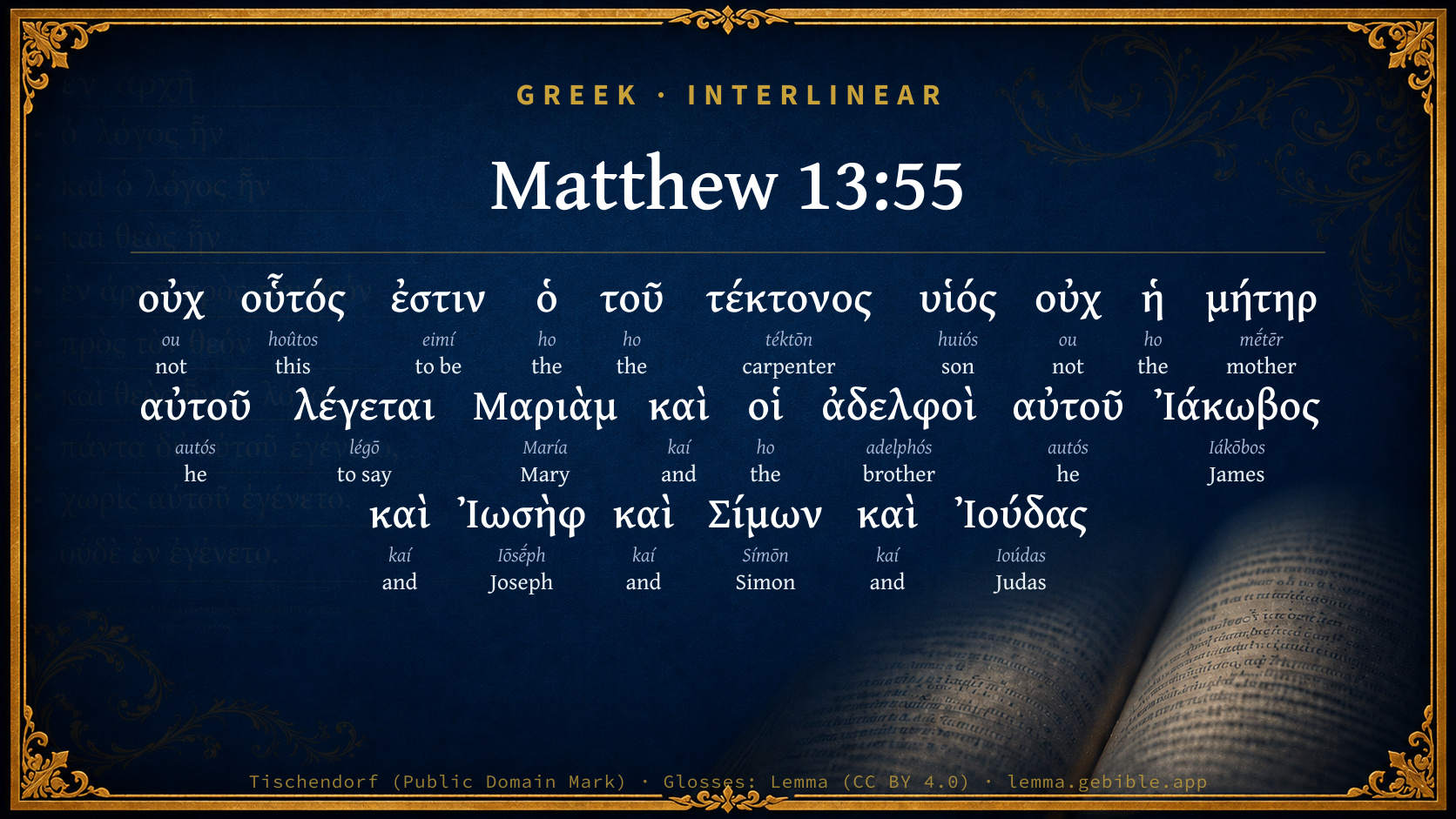
Download image
Cite this verse

Matthew 13:55 (World English Bible). Public Domain. Lemma interlinear Bible study tool, https://lemma.gebible.app/v/matthew/13/55.

Show BibTeX & RIS
BibTeX
RIS
English Translation
Isn't this the carpenter's son? Isn't his mother called Mary, and his brothers, James, Joses, Simon, and Judas?
World English Bible · Public Domain
Highlights
  • 1 first appearance in the Greek New Testament
Full analysis ↓
Download a study sheet

One document with this verse’s original text, its word-by-word gloss line, the meaning frame, cross-references with their text, attributed commentary, and full source and license credits — printable, and it pastes into notes with its structure intact.

This verse Autodidact and up

Study sheet (.html) Plain text (.txt)

A passage Seminary Student

Up to 50 verses in one chapter. A passage sheet keeps up to 6 commentary sources and 12 cross-references per verse, in the order this page ranks them, and says so on the sheet whenever that leaves anything out. Ask for a single verse and you get the Autodidact verse sheet above.

Everything on this page stays free to read, with no account — the sheet is a download of what is already on screen, not access to it.

Want to remove ads? Support Godless Engineer
Compare translations 3

The same verse in 3 English versions, stacked beneath the original-language interlinear above. Click any original word for its lexicon entry.

Each is an independent rendering of the whole verse — the interlinear is not word-aligned to these translations.

Highlighted words mark where these versions differ — a whole-verse word diff, not a word-by-word alignment.

  • World English Bible Public Domain
    Isn't this the carpenter's son? Isn't his mother called Mary, and his brothers, James, Joses, Simon, and Judas?
  • King James Version Public Domain
    Is not this the carpenter's son? is not his mother called Mary? and his brethren, James, and Joses, and Simon, and Judas?
  • unfoldingWord Literal Text CC BY-SA 4.0
    Is not this the son of the carpenter? Is not his mother called Mary, and his brothers, James and Joseph and Simon and Judas?

unfoldingWord Literal Text — © unfoldingWord, licensed CC BY-SA 4.0. Word-aligned USFM3 via Door43 (git.door43.org/unfoldingWord/en_ult).

Versions to compare (up to 4)

3 of 4 selected

Show all 19 translations

Every available English version of this verse, each an independent rendering of the whole verse.

  • World English Bible Public Domain
    Isn't this the carpenter's son? Isn't his mother called Mary, and his brothers, James, Joses, Simon, and Judas?
  • Berean Standard Bible Public Domain
    “Isn’t this the carpenter’s son? Isn’t His mother’s name Mary, and aren’t His brothers James, Joseph, Simon, and Judas?
  • Majority Standard Bible Public Domain
    “Isn’t this the carpenter’s son? Isn’t His mother’s name Mary, and aren’t His brothers James, Joses, Simon, and Judas?
  • King James Version Public Domain
    Is not this the carpenter's son? is not his mother called Mary? and his brethren, James, and Joses, and Simon, and Judas?
  • American Standard Version (1901) Public Domain
    Is not this the carpenter's son? is not his mother called Mary? and his brethren, James, and Joseph, and Simon, and Judas?
  • Revised Version (1885) Public Domain
    Is not this the carpenter’s son? is not his mother called Mary? and his brethren, James, and Joseph, and Simon, and Judas?
  • Geneva Bible (1599) Public Domain
    Is not this the carpenters sonne? Is not his mother called Marie, and his brethren Iames and Ioses, and Simon and Iudas?
  • Douay-Rheims (1899) Public Domain
    Is not this the carpenter's son? Is not his mother called Mary, and his brethren James, and Joseph, and Simon, and Jude:
  • Young's Literal Translation Public Domain
    is not this the carpenter's son? is not his mother called Mary, and his brethren James, and Joses, and Simon, and Judas?
  • Literal Standard Version CC BY-SA 4.0
    Is this not the carpenter’s Son? Is His mother not called Mary, and His brothers James, and Joses, and Simon, and Judas?
  • Unlocked Literal Bible CC BY-SA 4.0
    Is not this man the carpenter's son? Is not his mother called Mary? Are not his brothers James, Joseph, Simon, and Judas?
  • unfoldingWord Literal Text CC BY-SA 4.0
    Is not this the son of the carpenter? Is not his mother called Mary, and his brothers, James and Joseph and Simon and Judas?
  • Darby Bible Public Domain
    Is not this the son of the carpenter? Is not his mother called Mary, and his brethren James, and Joseph, and Simon, and Judas?
  • World Messianic Bible Public Domain
    Isn’t this the carpenter’s son? Isn’t his mother called Miriam, and his brothers Jacob, Yosi, Simon, and Judah?
  • Webster's Bible Public Domain
    Is not this the carpenter's son? is not his mother called Mary? and his brethren, James, and Joses, and Simon, and Judas?
  • Free Bible Version CC BY-SA 4.0
    Isn't this the carpenter's son? Isn't his mother's name Mary, and his brothers James, and Joseph, and Simon, and Judas?
  • Bible in Basic English Public Domain
    Is not this the woodworker's son? is not his mother named Mary? and his brothers James and Joseph and Simon and Judas?
  • Text-Critical English NT CC BY 4.0
    Is this not the carpenter's son? Is not his mother's name Mary, and are not his brothers James, Joses, Simon, and Judas?
  • Tyndale New Testament (1534) Public Domain
    Is not this the carpeters sonne? Is not his mother called Mary? and his brethren be called Iames and Ioses and Simon and Iudas?

Literal Standard Version (2020), Covenant Press — licensed CC BY-SA 4.0. Text via the HelloAO Bible API (eBible.org). Unlocked Literal Bible (unfoldingWord) — licensed CC BY-SA 4.0. Text via the HelloAO Bible API (eBible.org). unfoldingWord Literal Text — © unfoldingWord, licensed CC BY-SA 4.0. Word-aligned USFM3 via Door43 (git.door43.org/unfoldingWord/en_ult). Free Bible Version, Dr. Jonathan Gallagher — licensed CC BY-SA 4.0. Text via the HelloAO Bible API (eBible.org).

Word by word

More ways to search: Search by grammar → Find every occurrence → Compare this word →

Practice this passage: Drill this verse → Learn its vocabulary →

τέκτονος
téktōn
G5045
“carpenter”
Noun, Genitive, Singular, Masculine
Part of Speech
Noun
Case
Genitive
Number
Singular
Gender
Masculine
Full Thayer's Definition

Origin: from the base of G5098

TDNT: None

1. a worker in wood, a carpenter, joiner, builder a. a ship's carpenter or builder 2. any craftsman, or workman a. the art of poetry, maker of songs 3. a planner, contriver, plotter a. an author
  1. οὐχ ou G3756 “not” Particle, Negative
  2. οὗτός hoûtos G3778 “this” Demonstrative pronoun, Nominative, Singular, Masculine
  3. ἐστιν eimí G1510 “to be” Verb, Present, Active, Indicative, 3rd person, Singular
  4. ὁ ho G3588 “the” Article, Nominative, Singular, Masculine
  5. τοῦ ho G3588 “the” Article, Genitive, Singular, Masculine
  6. υἱός huiós G5207 “son” Noun, Nominative, Singular, Masculine
  7. οὐχ ou G3756 “not” Particle, Negative
  8. ἡ ho G3588 “the” Article, Nominative, Singular, Feminine
  9. μήτηρ mḗtēr G3384 “mother” Noun, Nominative, Singular, Feminine
  10. αὐτοῦ autós G846 “he” Personal pronoun, Genitive, Singular, Masculine
  11. λέγεται légō G3004 “to say” Verb, Present, Passive, Indicative, 3rd person, Singular
  12. Μαριὰμ María G3137 “Mary” Noun, Proper, indeclinable
  13. καὶ kaí G2532 “and” Conjunction
  14. οἱ ho G3588 “the” Article, Nominative, Plural, Masculine
  15. ἀδελφοὶ adelphós G80 “brother” Noun, Nominative, Plural, Masculine
  16. αὐτοῦ autós G846 “he” Personal pronoun, Genitive, Singular, Masculine
  17. Ἰάκωβος Iákōbos G2385 “James” Noun, Nominative, Singular, Masculine
  18. καὶ kaí G2532 “and” Conjunction
  19. Ἰωσὴφ Iōsḗph G2501 “Joseph” Noun, Proper, indeclinable
  20. καὶ kaí G2532 “and” Conjunction
  21. Σίμων Símōn G4613 “Simon” Noun, Nominative, Singular, Masculine
  22. καὶ kaí G2532 “and” Conjunction
  23. Ἰούδας Ioúdas G2455 “Judas” Noun, Nominative, Singular, Masculine

About this verse

These counts appear in no published source. They are computed here, from the morphology-tagged text and Lemma’s own curated glosses. What Lemma adds →

24
words
16
distinct lemmas
Gospels
section

Notable vocabulary

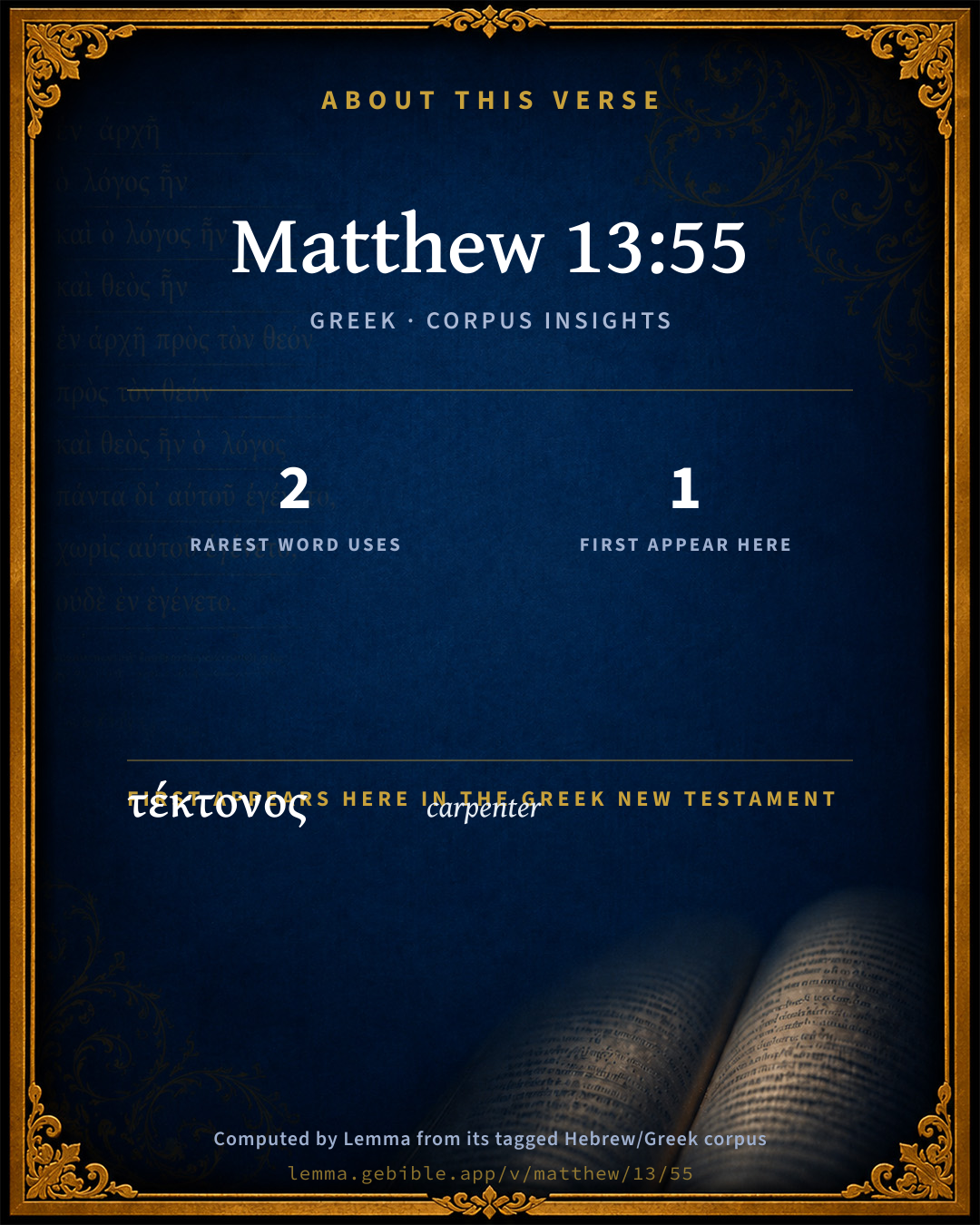
The rarest word here is τέκτονος carpenter G5045 — appearing just 2 times in the whole Greek New Testament.

First appearance in Scripture

This word makes its first canonical appearance in the Greek New Testament here:

  • τέκτονος carpenter G5045

Shared distinctive vocabulary

τέκτονος carpenter G5045 occurs in 2 verses of the Greek New Testament. Also found in:
Repetition

Words recur within this verse:

Cross-references

16

Topical passages linked to Matthew 13:55 in the Treasury of Scripture Knowledge — connected by theme and wording, ordered by reader-vote popularity; previews shown in the World English Bible.

  • Mark 6:3 Isn't this the carpenter, the son of Mary, and brother of James, Joses, Judas, and Simon? Aren't his sisters here with us?" They were offended at him.
  • John 6:42 They said, "Isn't this Jesus, the son of Joseph, whose father and mother we know? How then does he say, 'I have come down out of heaven?'"
  • Luke 3:23 Jesus himself, when he began to teach, was about thirty years old, being the son (as was supposed) of Joseph, the son of Heli,
  • Mark 15:47–16:1 Mary Magdalene and Mary, the mother of Joses, saw where he was laid.
  • Luke 4:22 All testified about him, and wondered at the gracious words which proceeded out of his mouth, and they said, "Isn't this Joseph's son?"
  • Luke 24:10 Now they were Mary Magdalene, Joanna, and Mary the mother of James. The other women with them told these things to the apostles.
  • John 19:25 But there were standing by the cross of Jesus his mother, and his mother's sister, Mary the wife of Clopas, and Mary Magdalene.
  • Galatians 1:19 But of the other apostles I saw no one, except James, the Lord's brother.
  • Isaiah 49:7 Thus says Yahweh, the Redeemer of Israel, [and] his Holy One, to him whom man despises, to him whom the nation abhors, to a servant of rulers: Kings shall see and arise; princes, and they shall worship; because of Yahweh who is faithful, [even] the Holy One of Israel, who has chosen you.
  • Isaiah 53:2–3 For he grew up before him as a tender plant, and as a root out of a dry ground: he has no form nor comeliness; and when we see him, there is no beauty that we should desire him.
  • Matthew 27:56 Among them were Mary Magdalene, Mary the mother of James and Joses, and the mother of the sons of Zebedee.
  • Mark 15:40 There were also women watching from afar, among whom were both Mary Magdalene, and Mary the mother of James the less and of Joses, and Salome;
  • Luke 2:5–7 to enroll himself with Mary, who was pledged to be married to him as wife, being pregnant.
  • Psalms 22:6 But I am a worm, and no man; A reproach of men, and despised by the people.
  • Matthew 1:18–20 Now the birth of Jesus Christ was like this; for after his mother, Mary, was engaged to Joseph, before they came together, she was found pregnant by the Holy Spirit.
  • Luke 1:27 to a virgin pledged to be married to a man whose name was Joseph, of the house of David. The virgin's name was Mary.

Cross-references courtesy of OpenBible.info (CC BY 4.0).

Commentary

Notes on Matthew 13:55 from classic Christian and Jewish commentators (each source and its license shown beneath its notes). The classic Christian expositions comment on the surrounding passage and are grouped to its opening verse, so a note may address several verses; the Jewish commentaries on the Tanakh (Rashi and others) are per-verse, so they appear only where the commentator wrote on this verse.

Lemma curates 59 commentaries, every one of them public domain or Creative Commons licensed, each selected and text-cleaned for this edition rather than reprinted as found. About our sources →

The Biblical Illustrator

Joseph S. Exell

Mat_13:55

Is not this the carpenters son?

The Divine rejected in the common

Thus the spiritual gem was dishonoured because of its earthly setting, and Christ was rejected on account of that which should have secured His acceptance. A small amount of thought would have sufficed to say, Out of the soil of our common life has arisen a plant, of uncommon flower and fruit, without any special training. What cannot be explained by ordinary laws must be sought for in the extraordinary, and that which He could not have derived from men must have been given Him by God! There were probably many feelings expressed in the words.

1. Perhaps there was envy. Theft did not like to think that one of themselves should be so much above them.

2. There was a prejudice against Christ because of the worldly circumstances of His family. Poverty has always been a sore hindrance to acceptance.

3. There was certainly a feeling in the Jews against Christ from the absence of any apparent means of His attaining uncommon eminence. Whence hath this man.

4. A stronger feeling against Christ arose in their minds from the commonness and familiarity of His associations. The effect of His teaching was lost through the nearness of His lower life. Had He come from far, had He been shrouded in mystery, then they might have received His claims. They had not spirituality enough to counteract the suggestions and influences of His carnal relations. Men are still backward to recognize the Divine in connection with the common; earthly genealogy disproves the heavenly descent. Illustrations of this fact:

I. The first shall be taken from Christ himself. Christ is God manifest in the flesh: we have felt that the great God might have chosen some other and higher mode of display; have clothed Himself with light.

II. The same may be said of Christianity. None can fail to recognize the thoroughly human character of the records of the New Testament. It has been objected that they are common and insignificant, that they mention trifling matters. Men want a more stately book-but then it had lost its charm. The human is Divine.

III. A third illustration we will take from the operation in nature. We are prevented from recognizing the Divine power by the commonness of daily operations.

IV. A fourth illustration is taken from divine providence. Men seem only to recognize the Divine working in extraordinary events.

V. The last illustration is taken from our common life. There is a great craving for extraordinary positions; had we more splendid conditions how we could display the energy of our faith. All life is Divine. The Divine man makes the Divine life; seek to detect the spiritual and Divine everywhere. (A. J. Morris.)

The carpenters son

When the Emperor Julian was about to wage war against the Persians and had threatened, when the war should be over, bitterly to persecute the Christians, insolently mocking the carpenters son as one quite unable to succour them, Didymas, an ecclesiastic, pronounced this sentence upon him: This carpenters son is even now making a wooden coffin for Julian! The Emperor went into the battle, and was suddenly struck in the breast with an arrow. He pulled it out, and, finding the wound inflicted by it to be deadly, he cursed the Lord; then, taking some of the blood from the wound, he threw it up into the air, exclaiming, Thou hast conquered, O Galilean. The son of the, carpenter:-Christ was, indeed, the son of a workman; but of Him who made the frame of the universe, not by a hammer, but by His command; who disposed the composition of the elements, not by skill, but by His Word; who kindled the sun, not by earthly fire, but by His supreme heat; who made all things out of nothing, and made them, O man, for thee-that thou mightest reflect on the Artificer by considering His work, (Crysologus.)

The Biblical Illustrator, edited by Joseph S. Exell (c. 1880s–1900s) — public domain. Text from a community e-Sword module.

Tyndale Open Study Notes

Tyndale Open Resources

13:55-56 carpenter’s son: A carpenter (literally craftsman) worked with his hands, whether in wood, metal, or stone.

Tyndale Open Study Notes — © Tyndale Open Resources, licensed CC BY-SA 4.0. Text via the HelloAO Bible API.

Bengel's Gnomon

Johann Albrecht Bengel

Mat 13:55. Τοῦ τέκτονος—ἡ μήτηρ, of the carpenter—His mother) Hence it may be inferred that Joseph had long been dead, and that Mary had lived in obscurity.—Μαριὰμ—Ἰάκωβος, Mary—James) They speak of them thus as if they had nothing but a name, by which name they were well known.

Bengel's Gnomon of the New Testament — English translation (T&T Clark, Edinburgh, 1860) — public domain. Text from a community e-Sword module.

Meyer's Critical & Exegetical Commentary

Heinrich August Wilhelm Meyer

Mat_13:55 ff. Τοῦ τέκτονος] of the carpenter, which, however, also embraces other workers in wood (the cabinetmaker, the cartwright, and such like). See Philo, Cod. apocr. I. p. 368 f.; Justin, c. Tryph. 88; Suicer, Thes. II. p. 1254 f. In Mar_6:3, Jesus Himself is spoken of by the people as ὁ τέκτων, and certainly not without reason; see note on that passage.

οἱ ἀδελφοὶ αὐτοῦ] See note on Mat_12:46.

According to the reading ʼΙωσήφ, there was only one of the sons of that Mary, who was the wife of Alphaeus, who was certainly of the same name, viz. James (Mat_27:56; on the Judas, brother of James, see note on Luk_6:16). But if this Mary, as is usually supposed, had been the sister of the mother of Jesus, we would have been confronted with the unexampled difficulty of two sisters bearing the same name. However, the passage quoted in support of this view, viz. Joh_19:25, should, with Wieseler, be so interpreted as to make it evident that the sister of Jesus mother was not Mary, but Salome. Comp. note on Joh_1:1.

πᾶσαι] therefore hardly to be understood, as some of the Fathers did (in Philo, Cod. apocr. p. 363), as meaning only two.

Observe, further, that in the course of what is said about the relatives, there is not the slightest indication of their being supposed to be different from the ordinary inhabitants of the place.

οὐκ ἔστι προφήτης … ἐν τῇ πατρίδι αὐτοῦ (not αὑτοῦ) κ. ἐν τ. οἰκ. αὐτ. is (Joh_4:44) a principle founded on experience, which is found to apply to the present case only as relatively true, seeing that, under different conditions, the contrary might prove to be the case.

The ἐν τ. οἰκίᾳ αὐτοῦ, in his own family (Mat_12:25), corresponds with Joh_7:3, comp. Mar_3:20. See also the note on Mat_12:46-50.

Meyer — Critical and Exegetical Commentary on the New Testament — English translation by Peter Christie, edited by Frederick Crombie (T&T Clark, 1880) — public domain. Text from a community e-Sword module.

Expositor's Greek Testament

ed. W. Robertson Nicoll

Mat 13:55 . ὁ τ . τέκτονος υἱός : Mk. has ὁ τέκτων , which our evangelist avoids; the son of the carpenter , one only in the town, well known to all. Μαριὰμ … Ιάκωβος , etc., names given of mother and brothers, to show how well they know the whole family. And this other man just come back is simply another of the family whose name happens to be Jesus. Why should He be so different? It is an absurdity, an offence, not to be commonplace. The irritation of the Nazareans is satisfactory evidence of the extraordinary in Jesus.

The Expositor's Greek Testament, edited by W. Robertson Nicoll (1897–1910) — public domain. Text from a community e-Sword module.

Jamieson, Fausset & Brown

Robert Jamieson, A. R. Fausset & David Brown

Is not this the carpenter's son?--In Mark (Mar 6:3) the question is, "Is not this the carpenter?" In all likelihood, our Lord, during His stay under the roof of His earthly parents, wrought along with His legal father.

is not his mother called Mary?--"Do we not know all about His parentage? Has He not grown up in the midst of us? Are not all His relatives our own townsfolk? Whence, then, such wisdom and such miracles?" These particulars of our Lord's human history constitute the most valuable testimony, first, to His true and real humanity--for they prove that during all His first thirty years His townsmen had discovered nothing about Him different from other men; secondly, to the divine character of His mission--for these Nazarenes proclaim both the unparalleled character of His teaching and the reality and glory of His miracles, as transcending human ability; and thirdly, to His wonderful humility and self-denial--in that when He was such as they now saw Him to be, He yet never gave any indications of it for thirty years, because "His hour was not yet come."

And his brethren, James, and Joses, and Simon, and Judas?

Jamieson, Fausset & Brown — Commentary Critical and Explanatory on the Whole Bible (1871) — public domain (CC PDM 1.0). Text via the HelloAO Bible API.

Adam Clarke's Commentary

Verse 55. Is not this the carpenter's son?] Seven copies of the old Itala have, Is not this the son of JOSEPH the carpenter? But it is likely our Lord, during the thirty years of his abode at Nazareth, wrought at the same trade with Joseph; and perhaps this is what is intended, Lu 2:51. He went down with them (his parents) to Nazareth, and was SUBJECT unto them. An honest trade is no discredit to any man. He who spends his time in idleness is fit for any business in which the devil chooses to employ him.

Is not his mother - Mary, and his brethren, James, c.] This insulting question seems to intimate that our Lord's family was a very obscure one and that they were of small repute among their neighbours, except for their piety.

It is possible that brethren and sisters may mean here near relations, as the words are used among the Hebrews in this latitude of meaning; but I confess it does not appear to me likely. Why should the children of another family be brought in here to share a reproach which it is evident was designed for Joseph the carpenter, Mary his wife, Jesus their son, and their other children? Prejudice apart, would not any person of plain common sense suppose, from this account, that these were the children of Joseph and Mary, and the brothers and sisters of our Lord, according to the flesh? It seems odd that this should be doubted; but, through an unaccountable prejudice, Papists and Protestants are determined to maintain as a doctrine, that on which the Scriptures are totally silent, viz. the perpetual virginity of the mother of our Lord. See Mt 1:25.

Adam Clarke's Commentary on the Bible (1810–1826) — public domain. Text from a community e-Sword/MySword module.

Ellicott's Commentary for English Readers

(55) Is not this the carpenter’s son?—In St. Mark, the question appears in the form, “Is not this the carpenter?” and it is, of course, in the nature of things probable that He both helped in the workshop during Joseph’s life, and assisted the “brethren” to carry on the work after his death. Justin Martyr (Dial. c. Tryph. c. 88) relates that in his time articles said to have been made by Him, such as rakes and harrows, were in demand as relics. The apocryphal Gospel of the Infancy, after its manner, makes Him instruct Joseph when he was bungling at his work.

And his brethren.—See Note on Mat_12:46.

Joses.—The authority of MSS. is in favour of the reading, “Joseph.” It was, of course, probable that the name of the father should be borne by one of those who were in some sense his children. Joses. however, was probably but a softened form of the same name.

A Bible Commentary for English Readers, edited by Charles John Ellicott (1878–1897) — public domain. Text from a community e-Sword module.

The Cambridge Bible for Schools and Colleges

gen. ed. J. J. S. Perowne

55. the carpenter’s son] “Is not this the carpenter?” (Mark). As every Jew was taught a trade there would be no improbability in the carpenter’s son becoming a scribe. But it was known that Jesus had not had the ordinary education of a scribe.

his brethren] Probably the sons of Joseph and Mary. It is certain that no other view would ever have been propounded except for the assumption that the blessed Virgin remained ever-virgin.

Two theories have been mooted in support of this assumption. (1) The “brethren of the Lord” were His cousins, being sons of Cleophas (or Alphæus), and Mary, a sister of the Virgin Mary. (2) They were sons of Joseph by a former marriage.

Neither of these theories derives any support from the direct words of Scripture, and some facts tend to disprove either. The second theory is the least open to objection on the ground of language, and of the facts of the gospel.

The Cambridge Bible for Schools and Colleges (gen. ed. J. J. S. Perowne; Cambridge University Press, 1878–1918) — public domain. Text from a community e-Sword module.

John Gill's Exposition

And he did not many mighty works there,.... Some he did, though not many; partly that they might be left inexcusable, and partly that it might not be said, he did not wish well, to his own country: what he did, were not of the first class, and greatest note; he only "laid his hands", as Mark says, Mar 6:5 "upon a few sick folk, and healed them"; and yet these were such as raised their wonder and astonishment, but did not command their faith, and were rather stumbling blocks unto them; such were their prejudices, their unbelief, and the hardness of their hearts: and the reason indeed why he did no more was,

because of their unbelief. These words in Mark are joined with this expression, "he marvelled"; showing, that their continued unbelief in him, notwithstanding his ministry and miracles among them, was matter of surprise to him; but here they are given as a reason why he did no more mighty works among them: and which Mark says he could not do, not for want of power, or as if their unbelief was too mighty for him to overcome; but he would not, because he judged them unworthy, and that it was not fit and convenient to perform any more, since they were offended with what was done; and that their condemnation might not be increased.

Next: Matthew Chapter 14

John Gill's Exposition of the Whole Bible (1746–1763) — public domain (CC PDM 1.0). Text via the HelloAO Bible API.

Trapp's Complete Commentary

John Trapp

55 Is not this the carpenter’s son? is not his mother called Mary? and his brethren, James, and Joses, and Simon, and Judas?

Ver. 55. Is not this the carpenter’s son?] Why, but was he not architect of the world? St Mark hath it, "Is not this the carpenter?" Why, yes; it may be so. Justin Martyr, an ancient writer, testifieth, that our Saviour, ere he entered upon the ministry, made ploughs, yokes, &c. {a} But was not that an honest occupation? And did not this carpenter make a coffin for Julian, that persecuting apostate, as a Christian schoolmaster fitly answered Libanins, sarcastically demanding what the carpenter’s son was now doing? Thus those three miscreants, Saul, Shimei and Sheba, took occasion to despise David, as the son of Jesse, who was vir bonus et honestus, minus tamen clarus, as one saith of him, a good honest man, but there’s little said of him.

{a} Pater Christi politicus, putativus. Fabrum fuisse lignarium, et aratra ac iuga, caeteraque eiusmodi fabricasse. Justin.

John Trapp, A Commentary or Exposition upon All the Books of the Old and New Testament (1647–1656) — public domain. Text from a community e-Sword module.

Albert Barnes' Notes on the Bible

Is not this the carpenter’s son? - Mark says, “Is not this the carpenter, the son of Mary?” Both these expressions would probably be used in the course of the conversation, and Matthew has recorded one and Mark the other. The expression recorded by Mark is a strong, perhaps decisive proof that he had himself worked at the business until he was 30 years of age. The people in the neighborhood would understand well the nature of his early employments. It is therefore almost certain that this had been his manner of life. A useful employment is always honorable. Idleness is the parent of mischief. Our Saviour, therefore, spent the greatest part of his life in honest, useful industry. Until the age of 30 he did not choose to enter on his great work; and it was proper before that time that he should set an example to the world of honorable though humble industry. Life is not wasted in such employments. They are appointed as the lot of man; and in the faithful discharge of duties in the relations of life, though obscure; in honest industry, however humble; in patient labor, if connected with a life of religion, we may be sure that God will approve our conduct. It was, moreover, the custom of the Jews - even those of wealth and learning - to train all their children to some “trade” or manual occupation. Thus Paul was a tent-maker. Compare Act 18:3.

This was, on the part of the Saviour, an example of great condescension and humility. It staggers the faith of many that the Son of God should labour in an occupation so obscure and lowly. The infidel sneers at the idea that “He that made the worlds” should live thirty years in humble life as a poor and unknown mechanic. Yet the same infidel will loudly praise Peter the Great of Russia because he laid aside his imperial dignity and entered the British service as a “ship-carpenter,” that he might learn the art of building a navy. Was the purpose of “Peter” of more importance than that of the Son of God? If Peter, the heir to the throne of the Czars, might leave his elevated rank and descend to a humble employment, and secure by it the applause of the world, why might not the King of kings evince a similar character for an infinitely higher object?

His brethren, James ... - The fair interpretation of this passage is, that these were the sons and daughters of Joseph and Mary. The people in the neighborhood thought so, and spoke of them as such.

Albert Barnes' Notes on the Bible (1834–1885) — public domain. Text from a community e-Sword/MySword module.

Haydock's Catholic Bible Commentary

Is not this the carpenter’s son?[1] I find carpenter in all translations, though the Greek word signifies, in general, a workman or craftsman. The Latin is also a general word, which of itself signifies no more a carpenter than a smith. But the common belief of the faithful is, that St. Joseph was a carpenter, which may be confirmed by what Theodoret relates (lib. iii. Hist. chap. xviii.) of one Libanius, under Julian the apostate, who asking scornfully of a holy man, what the carpenter’s son was doing at that time? the holy man made him this smart reply, that he was making a coffin for Julian; who was killed not long after. (Witham) --- O! how truly astonishing is the stupidity of the Nazareans! They wonder whence wisdom itself possesses wisdom, and virtue itself virtue. The reason is evident: they only considered him as the son of a carpenter. (St. Jerome) --- Was not David the son of an husbandman, and Amos a shepherd? They should then have honoured our Lord, when they heard him speak in this manner. What wonderful mildness in Christ! Though calumniated and reviled, he still answers with the greatest humility and charity, a prophet is not without honour, save in his own country. (ver. 57.) (St. John Chrysostom in St. Thomas Aquinas) --- His brethren. These were the children of Mary, the wife of Cleophas, sister of our blessed Lady; (Matthew xxviii. 56. John xix. 25.) and therefore, according to the usual style of the Scripture, they were called brethren, that is, near relations to our Saviour. (Challoner)

===============================

[BIBLIOGRAPHY]

Fabri filius. Greek: tou tektonos, artificis. St. Hilary (Can. or cap. xiv. in Matt. p. 678. Ed. Ben.) thought that St. Joseph wrought with fire and iron. We find in a manner the same in St. Ambrose Lib. iii. in Luc. in initio. p. 52. See also St. Chrysologus, Serm. xlviii. St. Justin (Dialogo cum Tryphone, p.69) says, Christ made aratra and juga; and in the Greek edition, (Parisiis, an. 1551, p. 93) Greek: arotra kai zuga. Theodoret, (lib. iii. Hist. chap. xviii, p. 656) Sandalipam fabricat, Greek: glossokomon ... kataskeuazei.

====================

George Leo Haydock (1774–1849), Haydock's Catholic Family Bible and Commentary, 1859 edition — public domain. Excludes Psalms (Douay-Rheims chapter numbering differs from Protestant) and Deuterocanonical books (Catholic canon only).

Matthew Poole's English Annotations

Mark saith the same, Mar 6:3; only he saith, Is not this the carpenter? ο τεκτων; which leadeth some to think that Christ, till he was thirty years of age, wrought with Joseph upon his trade. Luk 2:51, it is said, that he came to Nazareth, and was subject to his parents. Joseph was an artificer, that was certain; so τεκτων signifies; but whether a carpenter, or a smith, the word will not inform us. For the brethren of Christ and his sisters, here mentioned, the most by them understand his near relations. The Jews were offended at the meanness of our Saviour’s parents and relations.

They were offended in him; that is, these things made them stumble at him, and not receive him as the Messias, or a prophet sent from God. How unreasonable is malice and prejudice! One would have thought that their knowledge of his friends and education should have rather led them to have concluded that he must be sent from God, and more than a man, seeing that he did not come by this wisdom by any ordinary means, nor work these great works by any human power.

Matthew Poole's English Annotations on the Holy Bible (1683–1685) — public domain. Text from a community e-Sword/MySword module.

Whedon's Commentary on the Bible

Daniel D. Whedon

55. Is not this the carpenter’s son? — Most conclusive question! It is probable that many of them had seen our Saviour, in his youth, labouring at the occupation of his father. Thus had he honoured and sanctified the labourer’s calling, and shown that the secular duties rightly performed are a true service and acceptable to God. And if Christianity shows our Saviour as a carpenter, and his apostles as fishermen, how ought they to be ashamed of their mean pride who scorn the useful avocations of the labourer! Well would it be for society if there were less of extravagance and effeminate pride, and if Christians would adopt the maxim of the ancient Jews, that every man, however high his rank or intellectual his profession, should learn the mastery of some manual trade.

And his brethren — In regard to the brothers of our Lord, and the supposed perpetual virginity of the blessed mother, we may make the following remarks:

1. The supposed perpetuity is contradicted by the obvious, though not the necessary meaning of Mat_1:25. See note on the passage. 2. It is plain that while there were three if not four cousins of our Lord in the number of his disciples, his brothers remained at Nazareth, not even believing upon him. 3. When his mother and brothers came from Nazareth, (Mat_12:46-50) probably to induce him to retire from his ministry, his brothers and his cousins must have belonged to different parties. 4. Alford says that the phrase “brethren of the Lord” occurs ten times in the New Testament, and they are never called cousins. It is incredible, therefore, that they should have been other than literal brothers. 5. This presumption is increased by the fact that these brothers are mentioned in connection and in company with his sisters and his mother, all of whom collectively are called his “house” or family. If the mother was a literal mother, the sisters must have been literal sisters, and the brethren literal brothers. 6. Our Lord speaks of his house or family as a place wherein, as a prophet, he has no honour. But if this house consisted of cousins, and three or four of these cousins were his own disciples, who in addition to his mother believed upon him, how was he unhonoured in his own house?

Against this mass of reasoning there are two counter-arguments which admit of easy replies: 1. It appears that the cousins of Jesus, the sons of Mary, sister of the blessed mother, were named James, Joses, and Jude. It appears also that the brothers of Jesus were also named James, Joses, Jude, and Simon. Hence it is inferred that they were the same, and that the so-called brothers were only cousins. But we reply, although it may be singular that three or four couples of cousins should bear the same names, it was by no means improbable. It is quite credible that two sisters, themselves of the same name, should purposely give correspondent names to three of their children. 2. The second counter-argument is derived from the fact that our Lord committed the keeping of his mother not to these brethren, but to the apostle John. How could he thus prefer an unrelated friend above a brother? For the same reason, we reply, that he could choose disciples from strangers rather than from his own house. He did not choose his beloved disciple from among his cousins who were his disciples. His brothers of his own house did not believe, did not honour him. He dealt in sharp words with them. Joh_7:7. They were not found among his believers until after the resurrection. It cannot be wonderful then that these brethren should be set aside in comparison with the beloved disciple.

Upon the whole, we think it a clear case that the brethren of our Lord, so-called, were not cousins, but literal half brothers. The idea, therefore, that Mary was at once a wife and a nun, is an ecclesiastical tradition unsupported by Scripture, and is the offspring of the false notion of the superior sanctity of celibacy.

Daniel D. Whedon (gen. ed.), Commentary on the Old and New Testaments (1874–1909) — public domain. Text from a community e-Sword module.

The Pulpit Commentary

Is not this the carpenter"s son? In Mark, "the carpenter, the son of Mary," which may possibly be a doctrinal correction, made to avoid representing our Lord as the son of Joseph, but is more probably the earlier form of the narrative (due to immediate and, perhaps, local knowledge), which St. Matthew, or one of those who transmitted the source he used, avoided out of a feeling of reverence. In the Apocryphal Gospels our Lord is not represented as a carpenter himself, but as helping Joseph by miraculously lengthening a piece of wood which Joseph had cut too short (e.g. "Pseudo-Matthew," "Gospel of Thomas," first Greek form, contrast Justin Martyr, Dial. with Trypho," Is not his mother called Mary? and his brethren. (Mat_12:46) Probably sons of Joseph by a former wife (see Bishop Lightfoot"s classical dissertation in "Galatians"). James. Afterwards "bishop" of Jerusalem, (Gal_1:19 Act_15:13) and the author of the Epistle. And Joses; Joseph (Revised Version), which is also probably right in Mat_27:56. Joses is the Graecised form (see Westcott and Hort, "Append."). And Simon, and Judas. Probably the author of the Epistle.

Unexpected learning in a carpenter"s son.

"Whence hath this Man this wisdom, and these mighty works? Is not this the carpenter"s son?" The Jews never despised handicrafts, and this expression must not be explained as scorning Jesus because he was a carpenter"s son, or a carpenter. What is in the minds of these scorners is that he was nothing but a carpenter; he had received no training whatever in the rabbinical schools. He was no educated and authorized rabbi, and that they knew very well. Hillel, the greatest rabbi of the same age as Joseph, though he was a descendant of David, spent most of his life in the deepest poverty as a common workman.

I A SURPRISE THAT PROPERLY EXCITED THOUGHT. Jesus certainly was an unusual Teacher. He dealt with unusual subjects in an unusual way, and with an unusual attractiveness and authority. There were no such subtle distinctions as exhibited the great learning of the rabbis; but men had skill enough to recognize unusual and extraordinary intellectual as well as moral power in Christ. It was quite right for them to think about such a strange fact and phenomenon. It is quite right for us to think about it. We may well say to one another, "What think ye of Christ? Whose Son is he?

II A SURPRISE THAT RECEIVED MISTAKES EXPLANATIONS. Exactly how they explained the fact they admitted we are not told; but it is quite clear that prejudice blinded their eyes, and prevented their getting any true ideas of Christ. No doubt they accused him of conceited self-assertion. He was pushing himself to the front, and talking big, as if he were better than his brothers and sisters. They were offended at him, and thought unkind things of him. Illustrate by the things prejudiced men say of Christ now.

III A SURPRISE THAT CAN HAVE A SATISFACTORY EXPLANATION. This man was taught of God; was a Prophet of God who received Divine messages; nay, was the Son of God revealing the things of the Father-God to men. Never mind about remembering him when he was a boy. Never mind about his never having gone to a school of the rabbis. Never mind his having toiled at the carpenter"s bench. Fix thought on what he is the divinely taught Teacher and Saviour of men. R.T.

The Pulpit Commentary (1880–1919), ed. H.D.M. Spence-Jones & Joseph S. Exell — public domain. Text from a community e-Sword module.

John Wesley's Explanatory Notes

The carpenter's son - The Greek, word means, one that works either in wood, iron, or stone. His brethren -- our kinsmen. They were the sons of Mary, sister to the virgin, and wife of Cleophas or Alpheus. James - Styled by St. Paul also, the Lord's brother, Gal. i, 19. Simon - Surnamed the Canaanite.

John Wesley, Explanatory Notes Upon the Whole Bible (1754–1765) — public domain. Text via the GEBible commentary corpus.

Scofield Reference Notes

C. I. Scofield

James

Son of Alphaeus. (See Scofield "Mat 4:21")

The Scofield Reference Bible (1917 edition), notes by C. I. Scofield — public domain. Text from a community e-Sword module.

The People's New Testament

B. W. Johnson

55. Is not this the carpenter's son? Joseph. Jesus was a carpenter also (Mark 6:3). His mother called Mary? She is named, Joseph is indicated by his trade. His brethren, James and Joses, Simon and Judas? Sons of Joseph and Mary. For a full discussion of their relationship, see note on John 2:12.

B. W. Johnson's The People's New Testament with Notes (1889–1891) — public domain. Electronic text from the Christian Classics Ethereal Library (CCEL) ThML edition.

Cambridge Greek Testament for Schools and Colleges

55. οὐχ οὗτός ἐστιν ὁ τοῦ τέκτονος υἱός; In Mar 6:3, ὁ υἱὸς Μαρίας καὶ ἀδελφὸς Ἰακώβου καὶ Ἰωσῆτος καὶ Ἰούδα καὶ Σίμωνος; No allusion being made to the father, as in the other synoptists, possibly Joseph was no longer living. For ὁ τέκτονος υἱὸς Mark has ὁ τέκτων. As every Jew was taught a trade there would be no improbability in the carpenter’s son becoming a scribe. But it was known that Jesus had not had the ordinary education of a scribe.

οἱ ἀδελφοὶ αὐτοῦ. Probably the sons of Joseph and Mary. It is certain that no other view would ever have been propounded except for the assumption that the blessed Virgin remained ever-virgin.

Two theories have been mooted in support of this assumption. (1) The ‘brethren of the Lord’ were His cousins, being sons of Cleophas (or Alphæus), and Mary, a sister of the Virgin Mary. (2) They were sons of Joseph by a former marriage.

Neither of these theories derives any support from the direct words of Scripture, and some facts tend to disprove either. The second theory is the least open to objection on the ground of language, and of the facts of the gospel.

The brethren of the Lord were probably not in the number of the Twelve. This seems to be rendered nearly certain by St John’s assertion (Mat 7:5) οὐδὲ γὰρ οἱ ἀδελφοὶ αὐτοῦ ἐπίστευον εἰς αὐτόν, and is strengthened by the way in which the brethren’s names are introduced, as though they were more familiar than Jesus to the men of Nazareth; it seems to be implied that they were still living there.

James afterwards became president or bishop of the Church at Jerusalem: he presided at the first Council and pronounced the decision: διὸ ἐγὼ κρίνω κ.τ.λ. (Act 15:19). The authorship of the Epistle is generally ascribed to him. His manner of life and his death are described by Hegesippus (Eus. H. E. II. 23, p. 58, 59, Bright’s ed.). Of Joses nothing further is known. Jude is most probably to be identified with the author of the Epistle bearing his name. Tradition has an interesting story concerning his two grandsons, who being arrested as descendants of the royal house and therefore possible leaders of sedition, and brought before the Emperor Domitian, described their poverty, and shewed him their hands, rough and horny from personal toil, and so dispelled the idea of danger and regained their freedom (Eus. H. E. III. 21). Of Simeon tradition has nothing certain or trustworthy to report.

For the many difficult and intricate questions involved in the controversy as to the ‘brethren of the Lord,’ see the various articles in Dict. of the Bible, and Bp. Lightfoot’s dissertation in his edition of the Epistle to the Galatians.

Cambridge Greek Testament for Schools and Colleges (Cambridge University Press, 1896; 21 vols, various authors incl. Carr, Maclear, Plummer, Farrar, Lumby, Moule, M. R. James, Simcox) — public domain. Text from a community e-Sword module.

Alford’s Greek Testament

Henry Alford

55. οἱ ἀδελφοὶ αὐτοῦ] It is an enquiry of much interest and some difficulty, who these were. After long examination of the evidence on the subject, I believe that the truth will best be attained by disencumbering the mind in the first place of all à priori considerations, and traditions (which last are very inconsistent and uncertain), and fixing the attention on the simple testimony of Scripture itself. I will trace the ἀδελφοὶ αὐτοῦ or ἀδ. κυρίου through the various mentions of them in the N.T., and then state the result; placing at the end of the note the principal traditions on the subject, and the difficulties attending them. (I) The expression οἱ ἀδ. αὐτοῦ occurs nine times in the Gospels, and once in the Acts. Of these the three first are in the narratives of the coming of His mother and brethren to speak with Him, Mat 12:46: Mar 3:31: Luk 8:19: the two next are the present passage and its ║ in Mar 6:3, where they are mentioned in connexion with His mother and sisters; the four others are in Joh 2:12; Joh 7:3, Joh 7:5, Joh 7:10, in the first of which He and his mother and brethren and disciples are related to have gone down to Capernaum: and in the three last His brethren are introduced as urging Him to shew Himself to the world, and it is stated that they did not believe on Him. The last is in Act 1:14, where we read that the Apostles ‘continued in prayer and supplication with the women, and with Mary the mother of Jesus, and with his brethren.’ In another place, 1Co 9:5, Paul mentions οἱ λοιποὶ ἀπόστολοι, καὶ οἱ ἀδ. τ. κυρίου, κ. Κηφᾶς. Such are all the places where the meaning is undoubted, that persons called, and being in some usual sense, brethren of the Lord, are mentioned. (Besides these the Lord Himself uses the words οἱ ἀδελφοί μου Mat 28:10: Joh 20:17, but apparently with a wider meaning, including at least the eleven Apostles in the term, as He does in Mat 12:49 ║.) Now I would observe (α) that in all the mentions of them in the Gospels, except those in Joh_7, they are in connexion with His mother: the same being the case in Act 1:14. (β) That it is no where asserted or implied that any of them were of the number of the twelve; but from Joh 7:5, following upon 6:70 (by μετὰ ταῦτα 7:1), they are excluded from that number. John would certainly not have used the words οὐδὲ γὰρ οἱ ἀδ. αὐτ. ἐπίστ. εἰς αὐτόν, had any of them believed on Him at that time (see this substantiated in note ad loc.):—and again in Act 1:14, by being mentioned after the Apostles have been enumerated by name, and after the mother of Jesus, they are indicated at that time also to have been separate from the twelve, although then certainly believing on Him. (γ) Their names, as stated here and in Mar 6:3, were Jacob, Joseph (or Joses), Simon, and Judas, all of them among the commonest of Jewish names. Of Joseph (or Joses;—certainly not the Joseph Barsabas Justus of Act 1:23; see ib. ver. 21) and Simon (not Simon Cananæus or Zelotes: see above) we know from Scripture nothing. Of the two others we have the following traces—(δ) Jacob (James) appears in the apostolic narrative as ὁ ἀδελφὸς τοῦ κυρίου, Gal 1:19: he is there called an apostle. This however determines nothing as to his having been among the twelve (which is a very different matter); for Paul and Barnabas are called apostles, Act_14:(4) 14, and Paul always calls himself such. See also Rom 16:7: 1Th 2:7 compared with 1:1. That he is identical with the James of Gal 2:9, whom Paul mentions with Cephas and John as having given him and Barnabas the right hand of fellowship, fourteen years after the visit related ib. 1:19, does not appear for certain, but has been pretty generally assumed. (See this whole subject discussed in the prolegg. to the Epistle of James.) (ε) The Jude who has left an epistle, and was brother of James, not only does not call himself an apostle, ver. 1 (as neither does James, nor indeed John himself, so that this cannot be urged), but in ver. 17 (see note there) seems to draw a distinction between himself and the Apostles. Whether this indicate that the James and Jude, the authors of the Epistles, were two of these ἀδελφοὶ τ. κυρίου, is uncertain; but it may at least be mentioned in the course of our enquiry.

I shall now state the result of that enquiry, which has been based on Scripture testimony only. (1) That there were four persons known as οἱ ἀδ. αὐτοῦ or τ. κυρίου, not of the number of the twelve. (2) That these persons are found in all places (with the above exception) where their names occur in the Gospels, in immediate connexion with Mary, the mother of the Lord. (It is a strange phænomenon in argument, that it should have been maintained by an orthodox writer, that my inference from this proves too much, because Joseph is here introduced as His father: as if a mistake of the Jews with regard to a supernatural fact, which they could not know, invalidated their cognizance of a natural fact which they knew full well.) (3) That not a word is any where dropped to prevent us from inferring that the ἀδελφοί and ἀδελφαὶ αὐτοῦ were His relations in the same literal sense as we know ἡ μήτηρ αὐτοῦ to have been; but that His own saying, where He distinguishes His relations according to the flesh from His disciples (ch. 12:50 ║), seems to sanction that inference. (4) That nothing is said from which it can be inferred whether Joseph had been married before he appears in the Gospel history;—or again, whether these ἀδ. were, according to the flesh, older or younger than our Lord. (5) That the silence of the Scripture narrative leaves it free for Christians to believe these to have been real (younger) brethren and sisters of our Lord, without incurring any imputation of unsoundness of belief as to His miraculous conception. That such an imputation has been cast, is no credit to the logical correctness of those who have made it, who set down that, because this view has been taken by impugners of the great Truth just mentioned, therefore, it eventually leads, or may fairly be used, towards the denial of it (see Dr. Mill on the Brethren of our Lord, p. 224); for no attempt is made to shew its connexion with such a conclusion. The fact is, that the two matters, the miraculous conception of the Lord Jesus by the Holy Ghost, and the subsequent virginity of His Mother, are essentially and entirely distinct; see note on Mat 1:25: see also, respecting a supposed difficulty attending this view, note on Joh 19:27. (II) I will now state the principal traditionary views respecting the brethren of the Lord. (1) That they were all sons of Alphæus (or Clopas) and Mary the sister of the mother of our Lord; and so cousins of Jesus, and called agreeably to Jewish usage His brothers.

This is the view taken in the remarkable fragment of Papias, quoted in Dr. Mill, p. 238, adopted by Jerome (cont. Helvidium 13, vol. ii. p. 219), and very generally received in ancient and modern times. But it seems to me that a comparison of the Scripture testimonies cited above will prove it untenable. One at least of the sons of this Alphæus was an apostle, of the number of the twelve, viz. Ἰάκωβος ὁ τοῦ Ἀλφαίου (see all the lists, on ch. 10:3); which (see above) would exclude him from the number of the brethren of the Lord. But even if one of the four could be thus detached (which, from Joh 7:5, I cannot believe), it is generally assumed that Ἰούδας Ἰακώβου (see Luke’s two lists as above) is Jude the brother of James; and if so, this would be another son of Alphæus, and another subtraction from the number who did not believe on Him. Again Matthew (see note on Mat 9:9), if identical with Levi (Mar 2:14), was another son of Alphæus: which would make a fifth brother, and leave therefore, out of five, three believing on Him at the time when it was said οὐδὲ γὰρ οἱ ἀδ.… κ.τ.λ. This view besides labours under the difficulty arising from these brethren accompanying and being found in connexion with Mary the mother of our Lord, whereas throughout that time their own mother was living. The way in which the assertors of this view explain Joh 7:5, is either by supposing that all the brethren are not there implied, or that all are not here mentioned; both suppositions, it seems to me, very unlikely (compare e.g. John’s minute accuracy where an exception was to be made, ch. 6:23, 24). (2) That they were children of Joseph by a former marriage (or even by a later one with Mary wife of Clopas, to raise up seed to his dead brother,—as Clopas is said to have been: but this needs no refutation). This view was taken by several early Fathers, e.g. Hilary, Epiphanius, and mentioned by Origen, who (Winer, Realwörterbuch, i. p. 663) says respecting it, οἱ ταῦτα λέγοντες τὸ ἀξίωμα τῆς Μαρίας ἐν παρθενίᾳ τηρεῖν μέχρι τέλους βούλονται. This however, while by no means impossible, and in some respects agreeing with the apparent position of these brothers as older (according to the flesh) than the Lord (Joh 7:3), has no countenance whatever in Scripture, either in their being called sons of any other woman, or in any distinct mention of Joseph as their father, which surely in this case would be required. (III) On the à priori considerations which have influenced opinions on this matter, see note on Mat 1:25; and on the traditional literature, see the tract of Professor Mill on the Brethren of our Lord. See also Winer, Realwörterbuch, Art. Jesus, § 3. Greswell, Dissertations, vol. ii. Diss. iii. Blom, Disputatio Theologica de τ. ἀδ. τ. κ. Lug. Bat. 1839. Wieseler, Stud. und Kritiken, 1842, i. 96 ff. (these two last I have not seen); also, a letter on this my note, referred to above under I. 2, in the Journal of Sacred Literature for July, 1855. This letter is too much based on à priori considerations, but contains some valuable suggestions on this confessedly difficult question.

Neander, Leben J. p. 48, brings out the importance of the view which I have above, under (I), endeavoured to justify, as shewing that the account of the miraculous conception is not mythical, in which case all would have been arranged to suit the views of virginity from which it had arisen,—but strictly historical, found as it is with no such arrangements or limitations.

Henry Alford, The Greek Testament (1849–1861) — public domain. Text from a community e-Sword module.

International Critical Commentary

(M) 55. Is not this the Son of the carpenter? Is not His mother called Mary? and His brethren, James, and Joseph, and Simon, and, Judas?] Mk. has: “Is not this the Carpenter, the Son of Mary, and brother of James, and Joses, and Judas, and Simon?” Mt. has substituted “the Son of the carpenter” for “the Carpenter,” from a feeling that the latter was hardly a phrase of due reverence. Mk.’s striking phrase “the Carpenter” is occasionally echoed in later writers; cf. Celsus ap. Origen, vi. 34: ἦν τέκτων τὴν τέχνην. Origen, vi. 36, denies that Jesus was called τέκτων anywhere in the Gospels; Just Tryph. 88: τὰ τεκτονικὰ ἔργα ἠργάζετο ἐν ἀνθρώποις ὤν, ἄροτρα καὶ ζυγά; Acts of Judas Thomas, ed. Wright, p. 159: “I know how to make ploughs and yokes.” This substitution explains why he has felt it necessary to change Mk.’s ὁ υἱὸς τῆς Μαρίας. He might, of course, have simply substituted Καὶ Μαρίας; but it is questionable whether, whilst feeling no objection to “Son of Joseph” or “Son of the carpenter,” he would not have shrunk from “Son of Joseph (or the carpenter) and of Mary.” To the editor, Jesus was legally the Son of Joseph and physically the Son of Mary. He would probably avoid a phrase which seemed to describe Him as Son of Joseph in the same sense that He was Son of Mary. He therefore substitutes for ὁ υἱὸς τῆς Μαριάς a paraphrase, οὐχ ἡ μήτηρ αὐτοῦ λέγεται Μαριάμ; and this carries with it the change of καὶ ἀδελφὸς Ἰακώβου, κ.τ.λ., into καὶ οἱ ἀδελφοὶ αὐτοῦ Ἰάκωβος, κ.τ.λ.

Since parentage in Palestine was always reckoned (and expressed) from the father, it may be argued with much probability that Mk.’s ὁ υἱὸς τῆς Μαρίας implies either the death of Joseph, or, more naturally, an allusion to the supernatural circumstances of the birth of Jesus. The verse is entirely misquoted when it is used as an argument that S. Mark himself believed Jesus to be the natural Son of Joseph and Mary. He may have so believed, but no proof of such belief can be found in this passage.

Ἰωσήφ] Mt. substitutes the old Hebrew name for Mk.’s Ἰωσῆς. The latter represents the Galilean יוסי; cf. Dalm. Gram.2 175.

55. τέκτονος] S2 a b ff2 g1 h add “of Joseph”; S1 has “of Joseph” only. The true reading in Mk. seems to be ὁ τέκτων ὁ υἱὸς τῆς Μαρίας; so א B D Δ. Mt. has changed from the motives above explained. The variants in Mk. are due to assimilation to Mt. Mt. has no objection to the phrase “Son of Joseph,” but might not unnaturally wish to avoid “the carpenter.”

The editor now comes to Mar 6:6-13. This he has already inserted (9:35ff.). So he passes to Mar 6:14-29. From this point in his Gospel the grouping of material taken from Mk. and elsewhere under subject-heads ceases to be observable. Henceforth he follows Mk.’s order, expanding it and adding to it other material.

M the Second Gospel.

S Syriac version: Sinaitic MS.

E editorial passages.

al i.e. with other uncial MSS.

Targ. Targum.

LXX. The Septuagint Version.

S Syriac version: Curetonian.

L the Matthæan Logia.

X passages in which Mt. and Lk. agree closely, borrowed from an unknown source or sources.

Th. Theodotion.

O quotations from the Old Testament borrowed from a collection of Messianic prophecies. See pp.61 f.

Dalm. Dalman.

Eus. Eusebius.

International Critical Commentary — older volumes (1896–1929), various authors — public domain. Text from a community e-Sword module.

Lesson kit

Teaching starters — assembled from the data on this page, not authored interpretation. Every prompt links to the verse data it draws on. Edit before teaching.

Matthew, in the Gospels, opens this verse with 24 words (16 distinct Greek lemmas). Its most distinctive word is téktōn (“carpenter”). A historical commentator’s framing appears above. Read the whole chapter for the surrounding context.

Discussion questions

  1. What does “carpenter” (téktōn) contribute to the verse as a whole?
  2. The word “carpenter” first appears here in Scripture. What is being introduced at this debut?
  3. Mark 6:3 shares the word «carpenter» with this verse. How do the two illuminate each other?
  4. “the” occurs 4× in this one verse. What is the effect of the repetition?
  5. The translations on this page render this verse differently — a whole-verse word diff, not a word-by-word alignment. What might account for the different wordings?
  6. Reading how The Biblical Illustrator and Tyndale Open Study Notes read this verse, where do the two commentators agree and where do they part?

Things to notice

  • 1 word makes its first canonical appearance in Scripture here.
  • These translations choose different wording for 7 words in this verse.
  • “the” occurs 4× in this single verse.
  • 16 distinct Greek lemmas span 24 words in this verse.

Reading settings

Reading text

Shown beneath each verse's original-language words.

Old Testament
Old Testament edition

Read the OT as the Masoretic Hebrew (MT) or the Greek Septuagint (LXX).

English shown for the Greek Septuagint (in the Hebrew ↔ Greek comparison).

Comparing translations? Open the Compare panel on any verse page to stack up to four side by side.