
Mark 2:26

Greek (Tischendorf 8th ed.) Mark 2:26 appears in the Greek New Testament. The text above is from the Tischendorf 8th edition. Each word links to its Strong’s number and a concise gloss. Click any word for its full Thayer’s Greek Lexicon entry.
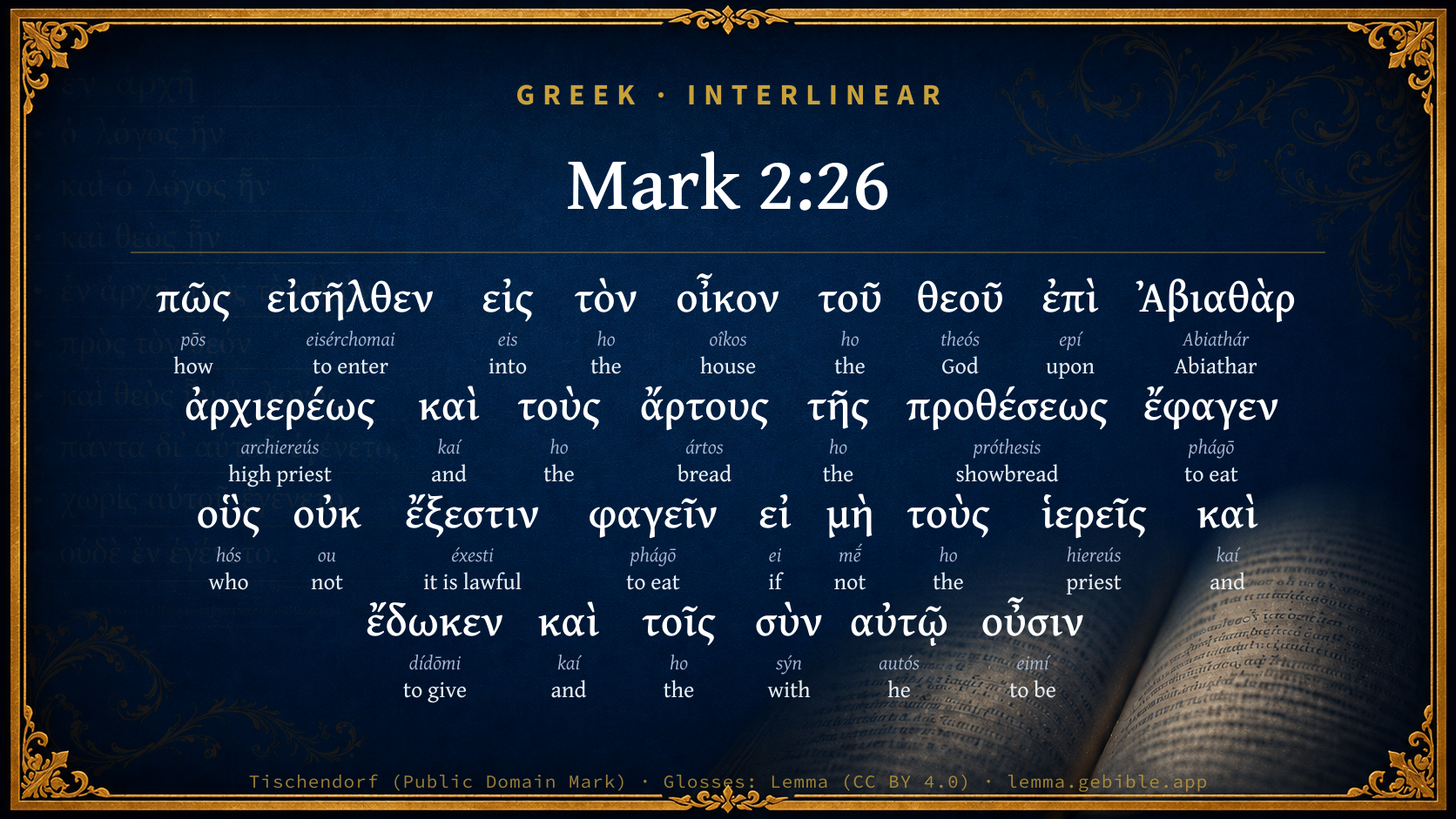
Download image
Cite this verse

Mark 2:26 (World English Bible). Public Domain. Lemma interlinear Bible study tool, https://lemma.gebible.app/v/mark/2/26.

Show BibTeX & RIS
BibTeX
RIS
English Translation
How he entered into the house of God when Abiathar was high priest, and ate the show bread, which it is not lawful to eat except for the priests, and gave also to those who were with him?"
World English Bible · Public Domain
Highlights
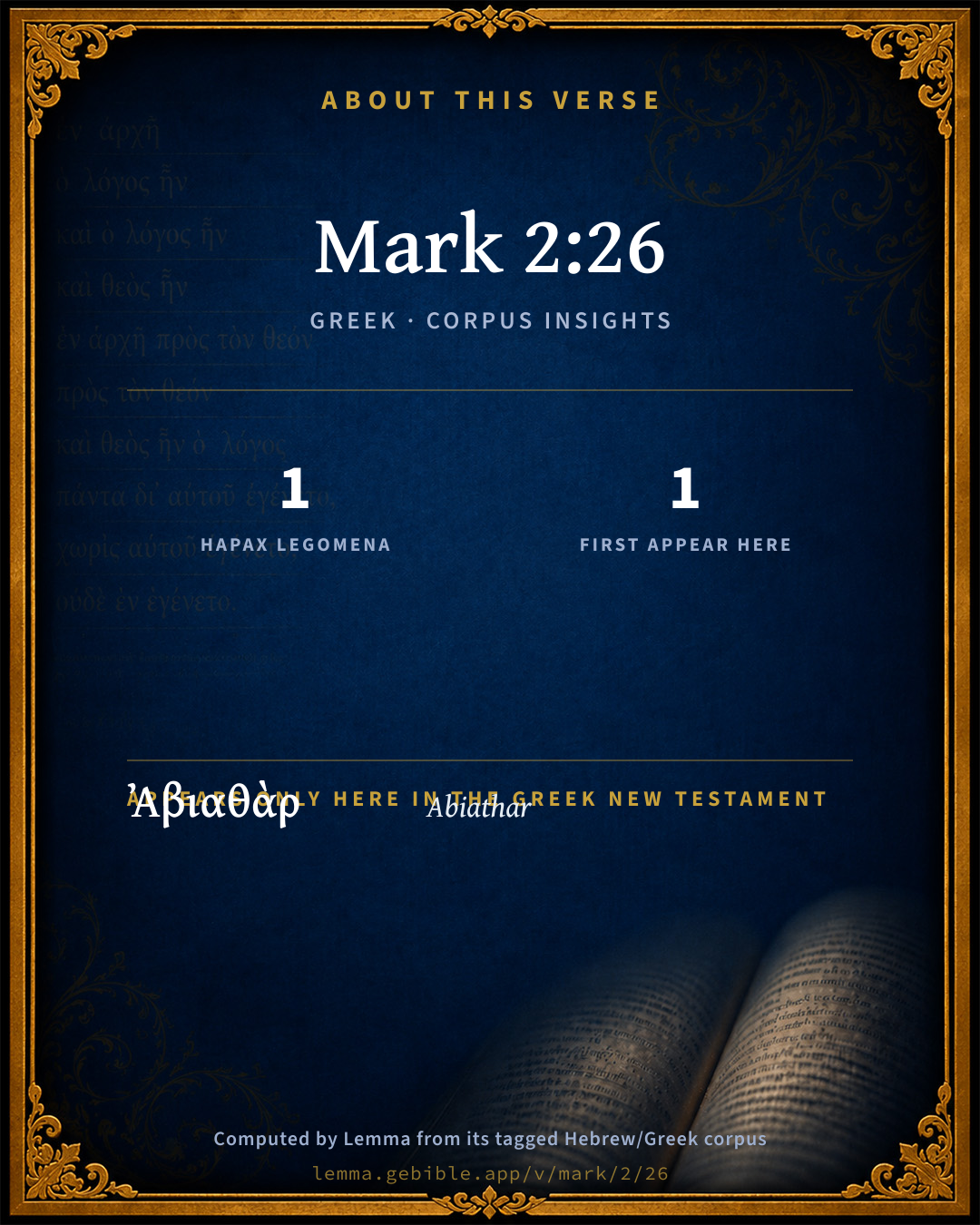
  • 1 hapax legomenon — only here in the Greek New Testament
  • 1 first appearance in the Greek New Testament
Full analysis ↓
Download a study sheet

One document with this verse’s original text, its word-by-word gloss line, the meaning frame, cross-references with their text, attributed commentary, and full source and license credits — printable, and it pastes into notes with its structure intact.

This verse Autodidact and up

Study sheet (.html) Plain text (.txt)

A passage Seminary Student

Up to 50 verses in one chapter. A passage sheet keeps up to 6 commentary sources and 12 cross-references per verse, in the order this page ranks them, and says so on the sheet whenever that leaves anything out. Ask for a single verse and you get the Autodidact verse sheet above.

Everything on this page stays free to read, with no account — the sheet is a download of what is already on screen, not access to it.

Want to remove ads? Support Godless Engineer
Compare translations 3

The same verse in 3 English versions, stacked beneath the original-language interlinear above. Click any original word for its lexicon entry.

Each is an independent rendering of the whole verse — the interlinear is not word-aligned to these translations.

Highlighted words mark where these versions differ — a whole-verse word diff, not a word-by-word alignment.

  • World English Bible Public Domain
    How he entered into the house of God when Abiathar was high priest, and ate the show bread, which it is not lawful to eat except for the priests, and gave also to those who were with him?"
  • King James Version Public Domain
    How he went into the house of God in the days of Abiathar the high priest, and did eat the shewbread, which is not lawful to eat but for the priests, and gave also to them which were with him?
  • unfoldingWord Literal Text CC BY-SA 4.0
    how he went into the house of God in the time of Abiathar the high priest and ate the loaves of the presence, which is not lawful to eat except for the priests, and he also gave to the ones being with him?”

unfoldingWord Literal Text — © unfoldingWord, licensed CC BY-SA 4.0. Word-aligned USFM3 via Door43 (git.door43.org/unfoldingWord/en_ult).

Versions to compare (up to 4)

3 of 4 selected

Show all 19 translations

Every available English version of this verse, each an independent rendering of the whole verse.

  • World English Bible Public Domain
    How he entered into the house of God when Abiathar was high priest, and ate the show bread, which it is not lawful to eat except for the priests, and gave also to those who were with him?"
  • Berean Standard Bible Public Domain
    During the high priesthood of Abiathar, he entered the house of God and ate the consecrated bread, which was lawful only for the priests. And he gave some to his companions as well.”
  • Majority Standard Bible Public Domain
    During the high priesthood of Abiathar, he entered the house of God and ate the consecrated bread, which was lawful only for the priests. And he gave some to his companions as well.”
  • King James Version Public Domain
    How he went into the house of God in the days of Abiathar the high priest, and did eat the shewbread, which is not lawful to eat but for the priests, and gave also to them which were with him?
  • American Standard Version (1901) Public Domain
    How he entered into the house of God when Abiathar was high priest, and ate the showbread, which it is not lawful to eat save for the priests, and gave also to them that were with him?
  • Revised Version (1885) Public Domain
    How he entered into the house of God when Abiathar was high priest, and did eat the shewbread, which it is not lawful to eat save for the priests, and gave also to them that were with him?
  • Geneva Bible (1599) Public Domain
    Howe he went into the house of God, in the daies of Abiathar the hie Priest, and did eat the shewe bread, which were not lawfull to eate, but for the Priests, and gaue also to them which were with him?
  • Douay-Rheims (1899) Public Domain
    How he went into the house of God, under Abiathar the high priest, and did eat the loaves of proposition, which was not lawful to eat but for the priests, and gave to them who were with him?
  • Young's Literal Translation Public Domain
    how he went into the house of God, (at `Abiathar the chief priest,') and the loaves of the presentation did eat, which it is not lawful to eat, except to the priests, and he gave also to those who were with him?'
  • Literal Standard Version CC BY-SA 4.0
    How he went into the house of God, in [the days of] Abiathar the chief priest, and ate the Bread of the Presentation, which it is not lawful to eat, except to the priests, and he also gave to those who were with him?”
  • Unlocked Literal Bible CC BY-SA 4.0
    how he went into the house of God when Abiathar was high priest, and ate the bread of the presence, which it is unlawful for anyone to eat except the priests, and he even gave some to those who were with him?”
  • unfoldingWord Literal Text CC BY-SA 4.0
    how he went into the house of God in the time of Abiathar the high priest and ate the loaves of the presence, which is not lawful to eat except for the priests, and he also gave to the ones being with him?”
  • Darby Bible Public Domain
    how he entered into the house of God, in [the section of] Abiathar [the] high priest, and ate the shew-bread, which it is not lawful unless for the priests to eat, and gave even to those that were with him?
  • World Messianic Bible Public Domain
    How he entered into God’s house at the time of Abiathar the high priest, and ate the show bread, which is not lawful to eat except for the priests, and gave also to those who were with him?”
  • Webster's Bible Public Domain
    How he went into the house of God, in the days of Abiathar the high priest, and ate the show-bread, which it is not lawful to eat, but for the priests, and gave also to them who were with him?
  • Free Bible Version CC BY-SA 4.0
    “He went into God's house when Abiathar was high priest, and ate the consecrated bread which no one except the priests are permitted to eat, and gave it to his men too.”
  • Bible in Basic English Public Domain
    How he went into the house of God when Abiathar was high priest, and took for food the holy bread, which only the priests may take, and gave it to those who were with him?
  • Text-Critical English NT CC BY 4.0
    how he entered the house of God, in the time of Abiathar the high priest, and ate the bread of the Presence, which is not lawful for anyone to eat except for the priests, and how he also gave it to those who were with him?”
  • Tyndale New Testament (1534) Public Domain
    How he went into the housse of God in the dayes of Abiathar the hye preste and dyd eate the halowed loves which is not laufull to eate but for the prestes only: and gave also to the which were with him?

Literal Standard Version (2020), Covenant Press — licensed CC BY-SA 4.0. Text via the HelloAO Bible API (eBible.org). Unlocked Literal Bible (unfoldingWord) — licensed CC BY-SA 4.0. Text via the HelloAO Bible API (eBible.org). unfoldingWord Literal Text — © unfoldingWord, licensed CC BY-SA 4.0. Word-aligned USFM3 via Door43 (git.door43.org/unfoldingWord/en_ult). Free Bible Version, Dr. Jonathan Gallagher — licensed CC BY-SA 4.0. Text via the HelloAO Bible API (eBible.org).

Word by word

More ways to search: Search by grammar → Find every occurrence → Compare this word →

Practice this passage: Drill this verse → Learn its vocabulary →

Ἀβιαθὰρ
Abiathár
G8
“Abiathar”
Noun, Proper, indeclinable
Part of Speech
Noun · Proper, indeclinable
Full Thayer's Definition

Origin: of hebrew origin H54

TDNT: None

Abiathar = "father of abundance" 1. the name of a high priest
  1. πῶς pōs G4459 “how” Adverb
  2. εἰσῆλθεν eisérchomai G1525 “to enter” Verb, Aorist, Active, Indicative, 3rd person, Singular
  3. εἰς eis G1519 “into” Preposition
  4. τὸν ho G3588 “the” Article, Accusative, Singular, Masculine
  5. οἶκον oîkos G3624 “house” Noun, Accusative, Singular, Masculine
  6. τοῦ ho G3588 “the” Article, Genitive, Singular, Masculine
  7. θεοῦ theós G2316 “God” Noun, Genitive, Singular, Masculine
  8. ἐπὶ epí G1909 “upon” Preposition
  9. ἀρχιερέως archiereús G749 “high priest” Noun, Genitive, Singular, Masculine
  10. καὶ kaí G2532 “and” Conjunction
  11. τοὺς ho G3588 “the” Article, Accusative, Plural, Masculine
  12. ἄρτους ártos G740 “bread” Noun, Accusative, Plural, Masculine
  13. τῆς ho G3588 “the” Article, Genitive, Singular, Feminine
  14. προθέσεως próthesis G4286 “showbread” Noun, Genitive, Singular, Feminine
  15. ἔφαγεν phágō G5315 “to eat” Verb, Aorist, Active, Indicative, 3rd person, Singular
  16. οὓς hós G3739 “who” Relative pronoun, Accusative, Plural, Masculine
  17. οὐκ ou G3756 “not” Particle, Negative
  18. ἔξεστιν éxesti G1832 “it is lawful” Verb, Present, Active, Indicative, 3rd person, Singular
  19. φαγεῖν phágō G5315 “to eat” Verb, Aorist, Active, Infinitive
  20. εἰ ei G1487 “if” Conditional
  21. μὴ mḗ G3361 “not” Particle, Negative
  22. τοὺς ho G3588 “the” Article, Accusative, Plural, Masculine
  23. ἱερεῖς hiereús G2409 “priest” Noun, Accusative, Plural, Masculine
  24. καὶ kaí G2532 “and” Conjunction
  25. ἔδωκεν dídōmi G1325 “to give” Verb, Aorist, Active, Indicative, 3rd person, Singular
  26. καὶ kaí G2532 “and” Conjunction
  27. τοῖς ho G3588 “the” Article, Dative, Plural, Masculine
  28. σὺν sýn G4862 “with” Preposition
  29. αὐτῷ autós G846 “he” Personal pronoun, Dative, Singular, Masculine
  30. οὖσιν eimí G1510 “to be” Verb, Present, Active, Participle, Dative, Plural, Masculine

About this verse

These counts appear in no published source. They are computed here, from the morphology-tagged text and Lemma’s own curated glosses. What Lemma adds →

31
words
23
distinct lemmas
Gospels
section

Notable vocabulary

1 hapax legomenon — a word that appears only here in the entire Greek New Testament:

  • Ἀβιαθὰρ Abiathar G8

First appearance in Scripture

This word makes its first canonical appearance in the Greek New Testament here:

  • Ἀβιαθὰρ Abiathar G8

Shared distinctive vocabulary

προθέσεως showbread G4286 occurs in 12 verses of the Greek New Testament. Also found in:
Repetition

Words recur within this verse:

  • ἔφαγεν to eat G5315 ×2
  • τὸν the G3588 ×6
  • καὶ and G2532 ×3

Cross-references

16

Topical passages linked to Mark 2:26 in the Treasury of Scripture Knowledge — connected by theme and wording, ordered by reader-vote popularity; previews shown in the World English Bible.

  • 2 Samuel 8:17 and Zadok the son of Ahitub, and Ahimelech the son of Abiathar, were priests; and Seraiah was scribe;
  • Leviticus 24:5–9 "You shall take fine flour, and bake twelve cakes of it: two tenth parts of an ephah shall be in one cake.
  • 1 Samuel 21:1 Then came David to Nob to Ahimelech the priest: and Ahimelech came to meet David trembling, and said to him, Why are you alone, and no man with you?
  • 1 Chronicles 24:6 Shemaiah the son of Nethanel the scribe, who was of the Levites, wrote them in the presence of the king, and the princes, and Zadok the priest, and Ahimelech the son of Abiathar, and the heads of the fathers' [houses] of the priests and of the Levites; one fathers' house being taken for Eleazar, and one taken for Ithamar.
  • 1 Samuel 22:20–22 One of the sons of Ahimelech, the son of Ahitub, named Abiathar, escaped, and fled after David.
  • 1 Kings 2:26–27 To Abiathar the priest said the king, Get you to Anathoth, to your own fields; for you are worthy of death: but I will not at this time put you to death, because you bear the ark of the Lord Yahweh before David my father, and because you were afflicted in all in which my father was afflicted.
  • Exodus 29:32–33 Aaron and his sons shall eat the flesh of the ram, and the bread that is in the basket, at the door of the tent of meeting.
  • 1 Samuel 23:6 It happened, when Abiathar the son of Ahimelech fled to David to Keilah, that he came down with an ephod in his hand.
  • 1 Samuel 23:9 David knew that Saul was devising mischief against him; and he said to Abiathar the priest, Bring here the ephod.
  • 2 Samuel 15:24 Behold, Zadok also [came], and all the Levites with him, bearing the ark of the covenant of God; and they set down the ark of God; and Abiathar went up, until all the people had done passing out of the city.
  • 2 Samuel 15:29 Zadok therefore and Abiathar carried the ark of God again to Jerusalem: and they abode there.
  • 2 Samuel 15:35 Don't you have Zadok and Abiathar the priests there with you? therefore it shall be, that whatever thing you shall hear out of the king's house, you shall tell it to Zadok and Abiathar the priests.
  • 2 Samuel 20:25 and Sheva was scribe; and Zadok and Abiathar were priests;
  • 1 Kings 1:7 He conferred with Joab the son of Zeruiah, and with Abiathar the priest: and they following Adonijah helped him.
  • 1 Kings 2:22 King Solomon answered his mother, Why do you ask Abishag the Shunammite for Adonijah? ask for him the kingdom also; for he is my elder brother; even for him, and for Abiathar the priest, and for Joab the son of Zeruiah.
  • 1 Kings 4:4 and Benaiah the son of Jehoiada was over the host; and Zadok and Abiathar were priests;

Cross-references courtesy of OpenBible.info (CC BY 4.0).

Commentary

Notes on Mark 2:26 from classic Christian and Jewish commentators (each source and its license shown beneath its notes). The classic Christian expositions comment on the surrounding passage and are grouped to its opening verse, so a note may address several verses; the Jewish commentaries on the Tanakh (Rashi and others) are per-verse, so they appear only where the commentator wrote on this verse.

Lemma curates 59 commentaries, every one of them public domain or Creative Commons licensed, each selected and text-cleaned for this edition rather than reprinted as found. About our sources →

Geneva Bible (1599)

Geneva Bible translators

In 1 Sam. 21:1 he is called Ahimelech and his son Abiathar, but by conference of other places, it is plain, that both of them had two names. See also 1 Chron. 24:6; 2 Sam. 8:17; 2 Sam. 15:29; 1 Kings 2:26; 2 Kings 25:18.

Geneva Bible (1599) marginal notes — public domain. Text via Bolls.life.

Ellicott's Commentary for English Readers

(26) In the days of Abiathar the high priest.—St. Mark’s is the only record that gives the name of the high priest, and in so doing it creates an historical difficulty. In 1Sa_21:1, Ahimelech is named as exercising the high priest’s office in the Tabernacle at Nob. He is slain by Doeg, at the command of Saul, and his son Abiathar joins David at the cave of Adullam (1Sa_22:20), and continues to act as high priest till his deposition by Solomon (1Ki_2:26). Two conjectural explanations suggest themselves as probable: (1) that St. Mark, or that our Lord, may have given the name of the more famous priest of the two, who, though not then high-priest, was at the Tabernacle at the time referred to; (2) that he might have acted then as a coadjutor to his father, as Eli’s sons seem to have done to him (1Sa_4:4), and being, as his flight showed, of David’s party, was the chief agent in allowing him to take the shew-bread.

A Bible Commentary for English Readers, edited by Charles John Ellicott (1878–1897) — public domain. Text from a community e-Sword module.

Bengel's Gnomon

Johann Albrecht Bengel

Mar 2:26. Ἐπὶ, Ἀβιάθαρ, under Abiathar) Ahimelech was the priest who gave loaves of bread to David; but on his being put to death for that very act, his son Abiathar presently after succeeded to him; and afterwards the priesthood of Abiathar and the reign of David were contemporary. The series of the priests was very well known among the Hebrews, and so the denomination of [the mode of marking] the age of David is taken from the priest of that day; and indeed the Evangelist mentions Abiathar, in whose time the actions of David seem to have been entered in the sacred records, in preference to Ahimelech; comp. the use of ἐπὶ, Mat 1:11. Not unlike is the phraseology, Gen 2:2, on the seventh day [God ended His work; we should have said, at the close of the sixth day], and ch. Mar 10:25, in the days of peleg (who was born a short while after) the earth was divided.

Bengel's Gnomon of the New Testament — English translation (T&T Clark, Edinburgh, 1860) — public domain. Text from a community e-Sword module.

Expositor's Greek Testament

ed. W. Robertson Nicoll

Mar 2:26 . ἐπὶ Ἀβιάθαρ ἀρ .: under A., a note of time, also implying his sanction: the sanction of a distinguished sacerdotal character = of Abiathar as priest . But Ahimelech was the priest then (1Sa 21:2 f.). Either a natural error arising from the close connection of David with Abiathar, the well-known high priest, or we must adopt one or other of the solutions proposed: father and son, Ahimelech and Abiathar, both bore both names (1Sa 22:20 , 2Sa 8:17 , 1Ch 18:16 ) so the Fathers; Abiathar, the son, Ahimelech’s assistant at the time, and mentioned as the more notable as approving of the conduct of his own father and of David (Grotius); ἐπὶ taken in the sense it bears in Mar 12:26 ( ἐπὶ βάτου ) in the passage about Abiathar not a satisfactory suggestion.

The Expositor's Greek Testament, edited by W. Robertson Nicoll (1897–1910) — public domain. Text from a community e-Sword module.

Adam Clarke's Commentary

Verse 26. The days of Abiathar the high priest] It appears from 1Sa 21:1, which is the place referred to here, that Ahimelech was then high priest at Nob: and from 1Sa 22:20; 1Sa 23:6, and 1Ch 18:16, it appears that Abiathar was the son of Ahimelech. The Persic reads Abimelech instead of Abiathar. Theophylact supposes that Abiathar was the priest, and Ahimelech or Abimelech the high priest, and thus endeavours to reconcile both the sacred historians. Others reconcile the accounts thus: Ahimelech was called Ahimelech Abiathar, אב ab, father, understood; and Abiathar was called Abiathar Ahimelech, בן ben, son, understood. Probably they both officiated in the high priesthood; and the name of the office was indifferently applied to either.

Shew-bread] See Mt 12:4.

Adam Clarke's Commentary on the Bible (1810–1826) — public domain. Text from a community e-Sword/MySword module.

The Cambridge Bible for Schools and Colleges

gen. ed. J. J. S. Perowne

26. Abiathar] In 2Sa_8:17, and the parallel passage 1Ch_18:16, we find Ahimelech substituted for Abiathar; while in 2Sa_20:25, and every other passage of the O. T., we are told it was Abiathar who was priest with Zadok in David’s reign, and that he was the son of Ahimelech. Some therefore suppose that there is a clerical error here in the MSS. Others think that the loaves of shewbread belonged to Abiathar, at this time a priest (Lev_24:9), that he persuaded his father to let David have them, and gave them to him with his own hand.

The Cambridge Bible for Schools and Colleges (gen. ed. J. J. S. Perowne; Cambridge University Press, 1878–1918) — public domain. Text from a community e-Sword module.

John Gill's Exposition

And he said unto them,.... Continuing his answer to them, and adding, in confirmation of what he had said, and for the further vindication of his disciples,

the sabbath was made for man; for his good, and not for his hurt; both for the good of his soul, that he might have an opportunity of attending divine worship, both in public and private; and for the good of his body, that he might have rest from his labour; and this was the end of the original institution and appointment of it; and therefore works of necessity are not forbidden on this day; such as are for the necessary comfort, support, and preservation of life; or otherwise it would be apparent, that the sabbath was not appointed for the good, but for the hurt of men. By "man", is not meant all mankind; for the sabbath was never appointed for all mankind, nor binding upon all; only the Jews, who are emphatically called "man", or "men"; see Eze 34:30, upon which the Jewish writers remark (o), that

"they are called, "man"; but the idolatrous Gentiles, and nations of the World, are not called "men";''

but dogs, beasts, &c. Our Lord may here be thought to speak in their language, as he does in Mat_. 15:26; see Gill on Mat 15:26. And that the observation of the seventh day, was only designed for the children of Israel, seems manifest from Exo 31:16, "wherefore the children of Israel shall keep the sabbath, to observe the sabbath throughout their generations, for a perpetual covenant; it is a sign between me and the children of Israel"; and not between him and the rest of the world: and in Exo 31:14, "ye shall keep the sabbath, for it is holy unto you": on which the Jews (p) make this remark, , "to you, and not to the rest of the nations": nor did they ever think that the Gentiles were obliged to observe their sabbath, only such who became proselytes to their religion; even those who were proselytes of righteousness: for a proselyte of the gate, was not bound to observe it; for so says (q) Maimonides,

"those who take upon them the seven commandments of Noah only, lo! they are as a proselyte of the gate, and they are free to do work on the sabbath day for themselves, openly, as an Israelite on a common day.''

Yea, they not only say, they were not obliged to keep the sabbath, but that it was not lawful for them to observe it; and that it was even punishable with death them to regard it; for so they say (r),

"a Gentile that keeps the sabbath before he is circumcised, is guilty of death, because it is not commanded him.''

They judged them unworthy of having this precept enjoined them, as being not men, but beasts, and worse than they, and had not the privilege the ass has: hence one of their commentators (s) says,

"concerning the rest of an ass, thou (O Israelite!) art commanded; but concerning the rest of a Gentile, thou art not commanded.''

And not man for the sabbath; who was in being long before that was appointed and enjoined.

(o) T. Bab. Bava Metzia, fol. 114. 2. Zohar in Exod. fol. 35. 4. (p) Zohar in Exod. fol. 26. 4. (q) Hilchot Sabbat, c. 20. sect. 14. (r) Debarim Rabba, sect. 1. fol. 234. 4. (s) Bartenora in Misn. Sabbat, c. 24. sect. 1.

John Gill's Exposition of the Whole Bible (1746–1763) — public domain (CC PDM 1.0). Text via the HelloAO Bible API.

Trapp's Complete Commentary

John Trapp

26 How he went into the house of God in the days of Abiathar the high priest, and did eat the shewbread, which is not lawful to eat but for the priests, and gave also to them which were with him?

Ver. 26. And to them that, &c.] Though meaner men than David.

John Trapp, A Commentary or Exposition upon All the Books of the Old and New Testament (1647–1656) — public domain. Text from a community e-Sword module.

Haydock's Catholic Bible Commentary

Under Abiathar. The priest from whom David had these loaves, is called Achimelech, 1 Kings xxi. The most probable answer to this difficulty is, that the priest had both these names of Achimelech and of Abiathar, as also his father had before him. For he that (1 Kings xxii.) is called Abiathar, the son of Achimelech, is called 2 Kings viii. 17, Achimelech, the son of Abiathar. See also 1 Paralipomenon xviii. 16. (Witham) --- Others say that Abiathar, son of Achimelech, was present, and sanctioned the deed of his father, thus making it his own. (Denis the Carthusian)

George Leo Haydock (1774–1849), Haydock's Catholic Family Bible and Commentary, 1859 edition — public domain. Excludes Psalms (Douay-Rheims chapter numbering differs from Protestant) and Deuterocanonical books (Catholic canon only).

Whedon's Commentary on the Bible

Daniel D. Whedon

26. In the days of Abiathar the high priest — It appears by the account of the transaction here referred to in 1Sa_21:1, that Ahimelech, father of Abiathar, was the high priest who supplied David the showbread. His son Abiathar was then priest, and afterward high priest; and as such under David attained a celebrity in Jewish history. Jesus, therefore, specifies the time as being the period of Abiathar’s life and office, who afterward became high priest. It is by no means improbable, though there is no other proof than arises from this passage, that Abiathar may have been high priest with his father, as he was high priest a part of his life conjointly with Zadock. There would be no extraordinary error, however, in saying that the American Constitution was formed in the time of President Washington.

Daniel D. Whedon (gen. ed.), Commentary on the Old and New Testaments (1874–1909) — public domain. Text from a community e-Sword module.

John Wesley's Explanatory Notes

In the days of Abiathar the high priest - Abimelech, the father of Abiathar, was high priest then; Abiathar himself not till some time after. This phrase therefore only means, In the time of Abiathar, who was afterward the high priest. 1 Sam. xxi, 6.

John Wesley, Explanatory Notes Upon the Whole Bible (1754–1765) — public domain. Text via the GEBible commentary corpus.

Scofield Reference Notes

C. I. Scofield

shewbread

(See Scofield "Exo 25:30")

The Scofield Reference Bible (1917 edition), notes by C. I. Scofield — public domain. Text from a community e-Sword module.

The People's New Testament

B. W. Johnson

26. In the days of Abiathar, the high priest. In 1 Sam. 21:1–9, Ahimelech is represented as the high priest. Abiathar was his son and successor. The Revised Version gives the text of the best MSS. by omitting “the high priest.”

B. W. Johnson's The People's New Testament with Notes (1889–1891) — public domain. Electronic text from the Christian Classics Ethereal Library (CCEL) ThML edition.

Cambridge Greek Testament for Schools and Colleges

26. πῶς before εἰσῆλθεν should probably be omitted with [365][366] t. [367] Lat-Vet. Syr-Sin. omit ἐπὶ Ἀβιάθαρ ἀρχιέρεως.

[365] Codex Vaticanus. 4th cent., but perhaps a little later than א. In the Vatican Library almost since its foundation by Pope Nicolas V., and one of its greatest treasures. The whole Gospel, ending at Mar 16:8. Photographic facsimile, 1889.

[366] Codex Bezae. 6th cent. Has a Latin translation (d) side by side with the Greek text, and the two do not quite always agree. Presented by Beza to the University Library of Cambridge in 1581. Remarkable for its frequent divergences from other texts. Contains Mark, except Mar 16:15-20, which has been added by a later hand. Photographic facsimile, 1899.

[367] Codex Bezae. 6th cent. Has a Latin translation (d) side by side with the Greek text, and the two do not quite always agree. Presented by Beza to the University Library of Cambridge in 1581. Remarkable for its frequent divergences from other texts. Contains Mark, except Mar 16:15-20, which has been added by a later hand. Photographic facsimile, 1899.

26. τὸν οἶκον τ. θεοῦ. Jdg 18:31; cf. 1Sa 1:7; 1Sa 1:24; 1Sa 3:15. In 1Sa 21:1-6 it is not stated that David entered the House of God, but it is just possible that the expression includes the τέμενος or sacred enclosure in which the Tabernacle stood. The Tabernacle was then at Nob, which was probably a little [404] of Jerusalem.

[404] Codex Purpureus. 6th cent. Full text in Texts and Studies v. No. 4, 1899. Contains Mar 5:20 to Mar 7:4; Mar 7:20 to Mar 8:32; Mar 9:1 to Mar 10:43; Mar 11:7 to Mar 12:19; Mar 14:25 to Mar 15:23; Mar 15:33-42. See below on Ψ.

ἐπὶ Ἀβιάθαρ ἀρχιερέως. When Abiathar was high-priest (R.V.). Cf. Luk 3:2; Luk 4:27; Act 11:28. [405][406] 33 insert τοῦ before ἀρχ., which would mean “in the time of Ab., who was high-priest,” without limiting the date to the duration of the high-priesthood. Mt. and Lk. omit the date, which is erroneous, for Ahimelech was the high-priest who gave David the shewbread. Syr-Sin. omits the date here. The error may be compared with that of Mat 23:35, and in both cases we probably have a slip of the Evangelist (or of a very early copyist), who inserted a note of his own into our Lord’s words and made a mistake in doing so. No date is required here. Conjectures that both high-priests had both names, or that ἐπὶ Ἀβ. may mean “in the passage about [407] (cf. Mar 12:6), are unsatisfactory. Here, as in the coupling of a prophecy from Malachi with one from Isaiah, as if both were from Isaiah (Mar 1:2), Mt. and Lk. omit what is erroneous in Mk.

[405] Codex Alexandrinus. 5th cent. Brought by Cyril Lucar, Patriarch of Constantinople, from Alexandria, and afterwards presented by him to King Charles I. in 1628. In the British Museum. The whole Gospel. Photographic facsimile, 1879.

[406] Codex Ephraemi. 5th cent. A palimpsest: the original writing has been partially rubbed out, and the works of Ephraem the Syrian have been written over it; but a great deal of the original writing has been recovered; of Mark we have Mar 1:17 to Mar 6:31, Mar 8:5 to Mar 12:29, Mar 13:19 to Mar 16:20. In the National Library at Paris.

[407] odex Alexandrinus. 5th cent. Brought by Cyril Lucar, Patriarch of Constantinople, from Alexandria, and afterwards presented by him to King Charles I. in 1628. In the British Museum. The whole Gospel. Photographic facsimile, 1879.

τοὺς ἄρτους τῆς τηροθέσεως. The bread or The loaves of the setting forth, panes propositionis (Vulg.). This expression occurs Exo 40:23; 1Ch 9:32; 1Ch 23:29. Other names in LXX. are ἀρ. τοῦ προσώπου, “of the Presence of God” (1Sa 21:6), τῆς προσφορᾶς, (1Ki 7:28), ἄρ. ἐνώπιοι (Exo 25:30), or οἱ διὰ παντός, “the perpetual loaves” (Num 4:7); cf. 2Ch 13:11; 2Ch 29:18. In Heb 9:2 we have ἡ πρόθεσις τῶν ἄρτων. See Deissmann, Bib. St. p. 157. “Shewbread” appears first in Coverdale (A.D. 1535), probably from Luther’s Schaubrote. Hebrew has few adjectives expressing such attributes, and hence the freq. use of the gen. Twelve loaves were placed on “the pure table” and renewed every Sabbath. Similar offerings of twelve or thirty-six loaves were made by other Semitic nations in the sacrifices to their gods as food for the gods to eat. To the Jew they signified the Presence of God and His perpetual acceptance of worship.

οὐκ ἔξεστιν. Lev 24:9 says that this bread is for Aaron and his sons, who are to eat it in a holy place. This οὐκ ἔξεστιν was therefore stronger than the οὐκ ἔξεστιν in Mar 2:24, and yet Ahimelech allowed an exception to be made. Only here and Luk 6:4; Luk 20:22, does ἔξεστιν c. acc. et infin. occur in N.T. Contrast Mar 6:18, Mar 10:2; Mt. here has the dat., and [408][409][410] against [411][412][413] have the dat. in Mk. Bede thinks that allowing David and his followers to eat the priests’ bread may point to the fact that omnes filii Ecclesiae sacerdotes sunt.

[408] Codex Alexandrinus. 5th cent. Brought by Cyril Lucar, Patriarch of Constantinople, from Alexandria, and afterwards presented by him to King Charles I. in 1628. In the British Museum. The whole Gospel. Photographic facsimile, 1879.

[409] Codex Ephraemi. 5th cent. A palimpsest: the original writing has been partially rubbed out, and the works of Ephraem the Syrian have been written over it; but a great deal of the original writing has been recovered; of Mark we have Mar 1:17 to Mar 6:31, Mar 8:5 to Mar 12:29, Mar 13:19 to Mar 16:20. In the National Library at Paris.

[410] Codex Bezae. 6th cent. Has a Latin translation (d) side by side with the Greek text, and the two do not quite always agree. Presented by Beza to the University Library of Cambridge in 1581. Remarkable for its frequent divergences from other texts. Contains Mark, except Mar 16:15-20, which has been added by a later hand. Photographic facsimile, 1899.

[411] Codex Sinaiticus. 4th cent. Discovered by Tischendorf in 1859 at the Monastery of St Katharine on Mount Sinai. Now at St Petersburg. The whole Gospel, ending at Mar 16:8. Photographic facsimile, 1911.

[412] Codex Vaticanus. 4th cent., but perhaps a little later than א. In the Vatican Library almost since its foundation by Pope Nicolas V., and one of its greatest treasures. The whole Gospel, ending at Mar 16:8. Photographic facsimile, 1889.

[413] Codex Regius. 8th cent. An important witness. At Paris. Contains Mar 1:1 to Mar 10:15; Mar 10:30 to Mar 15:1; Mar 15:20 to Mar 16:20, but the shorter ending is inserted between Mar 16:8 and Mar 16:9, showing that the scribe preferred it to the longer one.

ἔδωκεν καὶ τοῖς σὺν αὐτῷ. This also is not stated in 1 Samuel 21, but it may be inferred from David’s asking for five loaves, and from his assuring Ahimelech that the wallets of his followers were Levitically clean. Thus David allowed his followers, as the Son of David allowed His followers, to do what usage forbade.

Cambridge Greek Testament for Schools and Colleges (Cambridge University Press, 1896; 21 vols, various authors incl. Carr, Maclear, Plummer, Farrar, Lumby, Moule, M. R. James, Simcox) — public domain. Text from a community e-Sword module.

Alford’s Greek Testament

Henry Alford

26. ἐπὶ Ἀβ. ἀρχ.] during the high-priesthood of Abiathar. But in 1Sa_21, from which this account is taken, Ahimelech, not Abiathar, is the high-priest. There is however considerable confusion in the names about this part of the history: Ahimelech himself is called Ahiah, 1Sa 14:3; and whereas (1Sa 22:20) Ahimelech has a son Abiathar, in 2Sa 8:17, Ahimelech is the son of Abiathar, and in 1Ch 18:16, Abimelech. Amidst this variation, we can hardly undertake to explain the difficulty in the text. The insertion of the art. before ἀρχ. has been apparently done to give the words the sense ‘In the time of Abiathar the High-priest,’ so that the difficulty might be avoided by understanding the event to have happened in the time of (but not necessarily during the high-priesthood of) Abiathar (who was afterwards) the High-priest. But supposing the reading to be so, what author would in an ordinary narrative think of designating an event thus? Who for instance would speak of the defeat of the Philistines at Ephesdammim, where Goliath fell, as happening ἐπὶ Δανεὶδ τοῦ βασιλέως? Who would ever understand ἐπὶ Ἐλισσαίου τοῦ προφήτου, ‘in the time of Elisæus the prophet,’ as importing, in matter of fact, any other period than that of the prophetic course of Elisha? (The ἐγέννησεν Δανεὶδ τὸν βασιλέα of Mat 1:6 is not a case in point.) Yet this is the way in which the difficulties of the Gospels have been attempted to be healed over. (See Middleton on the article, in loc.) With the restoration of the true reading, even this resource fails. (I am sorry to see that Bp. Wordsw. writes, “ἐπὶ Ἀβιάθαρ ἀρχιερέως intimates indeed that it was in the days of Abiathar, but it rather suggests that he was not the High-priest then:” comparing ἐπὶ ἀρχιερέως Ἄννα, Luk 3:2. But surely Bp. W. must know, that such a rendering is ungrammatical: that ἀρχ ιερέως without the article must be simply predicatory, whether it precedes or follows the proper name; “when Abiathar was High-priest,”—and cannot be titular. The expression in 1 Mace. 13:42, which he quotes as similar, is not a case in point, as any reader may judge: ἐπὶ Σίμωνος ἀρχιερέως μεγάλου κ. στρατηγοῦ καὶ ἡγουμένου τῶν Ἰουδαίων: the epithet μεγάλου makes all the difference.)

Henry Alford, The Greek Testament (1849–1861) — public domain. Text from a community e-Sword module.

International Critical Commentary

26. οἶκον τοῦ Θεοῦ—the house of God is a generic term that would apply either to the tent or tabernacle in which the Jews at first worshipped, or to the later temple. Here, of course, the former. It was called the house of God, because in a sense God dwelt there, manifesting his presence in the inner shrine, the Holy of Holies.

ἐπὶ Ἀβιάθαρ ἀρχιερέως—in the high-priesthood of Abiathar.

Omit τοῦ before ἀρχιερέως Tisch. Treg. marg. WH. RV. א BL Γ etc.

In the account of this in 1Sa 21:1, sqq., Abimelech was high-priest, and Abiathar, his son, does not become high-priest until the reign of David. See ch. 22:21. To be sure, other passages in the O.T. make the same confusion of names, making Abimelech, the son of Abiathar, high-priest in David’s time. But this does not explain our difficulty; it only shows that there is the same difficulty in the O.T. account. Nor does it relieve it to suppose that this means simply that the event took place during the lifetime of Abiathar, not during the high-priesthood. For the transaction took place between David and the high-priest; and the object of introducing the name would be to show in whose high-priesthood it took place, not simply in whose lifetime. The impropriety would be the same as if one were to speak of something that took place between the Bishop of Durham and some other person in the time of Bishop Westcott, when, as a matter of fact, Lightfoot was bishop, and it was only during the lifetime of Bishop Westcott. And the phrase itself means strictly, during the high-priesthood of Abiathar. If such disagreement were uncommon, it would be worth while to try somewhat anxiously to remove this difficulty; but, as a matter of fact, discrepancies of this unimportant kind are not at all uncommon in the Scriptures.

τοὺς ἄρτους τῆς προθέσεως—the bread of setting forth. It is a translation of the Hebrew, לֶחֶם הַפָּנִים bread of the face, or presence, given to twelve loaves of bread set in two rows on the table in the holy place of the tabernacle, or temple, and renewed by the priests every Sabbath. S. Lev 24:5-9. The Greek name, taken from the Sept., denotes the bread set forth before God. The Hebrew name, about which there has been naturally much curious writing, seems to mean that the bread, in some way, symbolized God’s presence. τοὺς ἱερεῖς—the priests.

τοὺς ἱερεῖς, instead of τοῖς ἱερεῦσι, Tisch. Treg. marg. WH. א BL.

τοὺς ἱερεῖς is the subject of φαγεῖν. The priests were allowed to eat the bread after it had been replaced by fresh loaves. In this case, there was no other bread, and when David and his hungry men appeared, it became a case of physical need against ritual law. Jesus cites it as a case decided by a competent authority and accepted by the people, showing the superiority of natural law to positive enactment, the same principle involved in the alleged illegal action of his disciples. And he evidently upholds the correctness of the principle, and not simply the authority of this precedent.

International Critical Commentary — older volumes (1896–1929), various authors — public domain. Text from a community e-Sword module.

Vincent's Word Studies in the New Testament

Marvin R. Vincent

The shewbread [τους αρτους της προθεσεως] . Lit., the loaves of proposition, i e., the loaves which were set forth before the Lord. The Jews called them the loaves of the face, i e., of the presence of God. The bread was made of the finest wheaten flour that had been passed through eleven sieves. There were twelve loaves, or cakes, according to the number of tribes, ranged in two piles of six each. Each cake was made of about five pints of wheat. They were anointed in the middle with oil, in the form of a cross. According to tradition, each cake was five hand - breadths broad and ten long, but turned up at either end, two hand - breadths on each side, to resemble in outline the ark of the covenant. The shewbread was prepared on Friday, unless that day happened to be a feast - day that required sabbatical rest; in which case it was prepared on Thursday afternoon. The renewal of the shewbread was the first of the priestly functions on the commencement of the Sabbath. The bread which was taken off was deposited on the golden table in the porch of the sanctuary, and distributed among the outgoing and incoming courses of priests (compare save for the priests). It was eaten during the Sabbath, and in the temple itself, but only by such priests as were Levitically pure. This old bread, removed on the Sabbath morning, was that which David ate.

Marvin R. Vincent, Word Studies in the New Testament (1887–1900) — public domain. Text from a community e-Sword/MySword module.

Lesson kit

Teaching starters — assembled from the data on this page, not authored interpretation. Every prompt links to the verse data it draws on. Edit before teaching.

Mark, in the Gospels, opens this verse with 31 words (23 distinct Greek lemmas). Its most distinctive word is Abiathár (“Abiathar”). A historical commentator’s framing appears above. Read the whole chapter for the surrounding context.

Discussion questions

  1. The word Abiathár carries the sense “Abiathar.” How does it shape the verse?
  2. 1 word here appears nowhere else in the Greek New Testament. Why might the author reach for such rare wording?
  3. This is the first place “Abiathar” appears in Scripture (first appears here). What does its debut here establish?
  4. How does Matthew 12:4, which shares the word «showbread», read alongside this verse?
  5. What does the repetition of “to eat” (2× in this one verse) do in this verse?
  6. These translations render this verse differently. What is at stake in choosing one wording over another?
  7. Compare how Geneva Bible (1599) and Ellicott's Commentary for English Readers read this verse. Where do they agree or differ?

Things to notice

  • 1 word in this verse appears nowhere else in the Greek New Testament.
  • 1 word makes its first canonical appearance in Scripture here.
  • These translations choose different wording for 16 words in this verse.
  • “to eat” occurs 2× in this single verse.
  • 23 distinct Greek lemmas span 31 words in this verse.

Reading settings

Reading text

Shown beneath each verse's original-language words.

Old Testament
Old Testament edition

Read the OT as the Masoretic Hebrew (MT) or the Greek Septuagint (LXX).

English shown for the Greek Septuagint (in the Hebrew ↔ Greek comparison).

Comparing translations? Open the Compare panel on any verse page to stack up to four side by side.