Matthew 22:32

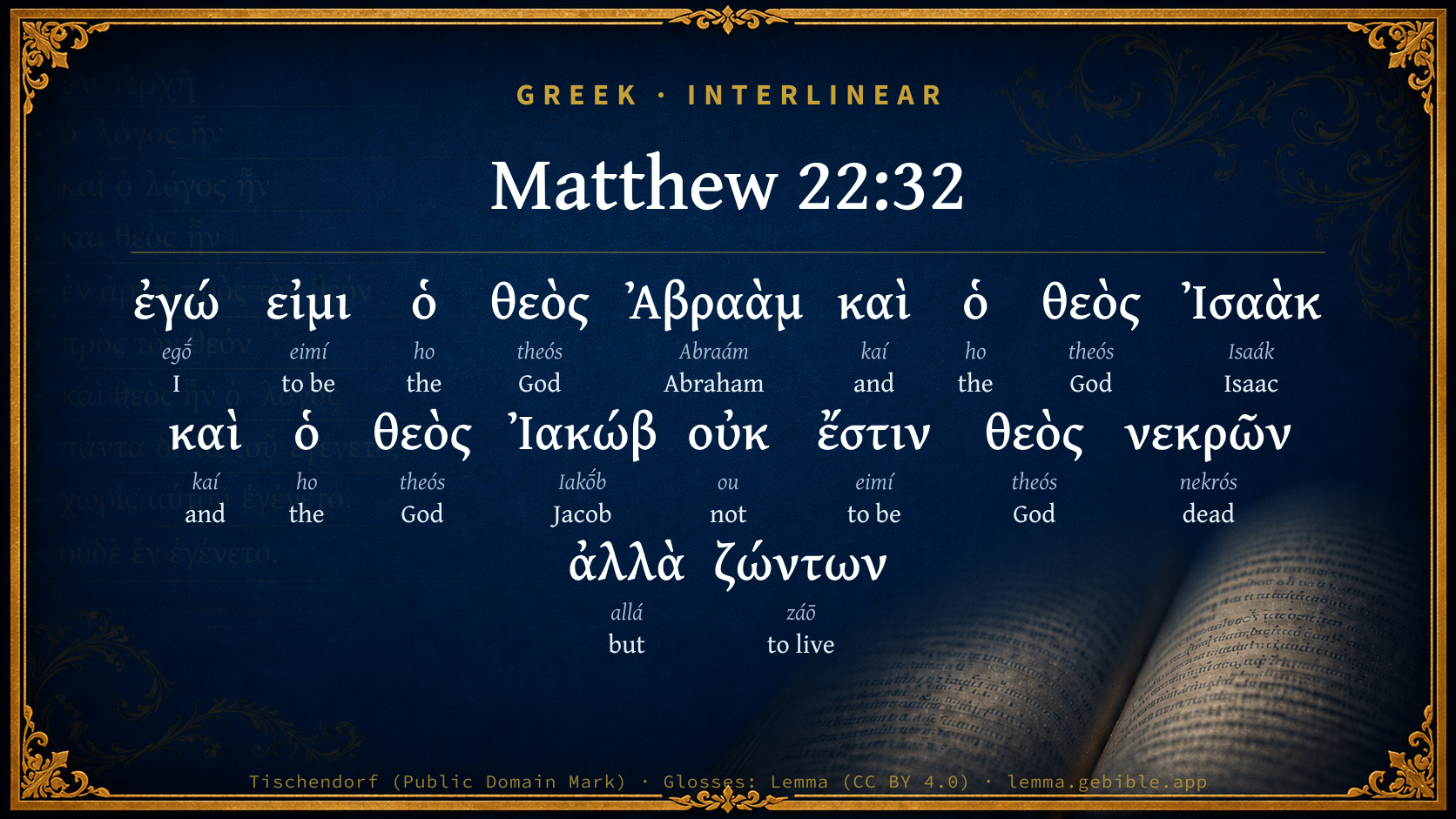
Greek (Tischendorf 8th ed.) Matthew 22:32 appears in the Greek New Testament. The text above is from the Tischendorf 8th edition. Each word links to its Strong’s number and a concise gloss. Click any word for its full Thayer’s Greek Lexicon entry.
Download image
Cite this verse

Matthew 22:32 (World English Bible). Public Domain. Lemma interlinear Bible study tool, https://lemma.gebible.app/v/matthew/22/32.

Show BibTeX & RIS
BibTeX
RIS
English Translation
'I am the God of Abraham, and the God of Isaac, and the God of Jacob?' God is not the God of the dead, but of the living."
World English Bible · Public Domain
Download a study sheet

One document with this verse’s original text, its word-by-word gloss line, the meaning frame, cross-references with their text, attributed commentary, and full source and license credits — printable, and it pastes into notes with its structure intact.

This verse Autodidact and up

Study sheet (.html) Plain text (.txt)

A passage Seminary Student

Up to 50 verses in one chapter. A passage sheet keeps up to 6 commentary sources and 12 cross-references per verse, in the order this page ranks them, and says so on the sheet whenever that leaves anything out. Ask for a single verse and you get the Autodidact verse sheet above.

Everything on this page stays free to read, with no account — the sheet is a download of what is already on screen, not access to it.

Want to remove ads? Support Godless Engineer
Compare translations 3

The same verse in 3 English versions, stacked beneath the original-language interlinear above. Click any original word for its lexicon entry.

Each is an independent rendering of the whole verse — the interlinear is not word-aligned to these translations.

Highlighted words mark where these versions differ — a whole-verse word diff, not a word-by-word alignment.

  • World English Bible Public Domain
    'I am the God of Abraham, and the God of Isaac, and the God of Jacob?' God is not the God of the dead, but of the living."
  • King James Version Public Domain
    I am the God of Abraham, and the God of Isaac, and the God of Jacob? God is not the God of the dead, but of the living.
  • unfoldingWord Literal Text CC BY-SA 4.0
    ‘I am the God of Abraham, and the God of Isaac, and the God of Jacob’? He is not a God of the dead, but of the living.”

unfoldingWord Literal Text — © unfoldingWord, licensed CC BY-SA 4.0. Word-aligned USFM3 via Door43 (git.door43.org/unfoldingWord/en_ult).

Versions to compare (up to 4)

3 of 4 selected

Show all 19 translations

Every available English version of this verse, each an independent rendering of the whole verse.

  • World English Bible Public Domain
    'I am the God of Abraham, and the God of Isaac, and the God of Jacob?' God is not the God of the dead, but of the living."
  • Berean Standard Bible Public Domain
    ‘I am the God of Abraham, the God of Isaac, and the God of Jacob’? He is not the God of the dead, but of the living.”
  • Majority Standard Bible Public Domain
    ‘I am the God of Abraham, the God of Isaac, and the God of Jacob’? He is not the God of the dead, but of the living.”
  • King James Version Public Domain
    I am the God of Abraham, and the God of Isaac, and the God of Jacob? God is not the God of the dead, but of the living.
  • American Standard Version (1901) Public Domain
    I am the God of Abraham, and the God of Isaac, and the God of Jacob? God is not `the God' of the dead, but of the living.
  • Revised Version (1885) Public Domain
    I am the God of Abraham, and the God of Isaac, and the God of Jacob? God is not the God of the dead, but of the living.
  • Geneva Bible (1599) Public Domain
    I am the God of Abraham, and the God of Isaac, and the God of Iacob? God is not the God of the dead, but of the liuing.
  • Douay-Rheims (1899) Public Domain
    I am the God of Abraham, and the God of Isaac, and the God of Jacob He is not the God of the dead, but of the living.
  • Young's Literal Translation Public Domain
    I am the God of Abraham, and the God of Isaac, and the God of Jacob? God is not a God of dead men, but of living.'
  • Literal Standard Version CC BY-SA 4.0
    I am the God of Abraham, and the God of Isaac, and the God of Jacob? God is not a God of dead men, but of living.”
  • Unlocked Literal Bible CC BY-SA 4.0
    'I am the God of Abraham, the God of Isaac, and the God of Jacob'? God is not the God of the dead, but of the living.”
  • unfoldingWord Literal Text CC BY-SA 4.0
    ‘I am the God of Abraham, and the God of Isaac, and the God of Jacob’? He is not a God of the dead, but of the living.”
  • Darby Bible Public Domain
    *I* am the God of Abraham, and the God of Isaac, and the God of Jacob? God is not God of [the] dead, but of [the] living.
  • World Messianic Bible Public Domain
    ‘I am the God of Abraham, and the God of Isaac, and the God of Jacob’? God is not the God of the dead, but of the living.”
  • Webster's Bible Public Domain
    I am the God of Abraham, and the God of Isaac, and the God of Jacob? God is not the God of the dead, but of the living.
  • Free Bible Version CC BY-SA 4.0
    ‘I am the God of Abraham, and the God of Isaac, and the God of Jacob’? He's not the God of the dead, but of the living.”
  • Bible in Basic English Public Domain
    I am the God of Abraham, and the God of Isaac, and the God of Jacob? God is not the God of the dead but of the living.
  • Text-Critical English NT CC BY 4.0
    ‘I am the God of Abraham, the God of Isaac, and the God of Jacob’? He is not the God of the dead, but of the living.”
  • Tyndale New Testament (1534) Public Domain
    I am Abrahams God and Ysaacks God and the God of Iacob? God is not the God of the deed: but of the lyvinge.

Literal Standard Version (2020), Covenant Press — licensed CC BY-SA 4.0. Text via the HelloAO Bible API (eBible.org). Unlocked Literal Bible (unfoldingWord) — licensed CC BY-SA 4.0. Text via the HelloAO Bible API (eBible.org). unfoldingWord Literal Text — © unfoldingWord, licensed CC BY-SA 4.0. Word-aligned USFM3 via Door43 (git.door43.org/unfoldingWord/en_ult). Free Bible Version, Dr. Jonathan Gallagher — licensed CC BY-SA 4.0. Text via the HelloAO Bible API (eBible.org).

Word by word

More ways to search: Search by grammar → Find every occurrence → Compare this word →

Practice this passage: Drill this verse → Learn its vocabulary →

Ἰσαὰκ
Isaák
G2464
“Isaac”
Noun, Proper, indeclinable
Part of Speech
Noun · Proper, indeclinable
Full Thayer's Definition

Origin: of hebrew origin H3327

TDNT: 3:191,*

Isaac = "to laugh" 1. the son of Abraham and Sarah
  1. ἐγώ egṓ G1473 “I” Personal pronoun, 1st person, Nominative, Singular
  2. εἰμι eimí G1510 “to be” Verb, Present, Active, Indicative, 1st person, Singular
  3. ὁ ho G3588 “the” Article, Nominative, Singular, Masculine
  4. θεὸς theós G2316 “God” Noun, Nominative, Singular, Masculine
  5. Ἀβραὰμ Abraám G11 “Abraham” Noun, Proper, indeclinable
  6. καὶ kaí G2532 “and” Conjunction
  7. ὁ ho G3588 “the” Article, Nominative, Singular, Masculine
  8. θεὸς theós G2316 “God” Noun, Nominative, Singular, Masculine
  9. καὶ kaí G2532 “and” Conjunction
  10. ὁ ho G3588 “the” Article, Nominative, Singular, Masculine
  11. θεὸς theós G2316 “God” Noun, Nominative, Singular, Masculine
  12. Ἰακώβ Iakṓb G2384 “Jacob” Noun, Proper, indeclinable
  13. οὐκ ou G3756 “not” Particle, Negative
  14. ἔστιν eimí G1510 “to be” Verb, Present, Active, Indicative, 3rd person, Singular
  15. θεὸς theós G2316 “God” Noun, Nominative, Singular, Masculine
  16. νεκρῶν nekrós G3498 “dead” Adjective, Genitive, Plural, Masculine
  17. ἀλλὰ allá G235 “but” Conjunction
  18. ζώντων záō G2198 “to live” Verb, Present, Active, Participle, Genitive, Plural, Masculine

About this verse

These counts appear in no published source. They are computed here, from the morphology-tagged text and Lemma’s own curated glosses. What Lemma adds →

19
words
12
distinct lemmas
Gospels
section

Notable vocabulary

The rarest word here is Ἰσαὰκ Isaac G2464 — appearing just 20 times in the whole Greek New Testament.

Shared distinctive vocabulary

Ἰσαὰκ Isaac G2464 occurs in 18 verses of the Greek New Testament. Also found in:

Repetition

Words recur within this verse:

Cross-references

6

Topical passages linked to Matthew 22:32 in the Treasury of Scripture Knowledge — connected by theme and wording, ordered by reader-vote popularity; previews shown in the World English Bible.

  • Exodus 3:6 Moreover he said, "I am the God of your father, the God of Abraham, the God of Isaac, and the God of Jacob." Moses hid his face; for he was afraid to look at God.
  • Mark 12:26–27 But about the dead, that they are raised; haven't you read in the book of Moses, about the Bush, how God spoke to him, saying, 'I am the God of Abraham, the God of Isaac, and the God of Jacob?'
  • Luke 20:37–38 But that the dead are raised, even Moses showed at the bush, when he called the Lord 'The God of Abraham, the God of Isaac, and the God of Jacob.'
  • Acts 7:32 'I am the God of your fathers, the God of Abraham, the God of Isaac, and the God of Jacob.' Moses trembled, and dared not look.
  • Exodus 3:15–16 God said moreover to Moses, "You shall tell the children of Israel this, 'Yahweh, the God of your fathers, the God of Abraham, the God of Isaac, and the God of Jacob, has sent me to you.' This is my name forever, and this is my memorial to all generations.
  • Hebrews 11:16 But now they desire a better country, that is, a heavenly one. Therefore God is not ashamed of them, to be called their God, for he has prepared a city for them.

Cross-references courtesy of OpenBible.info (CC BY 4.0).

Commentary

Notes on Matthew 22:32 from classic Christian and Jewish commentators (each source and its license shown beneath its notes). The classic Christian expositions comment on the surrounding passage and are grouped to its opening verse, so a note may address several verses; the Jewish commentaries on the Tanakh (Rashi and others) are per-verse, so they appear only where the commentator wrote on this verse.

Lemma curates 59 commentaries, every one of them public domain or Creative Commons licensed, each selected and text-cleaned for this edition rather than reprinted as found. About our sources →

Bengel's Gnomon

Johann Albrecht Bengel

Mat 22:32. Ὁ Θεὸς, the God) see Exo 3:6. These words are not put only once, but three times, because Jacob did not hear the promise of God merely from Isaac, or Isaac merely from Abraham, but each of them separately also from God Himself; and Abraham’s name was Divinely changed, Isaac’s Divinely given, that of Israel Divinely added to Jacob: see Gen 17:5; Gen 17:19; Gen 32:28.—οὐκ ἔστι Θεὸς νεκρῶν,[967] He is not God of the dead) i.e., God is not God of the dead. There is an ellipsis as in Rom 3:29. The value of inferential[968] reasoning is seen by this example,—“God is thine.” This phrase expresses both a Divine gift and a human duty. The Divine gift (for that is considered in this passage) thus expressed, is infinite, everlasting, and one which could never be fully realized to us by an earthly life, however long or happy (see Psa 144:15, and Luk 16:25), much less by a pilgrimage of a few and evil days, such as were the lives of Abraham, Isaac, and above all, Jacob, compared with those of their ancestors,[969] who, nevertheless, had not obtained that promise. For it is not said wealth, long life, security, or, in short, the world is thine, but, God is thine: nor is it said God is thine for fifty, an hundred, or seven hundred years, but simply God is thine. When, therefore, God first declared Himself to Abraham to be his God, He conferred, and was acknowledged to have conferred, upon him the everlasting communion of Himself everlasting. And though the death of the body has intervened in the case of the patriarchs, it cannot last for ever, nor produce a long delay, long in comparison with everlasting life. For Abraham himself, the whole man, and all that is included under the name Abraham, that is, not only his soul but also his body, which also received the seal of the promise, possesses GOD. God, however, is not the God of that which is not: He is the Living God; they therefore who possess God must themselves also be living, and as to any portion of them in which life has been suspended, must revive for ever. The force of the formula is shown also in Gnomon on Heb 11:16, which passage is chiefly to this effect, “He hath prepared for them a city,” and that principally in eternity; and therefore He is called their God. And this reasoning of Christ is sound, evident, and then heard for the first time: and most effectually proves both the immortality of the soul, and the resurrection of the body, against the Sadducees, who denied altogether the existence of spirits. The force, however, of the argument does not consist in the verb εἰμὶ, I am, nor in the use of its present tense at the time of Moses (for though it is expressed by St Matthew, it is not found in the parallel passages of St Mark or St Luke, or the original of Moses), but in the formula itself.[970] And these phrases, My, Thy, His, etc., GOD, are by far the most frequent. This passage, however, here cited against the Sadducees is furthermore the most striking of all of them, on the following grounds: (1) In it God speaks Himself, an irrefragable proof of its truth; (2) He speaks on the occasion of a most solemn and visible manifestation of Himself; (3) He speaks of Abraham, Isaac, and Jacob conjointly; (4) And indeed after their death, and that a long while after, at the very time of performing the promise to them, even in the persons of their descendants, which was a proof that these patriarchs had not in their own lifetime themselves obtained the promises. And thus, as we are told in Luk 20:37, EVEN, KAI, Moses showed the resurrection of the dead, even Moses, not only the prophets, in preference to whom, Moses was read publicly before the time of Antiochus.[971] At the same time, our Lord reduces to its proper shape the proverb of the Jews, who said, “God is not the God of the living but of the dead.” See Axiom ix. of Alexander Morus, and the Dissertation of E. F. Cobius, on the force of this passage.

[967] The reading of E. M. is “οὐκ ἔστιν ὁ Θεὸς Θεὸς νεκρῶν,” rendered in E. V. “God is not the God of the dead.”—(I. B.) BLΔbc Vulg. omit the second θεὸς: so Iren. Hil. 77, 484, 500, 722. But Orig. 3,828b; 829b support it, with the Rec. Text.—ED.

[968] Bengel means to say, that we are bound to receive not only what is actually written totidem verbis in Scripture, but also what may be logically inferred from the words of Holy Writ—not merely what “is contained therein,” but also what “may be proved thereby.”—(I. B.)

[969] Comp. Gen 47:9.—ED.

[970] For the possession of that which is everlasting implies everlasting possession, and everlasting possession involves everlasting duration.—(I. B.)

[971] Hartwell Horne says, “The third part of the synagogue service was the Reading of the Scriptures, which included the reading of the whole law of Moses, and portions of the Prophets, and the Hagiographa or holy writings. (1.) The Law was divided into fifty-three, according to the Masorets, or, according to others, fifty-four Paraschioth or sections: for the Jewish year consisted of twelve lunar months, alternately of twenty-nine or thirty days, that is of fifty weeks and four days. The Jews, therefore, in their division of the law into Paraschioth or sections, had a respect to their intercalary year, which was every second or third, and consisted of thirteen months; so that the whole law was read over this year, allotting one Parascha or section to every Sabbath; and in common years they reduced the fifty-three or fifty-four sections to the number of the fifty Sabbaths, by reading two shorter ones together, as often as there was occasion. They began the course of reading on the first Sabbath after the Feast of Tabernacles; or rather, indeed, on the Sabbath-day before that, when they finished the last course of reading, they also made a beginning of the new course; that so, as the rabbies say, the devil might not accuse them to God of being weary of reading His law. (2.) The portions selected out of the Prophetical writings are termed Haphtoroth. When Antiochus Epiphanes conquered the Jews, about the year 163 before the Christian sera, he prohibited the public reading of the Law in the synagogues on pain of death. The Jews, in order that they might not be wholly deprived of the Word of God, selected from other parts of the Sacred Writings fifty-four portions, which were termed HAPHTORAS חפטורת (HaPHTORoTH), from פטר (PaTaR), he dismissed, let loose, opened—for though the Law was dismissed from their synagogues, and was closed to them by the edict of this persecuting king, yet the prophetic writings, not being under the interdict, were left open; and therefore they used them in place of the others.”—(I. B.)

Bengel's Gnomon of the New Testament — English translation (T&T Clark, Edinburgh, 1860) — public domain. Text from a community e-Sword module.

Expositor's Greek Testament

ed. W. Robertson Nicoll

Mat 22:32 . Ἐγώ εἰμι , etc., quoted from Exo 3:6 . The stress does not lie on εἰμι , to which there is nothing corresponding in the Hebrew, bat on the relation implied in the title: God of Abraham. Note in this connection the repetition of the Divine name before each of the patriarchal names, and here the article ὁ before θεὸς each time (not so in Sept [126] ). The idea is that the Eternal could not stand in such intimate connection with the merely temporal. The argument holds a fortiori in reference to Christ’s name for God, Father , which compels belief in human immortality, and in the immortality of all, for God is Father of all men, whereas the text quoted might avail in proof only of the immortality of the great ones , the heroes of the race. οὐκ ἔστιν ὁ θεὸς , with the article θεὸς is subject, and the idea: God does not belong to the dead; without, it would be predicate = He is not a God of the dead. On second θεὸς vide critical notes.

[126] Septuagint.

The Expositor's Greek Testament, edited by W. Robertson Nicoll (1897–1910) — public domain. Text from a community e-Sword module.

Adam Clarke's Commentary

Verse 32. I am the God of Abraham] Let it be observed, that Abraham was dead upwards of 300 years before these words were spoken to Moses: yet still God calls himself the God of Abraham, c. Now Christ properly observes that God is not the God of the dead, (that word being equal, in the sense of the Sadducees, to an eternal annihilation,) but of the living it therefore follows that, if he be the God of Abraham, Isaac, and Jacob, these are not dead, but alive; alive with God, though they had ceased, for some hundreds of years, to exist among mortals. We may see, from this, that our Lord combats and confutes another opinion of the Sadducees, viz. that there is neither angel nor spirit; by showing that the soul is not only immortal, but lives with God, even while the body is detained in the dust of the earth, which body is afterwards to be raised to life, and united with its soul by the miraculous power of God, of which power they showed themselves to be ignorant when they denied the possibility of a resurrection.

Adam Clarke's Commentary on the Bible (1810–1826) — public domain. Text from a community e-Sword/MySword module.

The Cambridge Bible for Schools and Colleges

gen. ed. J. J. S. Perowne

32. Jesus appeals to the Pentateuch when arguing with the Sadducees, with whom the books of Moses had the greatest authority.

Stated in a logical form the argument is: God is a God of the living only, but He is the God of Abraham, therefore Abraham is living. The same deduction from the words was made by the later Rabbinical writers.

The principle on which the proposition “God is the God of the living” rests, lies deeper. It depends upon the close relation between the life of God and the life of His children. The best illustration of the truth is the parable of the Vine (Joh_15:1-8). The connection between the living God and the patriarchs, whose God He is, is as close as that between the vine and its branches. If the vine lives its branches live. If God is living and immortal the patriarchs are living and immortal. If the branches die they cease to belong to the vine; if the patriarchs were dead they would have ceased to have any relation to God, or God to them.

So far there has been proof of immortality.

The argument for the Resurrection is inferred. For if the patriarchs are living, they are living in Sheôl, or Hades, and therefore they are awaiting a resurrection; cp. Heb_11:16. For this thought see Meyer ad loc.

The Cambridge Bible for Schools and Colleges (gen. ed. J. J. S. Perowne; Cambridge University Press, 1878–1918) — public domain. Text from a community e-Sword module.

John Gill's Exposition

Then one of them, which was a lawyer,.... Or that was "learned", or "skilful in the law", as the Syriac and Persic versions, and Munster's Hebrew Gospel read. The Ethiopic version calls him, "a Scribe of the city", of the city of Jerusalem; but I do not meet with any such particular officer, or any such office peculiar to a single man any where: mention is made of "the Scribes of the people" in Mat 2:4 and this man was one of them, one that interpreted the law to the people, either in the schools, or in the synagogues, or both; and Mark expressly calls him a "Scribe": and so the Arabic version renders the word here; and from hence it may be concluded that the lawyers and Scribes were the same sort of persons. This man was by sect a Pharisee, and by his office a Scribe; or interpreter of the law, and suitable to his office and character,

asked him a question, tempting him, and saying: he put a difficult and knotty question to him, and thereby making a trial of his knowledge and understanding of the law; and laying a snare for him, to entrap him if he could, and expose him to the people, as a very ignorant man: and delivered it in the following form.

John Gill's Exposition of the Whole Bible (1746–1763) — public domain (CC PDM 1.0). Text via the HelloAO Bible API.

Trapp's Complete Commentary

John Trapp

32 I am the God of Abraham, and the God of Isaac, and the God of Jacob? God is not the God of the dead, but of the living.

Ver. 32. God is not the God of the dead] That is, in the Sadducees’ sense, utterly dead and extinct for ever; but in St Paul’s sense, Rom 14:9, He is the God of the dead. For the dead bodies also of the faithful, while they lie rotting in the grave, and resolved into dust, are united to Christ; by means whereof a substance is preserved, sin only is rotted with its concomitant infirmities. But the rotting of the body is but to refine it; it is but as the rotting of grain under the earth, 1Co 15:36, that it may arise more glorious. Once, death to the saints is neither total, but of the body only; nor yet perpetual, but for a time only. See both these together, Rom 8:10-11. Further, front this verse we may learn, that there is a two-fold knowledge to be gotten from holy Scriptures: 1. Express, "I am the God of Abraham," &c. 2. By due deduction and firm inference, God is the God of the living.

John Trapp, A Commentary or Exposition upon All the Books of the Old and New Testament (1647–1656) — public domain. Text from a community e-Sword module.

Haydock's Catholic Bible Commentary

He is not the God of the dead. Jesus Christ here proves the resurrection of the body by the immortality of the soul; because in effect these two tenets are inseparable. The soul being immortal, ought necessarily to be one day reunited to the body, to receive therein the recompense or punishment which it has merited in this same body, when it was clothed with it. --- By this text St. Jerome refutes the heretic Vigilantius, and in him many of modern date, who to diminish the honour Catholics pay to the saints, call them designedly dead men. But the Almighty is not the God of the dead; of consequence these patriarchs, dead as they are in our eyes as to their bodies, are still alive in the eyes of God as to their souls, which he has created immortal, and which he will undoubtedly have the power of reuniting to their bodies. --- The Sadducees were a profane sect, who denied the resurrection of the body, and the existence of angels and spirits, and any future state in another world: (see Acts xxiii. 8.) nor did they receive any books but the five books of Moses. Christ therefore, from a passage Exodus iii. 15, shewed them that Abraham, Isaac and Jacob, had still a being; because God, 200 years after the death of the last, said thus to Moses, I am the God of Abraham, &c. He did not say, (as St. John Chrysostom takes notice) I was the God of Abraham, &c. Therefore these souls had a being: for the Lord would not call himself the God of those who were not at all: no one calling himself lord or king of those who are no more. (Witham)

George Leo Haydock (1774–1849), Haydock's Catholic Family Bible and Commentary, 1859 edition — public domain. Excludes Psalms (Douay-Rheims chapter numbering differs from Protestant) and Deuterocanonical books (Catholic canon only).

Whedon's Commentary on the Bible

Daniel D. Whedon

32. I am the God — That is, the eternal God. Not a temporal nor a mortal God, but an eternal and an immortal. Of Abraham — An eternal God, standing in the relation of God to Abraham. And if Abraham’s be an eternal God, Abraham must be henceforth eternal. For if one party to the relation be eternal, and the relation itself be eternal, the other party must be eternal.

This meaning would naturally if not necessarily arise from the mere words, but it was surely the true meaning to the inspired mind of Moses, as it is the true meaning of God himself in speaking these words to Moses. Hence our Lord, with divine emphasis, raised, for a few moments, even the gross minds of these Sadducees to the elevated standpoint of Moses himself. For Moses did not conceive that God was the God of Abraham, as he might be the God of a perishing animal, or a bubble. The being who is elevated enough to have a true immortal God to be his God, must himself be neither the creature of time nor annihilation. The God of the dead — Of those now dead, or whoever will be dead. Our Lord here uses the word dead in the sense of these Sadducees with whom he is conversing, to signify extinct. God is not the God of the extinct or even of the extinguishable or transitory, but of the living. And Luke adds, “For they all live unto him:” they live by their relation to him who is their God.

Daniel D. Whedon (gen. ed.), Commentary on the Old and New Testaments (1874–1909) — public domain. Text from a community e-Sword module.

The Pulpit Commentary

I am (egw eimi). The quotation is from Exo_3:6, where God gives himself this name, as the Eternal, Self-existent One. The God of Abraham...Jacob. These patriarchs had long been dead when this revelation was made; had they been annihilated, the Lord could not have called himself still their God. By this utterance he implied that he had still to do with them had a blessing and a reward which they were to receive, and which they must be alive to enjoy. How can they who are his cease to exist? They who are in personal relation and covenant with God cannot perish. There were personal promises to Abraham, distinguished from those made to his seed, (see Gen_13:15 Gen_15:7 Gen_17:8, etc.) which were never fulfilled during his earthly life, and await realization in a future existence. God was the patriarchs" Father, Saviour, Redeemer, Judge, Rewarder; he could not hold these relations to mere dust and ashes, but only to con-scions and responsible beings, existing, though in another condition, and in another portion of God"s creation. Thus was proved the continued existence and personality of the soul; and the resurrection of the body follows consequentially from this. Man is a complex being; he has body and soul, neither of which is complete without the other. The soul is not perfect man without the body, which is its organ; the body is not perfect man without the soul, which animates it. In giving eternal life to man, God gives it to the creature as originally made, not to one portion only of his nature. Of the living. "For," as St. Luke adds, "all live unto him." The so called dead are alive in God"s view; they have an abiding relation to him, live in his world, which comprises the seen and unseen, the present and the future. Titus St. Paul says, (Rom_14:8, Rom_14:9) "Whether we live, we live unto the Lord; and whether we die, we die unto the Lord: whether we live therefore or die, we are the Lord"s. For to this end Christ both died and rose and revived, that he might be the Lord both of the dead and living.

The God of the living.

According to his wonderful custom, Jesus turns the conversation from a frivolous, unworthy course to a subject of loftiest import. The unseemly Sadducean jest (vers. 23-28) is rebuked, and a great thought is suggested in its stead. Our Lord utterly repudiates the notion that the resurrection will be a return to such a life as we now see on earth. But that there is a future life he distinctly teaches, and here he gives us a reason for expecting it. Let us examine this.

I THE NAME OF GOD IS ASSOCIATED WITH THE PATRIARCHS. Thus we have a familiar Divine title, for God is known by his revelation to Abraham, Isaac, Jacob, etc. We worship the same God whom our fathers worshipped. All that they discovered of God remains to us as an inherited possession of knowledge. Thus we have not to feel after an unknown God if haply we may find him. History has revealed God. Not the patriarchs alone, but our own Christian ancestors have handed down to us an experience of God. They knew and loved him, and he is presented to us for love and faith as the God of our fathers. Still, it may be said, while this helps us in relation to God, it does not reveal anything concerning the present existence of the blessed dead. We think of God as he was in relation to those departed men; thus we come to a certain knowledge of God; but this rests entirely in the past. What does it tell us concerning the men whose histories are the mirrors in which it is reflected to us? We must proceed to a further inquiry.

II GOD IS ESSENTIALLY IMMUTABLE. What he was to the patriarchs that he is to us now. This was partially confirmed confirmed as far as the time would allow, in the days of the patriarchs. What Abraham learnt of God, Isaac found to be true, and the same was confirmed in the experience of Jacob. The three generations of the patriarchs knew one and the same God, and they all found him to be changeless.

III THE ETERNITY OF GOD"S LOVE LEADS US TO RELIEVE IN THE CONTINUED LIFE OF HIS CHILDREN. If God is immutable, his love must be eternal. Loving once, he loves forever. It is not enough for him to transfer his affection to successive generations. It is of the nature of love to dwell without cessation on the objects beloved. But if God loves his children on earth, he will not cease to love them when they die; and if he loves them still, he will desire to see them, and will therefore desire their continued being. Thus the love of God is a great reason for believing that he will not suffer his children to perish.

IV THE ETERNAL LIFE OF GOD IS AN ASSURANCE OF THE ETERNAL LIFE OF HIS CHILDREN. The God of Abraham, Isaac, and Jacob is more than a name, and more than a passive Object of worship, for he is the Author and Sustainer of the lives of the patriarchs. He is a living God; his presence brings life; to be in him is to be in the very centre of the best life. Such a God does not content himself with moving among the tombs of the dead past. His own outflowing vitality touches and quickens all with whom he comes into contact. If he in any way associates himself with the men of a far-distant antiquity, he will be their Preserver. Their contact with the ever-living God gives them the life eternal. W.F.A.

The so called dead are alive.

"God is not the God of the dead, but of the living." Having separated the idea of marriage from the conditions of the after life, our Lord took the opportunity of showing these questioners how unspiritual they were, and how unspiritual was their reading and rendering of Holy Scripture. They could see only the surface; they could not discern meanings and suggestions. When God said he was the "God of Abraham," something was involved in the saying. For the spiritually minded man this was involved Abraham was alive. Abraham was risen and living. God was in actual, present relations with him. And what was true of Abraham is, for the spiritual man, true of all the so called dead they are risen, they do live. Our Lord here distinctly affirms the continued existence of the soul, which is the real man, after death. He taught the "immortality of the soul.

I DEATH IS A PHYSICAL EVENT. The soul is immaterial, but it comes into relation with a material body, and through its senses and faculties it acts in a material sphere. Death is one of the things that bear relation to that body. It is the supreme form of disease. Disease may destroy a limb or an organ, and the soul may keep within the limited body. But when disease affects what we call vital organs, and when death corrupts the body, the soul must go away from it it is no longer usable. The soul, the man, does not die; it is only liberated from the limitations of a particular environment. We are coming, in these days, more and more clearly to see that death is a physical affair.

II DEATH IS A NECESSARY EVENT. Because the connection between soul and body is made for a distinct moral purpose. It is therefore made for a limited time; and the connection must cease when the issue is reached. Life in the body and the earth sphere is the soul"s education time, it is its moral probation; and so it is as necessarily limited as a boy"s school years. Life on earth is not the soul"s real life; it is not its manhood, it is its preparation time.

III DEATH CANNOT TOUCH THE SOULS THAT MEN ARE. This has always been the Christian belief, though we express it nowadays in somewhat new forms. See how the truth bears on the question of the Sadducees They thought of humanity as permanently divided into sexes. They had to learn that souls have no sex, so their question, so far as it applied to them, was absurd. R.T.

The Pulpit Commentary (1880–1919), ed. H.D.M. Spence-Jones & Joseph S. Exell — public domain. Text from a community e-Sword module.

John Wesley's Explanatory Notes

I am the God of Abraham - The argument runs thus: God is not the God of the dead, but of the living: (for that expression, Thy God, implies both benefit from God to man, and duty from man to God) but he is the God of Abraham, Isaac, and Jacob: therefore, Abraham, Isaac, and Jacob are not dead, but living. Therefore, the soul does not die with the body. So indeed the Sadducees supposed, and it was on this ground that they denied the resurrection. Exod. iii, 6.

John Wesley, Explanatory Notes Upon the Whole Bible (1754–1765) — public domain. Text via the GEBible commentary corpus.

The People's New Testament

B. W. Johnson

32. I am the God of Abraham. Exod. 3:6. God does not say, “I was,” but “I am the God of Abraham, and of Isaac, and of Jacob.” The present tense shows that he is still the God of the departed patriarchs, and that they are still in existence. Queen Victoria is not the queen of Bacon, Shakespeare and Ben Jonson, but only of her living subjects. The Savior teaches that the soul is resurrected when it leaves the body, and that there is no unconscious state between death and the final resurrection of the body.

B. W. Johnson's The People's New Testament with Notes (1889–1891) — public domain. Electronic text from the Christian Classics Ethereal Library (CCEL) ThML edition.

Cambridge Greek Testament for Schools and Colleges

32. Against the repeated θεός, θεὸς the most ancient testimony is conclusive; between ὁ θεὸς and θεὸς the great MSS. are divided, θεὸς (אD), ὁ θεὸς (BLΔ). Tischendorf omits the article, Lachmann and Tregelles retain it.

32. Jesus appeals to the Pentateuch when arguing with the Sadducees, with whom the books of Moses had the greatest authority.

Stated in a logical form the argument is: God is a God of the living only, but He is the God of Abraham, therefore Abraham is living. The same deduction from the words was made by the later Rabbinical writers.

The principle on which the proposition ‘God is the God of the living’ rests, lies deeper. It depends upon the close relation between the life of God and the life of His children. The best illustration of the truth is the parable of the Vine (Joh 15:1-8). The connection between the living God and the patriarchs, whose God He is, is as close as that between the vine and its branches. If the vine lives its branches live. If God is living and immortal the patriarchs are living and immortal. If the branches die they cease to belong to the vine; if the patriarchs were dead they would have ceased to have any relation to God, or God to them. Cp. Joh 14:19, ὅτι ἐγὼ ζῶ καὶ ὑμεῖς ζήσετε, and Rom 5:10, σωθησόμεθα ἐν τῇ ζωῇ αὐτοῦ. Hence in a deep sense God is termed ὁ ζῶν, ‘the living One,’ in whom all live.

So far there has been proof of immortality.

The communion of saints in and with God carries with it immortality.

The resurrection of the body is not expressly proved. But as Maldonatus observes ad loc. those only denied the resurrection of the body who denied immortality; therefore one argument proved both. In Jewish thought to raise the dead implied reunion of soul and body. This appears from Heb 11:19 λογισάμενος ὂτι καὶ ἐκ νεκρῶν ἐγείρειν δυνατὸς ὁ θεός, ὅθεν αὐτὸν καὶ ἐν παραβολῇ ἐκομίσατο. Bengel adds the thought that God is God not of Abraham’s spirit only, but also of his body on which the seal of the promise was set, … ‘ergo ii qui Deum habent vivere debent et qua parte vivere intermiserant reviviscere in perpetuum.’

Cambridge Greek Testament for Schools and Colleges (Cambridge University Press, 1896; 21 vols, various authors incl. Carr, Maclear, Plummer, Farrar, Lumby, Moule, M. R. James, Simcox) — public domain. Text from a community e-Sword module.

Lesson kit

Teaching starters — assembled from the data on this page, not authored interpretation. Every prompt links to the verse data it draws on. Edit before teaching.

Matthew, in the Gospels, opens this verse with 19 words (12 distinct Greek lemmas). Its most distinctive word is Isaák (“Isaac”). A historical commentator’s framing appears above. Read the whole chapter for the surrounding context.

Discussion questions

  1. How does “Isaac” (Isaák) shape what this verse is saying?
  2. How does Matthew 1:2, which shares the word «Isaac», read alongside this verse?
  3. What does the repetition of “God” (4× in this one verse) do in this verse?
  4. Compare how Bengel's Gnomon and Expositor's Greek Testament read this verse. Where do they agree or differ?

Things to notice

Reading settings

Reading text

Shown beneath each verse's original-language words.

Old Testament
Old Testament edition

Read the OT as the Masoretic Hebrew (MT) or the Greek Septuagint (LXX).

English shown for the Greek Septuagint (in the Hebrew ↔ Greek comparison).

Comparing translations? Open the Compare panel on any verse page to stack up to four side by side.