Matthew 14:4

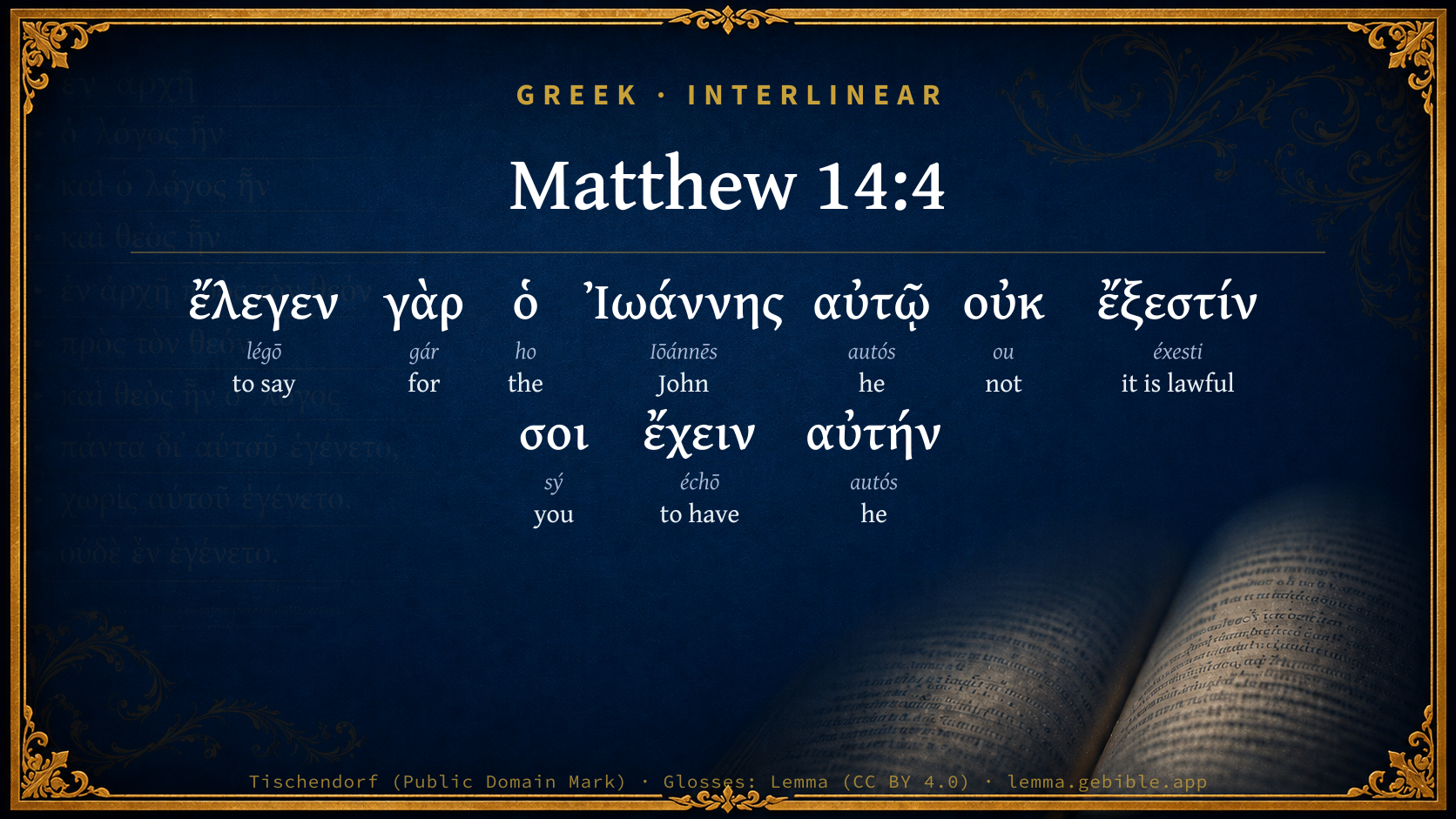
Greek (Tischendorf 8th ed.) Matthew 14:4 appears in the Greek New Testament. The text above is from the Tischendorf 8th edition. Each word links to its Strong’s number and a concise gloss. Click any word for its full Thayer’s Greek Lexicon entry.
Download image
Cite this verse

Matthew 14:4 (World English Bible). Public Domain. Lemma interlinear Bible study tool, https://lemma.gebible.app/v/matthew/14/4.

Show BibTeX & RIS
BibTeX
RIS
English Translation
For John said to him, "It is not lawful for you to have her."
World English Bible · Public Domain
Download a study sheet

One document with this verse’s original text, its word-by-word gloss line, the meaning frame, cross-references with their text, attributed commentary, and full source and license credits — printable, and it pastes into notes with its structure intact.

This verse Autodidact and up

Study sheet (.html) Plain text (.txt)

A passage Seminary Student

Up to 50 verses in one chapter. A passage sheet keeps up to 6 commentary sources and 12 cross-references per verse, in the order this page ranks them, and says so on the sheet whenever that leaves anything out. Ask for a single verse and you get the Autodidact verse sheet above.

Everything on this page stays free to read, with no account — the sheet is a download of what is already on screen, not access to it.

Want to remove ads? Support Godless Engineer
Compare translations 3

The same verse in 3 English versions, stacked beneath the original-language interlinear above. Click any original word for its lexicon entry.

Each is an independent rendering of the whole verse — the interlinear is not word-aligned to these translations.

Highlighted words mark where these versions differ — a whole-verse word diff, not a word-by-word alignment.

  • World English Bible Public Domain
    For John said to him, "It is not lawful for you to have her."
  • King James Version Public Domain
    For John said unto him, It is not lawful for thee to have her.
  • unfoldingWord Literal Text CC BY-SA 4.0
    For John was saying to him, “It is not lawful for you to have her.”

unfoldingWord Literal Text — © unfoldingWord, licensed CC BY-SA 4.0. Word-aligned USFM3 via Door43 (git.door43.org/unfoldingWord/en_ult).

Versions to compare (up to 4)

3 of 4 selected

Show all 19 translations

Every available English version of this verse, each an independent rendering of the whole verse.

  • World English Bible Public Domain
    For John said to him, "It is not lawful for you to have her."
  • Berean Standard Bible Public Domain
    because John had been telling him, “It is not lawful for you to have her.”
  • Majority Standard Bible Public Domain
    because John had been telling him, “It is not lawful for you to have her.”
  • King James Version Public Domain
    For John said unto him, It is not lawful for thee to have her.
  • American Standard Version (1901) Public Domain
    For John said unto him, It is not lawful for thee to have her.
  • Revised Version (1885) Public Domain
    For John said unto him, It is not lawful for thee to have her.
  • Geneva Bible (1599) Public Domain
    For Iohn saide vnto him, It is not lawfull for thee to haue her.
  • Douay-Rheims (1899) Public Domain
    For John said to him: It is not lawful for thee to have her.
  • Young's Literal Translation Public Domain
    for John was saying to him, `It is not lawful to thee to have her,'
  • Literal Standard Version CC BY-SA 4.0
    for John was saying to him, “It is not lawful to you to have her,”
  • Unlocked Literal Bible CC BY-SA 4.0
    For John had said to him, “It is not lawful for you to have her as your wife.”
  • unfoldingWord Literal Text CC BY-SA 4.0
    For John was saying to him, “It is not lawful for you to have her.”
  • Darby Bible Public Domain
    For John said to him, It is not lawful for thee to have her.
  • World Messianic Bible Public Domain
    For Yochanan said to him, “It is not lawful for you to have her.”
  • Webster's Bible Public Domain
    For John had said to him, It is not lawful for thee to have her.
  • Free Bible Version CC BY-SA 4.0
    For John had been telling him, “It's not legal for you to marry her.”
  • Bible in Basic English Public Domain
    Because John had said to him, It is not right for you to have her.
  • Text-Critical English NT CC BY 4.0
    For John had been saying to him, “It is not lawful for yoʋ to have her.”
  • Tyndale New Testament (1534) Public Domain
    For Ihon sayde vnto him: That is not lawfull for the to have her.

Literal Standard Version (2020), Covenant Press — licensed CC BY-SA 4.0. Text via the HelloAO Bible API (eBible.org). Unlocked Literal Bible (unfoldingWord) — licensed CC BY-SA 4.0. Text via the HelloAO Bible API (eBible.org). unfoldingWord Literal Text — © unfoldingWord, licensed CC BY-SA 4.0. Word-aligned USFM3 via Door43 (git.door43.org/unfoldingWord/en_ult). Free Bible Version, Dr. Jonathan Gallagher — licensed CC BY-SA 4.0. Text via the HelloAO Bible API (eBible.org).

Word by word

More ways to search: Search by grammar → Find every occurrence → Compare this word →

Practice this passage: Drill this verse → Learn its vocabulary →

About this verse

These counts appear in no published source. They are computed here, from the morphology-tagged text and Lemma’s own curated glosses. What Lemma adds →

10
words
9
distinct lemmas
Gospels
section

Shared distinctive vocabulary

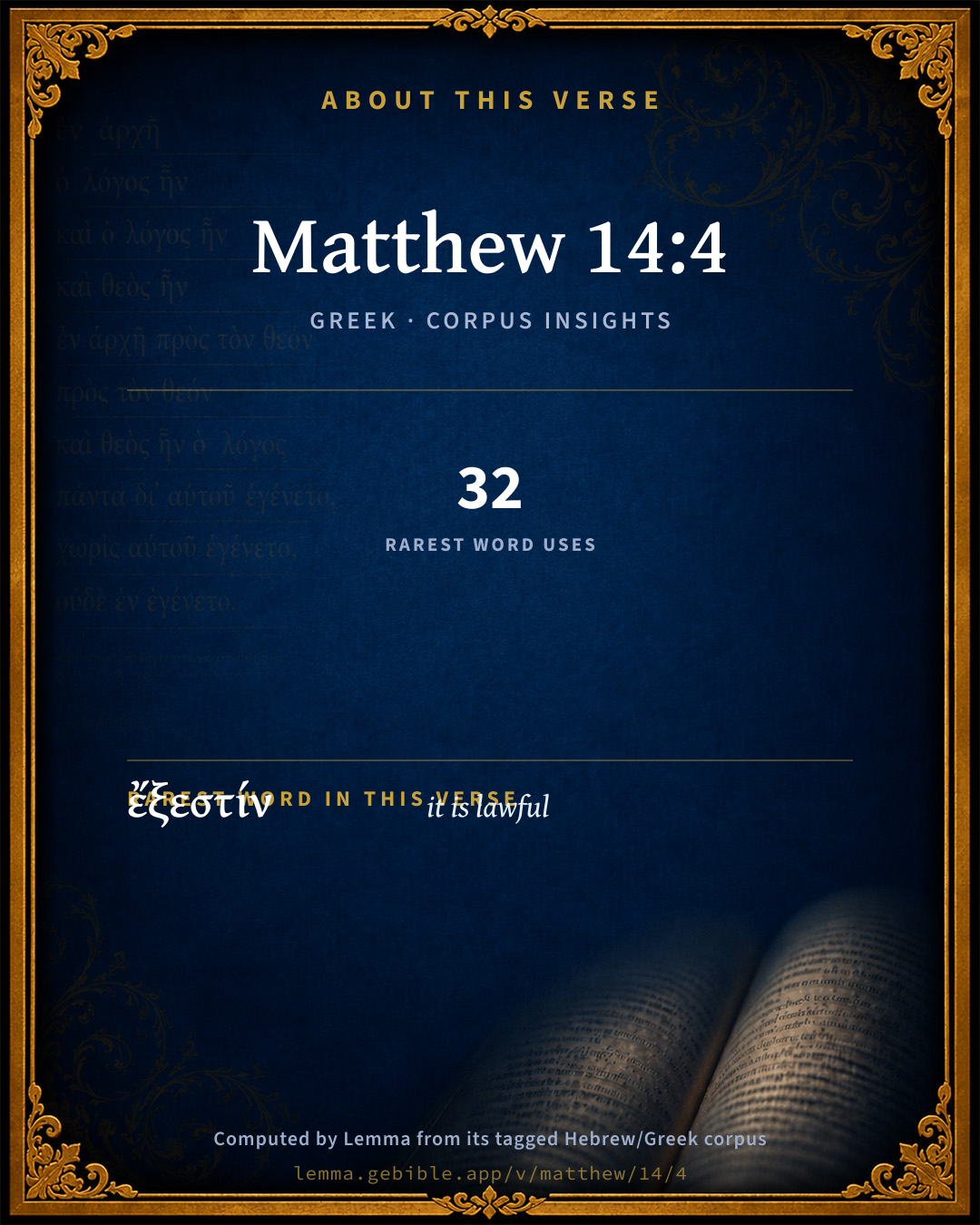
ἔξεστίν it is lawful G1832 occurs in 30 verses of the Greek New Testament. Also found in:

Repetition

A word recurs within this verse:

  • αὐτῷ he G846 ×2

Cross-references

10

Topical passages linked to Matthew 14:4 in the Treasury of Scripture Knowledge — connected by theme and wording, ordered by reader-vote popularity; previews shown in the World English Bible.

  • Leviticus 20:21 "'If a man takes his brother's wife, it is an impurity: he has uncovered his brother's nakedness; they shall be childless.
  • Leviticus 18:16 "'You shall not uncover the nakedness of your brother's wife: it is your brother's nakedness.
  • Mark 6:18 For John said to Herod, "It is not lawful for you to have your brother's wife."
  • Deuteronomy 25:5–6 If brothers dwell together, and one of them die, and have no son, the wife of the dead shall not be married outside to a stranger: her husband's brother shall go in to her, and take her to him as wife, and perform the duty of a husband's brother to her.
  • 2 Samuel 12:7 Nathan said to David, "You are the man. This is what Yahweh, the God of Israel, says: 'I anointed you king over Israel, and I delivered you out of the hand of Saul.
  • 1 Kings 21:19 You shall speak to him, saying, Thus says Yahweh, Have you killed and also taken possession? You shall speak to him, saying, Thus says Yahweh, In the place where dogs licked the blood of Naboth shall dogs lick your blood, even yours.
  • 2 Chronicles 26:18–19 and they withstood Uzziah the king, and said to him, It pertains not to you, Uzziah, to burn incense to Yahweh, but to the priests the sons of Aaron, who are consecrated to burn incense: go out of the sanctuary; for you have trespassed; neither shall it be for your honor from Yahweh God.
  • Proverbs 28:1 The wicked flee when no one pursues; But the righteous are as bold as a lion.
  • Isaiah 8:20 To the law and to the testimony! if they don't speak according to this word, surely there is no morning for them.
  • Acts 24:24–25 But after some days, Felix came with Drusilla, his wife, who was a Jewess, and sent for Paul, and heard him concerning the faith in Christ Jesus.

Cross-references courtesy of OpenBible.info (CC BY 4.0).

Commentary

Notes on Matthew 14:4 from classic Christian and Jewish commentators (each source and its license shown beneath its notes). The classic Christian expositions comment on the surrounding passage and are grouped to its opening verse, so a note may address several verses; the Jewish commentaries on the Tanakh (Rashi and others) are per-verse, so they appear only where the commentator wrote on this verse.

Lemma curates 59 commentaries, every one of them public domain or Creative Commons licensed, each selected and text-cleaned for this edition rather than reprinted as found. About our sources →

Tyndale Open Study Notes

Tyndale Open Resources

14:4 John had continually warned Herod of his sin (see Lev 18:6; 20:21).

Tyndale Open Study Notes — © Tyndale Open Resources, licensed CC BY-SA 4.0. Text via the HelloAO Bible API.

Bengel's Gnomon

Johann Albrecht Bengel

Mat 14:4. Οὐκ ἔξεστι, it is not lawful) John did not break the force of bitter truth by arguments of a too conciliatory nature; neither his words were soft, nor his dress. John did not come into Galilee, but yet he was able to reprove Herod.—σοὶ, to thee) Sins even of kings should be rebuked in the second person.—ἔχειν, to have) Theologians must not give up questions concerning marriage (see ch. Mat 19:3-4), since it is their duty to examine everything which is lawful or unlawful; cf. ch. Mat 22:17.

Bengel's Gnomon of the New Testament — English translation (T&T Clark, Edinburgh, 1860) — public domain. Text from a community e-Sword module.

Meyer's Critical & Exegetical Commentary

Heinrich August Wilhelm Meyer

Mat_14:4 f. Οὐκ ἔξεστι] Because Philip was still living, and had a daughter. Lev_18:16; Lev_20:21; Joseph. Antt. xviii. 5. 1, 2; Lightfoot on this passage. For ἔχειν γυναῖκα, as expressing matrimonial possession, see note on 1Co_5:1. It is probable that Herod only made Johns bold rebuke a pretext for putting him in prison; the real cause, according to Josephus, 18:5. 2 f., was fear lest he should be the means of creating an insurrection.

εἶχον] not: aestumabant (a common but ungrammatical rendering), but: they held him as a prophet, i.e. they stood to him as to a prophet. This is in conformity with classical usage, according to which ἔχω τινα, with a predicate, expresses the relation in which a person stands to some other person; for example, φίλους αὐτοὺς ἔχεις (Xen. Symp. iv. 49): thou standest related to them as to friends; Eur. Herc. fur. 1405: παῖδʼ ὅπως ἔχω σʼ ἐμόν, I stand to thee as to a child; Herodian, i. 13. 16; and see likewise the note on Luk_14:18; Phm_1:17. The appended ὡς means: not otherwise than as. Krüger, § 57. 3. 1 and 2; Kühner, II. 2, p. 995. Similarly also in Mat_21:26. Otherwise in Mar_11:32.

Meyer — Critical and Exegetical Commentary on the New Testament — English translation by Peter Christie, edited by Frederick Crombie (T&T Clark, 1880) — public domain. Text from a community e-Sword module.

Expositor's Greek Testament

ed. W. Robertson Nicoll

Mat 14:4 . ἔλεγε γὰρ ὁ Ι . The progressive imperfect, with force of a pluperfect. John had been saying just before he was apprehended (Burton, Moods and Tenses, § 29). οὐκ ἔξεστιν : doubly unlawful; as adultery, and as marriage within prohibited degrees (Lev 18:16 ; Lev 20:21 ).

The Expositor's Greek Testament, edited by W. Robertson Nicoll (1897–1910) — public domain. Text from a community e-Sword module.

Adam Clarke's Commentary

Verse 4. For John said unto him, It is not lawful for thee to have her.] Here is an instance of zeal, fidelity, and courage, highly worthy of imitation. Plainness, mildness, and modesty, are qualifications necessary to be observed when we reprove the great. The best service a subject can render his prince is to lay before him, in the plainest but most respectful manner, what the law of God requires of him, and what it forbids. How unutterable must the punishment of those be who are chaplains to princes, or great men, and who either flatter them in their vices, or wink at their sins!

Adam Clarke's Commentary on the Bible (1810–1826) — public domain. Text from a community e-Sword/MySword module.

Ellicott's Commentary for English Readers

(4) For John said unto him.—The Jewish historian (Ant. xviii. 5, § 2) states more generally that Antipas was afraid lest some popular outbreak should be the result of the preaching of the Baptist, working on the excitable peasantry of Galilee.

A Bible Commentary for English Readers, edited by Charles John Ellicott (1878–1897) — public domain. Text from a community e-Sword module.

The Cambridge Bible for Schools and Colleges

gen. ed. J. J. S. Perowne

4. It is not lawful for thee to have her] St Luke adds, Mar_3:19, that Herod was also reproved “for all the evil which he had done.” “Boldly to rebuke vice” is fixed upon as the leading characteristic of the Baptist in the collect for St John the Baptist’s day.

to have her] i. e. “to marry her,” a force which the word in the original bears, cp. 1Co_5:1.

The Cambridge Bible for Schools and Colleges (gen. ed. J. J. S. Perowne; Cambridge University Press, 1878–1918) — public domain. Text from a community e-Sword module.

John Gill's Exposition

For John said unto him,.... John having heard of this incestuous marriage, went to Herod, and reproved him to his face for it; and, as Luke says, "for all the evils he had done", Luk 3:19 for he was a very wicked man, and guilty of many flagitious crimes: John, in so doing, showed his zeal for holiness, his hatred of sin, his courage and faithfulness in reproving thus freely so great a man; and made it manifest, that he came in the spirit of Elijah: what he said to him was,

it is not lawful for thee to have her, being forbidden, Lev 18:16 for though by another law it was right to marry a brother's wife, after his decease, when he left no issue, yet this was not the case here; Philip was now living, and, had he been dead, such a marriage would have been unlawful, because there was issue; she had a daughter, who afterwards is said to dance before Herod; and besides, he himself had another wife, whom he put away; so that his sin was a very aggravated and complicated one: lying with a brother's wife, was one of those sins which, according to the Jewish (h) canons, deserved cutting off, or death by the hand of God. Josephus (i) gives another reason of the imprisonment and death of John, that Herod feared that the people of the Jews, through his means, would be moved to sedition, and revolt from his government; which might be what Herodias suggested to him, or what he gave out himself, to cover the true cause of his proceedings: but the true reason is, what is here given, and is to be confirmed by the testimony of Jewish writers. One of their chronologers (k) delivers the account in these express words:

"Herod Antipater was a very wicked and pernicious man, many of the wise men of Israel he slew with the sword; and he took to wife, his brother Philip's wife, whilst he was living; and because John the high priest (for so through mistake they call him) "reproved him for this"; (see Luk 3:19) he slew him with the sword, with many of the wise men of Israel.''

And, says their historian (l),

"also he, Herod, slew John, because he said unto him, it is forbidden thee to take the wife of Philip, and he slew him; this is that John that practised baptism.''

(h) Misn. Ceritot, c. 1. sect. 1. (i) Antiqu. lsss. 18. c. 6. (k) Ganz. Tzemach David, par. 1. fol. 25. 2. (l) Joseph. Gorionides, 1. 5. c. 45.

John Gill's Exposition of the Whole Bible (1746–1763) — public domain (CC PDM 1.0). Text via the HelloAO Bible API.

Trapp's Complete Commentary

John Trapp

4 For John said unto him, It is not lawful for thee to have her.

Ver. 4. For John had said unto him, It is not lawful] Others knew it to be so, but none dared tell him so but John. In like sort Elijah told Ahab that he had troubled israel (those times and these did very much suit; John was another Elias, Herod and Herodias answered to Ahab and Jezebel). So Latimer presented for a new year’s gift to King Henry VIII a New Testament, with a napkin, having this posy about it, Whoremongers and adulterers God will judge. He also wrote a letter to the king, after the proclamation for abolishing English books; where we may see and marvel at his great boldness and stoutness, who as being yet no bishop, so freely and plainly dared to so mighty a prince, in such a dangerous case, against the king’s proclamation, set out in such a terrible time, take upon him to write and to admonish that which no counsellor dared once speak unto him, in defence of Christ’s gospel. King Asa, though a godly prince, imprisoned the prophet for dealing plainly with him. Archbishop Grindal lost Queen Elizabeth’s favour, and was confined, for favouring prophecies, &c., as it was pretended; but in truth, for condemning an unlawful marriage of Julio an Italian physician with another man’s wife, while Leicester in vain opposed against his proceedings therein. (Camd. Elizab.) God’s truth must be told, however it be taken, and not be betrayed (as it is too often) by a cowardly silence.

It is not lawful for thee to have her] And yet the pope frequently dispenseth with such incestuous marriages, King Philip III of Spain, were he now alive, might call the Archduke Albert both brother, cousin, nephew, and son: for all this were he unto him, either by blood or affinity: being uncle to himself, first cousin to his father, husband to his sister, and father to his wife, and all by papal dispensation. Abhorred filth!

John Trapp, A Commentary or Exposition upon All the Books of the Old and New Testament (1647–1656) — public domain. Text from a community e-Sword module.

Matthew Poole's English Annotations

Mark telleth us, Mar 6:20, that Herod feared, that is, reverenced and respected, John, knowing that he was a just man and an holy, and observed him; and when he heard him, he did many things, and heard him gladly. John was very popular, and all men counted him as a prophet; so that probably Herod sent for him to the court, and heard him there. John seeing Herod live in adultery and incest, was not able to suffer such a sin upon him, but tells him he did that which was not lawful for him to do, for God’s law had forbidden such marriages. Mark addeth, that Herodias also had a quarrel against him, and would have killed him; but she could not, because of the respect which Herod had for him. But this wore off, for Matthew tells us... (see Mat 14:5)

Matthew Poole's English Annotations on the Holy Bible (1683–1685) — public domain. Text from a community e-Sword/MySword module.

Whedon's Commentary on the Bible

Daniel D. Whedon

4. It is not lawful — It is well when ministers dare rebuke the crimes of politicians and rulers. The doctrine that there is no higher law than wicked rulers are pleased to enact, is essential atheism.

And what adds to the force of John’s example in reproving the wickedness of rulers, is the fact that John, it seems, faced Herod Antipas himself with this rebuke. He “said unto him, It is not lawful for thee.” At what interview between the tyrant and the prophet this rebuke took place is not recorded. Very possibly Herod, knowing John’s great influence over the conscience of the people, had endeavoured by personal consultation to obtain the Baptist’s sanction of his adultery; or he may have heard of John’s inveighing against his profligacy, and have arrested him and brought the Baptist into his presence, where of course he would have found reproof not recanted, but reaffirmed.

Daniel D. Whedon (gen. ed.), Commentary on the Old and New Testaments (1874–1909) — public domain. Text from a community e-Sword module.

The Pulpit Commentary

For John said unto him, It is not lawful (ouk exestin , Mat_12:2) for thee to have her. Herod Philip being still alive. Bengel remarks, "Causas matrimoniales non possunt plane abdicare theologi." Was he thinking of Luther"s unfortunate advice to Philip of Hesse?

HOMILIES BY R. TUCK Ver. 4. John"s rugged faithfulness.

How John came into contact with Herod, or how he was called to administer such a public reproof, we are not informed. It is quite possible that, in the Divine inspiration, he had done somewhat as Elijah had done before him suddenly appeared at court, a strange weird figure before which the soldiers shrank back, marched straight into the presence of Herod, and with no preamble or apology, declared, "It is not lawful for thee to have her." It is, however, quite possible that Herod may have sent for him, hoping to get his conscience eased by securing the prophet"s approval of his act; and no doubt Herod had some fine excuses and explanations to offer. Men always have when they have resolved to satisfy their own fancies and vices. And at Eastern courts there are always people willing enough to flatter their king, and encourage him in his vices. John stands out in strong contrast with all such.

I A MAN WHO KNEW THE RIGHT. We are often confused because, though we may know the right, there are special circumstances in each particular case which disturb our judgment. We can see the abstract right, but it is difficult to see the right in just this case. It cannot be right that a man should have his brother"s wife. And yet advisers at court may make out that high policy makes that necessary in this case. Compare Cranmer helping Henry VIII to secure his shameless divorce. John the Baptist listened to no excuses of policy, which were but excuses of passion. He knew the right.

II A MAN WHO SPOKE OUT THE RIGHT HE KNEW. So often we "keep silence in the evil time." We think we can do no good by speaking out, and may only bring trouble on ourselves. The men who have influenced the generations are the men of strong convictions, who could not keep silence. John, on this occasion, might have been cautious; he might have spoken like a courtier, eased his message, spoken carefully, and taken care not to offend. His mission was to the conscience of the wicked king. There shall be no trimming in his message; it shall smite right home. It is bald, bare, strong, uncompromising. "It is not lawful for thee to have her." People are sometimes what they call "faithful," but they are only irritating and humiliating. True faithfulness is conscience rousing.

III A MAN WHO SUFFERED FOR THE RIGHT HE SPOKE. Not really at the hands of Herod. Really at the hands of Herodias, the unscrupulous woman who was the Jezebel to this Ahab. A man who fears the personal consequences of witnessing to the right, or doing the right, will never stand beside rugged, faithful John in the Divine approval. R.T.

The Pulpit Commentary (1880–1919), ed. H.D.M. Spence-Jones & Joseph S. Exell — public domain. Text from a community e-Sword module.

John Wesley's Explanatory Notes

It is not lawful for thee to have her - It was not lawful indeed for either of them to have her. For her father Aristobulus was their own brother. John's words were rough, like his raiment. He would not break the force of truth by using soft words, even to a king.

John Wesley, Explanatory Notes Upon the Whole Bible (1754–1765) — public domain. Text via the GEBible commentary corpus.

The People's New Testament

B. W. Johnson

4. It is not lawful for thee to have her. The marriage was unlawful for these three reasons: (1) The former husband of Herodias (Philip) was still living. (2) The former wife of Antipas was still living. (3) Besides, the Jewish law did not permit a man to marry his niece.

B. W. Johnson's The People's New Testament with Notes (1889–1891) — public domain. Electronic text from the Christian Classics Ethereal Library (CCEL) ThML edition.

Cambridge Greek Testament for Schools and Colleges

4. ἔλεγεν. Imperfect, ‘told him repeatedly.’

ἔχειν, ‘to marry’ her. ἔχειν has this special force, 1Co 5:1, τοιαύτη πορνεία … ὥστε γυναῖκά τινα τοῦ πατρὸς ἔχειν. ch. Mat 22:28, πάντες γὰρ ἔσχον αὐτήν. Xen. Cyrop. I, Κυαξάρης ἔπεμψε πρὸς Καμβύσην τὸν τὴν ἀδελφὴν ἔχοντα.

οὐκ ἔξεστίν σοι ἔχειν αὐτήν. St Luke adds, Luk 3:19, that Herod was also reproved ‘περὶ πάντων ὧν ἐποίησεν πονηρῶν.’ ‘Boldly to rebuke vice’ is fixed upon as the leading characteristic of the Baptist in the collect for St John the Baptist’s day.

Cambridge Greek Testament for Schools and Colleges (Cambridge University Press, 1896; 21 vols, various authors incl. Carr, Maclear, Plummer, Farrar, Lumby, Moule, M. R. James, Simcox) — public domain. Text from a community e-Sword module.

Alford’s Greek Testament

Henry Alford

4.] The marriage was unlawful for these three reasons: (1) The former husband of Herodias, Philip, was still living. This is expressly asserted by Josephus, Antt. xviii. 5. 4, Ἡρωδιάς, ἐπὶ συγχύσει φρονήσασα τῶν πατρίων, Ἡρώδῃ γαμεῖται τοῦ ἀνδρὸς τῷ ὁμοπατρίῳ ἀδελφῷ, διαστᾶσα ζῶντος. (A reply to the attempt made by some to interpret these last words, ‘having previously been divorced from him while living,’ is hardly needed, in the presence of the two unqualified synchronous participles, φρονήσασα and διαστᾶσα. Besides, the part. is not ἀποστᾶσα, as erroneously quoted by the Bp. of Exeter [Philpotts]: see his published speech of Feb. 25, 1851, note.) The same is surely implied by the whole narrative, and the word μετοικίσασθαι, Antt. xviii. 5. 1. (2) The former wife of Antipas was still living, and fled to her father Aretas on hearing of his intention to marry Herodias: Jos. ibid. (3) Antipas and Herodias were already related to one another within the forbidden degrees of consanguinity. For θυγάτηρ ἦν Ἀριστοβούλου, καὶ οὗτος ἀδελφὸς αὐτῶν (of Antipas and Philip), Jos. ib. See the Bp.’s note, and a reply to it in substance the same as the foregoing, in the Quarterly Journal of Sacred Lit. for Oct. 1852 and Jan. 1853. I may add that the remark of Josephus (Antt. xviii. 5. 4), that Salome’s birth had taken place previously to the infidelity of Herodias, is not given, as understood by the Bp. (after Tertullian, adv. Marcion. iv. 34, vol. ii. p. 443), as the technical reason why her conduct was ἐπὶ συγχύσει τῶν πατρίων, but as a moral aggravation of her unnatural crime. It was unlawful by Lev 18:16.

Henry Alford, The Greek Testament (1849–1861) — public domain. Text from a community e-Sword module.

International Critical Commentary

4. For John said to him, It is not lawful for thee to have her.]—αὐτῷ] Mk. has: τῷ Ἡρῴδῃ. Mt. as often omits Mk.’s ὅτι.—αὐτήν] Mk. has: τὴν γυναῖκα τοῦ ἀδελφοῦ σου. For Mt.’s avoidance of Mk.’s iteration of a phrase, see on 4:18, and Introduction, p. xxiv.

(M)

International Critical Commentary — older volumes (1896–1929), various authors — public domain. Text from a community e-Sword module.

Lesson kit

Teaching starters — assembled from the data on this page, not authored interpretation. Every prompt links to the verse data it draws on. Edit before teaching.

Matthew, in the Gospels, opens this verse with 10 words (9 distinct Greek lemmas). Its most distinctive word is éxesti (“it is lawful”). A historical commentator’s framing appears above. Read the whole chapter for the surrounding context.

Discussion questions

  1. The word éxesti carries the sense “it is lawful.” How does it shape the verse?
  2. How does Matthew 12:2, which shares the word «it is lawful», read alongside this verse?
  3. What does the repetition of “he” (2× in this one verse) do in this verse?
  4. These translations render this verse differently. What is at stake in choosing one wording over another?
  5. Compare how Tyndale Open Study Notes and Bengel's Gnomon read this verse. Where do they agree or differ?

Things to notice

  • These translations choose different wording for 3 words in this verse.
  • “he” occurs 2× in this single verse.
  • 9 distinct Greek lemmas span 10 words in this verse.

Reading settings

Reading text

Shown beneath each verse's original-language words.

Old Testament
Old Testament edition

Read the OT as the Masoretic Hebrew (MT) or the Greek Septuagint (LXX).

English shown for the Greek Septuagint (in the Hebrew ↔ Greek comparison).

Comparing translations? Open the Compare panel on any verse page to stack up to four side by side.