
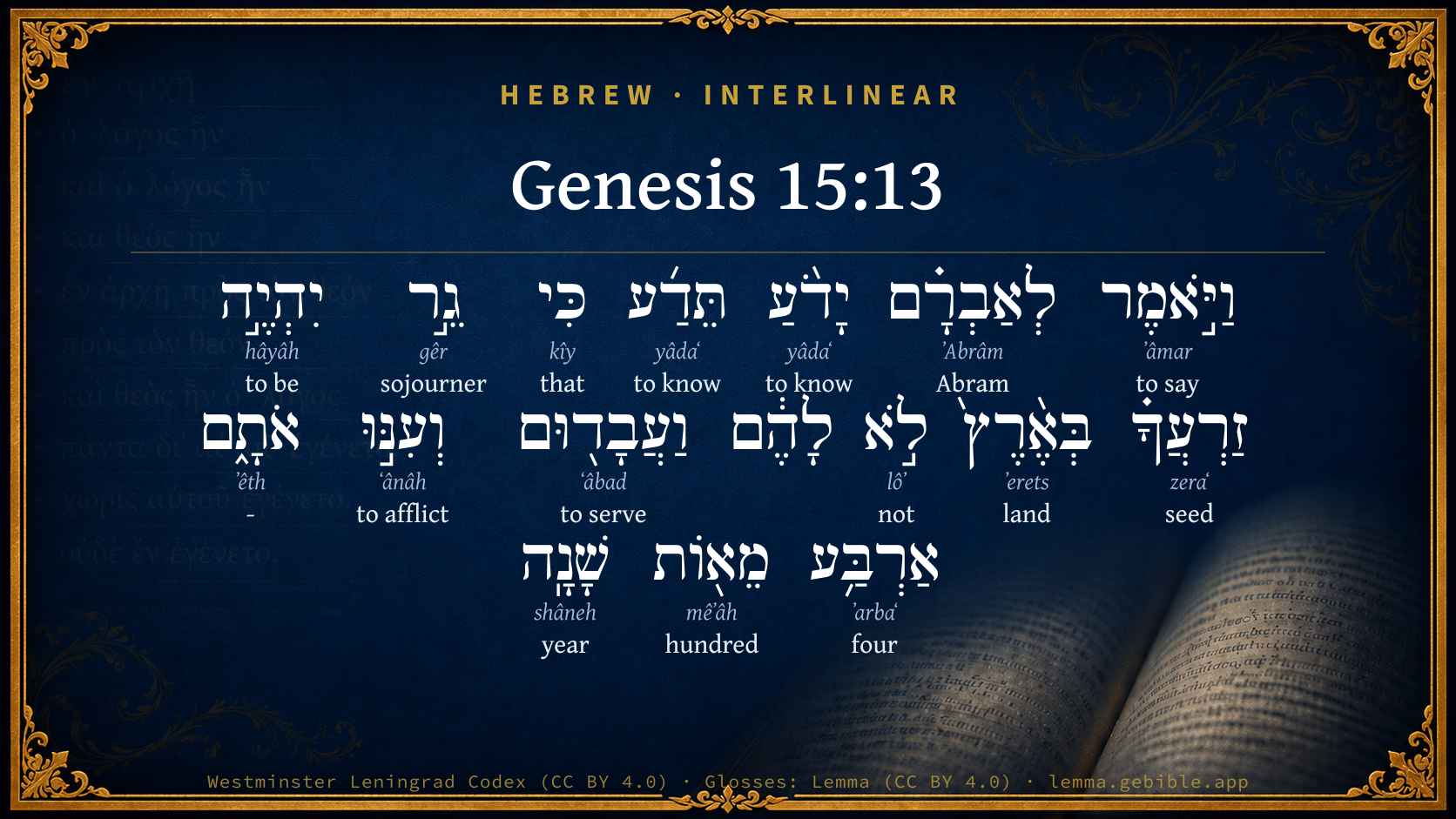
Genesis 15:13

Hebrew (Westminster Leningrad Codex) Genesis 15:13 appears in the Hebrew Old Testament. The text above is from the Westminster Leningrad Codex. Each word links to its Strong’s number, a concise gloss, and parsing drawn from the Open Scriptures Hebrew Bible morphology. Click any word for its full Brown-Driver-Briggs (BDB) entry.
Download image
Cite this verse

Genesis 15:13 (World English Bible). Public Domain. Lemma interlinear Bible study tool, https://lemma.gebible.app/v/genesis/15/13.

Show BibTeX & RIS
BibTeX
RIS
English Translation
He said to Abram, "Know for sure that your seed will live as foreigners in a land that is not theirs, and will serve them. They will afflict them four hundred years.
World English Bible · Public Domain
Highlights
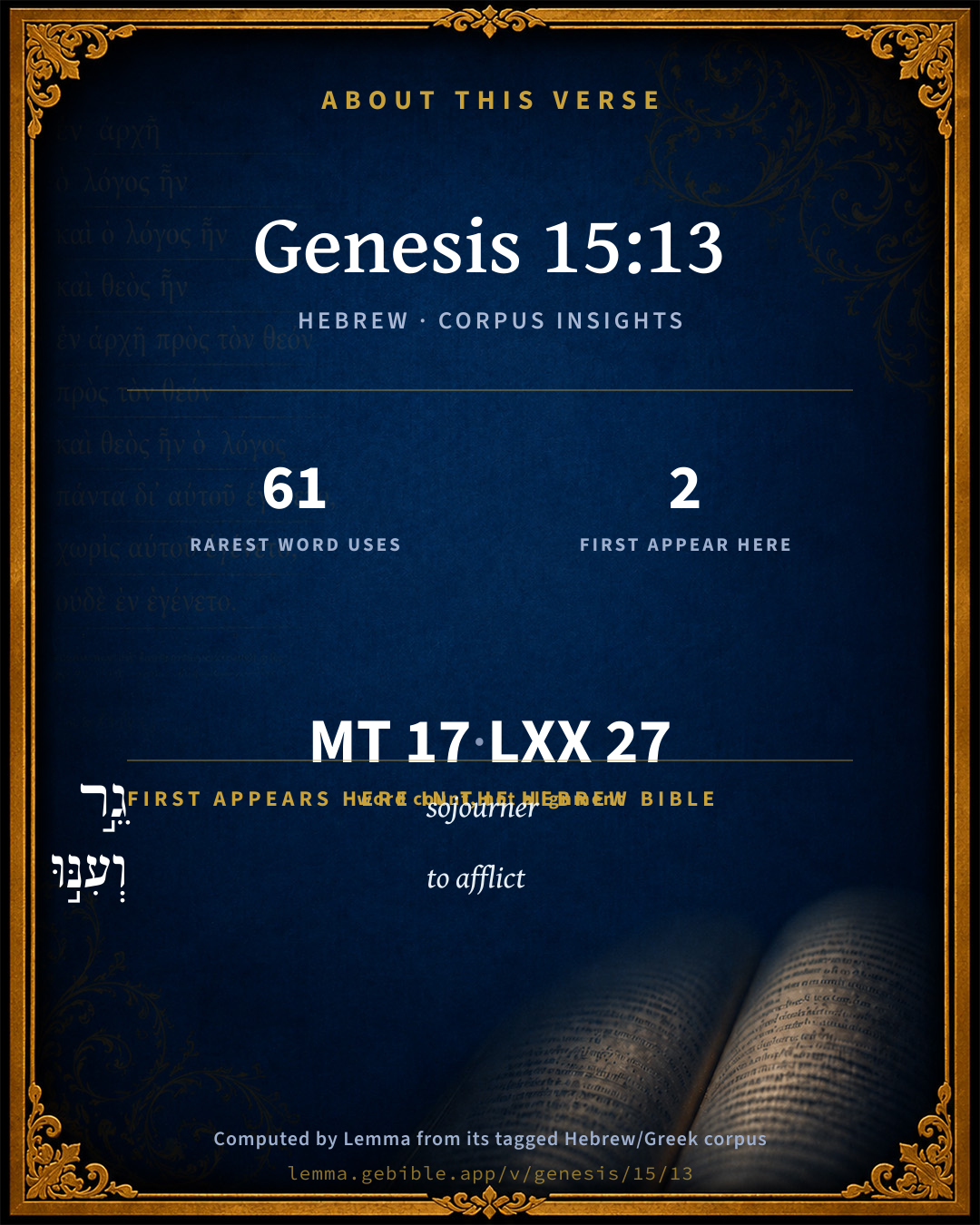
  • 2 first appearances in the Hebrew Bible
Full analysis ↓
Download a study sheet

One document with this verse’s original text, its word-by-word gloss line, the meaning frame, cross-references with their text, attributed commentary, and full source and license credits — printable, and it pastes into notes with its structure intact.

This verse Autodidact and up

Study sheet (.html) Plain text (.txt)

A passage Seminary Student

Up to 50 verses in one chapter. A passage sheet keeps up to 6 commentary sources and 12 cross-references per verse, in the order this page ranks them, and says so on the sheet whenever that leaves anything out. Ask for a single verse and you get the Autodidact verse sheet above.

Everything on this page stays free to read, with no account — the sheet is a download of what is already on screen, not access to it.

Want to remove ads? Support Godless Engineer
Compare translations 3

The same verse in 3 English versions, stacked beneath the original-language interlinear above. Click any original word for its lexicon entry.

Each is an independent rendering of the whole verse — the interlinear is not word-aligned to these translations.

Highlighted words mark where these versions differ — a whole-verse word diff, not a word-by-word alignment.

  • World English Bible Public Domain
    He said to Abram, "Know for sure that your seed will live as foreigners in a land that is not theirs, and will serve them. They will afflict them four hundred years.
  • King James Version Public Domain
    And he said unto Abram, Know of a surety that thy seed shall be a stranger in a land that is not theirs, and shall serve them; and they shall afflict them four hundred years;
  • unfoldingWord Literal Text CC BY-SA 4.0
    Then he said to Abram, “Know for certain that your offspring will be strangers in a land not to them, and they will serve them, and they will afflict them 400 years.

unfoldingWord Literal Text — © unfoldingWord, licensed CC BY-SA 4.0. Word-aligned USFM3 via Door43 (git.door43.org/unfoldingWord/en_ult).

Versions to compare (up to 4)

3 of 4 selected

Show all 18 translations

Every available English version of this verse, each an independent rendering of the whole verse.

  • World English Bible Public Domain
    He said to Abram, "Know for sure that your seed will live as foreigners in a land that is not theirs, and will serve them. They will afflict them four hundred years.
  • Berean Standard Bible Public Domain
    Then the LORD said to Abram, “Know for certain that your descendants will be strangers in a land that is not their own, and they will be enslaved and mistreated four hundred years.
  • Majority Standard Bible Public Domain
    Then the LORD said to Abram, “Know for certain that your descendants will be strangers in a land that is not their own, and they will be enslaved and mistreated four hundred years.
  • King James Version Public Domain
    And he said unto Abram, Know of a surety that thy seed shall be a stranger in a land that is not theirs, and shall serve them; and they shall afflict them four hundred years;
  • American Standard Version (1901) Public Domain
    And he said unto Abram, Know of a surety that thy seed shall be sojourners in a land that is not theirs, and shall serve them; and they shall afflict them four hundred years;
  • Revised Version (1885) Public Domain
    And he said unto Abram, Know of a surety that thy seed shall be a stranger in a land that is not theirs, and shall serve them; and they shall afflict them four hundred years;
  • Geneva Bible (1599) Public Domain
    Then he saide to Abram, Knowe for a suretie, that thy seede shalbe a stranger in a land, that is not theirs, foure hundreth yeeres, and shall serue them: and they shall intreate them euill.
  • Douay-Rheims (1899) Public Domain
    And it was said unto him: Know thou beforehand that thy seed shall be a stranger in a land not their own, and they shall bring them under bondage, and afflict them four hundred years.
  • Young's Literal Translation Public Domain
    and He saith to Abram, `knowing -- know that thy seed is a sojourner in a land not theirs, and they have served them, and they have afflicted them four hundred years,
  • Literal Standard Version CC BY-SA 4.0
    and He says to Abram, “knowing—know that your seed is a sojourner in a land not theirs, and they have served them, and they have afflicted them four hundred years,
  • Unlocked Literal Bible CC BY-SA 4.0
    Then Yahweh said to Abram, “Know for certain that your descendants will be strangers in a land that is not theirs, and will be enslaved and oppressed for four hundred years.
  • unfoldingWord Literal Text CC BY-SA 4.0
    Then he said to Abram, “Know for certain that your offspring will be strangers in a land not to them, and they will serve them, and they will afflict them 400 years.
  • Darby Bible Public Domain
    And he said to Abram, Know assuredly that thy seed will be a sojourner in a land [that is] not theirs, and they shall serve them; and they shall afflict them four hundred years.
  • World Messianic Bible Public Domain
    He said to Abram, “Know for sure that your offspring will live as foreigners in a land that is not theirs, and will serve them. They will afflict them four hundred years.
  • Webster's Bible Public Domain
    And he said to Abram, Know certainly that thy seed shall be a stranger in a land that is not theirs, and shall serve them; and they shall afflict them four hundred years;
  • Free Bible Version CC BY-SA 4.0
    The Lord explained to Abram, “You can be absolutely sure that your descendants will be strangers in a foreign land, where they will be slaves and mistreated for 400 years.
  • Bible in Basic English Public Domain
    And he said to Abram, Truly, your seed will be living in a land which is not theirs, as servants to a people who will be cruel to them for four hundred years;
  • JPS Tanakh (1917) Public Domain
    And He said unto Abram: 'Know of a surety that thy seed shall be a stranger in a land that is not theirs, and shall serve them; and they shall afflict them four hundred years;

Literal Standard Version (2020), Covenant Press — licensed CC BY-SA 4.0. Text via the HelloAO Bible API (eBible.org). Unlocked Literal Bible (unfoldingWord) — licensed CC BY-SA 4.0. Text via the HelloAO Bible API (eBible.org). unfoldingWord Literal Text — © unfoldingWord, licensed CC BY-SA 4.0. Word-aligned USFM3 via Door43 (git.door43.org/unfoldingWord/en_ult). Free Bible Version, Dr. Jonathan Gallagher — licensed CC BY-SA 4.0. Text via the HelloAO Bible API (eBible.org).

Word by word

More ways to search: Search by grammar → Find every occurrence → Compare this word →

Practice this passage: Drill this verse → Learn its vocabulary →

לְאַבְרָ֗ם
ʼAbrâm
H87
“to/for · Abram”
Preposition + Noun, Proper
Part of Speech
Preposition + Noun
Type
Proper
Full BDB Definition

Origin: contracted from H48

TWOT: None

Abram = "exalted father" - original name of Abraham
  1. וַיֹּ֣אמֶר ʼâmar H559 “and · to say” Conjunction + Verb, Qal, Sequential Imperfect, 3rd Person, Masculine, Singular
  2. יָדֹ֨עַ yâdaʻ H3045 “to know” Verb, Qal, Infinitive Absolute
  3. תֵּדַ֜ע yâdaʻ H3045 “to know” Verb, Qal, Imperfect, 2nd Person, Masculine, Singular
  4. כִּי kîy H3588 “that” Conjunction
  5. גֵ֣ר gêr H1616 “sojourner” Noun, Common, Masculine, Singular, Absolute
  6. יִהְיֶ֣ה hâyâh H1961 “to be” Verb, Qal, Imperfect, 3rd Person, Masculine, Singular
  7. זַרְעֲךָ֗ zeraʻ H2233 “seed · your” Noun, Common, Masculine, Singular, Construct + Suffix, Personal, 2nd Person, Masculine, Singular
  8. בְּאֶ֨רֶץ֙ ʼerets H776 “in/at · land” Preposition + Noun, Common, Both, Singular, Absolute
  9. לֹ֣א lôʼ H3808 “not” Particle, Negative
  10. וַעֲבָד֖וּם ʻâbad H5647 “and · to serve · them” Conjunction + Verb, Qal, Perfect, 3rd Person, Common, Plural + Suffix, Personal, 3rd Person, Masculine, Plural
  11. וְעִנּ֣וּ ʻânâh H6031 “and · to afflict” Conjunction + Verb, Piel, Perfect, 3rd Person, Common, Plural
  12. אֹתָ֑ם ʼêth H853 “- · them” Particle, Direct Object + Suffix, Personal, 3rd Person, Masculine, Plural
  13. אַרְבַּ֥ע ʼarbaʻ H702 “four” Adjective, Cardinal number, Feminine, Singular, Absolute
  14. מֵא֖וֹת mêʼâh H3967 “hundred” Adjective, Cardinal number, Both, Plural, Absolute
  15. שָׁנָֽה shâneh H8141 “year” Noun, Common, Feminine, Singular, Absolute

About this verse

These counts appear in no published source. They are computed here, from the morphology-tagged text and Lemma’s own curated glosses. What Lemma adds →

17
words
15
distinct lemmas
Pentateuch
section

First appearance in Scripture

These words make their first canonical appearance in the Hebrew Bible here:

  • גֵ֣ר sojourner H1616
  • וְעִנּ֣וּ to afflict H6031

Grammatical profile

  • 6 verbs
  • 5 nouns
  • 2 adjectives
  • 1 preposition
  • 1 conjunction
  • 2 particles

Verb forms

  • וַיֹּ֣אמֶר Qal · Sequential Imperfect
  • יָדֹ֨עַ Qal · Infinitive Absolute
  • תֵּדַ֜ע Qal · Imperfect
  • יִהְיֶ֣ה Qal · Imperfect
  • וַעֲבָד֖וּם Qal · Perfect
  • וְעִנּ֣וּ Piel · Perfect

Repetition

A word recurs within this verse — often emphatic in Hebrew:

  • יָדֹ֨עַ to know H3045 ×2

Hebrew & Septuagint length

In English translation the verse runs 32 words from the Hebrew and 37 from the Septuagint (LXX English) — closely comparable.

A rough comparison of the two English renderings, which tokenize alike — not a word-level alignment.

Word counts can differ between the Hebrew and the Greek without any difference in meaning — e.g. the Hebrew direct-object marker אֵת has no separate Greek word, and Greek often adds the article ὁ.

In the original languages it is 17 Hebrew tokens and 27 Greek tokens — but the two are counted differently (Hebrew bundles its prefixes and suffixes into one token; the Greek is in lemma form), so that isn’t a like-for-like length.

Cross-references

10

Topical passages linked to Genesis 15:13 in the Treasury of Scripture Knowledge — connected by theme and wording, ordered by reader-vote popularity; previews shown in the World English Bible.

  • Acts 7:6–7 God spoke in this way: that his seed would live as aliens in a strange land, and that they would be enslaved and mistreated for four hundred years.
  • Exodus 1:11 Therefore they set taskmasters over them to afflict them with their burdens. They built storage cities for Pharaoh: Pithom and Raamses.
  • Exodus 12:40–41 Now the time that the children of Israel lived in Egypt was four hundred thirty years.
  • Acts 7:17 "But as the time of the promise came close which God had sworn to Abraham, the people grew and multiplied in Egypt,
  • Exodus 1:1–2 Now these are the names of the sons of Israel, who came into Egypt (every man and his household came with Jacob):
  • Galatians 3:17 Now I say this. A covenant confirmed beforehand by God in Christ, the law, which came four hundred thirty years after, does not annul, so as to make the promise of no effect.
  • Leviticus 19:34 The stranger who lives as a foreigner with you shall be to you as the native-born among you, and you shall love him as yourself; for you lived as foreigners in the land of Egypt. I am Yahweh your God.
  • Genesis 17:8 I will give to you, and to your seed after you, the land where you are traveling, all the land of Canaan, for an everlasting possession. I will be their God."
  • Exodus 23:9 "You shall not oppress an alien, for you know the heart of an alien, seeing you were aliens in the land of Egypt.
  • Psalms 105:11–12 Saying, "To you I will give the land of Canaan, The lot of your inheritance;"

Cross-references courtesy of OpenBible.info (CC BY 4.0).

Hebrew and Greek witnesses Masoretic Hebrew ↔ Greek Septuagint

The same verse in the two great witnesses to the Old Testament, shown verse-for-verse.

These are two independent witnesses, not word-aligned to each other, and the Septuagint is shown in lemma (dictionary) form.

Hebrew Genesis 15:13 Masoretic · Westminster Leningrad Codex

וַיֹּ֣אמֶר לְאַבְרָ֗ם יָדֹ֨עַ תֵּדַ֜ע כִּי גֵ֣ר יִהְיֶ֣ה זַרְעֲךָ֗ בְּאֶ֨רֶץ֙ לֹ֣א לָהֶ֔ם וַעֲבָד֖וּם וְעִנּ֣וּ אֹתָ֑ם אַרְבַּ֥ע מֵא֖וֹת שָׁנָֽה

He said to Abram, "Know for sure that your seed will live as foreigners in a land that is not theirs, and will serve them. They will afflict them four hundred years.

World English Bible · Public Domain

Greek LXX Genesis 15:13 Septuagint · lemma form

καί εἴρω πρός αβραμ γιγνώσκω γιγνώσκω ὅτι πάροικος εἰμί ὁ σπέρμα σύ ἐν γῆ οὐ ἴδιος καί δουλόω αὐτός καί κακόω αὐτός καί ταπεινόω αὐτός τετρακόσιοι ἔτος

And it was said to Abram, You shall surely know that your seed shall be a sojourner in a land not their own, and they shall enslave them, and afflict them, and humble them four hundred years.

LXX2012 (modern English Septuagint) · Public Domain

On this verse, The Cambridge Bible for Schools and Colleges discusses the Septuagint’s reading. Read the note in Commentary ↓

Hebrew: Westminster Leningrad Codex (CC BY 4.0). Greek: Septuagint (public domain); English from LXX2012 (modern English Septuagint) (Public Domain). How the Septuagint differs from the Hebrew →

Targum (Aramaic paraphrase)

2

The Targum is the ancient Jewish Aramaic paraphrase of the Hebrew Scriptures — an interpretive translation, not the Hebrew text itself. Onkelos (literal) and Pseudo-Jonathan (expansive) render the Torah, and Jonathan the Prophets. Coverage is partial: where no permissively-licensed English translation exists for a verse, only the Aramaic is shown. This is verse-level text, not a word-by-word alignment to the Hebrew.

  1. Targum Onkelos Torah (Genesis–Deuteronomy)
    וַאֲמַר לְאַבְרָם מִדַע תִּדַע אֲרֵי דַיָרִין יְהוֹן בְּנָיךְ בְּאַרְעָא דְלָא דִילְהוֹן וְיִפְלְחוּן בְּהוֹן וִיעַנוּן יָתְהוֹן אַרְבַּע מְאָה שְׁנִין

    (no public-domain English translation for this verse)

    Targum Onkelos — Aramaic: “Onkelos Genesis” (public domain); “Onkelos Exodus” (public domain); “Onkelos Leviticus” (public domain); “Onkelos Numbers” (public domain); “Onkelos Deuteronomy” (public domain). English: “Sefaria Community Translation” (CC0 1.0 (public-domain dedication)); “J.W. Etheridge. The Targums of Onkelos and Jonathan Ben Uzziel on the Pentateuch. London: Longmans, Green, 1862” (public domain). Text via Sefaria.

  2. Targum Pseudo-Jonathan Torah (Genesis–Deuteronomy)
    וַאֲמַר לְאַבְרָם מִנְדַע תִּנְדַע אֲרוּם דַיְירִין יְהוֹן בְּנָךְ בְּאַרְעָא דְלָא דִלְהוֹן חֲלַף דְלָא הֵימְנַת וִישַׁעֲבְּדוּן בְּהוֹן וִיסַגְפוּן יַתְהוֹן אַרְבַּע מְאָה שְׁנִין

    And he said to Abram, Knowing, thou must know, that thy sons shall dwell in a land not their own, because thou hast not believed, and they will subjugate and afflict them four hundred years;

    Targum Pseudo-Jonathan — Aramaic: “Targum Jonathan on Genesis” (public domain); “Targum Jonathan on Exodus” (public domain); “Targum Jonathan on Leviticus” (public domain); “Targum Jonathan on Numbers” (public domain); “Targum Jonathan on Deuteronomy” (public domain). English: “The Targum of Jonathan ben Uzziel, trans. J. W. Etheridge, London, 1862” (public domain). Text via Sefaria.

Commentary

Notes on Genesis 15:13 from classic Christian and Jewish commentators (each source and its license shown beneath its notes). The classic Christian expositions comment on the surrounding passage and are grouped to its opening verse, so a note may address several verses; the Jewish commentaries on the Tanakh (Rashi and others) are per-verse, so they appear only where the commentator wrote on this verse.

Lemma curates 59 commentaries, every one of them public domain or Creative Commons licensed, each selected and text-cleaned for this edition rather than reprinted as found. About our sources →

Trapp's Complete Commentary

John Trapp

Gen 15:13 And he said unto Abram, Know of a surety that thy seed shall be a stranger in a land [that is] not theirs, and shall serve them; and they shall afflict them four hundred years;

Ver. 13. Know of a surety, that thy seed.] Must first suffer, before they can enter; and so be conformed to Christ their Captain, who was "perfected by sufferings," {Heb 2:10} and came not to the Crown but by the Cross. Difficile est ut praesentibus bonis quis fruatur et futuris; ut hic ventrem, illic mentem reficiat, ut de deliciis ad delicias transeat; ut in coelo et in terra gloriosus appareat , saith St Jerome. Through many tribulations we must enter into heaven. He that will go any other way, let him (as the emperor said to the heretic) erect a ladder, and go up alone {a}

{a} Erigito tibi scalam, et solus ascendito. - Const. Mag.

John Trapp, A Commentary or Exposition upon All the Books of the Old and New Testament (1647–1656) — public domain. Text from a community e-Sword module.

Joseph Benson's Commentary

Gen 15:13. Thy seed shall be strangers — So they were in Canaan first, Psa 105:12, and afterward in Egypt: before they were lords of their own land, they were strangers in a strange land. The inconveniences of an unsettled state make a happy settlement the more welcome. Thus the heirs of heaven are first strangers on earth. And they shall serve them — So they did the Egyptians, Exo 1:13. See how that which was the doom of the Canaanites, Gen 9:25, proves the distress of Abram’s seed: they are made to serve; but with this difference, the Canaanites serve under a curse, the Hebrews under a blessing. And they shall afflict them — See Exo 1:11. Those that are blessed and beloved of God are often afflicted by wicked men. This persecution began with mocking, when Ishmael, the son of an Egyptian, persecuted Isaac, (Gen 21:9,) and it came at last to murder, the basest of murders, that of their new-born children; so that, more or less, it continued four hundred years.

Joseph Benson's Commentary on the Old and New Testaments (1811–1818) — public domain. Text from a community e-Sword module.

Tyndale Open Study Notes

Tyndale Open Resources

15:13-16 Not even 400 years of bondage could interfere with God’s plan to fulfill the covenant.

15:13 oppressed: The same word is used in Exod 1:11-12. Egypt, like predatory birds (Gen 15:11), would try to destroy Israel and hinder the covenant’s fulfillment. • Apparently 400 years is a round number (also Acts 7:6; cp. Exod 12:40; Gal 3:17). Using the chronology in the Hebrew text, the family moved to Egypt around 1876 BC, and the Exodus occurred around 1446 BC (though many scholars date the Exodus later, around 1270 BC; see Exodus Book Introduction, “The Date of the Exodus”).

Tyndale Open Study Notes — © Tyndale Open Resources, licensed CC BY-SA 4.0. Text via the HelloAO Bible API.

Geneva Bible (1599)

Geneva Bible translators

Counting from the birth of Isaac to their departure out of Egypt: Which declareth that God will suffer his to be afflicted in this world.

Geneva Bible (1599) marginal notes — public domain. Text via Bolls.life.

Adam Clarke's Commentary

Verse 13. Four hundred years] "Which began," says Mr. Ainsworth, "when Ishmael, son of Hagar, mocked and persecuted Isaac, Ge 21:9; Ga 4:29; which fell out thirty years after the promise, Ge 12:3; which promise was four hundred and thirty years before the law, Ga 3:17; and four hundred and thirty years after that promise came Israel out of Egypt, Ex 12:41."

Adam Clarke's Commentary on the Bible (1810–1826) — public domain. Text from a community e-Sword/MySword module.

Ellicott's Commentary for English Readers

(13) Four hundred years.—The exact duration of the sojourn in Egypt was 430 years (Exo_12:40-41), and with this agrees the genealogy of Jehoshua (1Ch_7:23-27).

A Bible Commentary for English Readers, edited by Charles John Ellicott (1878–1897) — public domain. Text from a community e-Sword module.

The Cambridge Bible for Schools and Colleges

gen. ed. J. J. S. Perowne

13. a stranger] The word used (gêr) (LXX πάροικος) means more than a “sojourner” (cf. Gen_23:4, Exo_2:22).

A stranger (gêr) is properly a guest residing in another country, whose rights are in a sense protected. He may be merely a temporary sojourner (tôshâb). But as a “stranger” (gêr) he has a recognized status in the community. As a “sojourner” (tôshâb), he has none; he is a mere social “bird of passage.” The difference is that between a “resident foreigner” and “a foreign visitor.”

and shall serve them; and they shall afflict them] The personal pronouns in English are ambiguous. There is a change of subject. Israel shall be slaves to the people of a land that is not theirs, i.e. to the Egyptians; and the Egyptians shall afflict them. The LXX δουλώσουσιν, “they, i.e. the Egyptians, shall make bondmen of them, i.e. the Israelites,” gives a different turn to the first clause, and avoids the interchange of subject and object: cf. the quotation in Act_7:6.

four hundred years] See note on Gen_15:16. The figure agrees in round numbers with the number of 430 years assigned, in Exo_12:40, to the sojourning of Israel in Egypt. Cf. Act_7:6; Gal_3:17.

The Cambridge Bible for Schools and Colleges (gen. ed. J. J. S. Perowne; Cambridge University Press, 1878–1918) — public domain. Text from a community e-Sword module.

John Gill's Exposition

And also that nation whom they shall serve will I judge,.... It is not said "the land" in which they were strangers, though God did judge, condemn, and punish the inhabitants of the land of Canaan, and drove them out of it, to make way for Israel; but the "nation" they should "serve", meaning the Egyptians, to whom they became servants, and were very hardly and severely used by them; those the Lord threatens to enter into judgment with, and take vengeance upon them, as he did by inflicting the ten plagues on them, which brought them at last to be willing to let Israel go:

and afterward shall they come out with great substance; as they did after the four hundred years were ended, and after the Egyptian nation was judged and punished; then they came out of Egypt, with much gold, silver, jewels, and raiment, which they borrowed of the Egyptians, who were spoiled by them, though very justly; this being but a payment of them for the hard and long service with which they had served them; see the exact fulfilment of prophecy, Exo 11:2.

John Gill's Exposition of the Whole Bible (1746–1763) — public domain (CC PDM 1.0). Text via the HelloAO Bible API.

Haydock's Catholic Bible Commentary

Strangers, and under bondage, &c. This prediction may be dated from the persecution of Isaac by Ismael, in the year 2112, till the Jews left Egypt, 2513. In Exodus xii., and St. Paul, 430 years are mentioned; but they probably began when Abram went first into Egypt, 2084. Nicholas Abram and Tournemine say, the Hebrews remained in Egypt full 430 years. from the captivity of Joseph; and reject the addition of the Septuagint which adds, "they and their fathers dwelt in Egypt, and in Chanaan." On these points, we may expect to find chronologists at variance.

George Leo Haydock (1774–1849), Haydock's Catholic Family Bible and Commentary, 1859 edition — public domain. Excludes Psalms (Douay-Rheims chapter numbering differs from Protestant) and Deuterocanonical books (Catholic canon only).

Matthew Poole's English Annotations

In a land that is not theirs, i.e. in Canaan and Egypt; for though Canaan was theirs by promise, to be fulfilled in after-times, yet it was not theirs by actual donation and possession; but they were strangers in it, Gen 17:8; Psa 105:11-12.

Four hundred years, exactly four hundred and five years; but a small sum is commonly neglected in a great number, both in sacred and profane writers. There were four hundred and thirty years between the first promise, or between the renewing and confirming of the promise by the gift of Isaac, and Israel's going out of Egypt, or God's giving of the law, Exo 12:40; Gal 3:17; but part of this time Abraham with his son Isaac lived in much honour and comfort; but after Isaac grew up, the affliction here mentioned began with Isaac in Canaan, and continued to him and his posterity in Egypt till this time was expired.

Matthew Poole's English Annotations on the Holy Bible (1683–1685) — public domain. Text from a community e-Sword/MySword module.

Whedon's Commentary on the Bible

Daniel D. Whedon

13. Thy seed shall be a stranger — The Egyptian bondage is here foretold. That oppressive, but important, period in the history of the chosen seed, and its duration, is stated in round numbers as four hundred years. In Exo_12:40, it is said that “the sojourning of the children of Israel, who dwelt in Egypt, was four hundred and thirty years.” There we have the exact statement of history; here the more general one of prophecy. For the question of chronology here involved, see note on Exo_12:40.

Daniel D. Whedon (gen. ed.), Commentary on the Old and New Testaments (1874–1909) — public domain. Text from a community e-Sword module.

The Pulpit Commentary

And he said unto Abram, Know of a surety literally, knowing know (cf. Gen_2:17; vide Ewald"s "Hebrew Syntax," that thy seed shall be a stranger in a land which is not there (literally, not to them, viz., Egypt, or Egypt and Canaan, according to the view which is taken of the point of departure for the reckoning of the 400 years), and shall serve them (i.e. the inhabitants of that alien country); and they (i.e. these foreigners) shall afflict them three different stages of adverse fortune are described:

(1) exile;

(2) bondage;

(3) affliction (Murphy);

or the two last clauses depict the contents of the first (Kalisch)four hundred years. The duration not of their affliction merely, but either of their bondage and affliction, or more probably of their exile, bondage, and affliction; either a round number for 430 (Calvin, Rosenm Keil, Alford), to Be reckoned from the date of the descent into Egypt (Kalisch, Lunge), as Moses (Exo_12:8-9) and Stephen (Act_7:6) seem to say, and to be reconciled with the statement of Paul (Gal_3:17) by regarding the death of Jacob as the closing of the time of promise (Lange, Inglis); or an exact number dating from the birth of Isaac (Willet, Murphy, Wordsworth), which was thirty years after the call in Ur, thus making the entire interval correspond with the 430 years of Paul, or from the persecution of Ishmael (Ainsworth, Clarke, Bush), which occurred thirty years after the promise in Gen_12:3.

The Pulpit Commentary (1880–1919), ed. H.D.M. Spence-Jones & Joseph S. Exell — public domain. Text from a community e-Sword module.

John Wesley's Explanatory Notes

Thy seed shall be strangers - So they were in Canaan first, Psalm cv, 11, 12, and afterwards in Egypt: before they were lords of their own land, they were strangers in a strange land. The inconveniences of an unsettled state make a happy settlement the more welcome. Thus the heirs of heaven are first strangers on earth. And them they shall serve - So they did the Egyptians, Exod. i, 13. See how that which was the doom of the Canaanites, chap. ix, 25, proves the distress of Abram's seed: they are made to serve; but with this difference, the Canaanites serve under a curse, the Hebrews under a blessing. And they shall afflict them - See Exod. i, 11. Those that are blessed and beloved of God are often afflicted by wicked men. This persecution began with mocking, when Ishmael the son of an Egyptian, persecuted Isaac, chap. xxi, 9, and it came at last to murder, the basest of murders, that of their new born children; so that more or less it continued 400 years.

John Wesley, Explanatory Notes Upon the Whole Bible (1754–1765) — public domain. Text via the GEBible commentary corpus.

Kretzmann's Popular Commentary

Paul E. Kretzmann

The founding of the Covenant

v. 13. And He said unto Abram, Know of a surety that thy seed shall be a stranger in a land that is not theirs, and shall serve them; and they shall afflict them four hundred years;

v. 14. and also that nation whom they shall serve will I judge; and afterward shall they come out with great substance. The Lord Himself gives the explanation of some of the symbolical acts connected with the establishing of the covenant between Him and Abram. The latter should know for sure that his descendants would be strangers in a strange land for a matter of four hundred years, until the Lord Himself would execute judgment in their behalf and bring them out of the house of bondage, not empty, but with considerable property.

v. 16. And thou shalt go to thy fathers in peace; thou shalt be buried in a good old age. Abram himself would not be obliged to share in the afflictions which would come upon his children, but would die in peace, at an advanced age.

v. 16. But in the fourth generation they shall come hither again; for the iniquity of the Amorites is not yet full. The generations at that time were still reckoned at approximately one hundred years, and so four generations would represent, in round numbers, four hundred years. By that time the iniquity of the Amorites, here named as the representatives of all the Canaanites, would be fulfilled, and their annihilation by the children of Israel would come upon them as the judgment of the Lord.

v. 17. And it came to pass that, when the sun went down and it was dark, behold a smoking furnace and a burning lamp that passed between those pieces. These happenings completed the symbolical events connected with the founding of the covenant between the Lord and Abram. A smoking furnace, like that used in potteries, and a torch, or cresset, passed between the halves of the animals, symbols of the glory of the Lord in fire. The animals thus are a type of the descendants of Abraham, of the children of Israel, as they were tortured almost unto death, especially by the Egyptians. The birds of prey are pictures of these enemies of Israel. That these vultures were driven away indicates that the Lord would deliver His people for the sake of the promise made to Abram. The great darkness and the horror pointed to the severity of the miseries and tribulations which would strike the Israelites. But that finally the glory of the Lord passed between the halves of the animals showed that God would at the last bring help to His people and deliver them from the hands of all their enemies.

v. 18. In the same day the Lord made a covenant with Abram, saying, Unto thy seed have I given this land, from the river of Egypt unto the great river, the river Euphrates; these two rivers would he the southern and northern boundary lines of the kingdom of Israel respectively, the brook of Egypt, the Wady el Arisch, or Rhinocolura, and the Euphrates:

v. 19. the Kenites, in the southeastern part of Canaan, and the Kenizzites, probably west of them, and the Kadmonites, toward the Euphrates,

v. 20. and the Hittites, especially numerous in what was afterward Northern Galilee, and the Perizsites, in what was later Eastern Samaria, and the Rephaims, in the Perean country east of the Jordan,

v. 21. and the Amorites, in the region west of the Dead Sea, and the Canaanites, in the upper valley of the Jordan and in the plain of Sharon, and the Girgashites, west of the Sea of Galilee, and the Jebusites, in what was later Northern Judea. The Lord purposely enumerates peoples living in every part of Canaan, in order to impress upon Abram the completeness of the possession which his descendants would enjoy. His promises never return to Him void, and He has a way of overcoming our weak faith by the perfection of His fulfillment, beyond all that we ask or understand.

Paul E. Kretzmann, Popular Commentary of the Bible (1921–1924) — public domain. Text from a community e-Sword module.

Rashi

Rabbi Shlomo Yitzchaki (Rashi)

כי גר יהיה זרעך THAT THY SEED SHALL BE A STRANGER — From the birth of Isaac until Israel left Egypt was a period of 400 years. How so? Isaac was 60 years old when Jacob was born, and Jacob when he went down to Egypt himself stated, (Genesis 47:9) “The days of the years of my sojournings are a hundred and thirty years”, making together 190 years. In Egypt they were 210 years — corresponding to the numerical value of the word רדו (see Rashi in Genesis 42:2) — making altogether 400 years. If, however, you say that they were in Egypt 400 years — well, Kohath was one of those who went down to Egypt with Jacob; go and add up the years of Kohath (130), those of Amram (137), and the 80 years that Moses was old when Israel left Egypt, and you only have about 350, and you really have to deduct all the years that Kohath lived after Amram was born, and those that Amram lived after the birth of Moses (Megillah 9a).

בארץ לא להם IN A LAND THAT IS NOT THEIRS — It does not say here in the land of Egypt but in a land that is not theirs; for soon after Isaac was born it states, (Genesis 21:34) “And Abraham sojourned (ויגר) [in the land of the Philistines]”; in regard to Isaac it is said, (Genesis 26:3) “Sojourn (גור) in this land (Canaan)”, and of Jacob Scripture states, (Psalms 105:23) “Jacob sojourned (גר) in the land of Ham”, whilst of his sons it is said, (Genesis 47:4) “To sojourn (לגור) in the land (of Egypt) have we come”.

Rashi on the Tanakh — English translations: “The Judaica Press complete Tanach with Rashi, translated by A. J. Rosenberg” (CC BY 4.0); “Pentateuch with Rashi's commentary by M. Rosenbaum and A.M. Silbermann, 1929-1934” (public domain); “The Metsudah Tanach series, Lakewood, N.J” (CC BY 4.0); and “The Book of Joshua, Metsudah Publications, 1997” (CC BY 4.0). Text via Sefaria.

Ramban (Nachmanides)

Rabbi Moshe ben Nachman (Ramban / Nachmanides)

THAT THY SEED SHALL BE A STRANGER. This is a verse that is to be transposed, its purport being that “thy seed shall be a stranger for four hundred years in a land that is not theirs, and they shall enslave them, and they shall afflict them.” He has thus not specified the length of the period of servitude and affliction.There are many cases in Scripture where verses must be transposed if they are to be interpreted properly. Thus: There came unto me the Hebrew servant, who thou hast brought unto us, to mock me; And all countries came into Egypt to buy corn to Joseph;, 41:57. The meaning being: “And all countries came into Egypt to Joseph.…” For whosoever eateth leavened bread, that soul shall be cut off from Israel, from the first day until the seventh day; In that day a man shall cast away his idols of silver, and his idols of gold, which they made for themselves to worship, to the moles and to the bats; Come, and hearken, and I will declare, all ye that fear G-d, what He hath done for my soul; They cry unto Me, My G-d we Israel know Thee; And they shall be Mine, saith the Eternal of hosts, in the day that I do make, even Mine own treasure, and I will spare them. There are many other such verses.The sense of the verse is: “Even though I tell you that I have given this land to your children, you should surely know that before I give it to them they shall be strangers for four hundred years in a land not belonging to them, and they shall also enslave them and afflict them.”Rabbi Abraham ibn Ezra said [that the verse should be interpreted as follows]: “You should surely know that your children shall be strangers in servitude and affliction until the end of a four hundred year period commencing from this day of the covenant.” If so, G-d informed Abraham of the time of the redemption, but He did not inform him of the exact length of the exile. This too is correct.

Ramban (Nachmanides) on the Tanakh — English translation: “Commentary on the Torah by Ramban (Nachmanides). Translated and annotated by Charles B. Chavel. New York, Shilo Pub. House, 1971-1976” (CC BY 4.0). Text via Sefaria.

Sforno

Rabbi Ovadia Sforno

Know for sure. God’s main point here was that the inheritance of the Land had to wait until the sin of the Emorites was complete (v. 16). Along the way, however, He revealed the suffering that would befall some of Avraham’s offspring when they failed to live up to their obligations.

Sforno on the Tanakh — English translation: “Yalkut, Sifsei Chachomim Chumash, Metsudah Publications, 2009” (CC BY 4.0). Text via Sefaria.

Radak

Rabbi David Kimhi (Radak)

ויאמר...בארץ לא להם, which will never be theirs. G’d describes the lands in which the Israelites will be exiled as countries which were not included among those of which G’d had said that Avram’s descendants would inherit them. They would remain strangers in a country or countries not theirs until the conclusion of the period of 400 years of which G’d speaks here. G’d speaks of 400 years and an additional 30 years commencing now that G’d revealed this to him. [his descendants could not begin to be exiles until Yitzchok was born, 30 years after the date of this vision. Ed.] This prophecy was fulfilled, the Jewish people leaving Egypt at the conclusion of 400 years after the birth of Yitzchok, or 430 years from the date of these revelations. On the face of it, in light of Avram having been 75 years old when he migrated from Charan, we can only account for 425 years from that time until the redemption of the Israelites from Egypt. We need to assume therefore that the vision involving the 400 years was experienced by Avram while in Charan, five years before he moved to Canaan. At any rate, G’d did not elaborate how many of these 400 years would be spent in Egypt, or even if any would be spent in Egypt. Our sages however, (Seder Olam chapter 3) have said that 210 years of the 400 are accounted for by the stay in Egypt, basing themselves on an allusion contained in the numerical value of the word רדו being 210. (compare Genesis 42,2 רדו שמה). The details of the 400 years are as follows: we start with Yizchok’s birth. He was 60 years at the time Yaakov was born, and Yaakov, by his own account was 130 years old when he answered Pharaoh’s question as to his age. We therefore have the first 190 years accounted for as predating the descent of the family to Egypt. It is totally impossible to believe that the 400 years referred to by G’d’s announcement to Avram were all spent in Egypt, seeing that Kehot, a grandson of Yaakov was among those who moved to Egypt with his family, and his age at death is given by the Torah as 133 years. We know that Moses was 80 years at the time when he made his first appearance before Pharaoh, about a year before the Exodus. If the Israelites had stayed in Egypt for 400 years, then Amram, Moses‘ father, even if he had been born during the last year of the life of Kehat would have lived for 187 years assuming that Moses was born during the last year of Amram’s life. Both of these assumptions are highly unlikely, as is the likelihood of Amram living more that 187 years without the Torah mentioning any of this. In fact, the Torah specifically states that Amram lived to the age of 137 (Exodus 6,20) It is most likely therefore, that the count of 400 years does indeed begin with the birth of Yitzchok. As long as Avram’s descendants were so few in number, they most certainly deserved to be described as “strangers” even in the land of Canaan, seeing they did not own even a small part of it. If you add the fact that Yitzchok spent many years in the land of the Philistines, and Yaakov spent 20 years with Lavan in Aram, a land which would never be part of Eretz Yisrael, neither of them could truly be perceived as a resident of the land of Canaan.

ועבדום, the Egyptians will enslave them, and will oppress them. It is not unusual to apply the prefix ב to people who have been enslaved, as we find a similar construction in Leviticus 25,39 לא תעבוד בו עבודת עבד, “do not make him perform the menial duties performed by a slave.” Or Jeremiah 34,10, לבלתי עבד בם, “not to keep them enslaved.” The word עבדם i.e. עבודה is used to describe the status of the person described, whereas the word וענו refers to the manner in which such slaves would be treated.

Radak on the Tanakh — English translations: “Sefaria Community Translation” (CC0 1.0 (public-domain dedication)); “Eliyahu Munk, HaChut Hameshulash” (CC BY 4.0); “Rabbi Mike Feuer, Jerusalem Anthology” (CC BY 4.0); and “R. David Kimhi on the first book of Psalms, Translated by R.G. Finch, London, 1919” (public domain). Text via Sefaria.

Lesson kit

Teaching starters — assembled from the data on this page, not authored interpretation. Every prompt links to the verse data it draws on. Edit before teaching.

Genesis, in the Pentateuch, opens this verse with 17 words (15 distinct Hebrew lemmas). Its most distinctive word is ʼAbrâm (“Abram”). A historical commentator’s framing appears above. Read the whole chapter for the surrounding context.

Discussion questions

  1. How does “Abram” (ʼAbrâm) shape what this verse is saying?
  2. 2 words here appear for the first time in Scripture. What is being introduced at this debut?
  3. Acts 7:6–7 shares this passage’s theme. How do the two illuminate each other?
  4. “to know” occurs 2× in this one verse. What is the effect of the repetition?
  5. These translations render this verse differently; the difference is in the English rendering, not the original. What questions does that raise?
  6. The verb «וַיֹּ֣אמֶר» is Qal Sequential Imperfect. How does its form color the action?
  7. Reading how Trapp's Complete Commentary and Joseph Benson's Commentary read this verse, where do the two commentators agree and where do they part?

Things to notice

Reading settings

Reading text

Shown beneath each verse's original-language words.

Old Testament
Old Testament edition

Read the OT as the Masoretic Hebrew (MT) or the Greek Septuagint (LXX).

English shown for the Greek Septuagint (in the Hebrew ↔ Greek comparison).

Comparing translations? Open the Compare panel on any verse page to stack up to four side by side.