
Matthew 1:25

Greek (Tischendorf 8th ed.) Matthew 1:25 appears in the Greek New Testament. The text above is from the Tischendorf 8th edition. Each word links to its Strong’s number and a concise gloss. Click any word for its full Thayer’s Greek Lexicon entry.
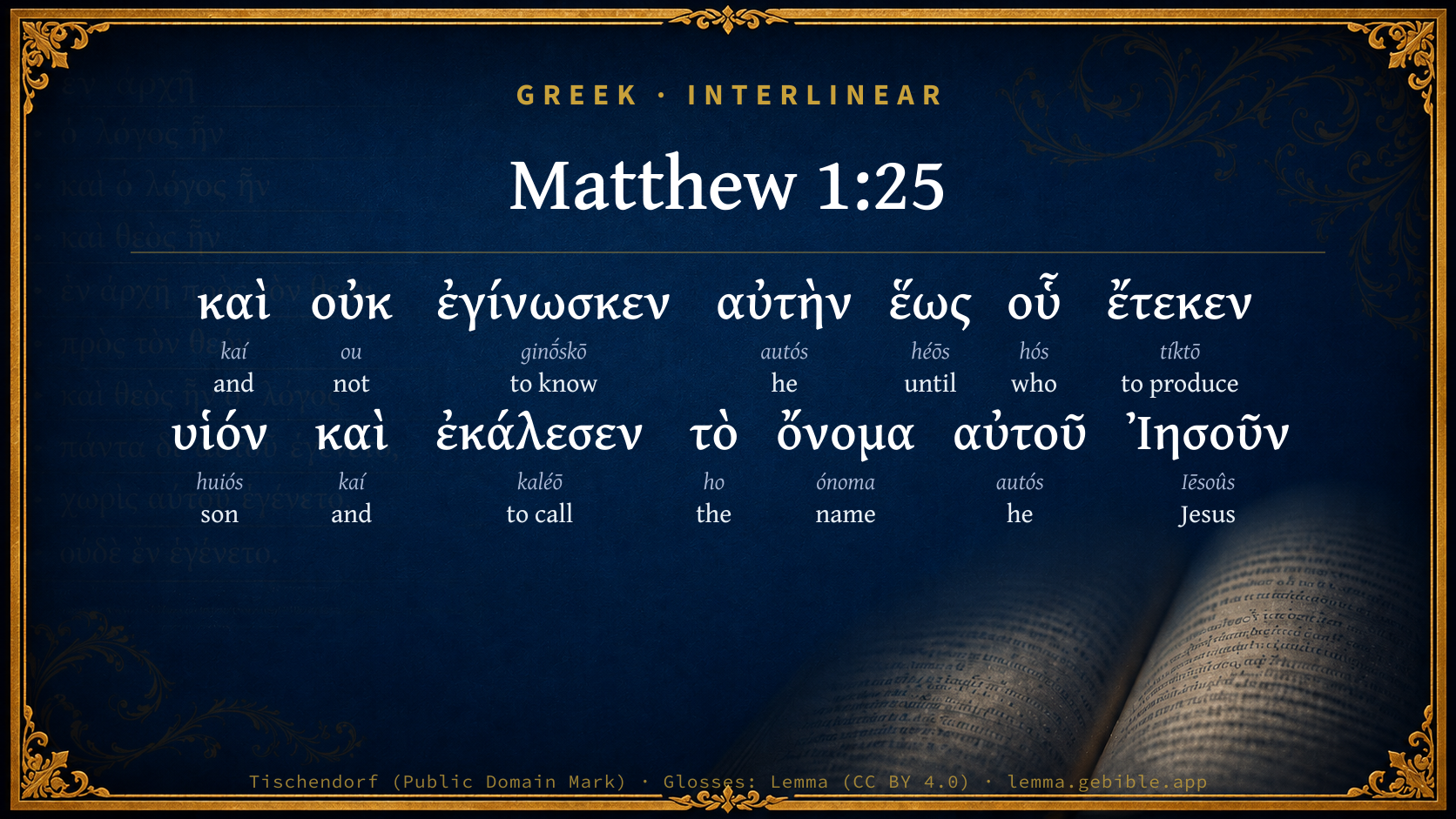
Download image
Cite this verse

Matthew 1:25 (World English Bible). Public Domain. Lemma interlinear Bible study tool, https://lemma.gebible.app/v/matthew/1/25.

Show BibTeX & RIS
BibTeX
RIS
English Translation
and didn't know her sexually until she had brought forth her firstborn son. He named him Jesus.
World English Bible · Public Domain
Highlights
  • 2 first appearances in the Greek New Testament
Full analysis ↓
Download a study sheet

One document with this verse’s original text, its word-by-word gloss line, the meaning frame, cross-references with their text, attributed commentary, and full source and license credits — printable, and it pastes into notes with its structure intact.

This verse Autodidact and up

Study sheet (.html) Plain text (.txt)

A passage Seminary Student

Up to 50 verses in one chapter. A passage sheet keeps up to 6 commentary sources and 12 cross-references per verse, in the order this page ranks them, and says so on the sheet whenever that leaves anything out. Ask for a single verse and you get the Autodidact verse sheet above.

Everything on this page stays free to read, with no account — the sheet is a download of what is already on screen, not access to it.

Want to remove ads? Support Godless Engineer
Compare translations 3

The same verse in 3 English versions, stacked beneath the original-language interlinear above. Click any original word for its lexicon entry.

Each is an independent rendering of the whole verse — the interlinear is not word-aligned to these translations.

Highlighted words mark where these versions differ — a whole-verse word diff, not a word-by-word alignment.

  • World English Bible Public Domain
    and didn't know her sexually until she had brought forth her firstborn son. He named him Jesus.
  • King James Version Public Domain
    And knew her not till she had brought forth her firstborn son: and he called his name JESUS.
  • unfoldingWord Literal Text CC BY-SA 4.0
    And he did not know her until she bore a son. And he called his name Jesus.

unfoldingWord Literal Text — © unfoldingWord, licensed CC BY-SA 4.0. Word-aligned USFM3 via Door43 (git.door43.org/unfoldingWord/en_ult).

Versions to compare (up to 4)

3 of 4 selected

Show all 19 translations

Every available English version of this verse, each an independent rendering of the whole verse.

  • World English Bible Public Domain
    and didn't know her sexually until she had brought forth her firstborn son. He named him Jesus.
  • Berean Standard Bible Public Domain
    But he had no union with her until she gave birth to a Son. And he gave Him the name Jesus.
  • Majority Standard Bible Public Domain
    But he had no union with her until she gave birth to her firstborn Son. And he gave Him the name Jesus.
  • King James Version Public Domain
    And knew her not till she had brought forth her firstborn son: and he called his name JESUS.
  • American Standard Version (1901) Public Domain
    and knew her not till she had brought forth a son: and he called his name JESUS.
  • Revised Version (1885) Public Domain
    and knew her not till she had brought forth a son: and he called his name JESUS.
  • Geneva Bible (1599) Public Domain
    But he knew her not, til she had broght forth her first borne sonne, and he called his name JESUS.
  • Douay-Rheims (1899) Public Domain
    And he knew her not till she brought forth her firstborn son: and he called his name JESUS.
  • Young's Literal Translation Public Domain
    and did not know her till she brought forth her son -- the first-born, and he called his name Jesus.
  • Literal Standard Version CC BY-SA 4.0
    and did not know her until she brought forth her Son—the firstborn, and he called His Name Jesus.
  • Unlocked Literal Bible CC BY-SA 4.0
    But he did not have sexual relations with her until she gave birth to a son. Then he called his name Jesus.
  • unfoldingWord Literal Text CC BY-SA 4.0
    And he did not know her until she bore a son. And he called his name Jesus.
  • Darby Bible Public Domain
    and knew her not until she had brought forth her firstborn son: and he called his name Jesus.
  • World Messianic Bible Public Domain
    and didn’t know her sexually until she had given birth to her firstborn son. He named him Yeshua.
  • Webster's Bible Public Domain
    And knew her not till she had brought forth her first-born son: and he called his name JESUS.
  • Free Bible Version CC BY-SA 4.0
    Joseph married Mary, but did not sleep with her until after she had given birth to a son, whom he named Jesus.
  • Bible in Basic English Public Domain
    And he had no connection with her till she had given birth to a son; and he gave him the name Jesus.
  • Text-Critical English NT CC BY 4.0
    but had no marital relations with her until she had given birth to her firstborn son. And he named him Jesus.
  • Tyndale New Testament (1534) Public Domain
    and knewe her not tyll she had brought forth hir fyrst sonne and called hys name Iesus.

Literal Standard Version (2020), Covenant Press — licensed CC BY-SA 4.0. Text via the HelloAO Bible API (eBible.org). Unlocked Literal Bible (unfoldingWord) — licensed CC BY-SA 4.0. Text via the HelloAO Bible API (eBible.org). unfoldingWord Literal Text — © unfoldingWord, licensed CC BY-SA 4.0. Word-aligned USFM3 via Door43 (git.door43.org/unfoldingWord/en_ult). Free Bible Version, Dr. Jonathan Gallagher — licensed CC BY-SA 4.0. Text via the HelloAO Bible API (eBible.org).

Word by word

More ways to search: Search by grammar → Find every occurrence → Compare this word →

Practice this passage: Drill this verse → Learn its vocabulary →

ἔτεκεν
tíktō
G5088
“to produce”
Verb, Aorist, Active, Indicative, 3rd person, Singular
Part of Speech
Verb
Tense
Aorist
Voice
Active
Mood
Indicative
Person
3rd person
Number
Singular
Full Thayer's Definition

Origin: a strengthened form of a primary teko tek'-o (which is used only as alternate in certain tenses)

TDNT: None

1. to bring forth, bear, produce (fruit from the seed) a. of a woman giving birth b. of the earth bringing forth its fruits c. metaph. to bear, bring forth
  1. καὶ kaí G2532 “and” Conjunction
  2. οὐκ ou G3756 “not” Particle, Negative
  3. ἐγίνωσκεν ginṓskō G1097 “to know” Verb, Imperfect, Active, Indicative, 3rd person, Singular
  4. αὐτὴν autós G846 “he” Personal pronoun, Accusative, Singular, Feminine
  5. ἕως héōs G2193 “until” Adverb
  6. οὗ hós G3739 “who” Relative pronoun, Genitive, Singular, Masculine
  7. υἱόν huiós G5207 “son” Noun, Accusative, Singular, Masculine
  8. καὶ kaí G2532 “and” Conjunction
  9. ἐκάλεσεν kaléō G2564 “to call” Verb, Aorist, Active, Indicative, 3rd person, Singular
  10. τὸ ho G3588 “the” Article, Accusative, Singular, Neuter
  11. ὄνομα ónoma G3686 “name” Noun, Accusative, Singular, Neuter
  12. αὐτοῦ autós G846 “he” Personal pronoun, Genitive, Singular, Masculine
  13. Ἰησοῦν Iēsoûs G2424 “Jesus” Noun, Accusative, Singular, Masculine

About this verse

These counts appear in no published source. They are computed here, from the morphology-tagged text and Lemma’s own curated glosses. What Lemma adds →

14
words
12
distinct lemmas
Gospels
section

Notable vocabulary

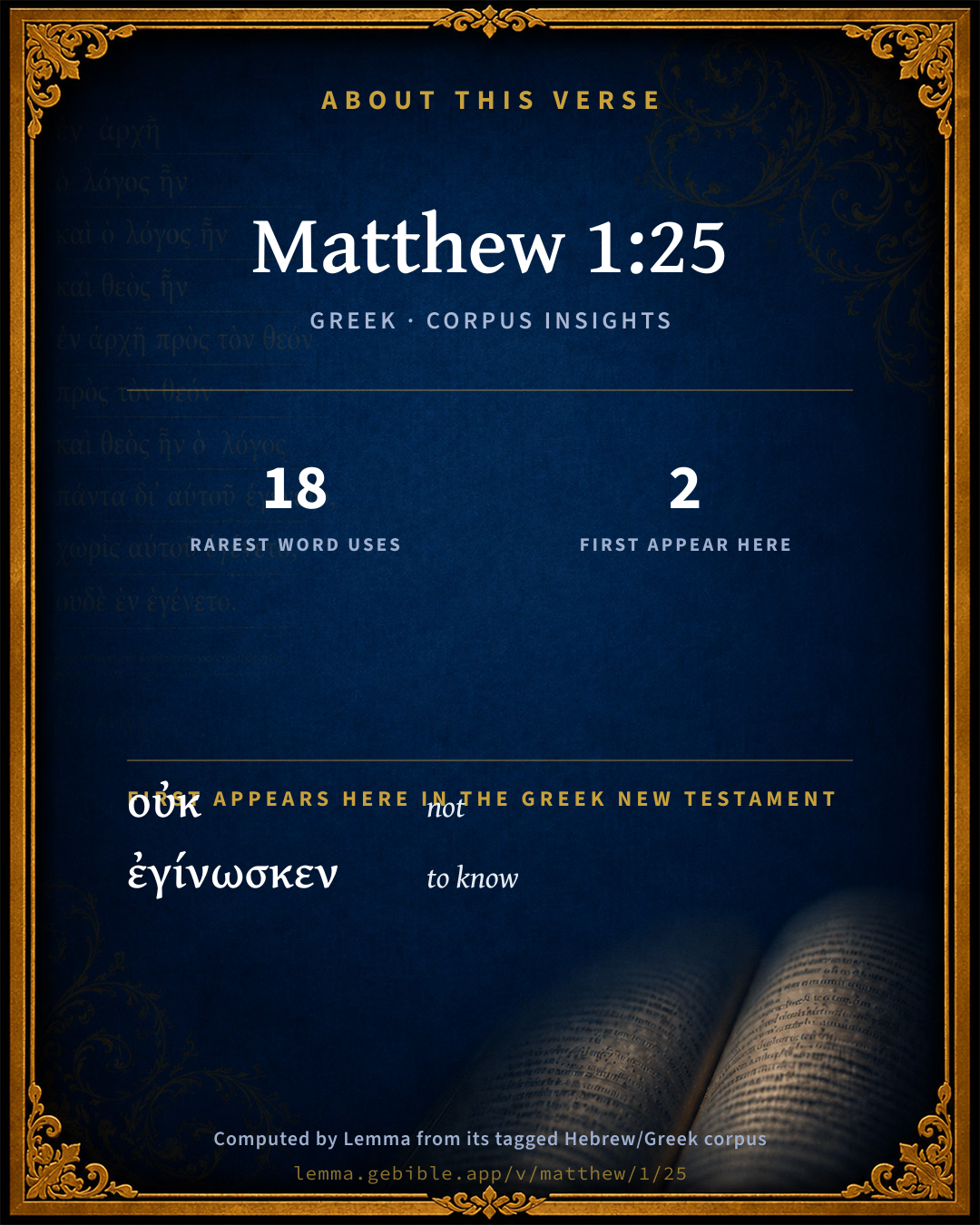
The rarest word here is ἔτεκεν to produce G5088 — appearing just 18 times in the whole Greek New Testament.

First appearance in Scripture

These words make their first canonical appearance in the Greek New Testament here:

  • οὐκ not G3756
  • ἐγίνωσκεν to know G1097

Shared distinctive vocabulary

ἔτεκεν to produce G5088 occurs in 17 verses of the Greek New Testament. Also found in:
Repetition

Words recur within this verse:

  • καὶ and G2532 ×2
  • αὐτὴν he G846 ×2

Cross-references

6

Topical passages linked to Matthew 1:25 in the Treasury of Scripture Knowledge — connected by theme and wording, ordered by reader-vote popularity; previews shown in the World English Bible.

  • Luke 2:21 When eight days were fulfilled for the circumcision of the child, his name was called Jesus, which was given by the angel before he was conceived in the womb.
  • Exodus 13:2 "Sanctify to me all of the firstborn, whatever opens the womb among the children of Israel, both of man and of animal. It is mine."
  • Exodus 22:29 "You shall not delay to offer from your harvest and from the outflow of your presses. "You shall give the firstborn of your sons to me.
  • Matthew 1:21 She shall bring forth a son. You shall call his name Jesus, for it is he who shall save his people from their sins."
  • Luke 2:7 She brought forth her firstborn son, and she wrapped him in bands of cloth, and laid him in a feeding trough, because there was no room for them in the inn.
  • Romans 8:29 For whom he foreknew, he also predestined to be conformed to the image of his Son, that he might be the firstborn among many brothers.

Cross-references courtesy of OpenBible.info (CC BY 4.0).

Where the printed editions differ

1 variant

Places in this verse where the major printed Greek editions disagree on the wording in a way that affects the translation — a comparison of editions, not a manuscript-by-manuscript collation. The editions are the modern critical texts (Nestlé-Aland 28/27, SBL, Westcott-Hort, Tregelles, Tyndale House) and the traditional texts behind the KJV (the Textus Receptus and the Byzantine/Majority text). It is not a claim about which reading is original.

  1. Extra text
    αὐτῆς τὸν πρωτότοκον,

    “of her <the> firstborn,”

    In TRByz Not in NA28NA27TynSBLWHTreg

    αὐτῆς τὸν πρωτότοκον, (autēs ton prōtotokon) 'of her firstborn,' is only in traditional manuscripts (TR+Byz)

Textual data: Translators Amalgamated Greek New Testament (STEPBible TAGNT) · CC BY 4.0.

Commentary

Notes on Matthew 1:25 from classic Christian and Jewish commentators (each source and its license shown beneath its notes). The classic Christian expositions comment on the surrounding passage and are grouped to its opening verse, so a note may address several verses; the Jewish commentaries on the Tanakh (Rashi and others) are per-verse, so they appear only where the commentator wrote on this verse.

Lemma curates 59 commentaries, every one of them public domain or Creative Commons licensed, each selected and text-cleaned for this edition rather than reprinted as found. About our sources →

Tyndale Open Study Notes

Tyndale Open Resources

1:25 Until probably implies that Joseph had sexual relations with Mary after the birth of Jesus. • And Joseph named him Jesus, thus showing his acceptance of the child as his own.

Tyndale Open Study Notes — © Tyndale Open Resources, licensed CC BY-SA 4.0. Text via the HelloAO Bible API.

Bengel's Gnomon

Johann Albrecht Bengel

Mat 1:25. Καὶ, and) St Matthew says “and,” not “but.” He took her, and knew her not: both by the command of the angel.—οὐκ ἐγίνωσκεν αὐτὴν, ἓως οὗ, knew her not until) It does not follow from this ἓως (until) that he did so afterwards. It is sufficient however, that her virginity should be established up to the time of her delivery. With regard to the remainder of her married life, the reader is left to form his own opinion. The angel did not expressly forbid Joseph to have conjugal intercourse with her: but he perceived such a command to be implied by the very nature of the case.—ἓως οὗ ἔτεκε τὸν υἱὸν, until she brought forth the Son) A very old Egyptian version has only these words, without the addition of “her first-born:[69] according to which reading, the address of the angel, the declaration of the prophet, and the act of Joseph [in naming Him as the angel directed] are expressed in words which exactly correspond together.—sc., “She shall bring forth a son, and thou shalt call his name Jesus,”—“She shall bring forth a Son, and they shall call his name Jesus,”—She brought forth TON Υἱὸν, THE Son, and he [Joseph][70] called His name Jesus. The article TON (the) has a relative value here, and refers to Mat 1:21 with the same meaning, “until she brought forth THAT Son” The same reading is found in Codex Barberini I. (by which name we suppose the celebrated Vatican MS. to be intended in this place), and we have assured ourselves that beyond doubt such must have been originally that of the Latin Vulgate. For Helvidius,[71] and Jerome in the commencement of his book against him, thus quote the words of St Matthew—et non cognovit eam, donec peperit filium suum, i.e., and he knew her not till she brought forth her Son; but more commonly they quote thus donec peperit filium, i.e., until she brought forth ([72] or the) Son, without the addition of either suum (her) or primogenitum (first-born); nor can it be argued, that they have in these instances intended to abridge the text, since Jerome in one place thus quotes the passage in full, “Exurgens autem—accepit uxorem suam et non cognovit eam, donec peperit filium: et vocavit nomen ejus Jesum,” i.e., But on rising from sleep—he received his wife, and knew her not until she had brought forth [the] Son: and he called His name Jesus.[73]

[69] The disputed words are found in E. M. Tregelles favours the omission.—(I. B.)

[70] See Text v. 25, “He called his name Jesus.”—ED.

[71] A famous Arian disciple of Auxentius. He lived in the fourth century.—(I. B.)

[72] Vercellensis of the old ‘Itala,’ or Latin Version before Jerome’s, probably made in Africa, in the second century: the Gospels.

[73] BZ. Memph. Theb. b.c. read only ὑιόν (without the article or the words following). Dd. and Vulg. read as the Rec. Text. Lachmann and Tischendorf follow the former reading, as resting on the weightiest authorities.—ED.

Both these writers, after a long dispute upon this passage of St Matthew, seek for a fresh argument grounded on the appellation πρωτότοκος, first-born, not from this passage of St Matthew, but solely from Luk 2:7. If the Codex Barberini I., and the Coptic version already mentioned, obtained this reading from Greek MSS., their testimony is on that ground of great weight: if, on the other hand, they obtained it from Latin sources, they greatly corroborate the genuine reading of the very ancient Latin version. The words αὐτῆς τὸν πρωτότοκον, “her first-born,” appear to have been introduced into St Matthew, from the parallel passage in St Luke already cited: and the very idea of the Son of a Virgin, implies that He must have been the first-born in a pre-eminent and strictly singular manner. [Such as He is expressly declared to be in Luk 2:7, Vers. Germ.]

In some passages our criticism takes a different view of matters from what it did formerly. Yet no one can fairly accuse me of inconstancy; for I do not confine myself to those views, which have gained acceptance by long usage (though I do not reject such assistance where truth requires it): but I proceed to draw forth, by degrees, from their concealment, those things which have been buried out of sight.

Ἐκάλεσε, he called) i.e., Joseph did so; as we learn from Mat 1:21.

Bengel's Gnomon of the New Testament — English translation (T&T Clark, Edinburgh, 1860) — public domain. Text from a community e-Sword module.

Meyer's Critical & Exegetical Commentary

Heinrich August Wilhelm Meyer

Mat_1:25. Ἐγίνωσκεν] He had no sexual intercourse with her (imperfect). In this sense ידע is used by the Hebrews, and γινώσκειν by the Greeks of a later age (often in Plutarch); also the Latin novi and cognosco (Justin, v. 2, xxvii. 3; Ovid. Meta. iv. 594; comp. Caesar, de bello Gallico, vi. 21 : feminae notitiam habuisse). See Wetstein and Kypke. Since Epiphanius, Jerome, Chrysostom, Theophylact, Luther, Calvin, very many expositors have maintained, with a view to support the perpetual virginity of Mary, but in opposition to the straightforward and impartial character of the narrative, that Joseph, even after the birth of Jesus, had no sexual intercourse with Mary.[365]

But (1) from ἕως οὗ of itself no inference can be drawn either in favour of or against such a view, as in all statements with until the context alone must decide whether, with regard to that which had not formerly occurred, it is or is not intended to convey that it afterwards took place. But (2) that it is here conceived as subsequently taking place, is so clear of itself to every unprejudiced reader from the idea of the marriage arrangement, that Matthew must have expressed the thought, not only untilbut afterwards also he had not, if such had been his meaning. That he did not, however, mean this is clearly shown (3) by his use of πρωτότοκον, which is neither equivalent to ΠΡῶΤΟς ΚΑῚ ΜΌΝΟς (Theophylact, Euth. Zigabenus), nor does it designate the first-born, without assuming others born afterwards (so formerly most expositors). The latter meaning is untenable, because the evangelist employed πρωτότοκον as an historian, from the standpoint of the time when his Gospel was composed, and consequently could not have used it had Jesus been present to his historical consciousness as the only son of Mary. But Jesus, according to Matthew (Mat_12:46 ff., Mat_13:55 f.), had also brothers and sisters, amongst whom He was the firstborn. Lucians remark (Demonax, 29), speaking of Agathocles, is correct: εἰ μὲν πρῶτος, οὐ μόνος· εἰ δὲ μόνος, οὐ πρῶτος. (4) All a priori suppositions are untenable, from which the perpetual virginity of Mary is said to appear,such as that of Euth. Zigabenus: πῶς ἂν ἐπεχείρησεν, ἢ καὶ ὅλως ἐνεθυμήθη γνῶναι τὴν συλλαβοῦσαν ἐκ πνεύματος ἁγίου καὶ τοιοῦτον δοχεῖον γεγενημένην; of Olshausen: it is manifest that Joseph, after such experiences, might with good reason believe that his marriage with Mary was intended for another purpose than that of begetting children. Hofmann has the correct meaning (Schriftbeweis, II. 2, p. 405), so also Thiersch, Wieseler, Bleek, Ewald, Laurent, neut. Stud. p. 153 ff., Schenkel, Keim, Kahnis, I. p. 426 f. Comp. on the passage before us, Diogenes Laertius, 3:22, where it is said of Platos father: ὅθεν καθαρὰν γάμου φυλάξαι ἕως τῆς ἀποκυήσεως; see also Wetstein; Paulus, exeget. Handb. I. p. 168 f.; Strauss, I. p. 209 ff.

ἐκάλεσε] is not to be referred to Mary, so that ἝΩς ΟὟ ἜΤΕΚΕ … ΚΑῚ ἘΚΆΛΕΣΕ would be taken together, as Paulus, after some older interpreters, maintains, but to Joseph, as is certain after Mat_1:21; comp. Grotius.

[365] As a logical consequence of this supposition, Joseph was made to be a worn-out old man (Thilo, ad cod. Apocr. I. p. 361; Keim, Gesch. Jes. I. p. 365), and his children were regarded either as children of a former marriage (Origen, Epiphanius, and many other Fathers), or the brothers of Jesus were transformed into cousins (Jerome). Of any advanced age in the case of Joseph there is no trace in the N. T. In Joh_6:42, the Jews express themselves in such a way that Joseph might be conceived as still alive at the time.

Meyer — Critical and Exegetical Commentary on the New Testament — English translation by Peter Christie, edited by Frederick Crombie (T&T Clark, 1880) — public domain. Text from a community e-Sword module.

Expositor's Greek Testament

ed. W. Robertson Nicoll

Mat 1:25 . καὶ οὐκ ἐγίνωσκεν … υἱόν : absolute habitual (note the imperfect) abstinence from marital intercourse, the sole purpose of the hastened marriage being to legitimise the child. ἕως : not till then, and afterwards? Here comes in a quæstio vexata of theology. Patristic and catholic authors say: not till then and never at all, guarding the sacredness of the virgin’s womb. ἕως does not settle the question. It is easy to cite instances of its use as fixing a limit up to which a specified event did not occur, when as a matter of fact it did not occur at all. E.g. , Gen 8:7 ; the raven returned not till the waters were dried up; in fact, never returned (Schanz). But the presumption is all the other way in the case before us. Subsequent intercourse was the natural, if not the necessary, course of things. If the evangelist had felt as the Catholics do, he would have taken pains to prevent misunderstanding. υἱόν : the extended reading (T. R.) is imported from Luk 2:7 , where there are no variants. πρωτότοκον is not a stumbling-block to the champions of the perpetual virginity, because the first may be the only . Euthymius quotes in proof Isa 44:6 : “I am the first, and I am the last, and beside Me there is no God.” καὶ ἐκάλεσεν , he (not she) called the child Jesus, the statement referring back to the command of the angel to Joseph. Wünsche says that before the Exile the mother, after the Exile the father, gave the name to the child at circumcision ( Neue Beiträge zur Erläuterung der Evangelien , p. 11).

The Expositor's Greek Testament, edited by W. Robertson Nicoll (1897–1910) — public domain. Text from a community e-Sword module.

Geneva Bible (1599)

Geneva Bible translators

This little word Till, in the Hebrew tongue, giveth us to understand also, that a thing shall not come to pass in time to come: as Michal had no children Till her death day, 2 Sam. 6:23. And in the last Chapter of this Evangelist: Behold, I am with you till the end of the world.

Geneva Bible (1599) marginal notes — public domain. Text via Bolls.life.

Jamieson, Fausset & Brown

Robert Jamieson, A. R. Fausset & David Brown

And knew her not till she had brought forth her first-born son: and he called his name JESUS--The word "till" does not necessarily imply that they lived on a different footing afterwards (as will be evident from the use of the same word in Sa1 15:35; Sa2 6:23; Mat 12:20); nor does the word "first-born" decide the much-disputed question, whether Mary had any children to Joseph after the birth of Christ; for, as LIGHTFOOT says, "The law, in speaking of the first-born, regarded not whether any were born after or no, but only that none were born before." (See on Mat 13:55-56).

Next: Matthew Chapter 2

Jamieson, Fausset & Brown — Commentary Critical and Explanatory on the Whole Bible (1871) — public domain (CC PDM 1.0). Text via the HelloAO Bible API.

Adam Clarke's Commentary

Verse 25. Her first-born son] Τον υιον αυτης τον πρω-οτοκον. Literally, That son of hers, the first-born one. That Mary might have had other children, any person may reasonably and piously believe; that she had others, many think exceedingly probable, and that this text is at least an indirect proof of it. However this may be, the perpetual virginity of Mary should not be made an article of faith. God has not made it one: indeed it can hardly bear the light of several texts in the Gospels.

He knew her not] Had no matrimonial intercourse with her - TILL she had brought forth that son of hers, of whom the evangelist had been just speaking, the first-born, the eldest of the family, to whom the birthright belonged, and who was miraculously born before she knew any man, being yet in a state of virginity. See on Mt 13:55. The virginity of Mary, previously to the birth of Christ, is an article of the utmost consequence to the Christian system; and therefore it is an article of faith: her perpetual virginity is of no consequence; and the learned labour spent to prove it has produced a mere castle in the air. The thing is possible; but it never has been, and never can be proved.

He called his name JESUS.] This name was given by the command of God, see Mt 1:16, and was imposed on Christ when eight days old; for then, according to the Jewish law, he was circumcised: thus he had the name of Saviour given when he first began to shed that blood without which there could be no remission of sins.

The goodness of God is manifested, not only in his giving his Son to save a lost world, but also in the choice of the persons who were his progenitors: among whom we find, First, SAINTS, to excite our courage: Abraham, remarkable for his faith; Isaac, for his obedience; and Jacob, for his fervour and constancy.

Secondly, Penitent SINNERS, to excite our confidence: such as David, Manasses, c.

Thirdly, Sinners, of whose repentance and salvation we hear nothing to put us on our guard. Who can read the account of idolatrous Solomon, who, from the whole evidence of the sacred history, died In his sins, without trembling?

Four WOMEN are mentioned in this genealogy: two of these were adulteresses, Tamar and Bathsheba; and two were Gentiles, Rahab and Ruth, and strangers to the covenant of promise; to teach us that Jesus Christ came to save sinners, and that, though strangers to his people, we are not on that account excluded from a salvation which God has designed for all men. He is not the God of the Jews only; he is also the God of the Gentiles.

The state of the royal family of David, the circumstances of the holy virgin and her spouse Joseph, the very remarkable prophecy of Isaiah, the literal and circumstantial fulfilment of it, the names given to our blessed Lord, the genealogical scroll of the family, c., &c., are all so many proofs of the wisdom, goodness, and providence of God. Every occurrence seems, at first view, to be abandoned to fortuitous influence, and yet the result of each shows that God managed the whole. These circumstances are of the greatest importance nor can the Christian reader reflect on them without an increase of his faith and his piety.

Adam Clarke's Commentary on the Bible (1810–1826) — public domain. Text from a community e-Sword/MySword module.

Ellicott's Commentary for English Readers

(25) Till she had brought forth her first-born son.—The word “firstborn” is not found in the best MSS. The questions which meet us here, unprofitable as they are, cannot be altogether passed over. What bearing have these words on the widespread belief of Christendom in the perpetual maidenhood of Mary? On what grounds does that belief itself rest?

A Bible Commentary for English Readers, edited by Charles John Ellicott (1878–1897) — public domain. Text from a community e-Sword module.

The Cambridge Bible for Schools and Colleges

gen. ed. J. J. S. Perowne

25. knew her not till] This expression cannot be considered as in any way decisive of the question, whether the Virgin Mary had or had not children besides our blessed Lord.

her firstborn son] The oldest MSS. omit the word “first-born:” translate “a son.”

The Cambridge Bible for Schools and Colleges (gen. ed. J. J. S. Perowne; Cambridge University Press, 1878–1918) — public domain. Text from a community e-Sword module.

John Gill's Exposition

And knew her not,.... Or "but he knew her not", answering to the Hebrew that is, had carnal knowledge of her, or copulation with her, though his wife. The words are an euphemism, or a modest way of expressing the conjugal act, and is a very ancient one, see Gen 4:1 and what has been used in nations and languages. And this conduct of his was necessary,

till she had brought forth her firstborn; that it might be manifest not only that she conceived, being a virgin, but also that she brought forth, being a virgin: for both are signified in the prophecy before related, "a virgin shall conceive and bring forth a son"; which is all one as if it had been said, a virgin shall conceive, and "a virgin" shall bring forth a son. The "firstborn" is that which first opens the womb of its mother, whether any follows after or not, Exo 13:12. Christ is called Mary's firstborn, because she had none before him, whether she had any after him or not; for her perpetual virginity seems to be no necessary article of faith: for when it is said,

Joseph knew her not till she had brought forth, the meaning is certain that he knew her not before. But whether he afterwards did or not, is not so manifest, nor is it a matter of any great importance; the word "until" may be so understood as referring to the time preceding, that the contrary cannot be affirmed of the time following, Sa2 6:23 and which may be the case here, and is indeed generally understood so; and it also may be considered as only expressive of the intermediate time, as in Mat 5:26 as Beza observes. Christ was "her firstborn" as he was man, and the firstborn of God, or his first and only begotten, as the Son of God. It is further observed, that she "called his name Jesus", as was foretold to her, or ordered her by the Angel, Luk 1:31 and to Joseph, Mat 1:21.

Next: Matthew Chapter 2

John Gill's Exposition of the Whole Bible (1746–1763) — public domain (CC PDM 1.0). Text via the HelloAO Bible API.

Trapp's Complete Commentary

John Trapp

25 And knew her not till she had brought forth her firstborn son: and he called his name JESUS.

Ver. 25. And knew her not till she brought forth] We think hardly of him that taketh to wife the widow and relict of another, that is left great with child, before she hath laid down her burden; how much more in this case! Besides, this might be part of the angel’s charge to him, that after she had brought forth her Son Jesus she continued still a Virgin, pie credimus, but it is neither article of our creed nor principle of our religion. But that she vowed virginity is both false and absurd. For how could she promise virginity to God and marriage to Joseph? Sure it is, the blemish will never be wiped off from some of the ancients, who, to establish their own idol, of I know not what virginity, have written most wickedly and most basely of marriage, which both Christ honoured with his first miracle and the Holy Ghost by overshadowing the betrothed Virgin. As for the Papists that disgrace it, they appear herein more like devils than divines. 1Ti 4:1. If the same God had not been the author of virginity and marriage, he had never countenanced virginity by marriage, as he did in the Virgin Mary.

John Trapp, A Commentary or Exposition upon All the Books of the Old and New Testament (1647–1656) — public domain. Text from a community e-Sword module.

Albert Barnes' Notes on the Bible

Knew her not - The doctrine of the virginity of Mary before the birth of Jesus is a doctrine of the Scriptures, and is very important to be believed. But the Bible does not affirm that she had no children afterward. Indeed, all the accounts in the New Testament lead us to suppose that she did have them. See the notes at Mat 13:55-56. The language here evidently implies that she lived as the wife of Joseph after the birth of Jesus.

Her first-born son - Her oldest son, or the one who had the privilege of birthright by the law. This does not of necessity imply that she had other children, though it seems probable. It was the name given to the son which was born first, whether there were others or not.

His name Jesus - This was given by divine appointment, Mat 1:21. It was conferred upon him on the eighth day, at the time of his circumcision, Luk 2:21.

Albert Barnes' Notes on the Bible (1834–1885) — public domain. Text from a community e-Sword/MySword module.

Haydock's Catholic Bible Commentary

See note on ver. 18. --- St. Jerome assures us, that St. Joseph always preserved his virginal chastity. It is "of faith" that nothing contrary thereto ever took place with his chaste spouse, the blessed Virgin Mary. St. Joseph was given her by heaven to be the protector of her chastity, to secure her from calumnies in the birth of the Son of God, to assist her in her flight into Egypt, &c. &c. We cannot sufficiently admire the modest reserve of both parties. Mary does not venture to explain to her troubled husband the mystery of her pregnancy; and Joseph is afraid of mentioning his uneasiness and doubts, for fear of troubling her delicate mind and wounding her exquisite feelings. So great modesty, reserve and silence, are sure to be approved by heaven; and God sends an angel to Joseph in his sleep, to dissipate his doubts, and to expound to him the mystery of the incarnation. (Haydock)

George Leo Haydock (1774–1849), Haydock's Catholic Family Bible and Commentary, 1859 edition — public domain. Excludes Psalms (Douay-Rheims chapter numbering differs from Protestant) and Deuterocanonical books (Catholic canon only).

Whedon's Commentary on the Bible

Daniel D. Whedon

25. Till she had brought forth her firstborn son — These words assert the virginity of the mother of the Lord until the time of his birth. According to the Creed, “He was born of the virgin Mary.” They are also understood by many to imply that she was subsequently the mother of other children than Jesus. On the other hand, the perpetual virginity of the blessed mother is a standard doctrine in the Roman Church, and is generally maintained by the older writers of the Christian Church. With many this opinion is mainly grounded upon what they consider the demands of our “pious feelings.” It may be doubted, however, whether this pious feeling is not rather ecclesiastical and sentimental than Scriptural and truly spiritual.

The proof that Mary was the mother of subsequent children, is derived, so far as this passage is concerned, both from the word until, and the words her firstborn. From the word until, the implication is inferred that her virginity continued not after her maternity. And this we apprehend is the usual sense of the word until and its corresponding term in most languages. When we affirm a certain state of things until a given point, we naturally imply a change after that point. Yet not necessarily. We may intend our affirmation to cover the time previous to the point, without pretending to affirm, imply, or even know what took place after that point. Examples of this, quoted by Bishop Pearson on the Creed, are Gen_28:15; Deu_34:6; 1Sa_15:35; 2Sa_6:23; Mat_28:20. The conclusion of this argument therefore fairly is, I think, that there is a decided probability, although no full certainty, that the evangelist meant to imply the birth of subsequent children. As to the word firstborn, it is affirmed by Pearson and others that the word is in the Old Testament properly applied to the only born. That is, it is applied to any child whose birth has been preceded by no other, whether succeeded by any or not. The Mosaic law prescribed the sanctification of the “firstborn.” Exo_12:2. And this firstborn was still so called, whether succeeded by subsequent children or not. This is undoubtedly true. But still it may be questioned whether a subsequent historian would style that child the firstborn where there was notoriously no second born. The evangelist could, I think, do so only by transferring himself, as it were, to the time of the birth, when the future contingency was unknown. Therefore, the balance of the argument upon this point also leaves an implication against the perpetual virginity of the blessed mother. This question is connected with the further discussion of the question concerning the brethren of the Lord. Upon that point see our note upon Mat_13:55.

In closing our notes upon this chapter, we offer the following remarks:

1. The style of the evangelist is eminently prosaic and plain. There is not the slightest tinge of poetry in the whole narrative. There is nothing of the fabulous or mythical strain. He narrates the most wonderful events without the slightest wonder. The whole tone of the style is purely historical, as plain and level as if it detailed the most ordinary events of life.

2. Matthew, thus far, gives neither date nor place. The persons are named without formal introduction. All are assumed to be familiar to his readers. As if writing to Jewish Christians, to whom all the facts, persons, and places are well known, he appears to write rather as if to verify and record than to inform.

3. In his first two chapters, Matthew so plans his narrative as, by blending fact with prophecy, to prove the Messiahship of Jesus. He is careful to inform us that these events took place for the purpose (in addition to all their other purposes) of fulfilling the predictions of the prophets of the Old Testament. The New Testament is born of the Old. The Gospel is contained in the law. The old dispensation is but a preparation for the new. He who is the true Jew is bound to be the believing Christian.

4. Matthew gives no dates, but his mention of historical names, such as Herod and Archelaus, enables us to fix, with some approach to accuracy, the time of our Lord’s birth. The following extract, from Prof. Robinson’s English Harmony of the New Testament, furnishes the best statement upon this point:

“The precise year of our Lord’s birth is uncertain. Several data, however, exist, by which an approximation may be made, sufficiently accurate to show that our present Christian era is not entirely correct.

“1. According to Mat_2:1-6, Jesus was born during the lifetime of Herod the Great, and not long before his death. Herod died in the year of Rome (A.U.) 750 just before the passover; see Josephus, Ant., b. 17, ch. 8, sec. 1; ib., b.17, ch. 9, sec. 3. This has been verified by calculating the eclipse of the moon, which happened just before his death; (Jos., Ant., b. 17, ch. 6, sec. 4. Ideler, Handb. of Chronol., vol. ii, p. 391 sq.) If now we make an allowance of time for the purification, the visit of the Magi, the flight into Egypt, and the remaining there till Herod was dead, for all of which not less than six months can well be required, it follows that the birth of Christ cannot in any case be fixed later than the autumn of A.U. 749.

“2. Another note of time occurs in Luk_3:1-2, where John the Baptist is said to have entered upon his ministry in the fifteenth year of Tiberius; and again in Luk_3:23, where Jesus is said to have been ‘about thirty years of age’ at his baptism. Now if both John and Jesus, as is quite probable, entered upon their ministry at the age of thirty, in accordance with the Levitical custom, (Num_4:3; Num_4:35; Num_4:39; Num_4:43; Num_4:47,) then by reckoning back thirty years we may ascertain the year of John’s birth, and of course also that of Jesus. Augustus died Aug. 29, A.U. 767; and was succeeded by Tiberius, who had already been associated with him in the government for at least two years, and probably three. If now we reckon from the death of Augustus, the fifteenth year of Tiberius commenced Aug. 29, A.U. 781; and going back thirty years, we find that John must have been born not earlier than August, A.U. 751, and our Lord of course not earlier than A.U. 752, a result disagreeing with that obtained from Matthew by three years. If, on the other hand, we reckon from the time when Tiberius was admitted as co-regent of the empire, which is shown to have been certainly as early as A.U. 765, and probably in A.U. 764; then the fifteenth year of Tiberius began in A.U. 778, and it follows that John may have been born in A.U. 748, and our Lord in A.U. 749. In this way the results obtained from Matthew and Luke are more nearly coincident.

“3. A third note of time is derived from Joh_2:20 : ‘Forty and six years was this temple in building.’ Josephus says in one place that Herod began to build the temple in the eighteenth year of his reign, while in another he specifies the fifteenth year. (Ant., b. 15, ch. 11, sec. 1; Wars, b. 1, ch. 21, sec. 1.) He also assigns the length of Herod’s reign at thirty-seven or thirty-four years; according as he reckons from his appointment by the Romans, or from the death of Antigoinus. (Ant., b. 17, ch. 8, sec. 1; Wars, b. 1, ch. 33, sec. 8.) Herod was first declared king of Judea in A.U. 714; (Jos., Ant., b. 14, ch. 14, sec. 4, 5; Wars, b. 1, ch. 14, see. 4; comp. Ant., b. 14, ch. 16, sec. 4. Ideler, Handb. of Chronicles, 2:390;) hence the eighteenth year of his reign, when Herod began to rebuild the temple, would coincide with A.U. 732; and our Lord’s first passover, in the forty-seventh year following, would fall in A.U. 779. If now our Lord at that time was thirty and a half years of age, as is probable, this would carry back the year of his birth to the autumn of A.U. 748.

“4. Further, according to a tradition preserved by the Latin Fathers of the first five centuries, our Lord’s death took place during the consulate of the two Gemini, C. Rubellius and C. Fufius; that is, in A.U. 782, So Tertullian, Lactantius, Augustine, etc. See Tertull. adv. Jud., sec. 8; Augustin. de Civ. Dei, 18:54.) If now the duration of his ministry was three and a half years, then, as before, the year of his birth would be carried back to the autumn of A.U. 748.

“5. Some modern writers, taking into account the abode in Egypt, and also the ‘two years’ of Mat_2:16, have supposed that Jesus must have been from two to three years old at Herod’s death, and hence they assume that he was born in A.U. 747. The same year, A.U. 747, is also fixed upon as the date of Christ’s birth by those who regard the star in the east as having been the conjunction of the planets Jupiter and Saturn. which occurred in that year. So Keppler, Munter, Ideler, Handb. of Chronol., Berlin, 1826.

“From all these data it would appear, that while our Lord’s birth cannot have taken place later than A.U. 749, it may nevertheless have occurred one or two years earlier.

“The present Christian era, which was fixed by the abbot Dionysius Exiguus in the sixth century, assumes the year of Christ’s birth as coincident with A.U. 754. It follows then, from the preceding statements, that this our common era begins in any case more than four years too late; that is, from four to five years, at the least, after the actual birth of Christ. This era was first used in historical works by the venerable Bede, early in the eighth century; and was not long after introduced in public transactions by the Frank kings Pepin and Charlemagne.”

Daniel D. Whedon (gen. ed.), Commentary on the Old and New Testaments (1874–1909) — public domain. Text from a community e-Sword module.

The Pulpit Commentary

And knew her not. The tense (eginwsken) brings out the continuance of Joseph"s obedient self-restraint. "He was dwelling in holiness with her" (Tatian"s "Diatess."). Till she had brought forth her firstborn Son . Thus the angel"s promise is so far fulfilled. A son (Revised Version); "her firstborn," though found as early as Tatian"s." Diatess.," having been added from Luk_2:7. Though no great stress can be laid on the word "till", (ewv ou , Basil refers to Gen_8:7; comp. also Psa_104:8) nor even on "firstborn," which suggested to a Jew rather consecration (Luk_2:23) than the birth of other children (comp. Bishop Lightfoot on Galatians, p. 270, edit. 1890); yet it is a reasonable inference from the passage as a whole that the ouk eginwsken was not continued after the birth of the Son. Whether, however, other children were born to Mary or not, the true text of this passage gives no hint. And he called his name JESUS (ver. 21, note). Observe that this name had already occurred in Joseph"s family. (Luk_3:29) It is, however, now given in sign of Joseph"s faith in him and his work.

The Pulpit Commentary (1880–1919), ed. H.D.M. Spence-Jones & Joseph S. Exell — public domain. Text from a community e-Sword module.

John Wesley's Explanatory Notes

He knew her not, till after she had brought forth. It cannot be inferred from hence, that he knew her afterward: no more than it can be inferred from that expression, 2 Sam. vi, 23, Michal had no child till the day of her death, that she had children afterward. Nor do the words that follow, the first-born son, alter the case. For there are abundance of places, wherein the term first born is used, though there were no subsequent children. Luke ii, 7.

John Wesley, Explanatory Notes Upon the Whole Bible (1754–1765) — public domain. Text via the GEBible commentary corpus.

Scofield Reference Notes

C. I. Scofield

JESUS

The Greek form of the Hebrew Jehoshua meaning saviour.

The Scofield Reference Bible (1917 edition), notes by C. I. Scofield — public domain. Text from a community e-Sword module.

Burkitt's Expository Notes on the New Testament

William Burkitt

It is piously believed, though not positively in scripture asserted,that the Virgin had no other child but our Savior: it is a very probable opinion, though not an infallible article of faith, as the Church of Rome would make it: for the word until signifies in scripture as much as never.

So Gen 28:15. I will not leave thee, until I have done that which I have promised; that is, I will never leave thee.

So the words following, Her first-born son, do not imply that she had any child after, but that she had none before. That child which first opened the womb, is usually in scripture called the first-born, though there was no other born after.

Thus Joshua 18 Machir is called the first-born of Manasseh, though he had no more children. So that Christ, not only as God, but as also he was man, was the first-born and only son. St. Austin expounds and applies Eze 44:2 to the virgin Mary; This gate shall be shut, it shall not be opened, and no man shall enter by it; because the Lord God of Israel hath entered in by it; therefore it shall be shut. And others of the ancients say, that as Christ lay in a tomb, in which none lay before or after himself. But he said, Quid post partum secutum erat curiose none est quarendum. What the Virgin was afterwards, is of small concern to the mystery, therefore not to be inquired after. And yet it is now passed by some into a matter of faith, that the Virgin Mary was ever a virgin, and it has been styled a heresy to hold the contrary; but how is it consistent with good divinity, to make that an article of divine faith, which is founded on no divine revelation. Or to make that necessary to be believed, which confessedly is not contained in the Holy scripture, let the Church of Rome answer.

Editor’s Note: it would benefit the reader to cross-reference Mar 6:3; Gal 1:19, etc., to put this matter to rest.

William Burkitt's Expository Notes on the New Testament (1700–1703) — public domain. Text from a community e-Sword module.

The People's New Testament

B. W. Johnson

25. Knew her not. A Hebrew form for conjugal intercourse. The language of the verse does not imply the perpetual virginity of Mary.

B. W. Johnson's The People's New Testament with Notes (1889–1891) — public domain. Electronic text from the Christian Classics Ethereal Library (CCEL) ThML edition.

Cambridge Greek Testament for Schools and Colleges

25. υἱὸν (א B) for τὸν υἱὸν αὐτῆς τὸν πρωτότοκον. The reading of the receptus is probably due to Luk 2:7, where πρωτότοκον is unchallenged. The insertion may have been made for controversial reasons, as slightly favouring the view that ‘the brethren of the Lord’ were his full brethren. But this is unlikely.

Εὐαγγέλιον, like χριστός (see ch. Mat 1:18), is rare in the classics. The history of it is that of many Hellenistic words—first Homeric, then vernacular, then again found in literature. It occurs twice in Homer, in the sense of ‘reward for good news,’ Od. XIV. 152 εὐαγγέλιον δέ μοι ἔστω | αὐτίκʼ ἐπεί κεν κεῖνος ἰὼν τὰ ἃ δώμαθʼ ἵκηται: and again in the same passage l. 166. In Aristoph. Eq. 656 εὐαγγέλια θύειν is ‘to sacrifice for good news,’ Eq. 647 εὐαγγέλια στεφανοῦν, ‘to crown for good news.’ In later Greek εὐαγγέλιον acquires the more familiar sense of ‘good news,’ as distinct from ‘reward for good news.’ The LXX. has the word in both senses. It was a familiar term to educated Romans: cp. ‘Primum ut opinor εὐαγγέλια. Valerius absolutus est,’ Cic. ad Att. II. 3. In its N.T. use εὐαγγέλιον is closely allied to the thought of the Kingdom of God, it is distinctively the announcement of the Messianic hopes fulfilled. The word is not used by St John except in one passage of the Apocalypse, ch. Mat 14:6, or by St James, and once only by St Peter, it does not occur in St Luke’s Gospel. With St Paul, however, εὐαγγέλιον is very frequent, and to him is due its leading place in the Christian vocabulary. For the verb see ch. Mat 11:5. The English equivalent ‘gospel’ (A.-Saxon Godspell) is a felicitous rendering, though it fails to convey all that belongs to εὐαγγέλιον. The Continental languages have naturalised the Greek word: évangile (French), evangelium (German), evangelio (Italian).

κατά, ‘according to.’ The gospel is presented according to the plan and aims of the different writers inspired to meet the requirements of particular readers and to satisfy special needs.

25. οὐκ ἐγίνωσκεν κ.τ.λ. This expression cannot be considered as in any way decisive of the question, whether the Virgin Mary had or had not children besides our blessed Lord.

Cambridge Greek Testament for Schools and Colleges (Cambridge University Press, 1896; 21 vols, various authors incl. Carr, Maclear, Plummer, Farrar, Lumby, Moule, M. R. James, Simcox) — public domain. Text from a community e-Sword module.

Alford’s Greek Testament

Henry Alford

25.] “ ‘non cognovit eam, doneo.’ Non sequitur, ergo post: sufficit tamen confirmari virginitatem ad partum usque: de reliquo tempore lectori æquo relinquitur existimatio.” Bengel. And with regard to the much-controverted sense of this verse we may observe, (1) That the primâ facie impression on the reader certainly is, that οὐκ ἐγίνωσκεν was confined to the period of time here mentioned. (2) That there is nothing in Scripture tending to remove this impression, either (α) by narration,—and the very use of the term, ἀδελφοὶ κυρίου (on which see note at ch. 13:55), without qualification, shews that the idea was not repulsive: or (β) by implication,—for every where in the N.T. marriage is spoken of in high and honourable terms; and the words of the angel to Joseph rather imply, than discountenance, such a supposition. (3) On the other hand, the words of this verse do not require it: the idiom being justified on the contrary hypothesis. See reff. On the whole it seems to me, that no one would ever have thought of interpreting the verse any otherwise than in its primâ facie meaning, except to force it into accordance with a preconceived notion of the perpetual virginity of Mary. It is characteristic, and historically instructive, that the great impugner of the view given above should be Jerome, the impugner of marriage itself: and that his opponents in its interpretation should have been branded as heretics by after-ages. See a brief notice of the controversy in Milman, Hist. of Latin Christianity, i. 72 ff. As to the expression, compare the remarkable parallel, Diog. Laert. iii. 1. 2, where he says of the father of Plato, καθαρὰν γάμου φυλάξαι, ἕως τῆς ἀποκυήσεως, with ib. 4 (said of Plato) ἔσχε δʼ ἀδελφοὺς Ἀδείμαντον κ. Γλαύκωνα κ. ἀδελφὴν Ποτώνην.

ἐκάλεσεν] i.e. Joseph; see ver. 21.

Henry Alford, The Greek Testament (1849–1861) — public domain. Text from a community e-Sword module.

International Critical Commentary

25. οὐκ ἐγίνωσκεν αὐτήν S2 has “purely was dwelling with her.” S1 k omit οὐκ ἐγίνωσκεν αὐτὴν ἔως οὖ.—υἱόν] So א B. Z S1 S2 k. τὸν υἱὸν αὐτῆς τὸν πρωτότοκον is substituted by C D al by assimilation to Luk 2:7.—ἐκάλεσεν] S2 has “she called.” On the Syriac VSS in these verses, see Burkitt, op. cit. p. 261 ff.

E editorial passages.

LXX. The Septuagint Version.

Dalm. Dalman.

Luc. Lucian.

B. Babylonian Talmud.

Jos. Josephus.

1 In 1 Esd 1:32 reference is made to τὸν Ἰεχονίαν υἱὸν Ιωσείου. Here Jehoahaz is meant. We might suppose that Mt. also meant Jehoahaz by τὸν Ἰεχονίαν, and that his καὶ τοὺς ἀδελφοὺς αὐτοῦ was a summary way of describing Jehoiakim; Jehoiachin and Zedekiah, of whom the first and third were brothers of Jehoahaz, whilst the second was his nephew, if it were not for the fact that in v. 12 Ἰεχονίας is clearly Jehoiachin. For confusion between Jehoiakim and Jehoiachin cf. 1 Esd 1:41, where the latter is called Ἰωακείμ.

Anth. P. Anthologia Palatina.

al i.e. with other uncial MSS.

Ox A papyrus fragment, containing Mat 1:1-9. Mat 1:12. Mat 1:14-20, published in Oxyrhynchus Papyri, i.

S Syriac version: Curetonian.

M the Second Gospel.

S Syriac version: Harclean.

S Syriac version: Jerusalem Lectionary.

S Syriac version: Sinaitic MS.

P Palestinian traditions.

Hdt. Herodotus.

Asc. Is. Ascension of Isaiah.

Am. Pap. Amherst Papyri.

Ditt. Dittenberger Sylloge.

O quotations from the Old Testament borrowed from a collection of Messianic prophecies. See pp.61 f.

Just. Mart. Justin Martyr.

1 See Briggs, “Criticism and the Dogma of the Virgin-Birth,” in North Amer. Rev., June 1906.

Tert. Tertullian.

L the Matthæan Logia.

Eus. Eusebius.

Ps.-Sol. The Psalms of Solomon.

Polyb. Polybius.

Plut. Plutarch.

International Critical Commentary — older volumes (1896–1929), various authors — public domain. Text from a community e-Sword module.

Lesson kit

Teaching starters — assembled from the data on this page, not authored interpretation. Every prompt links to the verse data it draws on. Edit before teaching.

Matthew, in the Gospels, opens this verse with 14 words (12 distinct Greek lemmas). Its most distinctive word is tíktō (“to produce”). A historical commentator’s framing appears above. Read the whole chapter for the surrounding context.

Discussion questions

  1. What does “to produce” (tíktō) contribute to the verse as a whole?
  2. 2 words here appear for the first time in Scripture. What is being introduced at this debut?
  3. Matthew 1:21 shares the word «to produce» with this verse. How do the two illuminate each other?
  4. “and” occurs 2× in this one verse. What is the effect of the repetition?
  5. These translations render this verse differently. What is at stake in choosing one wording over another?
  6. Reading how Tyndale Open Study Notes and Bengel's Gnomon read this verse, where do the two commentators agree and where do they part?

Things to notice

  • 2 words make their first canonical appearance in Scripture here.
  • These translations choose different wording for 16 words in this verse.
  • “and” occurs 2× in this single verse.
  • 12 distinct Greek lemmas span 14 words in this verse.

Reading settings

Reading text

Shown beneath each verse's original-language words.

Old Testament
Old Testament edition

Read the OT as the Masoretic Hebrew (MT) or the Greek Septuagint (LXX).

English shown for the Greek Septuagint (in the Hebrew ↔ Greek comparison).

Comparing translations? Open the Compare panel on any verse page to stack up to four side by side.