
Matthew 12:3

Greek (Tischendorf 8th ed.) Matthew 12:3 appears in the Greek New Testament. The text above is from the Tischendorf 8th edition. Each word links to its Strong’s number and a concise gloss. Click any word for its full Thayer’s Greek Lexicon entry.
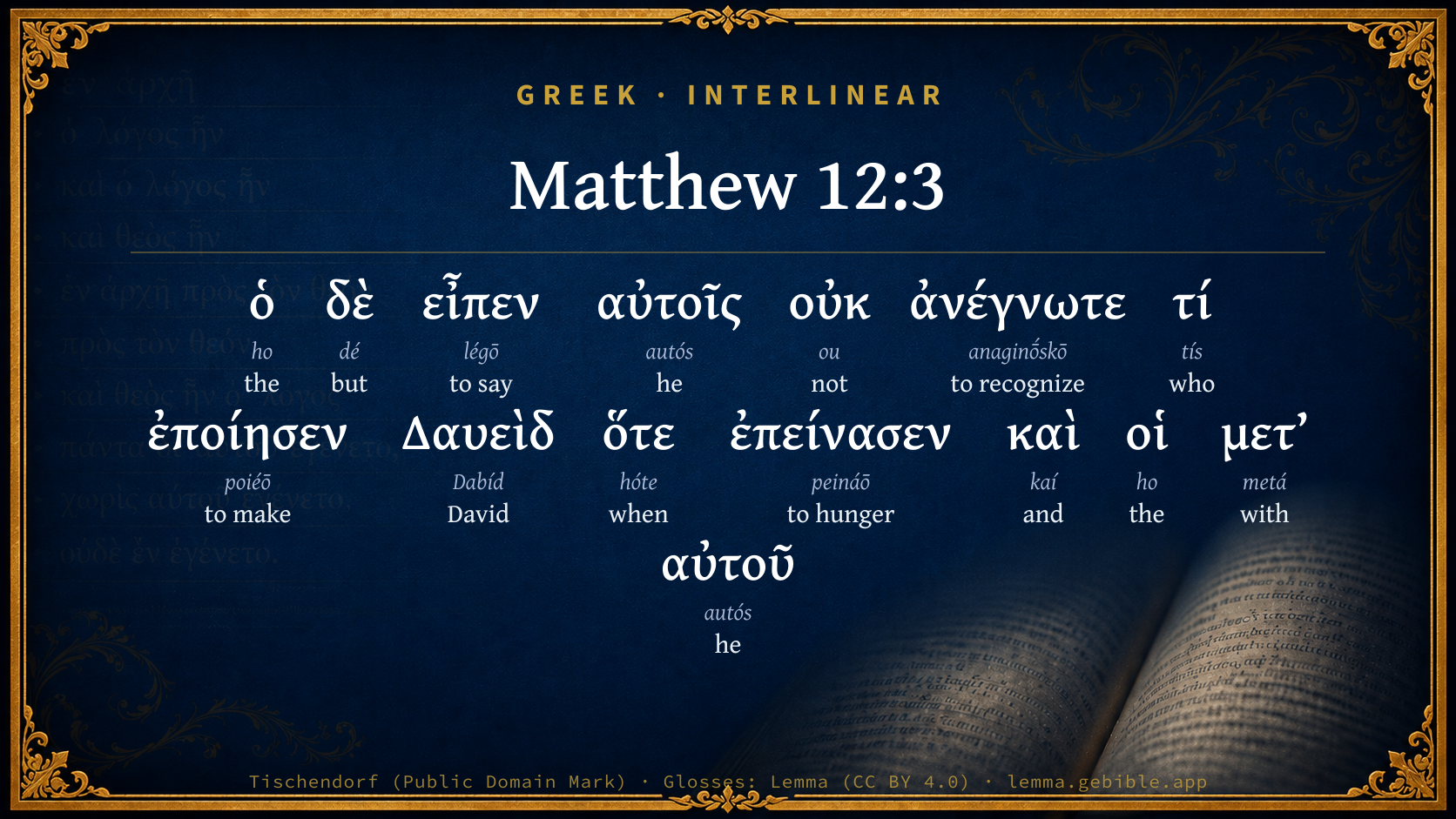
Download image
Cite this verse

Matthew 12:3 (World English Bible). Public Domain. Lemma interlinear Bible study tool, https://lemma.gebible.app/v/matthew/12/3.

Show BibTeX & RIS
BibTeX
RIS
English Translation
But he said to them, "Haven't you read what David did, when he was hungry, and those who were with him;
World English Bible · Public Domain
Highlights
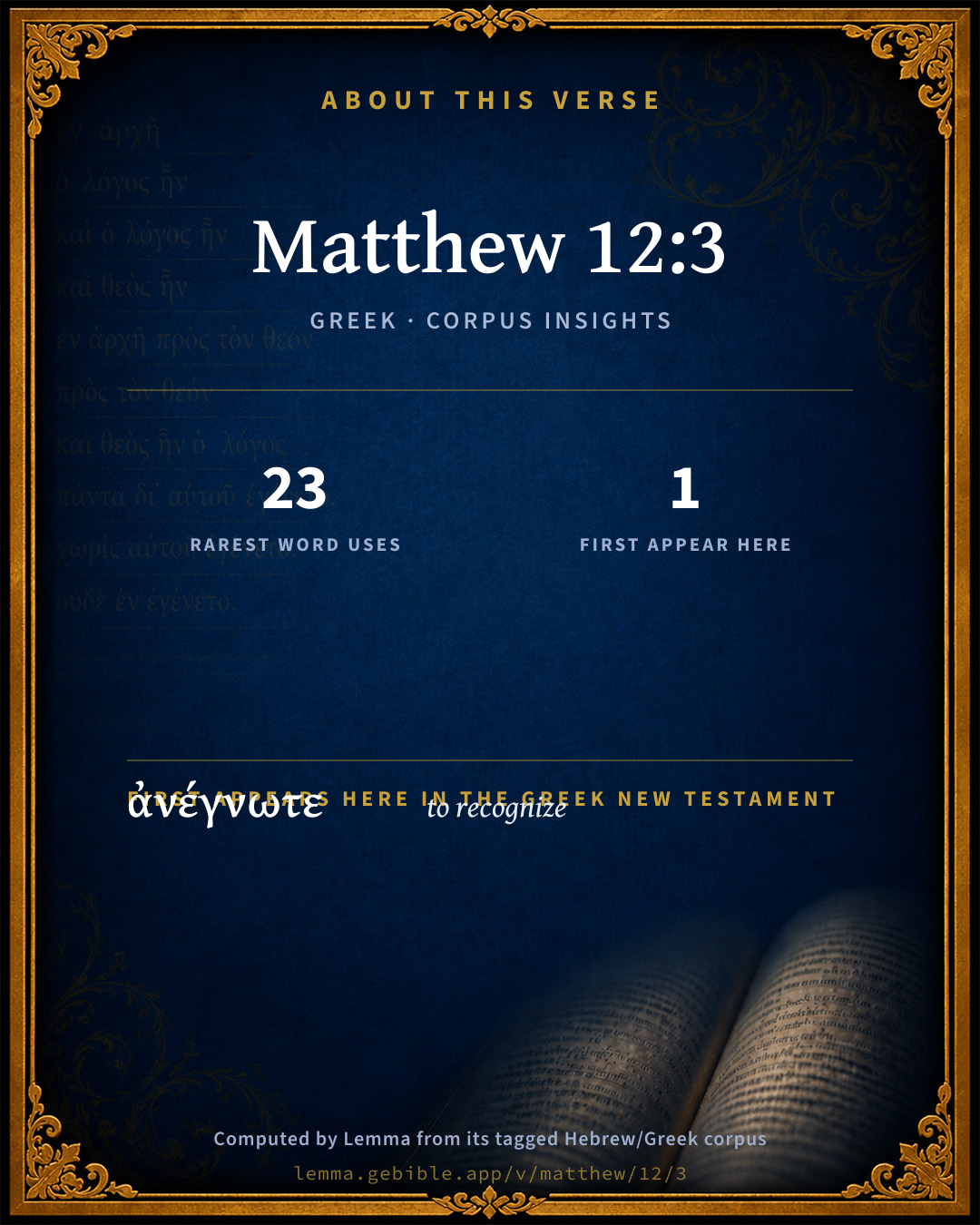
  • 1 first appearance in the Greek New Testament
Full analysis ↓
Download a study sheet

One document with this verse’s original text, its word-by-word gloss line, the meaning frame, cross-references with their text, attributed commentary, and full source and license credits — printable, and it pastes into notes with its structure intact.

This verse Autodidact and up

Study sheet (.html) Plain text (.txt)

A passage Seminary Student

Up to 50 verses in one chapter. A passage sheet keeps up to 6 commentary sources and 12 cross-references per verse, in the order this page ranks them, and says so on the sheet whenever that leaves anything out. Ask for a single verse and you get the Autodidact verse sheet above.

Everything on this page stays free to read, with no account — the sheet is a download of what is already on screen, not access to it.

Want to remove ads? Support Godless Engineer
Compare translations 3

The same verse in 3 English versions, stacked beneath the original-language interlinear above. Click any original word for its lexicon entry.

Each is an independent rendering of the whole verse — the interlinear is not word-aligned to these translations.

Highlighted words mark where these versions differ — a whole-verse word diff, not a word-by-word alignment.

  • World English Bible Public Domain
    But he said to them, "Haven't you read what David did, when he was hungry, and those who were with him;
  • King James Version Public Domain
    But he said unto them, Have ye not read what David did, when he was an hungred, and they that were with him;
  • unfoldingWord Literal Text CC BY-SA 4.0
    But he said to them, “Have you not read what David did when he was hungry, and the ones with him—

unfoldingWord Literal Text — © unfoldingWord, licensed CC BY-SA 4.0. Word-aligned USFM3 via Door43 (git.door43.org/unfoldingWord/en_ult).

Versions to compare (up to 4)

3 of 4 selected

Show all 19 translations

Every available English version of this verse, each an independent rendering of the whole verse.

  • World English Bible Public Domain
    But he said to them, "Haven't you read what David did, when he was hungry, and those who were with him;
  • Berean Standard Bible Public Domain
    Jesus replied, “Have you not read what David did when he and his companions were hungry?
  • Majority Standard Bible Public Domain
    Jesus replied, “Have you not read what David did when he and his companions were hungry?
  • King James Version Public Domain
    But he said unto them, Have ye not read what David did, when he was an hungred, and they that were with him;
  • American Standard Version (1901) Public Domain
    But he said unto them, Have ye not read what David did, when he was hungry, and they that were with him;
  • Revised Version (1885) Public Domain
    But he said unto them, Have ye not read what David did, when he was an hungred, and they that were with him;
  • Geneva Bible (1599) Public Domain
    But he said vnto them, Haue ye not read what Dauid did when he was an hungred, and they that were with him?
  • Douay-Rheims (1899) Public Domain
    But he said to them: Have you not read what David did when he was hungry, and they that were with him:
  • Young's Literal Translation Public Domain
    And he said to them, `Did ye not read what David did, when he was hungry, himself and those with him --
  • Literal Standard Version CC BY-SA 4.0
    And He said to them, “Did you not read what David did when he was hungry, himself and those with him—
  • Unlocked Literal Bible CC BY-SA 4.0
    But Jesus said to them, “Have you never read what David did, when he was hungry, and the men who were with him?
  • unfoldingWord Literal Text CC BY-SA 4.0
    But he said to them, “Have you not read what David did when he was hungry, and the ones with him—
  • Darby Bible Public Domain
    But he said to them, Have ye not read what David did when he was hungry, and they that were with him?
  • World Messianic Bible Public Domain
    But he said to them, “Haven’t you read what David did when he was hungry, and those who were with him:
  • Webster's Bible Public Domain
    But he said to them, Have ye not read what David did when he was hungry, and they that were with him;
  • Free Bible Version CC BY-SA 4.0
    But Jesus told them, “Haven't you read what David did when he and his men were hungry?
  • Bible in Basic English Public Domain
    But he said to them, Have you no knowledge of what David did when he had need of food, and those who were with him?
  • Text-Critical English NT CC BY 4.0
    He said to them, “Have you not read what David did when he was hungry, he and those who were with him,
  • Tyndale New Testament (1534) Public Domain
    He sayde vnto the: Haue ye not reed what David did when he was anhougered and they also which were with him?

Literal Standard Version (2020), Covenant Press — licensed CC BY-SA 4.0. Text via the HelloAO Bible API (eBible.org). Unlocked Literal Bible (unfoldingWord) — licensed CC BY-SA 4.0. Text via the HelloAO Bible API (eBible.org). unfoldingWord Literal Text — © unfoldingWord, licensed CC BY-SA 4.0. Word-aligned USFM3 via Door43 (git.door43.org/unfoldingWord/en_ult). Free Bible Version, Dr. Jonathan Gallagher — licensed CC BY-SA 4.0. Text via the HelloAO Bible API (eBible.org).

Word by word

More ways to search: Search by grammar → Find every occurrence → Compare this word →

Practice this passage: Drill this verse → Learn its vocabulary →

ἐπείνασεν
peináō
G3983
“to hunger”
Verb, Aorist, Active, Indicative, 3rd person, Singular
Part of Speech
Verb
Tense
Aorist
Voice
Active
Mood
Indicative
Person
3rd person
Number
Singular
Full Thayer's Definition

Origin: "from the same as G3993 (through the idea of pinching toil; "pine")"

TDNT: 06:12,8

1. to hunger, be hungry a. to suffer want b. to be needy 2. metaph. to crave ardently, to seek with eager desire
  1. ὁ ho G3588 “the” Article, Nominative, Singular, Masculine
  2. δὲ dé G1161 “but” Conjunction
  3. εἶπεν légō G3004 “to say” Verb, Aorist, Active, Indicative, 3rd person, Singular
  4. αὐτοῖς autós G846 “he” Personal pronoun, Dative, Plural, Masculine
  5. οὐκ ou G3756 “not” Particle, Negative
  6. ἀνέγνωτε anaginṓskō G314 “to recognize” Verb, Aorist, Active, Indicative, 2nd person, Plural
  7. τί tís G5101 “who” Interrogative pronoun, Accusative, Singular, Neuter
  8. ἐποίησεν poiéō G4160 “to make” Verb, Aorist, Active, Indicative, 3rd person, Singular
  9. Δαυεὶδ Dabíd G1138 “David” Noun, Proper, indeclinable
  10. ὅτε hóte G3753 “when” Adverb
  11. καὶ kaí G2532 “and” Conjunction
  12. οἱ ho G3588 “the” Article, Nominative, Plural, Masculine
  13. μετ’ metá G3326 “with” Preposition
  14. αὐτοῦ autós G846 “he” Personal pronoun, Genitive, Singular, Masculine

About this verse

These counts appear in no published source. They are computed here, from the morphology-tagged text and Lemma’s own curated glosses. What Lemma adds →

15
words
13
distinct lemmas
Gospels
section

Notable vocabulary

The rarest word here is ἐπείνασεν to hunger G3983 — appearing just 23 times in the whole Greek New Testament.

First appearance in Scripture

This word makes its first canonical appearance in the Greek New Testament here:

  • ἀνέγνωτε to recognize G314

Shared distinctive vocabulary

ἐπείνασεν to hunger G3983 occurs in 23 verses of the Greek New Testament. Also found in:
Repetition

Words recur within this verse:

  • ὁ the G3588 ×2
  • αὐτοῖς he G846 ×2

Cross-references

10

Topical passages linked to Matthew 12:3 in the Treasury of Scripture Knowledge — connected by theme and wording, ordered by reader-vote popularity; previews shown in the World English Bible.

  • 1 Samuel 21:3–6 Now therefore what is under your hand? give me five loaves of bread in my hand, or whatever there is present.
  • Luke 6:3 Jesus, answering them, said, "Haven't you read what David did when he was hungry, he, and those who were with him;
  • Mark 2:25–26 He said to them, "Did you never read what David did, when he had need, and was hungry--he, and they who were with him?
  • Matthew 21:16 and said to him, "Do you hear what these are saying?" Jesus said to them, "Yes. Did you never read, 'Out of the mouth of babes and nursing babies you have perfected praise?'"
  • Mark 12:10 Haven't you even read this Scripture: 'The stone which the builders rejected, The same was made the head of the corner.
  • Matthew 12:5 Or have you not read in the law, that on the Sabbath day, the priests in the temple profane the Sabbath, and are guiltless?
  • Matthew 22:31 But concerning the resurrection of the dead, haven't you read that which was spoken to you by God, saying,
  • Mark 12:26 But about the dead, that they are raised; haven't you read in the book of Moses, about the Bush, how God spoke to him, saying, 'I am the God of Abraham, the God of Isaac, and the God of Jacob?'
  • Matthew 19:4 He answered, "Haven't you read that he who made them from the beginning made them male and female,
  • Luke 10:26 He said to him, "What is written in the law? How do you read it?"

Cross-references courtesy of OpenBible.info (CC BY 4.0).

Commentary

Notes on Matthew 12:3 from classic Christian and Jewish commentators (each source and its license shown beneath its notes). The classic Christian expositions comment on the surrounding passage and are grouped to its opening verse, so a note may address several verses; the Jewish commentaries on the Tanakh (Rashi and others) are per-verse, so they appear only where the commentator wrote on this verse.

Lemma curates 59 commentaries, every one of them public domain or Creative Commons licensed, each selected and text-cleaned for this edition rather than reprinted as found. About our sources →

Tyndale Open Study Notes

Tyndale Open Resources

12:3-7 The Pharisees did not understand that the Sabbath was designed to benefit people. Their view of the Sabbath placed onerous burdens on people.

12:3-4 Ritual laws were at times rightly suspended for particular people or circumstances (1 Sam 21:1-6).

Tyndale Open Study Notes — © Tyndale Open Resources, licensed CC BY-SA 4.0. Text via the HelloAO Bible API.

Bengel's Gnomon

Johann Albrecht Bengel

Mat 12:3. Οὐκ ἀνέγνωτε, have ye not read) They had read the letter, without perceiving the spirit. Our Lord convicts them of error by the authority of the Old Testament.—Δαυὶδ, David) whose conduct, in this instance, you do not find fault with.—ὅτε ἑπείνασεν, when he was hungry) This is left, in 1Sa 21:3, to be understood by the reader.—μετʼ αὐτοῦ, with him) See ibid. Mat 12:4.

Bengel's Gnomon of the New Testament — English translation (T&T Clark, Edinburgh, 1860) — public domain. Text from a community e-Sword module.

Meyer's Critical & Exegetical Commentary

Heinrich August Wilhelm Meyer

Mat_12:3-4. Ἀνέγνωτε] 1 Samuel 21

The spurious αὐτός is unnecessary; καὶ οἱ μετʼ αὐτοῦ is connected with τί ἐποίησεν Δαυείδ. Comp. Thuc. i. 47. 2 : ἔλεγε δὲ ὁ Στύφων καὶ οἱ μετʼ αὐτοῦ, and Poppos note.

οἶκος τοῦ θεοῦ] in this instance the tabernacle, which was then at Nob. Comp. Exo_23:19. For the twelve pieces of shew-bread, on this occasion called ἄρτοι τῆς προθέσεως, i.e. לֶחֶם הַמַּעֲרֶכֶת, loaves of the pile (1Ch_23:29; Exo_40:23), elsewhere named ἄρτοι τοῦ προσώπου, לֶחֶם הַפָּנִים, loaves of the presence (of God), 1Sa_21:7, which, as a meat-offering, stood in the holy place, arranged in two rows upon a golden table, and were renewed every Sabbath, those of the previous week being given to the priests, see Lev_24:5 ff.; Lund, Jüd. Heiligth., ed. Wolf, p. 134 ff.; Ewald, Alterth. pp. 37, 153; Keil, Arch. I. p. 91.

εἰ μή] only appears to stand for ἀλλά, and retains its usual meaning of nisi. The language, however, assumes the tone of absolute negation: which it was not lawful for Him to eat, nor for those who were with Him, not lawful except for the priests alone. The neuter ὅ (see the critical remarks) indicates the category: what, i.e. which kind of food. See Matthiae, p. 987; Kühner, II. 1, p. 55. Comp. note on Gal_1:7; Gal_2:16; Luk_4:26 f.; Dindorf in Steph. Thes. III. p. 190 C; Fritzsche, ad Rom. III. p. 195.

Meyer — Critical and Exegetical Commentary on the New Testament — English translation by Peter Christie, edited by Frederick Crombie (T&T Clark, 1880) — public domain. Text from a community e-Sword module.

Expositor's Greek Testament

ed. W. Robertson Nicoll

Mat 12:3-8 . Christ’s defence . It is twofold. (1) He shields disciples by examples: David and the priests; to both the faultfinders would defer (Mat 12:3-5 ); (2) He indicates the principles involved in the examples (Mat 12:6-8 ). The case of David was apposite because ( a ) it was a case of eating, ( b ) it probably happened on Sabbath, ( c ) it concerned not only David but, as in the present instance, followers ; therefore οἱ μετʼ αὐτοῦ , Mat 12:3 , carefully added. ( b ) does not form an element in the defence, but it helps to account for the reference to David’s conduct. In that view Jesus must have regarded the act of David as a Sabbatic incident, and that it was may not unnaturally be inferred from 1Sa 21:6 . Vide Lightfoot, ad loc. This was probably also the current opinion. The same remark applies to the attendants of David. From the history one might gather that David was really alone, and only pretended to have companions. But if, as is probable, it was usually assumed that he was accompanied, Jesus would be justified in proceeding on that assumption, whatever the fact was ( vide Schanz, ad loc ).

The Expositor's Greek Testament, edited by W. Robertson Nicoll (1897–1910) — public domain. Text from a community e-Sword module.

Jamieson, Fausset & Brown

Robert Jamieson, A. R. Fausset & David Brown

But he said unto them, Have ye not read--or, as Mark (Mar 2:25) has it, "Have ye never read."

what David did when he was an hungered, and they that were with him-- (Sa1 21:1-6)

Jamieson, Fausset & Brown — Commentary Critical and Explanatory on the Whole Bible (1871) — public domain (CC PDM 1.0). Text via the HelloAO Bible API.

Adam Clarke's Commentary

Verse 3. - 4. Have ye not read what David did] The original history is in 1Sa 21:1-6.

When he was an hungered] Here hearken to Kimchi, producing the opinion of the ancients concerning this story in these words: "Our rabbins of blessed memory say, that he gave him the shew-bread, c. The interpretation also of the clause, Yea, though it were sanctified this day in the vessel, is this: It is a small thing to say, that it is lawful for us to eat THESE LOAVES, taken from before the Lord, when we are hungry for it would be lawful to eat this very loaf which is now set on, which is also sanctified in the vessel, (for the table sanctifieth), it would be lawful to eat even this, when another loaf is not present with you to give us, and we are so hunger-bitten. And a little after, There is nothing which may hinder taking care of life, beside idolatry, adultery, and murder. That is, a man, according to them, should do any thing but these in order to preserve life." See Lightfoot.

He entered into the house of God] Viz. the house of Ahimelech the priest, who dwelt at Nob, with whom the tabernacle then was, in which the Divine presence was manifested.

And did eat the shew-bread] τους αρτους τνς προθεσεως - in Hebrew, לחם פנים lechem panim - bread of the presence, or faces, because this bread was to be set continually, לפני יהוה lipney Yehovah, before the face of Jehovah. See the notes on Ex 25:23; Ex 25:30.

"Since part of the frankincense put in the bread was to be burnt on the altar for a memorial, Le 24:7, and since Aaron and his sons were to eat it in the holy place, it is evident that this bread typified Christ, first presented as a sacrifice to, or in the presence of, Jehovah, and then becoming spiritual food to such as, in and through him, are spiritual priests to God. See Re 1:6; Re 5:10; Re 20:6; also 1Pe 2:5." Parkhurst.

Adam Clarke's Commentary on the Bible (1810–1826) — public domain. Text from a community e-Sword/MySword module.

Ellicott's Commentary for English Readers

(3) Have ye not read . . .?—The question was an appeal to the Pharisees on the ground where they thought themselves strongest. For them it was an argument à fortiori. Would they accuse David of sacrilege and Sabbath-breaking because he, in a case of urgent need, set at nought the two-fold law of ordinances? If they shrank from that, was it not inconsistent to condemn the disciples of Jesus for a far lighter transgression?

A Bible Commentary for English Readers, edited by Charles John Ellicott (1878–1897) — public domain. Text from a community e-Sword module.

The Cambridge Bible for Schools and Colleges

gen. ed. J. J. S. Perowne

3. Ahimelech, the priest at Nob, gave David and his companions five loaves of the shewbread (1Sa_21:1-7).

The Cambridge Bible for Schools and Colleges (gen. ed. J. J. S. Perowne; Cambridge University Press, 1878–1918) — public domain. Text from a community e-Sword module.

John Gill's Exposition

But he said unto them, have ye not read,.... If they had not read the Scriptures, they were very unfit persons either to be teachers, or censurers of others, and must have been very slothful and negligent; and if they had, they could not but have observed the case of David, which Christ produces in vindication of his disciples:

what David did when he was an hungred; which was the case of the disciples, and is therefore mentioned; it being also the circumstance which could, and did excuse what was done by David and his men: and the Jews themselves own, that in case of hunger the showbread might be eaten, by those that were not priests; not only that which was removed from the table, but that which was upon it; yea, even when there was none to put in its room (l); and that David was in the utmost distress, and therefore desired it, and it was granted him on that account. They represent him as thus saying to the priest (m),

"when he found there was none but showbread, give it me, that we may not die with hunger; , "for danger of life drives away the sabbath";''

which perfectly agrees with our Lord's argument, and justifies the apostles conduct: and this was not a single fact of David's, but of others also;

and they that were with him; for though in Sa1 21:1 he is said to be "alone, and no man with him"; yet this must be understood either comparatively, having but very few with him, and which were as none, considering his dignity; or thus, though none came with him to Ahimelech, pretending to the priest he had a secret affair of the king's to transact; and therefore had left his servants in a certain place, and desires bread for himself and them; concerning whom the priest and he discourses, as may be seen in the place referred to: so that though no man was with him at the priest's house, yet there were some with him, and who partook with him in eating of the showbread.

(l) R. David Kimchi in 1 Sam. xxi. 5. (m) Laniado Cli Jaker, fol. 227. 2.

John Gill's Exposition of the Whole Bible (1746–1763) — public domain (CC PDM 1.0). Text via the HelloAO Bible API.

Trapp's Complete Commentary

John Trapp

3 But he said unto them, Have ye not read what David did, when he was an hungred, and they that were with him;

Ver. 3. But he said unto them] They had not proved a breach of the Sabbath, neither could they. A breach it had been, had not the disciples been hungry, and he denies it not, but confutes their present cavils by clear syllogisms, one in the neck of another, such as they could not answer, nor abide, {a} and therefore sought to destroy him, Mat 12:14. See here the lawful use of logic in divinity, and mistake not St Jerome, Qui syllogizandi artem, applicatam Theologiae, comparat plagis Aegypti: understand him of that false sophistry, which the apostle calleth vain philosophy, Col. ii.

David did when he was an hungred] Note here, that our Saviour excuseth David from his necessity, not from his dignity, which in point of sin God regards not; Potentes potenter torquebuntur. And yet how many are there who think, that when they have gotten an office, they may oppress at pleasure, swear by authority, drink and swill without control? But height of place ever adds two wings to sin, example and scandal. And ill accidents ever attend such great ones, as, being absolute in power, will be too resolute in will and dissolute in life. Queen Elizabeth said that princes owe a double duty to God: 1. As men. 2. As princes. Sedes prima et vita ima, is as unsuitable as for those that are clothed in scarlet to embrace the dunghill, Lam 4:5.

{a} Manifestis syllogismis adversarios redarguit. Gualt.

John Trapp, A Commentary or Exposition upon All the Books of the Old and New Testament (1647–1656) — public domain. Text from a community e-Sword module.

Albert Barnes' Notes on the Bible

But he said unto them ... - To vindicate his disciples, he referred them to a similar case, recorded in the Old Testament, and therefore one with which they ought to have been acquainted. This was the case of David. The law commanded that twelve loaves of bread should be laid on the table in the holy place in the tabernacle, to remain a week, and then to be eaten by the “priests only.” Their place was then supplied by fresh “bread.” This was called the “showbread,” Lev 24:5-9. David, fleeing before Saul, weary and hungry, had come to Ahimelech the priest; had found only this bread; had asked it of him, and had eaten it contrary to the “letter” of the law, 1Sa 21:1-7. David, among the Jews, had high authority. This act had passed uncondemned. It proved that in “cases of necessity the laws did not bind a man” - a principle which all laws admit. So the “necessity” of the disciples justified them in doing on the Sabbath what would have been otherwise unlawful.

Albert Barnes' Notes on the Bible (1834–1885) — public domain. Text from a community e-Sword/MySword module.

Haydock's Catholic Bible Commentary

What David, &c.[1] Christ shews them that the law need not always be taken according to the bare letter. --- Into the house of God; i.e. where the tabernacle was then kept: not into the temple, which at that time was not built. --- Eat the loaves, &c. Christ speaks of those loaves which were ordered to be placed on a table within the tabernacle, and changed from time to time. This translation seems as literal as may be, and more intelligible than loaves of proposition, or shew-bread. (Witham) --- To refute this calumny of the Jewish leaders, Jesus reminds them of the conduct of David when pursued by Saul, who, reduced to the like extremity, eat of that bread which the priests alone were allowed to touch. Achimelec, the high priest, thinking it a more pleasing sacrifice to God to preserve the life of man, than to make an offering of bread. (St. Jerome) --- And they that were with him. In the place alluded to, (1 Kings xxi.) it is said, that he was alone. It may be answered, that no one was with him when he received the loaves. (Menochius)

===============================

[BIBLIOGRAPHY]

Panes Propositionis. Greek: tous artous protheseos. They are also elsewhere called, panes faciales, Greek: artous enopious, (Deuteronomy xxv. 30.) and faciei, Greek: tou prosopou. (2 Esdras x. 33.)

George Leo Haydock (1774–1849), Haydock's Catholic Family Bible and Commentary, 1859 edition — public domain. Excludes Psalms (Douay-Rheims chapter numbering differs from Protestant) and Deuterocanonical books (Catholic canon only).

Matthew Poole's English Annotations

Mark and Luke add little, only Mark specifies the time, in the days of Abiathar the high priest, and saith, when he had need, and was an hungred. We have the history, 1Sa 21:1-15. David was upon his flight from Saul, upon the notice of his danger given him by Jonathan, 1Sa 20:1-42, and being hungry, he asks of the high priest five loaves of broad; the high priest tells him he had none but hallowed bread, which the high priest gave him, 1Sa 21:6. What the shewbread was may be read, Lev 24:5-9; it is expressly said, a stranger shall not eat thereof. Now (saith our Saviour) notwithstanding this, David and his followers, being an hungred, did eat thereof, though strictly, according to the letter of the law, none but the priests might eat it.

But some may object: What was this to the purpose? It was not upon the sabbath day.

Answer:

1. It was either upon the sabbath day, or immediately after, for it was to be set on every sabbath day, and to be eaten in the holy place, Lev 24:8,9, and the high priest told David, 1Sa 21:6, that it was taken away to set hot bread in the room of it.

2. But secondly, that which our Saviour produces this for, was to prove a more general proposition, which being proved, the lawfulness of his disciples’ act would easily be inferred from it. That was this: That the letter of a ritual law is not to be insisted upon, where some eminent necessity urges the contrary, in the performance of some natural or moral duty.

The law of nature commandeth every man to feed himself when he is hungry. The moral law confirms this, as it is a means to the observation of the sixth commandment, and especially on the sabbath day, so far as may fit us for the best sanctification of it. The law concerning the shewbread was but a ritual law, and that part of it which restrained the use of it when taken off from the holy table was of lightest concern, as it commanded it should be eaten by the priests only, and by them in the holy place. Where the life, or necessary relief, of men was concerned, the obligation of the ritual law ceased, and that was lawful, both for David and the high priest, which in ordinary cases had not been lawful. Works necessary either for the upholding of our lives, or fitting us for sabbath services, are lawful upon the sabbath day. Though the law concerning the sabbath be a moral law, yet it is jus positivum, not a law natural, but positive, and must be so interpreted as not to destroy the law natural, which commands men to feed themselves; nor yet to destroy itself. The scope and end of it is to be considered, which is the keeping of a day as a day of holy and religious rest. What labour is necessary to such keeping of it is also lawful. The time of the sabbath is not more holy than the shewbread; and as David in a case of necessity might make a common use of that holy bread, so the disciples in a case of like necessity might make use of a little of that holy time, in such necessary servile work as might fit them for their sabbath service. Thus it was lawful by the law of God, and if the Pharisees had not been ignorant, or had understood what they had read, they would never have disputed this, the instance of holy David might have satisfied. So that this little kind of labour could only be a breach of one of their bylaws, by which they pretended to expound the law of God, in which he showeth they had given a false interpretation.

Matthew Poole's English Annotations on the Holy Bible (1683–1685) — public domain. Text from a community e-Sword/MySword module.

Whedon's Commentary on the Bible

Daniel D. Whedon

3. Read what David did — Our Lord here is not arguing for a proper breaking of the law, but for its true construction. The mere formality of a ritual or strict letter of a positive precept is to yield to the demands of the true good, or the alternative consequence of essential evil. He shows this by an example of David, (1Sa_21:1-7,) who infringed the letter of the ceremonial law by obtaining from the priest and eating the showbread belonging to the tabernacle. To the necessity of preventing starvation the sanctity both of the showbread and of the Sabbath might yield. These institutions were both given in mercy, and it would be perverting their purpose to make them instruments of cruelty.

The showbread (in Hebrew, the bread of the presence, that is, of the divine presence) was placed first in the tabernacle and afterward in the temple of Solomon, on a table, in the Holy Place. As the temple was the house of God, so, symbolically, this was the bread of God. So the candlestick and other furnishings of the sacred place were emblems of the residence of Jehovah among his people.

3. After the resurrection of Christ the Jewish Sabbath, which was laid upon the primitive Sabbath, was abolished, and “the Lord’s day,” (Rev_1:10,) or Christian Sabbath, was superimposed upon another day. Thus the Christian Sabbath, being the same as the decalogue Sabbath, or the creation Sabbath, is of perpetual obligation and universal observance.

Daniel D. Whedon (gen. ed.), Commentary on the Old and New Testaments (1874–1909) — public domain. Text from a community e-Sword module.

The Pulpit Commentary

But he said unto them, Have ye not read. Our Lord answers them by showing that the principle of the action of his disciples was sanctioned in the Scriptures to which they implicitly appealed. He calls their attention first ( more Rabbinico; cf. on ver. 5) to the Prophets (i.e. the former prophets, according to the Hebrew division), as teaching by example that holy things are of secondary importance compared with the benefit of God"s people; and afterwards to the Law, which implies that the sabbath itself is of secondary importance compared with work necessary for the sanctuary. He then affirms that in the present case there is One present who is even greater than the sanctuary. He goes on to say that their complaint, however, was really due to the lack, not so much of intellectual as of spiritual knowledge; they had no rapprochement with the God of love, or they would not have condemned those who, both because they were men and because they were disciples of the Son of man, stood above the sabbath. What David did, when he was a hungred, and they that were with him. (1Sa_21:1-7)

The Pulpit Commentary (1880–1919), ed. H.D.M. Spence-Jones & Joseph S. Exell — public domain. Text from a community e-Sword module.

John Wesley's Explanatory Notes

Have ye not read what David did - And necessity was a sufficient plea for his transgressing the law in a higher instance.

John Wesley, Explanatory Notes Upon the Whole Bible (1754–1765) — public domain. Text via the GEBible commentary corpus.

Scofield Reference Notes

C. I. Scofield

what David did

Jesus’ action Mat 12:1-7 is highly significant. "What David did" refers to the time of his rejection and persecution by Saul. 1Sa 21:6. Jesus here is not so much the rejected Saviour as the rejected King; hence the reference to David.

The Scofield Reference Bible (1917 edition), notes by C. I. Scofield — public domain. Text from a community e-Sword module.

Burkitt's Expository Notes on the New Testament

William Burkitt

In these words our Saviour defends the action of his disciples in plucking the ears of corn in their necessity, by a double argument.

1. From David’s example: necessity freed him from fault in eating the consecrated bread, which none but the priest might lawfully eat; for in cases of necessity, a ceremonial precept must give place to a moral duty: works of mercy and necessity, for preserving our lives, and the better fitting us for sabbath-services, are certainly lawful on the sabbath-day.

2. From the example of the priests in the temple who upon the sabbath do break the outward rest of the day, by killing their sacrifices, and many other acts of bodily labour, which would be accounted sabbath-profanation, did not the service of the temple require and justify it.

Now, saith our Saviour, if the temple-service can justify labour on the sabbath, I am greater than the temple, and my authority and service can justify what my disciples have done.

From the whole we learn, That acts of mercy, which tend to fit us for works of piety, not only may, but ought to be, done on the sabbath-day.

William Burkitt's Expository Notes on the New Testament (1700–1703) — public domain. Text from a community e-Sword module.

The People's New Testament

B. W. Johnson

3. Have ye not read. The Lord answers them by citing the case of David, who, under necessity, took, ate, and gave to his followers the shew bread which it was lawful for priests only to eat. Necessity rose higher than ceremonial. See 1 Sam. 21:1–6.

B. W. Johnson's The People's New Testament with Notes (1889–1891) — public domain. Electronic text from the Christian Classics Ethereal Library (CCEL) ThML edition.

unfoldingWord translationNotes

Door43 World Missions Community

Connecting Statement:

Jesus responds to the Pharisees' criticism.

to them

"to the Pharisees"

Have you never read ... with him?

Jesus uses a question to respond to the criticism of the Pharisees. Jesus is challenging them to think about the meaning of the scriptures they have read. AT: "I know you have read about ... with him" (See: Rhetorical Question)

the house of God

During the time of David there was no temple yet. AT: "the tabernacle" or "the place for worshiping God"

bread of the presence

This is sacred bread that priests placed before God in the tabernacle. AT: "bread that the priest placed before God" or "the sacred bread" (See: Assumed Knowledge and Implicit Information)

those who were with him

"the men who were with David"

but lawful only for the priests

"but, according to the law, only the priest could eat it"

translationWords

David

house of God

lawful

lawful

priest

unfoldingWord translationNotes — © Distant Shores Media and the Door43 World Missions Community, licensed CC BY-SA 4.0. Source: git.door43.org/Door43/en_tn.

Cambridge Greek Testament for Schools and Colleges

3. Ahimelech, the priest at Nob, gave David and his companions five loaves of the shewbread (1Sa 21:1-7). ‘It is no improbable conjecture that David came to Nob either on the Sabbath itself, or when the Sabbath was but newly gone.’ Lightfoot, Hor. Heb. ad loc.

Cambridge Greek Testament for Schools and Colleges (Cambridge University Press, 1896; 21 vols, various authors incl. Carr, Maclear, Plummer, Farrar, Lumby, Moule, M. R. James, Simcox) — public domain. Text from a community e-Sword module.

Alford’s Greek Testament

Henry Alford

3.] It appears from 1Sa 21:6, that hot bread had been put in on the day of David’s arrival; which therefore, Lev 24:8, was a sabbath. The example was thus doubly appropriate. Bengel maintains, on the commonly received interpretation of σάβ. δευτερόπρωτον Luk 6:1, that 1Sa_21 was the lesson for the day. But the Jewish calendar of lessons cannot be shewn to have existed in the form which we now have, in the time of the Gospel history.

Henry Alford, The Greek Testament (1849–1861) — public domain. Text from a community e-Sword module.

International Critical Commentary

(M) 3. And He said to them, Did you not read what David did, when he was hungry, and those who were with him.] Mk. has “And He saith to them, Did ye never read what David did when he had need and was hungry; he and those who were with him?” ὁ δὲ εἶπεν] as often for Mk.’s καὶ λεγει.—οὐκ] for Mk.’s οὐδέποτε.—ὅτε ἐπείνασεν] Mk. has two clauses: ὅτε χρείαν ἔσχεν καὶ ἐπείασεν. For Mt.’s omission of one of two synonymous clauses, see Introduction, p. xxv.—καὶ οἱ μετʼ αὐτοῦ] Mk. prefixes αὐτός.

International Critical Commentary — older volumes (1896–1929), various authors — public domain. Text from a community e-Sword module.

Lesson kit

Teaching starters — assembled from the data on this page, not authored interpretation. Every prompt links to the verse data it draws on. Edit before teaching.

Matthew, in the Gospels, opens this verse with 15 words (13 distinct Greek lemmas). Its most distinctive word is peináō (“to hunger”). A historical commentator’s framing appears above. Read the whole chapter for the surrounding context.

Discussion questions

  1. The word peináō carries the sense “to hunger.” How does it shape the verse?
  2. The word “to recognize” first appears here in Scripture. What is being introduced at this debut?
  3. Matthew 4:2 shares the word «to hunger» with this verse. How do the two illuminate each other?
  4. “the” occurs 2× in this one verse. What is the effect of the repetition?
  5. These translations render this verse differently; the difference is in the English rendering, not the original. What questions does that raise?
  6. Reading how Tyndale Open Study Notes and Bengel's Gnomon read this verse, where do the two commentators agree and where do they part?

Things to notice

  • 1 word makes its first canonical appearance in Scripture here.
  • These translations choose different wording for 7 words in this verse.
  • “the” occurs 2× in this single verse.
  • 13 distinct Greek lemmas span 15 words in this verse.

Reading settings

Reading text

Shown beneath each verse's original-language words.

Old Testament
Old Testament edition

Read the OT as the Masoretic Hebrew (MT) or the Greek Septuagint (LXX).

English shown for the Greek Septuagint (in the Hebrew ↔ Greek comparison).

Comparing translations? Open the Compare panel on any verse page to stack up to four side by side.