Mark 2:19

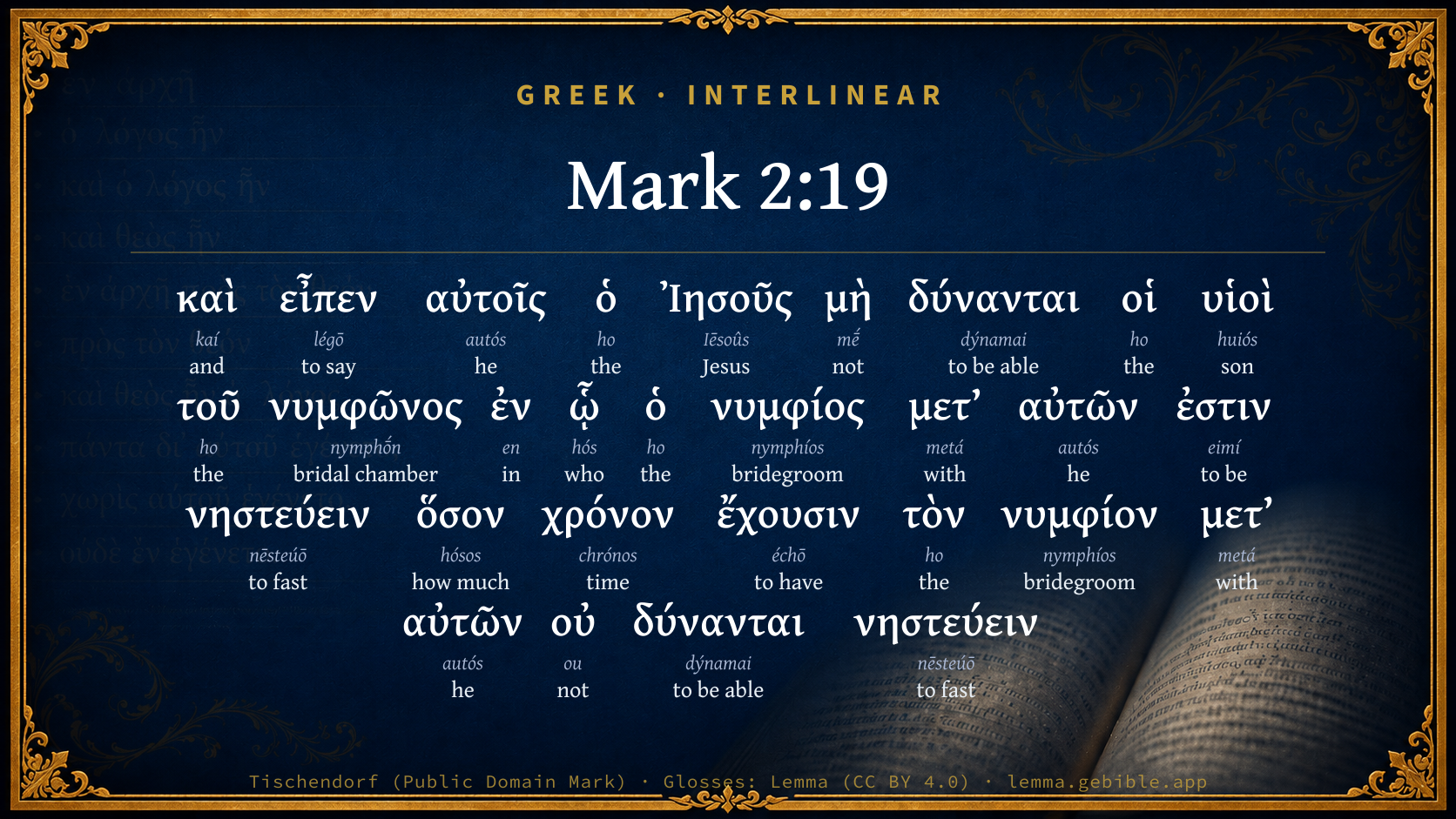
Greek (Tischendorf 8th ed.) Mark 2:19 appears in the Greek New Testament. The text above is from the Tischendorf 8th edition. Each word links to its Strong’s number and a concise gloss. Click any word for its full Thayer’s Greek Lexicon entry.
Download image
Cite this verse

Mark 2:19 (World English Bible). Public Domain. Lemma interlinear Bible study tool, https://lemma.gebible.app/v/mark/2/19.

Show BibTeX & RIS
BibTeX
RIS
English Translation
Jesus said to them, "Can the groomsmen fast while the bridegroom is with them? As long as they have the bridegroom with them, they can't fast.
World English Bible · Public Domain
Download a study sheet

One document with this verse’s original text, its word-by-word gloss line, the meaning frame, cross-references with their text, attributed commentary, and full source and license credits — printable, and it pastes into notes with its structure intact.

This verse Autodidact and up

Study sheet (.html) Plain text (.txt)

A passage Seminary Student

Up to 50 verses in one chapter. A passage sheet keeps up to 6 commentary sources and 12 cross-references per verse, in the order this page ranks them, and says so on the sheet whenever that leaves anything out. Ask for a single verse and you get the Autodidact verse sheet above.

Everything on this page stays free to read, with no account — the sheet is a download of what is already on screen, not access to it.

Want to remove ads? Support Godless Engineer
Compare translations 3

The same verse in 3 English versions, stacked beneath the original-language interlinear above. Click any original word for its lexicon entry.

Each is an independent rendering of the whole verse — the interlinear is not word-aligned to these translations.

Highlighted words mark where these versions differ — a whole-verse word diff, not a word-by-word alignment.

  • World English Bible Public Domain
    Jesus said to them, "Can the groomsmen fast while the bridegroom is with them? As long as they have the bridegroom with them, they can't fast.
  • King James Version Public Domain
    And Jesus said unto them, Can the children of the bridechamber fast, while the bridegroom is with them? as long as they have the bridegroom with them, they cannot fast.
  • unfoldingWord Literal Text CC BY-SA 4.0
    And Jesus said to them, “The sons of the bridal chamber are not able to fast while the bridegroom is still with them, are they? As much time as they have the bridegroom with them, they are not able to fast.

unfoldingWord Literal Text — © unfoldingWord, licensed CC BY-SA 4.0. Word-aligned USFM3 via Door43 (git.door43.org/unfoldingWord/en_ult).

Versions to compare (up to 4)

3 of 4 selected

Show all 19 translations

Every available English version of this verse, each an independent rendering of the whole verse.

  • World English Bible Public Domain
    Jesus said to them, "Can the groomsmen fast while the bridegroom is with them? As long as they have the bridegroom with them, they can't fast.
  • Berean Standard Bible Public Domain
    Jesus replied, “How can the guests of the bridegroom fast while He is with them? As long as He is with them, they cannot fast.
  • Majority Standard Bible Public Domain
    Jesus replied, “How can the guests of the bridegroom fast while He is with them? As long as He is with them, they cannot fast.
  • King James Version Public Domain
    And Jesus said unto them, Can the children of the bridechamber fast, while the bridegroom is with them? as long as they have the bridegroom with them, they cannot fast.
  • American Standard Version (1901) Public Domain
    And Jesus said unto them, Can the sons of the bridechamber fast, while the bridegroom is with them? as long as they have the bridegroom with them, they cannot fast.
  • Revised Version (1885) Public Domain
    And Jesus said unto them, Can the sons of the bride-chamber fast, while the bridegroom is with them? as long as they have the bridegroom with them, they cannot fast.
  • Geneva Bible (1599) Public Domain
    And Iesus saide vnto them, Can the children of the marriage chamber fast, whiles the bridegrome is with them? as long as they haue the bridegrome with them, they cannot fast.
  • Douay-Rheims (1899) Public Domain
    And Jesus saith to them: Can the children of the marriage fast, as long as the bridegroom is with them As long as they have the bridegroom with them, they cannot fast.
  • Young's Literal Translation Public Domain
    And Jesus said to them, `Are the sons of the bride-chamber able, while the bridegroom is with them, to fast? so long time as they have the bridegroom with them they are not able to fast;
  • Literal Standard Version CC BY-SA 4.0
    And Jesus said to them, “Are the sons of the bride-chamber able, while the bridegroom is with them, to fast? As long a time [as] they have the bridegroom with them they are not able to fast;
  • Unlocked Literal Bible CC BY-SA 4.0
    Jesus said to them, “Can the wedding attendants fast while the bridegroom is still with them? As long as they have the bridegroom with them, they cannot fast.
  • unfoldingWord Literal Text CC BY-SA 4.0
    And Jesus said to them, “The sons of the bridal chamber are not able to fast while the bridegroom is still with them, are they? As much time as they have the bridegroom with them, they are not able to fast.
  • Darby Bible Public Domain
    And Jesus said to them, Can the sons of the bride-chamber fast while the bridegroom is with them? As long as they have the bridegroom with them they cannot fast.
  • World Messianic Bible Public Domain
    Yeshua said to them, “Can the groomsmen fast while the bridegroom is with them? As long as they have the bridegroom with them, they can’t fast.
  • Webster's Bible Public Domain
    And Jesus said to them, Can the children of the bride-chamber fast, while the bridegroom is with them? As long as they have the bridegroom with them, they cannot fast.
  • Free Bible Version CC BY-SA 4.0
    “Do wedding guests fast while the bridegroom is with them?” Jesus asked them. “No. While the bridegroom's with them, they can't fast.
  • Bible in Basic English Public Domain
    And Jesus said to them, Will the friends of a newly-married man go without food while he is with them? as long as they have him with them they will not go without food.
  • Text-Critical English NT CC BY 4.0
    Jesus said to them, “Can the bridegroom's attendants fast while the bridegroom is with them? As long as they have the bridegroom with them they cannot fast.
  • Tyndale New Testament (1534) Public Domain
    And Iesus sayde vnto them: can the chyldren of a weddinge faste while the brydgrome is with them. As longe as they have the brydgrome with them they cannot faste.

Literal Standard Version (2020), Covenant Press — licensed CC BY-SA 4.0. Text via the HelloAO Bible API (eBible.org). Unlocked Literal Bible (unfoldingWord) — licensed CC BY-SA 4.0. Text via the HelloAO Bible API (eBible.org). unfoldingWord Literal Text — © unfoldingWord, licensed CC BY-SA 4.0. Word-aligned USFM3 via Door43 (git.door43.org/unfoldingWord/en_ult). Free Bible Version, Dr. Jonathan Gallagher — licensed CC BY-SA 4.0. Text via the HelloAO Bible API (eBible.org).

Word by word

More ways to search: Search by grammar → Find every occurrence → Compare this word →

Practice this passage: Drill this verse → Learn its vocabulary →

νυμφῶνος
nymphṓn
G3567
“bridal chamber”
Noun, Genitive, Singular, Masculine
Part of Speech
Noun
Case
Genitive
Number
Singular
Gender
Masculine
Full Thayer's Definition

Origin: from G3565

TDNT: None

1. the chamber containing the bridal bed, the bridal chamber a. of the friends of the bridegroom whose duty it was to provide and care for whatever pertained to the bridal chamber, i.e. whatever was needed for the due celebration of the nuptials b. the room in which the marriage ceremonies are held
  1. καὶ kaí G2532 “and” Conjunction
  2. εἶπεν légō G3004 “to say” Verb, Aorist, Active, Indicative, 3rd person, Singular
  3. αὐτοῖς autós G846 “he” Personal pronoun, Dative, Plural, Masculine
  4. ὁ ho G3588 “the” Article, Nominative, Singular, Masculine
  5. Ἰησοῦς Iēsoûs G2424 “Jesus” Noun, Nominative, Singular, Masculine
  6. μὴ mḗ G3361 “not” Particle, Negative
  7. δύνανται dýnamai G1410 “to be able” Verb, Present, Middle or Passive deponent, Indicative, 3rd person, Plural
  8. οἱ ho G3588 “the” Article, Nominative, Plural, Masculine
  9. υἱοὶ huiós G5207 “son” Noun, Nominative, Plural, Masculine
  10. τοῦ ho G3588 “the” Article, Genitive, Singular, Masculine
  11. ἐν en G1722 “in” Preposition
  12. ᾧ hós G3739 “who” Relative pronoun, Dative, Singular, Masculine
  13. ὁ ho G3588 “the” Article, Nominative, Singular, Masculine
  14. νυμφίος nymphíos G3566 “bridegroom” Noun, Nominative, Singular, Masculine
  15. μετ’ metá G3326 “with” Preposition
  16. αὐτῶν autós G846 “he” Personal pronoun, Genitive, Plural, Masculine
  17. ἐστιν eimí G1510 “to be” Verb, Present, Active, Indicative, 3rd person, Singular
  18. νηστεύειν nēsteúō G3522 “to fast” Verb, Present, Active, Infinitive
  19. ὅσον hósos G3745 “how much” Correlative pronoun, Accusative, Singular, Masculine
  20. χρόνον chrónos G5550 “time” Noun, Accusative, Singular, Masculine
  21. ἔχουσιν échō G2192 “to have” Verb, Present, Active, Indicative, 3rd person, Plural
  22. τὸν ho G3588 “the” Article, Accusative, Singular, Masculine
  23. νυμφίον nymphíos G3566 “bridegroom” Noun, Accusative, Singular, Masculine
  24. μετ’ metá G3326 “with” Preposition
  25. αὐτῶν autós G846 “he” Personal pronoun, Genitive, Plural, Masculine
  26. οὐ ou G3756 “not” Particle, Negative
  27. δύνανται dýnamai G1410 “to be able” Verb, Present, Middle or Passive deponent, Indicative, 3rd person, Plural
  28. νηστεύειν nēsteúō G3522 “to fast” Verb, Present, Active, Infinitive

About this verse

These counts appear in no published source. They are computed here, from the morphology-tagged text and Lemma’s own curated glosses. What Lemma adds →

29
words
19
distinct lemmas
Gospels
section

Notable vocabulary

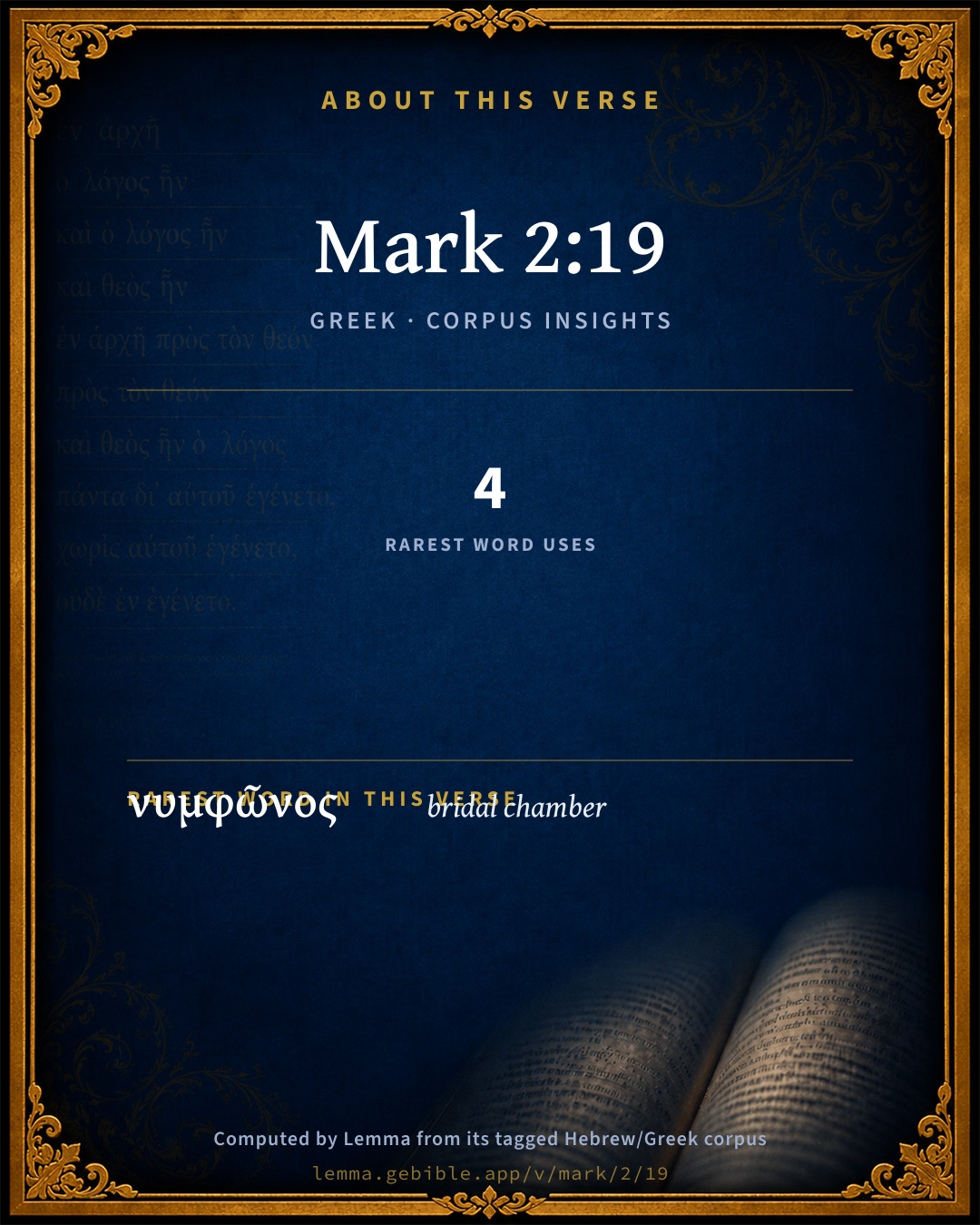
The rarest word here is νυμφῶνος bridal chamber G3567 — appearing just 4 times in the whole Greek New Testament.

Shared distinctive vocabulary

νυμφῶνος bridal chamber G3567 occurs in 4 verses of the Greek New Testament. Also found in:

Repetition

Words recur within this verse:

  • δύνανται to be able G1410 ×2
  • νυμφίος bridegroom G3566 ×2
  • νηστεύειν to fast G3522 ×2
  • ὁ the G3588 ×5
  • αὐτοῖς he G846 ×3
  • μετ’ with G3326 ×2

Cross-references

3

Topical passages linked to Mark 2:19 in the Treasury of Scripture Knowledge — connected by theme and wording, ordered by reader-vote popularity; previews shown in the World English Bible.

  • Matthew 25:1–10 "Then the Kingdom of Heaven will be like ten virgins, who took their lamps, and went out to meet the bridegroom.
  • Genesis 29:22 Laban gathered together all the men of the place, and made a feast.
  • Judges 14:10–11 His father went down to the woman: and Samson made there a feast; for so used the young men to do.

Cross-references courtesy of OpenBible.info (CC BY 4.0).

Commentary

Notes on Mark 2:19 from classic Christian and Jewish commentators (each source and its license shown beneath its notes). The classic Christian expositions comment on the surrounding passage and are grouped to its opening verse, so a note may address several verses; the Jewish commentaries on the Tanakh (Rashi and others) are per-verse, so they appear only where the commentator wrote on this verse.

Lemma curates 59 commentaries, every one of them public domain or Creative Commons licensed, each selected and text-cleaned for this edition rather than reprinted as found. About our sources →

MacLaren's Expositions of Holy Scripture

Alexander MacLaren

Mark

THE PUBLICANS’ FRIEND

THE SECRET OF GLADNESS

Mar 2:19.

This part of our Lord’s answer to the question put by John’s disciples as to the reason for the omission of the practice of fasting by His followers. The answer is very simple. It is-’My disciples do not fast because they are not sad.’ And the principle which underlies the answer is a very important one. It is this: that all outward forms of religion, appointed by man, ought only to be observed when they correspond to the feeling and disposition of the worshipper. That principle cuts up all religious formalism by the very roots. The Pharisee said: ‘Fasting is a good thing in itself, and meritorious in the sight of God.’ The modern Pharisee says the same about many externals of ritual and worship; Jesus Christ says, ‘No! The thing has no value except as an expression of the feeling of the doer.’ Our Lord did not object to fasting; He expressly approved of it as a means of spiritual power. But He did object to the formal use of it or of any outward form. The formalist’s form, whether it be the elaborate ritual of the Catholic Church, or the barest Nonconformist service, or the silence of a Friends’ meeting-house, is rigid, unbending, and cold, like an iron rod. The true Christian form is elastic, like the stem of a palm-tree, which curves and sways and yields to the wind, and has the sap of life in it. If any man is sad, let him fast; ‘if any man is merry, let him sing psalms.’ Let his ritual correspond to his spiritual emotion and conviction.

But the point which I wish to consider now is not so much this, as the representation that is given here of the reason why fasting was incongruous with the condition and disposition of the disciples. Jesus says: ‘We are more like a wedding-party than anything else. Can the children of the bridechamber fast as long as the bridegroom is with them?’

The ‘children of the bridechamber’ is but another name for those who were called the ‘friends’ or companions ‘of the bridegroom.’ According to the Jewish wedding ceremonial it was their business to conduct the bride to the home of her husband, and there to spend seven days in festivity and rejoicing, which were to be so entirely devoted to mirth and feasting that the companions of the bridegroom were by the Talmudic ritual absolved even from prayer and from worship, and had for their one duty to rejoice.

And that is the picture that Christ holds up before the disciples of the ascetic John as the representation of what He and His friends were most truly like. Very unlike our ordinary notion of Christ and His disciples as they walked the earth! The presence of the Bridegroom made them glad with a strange gladness, which shook off sorrow as the down on a sea-bird’s breast shakes off moisture, and leaves it warm and dry, though it floats amidst boundless seas. I wish now to meditate on this secret of imperviousness to sorrow arising from the felt presence of the Christ.

There are three subjects for consideration arising from the words of my text: The Bridegroom; the presence of the Bridegroom; the joy of the Bride-groom’s presence.

I. Now with regard to the first, a very few words will suffice.

The first thing that strikes me is the singular appropriateness and the delicate, pathetic beauty in the employment of this name by Christ in the existing circumstances. Who was it that had first said: ‘He that hath the bride is the bridegroom, but the friend of the bridegroom that standeth by and heareth him, rejoiceth greatly because of the bridegroom’s voice. This my joy therefore is fulfilled’? Why, it was the master of these very men who were asking the question. John’s disciples came and said, ‘Why do not your disciples fast?’ and our Lord reminded them of their own teacher’s words, when he said, ‘The friend of the bridegroom can only be glad.’ And so He would say to them, ‘In your master’s own conception of what I am, and of the joy that comes from My presence, you have an answer to your question. He might have taught you who I am, and why it is that the men that stand around Me are glad.’

But this is not all. We cannot but connect this name with a whole circle of ideas found in the Old Testament, especially with that most familiar and almost stereotyped figure which represents the union between Israel and Jehovah, under the emblem of the marriage bond. The Lord is the ‘husband’; and the nation whom He has loved and redeemed and chosen for Himself, is the ‘wife’; unfaithful and forgetful, often requiting love with indifference and protection with unthankfulness, and needing to be put away, and debarred of the society of the husband who still yearns for her; but a wife still, and in the new time to be joined to Him by a bond that shall never be broken and a better covenant.

And so Christ lays His hand upon all that old history and says, ‘It is fulfilled here in Me.’ A familiar note in Old Testament Messianic prophecy too is caught and echoed here, especially that grand marriage ode of the forty-fifth psalm, in which he must be a very prosaic or very deeply prejudiced reader who hears nothing more than the shrill wedding greetings at the marriage of some Jewish king with a foreign princess. Its bounding hopes and its magnificent sweep of vision are a world too wide for such interpretation. The Bridegroom of that psalm is the Messiah, and the Bride is the Church.

I need only refer in a sentence to what this indicates of Christ’s self-consciousness. What must He, who takes this name as His own, have thought Himself to be to the world, and the world to Him? He steps into the place of the Jehovah of the Old Testament, and claims as His own all these great and wonderful prophecies. He promises love, protection, communion, the deepest, most mystical union of spirit and heart with Himself; and He claims quiet, restful confidence in His love, absolute, loving obedience to His authority, reliance upon His strong hand and loving heart, and faithful cleaving to Him. The Bridegroom of humanity, the Husband of the world, if it will only turn to Him, is Christ Himself.

II. But a word as to the presence of the Bridegroom.

It might seem as if this text condemned us who love an unseen and absent Lord to exclusion from the joy which is made to depend on His presence. Are we in the dreary period when ‘the Bridegroom is taken away’ and fasting appropriate? Surely not. The time of mourning for an absent Christ was only three days; the law for the years of the Church’s history between the moment when the uplifted eyes of the gazers lost Him in the symbolic cloud and the moment when He shall come again is, ‘Lo, I am with you alway.’ The absent Christ is the present Christ. He is really with us, not as the memory or the influence of the example of the dead may be said to remain, not as the spirit of a teacher may be said to abide with his school of followers. We say that Christ has gone up on high and sits on ‘the right hand of God.’ The right hand of God is His active power. Where is ‘the right hand of God’? It is wherever His divine energy works. He that sits at the right hand of God is thereby declared to be wherever the divine energy is in operation, and to be Himself the wielder of that divine Power. I believe in a local abode of the glorified human body of Jesus Christ now, but I believe likewise that all through God’s universe, and eminently in this world, which He has redeemed, Christ is present, in His consciousness of its circumstances, and in the activity of His influence, and in whatsoever other incomprehensible and unspeakable mode Omnipresence belongs to a divine Person. So that He is with us most really, though the visible, bodily Form is no longer by our sides.

That Presence which survives, which is true for us here to-day, may be a far better and more blessed and real thing than the presence of the mere bodily Form in which He once dwelt. We may have lost something by His going away in visible form; I doubt whether we have. We have lost the manifestation of Him to the sense, but we have gained the manifestation of Him to the spirit. And just as the great men, who are only men, need to die and go away in order to be measured in their true magnitude and understood in their true glory; just as when a man is in amongst the mountains, he cannot tell which peak is the dominant one, but when he gets away a little space across the sea and looks back, distance helps to measure magnitude and reveal the sovereign summit which towers above all the rest, so, looking back across the ages with the foreground between us and Him of the history of the Christian Church ever since, and noticing how other heights have sunk beneath the waves and have been wrapped in clouds and have disappeared behind the great round of the earth, we can tell how high this One is; and know better than they knew who it is that moves amongst men in ‘the form of a servant,’ even the Bridegroom of the Church and of the world. ‘It is expedient for you that I go away,’ and Christ is, or ought to be, nearer to us to-day in all that constitutes real nearness, in our apprehension of His essential character, in our reception of His holiest influences, than He ever was to them who walked beside Him on the earth.

But, brethren, that presence is of no use at all to us unless we daily try to realise it. He was with these men whether they would or no. Whether they thought about Him or no, there He was; and just because His presence did not at all depend upon their spiritual condition, it was a lower kind of presence than that which you and I have now, and which depends altogether on our realising it by the turning of our hearts to Him, and by the daily contemplation of Him amidst all our bustle and struggle.

Do you, as you go about your work, feel His nearness and try to keep the feeling fresh and vivid, by occupying heart and mind with Him, by referring everything to His supreme control? By trusting yourselves utterly and absolutely in His hand, and gathering round you, as it were, the sweetness of His love by meditation and reflection, do you try to make conscious to yourselves your Lord’s presence with you? If you do, that presence is to you a blessed reality; if you do not, it is a word that means nothing and is of no help, no stimulus, no protection, no satisfaction, no sweetness whatever to you. The children of the Bridegroom are glad only when, and as, they know that the Bridegroom is with them.

III. And now a word, last of all, about the joy of the Bridegroom’s presence.

What was it that made these humble lives so glad when Christ was with them, filling them with strange new sweetness and power? The charm of personal character, the charm of contact with one whose lips were bringing to them fresh revelations of truth, fresh visions of God, whose whole life was the exhibition of a nature beautiful, and noble, and pure, and tender, and sweet, and loving, beyond anything they had ever seen before.

Ah! brethren, there is no joy in the world like that of companionship, in the freedom of perfect love, with one who ever keeps us at our best, and brings the treasures of ever fresh truth to the mind, as well as beauty of character to admire and imitate. That is one of the greatest gifts that God gives, and is a source of the purest joy that we can have. Now we may have all that and much more in Jesus Christ. He will be with us if we do not drive Him away from us, as the source of our purest joy, because He is the all-sufficient Object of our love.

Oh! you men and women who have been wearily seeking in the world for love that cannot change, for love that cannot die and leave you; you who have been made sad for life by irrevocable losses, or sorrowful in the midst of your joy by the anticipated certain separation which is to come, listen to this One who says to you: ‘I will never leave thee, and My love shall be round thee for ever’; and recognise this, that there is a love which cannot change, which cannot die, which has no limits, which never can be cold, which never can disappoint, and therefore, in it, and in His presence, there is unending gladness.

He is with us as the source of our joy, because He is the Lord of our lives, and the absolute Commander of our wills. To have One present with us whose loving word it is delight to obey, and who takes upon Himself all responsibility for the conduct of our lives, and leaves us only the task of doing what we are bid-that is peace, that is gladness, of such a kind as none else in the world gives.

He is with us as the ground of perfect joy, because He is the adequate object of all our desires, and the whole of the faculties and powers of a man will find a field of glad activity in leaning upon Him, and realising His presence. Like the Apostle whom the old painters loved to represent lying with his happy head on Christ’s heart, and his eyes closed in a tranquil rapture of restful satisfaction, so if we have Him with us and feel that He is with us, our spirits may be still, and in the great stillness of fruition of all our wishes and fulfilment of all our needs, may know a joy that the world can neither give nor take away.

He is with us as the source of endless gladness, in that He is the defence and protection for our souls. And as men live in a victualled fortress, and care not though the whole surrounding country may be swept bare of all provision, so when we have Christ with us we may feel safe, whatsoever befalls, and ‘in the days of famine we shall be satisfied.’

He is with us as the source of our perfect joy, because His presence is the kindling of every hope that fills the future with light and glory. Dark or dim at the best, trodden by uncertain shapes, casting many a deep shadow over the present, that future lies, unless we see it illumined by Christ, and have Him by our sides. But if we possess His companionship, the present is but the parent of a more blessed time to come; and we can look forward and feel that nothing can touch our gladness, because nothing can touch our union with our Lord.

So, dear brethren, from all these thoughts and a thousand more which I have no time to dwell upon, comes this one great consideration, that the joy of the presence of the Bridegroom is the victorious antagonist of all sorrow and mourning. ‘Can the children of the bridechamber mourn, while the bridegroom is with them?’ The answer sometimes seems to be, ‘Yes, they can.’ Our own hearts, with their experience of tears, and losses, and disappointments, seem to say: ‘Mourning is possible, even whilst He is here. We have our own share, and we sometimes think, more than our share, of the ills that flesh is heir to.’ And we have, over and above them, in the measure in which we are Christians, certain special sources of sorrow and trial, peculiar to ourselves alone; and the deeper and truer our Christianity the more of these shall we have. But notwithstanding all that, what will the felt presence of the Bridegroom do for these griefs that will come? Well, it will limit them, for one thing; it will prevent them from absorbing the whole of our nature. There will always be a Goshen in which there is ‘light in the dwelling,’ however murky may be the darkness that wraps the land. There will always be a little bit of soil above the surface, however weltering and wide may be the inundation that drowns our world. There will always be a dry and warm place in the midst of the winter, a kind of greenhouse into which we may get from out of the tempest and fog. The joy of the Bridegroom’s presence will last through the sorrow, like a spring of fresh water welling up in the midst of the sea. We may have the salt and the sweet waters mingling in our lives, not sent forth by one fountain, but flowing in one channel.

Our joy will sometimes be made sweeter and more wonderful by the very presence of the mourning and the pain. Just as the pillar of cloud, that glided before the Israelites through the wilderness, glowed into a pillar of fire as the darkness deepened, so, as the outlook around becomes less and less cheery and bright, and the night falls thicker and thicker, what seemed to be but a thin, grey, wavering column in the blaze of the sunlight will gather warmth and brightness at the heart of it when the midnight comes. You cannot see the stars at twelve o’clock in the day; you have to watch for the dark hours ere heaven is filled with glory. And so sorrow is often the occasion for the full revelation of the joy of Christ’s presence.

Why have so many Christian men so little joy in their lives? Because they look for it in all sorts of wrong places, and seek to wring it out of all sorts of sapless and dry things. ‘Do men gather grapes of thorns?’ If you fling the berries of the thorn into the winepress, will you get sweet sap out of them? That is what you are doing when you take gratified earthly affections, worldly competence, fulfilled ambitions, and put them into the press, and think that out of these you can squeeze the wine of gladness. No! No! brethren, dry and sapless and juiceless they all are. There is one thing that gives a man worthy, noble, eternal gladness, and that is the felt presence of the Bridegroom.

Why have so many Christians so little joy in their lives? A religion like that of John’s disciples and that of the Pharisees is a poor affair. A religion of which the main features are law and restriction and prohibition, cannot be joyful. And there are a great many people who call themselves Christians, and have just religion enough to take the edge off worldly pleasures, and yet have not enough to make fellowship with Christ a gladness for them.

There is a cry amongst us for a more cheerful type of religion. I re-echo the cry, but I am afraid that I do not mean by it quite the same thing that some of my friends do. A more cheerful type of Christianity means to many of us a type of Christianity that will interfere less with our amusements; a more indulgent doctor that will prescribe a less rigid diet than the old Puritan type used to do. Well, perhaps they went too far; I do not care to deny that. But the only cheerful Christianity is a Christianity that draws its gladness from deep personal experience of communion with Jesus Christ. There is no way of men being religious and happy except being profoundly religious, and living very near their Master, and always trying to cultivate that spirit of communion with Him which shall surround them with the sweetness and the power of His felt presence. We do not want Pharisaic fasting, but we do want that the reason for not fasting shall not be that Christians like eating better, but that their religion must be joyful because they have Christ with them, and therefore cannot choose but sing, as a lark cannot choose but carol. ‘Religion has no power over us, but as it is our happiness,’ and we shall never make it our happiness, and therefore never know its beneficent control, until we lift it clean out of the low region of outward forms and joyless service, into the blessed heights of communion with Jesus Christ, ‘Whom having not seen we love.’

I would that Christian people saw more plainly that joy is a duty, and that they are bound to make efforts to obey the command, ‘Rejoice in the Lord always,’ no less than to keep other precepts. If we abide in Christ, His joy ‘will abide in us, and our joy will be full.’ We shall have in our hearts a fountain of true joy which will never be turbid with earthly stains, nor dried up by heat, nor frozen by cold. If we set the Lord always before us our days may be at once like the happy hours of the ‘children of the bridechamber,’ bright with gladness and musical with song; and also saved from the enervation that sometimes comes from joy, because they are also like the patient vigils of the servants who ‘wait for the Lord, when He shall return from the wedding.’ So strangely blended of fruition and hope, of companionship and solitude, of feasting and watching, is the Christian life here, until the time comes when His friends go in with the Bridegroom to the banquet, and drink for ever of the new joy of the kingdom.

Alexander MacLaren, Expositions of Holy Scripture (1904–1910) — public domain. Text from a community e-Sword module.

Tyndale Open Study Notes

Tyndale Open Resources

2:19-20 Jesus was like a groom at his wedding, so fasting was inappropriate. It was a time for celebration (Luke 15:23-25, 32). The disciples would fast when Jesus was taken away by death (see Acts 13:2-3; 14:23).

Tyndale Open Study Notes — © Tyndale Open Resources, licensed CC BY-SA 4.0. Text via the HelloAO Bible API.

Expositor's Greek Testament

ed. W. Robertson Nicoll

Mar 2:19 . μὴ δύνανται etc.: the question answers itself, and is allowed to do so in Mt. and Lk. Mk. at the expense of style answers it formally in the negative. ὅσον χρόνον , etc. For all this the Syriac Vulgate has a simple no .

The Expositor's Greek Testament, edited by W. Robertson Nicoll (1897–1910) — public domain. Text from a community e-Sword module.

Adam Clarke's Commentary

Verse 19. Can the children of the bride - chamber fast while the bridegroom is with them?] Among the Hindoos, large parties of friends, belonging both to the bride and bridegroom, attend on both during the wedding day; on the following day, when the bridegroom leaves the house of his father-in-law, the attendants are filled with sorrow, especially the near relations. - WARD'S Customs.

Adam Clarke's Commentary on the Bible (1810–1826) — public domain. Text from a community e-Sword/MySword module.

The Cambridge Bible for Schools and Colleges

gen. ed. J. J. S. Perowne

19. the children of the bridechamber] i. e. the friends and companions of the bridegroom, who accompanied him to the house of the bride for the marriage. Comp. Jdg_14:11.

the bridegroom] He reminds the disciples of John of the image under which their own great Master had spoken of Him as the Bridegroom (Joh_3:29), at the sound of Whose voice he rejoiced.

The Cambridge Bible for Schools and Colleges (gen. ed. J. J. S. Perowne; Cambridge University Press, 1878–1918) — public domain. Text from a community e-Sword module.

John Gill's Exposition

But the days will come,.... As they were in some sense now come to the disciples of John, their master being taken up by Herod, and confined in prison, and so it was a mourning time with them:

when the bridegroom shall be taken away from them, and then shall they fast in those days: referring to the time of the sufferings and death of Christ, which would be, and was a sorrowful season to his disciples.

John Gill's Exposition of the Whole Bible (1746–1763) — public domain (CC PDM 1.0). Text via the HelloAO Bible API.

Trapp's Complete Commentary

John Trapp

19 And Jesus said unto them, Can the children of the bridechamber fast, while the bridegroom is with them? as long as they have the bridegroom with them, they cannot fast.

Ver. 19. While the bridegroom is with them?] Christ is mel in ore, melos iu aure, iubilum in corde. There cannot be but music in his temple.

John Trapp, A Commentary or Exposition upon All the Books of the Old and New Testament (1647–1656) — public domain. Text from a community e-Sword module.

Albert Barnes' Notes on the Bible

See the notes at Mat 9:15-17.

Albert Barnes' Notes on the Bible (1834–1885) — public domain. Text from a community e-Sword/MySword module.

The Pulpit Commentary

The Bridegroom here is Christ, because he espoused the human nature, and, through it, the Church to himself in his holy incarnation. This holy union he began by his grace on earth, and he will consummate it gloriously with his elect in heaven, when "the marriage of the Lamb shall have come, and his wife shall have made herself ready." Hence John the Baptist calls himself the friend of the Bridegroom, that is, of Christ. The sons (uioi) of the bridechamber are the special friends of the Bridegroom, those who are admitted into the closest fellowship with him. The expression is a Hebraism, like "the children of disobedience," and many other similar forms of expression. So long, then, as the bridegroom is with them they cannot fast. But the days will come when the bridegroom shall be taken away from them, and then shall they fast. It is as though our Lord said, "It is not surprising that they should not care to fast as long as they enjoy my presence; but when I am taken from them, then shall they fast."

The Pulpit Commentary (1880–1919), ed. H.D.M. Spence-Jones & Joseph S. Exell — public domain. Text from a community e-Sword module.

Cambridge Greek Testament for Schools and Colleges

19. Μὴ δύνανται; Like num, μή expects a negative reply. Blass § 75. 2; Winer, p. 641; cf. Mar 4:21; Mat 26:25; Luk 6:39. In Joh 4:29; Joh 18:17; Joh 18:25, A.V. goes wrong on this point. The analogy of a wedding might come home to those whose master had declared his own relation to Jesus to be that of Bridegroom’s friend to Bridegroom (Joh 3:29). It is morally impossible to combine ascetic fasting with a festival of exceptional joyousness. Lk. has “Can ye make them fast?” Mt. has “Can they mourn?”

οἱ υἱοὶ τοῦ νυμφῶνος. Filii nuptiarum (Vulg.). The common Hebraism for “those closely connected with” whatever the gen. denotes; Mar 3:17; Luk 10:6; Luk 16:8; Luk 20:36; etc. In LXX. such phrases are somewhat rare; Gen 11:10; 2Sa 12:5; 1Ki 1:52; 1Ma 4:2. Deissmann (Bib. St. p. 161) prefers to call them “Hebraisms of translation,” and he thinks that some of them are not Hebraisms at all. With this phrase compare the “comrades” of Samson (Jdg 14:11; Jdg 14:20), and the νυμφευταί, παράνυμφοι, or πάροχοι among the Greeks. They are analogous to our bridesmaids. Hort (Jud. Christ. p. 23) says that by custom those who were in attendance on a bridegroom were dispensed from certain religious observances. Here again (see on Mar 1:12) there is no reason to suspect that the saying is borrowed from heathen sources, such as myths about the marriage of the gods (Clemen, Primitive Christianity, p. 320). Νυμφών (Tob 6:14; Tob 6:17) is analogous to ἀνδρών, γυναικών, παρθενών, κ.τ.λ.

ὁ νυμφίος. In Hosea 2, the relation of Jehovah to Israel is repeatedly spoken of as betrothal. Jesus transfers the figure to the relation between Himself and His disciples, and it is often used in N.T. both by Himself (Joh 3:29; Mat 25:1-11) and the Apostles (2Co 11:2; Eph 5:27; Rev 19:7; Rev 21:9). “As long as they have the Bridegroom with them” has much more point than “as long as the wedding-feast lasts.” The sentence gives a solemn fulness to Christ’s reply to the questioners. The preceding question would have sufficed. The metaphor is not an obvious one to use of disciples, and the adoption of it by Christ in a saying which is certainly His is all the more remarkable.

Cambridge Greek Testament for Schools and Colleges (Cambridge University Press, 1896; 21 vols, various authors incl. Carr, Maclear, Plummer, Farrar, Lumby, Moule, M. R. James, Simcox) — public domain. Text from a community e-Sword module.

Alford’s Greek Testament

Henry Alford

19. ὅσον … νηστεύειν] This repetition, contained neither in Matt. nor Luke, is inconsistent with the design of an abridger; and sufficiently shews the primary authority of this report, as also the ἐν ἐκείνῃ τῇ ἡμ. ver. 20. St. Mark especially loves these solemn repetitions: cf. ch. 9:42 ff. It is strange to see such a Commentator as De Wette calling the ἐν ἐκείνῃ τῇ ἡμ. a proof of carelessness. It is a touching way, as Meyer well observes, of expressing ‘in that atra dies.’

Henry Alford, The Greek Testament (1849–1861) — public domain. Text from a community e-Sword module.

International Critical Commentary

19. υἱοὶ τ. νυμφῶνος1—sons of the bridechamber. A Hebraistic form of expression by which υἱός, with the genitive of a thing, denotes a person who stands in intimate relation of some kind to that thing. The sons of the bridechamber were friends of the bridegroom, whose duty it was to provide for the nuptials whatever was necessary. The principle contained in this analogy is that fasting is not a matter of prescription, but of fitness. If you set times for fasting, the circumstances of the set time may be such as to produce joy, instead of sorrow, and so make your fasting out of place. Fasting, i.e., is an expression of feeling, and is out of place unless the feeling is there which it is intended to express. But it is a matter, not only of feeling, but of fitness. If the circumstances of the time are such as to make sorrow the fit feeling, then it is a fit time for fasting also. οὐ δύνανται νηστεύειν—they cannot fast. This is said, of course, not of the outward act, which is possible at any time; but of fasting in the only sense in which it becomes a religious act, or the expression of the feeling to which it is appropriated. It is as much as to say, in a time of gladness it is impossible to mourn.

International Critical Commentary — older volumes (1896–1929), various authors — public domain. Text from a community e-Sword module.

Vincent's Word Studies in the New Testament

Marvin R. Vincent

Children of the bride - chamber [υιοι του νυμφωνος] . More correctly as Rev., sons. It is noteworthy that Christ twice uses a figure drawn from marriage in his allusions to John the Baptist, the ascetic. Compare Joh 3:29. The sons of the bride - chamber are different from the groomsmen. They are the guests invited to the bridal. The scene is laid in Galilee, where groomsmen were not customary, as in Judaea. Hence there is no mention of them in the account of the marriage at Cana. In Judaea there were at every marriage two groomsmen or friends of the bridegroom. See on Joh 3:29.

Marvin R. Vincent, Word Studies in the New Testament (1887–1900) — public domain. Text from a community e-Sword/MySword module.

Lesson kit

Teaching starters — assembled from the data on this page, not authored interpretation. Every prompt links to the verse data it draws on. Edit before teaching.

Mark, in the Gospels, opens this verse with 29 words (19 distinct Greek lemmas). Its most distinctive word is nymphṓn (“bridal chamber”). A historical commentator’s framing appears above. Read the whole chapter for the surrounding context.

Discussion questions

  1. How does “bridal chamber” (nymphṓn) shape what this verse is saying?
  2. How does Matthew 9:15, which shares the word «bridal chamber», read alongside this verse?
  3. What does the repetition of “to be able” (2× in this one verse) do in this verse?
  4. These translations render this verse differently; the difference is in the English rendering, not the original. What questions does that raise?
  5. Compare how MacLaren's Expositions of Holy Scripture and Tyndale Open Study Notes read this verse. Where do they agree or differ?

Things to notice

  • These translations choose different wording for 14 words in this verse.
  • “to be able” occurs 2× in this single verse.
  • 19 distinct Greek lemmas span 29 words in this verse.

Reading settings

Reading text

Shown beneath each verse's original-language words.

Old Testament
Old Testament edition

Read the OT as the Masoretic Hebrew (MT) or the Greek Septuagint (LXX).

English shown for the Greek Septuagint (in the Hebrew ↔ Greek comparison).

Comparing translations? Open the Compare panel on any verse page to stack up to four side by side.