Mark 1:34

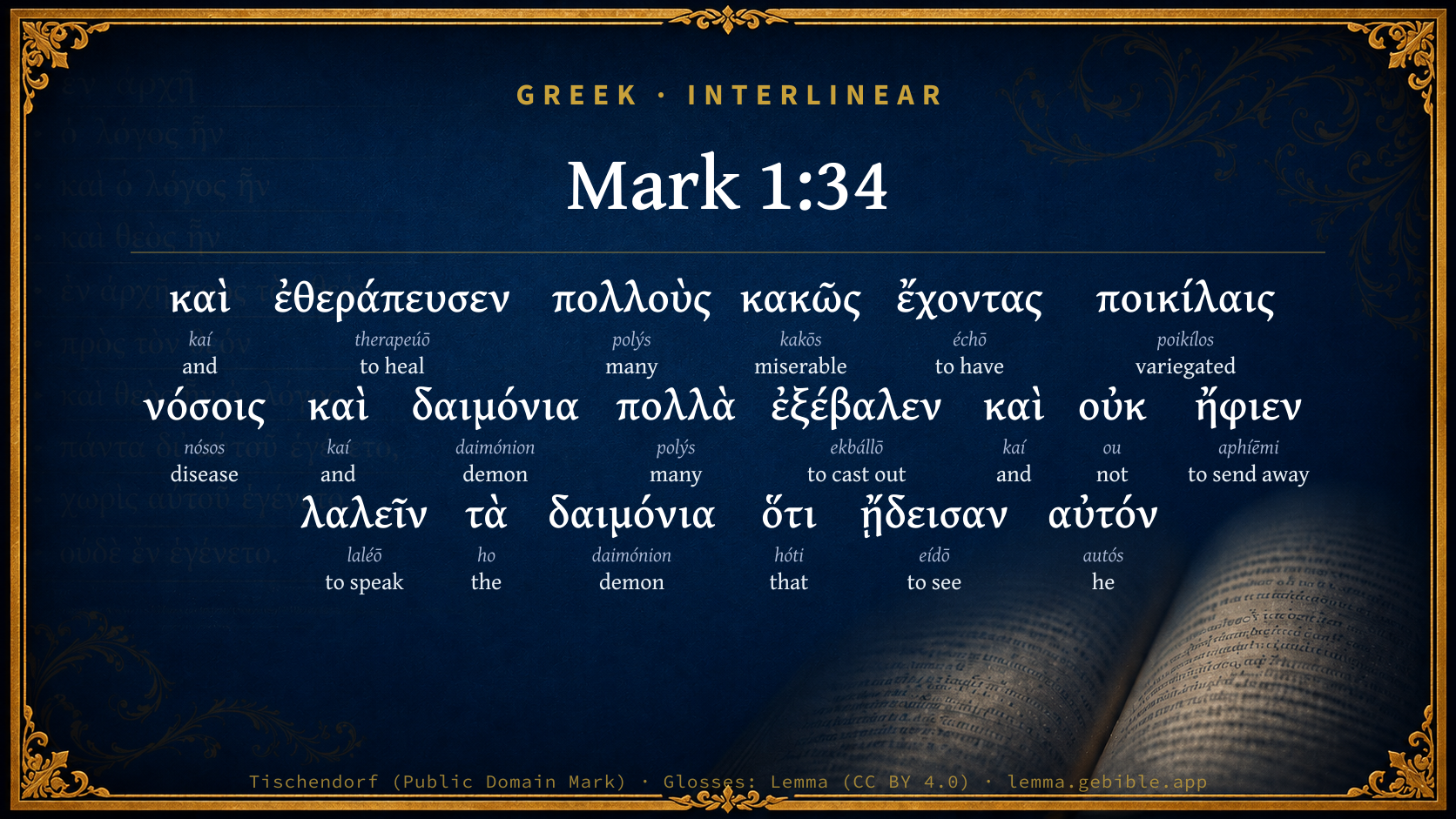
Greek (Tischendorf 8th ed.) Mark 1:34 appears in the Greek New Testament. The text above is from the Tischendorf 8th edition. Each word links to its Strong’s number and a concise gloss. Click any word for its full Thayer’s Greek Lexicon entry.
Download image
Cite this verse

Mark 1:34 (World English Bible). Public Domain. Lemma interlinear Bible study tool, https://lemma.gebible.app/v/mark/1/34.

Show BibTeX & RIS
BibTeX
RIS
English Translation
He healed many who were sick with various diseases, and cast out many demons. He didn't allow the demons to speak, because they knew him.
World English Bible · Public Domain
Download a study sheet

One document with this verse’s original text, its word-by-word gloss line, the meaning frame, cross-references with their text, attributed commentary, and full source and license credits — printable, and it pastes into notes with its structure intact.

This verse Autodidact and up

Study sheet (.html) Plain text (.txt)

A passage Seminary Student

Up to 50 verses in one chapter. A passage sheet keeps up to 6 commentary sources and 12 cross-references per verse, in the order this page ranks them, and says so on the sheet whenever that leaves anything out. Ask for a single verse and you get the Autodidact verse sheet above.

Everything on this page stays free to read, with no account — the sheet is a download of what is already on screen, not access to it.

Want to remove ads? Support Godless Engineer
Compare translations 3

The same verse in 3 English versions, stacked beneath the original-language interlinear above. Click any original word for its lexicon entry.

Each is an independent rendering of the whole verse — the interlinear is not word-aligned to these translations.

Highlighted words mark where these versions differ — a whole-verse word diff, not a word-by-word alignment.

  • World English Bible Public Domain
    He healed many who were sick with various diseases, and cast out many demons. He didn't allow the demons to speak, because they knew him.
  • King James Version Public Domain
    And he healed many that were sick of divers diseases, and cast out many devils; and suffered not the devils to speak, because they knew him.
  • unfoldingWord Literal Text CC BY-SA 4.0
    And he healed many having sickness with various diseases and cast out many demons, but he was not permitting the demons to speak, because they knew him.

unfoldingWord Literal Text — © unfoldingWord, licensed CC BY-SA 4.0. Word-aligned USFM3 via Door43 (git.door43.org/unfoldingWord/en_ult).

Versions to compare (up to 4)

3 of 4 selected

Show all 19 translations

Every available English version of this verse, each an independent rendering of the whole verse.

  • World English Bible Public Domain
    He healed many who were sick with various diseases, and cast out many demons. He didn't allow the demons to speak, because they knew him.
  • Berean Standard Bible Public Domain
    And He healed many who were ill with various diseases and drove out many demons. But He would not allow the demons to speak, because they knew who He was.
  • Majority Standard Bible Public Domain
    And He healed many who were ill with various diseases and drove out many demons. But He would not allow the demons to speak, because they knew who He was.
  • King James Version Public Domain
    And he healed many that were sick of divers diseases, and cast out many devils; and suffered not the devils to speak, because they knew him.
  • American Standard Version (1901) Public Domain
    And he healed many that were sick with divers diseases, and cast out many demons; and he suffered not the demons to speak, because they knew him.
  • Revised Version (1885) Public Domain
    And he healed many that were sick with divers diseases, and cast out many devils; and he suffered not the devils to speak, because they knew him.
  • Geneva Bible (1599) Public Domain
    And he healed many that were sicke of diuers diseases: and he cast out many deuils, and suffred not the deuils to say that they knewe him.
  • Douay-Rheims (1899) Public Domain
    And he healed many that were troubled with divers diseases; and he cast out many devils, and he suffered them not to speak, because they knew him.
  • Young's Literal Translation Public Domain
    and he healed many who were ill of manifold diseases, and many demons he cast forth, and was not suffering the demons to speak, because they knew him.
  • Literal Standard Version CC BY-SA 4.0
    and He healed many who were ill of manifold diseases, and He cast forth many demons, and was not permitting the demons to speak, because they knew Him.
  • Unlocked Literal Bible CC BY-SA 4.0
    He healed many who were sick with various diseases and cast out many demons, but he did not allow the demons to speak because they knew him.
  • unfoldingWord Literal Text CC BY-SA 4.0
    And he healed many having sickness with various diseases and cast out many demons, but he was not permitting the demons to speak, because they knew him.
  • Darby Bible Public Domain
    And he healed many suffering from various diseases; and he cast out many demons, and did not suffer the demons to speak because they knew him.
  • World Messianic Bible Public Domain
    He healed many who were sick with various diseases and cast out many demons. He didn’t allow the demons to speak, because they knew him.
  • Webster's Bible Public Domain
    And he healed many that were sick with divers diseases, and cast out many demons; and suffered not the demons to speak, because they knew him.
  • Free Bible Version CC BY-SA 4.0
    He healed many people who had various diseases, and threw out many demons. He did not permit the demons to speak, for they knew who he was.
  • Bible in Basic English Public Domain
    And a number, who were ill with different diseases, he made well, and sent out evil spirits; but he did not let the evil spirits say anything, because they had knowledge of him.
  • Text-Critical English NT CC BY 4.0
    and he healed many who were sick with various diseases. He also cast out many demons, but he would not allow the demons to speak, because they knew who he was.
  • Tyndale New Testament (1534) Public Domain
    and he healed many that were sicke of divers deseases. And he cast out many devyls and suffred not the devyls to speake because they knewe him.

Literal Standard Version (2020), Covenant Press — licensed CC BY-SA 4.0. Text via the HelloAO Bible API (eBible.org). Unlocked Literal Bible (unfoldingWord) — licensed CC BY-SA 4.0. Text via the HelloAO Bible API (eBible.org). unfoldingWord Literal Text — © unfoldingWord, licensed CC BY-SA 4.0. Word-aligned USFM3 via Door43 (git.door43.org/unfoldingWord/en_ult). Free Bible Version, Dr. Jonathan Gallagher — licensed CC BY-SA 4.0. Text via the HelloAO Bible API (eBible.org).

Word by word

More ways to search: Search by grammar → Find every occurrence → Compare this word →

Practice this passage: Drill this verse → Learn its vocabulary →

ποικίλαις
poikílos
G4164
“variegated”
Adjective, Dative, Plural, Feminine
Part of Speech
Adjective
Case
Dative
Number
Plural
Gender
Feminine
Full Thayer's Definition

Origin: of uncertain derivation

TDNT: 14:04,9

1. a various colours, variegated 2. of various sorts
  1. καὶ kaí G2532 “and” Conjunction
  2. ἐθεράπευσεν therapeúō G2323 “to heal” Verb, Aorist, Active, Indicative, 3rd person, Singular
  3. πολλοὺς polýs G4183 “many” Adjective, Accusative, Plural, Masculine
  4. κακῶς kakōs G2560 “miserable” Adverb
  5. ἔχοντας échō G2192 “to have” Verb, Present, Active, Participle, Accusative, Plural, Masculine
  6. νόσοις nósos G3554 “disease” Noun, Dative, Plural, Feminine
  7. καὶ kaí G2532 “and” Conjunction
  8. δαιμόνια daimónion G1140 “demon” Noun, Accusative, Plural, Neuter
  9. πολλὰ polýs G4183 “many” Adjective, Accusative, Plural, Neuter
  10. ἐξέβαλεν ekbállō G1544 “to cast out” Verb, Aorist, Active, Indicative, 3rd person, Singular
  11. καὶ kaí G2532 “and” Conjunction
  12. οὐκ ou G3756 “not” Particle, Negative
  13. ἤφιεν aphíēmi G863 “to send away” Verb, Imperfect, Active, Indicative, 3rd person, Singular
  14. λαλεῖν laléō G2980 “to speak” Verb, Present, Active, Infinitive
  15. τὰ ho G3588 “the” Article, Accusative, Plural, Neuter
  16. δαιμόνια daimónion G1140 “demon” Noun, Accusative, Plural, Neuter
  17. ὅτι hóti G3754 “that” Conjunction
  18. ᾔδεισαν eídō G1492 “to see” Verb, Pluperfect, Active, Indicative, 3rd person, Plural
  19. αὐτόν autós G846 “he” Personal pronoun, Accusative, Singular, Masculine

About this verse

These counts appear in no published source. They are computed here, from the morphology-tagged text and Lemma’s own curated glosses. What Lemma adds →

20
words
16
distinct lemmas
Gospels
section

Notable vocabulary

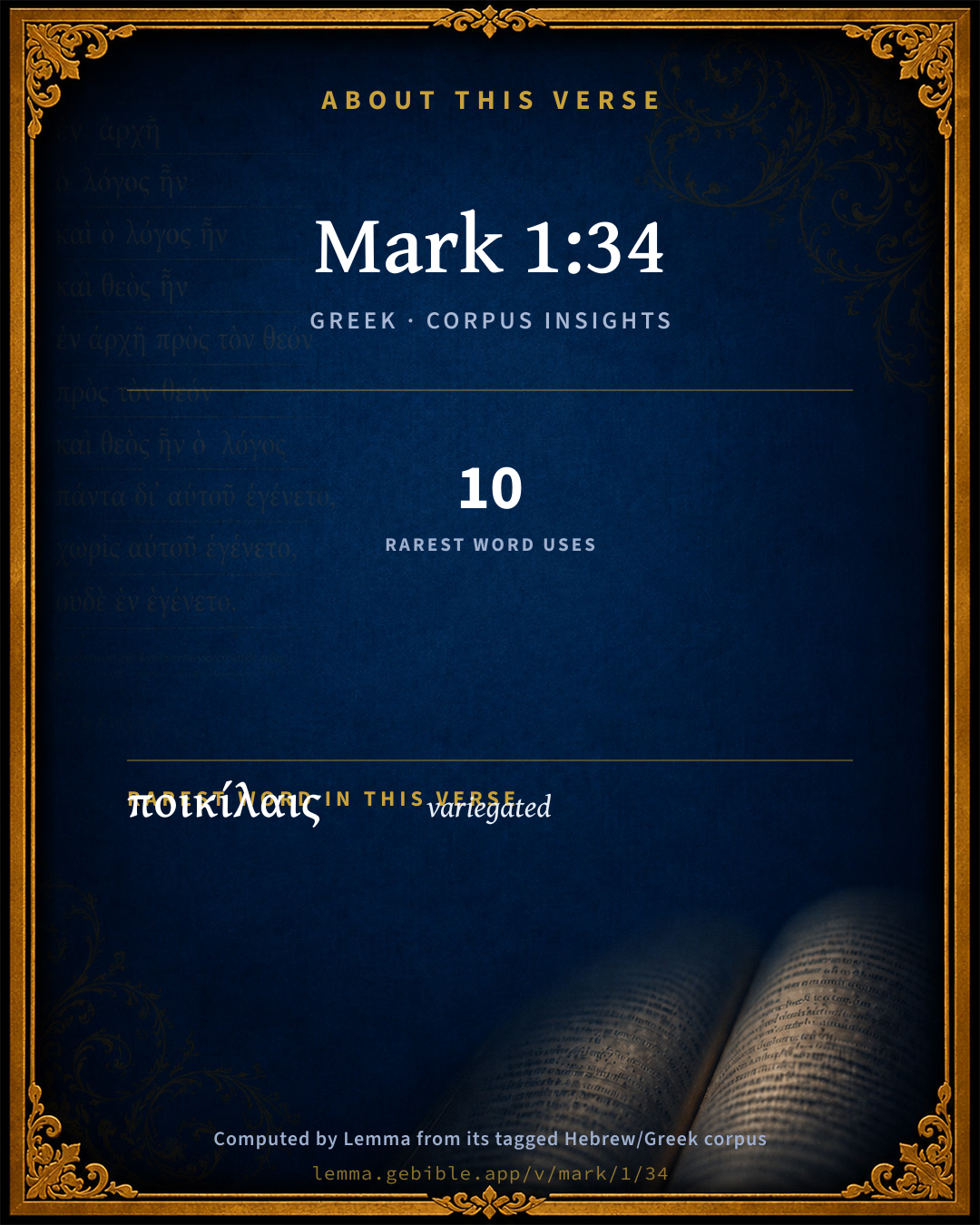
The rarest word here is ποικίλαις variegated G4164 — appearing just 10 times in the whole Greek New Testament.

Shared distinctive vocabulary

ποικίλαις variegated G4164 occurs in 10 verses of the Greek New Testament. Also found in:

Repetition

Words recur within this verse:

  • πολλοὺς many G4183 ×2
  • δαιμόνια demon G1140 ×2
  • καὶ and G2532 ×3

Cross-references

5

Topical passages linked to Mark 1:34 in the Treasury of Scripture Knowledge — connected by theme and wording, ordered by reader-vote popularity; previews shown in the World English Bible.

  • Luke 4:41 Demons also came out from many, crying out, and saying, "You are the Christ, the Son of God!" Rebuking them, he didn't allow them to speak, because they knew that he was the Christ.
  • Mark 3:12 He sternly warned them that they should not make him known.
  • Matthew 4:23 Jesus went about in all Galilee, teaching in their synagogues, preaching the Gospel of the Kingdom, and healing every disease and every sickness among the people.
  • Acts 16:16–18 It happened, as we were going to prayer, that a certain girl having a spirit of divination met us, who brought her masters much gain by fortune telling.
  • Mark 1:25 Jesus rebuked him, saying, "Be quiet, and come out of him!"

Cross-references courtesy of OpenBible.info (CC BY 4.0).

Where the printed editions differ

1 variant

Places in this verse where the major printed Greek editions disagree on the wording in a way that affects the translation — a comparison of editions, not a manuscript-by-manuscript collation. The editions are the modern critical texts (Nestlé-Aland 28/27, SBL, Westcott-Hort, Tregelles, Tyndale House) and the traditional texts behind the KJV (the Textus Receptus and the Byzantine/Majority text). It is not a claim about which reading is original.

  1. Extra text
    Χριστὸν εἶναι.¶

    “Christ to be.”

    In WH Not in NA28NA27TynSBLTregTRByz

    Χριστὸν εἶναι.¶ (Christon einai) 'Christ to be.' is only in a few manuscripts (WH)

Textual data: Translators Amalgamated Greek New Testament (STEPBible TAGNT) · CC BY 4.0.

Commentary

Notes on Mark 1:34 from classic Christian and Jewish commentators (each source and its license shown beneath its notes). The classic Christian expositions comment on the surrounding passage and are grouped to its opening verse, so a note may address several verses; the Jewish commentaries on the Tanakh (Rashi and others) are per-verse, so they appear only where the commentator wrote on this verse.

Lemma curates 59 commentaries, every one of them public domain or Creative Commons licensed, each selected and text-cleaned for this edition rather than reprinted as found. About our sources →

Tyndale Open Study Notes

Tyndale Open Resources

1:34 the demons knew who he was: See 1:23-25.

Tyndale Open Study Notes — © Tyndale Open Resources, licensed CC BY-SA 4.0. Text via the HelloAO Bible API.

Bengel's Gnomon

Johann Albrecht Bengel

Mar 1:34. Οὐκ ἤφιε, He suffered not) So ch. Mar 11:16. The second aorist of the verb ἀφιέω, as Sylberg shows in his Not. ad Clenard., p. 468.—ὅτι, because) They were attempting to speak.

Bengel's Gnomon of the New Testament — English translation (T&T Clark, Edinburgh, 1860) — public domain. Text from a community e-Sword module.

Meyer's Critical & Exegetical Commentary

Heinrich August Wilhelm Meyer

Mar_1:34. πολλοὺς … πολλά] therefore not all, which, nevertheless, does not presuppose attempts that were without result. It was already late, and in various cases, moreover, the conditions of healing might be wanting.

ἤφιε] as in Mar_11:16. Imperfect, from the form ἀφίω, with the augment on the preposition; see Winer, p. 74 [E. T. 97].

λαλεῖν … ὅτι] He allowed them not to speak, enjoined on them silence, because they knew Him. They would otherwise, had they been allowed to speak, have said that He was the Messiah. Kuinoel, Bleek, and others erroneously take it as if the expression was λέγειν … ὄτι. The two verbs (comp. on Joh_8:43; Rom_3:19) are never interchanged in the N. T., not even in such passages as Rom_15:18; 2Co_11:17; 1Th_1:8; hence to say that is never expressed by λαλεῖν, ὅτι.

As to the reason of the prohibition, see on Mar_5:43 and Mat_8:4.

Meyer — Critical and Exegetical Commentary on the New Testament — English translation by Peter Christie, edited by Frederick Crombie (T&T Clark, 1880) — public domain. Text from a community e-Sword module.

Expositor's Greek Testament

ed. W. Robertson Nicoll

Mar 1:34 . πολλοὺς , many; not all? In Matthew many are brought and all are healed. ἤφιε , allow, imperfect, as if from ἀφίω with augment on preposition, again in Mar 11:16 ; prorsus barbara (Fritzsche). ὅτι ᾔδεισαν α ., because they knew Him. On the insight of demoniacs cf. at Mat 8:28 ff.

The Expositor's Greek Testament, edited by W. Robertson Nicoll (1897–1910) — public domain. Text from a community e-Sword module.

Geneva Bible (1599)

Geneva Bible translators

For it belongeth not to the devils to preach the Gospel, Acts 16:18.

Geneva Bible (1599) marginal notes — public domain. Text via Bolls.life.

Jamieson, Fausset & Brown

Robert Jamieson, A. R. Fausset & David Brown

And he healed many that were sick of divers diseases, and cast out many devils--In Mat 8:16 it is said, "He cast out the spirits with His word"; or rather, "with a word"--a word of command.

and suffered not the devils to speak, because they knew him--Evidently they would have spoken, if permitted, proclaiming His Messiahship in such terms as in the synagogue; but once in one day, and that testimony immediately silenced, was enough. See on Mar 1:24. After this account of His miracles of healing, we have in Mat 8:17 this pregnant quotation, "That it might be fulfilled which was spoken by Esaias the prophet, saying (Isa 53:4), Himself took our infirmities, and bare our sicknesses."

Jamieson, Fausset & Brown — Commentary Critical and Explanatory on the Whole Bible (1871) — public domain (CC PDM 1.0). Text via the HelloAO Bible API.

Adam Clarke's Commentary

Verse 34. Because they knew him] To be the Christ, is added here by several ancient and respectable MSS. and versions; but it appears to be only a gloss.

Adam Clarke's Commentary on the Bible (1810–1826) — public domain. Text from a community e-Sword/MySword module.

Ellicott's Commentary for English Readers

(34) And suffered not the devils to speak.—St. Luke (Luk_4:41) gives the reason of the prohibition more distinctly. The demoniacs had cried out, “Thou art the Son of God.” They knew that He was the Christ.

A Bible Commentary for English Readers, edited by Charles John Ellicott (1878–1897) — public domain. Text from a community e-Sword module.

Trapp's Complete Commentary

John Trapp

34 And he healed many that were sick of divers diseases, and cast out many devils; and suffered not the devils to speak, because they knew him.

Ver. 34. Suffered not the devils to speak] For what calling had they to preach the gospel?

John Trapp, A Commentary or Exposition upon All the Books of the Old and New Testament (1647–1656) — public domain. Text from a community e-Sword module.

Haydock's Catholic Bible Commentary

The devils knew that it was Christ, who had been promised for so many ages before; for they saw him perform the wonders which the prophets had foretold of him; yet they were not perfectly acquainted with his divine nature, or otherwise they never would have persecuted to death and crucified the Lord of glory. (St. Augustine) --- But Christ would not permit them to declare that they knew him. (Bible de Vence) --- See Luke iv. 41.

George Leo Haydock (1774–1849), Haydock's Catholic Family Bible and Commentary, 1859 edition — public domain. Excludes Psalms (Douay-Rheims chapter numbering differs from Protestant) and Deuterocanonical books (Catholic canon only).

Whedon's Commentary on the Bible

Daniel D. Whedon

34. Suffered not the devils to speak — See notes on Mar_1:25. Some good critics render this clause, “suffered not the devils to say that they knew him.” His peremptory and stern dealing with these malignant beings was to show his abhorrence, of their malignant nature. Moreover, he thereby taught us at this day not to found our faith on pretended spiritualistic manifestations from unknown supernatural sources or sorceries. If we trust in that class of deceptions we are liable to be betrayed by them into damnable falsehood and delusion.

Daniel D. Whedon (gen. ed.), Commentary on the Old and New Testaments (1874–1909) — public domain. Text from a community e-Sword module.

John Wesley's Explanatory Notes

He suffered not the devils to say that they knew him - That is, according to Dr. Mead's hypothesis, (that the Scriptural demoniacs were only diseased persons) He suffered not the diseases to say that they knew him!

John Wesley, Explanatory Notes Upon the Whole Bible (1754–1765) — public domain. Text via the GEBible commentary corpus.

Scofield Reference Notes

C. I. Scofield

devils

demons. (See Scofield "Mat 7:22")

The Scofield Reference Bible (1917 edition), notes by C. I. Scofield — public domain. Text from a community e-Sword module.

Cambridge Greek Testament for Schools and Colleges

34. Χριστὸν εἶναι ([166][167][168] 33, Syr-Hark. Arm. Memph. Aeth.) is powerfully supported (τὸν Χν εἶναι, [169]c[170][171] but [172][173][174][175][176][177] etc., Latt. Syr-Sin. Syr-Pesh. Goth. omit. It may come from Luk 4:41.

[166] Codex Vaticanus. 4th cent., but perhaps a little later than א. In the Vatican Library almost since its foundation by Pope Nicolas V., and one of its greatest treasures. The whole Gospel, ending at Mar 16:8. Photographic facsimile, 1889.

[167] Codex Regius. 8th cent. An important witness. At Paris. Contains Mar 1:1 to Mar 10:15; Mar 10:30 to Mar 15:1; Mar 15:20 to Mar 16:20, but the shorter ending is inserted between Mar 16:8 and Mar 16:9, showing that the scribe preferred it to the longer one.

[168] Codex Rossanensis. 6th cent. Mar 16:14-20 is missing.

[169] Codex Sinaiticus. 4th cent. Discovered by Tischendorf in 1859 at the Monastery of St Katharine on Mount Sinai. Now at St Petersburg. The whole Gospel, ending at Mar 16:8. Photographic facsimile, 1911.

[170] Codex Seidelianus I. 9th or 10th cent. Contains Mar 1:13 to Mar 14:18; Mar 14:25 to Mar 16:20.

[171] odex Campianus. 9th cent. At Paris. Gospels complete.

[172] Codex Sinaiticus. 4th cent. Discovered by Tischendorf in 1859 at the Monastery of St Katharine on Mount Sinai. Now at St Petersburg. The whole Gospel, ending at Mar 16:8. Photographic facsimile, 1911.

[173] An asterisk denotes that the word is not found elsewhere in N.T., and such words are included in the index, even if there is no note on them in the commentary.

[174] Codex Alexandrinus. 5th cent. Brought by Cyril Lucar, Patriarch of Constantinople, from Alexandria, and afterwards presented by him to King Charles I. in 1628. In the British Museum. The whole Gospel. Photographic facsimile, 1879.

[175] Codex Bezae. 6th cent. Has a Latin translation (d) side by side with the Greek text, and the two do not quite always agree. Presented by Beza to the University Library of Cambridge in 1581. Remarkable for its frequent divergences from other texts. Contains Mark, except Mar 16:15-20, which has been added by a later hand. Photographic facsimile, 1899.

[176] Codex Basiliensis. 8th cent. At Basle.

[177] Codex Boreelianus. Once in the possession of John Boreel. 9th cent. At Utrecht. Contains Mk 1–41; Mar 2:8-23; Mar 3:5 to Mar 11:6; Mar 11:27 to Mar 14:54; Mar 15:6-39; Mar 16:19-20.

34. πολλούς. They brought πάντας and He healed πολλούς, which does not mean that some went away without treatment. To avoid this misinterpretation, Mt. transposes πολλούς and πάντας: they brought many and He healed all. The physician tells us the method of healing: “He laid His hands on each one.” He also has the more accurate ἐθεράπευεν, for such individual treatment was a long process, and persistent energy was evident through it all. All three distinguish casting out demons from healing the sick, and it is because of the preceding δαιμονιζομένους that Mk has δαιμόνια instead of πνεύματα ἀκάθαρτα. Syr-Sin. omits κακῶς … νόσοις.

ἤφιεν. We have the same form Mar 11:16; cf. Mar 11:4; Rev 11:9; συνίω is a similar form. W.H. App. p. 167; Blass, § 23. 7. The use of λαλεῖν (not λέγειν) shows that ὅτι means “because,” not “that.” The two verbs are not confused in N.T.

ἤδεισαν. See on οἶδα, Mar 1:24. It was the demons, not the demoniacs, who recognized Him. If the demoniacs were only insane or epileptic persons, how did they know who Jesus was? See crit. note. If Χριστὸν εἶναι is a gloss, it is a correct gloss; “knew Him” means “knew Him to be the Messiah.” But Mk writes with reserve as to what they knew, and perhaps we ought to write and speak with reserve also. We do not know enough about it to speak with confidence; but perhaps it is more correct to say that as yet Jesus was the Messiah-designate rather than the Messiah, because He had not yet been revealed to mankind as having this office. The time for that revelation had not yet come. In God’s sight He was the Messiah, a fact declared to Him and to John at the Baptism. And we are told here that this was known also to the demons. But it had not yet been revealed to men; and it was for God to make this revelation at the fitting time, not for demons, nor even for Apostles. Hence the silence about the fact which is strictly enjoined upon Peter and the rest (Mar 8:30). At first sight that requirement of silence from those who had to proclaim the coming of the reign of God seems inconsistent; but the nearer we get to the view given us by St Mark, the more intelligible it will become. We need not be surprised at finding that there are “things concerning Jesus of Nazareth” which we cannot fully explain; but we can understand that it was not God’s will that His Son should be prematurely proclaimed as the promised Messiah, or be proclaimed as such by demons.

Cambridge Greek Testament for Schools and Colleges (Cambridge University Press, 1896; 21 vols, various authors incl. Carr, Maclear, Plummer, Farrar, Lumby, Moule, M. R. James, Simcox) — public domain. Text from a community e-Sword module.

International Critical Commentary

34. πολλοὺς κακῶς ἔχοντας … δαιμόνια πολλὰ—many sick, and many demons. It is held by most (Meyer, Weiss, Holtzmann, and others) that the many here is in contrast with the all of v. 32. But it does not mean necessarily that it was only many, out of the all who were brought to him, who were healed. It may mean equally well that the number included in the all was not few but many. Many sick is not necessarily the same as many of the sick. The latter requires the partitive gen. for its exact expression. Such a partial healing would not be inexplicable, since the condition of faith required by Jesus might not be present in all cases. But the explanation is unnecessary.

Mat 8:16 says that they brought many demoniacs, and he cast out the demons, and healed all the sick. Lk. says that all who had sick persons brought them, and he healed them, laying his hand on each one; and that demons went out of many. In Lk.’s account certainly, it is not intended to contrast the cure of many demoniacs with that of all the sick.

Καὶ οὐκ ἤφιε λαλεῖν τὰ δαιμόνια, ὅτι ᾔδεισαν αὐτόν1—And he did not suffer the demons to speak, because they knew him. λαλεῖν is used in the N.T. with a direct obj., but not with ὅτι. Where the words follow, they are introduced with λέγων, saying; cf. Mat 23:1, Mar 6:50, Luk 24:6. Where ὅτι is used, without any intervening word, it is causal.2 The demons are said to speak, instead of the man, because the knowledge of Jesus is attributable to the demon, and not to the man. The man is represented as inhabited by an alien spirit, who used his organs of speech.

Χριστὸν εἶναι—to be the Christ, after ᾔδεισαν αὐτόν, they knew him, (WH.) RV.marg. אc BCGLM 1, 28, 33, 69, 124, mss. of Lat. Vet. and Vulg. Memph. Harcl. etc. Omitted by Tisch. Treg. WH. RV. text, א* ADEFKSUV Latt. Pesh. etc. Probable insertion from Luk 4:41.

This knowledge is one of the arguments for the supernaturalism of these cases, and one of the difficulties in the way of the naturalistic explanation of them. And it is not to be set aside lightly. But the reflections of the evangelists are to be distinguished from their statement of facts. And a supernatural cause once posited naturally gathers supernatural phenomena.

JESUS’ POLICY OF SILENCE

International Critical Commentary — older volumes (1896–1929), various authors — public domain. Text from a community e-Sword module.

Vincent's Word Studies in the New Testament

Marvin R. Vincent

Devils (δαιμόνια)

The Rev., unfortunately, and against the protest of the American committee, retains devils instead of rendering demons. See on Mat 4:1. The New Testament uses two kindred words to denote the evil spirits which possessed men, and which were so often east out by Christ: διάμων, of which demon is a transcript, and which occurs, according to the best texts, only at Mat 8:31; and δαιμόνιον, which is not a diminutive, but the neuter of the adjective δαιμόνιος, of, or belonging to a demon. The cognate verb is δαιμονίζομαι to be possessed with a demon, as in Mar 1:32.

The derivation of the word is uncertain. Perhaps δαίω, to distribute, since the deities allot the fates of men. Plato derives it from δαήμων, knowing or wise. In Hesiod, as in Pythagoras, Thales, and Plutarch, the word δαίμων is used of men of the golden age, acting as tutelary deities, and forming the link between gods and men. Socrates, in Plato's “Cratylus,” quotes Hesiod as follows: “Socrates: You know how Hesiod uses the word? Hermogenes: Indeed I do not. Soc.: Do you not remember that he speaks of a golden race of men who came first? Her.: Yes, I know that. Soc.: He says of them,

But now that fate has closed over this race,

They are holy demons upon earth,

Beneficent, averters of ills, guardians of mortal men.'”

After some further conversation, Socrates goes on: “And therefore I have the most entire conviction that he called them demons, because they were δαήμονες (knowing or wise). Now, he and other poets say truly that, when a good man dies, he has honor and a mighty portion among the dead, and becomes a demon, which is a name given to him signifying wisdom. And I say, too, that every wise man who happens to be a good man is more than human (δαιμόνιον) both in life and death, and is rightly called a demon.” Mr. Grote (“History of Greece”) observes that in Hesiod demons are “invisible tenants of the earth, remnants of the once happy golden race whom the Olympic gods first made - the unseen police of the gods, for the purpose of repressing wicked behavior in the world.” In later Greek the word came to be used of any departed soul.

In Homer δαίμων is used synonymously with θεός and θεά, god and goddess, and the moral quality of the divinity is determined by the context: but most commonly of the divine power or agency, like the Latin numen, the deity considered as a power rather than as a person. Homer does not use δαιμόνιον substantively, but as an adjective, always in the vocative case, and with a sorrowful or reproachful sense, indicating that the person addressed is in some astonishing or strange condition. Therefore, as a term of reproach - wretch! sirrah! madman! (“Iliad,” 2:190, 200; 4:31; ix., 40). Occasionally in an admiring or respectful sense (“Odyssey,” xiv., 443; xxiii., 174); Excellent stranger! noble sir! Homer also uses δαίμων of one's genius or attendant spirit, and thence of one's lot or fortune. So in the beautiful simile of the sick father (“Odyssey,” 5:396), “Some malignant genius has assailed him.” Compare “Odyssey,” x., 64; xi., 61. Hence, later, the phrase κατὰ δαίμονα is nearly equivalent to by chance.

We have seen that, in Homer, the bad sense of δαιμόνοις is the prevailing one. In the tragedians, also, δαίμων, though used both of good and bad fortune, occurs more frequently in the latter sense, and toward this sense the word gravitates more and more. The undertone of Greek thought, which tended to regard no man happy until he had escaped from life (see on Mat 5:3, blessed), naturally imparted a gloomy and forbidding character to those who were supposed to allot the destinies of life.

In classical Greek it is noticeable that the abstract τὸ δαιμόνιον fell into the background behind δαίμων, with the development in the latter of the notion of a fate or genius connected with each individual, as the demon of Socrates; while in biblical Greek the process is the reverse, this doctrine being rejected for that of an overruling personal providence, and the strange gods, “obscure to human knowledge and alien to human life,” taking the abstract term uniformly in an evil sense.

Empedocles, a Greek philosopher, of Sicily, developed Hesiod's distinction; making the demons of a mixed nature between gods and men, not only the link between the two, but having an agency and disposition of their own; not immortal, but long-lived, and subject to the passions and propensities of men. While in Hesiod the demons are all good, according to Empedocles they are both bad and good. This conception relieved the gods of the responsibility for proceedings unbecoming the divine nature. The enormities which the older myths ascribed directly to the gods - thefts, rapes, abductions - were the doings of bad demons. It also saved the credit of the old legends, obviating the necessity of pronouncing either that the gods were unworthy or the legends untrue. “Yet, though devised for the purpose of satisfying a more scrupulous religious sensibility, it was found inconvenient afterward when assailants arose against paganism generally. For while it abandoned as indefensible a large portion of what had once been genuine faith, it still retained the same word demons with an entirely altered signification. The Christian writers in their controversies found ample warrant among the earlier pagan authors for treating all the gods as demons; and not less ample warrant among the later pagans for denouncing the demons generally as evil beings” (Grote, “History of Greece”).

This evil sense the words always bear in the New Testament as well as in the Septuagint. Demons are synonymous with unclean spirits (Mar 5:12, Mar 5:15; Mar 3:22, Mar 3:30; Luk 4:33). They appear in connection with Satan (Luk 10:17, Luk 10:18; Luk 11:18, Luk 11:19); they are put in opposition to the Lord (1Co 10:20, 1Co 10:21); to the faith (1Ti 4:1). They are connected with idolatry (Rev 9:20; Rev 16:13, Rev 16:14). They are special powers of evil, influencing and disturbing the physical, mental, and moral being (Luk 13:11, Luk 13:16; Mar 5:2-5; Mar 7:25; Mat 12:45).

Marvin R. Vincent, Word Studies in the New Testament (1887–1900) — public domain. Text from a community e-Sword/MySword module.

Lesson kit

Teaching starters — assembled from the data on this page, not authored interpretation. Every prompt links to the verse data it draws on. Edit before teaching.

Mark, in the Gospels, opens this verse with 20 words (16 distinct Greek lemmas). Its most distinctive word is poikílos (“variegated”). A historical commentator’s framing appears above. Read the whole chapter for the surrounding context.

Discussion questions

  1. How does “variegated” (poikílos) shape what this verse is saying?
  2. How does Matthew 4:24, which shares the word «variegated», read alongside this verse?
  3. What does the repetition of “many” (2× in this one verse) do in this verse?
  4. These translations render this verse differently; the difference is in the English rendering, not the original. What questions does that raise?
  5. Compare how Tyndale Open Study Notes and Bengel's Gnomon read this verse. Where do they agree or differ?

Things to notice

Reading settings

Reading text

Shown beneath each verse's original-language words.

Old Testament
Old Testament edition

Read the OT as the Masoretic Hebrew (MT) or the Greek Septuagint (LXX).

English shown for the Greek Septuagint (in the Hebrew ↔ Greek comparison).

Comparing translations? Open the Compare panel on any verse page to stack up to four side by side.