

Matthew 23:13
Greek (Tischendorf 8th ed.) Matthew 23:13 appears in the Greek New Testament. The text above is from the Tischendorf 8th edition. Each word links to its Strong’s number and a concise gloss. Click any word for its full Thayer’s Greek Lexicon entry.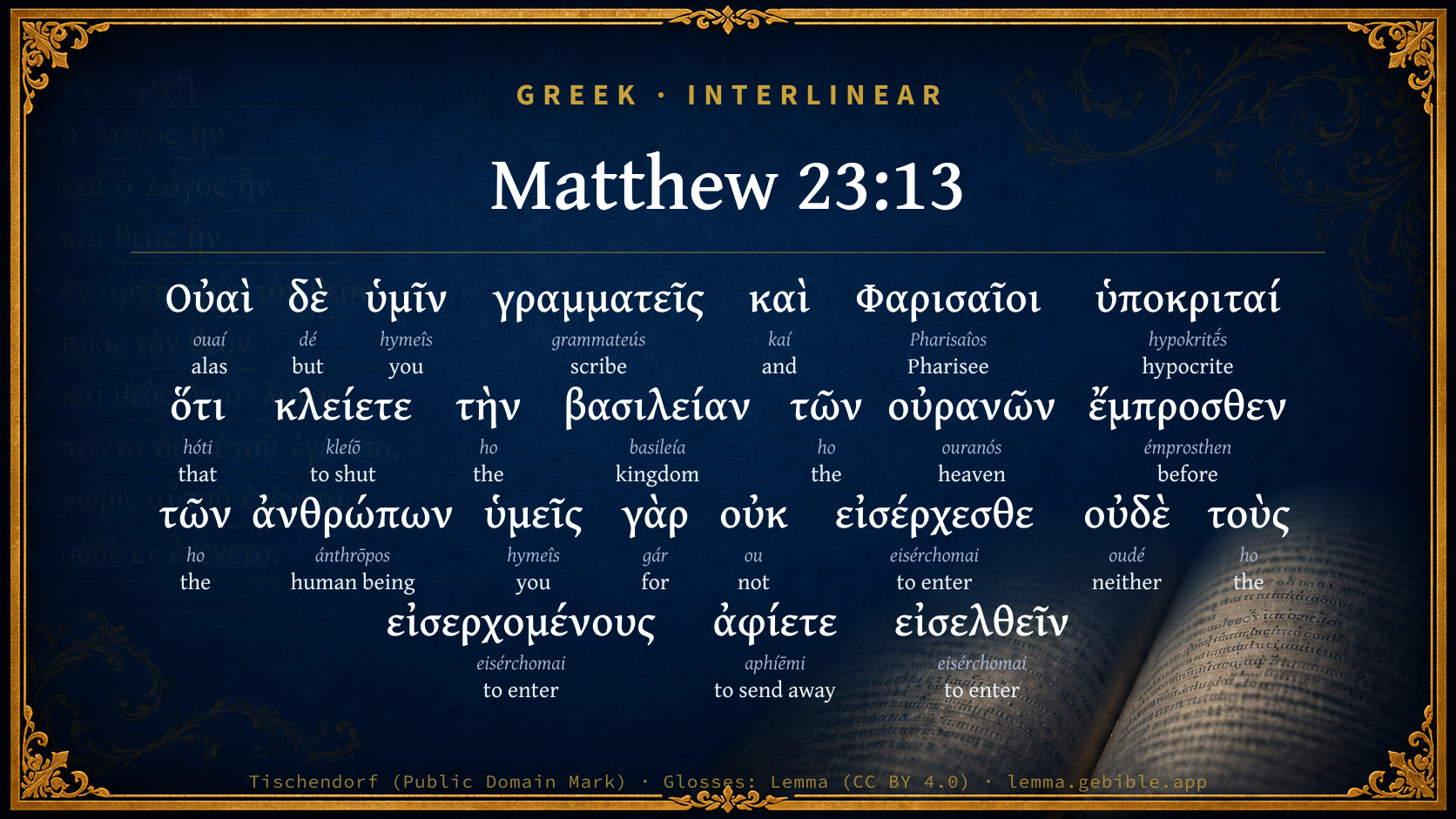
"Woe to you, scribes and Pharisees, hypocrites! For you devour widows' houses, and as a pretense you make long prayers. Therefore you will receive greater condemnation.
Download a study sheet
One document with this verse’s original text, its word-by-word gloss line, the meaning frame, cross-references with their text, attributed commentary, and full source and license credits — printable, and it pastes into notes with its structure intact.
This verse Autodidact and up
A passage Seminary Student
Up to 50 verses in one chapter. A passage sheet keeps up to 6 commentary sources and 12 cross-references per verse, in the order this page ranks them, and says so on the sheet whenever that leaves anything out. Ask for a single verse and you get the Autodidact verse sheet above.
Everything on this page stays free to read, with no account — the sheet is a download of what is already on screen, not access to it.
Compare translations 3
The same verse in 3 English versions, stacked beneath the original-language interlinear above. Click any original word for its lexicon entry.
Each is an independent rendering of the whole verse — the interlinear is not word-aligned to these translations.
Highlighted words mark where these versions differ — a whole-verse word diff, not a word-by-word alignment.
-
World English Bible Public Domain
"Woe to you, scribes and Pharisees, hypocrites! For you devour widows' houses, and as a pretense you make long prayers. Therefore you will receive greater condemnation.
-
King James Version Public Domain
But woe unto you, scribes and Pharisees, hypocrites! for ye shut up the kingdom of heaven against men: for ye neither go in yourselves, neither suffer ye them that are entering to go in.
-
unfoldingWord Literal Text CC BY-SA 4.0
But woe to you, scribes and Pharisees, hypocrites! For you shut the kingdom of the heavens in front of men. For you do not enter in, nor do you permit the ones entering to enter.
unfoldingWord Literal Text — © unfoldingWord, licensed CC BY-SA 4.0. Word-aligned USFM3 via Door43 (git.door43.org/unfoldingWord/en_ult).
Show all 19 translations
Every available English version of this verse, each an independent rendering of the whole verse.
-
World English Bible Public Domain
"Woe to you, scribes and Pharisees, hypocrites! For you devour widows' houses, and as a pretense you make long prayers. Therefore you will receive greater condemnation.
-
Berean Standard Bible Public Domain
Woe to you, scribes and Pharisees, you hypocrites! You shut the kingdom of heaven in men’s faces. You yourselves do not enter, nor will you let in those who wish to enter.
-
Majority Standard Bible Public Domain
Woe to you, scribes and Pharisees, you hypocrites! You defraud widows of their houses, and for a show make lengthy prayers. Therefore you will receive greater condemnation.
-
King James Version Public Domain
But woe unto you, scribes and Pharisees, hypocrites! for ye shut up the kingdom of heaven against men: for ye neither go in yourselves, neither suffer ye them that are entering to go in.
-
American Standard Version (1901) Public Domain
But woe unto you, scribes and Pharisees, hypocrites! because ye shut the kingdom of heaven against men: for ye enter not in yourselves, neither suffer ye them that are entering in to enter.
-
Revised Version (1885) Public Domain
But woe unto you, scribes and Pharisees, hypocrites! because ye shut the kingdom of heaven against men: for ye enter not in yourselves, neither suffer ye them that are entering in to enter.
-
Geneva Bible (1599) Public Domain
Wo therefore be vnto you, Scribes and Pharises, hypocrites, because ye shut vp the kingdome of heauen before men: for ye your selues go not in, neither suffer ye them that would enter, to come in.
-
Douay-Rheims (1899) Public Domain
But woe to you scribes and Pharisees, hypocrites; because you shut the kingdom of heaven against men, for you yourselves do not enter in; and those that are going in, you suffer not to enter.
-
Young's Literal Translation Public Domain
`Wo to you, Scribes and Pharisees, hypocrites! because ye shut up the reign of the heavens before men, for ye do not go in, nor those going in do ye suffer to enter.
-
Literal Standard Version CC BY-SA 4.0
Woe to you, scribes and Pharisees, hypocrites! Because you shut up the kingdom of the heavens before men, for you do not go in, nor do you permit those going in to enter.
-
Unlocked Literal Bible CC BY-SA 4.0
But woe to you, scribes and Pharisees, hypocrites! You shut the kingdom of heaven against people. For you do not enter it yourselves, and neither do you allow those about to enter to do so.
-
unfoldingWord Literal Text CC BY-SA 4.0
But woe to you, scribes and Pharisees, hypocrites! For you shut the kingdom of the heavens in front of men. For you do not enter in, nor do you permit the ones entering to enter.
-
Darby Bible Public Domain
But woe unto you, scribes and Pharisees, hypocrites, for ye shut up the kingdom of the heavens before men; for *ye* do not enter, nor do ye suffer those that are entering to go in.
-
World Messianic Bible Public Domain
“Woe to you, scribes and Pharisees, hypocrites! For you devour widows’ houses, and as a pretense you make long prayers. Therefore you will receive greater condemnation.
-
Webster's Bible Public Domain
But woe to you, scribes and Pharisees! hypocrites! for ye shut up the kingdom of heaven against men: for ye neither go in yourselves, neither suffer ye them that are entering, to go in.
-
Free Bible Version CC BY-SA 4.0
But what a disaster is coming on you religious teachers and Pharisees, you hypocrites! You slam shut the door of the kingdom of heaven in people's faces. You yourselves don't go in, yet you don't let anyone in who is trying to enter.
-
Bible in Basic English Public Domain
But a curse is on you, scribes and Pharisees, false ones! because you are shutting the kingdom of heaven against men: for you do not go in yourselves, and those who are going in, you keep back.
-
Text-Critical English NT CC BY 4.0
“But woe to you, scribes and Pharisees, hypocrites! For you devour widows' houses and for a pretense make long prayers. Therefore you will receive a more severe judgment.
-
Tyndale New Testament (1534) Public Domain
Wo be vnto you Scribes and Pharises ypocrites for ye shutte vp the kyngdome of heven before men: ye youre selves goo not in nether suffre ye them that come to enter in.
Literal Standard Version (2020), Covenant Press — licensed CC BY-SA 4.0. Text via the HelloAO Bible API (eBible.org). Unlocked Literal Bible (unfoldingWord) — licensed CC BY-SA 4.0. Text via the HelloAO Bible API (eBible.org). unfoldingWord Literal Text — © unfoldingWord, licensed CC BY-SA 4.0. Word-aligned USFM3 via Door43 (git.door43.org/unfoldingWord/en_ult). Free Bible Version, Dr. Jonathan Gallagher — licensed CC BY-SA 4.0. Text via the HelloAO Bible API (eBible.org).
Word by word
More ways to search: Search by grammar → Find every occurrence → Compare this word →
Practice this passage: Drill this verse → Learn its vocabulary →
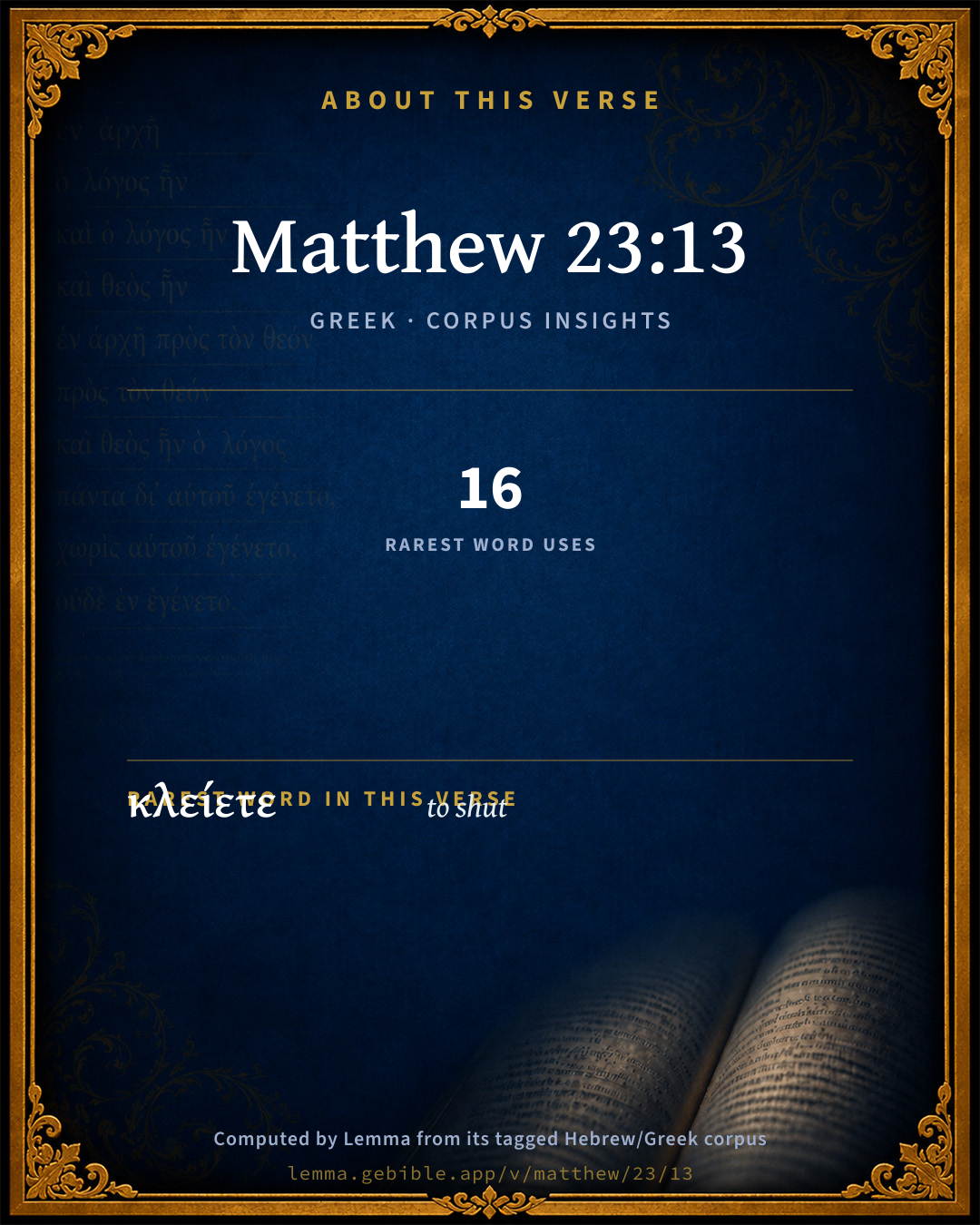
- Appears 16× in the Greek New Testament
- First appears at Matthew 6:6
- Part of Speech
- Verb
- Tense
- Present
- Voice
- Active
- Mood
- Indicative
- Person
- 2nd person
- Number
- Plural
Full Thayer's Definition
- Οὐαὶ ouaí G3759 “alas” Interjection
- δὲ dé G1161 “but” Conjunction
- ὑμῖν hymeîs G5210 “you” Personal pronoun, 2nd person, Dative, Plural
- γραμματεῖς grammateús G1122 “scribe” Noun, Vocative, Plural, Masculine
- καὶ kaí G2532 “and” Conjunction
- Φαρισαῖοι Pharisaîos G5330 “Pharisee” Noun, Vocative, Plural, Masculine
- ὑποκριταί hypokritḗs G5273 “hypocrite” Noun, Vocative, Plural, Masculine
- ὅτι hóti G3754 “that” Conjunction
- κλείετε kleíō G2808 “to shut” Verb, Present, Active, Indicative, 2nd person, Plural
- τὴν ho G3588 “the” Article, Accusative, Singular, Feminine
- βασιλείαν basileía G932 “kingdom” Noun, Accusative, Singular, Feminine
- τῶν ho G3588 “the” Article, Genitive, Plural, Masculine
- οὐρανῶν ouranós G3772 “heaven” Noun, Genitive, Plural, Masculine
- ἔμπροσθεν émprosthen G1715 “before” Preposition
- τῶν ho G3588 “the” Article, Genitive, Plural, Masculine
- ἀνθρώπων ánthrōpos G444 “human being” Noun, Genitive, Plural, Masculine
- ὑμεῖς hymeîs G5210 “you” Personal pronoun, 2nd person, Nominative, Plural
- γὰρ gár G1063 “for” Conjunction
- οὐκ ou G3756 “not” Particle, Negative
- εἰσέρχεσθε eisérchomai G1525 “to enter” Verb, Present, Middle or Passive deponent, Indicative, 2nd person, Plural
- οὐδὲ oudé G3761 “neither” Conjunction, Negative
- τοὺς ho G3588 “the” Article, Accusative, Plural, Masculine
- εἰσερχομένους eisérchomai G1525 “to enter” Verb, Present, Middle or Passive deponent, Participle, Accusative, Plural, Masculine
- ἀφίετε aphíēmi G863 “to send away” Verb, Present, Active, Indicative, 2nd person, Plural
- εἰσελθεῖν eisérchomai G1525 “to enter” Verb, Aorist, Active, Infinitive
About this verse
These counts appear in no published source. They are computed here, from the morphology-tagged text and Lemma’s own curated glosses. What Lemma adds →
- 25
- words
- 19
- distinct lemmas
- Gospels
- section
Cross-references
22Topical passages linked to Matthew 23:13 in the Treasury of Scripture Knowledge — connected by theme and wording, ordered by reader-vote popularity; previews shown in the World English Bible.
- Luke 11:52 Woe to you lawyers! For you took away the key of knowledge. You didn't enter in yourselves, and those who were entering in, you hindered."
- Matthew 23:29 "Woe to you, scribes and Pharisees, hypocrites! For you build the tombs of the prophets, and decorate the tombs of the righteous,
- Matthew 23:23 "Woe to you, scribes and Pharisees, hypocrites! For you tithe mint, dill, and cumin, and have left undone the weightier matters of the law: justice, mercy, and faith. But you ought to have done these, and not to have left the other undone.
- Matthew 23:27 "Woe to you, scribes and Pharisees, hypocrites! For you are like whitened tombs, which outwardly appear beautiful, but inwardly are full of dead men's bones, and of all uncleanness.
- Zechariah 11:17 Woe to the worthless shepherd who leaves the flock! The sword will be on his arm, and on his right eye. His arm will be completely withered, and his right eye will be totally blinded!"
- Acts 8:1 Saul was consenting to his death. A great persecution arose against the assembly which was in Jerusalem in that day. They were all scattered abroad throughout the regions of Judea and Samaria, except for the apostles.
- 2 Timothy 4:15 of whom you also must beware; for he greatly opposed our words.
- Isaiah 9:14–15 Therefore Yahweh will cut off from Israel head and tail, palm-branch and rush, in one day.
- Matthew 23:13–15 "Woe to you, scribes and Pharisees, hypocrites! For you devour widows' houses, and as a pretense you make long prayers. Therefore you will receive greater condemnation.
- 2 Timothy 3:8 Even as Jannes and Jambres opposed Moses, so do these also oppose the truth; men corrupted in mind, reprobate concerning the faith.
- Isaiah 33:14 The sinners in Zion are afraid; trembling has seized the godless ones: Who among us can dwell with the devouring fire? who among us can dwell with everlasting burning?
- Matthew 21:31–32 Which of the two did the will of his father?" They said to him, "The first." Jesus said to them, "Most assuredly I tell you that the tax collectors and the prostitutes are entering into the Kingdom of God before you.
- Matthew 23:25 "Woe to you, scribes and Pharisees, hypocrites! For you clean the outside of the cup and of the platter, but within they are full of extortion and unrighteousness.
- Luke 11:43–44 Woe to you Pharisees! For you love the best seats in the synagogues, and the greetings in the marketplaces.
- Acts 4:17–18 But so that this spreads no further among the people, let's threaten them, that from now on they don't speak to anyone in this name."
- Acts 5:28 saying, "Didn't we strictly charge you not to teach in this name? Behold, you have filled Jerusalem with your teaching, and intend to bring this man's blood on us."
- Acts 5:40 They agreed with him. Summoning the apostles, they beat them and charged them not to speak in the name of Jesus, and let them go.
- John 9:22 His parents said these things because they feared the Jews; for the Jews had already agreed that if any man would confess him as Christ, he would be put out of the synagogue.
- John 9:24 So they called the man who was blind a second time, and said to him, "Give glory to God. We know that this man is a sinner."
- John 9:34 They answered him, "You were altogether born in sins, and do you teach us?" They threw him out.
- Acts 13:8 But Elymas the sorcerer (for so is his name by interpretation) withstood them, seeking to turn aside the proconsul from the faith.
- 1 Thessalonians 2:15–16 who killed both the Lord Jesus and their own prophets, and drove us out, and didn't please God, and are contrary to all men;
Cross-references courtesy of OpenBible.info (CC BY 4.0).
Lesson kit
Teaching starters — assembled from the data on this page, not authored interpretation. Every prompt links to the verse data it draws on. Edit before teaching.
Matthew, in the Gospels, opens this verse with 25 words (19 distinct Greek lemmas). Its most distinctive word is kleíō (“to shut”). A historical commentator’s framing appears above. Read the whole chapter for the surrounding context.
Discussion questions
- What does “to shut” (kleíō) contribute to the verse as a whole?
- How does Matthew 6:6, which shares the word «to shut», read alongside this verse?
- What does the repetition of “to enter” (3× in this one verse) do in this verse?
- These translations render this verse differently; the difference is in the English rendering, not the original. What questions does that raise?
- Compare how The Biblical Illustrator and Joseph Benson's Commentary read this verse. Where do they agree or differ?
Things to notice
- These translations choose different wording for 29 words in this verse.
- “to enter” occurs 3× in this single verse.
- 19 distinct Greek lemmas span 25 words in this verse.
Commentary
Notes on Matthew 23:13 from classic Christian and Jewish commentators (each source and its license shown beneath its notes). The classic Christian expositions comment on the surrounding passage and are grouped to its opening verse, so a note may address several verses; the Jewish commentaries on the Tanakh (Rashi and others) are per-verse, so they appear only where the commentator wrote on this verse.
Lemma curates 59 commentaries, every one of them public domain or Creative Commons licensed, each selected and text-cleaned for this edition rather than reprinted as found. About our sources →
The Biblical Illustrator
Joseph S. Exell
The Biblical Illustrator, edited by Joseph S. Exell (c. 1880s–1900s) — public domain. Text from a community e-Sword module.
Joseph Benson's Commentary
Joseph Benson's Commentary on the Old and New Testaments (1811–1818) — public domain. Text from a community e-Sword module.
Whedon's Commentary on the Bible
Daniel D. Whedon
Daniel D. Whedon (gen. ed.), Commentary on the Old and New Testaments (1874–1909) — public domain. Text from a community e-Sword module.
The Preacher's Complete Homiletical Commentary
Joseph S. Exell (gen. ed.)
The Preacher's Complete Homiletical Commentary (gen. ed. Joseph S. Exell; Funk & Wagnalls, c. 1892) — public domain (pre-1929). A full-Bible homiletical/sermon-outline anthology covering 65 of 66 books (2 John is absent from the source module). Text from a community e-Sword module.
Broadus on Matthew
John A. Broadus
John A. Broadus, Commentary on the Gospel of Matthew (American Baptist Publication Society, 1886) — public domain. Text from a community e-Sword module.
Godbey's Commentary on the New Testament
William B. Godbey
William B. Godbey, Commentary on the New Testament (1896–1900) — public domain. Text from a community e-Sword module.
Tyndale Open Study Notes
Tyndale Open Resources
Tyndale Open Study Notes — © Tyndale Open Resources, licensed CC BY-SA 4.0. Text via the HelloAO Bible API.
Bengel's Gnomon
Johann Albrecht Bengel
Bengel's Gnomon of the New Testament — English translation (T&T Clark, Edinburgh, 1860) — public domain. Text from a community e-Sword module.
Meyer's Critical & Exegetical Commentary
Heinrich August Wilhelm Meyer
Meyer — Critical and Exegetical Commentary on the New Testament — English translation by Peter Christie, edited by Frederick Crombie (T&T Clark, 1880) — public domain. Text from a community e-Sword module.
Expositor's Greek Testament
ed. W. Robertson Nicoll
The Expositor's Greek Testament, edited by W. Robertson Nicoll (1897–1910) — public domain. Text from a community e-Sword module.
Geneva Bible (1599)
Geneva Bible translators
Geneva Bible (1599) marginal notes — public domain. Text via Bolls.life.
Jamieson, Fausset & Brown
Robert Jamieson, A. R. Fausset & David Brown
Jamieson, Fausset & Brown — Commentary Critical and Explanatory on the Whole Bible (1871) — public domain (CC PDM 1.0). Text via the HelloAO Bible API.
Adam Clarke's Commentary
Adam Clarke's Commentary on the Bible (1810–1826) — public domain. Text from a community e-Sword/MySword module.
Ellicott's Commentary for English Readers
A Bible Commentary for English Readers, edited by Charles John Ellicott (1878–1897) — public domain. Text from a community e-Sword module.
The Cambridge Bible for Schools and Colleges
gen. ed. J. J. S. Perowne
The Cambridge Bible for Schools and Colleges (gen. ed. J. J. S. Perowne; Cambridge University Press, 1878–1918) — public domain. Text from a community e-Sword module.
John Gill's Exposition
John Gill's Exposition of the Whole Bible (1746–1763) — public domain (CC PDM 1.0). Text via the HelloAO Bible API.
Trapp's Complete Commentary
John Trapp
John Trapp, A Commentary or Exposition upon All the Books of the Old and New Testament (1647–1656) — public domain. Text from a community e-Sword module.
Albert Barnes' Notes on the Bible
Albert Barnes' Notes on the Bible (1834–1885) — public domain. Text from a community e-Sword/MySword module.
Haydock's Catholic Bible Commentary
George Leo Haydock (1774–1849), Haydock's Catholic Family Bible and Commentary, 1859 edition — public domain. Excludes Psalms (Douay-Rheims chapter numbering differs from Protestant) and Deuterocanonical books (Catholic canon only).
Matthew Poole's English Annotations
Matthew Poole's English Annotations on the Holy Bible (1683–1685) — public domain. Text from a community e-Sword/MySword module.
The Pulpit Commentary
The Pulpit Commentary (1880–1919), ed. H.D.M. Spence-Jones & Joseph S. Exell — public domain. Text from a community e-Sword module.
John Wesley's Explanatory Notes
John Wesley, Explanatory Notes Upon the Whole Bible (1754–1765) — public domain. Text via the GEBible commentary corpus.
Kretzmann's Popular Commentary
Paul E. Kretzmann
Paul E. Kretzmann, Popular Commentary of the Bible (1921–1924) — public domain. Text from a community e-Sword module.
Burkitt's Expository Notes on the New Testament
William Burkitt
William Burkitt's Expository Notes on the New Testament (1700–1703) — public domain. Text from a community e-Sword module.
The People's New Testament
B. W. Johnson
B. W. Johnson's The People's New Testament with Notes (1889–1891) — public domain. Electronic text from the Christian Classics Ethereal Library (CCEL) ThML edition.
unfoldingWord translationNotes
Door43 World Missions Community
unfoldingWord translationNotes — © Distant Shores Media and the Door43 World Missions Community, licensed CC BY-SA 4.0. Source: git.door43.org/Door43/en_tn.
Cambridge Greek Testament for Schools and Colleges
Cambridge Greek Testament for Schools and Colleges (Cambridge University Press, 1896; 21 vols, various authors incl. Carr, Maclear, Plummer, Farrar, Lumby, Moule, M. R. James, Simcox) — public domain. Text from a community e-Sword module.
International Critical Commentary
International Critical Commentary — older volumes (1896–1929), various authors — public domain. Text from a community e-Sword module.
Vincent's Word Studies in the New Testament
Marvin R. Vincent
Marvin R. Vincent, Word Studies in the New Testament (1887–1900) — public domain. Text from a community e-Sword/MySword module.