

Mark 3:25
Greek (Tischendorf 8th ed.) Mark 3:25 appears in the Greek New Testament. The text above is from the Tischendorf 8th edition. Each word links to its Strong’s number and a concise gloss. Click any word for its full Thayer’s Greek Lexicon entry.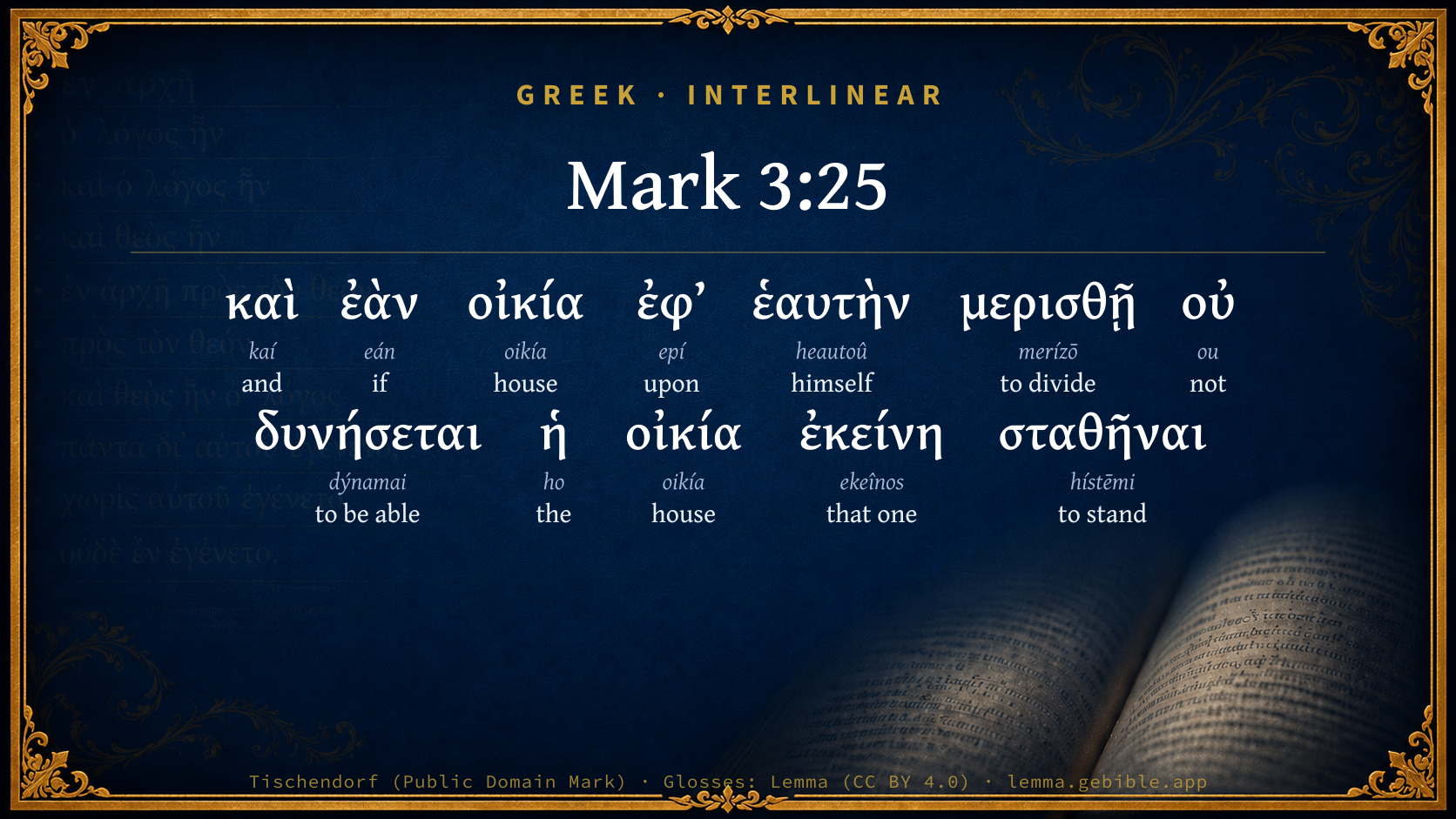
If a house is divided against itself, that house cannot stand.
Download a study sheet
One document with this verse’s original text, its word-by-word gloss line, the meaning frame, cross-references with their text, attributed commentary, and full source and license credits — printable, and it pastes into notes with its structure intact.
This verse Autodidact and up
A passage Seminary Student
Up to 50 verses in one chapter. A passage sheet keeps up to 6 commentary sources and 12 cross-references per verse, in the order this page ranks them, and says so on the sheet whenever that leaves anything out. Ask for a single verse and you get the Autodidact verse sheet above.
Everything on this page stays free to read, with no account — the sheet is a download of what is already on screen, not access to it.
Compare translations 3
The same verse in 3 English versions, stacked beneath the original-language interlinear above. Click any original word for its lexicon entry.
Each is an independent rendering of the whole verse — the interlinear is not word-aligned to these translations.
Highlighted words mark where these versions differ — a whole-verse word diff, not a word-by-word alignment.
-
World English Bible Public Domain
If a house is divided against itself, that house cannot stand.
-
King James Version Public Domain
And if a house be divided against itself, that house cannot stand.
-
unfoldingWord Literal Text CC BY-SA 4.0
And if a house has been divided against itself, that house will not be able to stand.
unfoldingWord Literal Text — © unfoldingWord, licensed CC BY-SA 4.0. Word-aligned USFM3 via Door43 (git.door43.org/unfoldingWord/en_ult).
Show all 19 translations
Every available English version of this verse, each an independent rendering of the whole verse.
-
World English Bible Public Domain
If a house is divided against itself, that house cannot stand.
-
Berean Standard Bible Public Domain
If a house is divided against itself, it cannot stand.
-
Majority Standard Bible Public Domain
If a house is divided against itself, it cannot stand.
-
King James Version Public Domain
And if a house be divided against itself, that house cannot stand.
-
American Standard Version (1901) Public Domain
And if a house be divided against itself, that house will not be able to stand.
-
Revised Version (1885) Public Domain
And if a house be divided against itself, that house will not be able to stand.
-
Geneva Bible (1599) Public Domain
Or if a house bee deuided against it selfe, that house can not continue.
-
Douay-Rheims (1899) Public Domain
And if a house be divided against itself, that house cannot stand.
-
Young's Literal Translation Public Domain
and if a house against itself be divided, that house cannot be made to stand;
-
Literal Standard Version CC BY-SA 4.0
and if a house is divided against itself, that house cannot be made to stand;
-
Unlocked Literal Bible CC BY-SA 4.0
If a house is divided against itself, that house will not be able to stand.
-
unfoldingWord Literal Text CC BY-SA 4.0
And if a house has been divided against itself, that house will not be able to stand.
-
Darby Bible Public Domain
And if a house has become divided against itself, that house cannot subsist.
-
World Messianic Bible Public Domain
If a house is divided against itself, that house cannot stand.
-
Webster's Bible Public Domain
And if a house be divided against itself, that house cannot stand.
-
Free Bible Version CC BY-SA 4.0
A household that's divided is doomed.
-
Bible in Basic English Public Domain
And if there is division in a house, that house will come to destruction;
-
Text-Critical English NT CC BY 4.0
And if a house is divided against itself, that house cannot stand.
-
Tyndale New Testament (1534) Public Domain
Or yf a housse be devided agaynste it silfe that housse cannot continue:
Literal Standard Version (2020), Covenant Press — licensed CC BY-SA 4.0. Text via the HelloAO Bible API (eBible.org). Unlocked Literal Bible (unfoldingWord) — licensed CC BY-SA 4.0. Text via the HelloAO Bible API (eBible.org). unfoldingWord Literal Text — © unfoldingWord, licensed CC BY-SA 4.0. Word-aligned USFM3 via Door43 (git.door43.org/unfoldingWord/en_ult). Free Bible Version, Dr. Jonathan Gallagher — licensed CC BY-SA 4.0. Text via the HelloAO Bible API (eBible.org).
Word by word
More ways to search: Search by grammar → Find every occurrence → Compare this word →
Practice this passage: Drill this verse → Learn its vocabulary →
- Appears 14× in the Greek New Testament
- First appears at Matthew 12:25
- Part of Speech
- Verb
- Tense
- Aorist
- Voice
- Passive
- Mood
- Subjunctive
- Person
- 3rd person
- Number
- Singular
Full Thayer's Definition
- καὶ kaí G2532 “and” Conjunction
- ἐὰν eán G1437 “if” Conditional
- οἰκία oikía G3614 “house” Noun, Nominative, Singular, Feminine
- ἐφ’ epí G1909 “upon” Preposition
- ἑαυτὴν heautoû G1438 “himself” Reflexive pronoun, 3rd person, Accusative, Singular, Feminine
- μερισθῇ merízō G3307 “to divide” Verb, Aorist, Passive, Subjunctive, 3rd person, Singular
- οὐ ou G3756 “not” Particle, Negative
- δυνήσεται dýnamai G1410 “to be able” Verb, Future, Middle deponent, Indicative, 3rd person, Singular
- ἡ ho G3588 “the” Article, Nominative, Singular, Feminine
- οἰκία oikía G3614 “house” Noun, Nominative, Singular, Feminine
- ἐκείνη ekeînos G1565 “that one” Demonstrative pronoun, Nominative, Singular, Feminine
- σταθῆναι hístēmi G2476 “to stand” Verb, Aorist, Passive, Infinitive
About this verse
These counts appear in no published source. They are computed here, from the morphology-tagged text and Lemma’s own curated glosses. What Lemma adds →
- 12
- words
- 11
- distinct lemmas
- Gospels
- section
Notable vocabulary
The rarest word here is μερισθῇ to divide G3307 — appearing just 14 times in the whole Greek New Testament.
Shared distinctive vocabulary
μερισθῇ to divide G3307 occurs in 13 verses of the Greek New Testament. Also found in:
Repetition
A word recurs within this verse:
- οἰκία house G3614 ×2
Cross-references
5Topical passages linked to Mark 3:25 in the Treasury of Scripture Knowledge — connected by theme and wording, ordered by reader-vote popularity; previews shown in the World English Bible.
- James 3:16 For where jealousy and selfish ambition are, there is confusion and every evil deed.
- Galatians 5:15 But if you bite and devour one another, be careful that you don't consume one another.
- Psalms 133:1 See how good and how pleasant it is For brothers to live together in unity!
- Genesis 37:4 His brothers saw that their father loved him more than all his brothers, and they hated him, and couldn't speak peaceably to him.
- Genesis 13:7–8 There was a strife between the herdsmen of Abram's cattle and the herdsmen of Lot's cattle: and the Canaanite and the Perizzite lived then in the land.
Cross-references courtesy of OpenBible.info (CC BY 4.0).
Lesson kit
Teaching starters — assembled from the data on this page, not authored interpretation. Every prompt links to the verse data it draws on. Edit before teaching.
Mark, in the Gospels, opens this verse with 12 words (11 distinct Greek lemmas). Its most distinctive word is merízō (“to divide”). A historical commentator’s framing appears above. Read the whole chapter for the surrounding context.
Discussion questions
- How does “to divide” (merízō) shape what this verse is saying?
- How does Matthew 12:25, which shares the word «to divide», read alongside this verse?
- What does the repetition of “house” (2× in this one verse) do in this verse?
- The translations on this page render this verse differently — a whole-verse word diff, not a word-by-word alignment. What might account for the different wordings?
- Compare how John Gill's Exposition and Trapp's Complete Commentary read this verse. Where do they agree or differ?
Things to notice
- These translations choose different wording for 5 words in this verse.
- “house” occurs 2× in this single verse.
- 11 distinct Greek lemmas span 12 words in this verse.
Commentary
Notes on Mark 3:25 from classic Christian and Jewish commentators (each source and its license shown beneath its notes). The classic Christian expositions comment on the surrounding passage and are grouped to its opening verse, so a note may address several verses; the Jewish commentaries on the Tanakh (Rashi and others) are per-verse, so they appear only where the commentator wrote on this verse.
Lemma curates 59 commentaries, every one of them public domain or Creative Commons licensed, each selected and text-cleaned for this edition rather than reprinted as found. About our sources →
John Gill's Exposition
John Gill's Exposition of the Whole Bible (1746–1763) — public domain (CC PDM 1.0). Text via the HelloAO Bible API.
Trapp's Complete Commentary
John Trapp
John Trapp, A Commentary or Exposition upon All the Books of the Old and New Testament (1647–1656) — public domain. Text from a community e-Sword module.
Cambridge Greek Testament for Schools and Colleges
Cambridge Greek Testament for Schools and Colleges (Cambridge University Press, 1896; 21 vols, various authors incl. Carr, Maclear, Plummer, Farrar, Lumby, Moule, M. R. James, Simcox) — public domain. Text from a community e-Sword module.
International Critical Commentary
International Critical Commentary — older volumes (1896–1929), various authors — public domain. Text from a community e-Sword module.