Mark 4:22

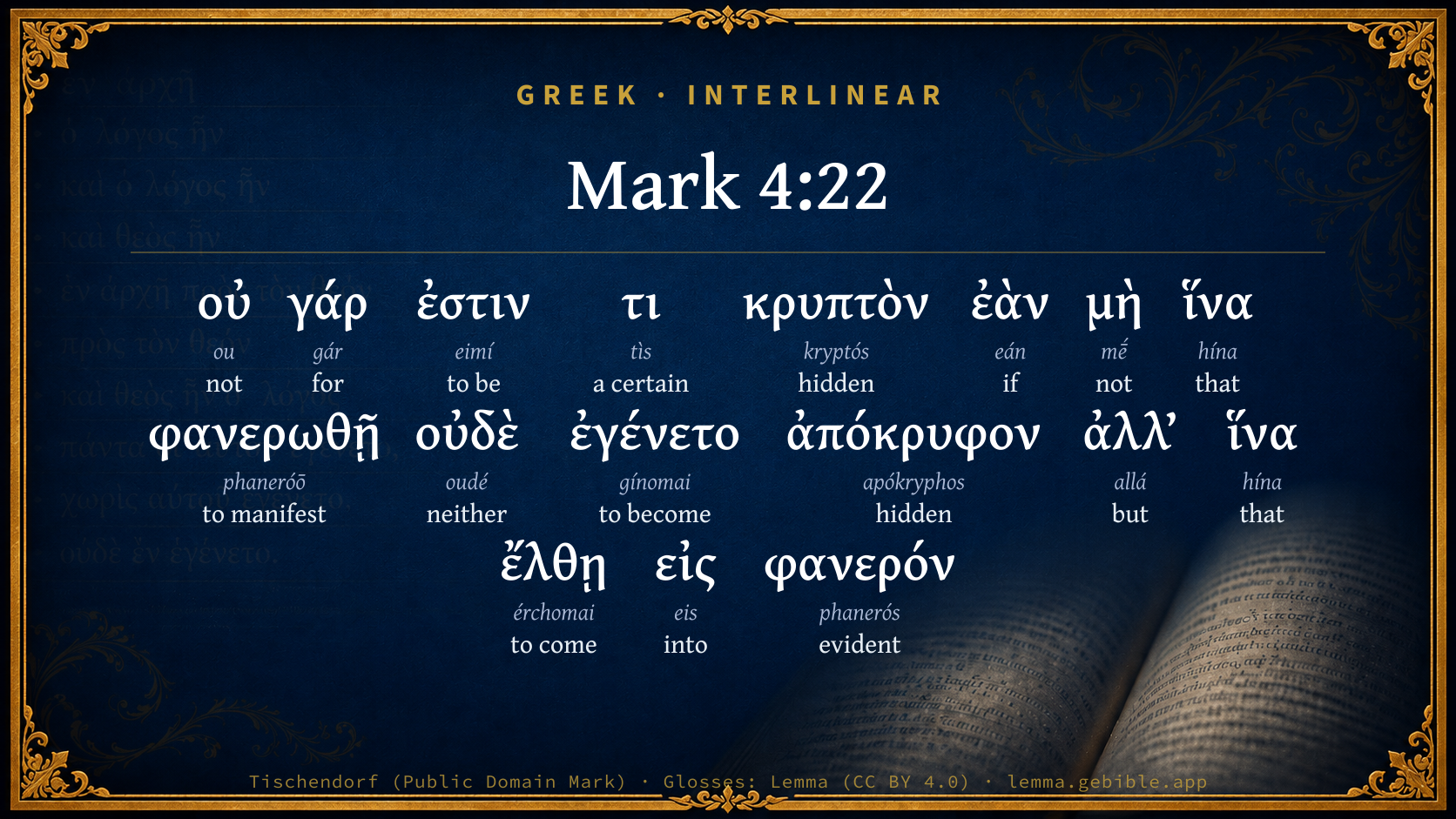
Greek (Tischendorf 8th ed.) Mark 4:22 appears in the Greek New Testament. The text above is from the Tischendorf 8th edition. Each word links to its Strong’s number and a concise gloss. Click any word for its full Thayer’s Greek Lexicon entry.
Download image
Cite this verse

Mark 4:22 (World English Bible). Public Domain. Lemma interlinear Bible study tool, https://lemma.gebible.app/v/mark/4/22.

Show BibTeX & RIS
BibTeX
RIS
English Translation
For there is nothing hidden, except that it should be made known; neither was anything made secret, but that it should come to light.
World English Bible · Public Domain
Highlights
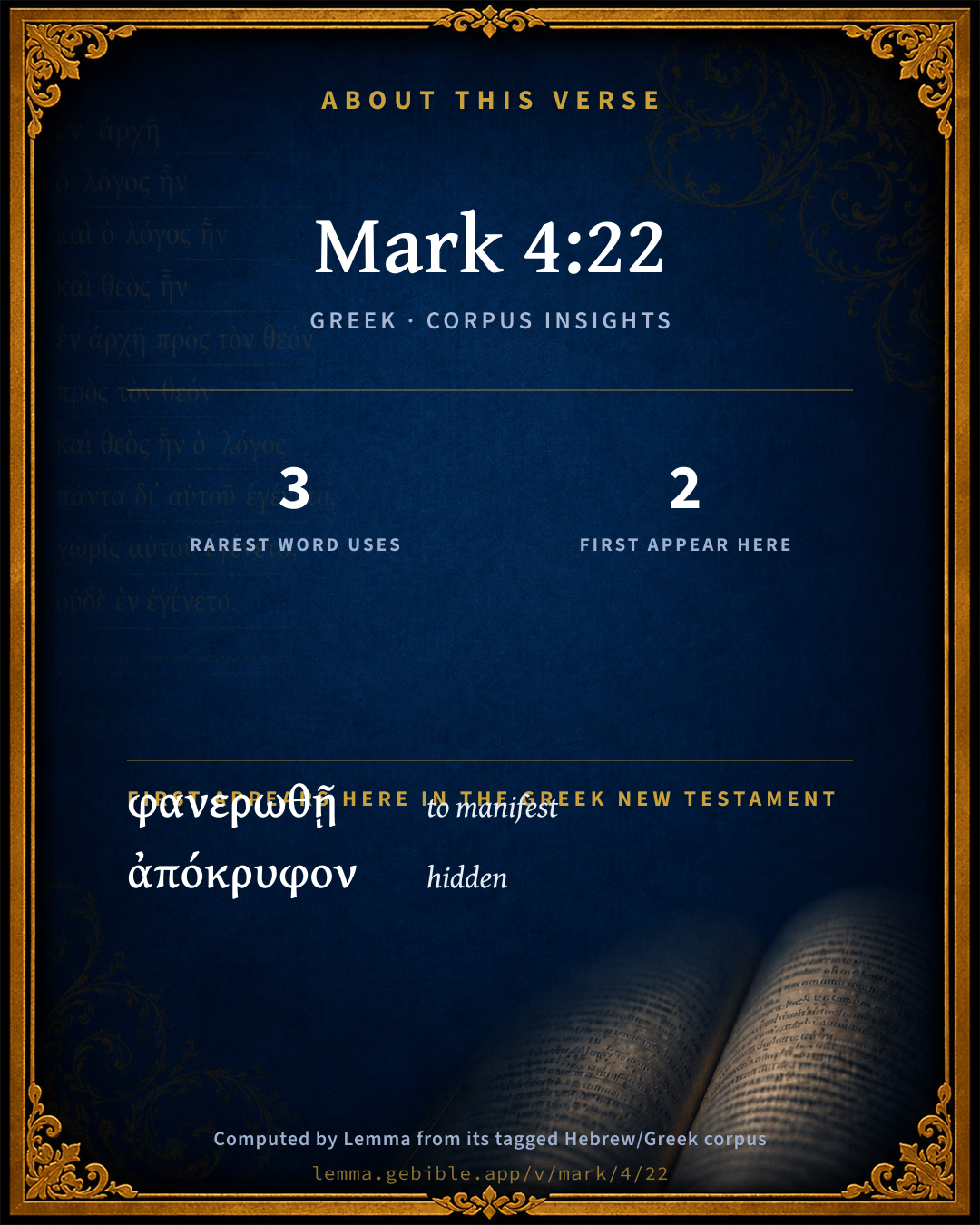
  • 2 first appearances in the Greek New Testament
Full analysis ↓
Download a study sheet

One document with this verse’s original text, its word-by-word gloss line, the meaning frame, cross-references with their text, attributed commentary, and full source and license credits — printable, and it pastes into notes with its structure intact.

This verse Autodidact and up

Study sheet (.html) Plain text (.txt)

A passage Seminary Student

Up to 50 verses in one chapter. A passage sheet keeps up to 6 commentary sources and 12 cross-references per verse, in the order this page ranks them, and says so on the sheet whenever that leaves anything out. Ask for a single verse and you get the Autodidact verse sheet above.

Everything on this page stays free to read, with no account — the sheet is a download of what is already on screen, not access to it.

Want to remove ads? Support Godless Engineer
Compare translations 3

The same verse in 3 English versions, stacked beneath the original-language interlinear above. Click any original word for its lexicon entry.

Each is an independent rendering of the whole verse — the interlinear is not word-aligned to these translations.

Highlighted words mark where these versions differ — a whole-verse word diff, not a word-by-word alignment.

  • World English Bible Public Domain
    For there is nothing hidden, except that it should be made known; neither was anything made secret, but that it should come to light.
  • King James Version Public Domain
    For there is nothing hid, which shall not be manifested; neither was any thing kept secret, but that it should come abroad.
  • unfoldingWord Literal Text CC BY-SA 4.0
    For it is not hidden except so that it might be revealed, nor has it become secret except so that it might come into visibility.

unfoldingWord Literal Text — © unfoldingWord, licensed CC BY-SA 4.0. Word-aligned USFM3 via Door43 (git.door43.org/unfoldingWord/en_ult).

Versions to compare (up to 4)

3 of 4 selected

Show all 19 translations

Every available English version of this verse, each an independent rendering of the whole verse.

  • World English Bible Public Domain
    For there is nothing hidden, except that it should be made known; neither was anything made secret, but that it should come to light.
  • Berean Standard Bible Public Domain
    For there is nothing hidden that will not be disclosed, and nothing concealed that will not be brought to light.
  • Majority Standard Bible Public Domain
    For there is nothing hidden that will not be disclosed, and nothing concealed that will not be brought to light.
  • King James Version Public Domain
    For there is nothing hid, which shall not be manifested; neither was any thing kept secret, but that it should come abroad.
  • American Standard Version (1901) Public Domain
    For there is nothing hid, save that it should be manifested; neither was `anything' made secret, but that it should come to light.
  • Revised Version (1885) Public Domain
    For there is nothing hid, save that it should be manifested; neither was anything made secret, but that it should come to light.
  • Geneva Bible (1599) Public Domain
    For there is nothing hid, that shall not be opened: neither is there a secret, but that it shall come to light.
  • Douay-Rheims (1899) Public Domain
    For there is nothing hid, which shall not be made manifest: neither was it made secret, but that it may come abroad.
  • Young's Literal Translation Public Domain
    for there is not anything hid that may not be manifested, nor was anything kept hid but that it may come to light.
  • Literal Standard Version CC BY-SA 4.0
    For there is not anything hid that may not be revealed, nor was anything kept hid but that it may come to light.
  • Unlocked Literal Bible CC BY-SA 4.0
    For nothing is hidden that will not be known, and nothing is secret that will not come out into the open.
  • unfoldingWord Literal Text CC BY-SA 4.0
    For it is not hidden except so that it might be revealed, nor has it become secret except so that it might come into visibility.
  • Darby Bible Public Domain
    For there is nothing hidden which shall not be made manifest; nor does any secret thing take place, but that it should come to light.
  • World Messianic Bible Public Domain
    For there is nothing hidden except that it should be made known, neither was anything made secret but that it should come to light.
  • Webster's Bible Public Domain
    For there is nothing hid, which shall not be manifested; neither hath any thing been kept secret, but that it should come abroad.
  • Free Bible Version CC BY-SA 4.0
    Everything that is hidden will be revealed, and everything that is secret will be brought out into the open.
  • Bible in Basic English Public Domain
    There is nothing covered which will not be seen openly, and nothing has been made secret which will not come to light.
  • Text-Critical English NT CC BY 4.0
    For there is nothing hidden that will not be made manifest, nor has anything been made secret except to come to light.
  • Tyndale New Testament (1534) Public Domain
    For there is nothinge so prevy that shall not be opened: nether so secreet but that it shall come abroade.

Literal Standard Version (2020), Covenant Press — licensed CC BY-SA 4.0. Text via the HelloAO Bible API (eBible.org). Unlocked Literal Bible (unfoldingWord) — licensed CC BY-SA 4.0. Text via the HelloAO Bible API (eBible.org). unfoldingWord Literal Text — © unfoldingWord, licensed CC BY-SA 4.0. Word-aligned USFM3 via Door43 (git.door43.org/unfoldingWord/en_ult). Free Bible Version, Dr. Jonathan Gallagher — licensed CC BY-SA 4.0. Text via the HelloAO Bible API (eBible.org).

Word by word

More ways to search: Search by grammar → Find every occurrence → Compare this word →

Practice this passage: Drill this verse → Learn its vocabulary →

ἀπόκρυφον
apókryphos
G614
“hidden”
Adjective, Nominative, Singular, Neuter
Part of Speech
Adjective
Case
Nominative
Number
Singular
Gender
Neuter
Full Thayer's Definition

Origin: from G613

TDNT: 18:57,5

1. hidden, secret 2. stored up
  1. οὐ ou G3756 “not” Particle, Negative
  2. γάρ gár G1063 “for” Conjunction
  3. ἐστιν eimí G1510 “to be” Verb, Present, Active, Indicative, 3rd person, Singular
  4. τι tìs G5100 “a certain” Indefinite pronoun, Nominative, Singular, Neuter
  5. κρυπτὸν kryptós G2927 “hidden” Adjective, Nominative, Singular, Neuter
  6. ἐὰν eán G1437 “if” Conditional
  7. μὴ mḗ G3361 “not” Particle, Negative
  8. ἵνα hína G2443 “that” Conjunction
  9. φανερωθῇ phaneróō G5319 “to manifest” Verb, Aorist, Passive, Subjunctive, 3rd person, Singular
  10. οὐδὲ oudé G3761 “neither” Conjunction, Negative
  11. ἐγένετο gínomai G1096 “to become” Verb, Aorist, Middle deponent, Indicative, 3rd person, Singular
  12. ἀλλ’ allá G235 “but” Conjunction
  13. ἵνα hína G2443 “that” Conjunction
  14. ἔλθῃ érchomai G2064 “to come” Verb, Aorist, Active, Subjunctive, 3rd person, Singular
  15. εἰς eis G1519 “into” Preposition
  16. φανερόν phanerós G5318 “evident” Adjective, Accusative, Singular, Masculine

About this verse

These counts appear in no published source. They are computed here, from the morphology-tagged text and Lemma’s own curated glosses. What Lemma adds →

17
words
16
distinct lemmas
Gospels
section

Notable vocabulary

The rarest word here is ἀπόκρυφον hidden G614 — appearing just 3 times in the whole Greek New Testament.

First appearance in Scripture

These words make their first canonical appearance in the Greek New Testament here:

  • φανερωθῇ to manifest G5319
  • ἀπόκρυφον hidden G614

Shared distinctive vocabulary

ἀπόκρυφον hidden G614 occurs in 3 verses of the Greek New Testament. Also found in:

Repetition

A word recurs within this verse:

Cross-references

10

Topical passages linked to Mark 4:22 in the Treasury of Scripture Knowledge — connected by theme and wording, ordered by reader-vote popularity; previews shown in the World English Bible.

  • Luke 8:17 For nothing is hidden, that will not be revealed; nor anything secret, that will not be known and come to light.
  • Ecclesiastes 12:14 For God will bring every work into judgment, with every hidden thing, whether it is good, or whether it is evil.
  • 1 Corinthians 4:5 Therefore judge nothing before the time, until the Lord comes, who will both bring to light the hidden things of darkness, and reveal the counsels of the hearts. Then each man will get his praise from God.
  • Psalms 78:2–4 I will open my mouth in a parable. I will utter dark sayings of old,
  • Matthew 10:26–27 Therefore don't be afraid of them, for there is nothing covered that will not be revealed; and hidden that will not be known.
  • Psalms 40:9–10 I have proclaimed glad news of righteousness in the great assembly. Behold, I will not seal my lips, Yahweh, you know.
  • Luke 12:2–3 But there is nothing covered up, that will not be revealed, nor hidden, that will not be known.
  • Acts 4:20 for we can't help telling the things which we saw and heard."
  • Acts 20:27 for I didn't shrink from declaring to you the whole counsel of God.
  • 1 John 1:1–3 That which was from the beginning, that which we have heard, that which we have seen with our eyes, that which we saw, and our hands touched, concerning the Word of life

Cross-references courtesy of OpenBible.info (CC BY 4.0).

Where the printed editions differ

1 variant

Places in this verse where the major printed Greek editions disagree on the wording in a way that affects the translation — a comparison of editions, not a manuscript-by-manuscript collation. The editions are the modern critical texts (Nestlé-Aland 28/27, SBL, Westcott-Hort, Tregelles, Tyndale House) and the traditional texts behind the KJV (the Textus Receptus and the Byzantine/Majority text). It is not a claim about which reading is original.

  1. Extra text
    ἵνα

    “in order”

    In NA28NA27TynSBLWH Not in TregTRByz

    ἵνα (ina) 'in order' is only in older manuscripts (NA28+NA27+Tyn+SBL+WH)

Textual data: Translators Amalgamated Greek New Testament (STEPBible TAGNT) · CC BY 4.0.

Commentary

Notes on Mark 4:22 from classic Christian and Jewish commentators (each source and its license shown beneath its notes). The classic Christian expositions comment on the surrounding passage and are grouped to its opening verse, so a note may address several verses; the Jewish commentaries on the Tanakh (Rashi and others) are per-verse, so they appear only where the commentator wrote on this verse.

Lemma curates 59 commentaries, every one of them public domain or Creative Commons licensed, each selected and text-cleaned for this edition rather than reprinted as found. About our sources →

The Biblical Illustrator

Joseph S. Exell

Mar_4:22

For there is nothing hid, which shall not be manifested.

Immediate revelation not always desirable

Here our Lord is justifying the parabolic form of teaching, which often serves to veil the truth, on the ground that immediate revelation is not always desirable. Many things are concealed, both in nature and by art, though the concealment is by no means designed to be permanent. What striking illustrations of this principle are furnished in geology! Look at the almost measureless beds of coal, hidden for ages in the bowels of the earth, but designed by Providence to be revealed when necessity should arise. The precise time for the unveiling it is not always easy to decide, because mans knowledge is finite, but we rest assured that it will coincide with the need for its use. It is a principle worth bearing in mind when human efforts fail; for it is encouraging to know that such a result may be due simply to the fact that we have tried unconsciously to anticipate the fore-appointed time. (H. M. Luckock, D. D.)

Things brought to light sooner or later

The doctrine of Jesus Christ has nothing in it which fears the light; it is itself the light which must enlighten the world. Everything is brought to light sooner or later. The humble person conceals his virtue in this life, but God will disclose it at the day of eternity. The hypocrite hides his wickedness here, but he shall suffer an eternal confusion for it in the sight of heaven and earth. (Quesnel.)

Secret sin comes out at the judgment

One day Thomas Edwards, the Scottish naturalist, went out on one of his expeditions to search for insects. He had on, as usual on such occasions, an old coat with many pockets, and each pocket held a goodly store of chip boxes wherein to place the various specimens of the insect tribe which he might find. He had a most successful day; met with many curious and rare insects, all of which he duly deposited each in its own little box, And now he was returning home laden with the spoils, every box and every pocket full, when suddenly he was overtaken by a tremendous storm. The thunder roared, the lightning blazed around him, the rain came down in torrents, like water from a bucket, and he was soon drenched and wet to the skin. Espying a farmhouse at a short distance, he made for it, and begged leave to shelter himself from the storm. To this the gudewife readily assented, made up a blazing fire, threw on a log, and told him to draw near and dry himself, whilst she went on with her household duties. Accordingly he did so, and soon his benumbed limbs began to feel the pleasant warmth of the fire. Presently the housewife returned, uttered a loud cry of horror and disgust, caught up a broomstick, and, deaf to all entreaties, drove him forth again into the pitiless storm. He now looked at himself, and soon perceived the cause of this strange treatment, for he was covered from head to foot with his beloved insects, so abhorred by others. The soaking rain had loosed and destroyed the boxes, and set their inhabitants at liberty, and they remained unseen in his pockets till the warmth of the fire brought them out. So will it be in the day of judgment: mens darling sins will come forth to light, and cover the sinner with horror and confusion as with a cloak. The fire of that day will bring them forth, and then the sinner will be driven out by the Judge into the fierce tempest of Gods wrath.

The Biblical Illustrator, edited by Joseph S. Exell (c. 1880s–1900s) — public domain. Text from a community e-Sword module.

Tyndale Open Study Notes

Tyndale Open Resources

4:22-23 One day the lamp (i.e., Jesus; cp. John 8:12) will shine his light on everything that is hidden, on every thought and secret action (Mark 13:26; 14:62; see Phil 2:10-11). The time to listen is before this occurs (Mark 4:9).

Tyndale Open Study Notes — © Tyndale Open Resources, licensed CC BY-SA 4.0. Text via the HelloAO Bible API.

Bengel's Gnomon

Johann Albrecht Bengel

Mar 4:22. Οὐ γὰρ ἐστί τι κρυπτὸν—οὐδὲ ἐγένετο ἀπόκρυφον, for there is nothing hidden—nor has anything become concealed) There is a difference both in the verbs is, implying that it was so naturally, and has become, implying intentional concealment, and also in the nouns [adjectives] used; comp. κρυπτὰ, 1Co 4:5, and ἀπόκρυφοι, Col 2:3;[38] to which corresponds the difference which is made in the corresponding antithesis, between φανερωθῇ, be manifested, and ἔλθῃ εἰς φανερὸν, come to be manifested; the former referring to manifestation by constraint, the latter to manifestation of its own accord, when it is ripe for manifestation. Therefore the former sentence can be understood of what is bad, the second sentence of what is good. This axiom holds good of the things in nature, of the feelings and actions of men, whether good or bad, in a natural condition or in a spiritual condition; as also of the divine mysteries.—ἐγένετο, has become [“was kept,” Engl. Vers.]) The subject is τὶ, anything, to be repeated from the previous sentence: the predicate is, hidden out of sight, ἀπόκρυφον.—ἔλθῃ, come) of its own accord; comp. Joh 3:21. This is done in successive stages in this present order of things; and it shall be done fully, when the light shall make manifest all secrets on the last day; 1Co 4:5.

[38] So Latin conditus, ‘hidden,’ whether undesignedly or otherwise: absconditus, “hidden out of sight,” by design.—ED.

Bengel's Gnomon of the New Testament — English translation (T&T Clark, Edinburgh, 1860) — public domain. Text from a community e-Sword module.

Expositor's Greek Testament

ed. W. Robertson Nicoll

Mar 4:22 . Double statement of the law that the hidden is to be revealed; 1st, predictively: there is nothing hidden which shall not be revealed; 2nd, interpretatively, with reference to the purpose of the hider: nor did anything become concealed with any other view than that it should eventually come to manifestation. ἀπόκρυφον ( ἀποκρύπτω ), here and in Luk 8:17 , Col 2:3 . ἀλλʼ : in effect = εἴ μὴ nisi , but strictly ἐγένετο ἀπόκρυφον is understood to be repeated after it = nothing becomes concealed absolutely, but it is concealed in order that, etc. This is universally true. Things are hid because they are precious, but precious things are meant to be used at some time and in some way. All depends on the time and the way, and it is there that diversity of action comes in. Christ’s rule for that was: show your light when it will glorify God and benefit men; the world’s rule is: when safe and beneficial to self.

The Expositor's Greek Testament, edited by W. Robertson Nicoll (1897–1910) — public domain. Text from a community e-Sword module.

Adam Clarke's Commentary

Verse 22. For there is nothing hid, c.] Probably our Lord means, that all that had hitherto been secret, relative to the salvation of a lost world, or only obscurely pointed out by types and sacrifices, shall now be uncovered and made plain by the everlasting Gospel. See Clarke on Mt 5:15 "Mt 10:26".

Adam Clarke's Commentary on the Bible (1810–1826) — public domain. Text from a community e-Sword/MySword module.

Ellicott's Commentary for English Readers

(22) For there is nothing hid.—This also is found elsewhere (e.g., in Mat_10:26). The Greek word here for “secret” is interesting as being the same as that which we find in our word “Apocrypha.” The term was, in the first instance, applied to books that were surrounded with the secrecy of a spurious sacred-ness, but were not publicly recognised in the Church as being of divine authority, and was then transferred to all books which, whether “spurious” or “secret,” wanted that recognition.

A Bible Commentary for English Readers, edited by Charles John Ellicott (1878–1897) — public domain. Text from a community e-Sword module.

John Gill's Exposition

And should sleep,.... That is, the man that casts in the seed, who represents the ministers of the Gospel: and, as applied to them, is not to be understood of natural sleep, and indulging themselves in that; much less of spiritual sloth and indolence, as if they cared not what became of the seed sown, whether it sprung up, and came to any thing, or not; for neither of these belong to the characters of the true ministers of the word: for though bodily sleep in them, as in other men, is necessary for the support of nature, and to put them in a capacity of discharging their work; yet perhaps none have less of it than studious and laborious preachers of the Gospel; and much less do they indulge a spiritual sleep and slothfulness; though this may sometimes attend them, as well as others: but then, whilst they sleep, in this sense, tares are sown, and they spring up, and not the good seed of the word, as in this parable; besides, as they labour in the word and doctrine, by studying and preaching it, so they follow their ministrations with incessant prayers that they be succeeded to the conversion of sinners, and comfort of saints; nor can they be easy, unless they have some seals of their ministry: but rather, this may be understood of the sleep of death; for so it often is, that the seed sown by them does not appear in the fruits of it to the churches of Christ, among whom they have ministered, until after they are fallen asleep in Jesus: though it seems best to understand it of their holy security, confidence, and satisfaction in their own minds, that it will turn to profit and advantage, both to the good of souls, and glory of God, not despairing of success; but having left their work with their Lord, they sit down easy and satisfied, believing that the word shall prosper to the thing whereunto it is sent:

and rise night and day; which shows their diligence and laboriousness, and their constant attendance to other parts of their work, rising up early, and sitting up late, to prepare for, and discharge their ministerial work; and their continued expectation of the springing-up of the seed sown, which accordingly does in proper time:

and the seed should spring and grow up, he knoweth not how; it is a mystery in nature, how the seed under the clods, where it dies before it is quickened, should spring and grow up, and bring forth fruit; and so it is in grace, how the word of God first operates on a sinner's heart, and becomes the ingrafted word there; the time when, and much less the manner how, grace, by this means, is implanted in the heart, are not known to a soul itself, and still less to the ministers of the word, who sometimes never know any thing of it; and when they do, not till some time after: this work is done secretly, and powerfully, under the influence of divine grace, without their knowledge, though by them as instruments; so that though the sowing and planting are theirs, all the increase is God's: this may encourage attendance on the ministry of the word, and teach us to ascribe the work of conversion entirely to the power and grace of God.

John Gill's Exposition of the Whole Bible (1746–1763) — public domain (CC PDM 1.0). Text via the HelloAO Bible API.

Trapp's Complete Commentary

John Trapp

22 For there is nothing hid, which shall not be manifested; neither was any thing kept secret, but that it should come abroad.

Ver. 22. There is nothing hid, &c.] i.e. The prophets have delivered nothing darkly of me, which you must not make more manifest, and for that end you are enlightened, Rom 16:15. See Mat 10:26.

John Trapp, A Commentary or Exposition upon All the Books of the Old and New Testament (1647–1656) — public domain. Text from a community e-Sword module.

Albert Barnes' Notes on the Bible

There is nothing hid ... - See the notes at Mat 10:26.

Albert Barnes' Notes on the Bible (1834–1885) — public domain. Text from a community e-Sword/MySword module.

Haydock's Catholic Bible Commentary

All my parables, doctrines, and actions, which appear now to you so full of mystery, shall not always be so: in due time they shall all be publicly expounded by you, my apostles, and by your successors. (Tirinus)

George Leo Haydock (1774–1849), Haydock's Catholic Family Bible and Commentary, 1859 edition — public domain. Excludes Psalms (Douay-Rheims chapter numbering differs from Protestant) and Deuterocanonical books (Catholic canon only).

Matthew Poole's English Annotations

Our Saviour, Mat 10:26, sending out his apostles, saith to them, Fear them not therefore, that is, not your enemies and persecutors: for there is nothing covered, that shall not be revealed; and hid, that shall not be known: the sense of which words we there said might be, though your innocency be now hid, yet it shall be made known, or though the gospel be now hid, and preached in a little corner, and kept secret, it shall be made manifest, and come abroad. Both Mark and Luke have it immediately after the parable of the sower, where it doth not seem to have the same sense as here. But more general proverbial common sayings may be variously applied to things, to which the common sense and import of them will agree. Some here apply them thus, There is nothing in the prophecies concerning me which shall not be manifested; which agrees with the sense of those who interpret the former verse concerning Christ, as if he had been giving a reason why he opened the parables to those that asked him of it. But those who interpret it to the sense which it beareth plainly, Mat 5:15,16, make the sense thus; For though you may play the hypocrites, and under a profession of the gospel but hide the hypocrisy, lusts, and corruptions of your hearts, yet that mask will not hold always, there will come a day of judgment, which will manifest and discover all, and bring to light the hidden things of dishonesty. What we have Mar 4:23 is but a usual conclusion which our Saviour hath often made of any grave and important discourses.

Matthew Poole's English Annotations on the Holy Bible (1683–1685) — public domain. Text from a community e-Sword/MySword module.

The Pulpit Commentary

For there is nothing hid which shall not be manifested. The Greek of the latter part of this sentence, according to the best authorities, runs thus: ea ina fanerwyh ; so the true rendering of the words is, there is nothing hid save that it should be manifested; that is, there is nothing now hid, but in order that it may be made known. There is a great principle of the Divine operations here announced by our Lord. Much, very much, is now hidden from us, in nature, in providence, and in grace. But it will not always be hidden. In natural things more and more is revealed as science advances, and in providence and in grace the mysteries of the kingdom will one day, and at the fitting time, be laid open to all. "What I tell you in the darkness, speak ye in the light". (Mat_10:27)

The Pulpit Commentary (1880–1919), ed. H.D.M. Spence-Jones & Joseph S. Exell — public domain. Text from a community e-Sword module.

John Wesley's Explanatory Notes

Matt. x, 26; Luke viii, 17.

John Wesley, Explanatory Notes Upon the Whole Bible (1754–1765) — public domain. Text via the GEBible commentary corpus.

Scofield Reference Notes

C. I. Scofield

For there is

For nothing is hidden except unto manifestation, nor a secret thing done that shall not be exposed. Cf. Rev 20:12; Rom 4:6; Heb 10:16; Heb 10:17

The Scofield Reference Bible (1917 edition), notes by C. I. Scofield — public domain. Text from a community e-Sword module.

Cambridge Greek Testament for Schools and Colleges

22. ἐὰν μὴ ἵνα ([765][766][767]) rather than ἐὰν μή ([768][769][770][771]) or ἀλλʼ ἵνα ([772][765] Codex Sinaiticus. 4th cent. Discovered by Tischendorf in 1859 at the Monastery of St Katharine on Mount Sinai. Now at St Petersburg. The whole Gospel, ending at Mar 16:8. Photographic facsimile, 1911.

[766] Codex Vaticanus. 4th cent., but perhaps a little later than א. In the Vatican Library almost since its foundation by Pope Nicolas V., and one of its greatest treasures. The whole Gospel, ending at Mar 16:8. Photographic facsimile, 1889.

[767] Codex Sangallensis. 9th or 10th cent. Contains the Gospels nearly complete, with an interlinear Latin translation. The text of Mark is specially good, agreeing often with CL. At St Gall.

[768] Codex Alexandrinus. 5th cent. Brought by Cyril Lucar, Patriarch of Constantinople, from Alexandria, and afterwards presented by him to King Charles I. in 1628. In the British Museum. The whole Gospel. Photographic facsimile, 1879.

[769] Codex Ephraemi. 5th cent. A palimpsest: the original writing has been partially rubbed out, and the works of Ephraem the Syrian have been written over it; but a great deal of the original writing has been recovered; of Mark we have Mar 1:17 to Mar 6:31, Mar 8:5 to Mar 12:29, Mar 13:19 to Mar 16:20. In the National Library at Paris.

[770] Codex Regius. 8th cent. An important witness. At Paris. Contains Mar 1:1 to Mar 10:15; Mar 10:30 to Mar 15:1; Mar 15:20 to Mar 16:20, but the shorter ending is inserted between Mar 16:8 and Mar 16:9, showing that the scribe preferred it to the longer one.

[771] Codex Petropolitanus. 9th cent. Gospels almost complete. Mar 16:18-20 is in a later hand.

[772] odex Bezae. 6th cent. Has a Latin translation (d) side by side with the Greek text, and the two do not quite always agree. Presented by Beza to the University Library of Cambridge in 1581. Remarkable for its frequent divergences from other texts. Contains Mark, except Mar 16:15-20, which has been added by a later hand. Photographic facsimile, 1899.

22. οὐ γὰρ ἔστιν κρυπτόν. For nothing is hidden, except for the purpose of being brought to light, nor yet anything become secret to remain so, but rather for the purpose of coming to light.

For this elliptical use of ἀλλʼ ἵνα = ἀλλὰ τοῦτο γέγονεν ἵνα cf. Mar 14:49, where Mt. (Mat 26:56) supplies the ellipse. The ellipse is freq. in the Johannine writings; Joh 1:8; Joh 9:3; Joh 13:18; Joh 15:25; 1Jn 2:19. Neither here nor Mar 10:40 does ἀλλά mean “except”; but see J. H. Moulton, pp. 191, 241. The difference between φανερωθῇ and ἔλθῃ εἰς φανερόν is worth keeping in translation; and we have a good instance of κρυπτά becoming φανερά 1Co 14:25. The saying may have been proverbial; our Lord uses it in different connexions. In Luk 12:2 the fact that nothing remains secret is applied to condemn hypocrisy; hypocrisy is not only wicked but futile, for one day there will be a merciless exposure. In Mat 10:26 the meaning seems to be that the Apostles proclaim publicly what Christ teaches them in private. Here and Luk 8:17 the saying indicates that parables are not given in order that unsympathetic hearers should never see or understand (Mar 4:12), but that in the end they should become sympathetic and be able to see and understand. This good result the disciples must effect by making known the light of Christ’s teaching. Things which are precious are hidden to prevent them from being misappropriated or misused; they are not hidden to prevent them from being ever seen or used. Things which are never to be seen again are not “hidden,” but “lost”; and what is put underground to remain there is not “sown,” but “buried.”

Cambridge Greek Testament for Schools and Colleges (Cambridge University Press, 1896; 21 vols, various authors incl. Carr, Maclear, Plummer, Farrar, Lumby, Moule, M. R. James, Simcox) — public domain. Text from a community e-Sword module.

Alford’s Greek Testament

Henry Alford

22.] ἀλλά here is almost equivalent to εἰ μή. Hartung, Partikel. ii. 43, cites Eur. 633, ῥᾷστον δʼ ὅτῳ τὸ μηδὲν ἀλλʼ ἀνωφελὴς | εὐηθίᾳ κατʼ οἶκον ἵδρυται γυνή· | σοφὴν δὲ μισῶ. We may add Xen. Mem. iii. 13. 6, ἤρετο αὐτόν, εἰ καὶ φορτίον ἔφερε; μὰ Δίʼ οὐκ ἔγωγʼ, ἔφη, ἀλλὰ τὸ ἱμάτιον. See Klotz, Devar. p. 7.

Henry Alford, The Greek Testament (1849–1861) — public domain. Text from a community e-Sword module.

International Critical Commentary

22. οὐ γάρ ἐστί τι κρυπτόν, ἐὰν μὴ ἵνα φανερωθῇ—for there is nothing hidden, except that it may be manifested.

Omit the relative ὃ before ἐὰν μὴ, Tisch. Treg. WH. RV. א ABCKL Δ 1, 13, 28, 33, 69, 209. D 49, mss. of Lat. Vet. ἀλλʼ ἵνα, but that.

The ultimate end of the hiding is manifesting. This is a case of the argumentum a minori. Even what is hidden is hidden only for the purpose of ultimate manifestation, and how much more is this true of anything that is in its nature light, instead of dark. κρυπτόν is emphatic. The progress of all knowledge is the manifestation of this principle. The earth is full of secrets, hidden treasures and forces, but they have been hidden away, only in order that man may bring them forth out of their hiding, and enrich his life with them.

οὐδὲ ἐγένετο ἀπόκρυφον—nor did it become hidden away. This differs from the former by the difference between ἐγένετο and ἐστί. It points to the act of hiding, as that does to the state. Both are for the same purpose. God has secrets, mysteries, but they are not permanent secrets, only held in reserve for future revelation.

This statement about hiding for the sake of revealing is connected immediately by γὰρ with the preceding statement about hiding the light. But it would seem more natural to connect it with the μυστήριον, the secret of the kingdom, the preservation of which is said to be the object of the parable. With this addition, the statement about secret things becomes complete. It is only temporarily that the secret is kept by the parable. Ultimately, it becomes a means of revealing that which it temporarily hides. And this brings it under the great law stated by Jesus.

International Critical Commentary — older volumes (1896–1929), various authors — public domain. Text from a community e-Sword module.

Vincent's Word Studies in the New Testament

Marvin R. Vincent

Which shall not be manifested [εαν μη ινα φανερωθη] . The A. V. makes Christ say that every hidden thing shall be revealed. This is wrong. He says that things are hidden in order that they may be manifested. Concealment is a means to revelation.

26 - 29. THE PARABLE OF THE SEED GROWING SECRETLY. Peculiar to Mark.

Marvin R. Vincent, Word Studies in the New Testament (1887–1900) — public domain. Text from a community e-Sword/MySword module.

Lesson kit

Teaching starters — assembled from the data on this page, not authored interpretation. Every prompt links to the verse data it draws on. Edit before teaching.

Mark, in the Gospels, opens this verse with 17 words (16 distinct Greek lemmas). Its most distinctive word is apókryphos (“hidden”). A historical commentator’s framing appears above. Read the whole chapter for the surrounding context.

Discussion questions

  1. The word apókryphos carries the sense “hidden.” How does it shape the verse?
  2. 2 words make their first appearance in Scripture here. What does this debut establish?
  3. How does Luke 8:17, which shares the word «hidden», read alongside this verse?
  4. What does the repetition of “that” (2× in this one verse) do in this verse?
  5. The translations on this page render this verse differently — a whole-verse word diff, not a word-by-word alignment. What might account for the different wordings?
  6. Compare how The Biblical Illustrator and Tyndale Open Study Notes read this verse. Where do they agree or differ?

Things to notice

  • 2 words make their first canonical appearance in Scripture here.
  • These translations choose different wording for 24 words in this verse.
  • “that” occurs 2× in this single verse.
  • 16 distinct Greek lemmas span 17 words in this verse.

Reading settings

Reading text

Shown beneath each verse's original-language words.

Old Testament
Old Testament edition

Read the OT as the Masoretic Hebrew (MT) or the Greek Septuagint (LXX).

English shown for the Greek Septuagint (in the Hebrew ↔ Greek comparison).

Comparing translations? Open the Compare panel on any verse page to stack up to four side by side.