
Matthew 25:24

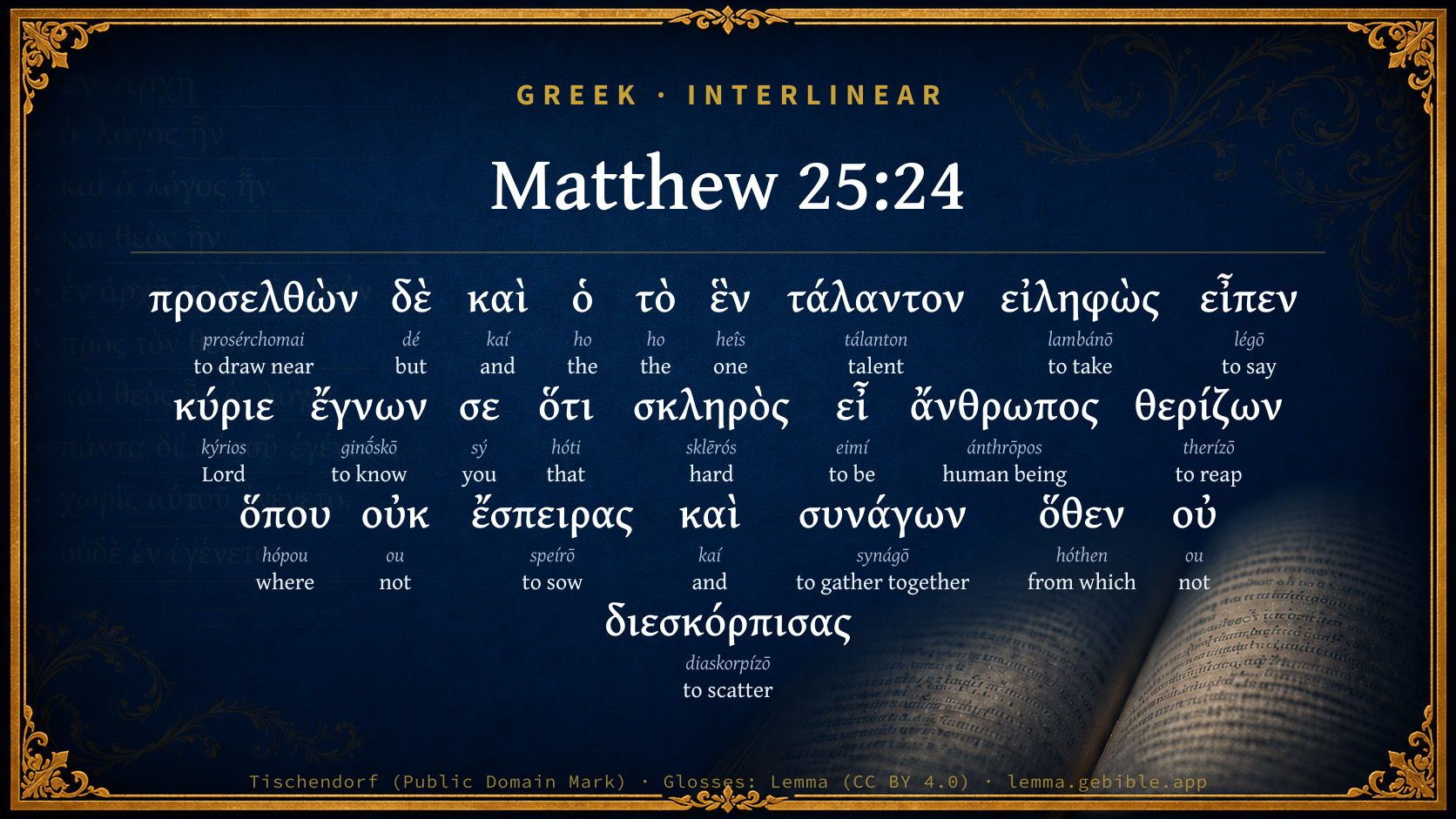
Greek (Tischendorf 8th ed.) Matthew 25:24 appears in the Greek New Testament. The text above is from the Tischendorf 8th edition. Each word links to its Strong’s number and a concise gloss. Click any word for its full Thayer’s Greek Lexicon entry.
Download image
Cite this verse

Matthew 25:24 (World English Bible). Public Domain. Lemma interlinear Bible study tool, https://lemma.gebible.app/v/matthew/25/24.

Show BibTeX & RIS
BibTeX
RIS
English Translation
"He also who had received the one talent came and said, 'Lord, I knew you that you are a hard man, reaping where you did not sow, and gathering where you did not scatter.
World English Bible · Public Domain
Highlights
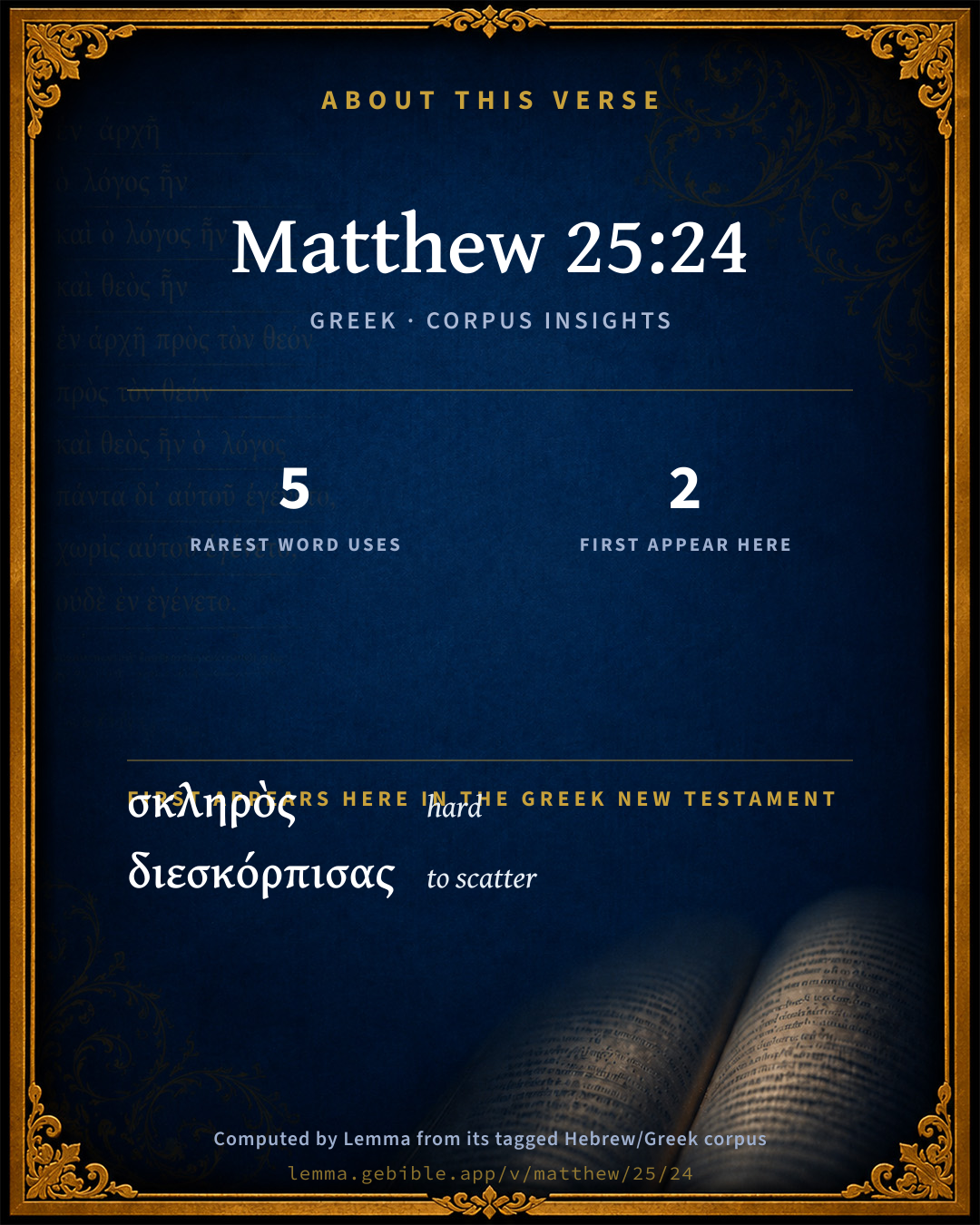
  • 2 first appearances in the Greek New Testament
Full analysis ↓
Download a study sheet

One document with this verse’s original text, its word-by-word gloss line, the meaning frame, cross-references with their text, attributed commentary, and full source and license credits — printable, and it pastes into notes with its structure intact.

This verse Autodidact and up

Study sheet (.html) Plain text (.txt)

A passage Seminary Student

Up to 50 verses in one chapter. A passage sheet keeps up to 6 commentary sources and 12 cross-references per verse, in the order this page ranks them, and says so on the sheet whenever that leaves anything out. Ask for a single verse and you get the Autodidact verse sheet above.

Everything on this page stays free to read, with no account — the sheet is a download of what is already on screen, not access to it.

Want to remove ads? Support Godless Engineer
Compare translations 3

The same verse in 3 English versions, stacked beneath the original-language interlinear above. Click any original word for its lexicon entry.

Each is an independent rendering of the whole verse — the interlinear is not word-aligned to these translations.

Highlighted words mark where these versions differ — a whole-verse word diff, not a word-by-word alignment.

  • World English Bible Public Domain
    "He also who had received the one talent came and said, 'Lord, I knew you that you are a hard man, reaping where you did not sow, and gathering where you did not scatter.
  • King James Version Public Domain
    Then he which had received the one talent came and said, Lord, I knew thee that thou art an hard man, reaping where thou hast not sown, and gathering where thou hast not strawed:
  • unfoldingWord Literal Text CC BY-SA 4.0
    But having approached, also the one having received the one talent said, ‘Master, I knew you, that you are a harsh man, reaping where you did not sow, and gathering where you did not scatter.

unfoldingWord Literal Text — © unfoldingWord, licensed CC BY-SA 4.0. Word-aligned USFM3 via Door43 (git.door43.org/unfoldingWord/en_ult).

Versions to compare (up to 4)

3 of 4 selected

Show all 19 translations

Every available English version of this verse, each an independent rendering of the whole verse.

  • World English Bible Public Domain
    "He also who had received the one talent came and said, 'Lord, I knew you that you are a hard man, reaping where you did not sow, and gathering where you did not scatter.
  • Berean Standard Bible Public Domain
    Finally, the servant who had received the one talent came and said, ‘Master, I knew that you are a hard man, reaping where you have not sown and gathering where you have not scattered seed.
  • Majority Standard Bible Public Domain
    Finally, the servant who had received the one talent came and said, ‘Master, I knew that you are a hard man, reaping where you have not sown and gathering where you have not scattered seed.
  • King James Version Public Domain
    Then he which had received the one talent came and said, Lord, I knew thee that thou art an hard man, reaping where thou hast not sown, and gathering where thou hast not strawed:
  • American Standard Version (1901) Public Domain
    And he also that had received the one talent came and said, Lord, I knew thee that thou art a hard man, reaping where thou didst not sow, and gathering where thou didst not scatter;
  • Revised Version (1885) Public Domain
    And he also that had received the one talent came and said, Lord, I knew thee that thou art a hard man, reaping where thou didst not sow, and gathering where thou didst not scatter:
  • Geneva Bible (1599) Public Domain
    Then he which had receiued the one talent, came, and said, Master, I knewe that thou wast an hard man, which reapest where thou sowedst not, and gatherest where thou strawedst not:
  • Douay-Rheims (1899) Public Domain
    But he that had received the one talent, came and said: Lord, I know that thou art a hard man; thou reapest where thou hast not sown, and gatherest where thou hast not strewed.
  • Young's Literal Translation Public Domain
    `And he also who hath received the one talent having come, said, Sir, I knew thee, that thou art a hard man, reaping where thou didst not sow, and gathering from whence thou didst not scatter;
  • Literal Standard Version CC BY-SA 4.0
    And he also who has received the one talent, having come, said, Lord, I knew you, that you are a hard man, reaping where you did not sow, and gathering from where you did not scatter;
  • Unlocked Literal Bible CC BY-SA 4.0
    Then the servant who had received one talent came and said, 'Master, I know that you are a strict man. You reap where you did not sow, and you harvest where you did not scatter.
  • unfoldingWord Literal Text CC BY-SA 4.0
    But having approached, also the one having received the one talent said, ‘Master, I knew you, that you are a harsh man, reaping where you did not sow, and gathering where you did not scatter.
  • Darby Bible Public Domain
    And he also that had received the one talent coming to [him] said, [My] lord, I knew thee that thou art a hard man, reaping where thou hadst not sowed, and gathering from where thou hadst not scattered,
  • World Messianic Bible Public Domain
    “He also who had received the one talent came and said, ‘Lord, I knew you that you are a hard man, reaping where you didn’t sow, and gathering where you didn’t scatter.
  • Webster's Bible Public Domain
    Then he who had received the one talent came, and said, Lord, I knew thee that thou art a hard man, reaping where thou hast not sown, and gathering where thou hast not strewed:
  • Free Bible Version CC BY-SA 4.0
    Then the man with one talent came. ‘Master,’ he said, ‘I know that you're a hard man. You reap where you didn't sow, and you harvest crops that you didn't plant.
  • Bible in Basic English Public Domain
    And he who had had the one talent came and said, Lord, I had knowledge that you are a hard man, getting in grain where you have not put seed, and making profits for which you have done no work:
  • Text-Critical English NT CC BY 4.0
    Then the man who had received the one talent came to him and said, ‘Master, I knew that yoʋ were a hard man, reaping where yoʋ did not sow and gathering where yoʋ scattered no seed.
  • Tyndale New Testament (1534) Public Domain
    Then he which had receaved the one talent came and sayd: master I considered that thou wast an harde man which repest where thou sowedst not and gadderest where thou strawedst not

Literal Standard Version (2020), Covenant Press — licensed CC BY-SA 4.0. Text via the HelloAO Bible API (eBible.org). Unlocked Literal Bible (unfoldingWord) — licensed CC BY-SA 4.0. Text via the HelloAO Bible API (eBible.org). unfoldingWord Literal Text — © unfoldingWord, licensed CC BY-SA 4.0. Word-aligned USFM3 via Door43 (git.door43.org/unfoldingWord/en_ult). Free Bible Version, Dr. Jonathan Gallagher — licensed CC BY-SA 4.0. Text via the HelloAO Bible API (eBible.org).

Word by word

More ways to search: Search by grammar → Find every occurrence → Compare this word →

Practice this passage: Drill this verse → Learn its vocabulary →

σκληρὸς
sklērós
G4642
“hard”
Adjective, Nominative, Singular, Masculine
Part of Speech
Adjective
Case
Nominative
Number
Singular
Gender
Masculine
Full Thayer's Definition

Origin: from the base of G4628

TDNT: 22:08,8

1. hard, harsh, rough, stiff a. of men: metaph. harsh, stern, hard b. of things: violent, rough, offensive, intolerable
  1. προσελθὼν prosérchomai G4334 “to draw near” Verb, Aorist, Active, Participle, Nominative, Singular, Masculine
  2. δὲ dé G1161 “but” Conjunction
  3. καὶ kaí G2532 “and” Conjunction
  4. ὁ ho G3588 “the” Article, Nominative, Singular, Masculine
  5. τὸ ho G3588 “the” Article, Accusative, Singular, Neuter
  6. ἓν heîs G1520 “one” Adjective, Accusative, Singular, Neuter
  7. τάλαντον tálanton G5007 “talent” Noun, Accusative, Singular, Neuter
  8. εἰληφὼς lambánō G2983 “to take” Verb, Perfect, Active, Participle, Nominative, Singular, Masculine
  9. εἶπεν légō G3004 “to say” Verb, Aorist, Active, Indicative, 3rd person, Singular
  10. κύριε kýrios G2962 “Lord” Noun, Vocative, Singular, Masculine
  11. ἔγνων ginṓskō G1097 “to know” Verb, Aorist, Active, Indicative, 1st person, Singular
  12. σε sý G4771 “you” Personal pronoun, 2nd person, Accusative, Singular
  13. ὅτι hóti G3754 “that” Conjunction
  14. εἶ eimí G1510 “to be” Verb, Present, Active, Indicative, 2nd person, Singular
  15. ἄνθρωπος ánthrōpos G444 “human being” Noun, Nominative, Singular, Masculine
  16. θερίζων therízō G2325 “to reap” Verb, Present, Active, Participle, Nominative, Singular, Masculine
  17. ὅπου hópou G3699 “where” Adverb
  18. οὐκ ou G3756 “not” Particle, Negative
  19. ἔσπειρας speírō G4687 “to sow” Verb, Aorist, Active, Indicative, 2nd person, Singular
  20. καὶ kaí G2532 “and” Conjunction
  21. συνάγων synágō G4863 “to gather together” Verb, Present, Active, Participle, Nominative, Singular, Masculine
  22. ὅθεν hóthen G3606 “from which” Adverb
  23. οὐ ou G3756 “not” Particle, Negative
  24. διεσκόρπισας diaskorpízō G1287 “to scatter” Verb, Aorist, Active, Indicative, 2nd person, Singular

About this verse

These counts appear in no published source. They are computed here, from the morphology-tagged text and Lemma’s own curated glosses. What Lemma adds →

25
words
22
distinct lemmas
Gospels
section

Notable vocabulary

The rarest word here is σκληρὸς hard G4642 — appearing just 5 times in the whole Greek New Testament.

First appearance in Scripture

These words make their first canonical appearance in the Greek New Testament here:

  • σκληρὸς hard G4642
  • διεσκόρπισας to scatter G1287

Shared distinctive vocabulary

σκληρὸς hard G4642 occurs in 5 verses of the Greek New Testament. Also found in:
Repetition

Words recur within this verse:

Cross-references

14

Topical passages linked to Matthew 25:24 in the Treasury of Scripture Knowledge — connected by theme and wording, ordered by reader-vote popularity; previews shown in the World English Bible.

  • Luke 19:20–22 Another came, saying, 'Lord, behold, your mina, which I kept laid away in a handkerchief,
  • Malachi 3:14–15 You have said, 'It is vain to serve God;' and 'What profit is it that we have kept his charge, and that we have walked mournfully before Yahweh of Hosts?
  • Luke 15:29 But he answered his father, 'Behold, these many years I have served you, and I never disobeyed a commandment of yours, but you never gave me a goat, that I might celebrate with my friends.
  • Jeremiah 2:31 Generation, see the word of Yahweh. Have I been a wilderness to Israel? or a land of thick darkness? why say my people, We are broken loose; we will come no more to you?
  • Ezekiel 18:25–29 Yet you say, The way of the Lord is not equal. Hear now, house of Israel: Is my way not equal? Aren't your ways unequal?
  • Job 21:14–15 They tell God, 'Depart from us, For we don't want to know about your ways.
  • Isaiah 58:3 Why have we fasted, [say they], and you don't see? [why] have we afflicted our soul, and you take no knowledge? Behold, in the day of your fast you find [your own] pleasure, and exact all your labors.
  • Jeremiah 44:16–18 As for the word that you have spoken to us in the name of Yahweh, we will not listen to you.
  • Malachi 1:12–13 "But you profane it, in that you say, 'Yahweh's table is polluted, and its fruit, even its food, is contemptible.'
  • Matthew 7:21 Not everyone who says to me, 'Lord, Lord,' will enter into the Kingdom of Heaven; but he who does the will of my Father who is in heaven.
  • Matthew 20:12 saying, 'These last have spent one hour, and you have made them equal to us, who have borne the burden of the day and the scorching heat!'
  • Luke 6:46 "Why do you call me, 'Lord, Lord,' and don't do the things which I say?
  • Romans 8:7 because the mind of the flesh is hostile towards God; for it is not subject to God's law, neither indeed can it be.
  • Romans 9:20 But indeed, O man, who are you to reply against God? Will the thing formed ask him who formed it, "Why did you make me like this?"

Cross-references courtesy of OpenBible.info (CC BY 4.0).

Commentary

Notes on Matthew 25:24 from classic Christian and Jewish commentators (each source and its license shown beneath its notes). The classic Christian expositions comment on the surrounding passage and are grouped to its opening verse, so a note may address several verses; the Jewish commentaries on the Tanakh (Rashi and others) are per-verse, so they appear only where the commentator wrote on this verse.

Lemma curates 59 commentaries, every one of them public domain or Creative Commons licensed, each selected and text-cleaned for this edition rather than reprinted as found. About our sources →

Joseph Benson's Commentary

Mat 25:24-25. He which received the one talent came — “This may intimate that we are accountable for the smallest advantages with which we are intrusted; but it cannot imply that they who have received much will ordinarily pass their account best; for it is too plain a fact, that most of those whose dignity, wealth, and genius give them the greatest opportunities of service, seem to forget they have either any Master in heaven to serve, or any future reckoning to expect; and many of them render themselves much more criminal than this wicked and slothful servant, who hid his talent in the earth.” — Doddridge. I knew that thou art a hard man — Here we have another, and no less certain mark of a slothful and wicked servant, his entertaining hard thoughts of his master. I knew, &c. — No: thou knewest him not. He never knew Christ who thinks him a hard master. Reaping where thou hast not sown — Requiring more of us than thou givest us power to perform. So does every obstinate sinner, in one kind or other, lay the blame of his own sins on God. And I was afraid — To risk thy money in trade, lest by some accident or other it should be lost, or miscarry under my management, and thou shouldst show me no mercy. Or rather, Lest, if I had improved my talent, I should have had more to answer for. So, from this fear, one will not learn to read, another will not hear sermons. Lo, there thou hast that is thine — If I have not made it more, as others have done, yet, this I can say, I have not made it less: and this, he thinks, may serve to bring him off, if not with praise, yet with safety. Observe, reader, many go very securely to judgment, presuming upon the validity of a plea that will be overruled as vain and frivolous. This servant thought that his account would pass well enough, because he had not wasted his lord’s money. As if he had said, “I was no spendthrift of my estate, not prodigal of my time, not a profaner of thy sabbaths, nor an opposer of good ministers and good preaching. Lord, I never despised my Bible, nor set my wits on work to ridicule religion, nor abused my power to persecute any good man; I never drowned my parts nor wasted God’s good creatures in drunkenness and gluttony; nor ever, to my knowledge, did I do an injury to any one.” Many that are called Christians build great hopes for heaven upon their being able to make such a plea; and yet all this amounts to no more than, There thou hast that is thine, as if no more were required, or would be expected.

Joseph Benson's Commentary on the Old and New Testaments (1811–1818) — public domain. Text from a community e-Sword module.

Tyndale Open Study Notes

Tyndale Open Resources

25:24 I knew you were . . . harsh: A false understanding of his master becomes this servant’s excuse for laziness.

Tyndale Open Study Notes — © Tyndale Open Resources, licensed CC BY-SA 4.0. Text via the HelloAO Bible API.

Bengel's Gnomon

Johann Albrecht Bengel

Mat 25:24. Ἔγνων σε, κ.τ.λ., I knew thee, etc.) He does not know the Lord who thinks Him hard. God is LOVE.[1094] Righteousness appears unrighteousness to the ungodly. The justice of God transcends the comprehension of the creature.—σκληρὸς, hard) In Luk 19:21, we find αὐστηρὸς, austere.—This Lord was not such; but let those earthly lords who really are so, consider what servant they will resemble on the judgment day.—οὐ διεσκόρπισας, thou hast not strawed) Though, in reality, God bestows all things liberally.

[1094] And indeed it is not without appearance of good for one to dwell rather much in thought upon the Divine severity; but such thoughts are not void of all danger.—V. g.

Bengel's Gnomon of the New Testament — English translation (T&T Clark, Edinburgh, 1860) — public domain. Text from a community e-Sword module.

Meyer's Critical & Exegetical Commentary

Heinrich August Wilhelm Meyer

Mat_25:24 f. Ἔγνων σε, ὅτι] well-known attraction. Winer, p. 581 [E. T. 781]. The aorist is not used here in the sense of the perfect, I know thee (Kuinoel), but: I knew thee, and hid.

What follows characterizes, in proverbial language (by a figure taken from farming), a man unconscionably hard to please, and demanding more than is reasonable.

συνάγων ὅθεν οὐ διεσκόρπ.] gathering (corn into the ἀποθήκη) from a place where you have not threshed (with reference to the threshing-floor of another mans farm). διασκορπίζειν, to scatter so as to separate from each other (for the classical character of which expression see Lobeck, ad Phryn. p. 213), is expressly used in the present instance, because it forms a better contrast to συνάγων than λικμᾶν (Mat_21:44). If it were to be taken as equivalent to σπείρειν, the result would be a tautological parallelism (in opposition to Erasmus, Beza, de Wette).

The entire excuse is a false pretext invented by moral indolence,a pretext which is reduced ad absurdum in Mat_25:26-27.

φοβηθείς] namely, of losing the talent in business, or of not being able to satisfy thee.

τὸ σόν] self-righteous.

Meyer — Critical and Exegetical Commentary on the New Testament — English translation by Peter Christie, edited by Frederick Crombie (T&T Clark, 1880) — public domain. Text from a community e-Sword module.

Expositor's Greek Testament

ed. W. Robertson Nicoll

Mat 25:24-30 .

Mat 25:24 . εἰληφώς , the perfect participle, instead of λαβὼν in Mat 25:20 , because the one fact as to him is that he is the man who has received a talent of which he has made no use . (So Weiss in Meyer.) ἔγνων σε ὅτι , for ἔγνων ὅτι συ , by attraction. σκληρὸς , “hard”: grasping, ungenerous, taking all to himself, offering no inducements to his servants, as explained in the proverbial expressions following: θερίζων , etc., reaping where you do not sow, and gathering where ( ὅθεν instead of ὅπου , a word signifying de loco , instead of a word signifying in loco ; vide Kypke for other examples) you did not scatter with the fan = appropriating everything produced on his land by the labour of his servants, without giving them any share no inducement to work for such a curmudgeon of a master: all toil, no pay. Compare this with the real character as revealed in: “Enter thou into the joy of lordship”.

The Expositor's Greek Testament, edited by W. Robertson Nicoll (1897–1910) — public domain. Text from a community e-Sword module.

Ellicott's Commentary for English Readers

(24) I knew thee that thou art an hard man.—The word “hard” points to stiffness of character—St. Luke’s “austere,” to harshness and bitterness. Was the plea an after-thought, put forward as an excuse for what had been originally sloth pure and simple? On that view, the lesson taught is that neglect of loyal service leads before long to disloyal thoughts. But it may have been our Lord’s intention to represent the slothful servant as having all along cherished the thought which he now pleads in his defence. That had been at the root of his neglect. The eye sees only so far as it brings with it the power to see, and therefore he had never seen in his master either generous love or justice in rewarding. The proverb, “One soweth, another reapeth” (Joh_4:37), taken on its darker and more worldly side, seemed to him the rule of his master’s conduct. So in the souls of men there springs up at times the thought that all the anomalies of earthly rule are found in that of God, that He too is arbitrary, vindictive, pitiless, like earthly kings; and that thought, as it kills love, so it paralyses the energy which depends on love. So, we may believe, following the thought already thrown out, the heart of the Traitor was full of envy and bitterness because he stood so low in the company of the Twelve, and thought hardly of his Master because He thus dealt with him and yet looked for faithful service.

A Bible Commentary for English Readers, edited by Charles John Ellicott (1878–1897) — public domain. Text from a community e-Sword module.

The Cambridge Bible for Schools and Colleges

gen. ed. J. J. S. Perowne

24. came and said] This slave anticipates his lord’s condemnation; “qui s’excuse s’accuse.”

gathering where thou hast not strawed] i. e. “gathering into the garner from another’s threshing-floor where thou hast not winnowed” (Meyer); so, “exacting interest where thou hast invested no money.” The accusation was false, but the lord takes his slave at his word, “thou oughtest therefore,” for that very reason.

The Cambridge Bible for Schools and Colleges (gen. ed. J. J. S. Perowne; Cambridge University Press, 1878–1918) — public domain. Text from a community e-Sword module.

John Gill's Exposition

Then he which had received the one talent came,.... For he that has the least gifts, is accountable for them; and therefore ought to make use of them to the good of his fellow creatures, and the interest of his Lord and Master; though these often lie neglected, and frivolous, and even wicked pretences are formed to excuse such neglect, as here:

and said, Lord, I knew that thou art an hard man; he calls him "Lord", though he had not served him, and pretends he knew him; but if he had, he would have had a true affection for him, faith in him, and would have observed his commands; and he would also have appeared altogether lovely to him, and of an amiable character, and not in such a light as he represents him; which makes it a clear case, that he was ignorant of him, or he would never have said, that he was an hard, severe, or austere man; one very difficult of being pleased, cruel and uncompassionate to his servants, unjustly withholding from them what was due unto them, and rigorously exacting service that could not be performed by them: all which is the reverse of Christ's true character; who accepts of the meanest services of his people: and takes what is done, though ever so little, as even a cup of cold water, given to the least of his disciples, as done to himself; is merciful and compassionate, both to the bodies and souls of men; and is not unrighteous to forget any labour of love, shown to him or his; and makes his strength perfect in the weakness of his servants, and his grace always to be sufficient for them: but this wicked servant goes on to traduce him, and adds,

reaping where thou hast not sown, and gathering where thou hast not strawed: which seem to be proverbial expressions; see Joh 4:37, describing either a covetous man, that is desirous of that which does not belong to him; or an hard master that requires work to be done, and gives neither tools nor matter to work with; like the Egyptian task masters, who demanded the full tale of bricks, but gave no straw: whereas Christ is neither niggardly, nor exacting; he requires nothing that is not his, and gives his grace, and bestows his gifts liberally, and upbraids not; nor does he call any to service, of whatsoever sort, but he gives them grace, strength, and abilities, proportionate to it; and as he has promised, he makes it good, that as their day is, so shall their strength be.

John Gill's Exposition of the Whole Bible (1746–1763) — public domain (CC PDM 1.0). Text via the HelloAO Bible API.

Trapp's Complete Commentary

John Trapp

24 Then he which had received the one talent came and said, Lord, I knew thee that thou art an hard man, reaping where thou hast not sown, and gathering where thou hast not strawed:

Ver. 24. Lord, I knew that thou wert, &c.] Invalidum omne natura querelum. A sorry senseless excuse it is that this man makes for himself; and such as is both false and frivolous. It shows an utter emptiness of the oil of God’s grace, when men’s lips, like doors on rusty hinges, move not without murmuring and discontentedness.

John Trapp, A Commentary or Exposition upon All the Books of the Old and New Testament (1647–1656) — public domain. Text from a community e-Sword module.

Albert Barnes' Notes on the Bible

The one talent - The design of this part of the parable is to show that no one is excused for neglecting his duty because he has few talents. God will require of him only according to his ability, 1Co 4:2; Luk 12:48; 2Co 8:12.

A hard man - Of a sordid, griping disposition; taking advantage of the poor, and oppressing them.

Reaping ... - This is indicative of an avaricious and overbearing disposition; compelling the poor to sow for him, and reaping all the benefit himself.

Hast not strawed - The word “straw” means to “scatter” - as people scatter seed in sowing it. It may mean, also, to “ventilate,” or to “fan by ventilating” or winnowing. As “sowing” the seed is mentioned just before, it may be that this refers to gathering grain fanned or winnowed by others, while he did nothing - indicating, also, a hard or sordid disposition.

Albert Barnes' Notes on the Bible (1834–1885) — public domain. Text from a community e-Sword/MySword module.

Haydock's Catholic Bible Commentary

I know that thou art a hard man. This is an insignificant part, that is, an ornament of the parable only; as also when it is said: I should have received mine with usury. ver. 27. (Witham) --- This seems to have been an adage levelled at avaricious men, who are never pleased but with what increases their hoards. Under this symbol is also depicted the excuse of many, who accuse God of being too severe and unbending, whose service is extremely hard, and who adopts, rejects, and reprobates whom he pleases; who deals out heavier burdens than the weak nature of man is made to support; who denies the grace of obedience, and thus wishes to reap where he has not sown. (Jansenius)

George Leo Haydock (1774–1849), Haydock's Catholic Family Bible and Commentary, 1859 edition — public domain. Excludes Psalms (Douay-Rheims chapter numbering differs from Protestant) and Deuterocanonical books (Catholic canon only).

Matthew Poole's English Annotations

We must remember that we are in a parable, which (as other similitudes) cannot be expected in all things to agree with what it is brought to illustrate. This part of the parable doth chiefly instruct us in these two things:

1. That it is the genius of wicked men to lay the blame of their miscarriages upon others, oft times upon God himself. The unprofitable servant here pretends that the dread of his lord, as a severe man, was that which kept him from labouring, and making an improvement of the talent with which his master had intrusted him. Thus many think that if there be an election of grace, or any thing of special and distinguishing grace, and man hath not a perfect power in his own will, he shall have something to excuse himself by before God hereafter, for his not repenting, and believing God in such a case, condemning men for unbelief and impenitency, should reap where he did not sow, and gather where he did not straw.

2. Men in their excuses which they fancy, instead of excusing will but accuse and condemn themselves. The lord of the unprofitable servant tells him that the fault lay in his own sloth and wickedness, and his dread of his lord’s security was but a mere frivolous pretence and unreasonable excuse; for if he had dreaded any such thing, he would have done what he could, he would have put out his money to the exchangers, and then he should have received his own with increase.

And shall not God as justly another day reply upon those who think to excuse their lewd and wicked lives, their impenitency and unbelief, from their not being elected, not having a power of themselves to repent and believe, nor receiving his efficacious grace. O you wicked and slothful wretches! Did you suspect or fear you were not elected? Why then did you not give all diligence to make your calling and election sure? Do you plead the want of power in your own wills to repent and believe, and that I did not give you a special, effectual grace? But had you not a power to keep from the taverns and alehouses? To keep from lying, and cursing, and swearing, and open profanation of my sabbaths? Had not you a power to read, to hear, to pray? If you had to your utmost used the talents I gave you, and I had been warning in my further necessary influences of grace, you might indeed have said something; but when you made no use of the talents you had, why should I trust you with more? Faith comes by reading, hearing, praying; you had a power to these things, these talents you had. Why did you not read, hear, pray, that you might believe? If you took me to be so severe a master, why did not you do what was in your power to do, that you might find me otherwise? If you had done what lay in your power to do, in the use of those talents which I gave you for that end, you might then have blamed me if I had not given you more; but you never tried my kindness in such a case. So that you are not ruined by any severity of mine, but by your own sloth, neglect, and wickedness. Thus much this parable teacheth us, that God in the recompences at the last day of judgment will be found just, and sinners will all be found liars, and their damnation will be of themselves.

Matthew Poole's English Annotations on the Holy Bible (1683–1685) — public domain. Text from a community e-Sword/MySword module.

Whedon's Commentary on the Bible

Daniel D. Whedon

24. The one talent — Our Lord does not mean by this, that men of inferior responsibilities are less likely to discharge them than those of higher. Men whose splendid abilities or means lade them with a mighty load of responsibilities, often make their very means an instrument, not only of unfaithfulness, but of great positive wickedness. Perhaps the smallness of the sum committed arose from the very smallness of his first moral value, and that same smallness of moral value he showed in his neglect. His talent was one because his ability was little, and because his heart and will were little.

Hard man — Very few men excuse their own sin without blaming God as a hard master. His religion is severe; he lays down too stern a morality; he exposes us to powerful temptation; he has established a humbling plan of salvation; he has not made the evidence of Christianity sufficiently clear; and in fine, he expects too much of men in the circumstances in which he has placed them. He would reap a harvest of requirements where he has not sowed sufficient means. The last clause is an allusion to the cleaning the wheat from the chaff. Thou art a man, gathering the clean kernels where thou hast not strewed or winnowed with the fan. The verbs to straw, to strow, or to strew, are all but different orthographies of the same word, and are cognate with the Latin sterno, to scatter. The scattering here is that done in the winnowing alluded to Mat_3:12.

Daniel D. Whedon (gen. ed.), Commentary on the Old and New Testaments (1874–1909) — public domain. Text from a community e-Sword module.

The Pulpit Commentary

He which had received the one talent. The rest of the parable is concerned with the case of this unprofitable servant. Usually, those who have most privileges neglect or misuse them or some of them; here the man apparently least favoured is taken as the type of the useless and wicked disciple, because his task was easiest, his responsibility less, his neglect most inexcusable. He has heard the words of his two fellow servants, and the great reward which their faithful service has received; he comes with no joy and confidence to render his account; he feels fully how unsatisfactory it is, and beans at once to defend his conduct by proclaiming his view of his lord"s character. I know thee that thou art a hard (sklhrov) man. He chooses to conceive of his lord as harsh, stern, churlish in nature, one without love, who taxes men above their powers, and makes no allowance for imperfect service, however honest. He dares to call this impudent fiction knowledge. Thus men regard God, not as he is, but according to their own perverted views; they read their own character into their conception of him; as the Lord says, in Psa_50:21, "Thou thoughtest that I was altogether such a one as thyself." Reaping where thou hast not sown (thou sowedst not), and gathering where thou hast not strawed (oyen ou dieskorpisav , whence thou scatteredst not). This is a proverbial saying, implying a desire of obtaining results without sufficient means. The last verb is interpreted either of sowing or winnowing; the latter seems to be correct here, thus avoiding tautology. It is used by the Septuagint in this sense in Eze_5:2, as the rendering of the Hebrew verb zarah (Edersheim). So the phrase here signifies gathering corn from a floor where thou didst not winnow. The slave virtually brings a twofold charge against his master, viz. that he enriched himself by others" toil; and that he expected gain from quarters where he had bestowed no labour.

Complaining of others when we ourselves are in the wrong.

This is familiar enough to all who have the management of families. The child in a temper is always ready to complain of his mother"s temper. The child who has done wrong is quick to make out that somebody else was in fault. The same thing is found in business and social relations. Servants complain of masters. One class of society complains of another class. More than half the sorrows of humanity would be removed if men would only look at home, and set themselves upon the correction of their own faults, the remedying of their own failings. In this parable nothing can be plainer than the fact that this man with one talent had been wilfully neglecting what he knew to be his duty. It was duty he could do; duty he ought to do. But when the day of reckoning came, he tried to hide his shame by complaining of his master, and calling him hard names. How that excused him nobody can see.

I IN MAN IS AN INVETERATE DISPOSITION TO RESIST THE CONVICTION OF SIN. It is the hardest thing we ever try to do, to say, "I am wrong." It is the hardest thing we ever undertake, to persuade another to say he was wrong. A man will set himself upon all sorts of guileful schemes, and readily yield to all kinds of self-delusions, rather than admit himself to be in the wrong. The man who has the quickest and keenest sense of sin in others is often utterly dull to any sense of his own sin.

1. It is this which partly explains the general conception of the devil. He is a convenient "other one" outside ourselves, on whom we can shift all responsibility for the sins which we ourselves plan and commit.

2. It is this that accounts for the gracious promise of the Holy Ghost as the "Convincer of sin, of righteousness, and of judgment.

3. This disposition is strengthened by every successful act of stifling conviction.

4. The disposition is even to be found in Christian people, and may be illustrated in relation to specific Christian sins. The one talent man represents a disciple.

II THE COMMONEST SIGN OF RESISTANCE IS COMPLAINING OF OTHERS.

1. This turns our thoughts away from ourselves. It is not safe for a wilful man to have his eye turned inward. He shrinks from. reading over his own story. He likes to hear about other people"s faults; and will dwell with much satisfaction upon his disabilities and lack of opportunities. Men are so hard, and men deal so hardly by him. If a man speaks harshly of others, it is well to suspect him of being guilty of the fault he condemns.

2. This turns other people"s thoughts away from us. See in the parable. The master is searching out the wilfulness of the one talent man. But he seems to say, "Think about yourself, and then you will leave me alone. R.T.

The Pulpit Commentary (1880–1919), ed. H.D.M. Spence-Jones & Joseph S. Exell — public domain. Text from a community e-Sword module.

John Wesley's Explanatory Notes

I knew thou art a hard man - No. Thou knowest him not. He never knew God, who thinks him a hard master. Reaping where thou hast not sown - That is, requiring more of us than thou hast given us power to perform. So does every obstinate sinner, in one kind or other, lay the blame of his own sins on God.

John Wesley, Explanatory Notes Upon the Whole Bible (1754–1765) — public domain. Text via the GEBible commentary corpus.

Kretzmann's Popular Commentary

Paul E. Kretzmann

The accounting of the lazy servant:

v. 24. Then he which had received the one talent came and said, Lord, I knew then that thou art an hard man, reaping where thou hast not sown, and gathering where thou hast not strewed;

v. 25. and I was afraid, and went and hid thy talent in the earth. Lo, there thou hast that is thine.

v. 26. His lord answered and said unto him, Thou wicked and slothful servant, thou knewest that I reap where I sowed not, and gather where I have not strewed.

v. 27. Thou oughtest, therefore, to have put my money to the exchangers, and then at my coming I should have received mine own with usury.

v. 28. Take therefore the talent from him, and give it unto him which hath ten talents.

v. 29. For unto every one that hath shall be given, and he shall have abundance; but from him that hath not shall be taken away even that which he hath.

v. 30. And cast ye the unprofitable servant into outer darkness; there shall be weeping and gnashing of teeth.

The whining, disagreeable wretch of a servant is excellently portrayed. Slinking forward, he brought his one lonely talent, and then tried to make a defense of his inexcusable conduct. As usual in such cases, he tried to put the blame upon the master. He believed the master to be hard, avaricious, grasping, ungenerous, with no love and reward for his servants, who were forced to slave and toil unremittingly to increase his gains, without receiving any share in the harvest which their hands produced—the old cry of labor against capital. He intimates that he did not want to do a thing more than he was absolutely obliged to for such a master, since it did not pay; do only and exactly as much as is demanded, but not a shred more. And so in the fear of his cowardly heart, he himself did not know what about, he had hidden the talent, which he now produced. But in these words he pronounced his own sentence. If he believed that to be the character of his master, he should have acted in accordance with his judgment. Without in any way hurting himself and straining his own energy and business ability, he could have carried the money to the bank, where the money-changers would have been glad to invest the silver for him and give the master interest into the bargain. The sentence of the master is therefore quickly passed upon him. He calls him a wicked, mean-spirited servant, one of those small souls that never rise above the dirt. The real trouble with him is laziness, together with lack of appreciation of the chances offered him. And so his one talent is to be taken from him and added to the ten talents of the one whose energy and ambition shone forth in comparison with this sluggard. The proverbial saying used once before, chapter 13:12, again finds its application. The reward of success is further success, while the penalty of failure goes to enrich the successful, true in the spiritual as well as in the temporal field. And the useless servant would have leisure to repent of his sloth in the dungeon, with weeping and gnashing of teeth.

Christ’s meaning is plain. The rich man is God Himself. The servants are those that profess faith in Him, who are His followers. To these God delivers spiritual gifts and goods, the means of grace, His Holy Spirit, all the Christian virtues, ability along the various lines of work in His kingdom. To everyone, to each individual, God has given spiritual gifts to be used in His service, 1Co 7:7; 1Pe 4:10. He knows the intellectual as well as the moral strength of every one, and is sure that He expects too much from no one. But He wants to see results, in the individual and in the whole Church. He wants to have each one invest the talents he has received with all energy, to work unceasingly in His service. It pleases Him to give a reward of mercy to those that are faithful in these small things, in their own little sphere. To them He will give a partnership in the joys of the Kingdom above. But woe unto the small, mean-spirited weakling, the slothful servant, that refuses to invest his talent, to make use of his gifts and abilities in that sphere of activity where the Lord has placed him. He thereby shows that he is not worthy of the Lord’s bounty and cares nothing for His grace. There are few excuses so poor and so miserable in sound as those by which professing Christians attempt to evade work in the Church. All the more terrible, then, will be the Lord’s sentence: From him that hath not even that which he hath shall be taken away.

Paul E. Kretzmann, Popular Commentary of the Bible (1921–1924) — public domain. Text from a community e-Sword module.

Burkitt's Expository Notes on the New Testament

William Burkitt

Observe here, 1. That he that received but one talent is called to an account as well as he that received five. Heathens that have but one talent, namely, the light of nature, must give an account for that one talent, as well as Christians that have five must account for five.

Observe, 2. The slothful servant’s allegation: I knew thee to be an hard man, and I was afraid.

Where note, His prejudice against his master, and the effect of that prejudice, he was afraid; and the fruit of his fear, he hid his talent in the earth.

Learn hence, That sinners entertain in their minds very hard and unkind thoughts of God; they look upon him as a hard Master, rigorous in his commands, and difficult to be pleased.

Learn, 2. That such hard thoughts of God do naturally occasion slavish fear, which is a great hindrance to the faithful discharge of our duty to God.

Observe, 3. The master’s reply to the slothful servant’s allegation, which contains an exprobation, or unbraiding of him for his sloth and negligence; Thou wicked and slothful servant.

Where note, 1. That the slothful servant is a wicked servant, as well as the unfaithful servant.

2. The wicked and slothful servants, to excuse themselves, will not stick to charge their miscarriages upon God themselves: Thou wert an hard man.

3. That no excuses whatsoever shall serve either the slothful or unfaithful servant at the bar of Christ.

William Burkitt's Expository Notes on the New Testament (1700–1703) — public domain. Text from a community e-Sword module.

The People's New Testament

B. W. Johnson

24. I knew thee that thou art a hard man. The charge against the lord is insulting. The term hard, and the charge in the next clause, “of reaping where thou hast not sown,” affirm that the lord was harsh, unfeeling, grasping, and unscrupulous about his methods of acquisition. It states the position of many of our fellow-men. Many refuse to employ their talents in Christ's service because they think it a hard, exacting service, making unreasonable demands of self-denial, self-control and self-sacrifice.

B. W. Johnson's The People's New Testament with Notes (1889–1891) — public domain. Electronic text from the Christian Classics Ethereal Library (CCEL) ThML edition.

unfoldingWord translationNotes

Door43 World Missions Community

Connecting Statement:

Jesus continues telling the parable about the servants and the talents. (See: Parables and Biblical Money)

You reap where you did not sow, and you harvest where you did not scatter

The words "reap where you did not sow" and "harvest where you did not scatter" mean the same thing. They refer to a farmer who gathers crops that other people have planted. The servant uses this metaphor to accuse the master of taking what rightfully belongs to others. (See: Parallelism and Metaphor)

scatter

"scatter seed." This refers to sowing seed by gently throwing handfuls of it onto the soil.

See, you have here what belongs to you

"Look, here is what is yours"

translationWords

reap

plant

harvest

unfoldingWord translationNotes — © Distant Shores Media and the Door43 World Missions Community, licensed CC BY-SA 4.0. Source: git.door43.org/Door43/en_tn.

Cambridge Greek Testament for Schools and Colleges

24. ὁ εἰληφώς. A variety from ὁ λαβών, Mat 25:16.

εἶπεν κ.τ.λ. This slave anticipates his lord’s condemnation; ‘qui s’excuse s’accuse.’

σκληρός. ἄνθρωπον μὲν σκληρὸν λὲγουσι τὸν μονότροπον καὶ δυσπειθῆ καὶ πρὸς ἅπαν ἀντιτείνοντα. Galen, quoted by Wetstein.

συνάγων ὅθεν οὐ διεσκόρπισας. i.e. ‘gathering into the garner from another’s threshing-floor where thou hast not winnowed’ (Meyer); so, ‘exacting interest where thou hast invested no money.’ The accusation was false, but the Lord takes his slave at his word, ‘thou oughtest therefore,’ for that very reason.

συνάγειν is used of the Israelites gathering straw in Egypt; αὐτοὶ πορευέσθωσαν καὶ συναγαγέτωσαν ἑαυτοῖς ἄχυρα, Exo 5:7; σκορπίζων is used of the sower: ὁ σκορπίζων τὸν σῖτον σπορεύς ἐστιν (Eustathius, quoted by Wetstein). This verb and its compounds are Ionic, and do not belong to the Attic dialect. Lob. Phryn., p. 218.

Cambridge Greek Testament for Schools and Colleges (Cambridge University Press, 1896; 21 vols, various authors incl. Carr, Maclear, Plummer, Farrar, Lumby, Moule, M. R. James, Simcox) — public domain. Text from a community e-Sword module.

International Critical Commentary

24. And he who had received the one talent came and said, Lord, I knew thee that thou art a hard man, reaping where thou didst not sow, and gathering whence thou didst not scatter:]

(L)

International Critical Commentary — older volumes (1896–1929), various authors — public domain. Text from a community e-Sword module.

Vincent's Word Studies in the New Testament

Marvin R. Vincent

Hard [σκληρος] . Stronger than the austere [αυστηρος] of Luk 19:21 (see there), which is sometimes used in a good sense, as this never is. It is an epithet given to a surface which is at once dry and hard.

Strawed [διεσκορπισας] . Rev., didst scatter. Not referring to the sowing of seed, for that would be saying the same thing twice. The scattering refers to the winnowing of the loosened sheaves spread out upon the threshing - floor. "The word," as Trench observes "could scarcely be applied to the measured and orderly scattering of the sower's seed. It is rather the dispersing, making to fly in every direction." Hence used of the pursuit of a routed enemy (Luk 1:51); of the prodigal scattering his good; making the money fly, as we say (Luk 14:13); of the wolf scattering the sheep (Mt 26:31). Wyc., spread abroad.

Marvin R. Vincent, Word Studies in the New Testament (1887–1900) — public domain. Text from a community e-Sword/MySword module.

Lesson kit

Teaching starters — assembled from the data on this page, not authored interpretation. Every prompt links to the verse data it draws on. Edit before teaching.

Matthew, in the Gospels, opens this verse with 25 words (22 distinct Greek lemmas). Its most distinctive word is sklērós (“hard”). A historical commentator’s framing appears above. Read the whole chapter for the surrounding context.

Discussion questions

  1. The word sklērós carries the sense “hard.” How does it shape the verse?
  2. 2 words make their first appearance in Scripture here. What does this debut establish?
  3. How does John 6:60, which shares the word «hard», read alongside this verse?
  4. What does the repetition of “and” (2× in this one verse) do in this verse?
  5. These translations render this verse differently. What is at stake in choosing one wording over another?
  6. Compare how Joseph Benson's Commentary and Tyndale Open Study Notes read this verse. Where do they agree or differ?

Things to notice

  • 2 words make their first canonical appearance in Scripture here.
  • These translations choose different wording for 17 words in this verse.
  • “and” occurs 2× in this single verse.
  • 22 distinct Greek lemmas span 25 words in this verse.

Reading settings

Reading text

Shown beneath each verse's original-language words.

Old Testament
Old Testament edition

Read the OT as the Masoretic Hebrew (MT) or the Greek Septuagint (LXX).

English shown for the Greek Septuagint (in the Hebrew ↔ Greek comparison).

Comparing translations? Open the Compare panel on any verse page to stack up to four side by side.